
A complete issue · 39 pages · 1920
Life — December 30, 1920
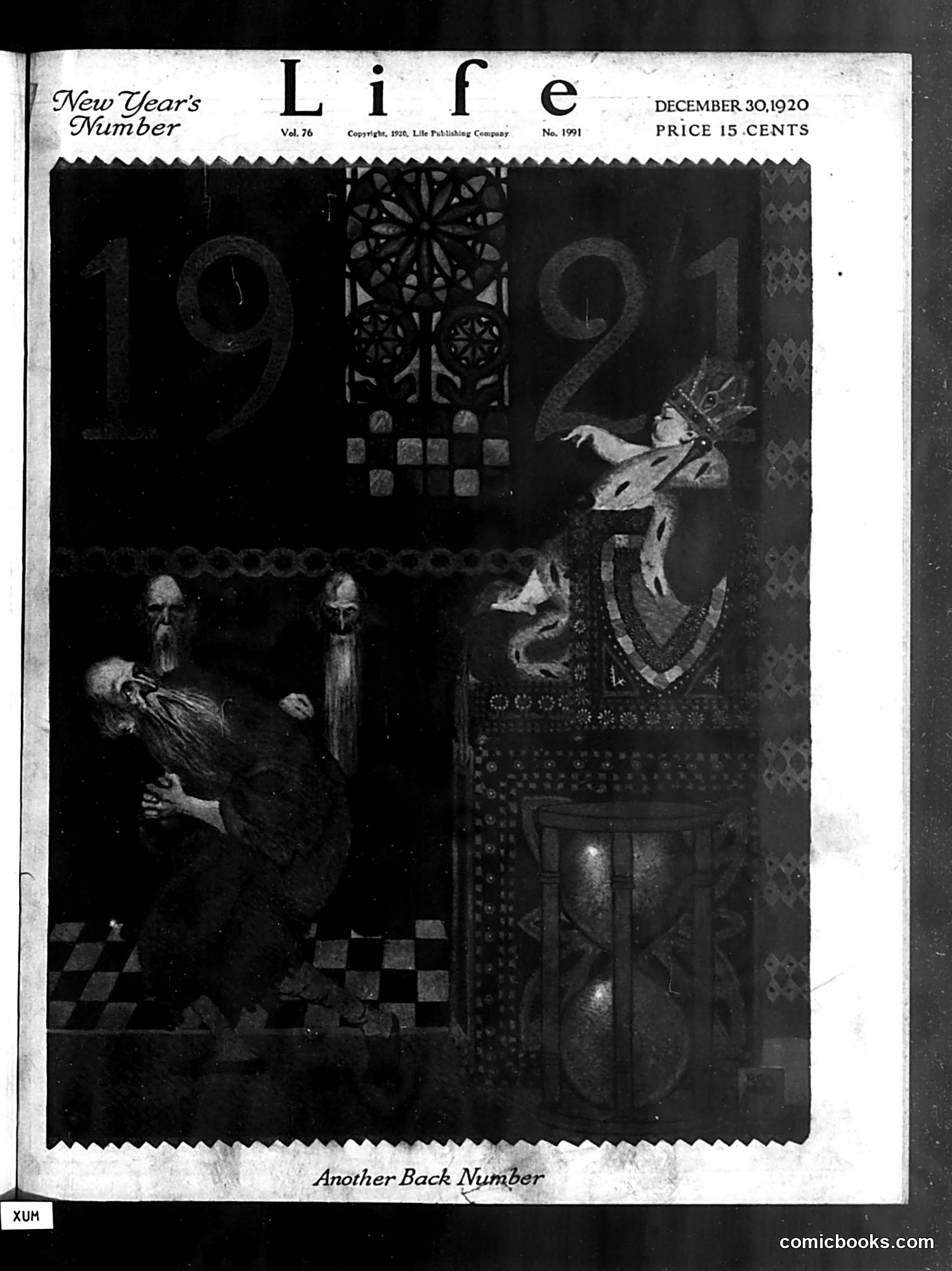
This New Year's cover depicts a theatrical scene marking the transition from 1920 to 1921. The imagery appears allegorical rather than explicitly political: an elderly bearded figure (possibly representing the old year) gestures dramatically on the left, while a winged figure or cherub representing the new year emerges on the right. The ornate architectural frame, checkerboard floor, and dramatic lighting create a fantastical theatrical setting. The numerals "1920" and "1921" dominate the composition. The overall tone suggests optimism about the incoming year, common for New Year's editions of satirical magazines. Without clearer identifying details, the specific satirical commentary remains ambiguous.
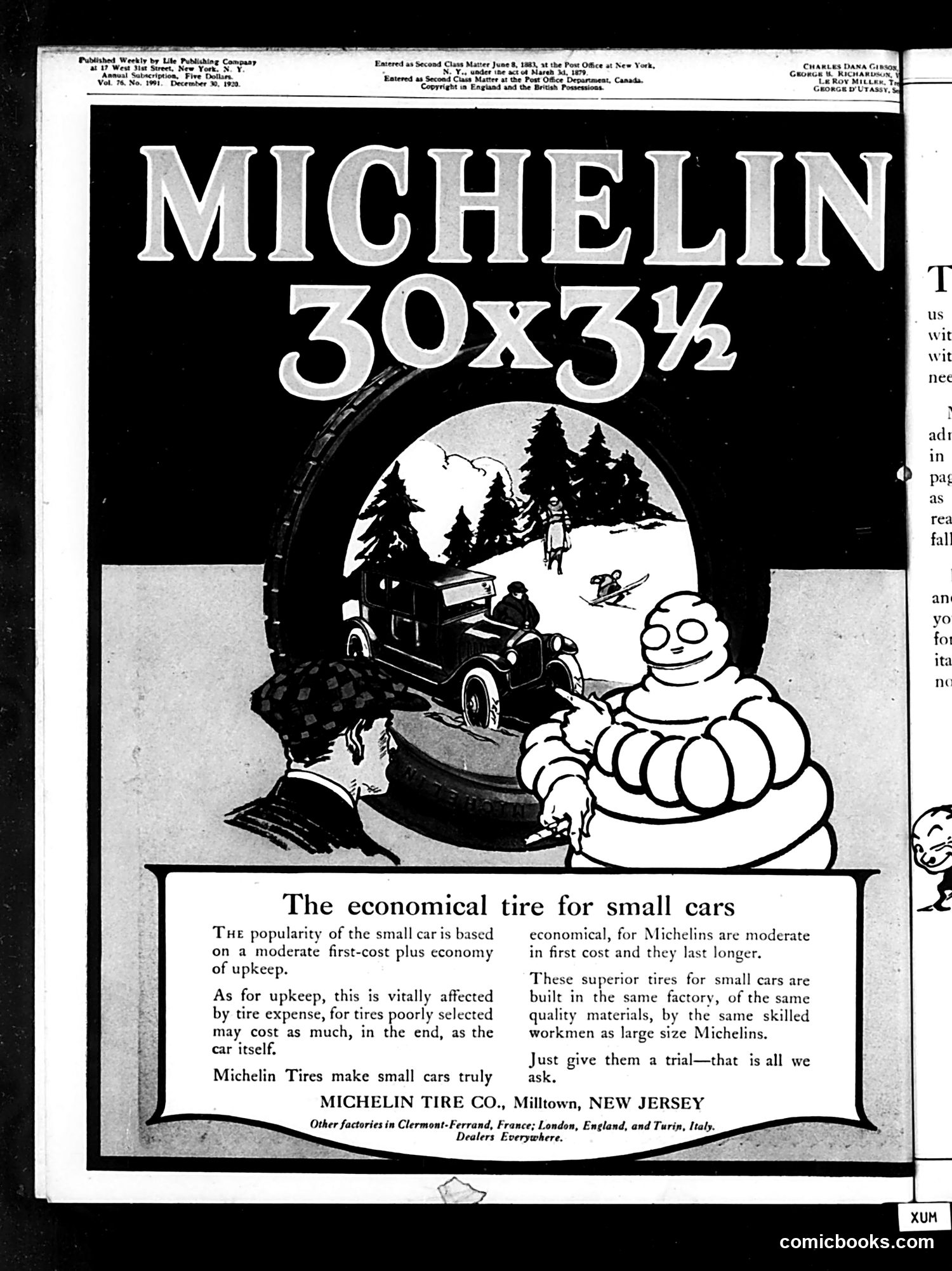
This is primarily a **commercial advertisement**, not political satire. It promotes Michelin tires for small cars, featuring the iconic Michelin Man (Bibendum) — the rotund, mascot character made of stacked tire rings. The ad argues that small cars require economical tire selection, and Michelin tires offer superior value: moderately priced initially but long-lasting, offsetting higher upfront costs for competitors. The circular vignette shows a winter driving scene with the Michelin Man presenting the tire as ideal for small vehicles. The advertisement targets cost-conscious automobile owners during the early automotive era, emphasizing reliability and economy — key selling points as automobile ownership expanded to middle-class consumers.
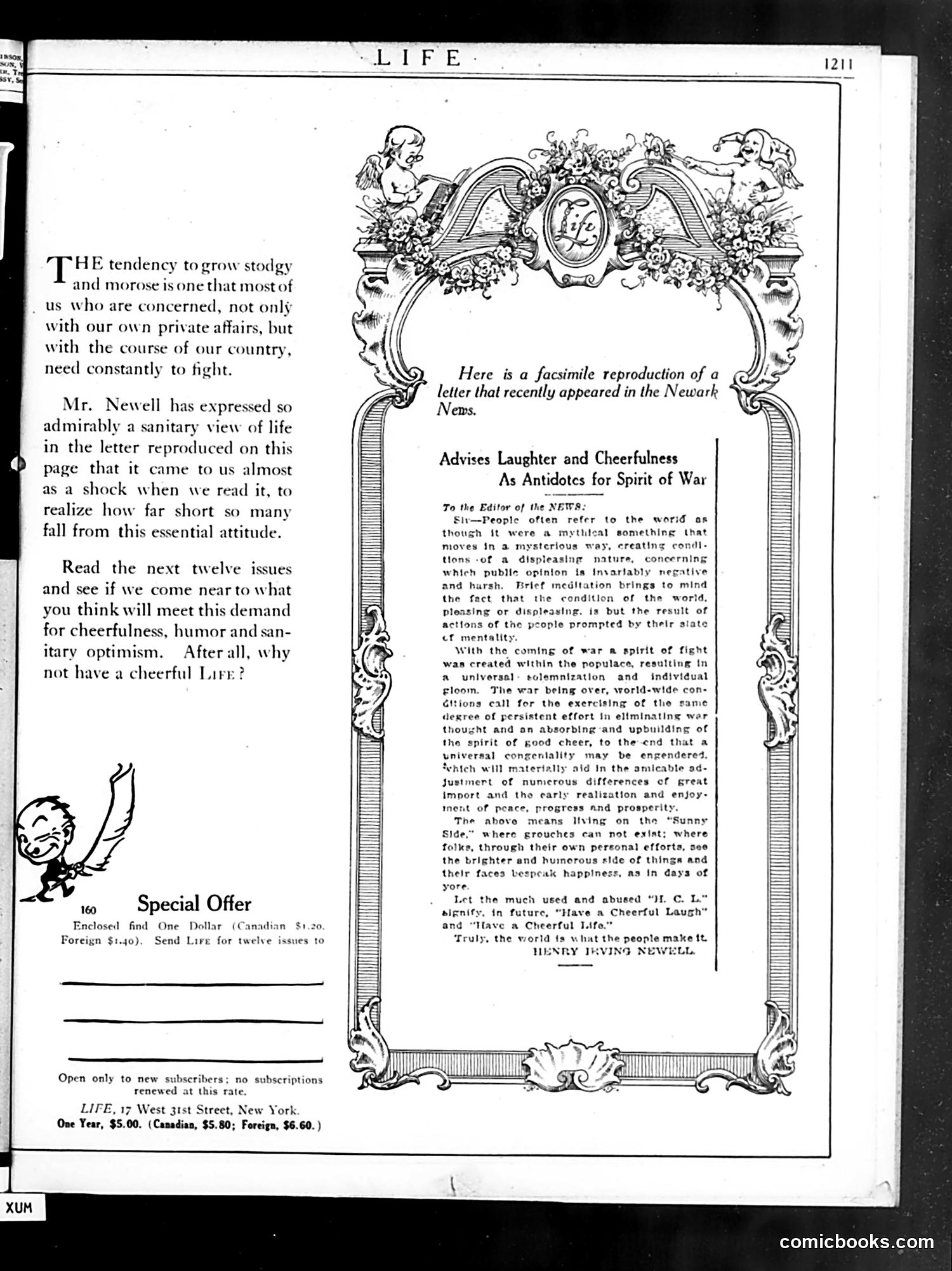
This page primarily features a letter to the editor from **Henry Irving Newell** advocating for humor and cheerfulness as psychological remedies against wartime despair. The letter, titled "Advises Laughter and Cheerfulness As Antidotes for Spirit of War," argues that maintaining good spirits helps people endure hardship and promotes peace. The left side contains editorial commentary supporting this view, noting how people have grown "stodgy and morose" and need to cultivate a "cheerful LIFE." The small cartoon depicts a **cheerful, exuberant figure** (likely a personification of good humor) with raised arms—visually reinforcing the message about maintaining optimism. The page is primarily **editorial/opinion content** rather than political satire. It reflects early-20th-century Life magazine's advocacy for psychological resilience during wartime.

This is **not a satirical cartoon page, but an advertisement**. The page promotes White Trucks for public utility work (telephone, telegraph, electric, gas, rail, and water companies). The image shows a White Truck equipped with a tall hydraulic lift platform—technology designed for utility workers to access overhead lines safely. The accompanying text emphasizes reliability and durability: White Trucks allegedly perform "hard day's work after years of service" and remain "ready" for emergencies where "five-minute delays" prove costly. The "summary" lists statistics showing widespread adoption across utility companies (635 trucks for telephone/telegraph, 482 for electric companies, etc.), a common advertising strategy to demonstrate market dominance and trustworthiness through numbers. This represents straightforward early-20th-century industrial marketing, not satire.
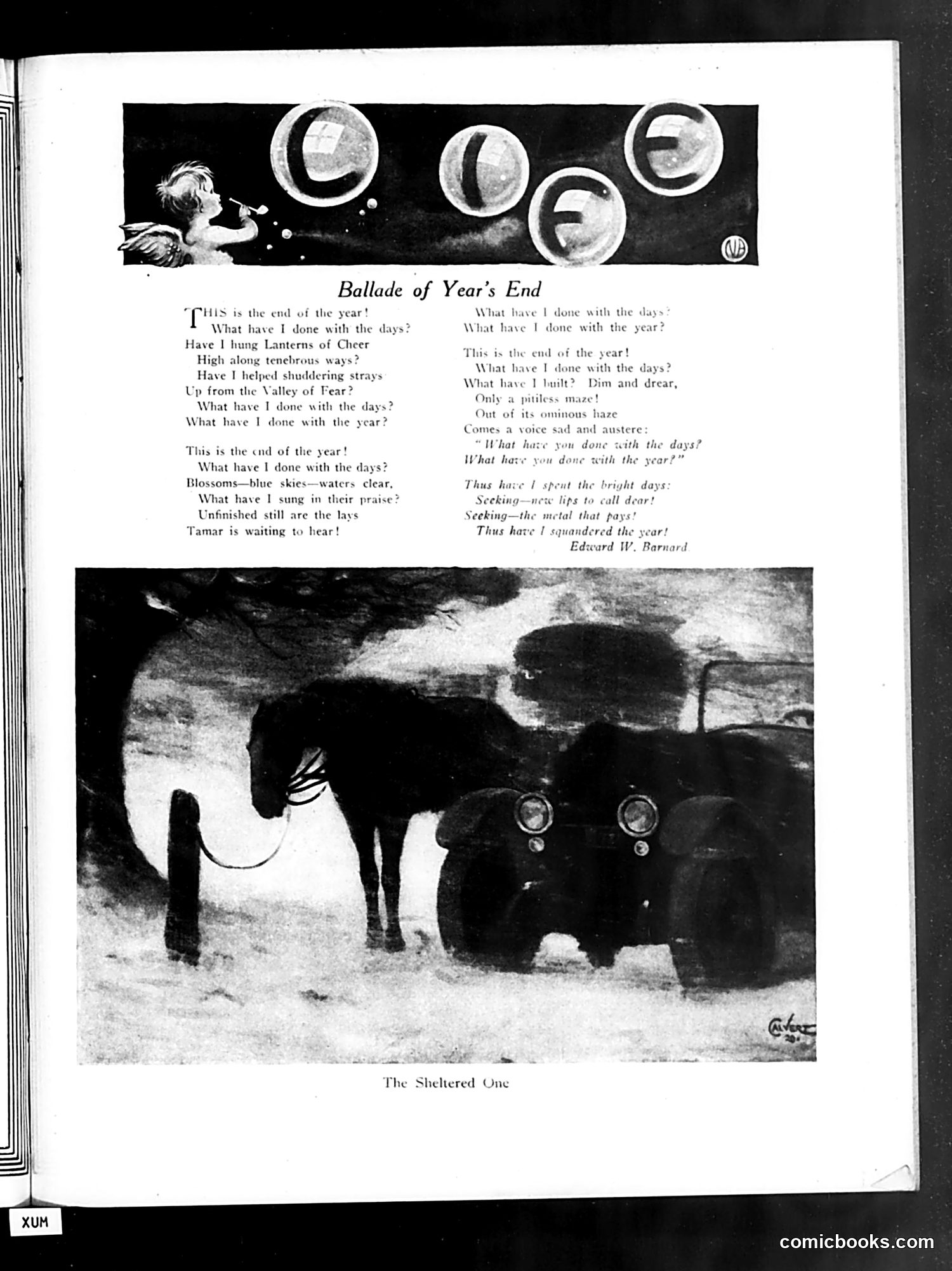
This page contains a reflective poem by Edouard W. Barnard titled "Ballade of Year's End," contemplating what one has accomplished during the past year. The poem uses repeated refrains—"What have I done with the days? What have I done with the year?"—to express uncertainty about personal achievement and legacy. The illustration titled "The Sheltered One" depicts a horse standing beside a parked automobile, suggesting a comparison between old and new transportation methods. This likely satirizes how some people (represented by the horse owner) clung to traditional ways while society modernized around them, or comments on economic disparities during an era of rapid industrial change. The imagery complements the poem's theme of reckoning with time and change.
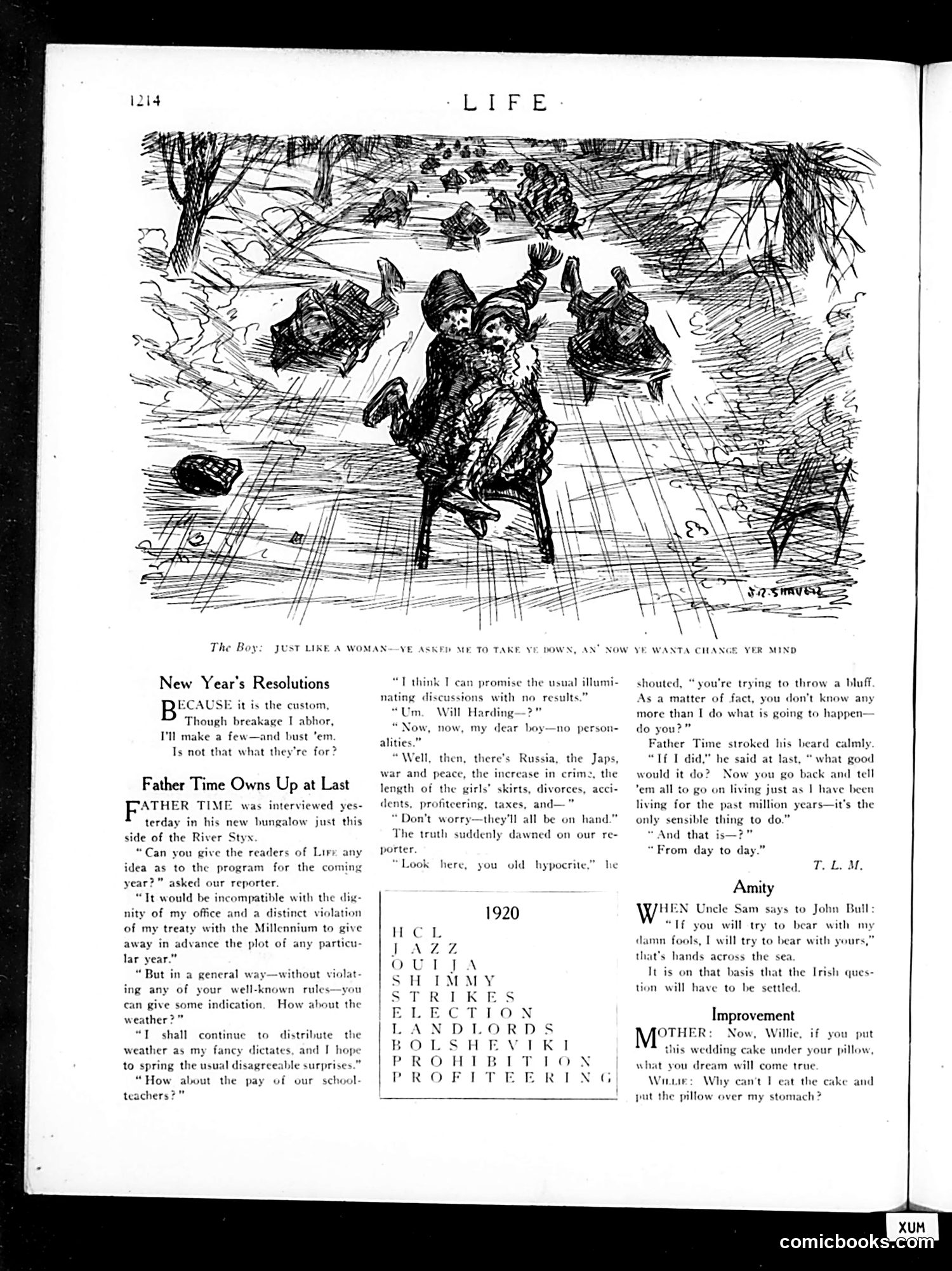
The main illustration depicts a boy (center) surrounded by three figures on ice, with the caption referencing a woman's request: "Just like a woman—ye asked me to take ye down, an' now ye wanta change yer mind." This is a gender-stereotype joke playing on the idea that women are indecisive or blame men for their own choices. The ice setting suggests winter danger, making the humor darker—the implication being that the woman's changing mind could have serious consequences. The text sections below cover unrelated satirical pieces: "New Year's Resolutions" mocks resolution-making, while "Father Time Owns Up at Last" features Father Time discussing post-WWI issues (Russia, Japan, crime, taxes, divorces) with a Life reporter, reflecting contemporary 1920 concerns about social upheaval following the war.
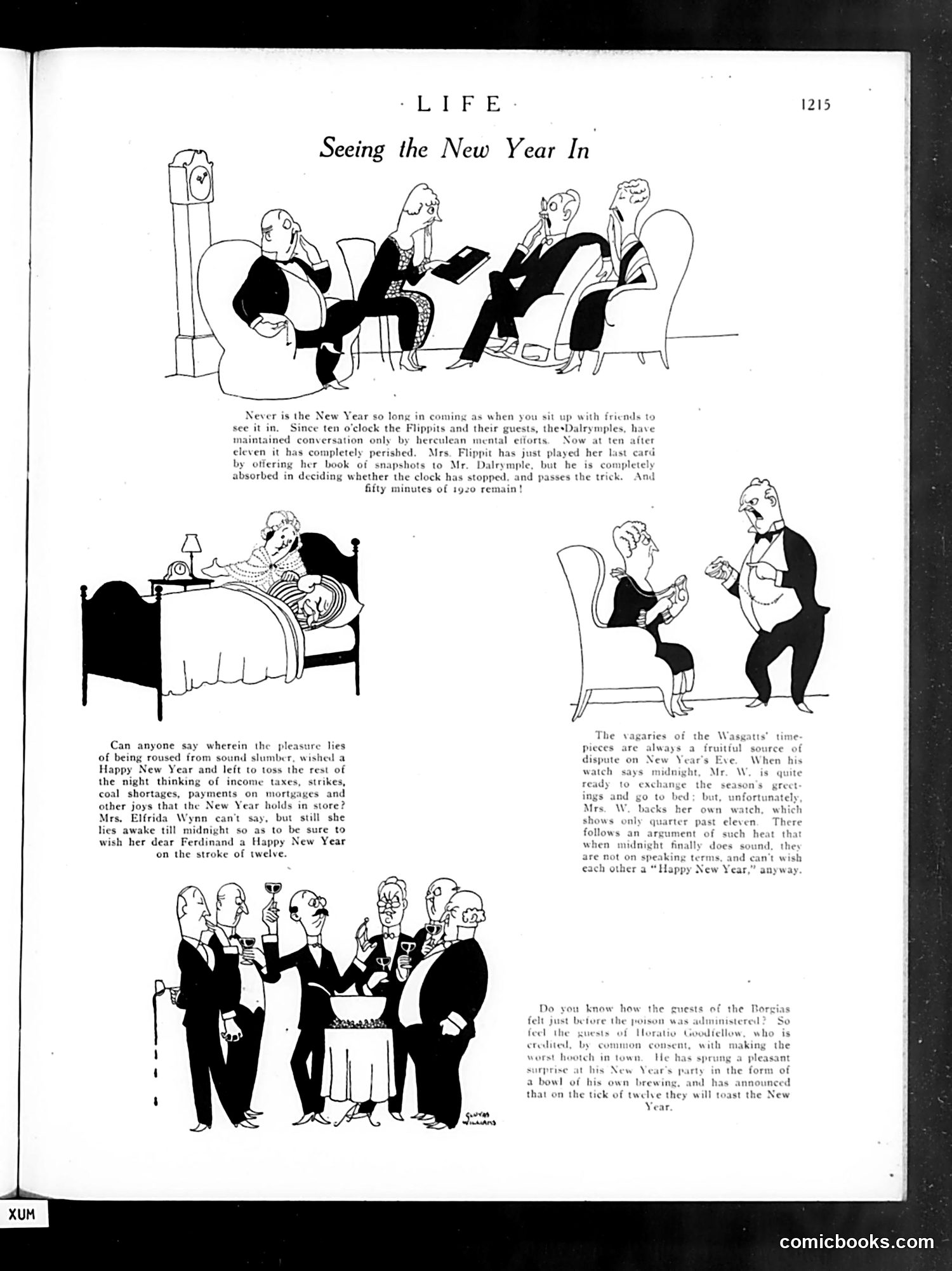
This satirical page mocks New Year's Eve social customs among the wealthy. The cartoons depict: 1. **Upper panel**: Friends gathered to watch the clock strike midnight—a tradition the text notes has become tedious after maintaining "conversation only by herculean mental efforts" for hours. 2. **Middle left**: A woman wishing her husband a Happy New Year from bed, escaping the forced socializing. 3. **Middle right**: A couple arguing over clock discrepancies—the Waspata's clock shows only quarter past eleven, sparking heated debate about when to actually celebrate. 4. **Bottom**: Guests toasting with "a bowl of his own brewing"—implying homemade alcohol, likely referencing Prohibition-era bootlegging. The satire targets the artificiality and tedium of upper-class New Year's traditions.
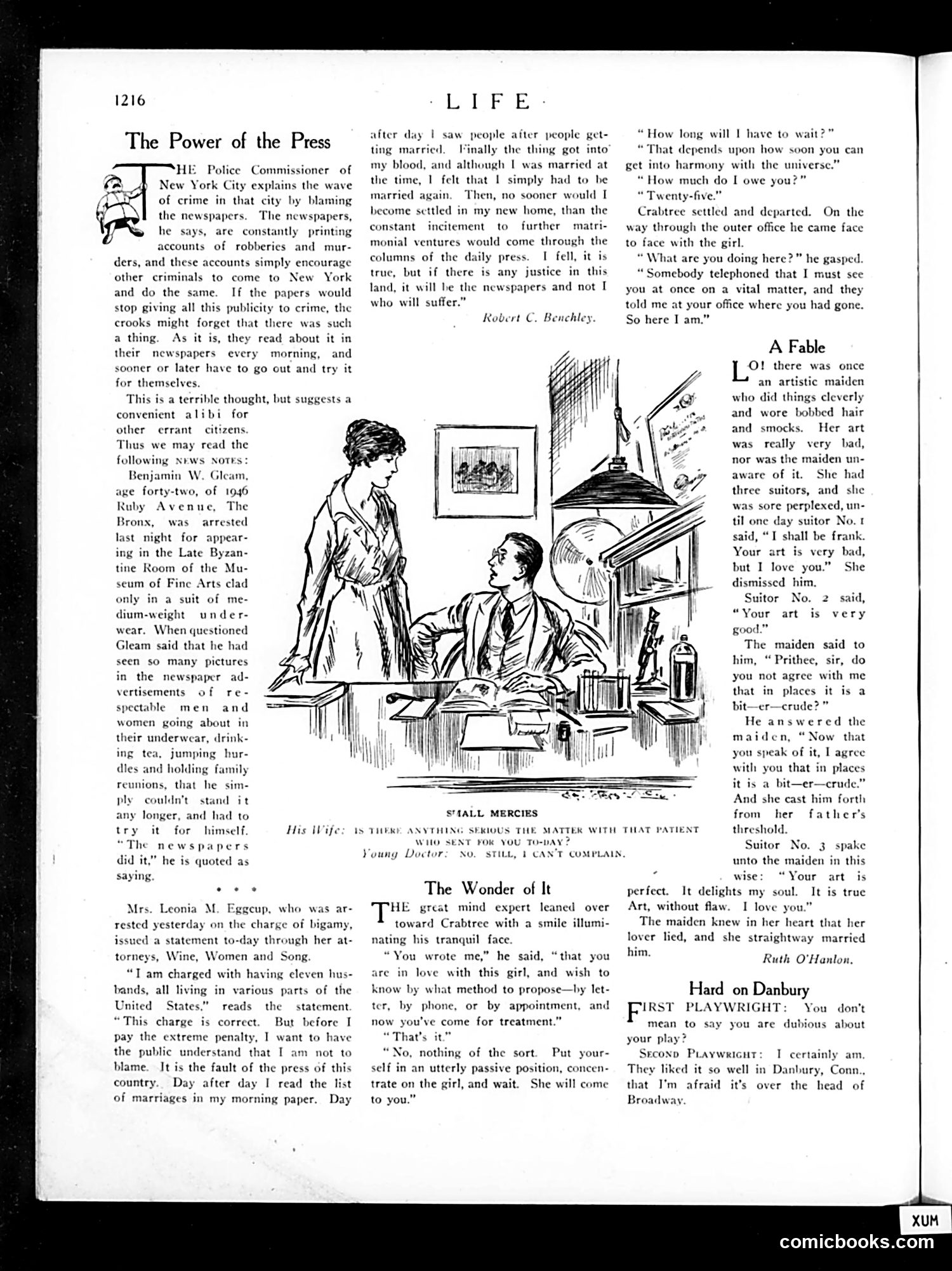
This page from *Life* magazine contains three separate pieces: 1. **"The Power of the Press"** — An editorial by Robert C. Benchley criticizing how New York newspapers sensationalize crime coverage, encouraging criminals to commit offenses for publicity. Benchley argues newspapers bear responsibility for crime waves. 2. **"Small Mercies"** — An illustration showing a young doctor visiting a patient, with dialogue about receiving treatment. The caption reads: "His wife: Is there anything serious the matter with that patient you sent for you today? Young Doctor: No still, I can't complain." 3. **"A Fable"** and **"The Wonder of It"** — Brief humorous stories about romantic/artistic matters. The page represents typical early 20th-century satirical magazine content mixing social commentary with light humor.
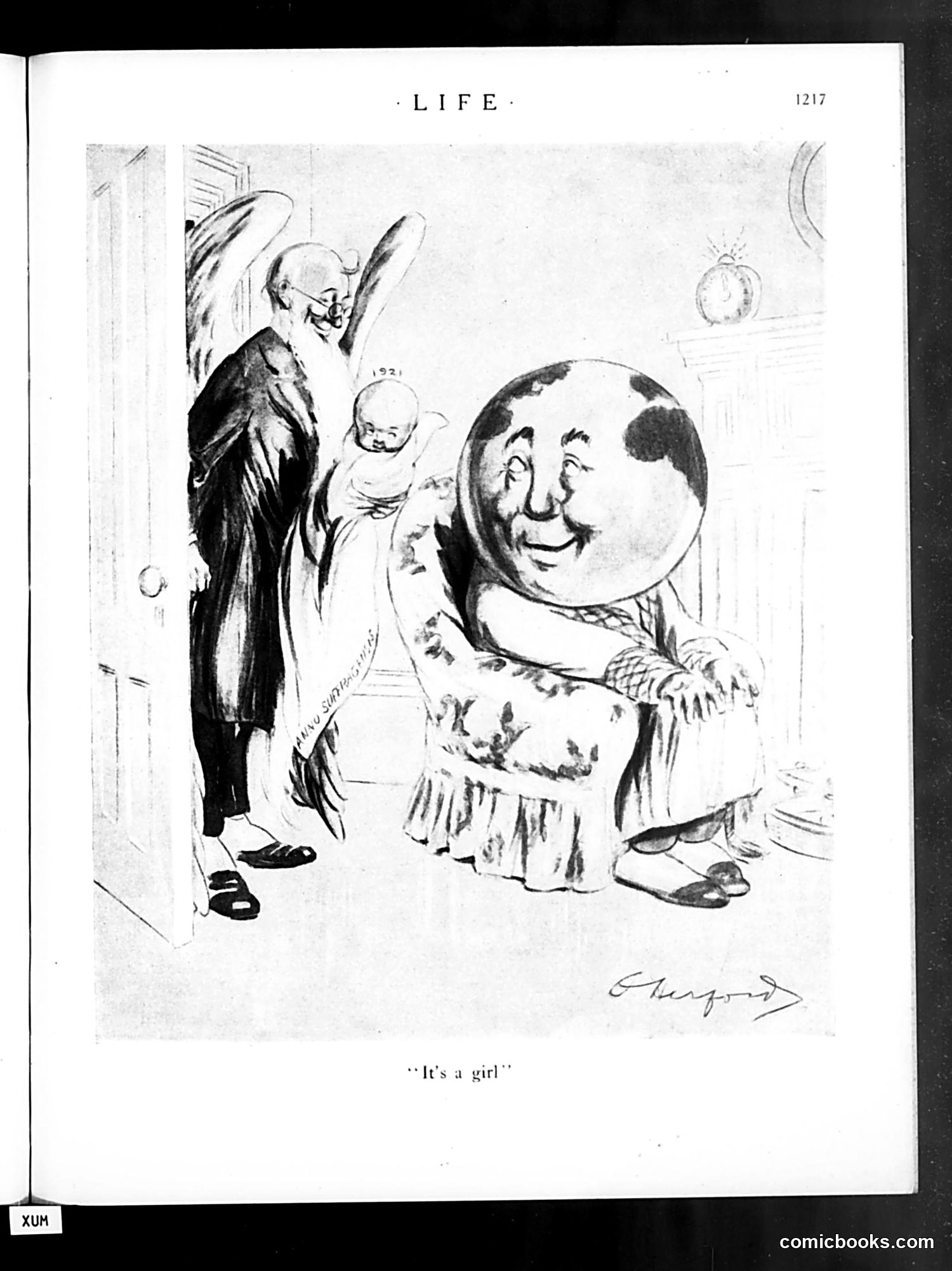
This is a humorous domestic cartoon depicting the announcement of a newborn daughter. The scene shows a proud, rotund father figure displaying his spherical head like a globe—complete with continental markings—suggesting he's so pleased with himself that his head has become oversized with pride. Behind him stands a thin, elderly man (likely a doctor or grandfather) holding an infant, while the mother sits exhausted in bed. The joke plays on the father's absurd self-satisfaction at producing a daughter, his comically exaggerated head symbolizing his inflated ego. The cartoon gently satirizes traditional masculine pride in paternity and the contrast between the father's vanity and the mother's evident exhaustion from childbirth. The artist's signature appears at bottom left.
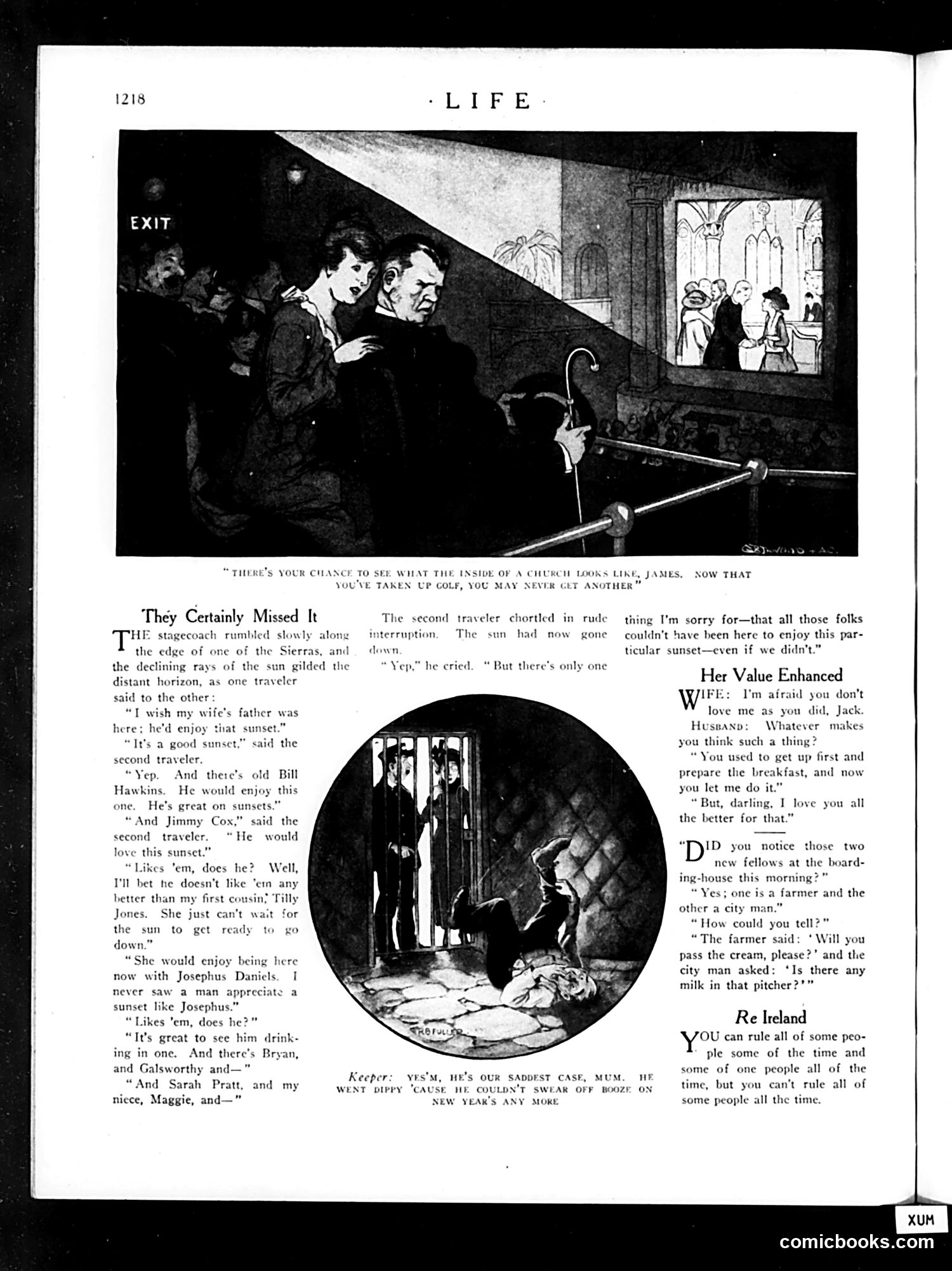
This page contains three distinct pieces of humor: 1. **Top cartoon**: Shows a couple at what appears to be a church interior viewing, with the caption about a man named James taking up golf and thus missing future opportunities to see church interiors. The joke satirizes how golf has become an all-consuming hobby for men, replacing cultural or religious activities. 2. **"They Certainly Missed It"**: A narrative joke about travelers discussing who would have enjoyed a sunset—references to specific individuals (Bill Hawkins, Jimmy Cox, Josephus, etc.) and their supposed appreciation for scenery. It's a gentle satire on nostalgia and who misses out on life's moments. 3. **"Her Value Enhanced" and "Re Ireland"**: Two brief dialogue-based humor pieces about domestic relationships and Irish stereotypes, typical of period social comedy. The overall tone is genteel, domestic satire targeting middle-class American life.
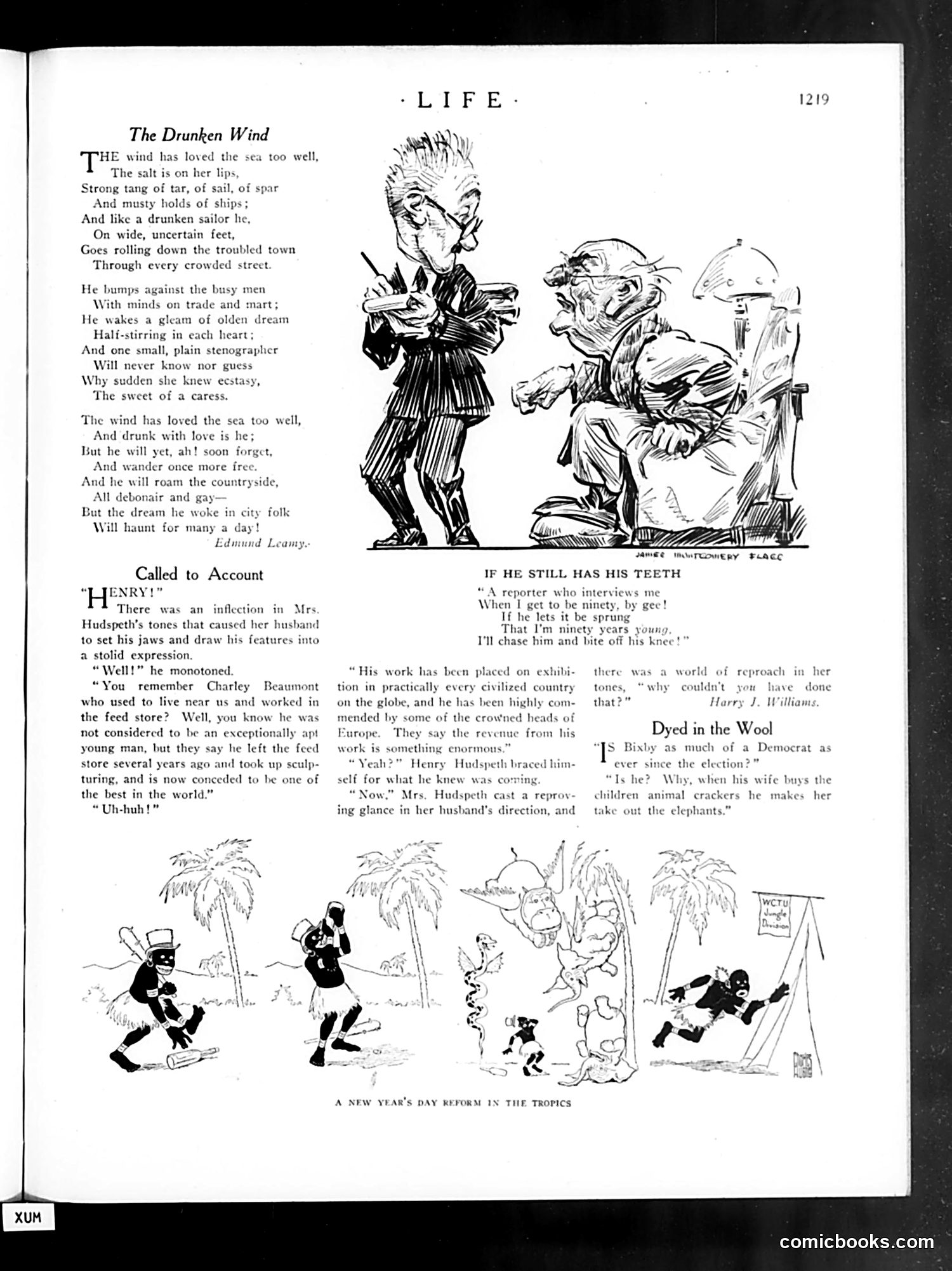
This page contains three distinct pieces of humor: 1. **"The Drunken Wind"** (Edmund Leamy): A poem personifying wind as a rowdy drunk sailor stumbling through town, bothering workers and leaving dreams in people's hearts. 2. **"Called to Account"**: A domestic comedy sketch where Mrs. Hudspeth criticizes her husband Henry for his sculpture work, which she finds unflattering. She references artist Charles Beaumont as superior. The humor lies in the wife's reproving tone about his artistic ambitions. 3. **"Dyed in the Wool"** and **"A New Year's Day Reform in the Tropics"**: Brief joke and cartoon sequence about political/social behavior, though specific references are unclear without additional historical context. The cartoons use caricature and visual humor typical of early 20th-century American satire.
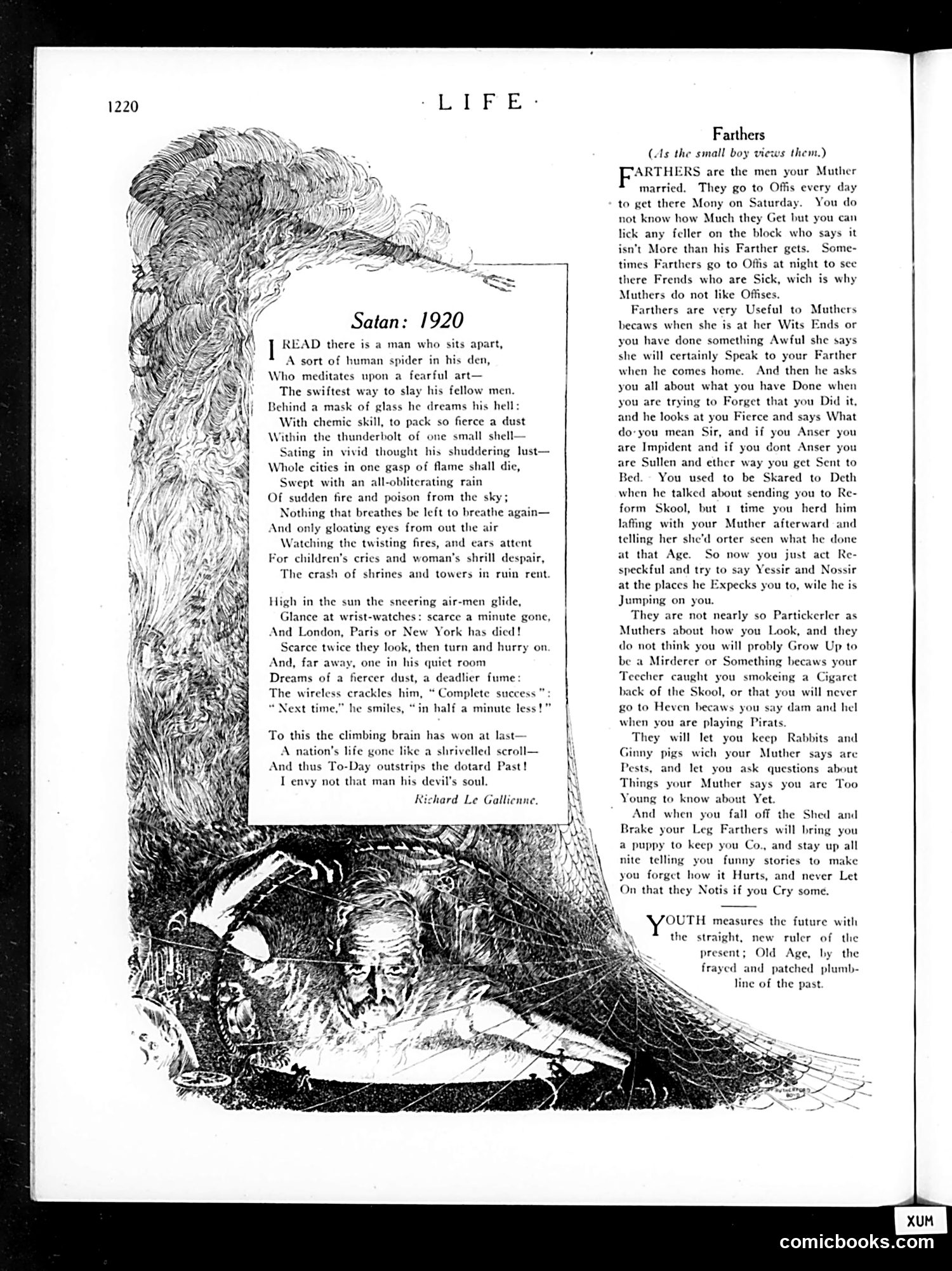
The left side features "Satan: 1920," a poem by Richard Le Gallienne depicting a powerful, manipulative figure who corrupts humanity through ambition and deception. The illustration shows Satan as a looming, demonic force—a clear reference to post-WWI anxieties about evil influences in society. The right column, "Fathers," offers satirical advice to boys about their fathers' behavior—they visit sick friends at pubs, are unreliable moral guides, and use profanity. The satire mocks working-class fathers' hypocrisy: they discipline children while setting poor examples themselves. Together, these pieces reflect 1920s concerns about moral corruption and generational conflict in the aftermath of World War I.
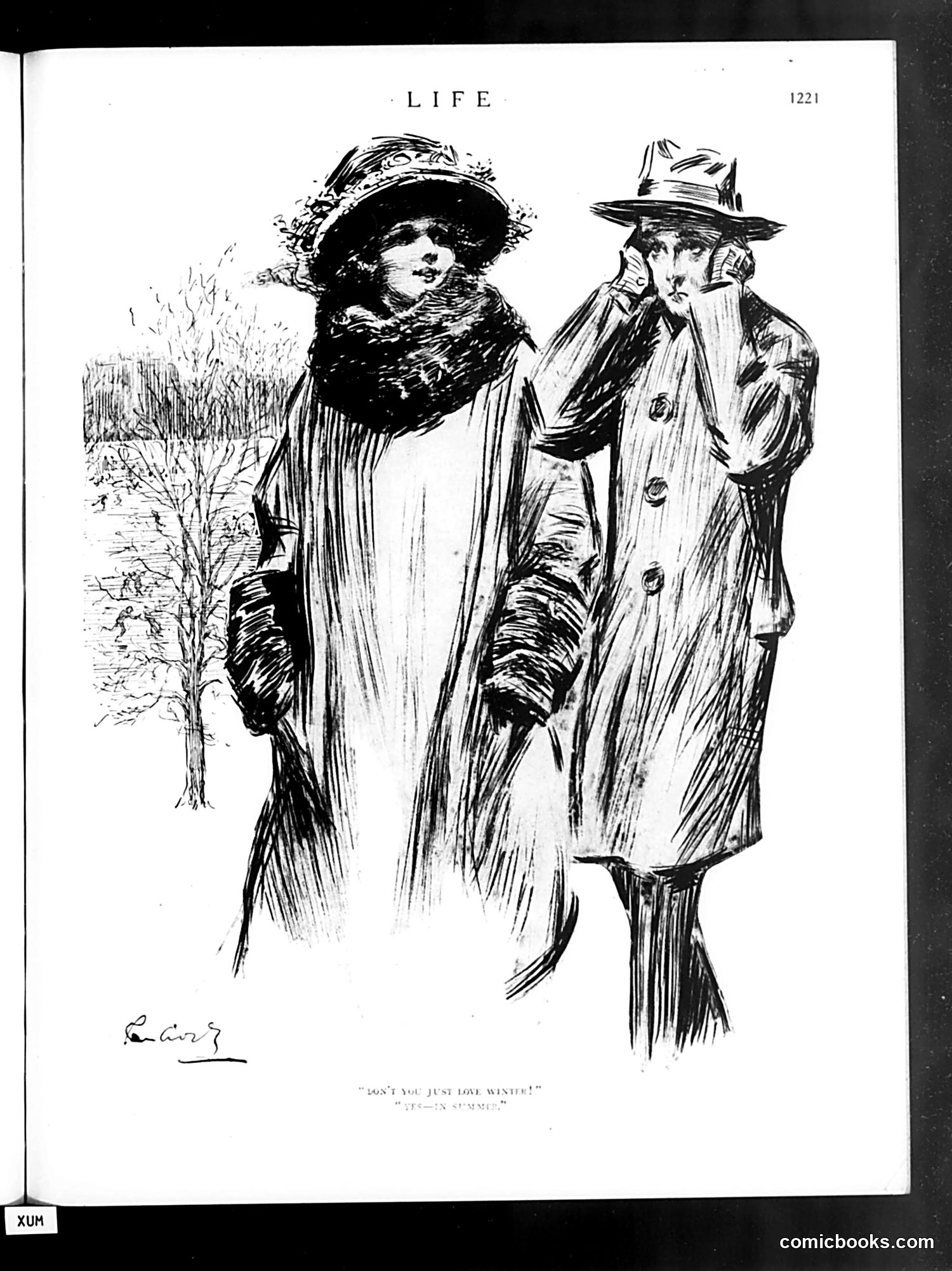
This is a single illustration by a cartoonist (signature appears to be "Cesare" or similar) depicting two figures in winter coats standing together outdoors, with a bare tree visible in the background. The caption reads: "DON'T YOU JUST LOVE WINTER?" / "IT—IS SUMMER." The satire appears to be about seasonal confusion or meteorological disappointment—one figure optimistically remarks on loving winter while the other corrects them, noting it's actually summer. This likely satirizes unexpectedly cold or harsh weather during what should be summer months, or comments on the disappointment of poor summer conditions. The joke plays on the contrast between expected seasonal weather and reality, with the figures' formal winter coats underscoring the absurdity.
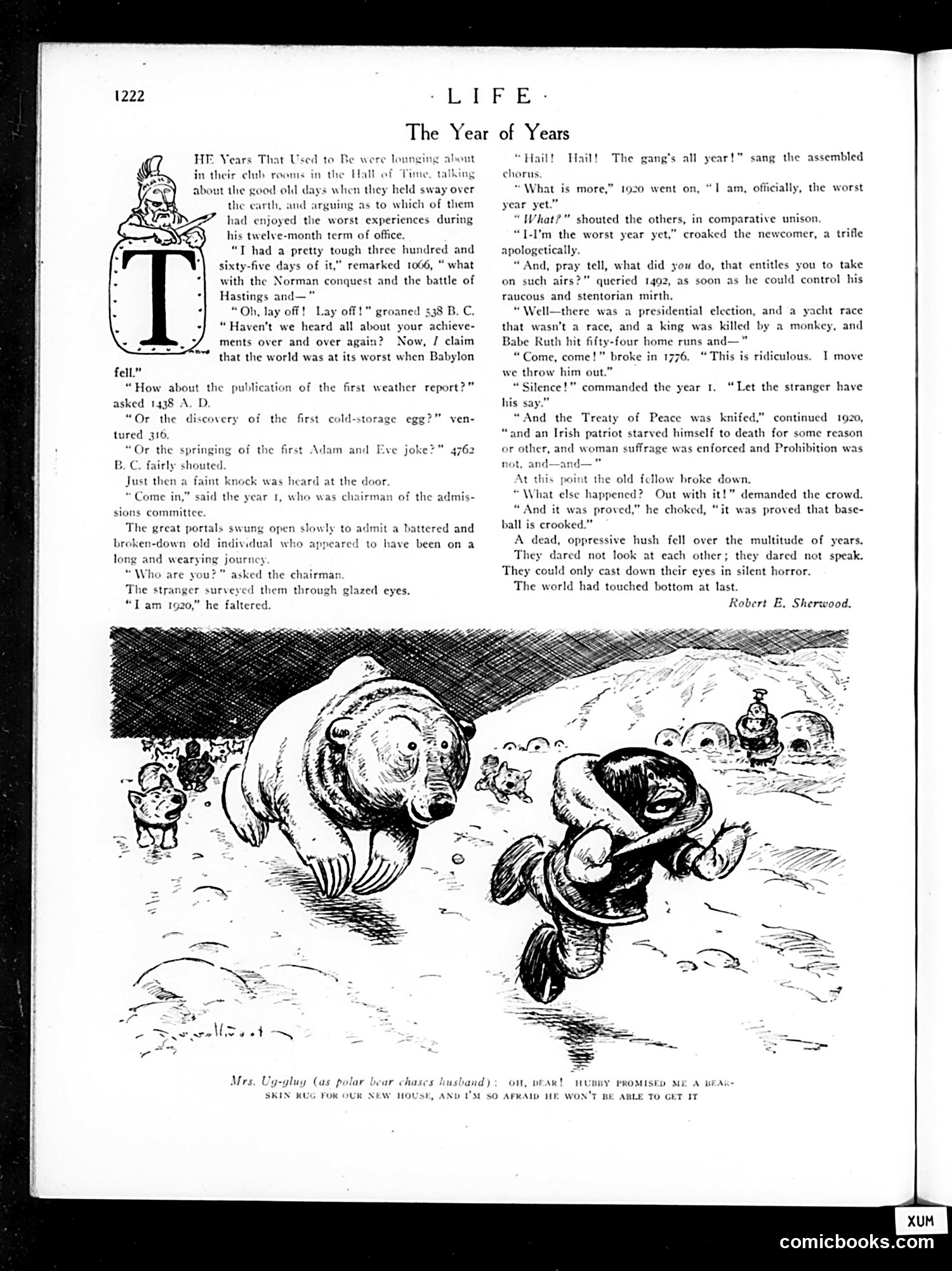
This page presents a satirical dialogue where various years personified as characters boast about their terrible accomplishments. The 1920 figure claims to be "officially, the worst year yet," citing a presidential election, a yacht race involving Babe Ruth hitting home runs, the Treaty of Peace being "knifed," and Irish starving amid Prohibition's enforcement. The cartoon below shows a polar bear family in Arctic conditions. The caption reads: "Mrs. Ug-glug (as polar bear chases husband): 'Oh, dear! Hubby promised me a bear-skin rug for our new house, and I'm so afraid he won't be able to get it.'" The humor plays on 1920s anxieties about economic hardship, political turmoil, and Prohibition's failures, while the polar bear joke offers dark satire about domestic life and male responsibility.
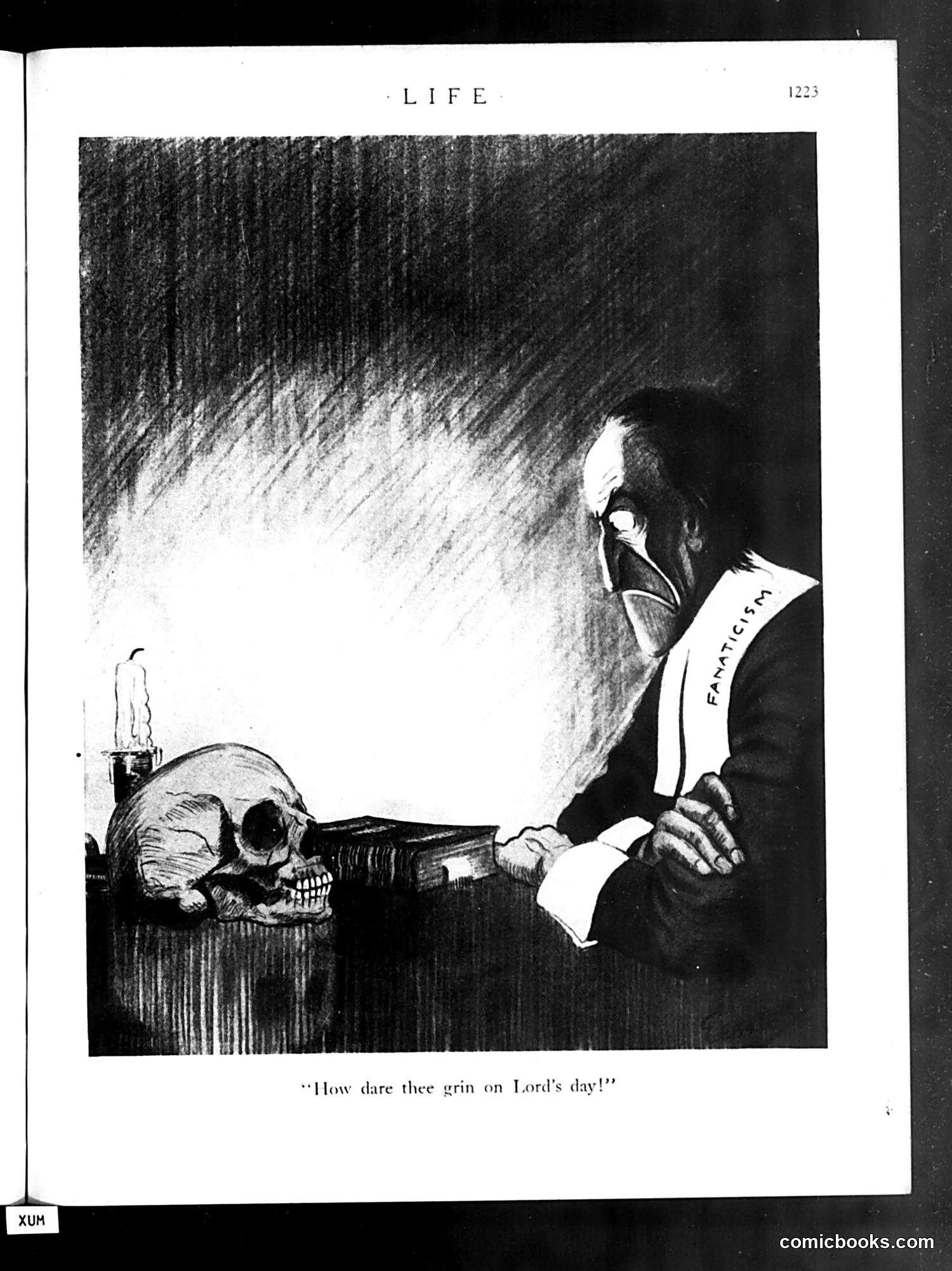
This appears to be a political cartoon from *Life* magazine showing a figure labeled "FANATICS" recoiling in horror from a skull, with the caption: "How dare thee grin on Lord's day!" The satire targets religious extremism and puritanical zealotry. The "fanatic" figure, dressed formally with what appears to be religious garb, is shocked by a literal skull—perhaps representing death, mortality, or secular reality itself. The reference to "Lord's day" (Sunday) suggests criticism of overly rigid Sabbath observance or religious hypocrisy. The cartoon mocks how religious fanatics allegedly react with horror to anything they perceive as sinful or irreverent, even universal human truths like death. The skull's "grin" is ironic—death doesn't discriminate between the pious and profane, undermining the fanatic's moral pretensions.
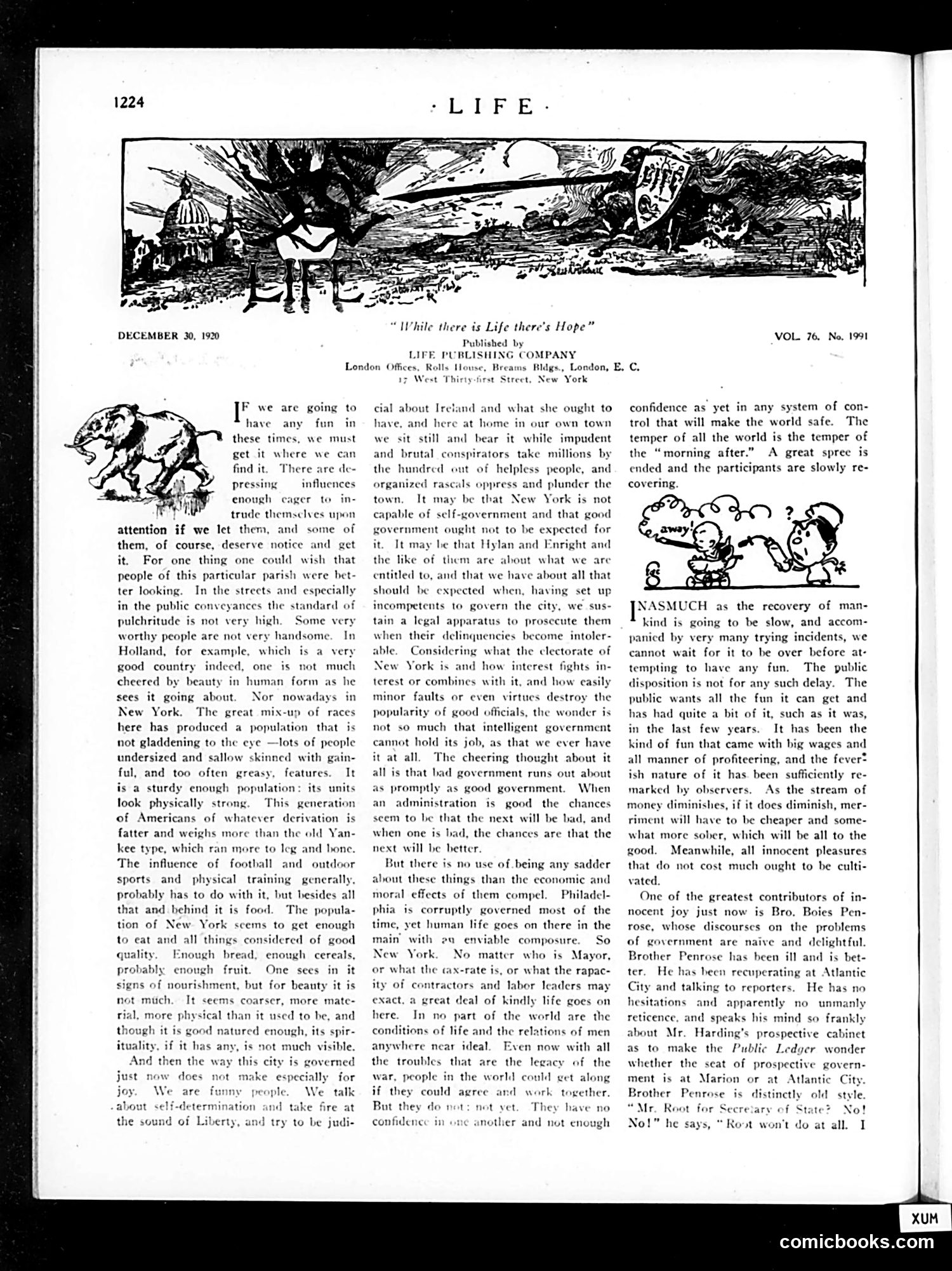
This *Life* magazine page from December 30, 1920 contains a political editorial attacking Ireland's governance and New York City politics. The **main cartoon** (top left) depicts a distressed figure, likely representing Ireland or Irish governance, in chaotic circumstances—referencing the Irish War of Independence and civil turmoil occurring at that time. The **editorial text** criticizes Ireland's inability at self-government and draws parallels to New York City's corruption under its current administration. The author argues that good government requires honest officials, not just laws, and questions whether New York's electorate can demand better leadership. The piece also references **Brother Penrose** (likely a religious or political figure) and mentions Philadelphia's corrupt governance as a cautionary example. The overall message: governments fail due to corrupt officials and public apathy, not inherent systems—a common Progressive Era critique.
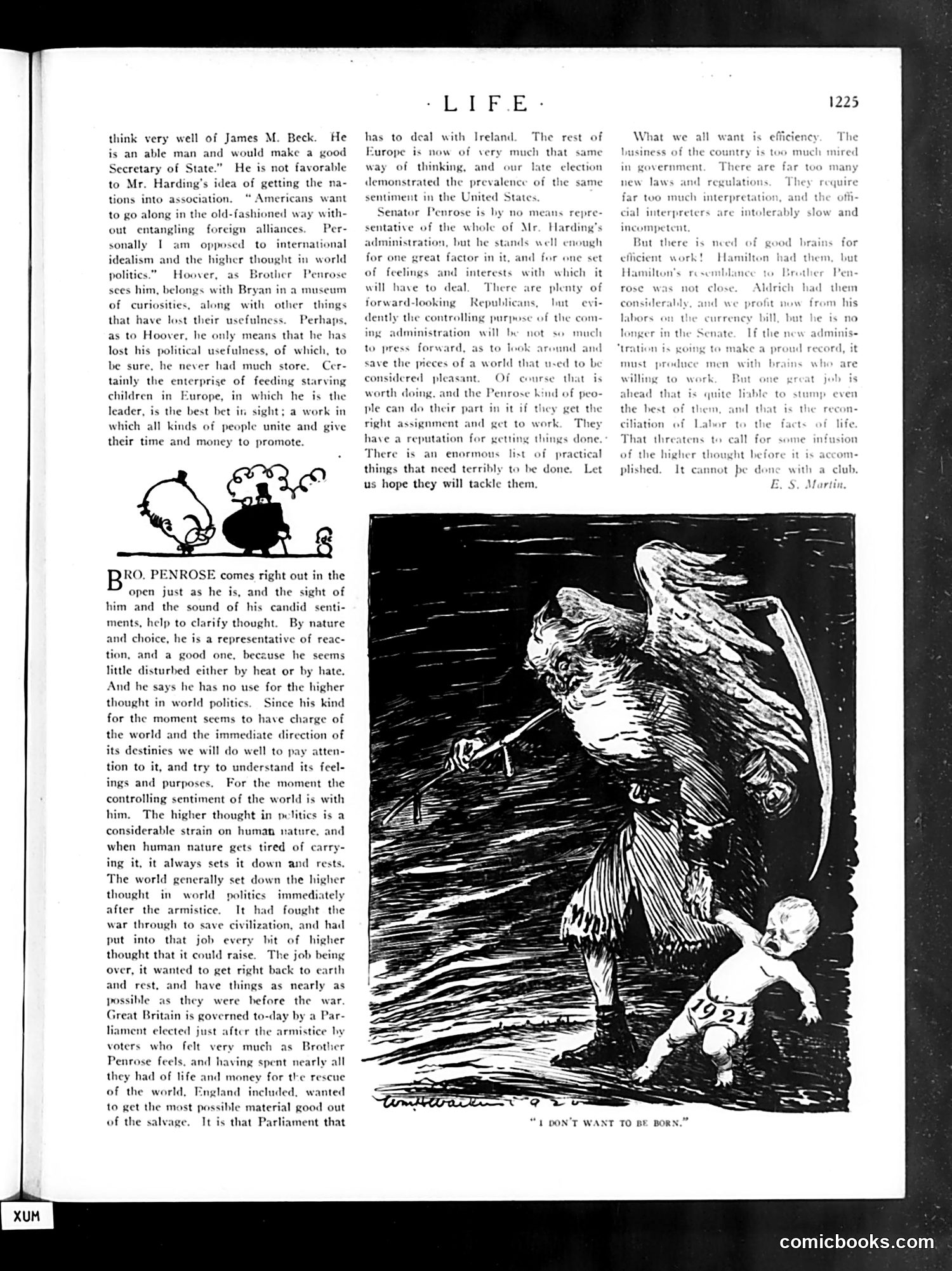
This page discusses **Senator Boies Penrose**, a prominent Republican political figure. The text praises Penrose as an honest representative of "reaction" (conservatism)—someone who openly opposes "higher thought in world politics" and advocates returning to pre-war normalcy rather than pursuing idealistic international engagement. The **main cartoon** (titled "I Don't Want to Be Born") depicts **Death** as a skeletal reaper confronting a **baby**, likely representing an unwanted child born into a post-war world. This appears to satirize the article's theme: after WWI exhausted nations' idealism, people rejected ambitious political visions in favor of material comfort and rest, making life seem grim for future generations. The text also critiques James M. Beck and discusses Herbert Hoover, positioning post-war politics as dominated by practical materialism rather than progressive ideals. The cartoon's dark message suggests satire of this very sentiment—that prioritizing recovery over vision leaves a bleak inheritance.
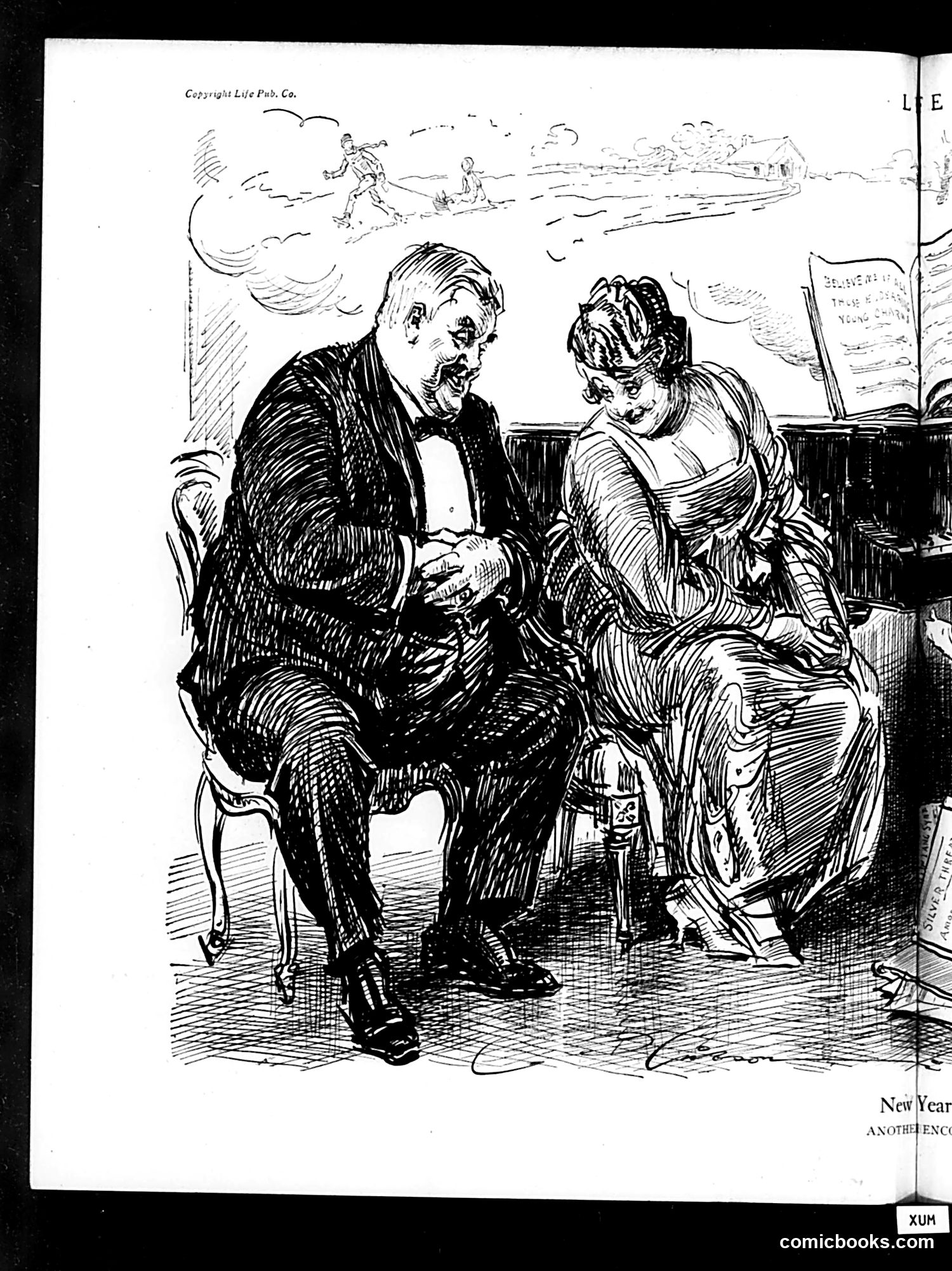
This appears to be a satirical illustration from *Life* magazine showing an intimate scene between a well-dressed older man in formal attire (suit and bow tie) and a younger woman in an elegant dress. The man appears to be proposing or presenting something (possibly a ring or gift) to the woman, who gazes at him with apparent interest. The cartoon likely satirizes romantic or matrimonial pursuits, possibly mocking wealthy older men pursuing younger women, a common *Life* magazine theme of social satire. The formal indoor setting contrasts with the pastoral landscape visible through a window behind them, perhaps suggesting romantic pretense or artifice. Without complete OCR text or a visible caption, the specific historical reference remains unclear, though the style suggests early-to-mid 20th century publication.
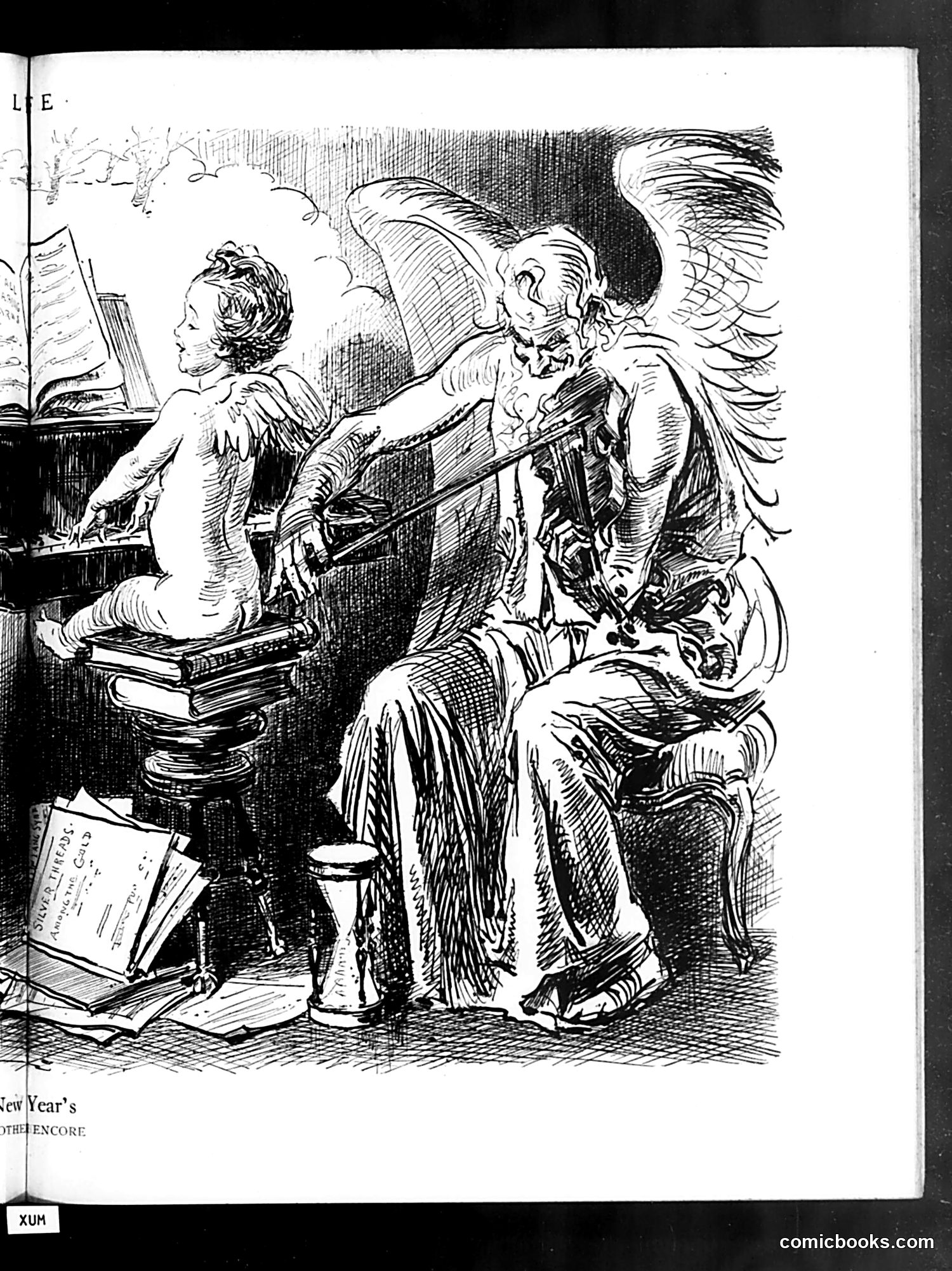
This satirical illustration depicts winged angelic or cherubic figures in a musical performance context. One figure sits at a piano on the left, while others hold instruments (appearing to be violins), suggesting they're performing together. The title "The Encore" indicates this is commentary on a repeated performance or continuation of something from the past year into the new year. The angelic imagery likely represents idealized or heavenly aspirations. Without clearer historical context or visible captions identifying specific figures, the exact political or social references remain unclear. However, the composition suggests satire about whether society's "better angels" or noble ideals will actually be practiced in the coming year, or merely repeated as empty encores of previous promises.
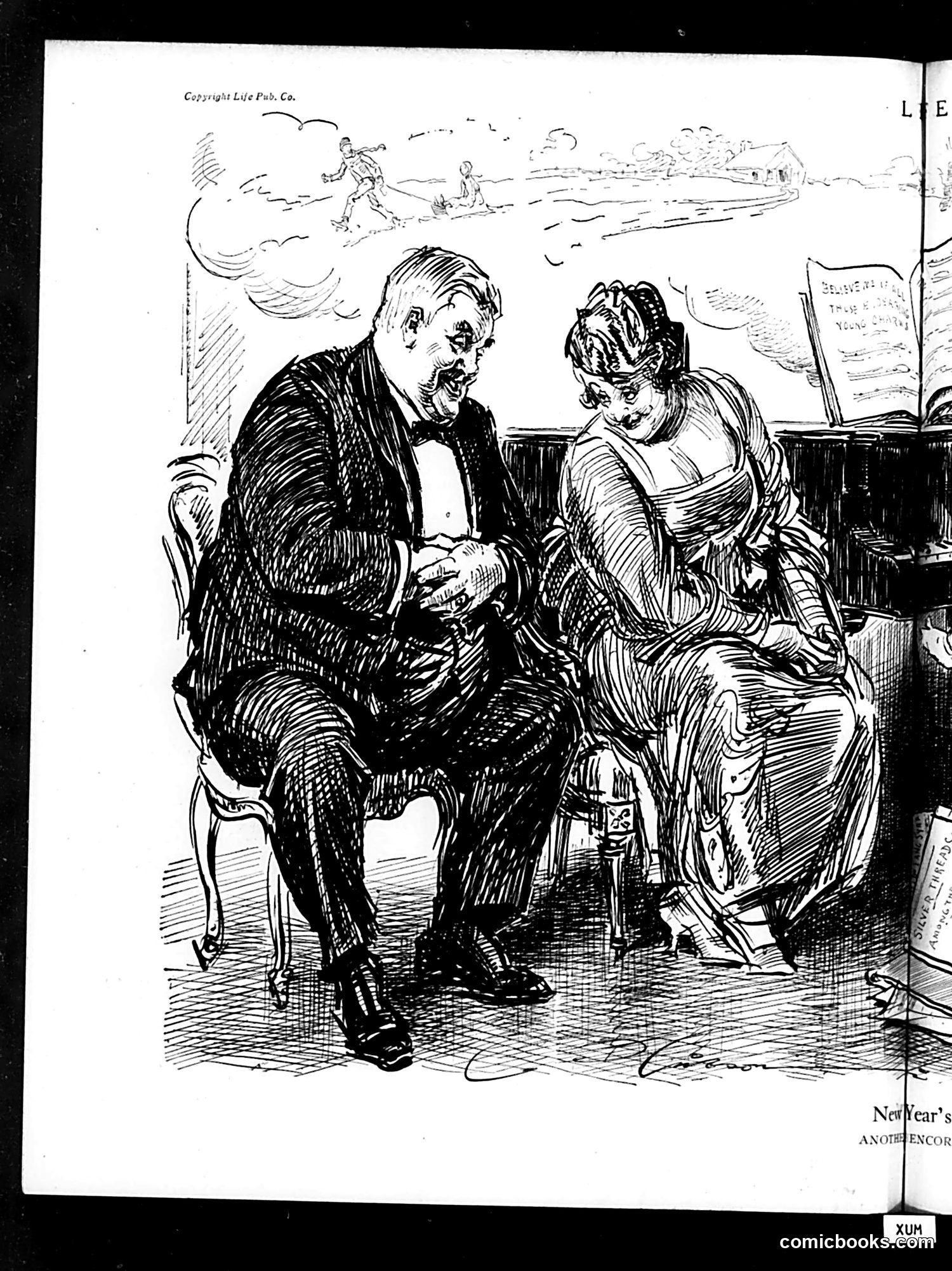
This page shows a social illustration depicting a well-dressed older man in formal attire conversing with a fashionably dressed woman. The setting appears to be indoors, with a pastoral landscape visible through a window in the background. The OCR text is largely illegible, containing only fragments. Without clear text identifying the figures or providing context, the cartoon's specific satirical meaning is unclear. However, the formal dress and intimate conversation suggest this may satirize courtship, social propriety, or romantic encounters among the upper classes—common themes in Life magazine's social satire. The illustration style is consistent with late 19th or early 20th-century satirical work, but without readable caption text, I cannot definitively explain the intended joke or social commentary.
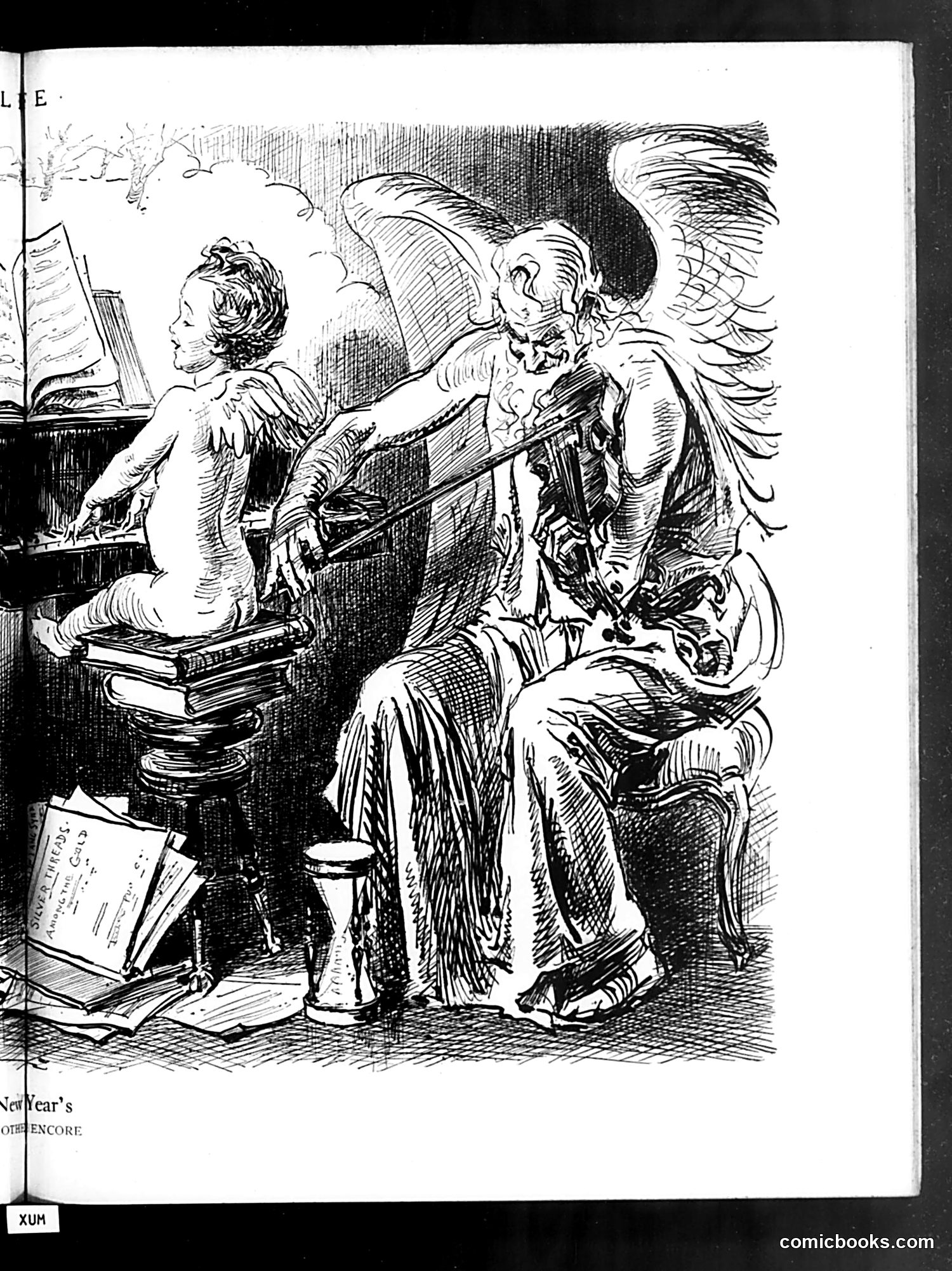
This page contains a satirical illustration titled "New Year's" with the subtitle "ORNE" (possibly "ORNE ENCORE" - "One More"). The image depicts winged allegorical figures—appearing to represent concepts like Time, Fate, or the New Year—gathered around a female figure seated at a piano or desk, surrounded by books and papers. The composition suggests New Year's themes: reflection on the past year and anticipation of the future. The allegorical beings seem to be presenting or directing the woman's attention forward. The artistic style and subject matter are typical of *Life* magazine's satirical commentary on contemporary social and cultural moments. Without clearer context about the specific year of publication, the exact satirical target remains unclear, though it likely comments on how the New Year arrives with inevitable forces beyond individual control.
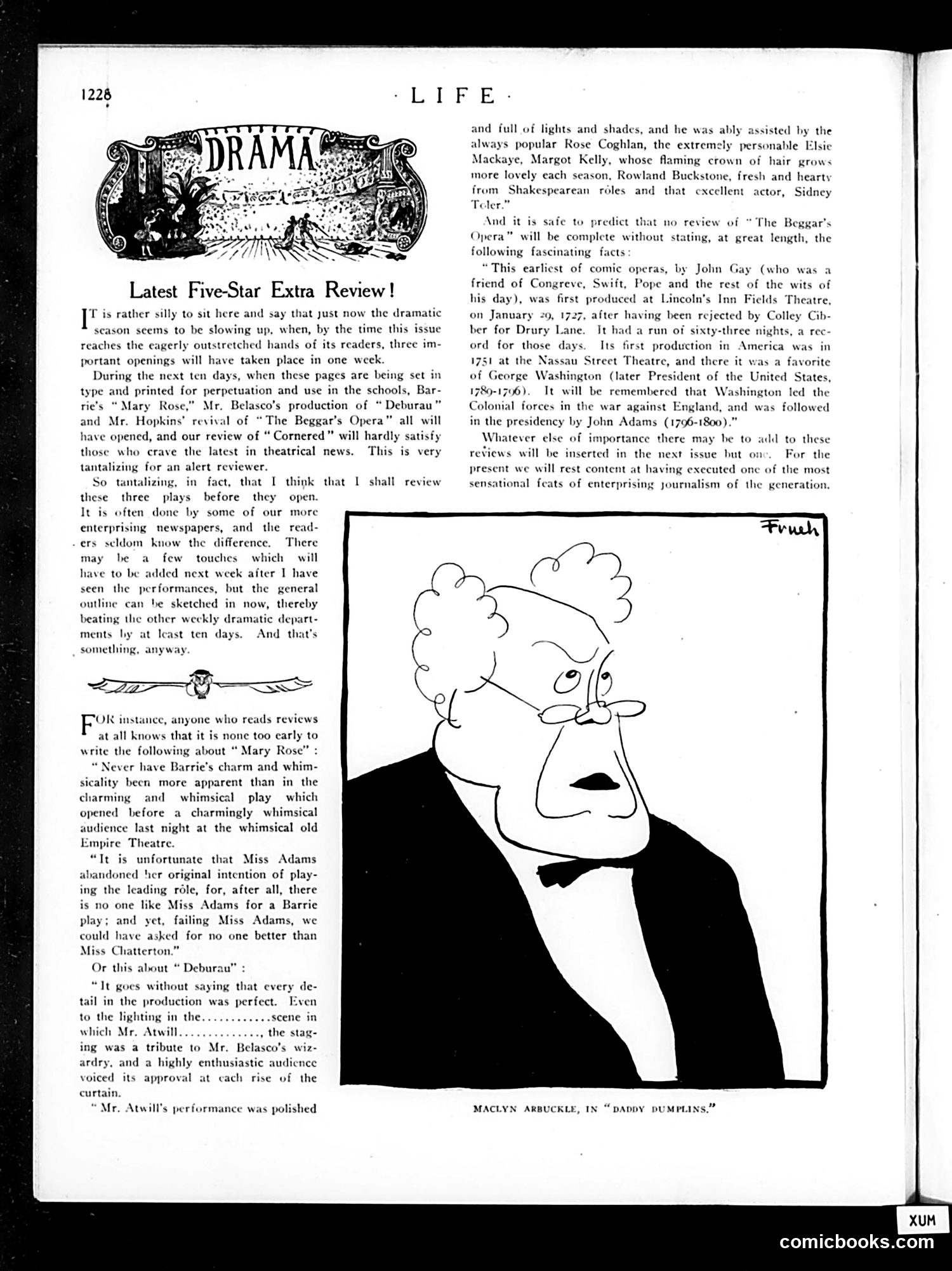
This page satirizes theatrical criticism and journalistic shortcuts. The author humorously proposes reviewing three Broadway plays—"Mary Rose," "Deburau," and "The Beggar's Opera"—*before they open*, claiming newspapers do this routinely without readers noticing. The satire mocks predictable critical clichés: praising a playwright's "charm and whimsy," calling production details "perfect," listing cast members with generic compliments, and padding reviews with irrelevant historical facts (about John Gay and George Washington). The cartoon shows Maclyn Arbuckle in "Daddy Dumplins," illustrating contemporary theater. The joke targets both lazy journalism and formulaic theater criticism—exposing how reviews often follow templates rather than genuine engagement with actual performances. For modern readers, it's a timeless critique of how media sometimes manufactures content rather than reporting actual events.
This page contains theater reviews from Life magazine's drama criticism section. The prominent "Confidential Guide" feature reviews Broadway productions, offering witty, dismissive assessments typical of the era's satirical criticism. The main review discusses "Cornered," praising actress Madge Kennedy's comedic talent while criticizing the play itself as a tired "crook play"—a formulaic crime drama. Critic Robert C. Benchley notes the play wastes Kennedy's abilities on mediocre material, suggesting the playwright could have written something worthier of her talents. The surrounding reviews mock various productions with exaggerated wordplay (comparing a play's structure to a geometric equation, describing another as unmemorable). The tone is sophisticated mockery aimed at Broadway's conventional output and recycled plots. The disclaimer at top indicates Life's publication lag—reviews verified daily newspapers for current theater information, a practical necessity before modern media.
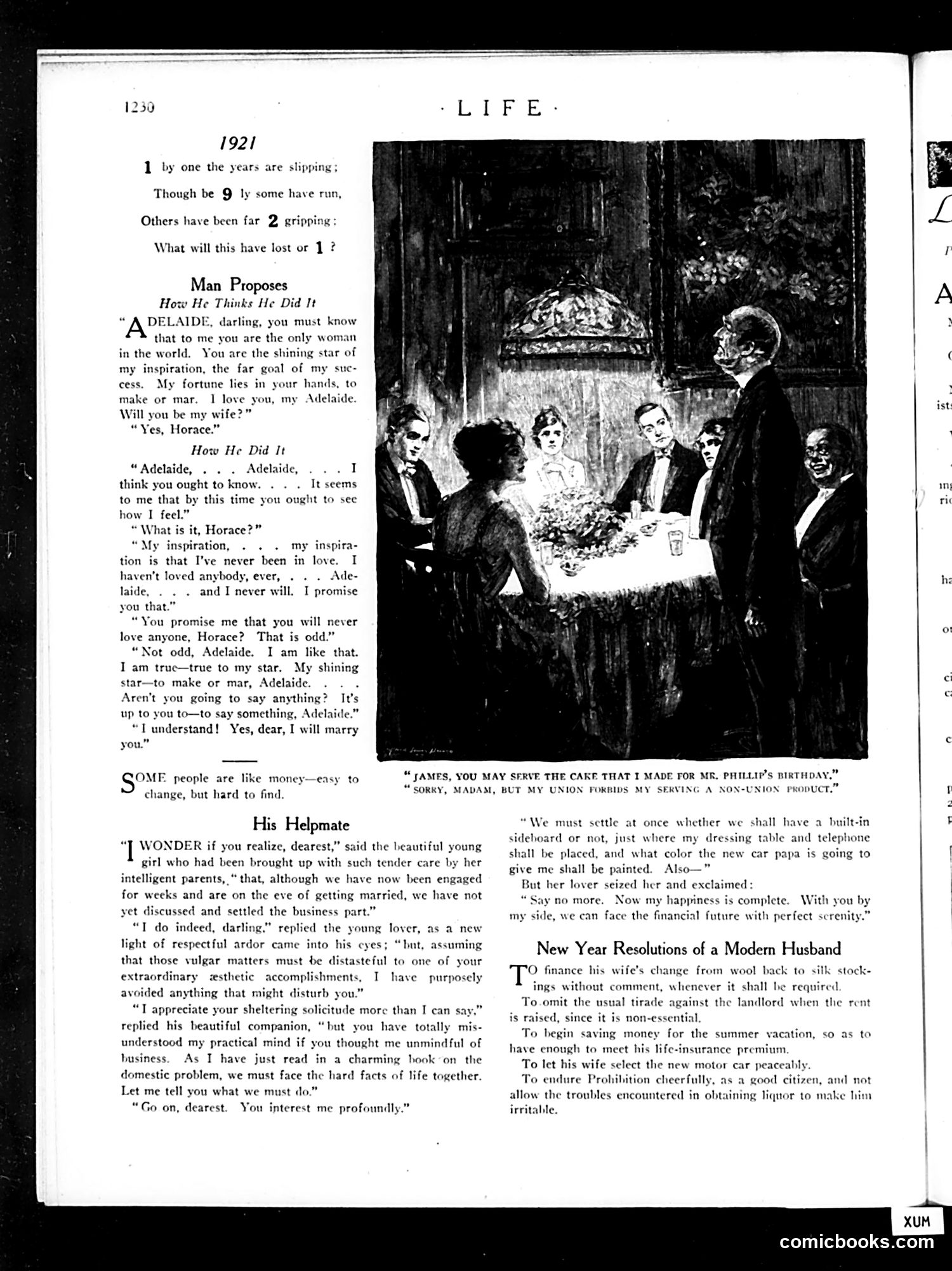
This page satirizes modern courtship and marriage through three interconnected sketches: **"Man Proposes"** mocks romantic rhetoric. Horace delivers flowery marriage proposals about Adelaide being his "shining star," then admits he's never loved anyone and never will—yet she accepts anyway. The satire targets the gap between romantic language and actual emotional commitment. **"His Helpmate"** presents a young woman who rejects her fiancé's assumption that she's too "aesthetic" for practical matters. She immediately pivots from romance to demanding decisions about furniture and automobiles, satirizing how quickly marriage becomes domestic negotiation. **The union servant joke** references post-WWI labor movement strength—even a cake-serving becomes a labor dispute because it's "non-union." **"New Year Resolutions"** lists a husband's pledges: accepting his wife's clothing expenses, not complaining about rent increases, funding vacations, letting her choose the car, and tolerating Prohibition without irritability. The overall satire targets the collision between romantic idealism and marital realities—the quick descent from passionate proposals to haggling over dressing tables and automobiles.
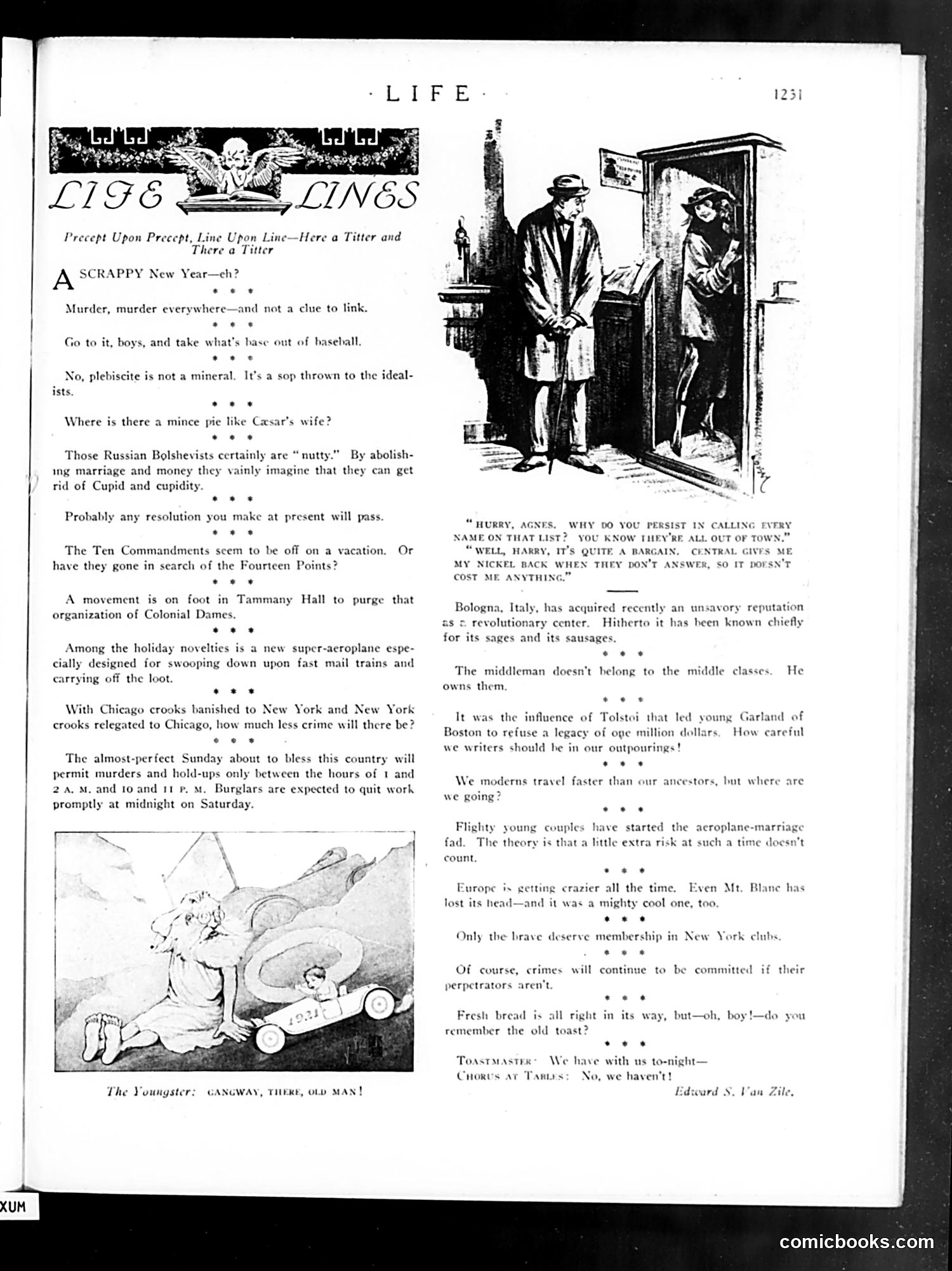
This is a satirical humor column from *Life* magazine featuring topical one-liners and two cartoons mocking American society circa early 1920s. **The cartoons:** 1. **Top right**: A man at a doorway confronts a woman about repeatedly calling names from a list, assuming they're out of town. The joke: she exploits the phone system—getting her nickel back when calls go unanswered, making harassment free. 2. **Bottom left**: "The Youngster" shows a child telling an elderly man to move aside, satirizing generational rudeness or youth's disregard for elders. **The text satirizes:** - Post-WWI anxieties (Bolshevism, "Fourteen Points," crime waves) - New Year's resolutions as meaningless - Russian communists' abolition of marriage/money - Urban crime (Chicago/New York crook transfers) - Tammany Hall corruption - Airplane novelties and "aeroplane-marriage" fads - Tolstoy's influence on wealthy Americans refusing inheritance The humor is cynical, assuming readers recognize current events and share skepticism about modern progress and morality.
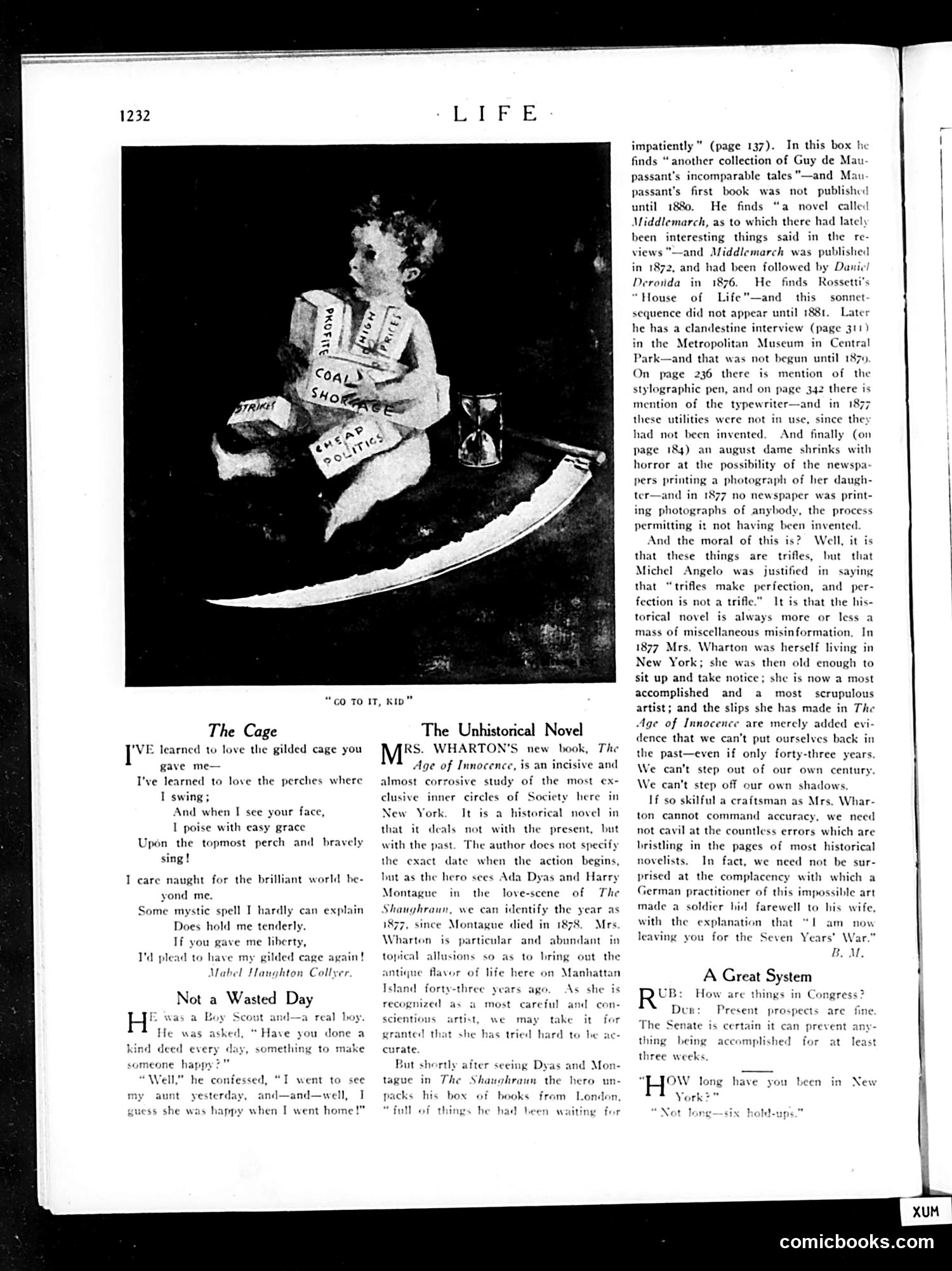
This page from *Life* magazine contains a literary critique of Edith Wharton's novel *The Age of Innocence*. The reviewer systematically identifies historical anachronisms in the book—items and references that shouldn't exist in 1877 (the novel's setting), including Guy de Maupassant's works (published after 1880), the Metropolitan Museum (not completed until 1870), stylographic pens and newspaper photography (not yet invented), and Rossetti's poetry collection (1881). The reviewer's point: even accomplished artists like Wharton cannot accurately recreate the past. The column argues these "trifles" matter because humans cannot truly escape their own era—we're trapped by our contemporary perspective. This serves as commentary on the impossibility of historical authenticity, not genuine criticism of Wharton's artistic merit. The poems and brief anecdotes on the page are unrelated filler content typical of *Life*'s mixed editorial format.
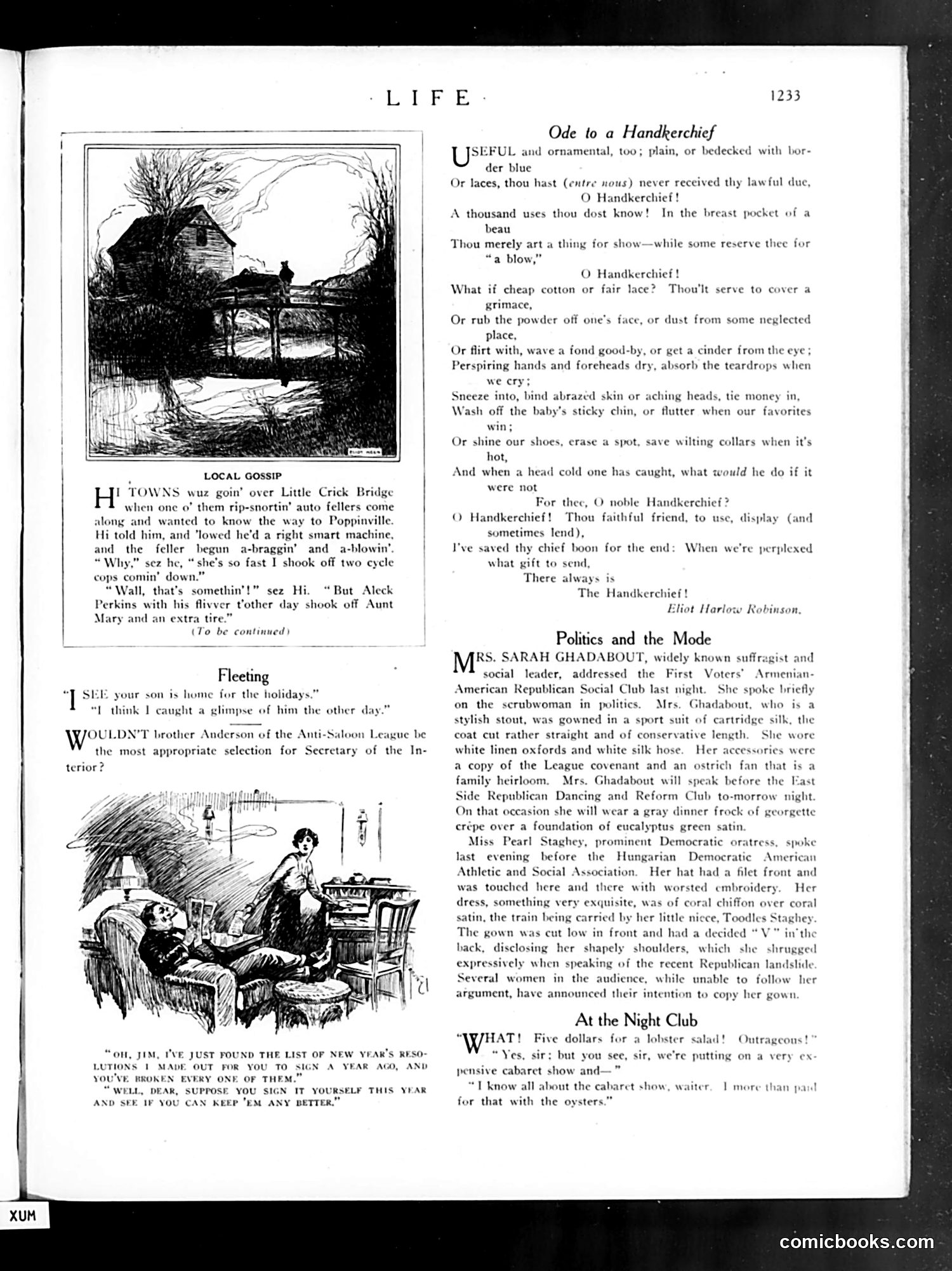
This page from *Life* satirizes early 20th-century American social and political pretension through humor and brief comedic pieces. **"Local Gossip"** presents rural dialect humor about automobiles—a new technology—with characters bragging about car speed in exaggerated terms. **"Fleeing"** jokes about a son briefly visiting home during holidays, suggesting he avoids his parents. **"Politics and the Mode"** offers sharp satire on suffragists and female political speakers. Two women—Mrs. Sarah Ghadabout (a suffragist) and Miss Pearl Staghey (a Democrat)—deliver speeches on serious political topics, yet the article describes only their clothing in elaborate detail. The final lines mock female audience members who couldn't follow the arguments but plan to copy the dress designs. This satirizes how women's political participation was trivialized by focusing on fashion rather than substance—a common dismissal of early suffragists. The "Ode to a Handkerchief" and "At the Night Club" are separate lighter pieces. The satire exposes how women's political ambitions were undermined by society's obsession with their appearance rather than their ideas.
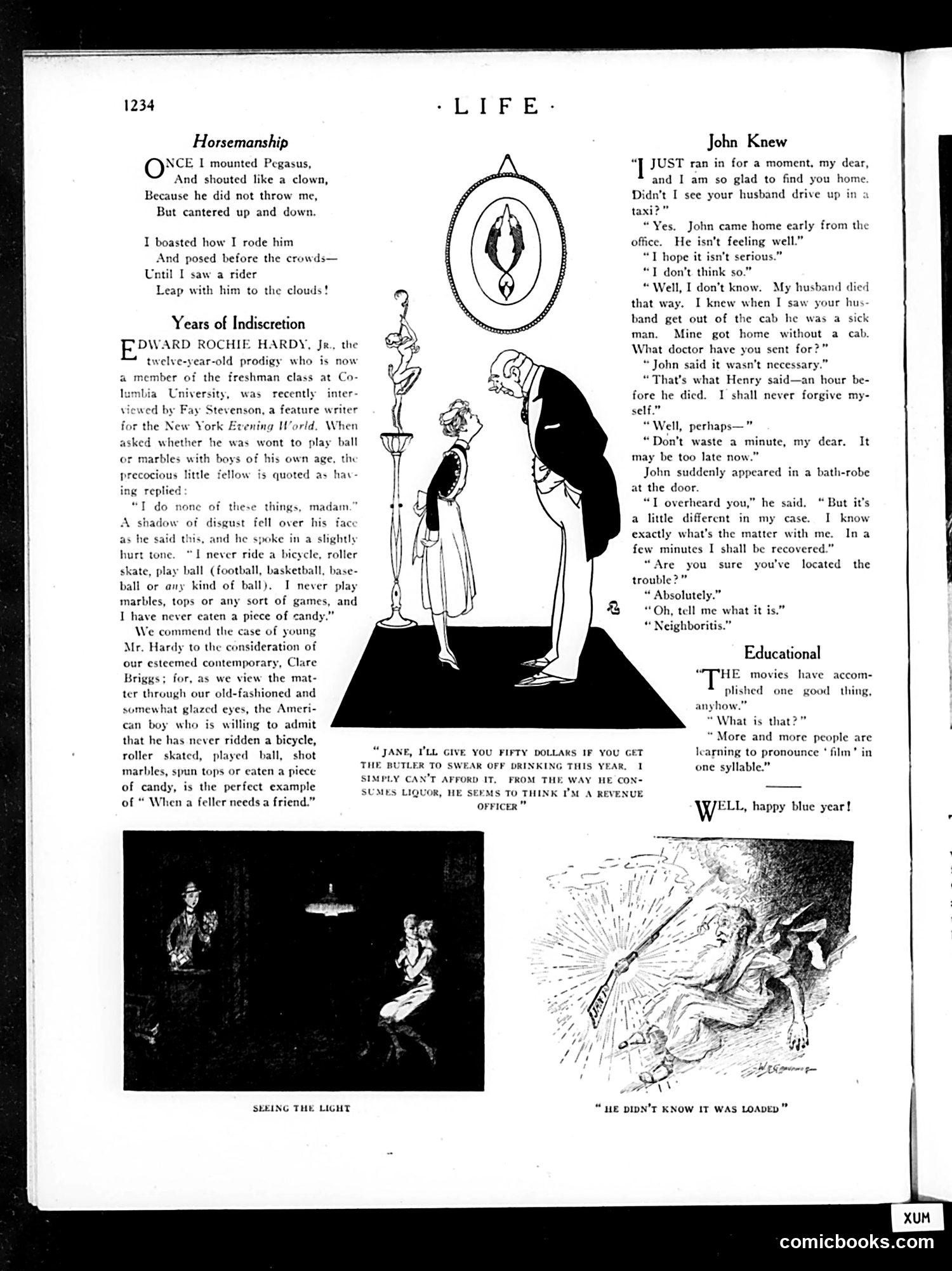
This page contains three satirical pieces typical of early 20th-century American humor: **"Horsemanship"**: A brief poem mocking false boasting—someone brags about riding Pegasus (the mythical winged horse) until witnessing a truly skilled rider. **"Years of Indiscretion"**: Satirizes Edward Rochie Hardy Jr., a twelve-year-old prodigy enrolled at Columbia University. The piece quotes him claiming he's never played sports, ridden bicycles, or eaten candy—rejecting all normal childhood activities. The magazine sardonically praises this as admirable discipline while implying such behavior is emotionally stunted and unnatural for boys. **"John Knew"**: A domestic comedy where a visiting woman diagnoses John's minor illness as serious ("neighboritis"), based on her late husband's similar symptoms, creating comic anxiety until John reveals he already knows his condition is trivial. The bottom panels include unrelated brief jokes about butler drinking and firearms safety. Overall, the page satirizes pretension, social anxiety, and shifting cultural attitudes toward childhood development.
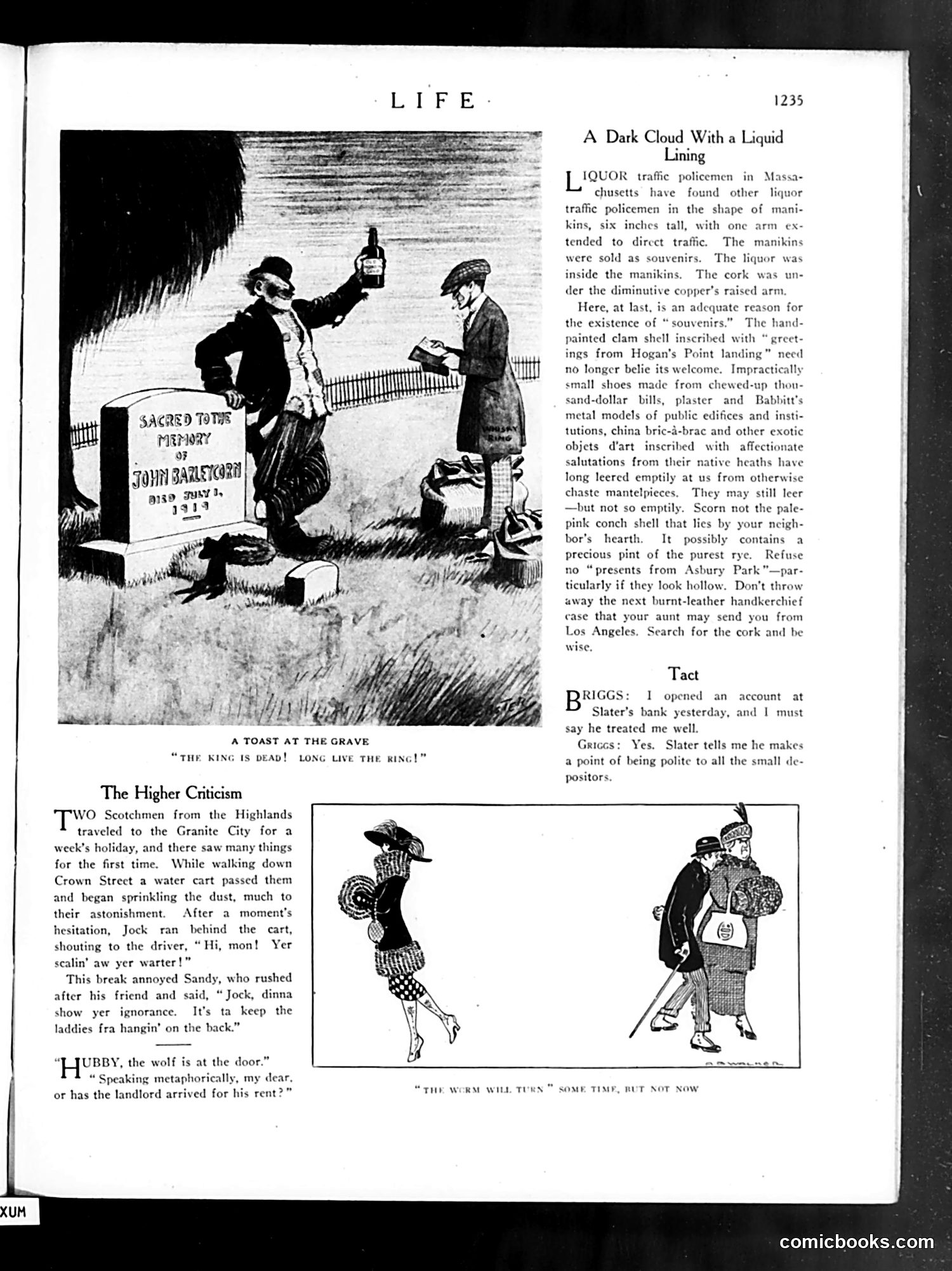
This page contains three distinct satirical pieces: **"A Dark Cloud With a Liquid Lining"**: Commentary on Prohibition-era smuggling. Massachusetts police discovered liquor hidden inside small souvenir manikins (6-inch copper policeman figurines with raised arms) sold as tourist trinkets. The piece sardonically notes that hollow souvenirs—clam shells, plaster models, decorative objects—traditionally cluttering mantels could now secretly contain bootleg whiskey, making them finally "useful." **"The Higher Criticism"**: A Scottish dialect joke about two Highland visitors to Glasgow who misunderstand a water cart sprinkling streets (to suppress dust). One assumes the driver is "scalin' aw yer warter" (wasting water); the other condescendingly explains it prevents people hanging onto the back—implying rural ignorance versus urban sophistication. **"Tact"**: A brief banking joke where Slater's politeness to new depositors is actually calculated self-interest: he treats small depositors well knowing they'll eventually accumulate wealth. All content satirizes class differences, provincial ignorance, and everyday hypocrisy.
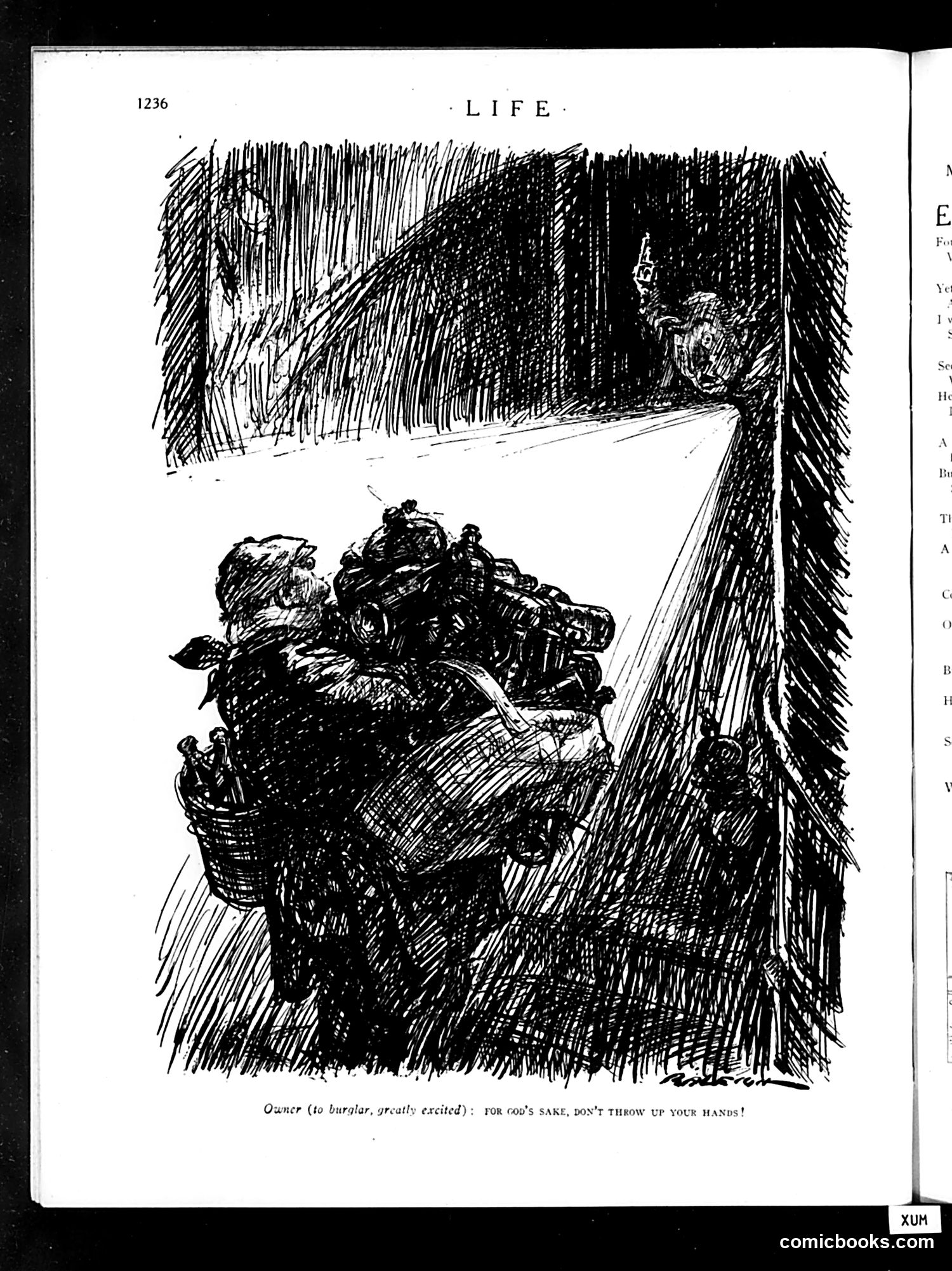
This single-panel cartoon depicts a home invasion scenario with dark humor. A burglar, caught in the act, is being confronted by the homeowner who frantically urges him not to raise his hands in surrender. The joke appears to rely on the burglar's loaded arms—he's carrying so much stolen loot that raising his hands would cause everything to spill and scatter across the floor. The homeowner, seemingly more concerned about the mess than the theft itself, pleads with the criminal to keep his hands down. The satire mocks the homeowner's misplaced priorities, suggesting he cares more about household disorder than protecting his property—a commentary on bourgeois anxieties about cleanliness and tidiness superseding practical concerns.
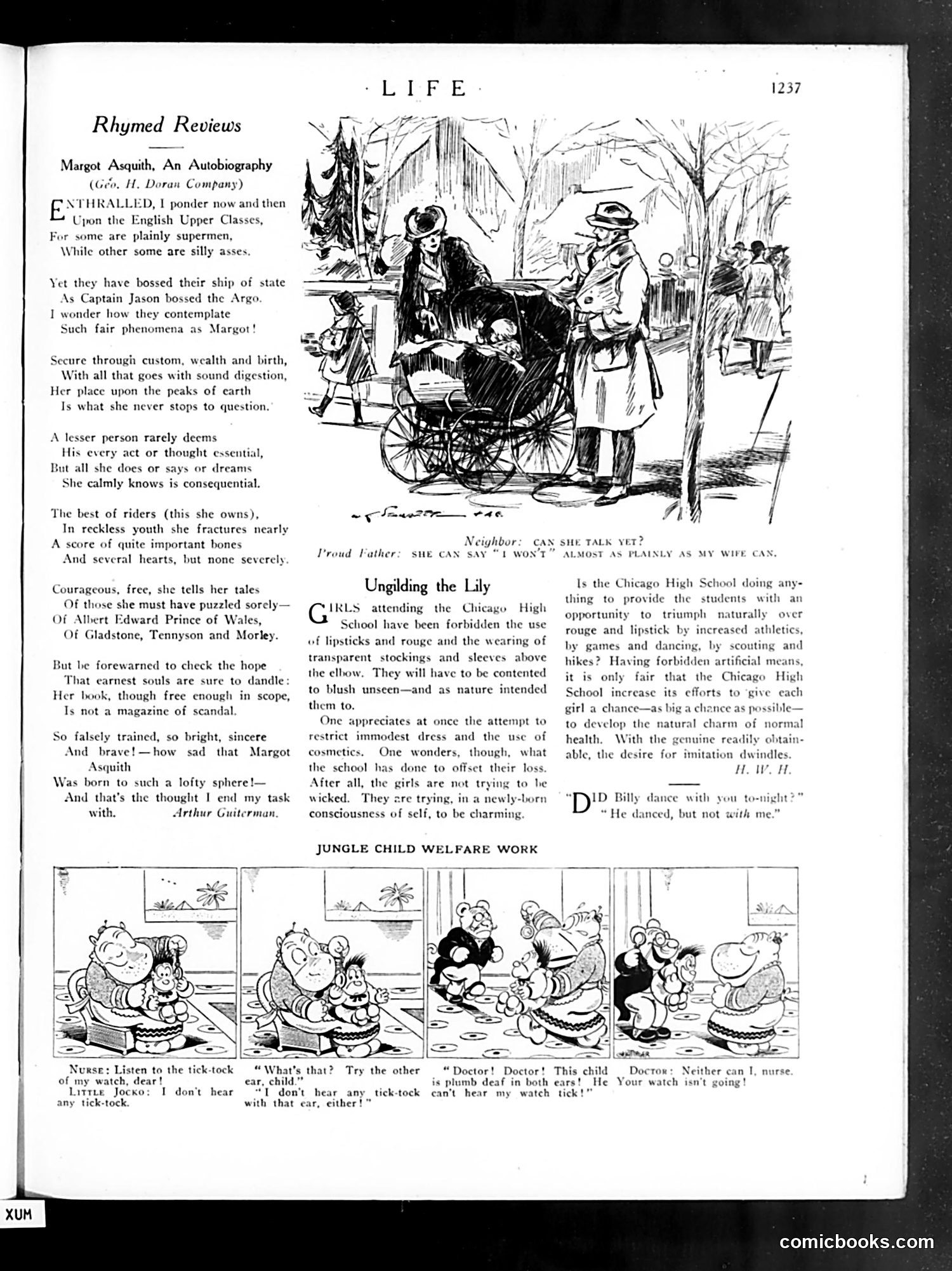
**Rhymed Review:** Arthur Guiterman satirizes Margot Asquith's autobiography. Asquith was the wife of British Prime Minister H.H. Asquith. Guiterman mocks the English upper class—particularly Asquith herself—for their unearned confidence and self-importance despite being sometimes "silly asses." He acknowledges she's bold and well-connected (mentioning Prince Albert Edward, Gladstone, Tennyson), but suggests she epitomizes aristocratic entitlement: born into privilege, she "never stops to question" her elevated position and views her every action as "consequential." The satire targets upper-class smugness and obliviousness. **"Ungilding the Lily":** This mocks Chicago High School's ban on lipstick, rouge, and revealing clothing for girls. The commentary ironically questions whether the school, having forbidden cosmetics to encourage "natural" beauty, will provide alternative outlets (athletics, dancing, scouting) to help girls develop genuine health and charm—or if it simply denies them tools for self-expression without compensation. **"Jungle Child Welfare Work":** A comic strip where a nurse can't detect a child's deafness, leading to absurd misdiagnosis by a "doctor."
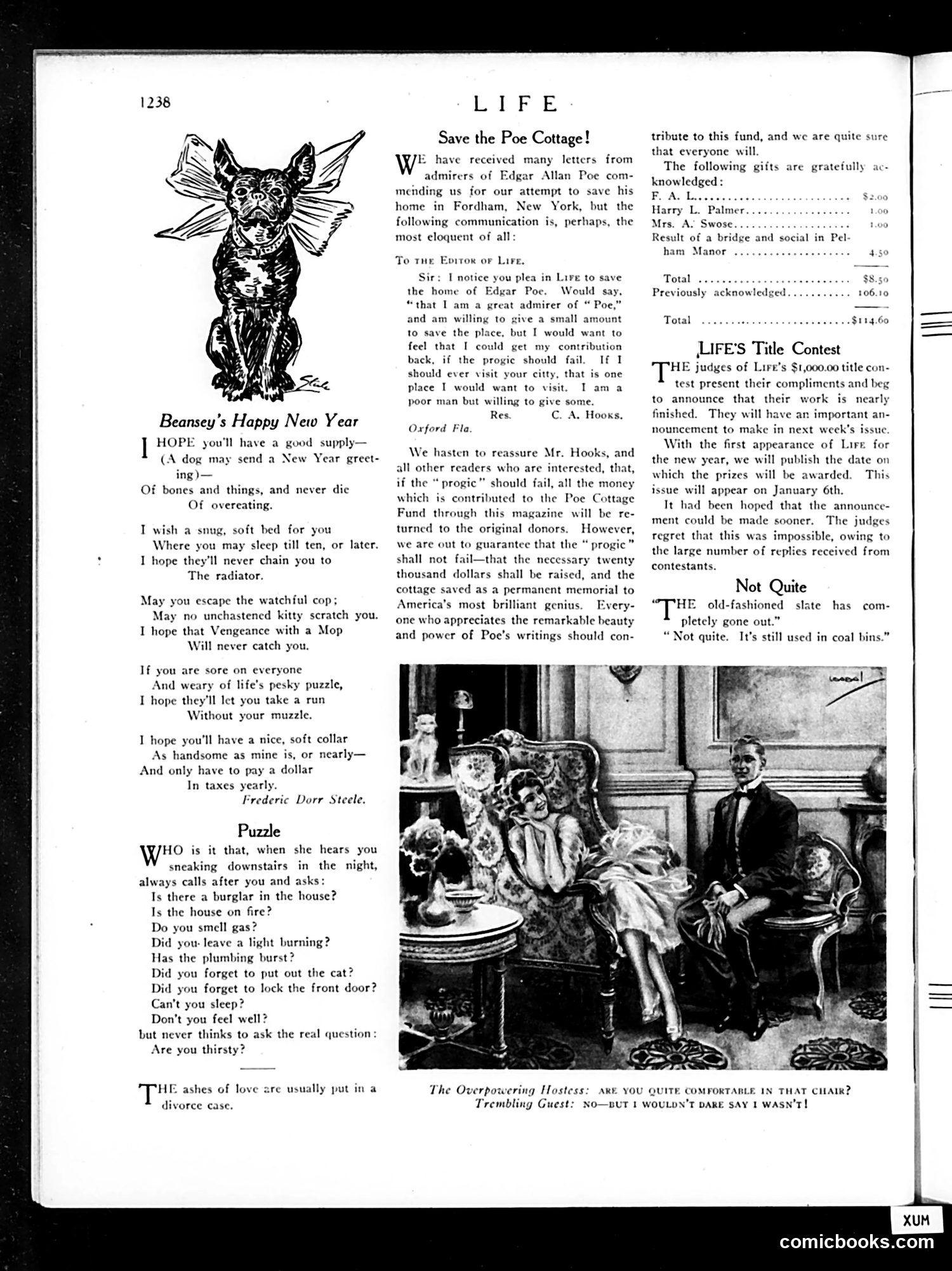
This page contains several distinct pieces of humor and content: **"Beansey's Happy New Year"** is a lighthearted poem by Frederic Dorr Steele offering comic New Year's wishes *to a dog*—hoping for bones, freedom from chains and muzzles, escape from police, and modest tax burdens. It's anthropomorphic humor treating a dog as a citizen with recognizable grievances. **"The Puzzle"** is a domestic joke identifying "the mother" or worried wife—the figure who interrogates a person sneaking downstairs at night with endless anxious questions (burglars? fire? gas leaks?) but never asks the obvious practical one: "Are you thirsty?" The humor lies in exposing the absurdity of anxious overthinking. **"Save the Poe Cottage!"** reports a fundraising campaign to preserve Edgar Allan Poe's home in Fordham, New York, with reader donations acknowledged. **"Not Quite"** is a brief joke about old-fashioned slate—supposedly obsolete but still used in coal bins. The cartoon shows an anxious guest uncomfortably seated while the hostess inquires about comfort; the guest won't honestly complain due to social politeness.
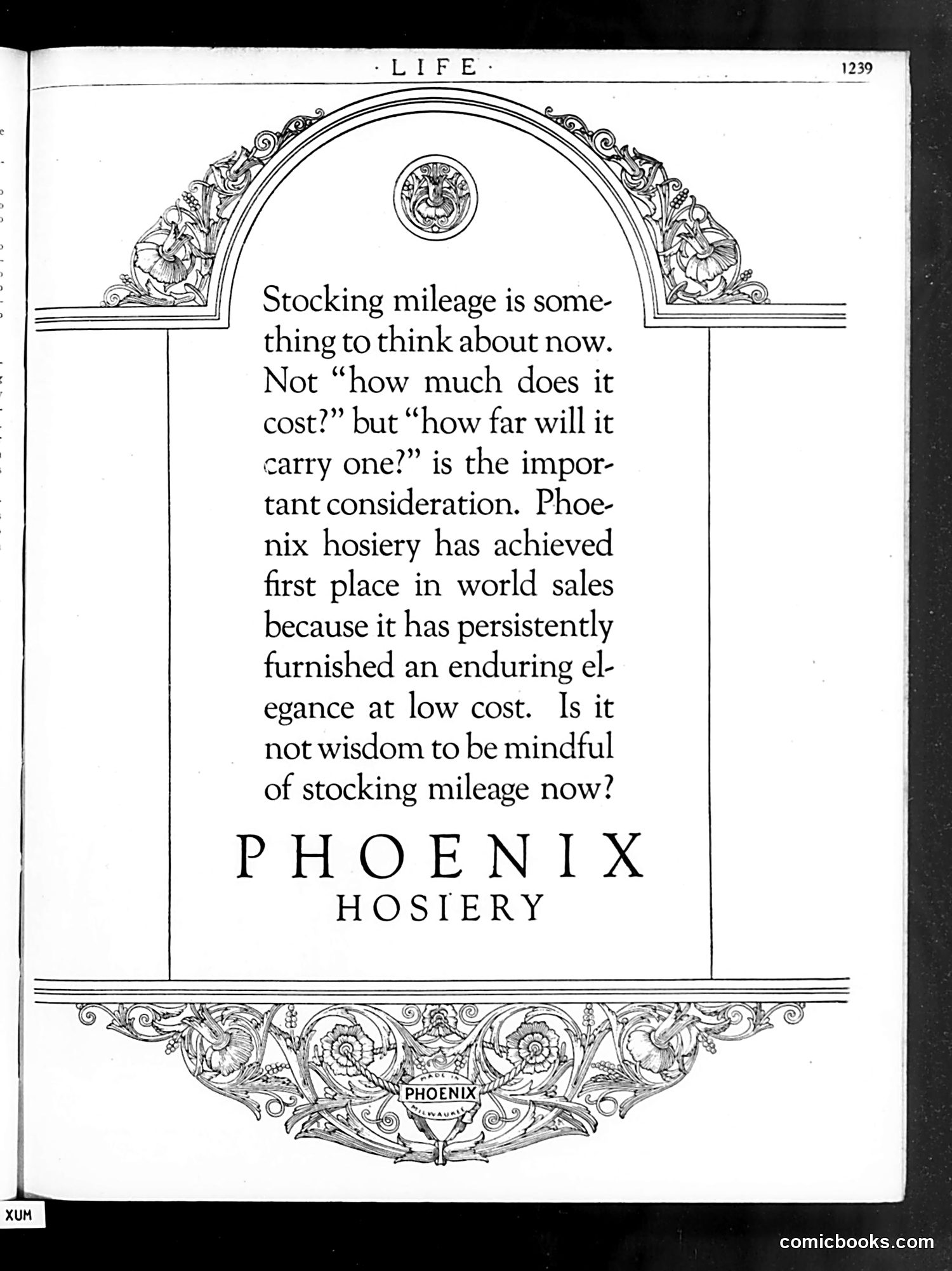
This is a **full-page advertisement**, not political satire. The page promotes Phoenix brand hosiery to early-twentieth-century consumers, likely during or after World War I when rationing and material scarcity made durability a selling point. The ad's pitch reframes the purchasing decision: rather than asking "how much does it cost," buyers should consider "how far will it carry one?"—essentially, how many miles of wear before the stockings wear out. This emphasizes value and longevity over price. The decorative border and formal typography reflect the magazine's upscale presentation. The claim that Phoenix achieved "first place in world sales" through offering "enduring elegance at low cost" positions the brand as combining quality with affordability—a pragmatic appeal during economically uncertain times.
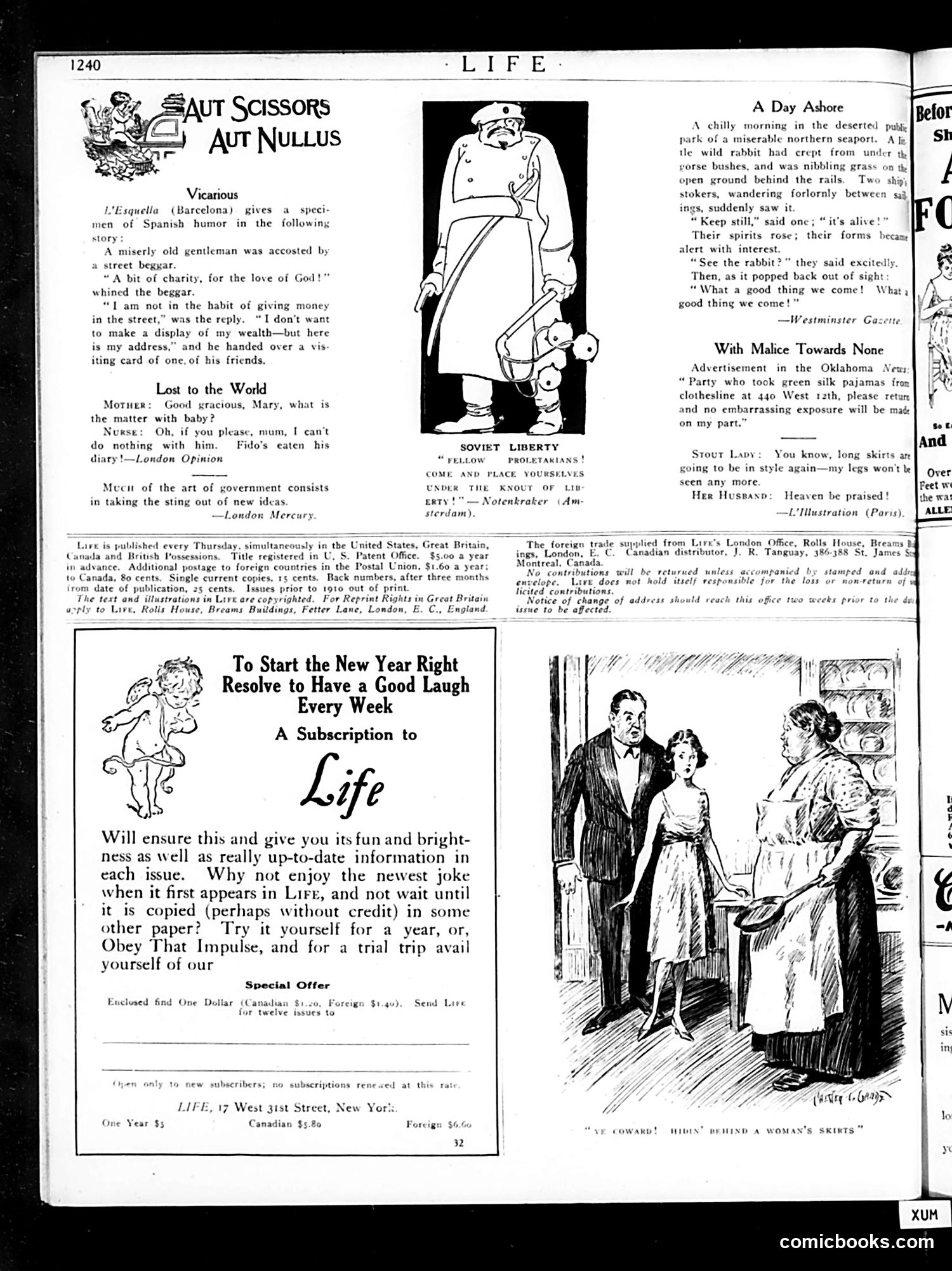
This page contains multiple brief satirical pieces typical of Life's humor: **"Soviet Liberty" cartoon**: Mocks Soviet communism by depicting a brutal "knout" (whip) labeled as "liberty"—suggesting the revolution merely replaced one tyranny with another under Lenin's regime. **"Lost to the World"**: A domestic humor piece where a nurse reports the baby's diary was eaten by the family dog, playing on class anxieties about servants and privacy. **The illustration** (bottom right) captioned "Coward! Hides Behind a Woman's Skirts" depicts a man ducking behind a woman, likely satirizing male cowardice or social hypocrisy—possibly referencing wartime draft evasion or political opportunism. **"A Day Ashore"**: Brief narrative about working-class sailors finding momentary joy spotting a wild rabbit during shore leave—gentle humor about simple pleasures. The page emphasizes Life's mission: delivering current political and social satire alongside domestic humor, targeting educated readers aware of contemporary issues like Bolshevism and class dynamics.
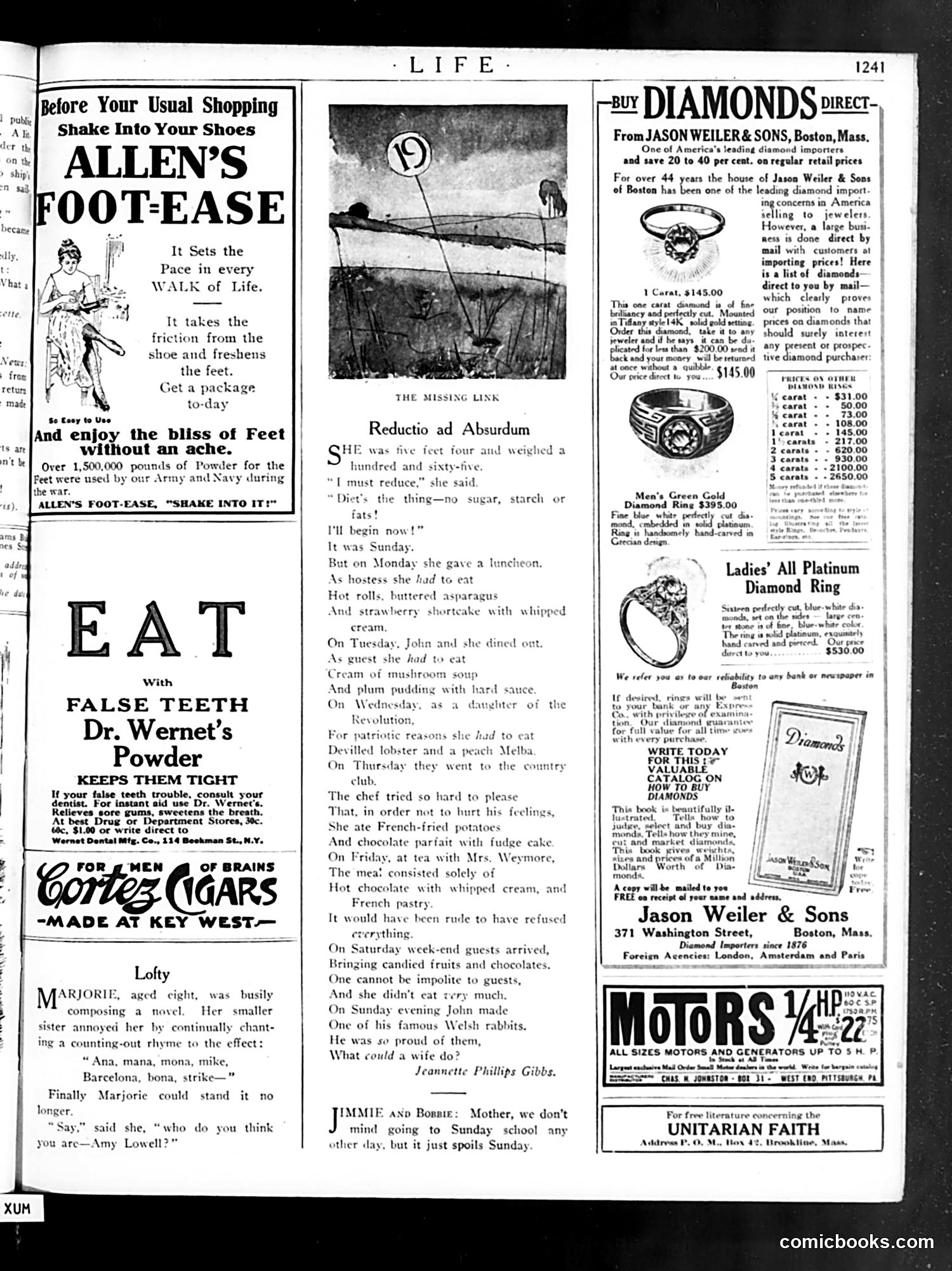
This page is **primarily advertising** with two brief satirical pieces interspersed. The main content advertises foot powder, false teeth powder, cigars, and diamonds—typical early 20th-century products. **The satire:** 1. **"Reductio ad Absurdum"** (center): A woman vows to diet but finds herself eating rich foods at every social obligation throughout the week—hot rolls, lobster, chocolate parfait, etc. The joke: she blames social politeness ("one cannot be impolite to guests") for her inability to maintain the diet. It satirizes both women's weight-consciousness and the social pressures of entertaining/dining culture. 2. **"Lofty"** (lower left): A child annoys her sister Marjorie by reciting a counting-out rhyme. Marjorie snaps back sarcastically, "who do you think you are—Amy Lowell?" This references **Amy Lowell**, the famous modernist poet known for experimental verse—the joke being comparing a silly nursery rhyme to serious poetry. Both pieces gently mock social conventions and affectations of the era.
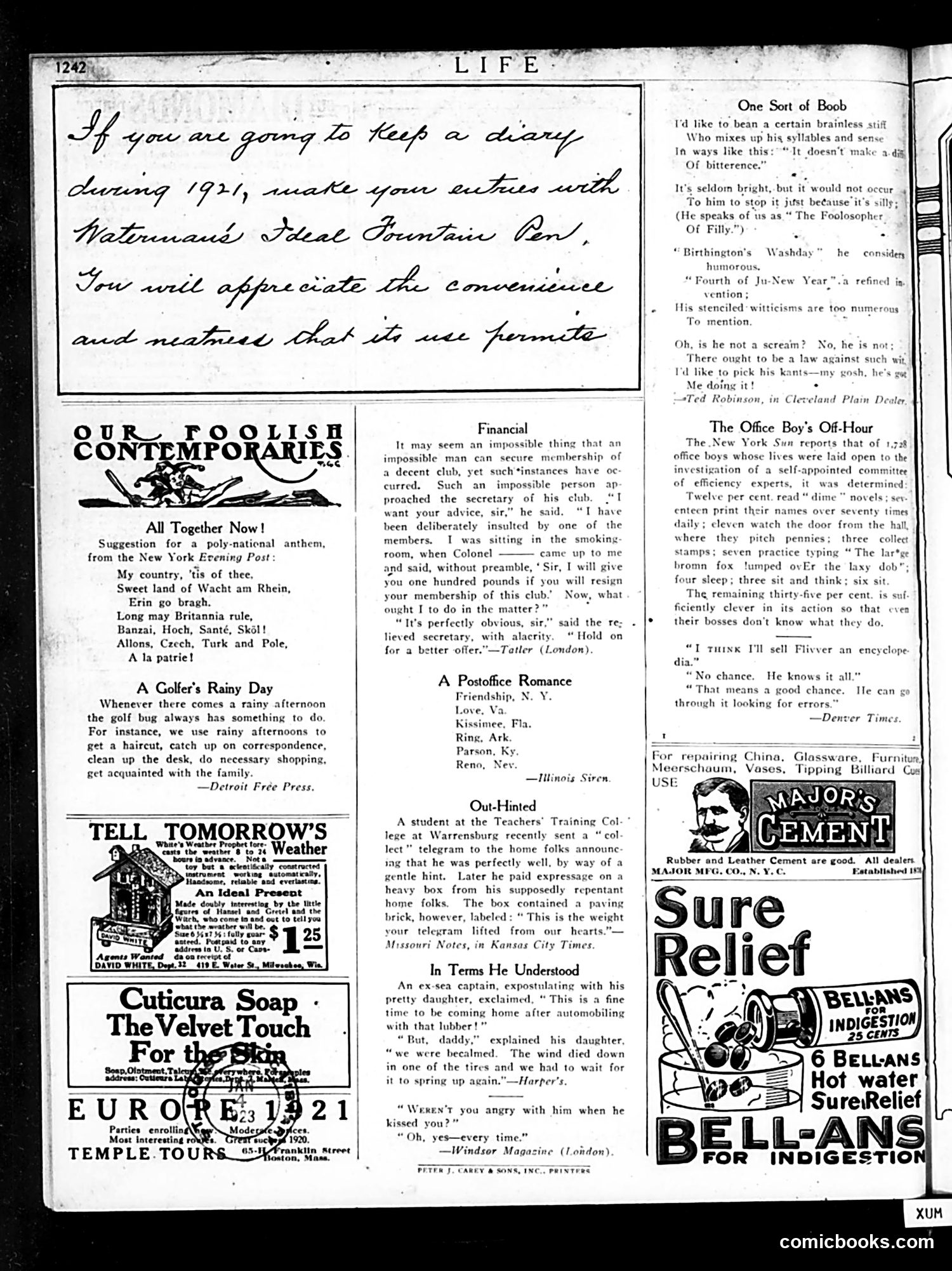
This page from Life magazine (circa 1921) is primarily **advertising and humorous short pieces**, not political cartoons. The main satirical content is "All Together Now!" — a suggestion for a "poly-national anthem" mixing patriotic songs from multiple nations (American, German, Irish, British, Japanese, French, Czech, Turkish, Polish). This mocks post-WWI national tensions and the difficulty of international unity after the Great War, when these nations had recently been enemies or rivals. The other pieces are light humor: golfers use rain as excuses to avoid family time; a club member tries to bribe someone to resign; a student's clever "light" telegram is met with a heavy brick response; an ex-sea captain misunderstands his daughter's automobile excuse; an office boy's time is unaccounted for. The advertisements (Cuticura Soap, Bell-ans indigestion remedy, cement) occupy significant space. Overall, this is a typical 1921 Life issue mixing gentle satire with advertising.

This is a **United States Rubber Company advertisement**, not political satire. The page promotes United States Tires through a somewhat manipulative argument. The ad's logic: just as you'd demand transparency buying a tire from a stranger, you should trust tire dealers who openly display the U.S. Rubber Company name and provide facts—implying competitors withhold information. The headline "Where there is Secrecy and Evasion there is Something to Hide" suggests rival tire makers are dishonest. The photograph shows two men in a garage examining automobiles, likely illustrating proper tire care (jacking up cars for winter storage) mentioned in the caption above. The pitch is essentially: **transparency equals trustworthiness; therefore buy from us**—a corporate trust-building campaign common in early 20th-century advertising. It conflates the company's reputation with dealer honesty, claiming U.S. Rubber "backs" all dealers with "its own" resources and responsibility.
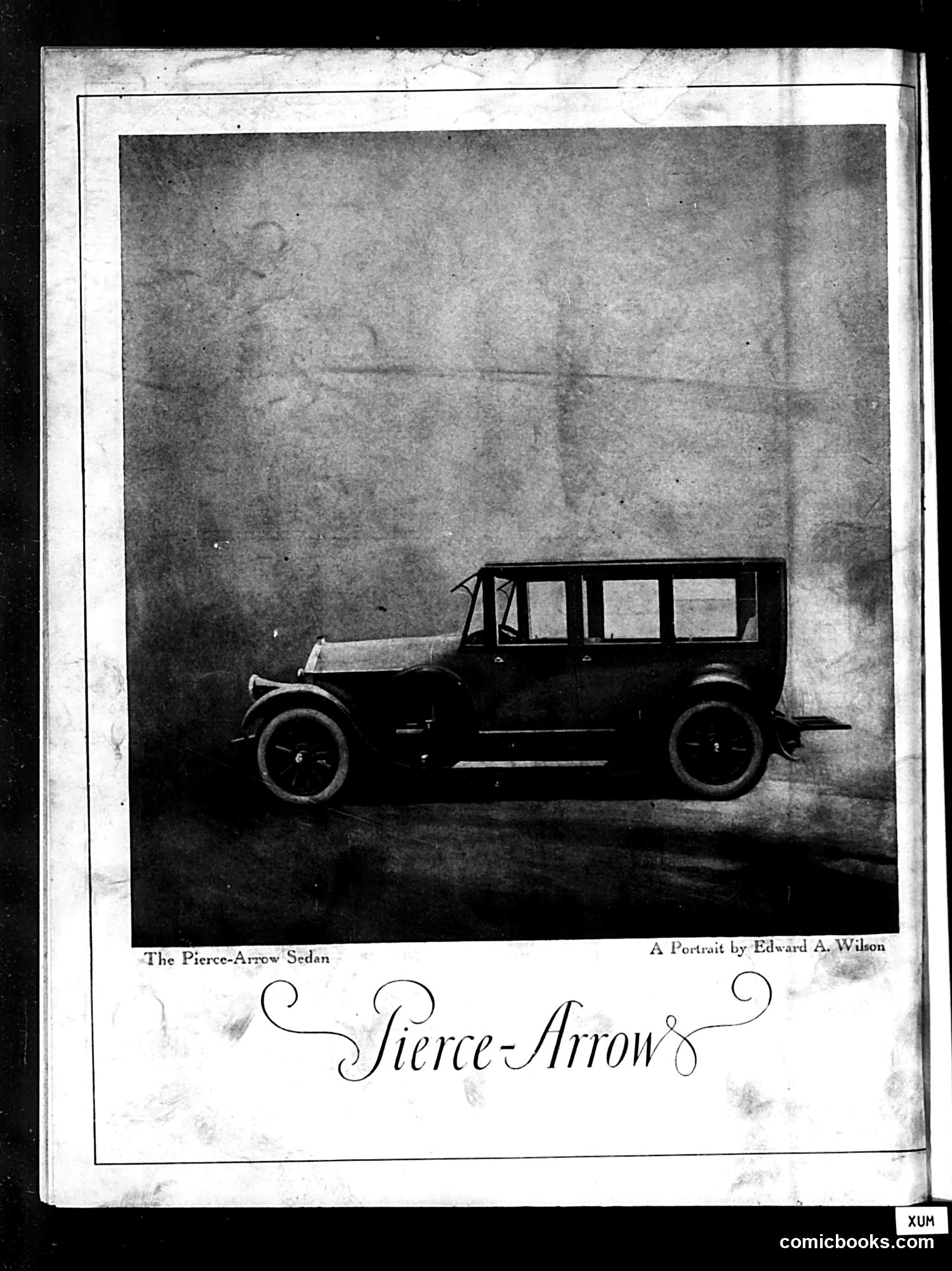
This is a straightforward automobile advertisement, not political satire. It presents a side-profile photograph of a Pierce-Arrow Sedan—a luxury car manufactured in the early 20th century. The image is credited as "A Portrait by Edward A. Wilson," treating the vehicle as a subject worthy of artistic portraiture, which was common advertising practice for high-end automobiles of this era. The elegant script typography and studio photography against a plain backdrop emphasize the car's prestige and refinement. There is no cartoon, caricature, or political commentary visible. This appears to be a branded advertisement from *Life* magazine showcasing the Pierce-Arrow's design to affluent readers.

I can see this is a mostly black page with "XUM" labeled in the bottom left corner and "comicbooks.com" at the bottom right. The image is extremely dark and illegible—I cannot make out any cartoon illustrations, text content, or satirical elements that would allow me to identify figures, political references, or explain any jokes to a modern reader. The watermark "comicbooks.com" suggests this may be a digitized archive image, but the poor image quality (possibly a scanning error or deteriorated original) prevents meaningful analysis. Without visible content, I cannot fulfill the task of explaining the satire or context.