
Life, 1920-12-30 · page 28 of 39
Life — December 30, 1920 — page 28: what you’re looking at
What you’re looking at
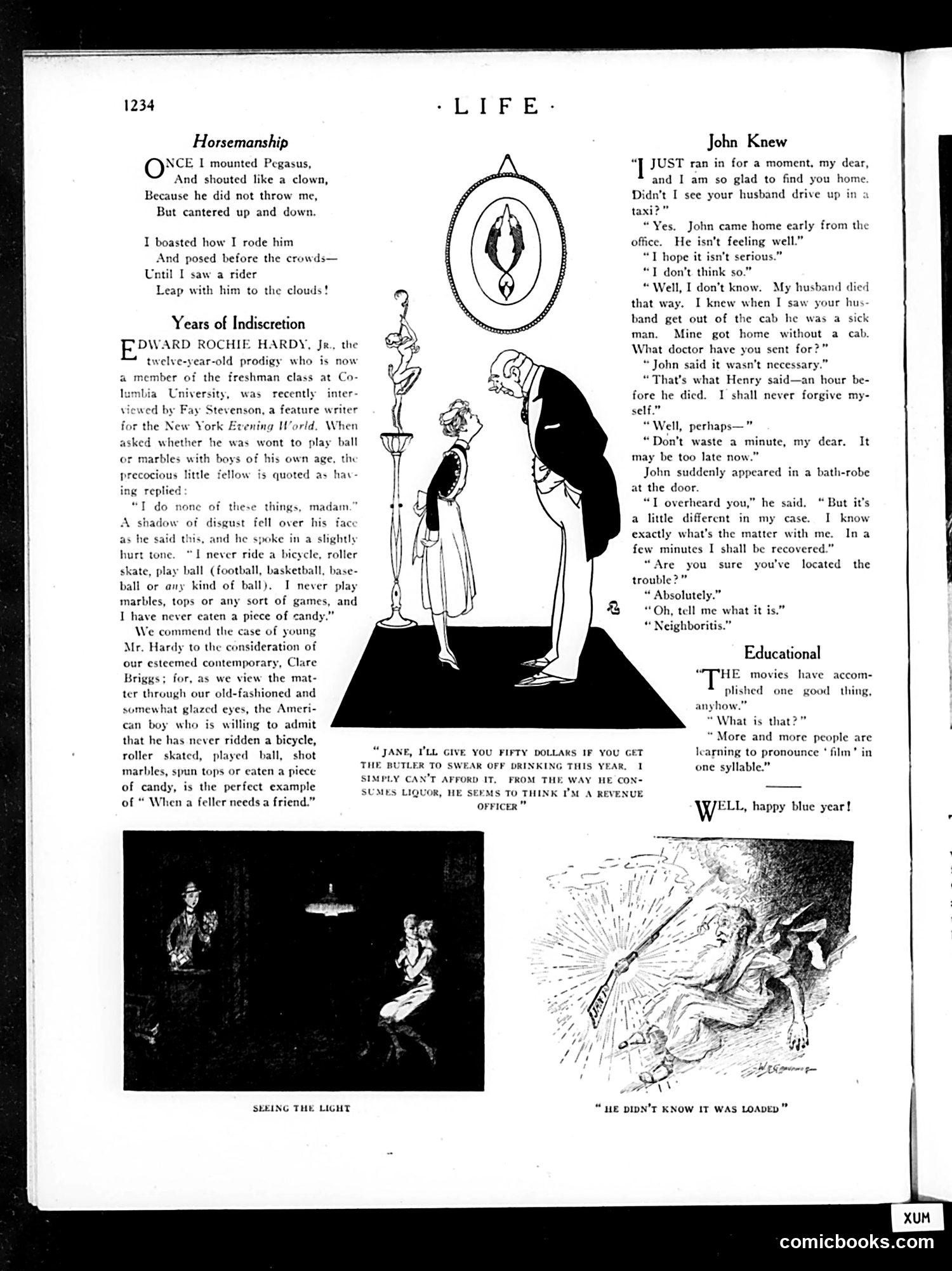
This page contains three satirical pieces typical of early 20th-century American humor: **"Horsemanship"**: A brief poem mocking false boasting—someone brags about riding Pegasus (the mythical winged horse) until witnessing a truly skilled rider. **"Years of Indiscretion"**: Satirizes Edward Rochie Hardy Jr., a twelve-year-old prodigy enrolled at Columbia University. The piece quotes him claiming he's never played sports, ridden bicycles, or eaten candy—rejecting all normal childhood activities. The magazine sardonically praises this as admirable discipline while implying such behavior is emotionally stunted and unnatural for boys. **"John Knew"**: A domestic comedy where a visiting woman diagnoses John's minor illness as serious ("neighboritis"), based on her late husband's similar symptoms, creating comic anxiety until John reveals he already knows his condition is trivial. The bottom panels include unrelated brief jokes about butler drinking and firearms safety. Overall, the page satirizes pretension, social anxiety, and shifting cultural attitudes toward childhood development.
📄 Transcribed text from this page (OCR, searchable)
Machine-transcribed from the original scan — historical spelling and the odd misread are preserved.
Horsemanship CE I mounted Pegasus, And shouted like a clown, Because he did not throw me, But cantered up and down. I boasted how I rode him And posed before the crowds— Until I saw a rider Leap with him to the clouds! Years of Indiscretion DWARD ROCHIE HARDY, Ja., the twelve-year-old prodigy who is now mber of the freshman class at Co- nbia University, was recently inter- iewed by Fay Stevenson, a feature writer the New York Evening H’orld. When whether he was wont to play ball or marbles with boys of his own age, precocious little fellow is quoted as hav- ing replied “T do none of these things, madam.” A shadow of disgust fell over his face as he said ti and he spoke in a slightly hurt tone. “1 never ride a bicycle, roller skate, play ball (football, basketball, base- ball or any kind of ball). I never play marbles, tops or any sort of games, and I have never eaten a piece of candy We commend the case of young Mr. Hardy to the consideration of our esteemed contemporary, Clare Briggs; for we view the mat- ter through our old-fashioned and smewhat glazed eyes, the Ameri- can boy who is willing to admit that he has never ridden a bicycle, roller skated, played ball, shot marbles, spun tops or eaten a piece of candy, is the perfect example of “ When a feller needs a friend.” SEEING THE LIGHT John Knew “T JUST ran in for a moment, my dear, and I am so glad to find you home. Didn't I see your husband drive up in Yes. John came home early from the office. He isn’t feeling well.” “T hope it isn’t serious.” “T don’t think so.” “Well, I don’t know. My husband died that way. I knew when I saw your hus- band get out of the cab he was a sick man. Mine got home without a cab. What doctor have you sent for?” “John said it wasn’t necessary.” “That's what Henry said—an hour be- fore he died. I shall never forgive my- self.” “Well, perhaps—” “Don't waste a minute, my dear. It may be too late now.” John suddenly appeared in a bath-robe at the door. “T overheard you,” he said. “ But it’s a little different in my case. I know exactly what's the matter with me. Ina few minutes I shall be recovered.” “Are you sure you've located the troubl “ Absolutely.” % “Oh, tell me what it is.” “ Neighboritis.” Educational “"THE movies have accom- plished one good thing, anyhow.” “What is that?” “More and more people are “ JANE, I'LL GIVE YOU FIFTY DOLLARS IF YOU GET learning to pronounce * film’ in THE BUTLER TO SWEAR OFF DRINKING THIS YEAR, I one syllable.” SIMPLY CAN'T AFFORD IT, FROM THE WAY HE CON- SUMES LIQUOR, HE SEEMS TO THINK I'M A REVENUE OFFICER” W ELL, happy blue year! “ME DIDN'T KNOW IT WAS LOADED” comicbooks.com