
Life, 1920-12-30 · page 22 of 39
Life — December 30, 1920 — page 22: what you’re looking at
What you’re looking at
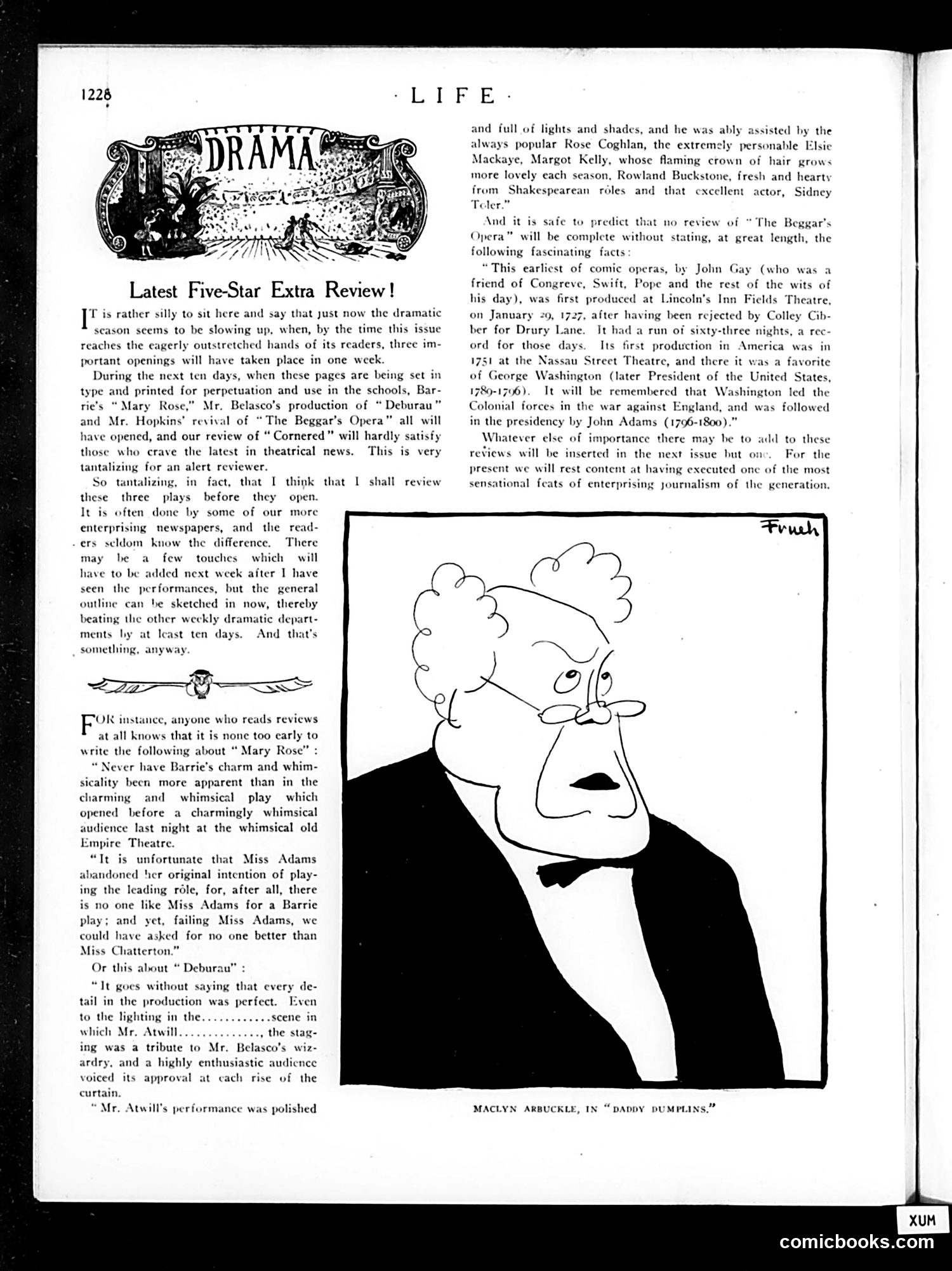
This page satirizes theatrical criticism and journalistic shortcuts. The author humorously proposes reviewing three Broadway plays—"Mary Rose," "Deburau," and "The Beggar's Opera"—*before they open*, claiming newspapers do this routinely without readers noticing. The satire mocks predictable critical clichés: praising a playwright's "charm and whimsy," calling production details "perfect," listing cast members with generic compliments, and padding reviews with irrelevant historical facts (about John Gay and George Washington). The cartoon shows Maclyn Arbuckle in "Daddy Dumplins," illustrating contemporary theater. The joke targets both lazy journalism and formulaic theater criticism—exposing how reviews often follow templates rather than genuine engagement with actual performances. For modern readers, it's a timeless critique of how media sometimes manufactures content rather than reporting actual events.
📄 Transcribed text from this page (OCR, searchable)
Machine-transcribed from the original scan — historical spelling and the odd misread are preserved.
“LIFE: Latest Five-Star Extra Review! T is rather silly to sit here and say that just now the dramatic ason scems to be slowing up, when, by the time this issue reaches the eagerly outstretched hands of its readers, three im- portant openings will have taken place in one week. During the next ten days, when these pages are being set in type and printed for perpetuation and use in the schools, Bar- rie’s “ Mary Rose,” Mr. Belasco’s production of “ Deburau” and Mr. Hopkins’ revival of “The Beggar’s Opera” all will have opened, and our review of “ Cornered” will hardly satisfy those who crave the latest in theatrical news. This is very tantalizing for an alert reviewer. So tantalizing, in that I think that 1 shall review these three plays before they open. It is often done by some of our more enterprising newspapers, and the read- ers seldom know the difference. There may be a few touches which will have to be added next week after 1 have seen the performances, but the general outline can he sketched in now, thereby beating the other weckly dramatic depart- ments hy at Icast ten days, And that’s something, anyway MO Se F‘ JK instance, anyone who reads reviews at all knows that it is none too early to write the following about “ Mary Rose “ Never have Barrie’s charm and whim- sicality been more apparent than in the charming and whimsical play which opened before a charmingly whimsical audience last night at the whimsical old Empire Theatre. “Tt is unfortunate that Miss Adams abandoned her original intention of play- ing the leading role, for, after all, there is no one like Miss Adams for a Barrie and yet, failing Miss Adams, we could have asked for no one better than Miss Chatterton,” Or this about “ Deburau” : “It goes without saying that every de- tail in the production was perfect. Even to the lighting in the..........6. scene in which Mr. Atwill... ++, the stag- ing was a tribute to Mr. Belasco’s wiz- ardry, and a highly enthusiastic audience voiced its approval at cach rise of the curtain. “Mr. Atwill’s performance was polished and {ull of lights and shades, and he was ably assisted by the always popular Rose Coghlan, the extremely personable Elsie Mackaye, Margot Kelly, whose flaming crown of hair grows more lovely each season, Rowland Buckstone, fresh and hearty from SI spearean roles and that excellent actor, Sidney Toler.” And it is safe to predict that no rev “The Beggar's Opera” will be complete without stating, at great length, the following fascinating facts “This earliest of comic operas, by John Gay (who was a friend of Congreve, Swift, Pope and the rest of the wits of his day), was first produced at Lincoin’s Inn Fields Theatre, on January 29, 1727, after having been rejected by Colley Cib- ber for Drury Lane. It had a run of sixty-three nights, a rec- ord for those days. Its first production in America was in 1751 at the Nassau Street Theatre, and there it was a favorite of George Washington (later President of the United ates, 1789-1706). It will be remembered that Washington led the Colonial forces in the war against England, and was followed in the presidency by John Adams (1796-1800) Whatever else of importance there may be to add to these reviews will be inserted in the next issue but ot For the present we will rest content at having executed one of the most sensational feats of enterprising journalism of the generation. MACLYN ARBUCKLE, IN “DADDY DUMPLINS.” comicbooks.com