
Life, 1920-12-30 · page 26 of 39
Life — December 30, 1920 — page 26: what you’re looking at
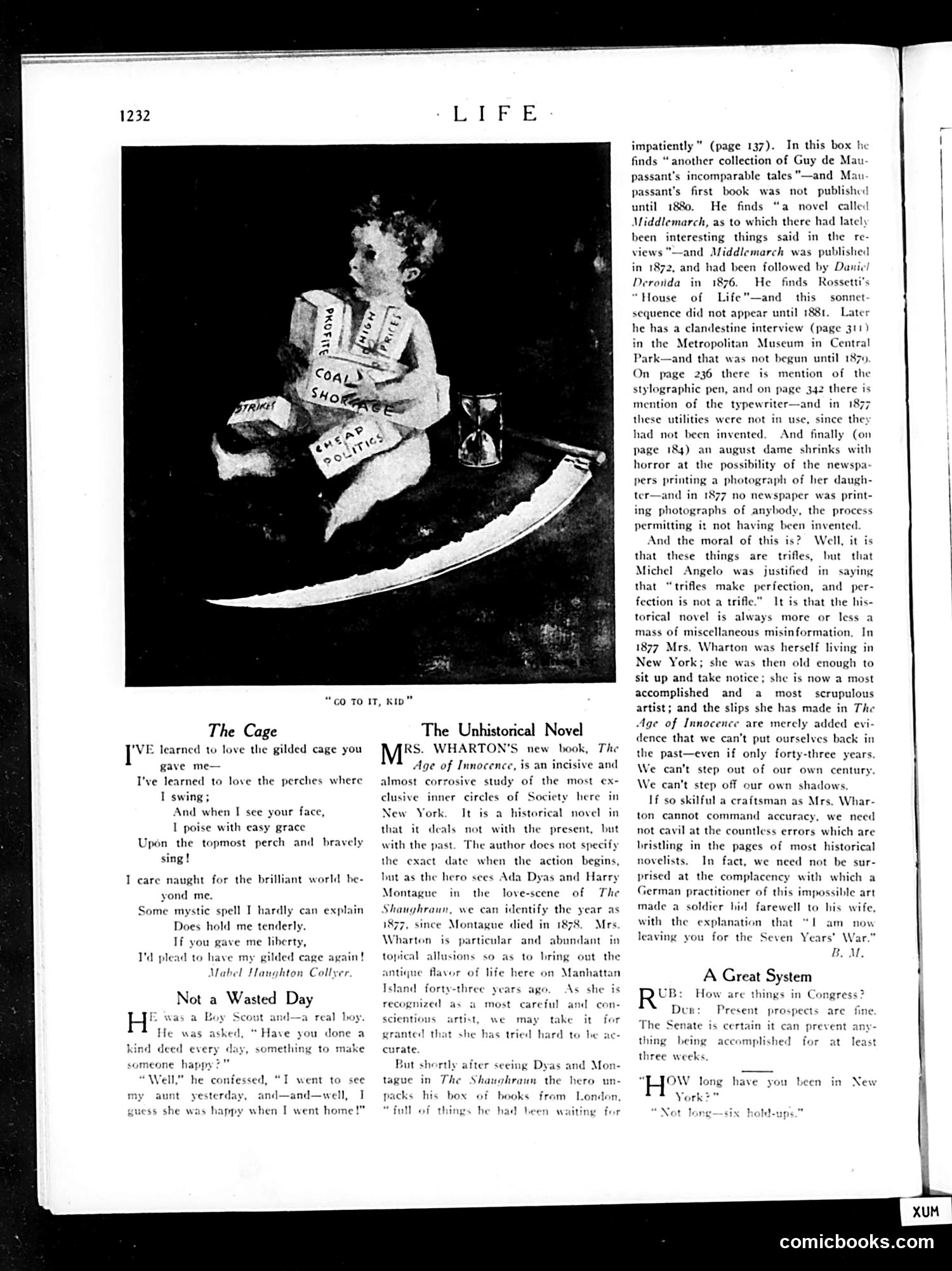
What you’re looking at
This page from *Life* magazine contains a literary critique of Edith Wharton's novel *The Age of Innocence*. The reviewer systematically identifies historical anachronisms in the book—items and references that shouldn't exist in 1877 (the novel's setting), including Guy de Maupassant's works (published after 1880), the Metropolitan Museum (not completed until 1870), stylographic pens and newspaper photography (not yet invented), and Rossetti's poetry collection (1881). The reviewer's point: even accomplished artists like Wharton cannot accurately recreate the past. The column argues these "trifles" matter because humans cannot truly escape their own era—we're trapped by our contemporary perspective. This serves as commentary on the impossibility of historical authenticity, not genuine criticism of Wharton's artistic merit. The poems and brief anecdotes on the page are unrelated filler content typical of *Life*'s mixed editorial format.
📄 Transcribed text from this page (OCR, searchable)
Machine-transcribed from the original scan — historical spelling and the odd misread are preserved.
“CO TO IT, Kip” The Cage Jv" learned to love the gilded cage you gave me— I've learned to love the perches where I swing; And when I see your face, I poise with easy grace Upon the topmost perch and bravely sing! I care naught for the brilliant world be- yond me. sme mystic spell T hardly can explain Does hold me tender! If you gave me liberty, I'd plead to have my gilded cag Mabel Haughton Collyer Not a Wasted Day a Boy Sec and—a rea Have you done a kind deed every something to make meone happy wW r aunt “T went to see nd—and—well, 1 happy when I went home!” "he confesse yesterday, guess she w The Unhistorical Novel RS. WHARTON'’S new boo! Age of Innocence almost corrosive study of the most ex- » The is an incisive and clusive inner circles of Society here in New York. It is a historical novel in that it deals not with the present, but with the past. The author does not specify the exact date when the action begins, but as the hero sees Ada Dyas and Harry Montague in the love-scene of The Shaughraun, we can identify the year as 1877, since Montague died in 1878. Mrs Wharton is particular and abundant in topical allusions so as to bring out. the antique flaver of life here on Manhattan Island forty-three years ago. As she is recognized as a most careful scientious artist, we may take nted that she has tried hard to he ac- urate, But shortly after seeing Dyas and Me tague in The Shaughraun the books ad heen waitir hero ur packs his box of “full of from Lon impatiently” (page 137). In this box he finds “another collection of Guy de Mau passant’s incomparable tales"—and M passant’s first book was not published until 1880. He finds “a novel called Middlemarch, as to which there had lately been interesting things said in the re- views "—and Middlemarch was published in 1872, and had been followed by Danic Deronda in 1876. He “House of Life"—and this sonnet sequence did not appear until 1881. Later he has a clandestine interview (page 311) in the Metropolitan Museum in Central Park—and that was not begun until 1870. On page 236 there is mention of the stylographic pen, and on page mention of the ty finds Rossetti’s 342 there is nd in 1877 these utilities were not in use, since they pewriter—; had not been invented. And finally (on page 184) an august dame shrinks with horror at the possibility of the newspa- pers printing a photograph of her daugh- ter—and in 1877 no newspaper was print- ing photographs of anybody, the process permitting it not having been invented. And the moral of this is? Well, it is that these things are trifles, but that Michel Angelo was justified in saying that “trifles make perfection, and per- fection is not a trifle.” torical novel is It is that the his- always more or less a mass of miscellaneous misinformation, In 1877 Mrs. Wharton was herself living in New York; she was then old enough to sit up and take notice; she is now a most accomplished and a most scrupulous artist; and the slips she has made in The Age of Innocence are merely added evi- dence that we can’t put ourselves back in the past—even if only forty-three years. We can't step out of our own century We can't step off our own shadows. If so skilful a craftsman as Mrs. Whar- ton cannot command accuracy, we need not cavil at the countless errors which are bristling in the pages of most historical novelists. In fact, we need not be sur- prised at the complacency with which a German practitioner of this impossible art made a soldier hid farewell to his wife with the expls ation that “1 am now leaving you for the Seven Years’ War.” BLM, A Great System UB: How are things in Congress? Dus: Present prospects are The Senate certain it can prevent thing thre being accomplished for at le weeks Hew long have y York?” Not been in New comicbooks.com f\