
Life, 1920-12-30 · page 8 of 39
Life — December 30, 1920 — page 8: what you’re looking at
What you’re looking at
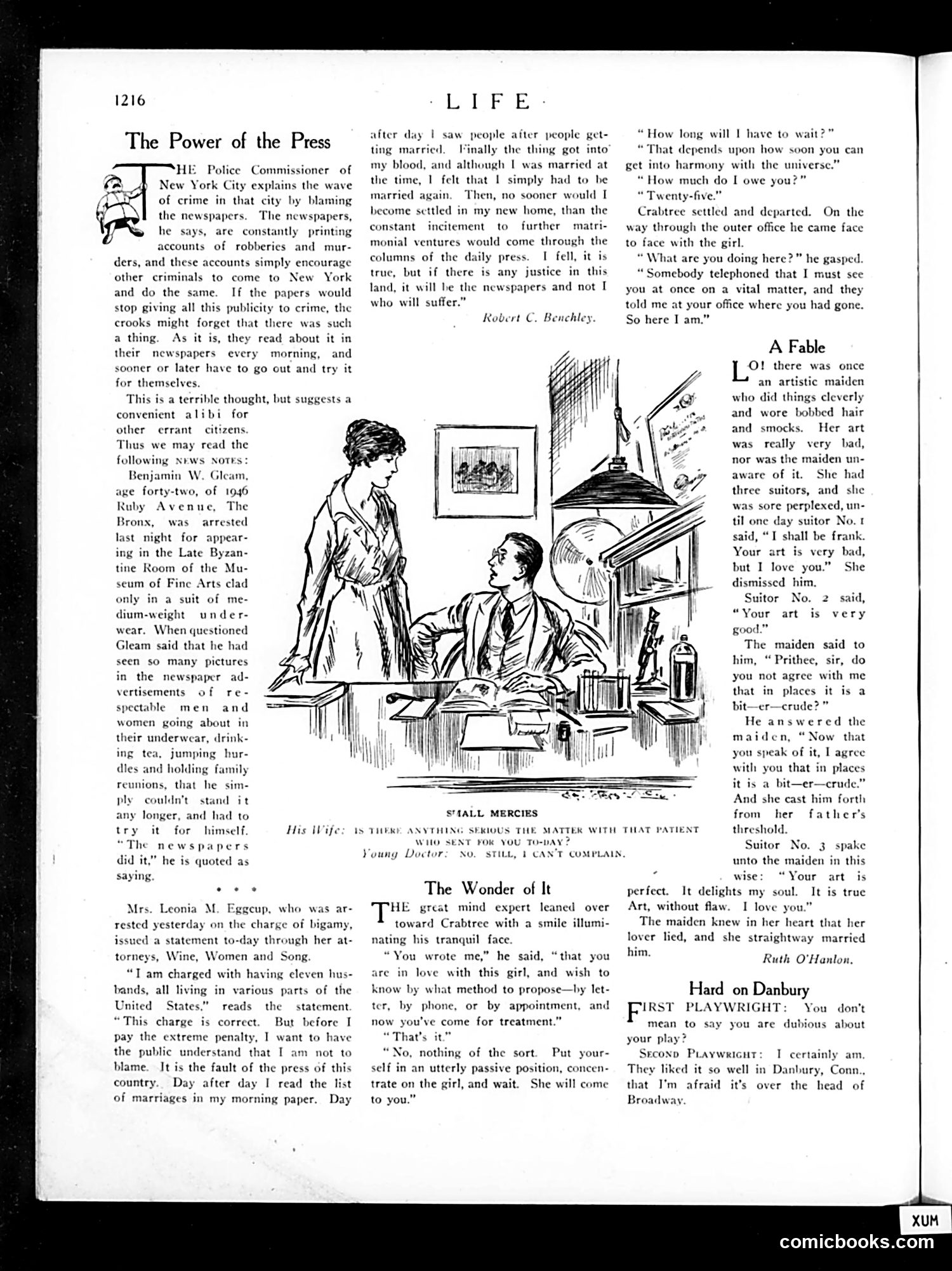
This page from *Life* magazine contains three separate pieces: 1. **"The Power of the Press"** — An editorial by Robert C. Benchley criticizing how New York newspapers sensationalize crime coverage, encouraging criminals to commit offenses for publicity. Benchley argues newspapers bear responsibility for crime waves. 2. **"Small Mercies"** — An illustration showing a young doctor visiting a patient, with dialogue about receiving treatment. The caption reads: "His wife: Is there anything serious the matter with that patient you sent for you today? Young Doctor: No still, I can't complain." 3. **"A Fable"** and **"The Wonder of It"** — Brief humorous stories about romantic/artistic matters. The page represents typical early 20th-century satirical magazine content mixing social commentary with light humor.
📄 Transcribed text from this page (OCR, searchable)
Machine-transcribed from the original scan — historical spelling and the odd misread are preserved.
1216 The Power of the Press HE Police Commissioner of New York City explains the wave of crime in that city by blaming the newspapers. The newspapers he says, are constantly printing and accounts of robberies ders, and these accounts simply encourage other criminals to to New York and do the same. If the papers would stop giving all this publicity to crime, the crooks might forget that there was such a thing. As it is, they read about it in their newspapers every morning, sooner or later have to go out and try it for themselves. mur- come and This is a terrible thought, but suggests a convenient alibi for other Thus we may read the following News Notes: errant citizens. Benjamin W. Gleam, age forty-two, of 1946 Ruby Avenue, The Bronx, arrested last night for appear- in the Late Byzan- tine Room of the Mu- seum of Fine Arts clad only in a suit of me- was dium-weight under- wear. When questioned Gleam said that he had seen so many pictures in the newspaper ad- vertisements of re- spectable men and women going about in their underwear, drink- ing tea, jumping hur- dles and holding family reunions, that he aldn’t ply c¢ stand it any longer, and had to tr it for himself. "The newspapers did it,” he is quoted as ing His Wife 84 Mrs. Leonia M. Eggeup, who ar- rested yesterday on the charge of bigamy, issued a statement to-day through her at- Women and Song. torneys, Wine, “Tam charged with having eleven hus- bands, all living in various parts of the United States,” the “This charge is correct. But pay the extreme penalty, I want to have the public understand that I blame. It is the fault of the press of this country. Day after day I read the list of marriages in my morning paper. Day reads statement before I um not to Is THK “LIFE. after day | saw people after people get- ting married. Finally the thing got into my blood, and although | was married at the time, | felt that 1 simply 1 to be married again become scttled in my new home, than the further matri- Then, no sooner would I constant incitement to monial ventures would come through the columns of the daily press. I fell, it is truc, but if there is any justice in this land, it will be the newspapers and not I who will suffer.” Robert C. Bench SMALL MERCIES ANYTHING SERIOUS THE MATTER WITH WHO SENT FOK YOU TO-DAY? Young Doctor: xo The Wonder of It HE great mind expert leaned over toward Crabtree with a smile illumi- nating his tranquil face. “You wrote me,” he said, “that you are in love with this girl, and wish to know by what method to propose—by let- ter, by phone, or by appointment, and now you've come for treatment.” “That's it.” No, nothing of the sort. Put your- self in an utterly passive position, concen- trate on the girl, and wait. She will come to you.” STILL, 1 CAN'T COMPLAIN, “How long will I have to wait “That depends upon how soon you get into harmony with the univers “How much do I owe you? “ Twenty-five.” Crabtree settled and departed. On the way through the outer office he came face to face with the girl. “What are you doing here?” he gasped. “Somebody telephoned that I must see you at once on a vital matter, and they told me at your office where you had gone. So here I am.” A Fable O! there was once an artistic maiden who did things cleverly and wore bobbed hair smocks. Her art was really very nor was the maiden un- aware of it. She had three suitors, and she and bad, was sore perplexed, un- til one day suitor No. 1 said, “I shall be frank. Your art is very bad, but I love you.” She dismissed him, Suitor No. said, “Your art is very good.” The maiden said to him, “ Prithee, sir, do you not agree with me that in places is a bit crude? He answered the len, “Now that ak of it, I agree er- ma you sq with you that in pla it is a bit—er—crude.’ And she cast him forth from her father’s THAT PATIENT threshold. Suitor No. 3 spake unto the maiden in this 2 wise: “Your art is perfect. It delights my soul. It is true Art, without flaw. I love you.” The maiden knew in her heart that her lover lied, and she straightway married hin: Ruth O'Hanlon, Hard on Danbury Flgst PLAYWRIGHT: mean to say You don't you are dubious about your play? Srcono Piayweicut: I certainly am They liked it so well in Danbury, Conn., that I'm afraid it’s the head Broadway over comicbooks.com