
A complete issue · 40 pages · 1920
Life — July 22, 1920
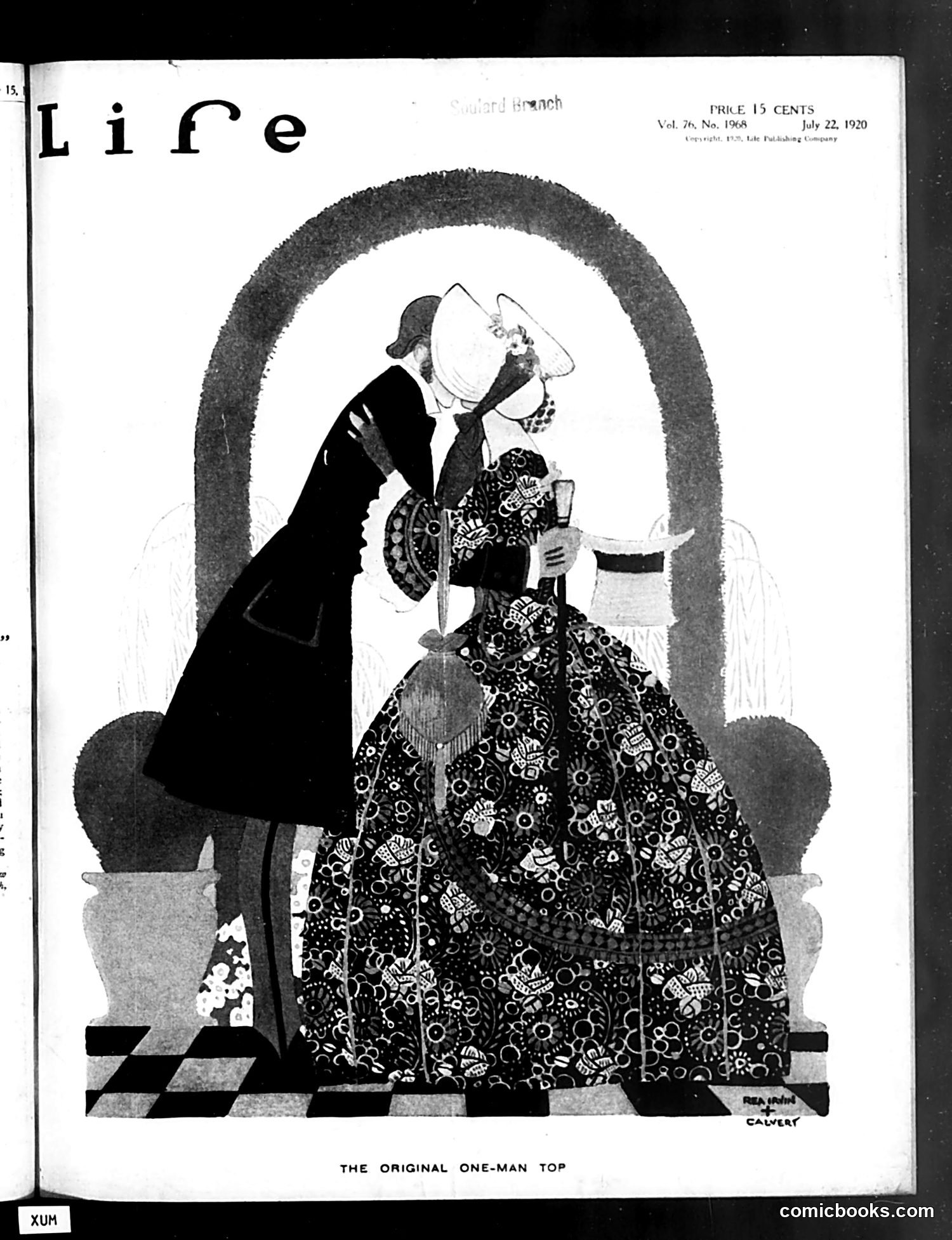
This illustration satirizes women's fashion, specifically the "one-man top" or one-piece bathing suit/garment. The cartoon depicts two fashionable figures in an ornate archway: one wearing an elegant patterned dress with decorative elements, the other leaning in wearing a black coat and hat. The satire likely critiques how the "one-man top" — a revealing or form-fitting garment — was marketed as empowering or modern women's fashion while actually attracting male attention. The intimate pose and the title suggest irony about female independence versus the garment's actual social function of attracting men. This reflects 1920s debates over women's changing roles and fashion following women's suffrage (1920).
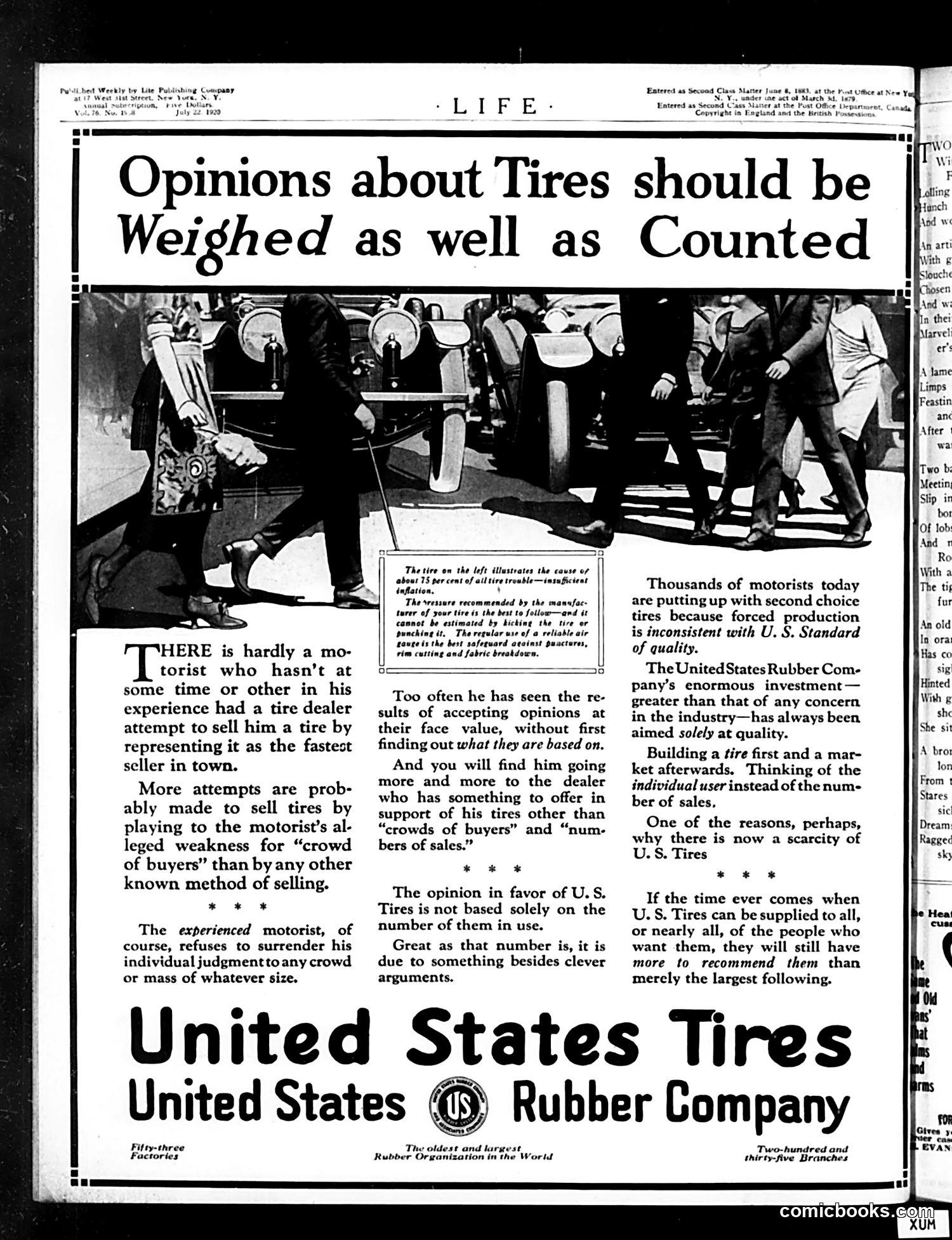
This is primarily a **product advertisement** for United States Rubber Company's tires, disguised as editorial commentary. The headline satirizes consumer decision-making: opinions about tires should be "weighed as well as counted"—meaning quality matters more than popularity. The accompanying photograph shows what appears to be a tire inspection or sales demonstration, with men examining tires on a vehicle. The ad argues that motorists choosing second-choice tires due to "forced production" inconsistent with U.S. Standard quality are making poor decisions. It criticizes purchasing based on "crowd of buyers" popularity rather than actual tire performance. The piece essentially claims U.S. Tires prioritizes quality over volume—a competitive pitch against rival manufacturers during an era of expanding automobile ownership.
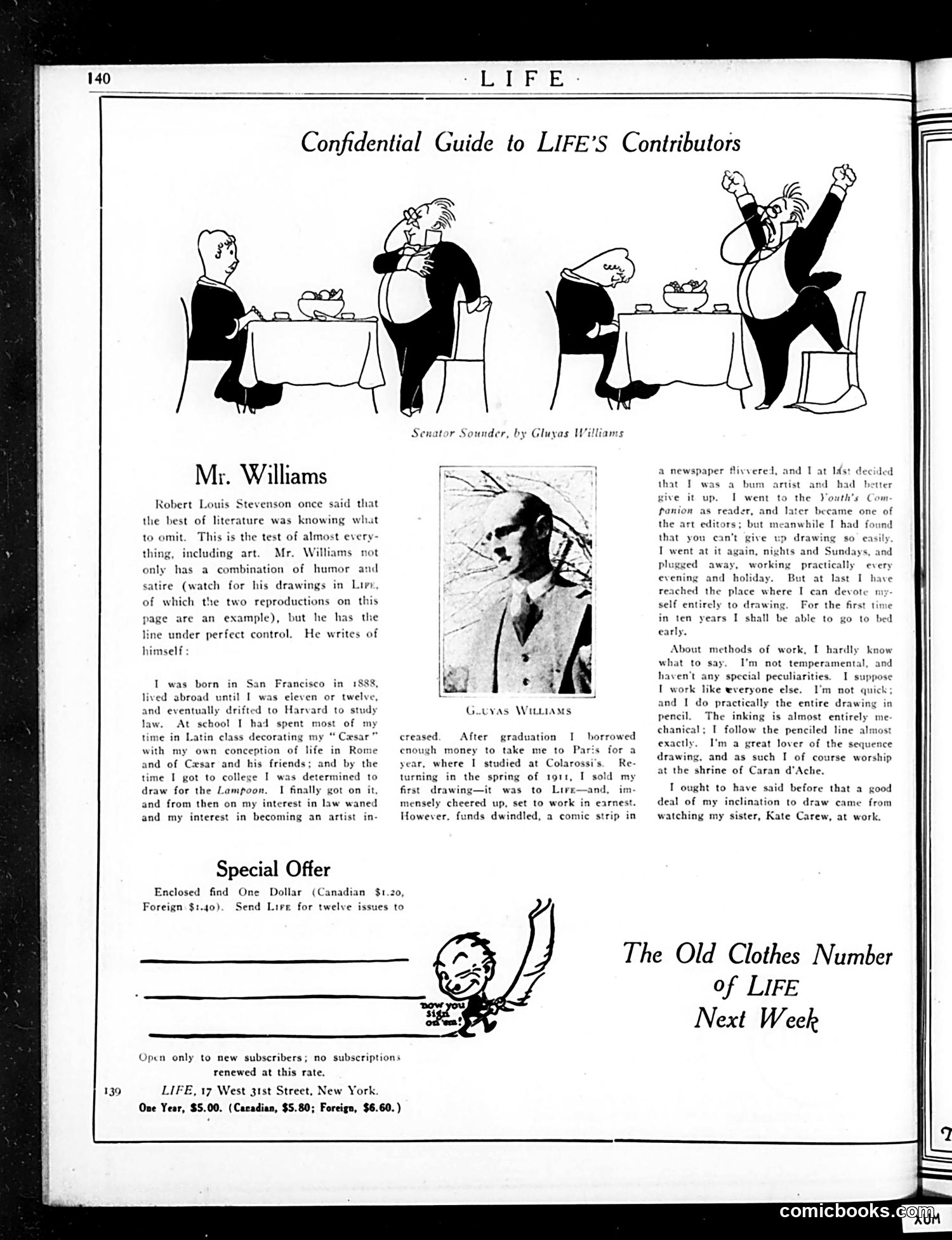
The top cartoon, "Senator Sounder, by Gluyas Williams," depicts a portly senator at a dinner table. In the left panel, he sits calmly eating; in the right, he's dramatically gesticulating with arms raised. The joke appears to be about senators who are verbose or theatrical speakers—"sounders" who make loud pronouncements, presumably about trivial matters like the soup course. Williams's satire mocks politicians' tendency toward grandiose speechmaking over substance. The page also features a biographical profile of contributor **Gluyas Williams**, a commercial artist and cartoonist who studied at Harvard. Williams describes his artistic process and dedication to drawing. Below is a subscription offer for LIFE magazine at $1.20 (Canadian rates listed). The page is primarily promotional/editorial rather than news-driven satire.
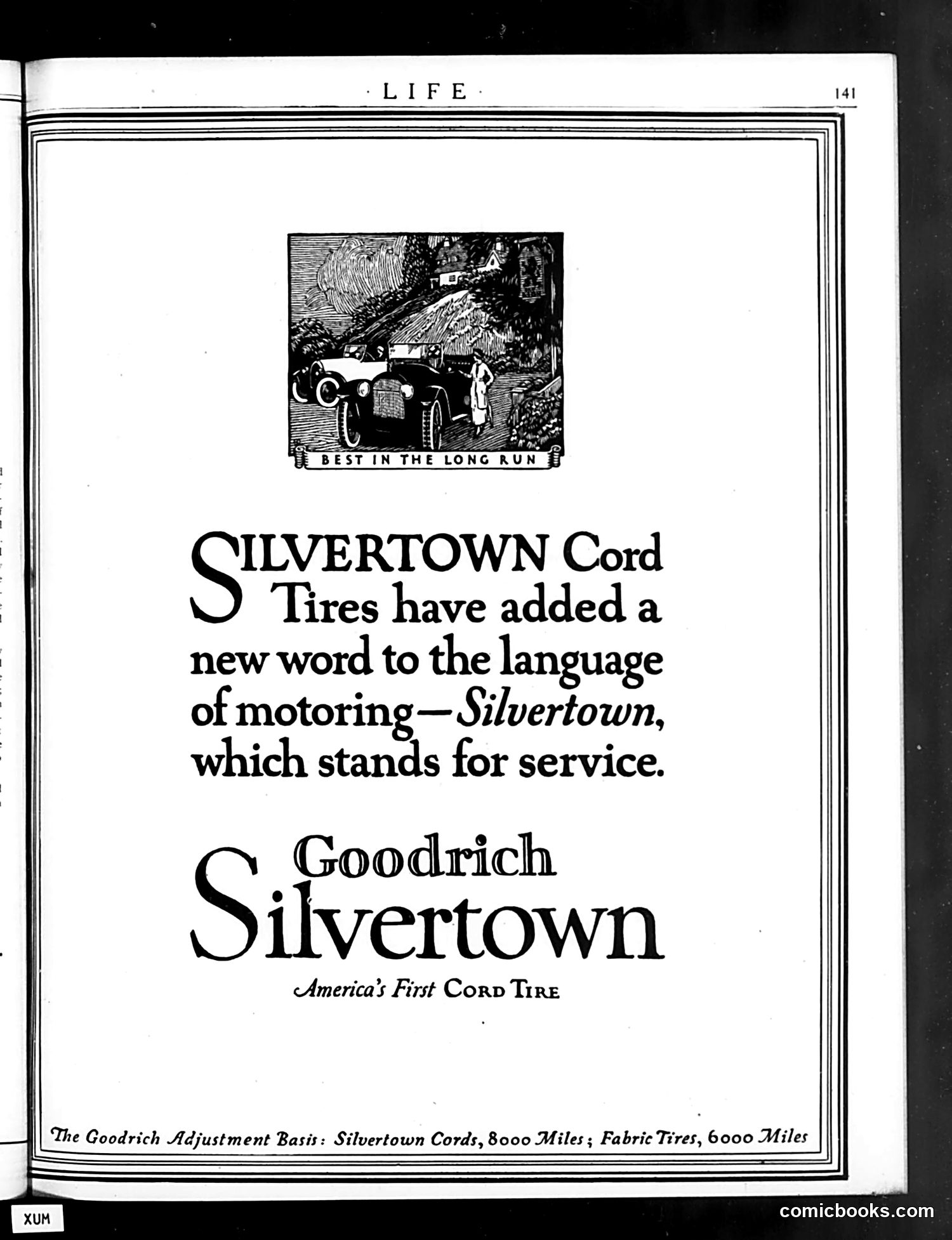
This page is primarily **advertising, not satire or political commentary**. It's a Goodrich tire advertisement for "Silvertown Cord Tires," described as "America's First Cord Tire." The ad uses the phrase "Best in the Long Run" (shown on a banner in the woodcut-style illustration) as both a product endorsement and a pun about tire durability for automobiles. The image depicts a vintage car and figures on a rural road, emphasizing the tire's reliability for extended driving. The ad claims Silvertown "has added a new word to the language of motoring," positioning the brand name itself as synonymous with quality service. The specification details at the bottom—"8000 Miles" for cord tires versus "6000 Miles" for fabric tires—highlight competitive advantage. This reflects 1920s automotive advertising strategy: establishing brand prestige and superior performance metrics.
This page is **not a cartoon or satire**—it's a straightforward **advertisement for White Trucks**, published in *Life* magazine (page 142). The ad promotes White Company of Cleveland by emphasizing six types of stability: of the maker, policy, product, quality, price, and ownership. It highlights that White Trucks have proven reliability through extensive mileage records and widespread fleet adoption. The ad includes specific claims: 3,501 White Fleets comprising 40,919 trucks, and testimonials about service infrastructure and investment value. This represents typical early 20th-century industrial advertising—targeting business buyers by stressing corporate reliability, manufacturing consistency, and proven track records rather than using humor or satire.
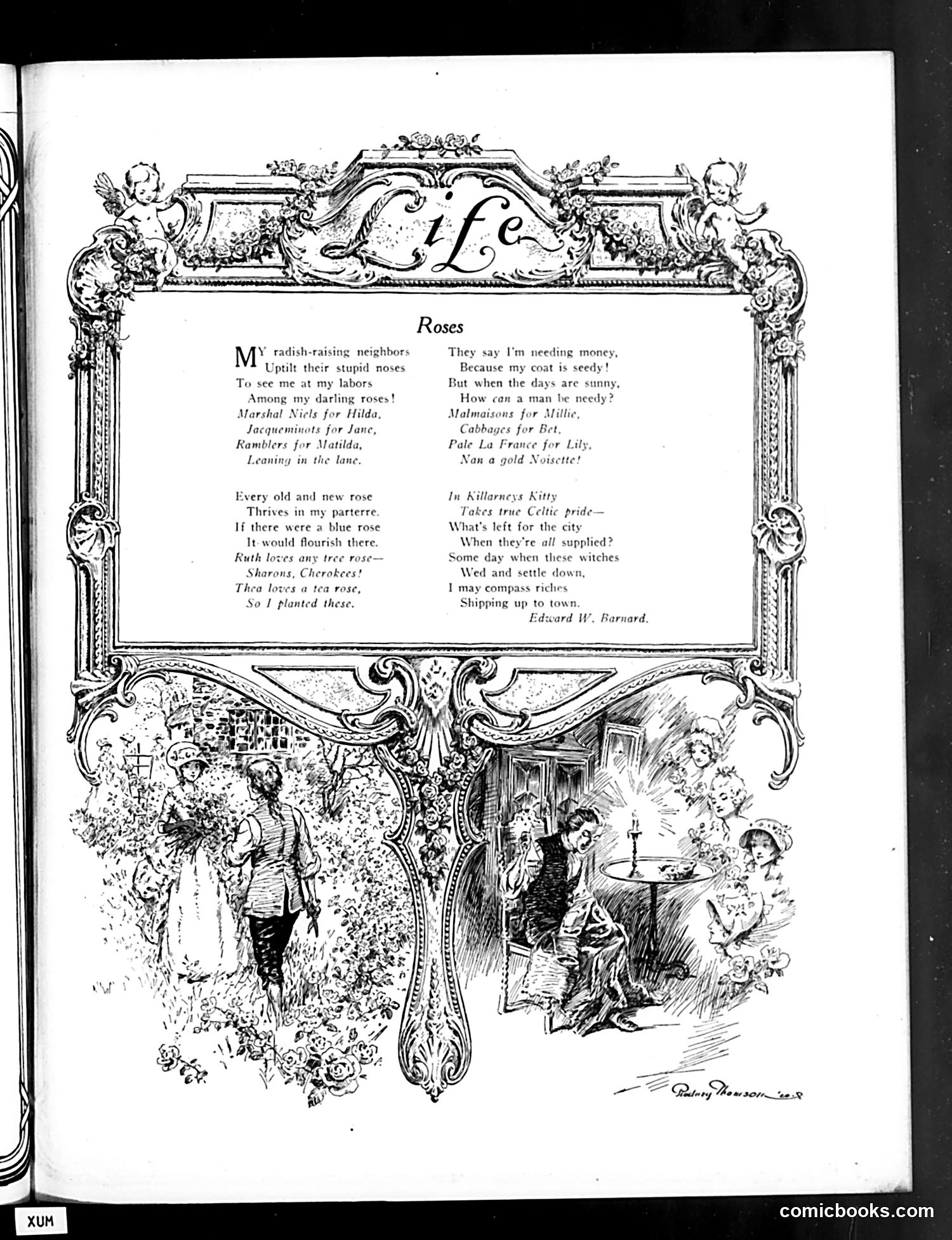
This poem by Edward W. Barnard, illustrated by Rollin Kirnan, satirizes the wealthy through their roses. The speaker—apparently a rose gardener of modest means—is pestered by "radish-raising neighbors" who resent his fine roses and spread gossip that he needs money because "my coat is seedy." The satire hinges on class resentment: wealthy or status-conscious neighbors assume poverty because appearance doesn't match their expectations. The poem mocks both their petty judgment and their own pretensions (references to "Malmaisous for Millie" and "Cabbages for Bet" suggest their limited sophistication). The illustration shows a domestic interior scene, likely depicting the contrast between the speaker's refined roses and his modest circumstances—the central joke being that good taste and beauty transcend social class.
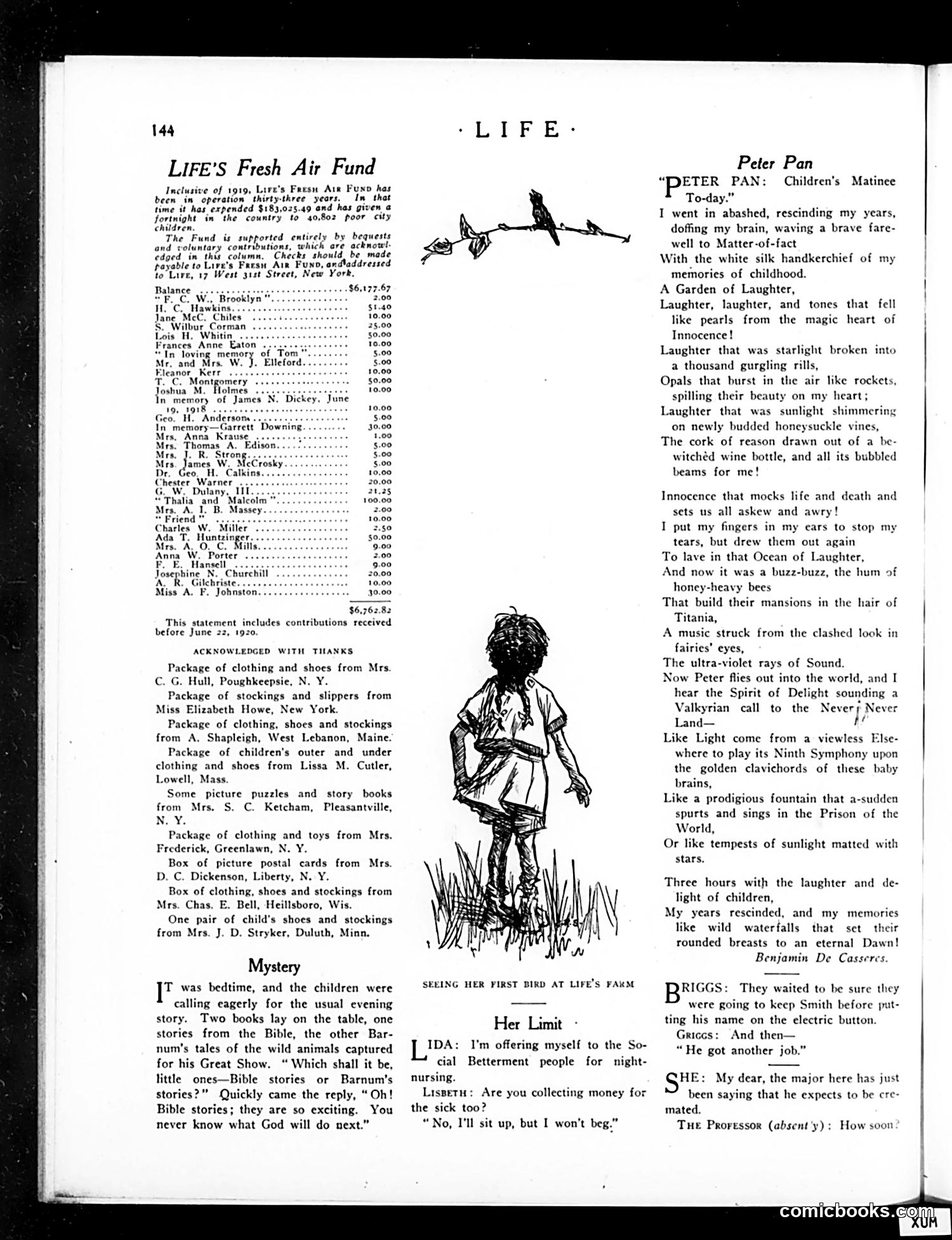
This page contains literary content rather than political satire. The main features are: 1. **"Life's Fresh Air Fund"** - A charitable fundraising list showing donations to send poor children to the countryside for health benefits. This was a genuine Progressive Era social program. 2. **"Peter Pan: Children's Matinee"** - A poem by Benjamin De Casseres about the J.M. Barrie character, reflecting on childhood innocence and wonder. 3. **Three short satirical dialogues** titled "Mystery," "Her Limit," and "Briggs" - brief comedic sketches poking fun at domestic life and workplace absurdities (a woman refusing to beg for charity, a woman resisting her husband's expectations, an employee getting fired). The page is primarily cultural/literary rather than political commentary.
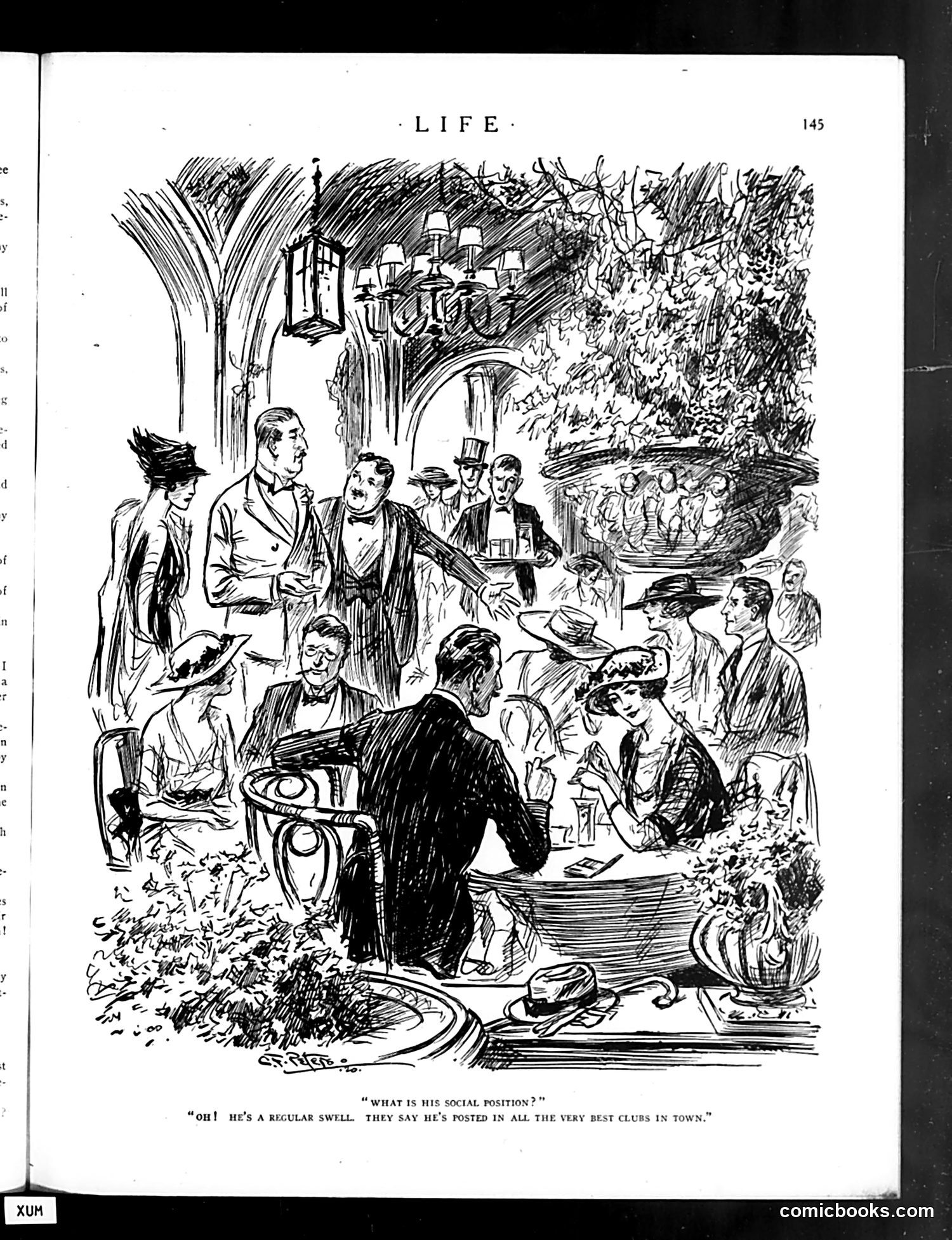
This cartoon satirizes social climbing and pretension in high society. The scene depicts a garden party or outdoor gathering where well-dressed guests are assembled. The dialogue reveals the joke: when someone asks "What is his social position?" another responds that he's "a regular swell" who is "posted in all the very best clubs in town." The humor lies in the hollow nature of social status—the man is judged solely by club memberships rather than character, wealth, or accomplishment. The ornate setting and formally dressed figures emphasize the superficiality of upper-class society, where belonging to exclusive clubs becomes the primary marker of respectability and worth. This mocks the era's obsession with status symbols and social acceptance.
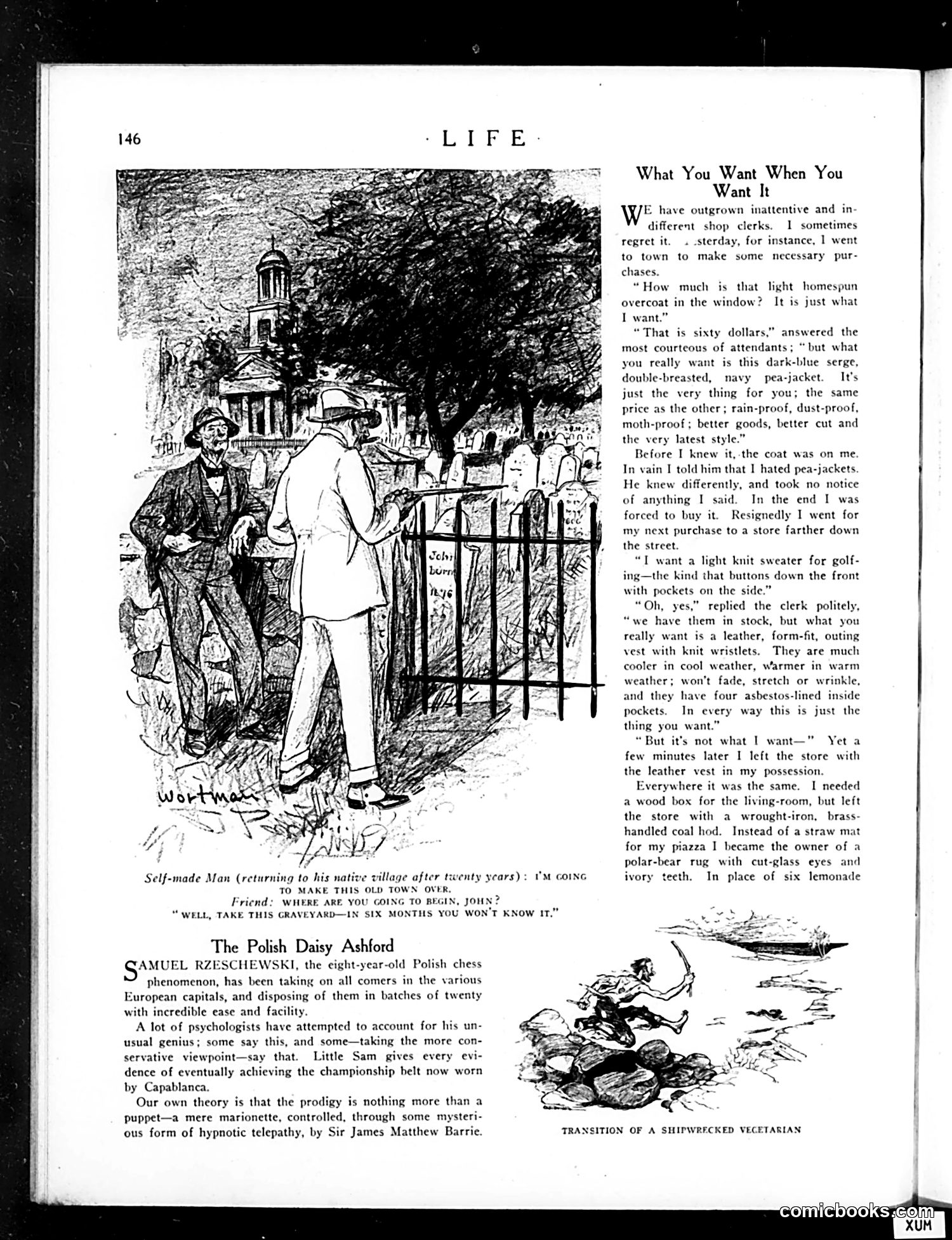
The top article "What You Want When You Want It" satirizes inattentive shop clerks who push unwanted merchandise on customers. The illustration shows a customer at a gate being persuaded to buy items he doesn't want—a pea-jacket instead of the light homespun overcoat he requested, a leather vest instead of a knit sweater. The satire critiques salespeople who ignore customer preferences, instead steering buyers toward whatever inventory the store wants to move or profits from most. The lower section introduces "The Polish Daisy Ashford," discussing Samuel Rzeszewski, an eight-year-old Polish chess prodigy. The accompanying illustration shows someone in transition, likely depicting the "shipwrecked vegetarian" mentioned in the caption—a humorous juxtaposition unrelated to the chess story.
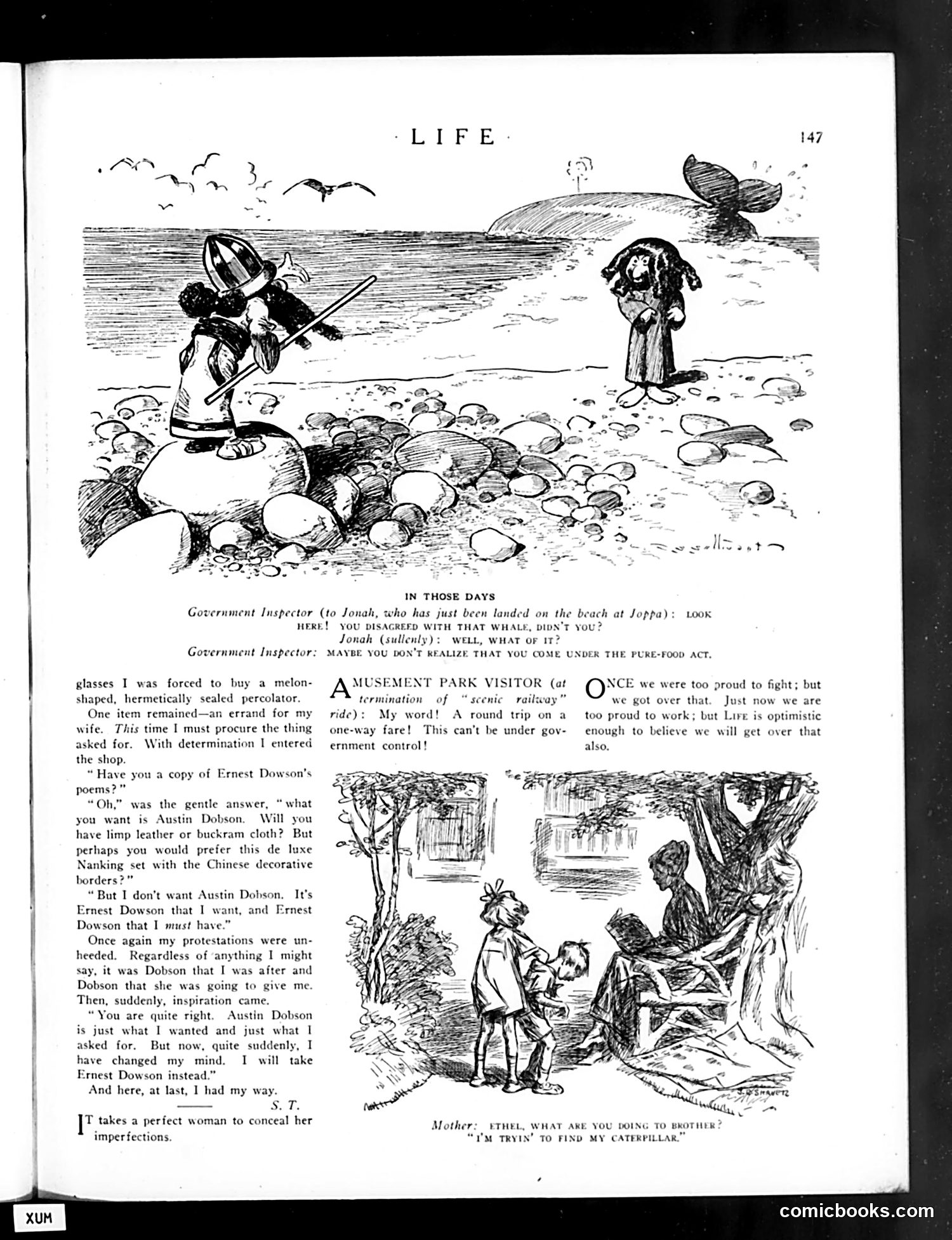
**Top Cartoon ("In Those Days"):** A government inspector confronts a child on a beach near a dead whale, citing the "Pure Food Act." The joke satirizes overzealous government food safety regulation—the inspector absurdly suggests the child violated food purity laws by disliking the whale, as if consumption were mandatory. This mocks Progressive Era food inspection bureaucracy as intrusive and ridiculous. **Bottom Section:** A domestic scene where a woman justifies her choice of "Ernest Dowson" (likely the 1890s poet) over "Austin Dobson" as her preferred literary taste. The humor plays on debate over aesthetic preferences and perhaps marital compromise, with the caption about women concealing imperfections adding gentle domestic satire. Both pieces reflect early-20th-century anxieties about regulation and domestic life.
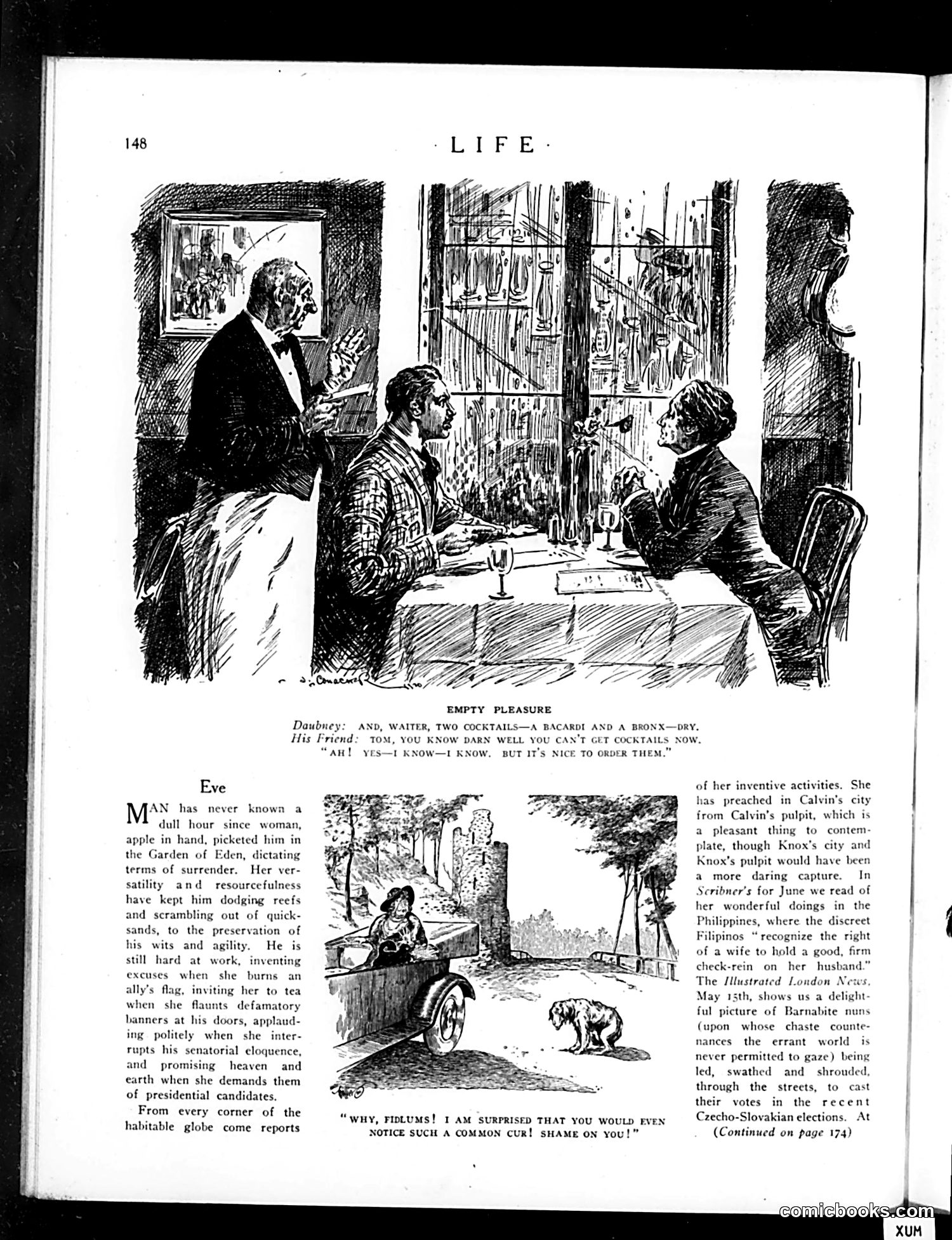
This cartoon satirizes Prohibition-era drinking. Two men dine while a waiter serves cocktails despite the alcohol ban. The dialogue mocks the situation: one man insists he can't get cocktails, while his friend replies "it's nice to order them"—highlighting the absurdity of speakeasies where illegal drinks were openly served despite federal law. The second illustration, captioned "Why, Fiends! I am surprised that you would even notice such a common cur! Shame on you!" appears unrelated—showing children noticing a stray dog. The page also discusses a female missionary in the Philippines, referencing contemporary women's activism and international mission work. Together, these elements reflect early 1920s American social debates around Prohibition enforcement, gender roles, and religious missions.
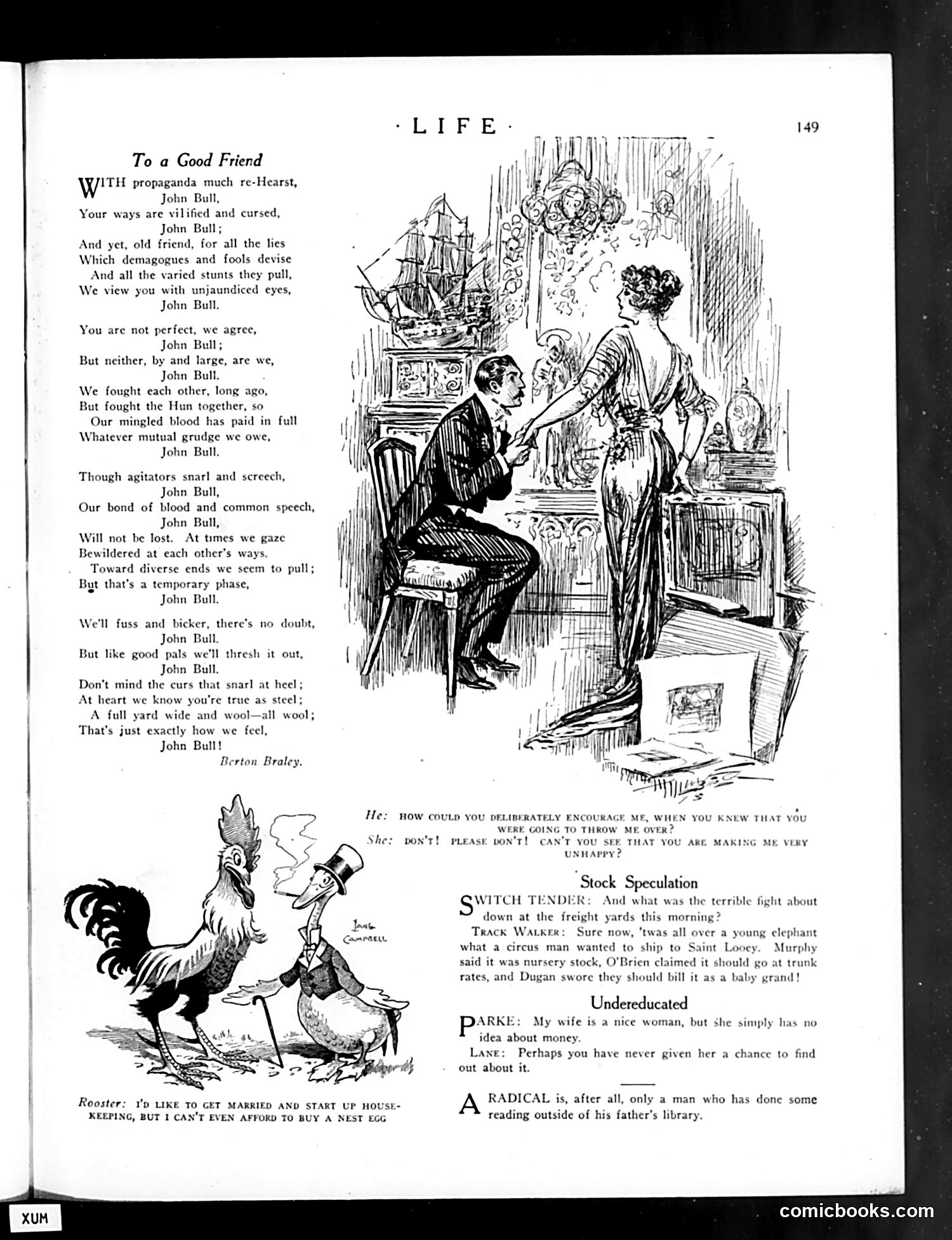
This page contains satirical humor rather than political cartooning: **"To a Good Friend"** is a poem by Berton Braley praising "John Bull" (personification of Britain/the British people), emphasizing shared bonds despite disagreements. **The main illustration** shows a couple in an interior scene—a man seated, woman standing—with dialogue about one partner encouraging the other's infidelity, creating domestic comedy about marital trust and hypocrisy. **"Stock Speculation"** and **"Undereducated"** are brief satirical anecdotes mocking financial speculation (circus animals confused with stock), and a man whose wife is financially naive because he's never educated her. **The rooster cartoon** shows farm animals discussing marriage costs—visual humor about working-class economics. These represent typical *Life* magazine content: light social satire targeting middle-class manners, financial speculation, and domestic relationships rather than serious political critique.
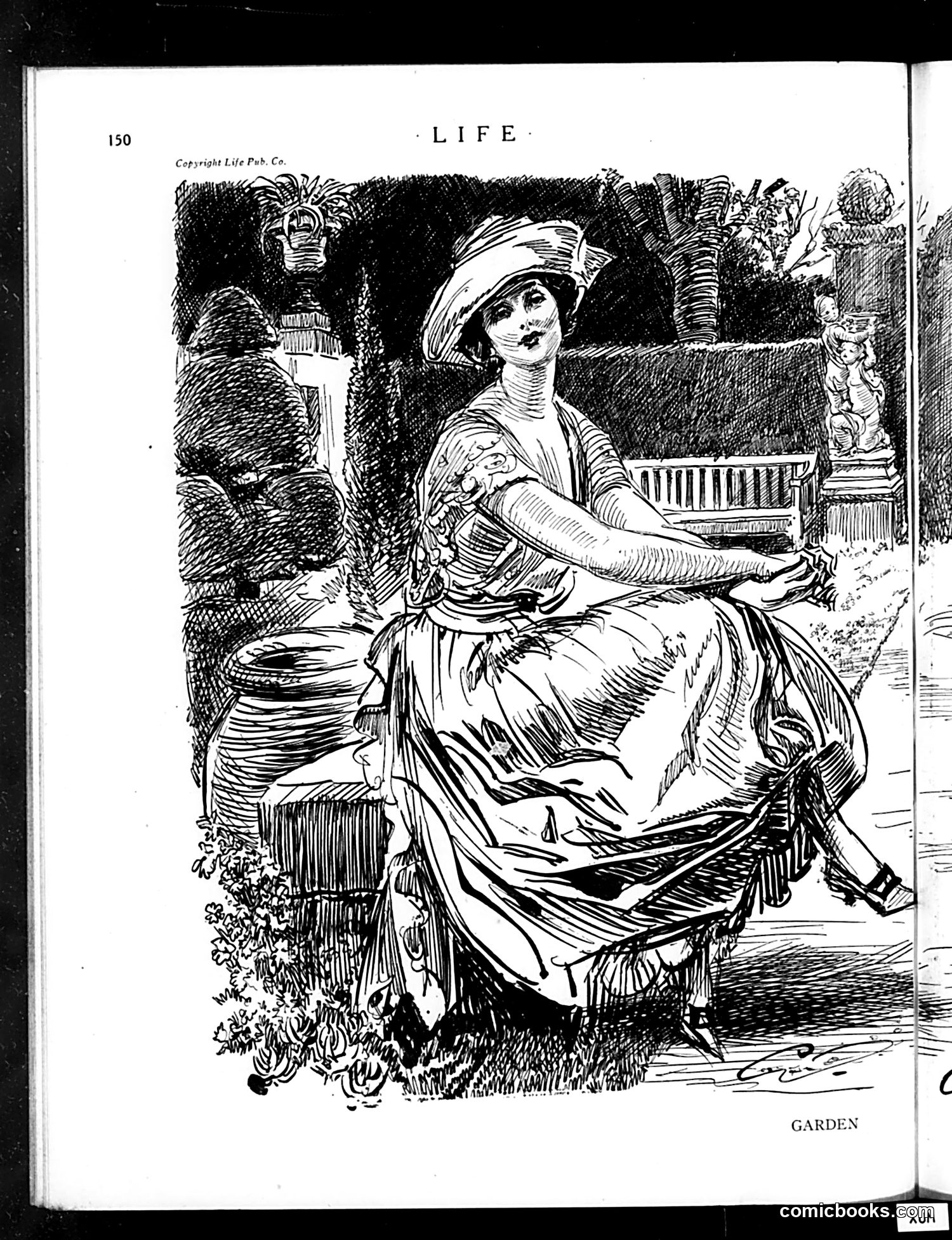
This page features a single ink illustration titled "GARDEN" depicting a fashionable woman in an elegant early 20th-century garden setting. She wears a flowing dress, decorative hat, and long gloves—typical upper-class attire of the era. She reclines gracefully among flowering plants and ornamental garden features. The satire appears to target leisure-class femininity and artificial refinement. The woman's exaggerated pose and elaborate costume suggest mockery of wealthy women's leisured lifestyles and their performative elegance. The garden setting emphasizes her as ornamental—paralleling the decorative plants surrounding her—rather than as a functional member of society. The illustration exemplifies Life magazine's satirical commentary on Gilded Age social pretension and gender roles.
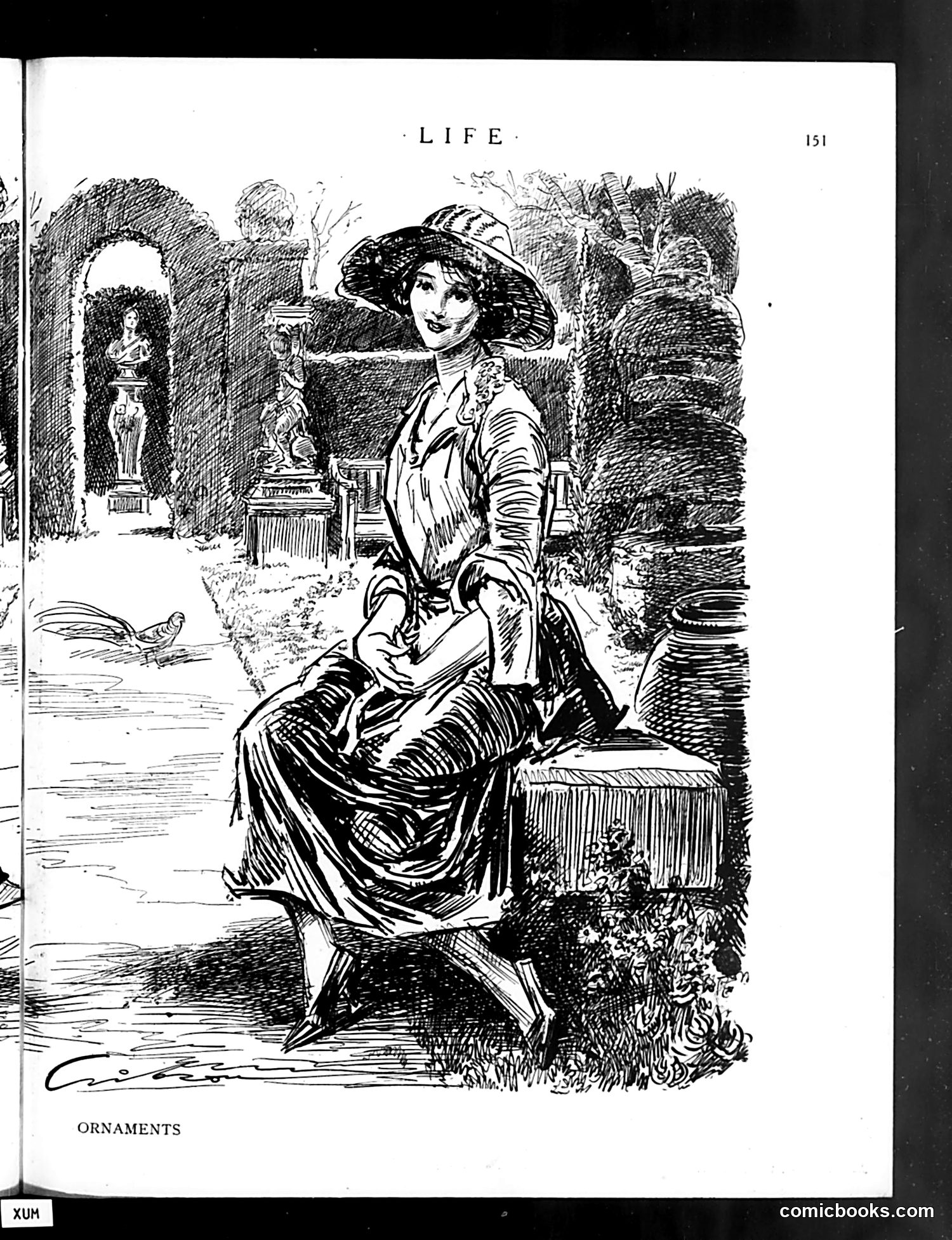
This page from *Life* magazine (page 151) is titled "ORNAMENTS" and depicts a woman in fashionable early 20th-century dress sitting in an ornamental garden setting. She wears a large decorative hat and holds what appears to be a cocktail glass, positioned among classical garden statuary and manicured hedges. The satire appears to critique wealthy women as themselves ornamental objects—decorative accessories in affluent leisure spaces rather than substantive individuals. The woman's pose, styling, and placement among garden ornaments suggest she functions as decoration herself. This likely satirizes the social expectations and limited roles of upper-class women during this era, reducing them to aesthetic objects within wealthy domestic life.
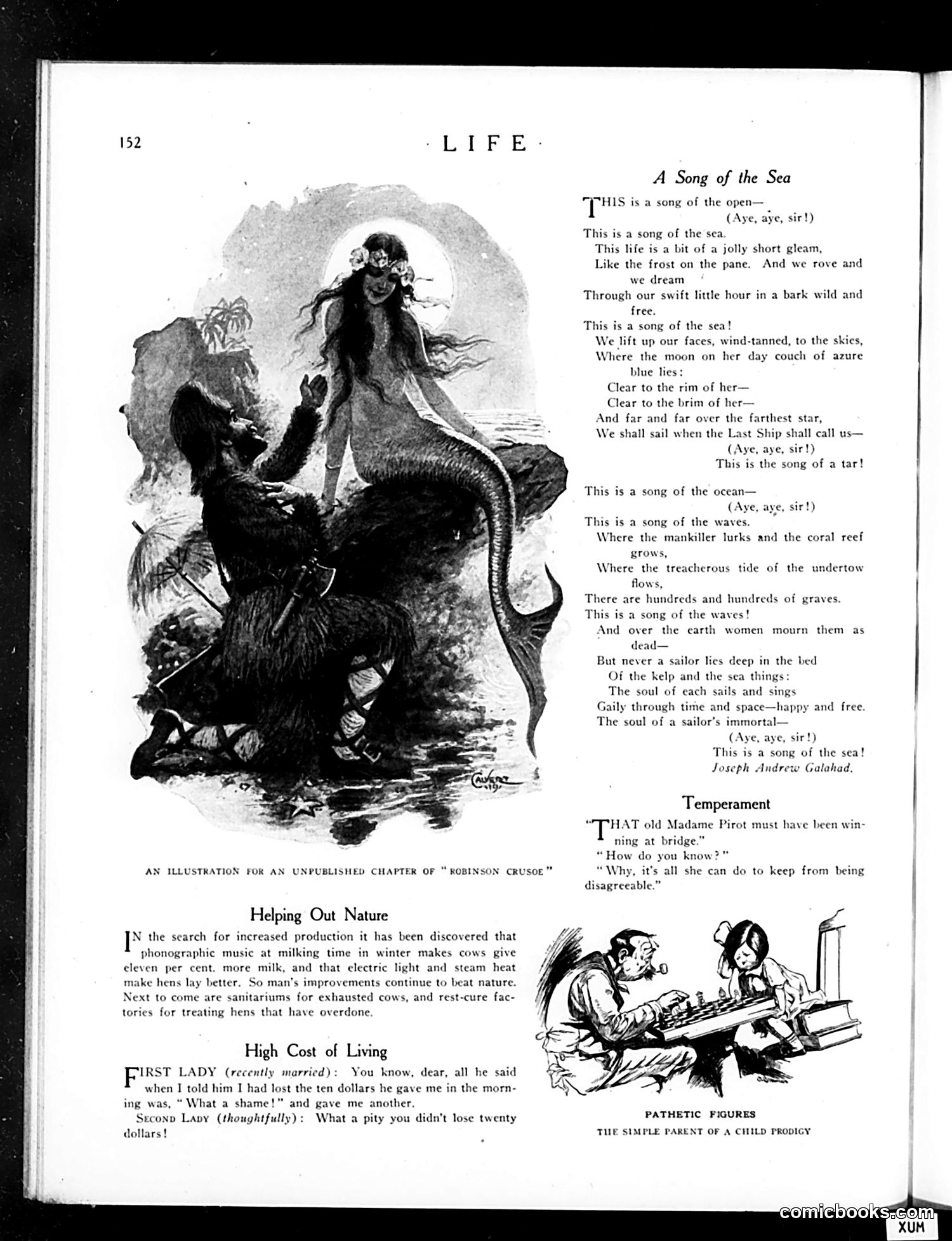
This page contains three distinct items: 1. **"A Song of the Sea"** by Joseph Andrew Galahad—a romantic poem about sailors and ocean life, accompanied by an illustration of a mermaid with a man in classical style. 2. **"Temperament"** — a brief joke about Madame Pirot winning at bridge, playing on the idea that concentration helps suppress disagreeable behavior. 3. **"High Cost of Living"** — a dialogue joke where a recently married woman complains her husband lost ten dollars; her friend notes she should be grateful he didn't lose twenty (implying husbands spend money foolishly). This satirizes both marital dynamics and postwar inflation concerns. The bottom illustration shows "Pathetic Figures: The Simple Parent of a Child Prodigy"—likely mocking parents who boast about gifted children.
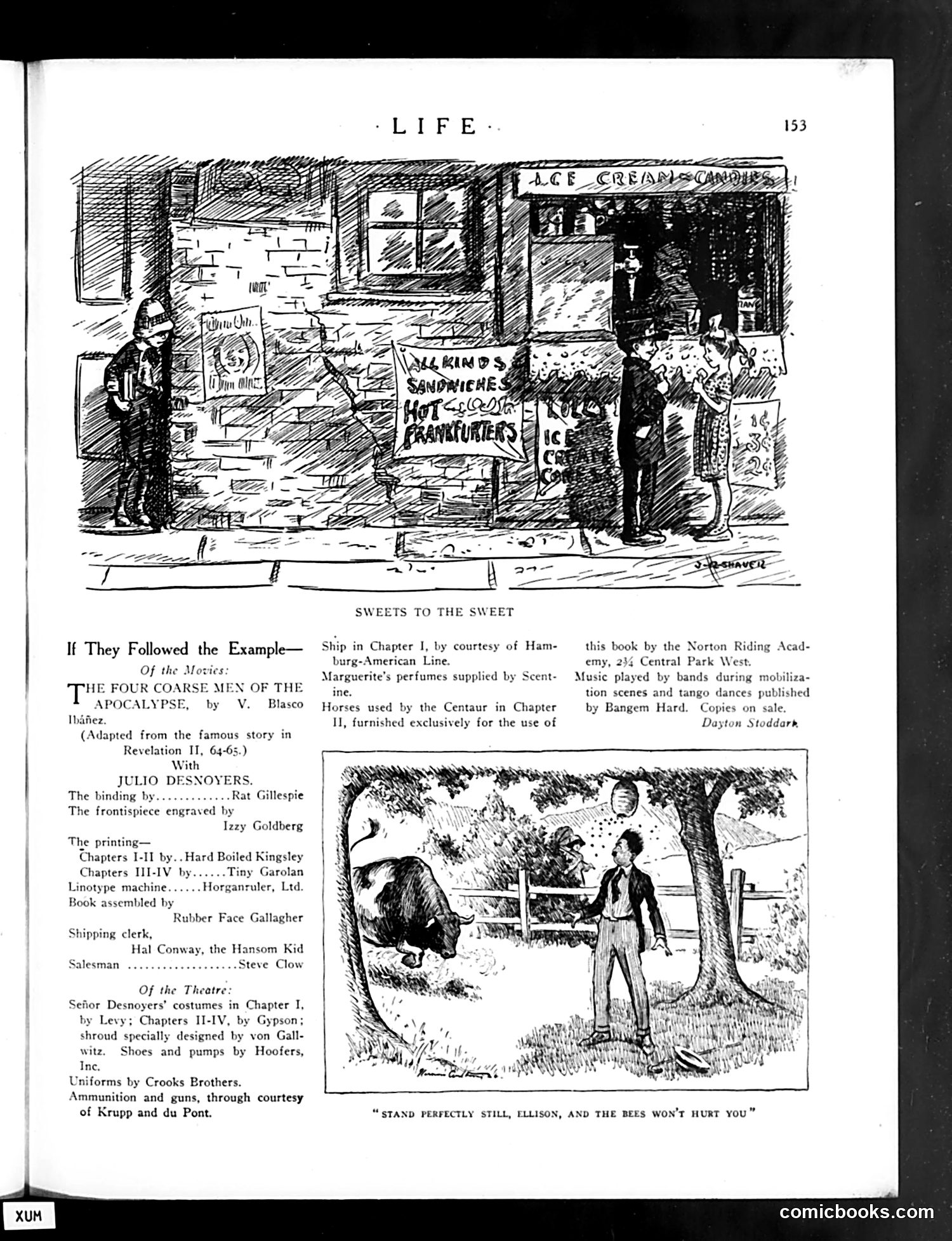
**Top Cartoon ("Sweets to the Sweet"):** This satirical illustration depicts a street-level ice cream and hot food shop. The joke appears to be a visual pun on indulgence and temptation—the shop's modest exterior contrasts with its appeal to passersby. The title likely references Shakespeare, suggesting even humble pleasures deserve acknowledgment. **Bottom Section:** This is a mock "credits" page for a theatrical adaptation of V. Blasco Ibáñez's novel *The Four Horsemen of the Apocalypse*. The satire lies in absurdly attributing every production element—binding, printing, costumes, props, even ammunition and guns—to named individuals and companies. Notably, "Krupp and du Pont" (major munitions manufacturers) are credited for supplying weapons, sarcastically implicating real arms dealers in the story's apocalyptic violence. This appears to be anti-war commentary, suggesting commercial interests profit from catastrophe. **Bottom Illustration:** Shows someone warned to stand still so bees won't attack—likely another satirical joke about avoiding danger through passivity, possibly reflecting broader commentary on how people respond to threats.
This July 1920 *Life* magazine page discusses the 1920 presidential election, noting that two Ohio newspaper publishers—**James Cox** (Democratic nominee) and **Warren Harding** (Republican nominee)—are both candidates. The article finds this remarkable, as newspaper editors rarely become presidential candidates. The text assesses Cox favorably: he's experienced in business, Congress, and served as Ohio governor three times. The author notes Cox is moderately prohibitionist (supporting Prohibition enforcement like President Wilson) but not fanatically so. Regarding Harding, the article observes Republicans seem less unified behind him than Democrats are behind Cox, calling the Democratic convention process fair and transparent despite political bosses present. The cartoon at the top (unclear in details) appears decorative rather than directly satirical. The overall tone treats both candidates seriously while subtly favoring Cox's perceived competence and the Democrats' nomination process.
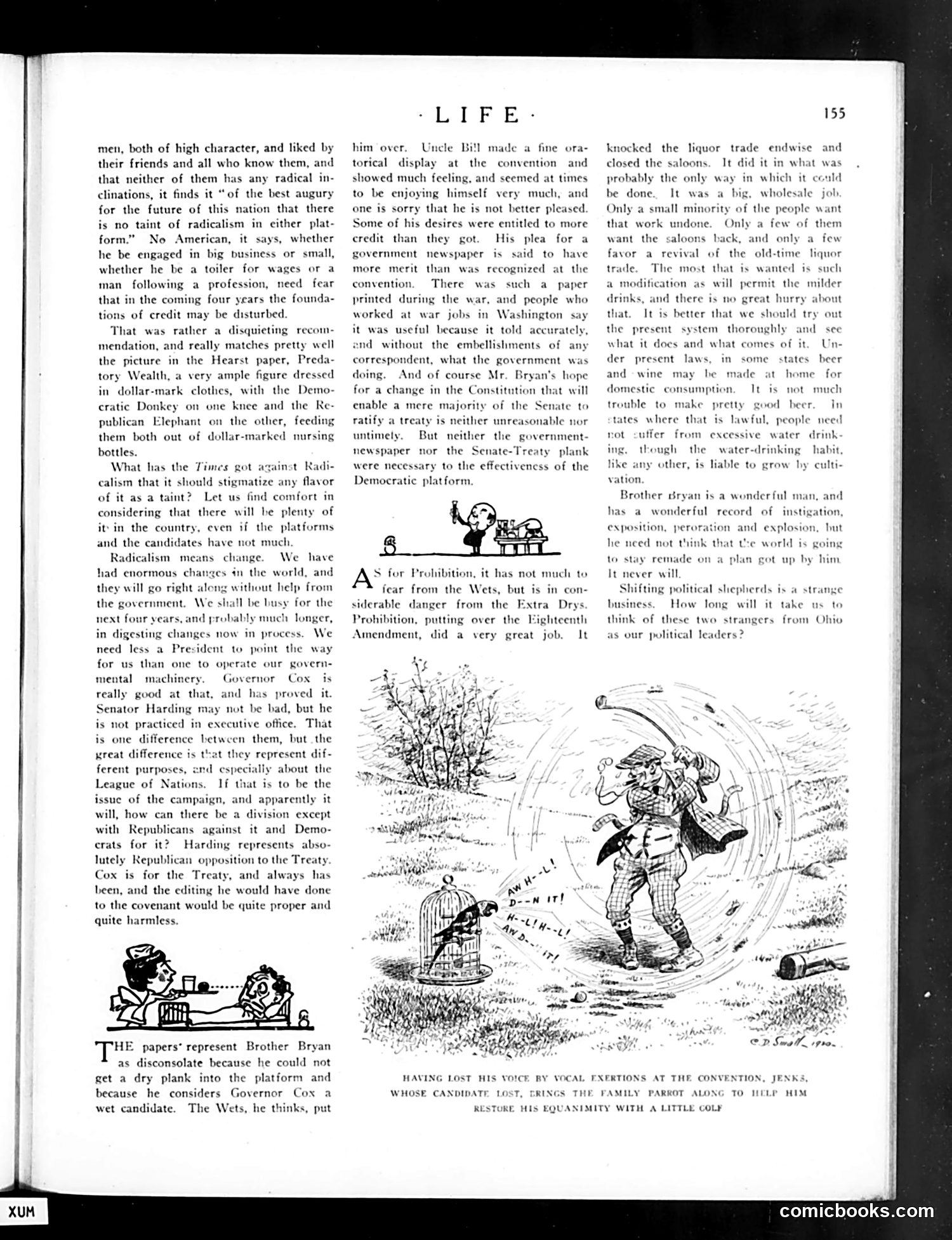
This page discusses the 1920 presidential campaign, contrasting candidates Cox (Democrat) and Harding (Republican), particularly regarding the League of Nations and Prohibition. The main cartoon depicts **William Jennings Bryan** (the three-time presidential candidate), shown as hoarse and exhausted after vocal exertions at the Democratic convention. The caption indicates he's upset because the platform didn't include a "dry plank" (anti-alcohol provision) and because he views Cox as a "wet candidate" (pro-alcohol). The satire targets Bryan's disappointment: despite his passionate speechmaking at the convention, he failed to influence the platform on Prohibition—a key issue for him. The family parrot being brought along suggests the futility of his efforts, as even the bird's mimicry of his rhetoric won't help restore his lost voice or change outcomes. The article frames this as Bryan's personal frustration rather than a substantive policy debate, mocking his outsized emotional investment in convention proceedings.
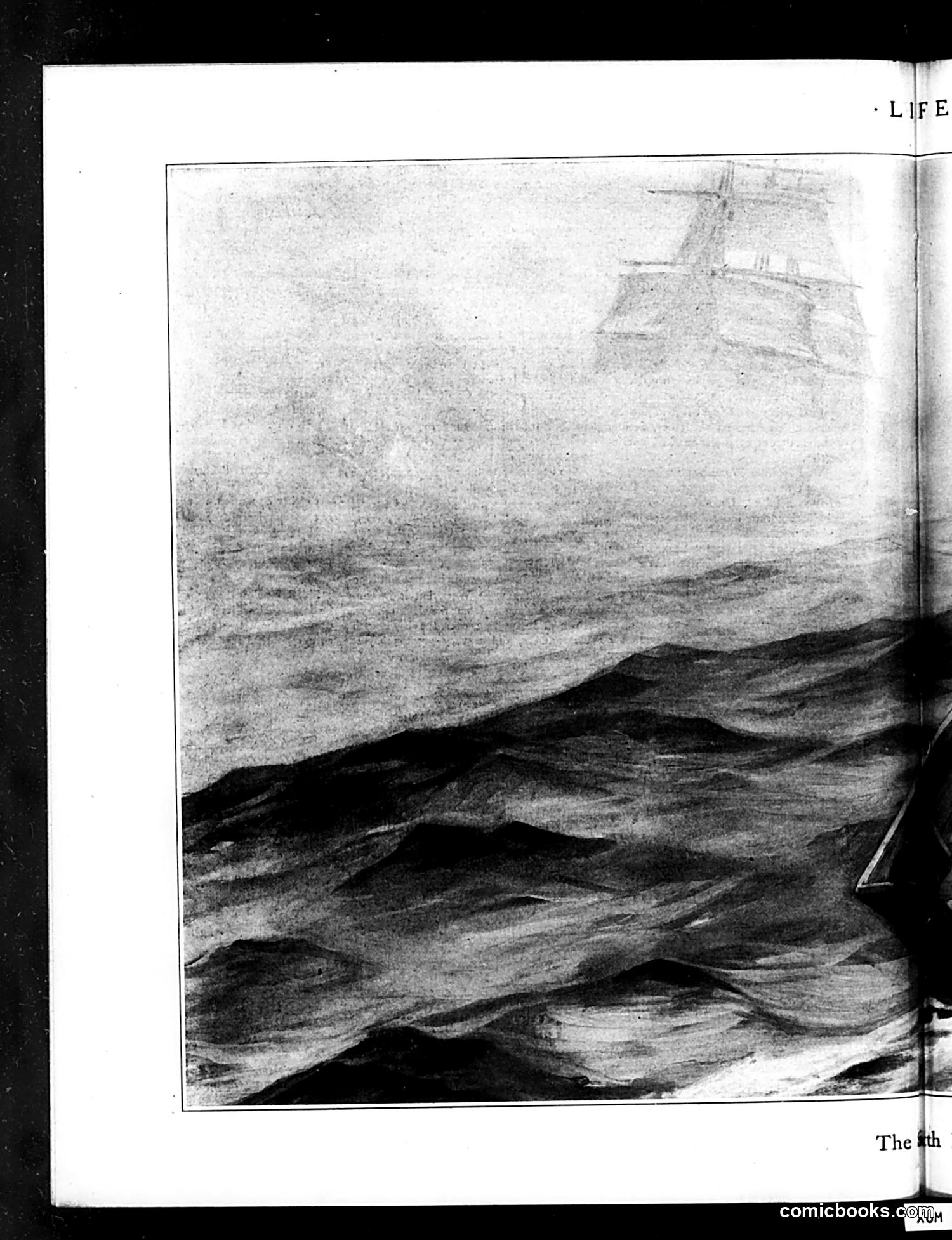
This page from *Life* magazine appears to be primarily a photograph rather than a political cartoon. The image shows a seascape with rough, dark waves in the foreground and what looks like sailing vessels or ships visible in the misty background. The page header reads "LIFE" and there's partial text at the bottom that says "The" followed by cut-off words. Without clearer text or identifying captions, it's difficult to determine the specific satirical intent or what contemporary event this image references. The photograph's artistic quality and placement in *Life*—known for satirical commentary—suggests it may carry symbolic meaning, but the exact context and message remain unclear from this image alone.
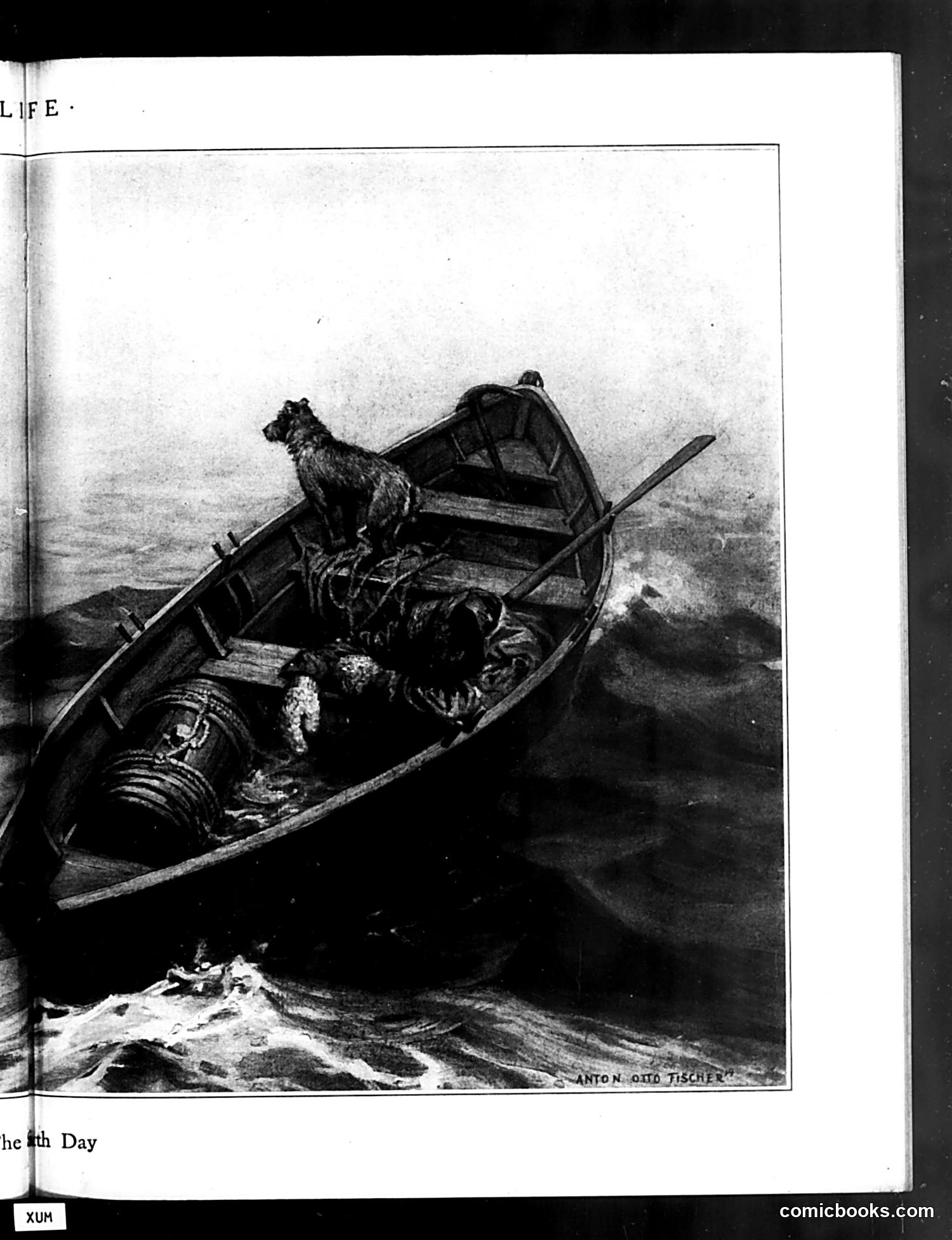
This appears to be an illustration by Anton Otto Fischer from Life magazine. The image depicts a dramatic maritime scene: a small boat in rough waters with two figures—one appears to be a person in the boat and another animal (possibly a goat or similar creature) perched on the bow. Without additional context from surrounding text on the page, I cannot definitively identify what specific political or social satire this represents. The "6th Day" reference (visible at bottom left) might suggest a biblical or mythological allusion, but I cannot confirm the cartoon's intended meaning or target from the image alone. To accurately explain the satire's point to modern readers, I would need clearer text or additional page context identifying the figures or event being referenced.
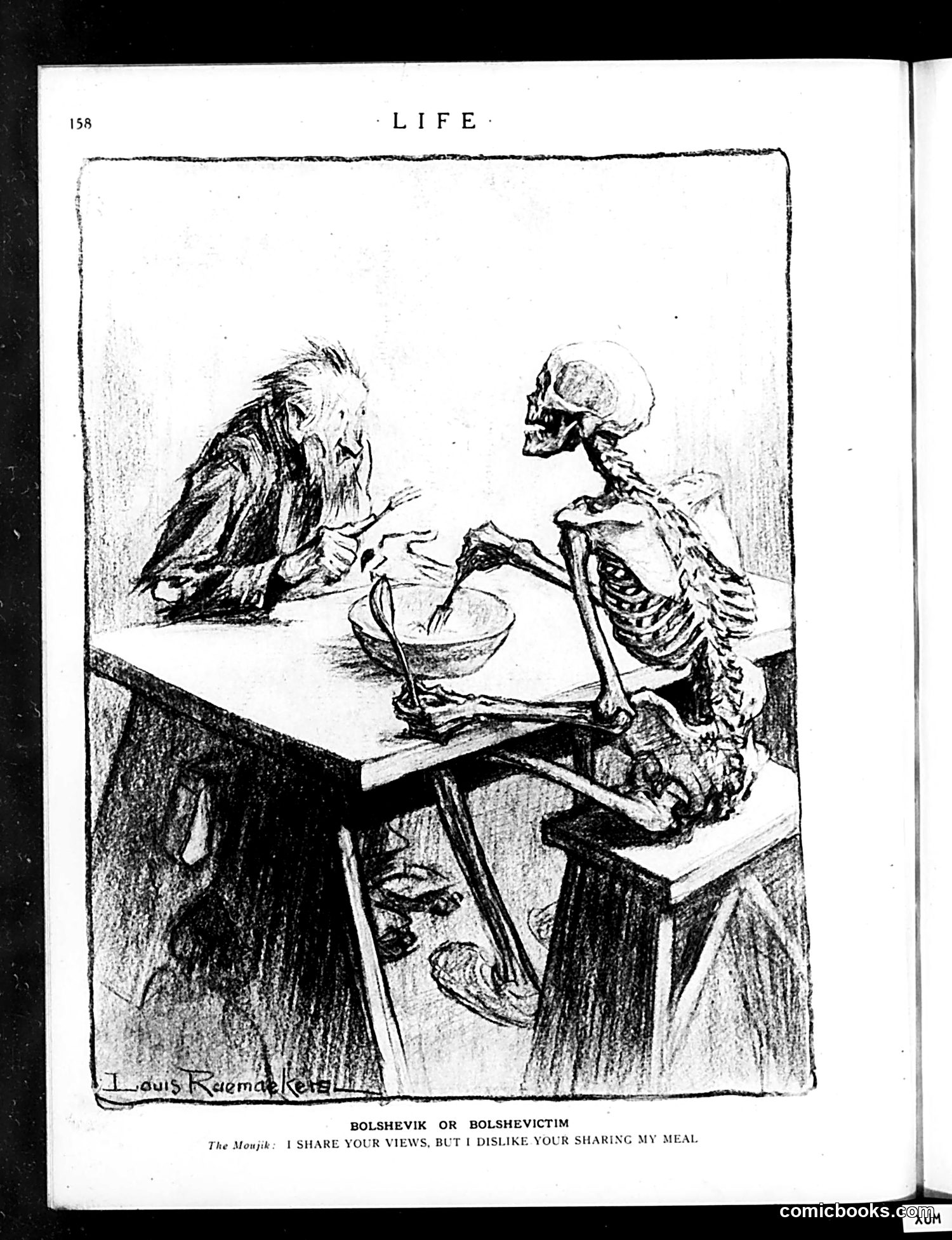
This political cartoon satirizes early Soviet communism and the Russian Revolution. The image depicts a skeleton (labeled "Bolshevik") seated at a table with a peasant ("Moujik," a Russian farm worker). The skeleton is eating from a bowl while the peasant protests that though he agrees with communist ideology, he objects to the literal appropriation of his food. The cartoon's message critiques Bolshevik practice versus theory: communists claimed to share ideology with common people, but actually seized their material resources—grain, livestock, and sustenance. The skeleton imagery suggests death and deprivation caused by Soviet policies. This reflects Western anti-communist sentiment, likely from the early 1920s when famine and "War Communism" were producing widespread suffering in Russia. The title puns on "victim," suggesting peasants became victims of Bolshevism despite its egalitarian rhetoric.
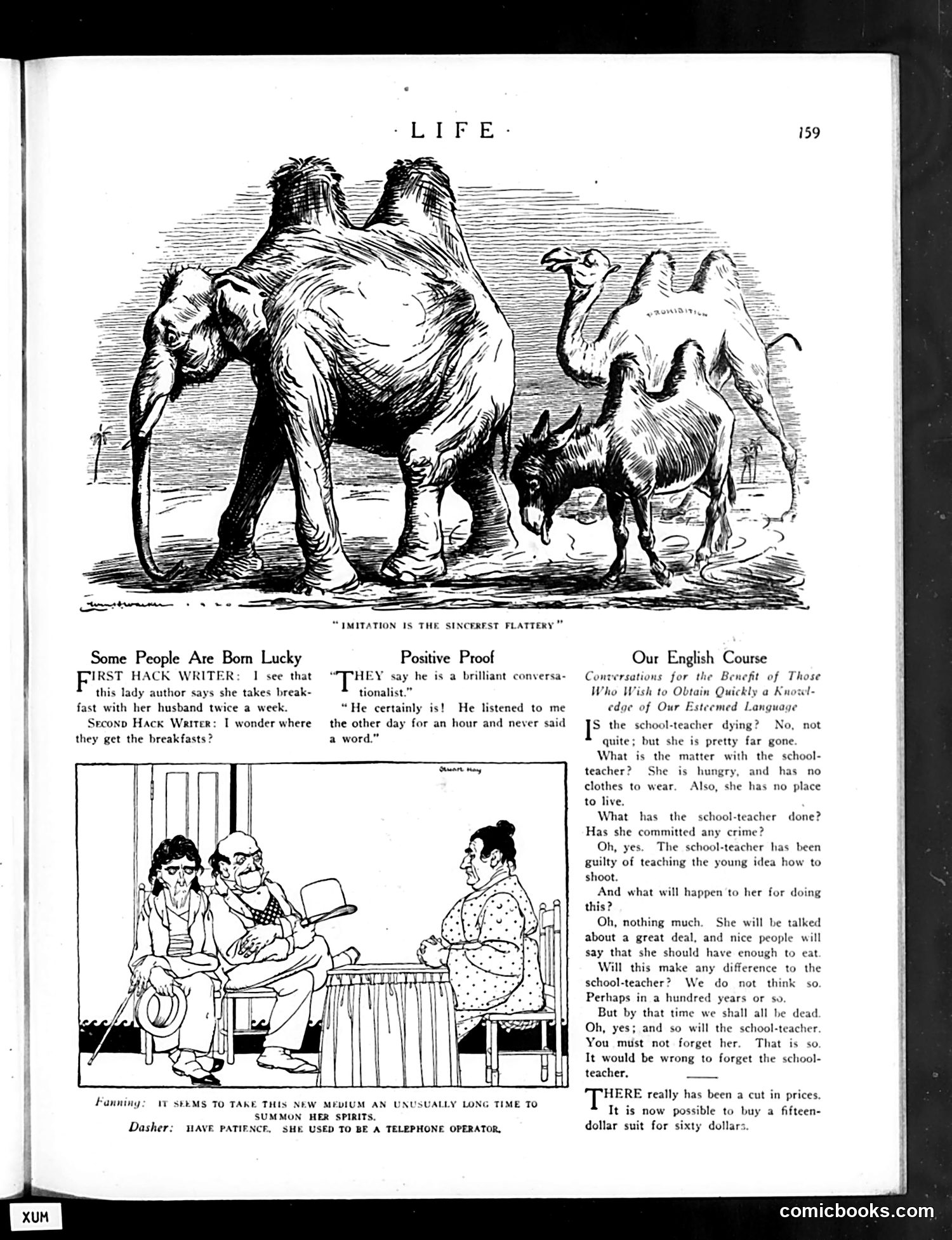
This page contains three separate satirical pieces mocking early-20th-century social issues: **"Some People Are Born Lucky"**: Two writers joke about a female author who supposedly has breakfast with her husband twice weekly—implying she's so poor or busy this is remarkable, not luxurious. **"Positive Proof"**: A quip about a man being a "brilliant conversationalist" because he listened without speaking—satirizing vapid social pretense. **Séance cartoon**: Mocks spiritualism's popularity by showing a medium struggling to "summon spirits," with a joke that she was a telephone operator (suggesting incompetence at a new "medium"). **"Our English Course"**: The longest piece sardonically presents dialogue teaching English while describing a starving schoolteacher punished for teaching youth about war/violence. It bitterly suggests society will only remember her after everyone dies—dark social commentary on how little society valued teachers. The camel illustration's caption, "Imitation is the sincerest flattery," appears thematic but its specific reference is unclear.
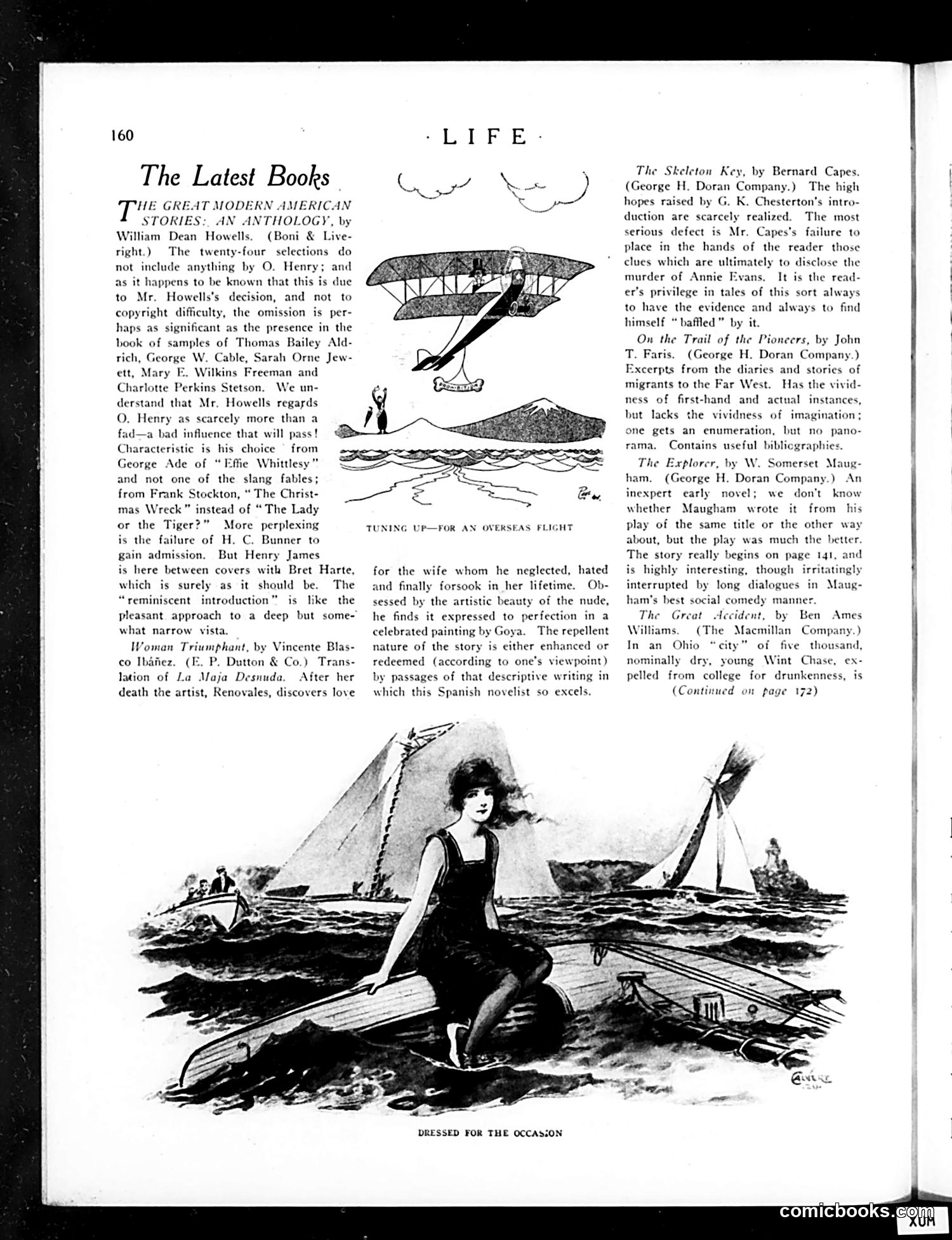
This page presents **book reviews** from Life magazine's "The Latest Books" column, not political cartoons. The content critiques contemporary American literature circa the 1920s. Key points of interest: **The reviews discuss:** - William Dean Howells' anthology deliberately excluding O. Henry, whom Howells dismisses as "scarcely more than a fad" - A Spanish novel by Blasco Ibáñez about an artist obsessed with a nude painting by Goya - Mystery and frontier literature **The illustrations** are decorative—showing early aircraft ("Tuning Up—For an Overseas Flight") and a fashionable woman on a beach ("Dressed for the Occasion")—typical period magazine ornamentation. This reflects early 20th-century literary taste-making, where established critics like Howells wielded considerable power to dismiss popular writers. The page shows how Life functioned as a cultural arbiter for educated American readers.
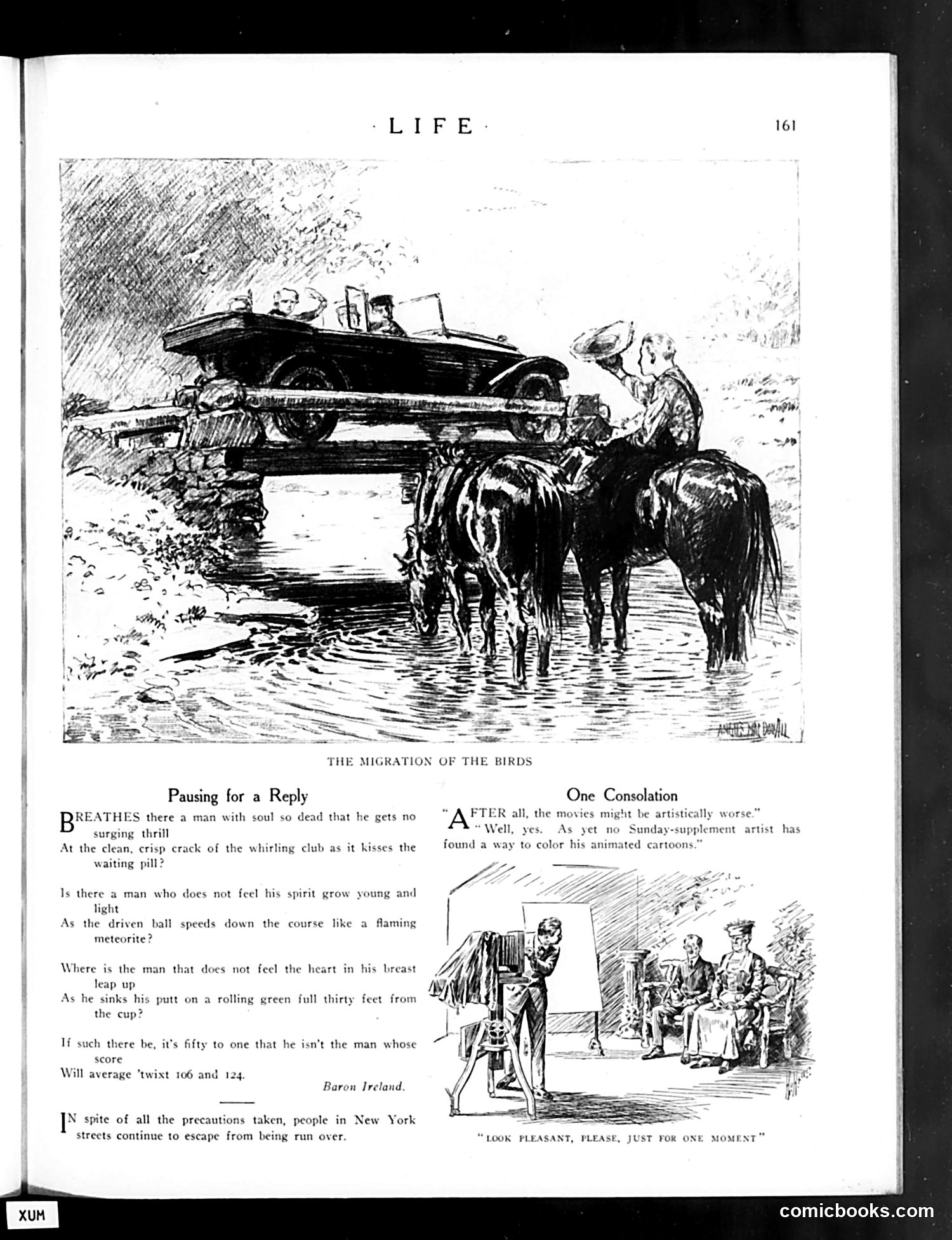
**Main Cartoon ("The Migration of the Birds"):** Depicts a horse-drawn wagon carrying an automobile crossing a stream. The title sarcastically invokes bird migration, suggesting automobiles are the new "migrating species" replacing traditional transportation—a joke about the rapid displacement of horses by cars in early 20th-century America. **"Pausing for a Reply":** Baron Ireland's poem mocks golf enthusiasts' passionate devotion to the sport, then delivers the punchline: golfers who genuinely feel this "thrill" typically score between 106-124—terrible scores. The satire targets golf's pretentious romanticism versus the reality of most players' mediocre performance. **"One Consolation":** A brief joke about animated cartoons' inability to be color-filmed yet (a technical limitation of early cinema), presented as the one advantage movies have over Sunday newspaper supplements. **Bottom item:** A dry one-liner observing that despite precautions, New York pedestrians still avoid being hit by vehicles—understated urban humor.
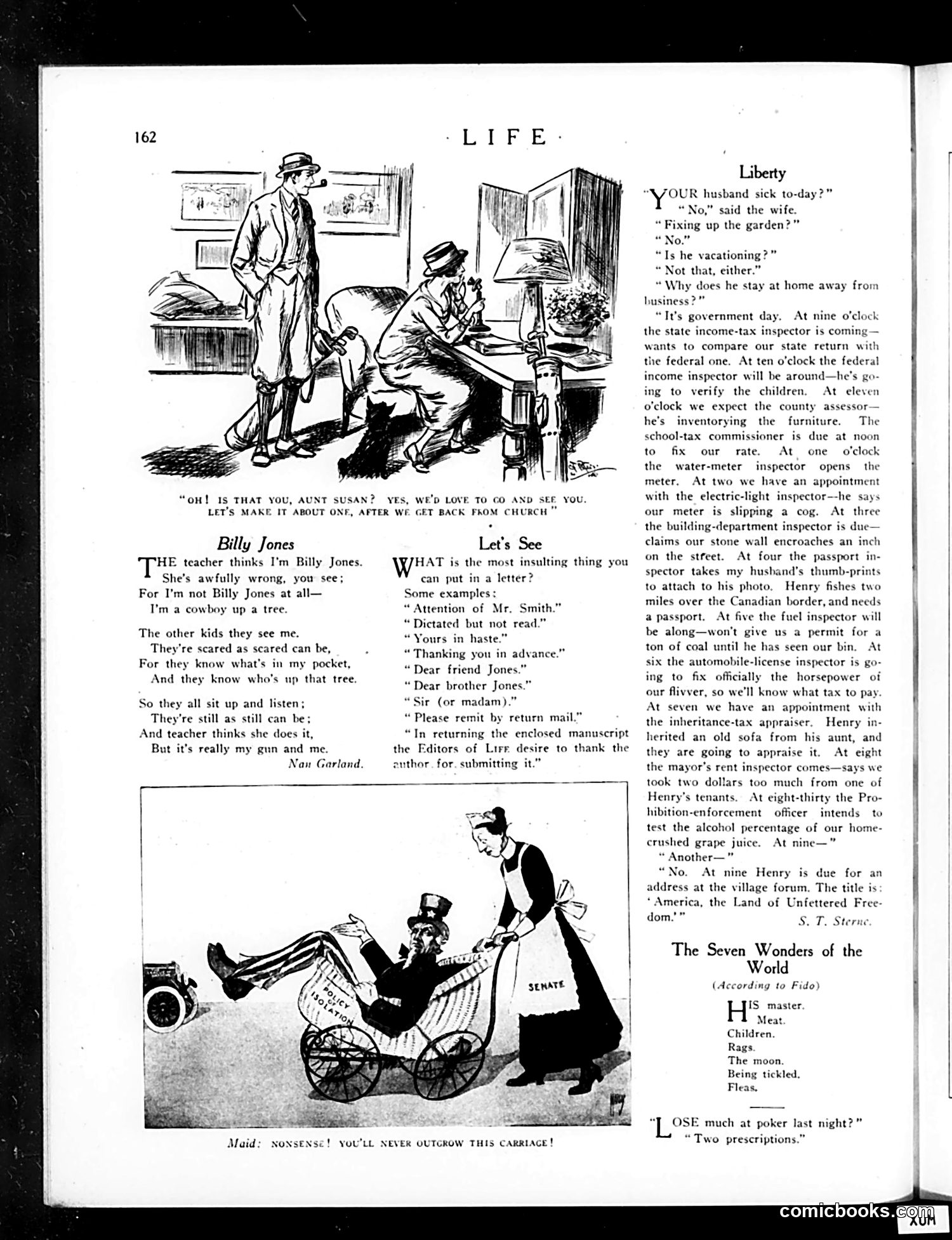
This page contains three satirical pieces typical of Life's humor circa the 1920s-30s: **"Billy Jones"** (poem by Nan Garland): A child's perspective on classroom disruption. A boy pretends to be a cowboy with a gun while sitting in a tree, terrifying classmates while the teacher remains oblivious to the real source of classroom control. **"Let's See"** (humor piece): A list of insulting phrases to include in letters—mostly bureaucratic or dismissive language ("Dictated but not read," "Yours in haste"). Contemporary readers would recognize these as genuinely offensive letter conventions. **"Liberty"** (by S.T. Sterne): Heavy satire on government bureaucracy. A husband stays home not sick or vacationing, but because it's "government day"—a parade of inspectors (income-tax, federal, county assessor, school-tax, water-meter, electric, building-department, passport, fuel, auto-license, inheritance-tax, rent, Prohibition-enforcement) descend throughout the day. The satire mocks excessive government oversight and regulation of ordinary citizens' lives. **"Seven Wonders" (Fido's list)**: A dog's priorities—mundane to readers but humorously self-absorbed.
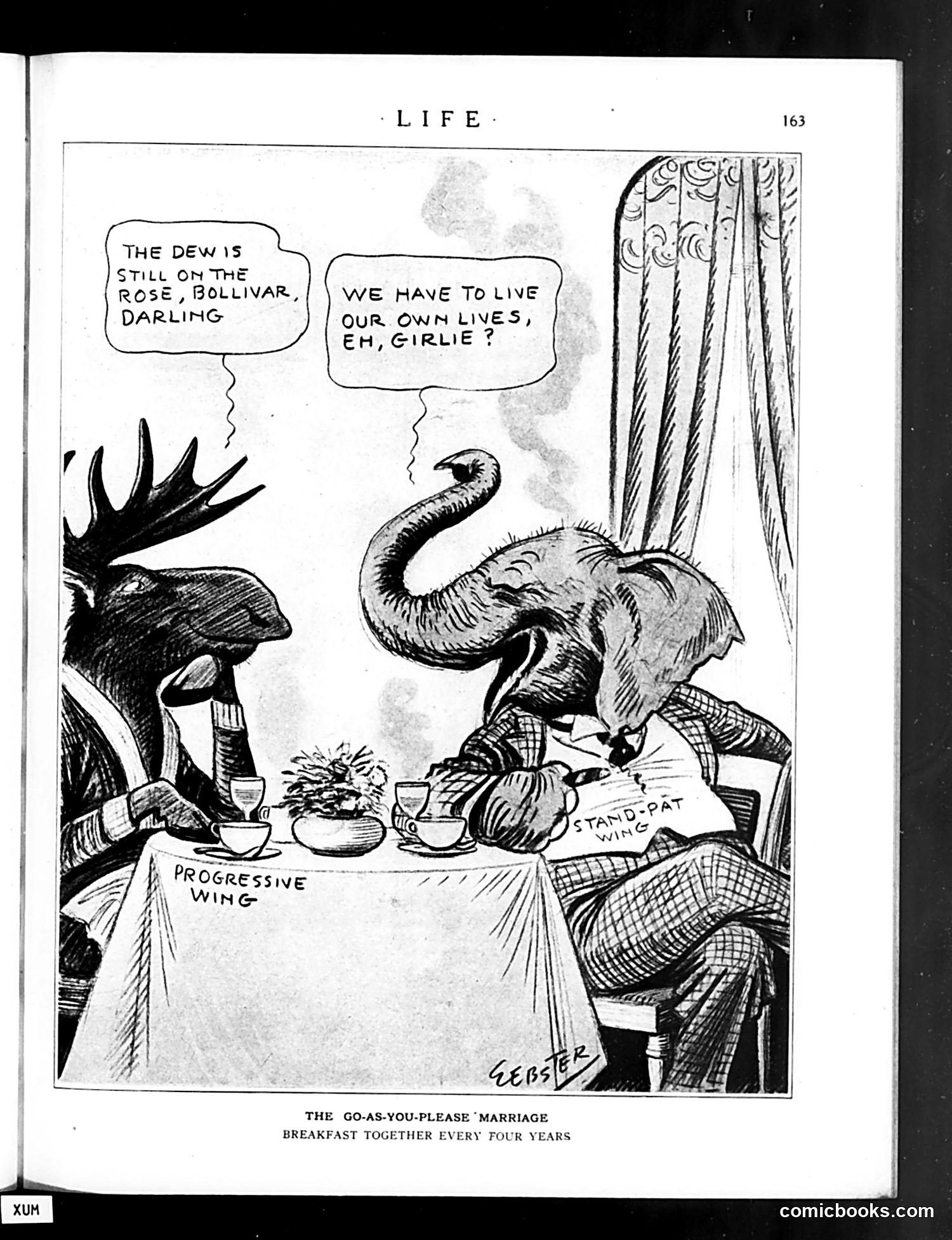
This cartoon satirizes a progressive marriage concept popular among early 20th-century radicals. The moose (labeled "Progressive Wing") and elk (labeled "Standard Goat") represent political factions or ideological partners who meet only occasionally ("breakfast together every four years") rather than maintaining constant commitment. The dialogue mocks romantic rhetoric about "living our own lives" while the couple remains legally bound. The cartoon suggests that this "go-as-you-please marriage"—where partners maintain complete independence and minimal contact—is absurd and impractical, despite progressive arguments for personal freedom. The satire targets both the Progressive political movement and contemporary debates about marriage reform, portraying radical ideas about independence and non-traditional relationships as ridiculous.
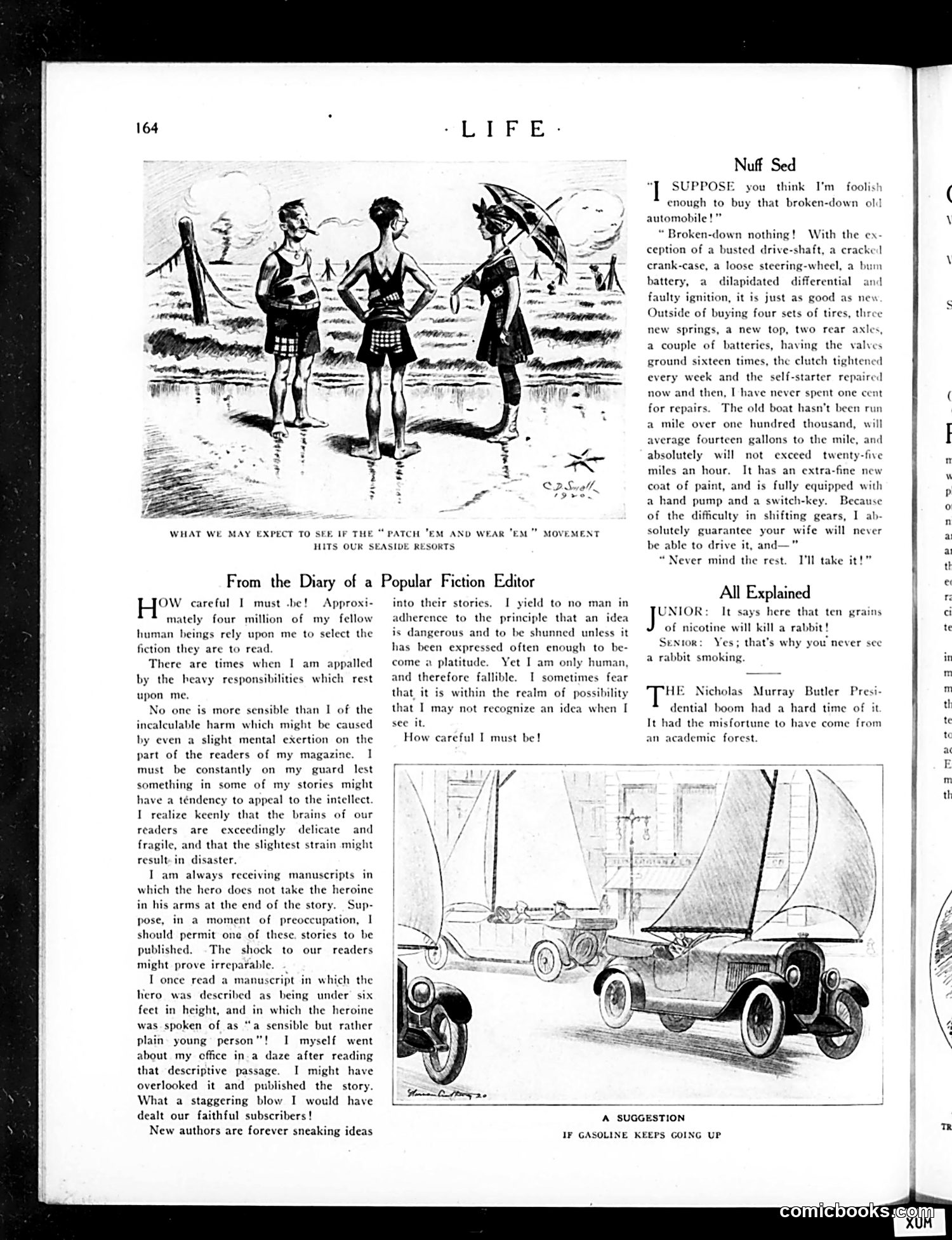
This page contains three separate satirical pieces mocking American culture circa the 1920s: 1. **"From the Diary of a Popular Fiction Editor"** mocks editors who censor intellectual content from magazine fiction, treating readers as fragile-minded. The editor boasts of preventing any story with ideas or realistic characters from publication, fearing readers might strain their intellects. 2. **"Nuff Sed"** satirizes used car salesmen's deceptive practices. A man describes his decrepit automobile as "just as good as new" while listing catastrophic mechanical failures—broken shaft, cracked engine, faulty ignition—yet claims it runs without excessive fuel consumption. The joke exposes how salesmen obscure obvious defects with casual dismissal. 3. **Two brief jokes**: One connects nicotine poisoning to rabbit mortality; another references **Nicholas Murray Butler's** failed presidential campaign, suggesting academic credentials damaged his political viability. The bottom illustration shows a car with a sail, captioning rising gasoline prices as a problem requiring creative solutions.
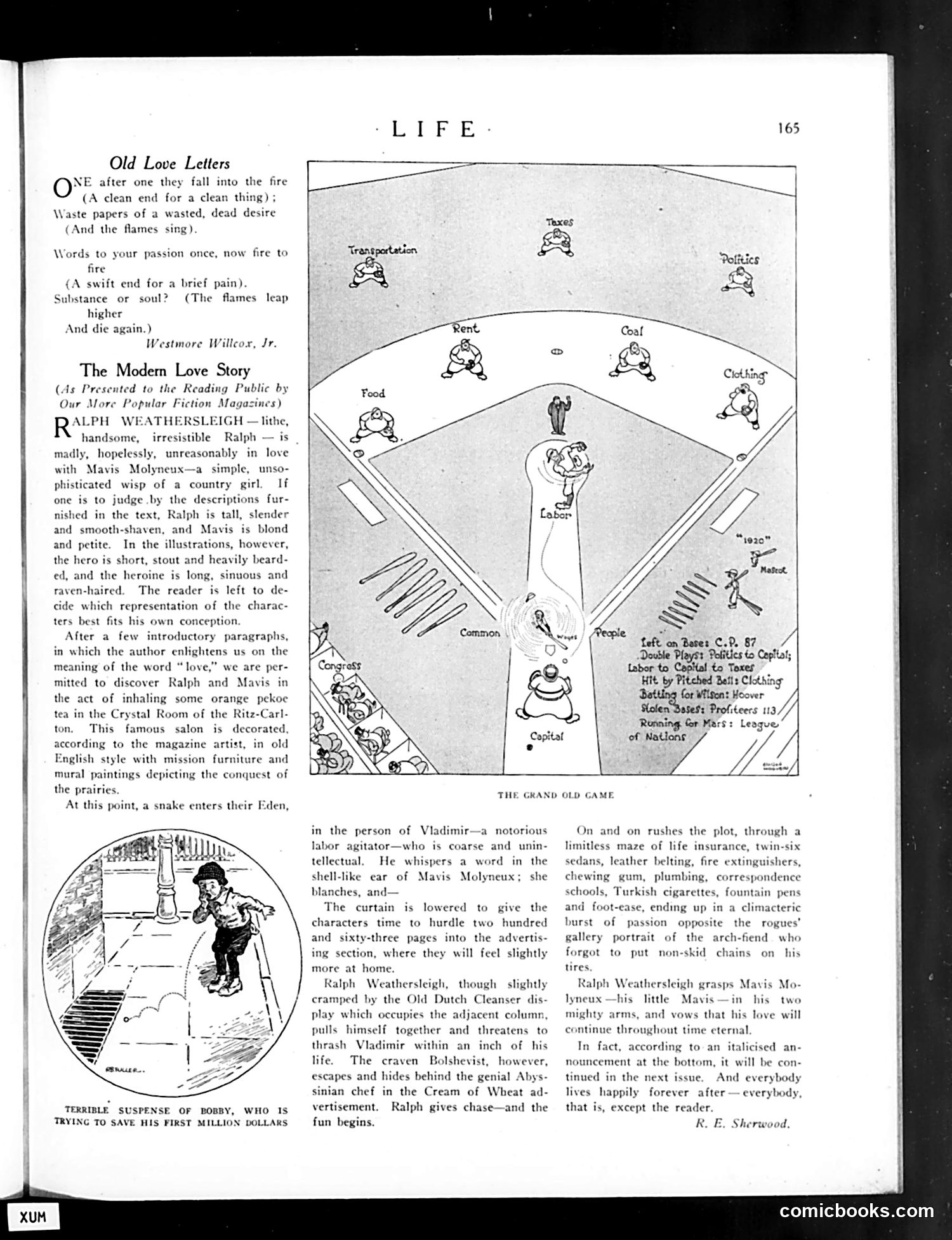
This piece mocks popular fiction magazines' melodramatic serials of the 1920s. The text describes a romance between wealthy Ralph Weathersleigh and country girl Mavis Molyneux, interrupted by a villainous labor agitator named Vladimir. The satire targets several things: the disconnect between text descriptions and illustrations (hero described as "lithe" but drawn stout); the intrusion of advertisements into narratives (characters literally "hurdle" into the advertising section); and the absurd plot that weaves through product placements (life insurance, automobiles, cleaning products) rather than genuine drama. The accompanying diagram, "The Grand Old Game," maps baseball fields onto capitalist concerns—taxes, politics, labor—suggesting satire of how commercial interests dominate American life even in leisure. The joke: popular magazines care more about selling products than telling coherent stories. Readers suffer through endless installments padding ad revenue, while the narrative continues "happily forever after" in perpetuity—except for the actual reader.
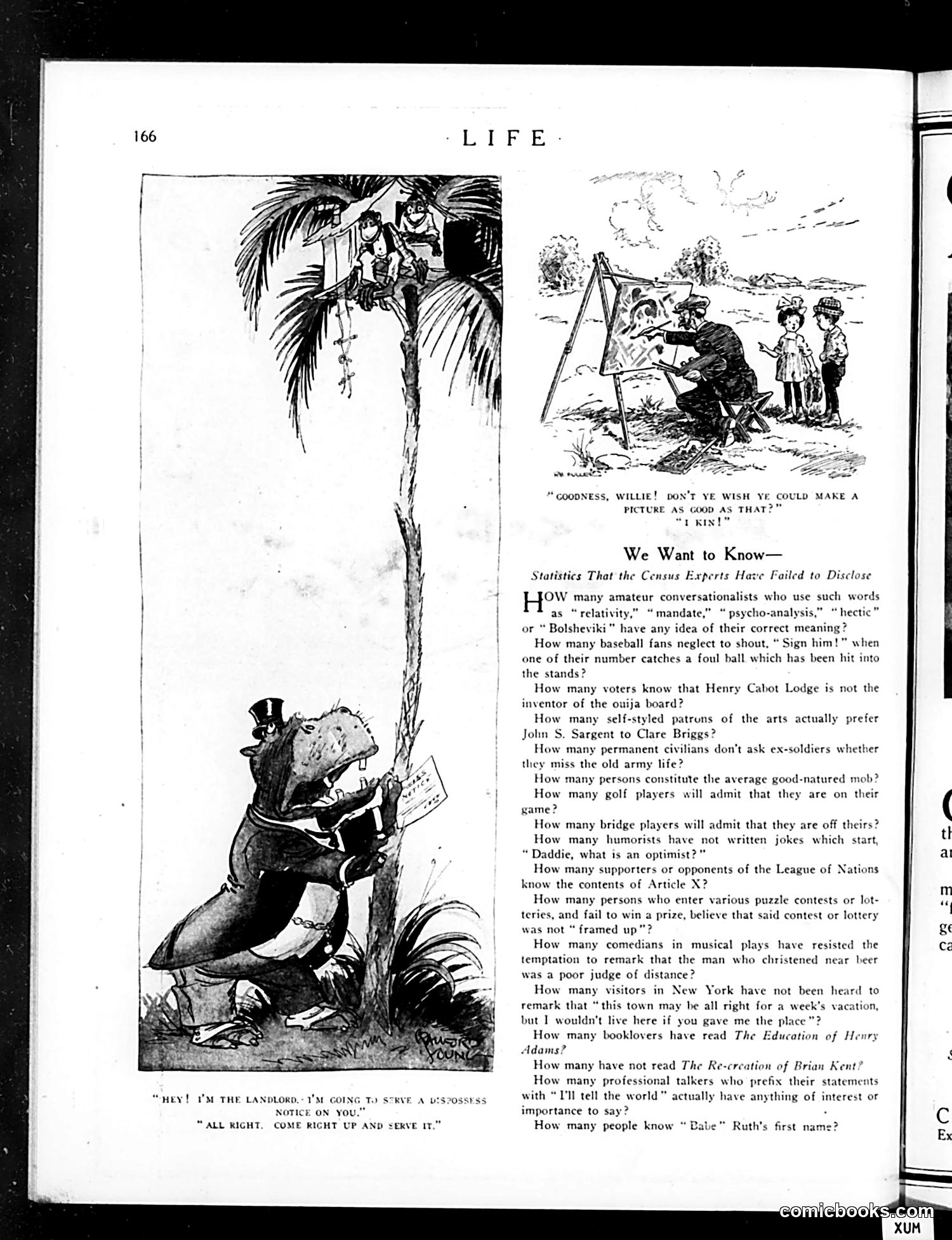
This Life magazine page contains two distinct elements: **Left side:** Two cartoons depicting a landlord-tenant interaction. A man in a top hat (the landlord) serves notice on a tenant, who responds with working-class dialect ("nev!"). Below, a child asks if an adult could draw a picture "as good as that," and the adult claims "i kin!"—satirizing overconfidence and American boastfulness. **Right side:** A column titled "We Want to Know" lists rhetorical questions about American knowledge gaps and social pretension. It mocks people who use fashionable words ("psycho-analysis," "Bolsheviki," "mandate") without understanding them, baseball etiquette, political ignorance, and people's false claims about their abilities (golf, bridge, reading). It also references Henry Cabot Lodge, the ouija board, artist Clare Briggs, and "Babe" Ruth. **The satire:** Life ridicules American cultural and intellectual pretension—people claiming knowledge, taste, or skill they don't possess; adopting trendy vocabulary without comprehension; and making tired conversational clichés. The overall message critiques American hubris and superficiality.
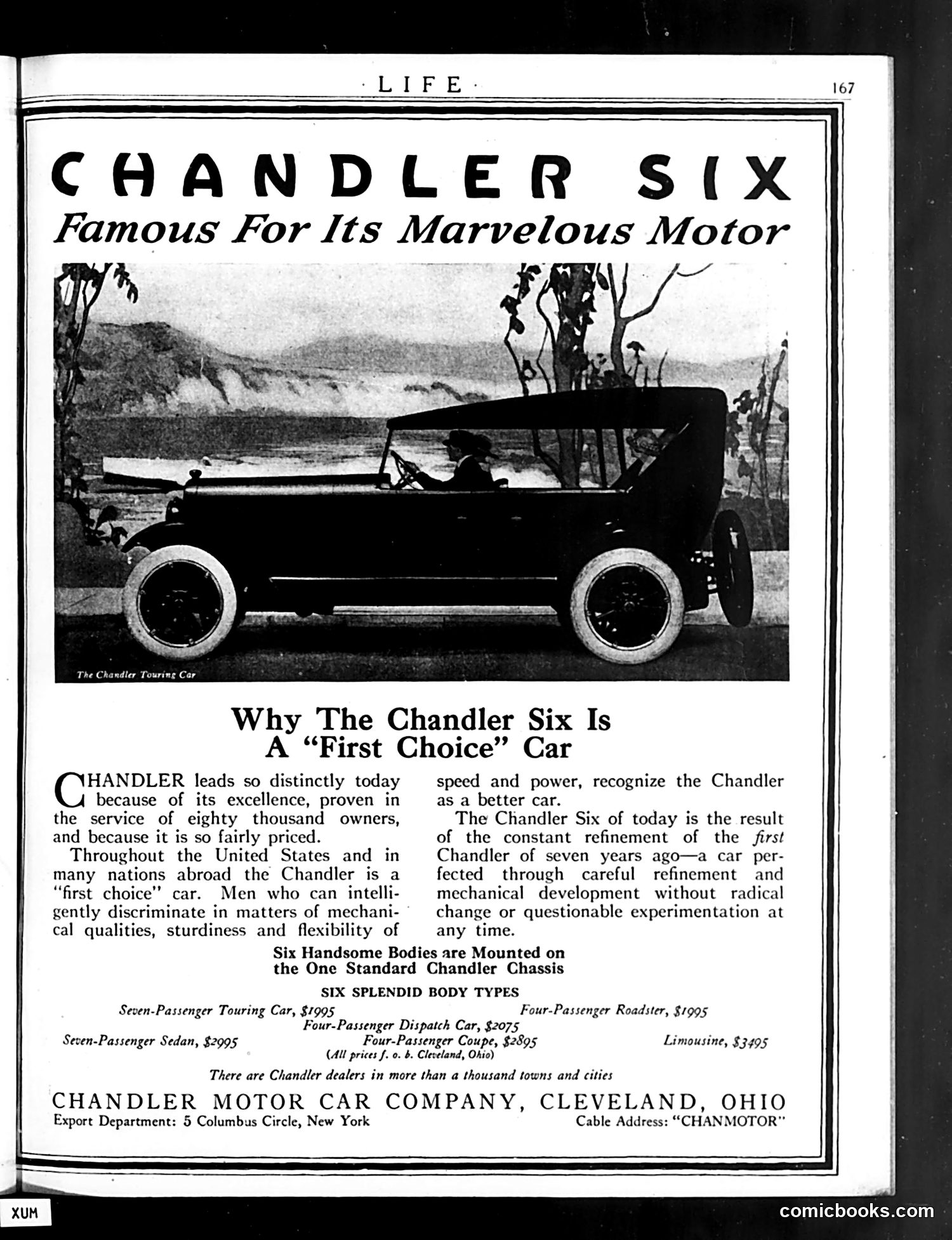
This is **not a cartoon or satire**—it's a straightforward automobile advertisement from Life magazine's early automotive era (circa 1920s). The Chandler Motor Car Company, based in Cleveland, Ohio, is marketing its "Six" model as a premium vehicle. The ad emphasizes reliability through "eighty thousand owners" and positions it as the intelligent buyer's choice for mechanical quality and value. The touring car pictured represents the popular open-air style of that era. The ad lists six body variants ranging from $1,995 to $3,495, suggesting options for different customer needs. The phrase "first choice" plays on the car's reputation rather than satirizing anything. Life magazine at this time regularly published such advertisements alongside its humor and commentary. There is no political satire or social commentary present—this is simply vintage marketing appealing to discerning, mechanically-minded buyers of the prosperous 1920s.
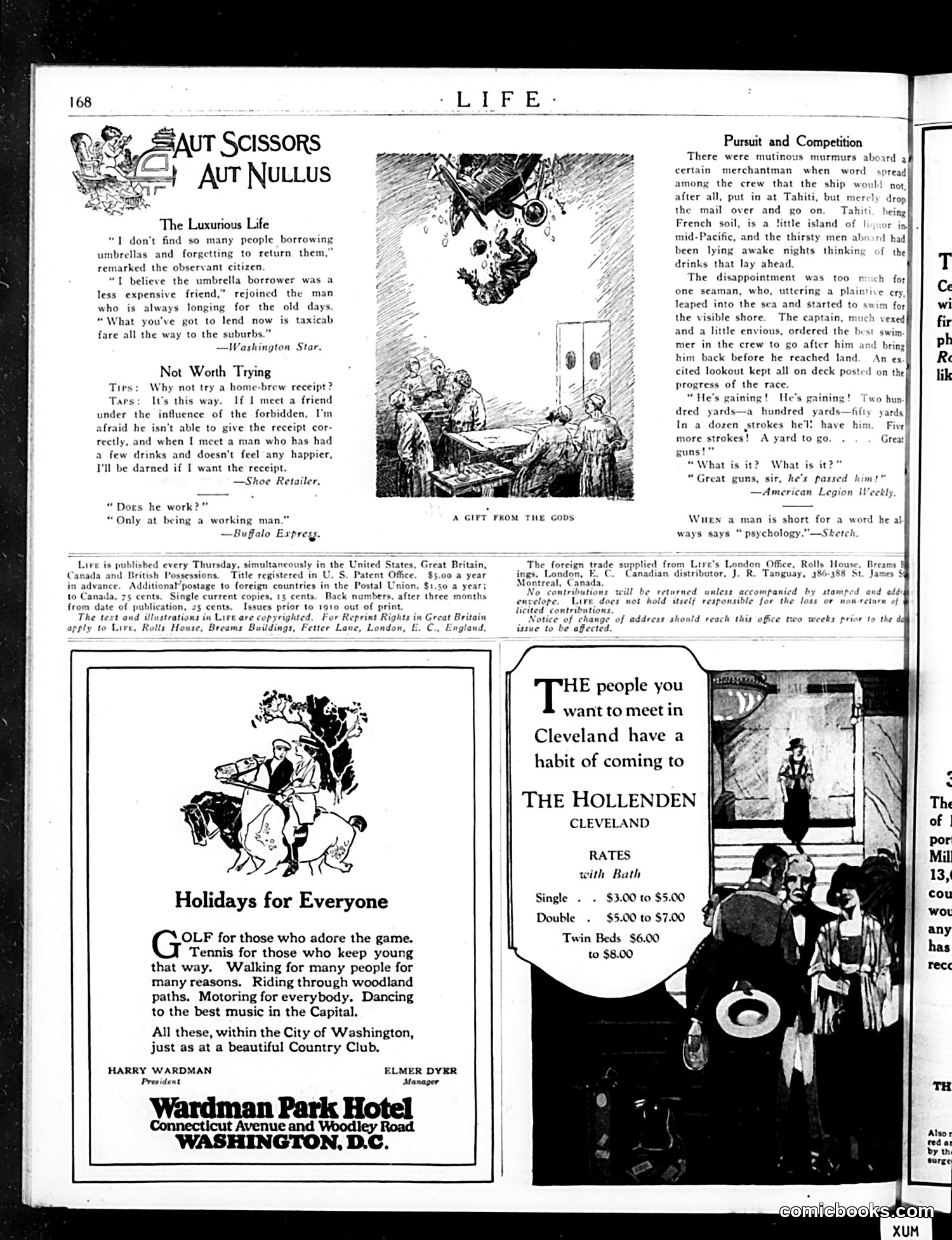
This page from *Life* magazine contains several short humorous pieces and advertisements typical of early 20th-century American satire. **The cartoons and jokes** mock everyday social behaviors: umbrella borrowing (complaining that lending taxicab fare to suburbs is more burdensome than umbrellas), home-brew liquor during Prohibition (suggesting the recipe is worthless if it doesn't make people happy), and a workplace observation about "working men" merely existing rather than achieving. **The central illustration** titled "A Gift from the Gods" depicts a dramatic maritime scene where a crew member jumps overboard near Tahiti, apparently hoping to reach shore. The joke satirizes the crew's disappointment at missing port and the comical competition to retrieve the swimmer—capturing the absurdity of human desire conflicting with duty. **The advertisements** (Wardman Park Hotel, Hollenden Cleveland) represent typical period hospitality marketing. The page reflects *Life*'s formula: mixing observational humor about modern life with satirical commentary on human nature, all in accessible, witty formats for middle-class readers.
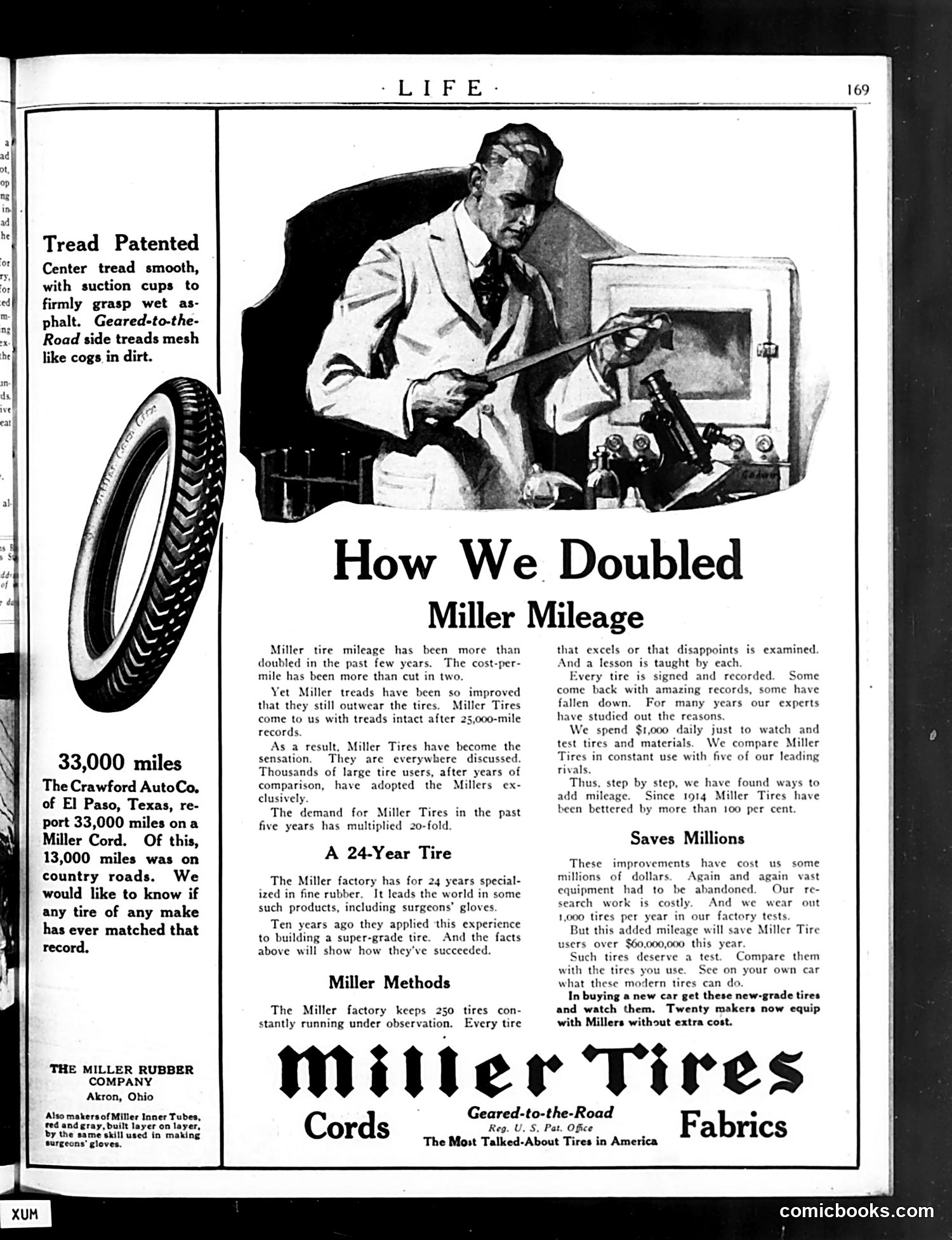
This is primarily a **tire company advertisement**, not satire or political commentary. It promotes Miller Tires (made by the Miller Rubber Company of Akron, Ohio) to a 1920s American audience. The image shows a well-dressed man (likely a tire engineer or company representative) examining tires in a laboratory setting. The advertisement emphasizes Miller's competitive advantages: durability (a 33,000-mile test case), superior tread design ("Geared-to-the-Road"), and rigorous quality control (250 tires constantly tested, $1,000 spent daily on testing). The text repeatedly stresses that Miller has "doubled" mileage while cutting costs in half since 1914—a major selling point during an era when tire durability directly affected car ownership costs. The ad appeals to practical consumers by highlighting that twenty car manufacturers now equipped vehicles with Millers "without extra cost," positioning the brand as both premium and accessible. There is **no cartoon or satire present**—this is straightforward commercial persuasion targeting middle-class automobile owners.
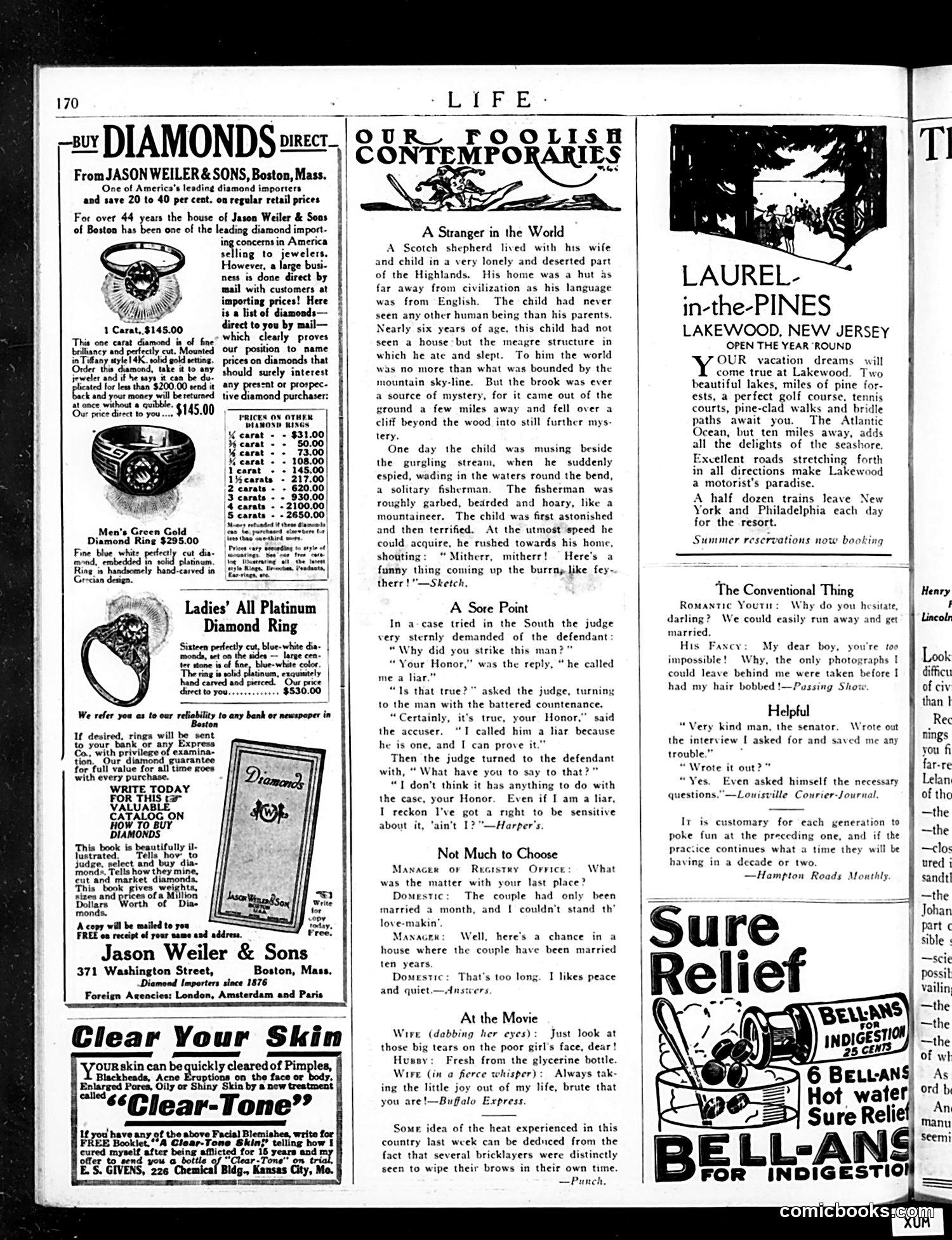
This page is primarily **advertising and light humor content**, not political satire. It contains: **Main Content:** - Diamond ring advertisements from Jason Weiler & Sons (Boston) - Several short humorous anecdotes titled "Our Foolish Contemporaries," a regular Life feature satirizing everyday human absurdities - Advertisements for Laurel-in-the-Pines resort, skin cream, and Bellans indigestion remedy **The Humor:** The anecdotes mock modern conventions and pretensions: - "A Sore Point" ridicules a courtroom liar claiming offense at being called a liar - "The Conventional Thing" jokes about a woman whose only concern about eloping is that her old photographs predate her bobbed hairstyle (suggesting 1920s-30s era) - "Not Much to Choose" satirizes a couple's marriage troubles over excessive affection **Context for Modern Readers:** These aren't political cartoons but rather gentle mockery of contemporary social situations—relationship dynamics, vanity, and legal absurdity. The bobbed hair reference suggests this is 1920s-era Life, when women's fashion choices were culturally significant.
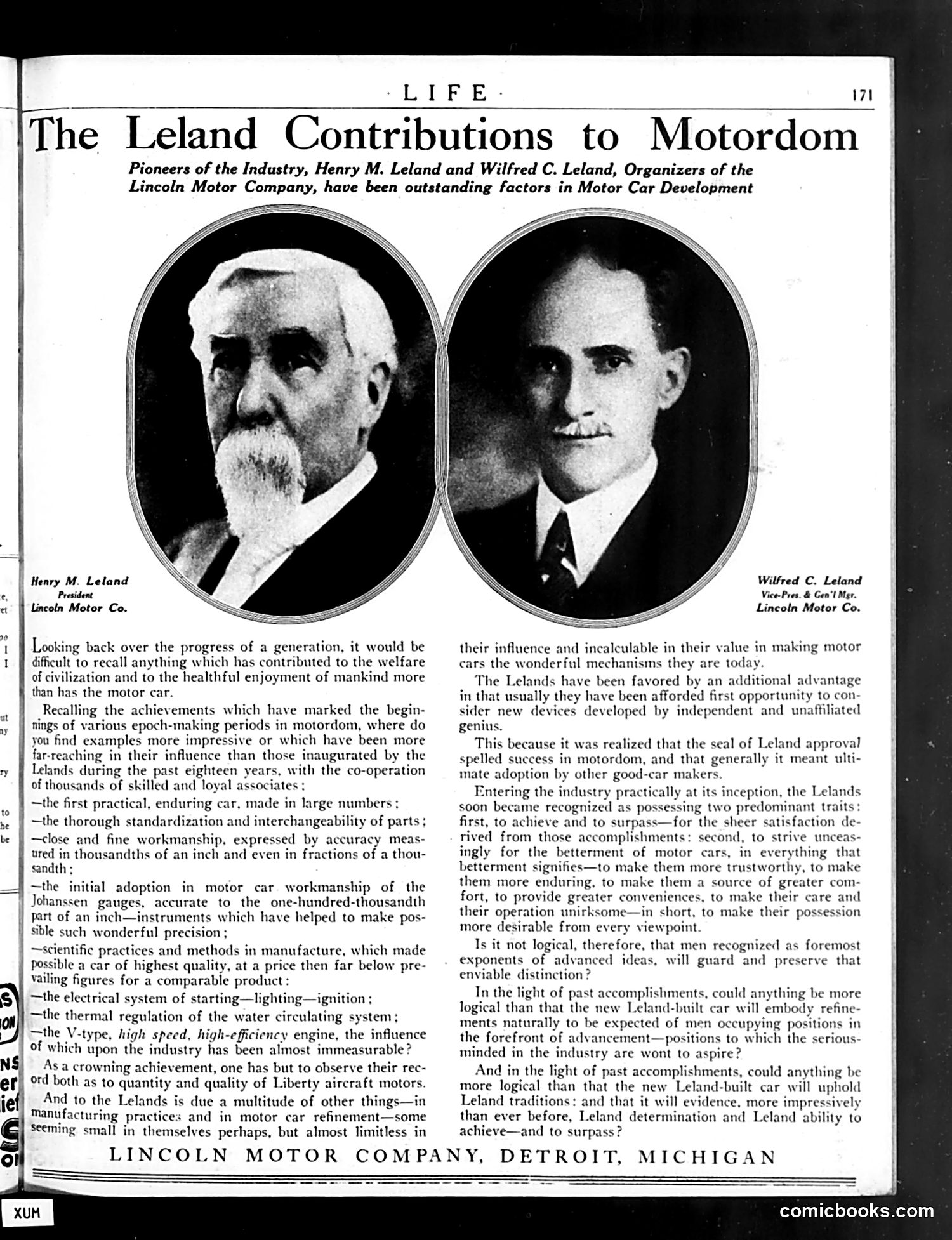
This is **corporate advertising**, not satire or political commentary. The page promotes the Lincoln Motor Company and its founders, Henry M. and Wilfred C. Leland. The two oval portraits show the elder Henry (left, with white beard) and younger Wilfred (right). The text—presented as editorial content in *Life* magazine—lists their automotive innovations: standardized parts, precision manufacturing, electrical systems, and the V-type engine. It emphasizes their reputation for quality and their wartime production of Liberty aircraft motors. The rhetorical strategy is subtle: by framing the Lelands' accomplishments as industrywide contributions rather than mere business success, the advertisement positions them as visionary pioneers deserving consumer trust. This was common early-20th-century marketing—wrapping product promotion in narratives of American progress and engineering excellence. Modern readers should recognize this as sponsored content masquerading as journalism.
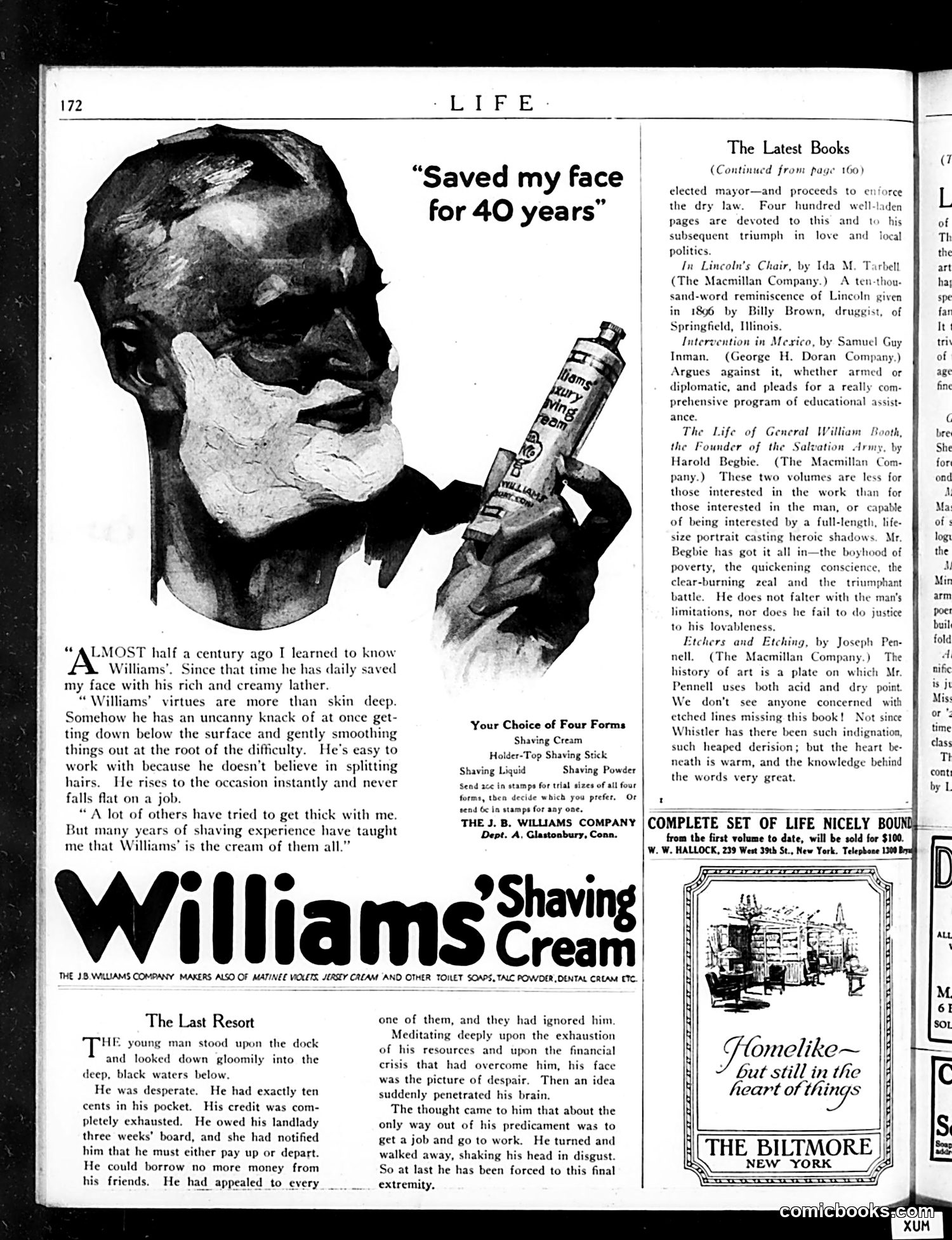
This page is primarily **advertising**, not satire or political commentary. The dominant content is a **Williams' Shaving Cream advertisement** featuring a testimonial from an unnamed man claiming the product "saved my face for 40 years." The ad uses the device of a quasi-endorsement, with the speaker praising Williams' superior lathering and performance compared to competitors. Below the main ad is a short humorous fiction piece titled "The Last Resort," depicting a desperate young man with ten cents who contemplates suicide at a dock, then realizes his only option is to find employment—a mild joke about economic hardship and the necessity of work. The right column contains book reviews from Life's literary section, covering titles about Lincoln, Mexican intervention, General William Booth, and etching techniques. There is **no political cartoon** on this page. It's a standard magazine layout mixing advertisements with editorial content typical of early 20th-century Life magazine.
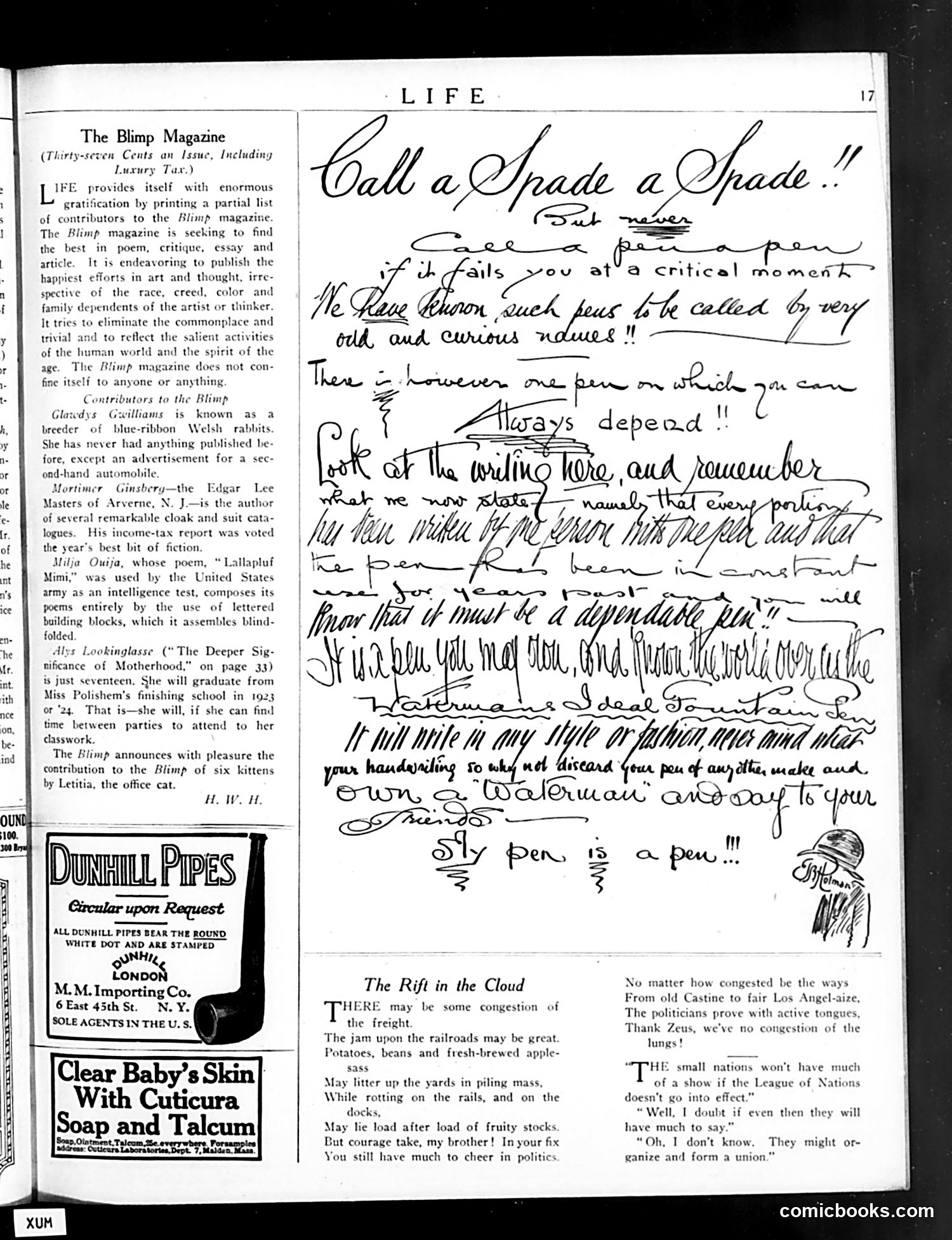
This page primarily showcases **The Blimp Magazine**, a fictional satirical publication that Life is mock-promoting. The satire mocks pretentious literary magazines by listing absurd "contributors": a Welsh rabbit breeder who's never published, a poet named after a Ouija board, and a seventeen-year-old debutante whose poem is about "deeper significance." The handwritten section appears to be a humorous submission or editorial note, likely satirizing overwrought artistic pretension. **"The Rift in the Cloud"** below is political verse about post-WWI logistics concerns—railroad congestion, food shortages—followed by commentary on the **League of Nations** debate. The dialogue jokes that small nations joining the League still won't have influence, but might "organize and form a union" anyway—satirizing both their powerlessness and optimistic internationalism. The ads (Dunhill Pipes, Cuticura) are period commercial matter unrelated to the satire.
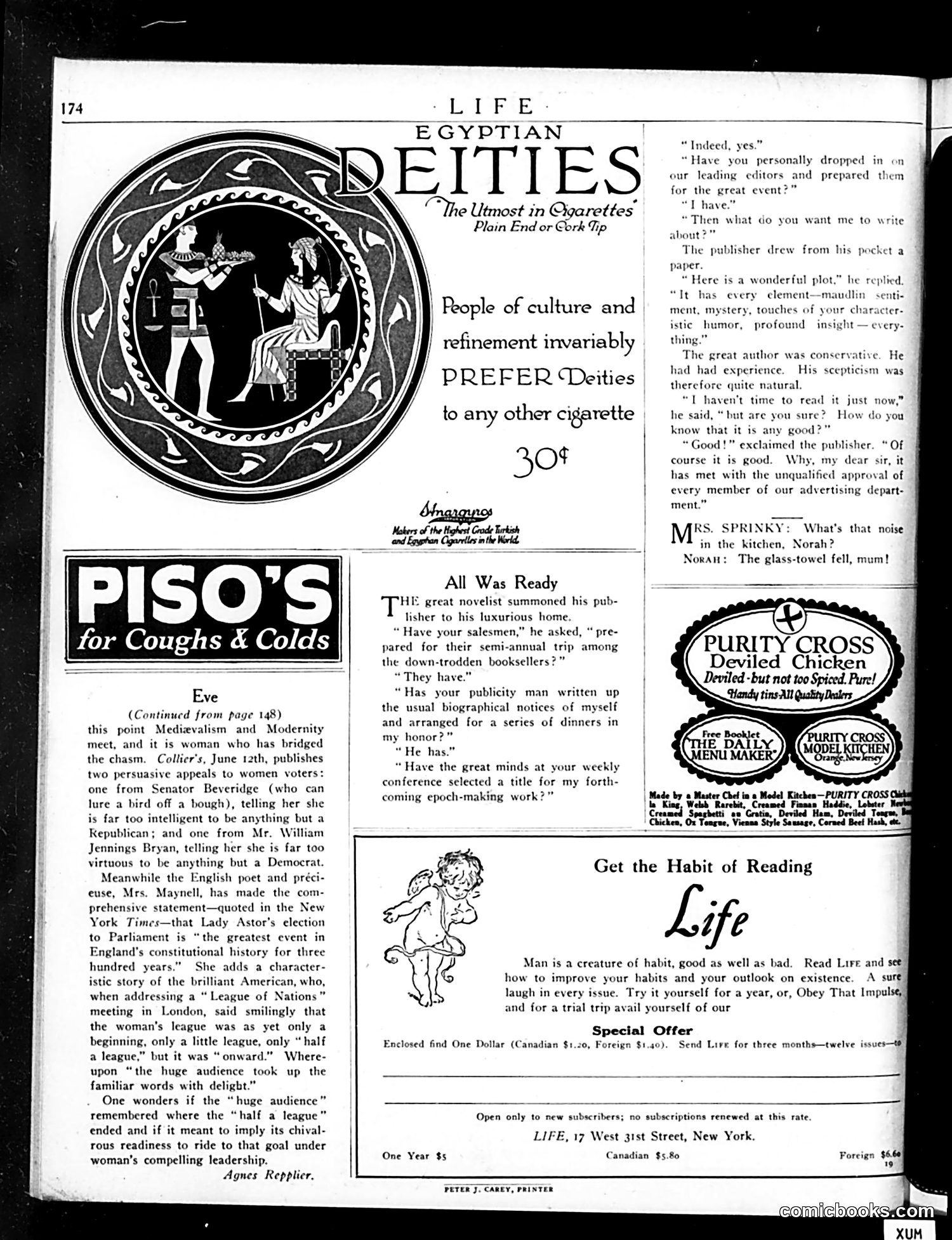
This page contains satirical dialogue about publishing and authorship, typical of *Life* magazine's humor. The main cartoon depicts a publisher pitching a plot to a skeptical famous novelist. The satire targets the publishing industry's priorities: the publisher boasts the plot is "good" not because it has literary merit, but because "every member of our advertising department" approved it. The joke mocks how commercial considerations—advertising approval rather than artistic quality—drive publishing decisions. A secondary cartoon shows a domestic scene ("What's that noise in the kitchen, Norah?") using servant-class dialect for quick humor. The page also includes advertisements (Egyptian Deities cigarettes, Piso's cough medicine, Purity Cross deviled chicken) and a subscription pitch for *Life* itself. The Egyptian Deities ad features classical imagery. Overall, this reflects early 20th-century satirical magazine format mixing literary humor with advertising.
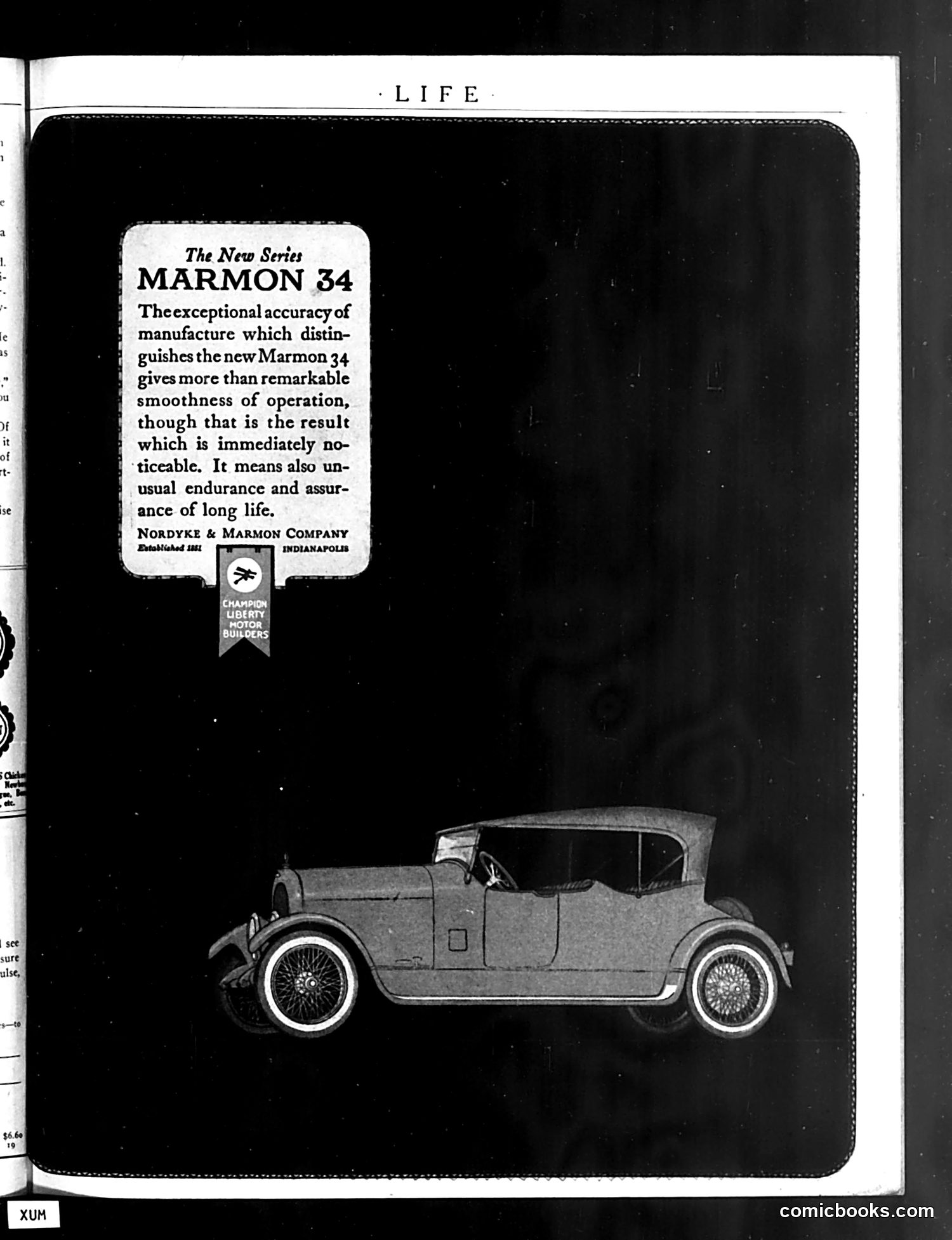
This is a straightforward advertisement, not satire or political commentary. It promotes the Marmon 34 automobile, manufactured by Nordyke & Marmon Company of Indianapolis. The ad emphasizes manufacturing precision as the key to the car's smooth operation, durability, and longevity. The side-view illustration shows a 1920s-era touring car with characteristic features of that period: spoke wheels, open cabin, and boxy design. A "Champion" badge appears below the text box, likely indicating the car's competitive standing or award status. This is typical early-twentieth-century automotive advertising focusing on engineering quality and reliability as selling points to consumers.
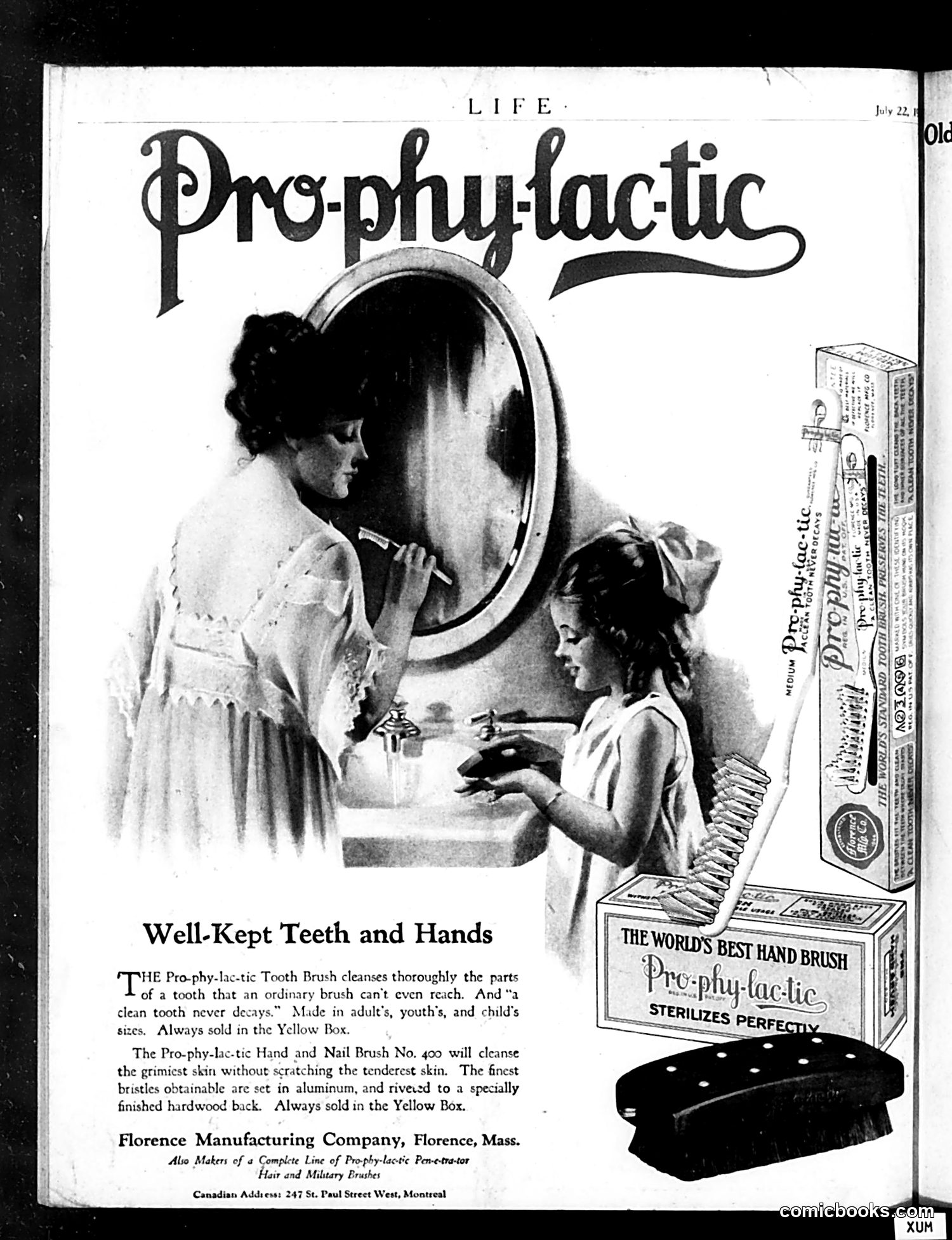
This page is primarily a **product advertisement**, not political satire. It promotes Pro-phy-lactic brand toothbrushes and hand brushes, manufactured by Florence Manufacturing Company in Massachusetts. The image shows a woman and child at a mirror, illustrating proper dental and hand hygiene. The advertisement emphasizes that the toothbrush reaches parts ordinary brushes cannot, and that the hand brush cleans effectively without scratching delicate skin. Both products are distinctive by their "Yellow Box" packaging. The tagline "a clean tooth never decays" reflects early 20th-century beliefs about hygiene and dental health. The mention of sizes for "adult's, youth's, and child's" indicates the product line's range. There is no apparent political cartoon or satire on this page—it is straightforward commercial advertising typical of *Life* magazine's revenue model during this era.