
Life, 1920-07-22 · page 10 of 40
Life — July 22, 1920 — page 10: what you’re looking at
What you’re looking at
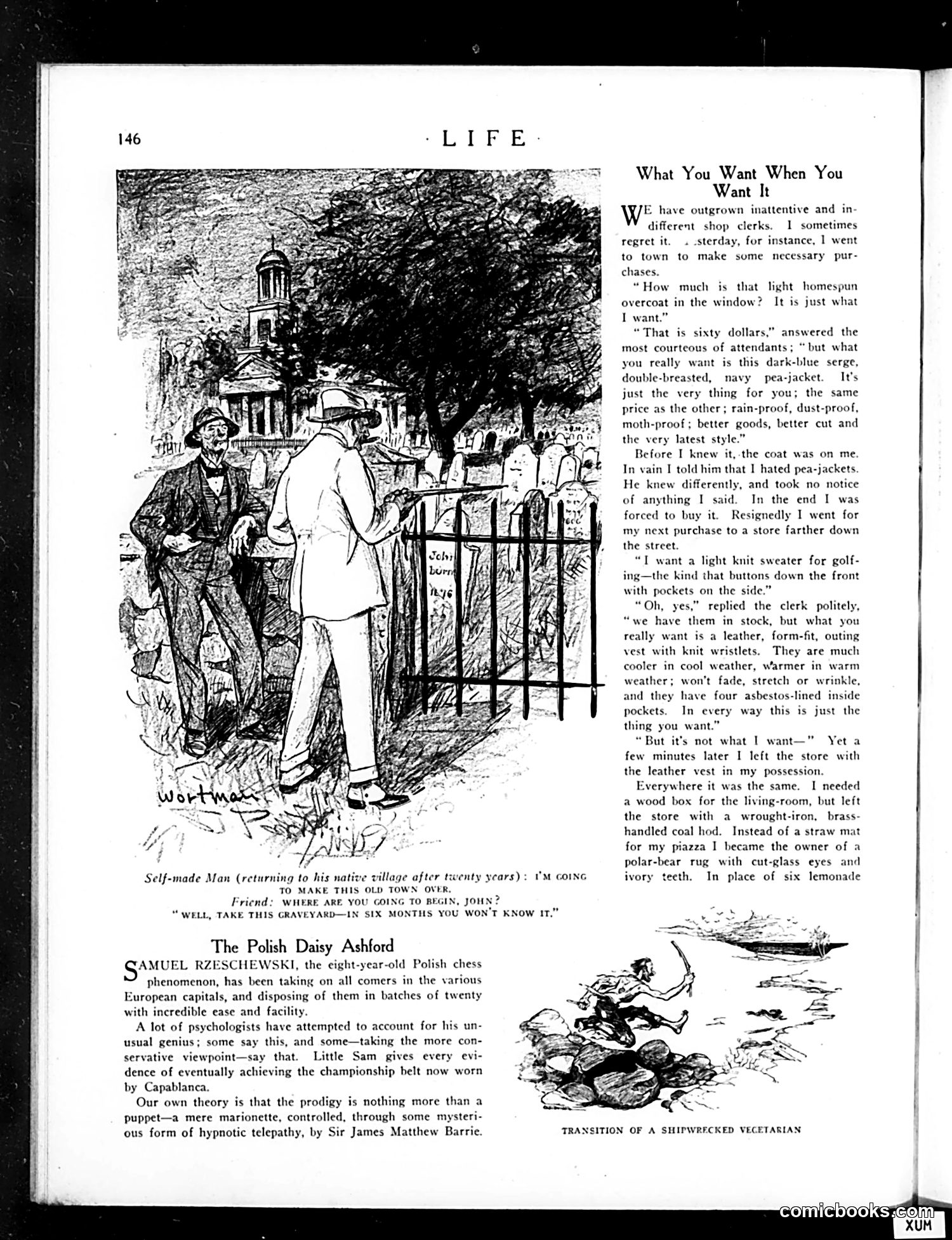
The top article "What You Want When You Want It" satirizes inattentive shop clerks who push unwanted merchandise on customers. The illustration shows a customer at a gate being persuaded to buy items he doesn't want—a pea-jacket instead of the light homespun overcoat he requested, a leather vest instead of a knit sweater. The satire critiques salespeople who ignore customer preferences, instead steering buyers toward whatever inventory the store wants to move or profits from most. The lower section introduces "The Polish Daisy Ashford," discussing Samuel Rzeszewski, an eight-year-old Polish chess prodigy. The accompanying illustration shows someone in transition, likely depicting the "shipwrecked vegetarian" mentioned in the caption—a humorous juxtaposition unrelated to the chess story.
📄 Transcribed text from this page (OCR, searchable)
Machine-transcribed from the original scan — historical spelling and the odd misread are preserved.
Self-made Man (returning to his nati TO MAKE THIS OLD TOWN OVER, “WELL, TAKE THIS GRAVEYARD—IN SIX MONTHS YOU WOD The Polish Daisy Ashford AMUEL RZESCHEWSKI, the eight-year-old Polish chess gon all comers in the various phenomenon, has been taki European capitals, and disposing of them in batches of twenty with incredible ease and facility. A lot of psychologists have attempted to account for his un- usual genius; some say this, and some—taking the more con- servative viewpoint—say that. Little Sam gives every evi- dence of eventually achieving the championship belt now worn by Capablanca. Our own theory is that the prodigy is nothing more than a puppet—a mere marionette, controlled, through some mysteri- ous form of hypnotic telepathy, by Sir James Matthew Barrie. Friend: WHERE ARE YOU GOING TO BEGIN, JOH) village after twenty years): I'M conc KNow 1,” What You Want When You Want It W have outgrown inattentive and in- different shop clerks. 1 sometimes regret it. . .sterday, for instance, 1 went to town to make some necessary pur- chases. “How much is that light homespun overcoat in the window? It is just what I want.” “That is sixty dollars,” answered the most courteous of attendants; “but what you really want is this dark-blue serge, double-breasted, navy pea-jacket. It's just the very thing for you; the same price as the other; rain-proof, dust-proof, moth-proof; better goods, better cut and the very latest style.” Before I knew it,-the coat was on me. In vain I told him that I hated pea-jackets. He knew differently, and took no notice of anything I said. In the end I was forced to buy it. Resignedly 1 went for my next purchase to a store farther down the street. “T want a light knit sweater for golf- ing—the kind that buttons down the front with pockets on the side.” “Oh, yes,” replied the clerk politely, “we have them in stock, but what you really want is a leather, form-fit, outing vest with knit wristlets. They are much cooler in cool weather, Warmer in warm weather; won't fade, stretch or wrinkle, and they have four asbestos-lined inside pockets. In every way this is just the thing you want.” “But it’s not what | want—" Yet a few minutes later I left the store with the leather vest in my possession. Everywhere it was the same. I needed a wood box for the living-room, but left the store with a wrought-iron, brass- handled coal hod. Instead of a straw mat for my piazza I became the owner of a polar-bear rug with cut-glass eyes and ivory teeth. In place of six lemonade TRANSITION OF A SHIPWRECKED VECETARIAN