
A complete issue · 48 pages · 1919
Life — October 9, 1919
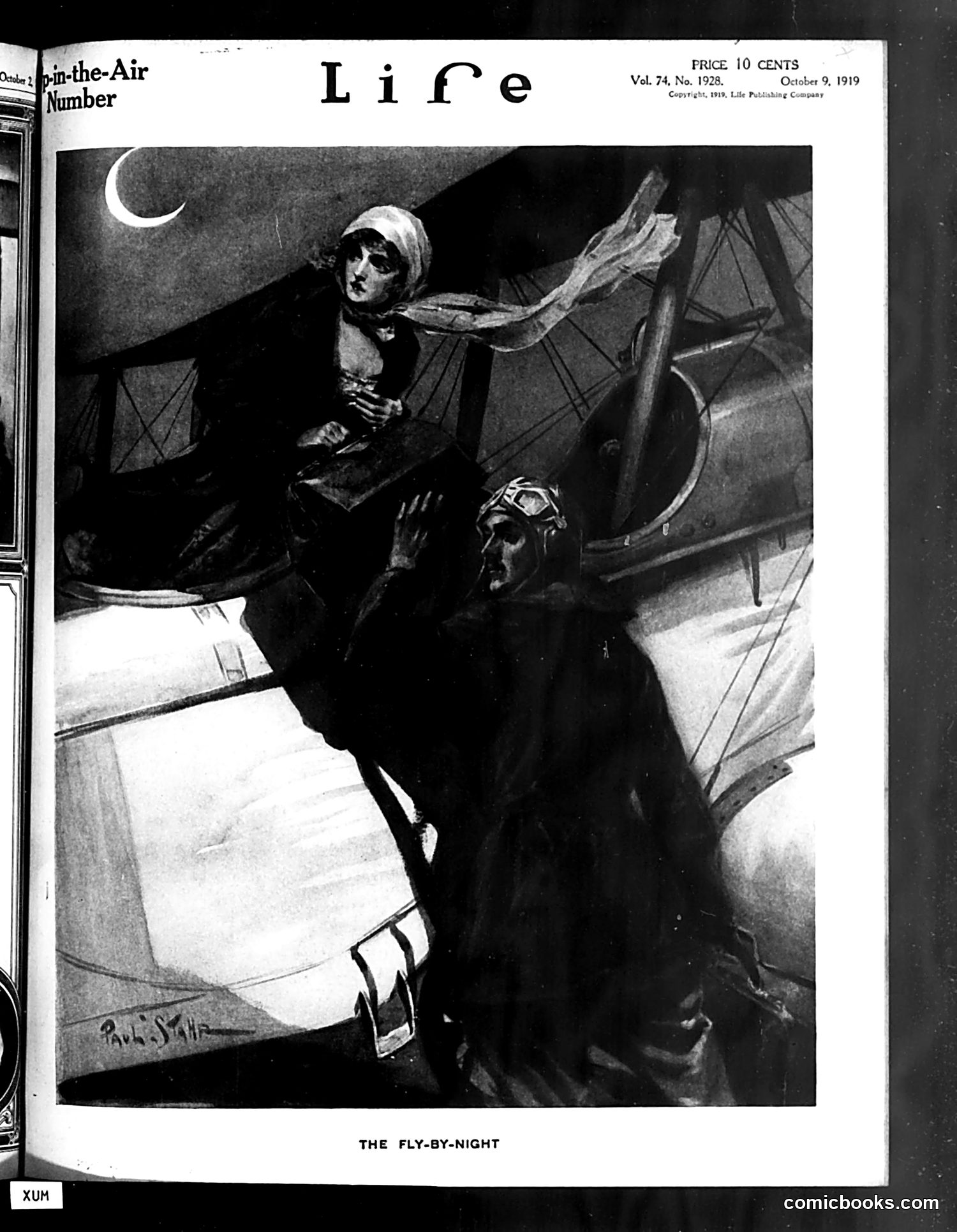
This Life magazine cover from October 9, 1919 depicts two figures in what appears to be an aircraft at night, with a crescent moon visible. The title "The Fly-by-Night" is a pun suggesting both literal nighttime flying and the colloquial term for someone unreliable or evasive. The illustration likely satirizes early aviation's dangers and novelty, or possibly references contemporary concerns about aircraft. The formal dress and goggles suggest these may be notable figures, though without additional context, their specific identities remain unclear. The nighttime setting emphasizes the adventurous or risky nature of the scenario. The 10-cent price and "Out-in-the-Air Number" designation indicate this was a themed issue celebrating aviation's growing cultural prominence in 1919.
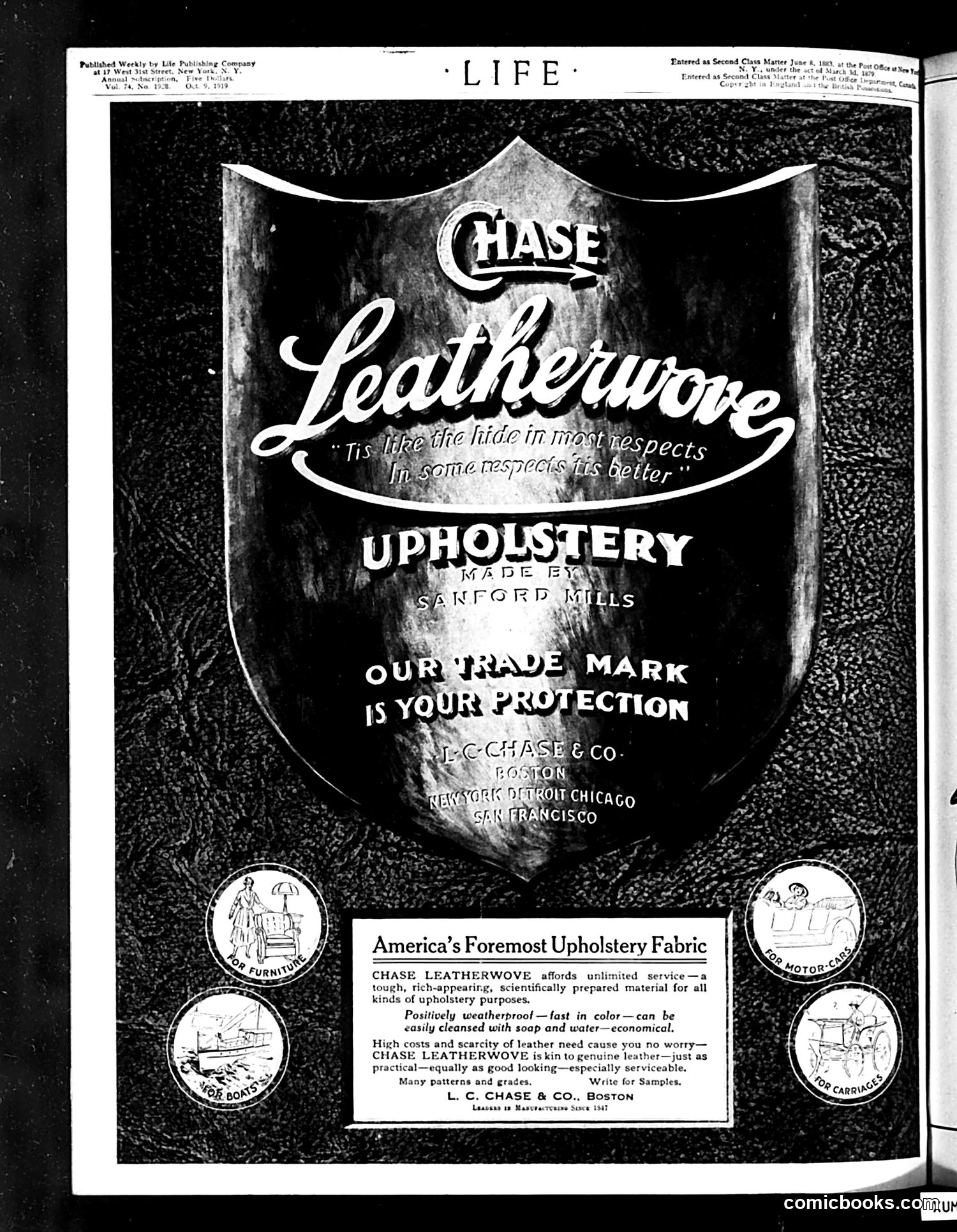
This is **not a political cartoon or satirical content**—it's a full-page advertisement for Chase Leatherwove upholstery fabric, published in *Life* magazine (Vol. 74, No. 1928, dated October 5, 1919). The ad promotes Chase Leatherwove as "America's Foremost Upholstery Fabric," claiming it mimics genuine leather while being practical and economical. The shield-shaped design emphasizes the trade mark as consumer protection. Four circular vignettes around the border (showing furniture, a ship, a motor car, and a carriage) demonstrate the product's versatile applications. This is a straightforward commercial advertisement rather than editorial satire or political commentary.
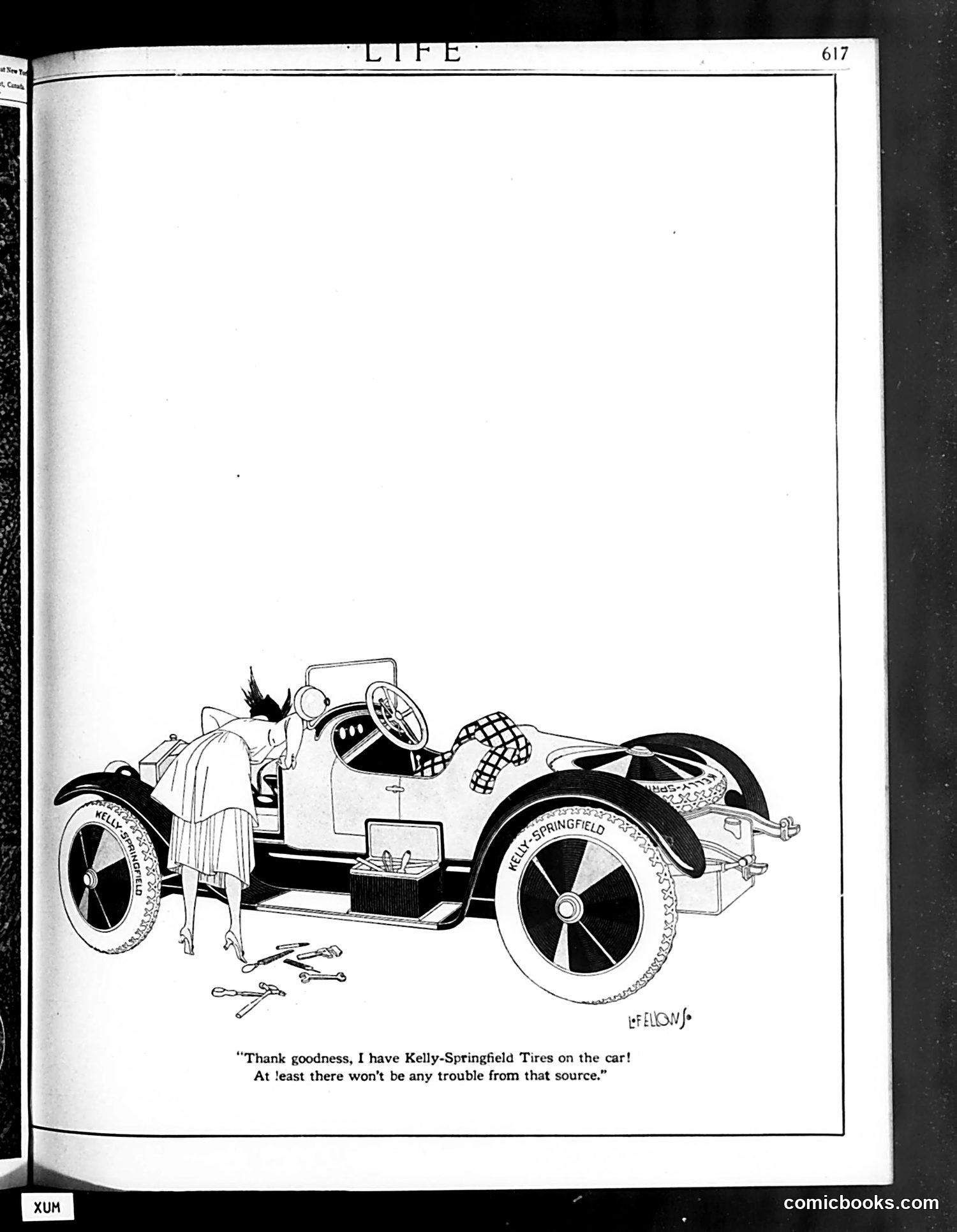
This is a vintage advertisement disguised as humor. A woman stands beside a broken-down early automobile (appears to be from the 1910s-1920s era) surrounded by scattered tools, suggesting mechanical failure. Her caption reads: "Thank goodness, I have Kelly-Springfield Tires on the car! At least there won't be any trouble from that source." The joke relies on irony—the car has clearly suffered multiple failures, yet she reassures herself that at least the tires are reliable. This is classic advertising satire from *Life* magazine: by acknowledging the car's general unreliability, the ad paradoxically emphasizes Kelly-Springfield Tires as the one dependable component. The cartoon thus sells tire quality by humorously conceding that everything else might fail.
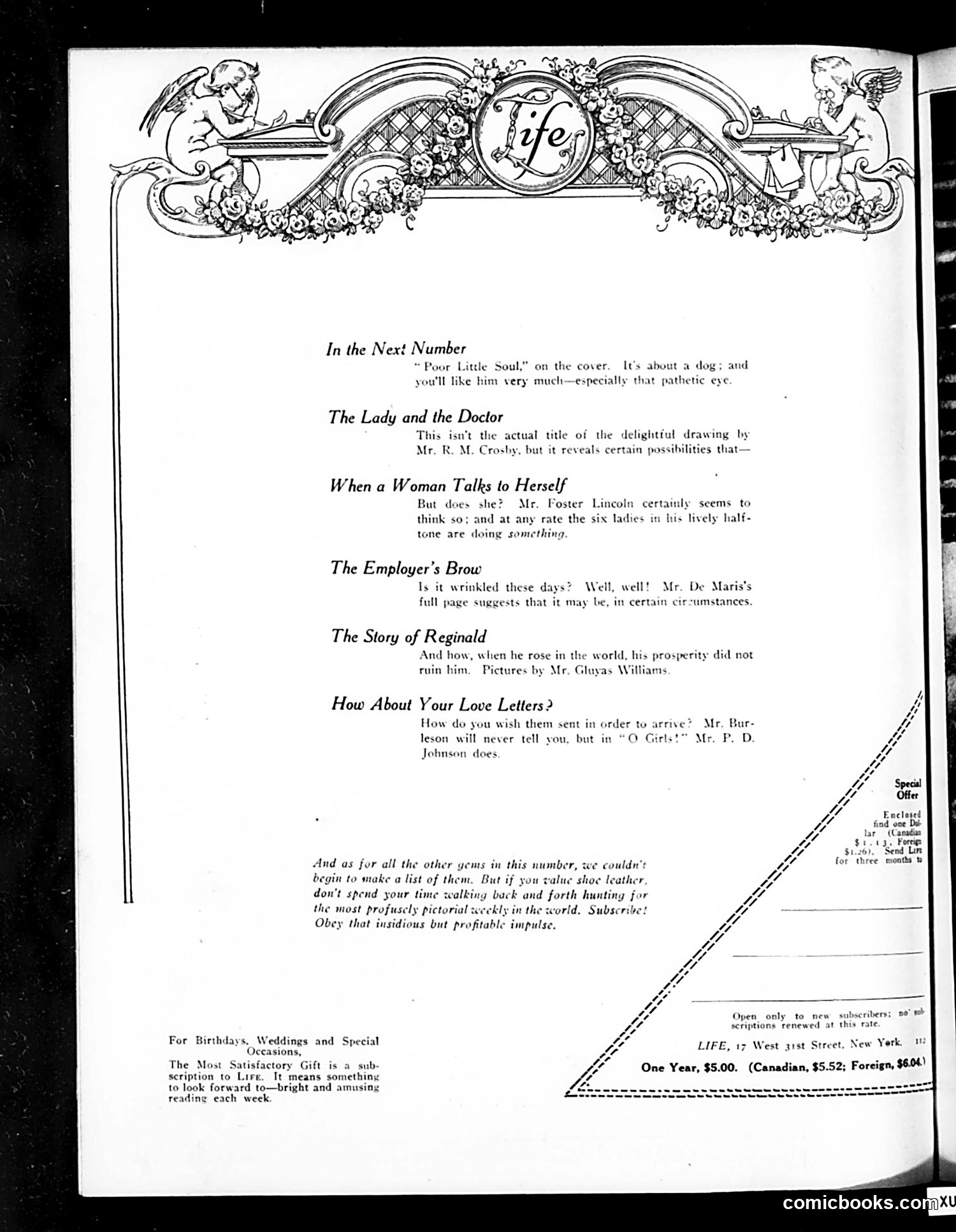
This appears to be a **table of contents or preview page** for an upcoming issue of *Life* magazine, rather than a political cartoon page. The decorative header features cherubs and floral ornaments framing the word "Life." The page previews several articles and illustrations: - "Poor Little Soul" (about a dog) - "The Lady and the Doctor" (by R.M. Crosby) - "When a Woman Talks to Herself" (commentary on six ladies) - "The Employer's Brow" (by De Maris, about wrinkles) - "The Story of Reginald" (illustrated by Gloyas Williams) - "How About Your Love Letters?" (featuring contributions by Burleson and P.D. Johnson) The page also includes subscription information and gift suggestions. **No political satire is evident here**—this is primarily a promotional/contents page showcasing the magazine's upcoming humorous and illustrative content.
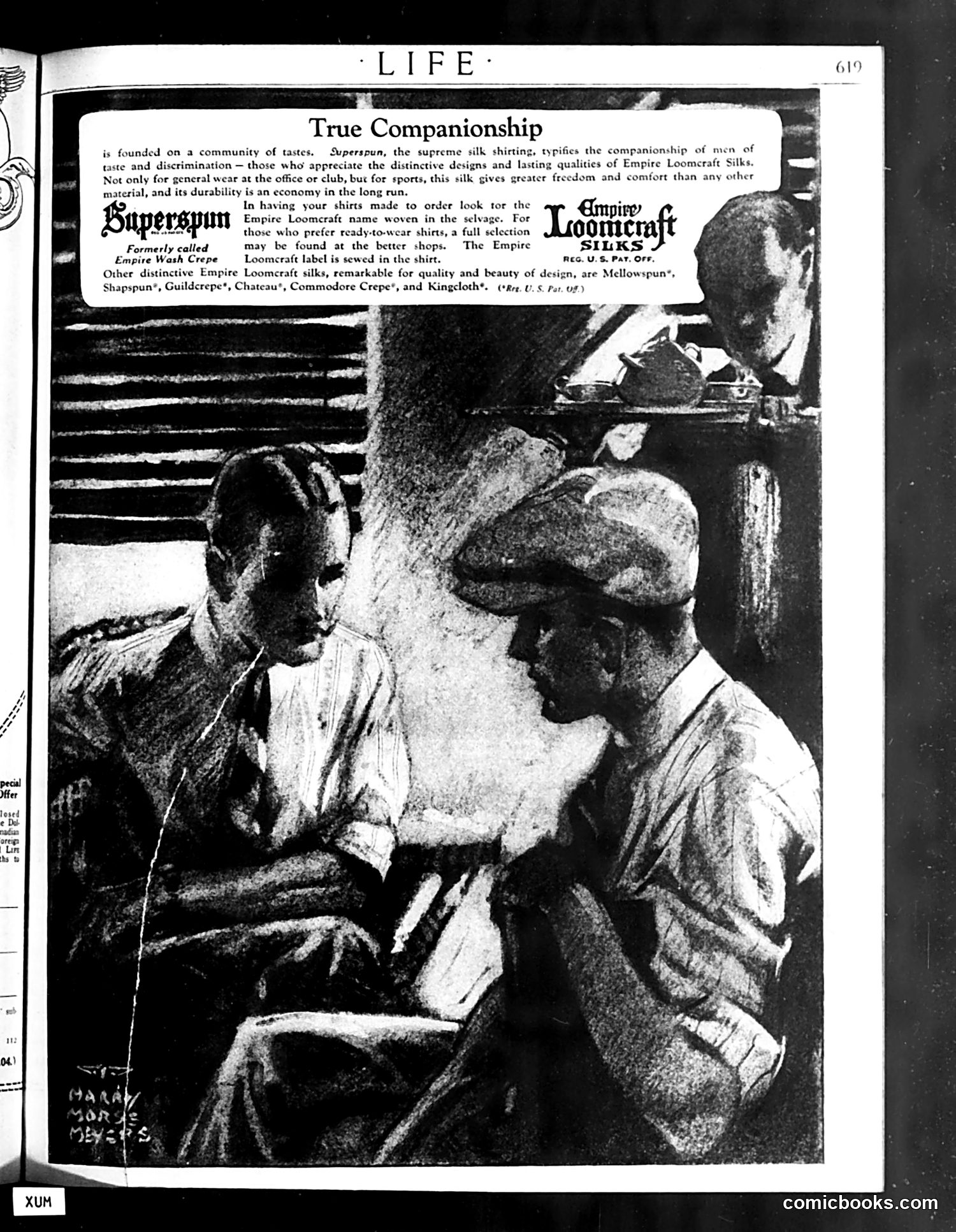
This page is **primarily an advertisement**, not political satire. The heading "True Companionship" promotes Superspun silk shirts and Empire Loomcraft brand fabrics. The text argues that quality shirting reflects shared taste and masculine companionship—positioning these products as markers of refined taste suitable for office wear, sports, and social occasions. Empire Loomcraft silks are praised for "quality and beauty of design." The photograph below shows three men in casual discussion, likely modeling or demonstrating the advertised shirtwear in a social context. This visual is meant to reinforce the advertisement's message: that wearing these branded silks signifies belonging to a community of discerning men. The page represents early 20th-century advertising strategy linking consumer products to social identity and masculine belonging.
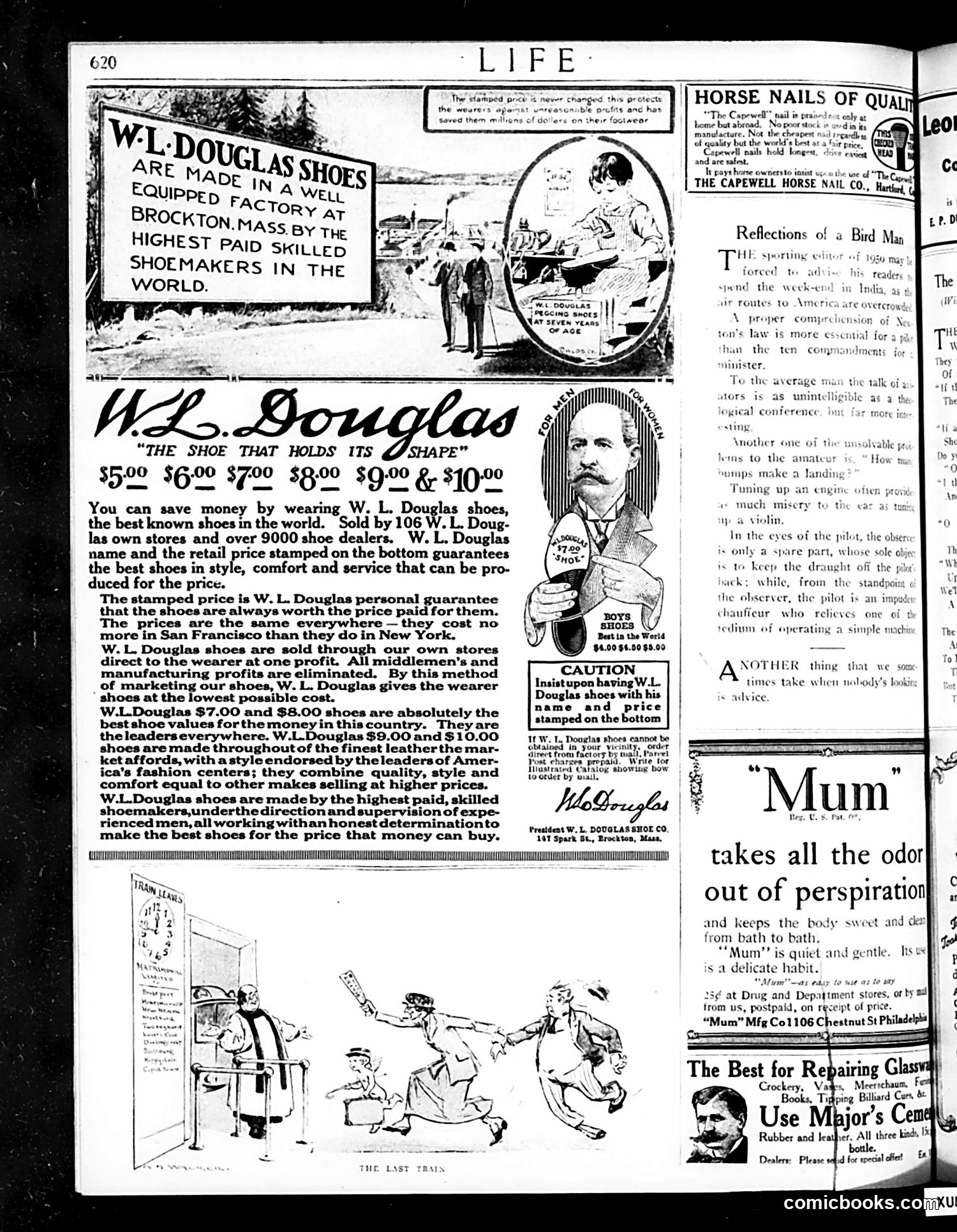
This page is primarily **advertising**, not political satire. The dominant content is a W.L. Douglas Shoes advertisement emphasizing the brand's value proposition: shoes priced $5-$10 that are "always worth the price paid" through direct manufacturer-to-consumer sales, eliminating middleman markups. The small cartoon at bottom ("The Last Train") shows figures rushing toward a departing train—a generic comedic situation about missing transportation, common to the era's humor. The right column contains unrelated articles: "Reflections of a Bird Man" (about aviation and observation) and advertisements for "Mum" deodorant and "Major's Cement" glass repair product. **No significant political or social satire is present on this page.**
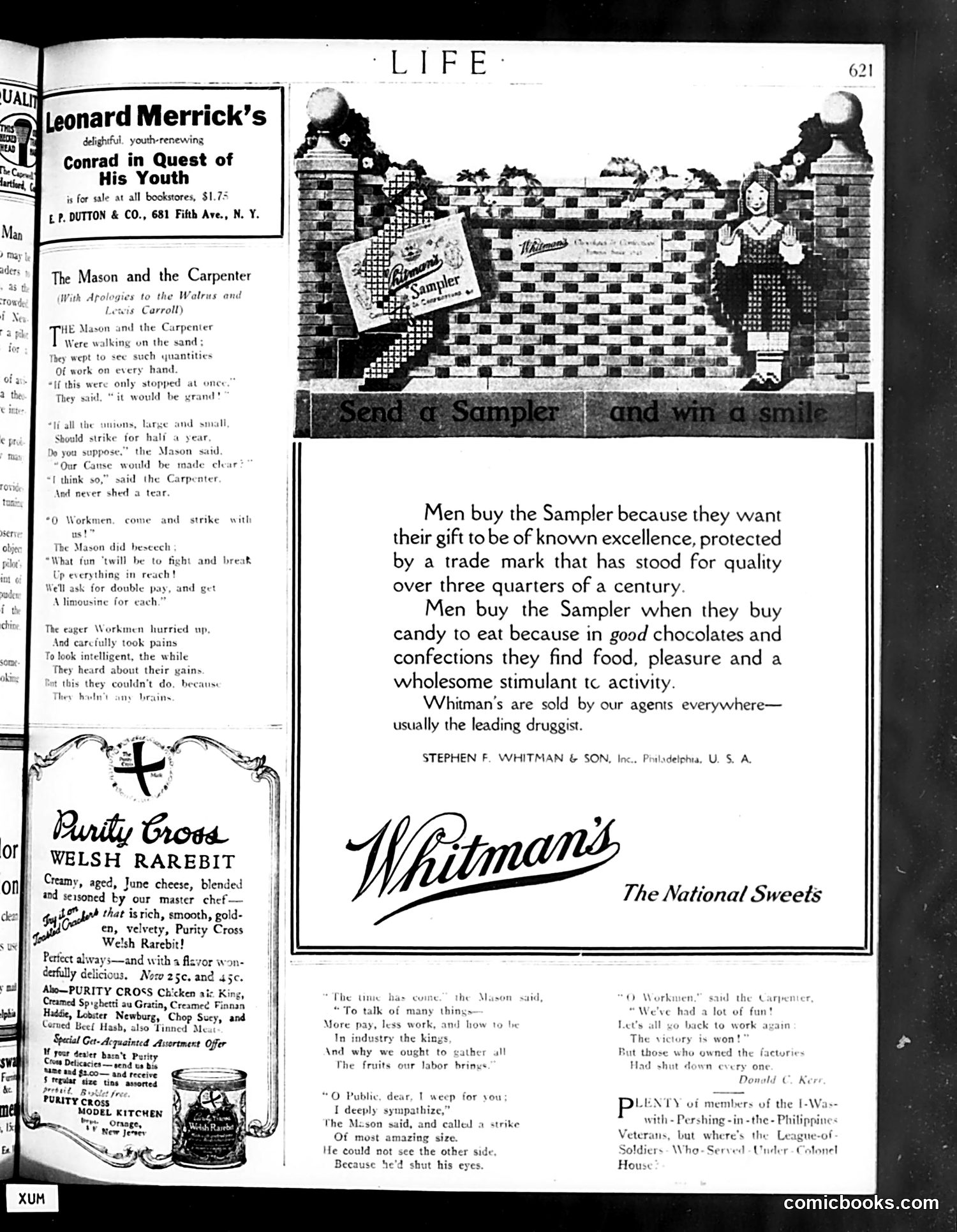
This page mixes literary content with period advertising. The left side features "The Mason and the Carpenter," a poem by Lewis Carroll about labor and class conflict—two workmen discussing striking for better conditions. The poem's political commentary on workers' rights appears intentionally positioned alongside advertisements. The right side is dominated by a Whitman's candy advertisement showing figures on a brick wall with "Send a Sampler and win a smile." The ad emphasizes the candy's established reputation for quality "over three quarters of a century." The juxtaposition—placing Carroll's labor-conscious poetry next to commercial advertising—creates subtle social commentary typical of Life magazine's satirical approach, contrasting working-class struggle with consumer culture.
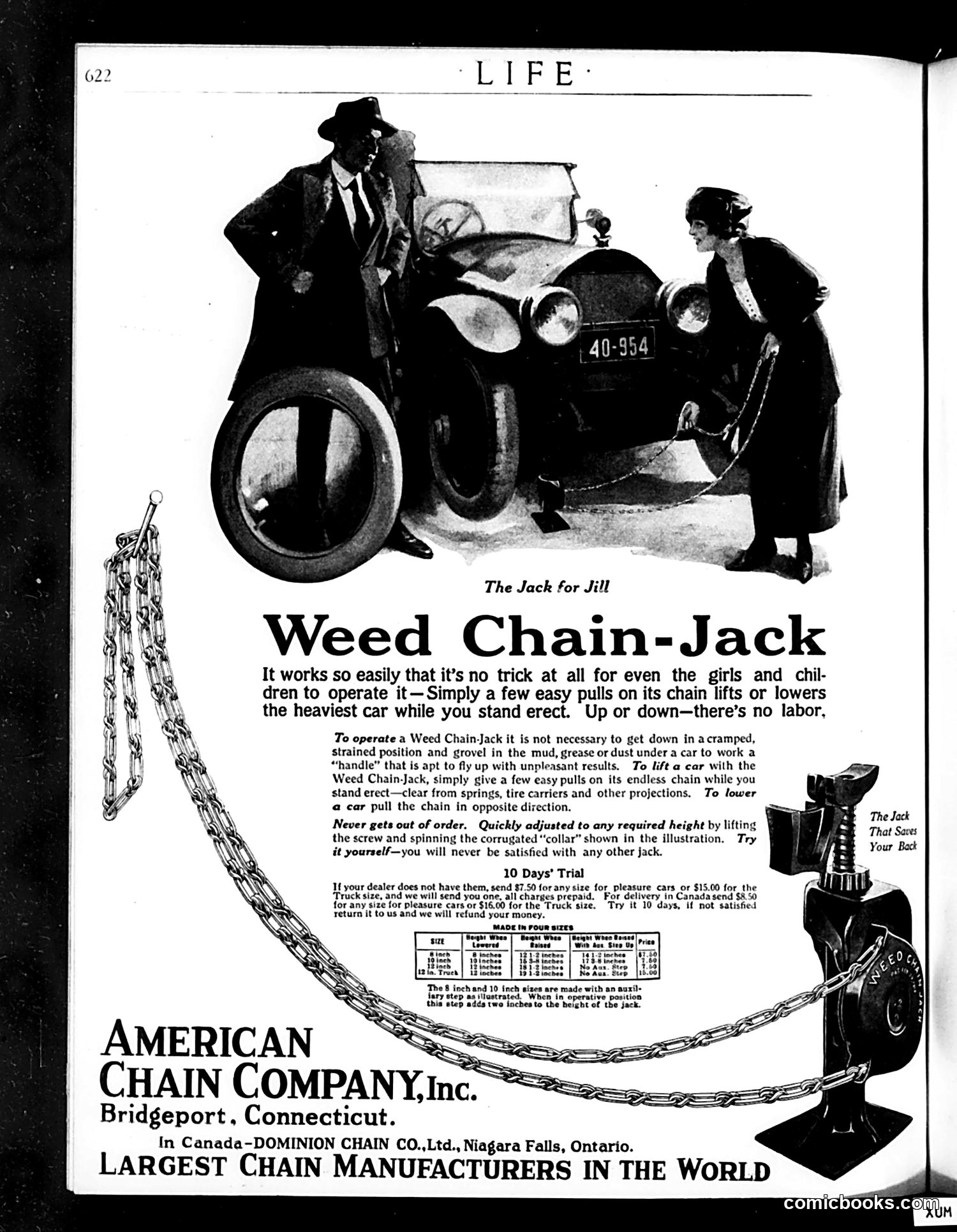
This is a **product advertisement, not political satire**. It promotes the "Weed Chain-Jack," a mechanical car jack manufactured by American Chain Company of Bridgeport, Connecticut. The illustration shows a man and woman (likely a couple) operating the jack beside an automobile with license plate 40-954. The ad emphasizes ease of use: "It works so easily that it's no trick at all for even the girls and children to operate it." The gendered language reflects early 20th-century marketing conventions—the ad's selling point is that the jack requires so little strength that women and children can manage it. The accompanying chain imagery and sizing chart promote various commercial applications. This is straightforward industrial advertising exploiting period gender stereotypes to highlight the product's user-friendliness.
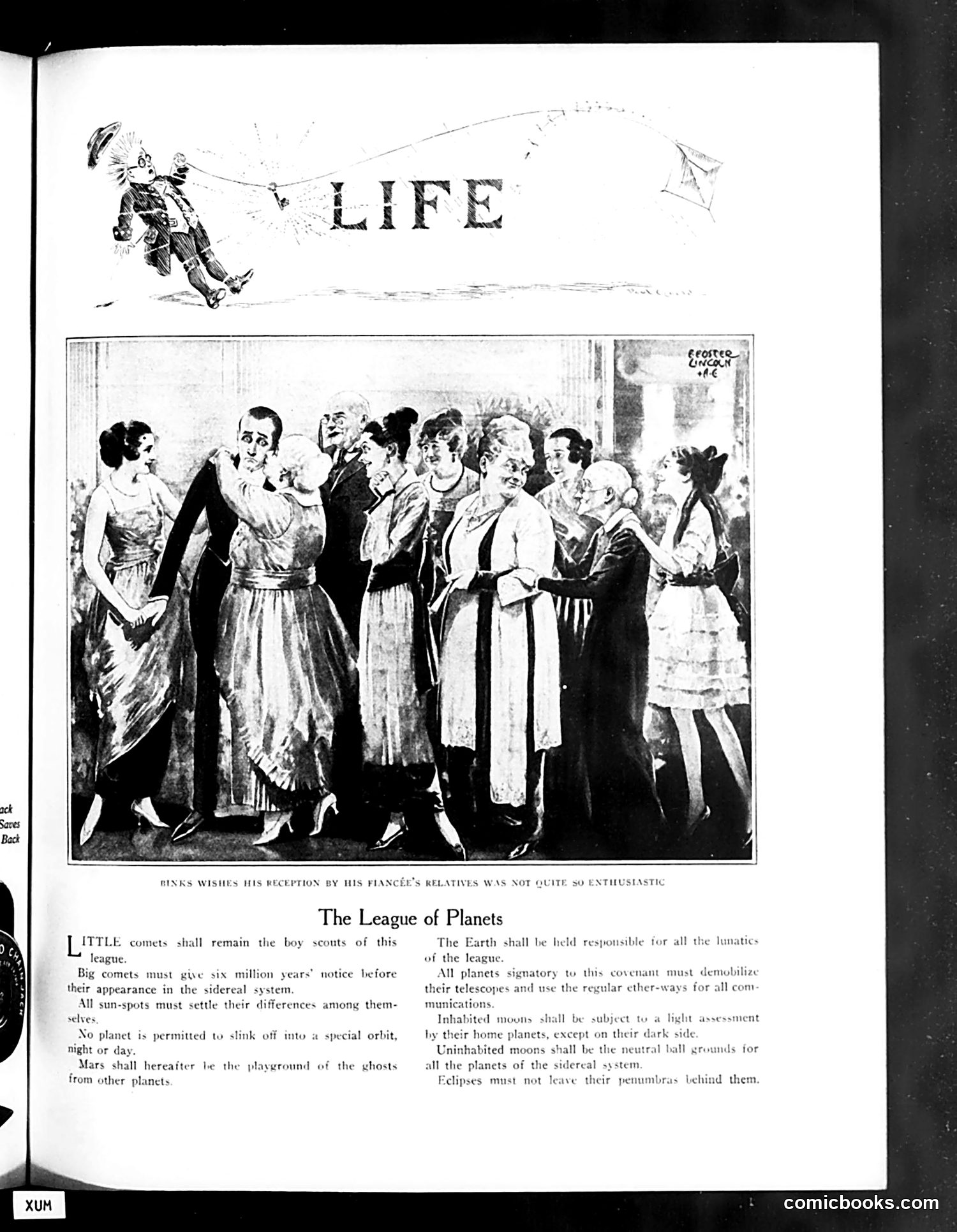
This is a humorous satirical piece imagining planets as a political league with absurd bylaws. The illustration shows what appears to be a formal diplomatic reception with various figures in formal dress. The text mocks international governance by treating celestial bodies as member states with ridiculous rules: comets must give advance notice, Mars becomes a "playground of ghosts," moons face taxation, and eclipses have restrictions. The caption beneath the illustration—"Binks wishes his reception by his fiancée's relatives was not quite so enthusiastic"—suggests the cartoon above is unrelated domestic humor (a man overwhelmed by his future in-laws). The satire likely reflects early 20th-century anxieties about international diplomacy and treaty obligations, rendered absurd through cosmic setting. The piece exemplifies Life magazine's characteristic blend of political commentary with whimsy.
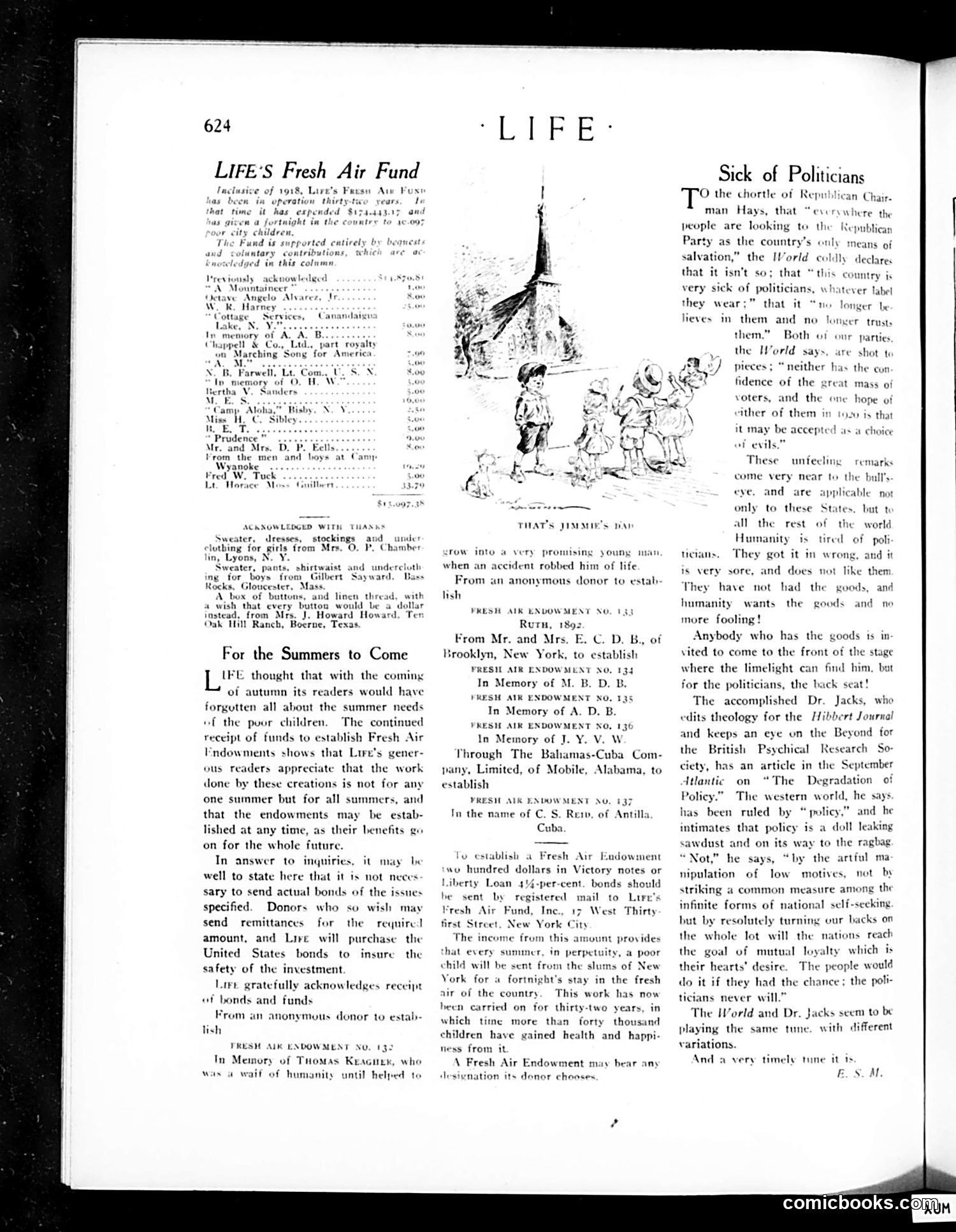
This page contains two distinct sections: a charitable fundraising announcement ("Life's Fresh Air Fund") on the left, and a political editorial on the right titled "Sick of Politicians." The editorial mocks both major American political parties, quoting the *World* newspaper's assertion that the public has lost faith in politicians generally. The piece argues that neither Republicans nor Democrats deserve voter confidence, and that voters should view politicians skeptically as "a choice of evils." The cartoon illustrates this theme: it shows children at play beneath a gallows—a darkly satirical visual metaphor suggesting that supporting politicians is inherently dangerous or doomed. The juxtaposition of innocent children with the execution apparatus underscores the editorial's cynical tone about political corruption affecting the nation's future. The piece is signed E.S.M.
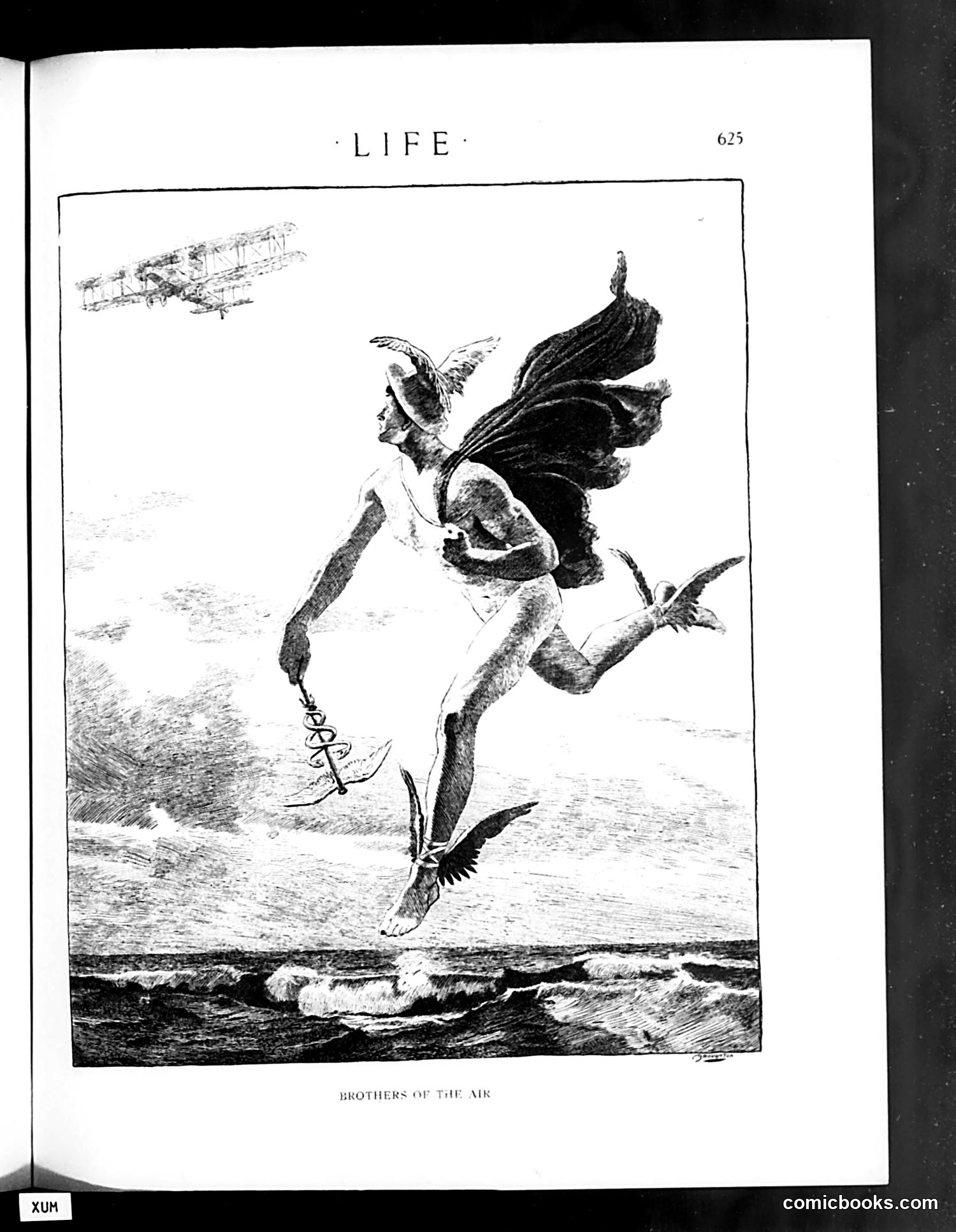
This illustration depicts a winged figure—appearing to be Mercury or a similar mythological messenger god, identifiable by the caduceus (staff with intertwined serpents) in hand—leaping joyfully above ocean waves. An early airplane is visible in the upper left. The caption "Brothers of the Air" suggests this is satirical commentary on aviation as an emerging technology, likely from the early 1900s. The cartoon appears to celebrate or mock humanity's newfound ability to fly, positioning aviators as modern equivalents to classical gods. The mythological framing could be either earnest admiration for aviation's revolutionary potential or gentle satire about society's romantic exaggeration of early aircraft capabilities and pilots. The specific satirical angle—whether praising or mocking—remains somewhat ambiguous without additional context.
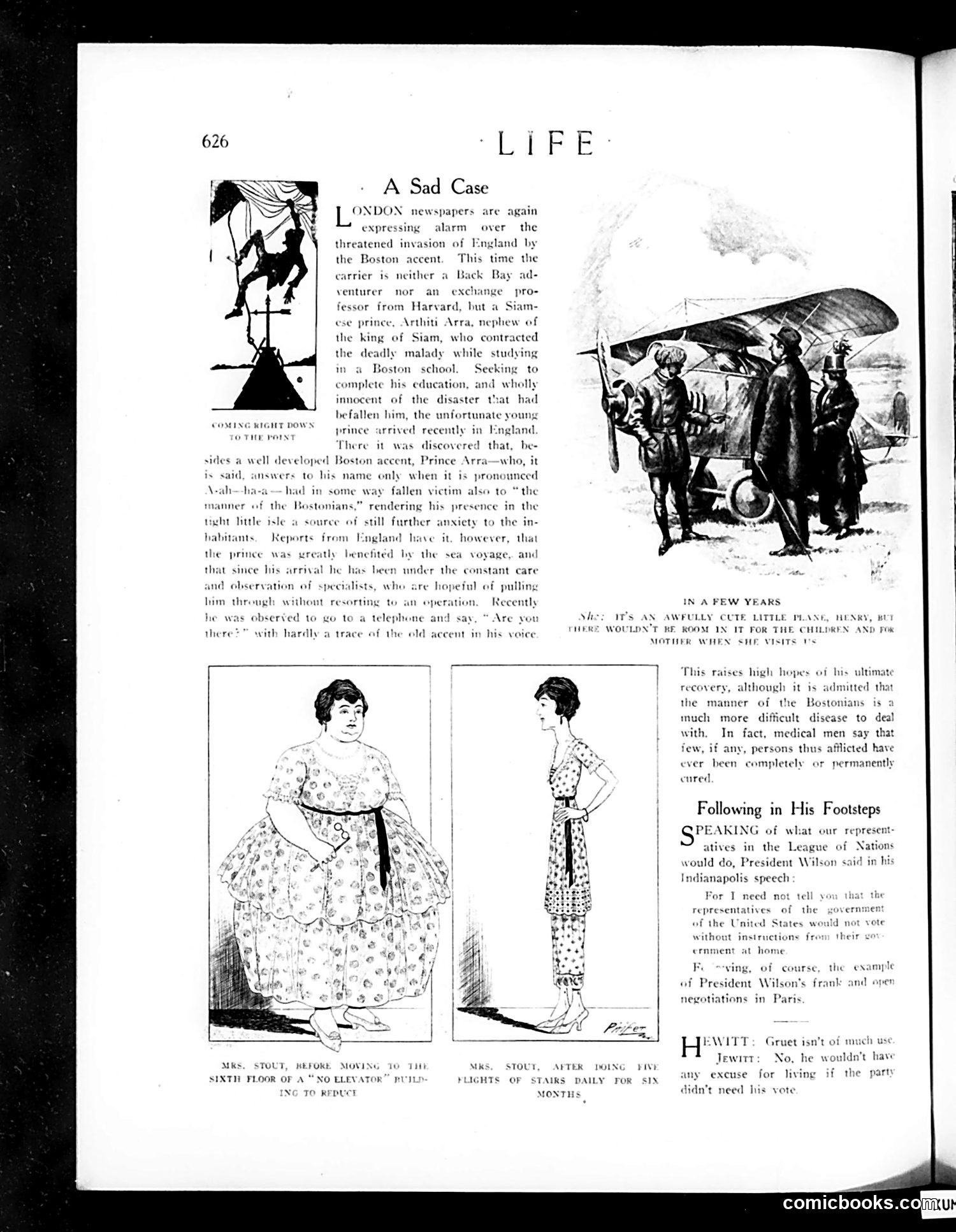
This satirical piece concerns **Prince Aura of Siam**, nephew of the Siamese king, who contracted deadly measles while studying in Boston. The article expresses alarm that this "Boston accent" (the disease) threatens to invade England. The satire mocks American anxiety about foreign contamination. The two illustrations show **Mrs. Stout** before and after climbing six flights of stairs daily for six months—a weight-loss regimen. The caption "In a Few Years" jokes that her transformation is as unlikely as the prince's recovery. The "Following in His Footsteps" section quotes President Wilson on League of Nations voting, with a comic exchange between "Hewitt" and "Jewitt" about whether granting voting rights requires government approval—likely satirizing confusion over Wilson's diplomatic authority and domestic political constraints.
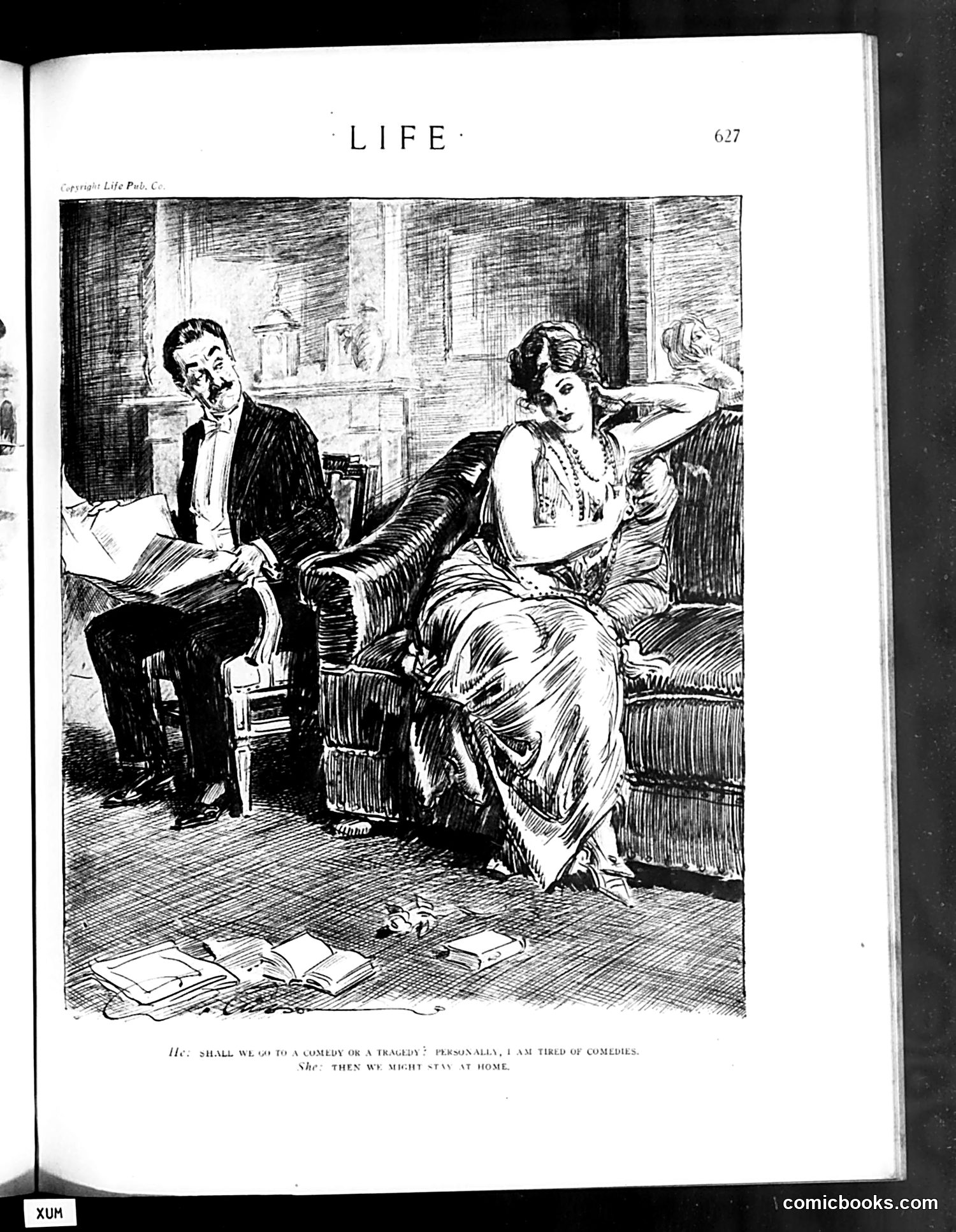
This is a single-panel cartoon from Life magazine (page 627) depicting a domestic scene. A man and woman sit in a parlor; he holds papers while she reclines on a sofa in a relaxed pose. The caption reads: **He:** "SHALL WE GO TO A COMEDY OR A TRAGEDY? PERSONALLY, I AM TIRED OF COMEDIES." **She:** "THEN WE MIGHT STAY AT HOME." The satire targets marital discord, suggesting the woman views their home life as inherently tragic or unpleasant. The joke implies that staying home with his wife would be more depressing than attending a theater tragedy—a commentary on unhappy domestic relationships and, implicitly, female dissatisfaction in marriage. The cartoon uses theatrical framing (comedy vs. tragedy) to mock both the couple's relationship and broader marriage dynamics of the era.
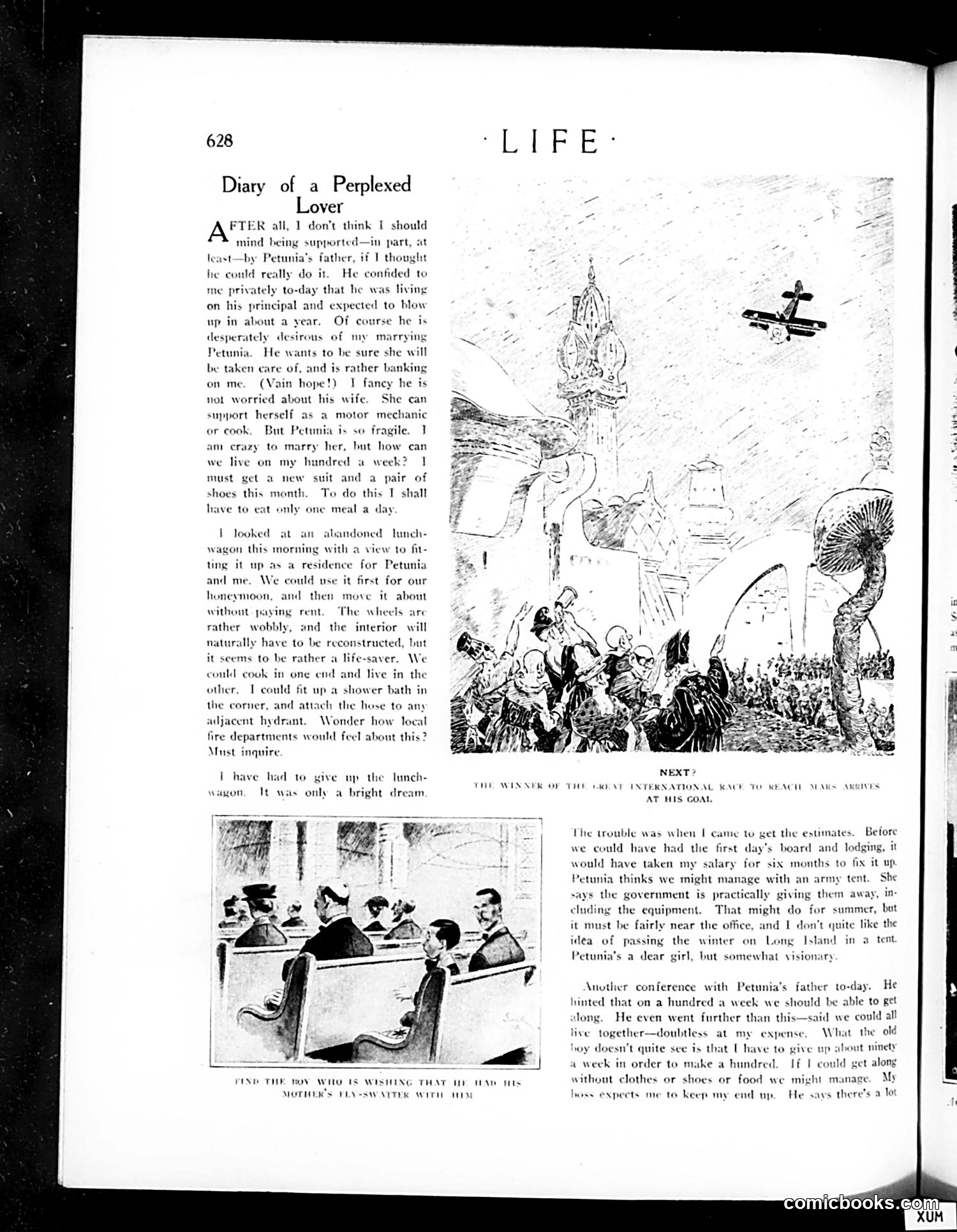
This page contains a humorous essay about romantic financial struggles, illustrated with two cartoons. The main narrative describes a man trying to marry a woman named Petúnia while living on minimal means—he's considering converting an abandoned lunch wagon into a honeymoon residence and eating only one meal daily. The top illustration shows an aerial/fantastical scene, apparently depicting "the winner of the great international race to reach Mars arrives at his goal"—a science-fiction reference unrelated to the main story. The lower cartoon shows a domestic scene of people at a table, captioned "Find the boy who is wishing that he had his mother's fly-swatter with him"—a typical early 20th-century humor setup about family dining situations. The page satirizes courtship economics during what appears to be a period of financial constraint.
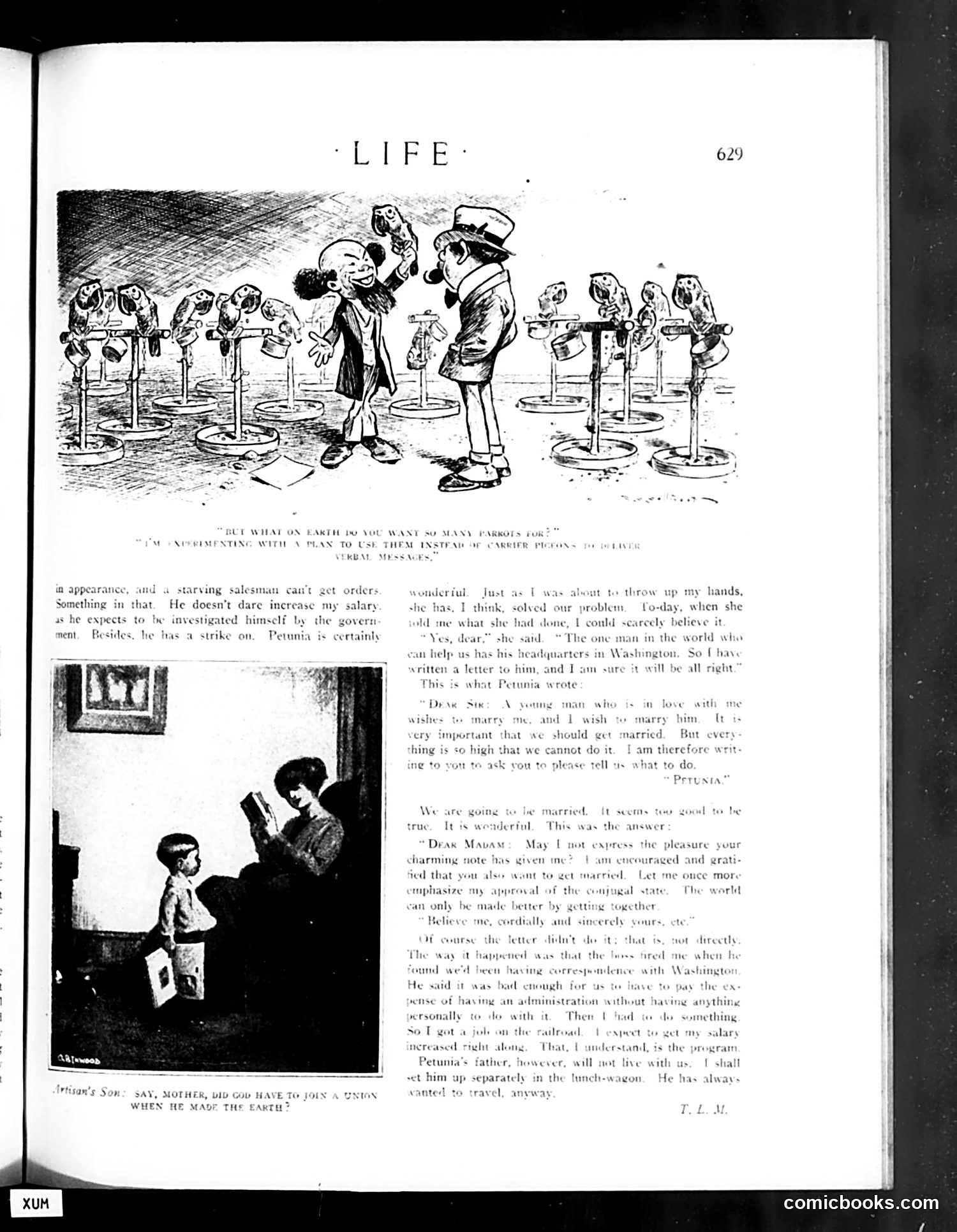
**Top Cartoon:** A man in a hat and coat stands among numerous parrots on pedestals, speaking with another man. The caption reads: "I'M NURSING ON EARTH AS YOU WANT SO MANY PARROTS FOR?" He replies: "I'M EXPERIMENTING WITH A PLAN TO USE THEM INSTEAD OF CARRIER PIGEONS TO DELIVER WIRELESS MESSAGES." **Satire Target:** This appears to mock impractical technological schemes or overly ambitious inventors of the era. The humor lies in the absurdity of replacing proven carrier pigeon communication systems with unreliable parrots—an obvious failure the inventor hasn't considered. **Bottom Image:** Shows a young boy presenting something to his mother indoors. **Caption:** "BRITAIN'S SON: 'SAY, MOTHER, DID GOD HAVE TO JOIN A UNION WHEN HE MADE THE EARTH?'" This satirizes labor union politics, likely referencing contemporary labor disputes in Britain or America.
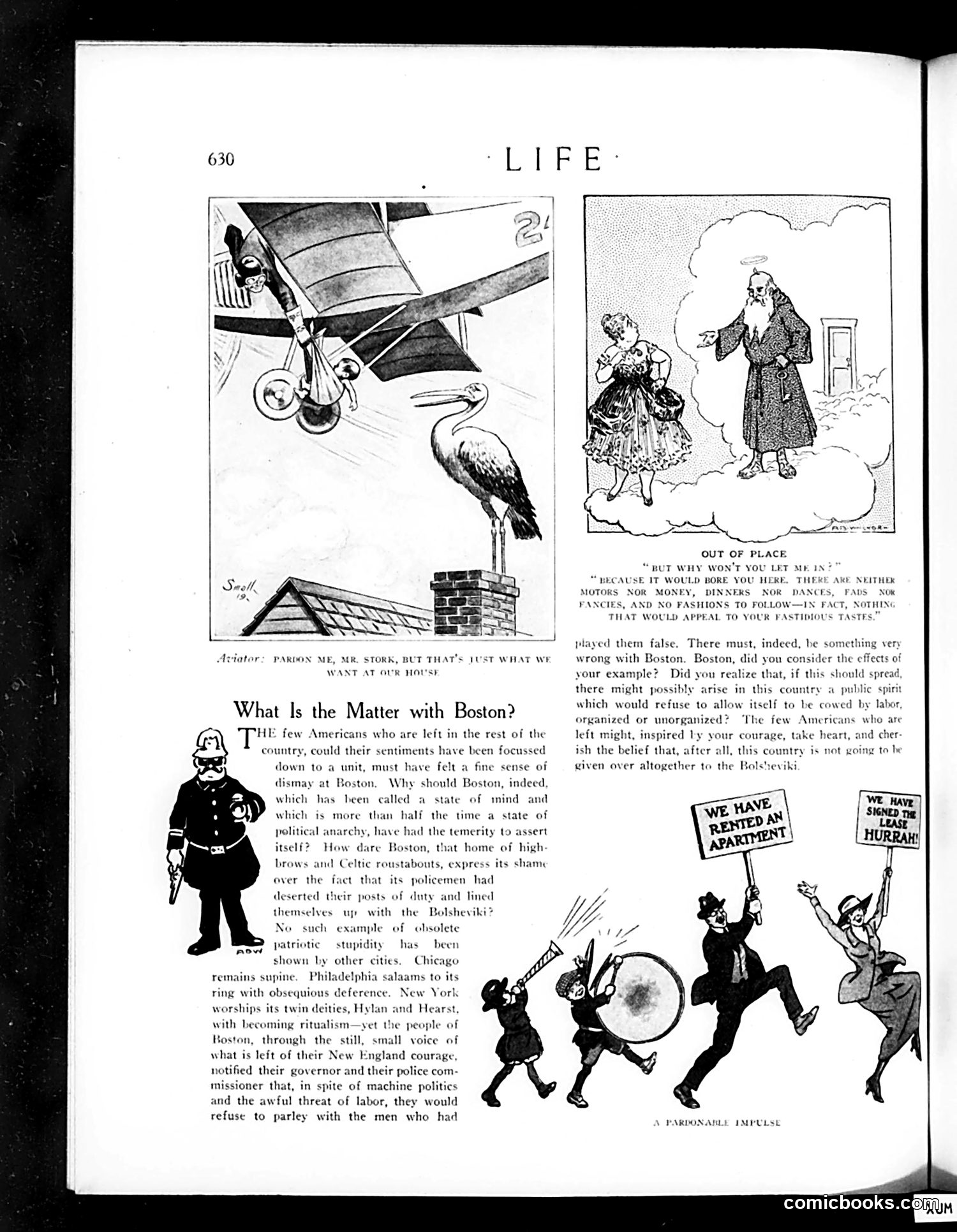
This 1919 Life magazine page satirizes Boston's police strike and the broader American political climate. The main article criticizes Boston for its audacity in *supporting* its police who deserted their posts rather than accepting labor organizing demands—behavior the author finds dangerously principled. The cartoon at bottom ("A Pardonable Impulse") depicts celebratory figures holding signs reading "WE HAVE RENTED AN APARTMENT" and "WE HAVE SECURED THE LEAD HURRAH!"—likely celebrating housing or labor victories after the police strike created temporary lawlessness. The satirical point: the author fears Boston's example of civic resistance might inspire other Americans to reject labor pressure and political chaos, threatening the spread of Bolshevik (communist) influence in America. The "top cartoon about the stork mocking aviators wanting deliveries reflects broader anxiety about social disruption. This reflects post-WWI American fears about labor unrest and communist infiltration during the "Red Scare" period.
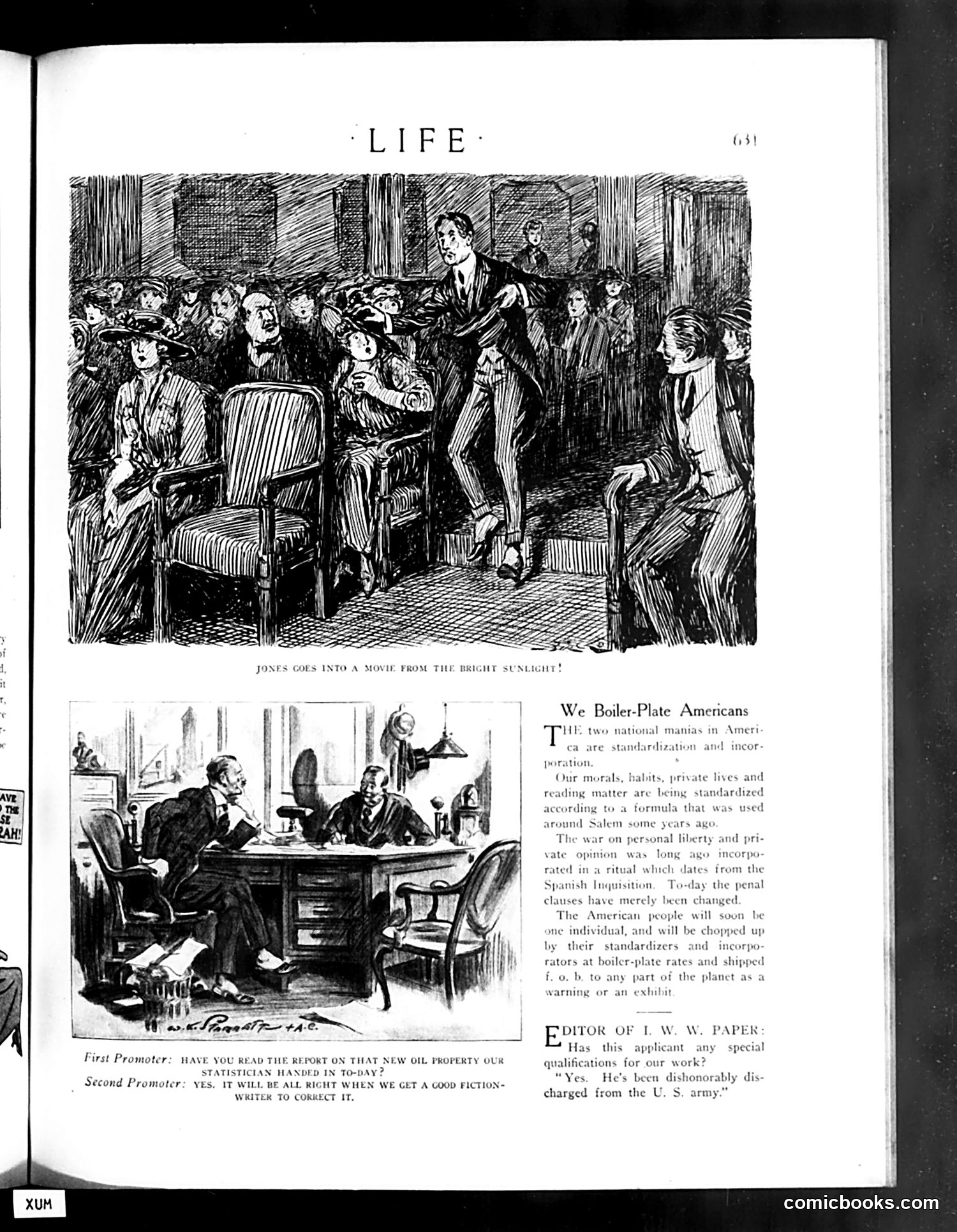
This page satirizes the standardization and corporatization of American life. The top cartoon depicts a movie theater scene where standardized content is being consumed by a passive audience—illustrating how mass media homogenizes culture. The lower cartoon mocks corporate dishonesty: two business promoters discuss an oil property report, with one suggesting they hire a "fiction-writer to correct it"—meaning they'll fabricate data to make a poor investment seem profitable. This exposes how corporations manipulate statistics and deceive the public. The accompanying article warns that Americans are being "chopped up" and standardized "at boiler-plate rates"—reducing individuals to commodities. The closing anecdote about hiring a disreputable army discharge applicant reinforces the theme of ethical compromise in business and institutional corruption during this era.
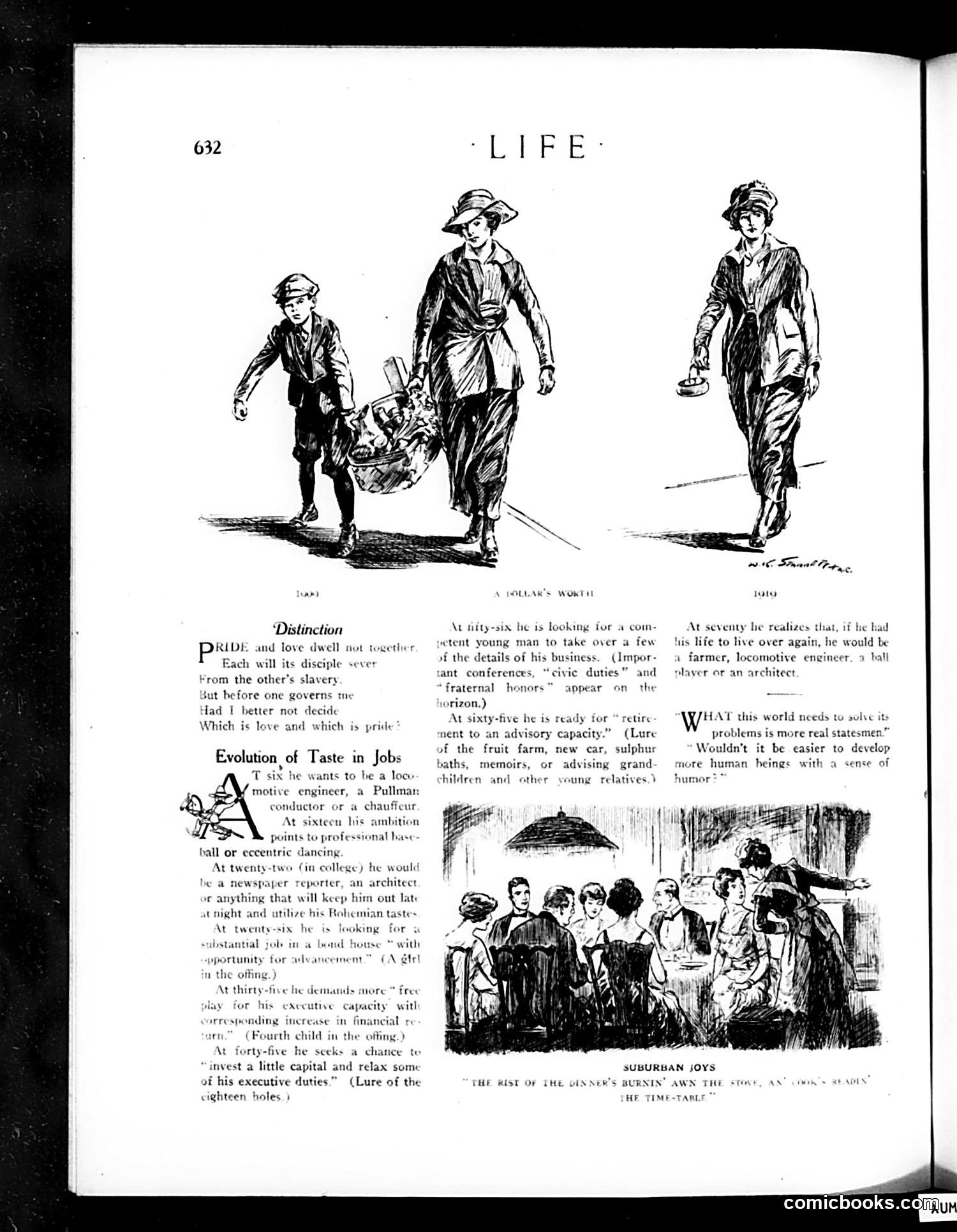
This page contains two satirical pieces about American social mobility and aspiration. **"Evolution of Taste in Jobs"** traces a man's career ambitions from age six (locomotive engineer) through seventy, showing how youthful Bohemian dreams gradually surrender to bourgeois domesticity. At each stage—marriage, children, mortgages, golf clubs—his aspirations diminish. The satire culminates in his deathbed realization that he should have pursued those original humble ambitions. The editorial note calls for "real statesmen" with "sense of humor," suggesting the piece mocks how ordinary men abandon authenticity for respectability. **"Distinction"** (upper left) juxtaposes three sketches of women with a philosophical quote distinguishing pride from love, likely commenting on female independence and social standing. **"Suburban Joys"** (bottom) depicts a gathering, its caption unclear but apparently satirizing middle-class domestic leisure. The overall message critiques conformist capitalism: men sacrifice genuine desires for financial security and social status, only to regret it when too late.
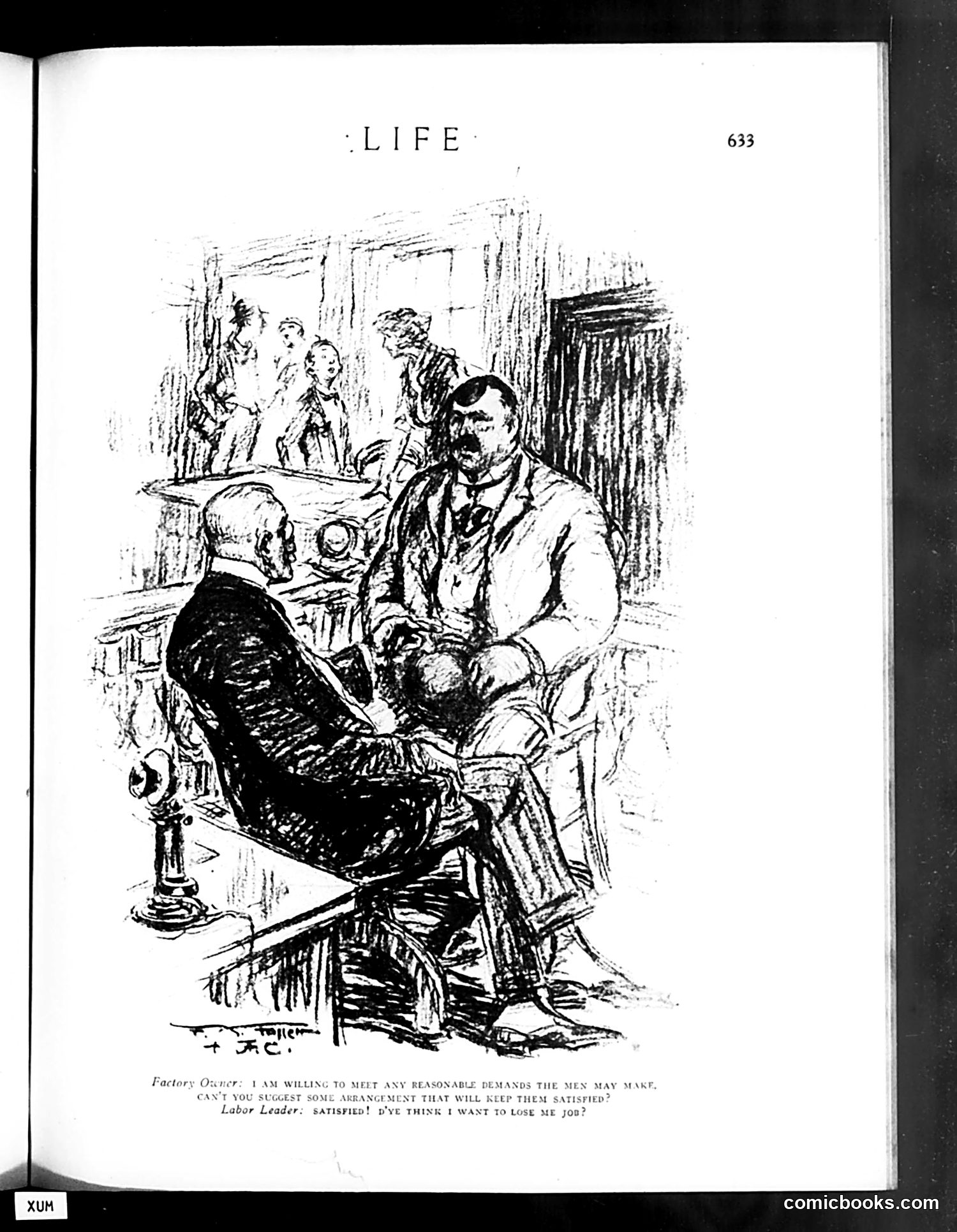
This is a satirical commentary on labor disputes and union leadership. A factory owner (left) offers to negotiate reasonable demands with workers, but the labor leader (right) dismisses the idea of worker satisfaction—because his job depends on ongoing conflict and grievances. The cartoon mocks union leaders as having a vested interest in perpetuating labor strife rather than resolving it. If workers became satisfied, the leader suggests, he'd become unnecessary and lose his position. The satire criticizes labor leadership as self-serving, prioritizing their own power over workers' actual welfare. This reflects early-20th-century skepticism about whether union officials genuinely served workers' interests or merely exploited labor discontent for personal gain.
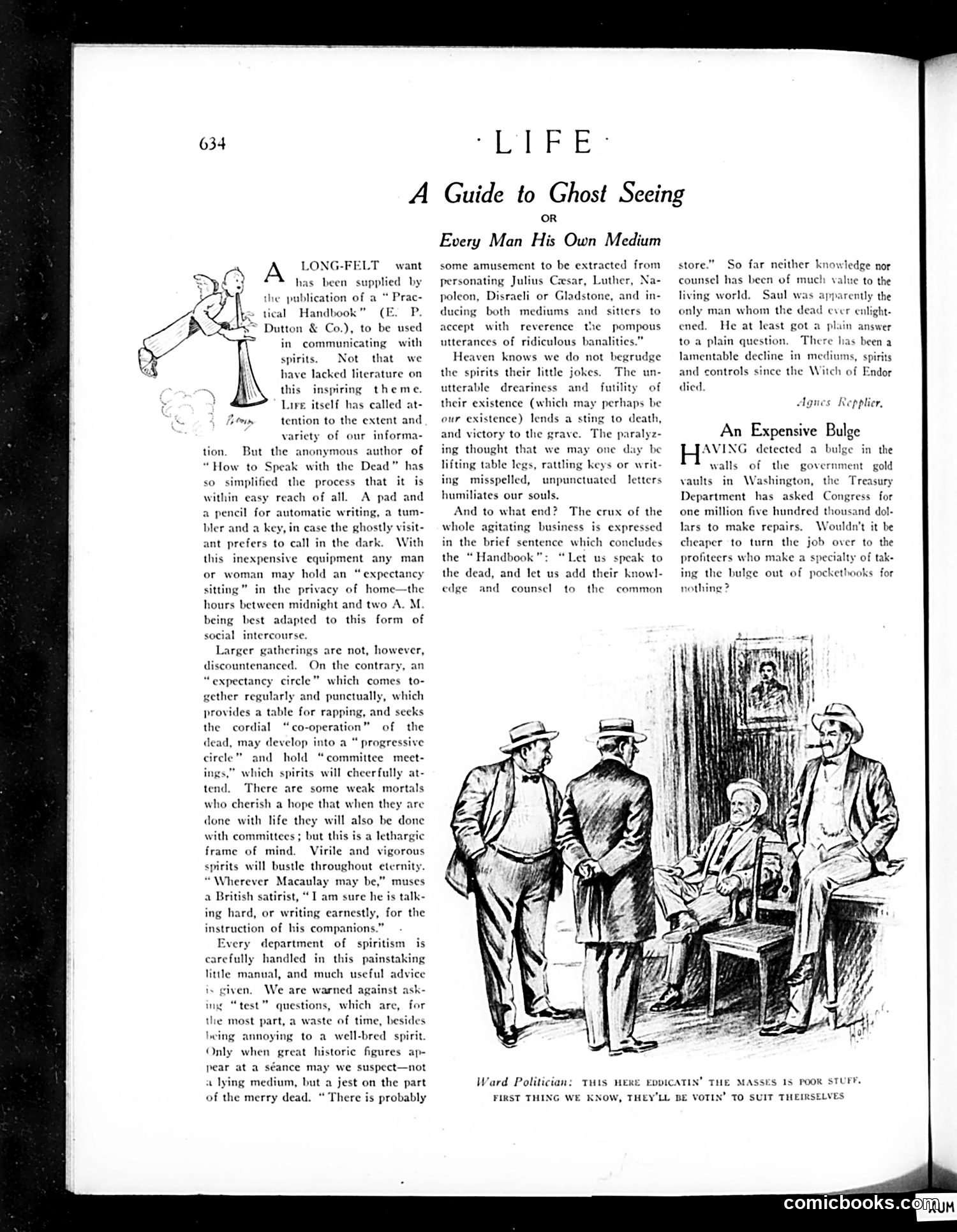
This page satirizes two distinct targets: **"A Guide to Ghost Seeing"** mocks the popular spiritualism craze of the era—the widespread belief in séances, automatic writing, and communicating with the dead through mediums. The article ridicules both the naïveté of believers and the absurdity of the practice itself, noting that even "great historic figures" appearing at séances are likely just "a jest on the part of the merry dead." The satire suggests spiritualism offers nothing of actual value. **The cartoon below** depicts a "Ward Politician" addressing laborers about education, sneering that teaching the masses is "poor stuff" because "first thing we know, they'll be votin' to suit themselves." This directly critiques political corruption and the deliberate suppression of working-class education to maintain political control—the politician fears an educated electorate won't be manipulated. Both pieces reflect early-20th-century anxieties: gullibility to pseudoscience among the public, and elite resistance to democratic participation through education.
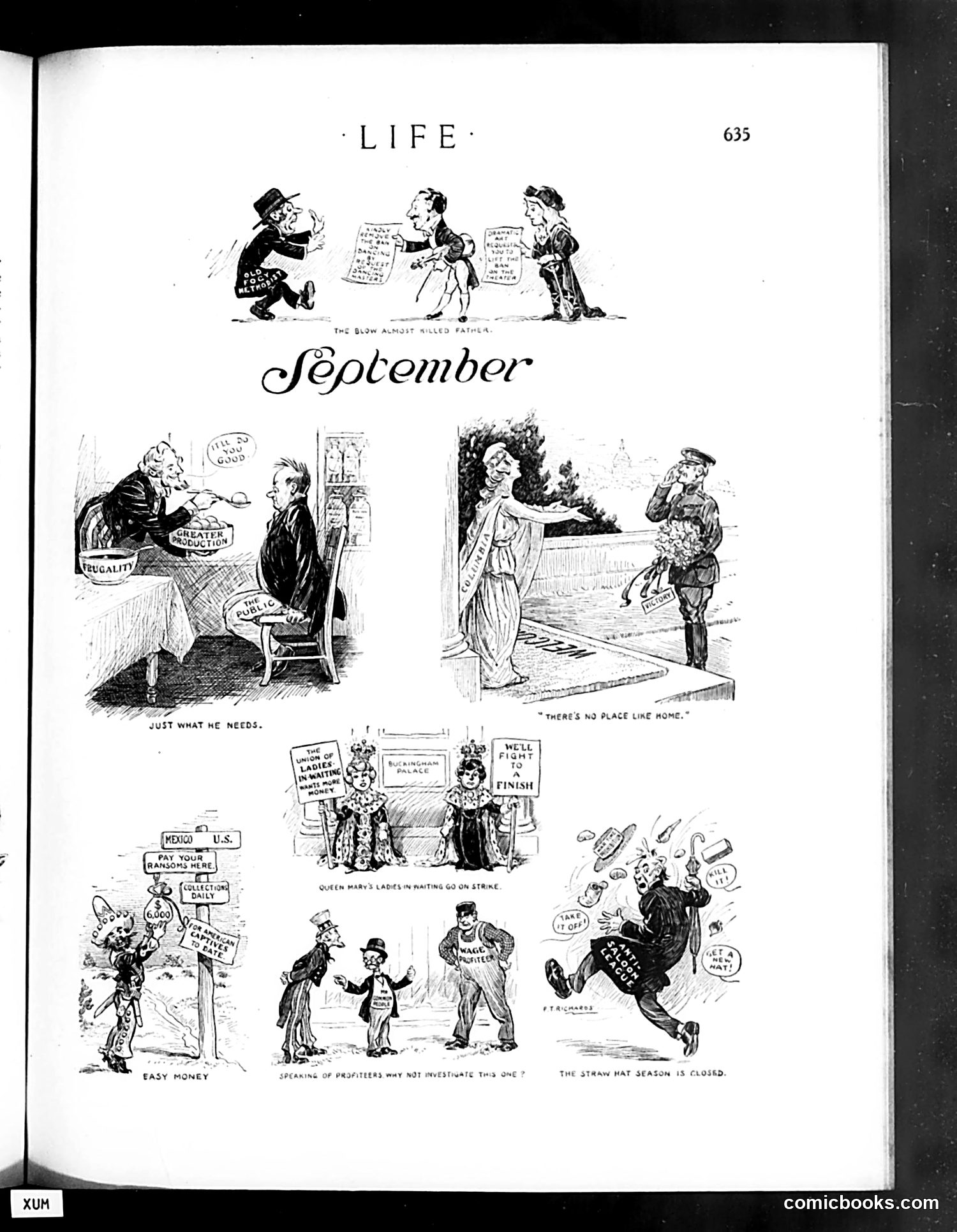
This page contains multiple September-themed satirical cartoons from early 20th-century Life magazine. Key cartoons include: **"Just What He Needs"**: Shows a figure labeled "Greater Frugality" offering advice to a man, satirizing calls for economic restraint. **"There's No Place Like Home"**: References the famous Dorothy quote, showing a soldier and woman—likely commentary on WWI or military service. **"Easy Money"**: Depicts financial schemes and profiteering, with text questioning why authorities don't investigate dubious money-making ventures. **"The Straw Hat Season Is Closed"**: Shows a man tumbling, pun on the seasonal end of straw hat fashion. **Royal Ladies' Strike**: Features Queen Mary's ladies in formal dress regarding a "finish" line—unclear reference but appears political. The cartoons blend domestic humor with social commentary about wartime profiteering, economics, and class issues typical of Life's satirical approach.
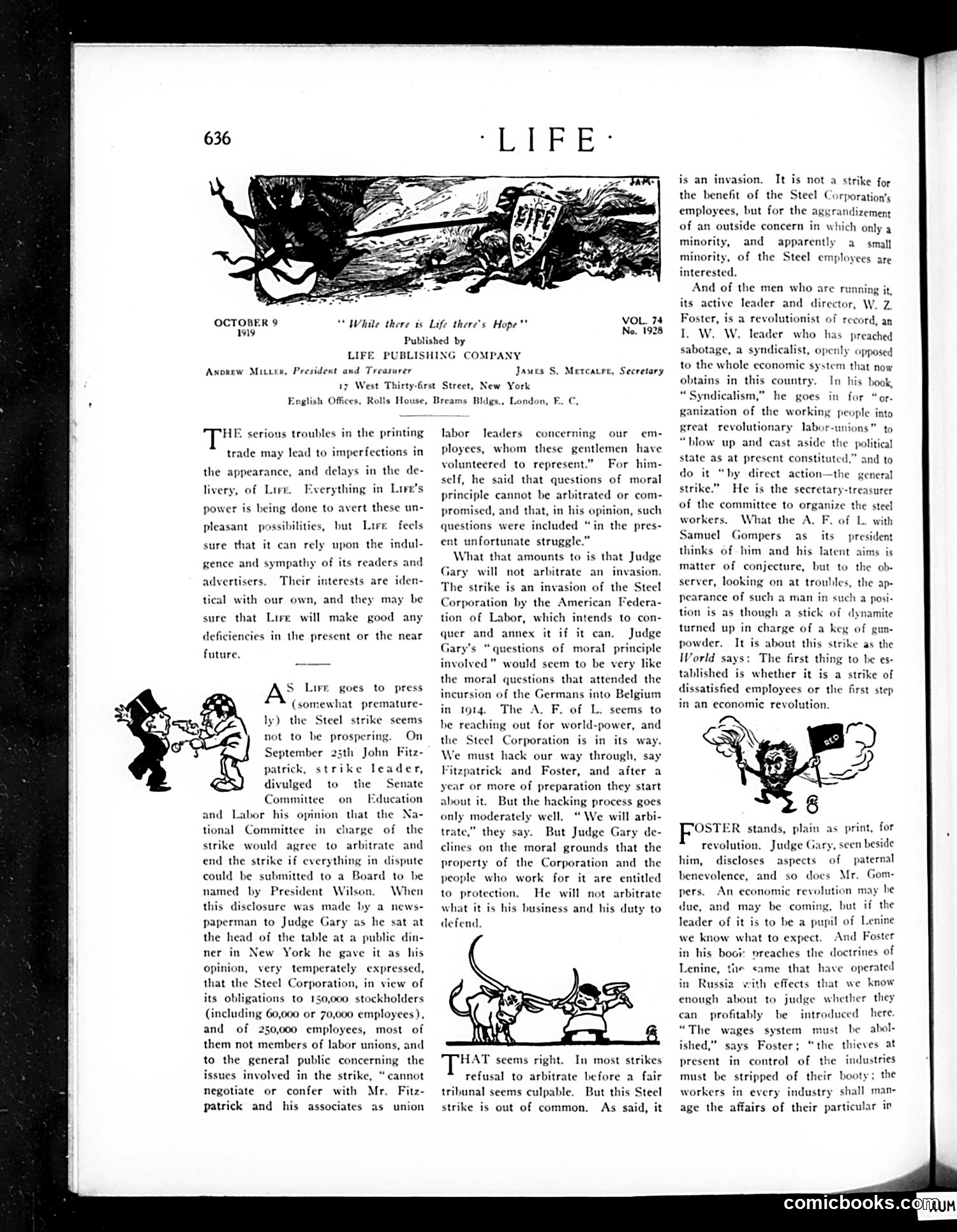
This October 1919 editorial addresses the ongoing steel workers' strike, framing it as an "invasion" rather than a legitimate labor dispute. The article criticizes **William Z. Foster**, the strike's active leader, identifying him as an I.W.W. member and self-proclaimed syndicalist opposed to capitalism itself. **Judge Elbert Gary** of U.S. Steel refuses arbitration on "moral principle," comparing the strike to Germany's 1914 invasion of Belgium—equating labor organizing with military aggression. Life's position: this isn't workers fighting for their own interests, but an external revolutionary organization (the American Federation of Labor) attempting to "conquer and annex" the corporation. The cartoons (small illustrations of fighting figures) reinforce this adversarial framing. Life argues Gary's refusal to negotiate is justified because the strike represents ideological revolution, not economic justice, making arbitration impossible on principled grounds.
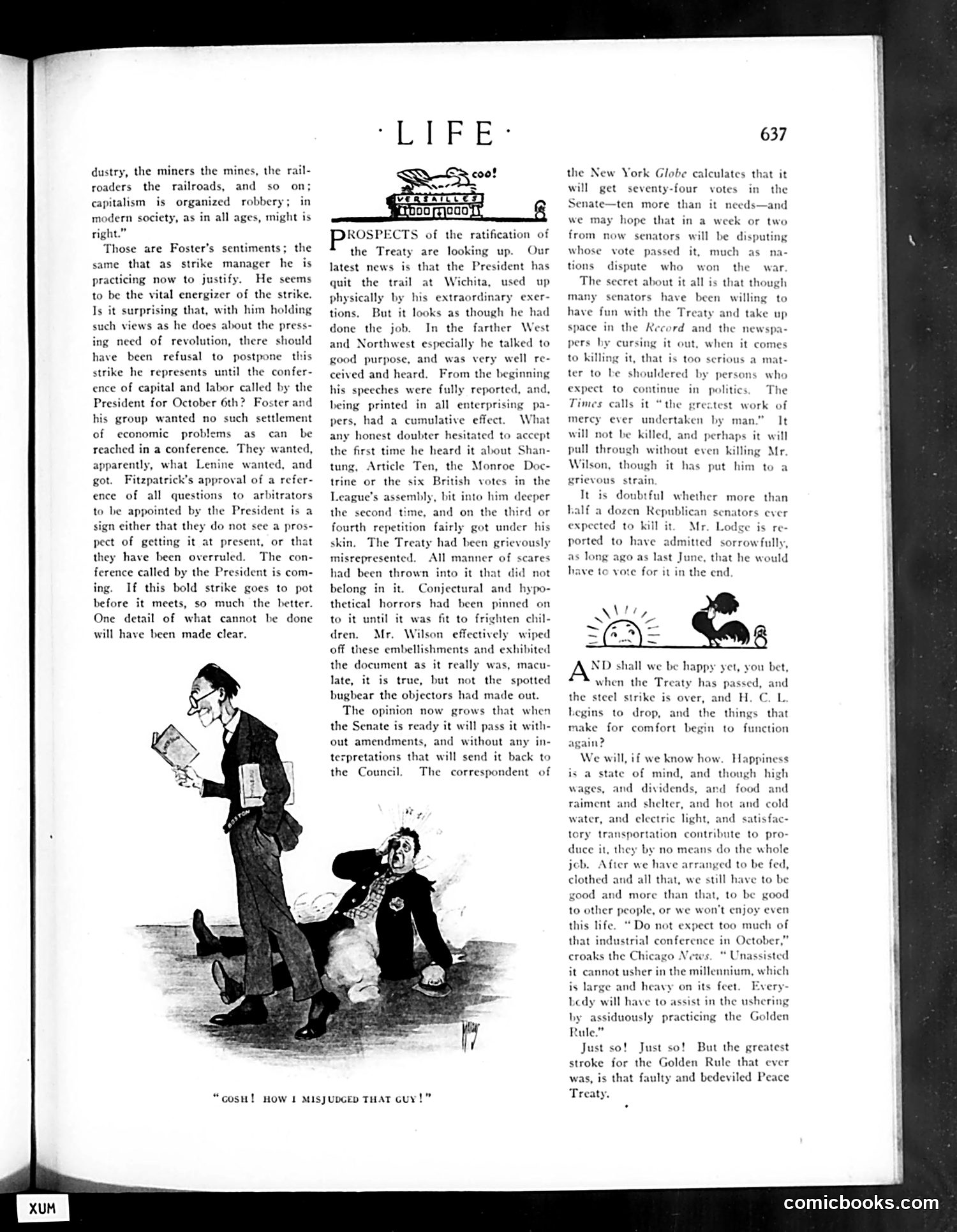
This 1919 *Life* magazine page satirizes two major political crises: the steel strike and the League of Nations treaty ratification. **The Cartoon:** Shows a well-dressed man (likely President Wilson or a politician) stepping over a disheveled figure labeled with strike imagery. The caption "Gosh! How I misjudged that guy!" suggests ironic commentary on strike leadership—likely targeting William Z. Foster, whose radical views about "organized robbery" are discussed in the text. The cartoon mocks the disconnect between strike leaders' revolutionary rhetoric and practical outcomes. **The Treaty Discussion:** Addresses Wilson's cross-country campaign promoting the League of Nations treaty. The text reports optimistically that the Senate will ratify it with ~74 votes (exceeding the 64 needed), despite Republican opposition. It notes even skeptical senators like Lodge will ultimately vote for it rather than risk being blamed for killing it. **The Satire's Point:** Criticizes both radical strikers as impractical ideologues and suggests politicians will ultimately abandon their public opposition to the treaty for political self-preservation.
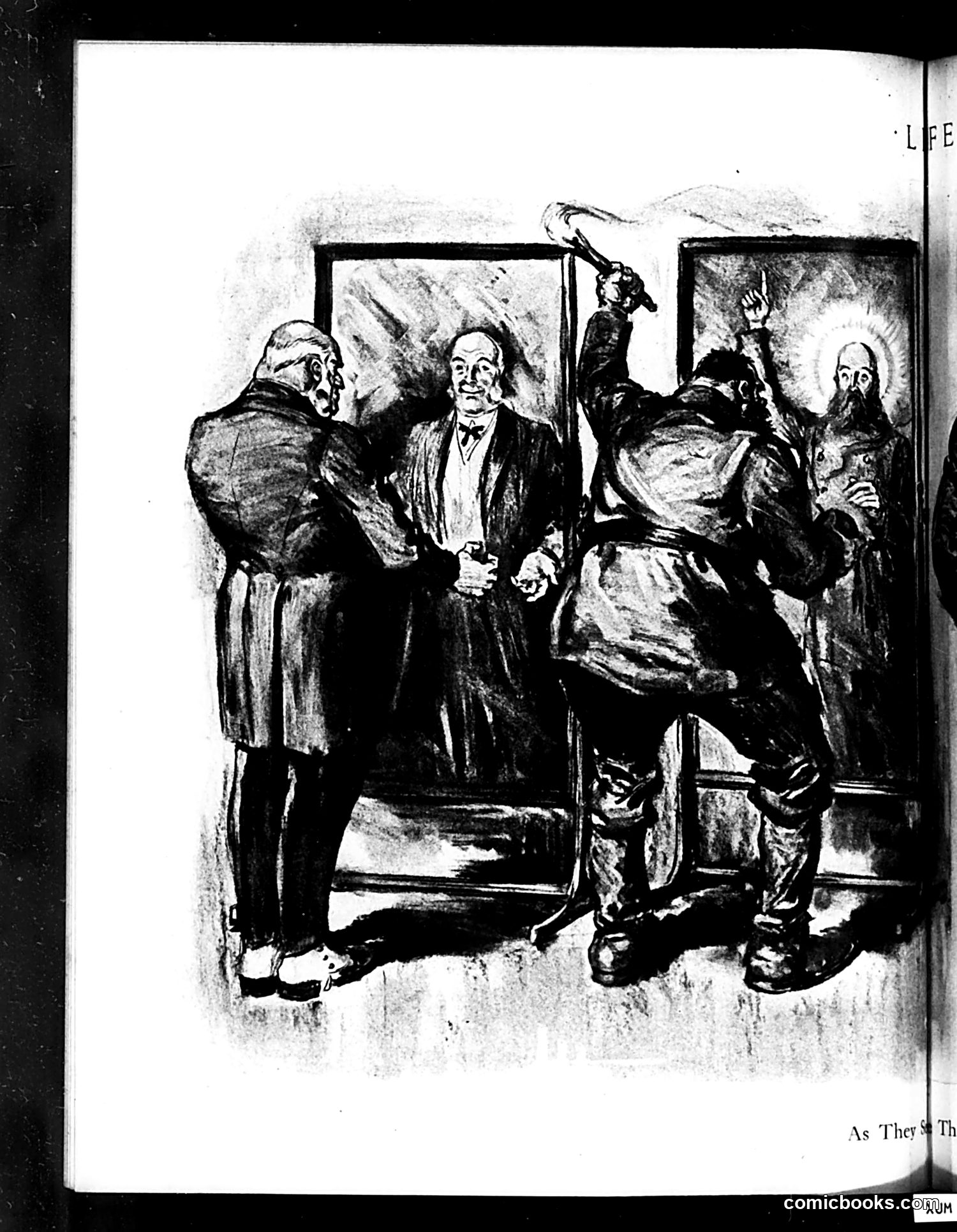
This appears to be a satirical illustration from *Life* magazine depicting a tense confrontation scene. The image shows several figures in 19th-century dress in what seems to be an official or formal setting, with one central figure appearing confronted or interrogated by others. One figure holds what appears to be a weapon or tool raised overhead. However, the OCR text is too fragmentary ("As They" and "comicbooks.comm") to identify the specific historical event, political figures, or satirical point being made. Without clearer caption text or date information visible on the page, I cannot reliably determine which political scandal, trial, or incident this cartoon references or who the figures represent. The style and clothing suggest late 19th-century subject matter, but specifics remain unclear from the image alone.
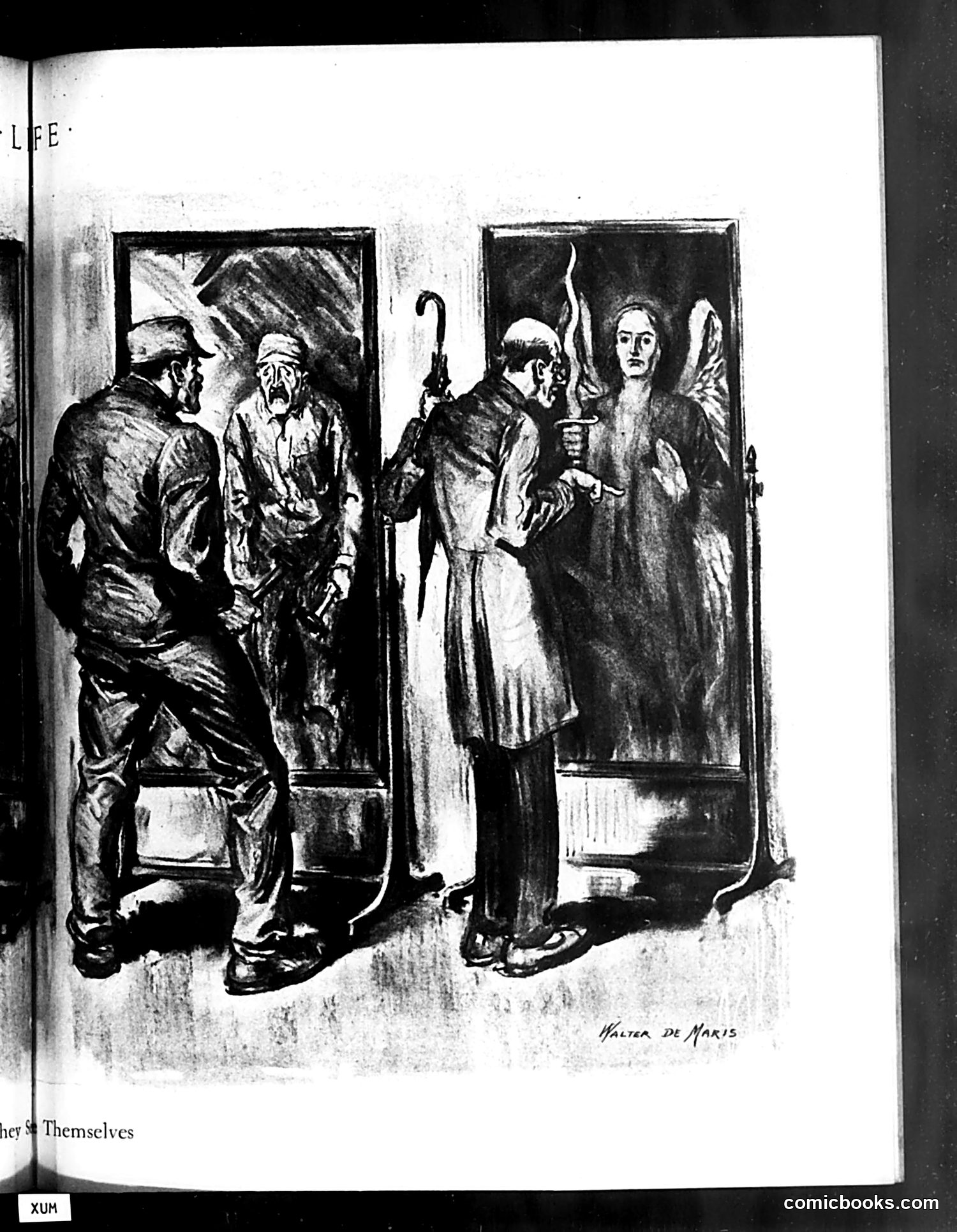
This is a satirical illustration signed by Walser de Maris depicting what appears to be a supernatural or otherworldly encounter. On the left, two military or uniformed figures appear startled or distressed when confronted by ethereal, ghostly figures on the right—one appears angelic or otherworldly with wings suggested. The caption "Themselves" suggests these ghostly apparitions represent the soldiers' own reflections, consequences, or spiritual counterparts—possibly critiquing the human cost of military conflict or suggesting soldiers confronting the moral weight of their actions. Without the full article context, the specific historical moment remains unclear, but the imagery implies commentary on warfare's psychological or spiritual toll on combatants. The style and presentation suggest early-to-mid 20th century American satire.
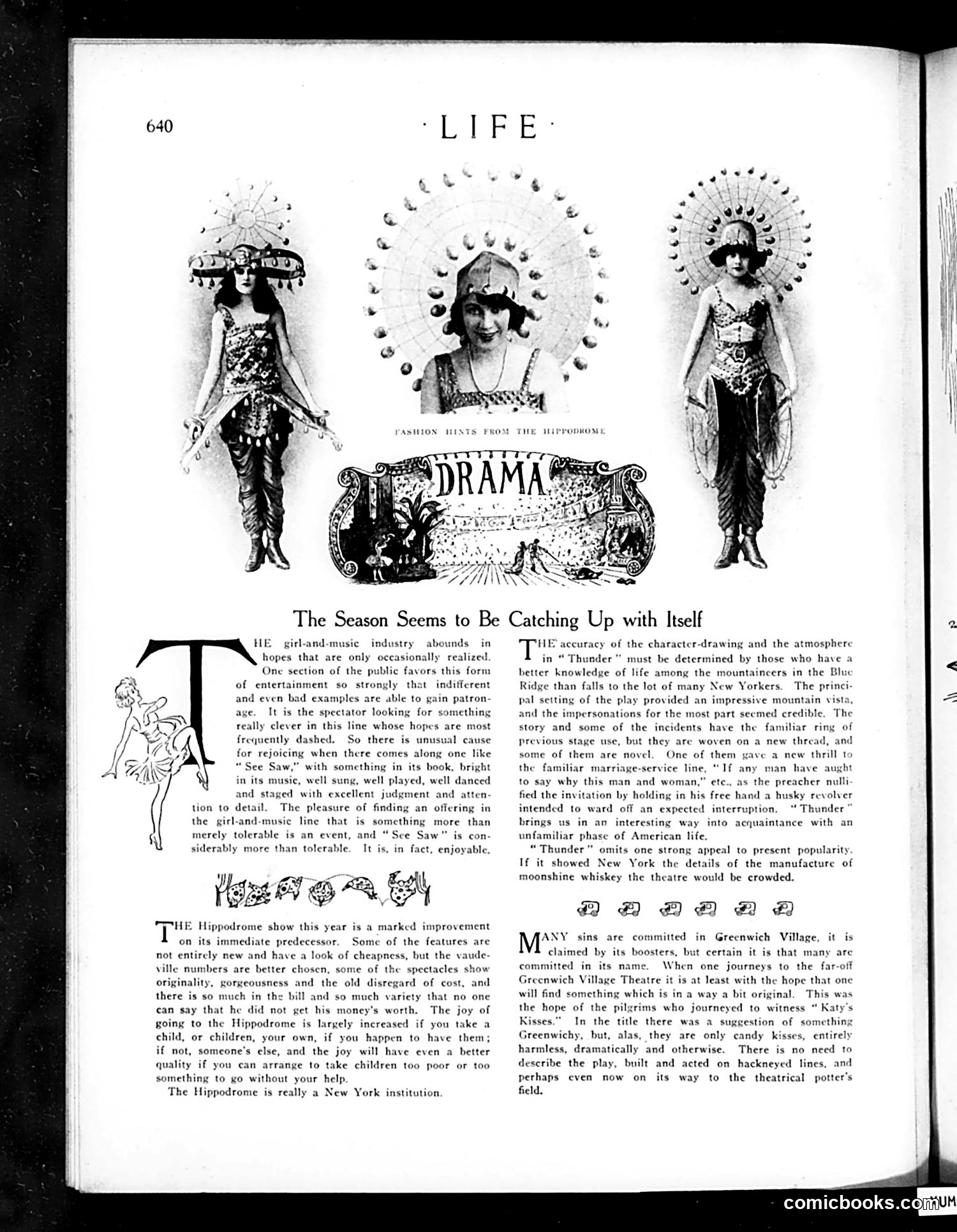
This page reviews three Broadway productions. The decorative illustrations at top show elaborate theatrical costumes—likely depicting scenes from the shows discussed. **"See Saw"** receives praise as a rare competent girl-and-music show, acknowledging that audiences tolerate mediocre examples of this popular genre, making good ones noteworthy. **The Hippodrome** review praises its variety spectacle as a "New York institution," recommending it especially for bringing children—including poor children—to experience entertainment they couldn't otherwise afford. This reflects Progressive-era sentiment about public cultural access. **"Thunder"** is a rural mountain drama set in the Blue Ridge. The reviewer notes it brings unfamiliar Appalachian life to New York audiences, though jokes that showing whiskey-making would pack the theater—likely a Prohibition-era reference mocking public fascination with illegal liquor. **"Katy's Kisses"** at Greenwich Village Theatre disappoints despite its Village location (known for bohemian culture), delivering only conventional theater rather than something genuinely original.
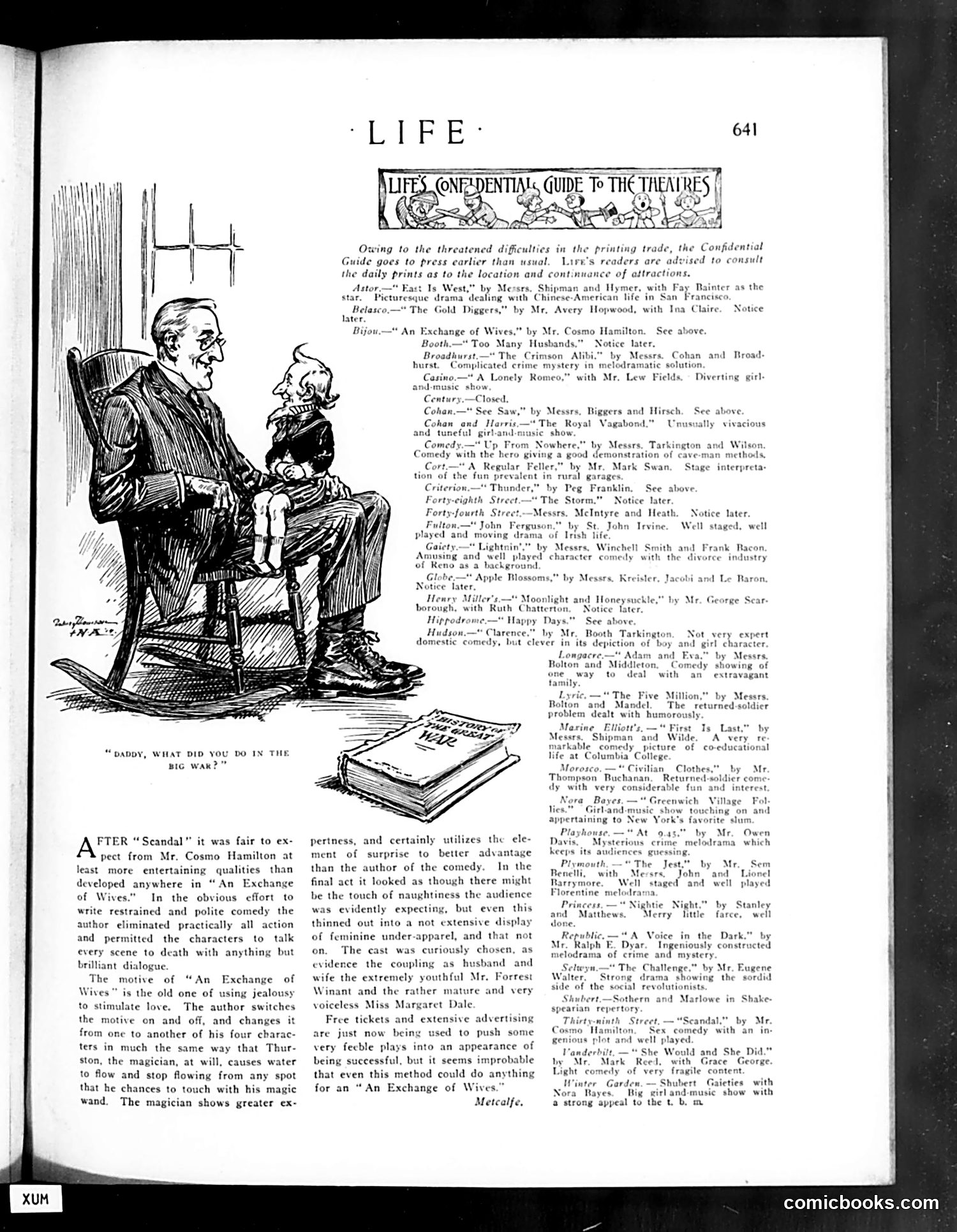
This page reviews theatrical productions, with a cartoon illustrating a father-son conversation about WWI service. The caption "Daddy, what did you do in the Big War?" references the famous British recruitment poster asking men to justify their wartime contributions to their children. The main text critiques Cosmo Hamilton's play "An Exchange of Wives"—a domestic comedy about using jealousy to rekindle love between couples. The reviewer finds it tedious, poorly plotted, and saved only by cast performances. Hamilton had previously written "Scandal," which apparently had better dramatic qualities. The surrounding listings advertise various Broadway productions of the era. The reference to "free tickets and extensive advertising" pushing "feeble plays" suggests cynicism about theatrical marketing practices. The overall context is post-WWI American theater, when war experiences heavily influenced cultural conversations and entertainment.
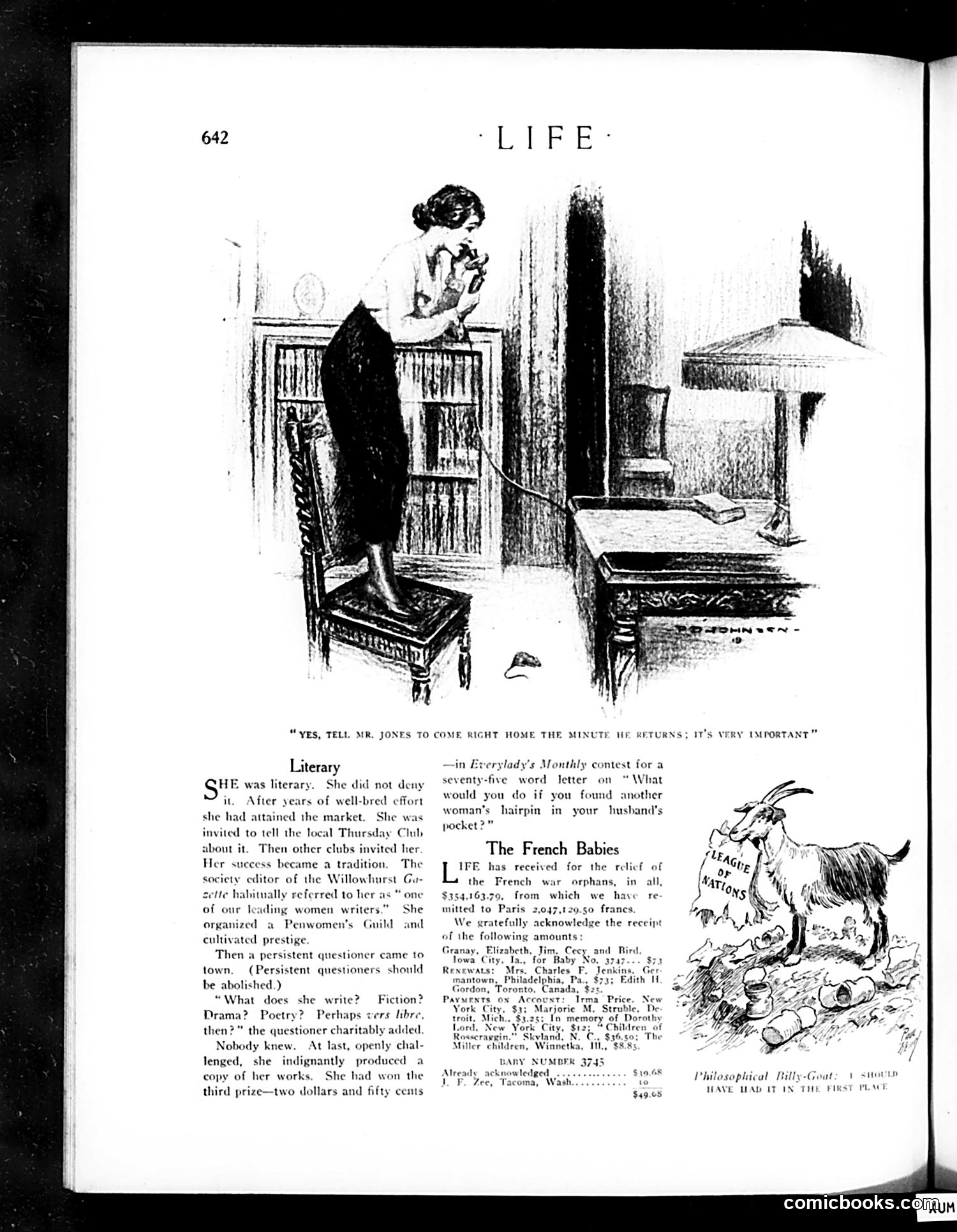
**The Main Cartoon:** Shows a woman standing on a chair, speaking animatedly while a man (presumably her husband Mr. Jones) is being summoned home. The caption satirizes the social pretension of literary women in the early 20th century. **The Satire:** The article "Literary" mocks a woman who has achieved social status as a celebrated "woman writer" without anyone—including herself—actually knowing what she writes. When finally challenged to produce her work, she reveals she won third prize ($2.50) in a magazine contest for a 75-word letter answering "What would you do if you found another woman's hairpin in your husband's pocket?" **The Point:** This is social satire targeting the gap between literary *prestige* and actual literary achievement. The woman's status derives entirely from reputation and club invitations rather than substantive creative work. The cartoon illustrates her presumably holding forth at home, with the caption emphasizing she demands her husband's immediate attention—suggesting her self-importance exceeds her actual accomplishments. The humor relies on early 20th-century anxiety about women's intellectual and social advancement.
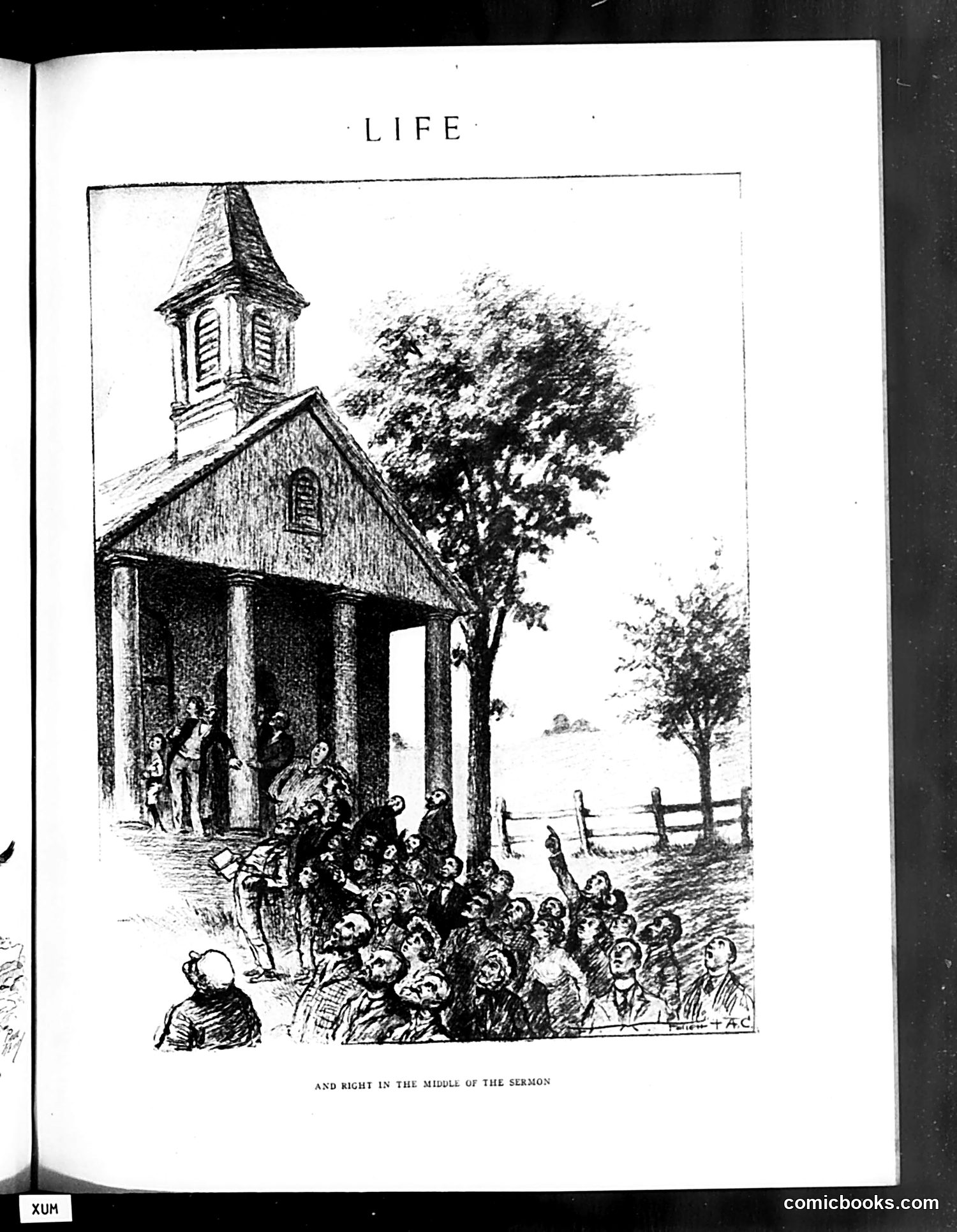
This page shows a satirical illustration titled "LIFE" with the caption "AND RIGHT IN THE MIDDLE OF THE SERMON." The image depicts a rural church scene with a preacher addressing a large congregation from the pulpit. The sketch uses exaggerated, caricatured figures typical of period satire—showing a crowd of parishioners in the pews below. The humor likely targets one of two common satirical subjects of the era: either the gap between a preacher's moral teachings and congregants' actual behavior, or possibly disruption/distraction occurring during a sermon. The rural setting and style suggest commentary on American provincial religious life. However, without additional context or visible specific caricatures of identifiable figures, the exact satirical target remains unclear.
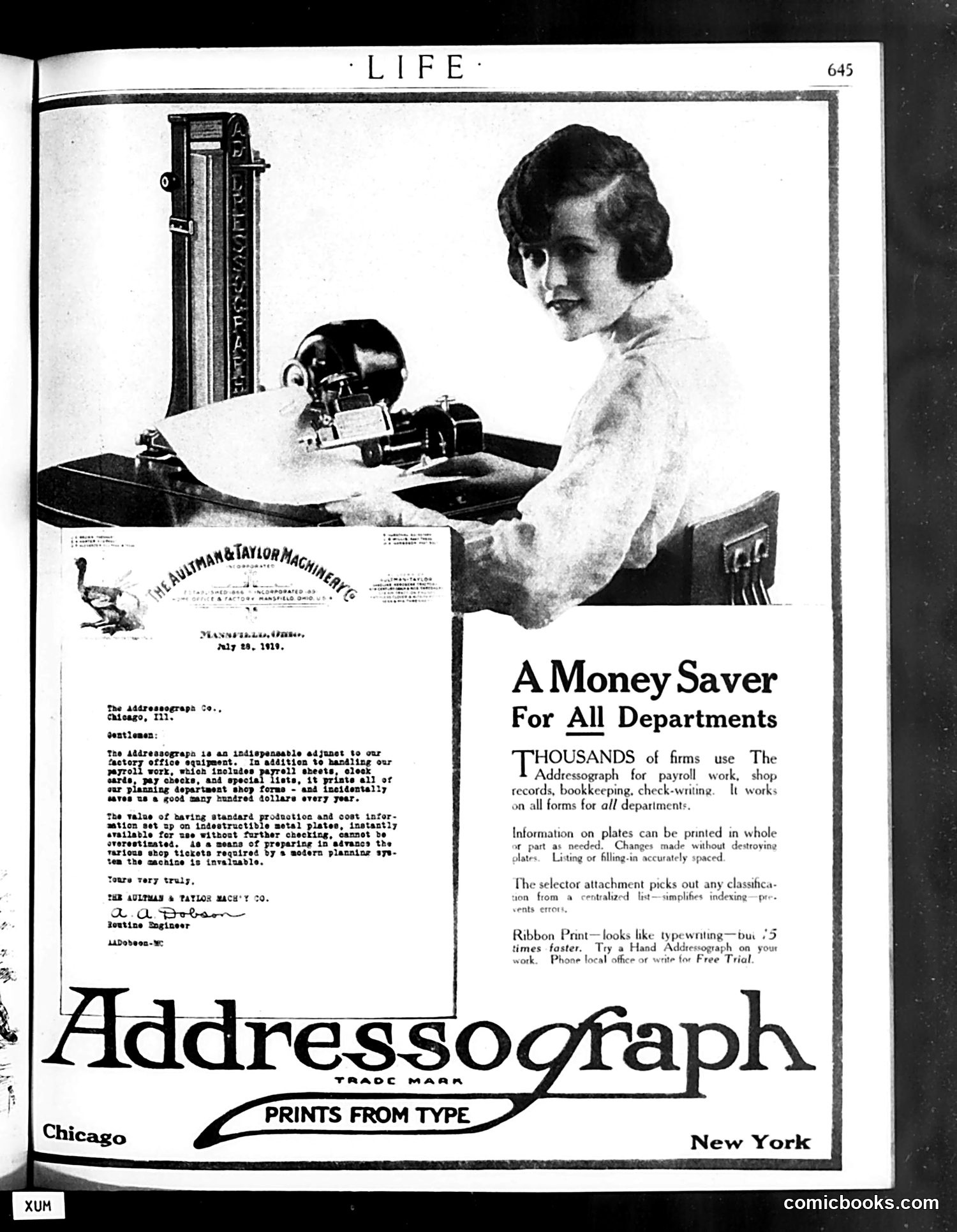
This page is primarily **advertising, not political satire or comics**. It's a full-page advertisement for the Addressograph machine, placed in *Life* magazine (page 645). The image shows a woman operating an Addressograph—a mechanical printing device used for mass-producing addressed envelopes, payroll forms, and business records. The accompanying letter (dated July 28, 1919) is a testimonial from the Aultman & Taylor Machinery Company praising the machine's efficiency in handling factory payroll work and reducing costs. The ad targets business managers by emphasizing labor-saving benefits: the device prints from type, handles multiple form types, and saves "hundreds of dollars every year." The "money saver for all departments" headline appeals to post-WWI cost-consciousness. There is no political cartoon or satire here—this is straightforward commercial messaging aimed at industrial and office administrators in the early 20th century.
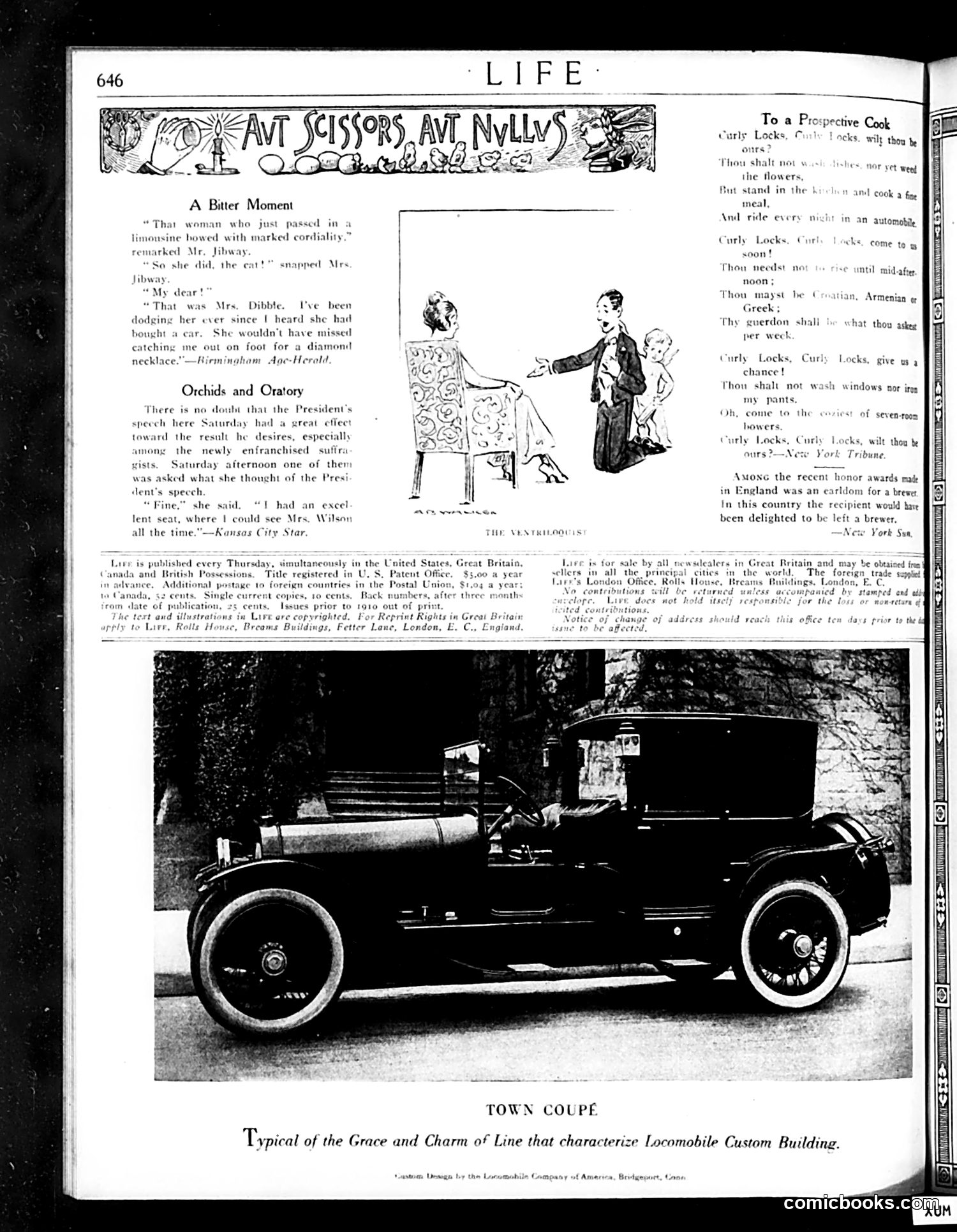
This page contains three separate humor pieces typical of early 20th-century American satire: **"A Bitter Moment"**: A brief joke about a woman in a limousine greeting another woman cordially, though the greeter calls her "the cat" once she passes. The punchline hinges on Mrs. Jibway's jealousy—apparently Mrs. Dibble once went missing while searching for a diamond necklace, creating lasting social tension. It satirizes the cattiness and materialism of wealthy women. **"Orchids and Oratory"**: Mocks women's newly gained voting rights by reporting that a woman, when asked about the President's speech, cared only about seeing Mrs. Wilson (the First Lady), not the political content. The satire suggests newly enfranchised suffragettes are more interested in celebrities than governance. **Image & Advertisement**: The lower half shows a Locomobile town coupe automobile, advertising the vehicle's "grace and charm." This is luxury-car marketing, not satire. The page reflects 1920s attitudes mixing misogyny with social change—poking fun at both female materialism and the recent suffrage movement.
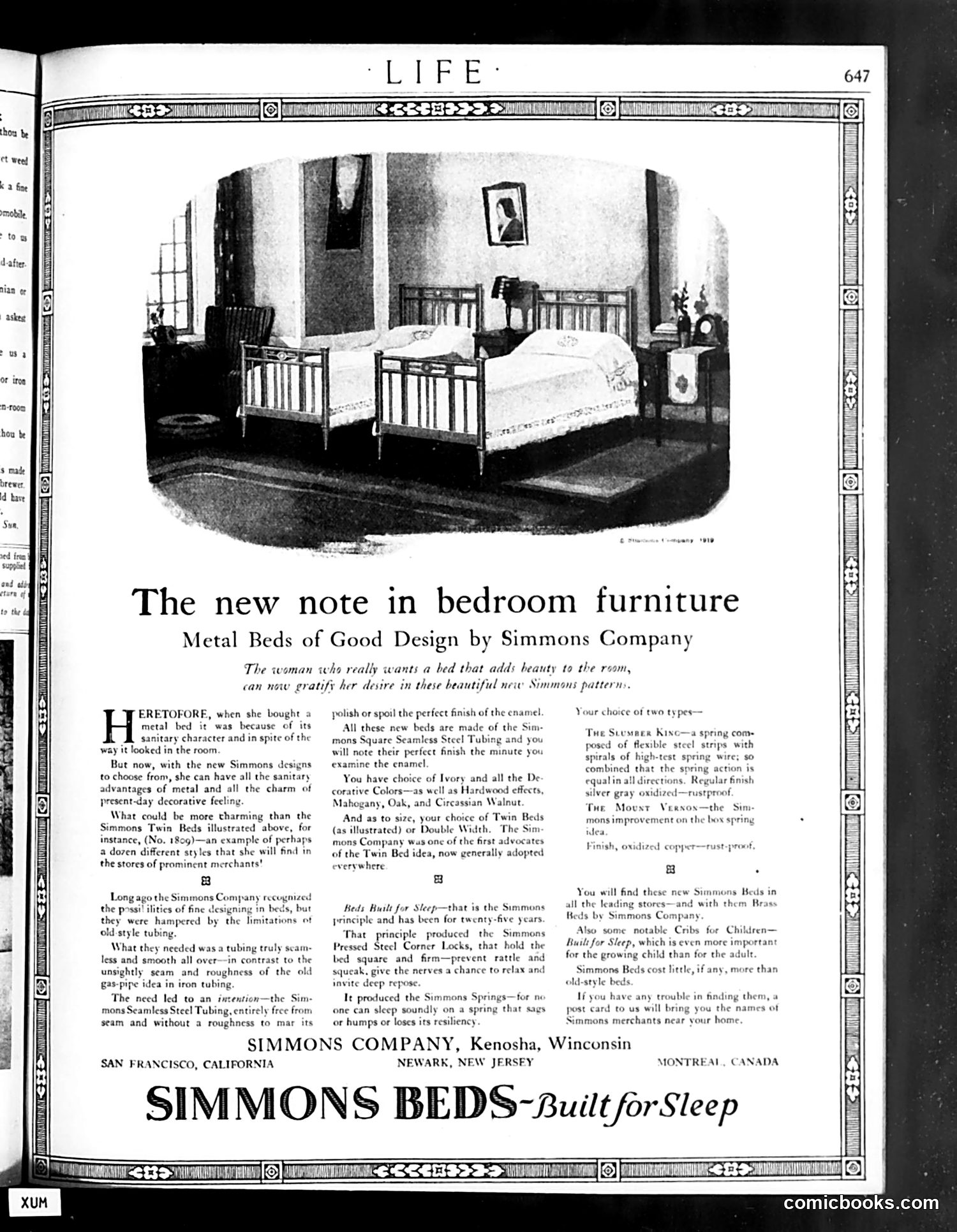
This is **not a cartoon or satire**—it's a straightforward **advertisement** for Simmons Company metal beds, appearing in *Life* magazine (page 647). The page features: - A product photograph showing twin metal beds in a bedroom setting - Marketing copy emphasizing that metal beds are now both sanitary *and* aesthetically appealing ("charm of present-day decorative feeling") - Technical details about Simmons' innovations: seamless steel tubing (eliminating unsightly seams) and improved spring mechanisms - Appeals to early 20th-century consumer desires: hygiene, modern design, comfort, and choice (multiple colors and bed sizes) The key selling point addresses a genuine problem: metal beds were previously chosen for cleanliness but looked institutional or ugly. Simmons solved this by making them decorative. This represents typical *Life* magazine advertising from this era—full-page product placements marketed to middle-class homemakers concerned with both health and home aesthetics.
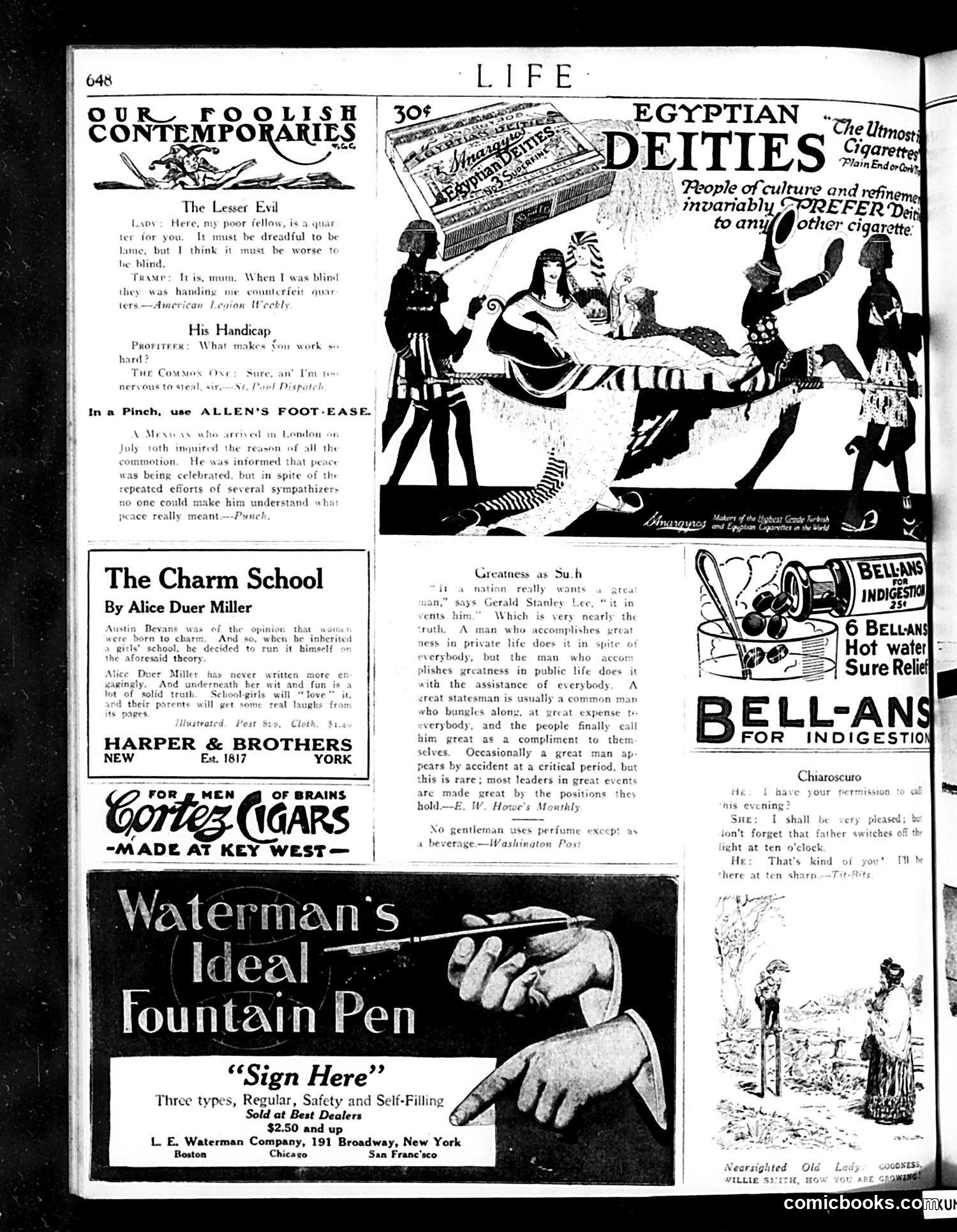
This page contains multiple satirical elements typical of Life magazine's editorial humor: **"Our Foolish Contemporaries"** (top left): A brief joke about blindness and hardship, mocking romantic notions of poverty. **"His Handicap"**: A dark humor exchange between a vagrant and a wealthy man. The tramp explains he works because he's "too nervous to steal"—satirizing both poverty and the notion that the poor lack initiative or morality. **"The Charm School"** (center): A serialized story by Alice Duer Miller about social etiquette and refinement, reflecting early 20th-century concerns with "improving" oneself through proper behavior. **"Egyptian Deities"** (right): A satirical advertisement suggesting cigarette smokers are like Egyptian aristocrats—mocking both orientalism and cigarette marketing's grandiose claims. The remaining content comprises **period product advertisements** (Cortez Cigars, Bell-Ans digestive aid, Waterman fountain pens), which were common revenue sources. Overall, this page reflects Life's blend of social satire, serialized fiction, and commercial advertising typical of 1920s American magazines.
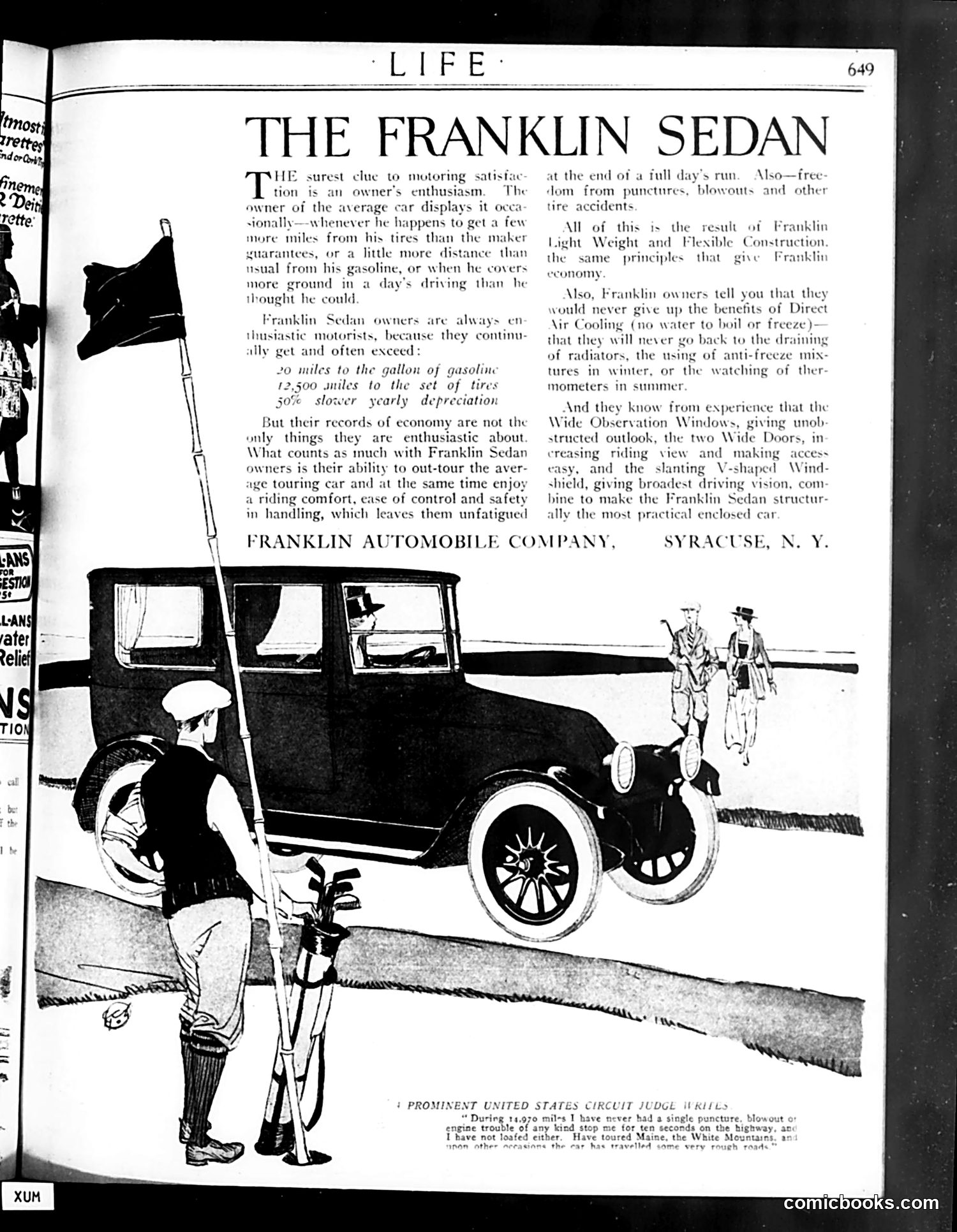
This is a **car advertisement**, not political satire. It promotes the Franklin automobile, manufactured in Syracuse, New York, as a superior touring vehicle. The ad targets enthusiast drivers by emphasizing the Franklin's economy (20 miles per gallon, 12,500 miles per tire set, 50% slower depreciation) and distinctive mechanical features: direct air cooling (avoiding radiator problems), wide observation windows, and easy handling that leaves drivers "unfatigued" after long drives. The illustration shows a cyclist admiring the Franklin sedan, with well-dressed motorists in the background—positioning the car as aspirational and practical for active, touring-minded people of means. At page bottom, a prominent circuit judge endorses the car's reliability on highways, lending credibility. The ad's tone suggests this was likely published in the 1920s, when such detailed mechanical specifications and touring capability were major selling points.
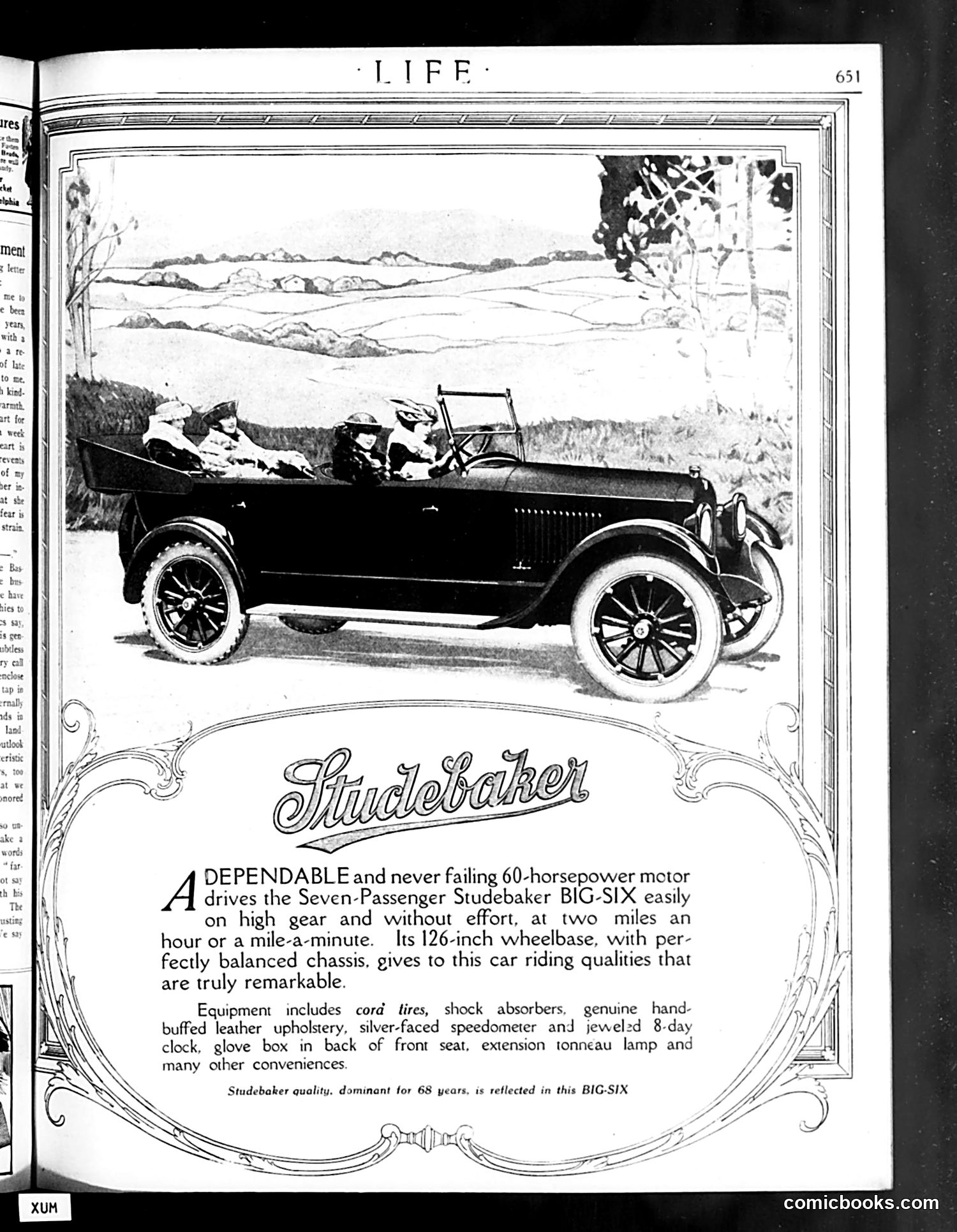
This page is **primarily an advertisement**, not political satire. It's a Studebaker automobile ad from Life magazine (page 651). The image shows a 1920s open-air touring car with passengers enjoying a scenic countryside drive. The ad copy emphasizes the car's reliability, power (60 horsepower), capacity (seven passengers), and smooth ride on its 126-inch wheelbase. The "satire" element, if any, is subtle and typical of early-20th-century advertising: the glamorous lifestyle imagery (well-dressed passengers, pastoral landscape) selling aspirational middle-class comfort. The ad boasts about luxuries like "genuine hand-buffed leather upholstery" and a "jeweled 8-day clock"—details that sound humorous to modern ears but were genuine selling points then. The reference to Studebaker's "68 years" of quality establishes brand heritage as a trust signal. This is straightforward period advertising, not editorial commentary.
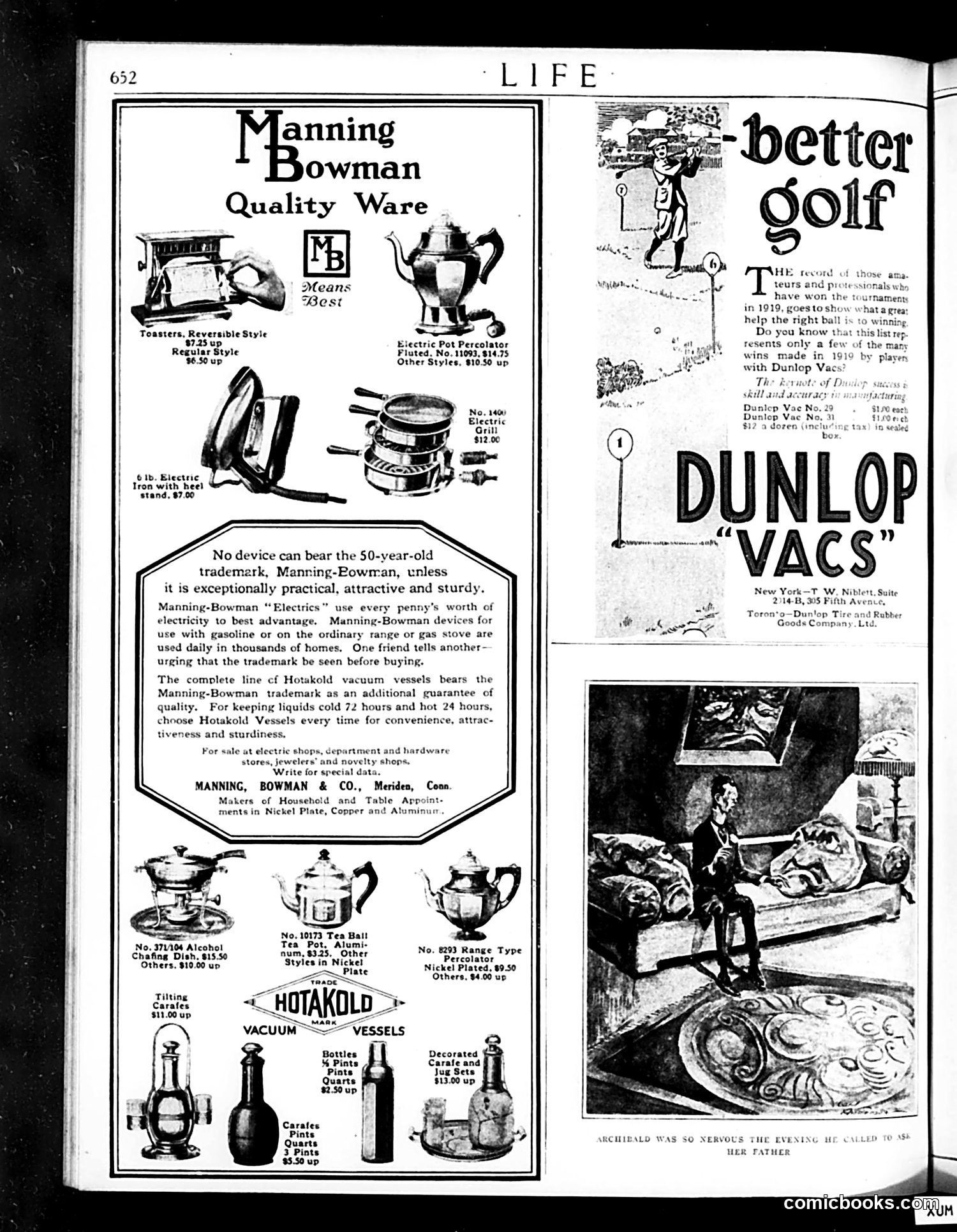
This page is primarily **advertising**, not editorial content or satire. It contains two major product advertisements: **Left side:** Manning-Bowman Quality Ware—household appliances (electric irons, percolators, chafing dishes, vacuum vessels) from a Connecticut manufacturer. The text emphasizes their 50-year trademark reputation for durability and practicality. **Right side:** Dunlop Vacs (vacuum tires for automobiles), promoting their 1919 golf tournament wins. The accompanying illustration shows a golfer with a nervous expression, captioned that "Archibald was so nervous the evening he called to see her father"—a humorous domestic scenario implying anxiety about meeting the girlfriend's father, unrelated to the product itself. There is no political satire or social commentary visible. This is a typical early-20th-century *Life* magazine advertising section mixing household and automotive products with light humor.
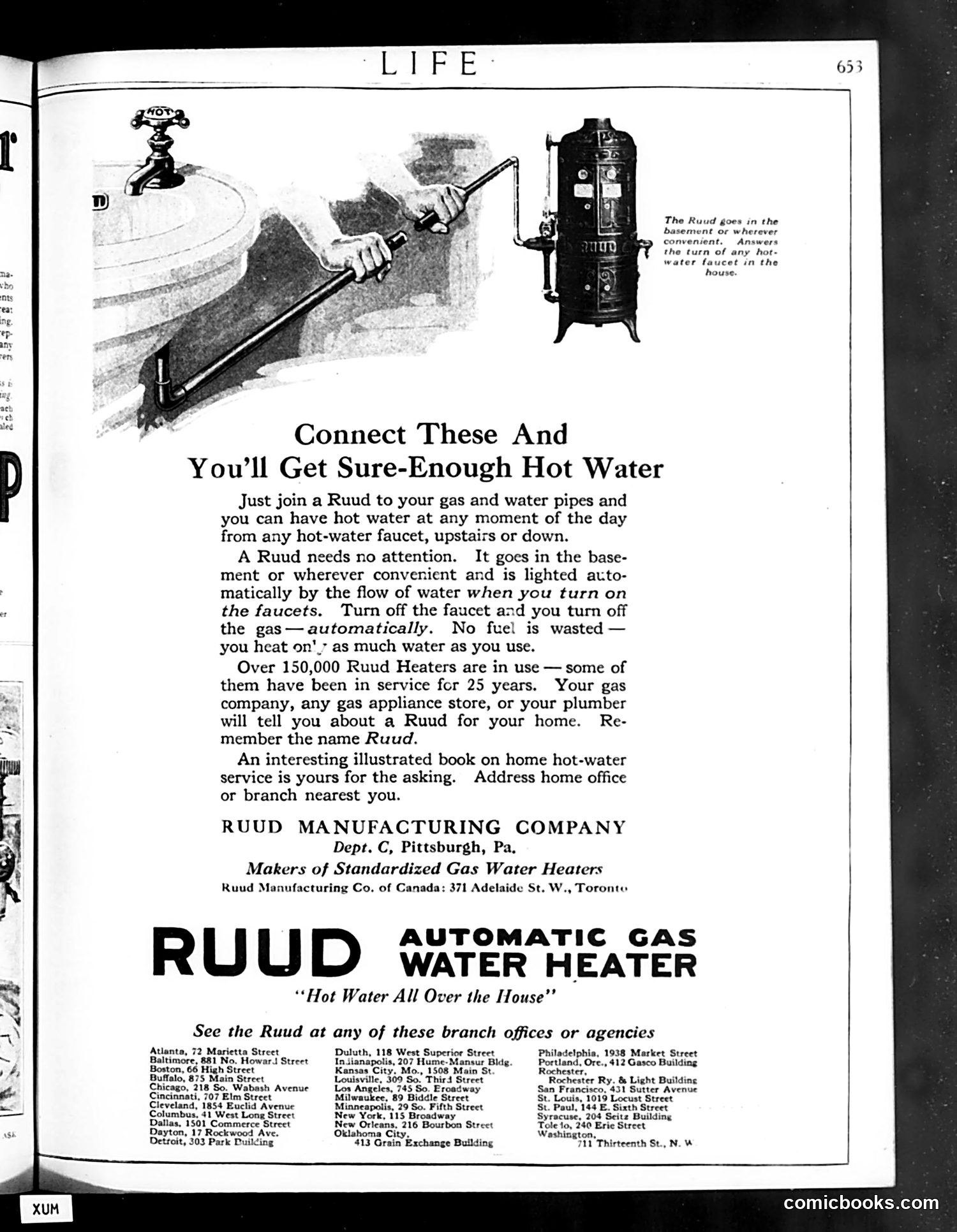
This page is **entirely an advertisement** for Ruud Automatic Gas Water Heaters, not satire or political commentary. There are no cartoons or caricatures to analyze. The ad promotes an innovative home appliance: an automatic gas water heater that connects to household pipes and ignites automatically when faucets turn on, then shuts off when they close. The copywriting emphasizes convenience ("no attention needed"), efficiency ("no fuel wasted"), and reliability (claiming 150,000+ units in use, some for 25 years). The visual diagrams show the heater unit itself and installation setup. For modern readers, this represents early 20th-century marketing of what became standard household technology—then a novelty worthy of detailed explanation and extensive branch-office listings across America and Canada.
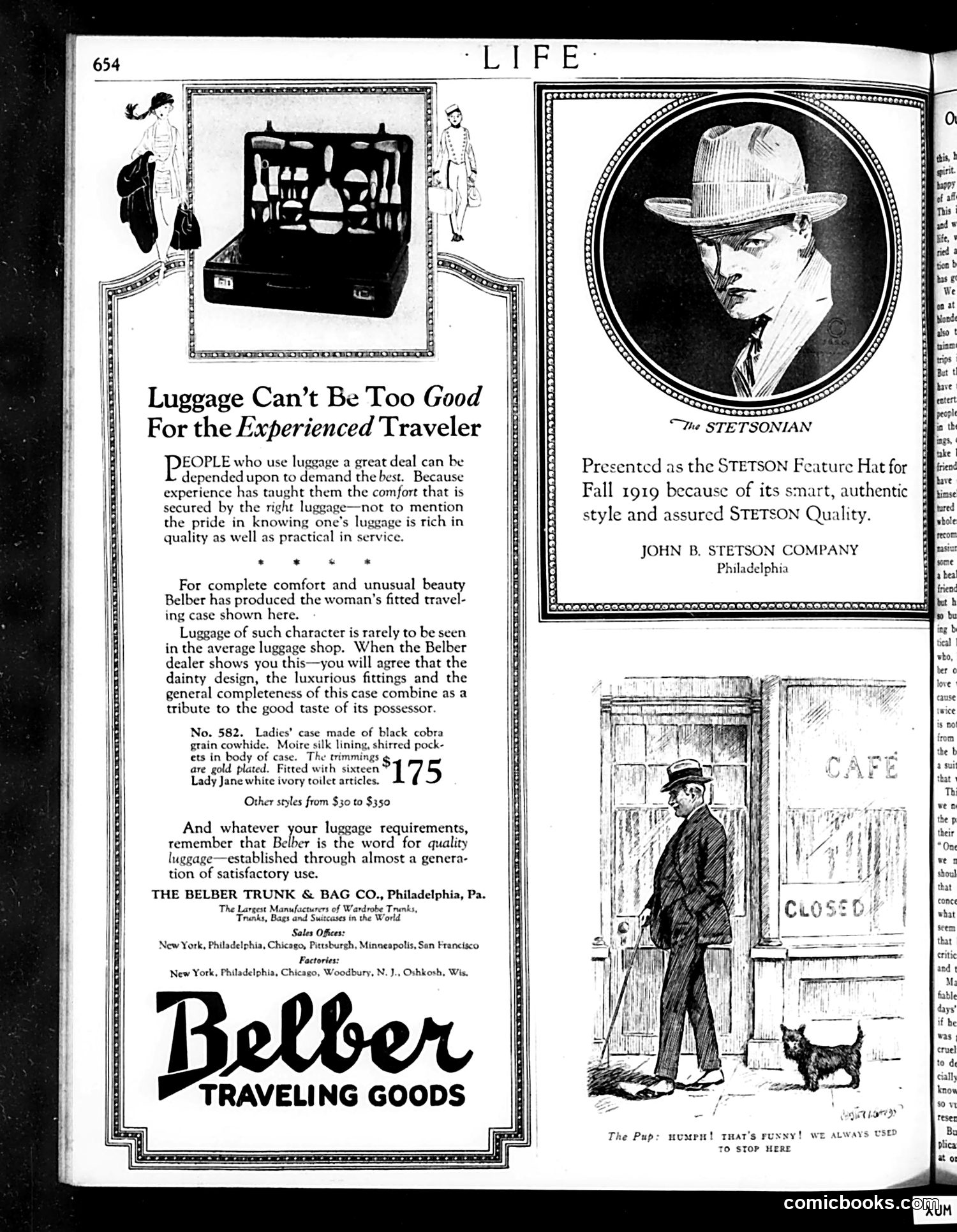
This page consists primarily of **advertisements**, not political satire. The left side advertises Belber luggage, emphasizing quality craftsmanship for experienced travelers—a luxury good marketed to the wealthy. The price ($175 for one case) underscores exclusivity. The right side features a Stetson hat advertisement and an unrelated cartoon. The cartoon depicts a man and dog outside a closed café, with the caption "Humph! That's funny! We always used to stop here"—a Depression-era joke about business closures and changed routines. There is no political commentary here. This appears to be a standard commercial magazine page from the 1919 period, mixing ads with light humor. The only social reference is the cartoon's implicit acknowledgment of economic disruption affecting ordinary people's habits.
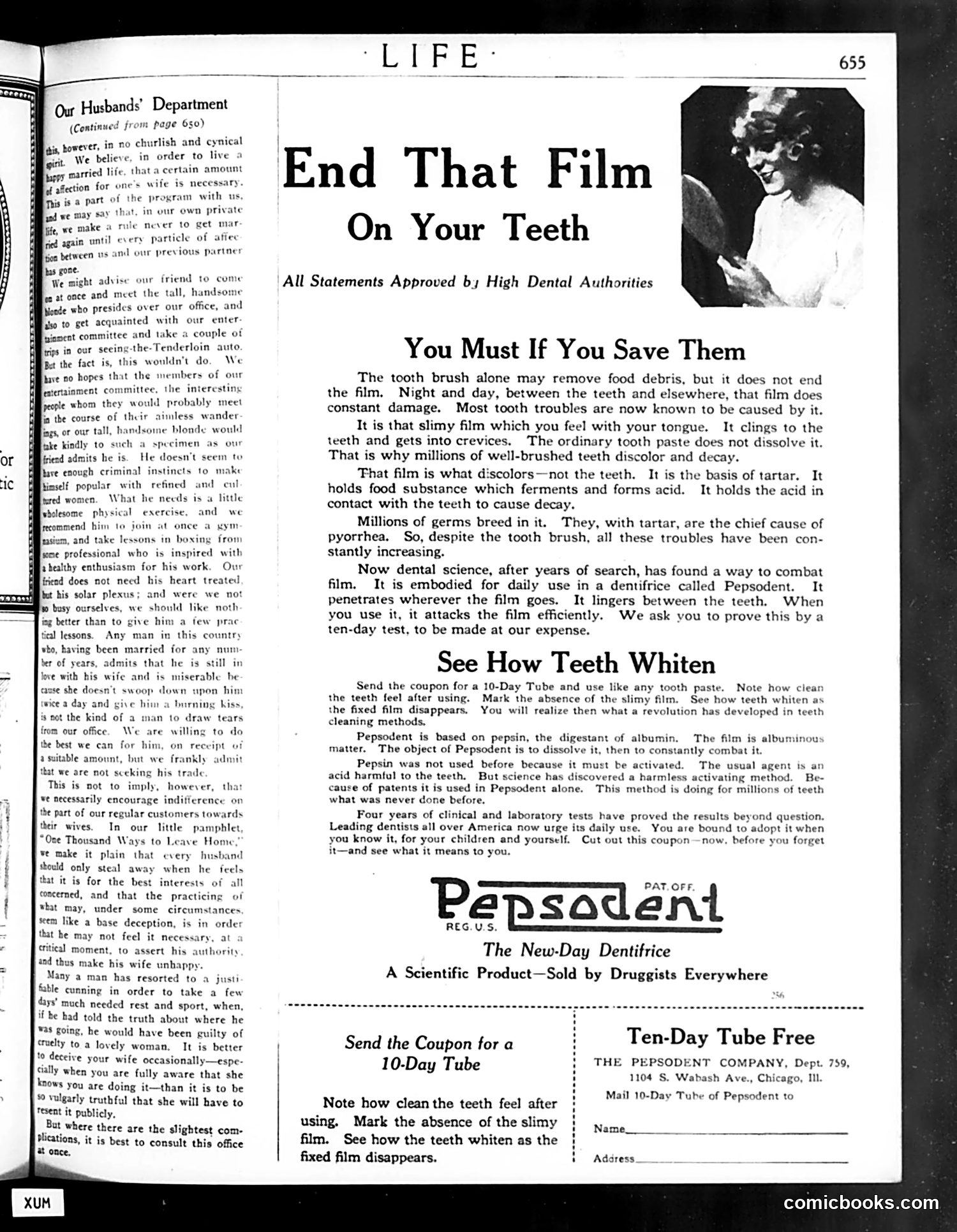
This page is primarily a **toothpaste advertisement**, not political satire. The left column contains the conclusion of "Our Husbands' Department"—a humor column about marriage advice—while the right side promotes Pepsodent, a new dentifrice. The ad's pitch claims Pepsodent uniquely dissolves "film" (plaque/tartar buildup) on teeth through pepsin, an enzyme that dissolves albumin. It positions this as a scientific breakthrough approved by "High Dental Authorities." The advertisement invites readers to test a free 10-day tube and observe teeth whitening and the disappearance of the slimy film. This represents early **20th-century dental product marketing**, emphasizing scientific credibility and personal hygiene—common themes during the Progressive Era when new consumer products claimed scientific validation to build consumer trust.
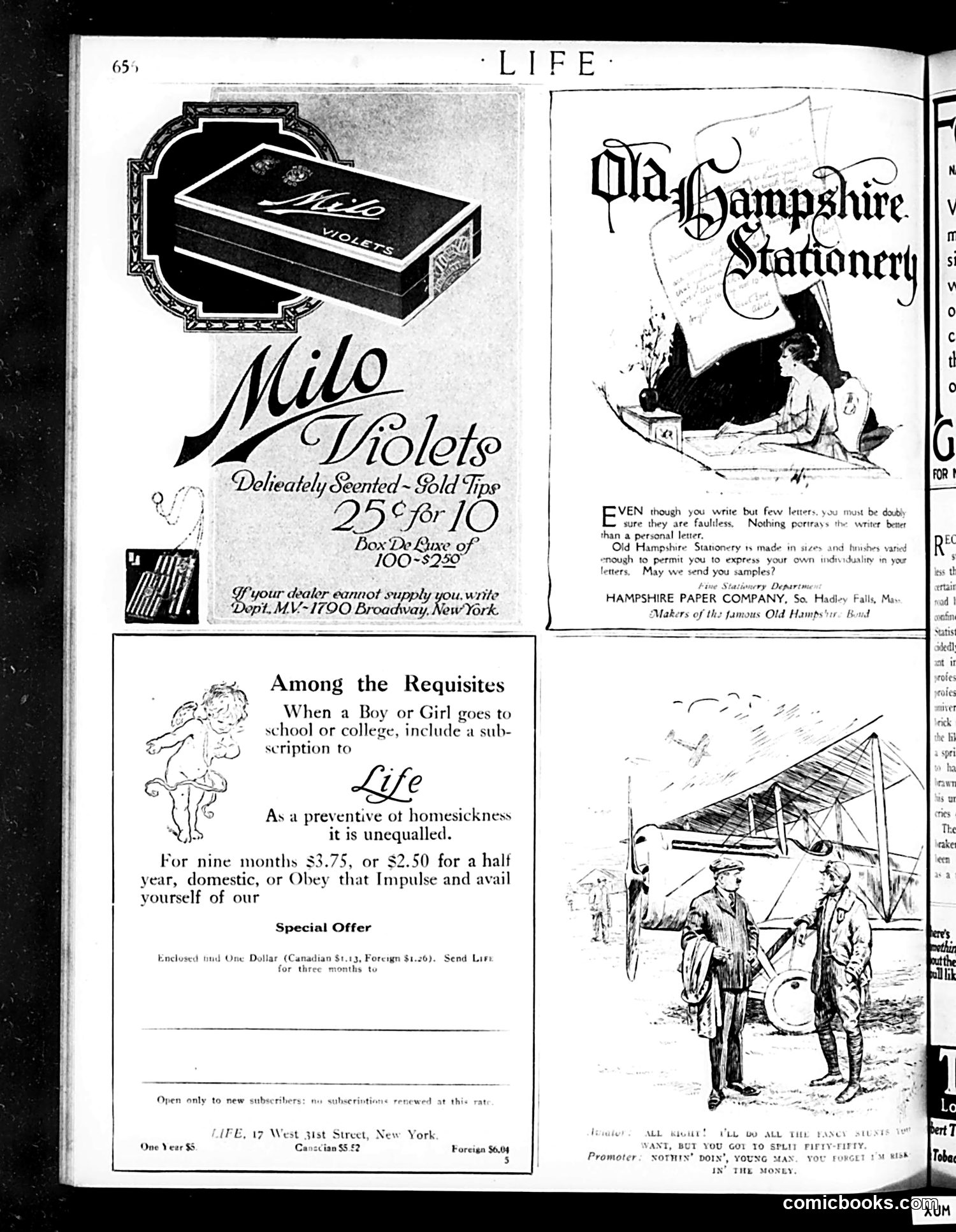
This page is primarily **advertising and subscription promotions** rather than political satire or editorial cartoons. The content includes: 1. **Milo Violets ad** (top left): scented stationery product, 25¢ for 10 boxes 2. **Old Hampshire Stationery ad** (top right): emphasizes quality personal correspondence 3. **Life magazine subscription pitch** (center): targets parents of students, marketed as a "preventive of homesickness" during school/college years. Special offer: $1 (or $1.13 Canadian) for three months 4. **Aviation illustration** (bottom right): shows two men discussing an airplane venture, with dialogue about splitting profits "fifty-fifty" versus the promoter's refusal ("nothin' doin'"), satirizing get-rich-quick schemes and business disputes of the era The aviation cartoon appears to be the only satirical content—mocking optimistic business pitches and entrepreneurial hype, likely referencing 1920s aviation enthusiasm and speculation. The rest is commercial messaging targeting middle-class families and students.
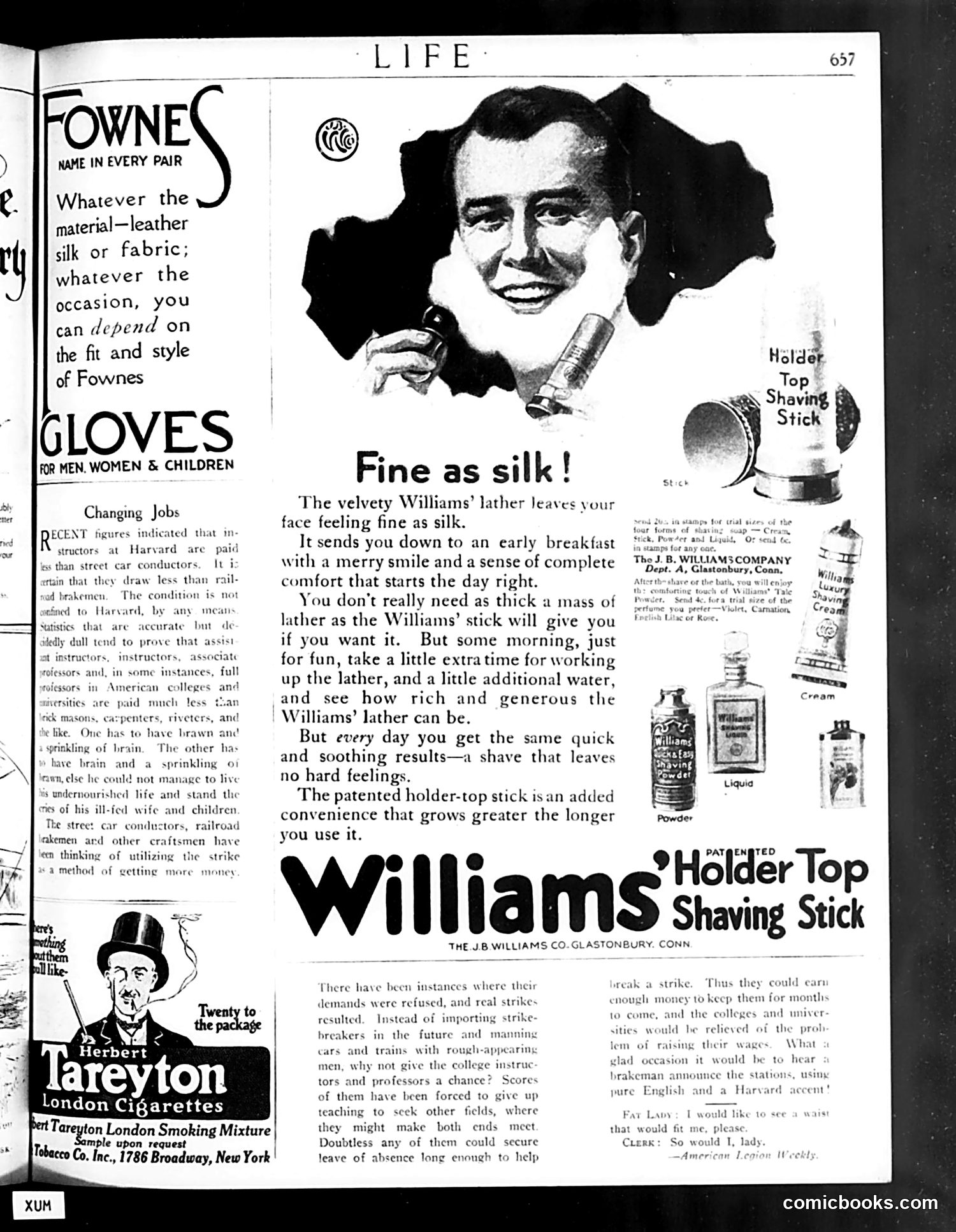
This editorial piece satirizes the economic plight of Harvard instructors and college professors, who—according to cited figures—earn less than street car conductors, railroad brakemen, and skilled tradesmen (masons, carpenters, riveters). The satire's point: College-educated professionals are so underpaid that they're considering labor strikes like working-class tradesmen do. The text mocks this scenario, suggesting that professors and instructors—who lack "brawn" and possess only "a sprinkling of brain"—could never successfully strike or seek employment elsewhere. It notes some have already been forced to abandon teaching for other fields. The underlying complaint is class-based economic injustice: highly educated workers earning poverty wages while manual laborers prosper. The tone is darkly comedic about the absurdity of intellectuals contemplating union tactics while being structurally unable to execute them. The page also contains period advertisements (Fownes Gloves, Williams Shaving Stick, Tareyton Cigarettes), typical of *Life* magazine's commercial model.
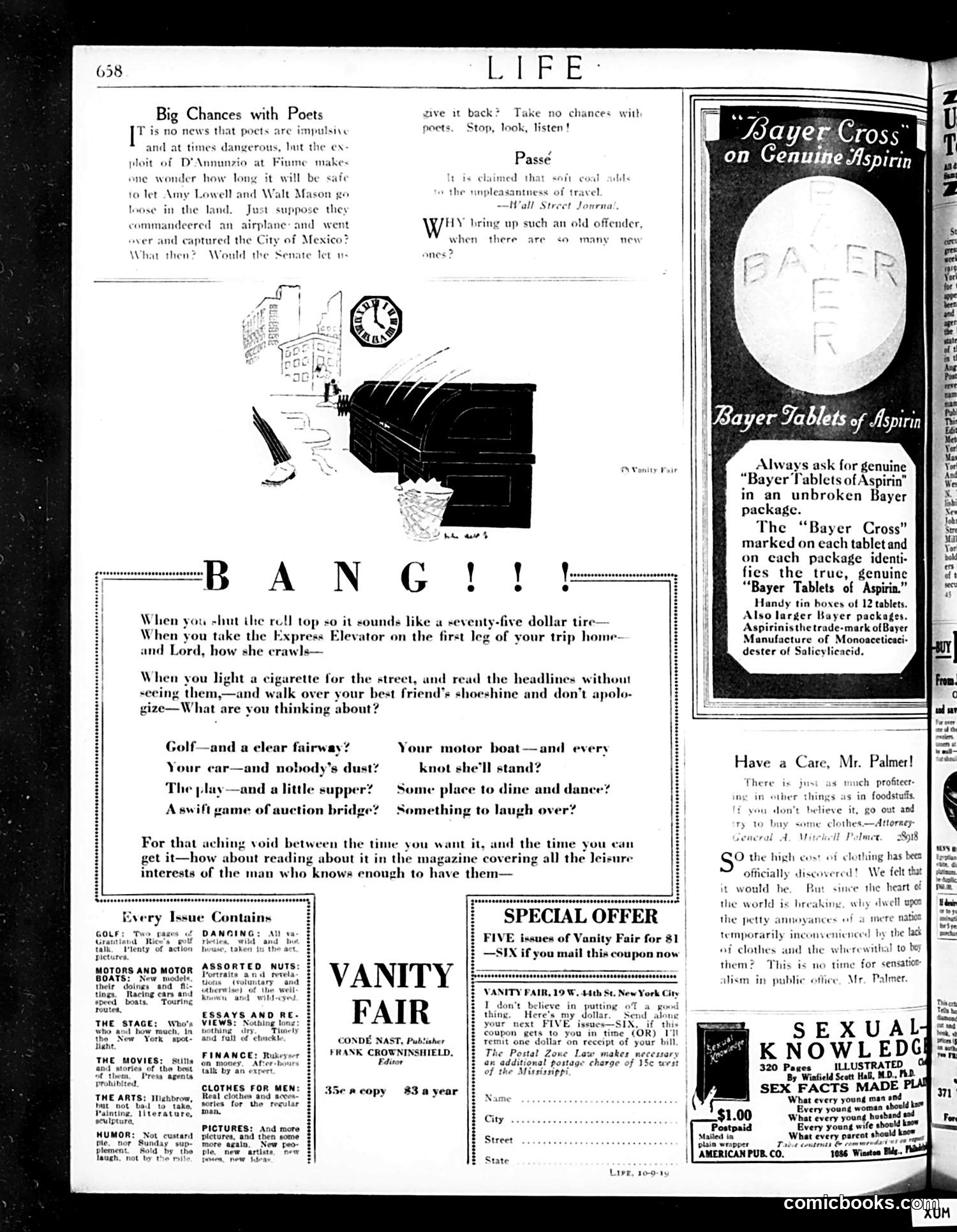
This satirical piece mocks the idea of letting famous American poets loose with dangerous power. It references Gabriele D'Annunzio, an Italian poet-adventurer who recently seized the city of Fiume (now Rijeka) in a nationalist military action—a real, shocking event of 1919. Life jokes: what if American poets Amy Lowell and Walt Mason commandeered an airplane and attacked Mexico City? Would the Senate permit such chaos? The cartoon illustrates the absurdity by showing a poet's desk transformed into a weapon of mass distraction—his writing so consuming that the user becomes oblivious to real life (stepping on friends, ignoring headlines). The "BANG!!" headline emphasizes the explosive, disruptive power of poetic obsession. The satire critiques both the dangerous romanticism of artistic genius and the impracticality of poets dabbling in real-world politics. It's humorous anxiety about where artistic passion, unmoored from responsibility, might lead.
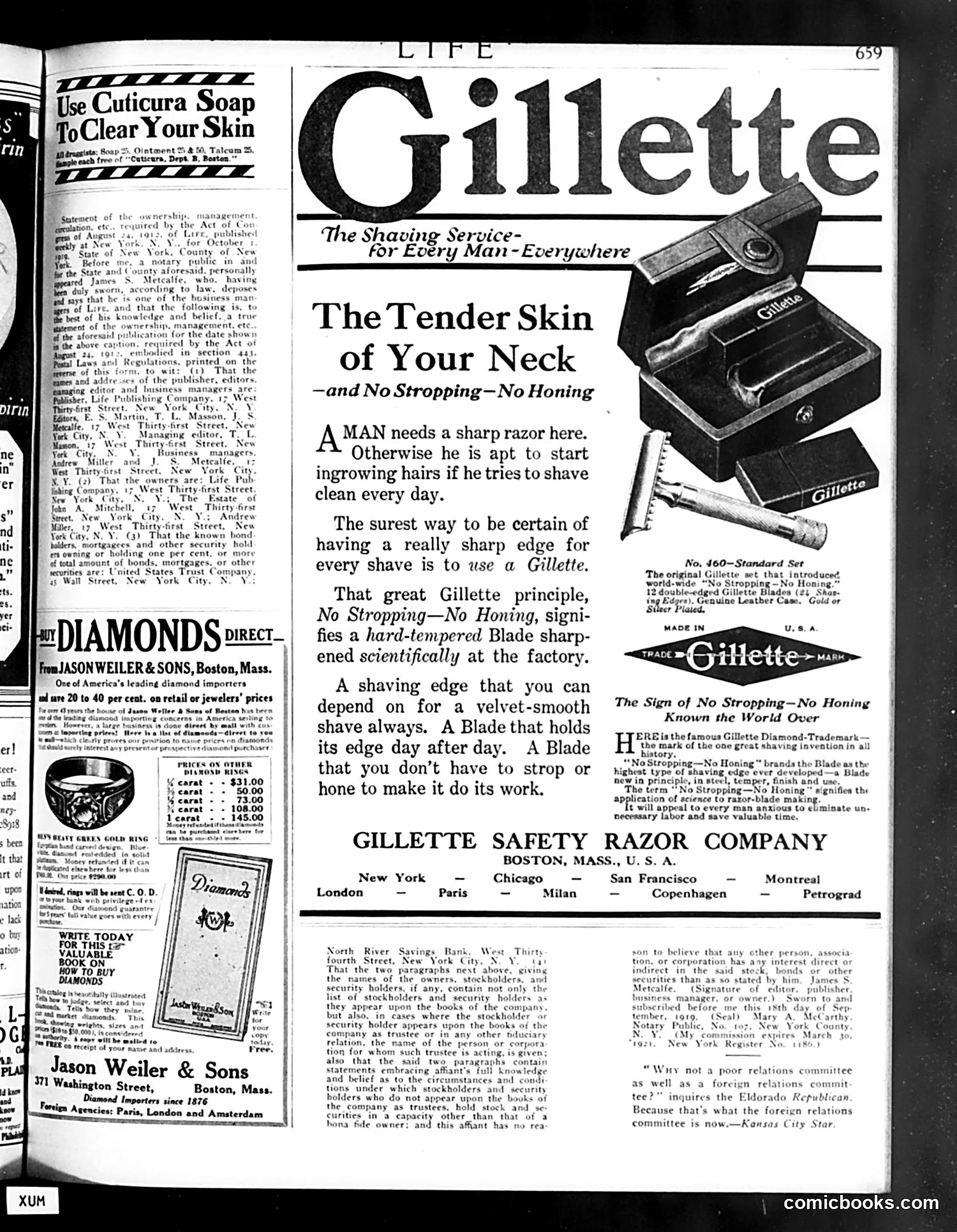
This page is **primarily advertising**, not political satire or comics. The dominant content is a Gillette Safety Razor advertisement occupying roughly half the page. The Gillette ad features a product photograph and marketing copy emphasizing the razor's key innovation: "No Stropping—No Honing." The text explains that men need sharp razors to avoid ingrown hairs and that Gillette's factory-sharpened blades eliminate the tedious maintenance (stropping/honing) required by competing razors. The page also contains advertisements for **Cuticura Soap**, **Jason Weiler & Sons diamonds**, and a notice from **North River Savings Bank** regarding stockholders. There is **no political cartoon or satire visible** on this page. The content reflects early 20th-century consumer advertising and banking notices typical of *Life* magazine during this period, when the publication functioned as a general-interest magazine carrying substantial advertising alongside editorial content.
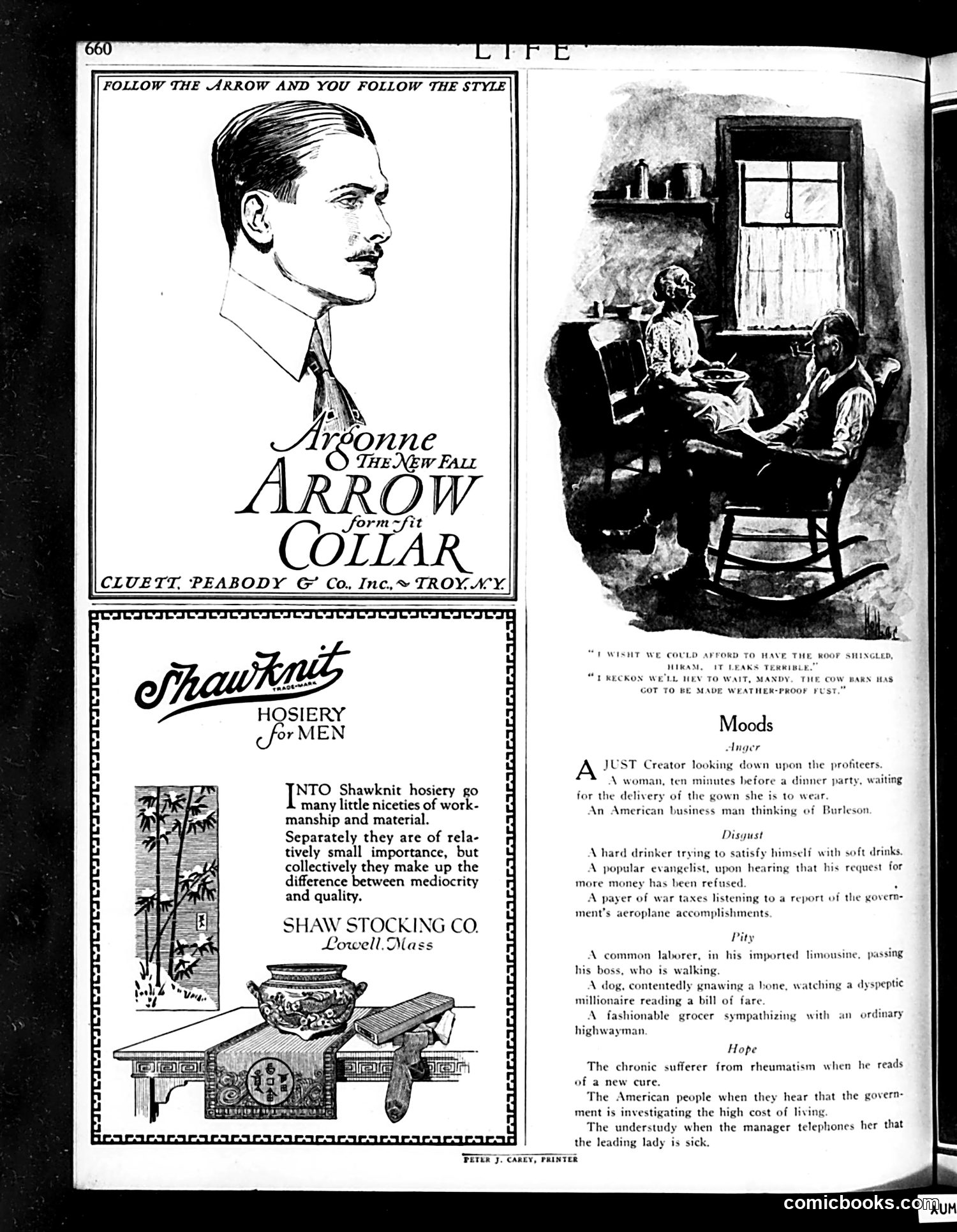
This page combines advertisements with a satirical "Moods" feature typical of Life's social commentary. The top advertises Arrow Collar shirts and Shawknit hosiery—standard early 20th-century menswear ads. The main content is a series of vignettes illustrating human emotions through contemporary situations. The rural couple discussing roof repairs while prioritizing the cow barn exemplifies Depression-era hardship. Other entries target specific frustrations: war profiteers, slow mail delivery (possibly referencing Postmaster General Burleson), soft drinks as alcohol substitutes (Prohibition era), and government waste on aviation programs. The satire cuts across classes—mocking both wealthy profiteers and a nouveau-riche laborer in a limousine. The final "Hope" section shows typical American optimism about government action on living costs, suggesting the page dates to a period of public concern over inflation and economic inequality, likely during or shortly after World War I.
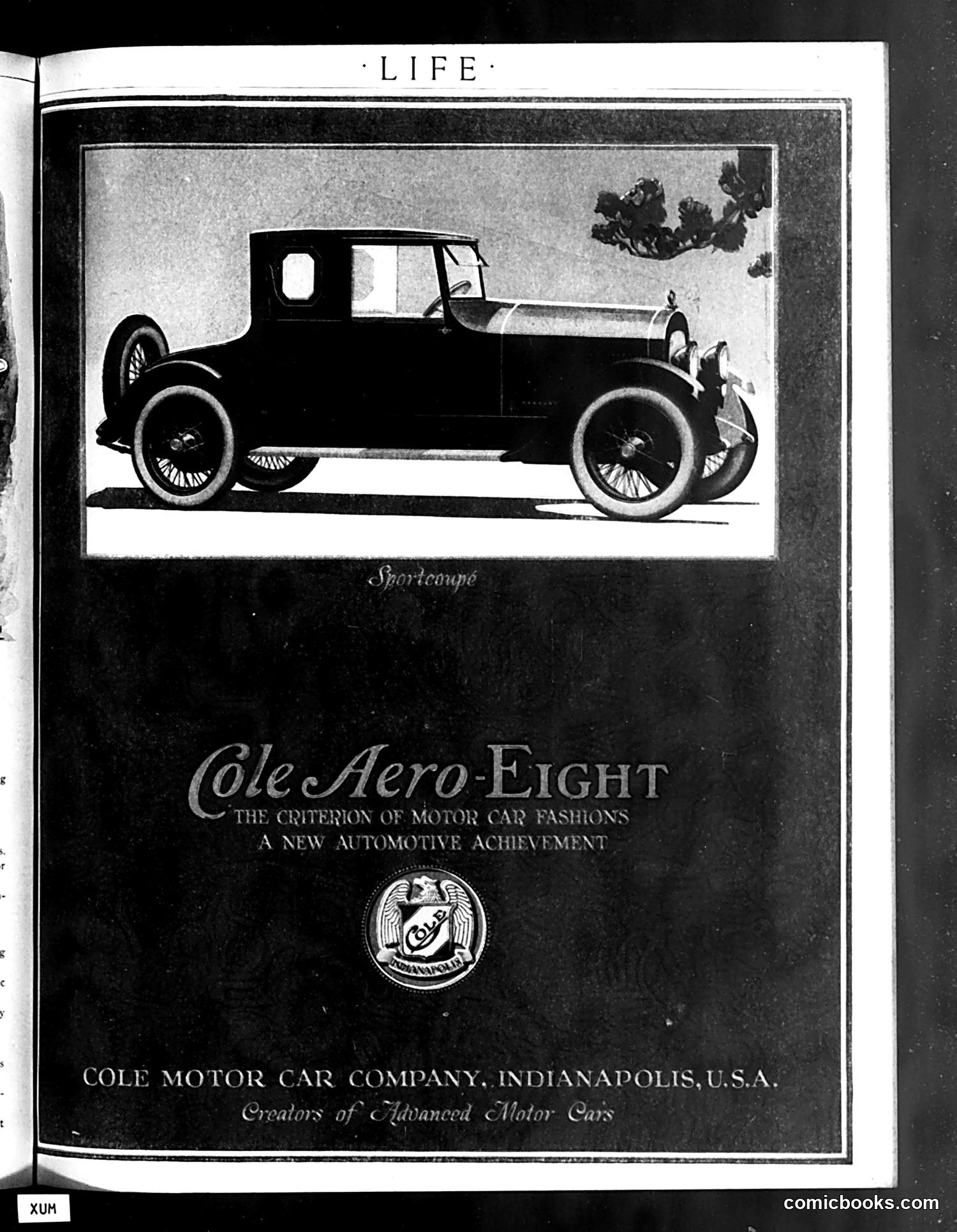
This is primarily a **product advertisement**, not political satire. It appears in *Life* magazine promoting the Cole Aero-Eight automobile, manufactured by Cole Motor Car Company in Indianapolis. The page features an illustration of a "Sportcoupe" vehicle in profile view against a minimalist background with decorative foliage. The advertisement emphasizes the car as "the criterion of motor car fashions" and "a new automotive achievement," positioning it as a stylish, advanced vehicle. The company's logo and tagline—"Creators of Advanced Motor Cars"—reinforce their market positioning. This represents typical early-20th-century automotive advertising, when cars were luxury goods marketed to affluent consumers through design-focused imagery rather than detailed specifications.
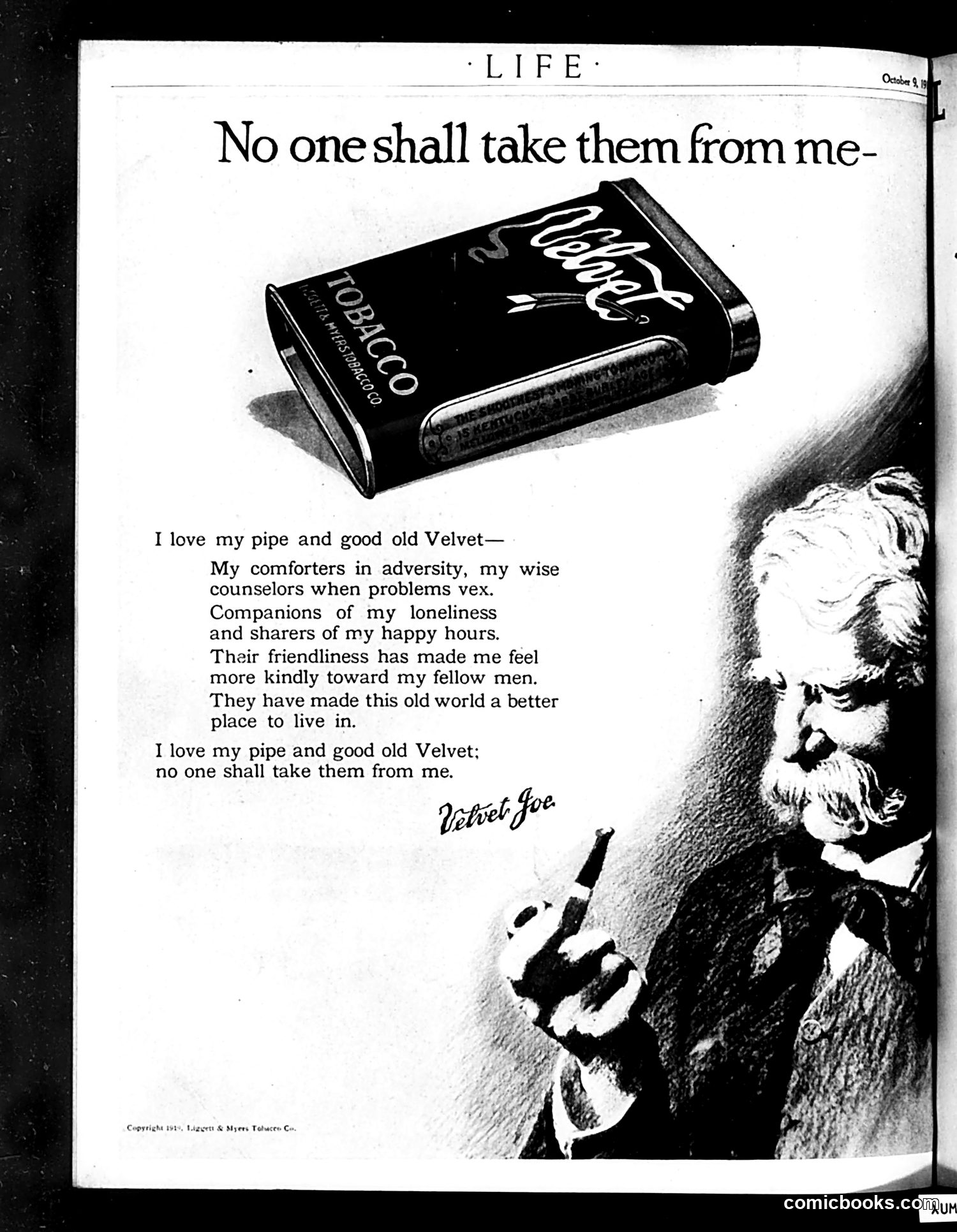
This is a **tobacco advertisement** for "Velvet" brand pipe tobacco, not political satire. The page features an illustrated bearded man (labeled "Velvet Joe") holding a pipe, alongside a product image of the Velvet tobacco package. The ad uses sentimental messaging to market tobacco as a source of comfort and companionship—describing it as a "comforter in adversity" and "wise counselor." The phrase "no one shall take them from me" suggests defiance, possibly referencing **Prohibition-era concerns** about government restrictions on consumer goods, though the copyright date isn't fully visible here. The emotional appeal targets male consumers by romanticizing pipe smoking as a path to kindness and improved worldview. This represents typical early-20th-century advertising strategy: associating products with personal virtue and emotional well-being.