
Life, 1919-10-09 · page 27 of 48
Life — October 9, 1919 — page 27: what you’re looking at
What you’re looking at
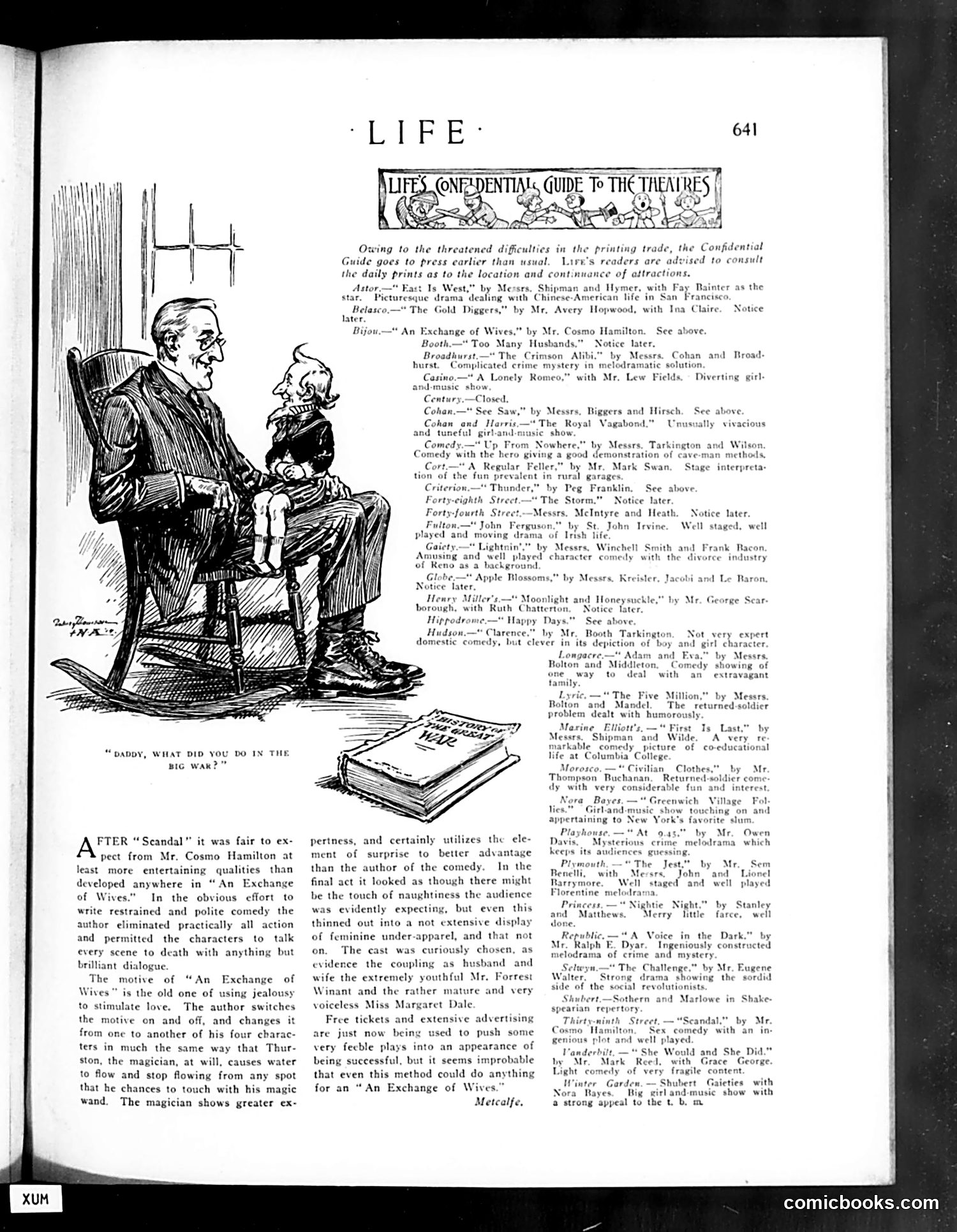
This page reviews theatrical productions, with a cartoon illustrating a father-son conversation about WWI service. The caption "Daddy, what did you do in the Big War?" references the famous British recruitment poster asking men to justify their wartime contributions to their children. The main text critiques Cosmo Hamilton's play "An Exchange of Wives"—a domestic comedy about using jealousy to rekindle love between couples. The reviewer finds it tedious, poorly plotted, and saved only by cast performances. Hamilton had previously written "Scandal," which apparently had better dramatic qualities. The surrounding listings advertise various Broadway productions of the era. The reference to "free tickets and extensive advertising" pushing "feeble plays" suggests cynicism about theatrical marketing practices. The overall context is post-WWI American theater, when war experiences heavily influenced cultural conversations and entertainment.
📄 Transcribed text from this page (OCR, searchable)
Machine-transcribed from the original scan — historical spelling and the odd misread are preserved.
“abby, WHAT DID YOU DO IN THE BIG Wak?” FTER “Scandal” it was fair to ex- pect from Mr, Cosmo Hamilton at least more entertaining qualities than developed anywhere in “An Exchange of Wives.” In the obvious effort to write restrained and polite comedy the author eliminated practically all action and permitted the characters to talk every scene to death with anything but brilliant dialogue. The motive of “An Exchange of Wives” is the old one of using jealousy to stimulate love. The author switches the motive on and off, and changes ii from one to another of his four charac- ters in much the same way that Thur- ston, the magician, at will, causes water to flow and stop flowing from a that he chances t wand. The magi y spot touch with his magic jan shows greater ex- Owing to the threatened difficulties in the printing trade, the Conf Guide goes to press earlier than usual the daily prints as to th Asto Fast Is West, star. Picturesque drama ‘deali Belasco,—* The Gold Diggers,’ later Bijou Booth Broa burst. ( hurst. The Casino.— sic show ntury.—Closed, Cohan.— and tunefy ¢ fun pre Thunde * John Lightnin dwell playe of Reno as a background. —"* Apple Blossoms,” Globe. ice later, Henry Miller's. — boro Hippodr pertness, and certainly utilizes the ele- ment of to better advantage than the author of the comedy. In the final act it looked as though there might be the touch of naughtiness the audience expecting, but even thinned out into a not extensive display of feminine under-apparel, and that not on. The cast was curiously chosen, as evidence the coupling as husband wife the extremely youthful Mr. F Winant and the rather mature and very voiceless Miss Margaret Dale Free tickets and ext are just now being used to push some very feeble plays into an appearance of being successful, but it seems improbable that even this method could do anything for an “An Exchange of Wives.” Metcalfe, surprise was evidently this and rest nsive advertising location and continuan Shi 1 Hymer, th Chinese-American life in San Francisco. y Mr. * by Messrs “An Exchange of Wives,” by Mr, Cosmo Hamilton, “Too Many Husbands.” Crimson nplicated crime mystery in m A Lonely Rome The ing a g A Regular Fell lent i “The Storm.” No Messrs. McIntyre Fergu joving dram by Messrs, W Moonlight and Honeysuckle . with Ruth Chatterton. “Happy Days.” .—" Clarence.” by Mr. Booth Tarkingt nedy, Iut clever in its depiction Live's readers are advised to consult of attractions. with Fay Bainter as the very Hopwood, with Ina Claire. Notice See a Notice later. Alibi.” by Messrs. jodram. with Mr. Lew See Saw," by Messrs, Bi Cohan and Harris.— Royal Vagabond.” Unusually vivacious owhere.” by Messrs. Tarkington and Wi od demonstration of cave-man methe k Swan, Stage interpreta: g Franklin, See above ce later nd Heath. Irvine. Notice later. n.” by St. John Well staged, well of Irish life 1 Smith with the Frank Racon. character comed worce industry by Messrs. Kreister, Jacobi and Le Raron hy Mr. George Sear- Notice Tater, See abov Not very expert of be nd girl char: and Ev Comedy with an Longac Rolton and Middleton, one way to deal family. Lyric. —“ The Five Million,” by Messrs. Rolton ‘and Mandel. ‘The returned-soldier problem dealt with humorously Marine Eltiott's, —“ First 1s Me Shipman and Wilde. A markable comedy picture of co-ed life at Columbia College More “ Civilian Thompson Buchanan dy with very cons -"* Ada Last.” by ational Clothes," by Mr. Returned erable fun ai ra_ Bayes. —" C Villa lies.” Girl-andsmus appertaining to lier come interest cenwich Playhou Davis, Myster ne melodrama which Jest." by Mr. hn and well pi by Stanley Merry little farce, well —“A Voice in the Dark.” by FE. Dyar. Ingeniow constructed Se The Walter, “Strong ‘of the social re Shubert.—S: spearian repert Challenge. by Mr, Eugene nwing the sordid olutionists and Marlowe in Shake- as plot a Street, by Sex c with an in 1 well played. Vanderbilt. —* She Would and She Did by Mr. Mark Reed, with Light cc ly of very fragile Winter Garden. — Shubert Gaieties with Nora Rayes. Big girland-music show with a strong appeal to the t. b. m comicbooks.com