
Life, 1919-10-09 · page 18 of 48
Life — October 9, 1919 — page 18: what you’re looking at
What you’re looking at
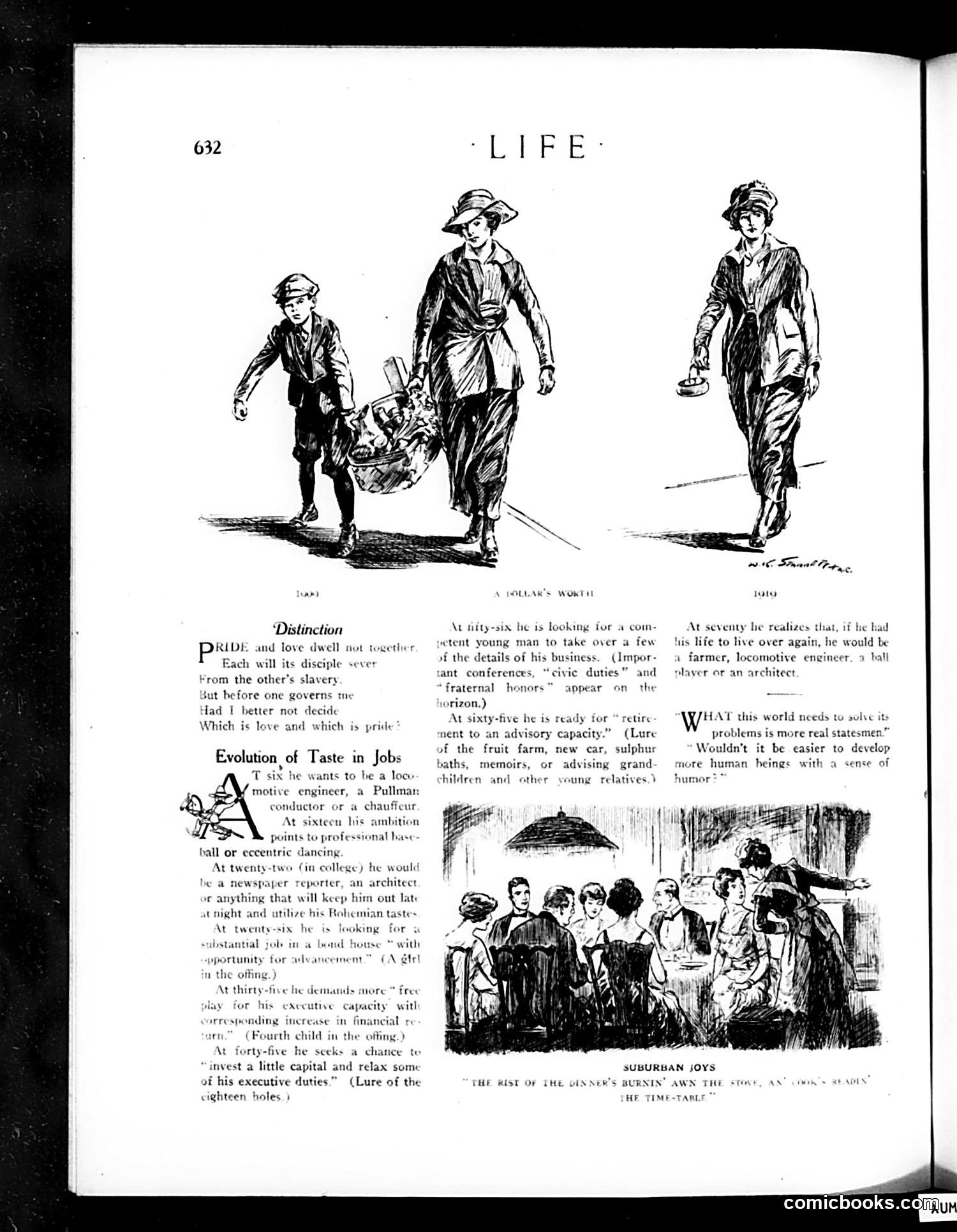
This page contains two satirical pieces about American social mobility and aspiration. **"Evolution of Taste in Jobs"** traces a man's career ambitions from age six (locomotive engineer) through seventy, showing how youthful Bohemian dreams gradually surrender to bourgeois domesticity. At each stage—marriage, children, mortgages, golf clubs—his aspirations diminish. The satire culminates in his deathbed realization that he should have pursued those original humble ambitions. The editorial note calls for "real statesmen" with "sense of humor," suggesting the piece mocks how ordinary men abandon authenticity for respectability. **"Distinction"** (upper left) juxtaposes three sketches of women with a philosophical quote distinguishing pride from love, likely commenting on female independence and social standing. **"Suburban Joys"** (bottom) depicts a gathering, its caption unclear but apparently satirizing middle-class domestic leisure. The overall message critiques conformist capitalism: men sacrifice genuine desires for financial security and social status, only to regret it when too late.
📄 Transcribed text from this page (OCR, searchable)
Machine-transcribed from the original scan — historical spelling and the odd misread are preserved.
‘Distinction RIDE and love dwell not together Each will its disciple from the other's slavery sever Sut hefore one governs te Had I better not decide Which is love and which is price Evolution of Taste in Jobs T six he wants to be a loc motive engineer, a Pullms conductor or a chauffeur At sixteen his ambition points to professional hase ball or eccentric dancing At twenty-two (in college) he woul: be a newspaper reporter, an architect oc anything that will keep him out late tnight and utilize his Bohemian taste- At twenty-six he is looking for « “with (A gtel substantial job in a bend house pportunity for advancement u the offing.) At thirty-five he demands more * free lay for his executive capacity with orresponding inerease in financial re inn.” (Fourth child in the offing.) At forty-five he seeks a chance te “invest a little capital and relax some of his executive duties.” (Lure of the cighteen holes.) tant conferences, \ POLLAR’S WORTH At fiity-six he is looking for a com- vetent young man to take over a few of the details of his business. (Impor- “civic duties” appear and “fraternal honors ™ on the vorizon.) At sixty-five he is ready for nent to an advisory capacity.” retire (Lure of the fruit farm, new car, sulphur advising grand relatives.) ths, memoirs, hildren other or and oung Wt Tana l op, ate At seventy he realizes that, if he had his life to live over again, he would be « farmer, locomotive engineer, a ball plaver or an architect HAT this world needs to sulve its problems is more real statesmen” Wouldn't it be easier to develop more human heings with a sense of SUBURBAN jOYS RIST OF THE UINNER’S BURNIN® HE HE AWN THE = 00H TEME-T comicbooks.com{r