
Life, 1919-10-09 · page 23 of 48
Life — October 9, 1919 — page 23: what you’re looking at
What you’re looking at
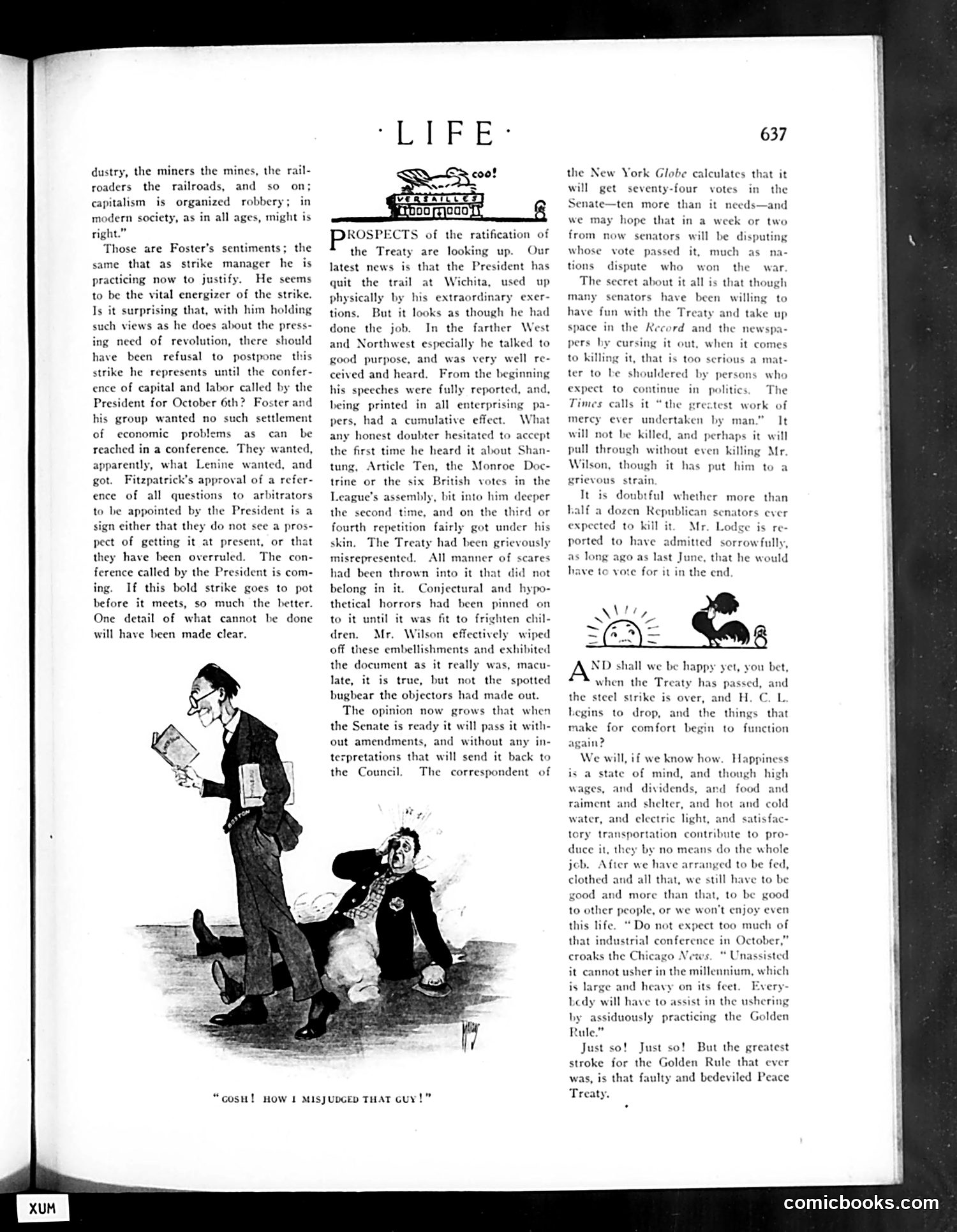
This 1919 *Life* magazine page satirizes two major political crises: the steel strike and the League of Nations treaty ratification. **The Cartoon:** Shows a well-dressed man (likely President Wilson or a politician) stepping over a disheveled figure labeled with strike imagery. The caption "Gosh! How I misjudged that guy!" suggests ironic commentary on strike leadership—likely targeting William Z. Foster, whose radical views about "organized robbery" are discussed in the text. The cartoon mocks the disconnect between strike leaders' revolutionary rhetoric and practical outcomes. **The Treaty Discussion:** Addresses Wilson's cross-country campaign promoting the League of Nations treaty. The text reports optimistically that the Senate will ratify it with ~74 votes (exceeding the 64 needed), despite Republican opposition. It notes even skeptical senators like Lodge will ultimately vote for it rather than risk being blamed for killing it. **The Satire's Point:** Criticizes both radical strikers as impractical ideologues and suggests politicians will ultimately abandon their public opposition to the treaty for political self-preservation.
📄 Transcribed text from this page (OCR, searchable)
Machine-transcribed from the original scan — historical spelling and the odd misread are preserved.
dustry, the miners the mines, the rail- roaders the railroads, on; capitalism is organized modern society, as in all ages, might is and so robbery; in right.” Those are Foster's sentiments; the me that as strike manager he is practicing now to justify. He seems to be the vital energizer of the strike. Is it surprising that, with him holding such views as he does about the press- ing need of revolution, there should have been refusal to postpone this strike he represents until the confer- ence of capital and labor called by the President for October 6th? Foster and his group wanted no such settlement of economic problems as can be reached in a conference. They wanted, apparently, what Lenine wanted, and got. Fitzpatrick’s approval of a refer- ence of all questions to arbitrators to be appointed by the President is a sign either that they do not see a pros- pect of getting it at present, or that they have been overruled. The con- ference called by the President is com- ing. If this bold strike goes to pot before it meets, so much the better. One detail of what cannot will have been made clear. be done ROSPECTS of the ratification of the Treaty are looking up. latest news is that the President has quit the trail at Wichita, physically by his extraordinary exer- But it looks as though he had done the job. In the farther West and Northwest especially he talked to good purpose, and was very well re- From the beginning Our used up tions. ceived and heard. his speeches were fully reported, and, being printed in all enterprising pa- pers, had a cumulative effect. What any honest doubter hesitated to accept the first time he heard it about Shan- tung, Article Ten, the Monroe Doc- trine or the six British votes in the League's assembly, bit into him deeper the second time, and on the third or fourth repetition fairly got under his skin. The Treaty had heen grievously misrepresented. had been thrown into it that did not belong in it. Conjectural and hypo- thetical horrors had been pinned on to it until it was fit to frighten chil- Mr. Wilson effectively wiped off these embellishments and exhibited the document as it really was, macu- late, it is true, but not the spotted bugbear the objectors had made out. The opinion now grows that whi the Senate is ready it will pass it with- out amendments, and without any in- terpretations that will send it back to the Council. The correspondent of All manner of scares dren, 637 the New York Globe calculates that it will get seventy-four votes in the Senate—ten more than it needs—and we may hope that in a week or tw from now senators will be disputing vote passed it, much as na- dispute whose tions who won the war. The secret about it all is that though many senators have been willing to have fun with the Treaty and take up space in the Record and the newspa- pers by cursing it out, when it comes to killing it, that is too serious a mat- ter to be shouldered by persons who expect to continue in Times calls it “ the politics, The work of mercy ever undertaken by man.” It will not be killed, and perhaps it will pull through without even killing Mr. Wilson, though it has put him to a grievous strain. It is doubtful whether more than Lalf a dozen Republican senators ever expected to kill it. Mr. Lodge is re- ported to have admitted sorrow fully, as long ago as last June, that he would have to vote for it in the end greatest 1 we be happy yet, you bet, when the Treaty has passed, and the steel strike is over, and H. C. L. hegins to drop, and the things that make for comfort begin to function again? We will, if we know how. Happiness is a state of mind, and though high food and raiment and shelter, and hot and cold wages, and dividends, and water, and electric light, and satisfac tory transportation contribute to pro- duce it, they by no means do the whole job. After we have arranged to be fed, clothed and all that, we still have to be good and more than that, to be good to other people, or we won't enjoy this life: that industrial conference croaks the Chi it cannot usher in the millennium, which. is large and heavy on its feet even “Do not expect too much of October,” ago ! s. “ Unassisted Every bedy will have to assist in the ushering by assiduously practicing the Golden Rule.” Just so! Just so! But the greatest stroke for the Golden Rule that ever was, is that faulty and bedeviled Peace “cosu! HOW 1 MisJUDGED THAT Guy!” comicbooks.com