
A complete issue · 42 pages · 1919
Life — June 19, 1919
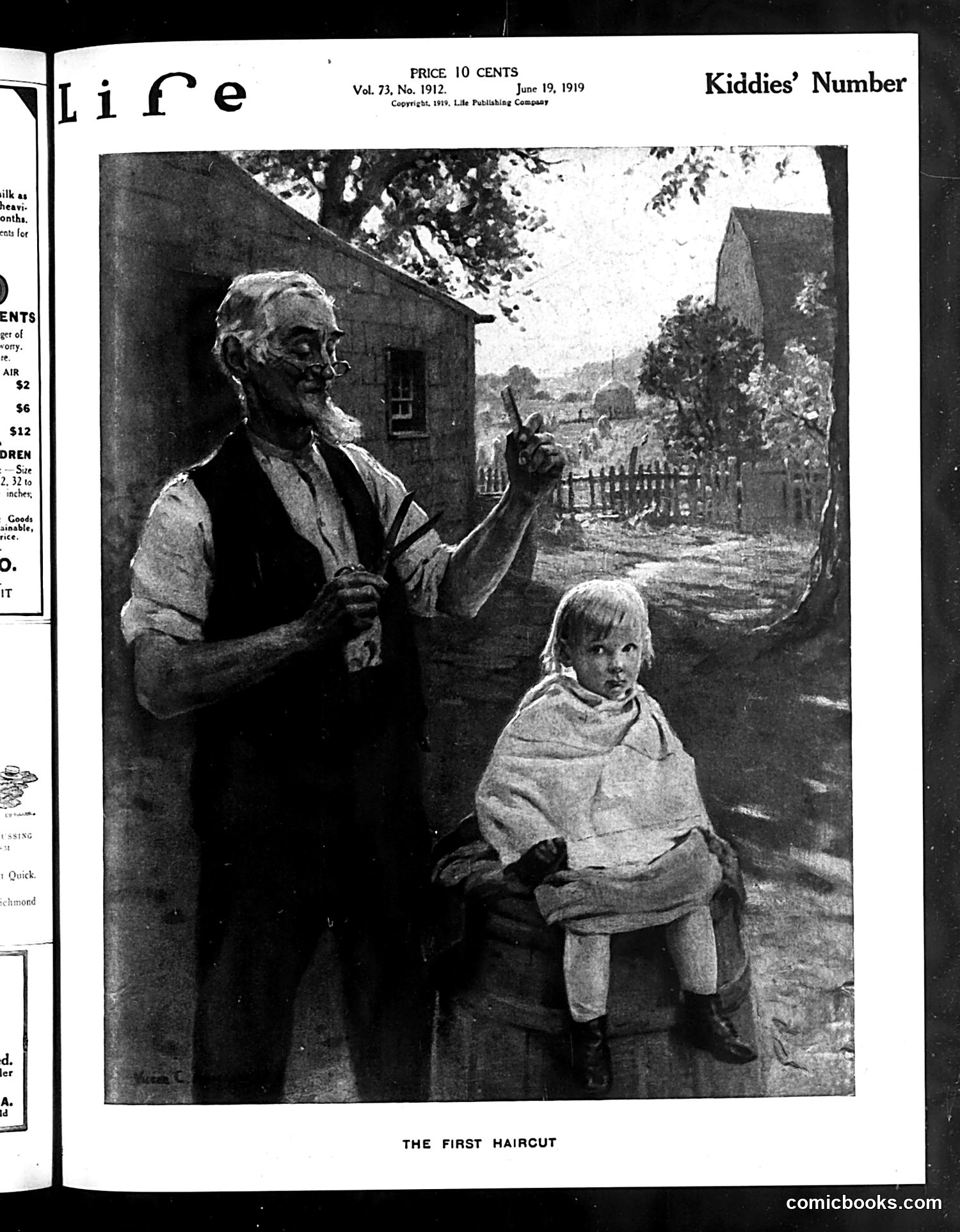
This illustration depicts a child receiving their first haircut from an elderly barber in a rural setting. The image is sentimental rather than satirical—it captures a nostalgic Americana scene of childhood milestones and small-town life. The "Kiddies' Number" designation indicates this was a special issue of Life magazine focused on children's content. The scene romanticizes the traditional rite of passage of a child's first barber visit, emphasizing wholesome Americana values popular in 1919—a period of post-World War I nostalgia for simpler, rural American life. There is no apparent political satire here; rather, it's genre illustration celebrating childhood innocence and traditional rural American customs.
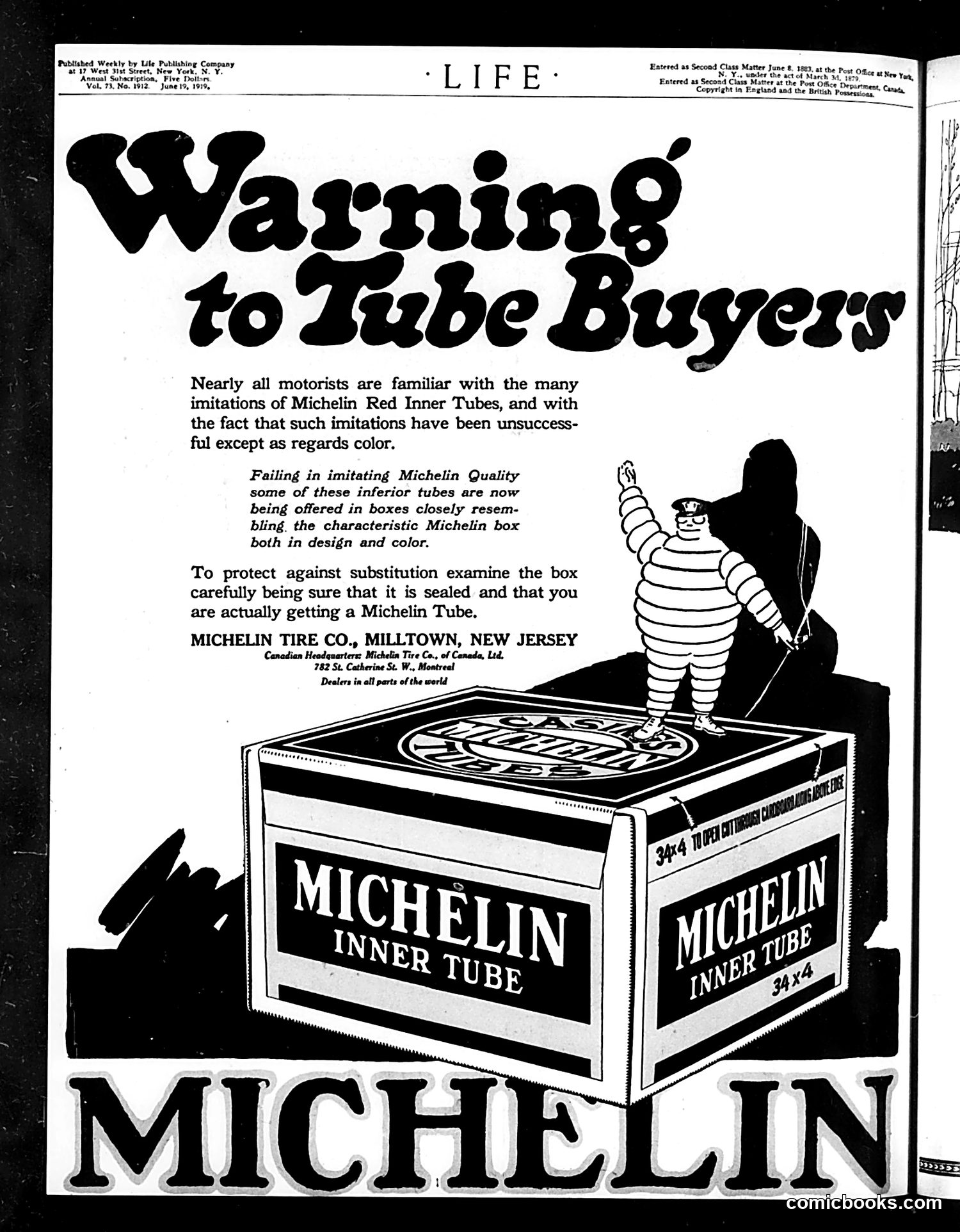
This is primarily a **Michelin tire advertisement**, not editorial content. It warns motorists against counterfeit inner tubes flooding the market. The ad features Bibendum, Michelin's famous mascot (the round, puffy character made of tire rings), standing atop a Michelin inner tube box. **The pitch**: Unscrupulous competitors were selling fake tubes in boxes designed to mimic authentic Michelin packaging—fooling buyers through appearance alone. The warning advises consumers to carefully inspect boxes for proper sealing and verify they're purchasing genuine Michelin products. The address given is Michelin Tire Co. in Milltown, New Jersey. This reflects early 20th-century concerns about product counterfeiting and consumer protection during an era before modern packaging regulations and authentication methods existed.
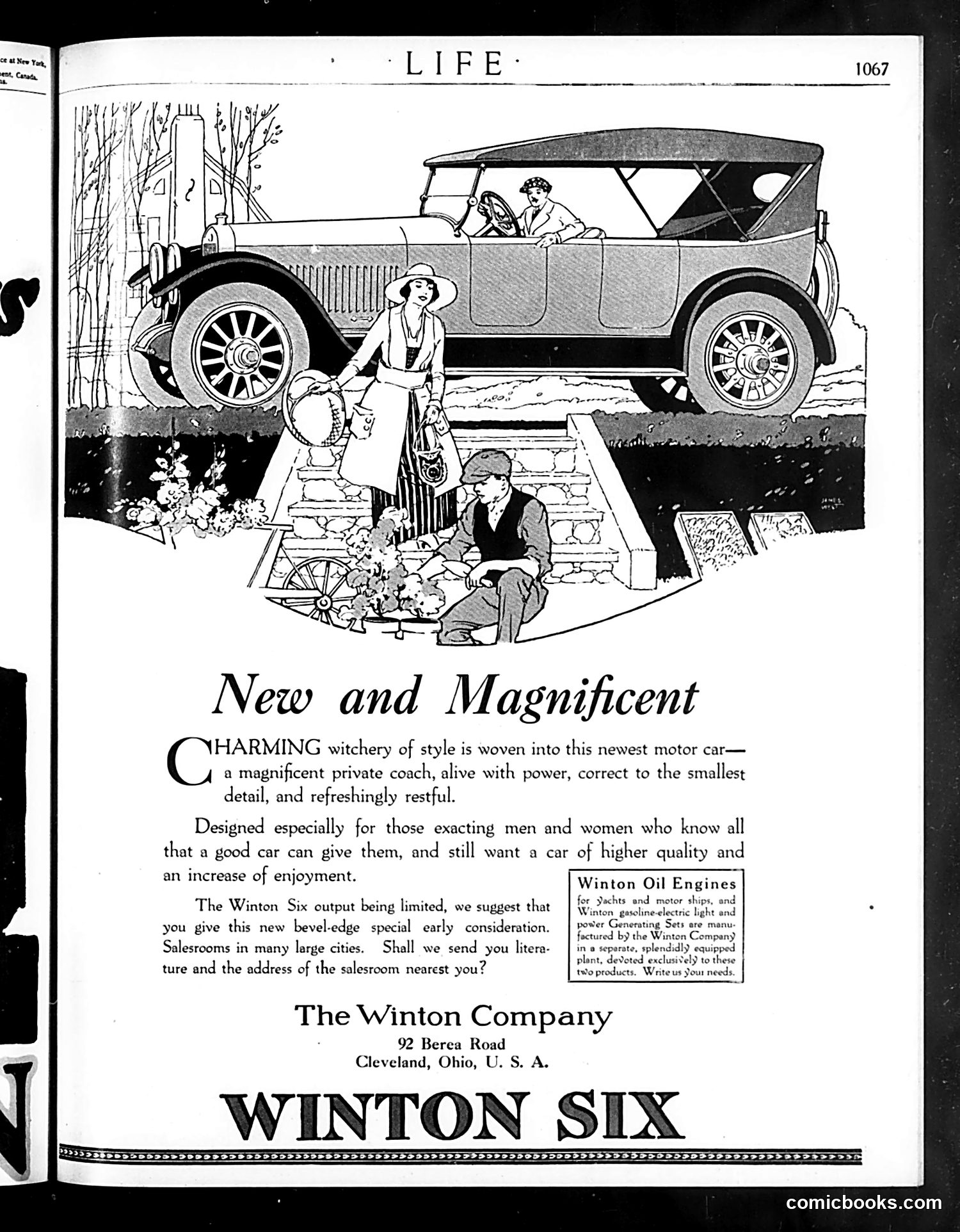
This page is primarily **advertising, not satire or political commentary**. It's a full-page advertisement for the Winton Six automobile, published in Life magazine (page 1067). The illustration shows a wealthy family with their new motor car—a common advertising trope of the era. The scene depicts leisurely leisure-class activities: well-dressed people, a manicured home setting, and a stylish open-air vehicle. The copy promises "charming witchery of style" and targets "exacting men and women who know all that a good car can give them." The Winton Company of Cleveland, Ohio manufactured automobiles. This represents early 20th-century automotive marketing, emphasizing luxury, quality, and aspirational lifestyle rather than technical specifications. It's purely commercial, not satirical content.
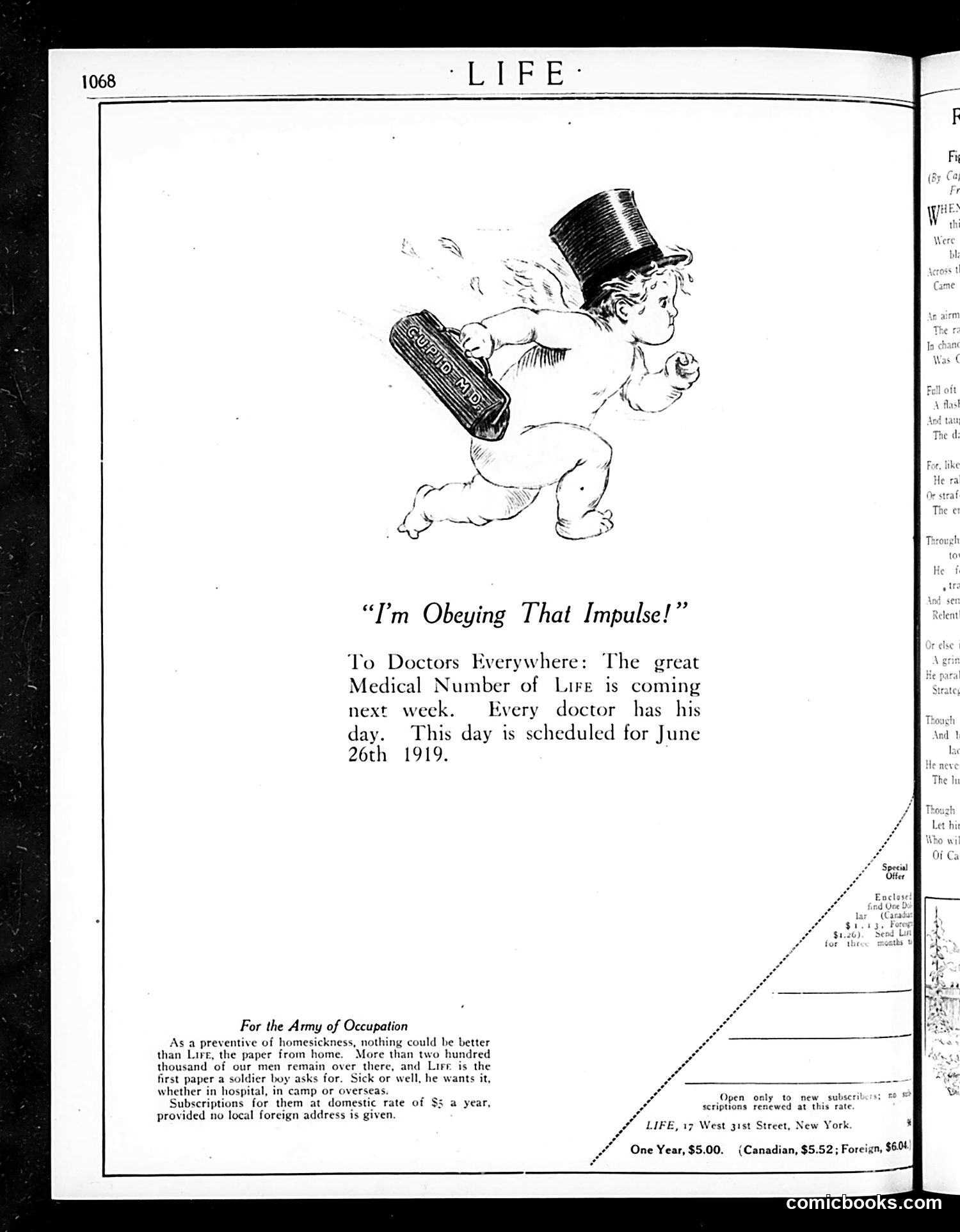
This page is primarily **advertising for Life magazine itself**, disguised as editorial content. The cherubic figure wearing a top hat depicts Cupid or a cherub character, labeled "I'm Obeying That Impulse!" The advertisement announces Life's "great Medical Number" scheduled for June 26th, 1919, directed at doctors. Below, a secondary advertisement promotes Life subscriptions to soldiers, framing the magazine as homesickness prevention for troops stationed overseas during the post-WWI occupation period. The page lacks traditional political satire. Instead, it uses whimsical illustration and patriotic appeals to drive subscriptions among both medical professionals and military personnel during the immediate post-war era.
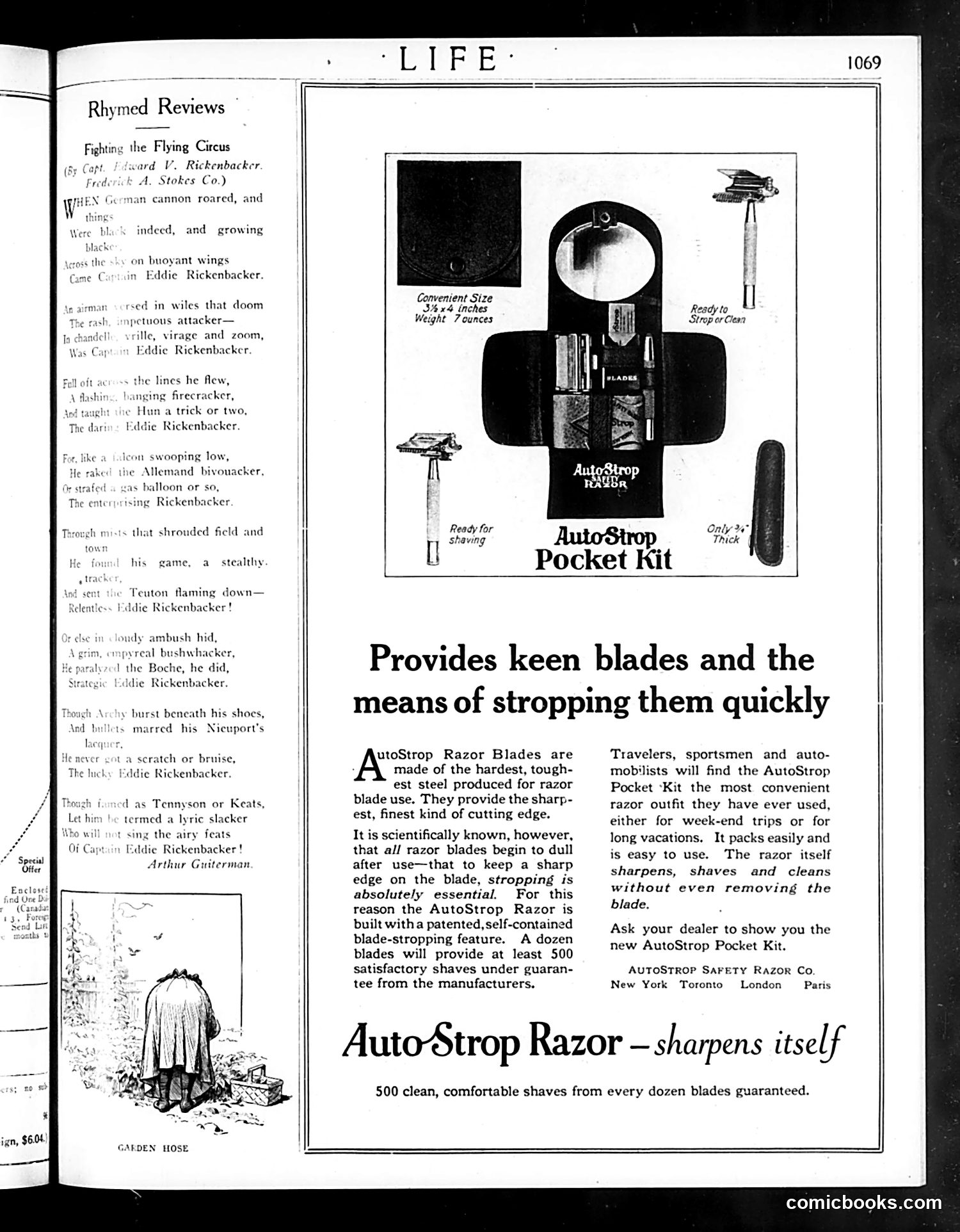
This page contains two distinct elements: **Left side:** A rhymed review poem titled "Fighting the Flying Circus" by Capt. Edward V. Rickenbacker (Frederick A. Stokes Co.). The poem celebrates Eddie Rickenbacker, America's top WWI fighter pilot, using dramatic rhyming couplets about aerial combat. References to "German," "Treuton flaming," and combat tactics indicate it's commemorating his wartime heroics. The adjacent illustration shows a figure crouching, possibly depicting a combat scene. **Right side:** A full-page advertisement for the AutoStrop Pocket Kit razor—a self-stropping razor blade system. The ad emphasizes convenience for travelers and sportsmen, guaranteeing 500 shaves per dozen blades. The juxtaposition appears accidental—the poem honoring a war hero shares space with a consumer product advertisement, typical of Life magazine's mixed editorial and advertising content format.
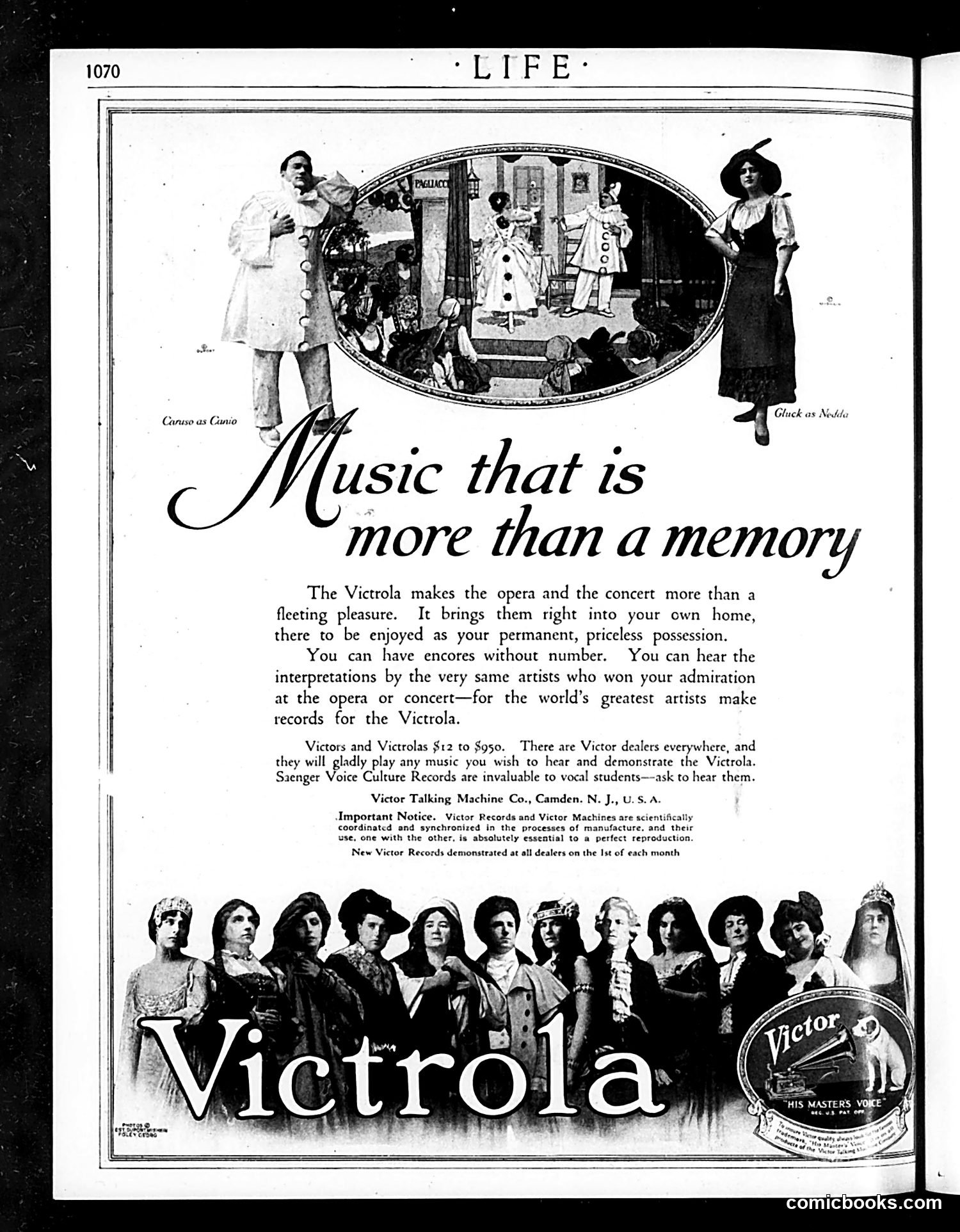
This page is **primarily an advertisement**, not satire or political commentary. It promotes the Victrola, a phonograph manufactured by Victor Talking Machine Co. in Camden, New Jersey. The ad's headline—"Music that is more than a memory"—emphasizes the novelty of recorded music as a permanent home possession. The central oval illustration shows an opera/concert scene, flanked by figures labeled "Caruso as Canio" (left) and "Gluck as Noldi" (right), referencing famous opera singers whose recordings were available. The bottom section displays numerous female performers, likely opera singers whose voices could be purchased on Victor records. The "His Master's Voice" logo appears in the corner. The ad promises customers access to world-class performances without attending live events—a significant technological innovation for the era.
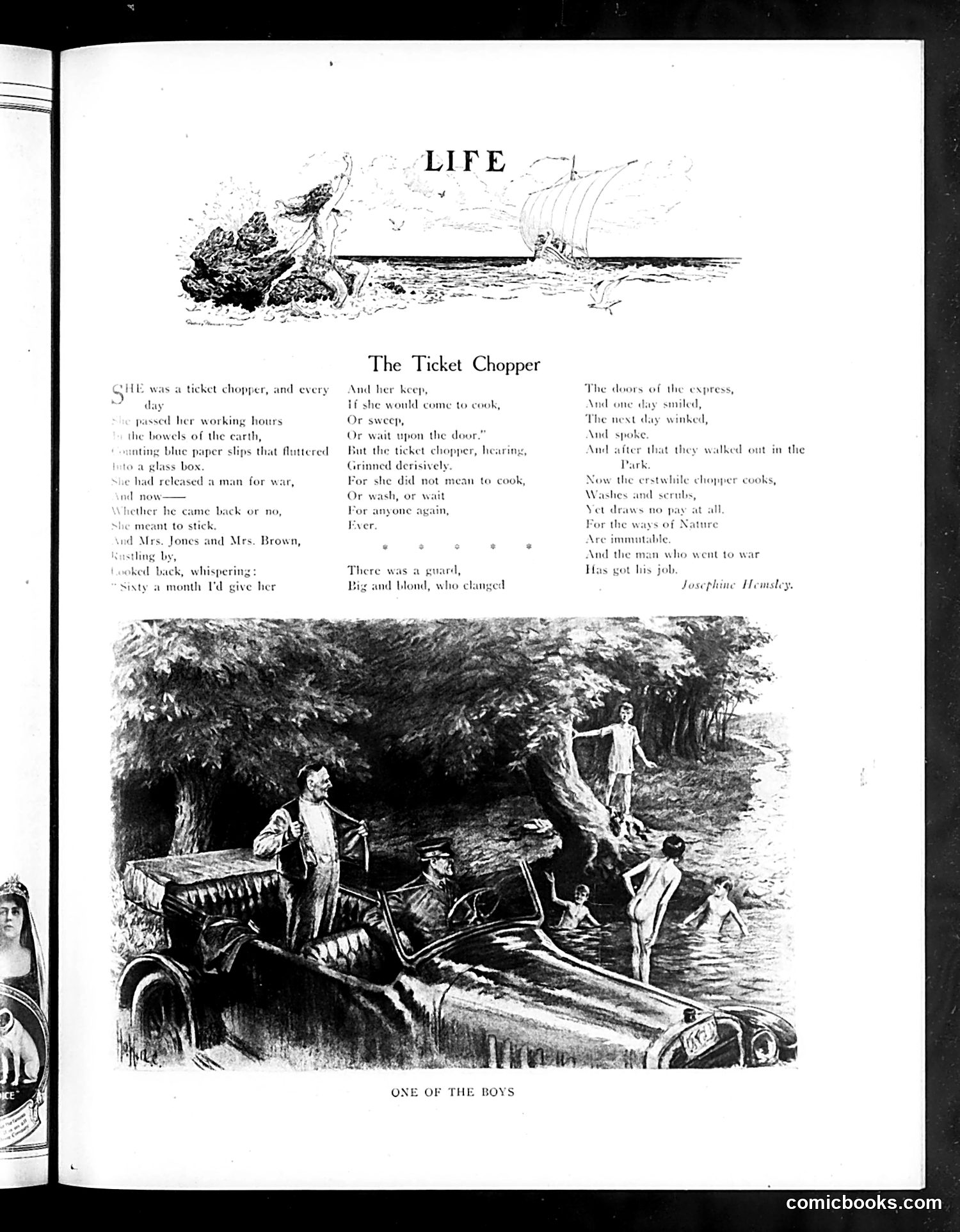
This page contains a poem by Josephine Hemsley about a female ticket-chopper during wartime. The poem describes a woman working at a transit station who processes tickets while the men go to war. Despite her steady, unglamorous labor—cooking, sweeping, waiting—she maintains her post. The satire appears to celebrate this working-class woman's constancy: while soldiers come and go, she remains, her contributions rendered invisible by the "ways of Nature." The illustration shows a leisure scene with children and adults by water, contrasting sharply with the text's acknowledgment of wartime separation and women's essential but unrecognized domestic and service work. The piece reflects WWI-era attitudes toward female labor during male conscription.
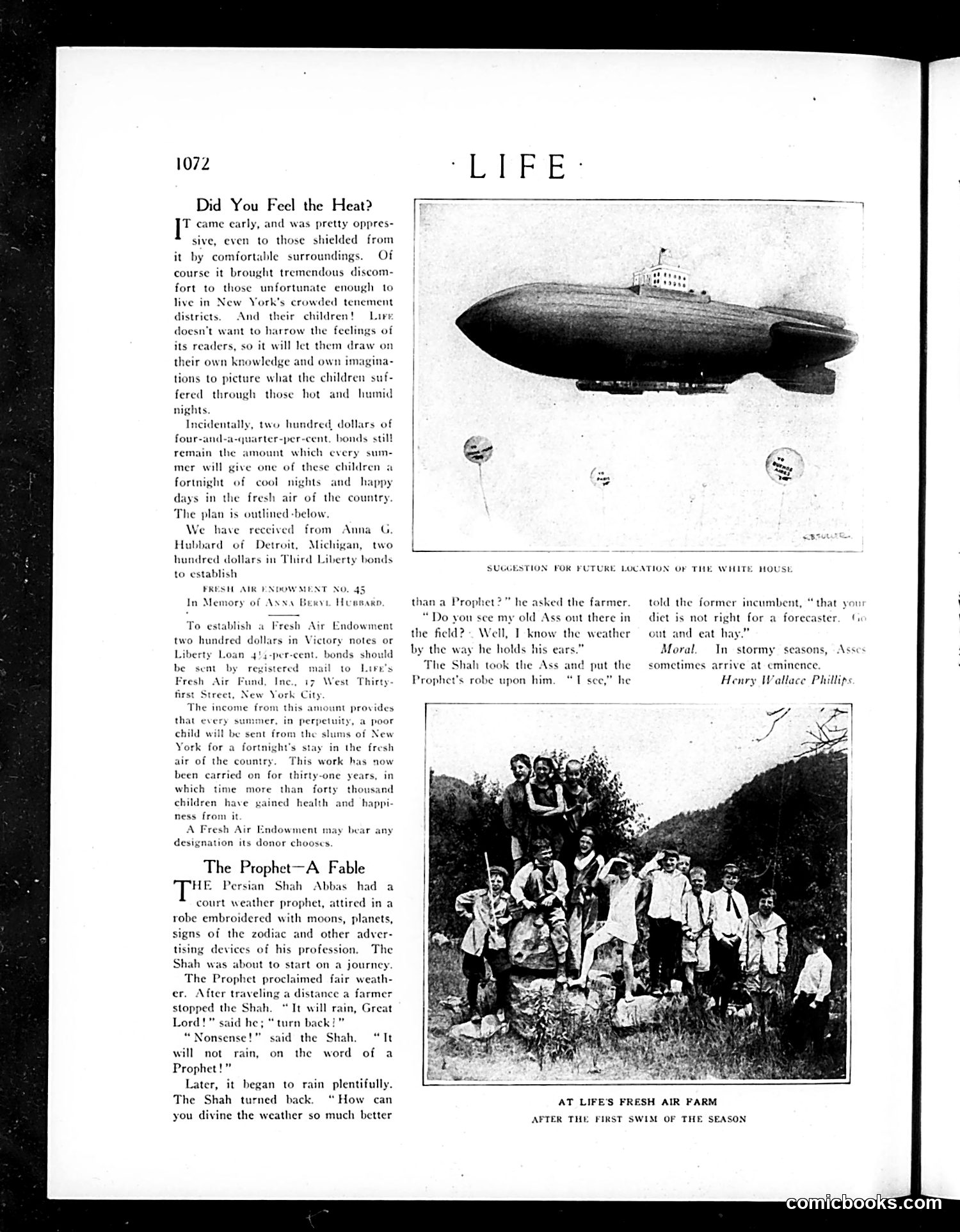
This page contains two distinct pieces: **"Did You Feel the Heat?"** discusses a charitable Fresh Air Fund providing poor New York City children summer relief in the countryside—a real early 20th-century philanthropy effort. **"The Prophet—A Fable"** is a satirical story mocking a charlatan "weather prophet" who wears astrological robes and claims to predict rain. When challenged by a farmer ("Can you divine weather better than a Prophet?"), the Shah confidently declares rain won't come, only to be immediately proven wrong by heavy rainfall. The satire ridicules false expertise and fraudulent fortune-tellers who dressed in mystical garb to con the credulous. The photographs show Life's Fresh Air Farm initiative and children enjoying outdoor swimming. The satirical fable critiques superstition-based authority figures.
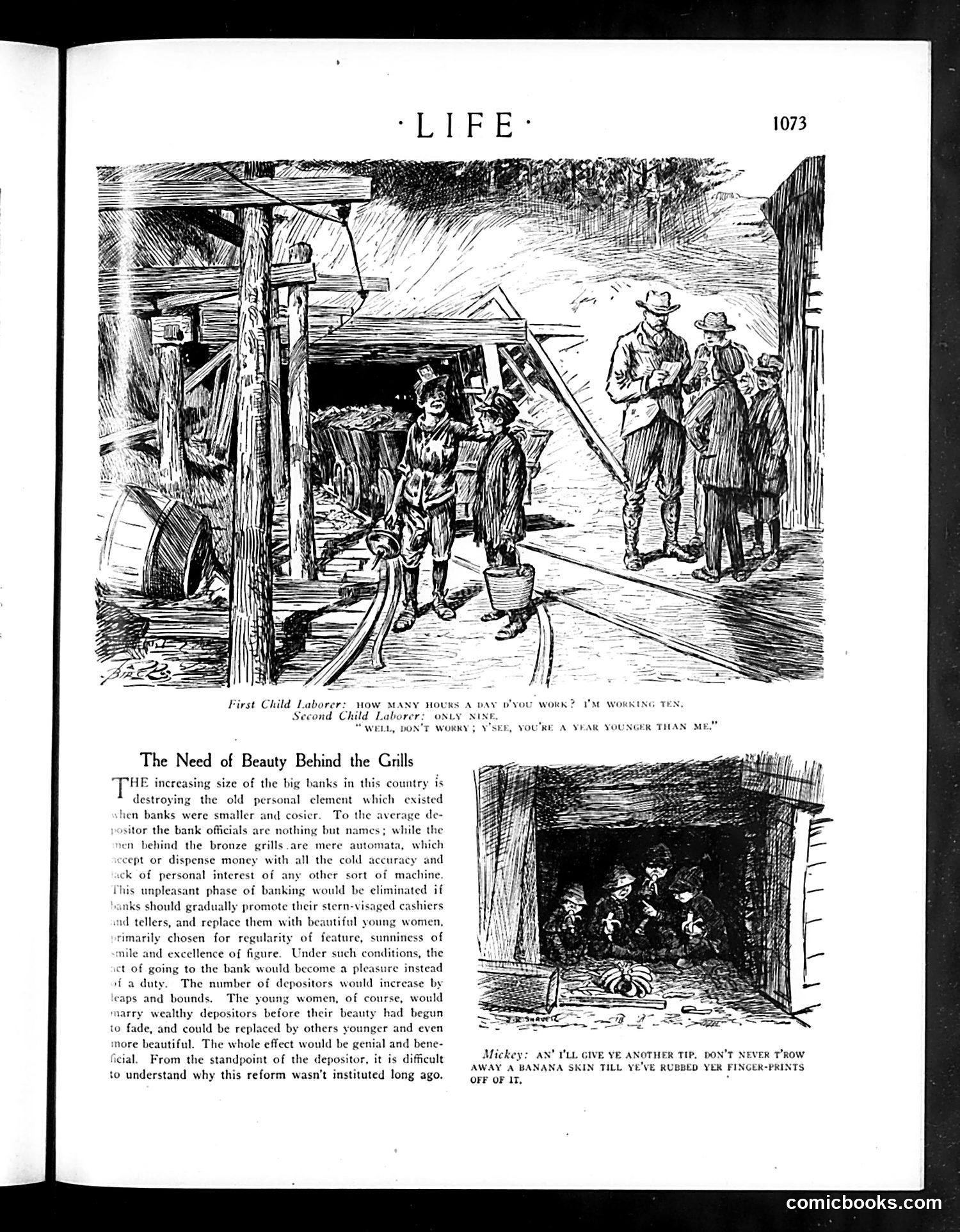
**Top Cartoon:** Two child laborers at what appears to be a mining or industrial operation discuss their work hours. One works ten hours daily; the other only nine but reassures the first not to worry, being a year younger. This satirizes the harsh reality of child labor in early 20th-century America, where children worked grueling hours in dangerous conditions. **Article & Bottom Cartoon:** "The Need of Beauty Behind the Grills" advocates replacing stern male bank tellers with attractive young women to improve customer experience and bank aesthetics. The accompanying cartoon shows "Mickey" receiving a tip about banana skins. This reflects period attitudes about women's roles and appearance in the workplace.
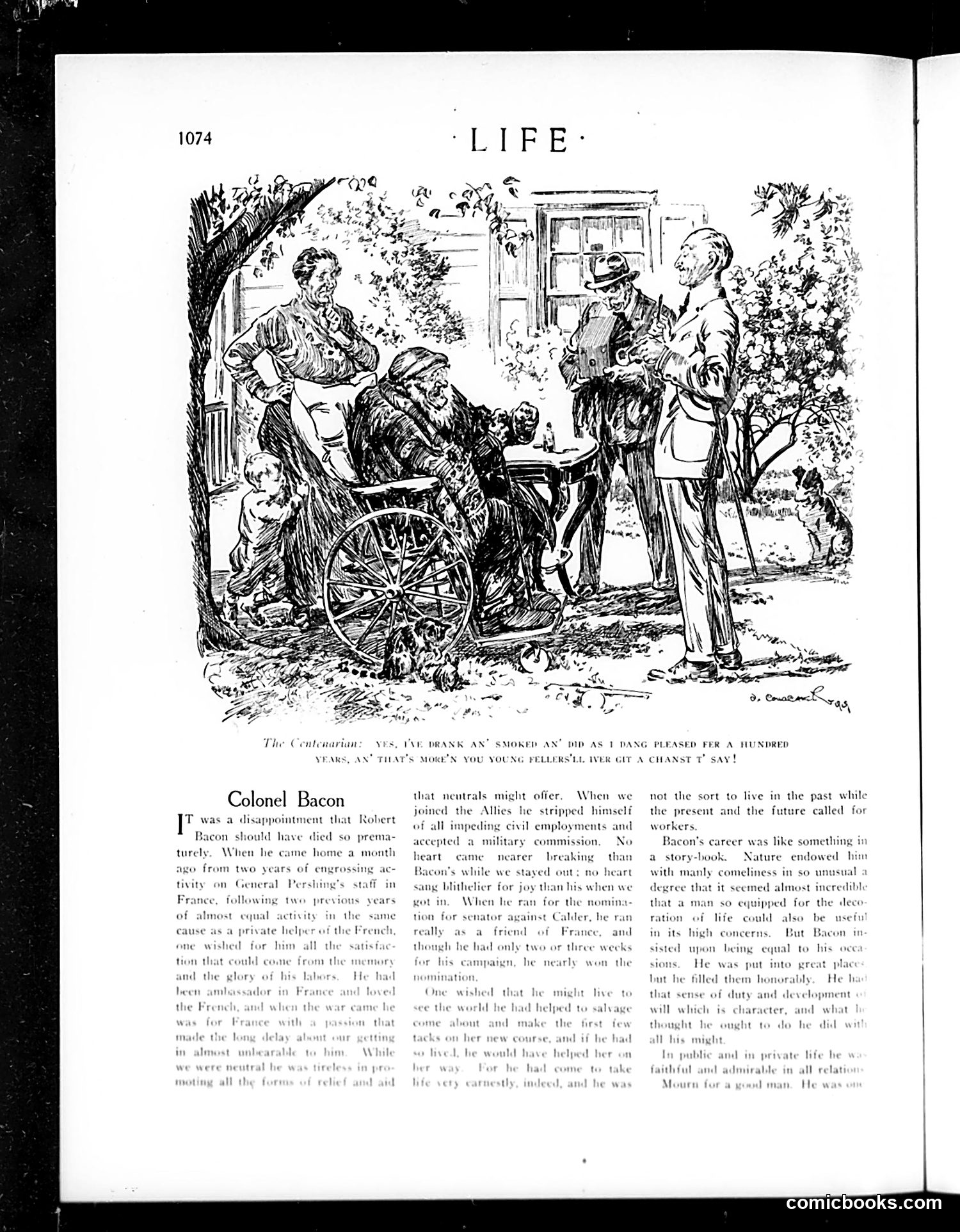
This page contains a biographical sketch titled "Colonel Bacon" alongside a cartoon. The illustration shows an elderly man in a wheelchair speaking with three well-dressed gentlemen outside a house, while a young child stands nearby. The caption quotes the centennarian: "Yes, I've drank an' smoked an' did as I dang pleased for a hundred years, an' that's more'n you young fellers'll ever git a chanst t' say!" The satire mocks turn-of-the-century health concerns and moral anxieties. The cartoon presents a long-lived man who openly defied contemporary rules about temperance and virtue, suggesting these restrictions may be unnecessary—or at least that living a "sinful" life doesn't guarantee early death. This challenges the era's moralizing about proper behavior and longevity.
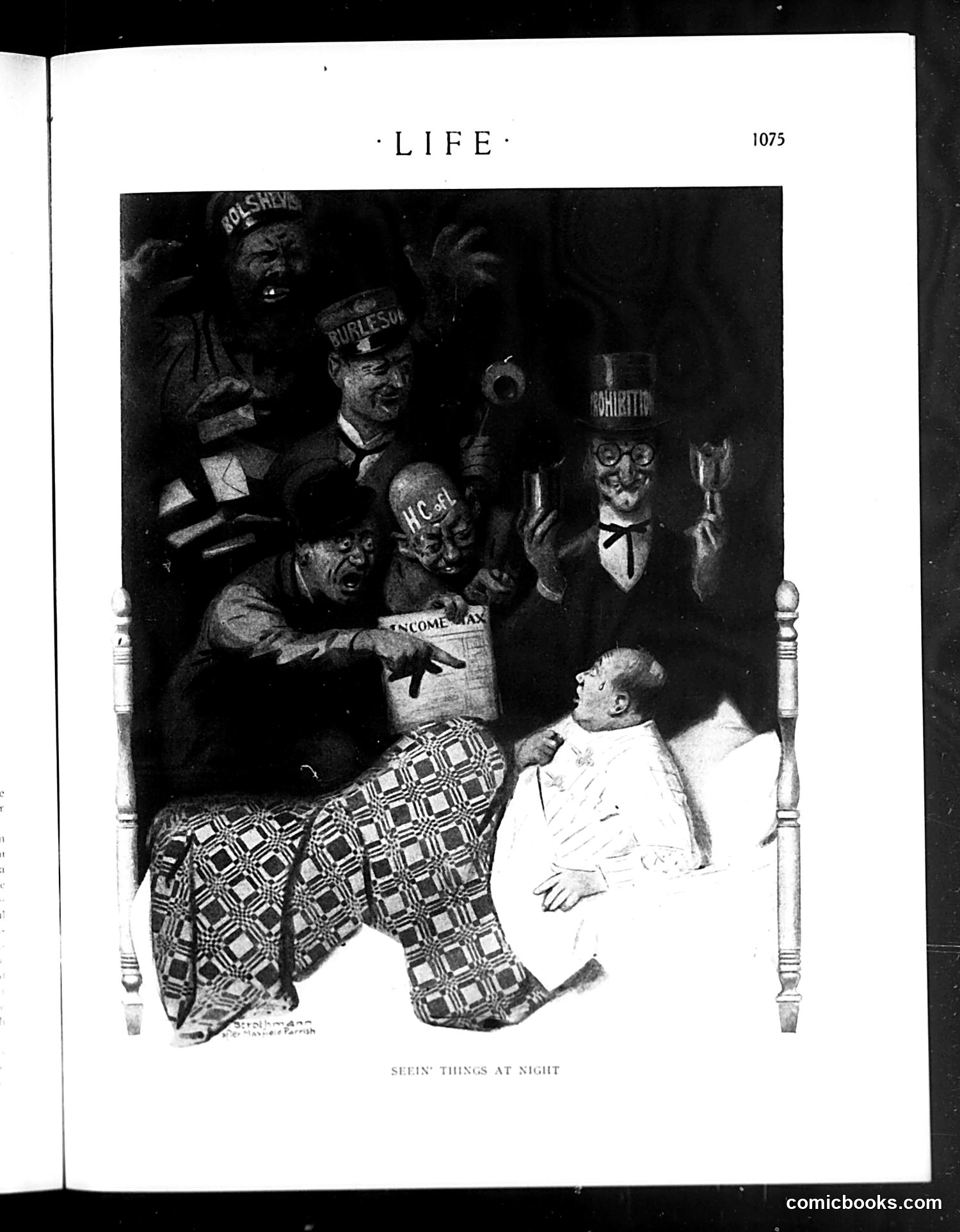
This satirical illustration depicts what appears to be a bed scene where a man lying down is surrounded by grotesque, menacing figures wearing various labeled hats or headgear (visible text includes "INCOME TAX" and other partially legible labels). The figures seem to represent personified fears or anxieties—likely taxes, debts, or financial worries that plague people at night. The cartoon uses the common satirical device of visualizing abstract anxieties as nightmarish creatures. The man's expression suggests distress, while the surrounding figures loom ominously. This reflects early 20th-century anxieties about taxation, financial burdens, or regulatory concerns. The title's wordplay suggests these are psychological "visions" rather than literal threats—commentary on how financial worries haunt people's sleep and peace of mind.
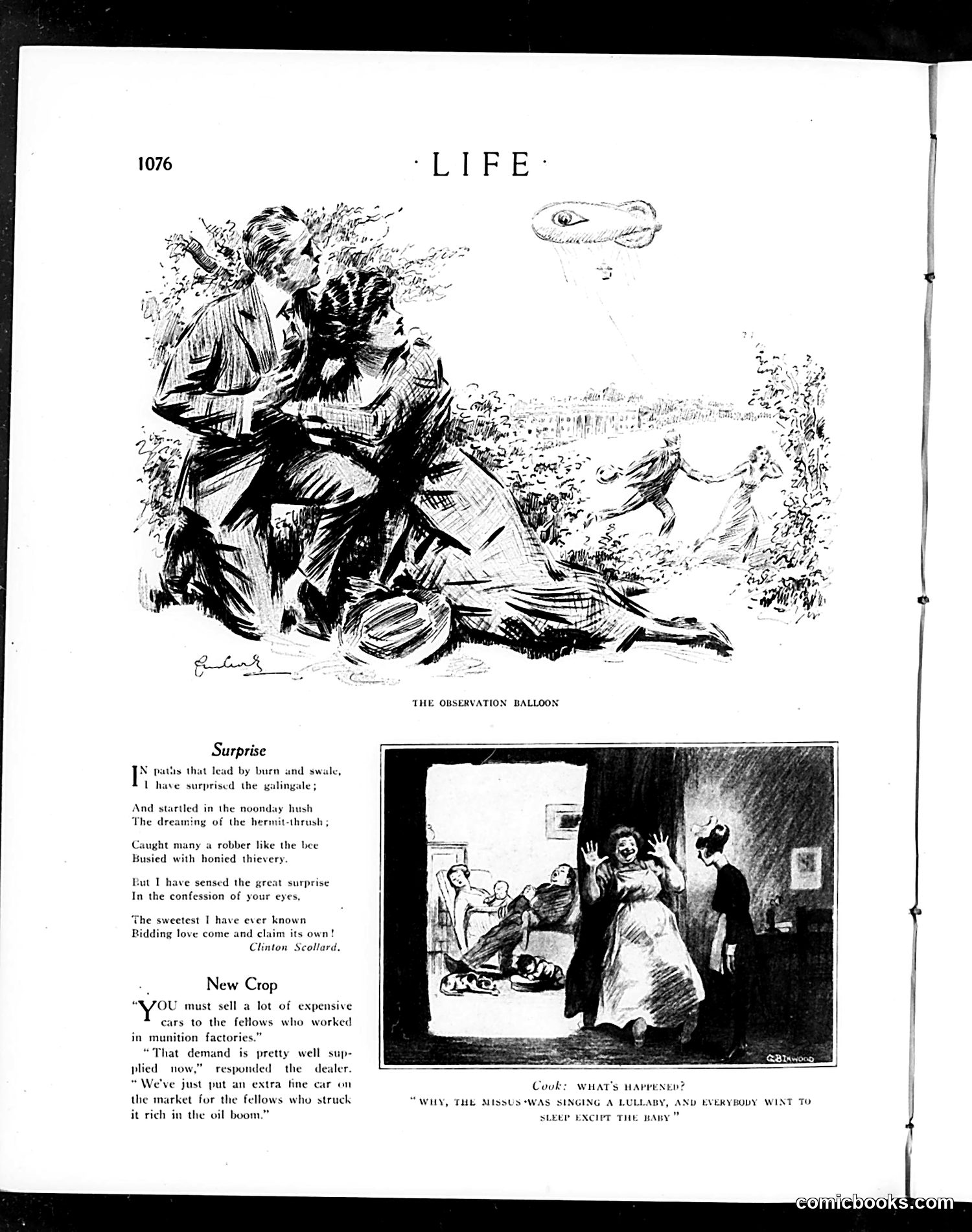
**Top Illustration: "The Observation Balloon"** A sketch showing two figures in a hot air balloon observing a landscape. The romantic/sentimental imagery appears to contrast with satirical verse below titled "Surprise," which mocks the clichés of love and courtship ("The sweetest love I have ever known / Bidding-love come and claim its own!"). **Middle Section: "New Crop"** A brief comedic dialogue between a car dealer and customer about selling expensive cars to oil-boom workers. The joke satirizes post-boom consumerism—workers suddenly wealthy from oil strikes are being sold luxury vehicles at inflated prices. **Bottom Cartoon: "Cook: What's Happened?"** Shows domestic chaos: a woman (the cook) discovers the household singing lullabies instead of sleeping. The caption's humor lies in the absurd reversal of normal household order.
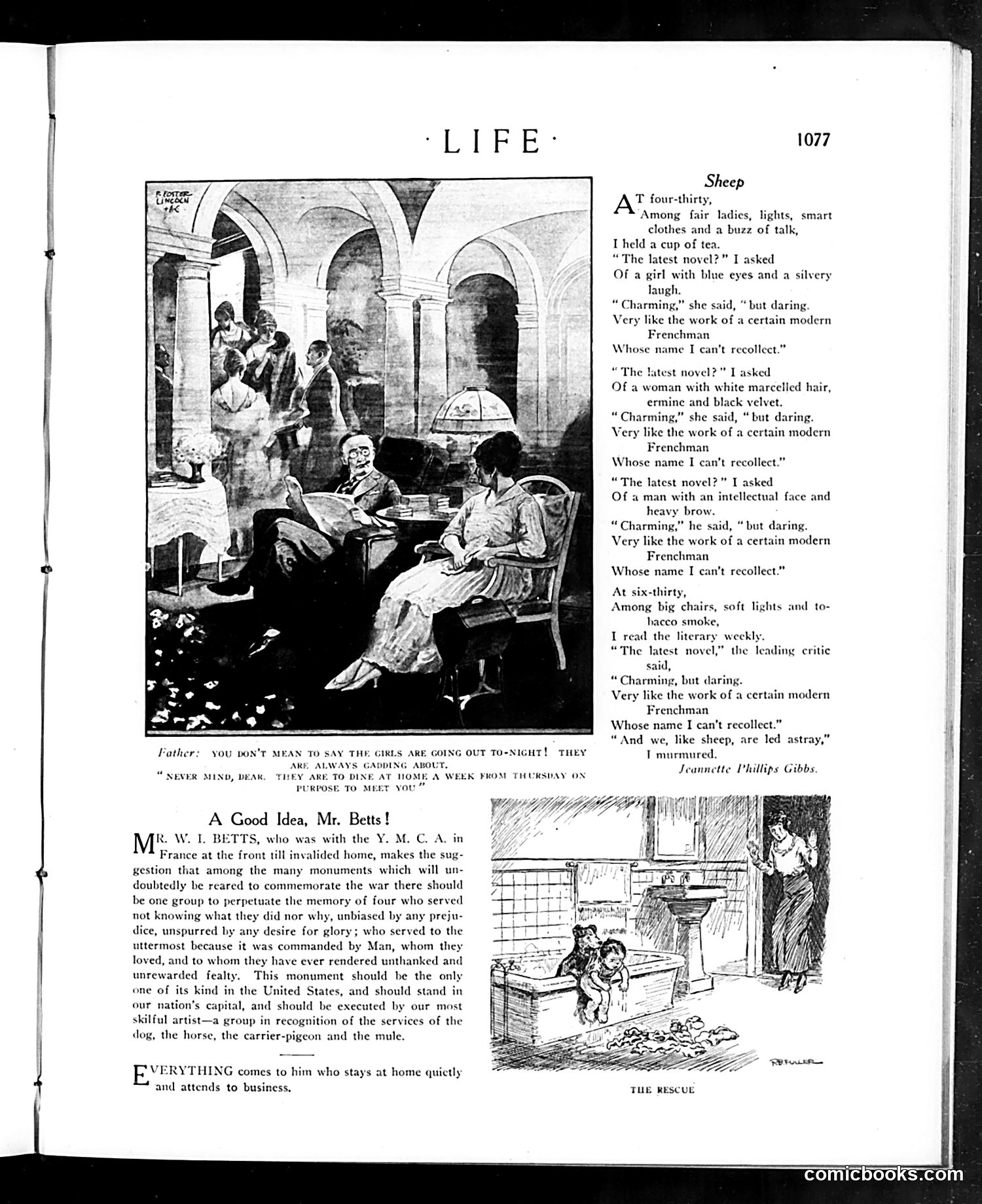
This page contains two distinct pieces: **"Sheep" (poem by Jeannette Phillips Gibbs):** A satirical poem mocking literary pretension. At fashionable social gatherings, the speaker encounters people praising the "latest novel" by unnamed "modern Frenchmen." The repetition of this phrase—with characters of different backgrounds all offering identical praise—satirizes mindless conformity and status-seeking. People uncritically adopt fashionable opinions to appear cultured, following the crowd "like sheep." **"A Good Idea, Mr. Betts!":** A proposal by W.I. Betts (Y.M.C.A. worker) advocating a WWI memorial featuring dog, horse, carrier-pigeon, and mule—animals that served soldiers. The accompanying sketch titled "The Rescue" depicts a rescue dog. This serious piece honors animal service during war, contrasting sharply with the satirical poem above.
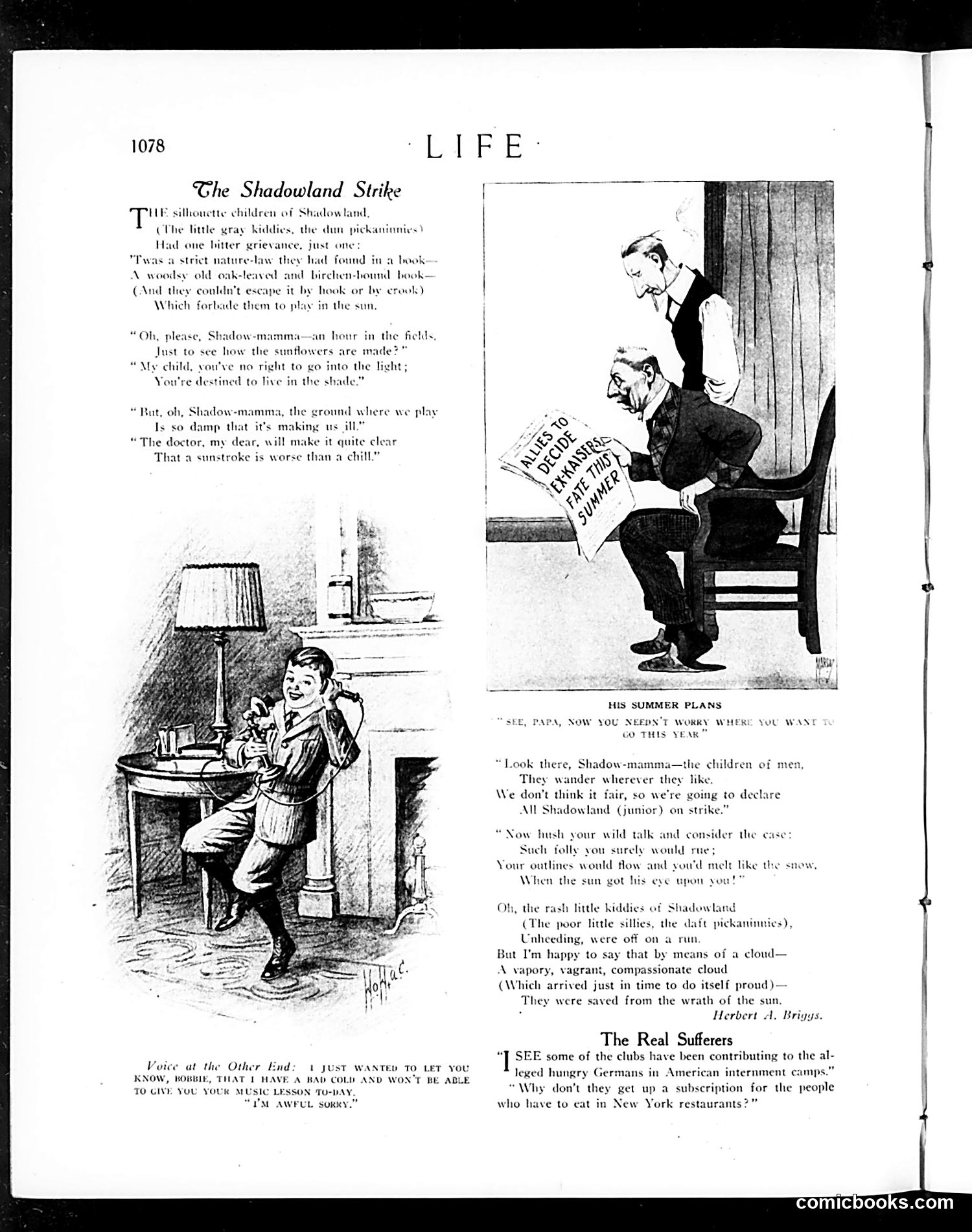
This page contains two satirical cartoons commenting on early 20th-century social issues. **"The Shadowland Strike"** (left): A poem-and-illustration piece about impoverished children in "Shadowland" (likely a slum district) threatening to strike because playing grounds are damp and unhealthy. The satire criticizes indifferent adults dismissing children's legitimate health concerns. **"His Summer Plans"** (right): Shows two men examining what appears to be a newspaper or document about "all is forgiven" and "come home this summer." The caption suggests one is reluctant about summer plans. This likely satirizes domestic disputes or reconciliations, though specific context is unclear. **"The Real Sufferers"** (bottom): Brief text critiquing how clubs contribute to hungry German internment camps in America while New York restaurant patrons dine comfortably—commentary on wartime hypocrisy and inequality.
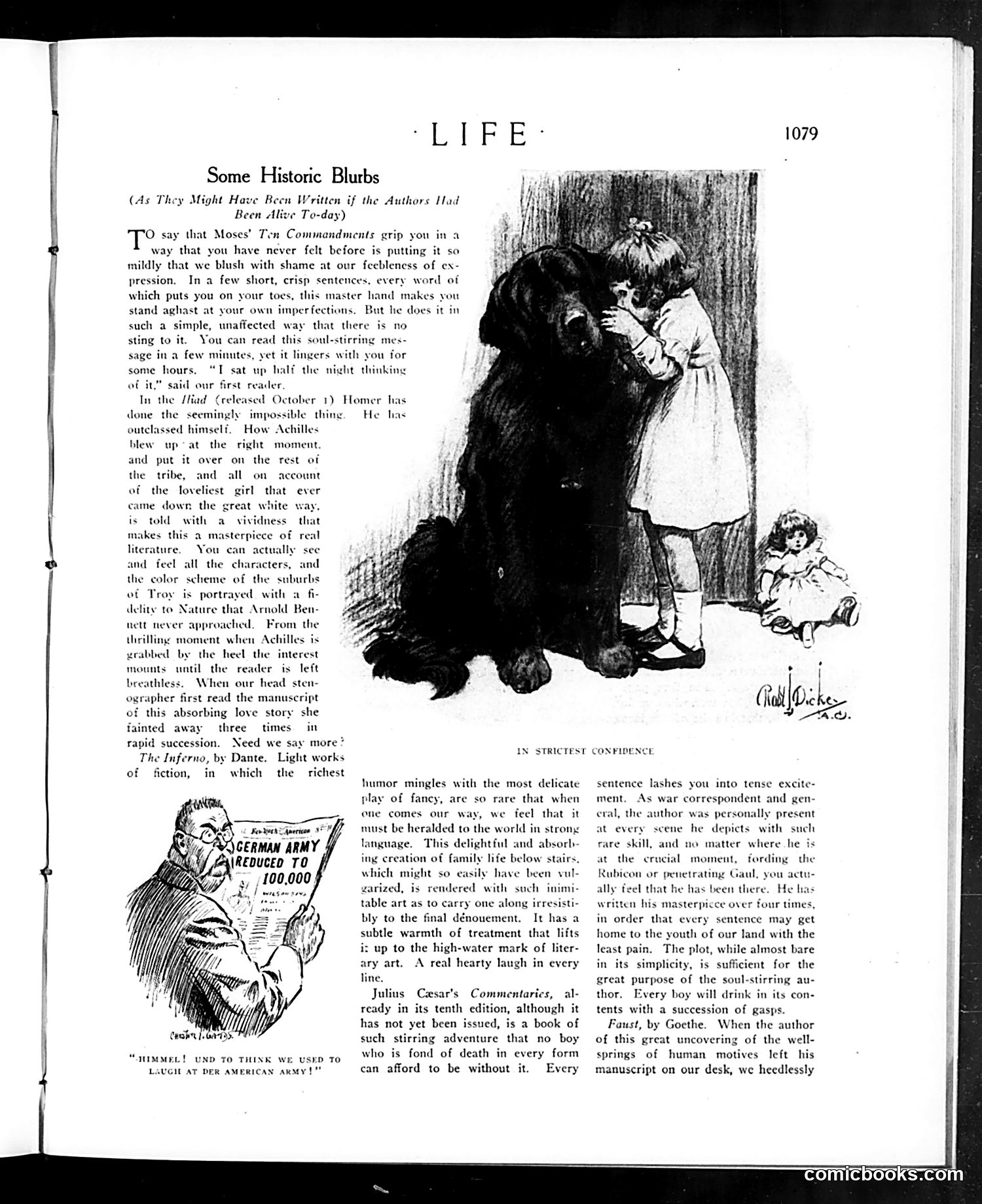
This page contains book reviews rather than political cartoons. The main illustration shows a woman with a dog and child, accompanying a review of Homer's *Iliad*. The lower left contains a small cartoon labeled "HIMMEL! UND SO THINK WE USED TO LAUGH AT DER AMERICAN ARMY!" It depicts a German soldier holding a document reading "GERMAN ARMY REDUCED TO 100,000." This satirizes German military reduction—likely referencing post-WWI treaty limitations (the Treaty of Versailles, 1919, restricted Germany's army to 100,000 men). The joke mocks Germany's previous confidence in its military might, now drastically diminished. The German-dialect caption emphasizes the ironic humiliation of this dramatic decline from imperial pretensions.
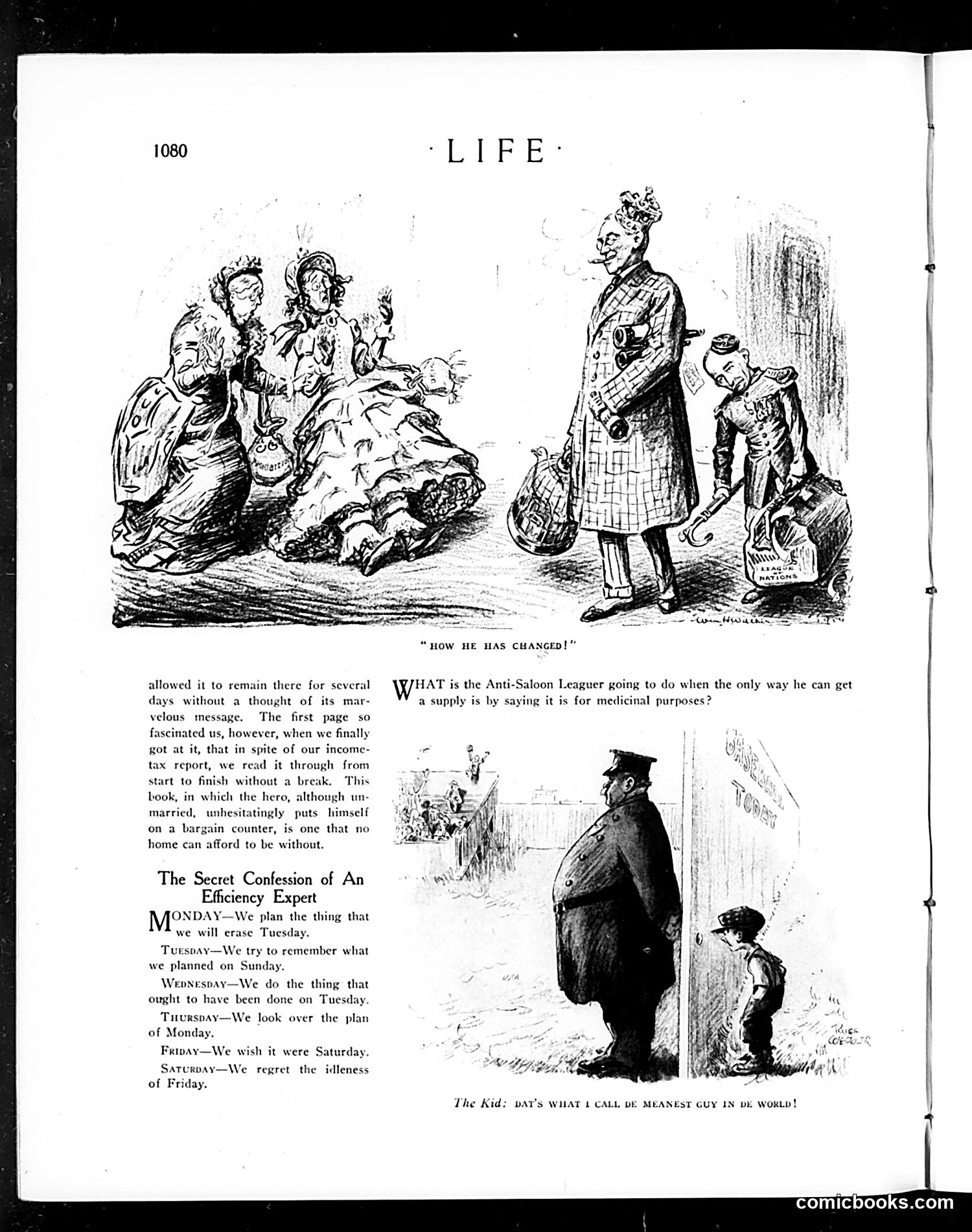
**Top cartoon ("How He Has Changed!"):** Depicts a well-dressed woman with children confronting a disheveled man, suggesting moral reformation or changed circumstances—likely satirizing Prohibition's social impacts on families. **Middle section:** "The Secret Confession of an Efficiency Expert" mocks workplace productivity culture through ironic daily contradictions—planning tasks that get postponed, doing yesterday's work today, and the perpetual wish for weekend. It satirizes the inefficiency of so-called "efficiency" systems. **Bottom cartoon ("The Kid"):** A small boy calls a tall policeman or authority figure "the meanest guy in the world," likely commenting on Prohibition enforcement. The caption suggests the child resents the cop for preventing access to alcohol, satirizing how Prohibition affected ordinary citizens and created resentment toward enforcement officials.
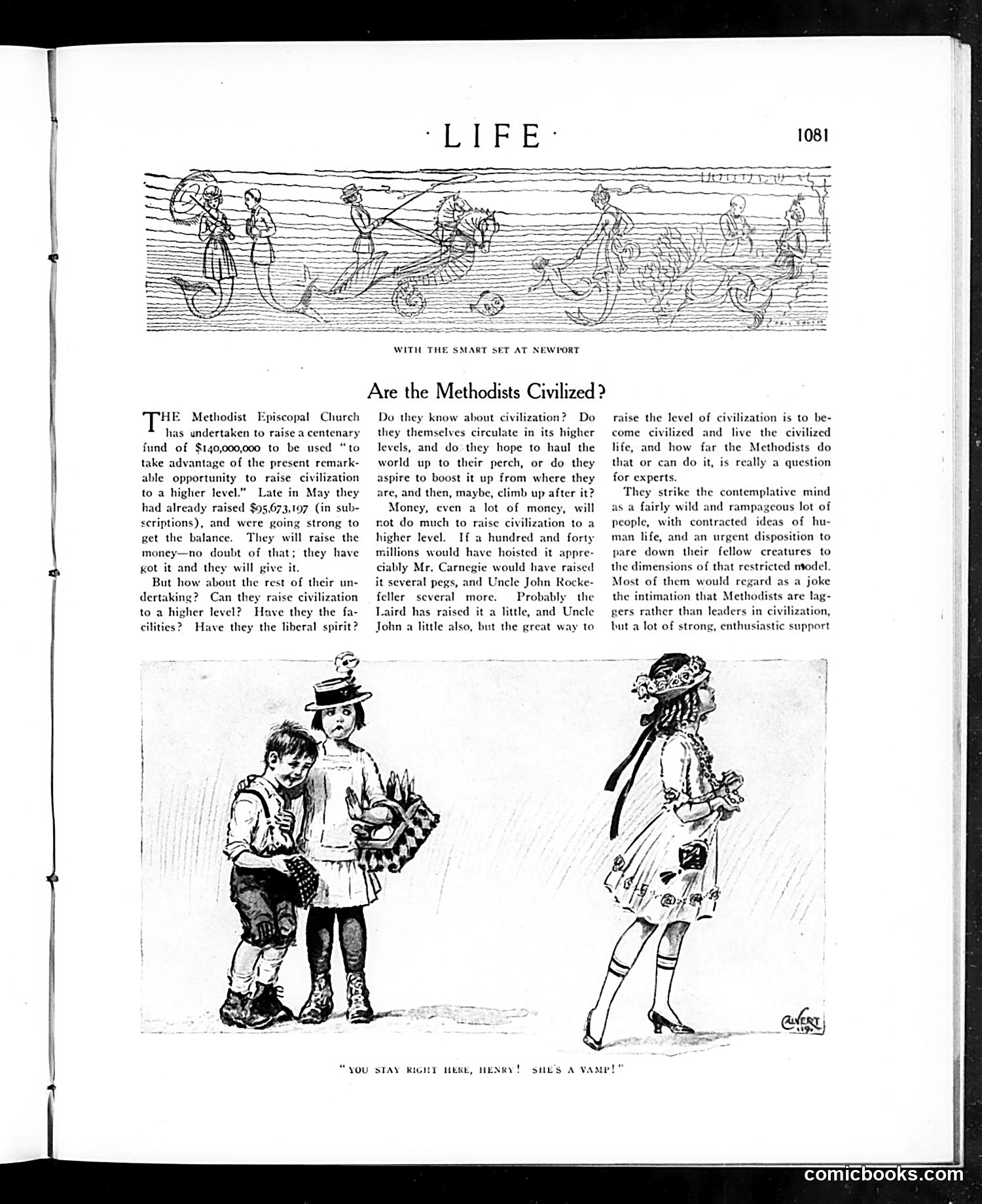
This page satirizes Methodist hypocrisy regarding "civilization." The Methodist Episcopal Church has raised $140 million for a centenary fund claiming to "raise civilization to a higher level," but the article questions whether Methodists themselves embody civilization. The accompanying cartoon (captioned "You stay right here, Henry! She's a vamp!") depicts a well-dressed woman at Newport (an elite seaside resort) warning a boy away from another fashionable woman. The satire's point: Methodists preach moral elevation while the wealthy "smart set" at Newport—likely including Methodists themselves—live indulgently and judgmentally. The article further argues that wealth alone (citing Carnegie and Rockefeller) cannot improve civilization; only living civilized lives matters. The implication is that Methodists, despite their moral pretensions, are "wild and rampageous," narrow-minded, and more interested in restricting others' behavior than exemplifying virtue themselves.
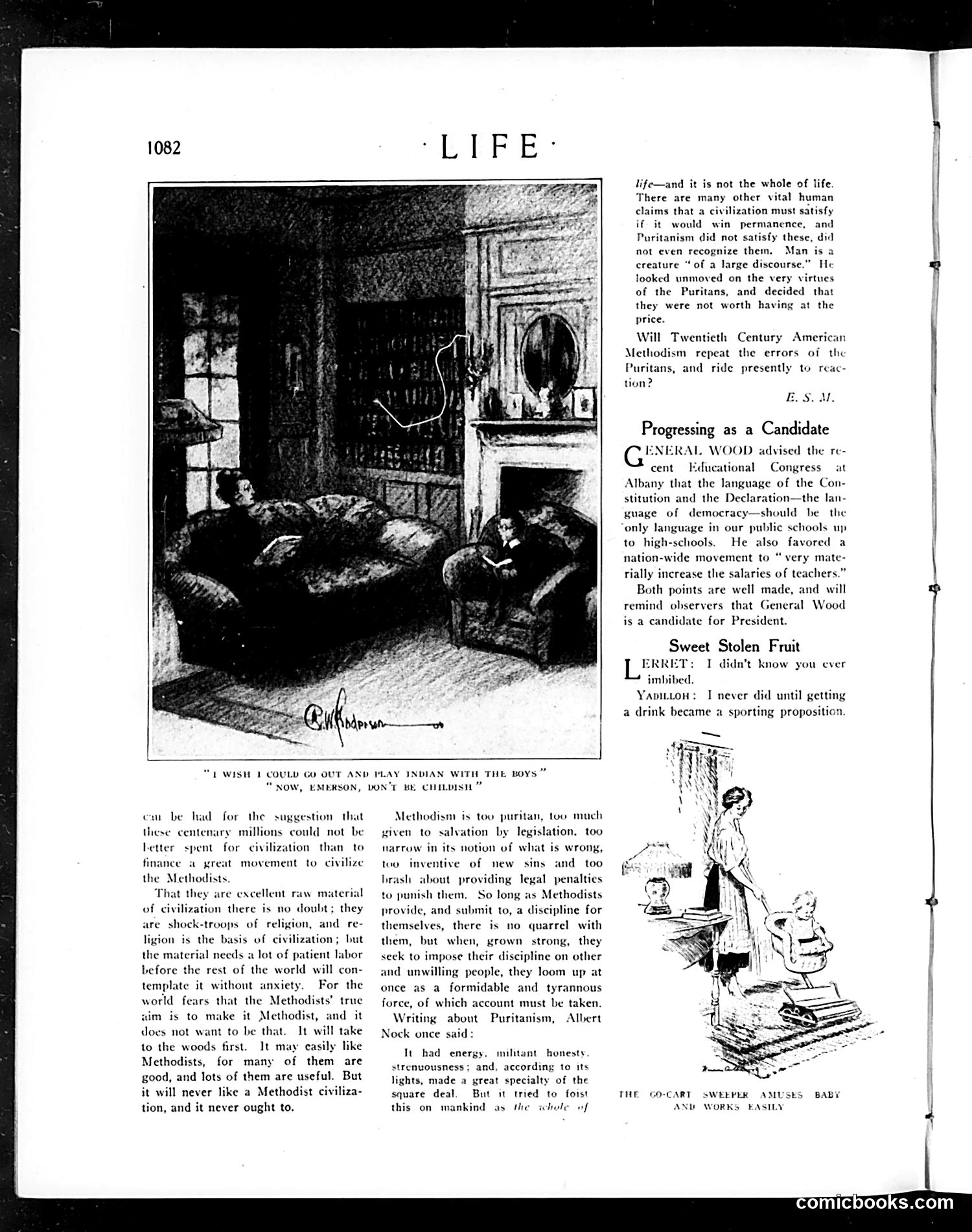
The main cartoon depicts a man (labeled "Emerson") being told by a woman not to be childish for wanting to "go out and play Indian with the boys." This satirizes adult male nostalgia and the period's casual appropriation of Native American imagery as entertainment. The text criticizes **Methodism** as excessively puritanical and tyrannical—comparing it unfavorably to Puritanism itself. The author argues Methodists impose their strict moral discipline on unwilling people, threatening individual liberty. The piece questions whether 20th-century American Methodism will repeat historical Puritan errors. A secondary item mocks **General Wood** (likely General Leonard Wood, a 1920 presidential candidate) as a political opportunist, noting his suddenly fashionable support for constitutional language in schools and teacher salary increases—transparent positioning for a presidential run. The "Sweet Stolen Fruit" vignette jokes about drinking becoming socially fashionable among the upper classes.
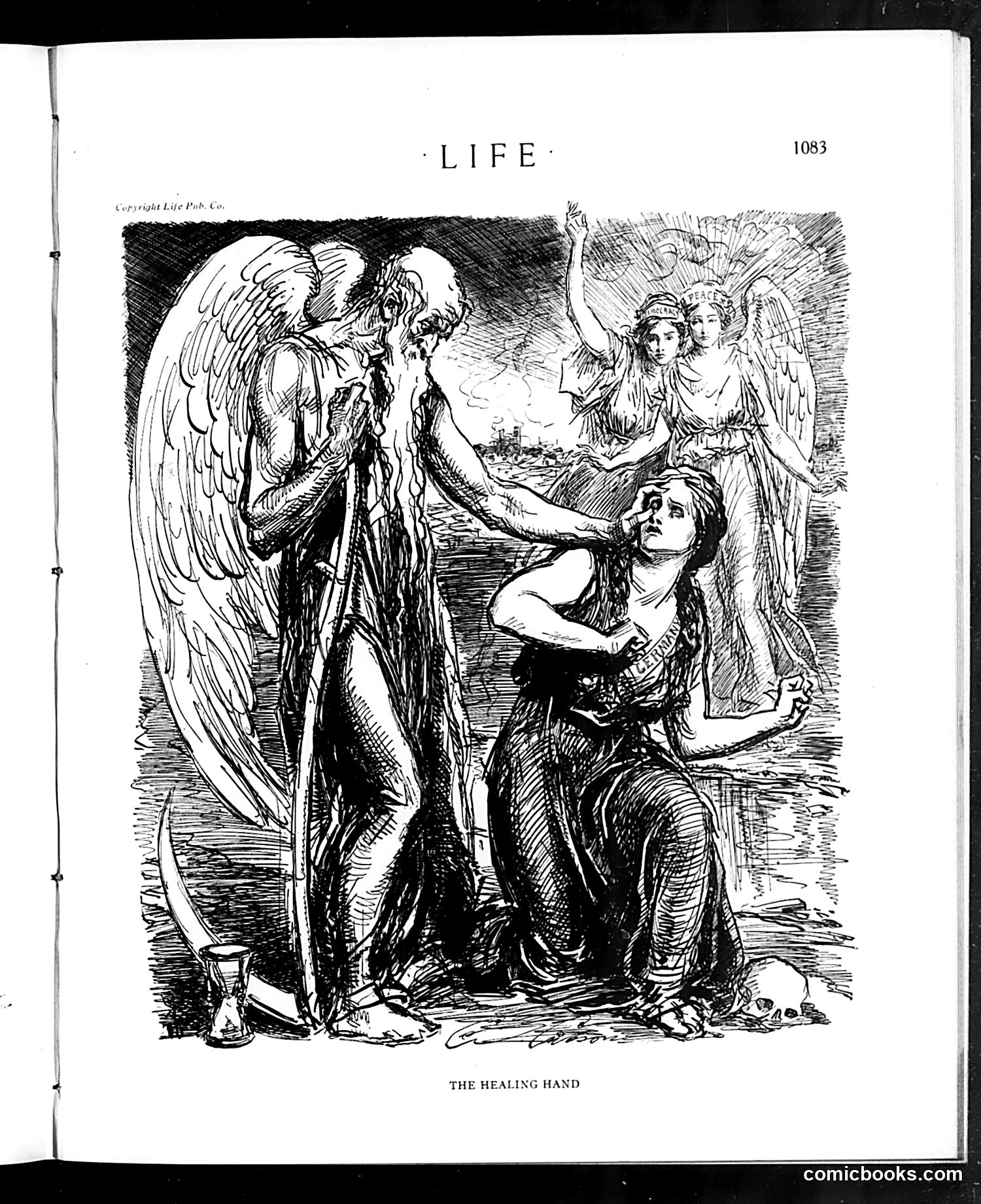
This allegorical engraving depicts an angelic or divine figure with large wings offering a healing hand to a kneeling, suffering person. Additional angels appear in the background, suggesting divine intervention or spiritual comfort. The title "The Healing Hand" and religious imagery suggest this addresses themes of divine mercy, redemption, or spiritual healing. The composition—with the supplicant in a vulnerable position receiving grace from above—uses Christian iconography common to 19th-century American magazine illustration. Without additional context or OCR text, the specific political or social reference remains unclear. This could relate to social reform, religious charity work, or spiritual renewal movements popular during Life magazine's era, but the particular target of satire or commentary cannot be determined from the image alone.
This piece satirizes post-WWI political rivalries and vanity among American leaders. The article mocks a rumor that Treasury Secretary William McAdoo bought Santa Barbara land to provide President Wilson a retirement retreat where he'd write his memoirs about the Peace Treaty and League of Nations. The satire ridicules the scenario's implausibility while gently poking fun at Wilson's self-importance and McAdoo's ambitious financial gestures. More pointedly, it attacks Senate Republicans—specifically Senators Henry Lodge and William Borah—for their petty posturing over access to Peace Treaty copies. The text sarcastically compares their self-righteous indignation to classical mythological figures (Minerva and Juno), suggesting their complaints about being denied documents are performative outrage designed for newspaper headlines rather than genuine constitutional concerns. The cartoon depicts political squabbling during treaty ratification debates.
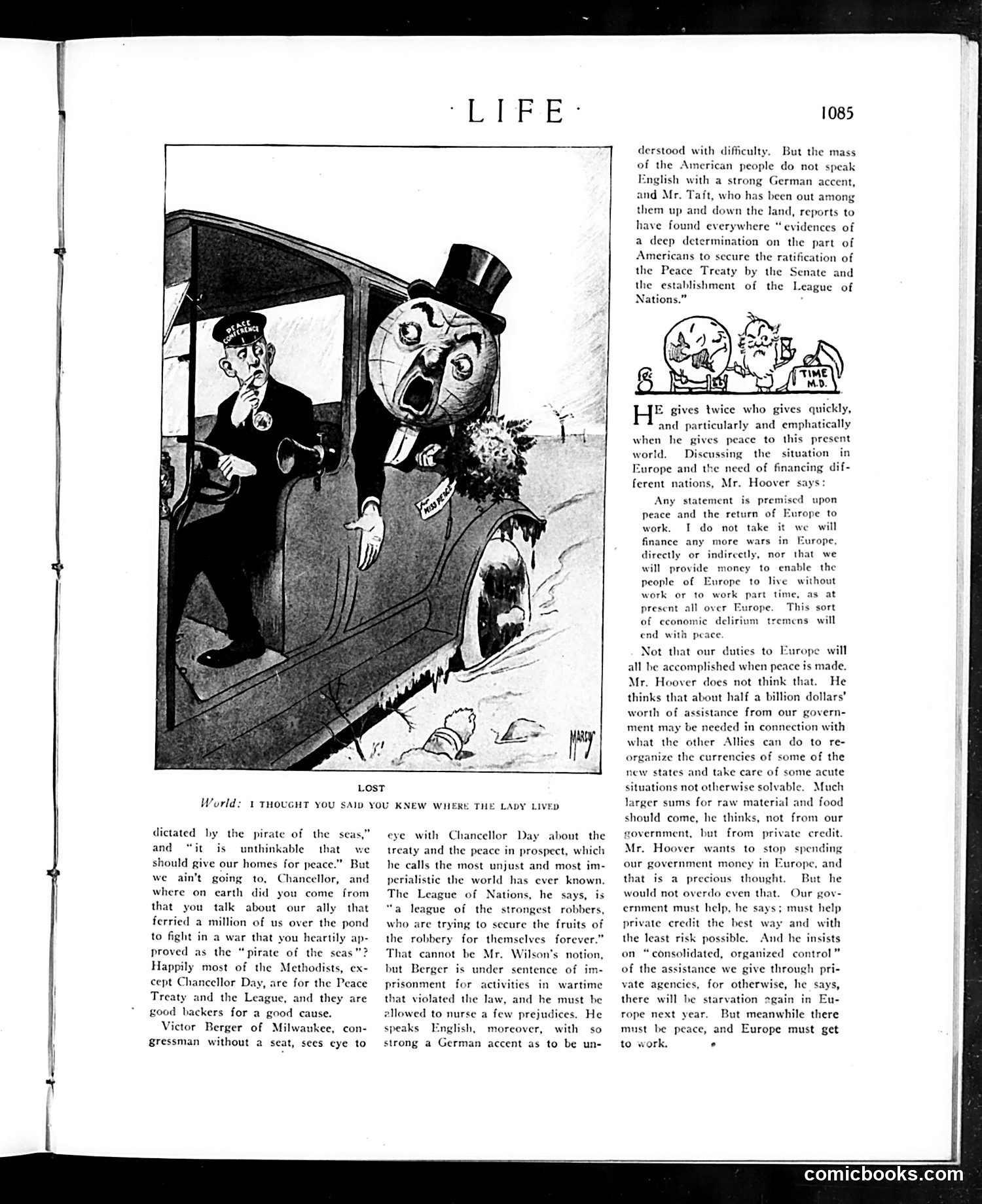
This cartoon satirizes post-World War I peace negotiations and the League of Nations debate. The figure labeled "World" sits in a car driven by a grotesque character representing the "pirate of the seas"—likely Germany or German aggression. An American figure inside appears confused and lost. The satire targets multiple figures: **Chancellor Day** (Methodist leader opposed to the peace treaty), **Victor Berger** (Socialist congressman with German accent, imprisoned for wartime activities), and implicitly **President Wilson's** League proposal. The cartoon mocks those who question American commitment to peace efforts while having supported the war itself. The "pirate" driving suggests Germany still controls outcomes despite defeat. The lost world imagery implies confusion about post-war direction. The accompanying text by **Hoover** advocates conditional European aid—peace first, then limited reconstruction financing—rejecting perpetual American financial support for European recovery.
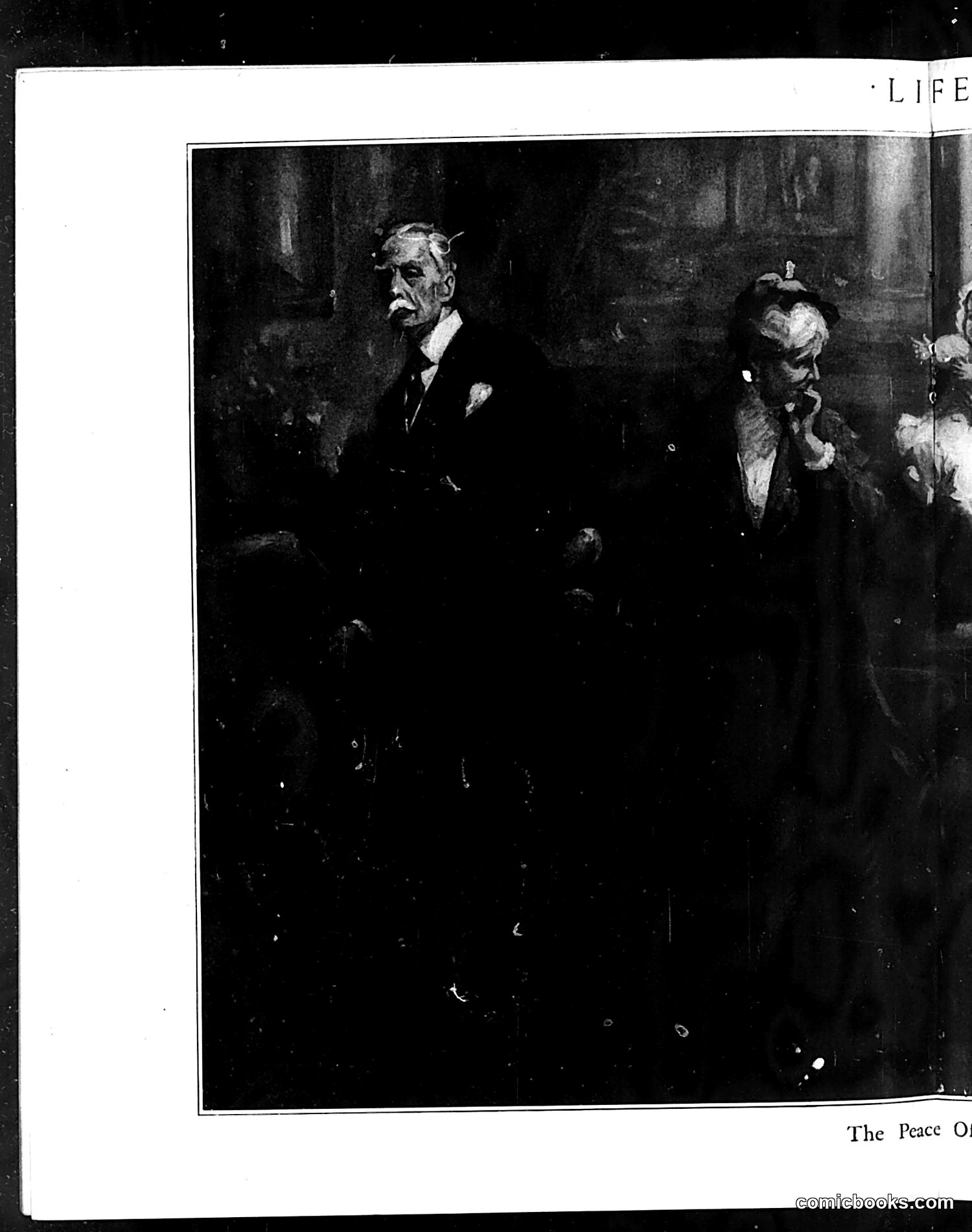
This page appears to be from *Life* magazine and shows a dark, dramatic illustration labeled "The Peace O[f]" (text cut off). The image depicts what appears to be a formal diplomatic or political scene with several figures in formal dress gathered in shadows. The central figure, an older man with distinctive features, stands prominently in formal attire. However, the OCR text is largely illegible—appearing to be scanning errors or page artifacts rather than actual readable content. Without clear text identifying the figures, the specific political event, or the satirical point, I cannot reliably explain what this cartoon references or whom it depicts. To properly analyze this satire, I would need either clearer text or additional context about the publication date and political circumstances.
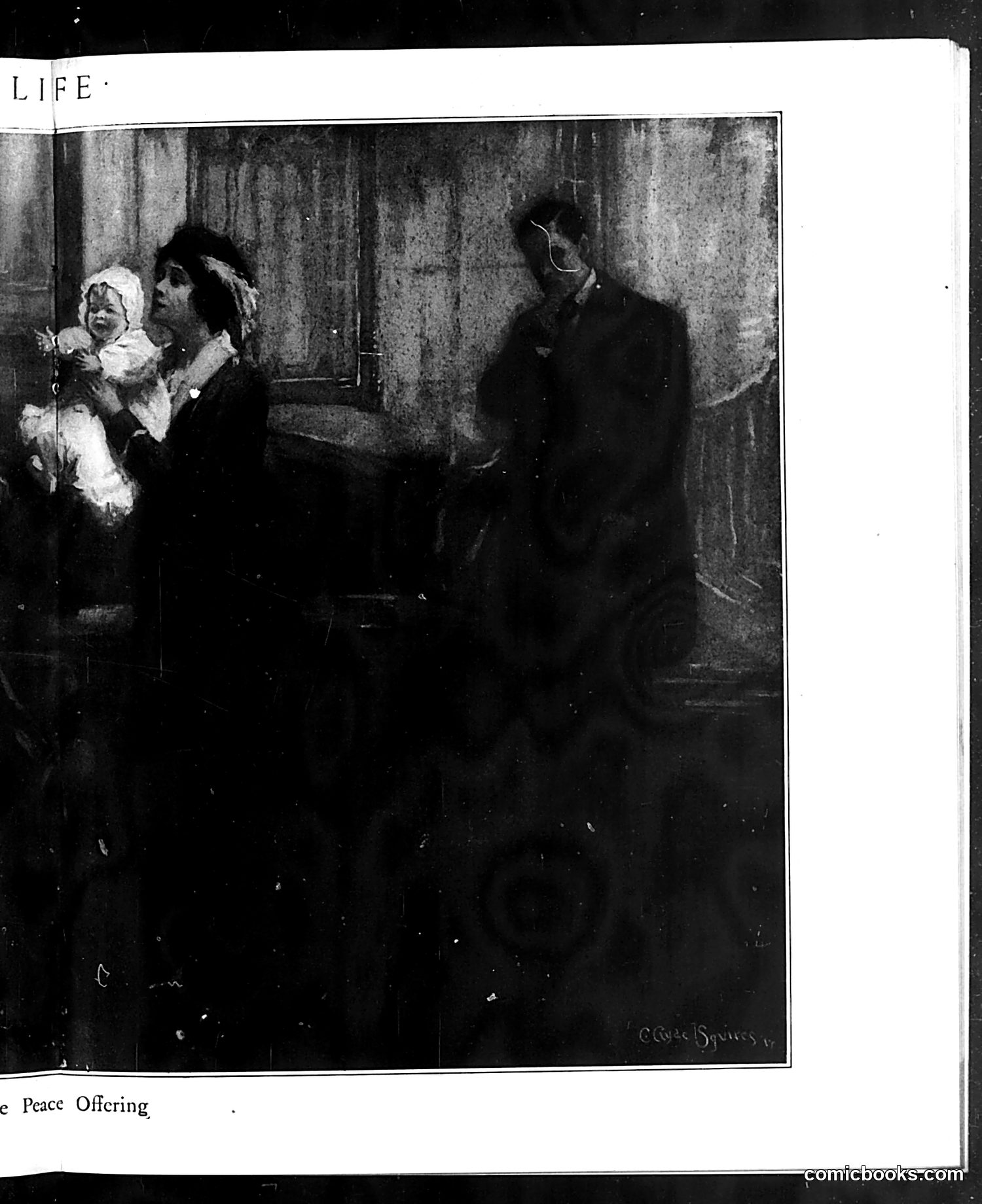
This political cartoon depicts what appears to be a domestic dispute scene. On the left, a man holds a small child while a woman gestures animatedly—suggesting conflict or argument. On the right stands another figure, possibly representing a mediator or authority figure, watching the interaction. The caption "Peace Offering" suggests irony: the man may be attempting reconciliation (using the child as a "peace offering" to appease the woman) during what appears to be a heated marital dispute. The cartoon satirizes domestic relationships and male attempts at conflict resolution, implying that such gestures are often transparent or ineffective attempts to restore harmony after quarrels. The exact date and artist attribution remain unclear from the visible text.
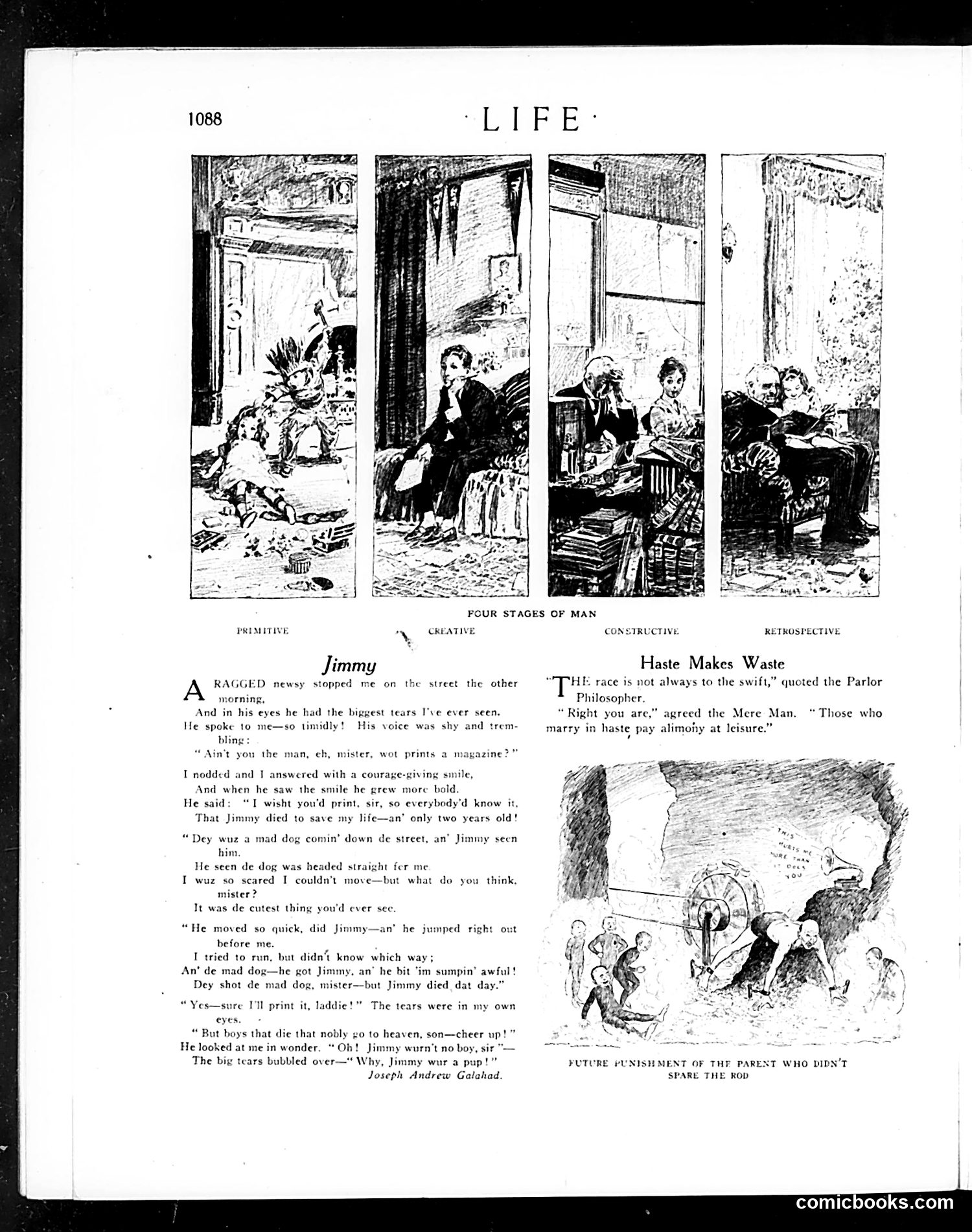
This page contains two distinct pieces of satirical content: **"Jimmy"** (left): A sentimental poem about a street child whose dog sacrificed itself to save him from a mad dog. The narrator—a magazine publisher—promises to print the story. The twist ending reveals "Jimmy" is actually a dog, not a boy, subverting the reader's expectation of a heroic human sacrifice narrative. This appears to satirize both sentimental journalism and urban poverty. **"Haste Makes Waste"** (right): A four-panel illustration labeled "Four Stages of Man" (Primitive, Creative, Constructive, Retrospective) paired with a brief philosophical exchange. Two men discuss whether success goes to the swift; one notes that hasty marriages lead to paying alimony "at leisure"—a commentary on divorce and its financial consequences. The bottom illustration depicts corporal punishment of children. Both pieces use humor to comment on contemporary social issues: urban suffering, journalism ethics, marriage/divorce, and child discipline.
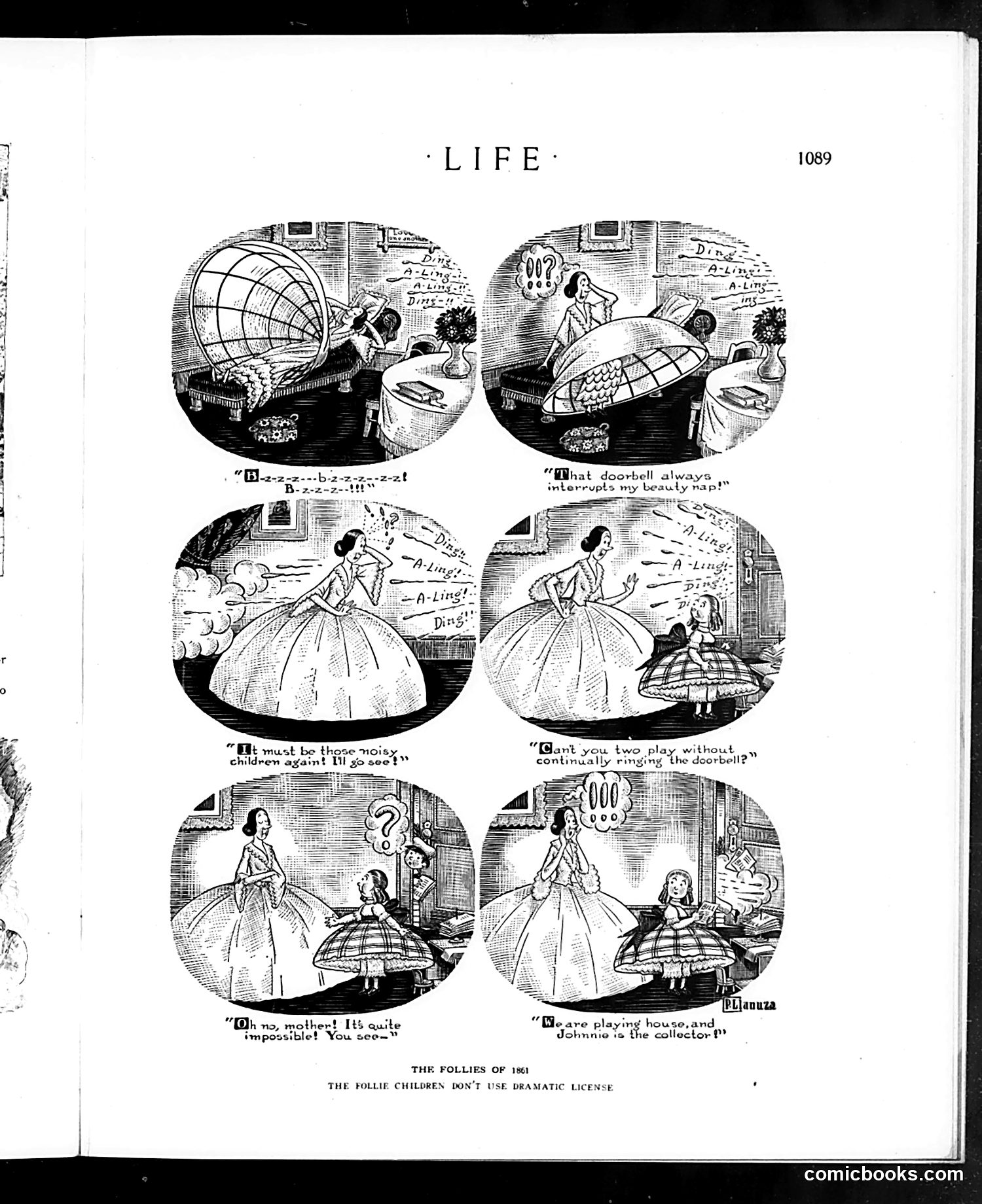
This is a six-panel comic strip satirizing children's dramatic play. The humor centers on a mother's escalating frustration as two children play "house" with increasingly loud sound effects and props—doorbells, dramatic music cues, and elaborate costumes (umbrellas as ball gowns). The satire mocks how children mimic theatrical productions they've seen, complete with exaggerated "dramatic license" (sound effects, props, performative gestures). The final panels show the mother's breaking point: she forbids the children from using theatrical conventions in their play, wanting them to play quietly without the constant doorbell-ringing and noise. The title "The Follies of 1861" likely references Broadway revues of that era, suggesting children have absorbed theatrical tropes from contemporary entertainment. The joke is that domestic peace requires children to abandon the dramatic embellishments they've absorbed from popular culture.
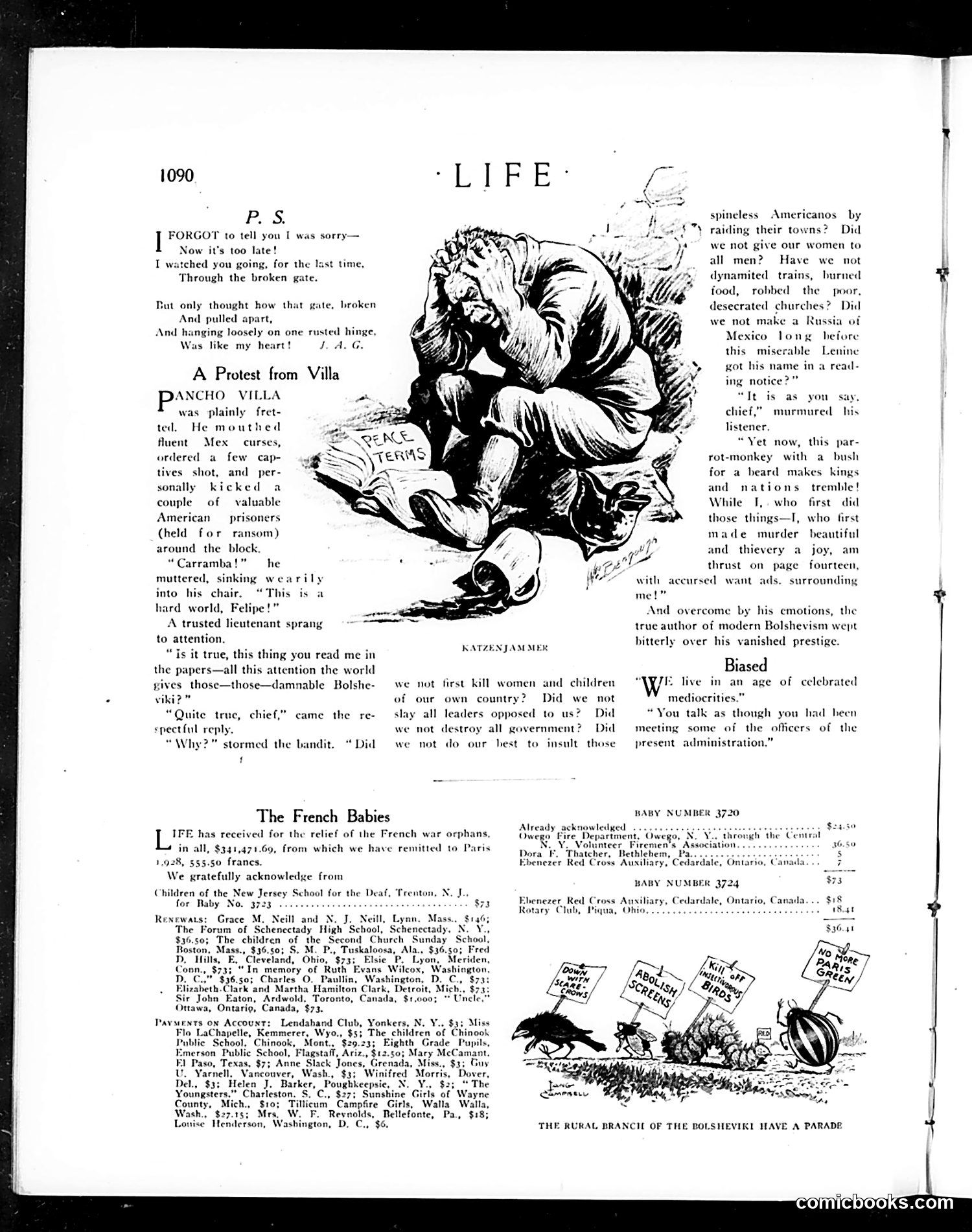
This page contains political satire attacking Pancho Villa and, by extension, Vladimir Lenin and Bolshevism. **"A Protest from Villa"**: The cartoon depicts Villa as aggrieved that his atrocities—killing civilians, destroying property, looting—receive less newspaper attention than Lenin's similar crimes. Villa complains that Lenin, the "parrot-monkey," receives fame while Villa, who "first made murder beautiful and thievery a joy," is relegated to page fourteen. The satire's point: both Villa and Lenin are murderous thugs, but Lenin has undeservedly captured world attention as the supposedly novel "true author of modern Bolshevism." **"The Rural Branch of the Bolsheviki Have a Parade"**: The bottom cartoon shows a donkey carrying Bolshevik propaganda signs, satirizing rural Bolshevik recruitment efforts as absurd and primitive. The page contrasts these attacks on radical violence with fundraising announcements for French war orphans—implying that Western charitable impulses are being misdirected while dangerous radicals gain credibility.
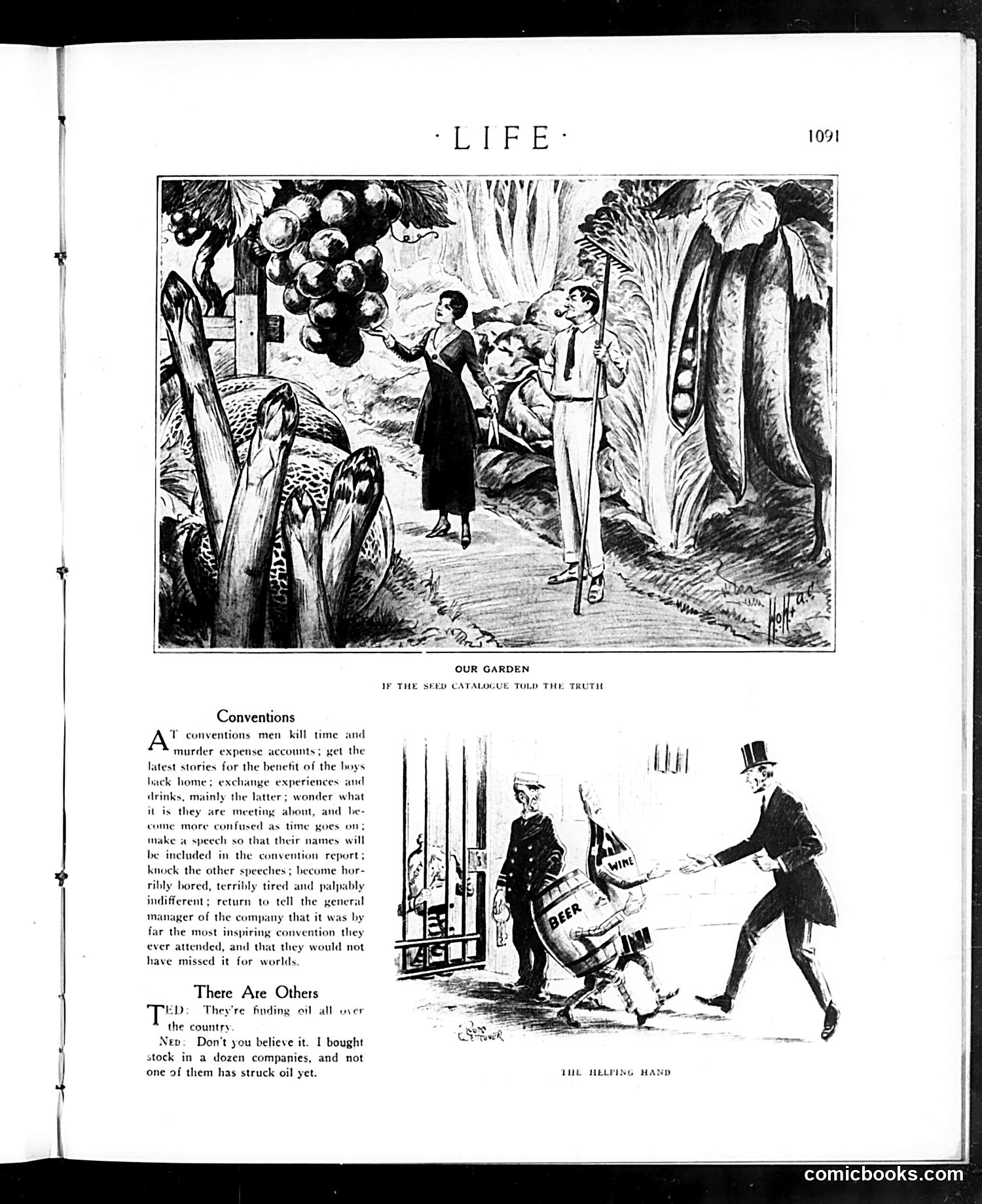
This page satirizes business conventions and oil-stock speculation circa the early 20th century. The top illustration ("Our Garden") uses horticultural imagery to mock convention attendees picking oversized fruits/vegetables, suggesting they're harvesting unrealistic promises. The "Conventions" essay mocks the hypocrisy of business gatherings: men waste time and money, become bored and confused, yet claim upon returning home that it was "the most inspiring convention" they wouldn't have missed. The dialogue "There Are Others" references the oil boom. Ned reports oil discoveries "all over the country," but his companion reveals he bought stock in a dozen companies with zero results—satirizing the get-rich-quick speculation mania and fraudulent oil stocks that likely duped many investors. "The Helping Hand" cartoon (bottom) depicts a man struggling with an oil barrel labeled "BEER," possibly commenting on Prohibition-era substitutions or black-market dealings.
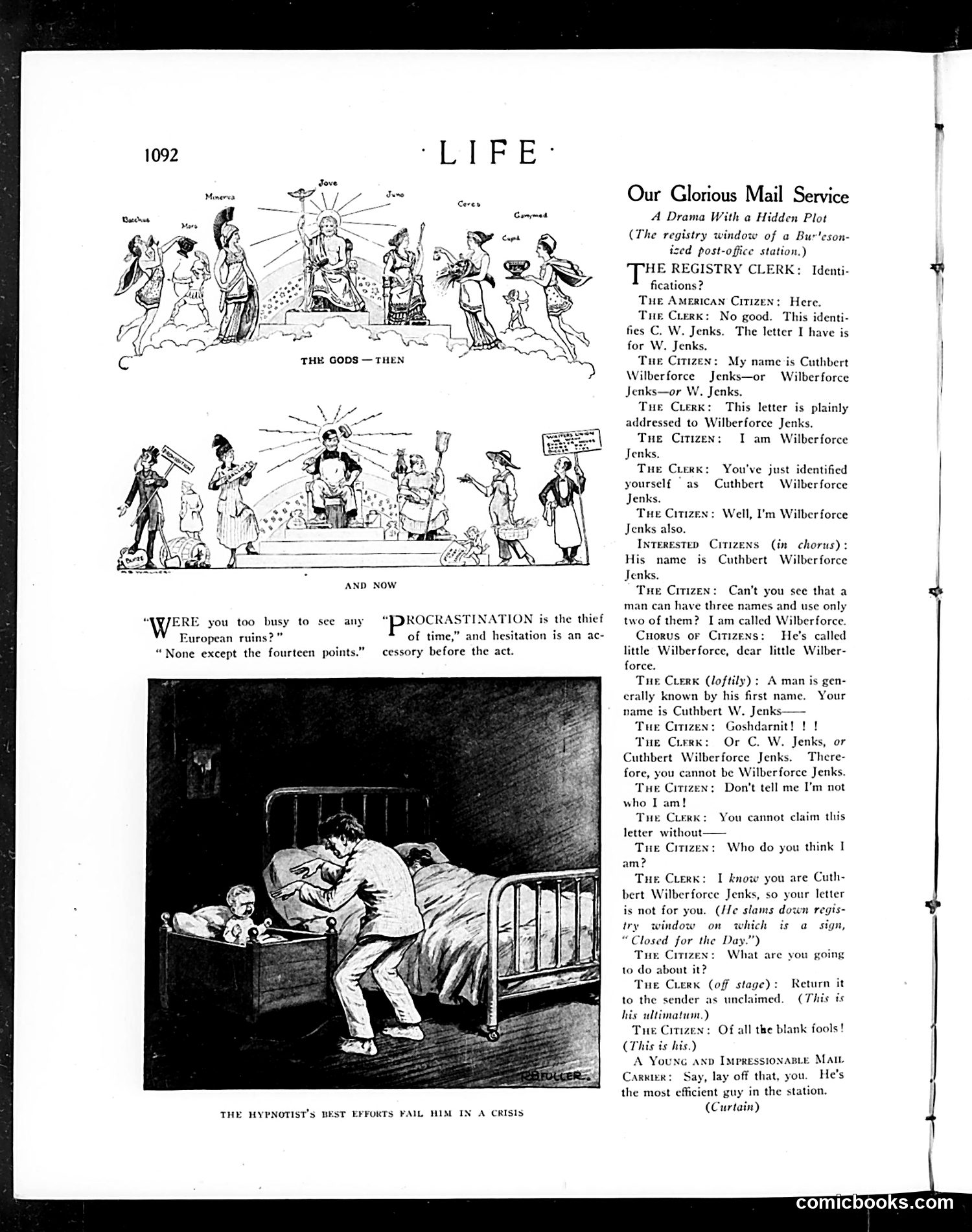
This satirical sketch mocks the U.S. Post Office bureaucracy, likely under Postmaster General Albert Burleson (referenced as "Bur'eson-ized" in the subtitle). The joke centers on rigid, absurd officiousness: a clerk refuses to deliver mail to "Wilberforce Jenks" because the addressee's official name is "Cuthbert W. Jenks"—despite the citizen demonstrating these are the same person using different name variations. The clerk insists on literal identity matching, making the mail undeliverable on technicality alone. The satire targets government inefficiency and red tape: regulations meant to ensure accuracy instead produce comical obstruction. The hypnotist illustration above suggests authority figures' inability to solve real problems. The final stage direction—a bystander defending the clerk as "the most efficient guy in the station"—delivers the punchline: this absurdity represents the Post Office's actual standard of "efficiency." The sketch criticizes bureaucratic inflexibility harming ordinary citizens.
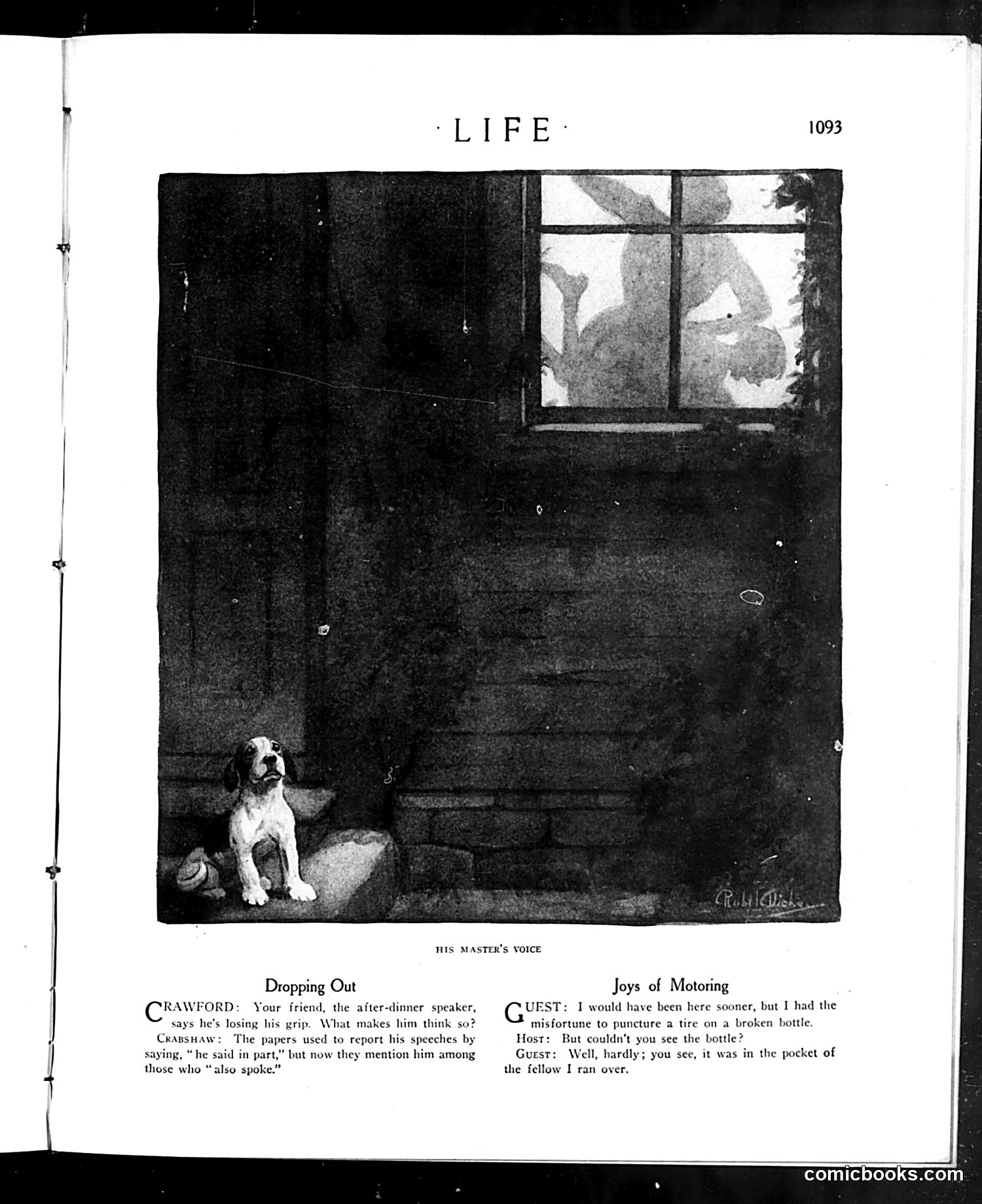
This 1920s *Life* magazine page contains two satirical jokes: **"Dropping Out"**: Mocks an after-dinner speaker whose importance has diminished. Newspapers once reported his speeches prominently; now they're lumped with minor speakers in a catch-all phrase ("also spoke"). The joke targets public figures whose relevance fades. **"Joys of Motoring"**: A dark comedy about early automobile culture. A guest blames a puncture on a bottle in another person's pocket—implying he hit and ran over someone. The callous punchline satirizes reckless driving and indifference to pedestrian safety, treating a serious accident as a trivial inconvenience. The accompanying illustration shows a dog watching through a window—titled "His Master's Voice"—likely commenting on loyal attention to absent figures.
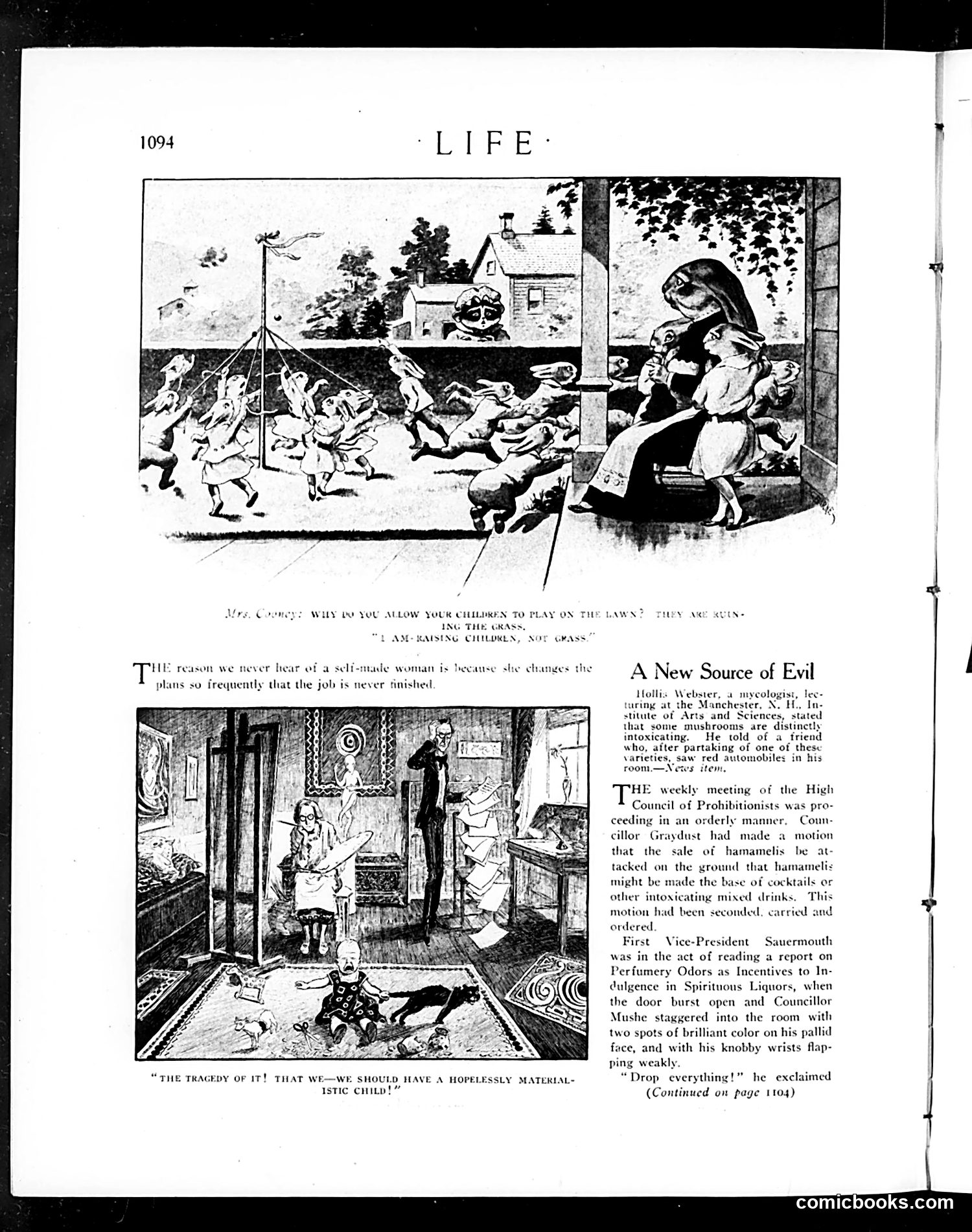
This page contains two satirical cartoons mocking early 20th-century social anxieties: **Top cartoon:** Shows a woman supervising children playing outdoors while relaxing. The caption jokes that self-made women constantly change their plans, so projects never finish—satirizing the emerging "New Woman" figure gaining independence. **Bottom cartoon and article:** Titled "A New Source of Evil," it mocks Prohibition-era anxiety. A High Council of Prohibitionists meetings to ban hamamelis (a plant extract) as a potential cocktail base when a panicked councillor bursts in about intoxicating mushrooms. The satire targets prohibitionist hysteria—their endless search for new substances to ban becomes absurdly expansive, treating innocent items as threats to public morality. Both pieces mock contemporary anxieties: changing gender roles and increasingly zealous alcohol prohibition enforcement. The humor lies in exaggerating these concerns to reveal their underlying absurdity.
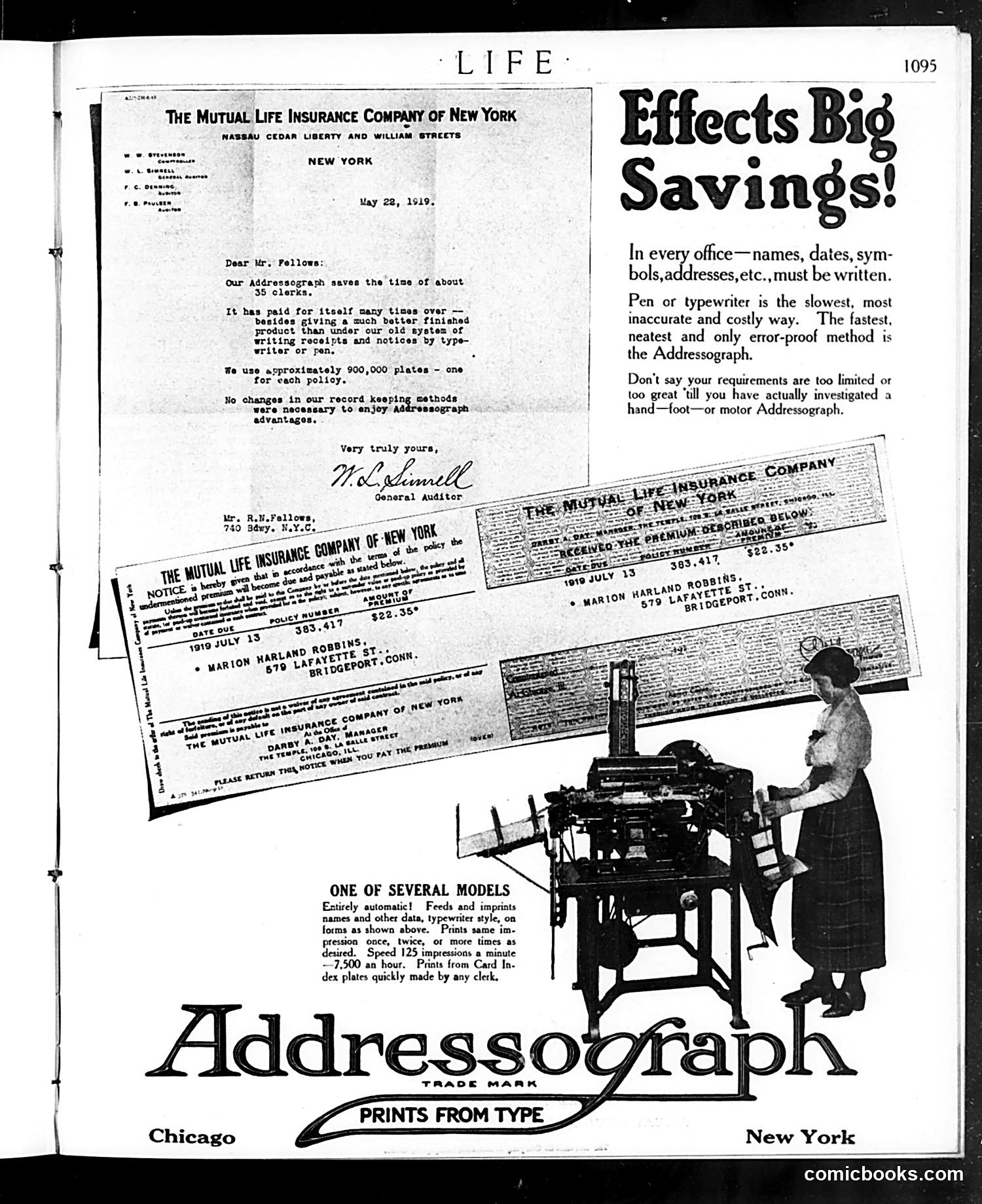
This is primarily a **product advertisement**, not a cartoon or satire. It appears in *Life* magazine (May 22, 1919) promoting the Addressograph, an early automated addressing machine. The ad features a testimonial letter from The Mutual Life Insurance Company of New York praising the device's efficiency—it allegedly replaced 35 clerks' work and saved time on repetitive tasks like addressing forms and printing notices. The company used approximately 900,000 address plates. The advertisement emphasizes the machine's speed (125 impressions per minute) and accuracy compared to manual pen or typewriter work, which it characterizes as "slowest, most inaccurate and costly." A photograph shows the machine in operation. The ad targets businesses with high-volume addressing needs, suggesting the Addressograph was a significant productivity innovation of the early 20th century—an ancestor of modern printing and data-handling technology. There is no satire or political commentary apparent here; it's straightforward advertising.
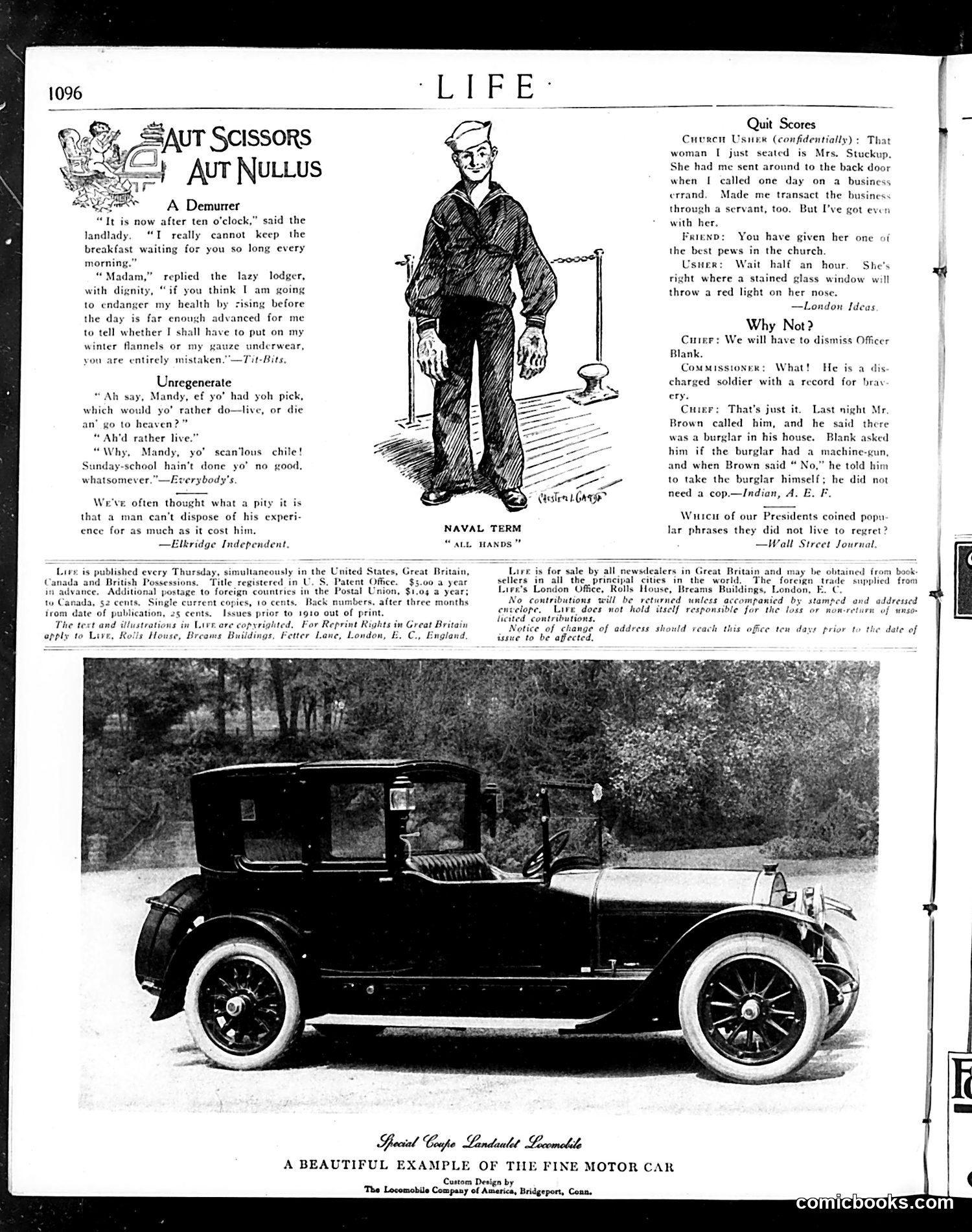
This page contains several brief satirical pieces typical of early 20th-century American humor magazines: **"Aut Scissors Aut Nullus"** mocks a lazy lodger who refuses to rise early, claiming he can't determine proper clothing until late morning—satire on indolence disguised as fastidiousness. **"Unregenerate"** uses dialect humor (common but now offensive) to joke about an African American woman choosing life over heaven, with the punchline that Sunday school hasn't reformed her worldly values. **"Naval Term"** and other brief quips mock military pretension and bureaucratic absurdity. The **"Why Not?"** piece satirizes a police officer who, when told a burglar lacks a machine gun, refuses to help—mocking either cowardice or absurd official procedure. **"Quit Scores"** depicts revenge: a church usher seats a snobbish woman where stained glass throws unflattering red light on her face. The page concludes with an automobile advertisement. The humor relies on class mockery, ethnic stereotypes, and wordplay—conventions that define the magazine's satirical approach.
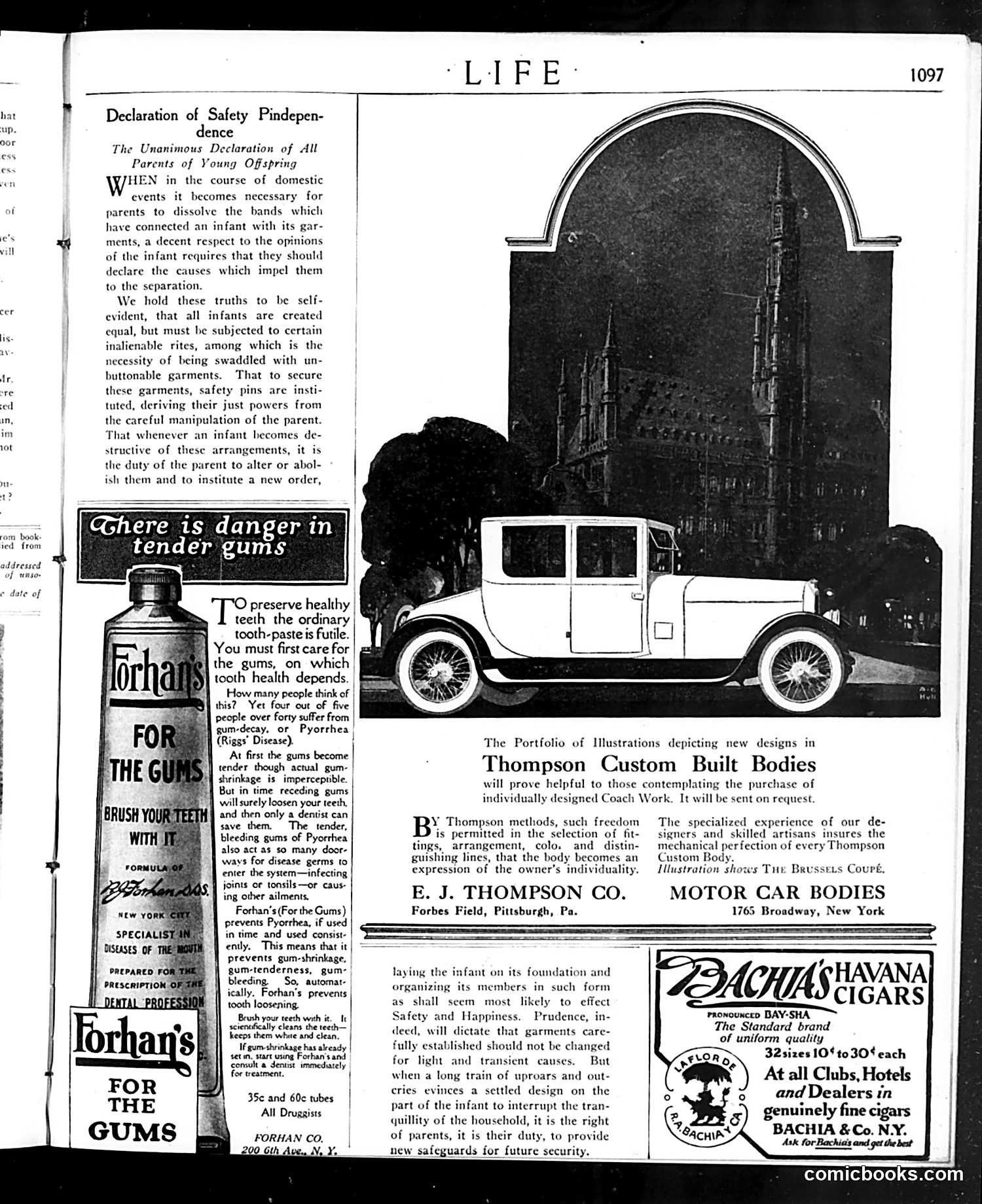
This page is primarily **advertising**, not political satire. The main content is a humorous parody titled "Declaration of Safety Pindependence"—a mock-serious document mimicking the Declaration of Independence's language but about infant safety pins and swaddling clothes. It's gentle domestic humor targeting parents, using grandiose revolutionary rhetoric for the mundane task of securing baby garments. The page features three advertisements: Forhan's toothpaste (emphasizing gum health to prevent pyorrhea/gum disease), Thompson Custom Built Motor Car Bodies (luxury automobiles), and Bachas Havana Cigars. There is **no political cartoon or satire** present. The "Declaration" is simply a playful rhetorical device—applying Founding Fathers language to baby care—rather than commentary on actual politics or social issues. It's the kind of lighthearted parody common in Life magazine's humor sections.
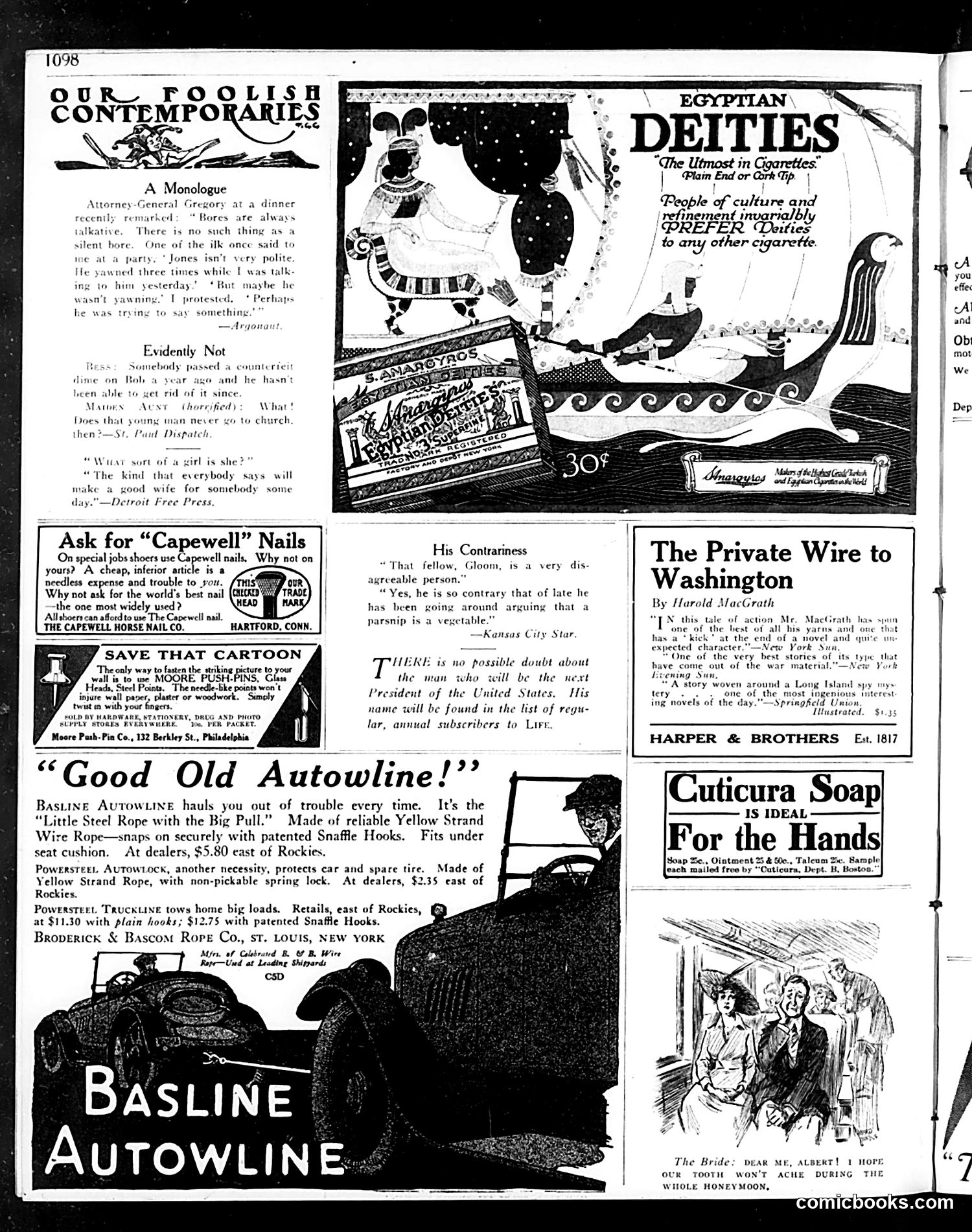
This page is primarily **advertising with satirical humor sections**. The main satirical content includes: **"Our Foolish Contemporaries"** — brief jokes mocking conversational pretension and social hypocrisy. One anecdote ridicules an Attorney-General who talks endlessly yet complains about "silent bores." Another jokes about a young man who never attends church, and a third about a girl praised as wife-material. **"His Contrariness"** — a one-liner mocking someone named Gloom for being so argumentative he claims a parsnip is a vegetable (absurd contradiction used to illustrate his disagreeable nature). **"The Private Wire to Washington"** — promotes Harold MacGrath's spy novel, claiming it contains "one of the best of all" war stories. The page's bulk comprises period advertisements: Capewell Nails, Basline Autowline rope, Cuticura Soap, and Egyptian Deities cigarettes. A cartoon at bottom shows newlyweds joking about tooth pain during their honeymoon—mild domestic humor typical of the era.
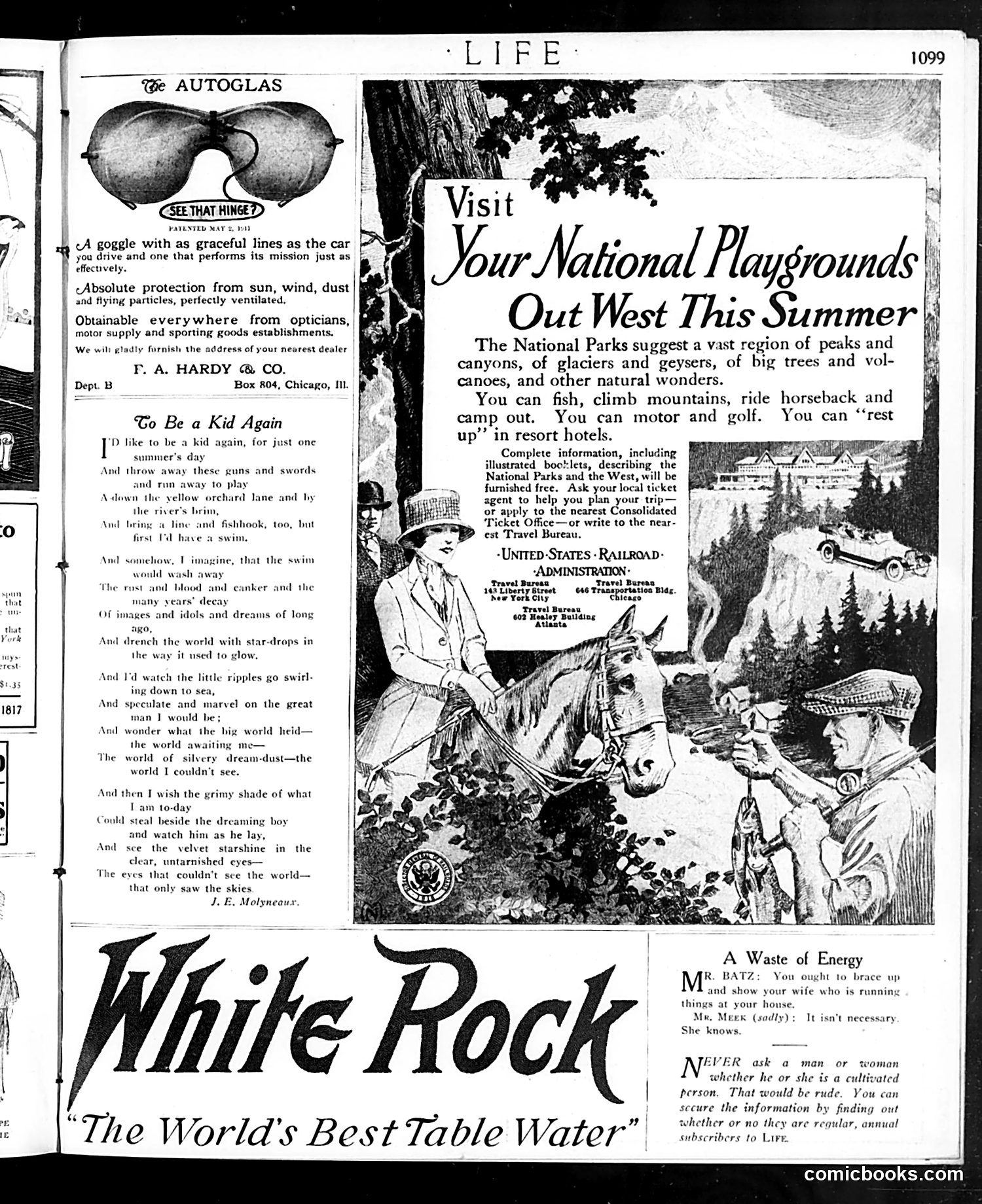
This page contains advertisements and light humor rather than political satire. **The Autoglas Ad** (top left): Promotes motor goggles with graceful design, emphasizing protection from sun, wind, and dust for drivers—reflecting the early automotive era when open cars required eye protection. **"To Be a Kid Again"** (left): A sentimental poem by J.E. Molyneaus about nostalgic childhood memories, contrasting youthful innocence with adult disillusionment. The reference to "guns and swords" is innocent play, not political. **National Parks Advertisement** (center-right): Promotes summer travel to western U.S. national parks, encouraging fishing, horseback riding, and motor trips—typical 1920s leisure marketing. **"A Waste of Energy"** (bottom right): A brief domestic humor exchange where Mr. Batz suggests Mr. Meek assert authority over his wife, but Meek resignedly replies she already knows who runs things—gentle satire of domestic power dynamics, not political commentary. **White Rock Ad** (bottom): Advertises table water.
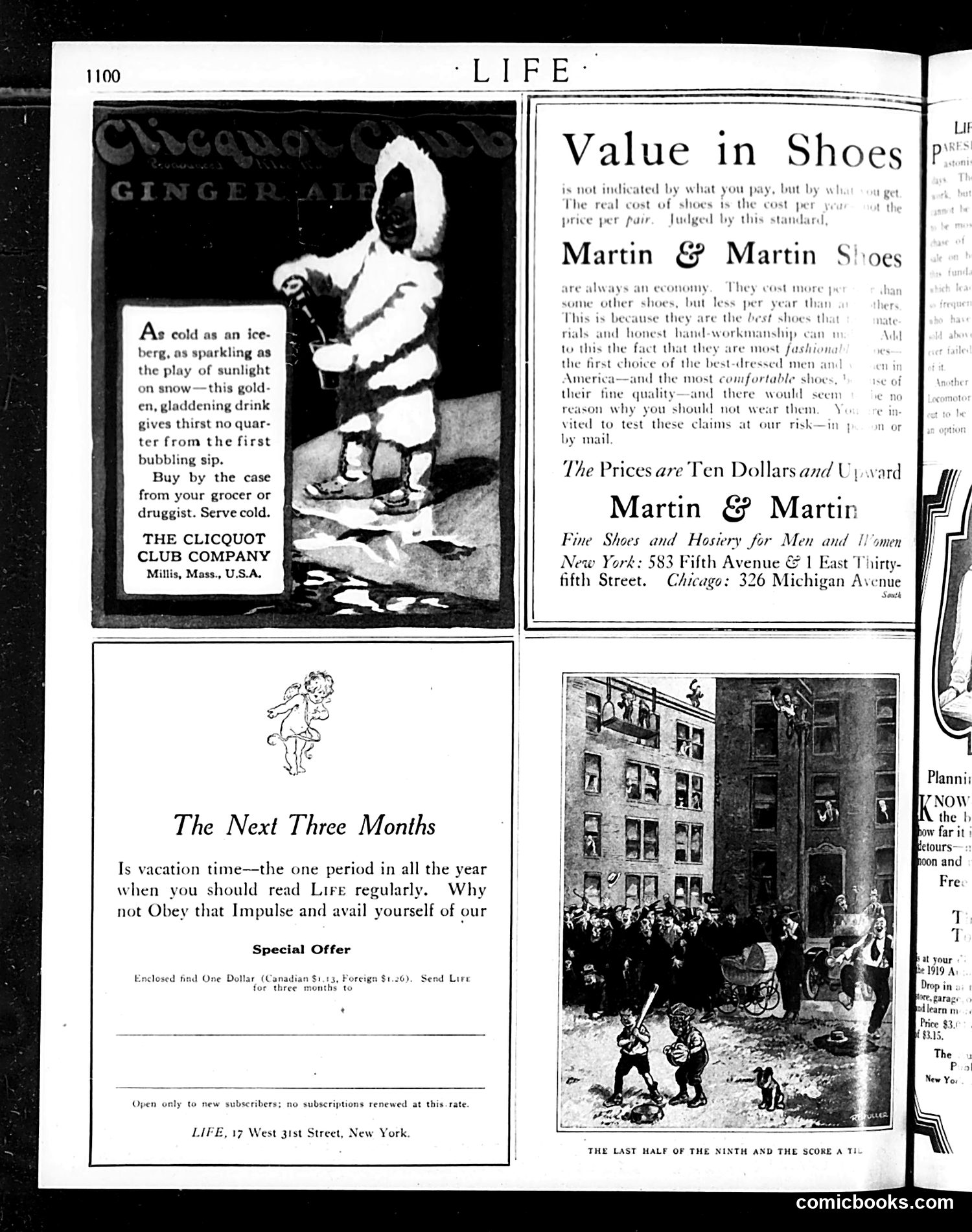
This page is primarily **advertising**, not political satire. It contains three unrelated ads: 1. **Clicquot Club** (top left): A ginger ale advertisement featuring a woman in winter clothing, emphasizing the drink's refreshing qualities. The copy uses period marketing language common to early 20th-century beverage ads. 2. **Martin & Martin Shoes** (top right): A shoe company advertisement arguing that value lies in cost-per-wear, not purchase price. It claims their shoes are preferred by "best-dressed men" and offer superior craftsmanship. 3. **Life Magazine Subscription** (bottom left): A promotional offer encouraging readers to subscribe during vacation season, with a special discounted rate for new subscribers only. The bottom right contains what appears to be a photograph or illustration related to a baseball game ("the last half of the ninth"), but the caption is partially cut off. No political figures or satirical commentary are evident on this page.
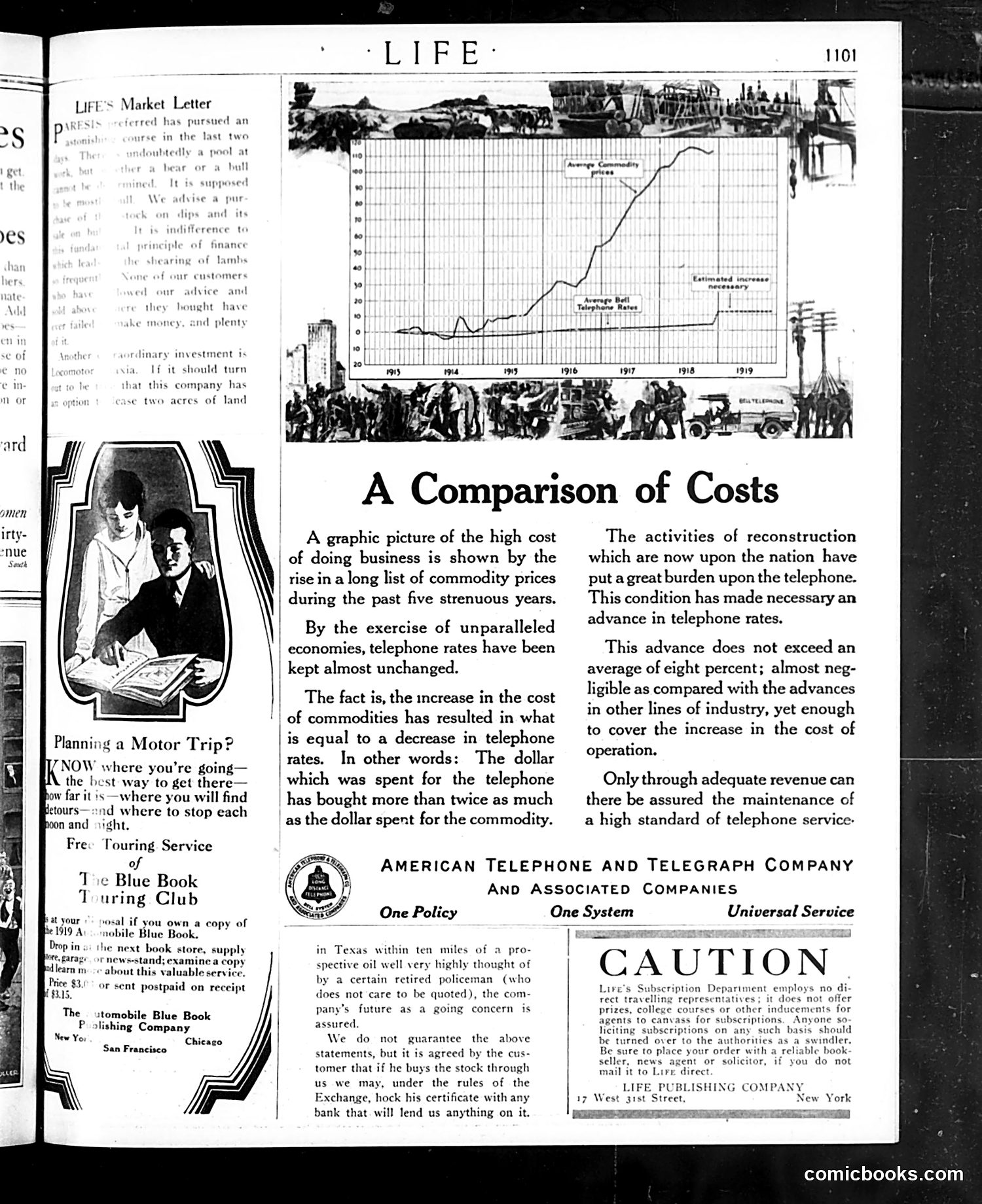
This page is primarily **advertising and corporate messaging**, not political satire. The dominant content is a **full-page advertisement by American Telephone and Telegraph Company** defending recent telephone rate increases. The accompanying graph shows commodity price inflation from 1913-1919 (during WWI and its aftermath). AT&T's argument: while other industries raised prices dramatically, telephone rates remained nearly flat—so the modest 8% rate increase is justified and reasonable. The smaller items are service advertisements: the **Automobile Blue Book** (a travel guide for motor trips) and a **stock-promotion scheme** for an oil well in Texas, humorously noting that a "retired policeman" is confident in the venture. There's mild satire in the stock pitch's cavalier tone about collateral, but the page reflects post-WWI economic anxiety—justifying price increases to a public facing inflation everywhere. The message: telephone service deserves revenue support to maintain quality, positioning AT&T as a responsible monopoly amid broader economic strain.
This is not a cartoon but an **advertising essay** promoting the value of advertising itself. The piece argues that inflation—the decreasing purchasing power of pennies over time—is actually *positive* because advertising has enabled mass production and distribution, making goods affordable to more people. The argument compares purchasing power from James Buchanan's era (1850s-60s) to the present day: a penny once bought a pastry; now it buys less individually, but modern consumers enjoy far greater *variety* and *availability* of goods at reasonable prices due to advertising-driven markets. The essay essentially claims readers owe their prosperity to advertisers and advertising, framing ad-reading as a civic duty. This self-promotional piece was written by LIFE's own Advertising Manager and appears designed to convince readers (and potential advertisers) that advertising benefits society by expanding consumer choice and economic opportunity.
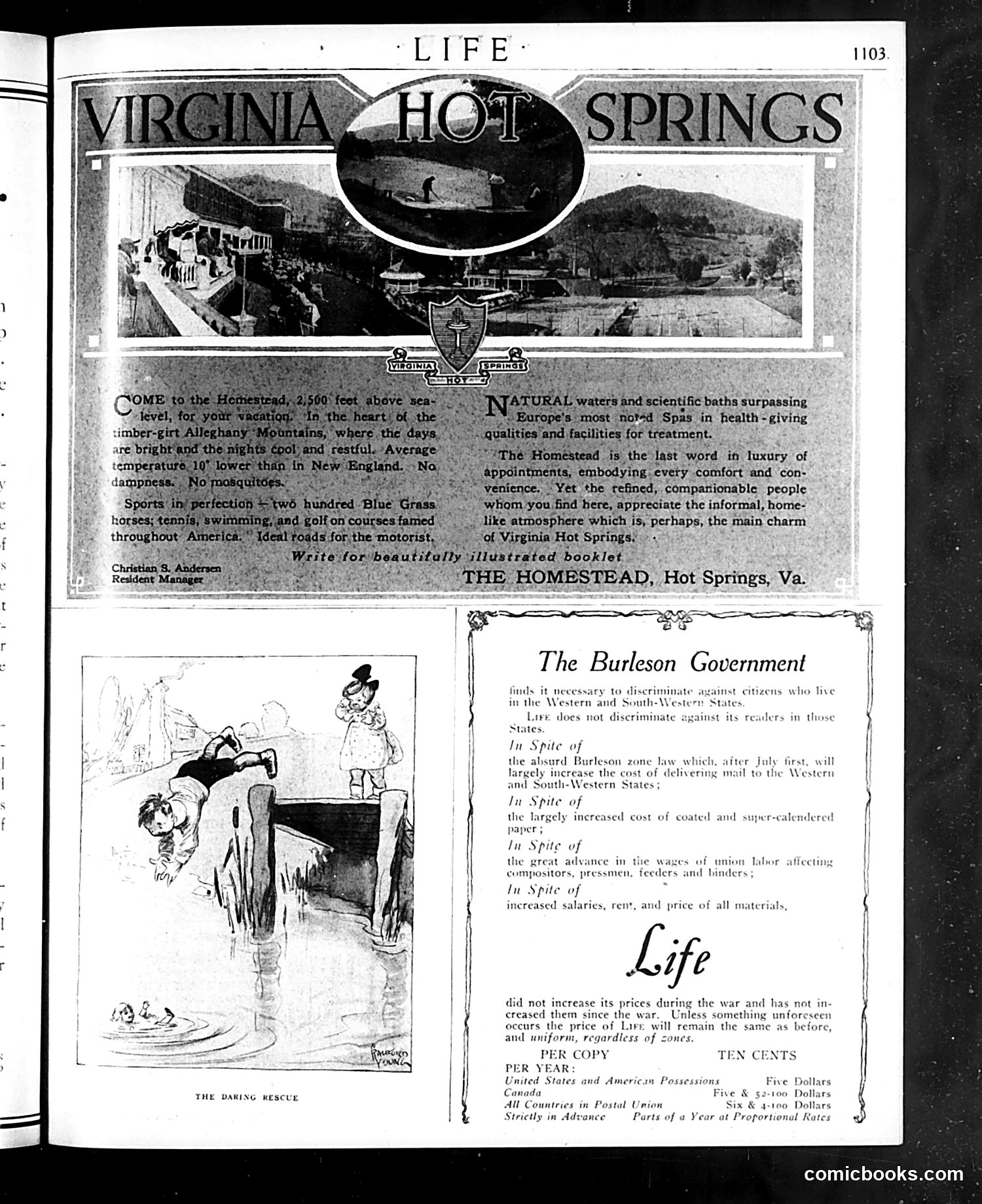
This page contains an advertisement defending Life magazine's pricing against postmaster Albert Burleson's wartime postal policies. The cartoon "The Daring Rescue" (left) depicts a figure pulling another from water, likely a visual metaphor for Life "rescuing" readers from unfair treatment. **The Political Context:** Burleson implemented controversial "zone laws" after July 1st that dramatically increased mail delivery costs to Western and South-Western states. Life magazine frames itself as a hero standing against this discrimination, refusing to raise subscription prices despite increased postage, paper, and labor costs—conditions explicitly enumerated in the ad. **The Satire:** Life positions itself as championing ordinary citizens harmed by what it characterizes as an "absurd" government policy. The magazine's restraint on pricing becomes an implicit critique of Burleson's administration, suggesting the government unfairly burdens Western readers while Life absorbs losses to maintain fairness. This reflects broader Progressive-era tensions over postal policy and regional equity during WWI.
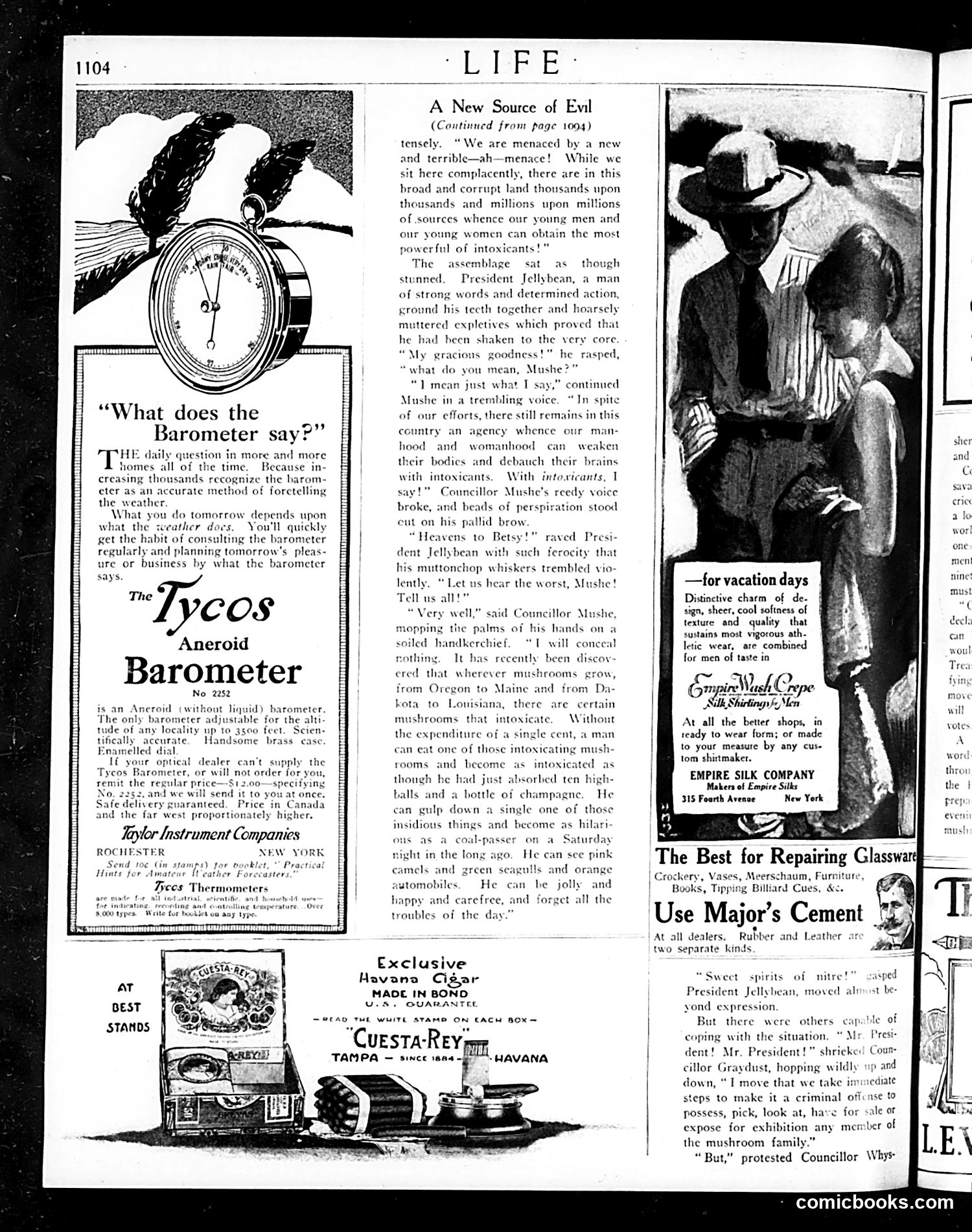
This page satirizes Prohibition-era panic about intoxicants. The main article mocks moral crusaders by inventing an absurdly overwrought crisis: wild mushrooms growing across America that cause intoxication. Characters like "President Jellybean" and "Councillor Mushe" are caricatured as hysterical officials whose theatrical outrage ("Heavens to Betsy!") over this ridiculous "menace" parodies real temperance activists' breathless warnings about alcohol's dangers. The joke targets how reformers invoked apocalyptic language about intoxication's spread, treating it as an unstoppable plague. By making the threat comically absurd (naturally-occurring psychoactive mushrooms) yet treating it with the same gravitas as actual Prohibition debates, Life magazine ridicules the overwrought moralism of the anti-alcohol movement. The remainder advertises barometers, cigars, and other products—typical magazine filler.
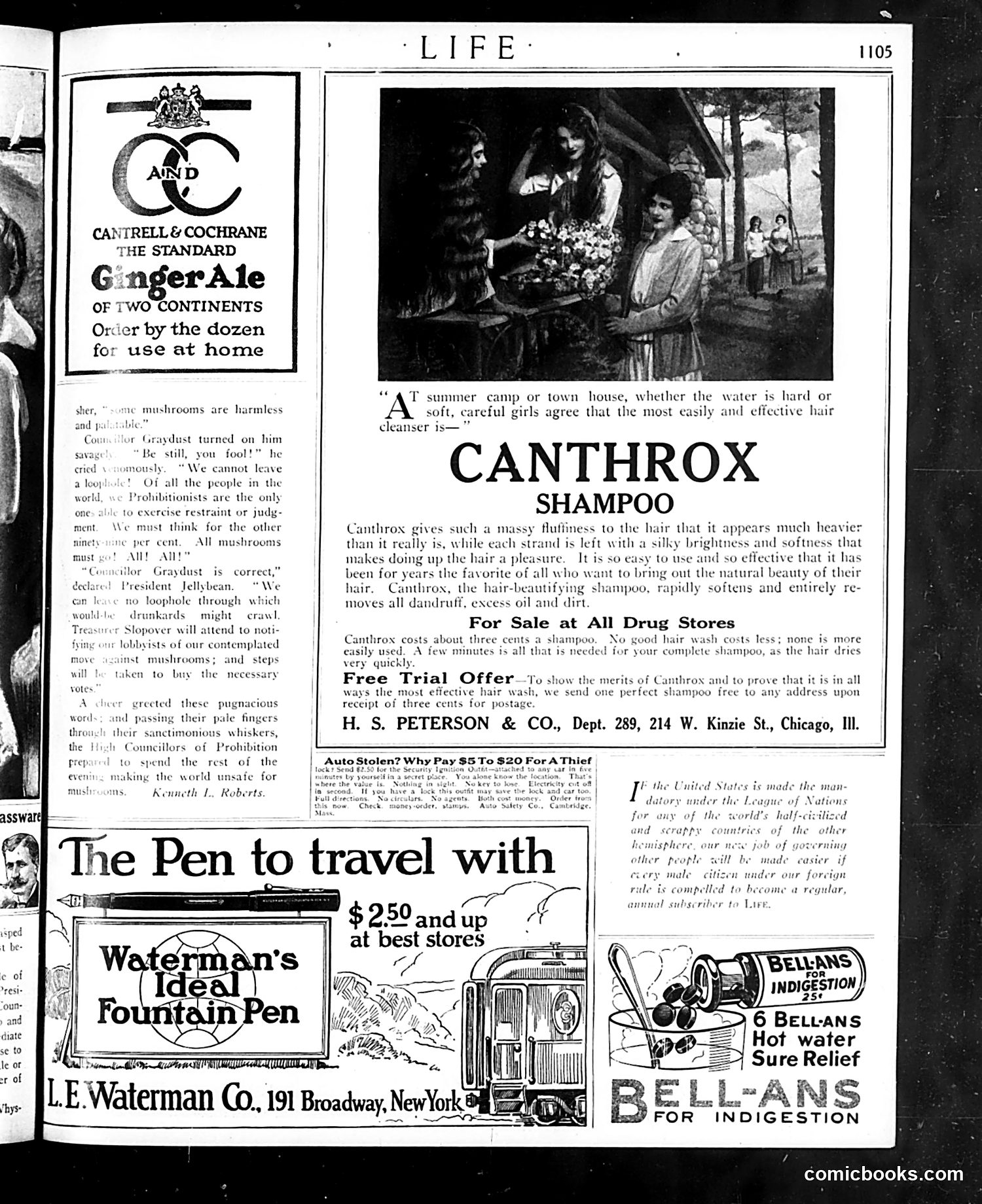
This page is primarily **advertising**, not political satire. The main content consists of product advertisements for: 1. **Cantrell & Cochrane Ginger Ale** (top left) 2. **Canthrox Shampoo** (center, largest ad) — marketed as effective for removing dandruff and conditioning hair 3. **Waterman's Ideal Fountain Pen** (lower left) 4. **Bellans antacid** (lower right) The only editorial content is a fragmentary text excerpt (top left) mentioning "Prohibition" and characters like "Councillor Graydust" and "President Jellybean," apparently satirizing Prohibitionist politicians as self-righteous while exempting themselves from restraint—a common anti-Prohibition jab. However, this text is heavily damaged/unclear in the OCR and image. The page number (1105) and "LIFE" masthead indicate this is from Life magazine's advertising section, where editorial content and ads mixed freely. The satire here, if present, is marginal to the commercial purpose.
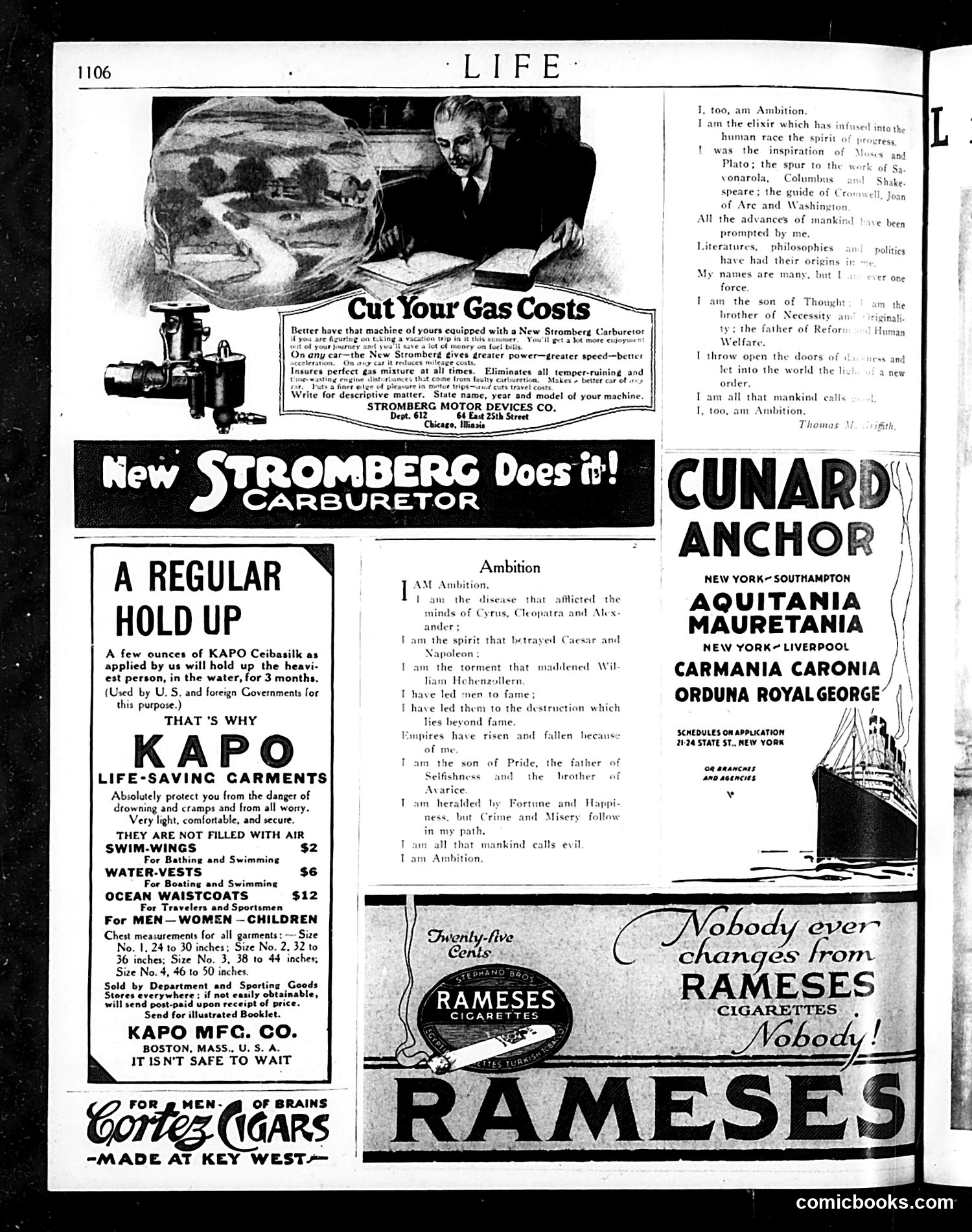
This page is primarily **advertisements** with one notable literary piece. The main content is a philosophical poem titled "Ambition" presented as two competing voices—one warning of ambition's destructive nature (ambition as disease, leading to Napoleon's fall, empire destruction), the other defending it as human progress (inspiration for Plato, Columbus, Joan of Arc). The advertising includes life-saving swimwear (KAPO), a Stromberg carburetor, Cortez cigars, Cunard steamship lines, Rameses cigarettes, and other products typical of early 20th-century magazines. The "Ambition" piece appears to be satirical commentary on human striving—presenting both the cautionary and celebratory views of ambition without resolving which is "correct." This reflects the era's tension between industrial progress and skepticism about unchecked ambition. The cigarette advertisement below seems deliberately ironic placement given the poem's moral themes.