
Life, 1919-06-19 · page 21 of 42
Life — June 19, 1919 — page 21: what you’re looking at
What you’re looking at
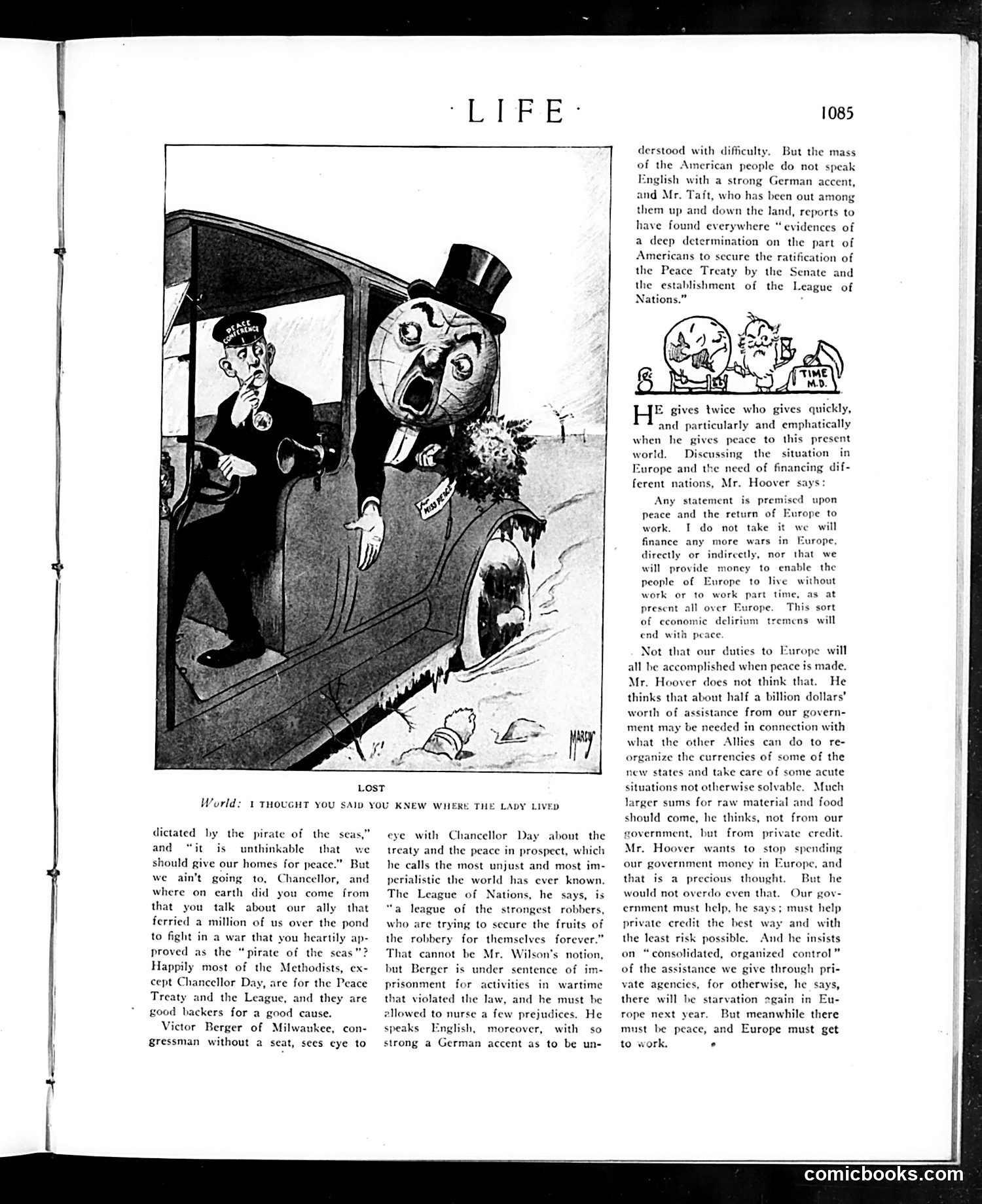
This cartoon satirizes post-World War I peace negotiations and the League of Nations debate. The figure labeled "World" sits in a car driven by a grotesque character representing the "pirate of the seas"—likely Germany or German aggression. An American figure inside appears confused and lost. The satire targets multiple figures: **Chancellor Day** (Methodist leader opposed to the peace treaty), **Victor Berger** (Socialist congressman with German accent, imprisoned for wartime activities), and implicitly **President Wilson's** League proposal. The cartoon mocks those who question American commitment to peace efforts while having supported the war itself. The "pirate" driving suggests Germany still controls outcomes despite defeat. The lost world imagery implies confusion about post-war direction. The accompanying text by **Hoover** advocates conditional European aid—peace first, then limited reconstruction financing—rejecting perpetual American financial support for European recovery.
📄 Transcribed text from this page (OCR, searchable)
Machine-transcribed from the original scan — historical spelling and the odd misread are preserved.
7 Lost World: dictated by the pirate of the s and “it is unthinkable that should give our homes for peace.” But we ain't going to, Chancellor, and where on earth did you come from that you talk about our ally that ferried a million of us over the pond to fight in a war that you heartily ap- proved as the “pirate of the seas"? Happily most of the Methodists, ex- cept Chancellor Day, are for the Peace Treaty and the League, and they are good backers for a good cause. Victor Berger of Milwaukee, con- gressman without a seat, sees cye to we I THOUGHT YOU SAID YOU KNEW WHE! LADY LIVED eye with Chancellor Day about the treaty and the peace in prospect, which he calls the most unjust and most im- perialistic the world has ever known. The League of Nations, he says, is “a league of the strongest robbers, who are trying to secure the fruits of the robbery for themselves forever.” That cannot be Mr. Wilson's notion, but Berger is under sentence of im- prisonment for activities in wartime that violated the law, and he must be allowed to nurse a few prejudices. He speaks English, moreover, with so strong a German accent as to be un- 1085 derstood with difficulty, But the mass of the American people do not speak English with a strong German accent, and Mr. Taft, who has been out among them up and down the land, reports to have found everywhere “evidences of a deep determination on the part of Americans to secure the ratification of the Peace Treaty by the Senate and the L the establishment of E gives twice who gives quickly, and particularly and emphatically when he gives peace to this present world. Discussing the situation in rope and the need of financing dif- ferent nations, Mr. Hoover says: Any statement is premised upon peace and the return of Europe to work. I do not take will finance any more wars in directly or indircetly, nor that we will provide money to enable the people of Europe to live without work or to work part time, as at present all over Europe. This sort ie del tremens will ace. it we Europe, of econo: ium end with p Not that our duties to Europe will all he accomplished when peace is made. Mr. Hoover does not think that. He thinks that about half a billion dollars’ worth of assistance from our govern- ment may be needed in connection with what the other Allies can do to re- organize the currencies of some of the new states and take care of some acute situations not otherwise solvable. Much larger sums for raw material and food should come, he thinks, not from our government, but from private credit. Mr. Hoover wants to stop spending our government money in Europe, and that is a precious thought. But he would not overdo even that. Our gov- ernment must help, he says; must help private credit the best way and with the least risk possible. And he insists on “consolidated, organized control” of the assistance we give through pri- vate agencies, for otherwise, he says, there will be starvation again in Eu- rope next year. But meanwhile there must be peace, and Europe must get to work. . comicbooks.com