
Life, 1919-06-19 · page 20 of 42
Life — June 19, 1919 — page 20: what you’re looking at
What you’re looking at
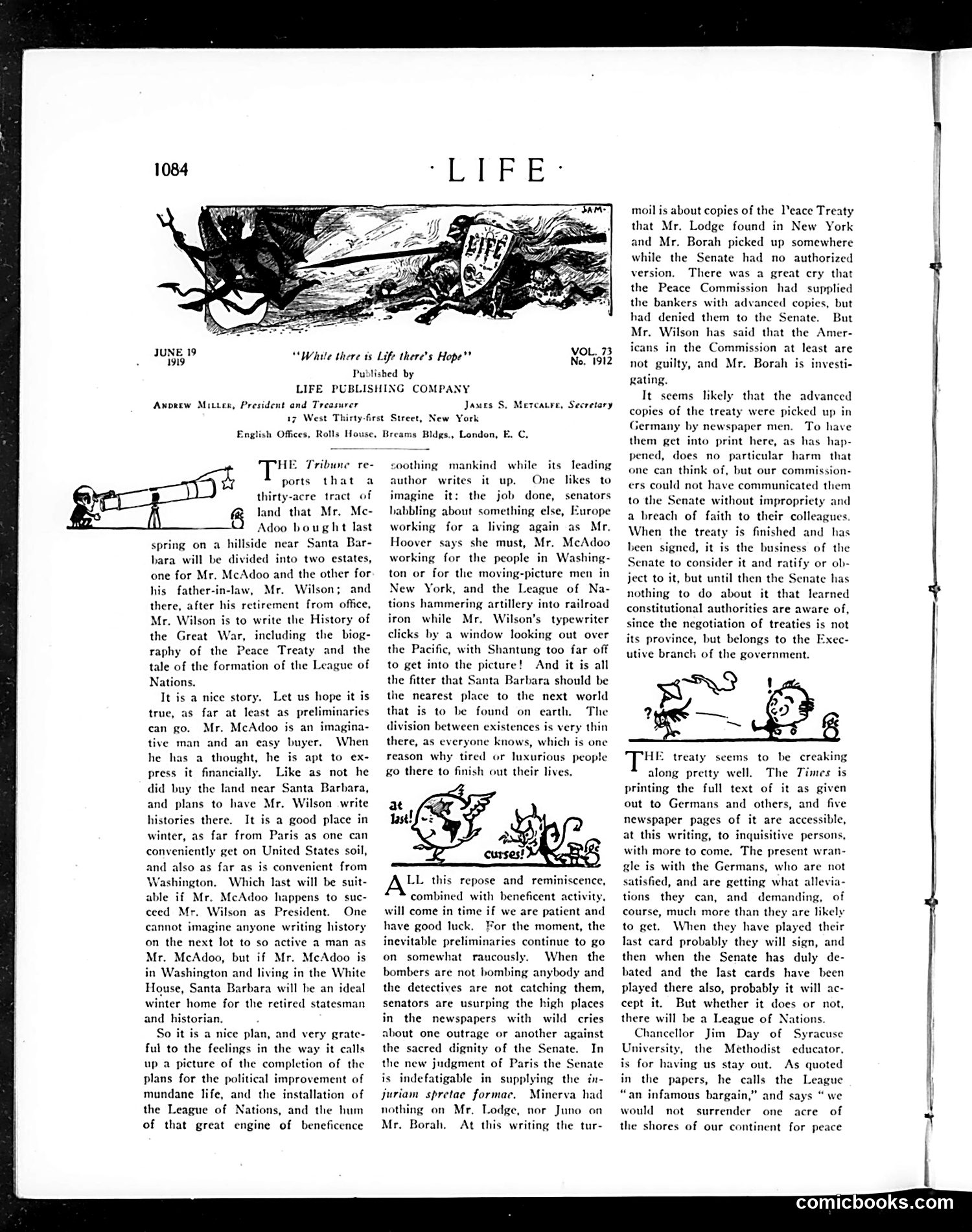
This piece satirizes post-WWI political rivalries and vanity among American leaders. The article mocks a rumor that Treasury Secretary William McAdoo bought Santa Barbara land to provide President Wilson a retirement retreat where he'd write his memoirs about the Peace Treaty and League of Nations. The satire ridicules the scenario's implausibility while gently poking fun at Wilson's self-importance and McAdoo's ambitious financial gestures. More pointedly, it attacks Senate Republicans—specifically Senators Henry Lodge and William Borah—for their petty posturing over access to Peace Treaty copies. The text sarcastically compares their self-righteous indignation to classical mythological figures (Minerva and Juno), suggesting their complaints about being denied documents are performative outrage designed for newspaper headlines rather than genuine constitutional concerns. The cartoon depicts political squabbling during treaty ratification debates.
📄 Transcribed text from this page (OCR, searchable)
Machine-transcribed from the original scan — historical spelling and the odd misread are preserved.
JUNE 19 wig “While there is Life there's Hope" VOL. 73 No, 1912 Published by LIFE PUBLISHING COMPANY Anperw Mittes, President and Treasurer Janes S. Metcatre, Secretary 17 West Thirty-first Street, New York English Offices, Rolls House, Breams Bldgs., London, E. C. Tribune re- T! = ports that a thirty-acre tract of Gi land that Mr. Me- Adoo bought last spring on a hillside near Santa Bar- bara will be divided into two estates, one for Mr. McAdoo and the other for his father-in-law, Mr. Wilson; and there, after his retirement from office, Mr. Wilson is to write the History of the Great War, including the biog- raphy of the Peace Treaty and the tale of the formation of the League of Nations, It is a nice story. Let us hope it is true, as far at least as preliminaries can go. Mr. McAdoo is an imagina- tive man and an easy buyer, When he has a thought, he is apt to ex- press it financially. Like as not he did buy the land near Santa Barbara, and plans to have Mr. Wilson write histories there. It is a good place in winter, as far from Paris as one can conveniently get on United States soil, and also as far as is convenient from Washington. Which last will be suit- able if Mr. McAdoo happens to suc- ceed Mr. Wilson as President. One cannot imagine anyone writing history on the next lot to so active a man as Mr. McAdoo, but if Mr. McAdoo is in Washington and living in the White House, Santa Barbara will an ideal winter home for the retired statesman and historian, So it is a nice plan, and very grate- ful to the feelings in the way it calls up a picture of the completion of the plans for the political improvement of mundane life, and the installation of the League of Nations, and the hum of that great engine of beneficence soothing mankind while its leading author writes it up. One likes to imagine it: the job done, senators babbling about something e urope working for a living again as Mr. Hoover says she must, Mr. McAdoo working for the people in Washing- ton or for the moving-picture men in New York, and the League of Na- tions hammering artillery into railroad iron while Mr, Wilson’s typewriter clicks by a window looking out over the Pacific, with Shantung too far off to get into the picture! And it is all the fitter that Santa Barbara should be the nearest place to the next world that is to be found on earth. The division between existences is very thin there, as everyone knows, which is one reason why tired or luxurious people go there to finish out their live: LL this repose and reminiscence, combined with beneficent activ will come in time if we are patient and have good luck. For the moment, the inevitable preliminaries continue to go on somewhat raucously. When the bombers are not bombing anybody and the detectives are not catching them, senators are usurping the high places in the newspapers with wild cries about one outrage or another against the sacred dignity of the Senate. In the new judgment of Paris the Senate is indefatigable in supplying the in- juriam spretae formae, Minerva had nothing on Mr. Lodge, nor Juno on Mr. Borah. At this writing the tur- moil is about copies of the leace Treaty that Mr. Lodge found in New York and Mr. Borah picked up somewhere while the Senate had no authorized version. There was a great cry that the Peace Commission had supplied the bankers with advanced copies, but had denied them to the Senate. But Mr. Wilson has said that the Amer- icans in the Commission at least are not guilty, and Mr. Borah is investi- gating. It seems likely that the advanced copies of the treaty were picked up in Germany by newspaper men. To have them get into print here, as has hap- pened, does no particular harm that one can think of, but our commission- ers could not communicated them to the Senate without impropriety and a breach of faith to their colleagues. When the treaty is finished and has been signed, it is the business of the Senate to consider it and ratify or ob- ject to it, but until then the Senate has nothing to do about it that learned constitutional authorities are aware of, since the negotiation of treaties is not its province, but belongs to the Exec- utive branch of the government. HE treaty seems to be creaking along pretty well. The Times is printing the full text of it as given out to Germans and others, and five newspaper pages of it are accessible, at this writing, to inquisitive persons, with more to come. The present wran- gle is with the Germans, who are not satisfied, and are getting w allevi tions they can, and demanding, of course, much more than they are likely to get. When they have played their last card probably they will sign, and then when the Senate has duly de- bated and the last cards have been played there also, probably it will ac- cept it. But whether it does or not, there will be a League of Nations. Chancellor Jim Day of Syracuse University, the Methodist educator. is for having us stay out. As quoted in the papers, he calls the League “an infamous bargain,” and says “we would not surrender one acre of the shores of our continent for peace comicbooks.com nf