A complete issue · 46 pages · 1919
Life — June 12, 1919
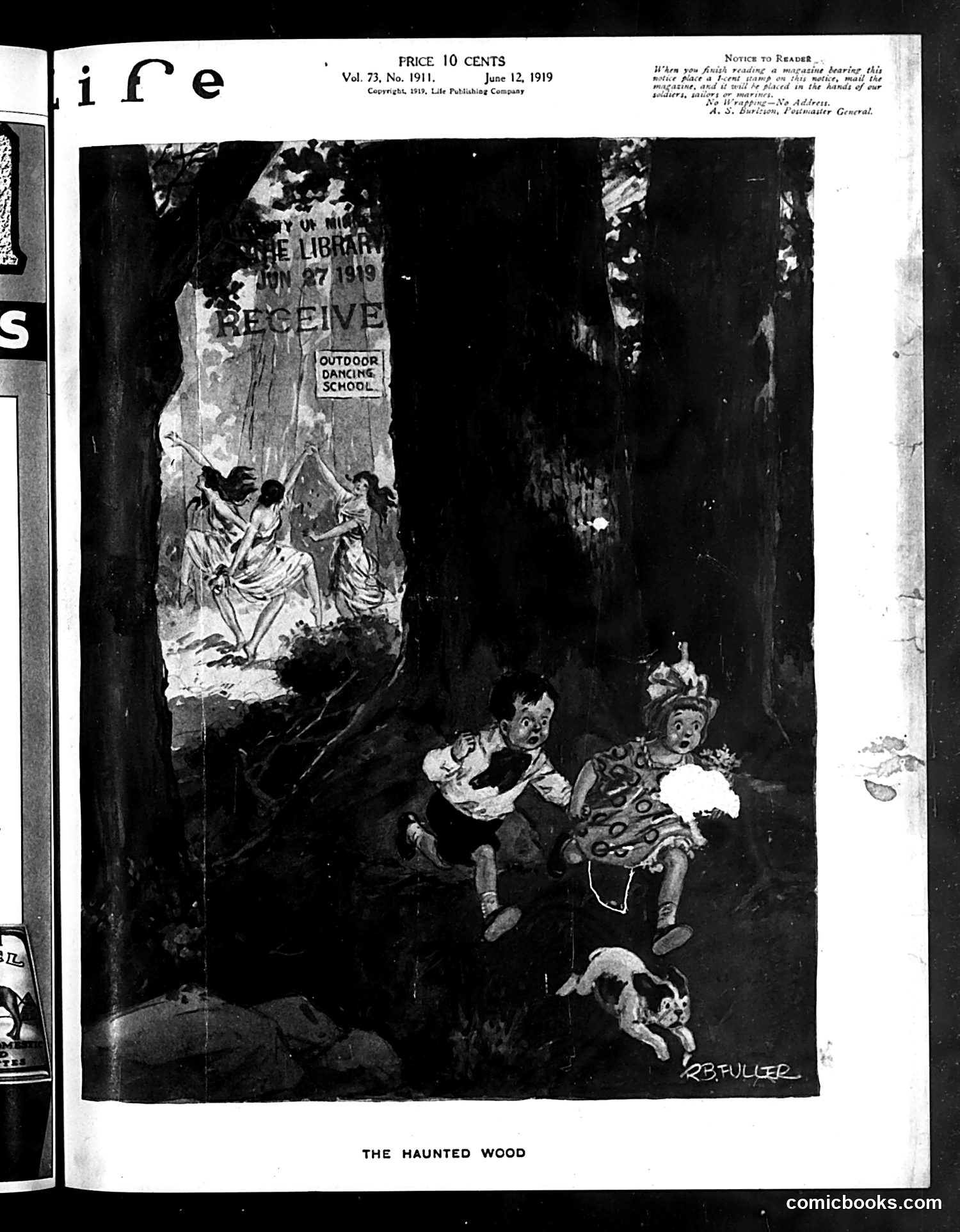
This cartoon depicts two children discovering a sign for an "Outdoor Dancing School" in a dark, spooky forest. The wood itself appears haunted, with ghostly figures visible in the trees above—appearing to be classical or angelic figures. The satire likely mocks the era's enthusiasm for "outdoor dancing" as a fashionable activity, contrasting this modern leisure trend against older, more traditional or spiritual imagery. The "haunted" setting suggests nostalgia or unease about abandoning traditional customs for new fads. The children's innocent discovery of the sign amid supernatural imagery underscores the cartoon's critique: modern entertainment (represented by the dancing school) displacing or haunting traditional values. The artwork is signed "V.B. Fuller."
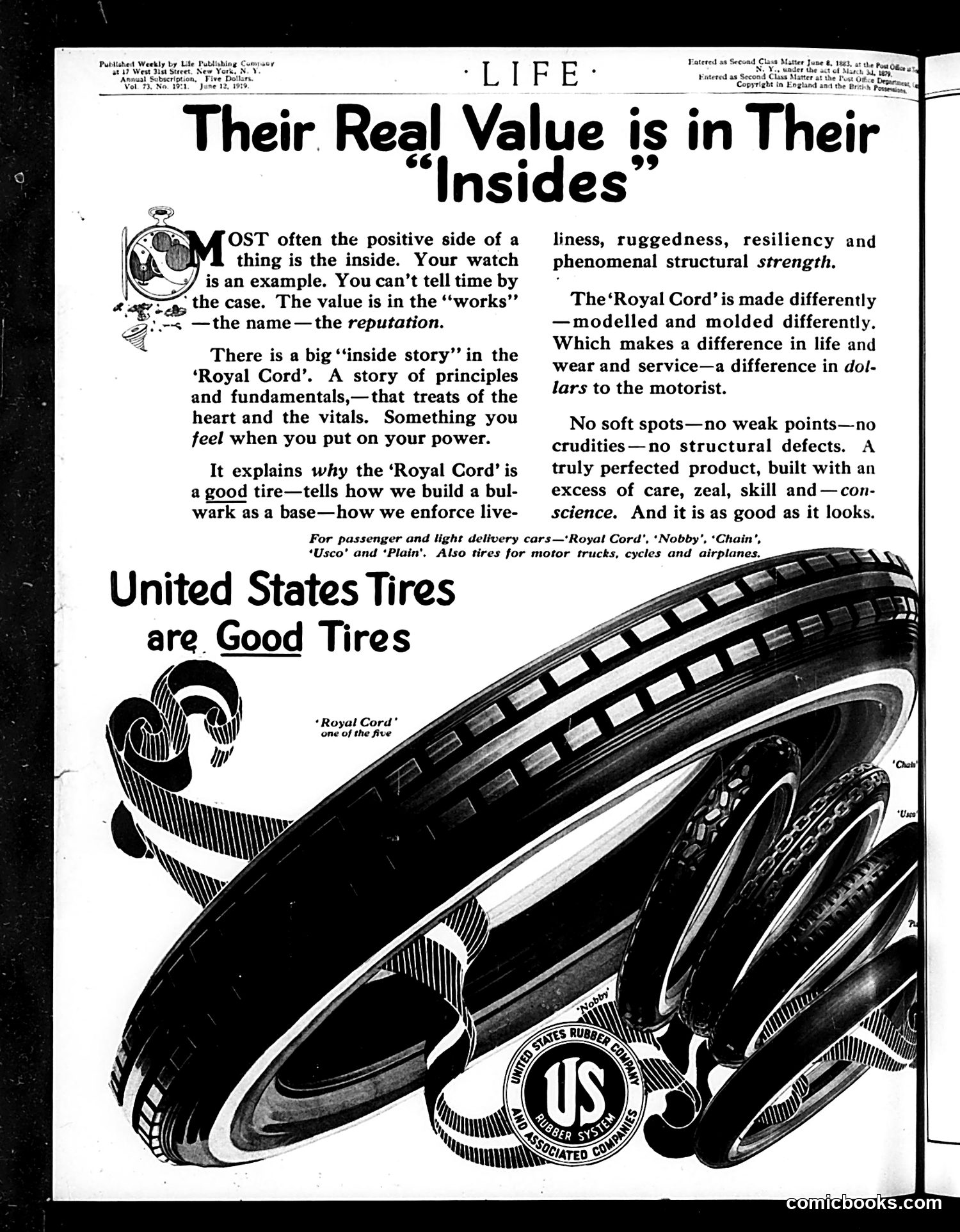
This is primarily a **United States Tires advertisement**, not political satire. The page promotes the "Royal Cord" tire brand, emphasizing that quality lies in internal construction rather than external appearance—comparing it to a watch where "the value is in the 'works.'" The ad emphasizes durability, structural integrity, and reliability of US Tires products for various vehicles (passenger cars, trucks, motorcycles, airplanes). The accompanying illustrations show cross-sections and multiple tire profiles to highlight engineering quality. There is **no political cartoon or satire present**. This is straightforward commercial advertising from *Life* magazine's June 12, 1919 issue, showcasing industrial American manufacturing during the post-WWI era when automobile ownership was expanding rapidly.
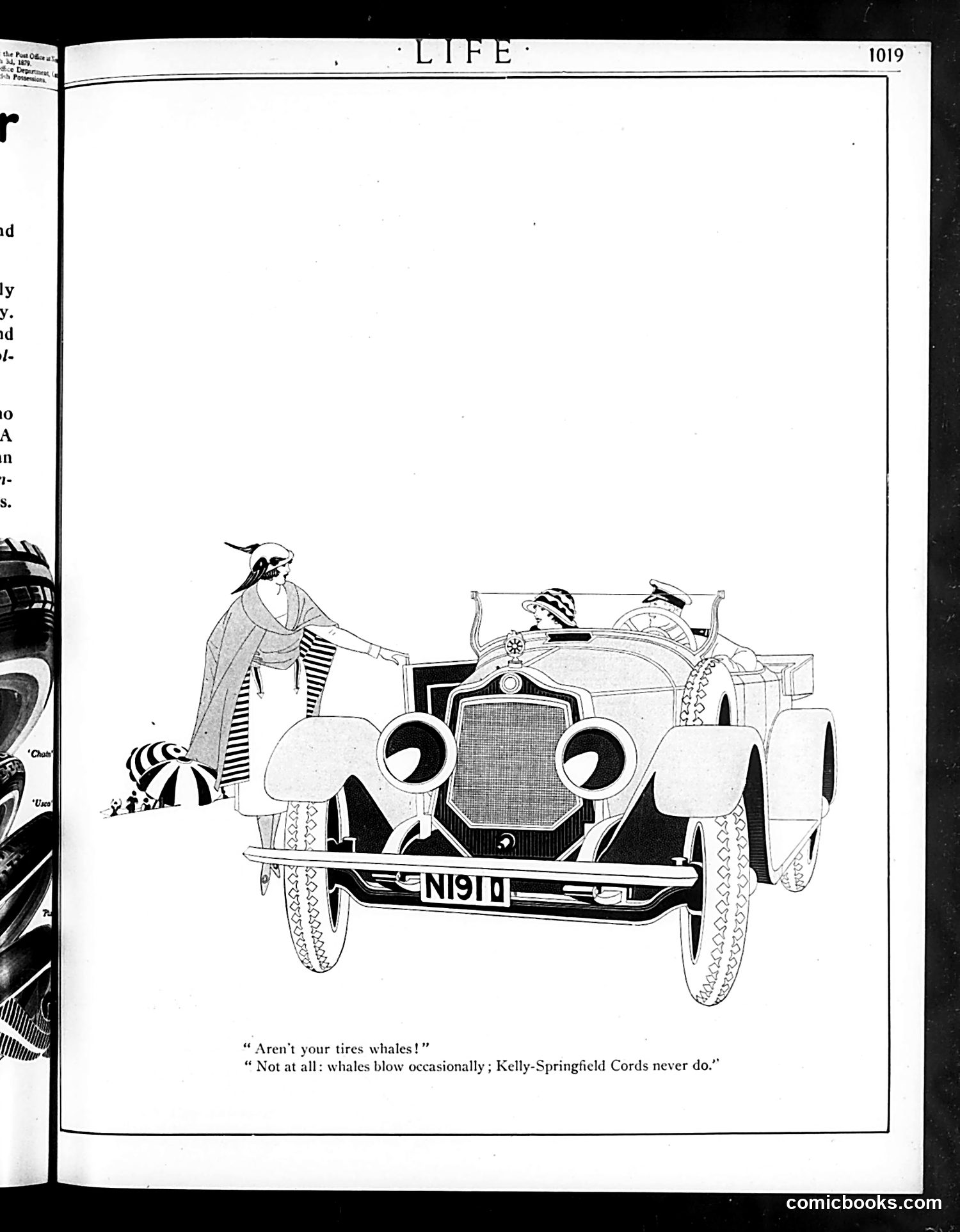
This is a **tire advertisement disguised as a cartoon joke** from Life magazine (page 1019). The image shows a stylishly dressed woman (left) and two men in a convertible car with license plate "N191L." The dialogue reads: **Woman:** "Aren't your tires whales!" **Man:** "Not at all; whales blow occasionally; Kelly-Springfield Cords never do." The joke plays on "whales" as slang for worn or defective tires (which "blow out" or fail). The punchline advertises Kelly-Springfield Cords as superior tires that never blow, in contrast to inferior tires that do. The art deco style and fashionable figures suggest this targets affluent car owners. This is **promotional content** marketed as entertainment—a common advertising technique in early 20th-century magazines.
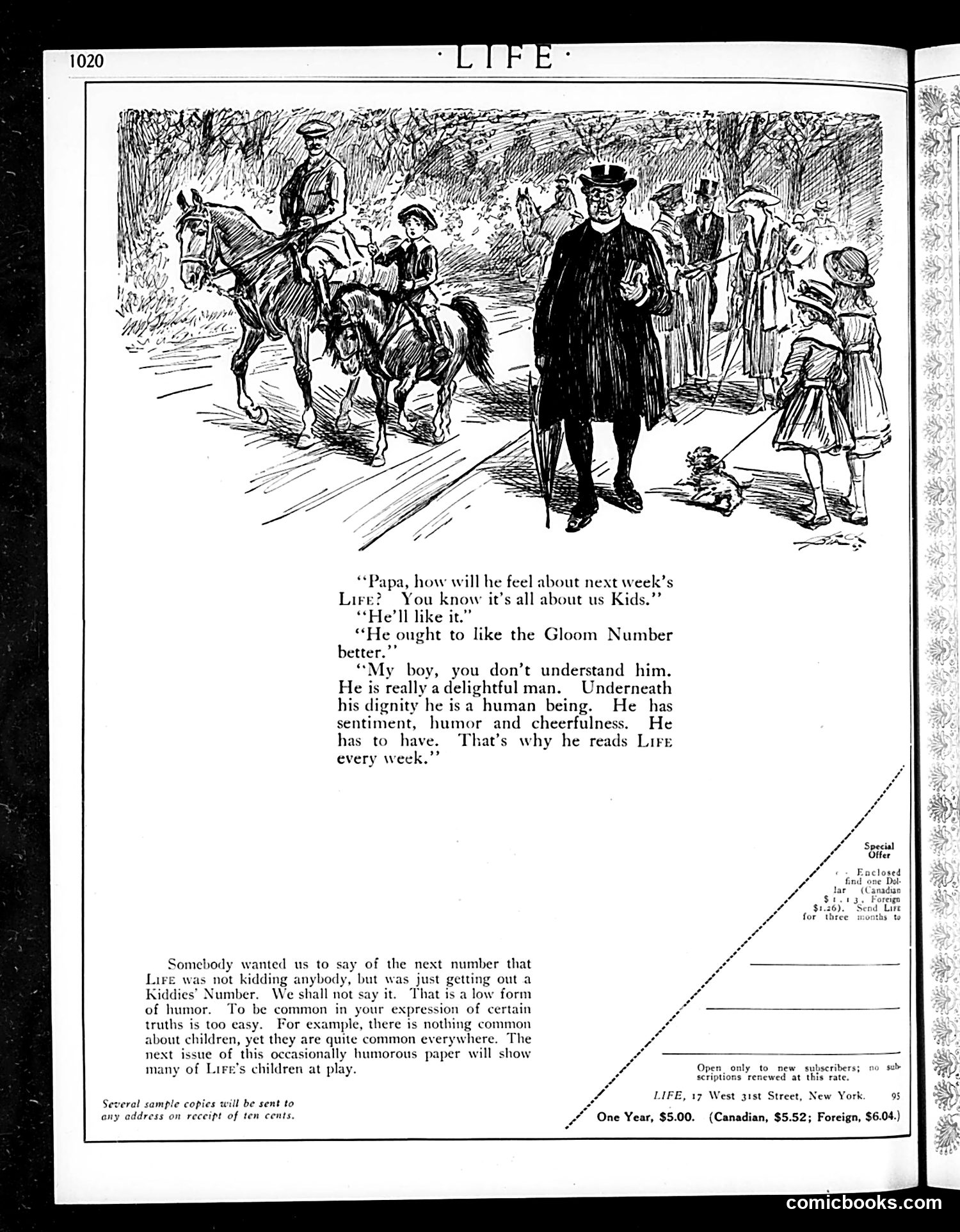
This page features a domestic scene satirizing class attitudes toward popular magazines. An elegantly dressed gentleman (likely representing upper-class sensibilities) dismisses *Life* magazine as suitable only for children, preferring "the Gloom Number" instead—a probable reference to a more serious, intellectual publication. His companion defends *Life*, arguing that beneath its humor lies genuine human sentiment and value. The satire targets snobbish attitudes toward popular entertainment: the implication that serious literature is inherently superior while humor and accessible writing are intellectually inferior. The accompanying text announces an upcoming "Kiddies' Number," clarifying that *Life* deliberately combines lighthearted content with social commentary, defending humor as a legitimate vehicle for truth-telling rather than mere frivolity.
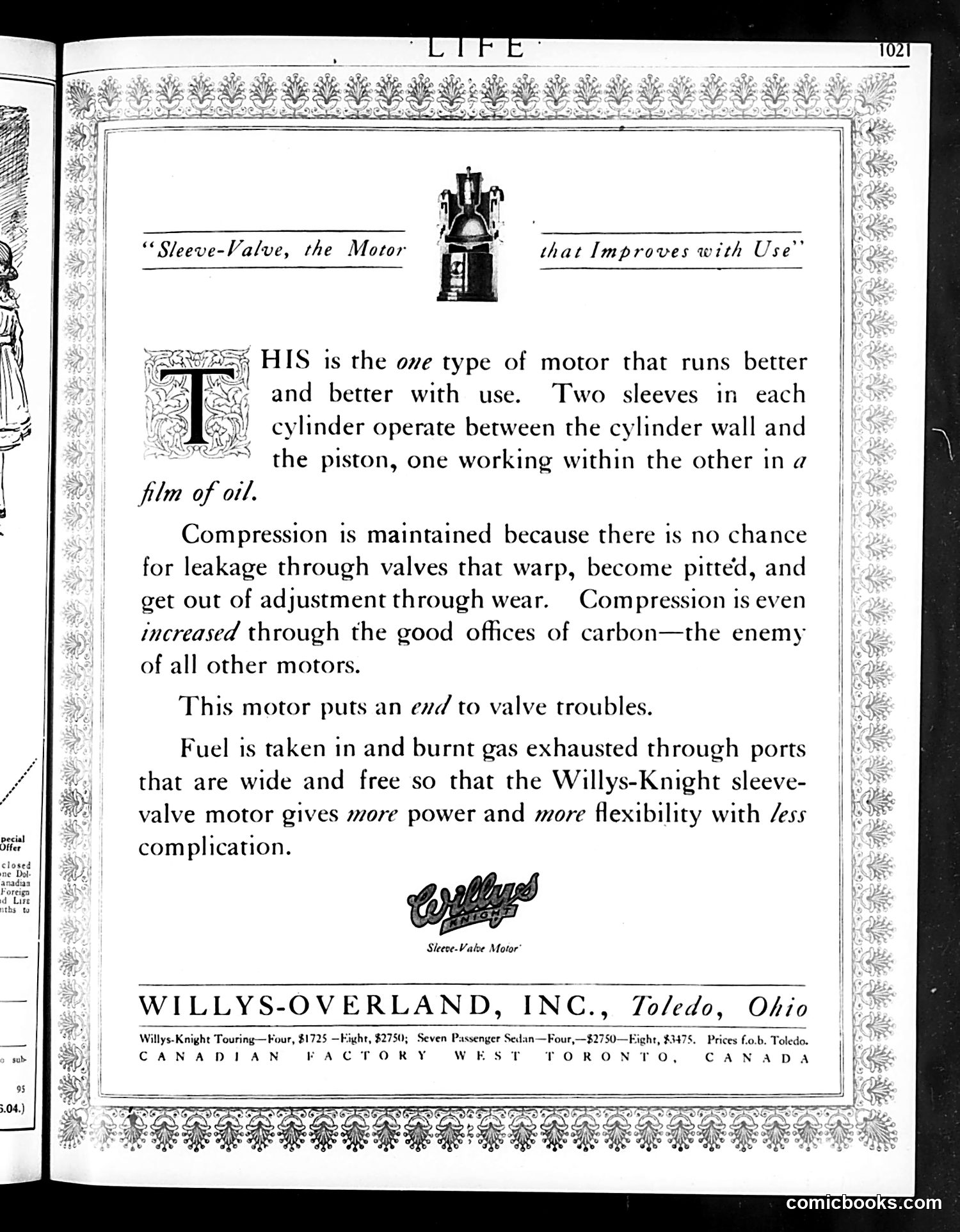
This page is primarily an **advertisement for Willys-Overland automobiles**, not satirical content. It promotes the "Sleeve-Valve Motor" as a technical innovation that "improves with use." The ad claims the motor's design—using two sleeves operating between cylinder walls and pistons in an oil film—prevents valve problems common in competing engines. It emphasizes the motor provides "more power and more flexibility with less complication." The Willys-Knight brand name appears at bottom, along with the company's location (Toledo, Ohio) and vehicle pricing/specifications for Canadian sales. There is no political cartoon or satire visible. This is straightforward early 20th-century automotive advertising emphasizing mechanical superiority over rival manufacturers' engines.
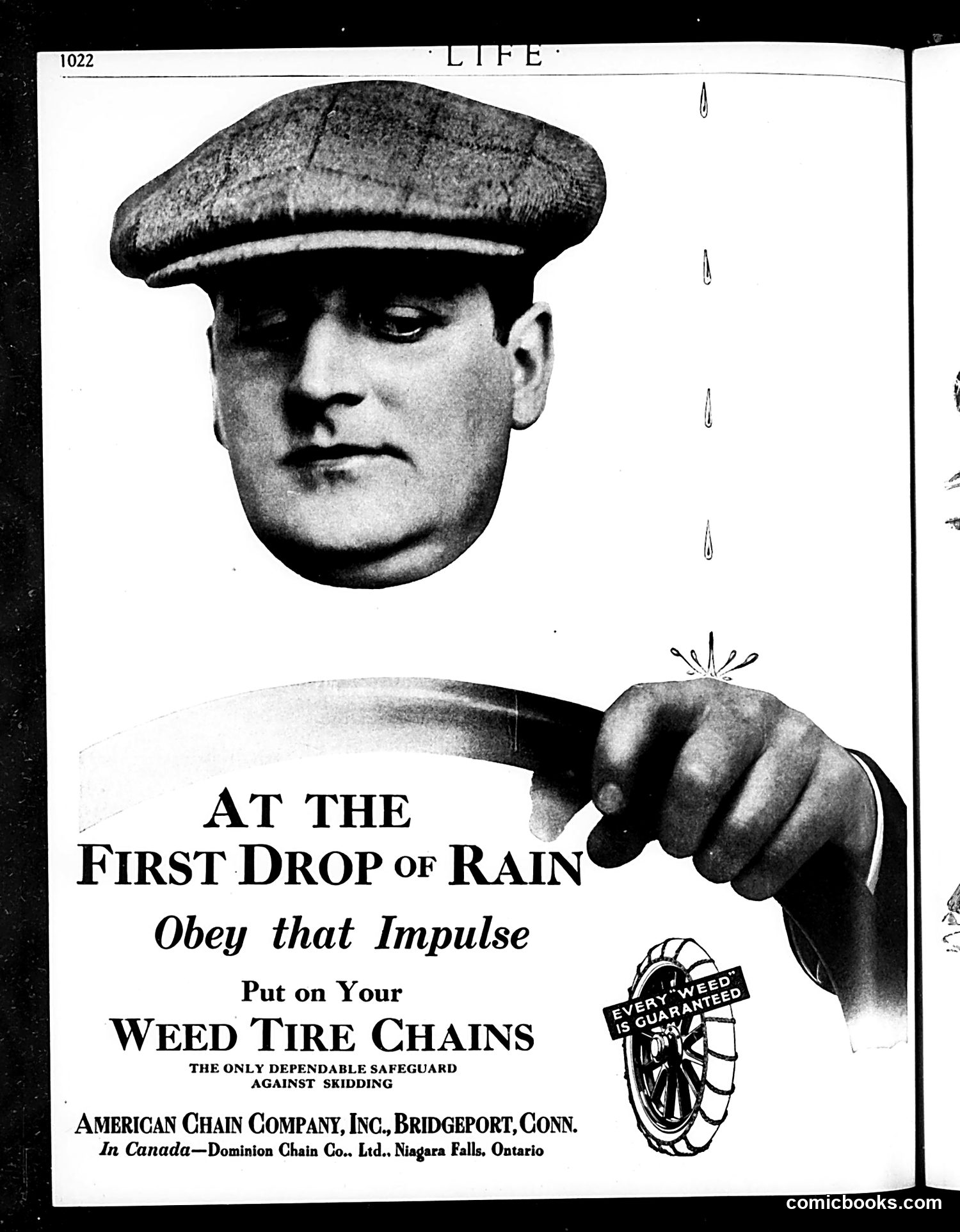
This is primarily a **vintage advertisement**, not political satire. It promotes Weed Tire Chains, manufactured by American Chain Company in Bridgeport, Connecticut. The ad features a man's portrait wearing a flat cap, holding what appears to be a tire chain. The headline urges drivers to install chains "at the first drop of rain" to prevent skidding—a practical safety concern for early automobiles with inferior traction. The phrase "Obey that Impulse" frames this as an instinctive safety measure. The small wheel logo includes "Every Weed is Guaranteed," emphasizing product reliability. This reflects early 20th-century driving conditions when tire chains were essential winter/wet-weather equipment, before modern tire technology made them largely obsolete.
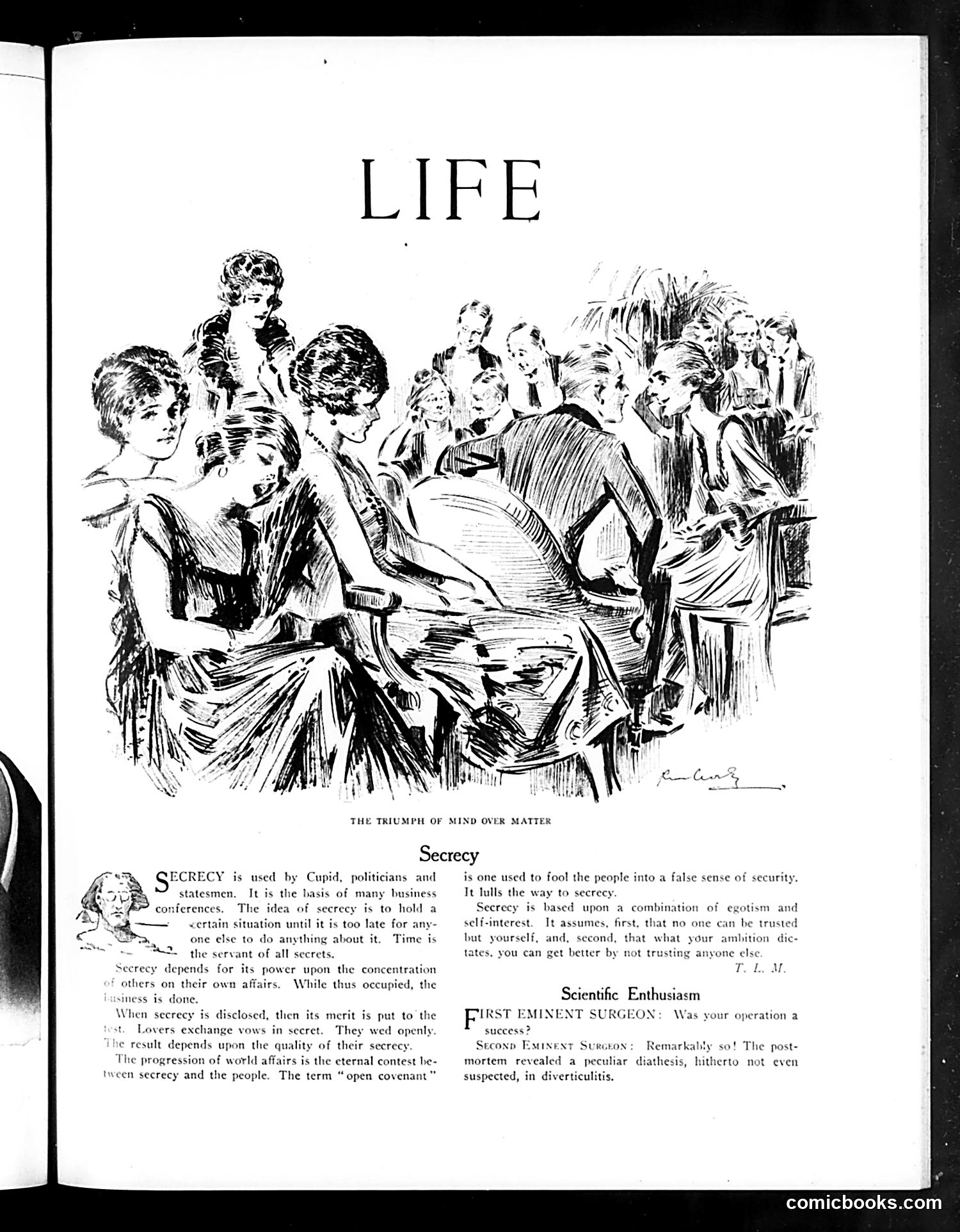
This page from *Life* magazine features "The Triumph of Mind Over Matter," a sketch depicting a social gathering where people appear engaged in conversation or gossip. The accompanying text explores **Secrecy** as a social and political tool—describing how it's used by "Cupid, politicians and statesmen" to manipulate situations and people. The article argues that secrecy depends on egotism and self-interest, allowing people to maintain false authority by withholding information. It concludes that transparency ("open covenant") benefits society more than concealment. Below this is a brief satirical exchange between two surgeons discussing a successful operation, mocking pretentious medical jargon and professional self-congratulation. The page critiques both social gossip and institutional secrecy as tools of power and deception.
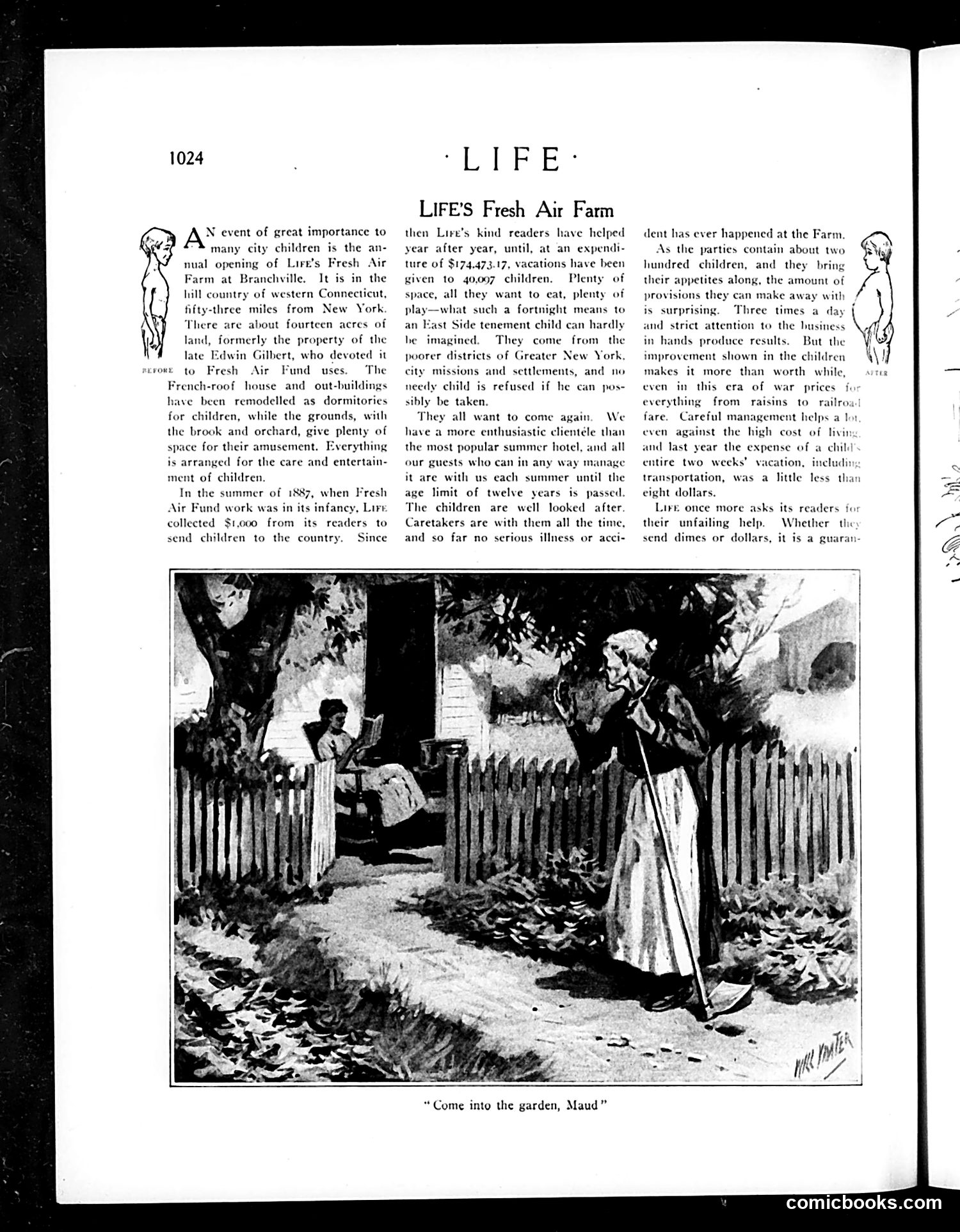
This page describes Life magazine's charitable Fresh Air Farm in Branchville, Connecticut—a real philanthropic initiative, not satire. The illustrated scene shows a woman and child in a garden setting with the caption "Come into the garden, Maud." The article explains that since 1887, Life has funded vacations for poor urban children from New York City, spending $174,473 annually to send roughly 10,000 children to the countryside. The text praises the program's success: children receive proper food, rest, and outdoor recreation they lack in city tenements. This represents Life magazine's era as a journal combining humor with progressive social advocacy—using its platform to highlight urban poverty and promote charitable solutions.
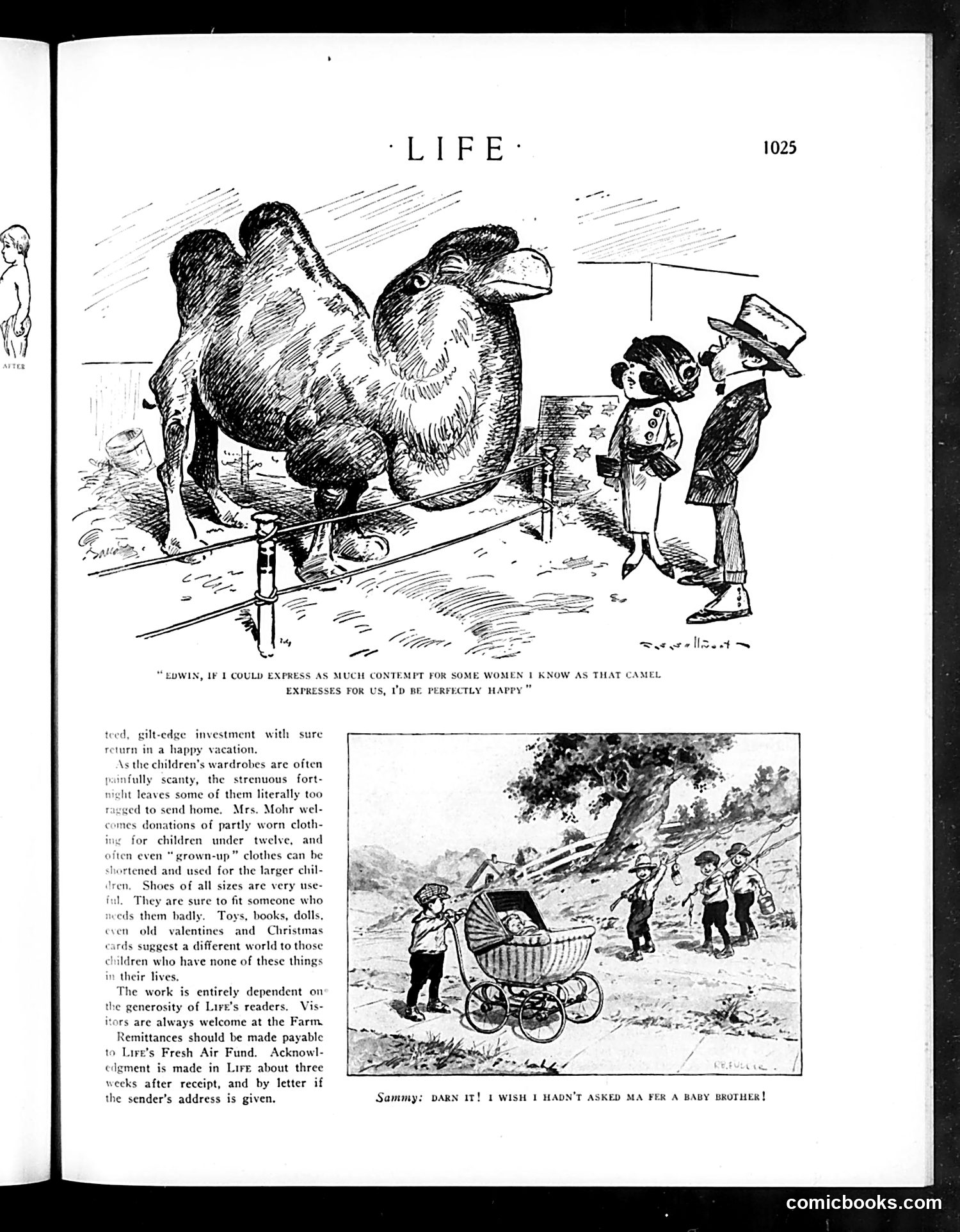
The top cartoon depicts two men in formal attire examining a camel at what appears to be a zoo or exhibition. The caption reads: "EDWIN, IF I COULD EXPRESS AS MUCH CONTEMPT FOR SOME WOMEN I KNOW AS THAT CAMEL EXPRESSES FOR US, I'D BE PERFECTLY HAPPY." This is a misogynistic joke typical of early 20th-century humor. The satire works by comparing women unfavorably to a camel's apparent disdain—suggesting women deserve contempt similar to what the animal displays. The camel's expression of superiority becomes a metaphor for masculine frustration with women. The lower image shows children with a baby carriage outdoors. The caption reads: "SAMMY: DARN IT! I WISH I HADN'T ASKED MA FOR A BABY BROTHER!" This is domestic humor about sibling rivalry and childcare responsibilities.
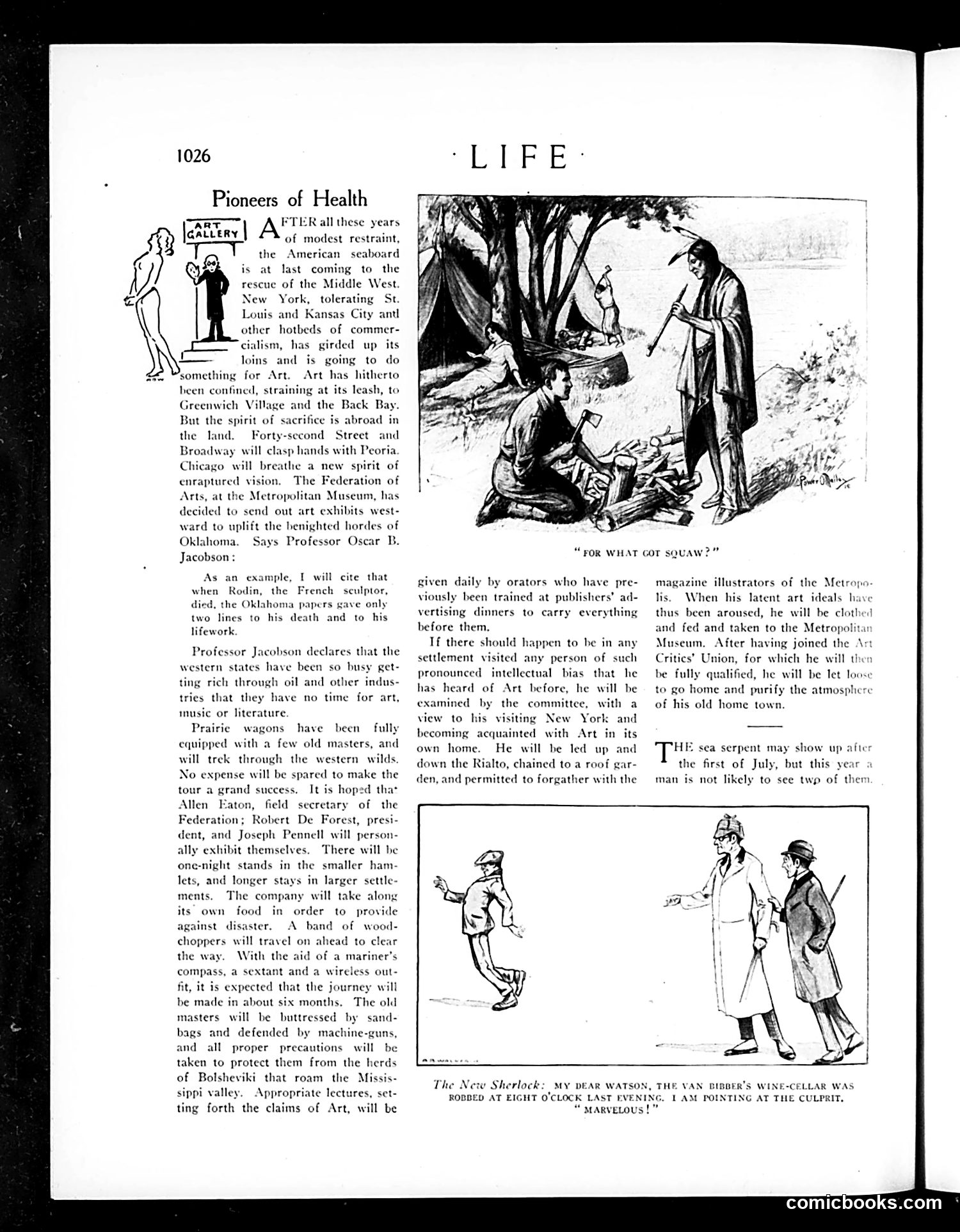
This page satirizes the American art establishment's dismissal of Western and Midwestern culture. The main article criticizes how Eastern cultural gatekeepers—centered on Broadway and New York—ignore art from regions like Oklahoma and Kansas. Professor Oscar B. Jacobson is cited arguing that Western states lack time for "Art, music or literature" due to industrial preoccupation. The top illustration titled "For What Got Squaw?" depicts Native Americans, sardonically commenting on Western artistic subjects deemed primitive or exotic by Eastern elites. The lower cartoon, "The New Sherlock," shows two men discussing an apparent theft—likely satirizing how Eastern sophisticates view Western culture as unsophisticated or criminal. The satire targets regional cultural bias and Eastern snobbery toward non-coastal American artistic contributions.
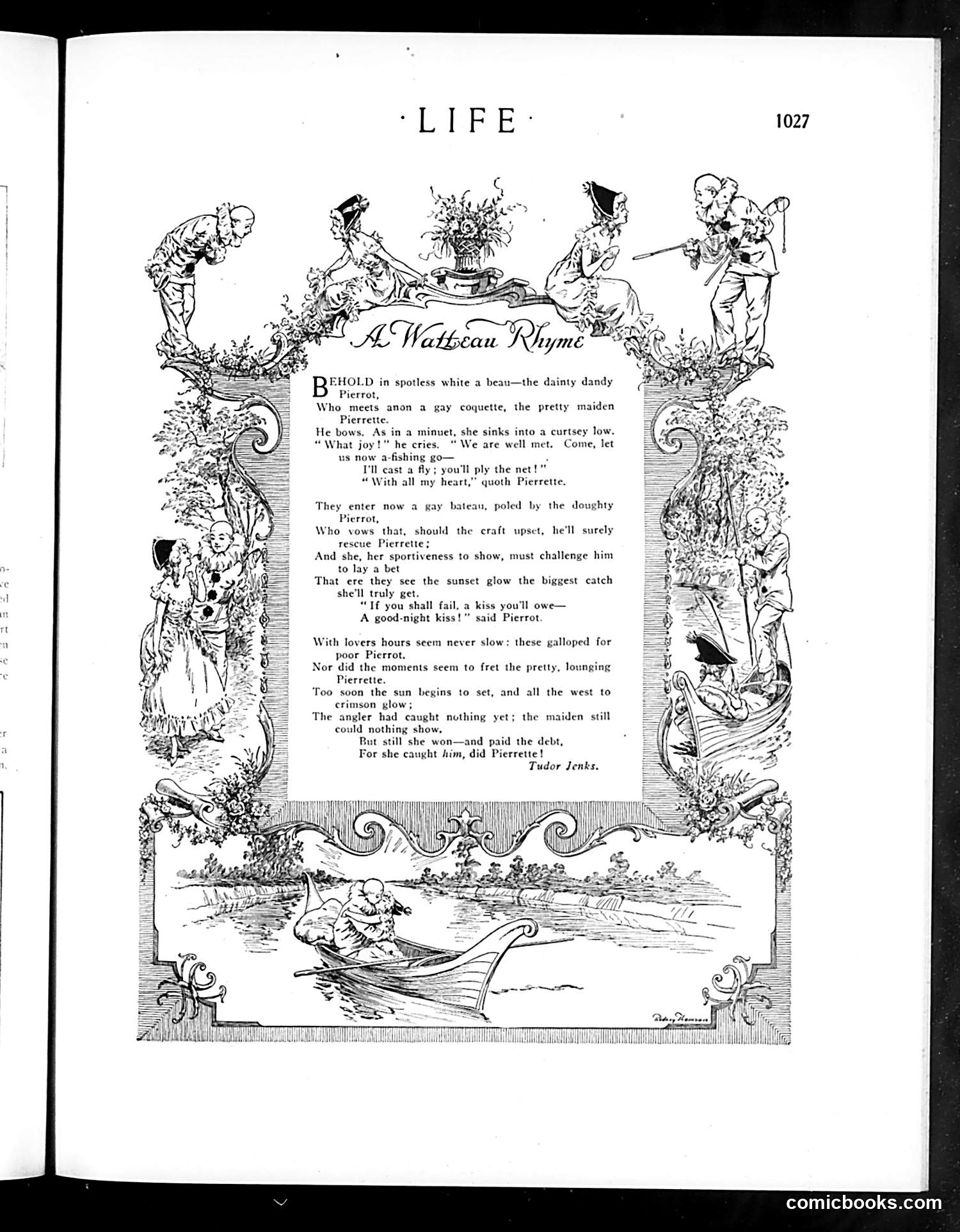
This is a whimsical illustrated poem by Tudor Jenks satirizing romantic French pastoral conventions. The narrative follows Pierrot (a stock character from French comedy—the lovesick clown) and Pierrette (a coquettish maiden) on a romantic boating excursion. The satire mocks the artificiality of idealized romance: despite Pierrot's earnest declarations and betting he'll catch fish to impress her, Pierrette remains indifferent. She ultimately "wins" the wager—catching Pierrot himself instead of fish—suggesting that calculated feminine charm defeats sincere male devotion. The ornate Watteau-inspired illustrations frame this gently cynical commentary on courtship rituals, dressed in the veneer of elegant 18th-century French aesthetics that Life's educated readers would recognize as deliberately overwrought.
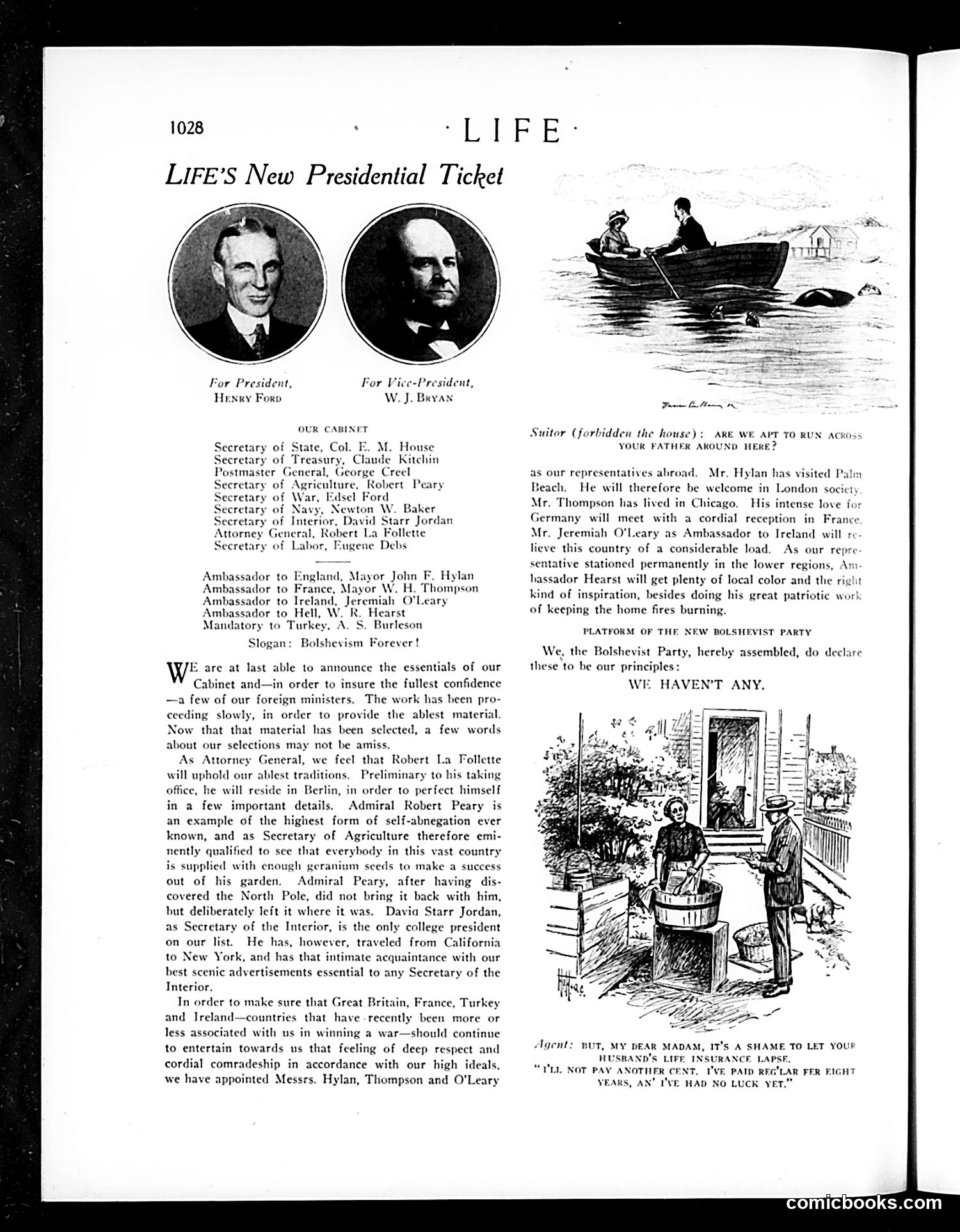
This page satirizes the 1912 U.S. presidential election, proposing Henry Ford for president and W.J. Bryan for vice-president as a joke ticket. The accompanying cartoons mock political absurdities of the era. The top cartoon shows two men in a rowboat, captioned "Suitor (Forbidden the house): ARE WE APT TO RUN ACROSS YOUR FATHER AROUND HERE?" — a comedic reference to the ambassadors and cabinet positions listed, suggesting political appointments involve dodging scrutiny. The bottom cartoon depicts life insurance rejection, where an agent tells a woman: "I'LL NOT PAY ANOTHER CENT. I'VE PAID REGULAR PER EIGHT YEARS, AN' I'VE HAD NO LUCK YET." This lampoons insurance company practices of denying claims on technicalities. The "Platform of the New Bolshevist Party" stating "WE HAVEN'T ANY" mocks both anarchist politics and the vagueness of contemporary political platforms.
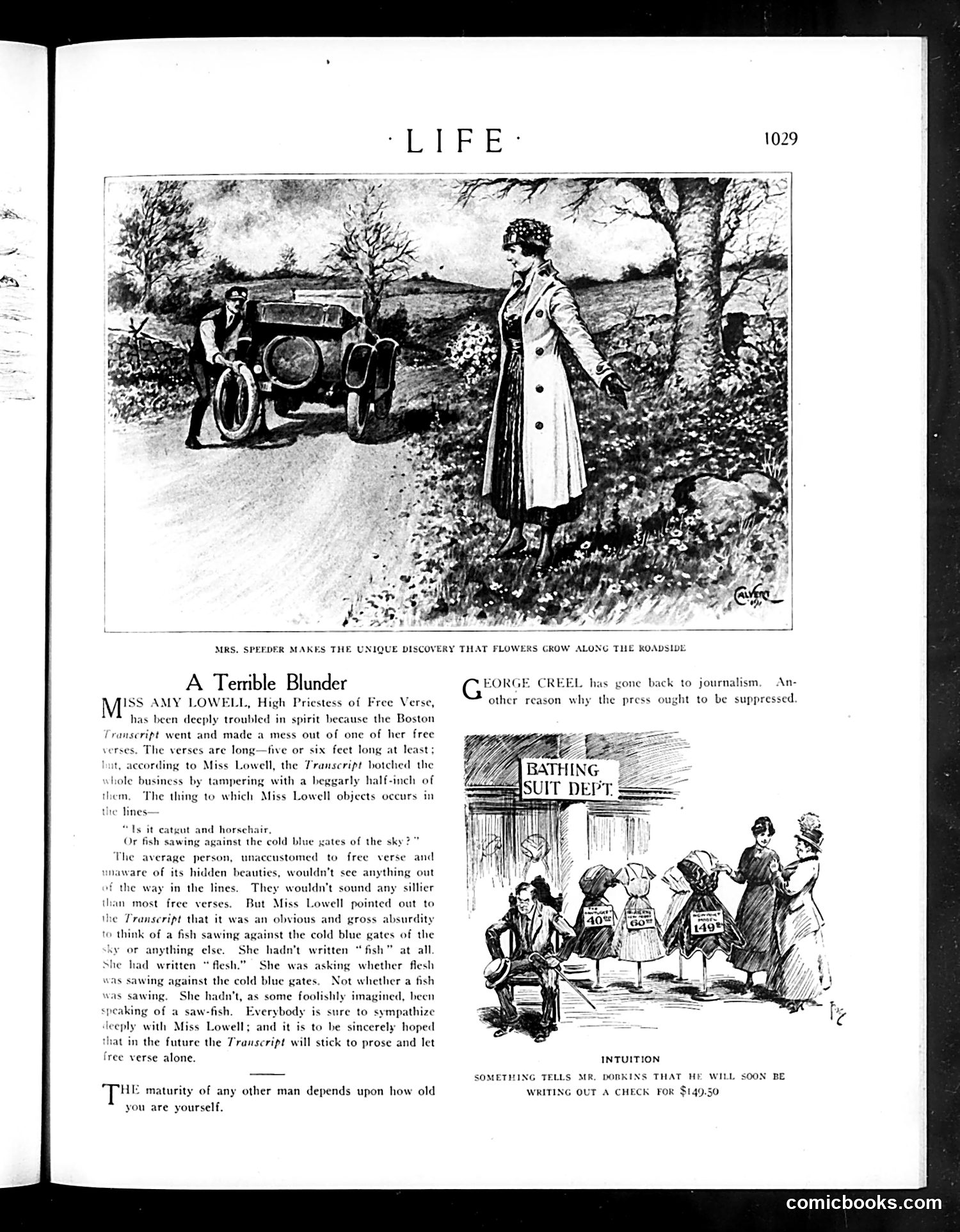
**Top Illustration: "A Terrible Blunder"** This cartoon critiques poet Amy Lowell's free verse. The text explains that Lowell's published manuscript contained lines about "fish sawing against cold blue gates of the sky"—which she hadn't actually written. The article humorously notes this represents either careless editing or absurdist poetry taken to ridiculous extremes. The accompanying illustration shows a well-dressed woman (Mrs. Speeder) by a roadside, apparently discovering that flowers grow there—a mundane observation presented as a profound poetic discovery, satirizing pretentious modernist verse. **Bottom Cartoon: "Intuition"** This brief gag depicts customers at a bathing suit department. A salesman will soon write a check for $149.50, suggesting he somehow intuits a customer's purchasing intent—or perhaps their financial desperation.
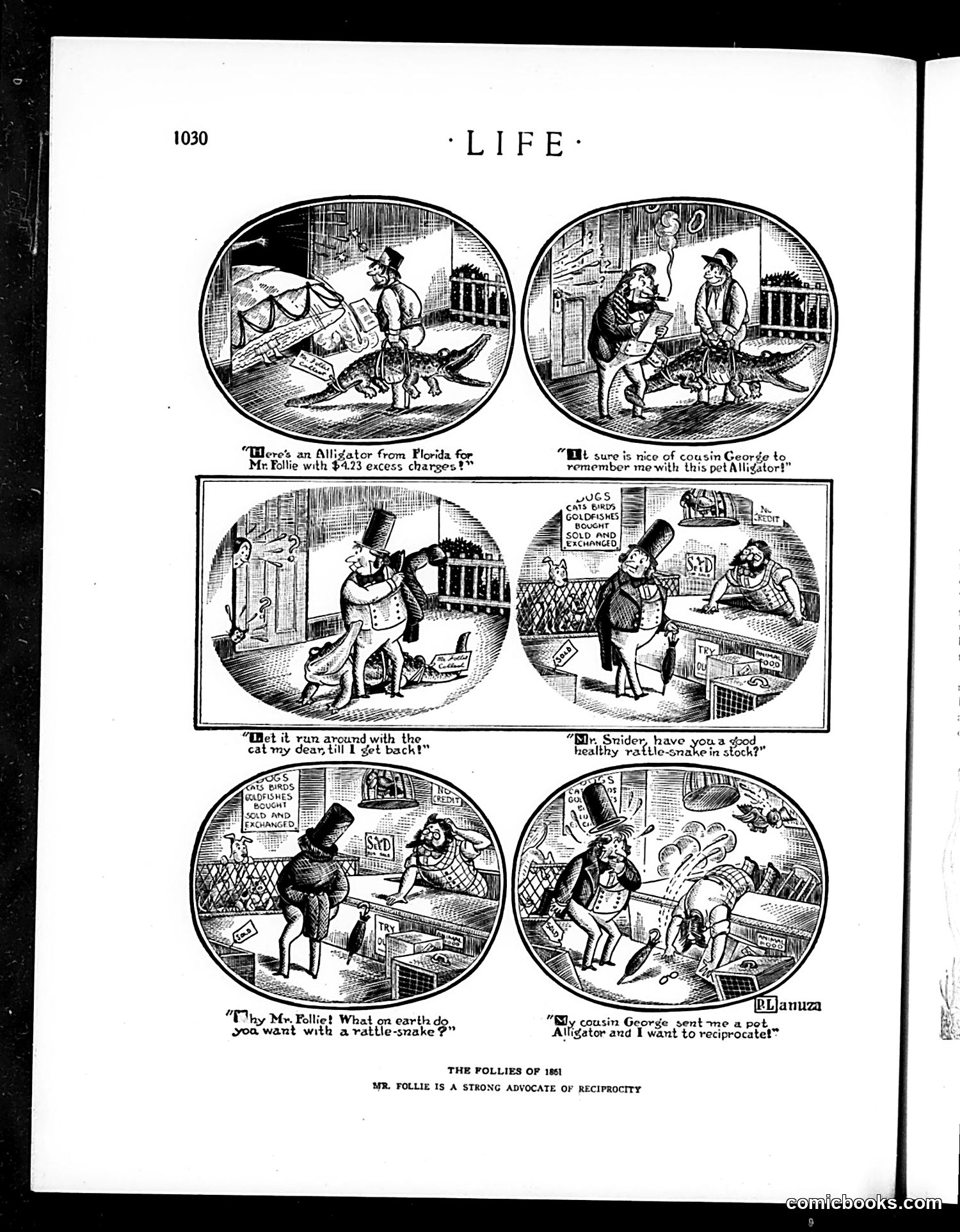
This satirical comic strip mocks Mr. Follie, characterized as "a strong advocate of reciprocity" (a trade policy). The humor centers on Follie sending his cousin George a live alligator from Florida as a "gift," then repeatedly trying to get it back through increasingly absurd excuses and demands. The joke exploits the concept of reciprocity—the idea that if you give someone a gift, they should reciprocate with something of equal value. Follie's escalating desperation to retrieve the alligator (insisting George return something equally valuable) satirizes the absurdity of strict reciprocal trade agreements. The 1861 date suggests this comments on contemporary trade policy debates during the Civil War era.
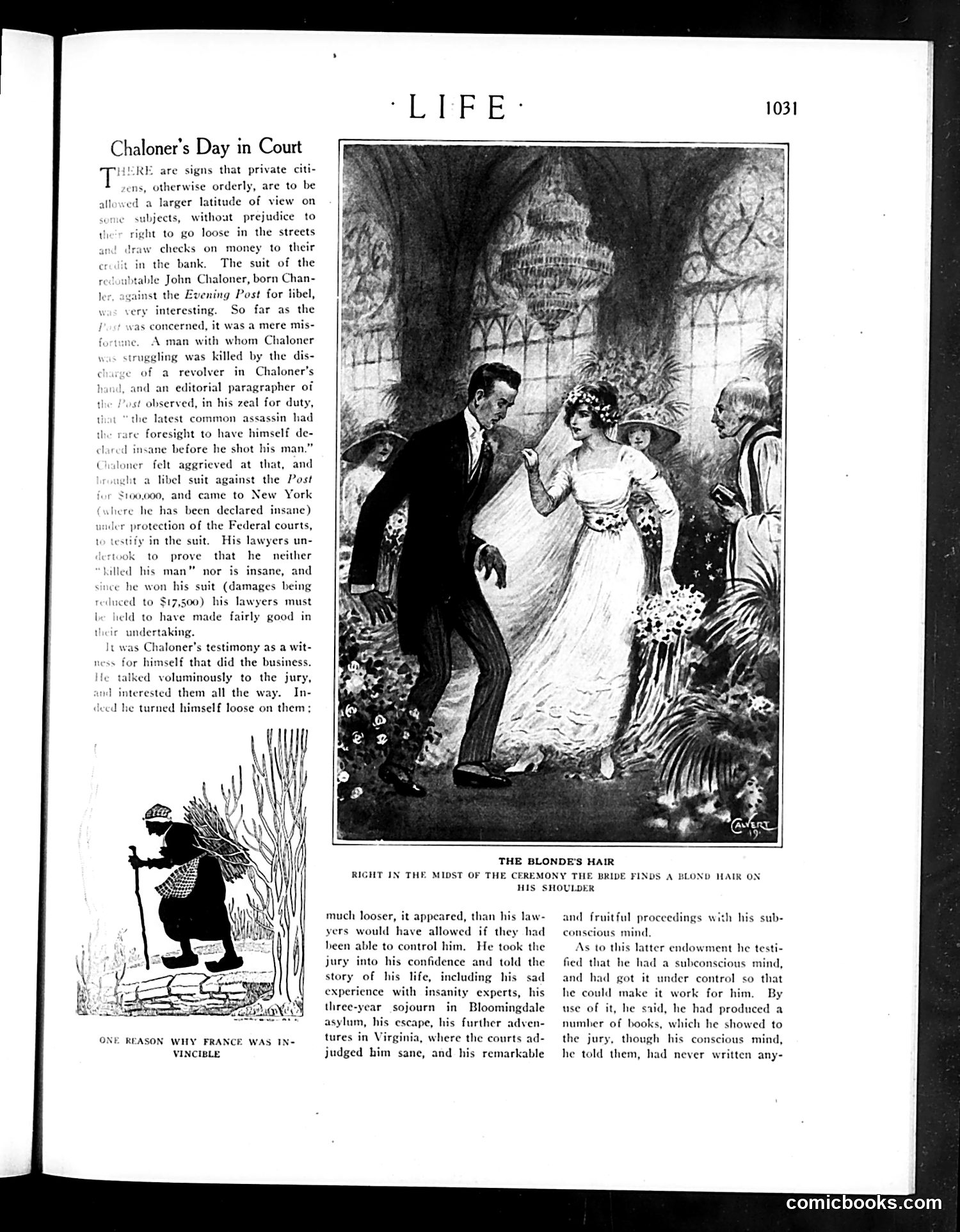
This page satirizes John Chaloner, a wealthy eccentric who sued the *Evening Post* for libel after they published an editorial calling him insane. The text describes how Chaloner's own testimony backfired—his verbose, rambling account to the jury essentially proved the newspaper's point rather than refuting it. The main illustration shows a wedding scene where a blonde woman's hair has fallen onto a man's shoulder, captioned "The Blondes Hair." This appears unrelated to the Chaloner story, suggesting it's a separate satirical cartoon about social propriety or marital mishaps. The smaller cartoon at bottom left ("One Reason Why France Was Invincible") depicts a soldier with bundled hay, likely a joke about military logistics or French military culture.
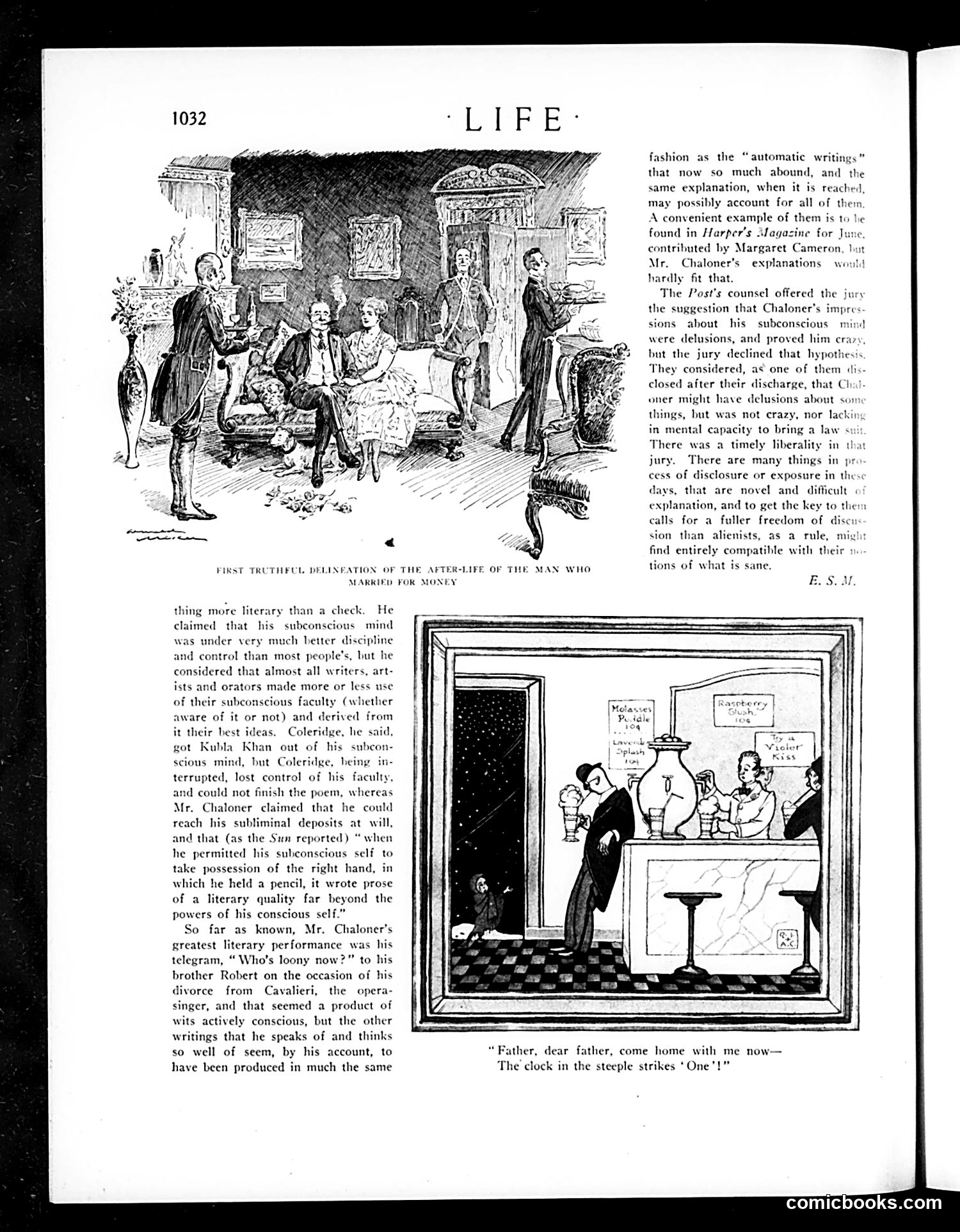
This page satirizes a legal case involving a man named Chaloner who claimed his best literary work was produced by his "subconscious mind" through automatic writing—a fashionable pseudo-scientific practice of the era. The top cartoon depicts Chaloner's "after-life" as a man "married for money," showing him surrounded by society figures in what appears to be an afterlife reception. The lower cartoon shows a domestic scene with the caption about a father coming home—illustrating the mundane reality of married life, contrasting with Chaloner's grandiose artistic claims. The text mocks Chaloner's defense in a lawsuit where he claimed delusions about his subconscious mind, but a jury found him mentally competent despite his peculiar beliefs. Life ridicules both Chaloner's pretentious literary claims and the broader 1920s fascination with automatic writing and subconscious psychology as fashionable nonsense.
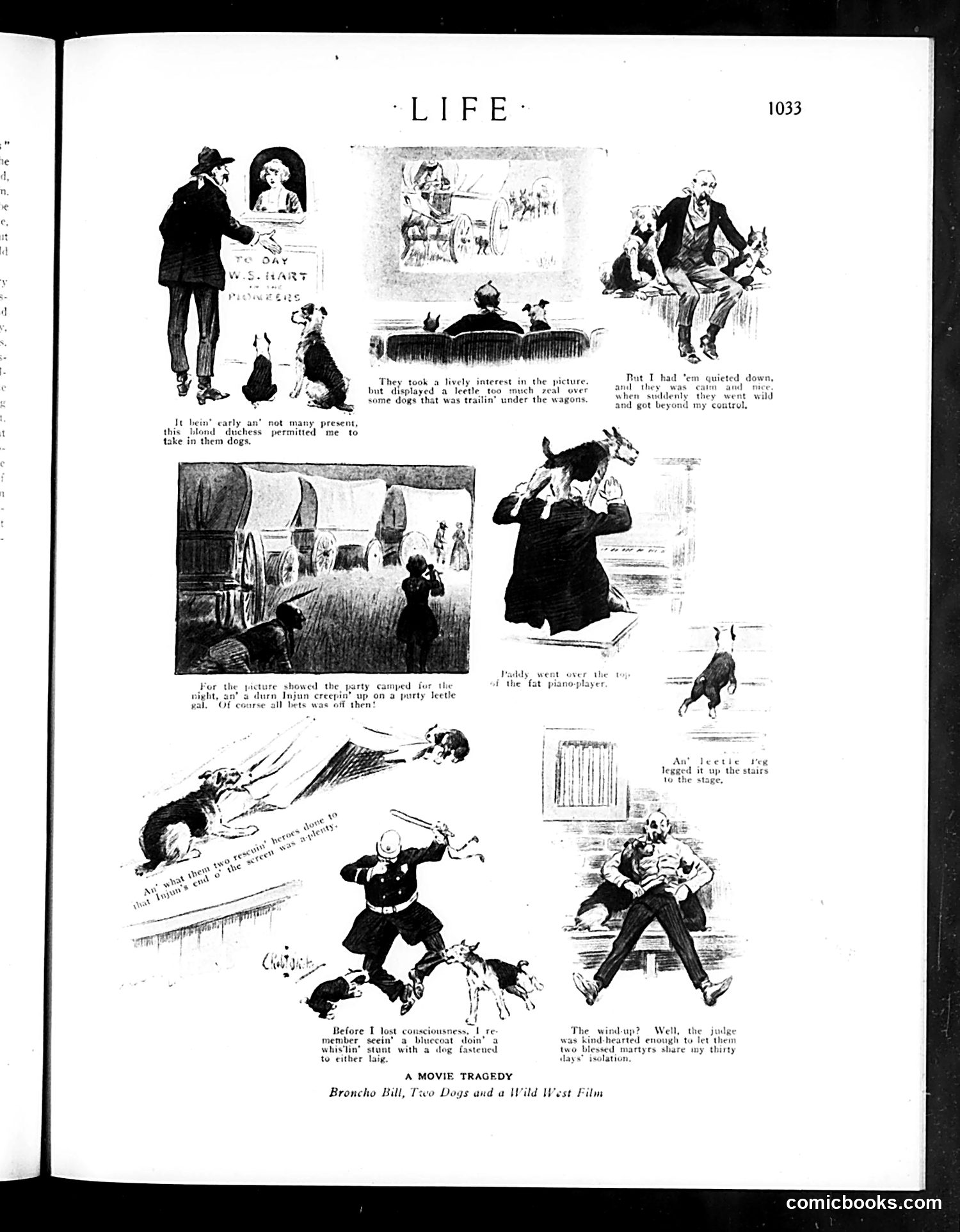
This is a humorous narrative comic about a Wild West film production. A narrator (appearing to be a frontier character) describes filming a movie featuring "Broncho Bill." The story follows a chaotic shoot: during an early morning scene with few onlookers, a "blond duchess" permits the narrator to bring dogs into a shot of a camp. The dogs, however, become distracted by a "fat piano-player," disrupting the scene. Later, an "Injun" (Native American character) is filmed "creepin' up" on a woman, but the dogs again cause mayhem. The final panels show the judge-like director struggling to control the situation. The satire mocks early cinema's Wild West genre—its melodramatic plots, unprofessional productions, and general chaos. The dogs represent uncontrollable real-world elements that undermine carefully planned narratives, a common source of comedy in slapstick-era filmmaking humor.
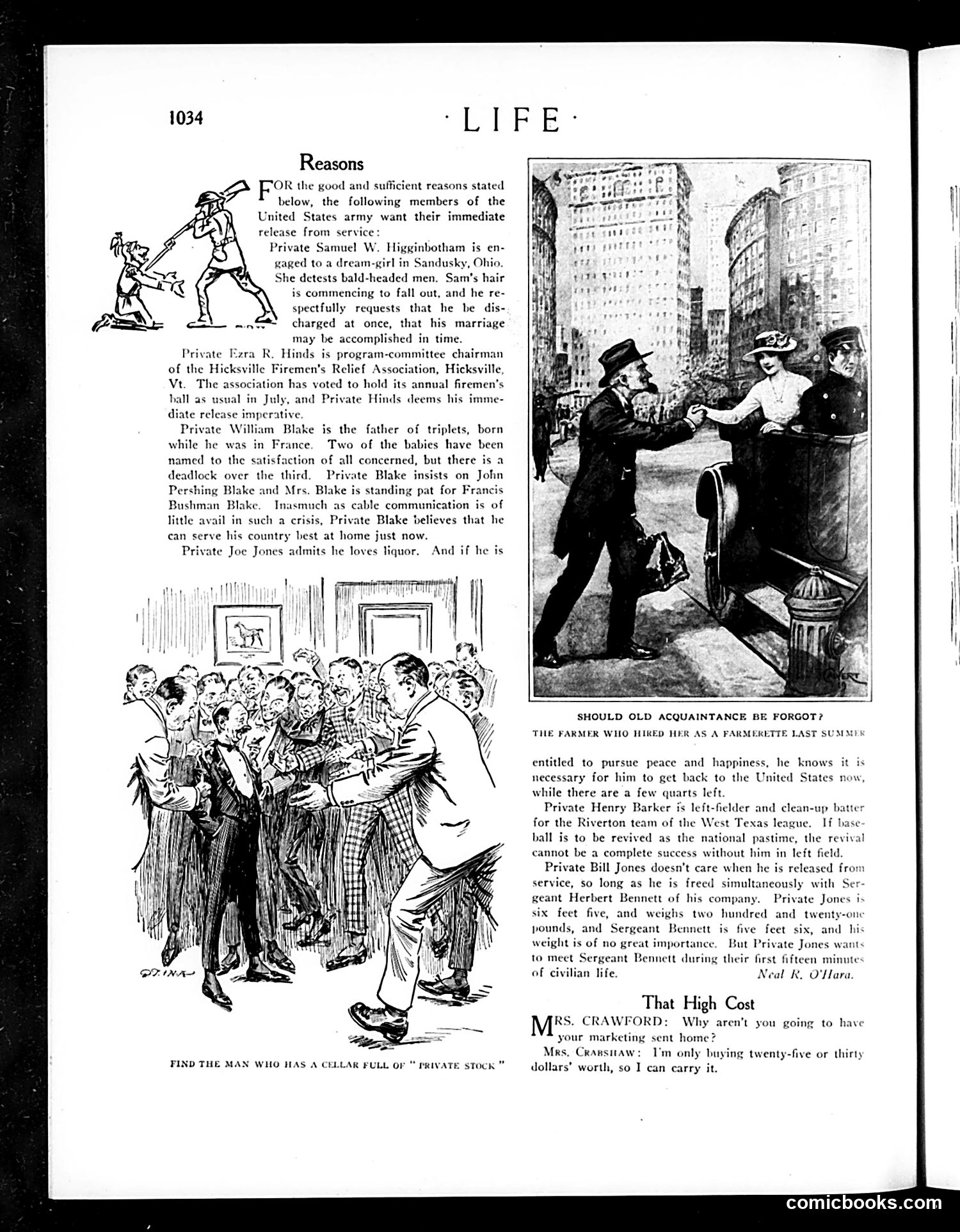
This 1920s *Life* magazine page satirizes soldiers seeking discharge from the U.S. Army after World War I by listing absurd "reasons" for release. The humor mocks both the soldiers' priorities and post-war demobilization chaos. **The cartoons:** - Top left: A man literally pulling another from military service - Bottom left: "Find the man with a cellar full of 'private stock'"—a joke about Prohibition (alcohol was illegal), suggesting soldiers want discharge to access hidden liquor **The reasons listed are deliberately ridiculous:** a soldier losing his hair before marriage, another needed for a firemen's ball, one stuck mediating over naming triplets, and one wanting to rejoin a baseball league. "Private Joe Jones" wants discharge because he loves liquor and fears it will run out—a Prohibition-era joke. **The bottom sketch** contrasts with war concerns: a woman won't use delivery service because her $25-30 grocery purchase is light enough to carry, highlighting how trivial post-war civilian concerns seemed. The satire critiques both soldiers' self-interested priorities and society's rapid return to mundane preoccupations after the war.
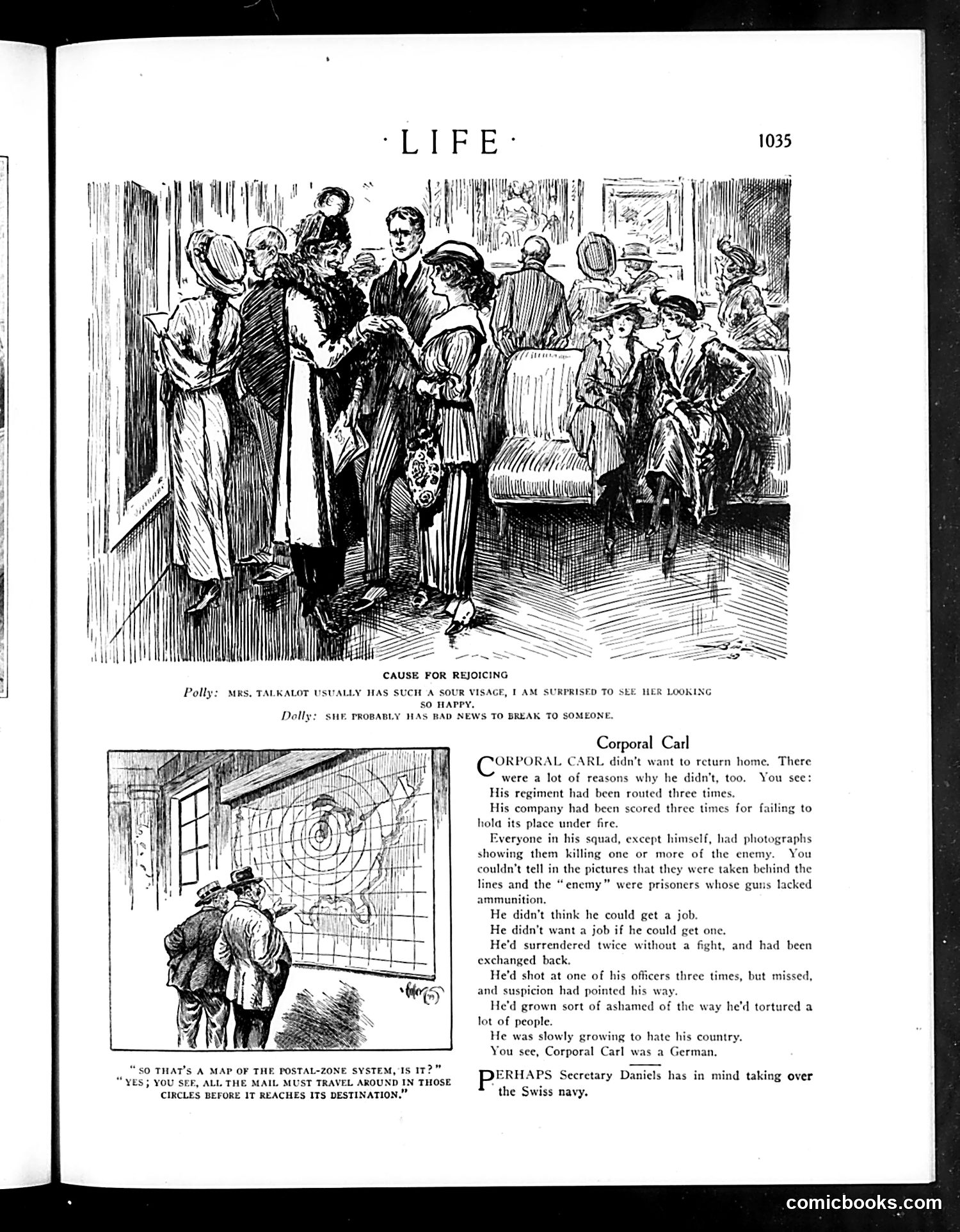
This page contains two distinct pieces of post-WWI satire: **"Cause for Rejoicing"** (top): A simple joke about Mrs. Talkalot appearing unusually happy—the punchline being she likely has bad news to share with someone, implying her happiness stems from others' misfortune. **"Corporal Carl"** (main story): A darker satirical portrait of a German soldier reluctant to return home after WWI. The narrative catalogs his military failures and moral compromises—his regiment routed repeatedly, his company's poor performance, faked combat photographs, two surrenders, and alleged torture of civilians. The piece concludes that Carl "was slowly growing to hate his country," suggesting the German military experience corrupted him morally. The postal-zone caption is a separate quip mocking the postal system's inefficiency. The brief note about Secretary Daniels and the Swiss navy appears to be unrelated contemporary political humor, likely referencing Secretary of the Navy Josephus Daniels.
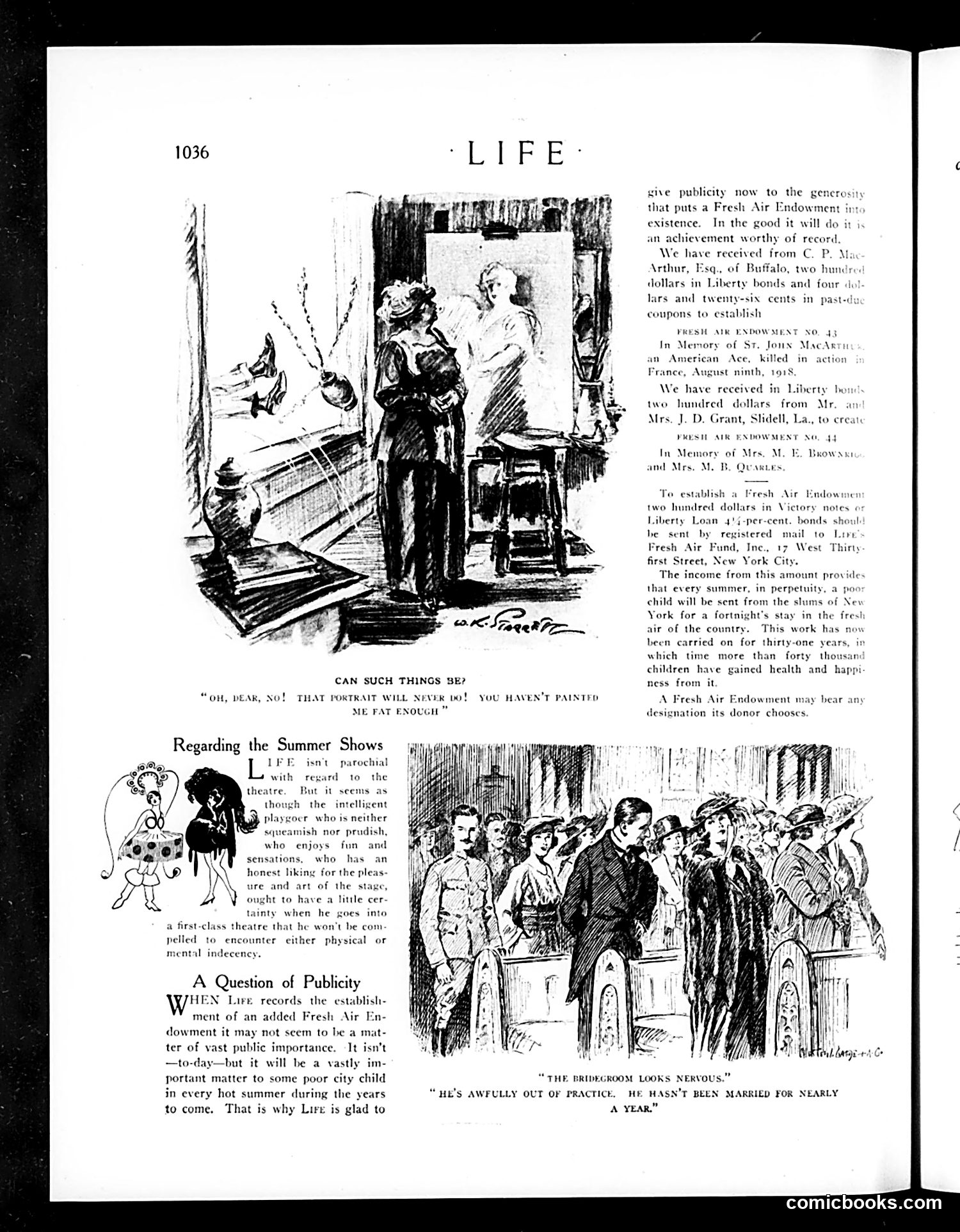
This page contains two satirical cartoons and articles about early 1900s social concerns. **Top cartoon** ("Can Such Things Be?"): A woman objects to her portrait, complaining the artist hasn't made her look fat enough—mocking vanity and society women's bizarre aesthetic preferences or self-delusion about their appearance. **Bottom cartoon** ("The Bridegroom Looks Nervous"): A nervous groom at the altar is reassured that his anxiety is normal since he hasn't been married in nearly a year—implying infidelity or casual remarriage attitudes among wealthy society men. **Articles**: The page promotes Life's Fresh Air Endowment, a charitable program sending poor urban children to the countryside for summer stays. It lists memorial donations and solicits contributions, positioning the magazine as a civic-minded institution concerned with child welfare and public health—a common Progressive Era concern about urban poverty and children's wellbeing. The satirical cartoons contrast sharply with the serious charitable mission, typical of Life's editorial approach mixing social commentary with moral purpose.
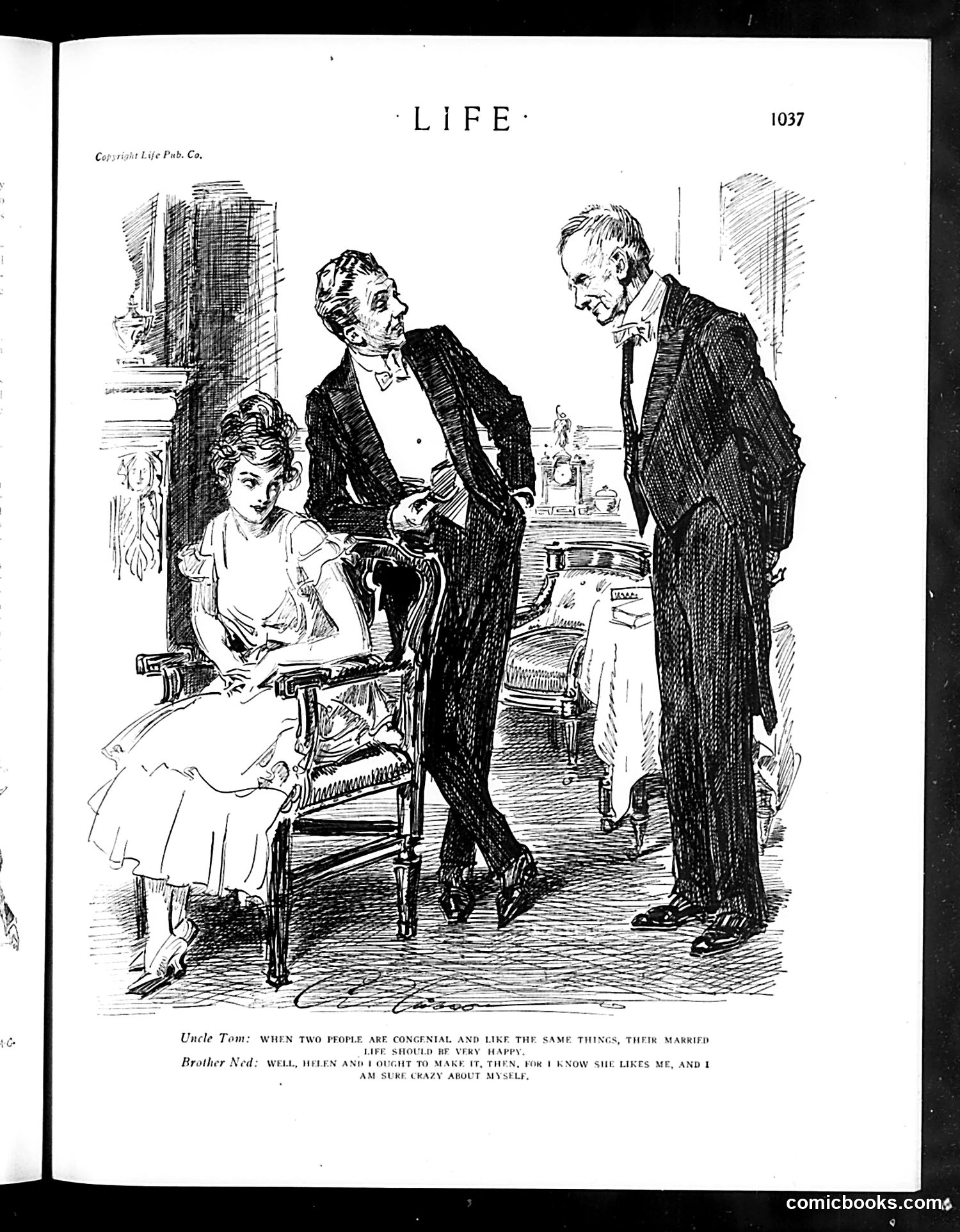
This is a single-panel joke cartoon from *Life* magazine (page 1037). **The Setup:** Uncle Tom offers conventional wisdom about marriage—that compatibility and shared interests ensure happiness. Brother Ned agrees their marriage to Helen should succeed because Helen likes him and he likes himself. **The Joke:** The humor lies in Ned's misunderstanding or deliberate misreading. He interprets Uncle Tom's advice about mutual compatibility as justification for marrying someone based solely on narcissism—he's "sure crazy about" *himself*, not about achieving mutual happiness with Helen. **The Satire:** This mocks self-centered men who misinterpret or ignore the reciprocal nature of marriage, suggesting they believe their own self-regard is sufficient. It's a commentary on male vanity and obliviousness to what actually makes marriages work. The three men and seated woman depicted appear to be stock characters representing these personality types, drawn in the magazine's typical early-20th-century satirical style.
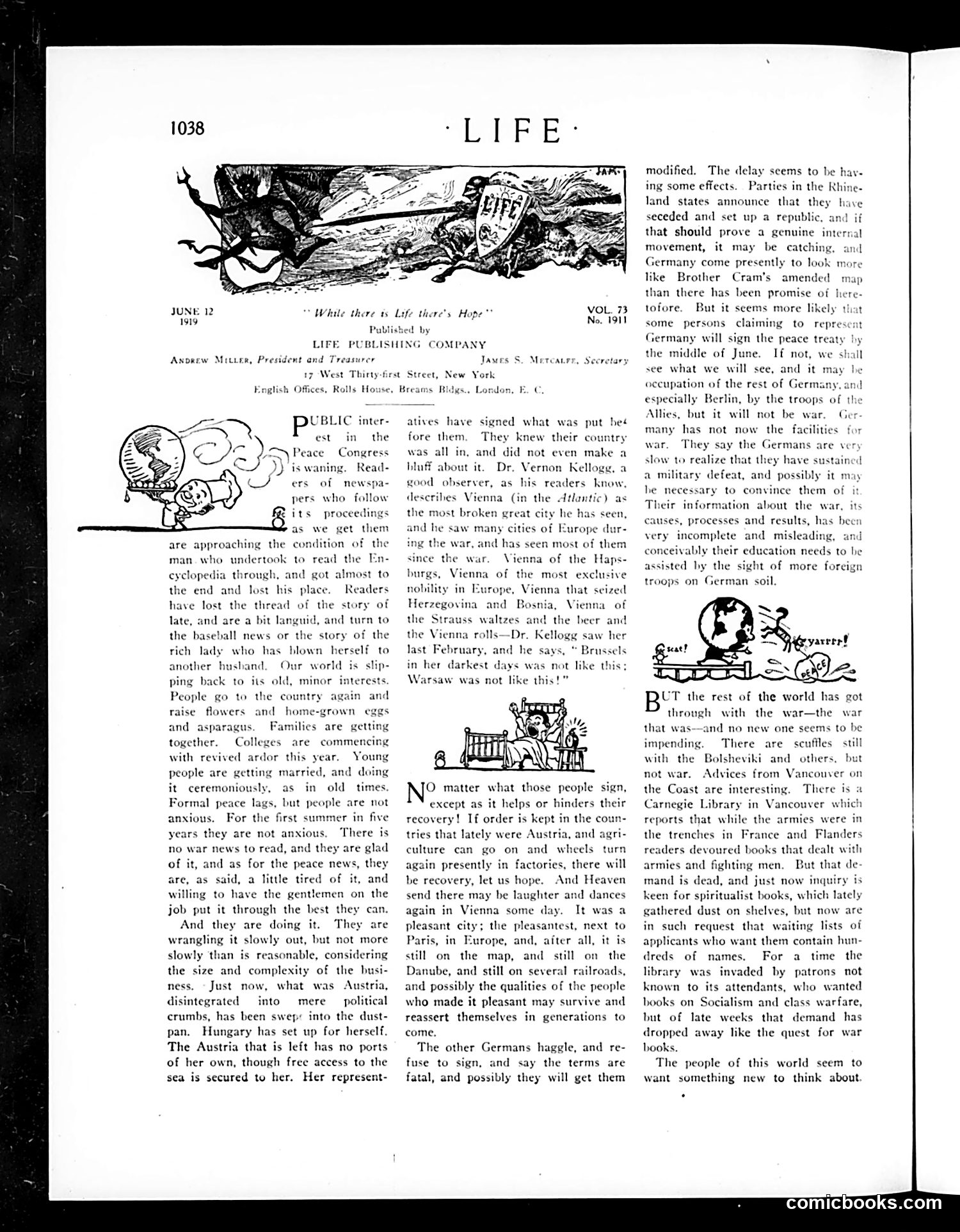
This page discusses post-World War I peace negotiations and the dismantling of the Austro-Hungarian Empire. The main cartoon (top left) shows a skeletal or death figure labeled "LIFE," illustrating the publication's satirical masthead. The editorial commentary reflects on the Peace Congress's slow progress and public apathy toward peace negotiations—Americans are tired of war news and returning to domestic concerns (baseball, gardening, courtship). The text references Dr. Vernon Kellogg's observations of Vienna's devastation, describing it as worse than Brussels or Warsaw during the war. Austria-Hungary has been reduced to "political crumbs," with Hungary separating and the remaining Austria losing its ports. The piece suggests that actual recovery depends less on signed treaties than on maintaining order, resuming agriculture, and restoring factories. It expresses skepticism that Germany will sign the peace treaty voluntarily, predicting either fragmentation (like Rhineland secession movements) or eventual compliance by mid-June. The overall tone blends cynicism about diplomatic processes with hope for European recovery.
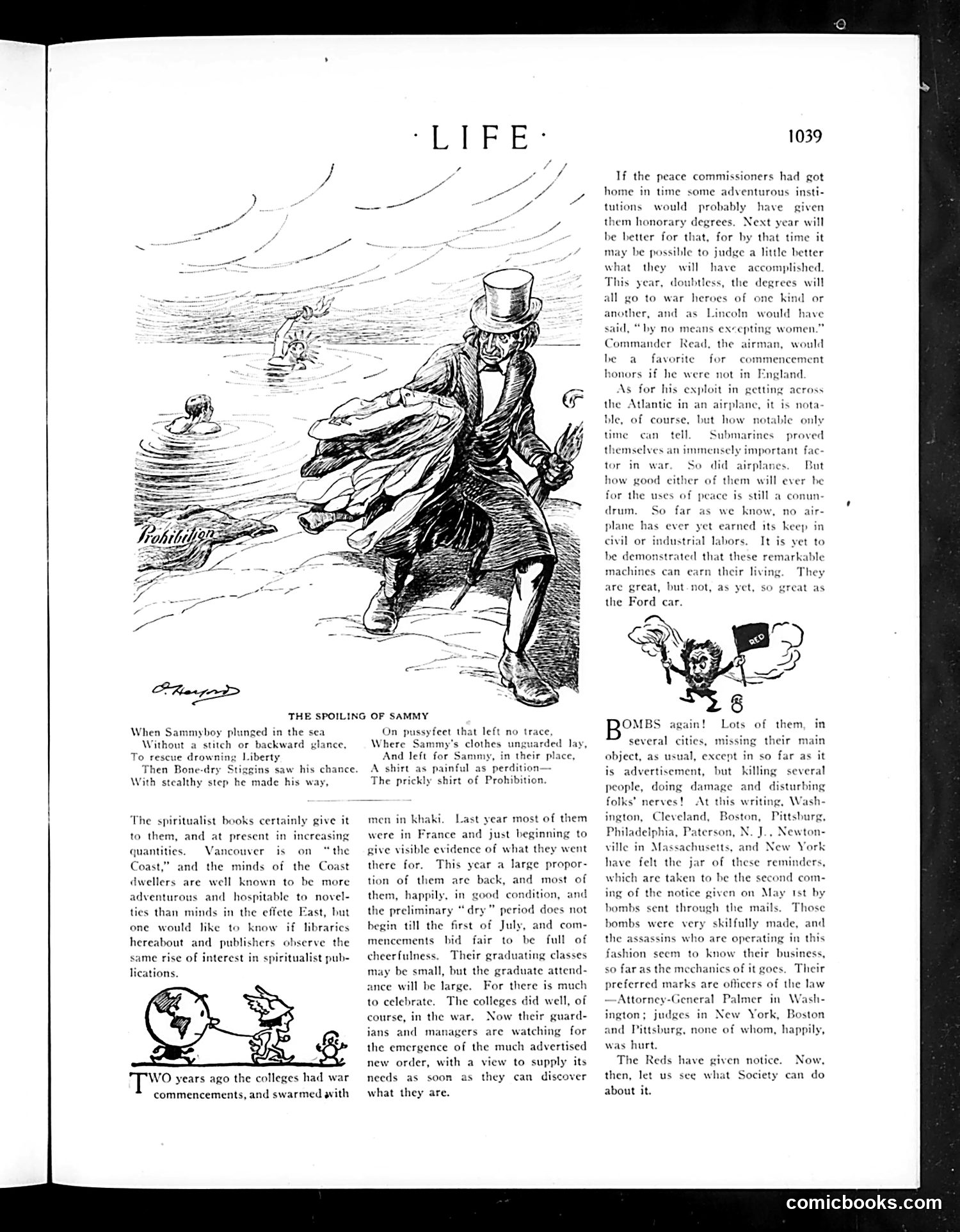
This cartoon satirizes Prohibition's implementation. "Sammy" (representing America or American soldiers returning from WWI) jumps into the sea naked—symbolizing freedom. "Bone-dry Stiggins" (a reference to a hypocritical character from Dickens) steals Sammy's clothes and replaces them with a "prickly shirt of Prohibition," forcing uncomfortable restrictions upon him. The accompanying text discusses colleges' war efforts and mentions bomb attacks by anarchists ("the Reds") on government officials and judges, referencing Attorney General Palmer's recent experiences. The piece criticizes Prohibition as an unwelcome imposition despite wartime sacrifice, while acknowledging real domestic terror threats that society must address. The satire mocks both forced moral legislation and radical violence threatening social order.
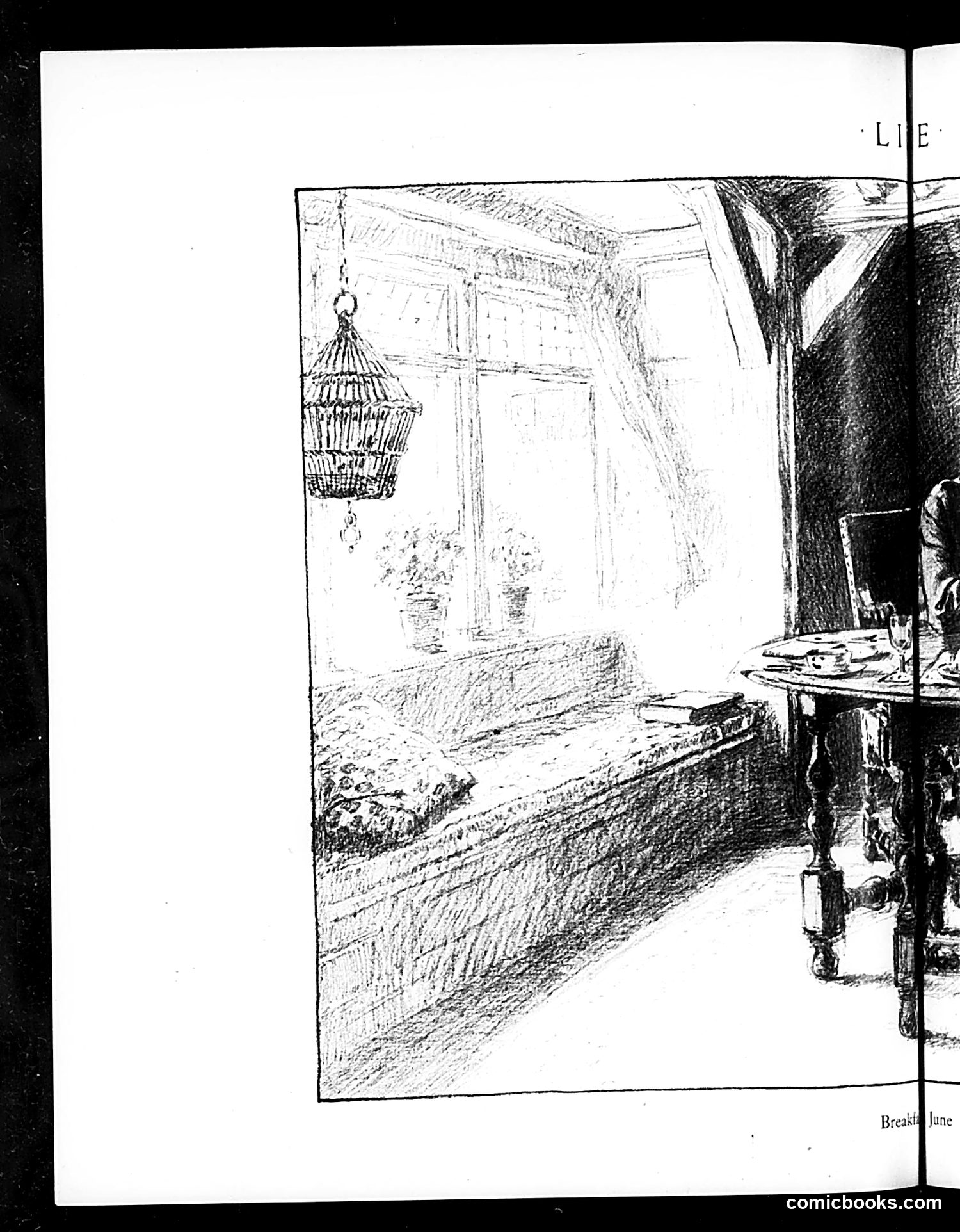
This page contains a pen-and-ink sketch showing an interior domestic scene. A figure sits at a table on the right side of the composition, while a birdcage hangs from the ceiling in the background. The drawing emphasizes perspective and shadow through cross-hatching techniques typical of early 20th-century illustration. The OCR text is largely illegible, appearing to be corrupted character data rather than readable text. Without clear textual context or identifiable captions, I cannot determine the specific satirical point, political references, or social commentary this cartoon intended. The image alone shows a domestic interior scene but does not contain obvious caricature or political symbolism that would allow definitive interpretation of its satirical meaning to a modern reader.
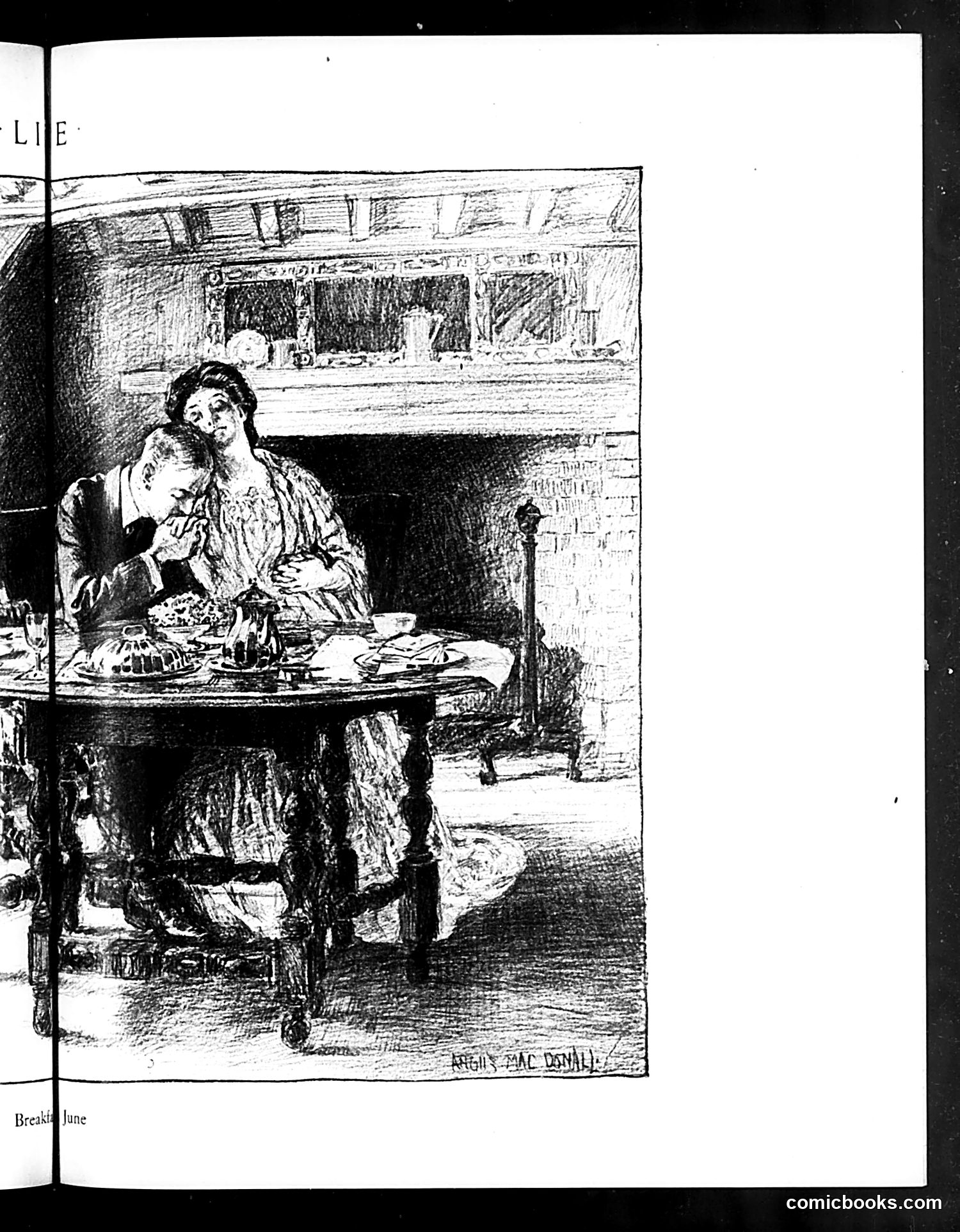
This page contains a single sketch titled "Breakfast June" (visible at bottom left), signed by what appears to be "Isaac Donoil" or similar. The image shows two figures seated at a round table during a meal. The man appears distressed or troubled, while the woman beside him maintains a composed expression. The domestic interior setting—with a fireplace and window visible—and the simple breakfast scene suggest this is social satire about married life or intimate relationships. Without clearer OCR text or additional context, the specific satirical point remains unclear. The title "Breakfast June" and the figures' contrasting emotional states suggest commentary on a relationship moment, but the exact reference—whether to a current event, social trend, or literary work—cannot be definitively determined from the image alone.
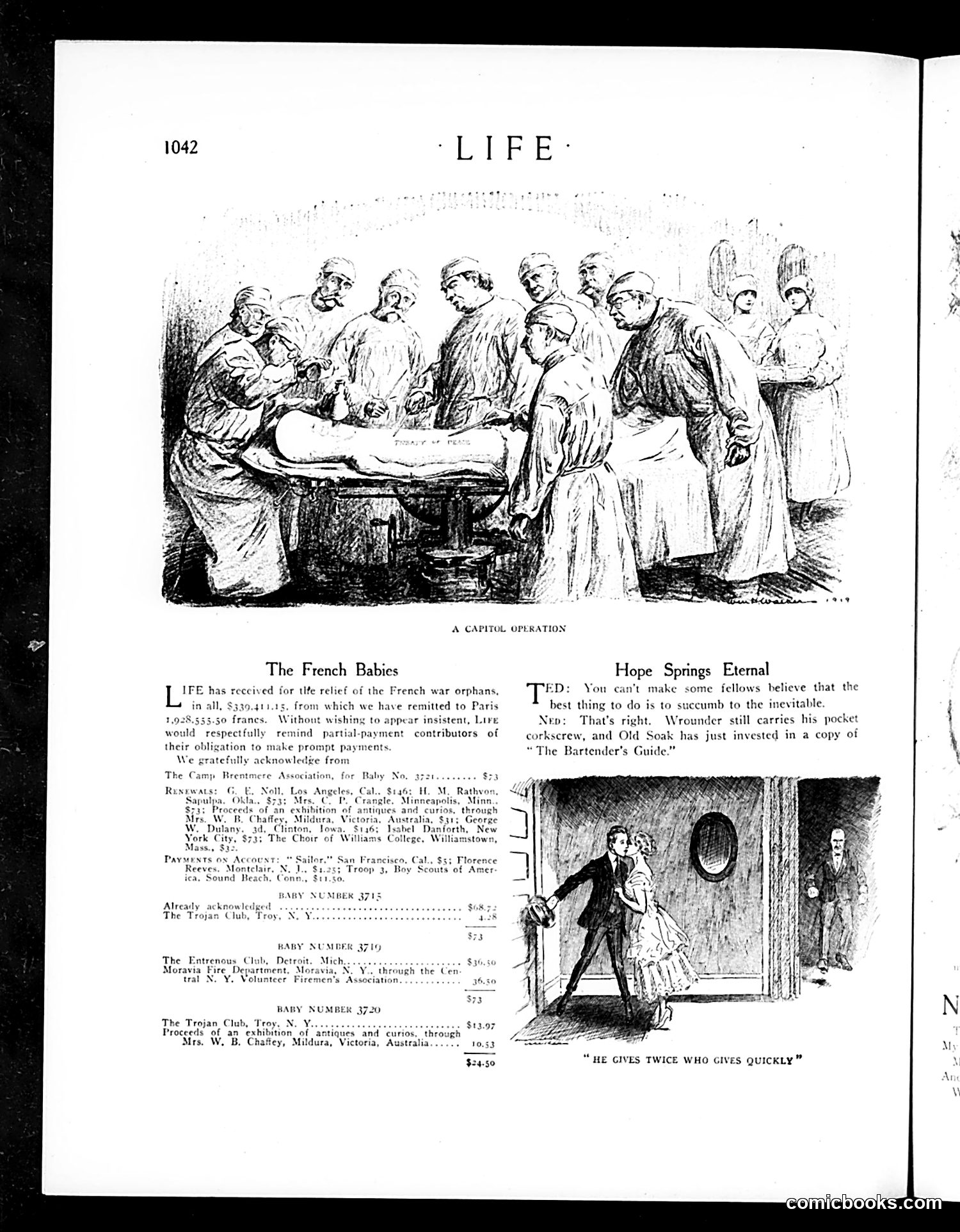
**Top Cartoon ("A Capitol Operation"):** This depicts a medical/surgical scene with multiple figures gathered around a table, likely satirizing Congressional deliberations or political maneuvering. The title suggests ironic treatment of government "operations" as medical procedures. **"The French Babies" Section:** Life magazine solicited donations for French war orphans relief (WWI context, given the "war orphans" language). The text acknowledges contributors and lists donation amounts, reminding donors to make prompt payments—a mild jab at delinquent givers. **"Hope Springs Eternal" Cartoon (bottom right):** A man persistently knocks on a door despite repeated rejection, embodying the proverb that optimists never surrender hope even against obvious futility. The caption "He gives twice who gives quickly" promotes prompt charitable giving. **Overall Message:** The page combines fundraising appeals with gentle satire about human nature—both in politics (top) and charity (bottom)—using the contrast between idealistic hopes and practical reality.
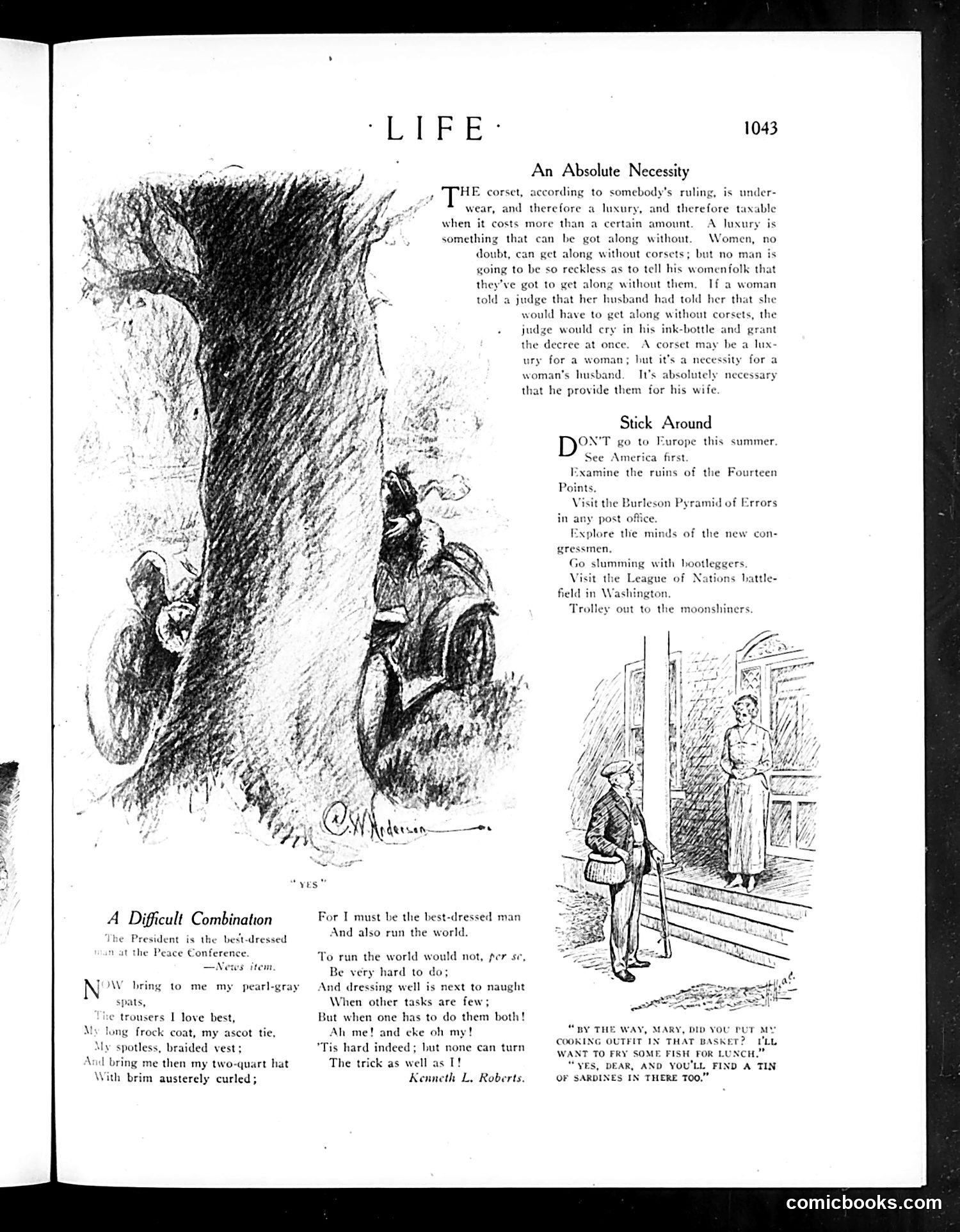
This page contains three satirical pieces from the post-WWI era (likely early 1920s): **"A Difficult Combination"** mocks the President (appears to be Woodrow Wilson) attempting to simultaneously maintain impeccable appearance while managing world affairs. The poem humorously presents dressing well and running the world as incompatible tasks, suggesting the President cannot do both effectively. **"An Absolute Necessity"** satirizes a taxation ruling on expensive corsets by arguing they're actually a necessity (not luxury) because husbands require their wives wear them. It's tongue-in-cheek social commentary on both fashion expectations and marital dynamics. **"Stick Around"** ironically recommends touring America's post-war failures instead of Europe: the failed "Fourteen Points" (Wilson's peace plan), Post Office bungling, congressional incompetence, Prohibition bootlegging, and League of Nations rejection—all contemporary political disappointments. The accompanying illustrations are genteel sketches typical of Life's satirical style. The humor relies on readers' familiarity with these specific post-war American political failures and social conventions.
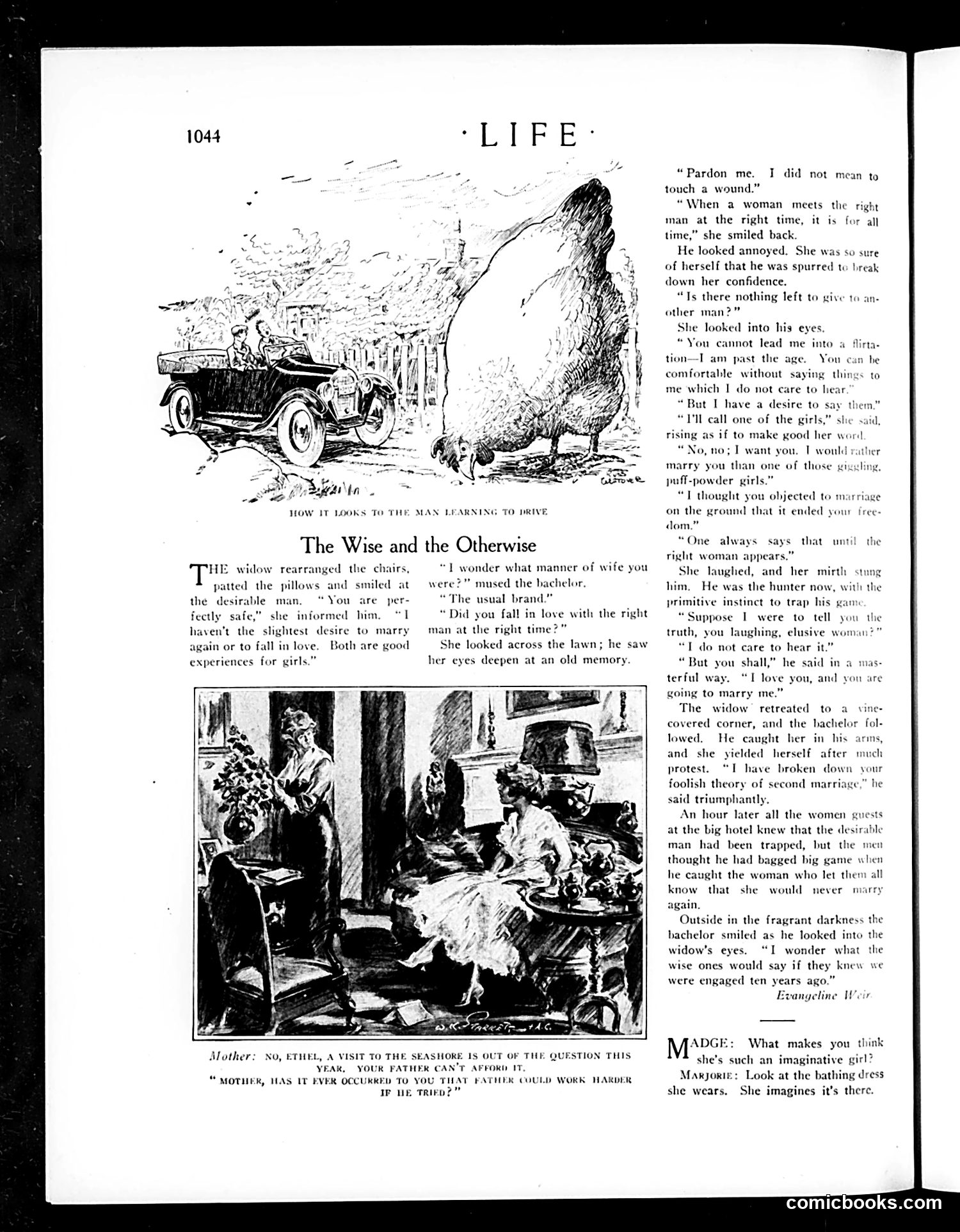
This page contains two distinct pieces: **"The Wise and the Otherwise"** is a romantic short story about a widow and bachelor. The widow, confident and experienced from a previous marriage, claims she has no interest in remarriage. The bachelor pursues her, eventually trapping her into an engagement—though the final twist reveals they were actually engaged ten years prior, suggesting the entire encounter was a romantic game. The satire gently mocks both characters' pretense and the "battle of the sexes" romantic dynamics of the era. **The cartoon at bottom** is a brief joke about parental expectations during economic hardship. A mother dismisses her daughter's suggestion that the father work harder to afford a seashore vacation, implying wives don't encourage husbands to labor more intensely—a commentary on gender roles and economic responsibility in working-class households. The top cartoon illustrates a nervous new driver, exaggerating the car's appearance as unstable—typical slapstick humor about automobile anxiety in the early automotive age.
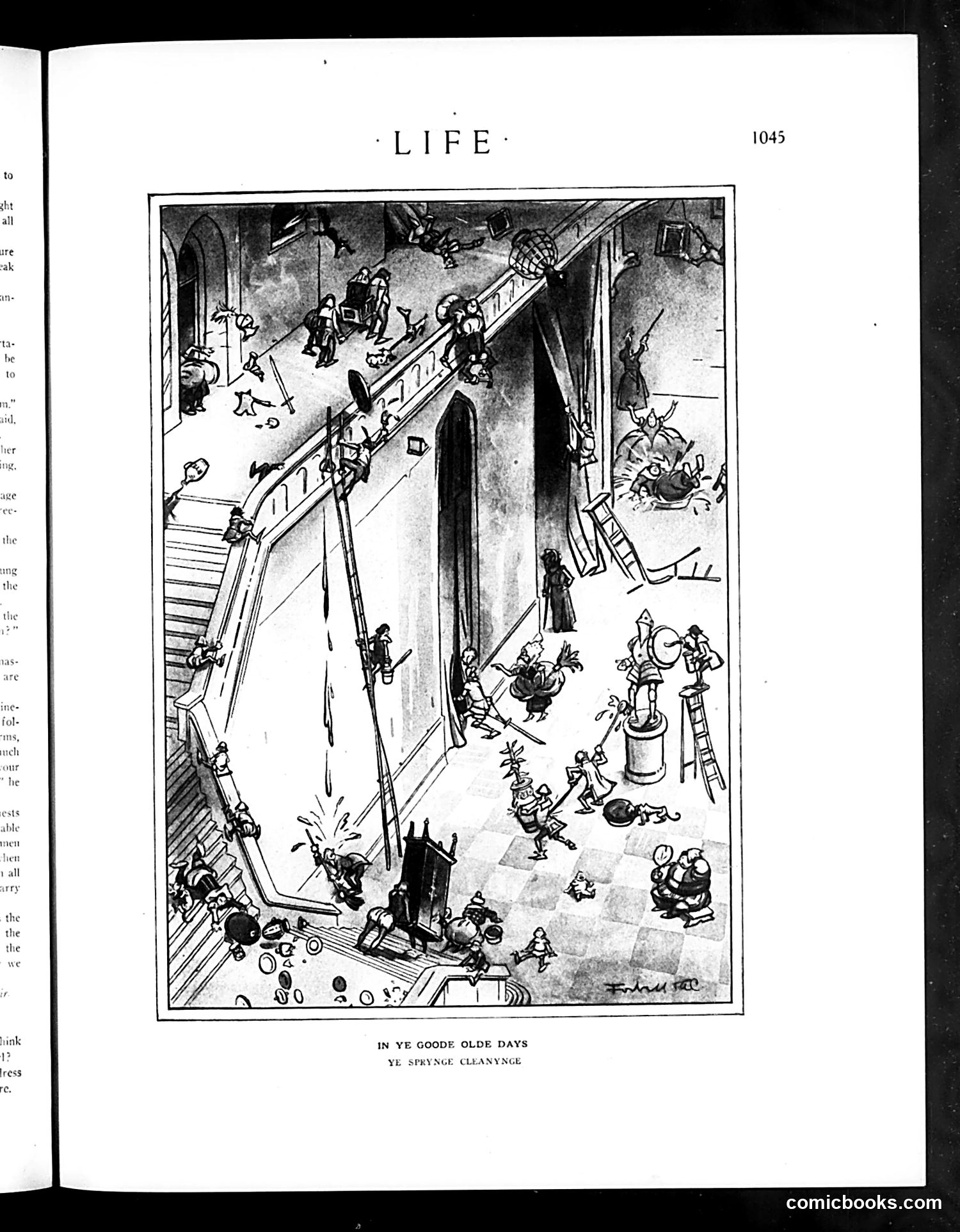
This is a humorous cartoon depicting spring cleaning in medieval or colonial times. The title uses deliberately archaic spelling ("Ye Goode Olde Days," "Springe Cleanyuge") to create comic effect. The illustration shows a chaotic domestic scene with numerous figures engaged in vigorous cleaning activities within a large building or castle. People are shown hauling items, climbing ladders, throwing objects out windows, and generally creating disorder in pursuit of cleanliness—exaggerating the scope and mayhem of spring cleaning. The satire appears to mock the nostalgia for "the good old days" by showing that spring cleaning was always messy, labor-intensive, and disruptive, regardless of era. It's a gentle parody of both overly romanticized historical perspectives and the universal domestic chaos of seasonal cleaning.
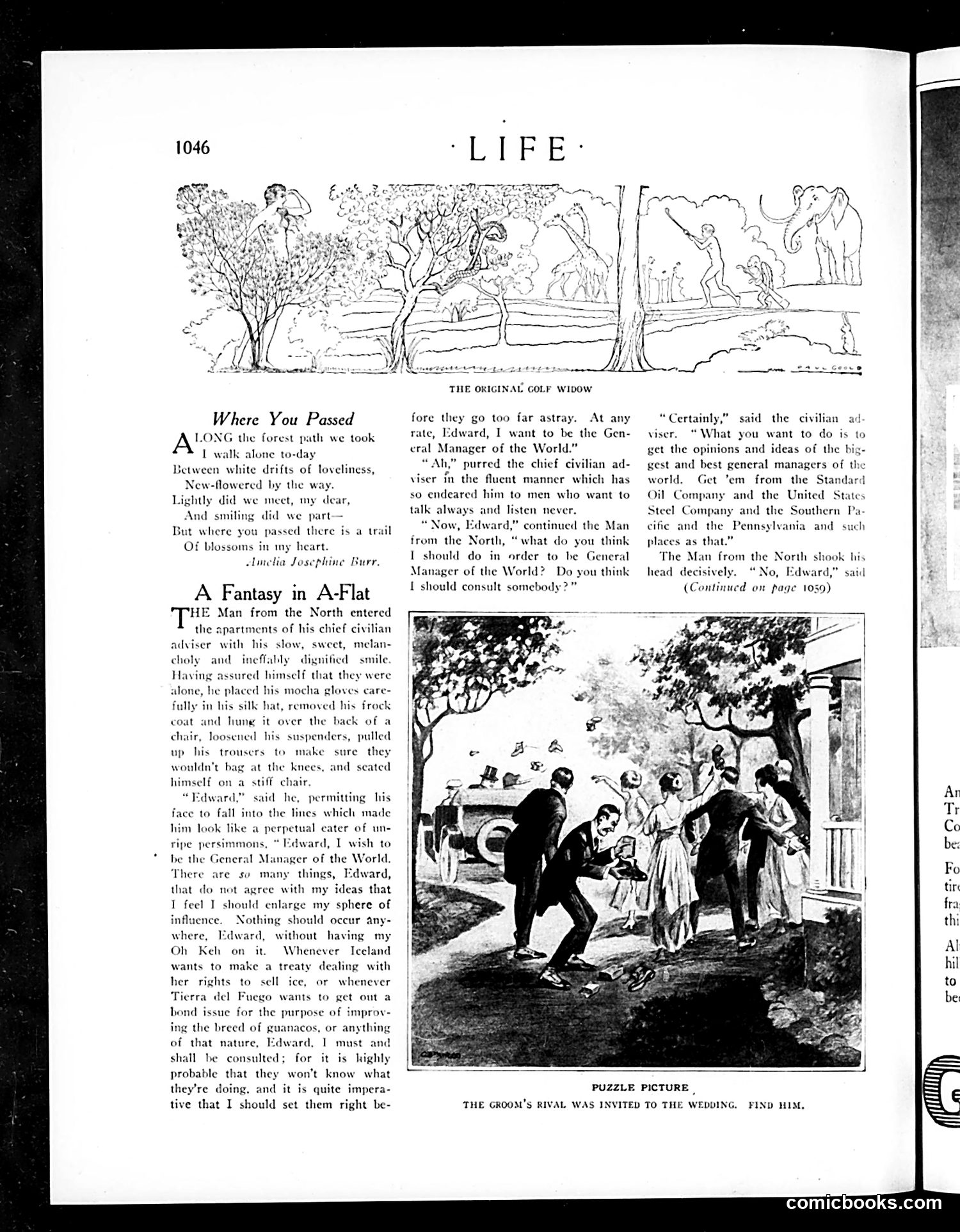
This page contains two distinct pieces: **"Where You Passed"** is a sentimental poem by Amelia Josephine Burr about romantic memory—standard romantic verse of the era. **"A Fantasy in A-Flat"** is the satirical centerpiece. It mocks an unnamed pompous authority figure ("the Man from the North") who fantasizes about becoming "General Manager of the World." He wishes to control all international affairs—Iceland's rights, Tierra del Fuego's finances, even guanaco breeding—without consultation. His civilian adviser humorously indulges him, eventually suggesting he consult actual industrial titans (Standard Oil, U.S. Steel, Southern Pacific) for advice. The satire targets wealthy industrialists' inflated egos and imperial ambitions during the early 20th century, when powerful business moguls wielded enormous geopolitical influence. The humor lies in the absurdity of one man wanting to micromanage global affairs, and the adviser's deadpan agreement with his delusions. The "puzzle picture" shows a wedding scene where readers must locate the "groom's rival"—a separate visual game unrelated to the text.
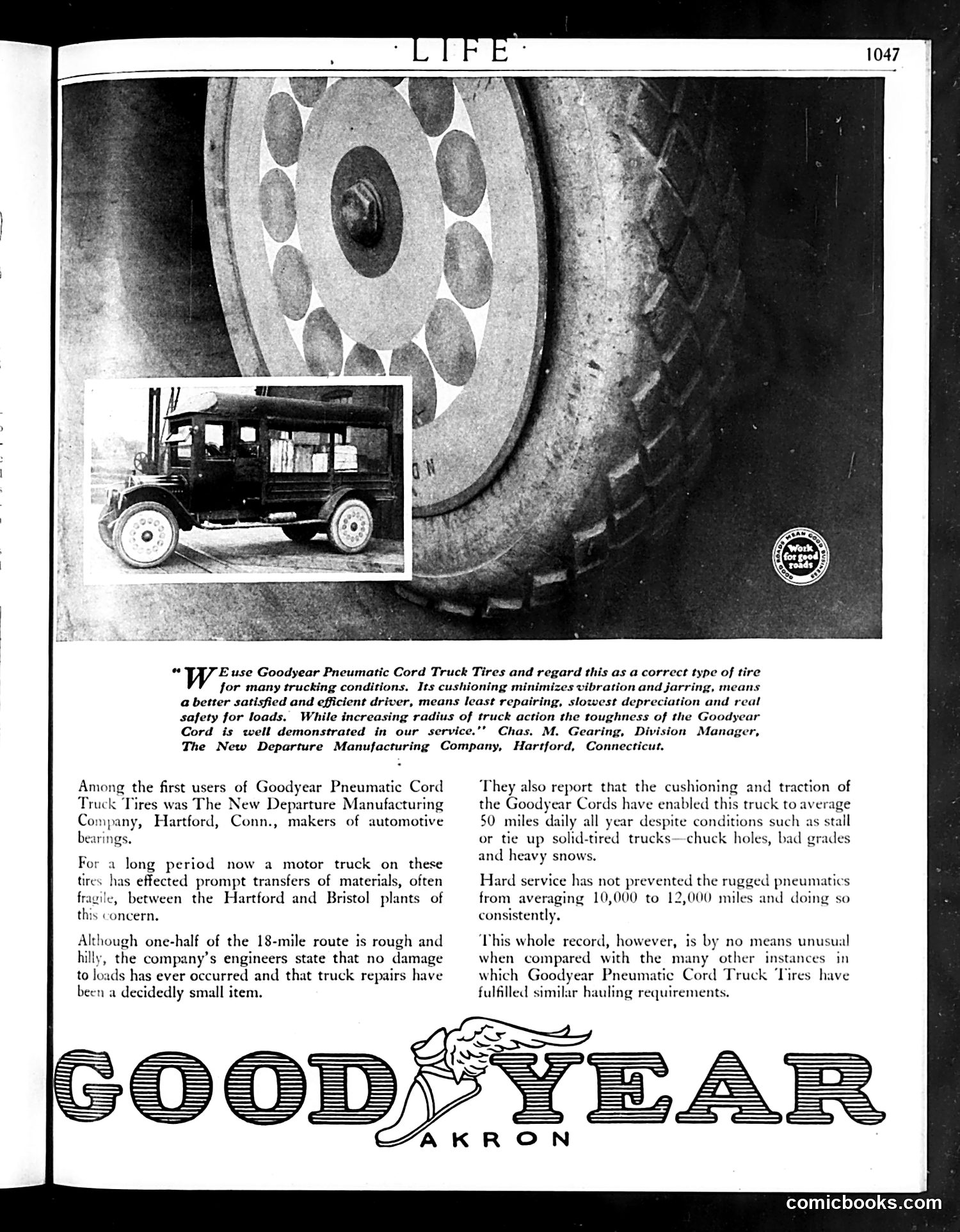
This is **not a cartoon or satire page**—it's a Goodyear tire advertisement disguised as editorial content, a common early 20th-century advertising technique. The page features a testimonial from Chas. M. Gearing, Division Manager at New Departure Manufacturing (Hartford, Connecticut), praising Goodyear Pneumatic Cord truck tires. A small inset photograph shows an early motor truck, while the main image displays an enormous tire next to the vehicle for dramatic scale comparison. The "story" is pure product marketing: the company supposedly used these tires on an 18-mile route between Hartford and Bristol plants, experiencing minimal damage and repairs while averaging 50 miles daily and 10,000-12,000 miles per tire. For modern readers, this represents advertising's early deception—presenting promotional claims as objective reporting in a prestigious publication. There's no satire intended; the humor (if any) would be unintentional, stemming from the over-the-top claims and the awkwardly phrased testimonial.
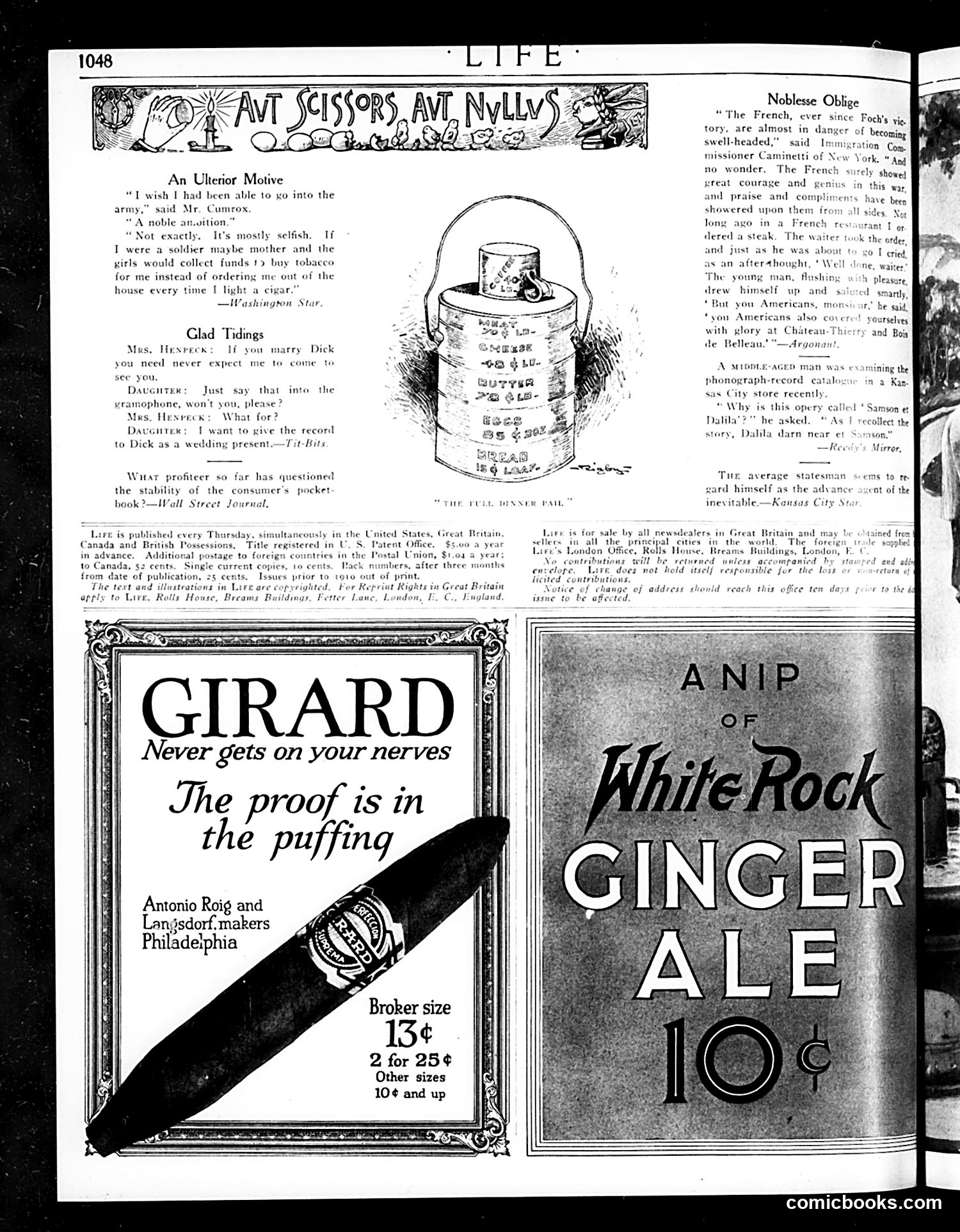
This page contains several brief humorous anecdotes and advertisements typical of Life's satirical format: **"An Ulterior Motive"**: A man admits he wants to join the army selfishly—so his mother and girls would collect tobacco funds for him instead of ordering him to stop smoking at home. The joke mocks both his lack of patriotic motivation and domestic hen-pecking. **"Glad Tidings"**: A mother threatens not to visit her daughter if she marries Dick. The daughter asks her to record this on a gramophone as a wedding gift—implying the mother-in-law is unwelcome. Standard mother-in-law humor. **"Noblesse Oblige"**: References French General Foch's WWI victory, joking that the French are becoming arrogant. Includes a story about a French waiter dismissing an American customer's complaint by boasting of French military glory at Château-Thierry. The page is primarily **advertisements** for Girard cigars and White Rock Ginger Ale, alongside these brief comic pieces. No political cartoons appear.
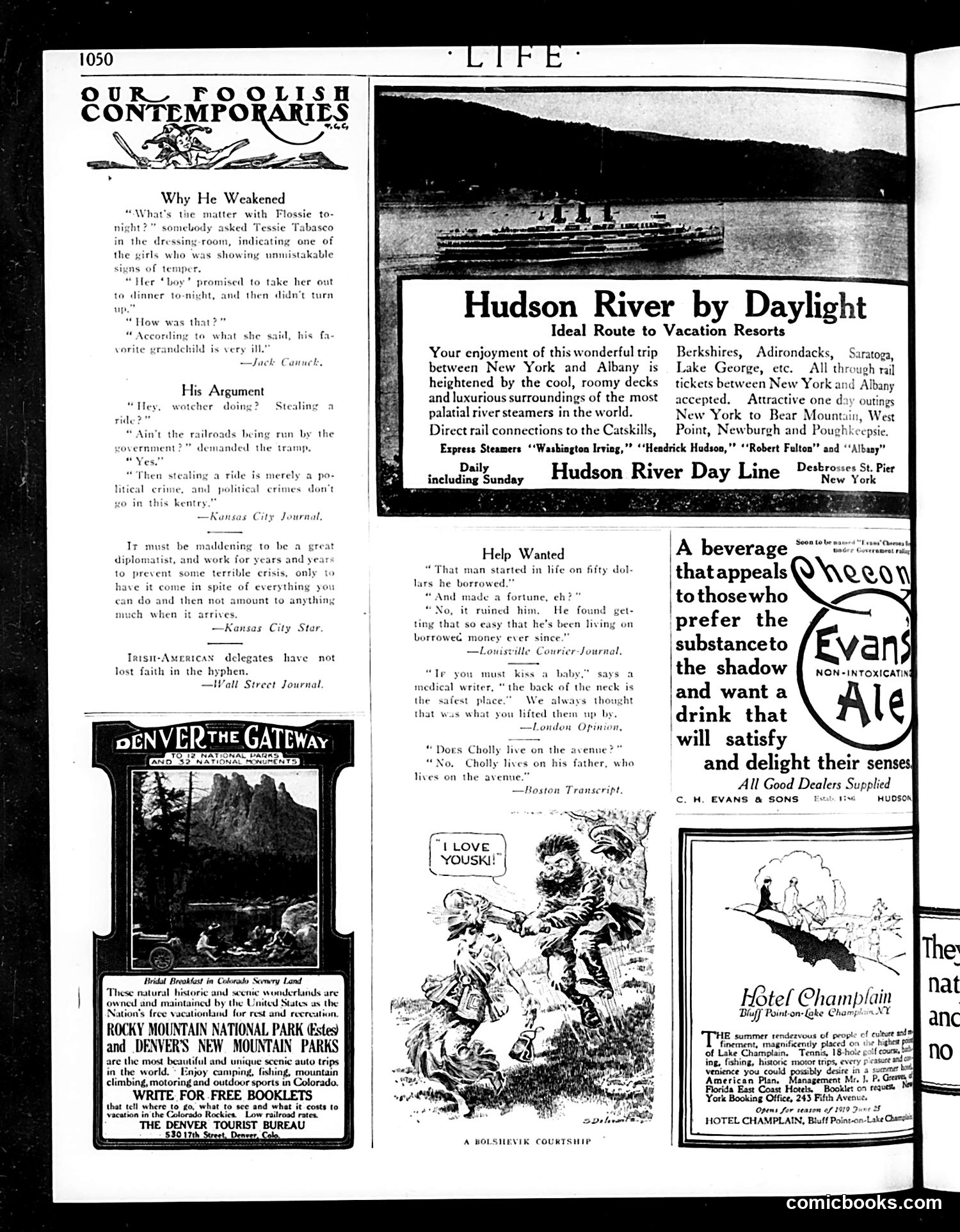
This page contains satirical humor pieces typical of Life's "Our Foolish Contemporaries" column, plus advertisements. **The cartoons/jokes mock:** 1. **"Why He Weakened"** — A dressing-room exchange where a girl is upset because her boyfriend promised dinner but canceled, claiming his father's grandchild is ill. The satire targets men's excuses and relationship disappointments. 2. **"His Argument"** — A tramp argues that stealing a railroad ride is "merely a political crime" since railroads are government-run. The joke mocks both socialist arguments about public ownership and vagrants' rationalizations. 3. **Other short quips** mock diplomacy, Irish-American hyphenated identity, and social pretension (a man who borrowed money, a mother kissing babies, someone living off his father). 4. **"A Bolshevik Courtship"** (illustrated) — appears to satirize revolutionary or radical courtship, likely mocking bohemian or communist social attitudes popular post-WWI. The page is primarily **advertising** (steamship lines, national parks, ale, hotels), with satirical commentary filling spaces between ads — typical Life magazine layout of the 1920s era.
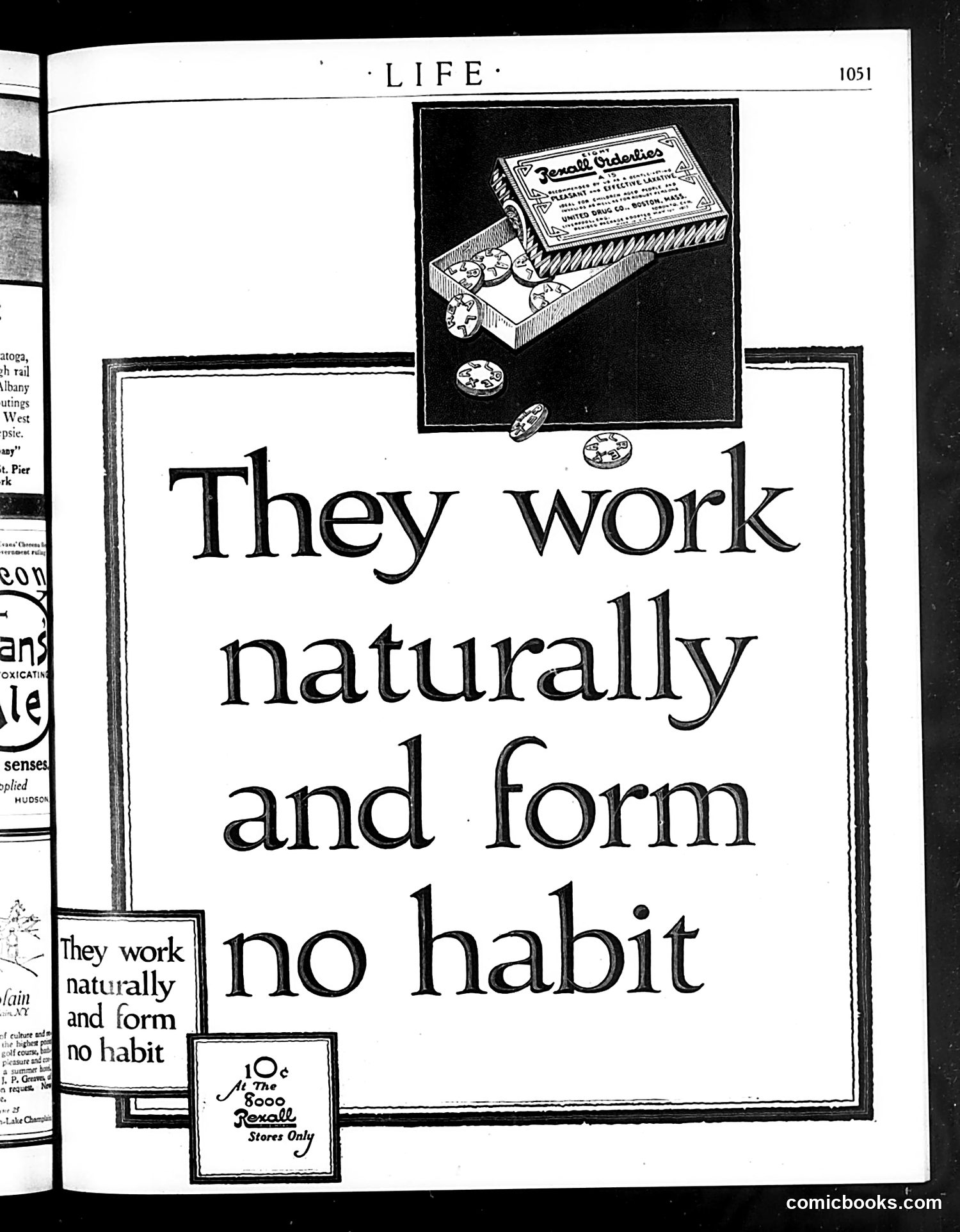
This page is primarily an **advertisement for Fezall Oldodies** (a product whose exact nature is unclear from the image alone, though the box illustration suggests some kind of small confection or candy). The ad's central claim—"They work naturally and form no habit"—appears to be **satirizing patent medicines and proprietary products** common in early 20th-century advertising. The phrase "form no habit" is particularly telling, as it references contemporary anxieties about addiction to substances like cocaine, morphine, and other ingredients found in unregulated medicines of the era. The ad's reassurance that the product works "naturally" and creates "no habit" suggests Life magazine is mocking the exaggerated health claims and addiction concerns surrounding commercial products of that period.
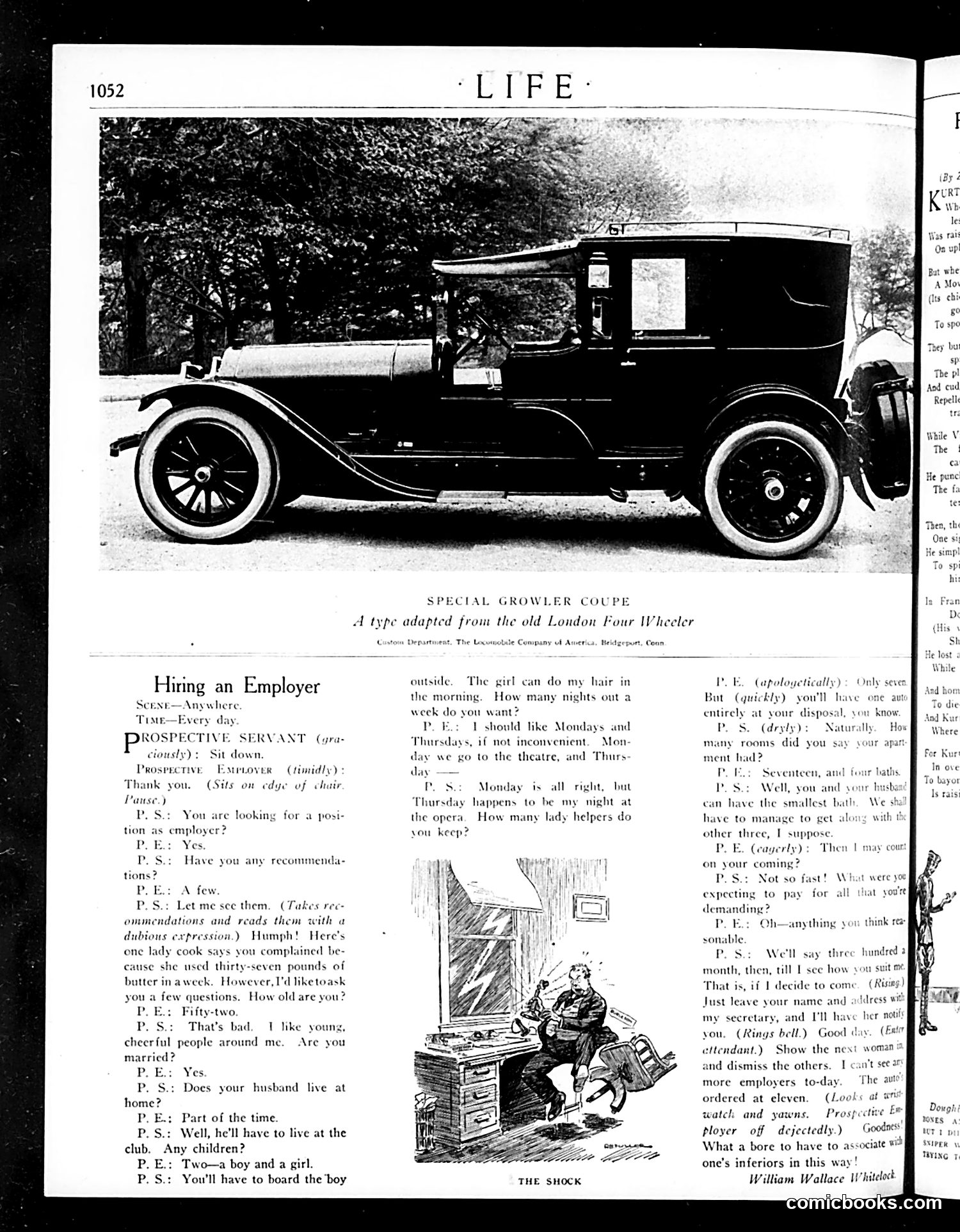
This sketch inverts the typical employer-employee power dynamic. A "Prospective Servant" (actually a wealthy employer seeking household help) interviews a "Prospective Employer" (a desperate job-seeker) for a domestic position. The satire mocks the unreasonable demands domestic servants faced: the employer demands the servant's husband live at the club, boards her son elsewhere, and has her daughter serve as a lady's maid—all while offering minimal time off and vague wages. The servant controls the entire interaction, treating the employer as an inferior applicant. The joke exposes how employers exploited domestic workers by reversing roles—making absurd demands seem ridiculous when directed at someone of higher social standing. The final line ("What a bore to have to associate with one's inferiors") underscores the class contempt underlying such employment relationships. This critiques the era's callous treatment of household staff around the early 20th century.
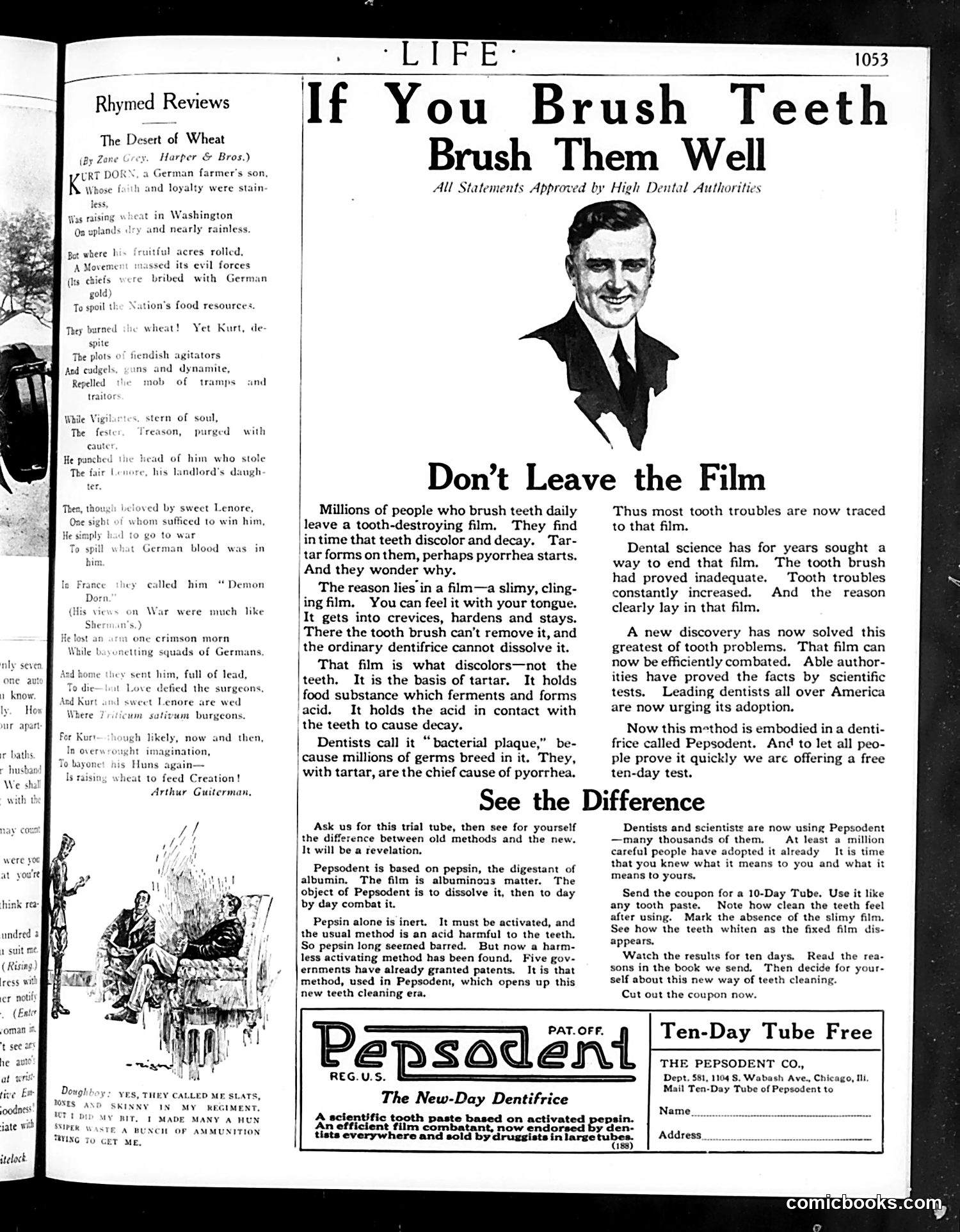
This page is primarily **advertising**, not political satire. The main content is a Pepsodent toothpaste advertisement (1920s era) claiming a scientific breakthrough: a new dentifrice containing "pepsin" that dissolves bacterial film on teeth. The advertisement's pitch to modern readers appears quaint: it promises that most tooth decay results from a "slimy, clinging film" that ordinary brushing cannot remove. The solution is Pepsodent's "activated pepsin," endorsed by dental authorities. The left column contains a romantic poem ("The Desert of Wheat" by Zane Grey) about a German-American farmer's son during WWI—likely patriotic wartime content unrelated to the ad. At the bottom, there's a brief cartoon captioned "Doughboy" featuring a soldier's quip about being called "Slats" and "Skinny," a casual WWI-era humor bit. The page reflects early 20th-century advertising's invocation of "scientific" claims to sell consumer products, a practice that would later face regulation.
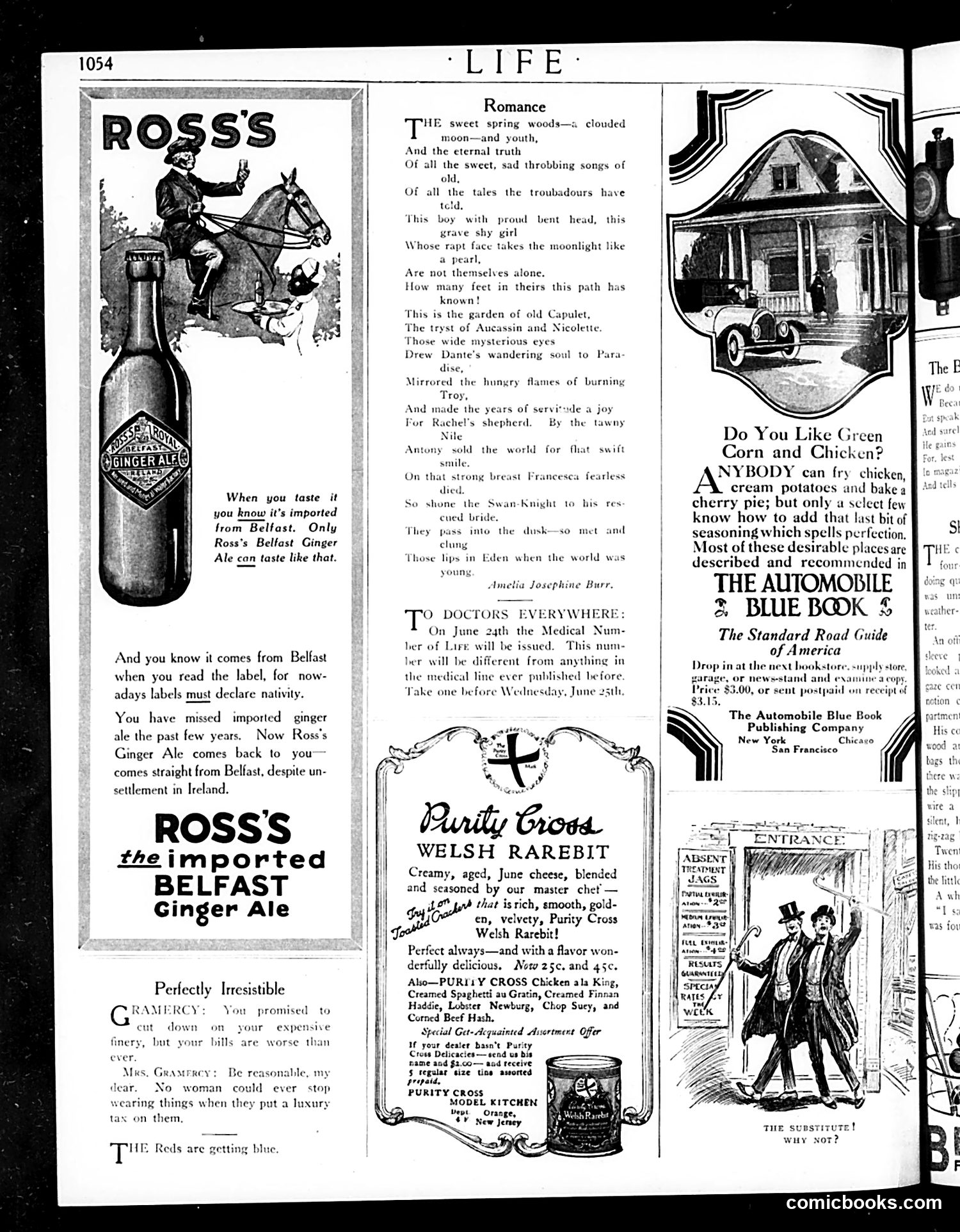
This page is primarily **advertising and light humor**, not political satire. The main content includes: **Advertisements:** - Ross's Belfast Ginger Ale (emphasizing Irish import origin) - Purity Cross Welsh Rarebit and prepared foods - The Automobile Blue Book travel guide **Humor sections:** - A romantic poem about young lovers evoking classical literary couples (Dante, Antony and Cleopatra, etc.) - A brief domestic comedy exchange about a woman's spending despite a "luxury tax" - A notice announcing Life magazine's upcoming Medical issue (June 29th) - A cartoon titled "The Substitute! Why Not?" (partially visible, unclear context) **Social context:** References to Irish "settlement" troubles and luxury taxation suggest post-WWI America (likely early 1920s). The "Reds are getting blue" quip likely references political anxieties of the Red Scare era. Otherwise, this is standard magazine filler—lifestyle ads and sentimental verse aimed at middle-class readers.
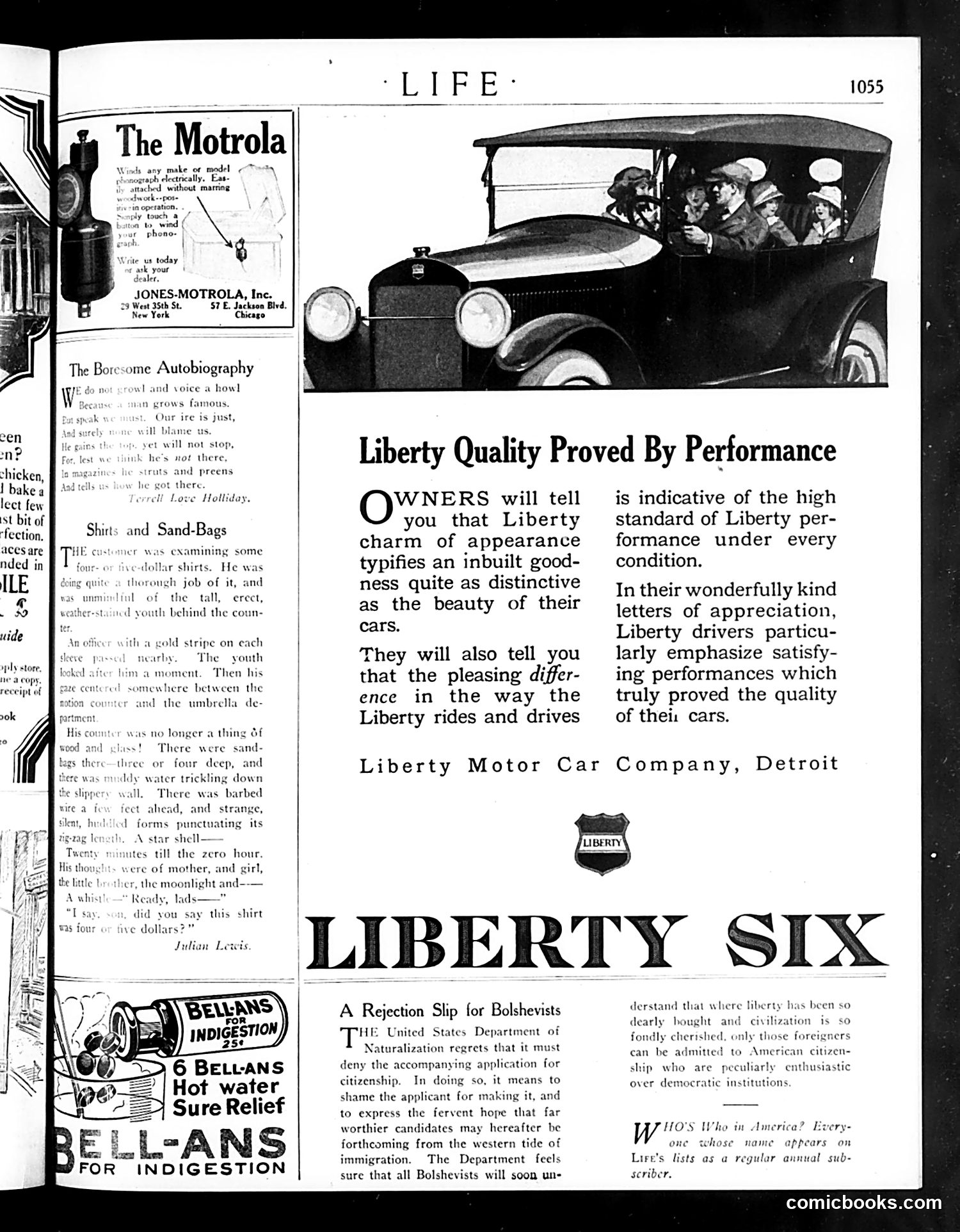
This page contains **anti-Bolshevik satire** disguised as a citizenship rejection notice. Titled "A Rejection Slip for Bolshevists," it presents a fictional Department of Naturalization letter denying citizenship to communist applicants. The piece mocks Russian immigrants and socialist ideologies during the post-WWI Red Scare (likely early 1920s), when American fear of Bolshevism peaked. The satire argues that immigrants with communist sympathies are unworthy of American citizenship because they don't sufficiently embrace "democratic institutions." The tone is openly contemptuous, shaming applicants for even applying. The page also contains standard period advertising (Motrola radios, Bell-Ans antacid) and a brief story excerpt. The Liberty Six automobile ad appears unrelated to the political content—a typical magazine layout mixing commerce with editorial material.
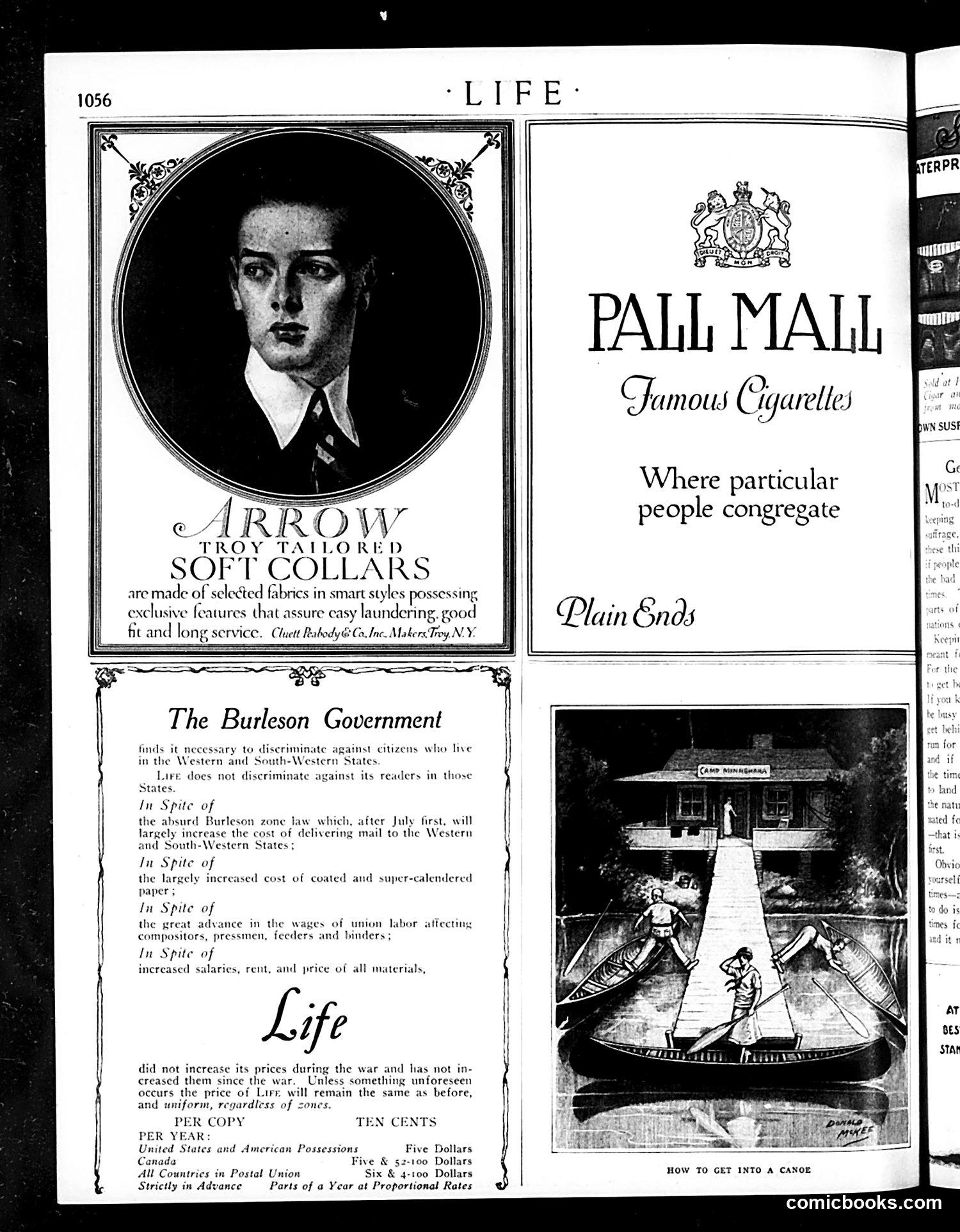
This page combines advertisements with political messaging. The top features ads for Arrow shirt collars and Pall Mall cigarettes—typical commercial content for the era. The substantial middle section is a statement by *Life* magazine defending itself against the "Burleson Government." Albert Burleson, Postmaster General under President Wilson, had implemented controversial postal rate zones that increased mailing costs for Western and Southwestern states. *Life* uses this as a platform to boast that despite wartime inflation, labor cost increases, and material shortages, the magazine has kept its subscription price stable at five dollars annually. This reads as both a complaint about Burleson's policies and a marketing pitch: *Life* is positioning itself as consumer-friendly and patriotic by absorbing costs others passed along. The bottom image, captioned "How to Get Into a Canoe," appears to be a humorous illustration, though details are unclear in this reproduction.
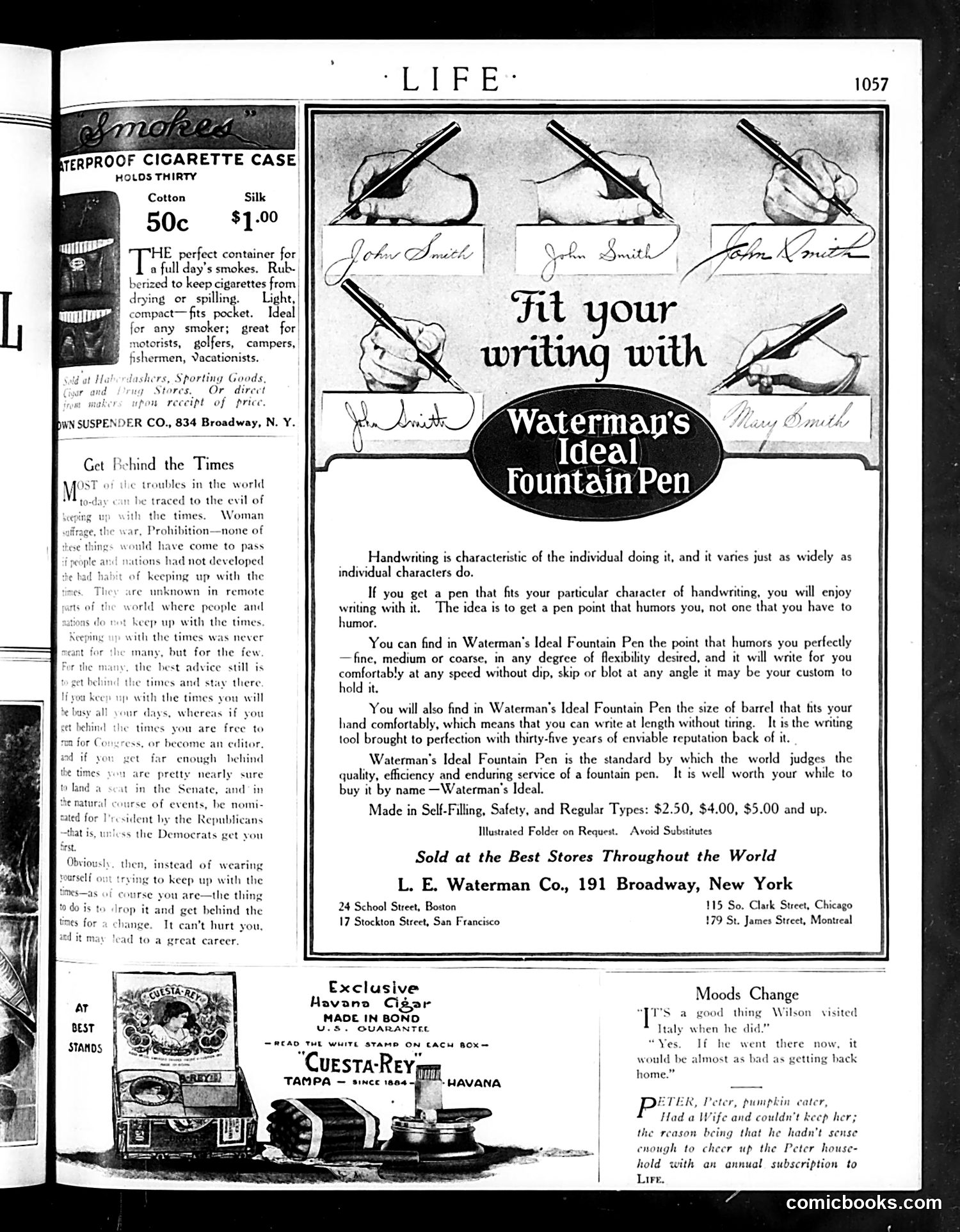
This page is primarily **advertising**, not political satire. It contains four product advertisements: 1. **Smoker's Waterproof Cigarette Case** (top left): A practical container marketed to businessmen and outdoorsmen. 2. **Waterman's Ideal Fountain Pen** (center): The main advertisement, emphasizing that different handwriting styles require different pen points. The decorative header shows various signatures, suggesting personalization and individual character. 3. **Cuesta-Rey Havana Cigars** (bottom left): A luxury cigar brand. 4. **Editorial snippet "Get Behind the Times"** and **"Moods Change"** (sides): Brief satirical pieces—the first ironically advising readers to *avoid* keeping up with current events to ensure political success; the second a joke about President Wilson's Italy visit and maintaining domestic happiness through *Life* magazine subscriptions. The page reflects early 20th-century consumer culture and light political humor rather than sustained cartoon satire. The Wilson reference dates this to around 1919.
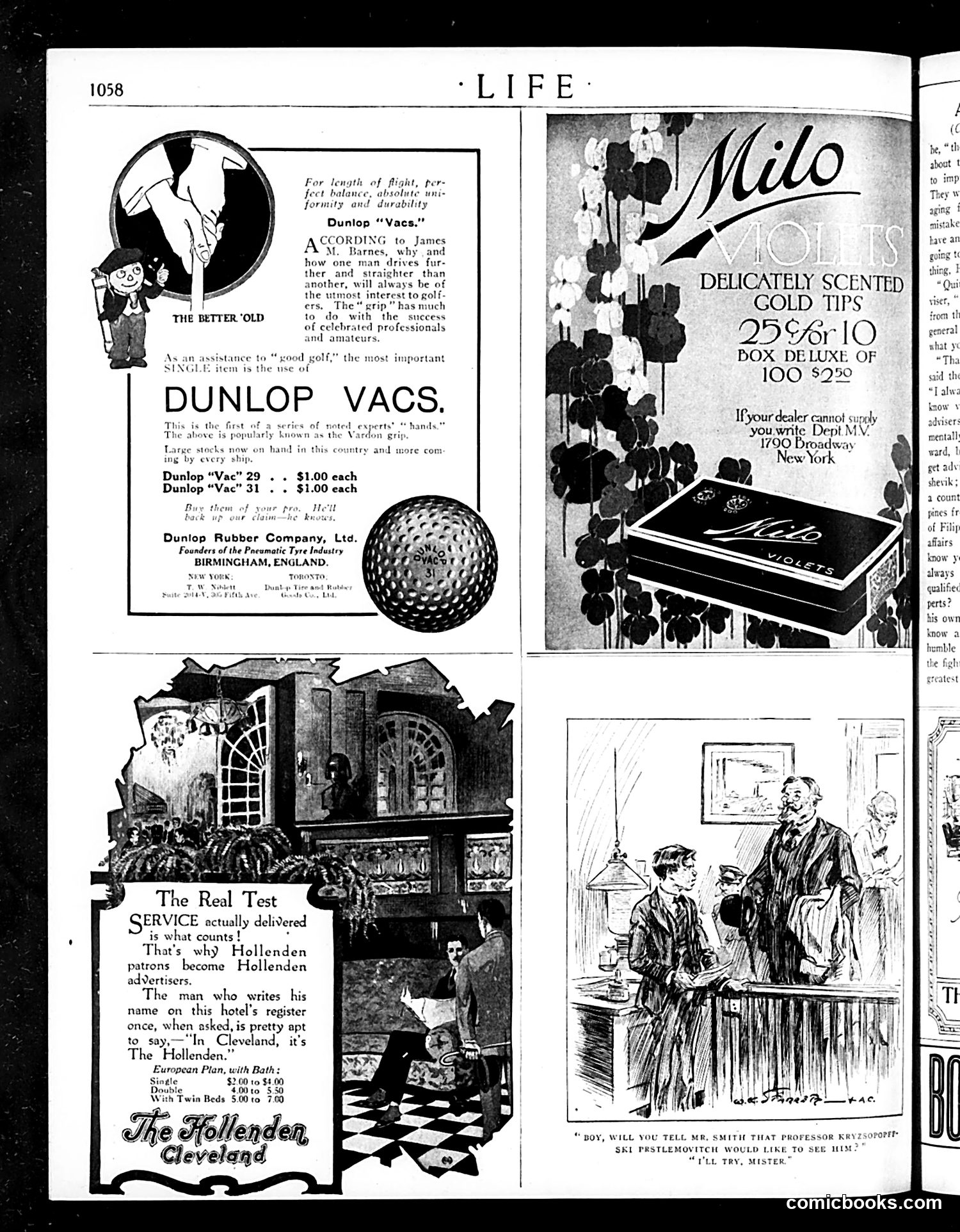
This page is primarily **advertising**, not political satire. The main content includes: **Dunlop Vacs** (golf balls): An equipment ad claiming proper golf balls are essential to success—a humorous exaggeration of equipment's importance versus skill. **Milo Cigarettes**: A deluxe box of "delicately scented gold tips" cigarettes at premium pricing ($2.90-$7.50), targeting affluent smokers. **The Hollenden Hotel** (Cleveland): A service-quality testimonial ad, emphasizing repeat customer loyalty as proof of excellence. **Bottom cartoon**: A sketch showing a hotel clerk fielding an unusual request about "Professor Kryzosopff" and "Ski Pestlemovitch"—appears to be ethnic name-humor typical of the era, playing on foreign-sounding names for comedic effect. The page reflects early 20th-century advertising priorities: luxury goods, leisure activities (golf), and service reputation, with casual ethnic stereotyping in humor.
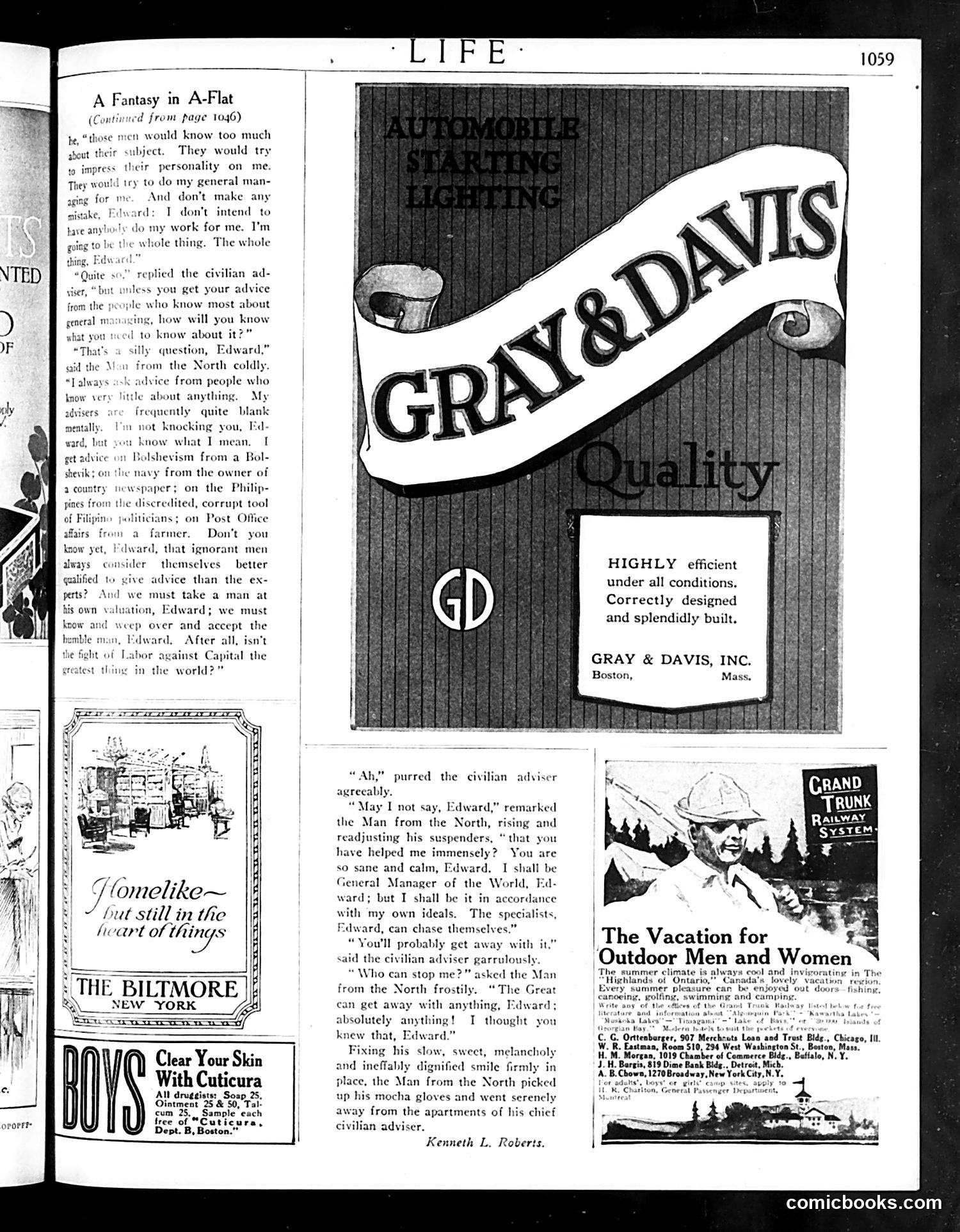
This is a satirical story (continued from a previous page) mocking autocratic leadership and dangerous ideological certainty. The central figure is "the Man from the North," who represents an arrogant, authoritarian leader dismissing expert advice. He proudly boasts he seeks counsel only from people who know *nothing* about their subjects—a deliberate inversion of rational governance. His reasoning: ignorant advisers won't challenge him or impose their personalities on his decisions. The civilian adviser attempts to challenge this absurdity, warning that one cannot understand complex governance (navy policy, colonial administration, etc.) without consulting actual experts. The Man from the North's response—that he will do "absolutely anything" without restraint—suggests dangerous megalomaniacal ambitions. The satire targets anti-democratic leadership philosophies and the rejection of expertise, likely referencing political trends of the era (the story byline credits Kenneth L. Roberts). The Man's grandiose self-regard and contempt for informed counsel represent a direct threat to rational society.
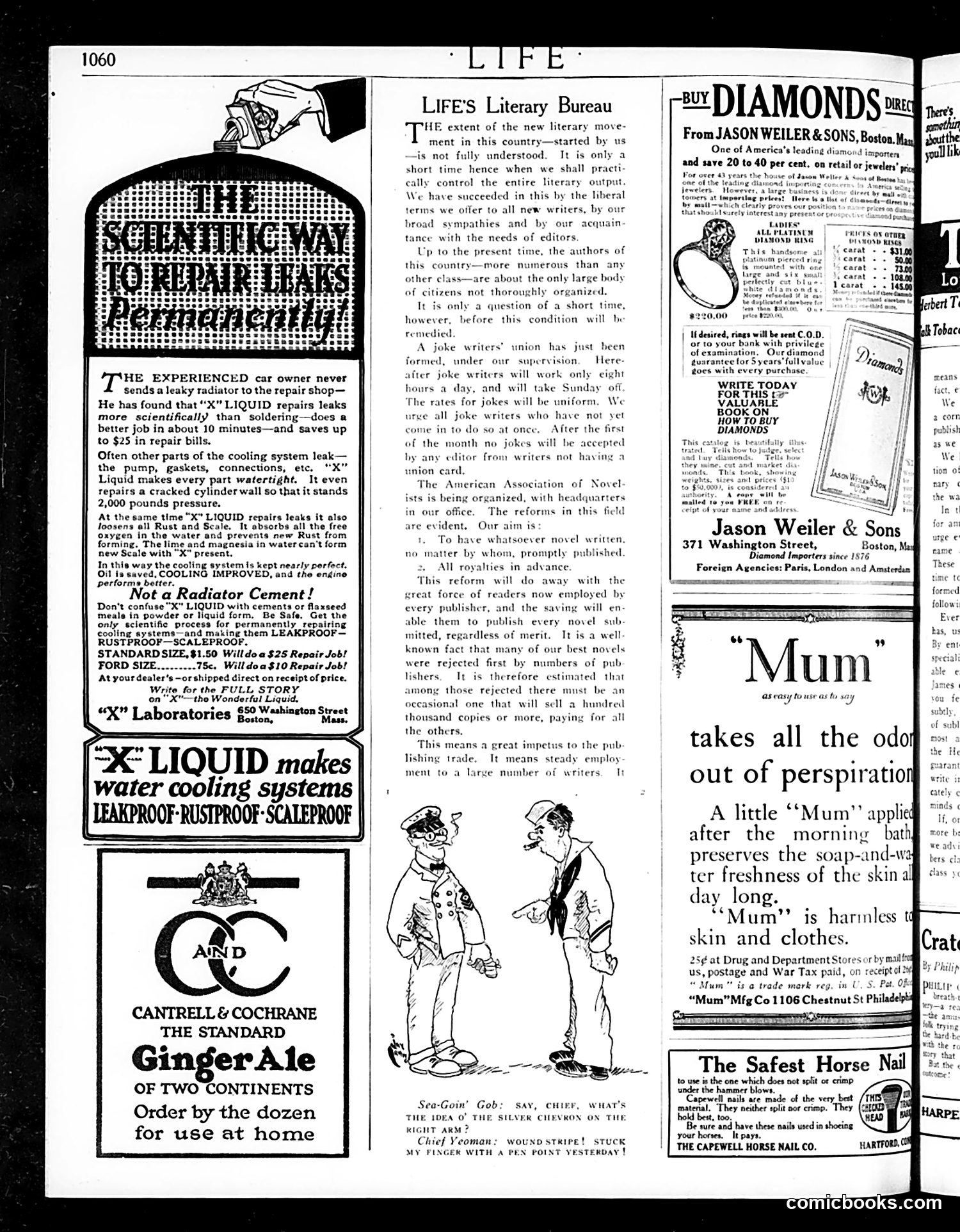
This page is primarily **advertising and editorial content**, not political satire in the traditional sense. The main cartoon depicts a naval exchange: a "Sea-Goin' Gob" (sailor) questions a Chief Yeoman about a silver chevron on his arm. The Chief jokes that he accidentally stuck his finger with a pen point yesterday—a humorous deflation of what should be an official military insignia, suggesting the Chief got his rank marking through accident rather than achievement. It's gentle humor mocking bureaucratic absurdity. The page is dominated by product advertisements (X-Liquid radiator fluid, Ginger Ale, diamonds, "Mum" deodorant, horse nails) and an editorial piece from "Life's Literary Bureau" satirizing the magazine's claimed influence over American literature—pretending Life controls publishing through writers' unions and novelist associations. This is self-promotional satire, likely tongue-in-cheek boasting about the magazine's cultural authority.
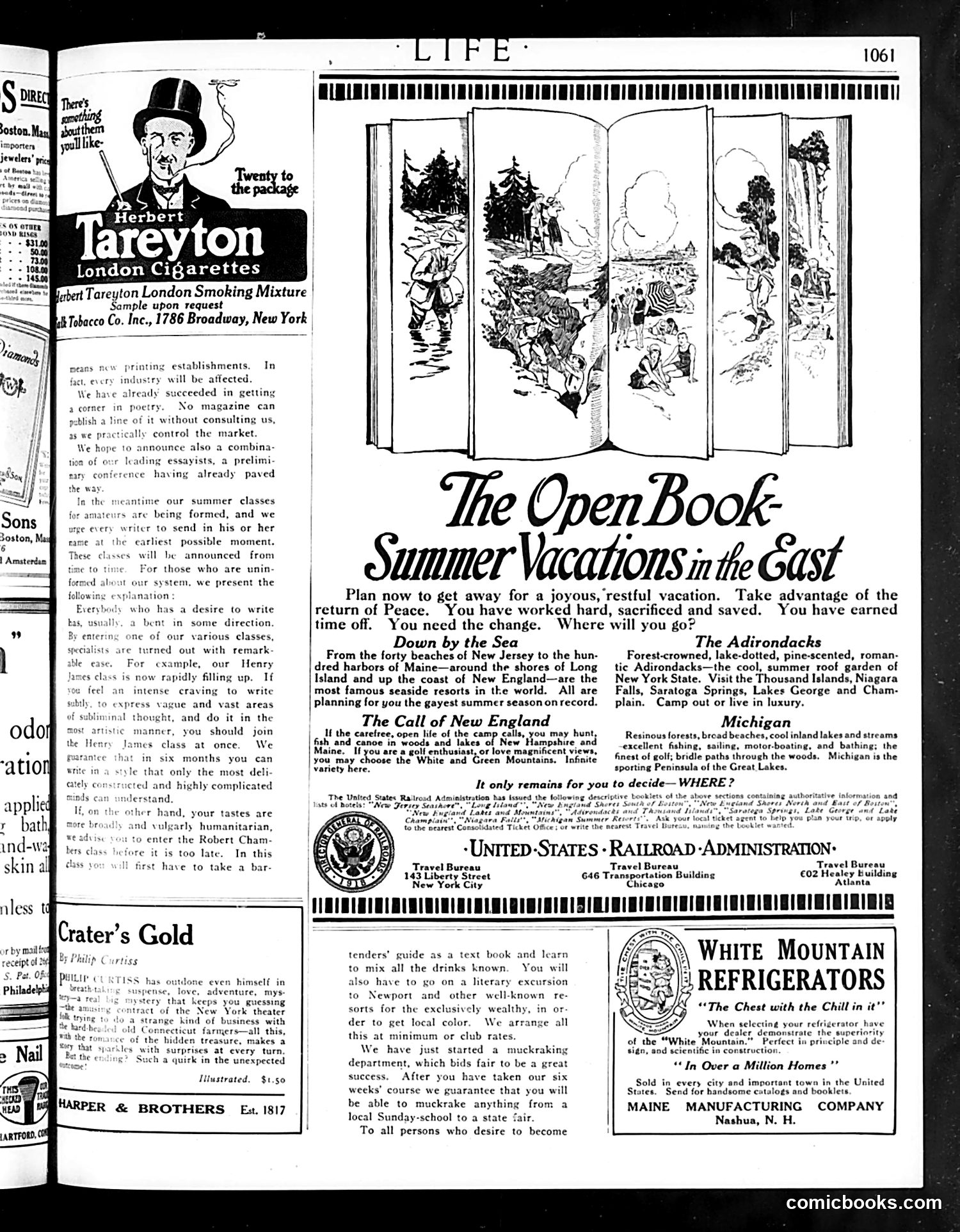
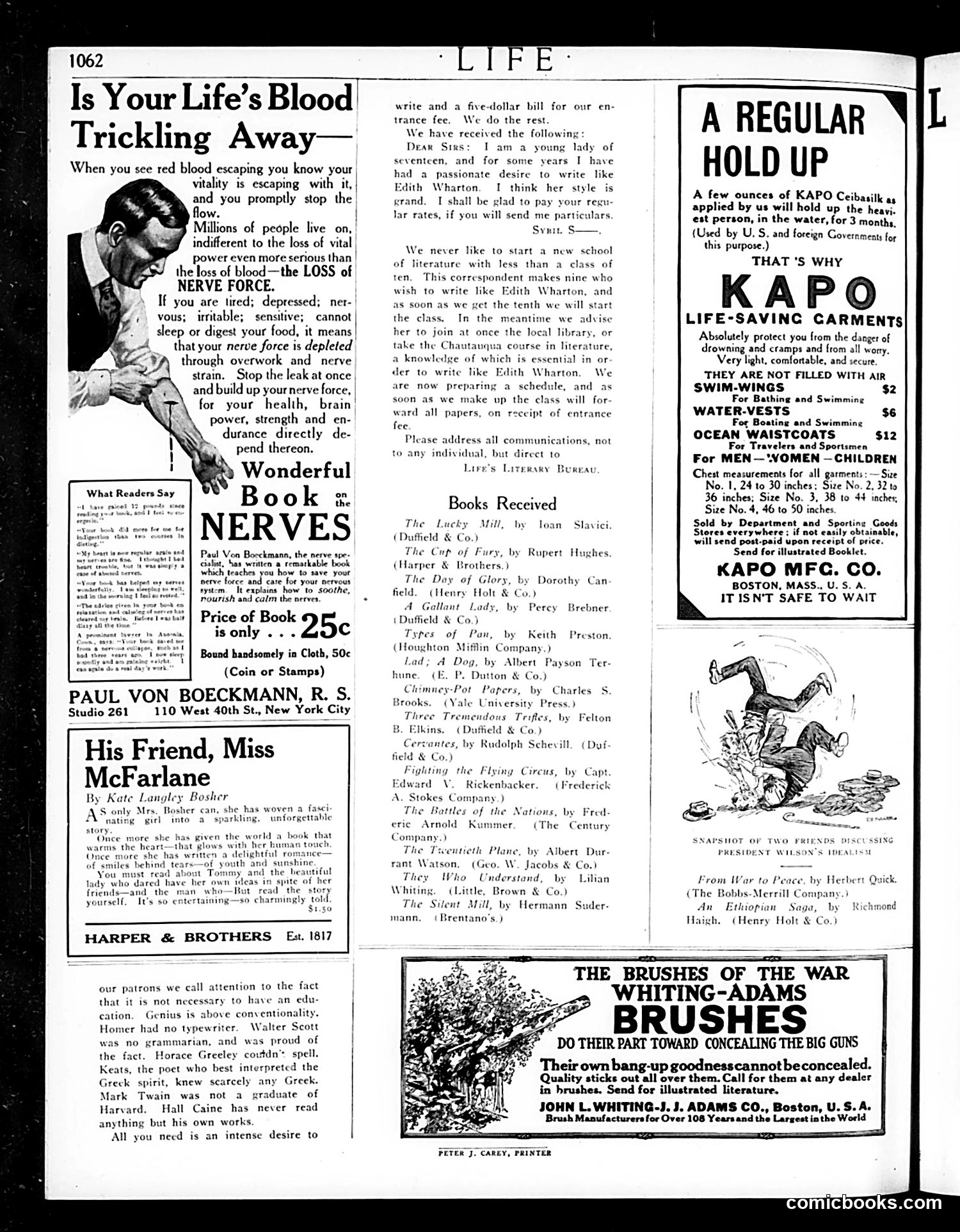
This page is primarily **advertising and travel promotion**, not political satire. The dominant feature is a large illustrated advertisement from the United States Railroad Administration promoting summer vacation destinations in the eastern United States. The ad showcases scenic locations—the Jersey Shore, New England, the Adirondacks, and Michigan—using woodcut-style illustrations of forests, lakes, and outdoor activities. The text emphasizes that Americans have "earned time off" after wartime sacrifice and should travel via railroad to these destinations. The smaller advertisements (Herbert Tareyton cigarettes, White Mountain Refrigerators, Harper & Brothers books) are conventional commercial notices typical of Life magazine's revenue model. The left column contains what appears to be **satirical commentary** about writers' unions or professional guilds controlling various industries including poetry and journalism, but the text is partially obscured and unclear in context. This is primarily a **commercial publication page** rather than a vehicle for political commentary.