
Life, 1919-06-12 · page 16 of 46
Life — June 12, 1919 — page 16: what you’re looking at
What you’re looking at
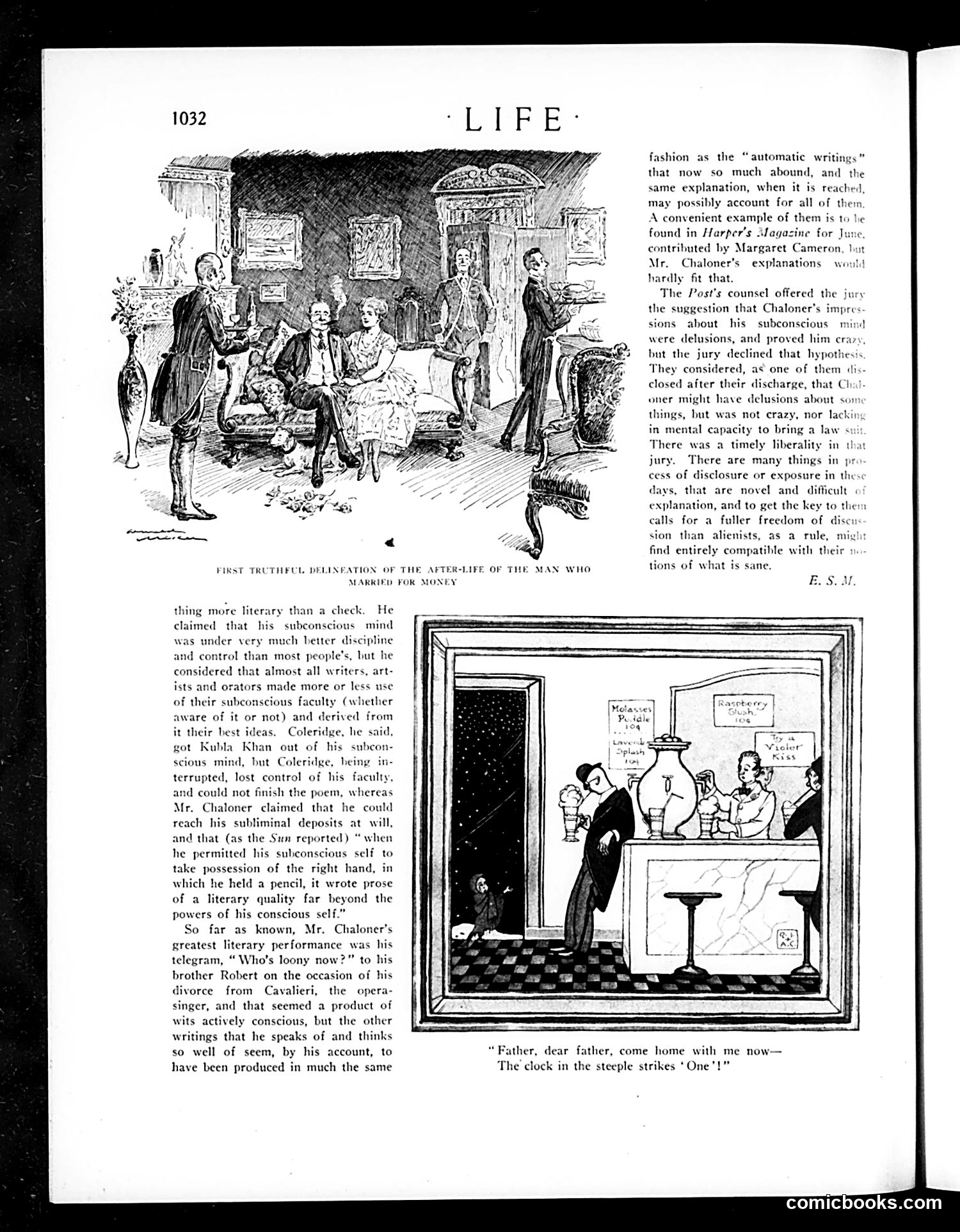
This page satirizes a legal case involving a man named Chaloner who claimed his best literary work was produced by his "subconscious mind" through automatic writing—a fashionable pseudo-scientific practice of the era. The top cartoon depicts Chaloner's "after-life" as a man "married for money," showing him surrounded by society figures in what appears to be an afterlife reception. The lower cartoon shows a domestic scene with the caption about a father coming home—illustrating the mundane reality of married life, contrasting with Chaloner's grandiose artistic claims. The text mocks Chaloner's defense in a lawsuit where he claimed delusions about his subconscious mind, but a jury found him mentally competent despite his peculiar beliefs. Life ridicules both Chaloner's pretentious literary claims and the broader 1920s fascination with automatic writing and subconscious psychology as fashionable nonsense.
📄 Transcribed text from this page (OCR, searchable)
Machine-transcribed from the original scan — historical spelling and the odd misread are preserved.
fashion as the “automatic writings” that now so much abound, and. the same explanation, when it is reac may possibly account for all of them A convenient example of them is to found in Harper's Magazine for J contributed by Margaret Cameron, hut Mr. Chaloner’s explanations w+ hardly fit: that. The Post's counsel offered the the suggestion that Chaloner’s impres sions about his subconscious mir were delusions, and proved him crazy, but the jury declined that hypoth They considered, ag one of them dis- closed after their discharge, that Ci oner might have delusions about sor things, but was not crazy, nor lacking in mental capacity to bring a law < There was a timely liberality in jury. There are many things in 4 cess of disclosure or exposure in these days, that are novel and difficult « explanation, and to get the key to them calls for a fuller freedom of dis sion than alienists, as a rule, m find entirely compatible with their » MAN WHO tions of what is sane. FIRST TRUTHEUL DELINEATION OF THE APTER-LIFE OF TIE MARRIED FOR MONEY thing more literary than a check. He claimed that his subconscious mind was under very much better discipline 1 control than most people’s, but he considered that almost all writers, art- ists and orators made more or less use of their subconscious faculty (whether aware of it or not) and derived from it their hest ideas. Coleridge, he said, got Kubla Khan out of his subcon- scious mind, but Coleridge, heing in- terrupted, lost control of his faculty, and could not finish the poem, whereas Mr. Chaloner claimed that he could reach his subliminal deposits at will, and that (as the Sun reported) “ when he permitted his subconscious self to take possession of the right hand, in which he held a pencil, it wrote prose of a literary quality far beyond the powers of his conscious self.” So far as known, Mr, Chaloner’s greatest literary performance was his telegram, “ Who's loony now?” to his. brother Robert on the occasion of his divorce from Cavalieri, the opera- singer, and that seemed a product of wits actively conscious, but the other writings that he speaks of and thinks so well of seem, by his account, to ather, dear father, come home with me now— have been produced in much the same The clock in the steeple strikes One!” comicbooks.com