
A complete issue · 42 pages · 1919
Life — May 22, 1919
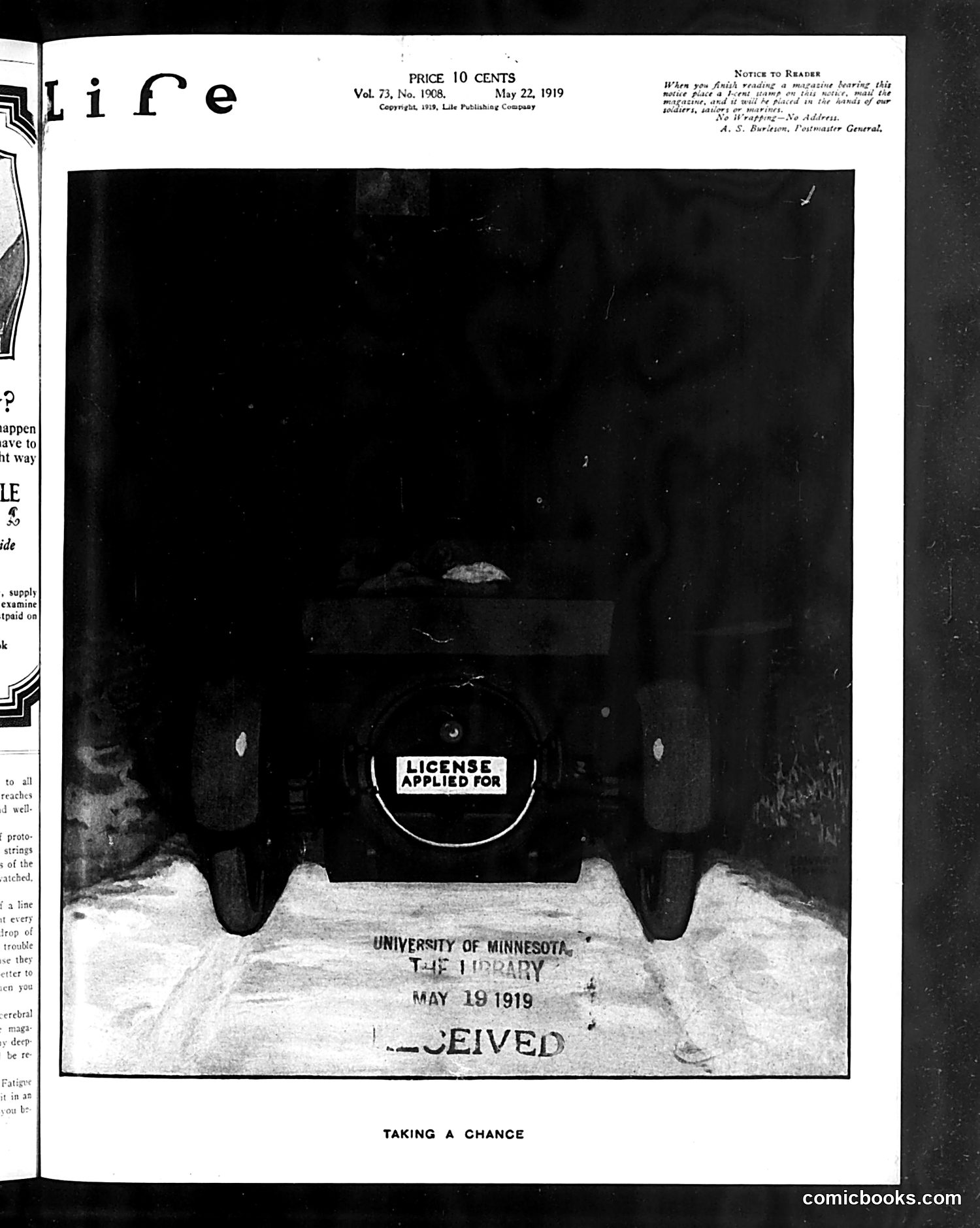
This cartoon shows an automobile with a "LICENSE APPLIED FOR" sign, depicted from above in a stark, somewhat ominous manner. The image suggests the vehicle is precariously positioned—the composition emphasizes wheels and undercarriage against what appears to be rough terrain or a cliff edge. The title "Taking a Chance" plays on the irony of a vehicle operating without proper licensing. In 1919, automobile regulation was still relatively new in America, and this likely satirizes either: the risks of unlicensed driving, the proliferation of automobiles outpacing legal oversight, or perhaps reckless motorists flouting regulations. The stark photographic style—rare for Life at the time—heightens the sense of danger or consequences, suggesting that operating without proper authorization was foolish or hazardous.
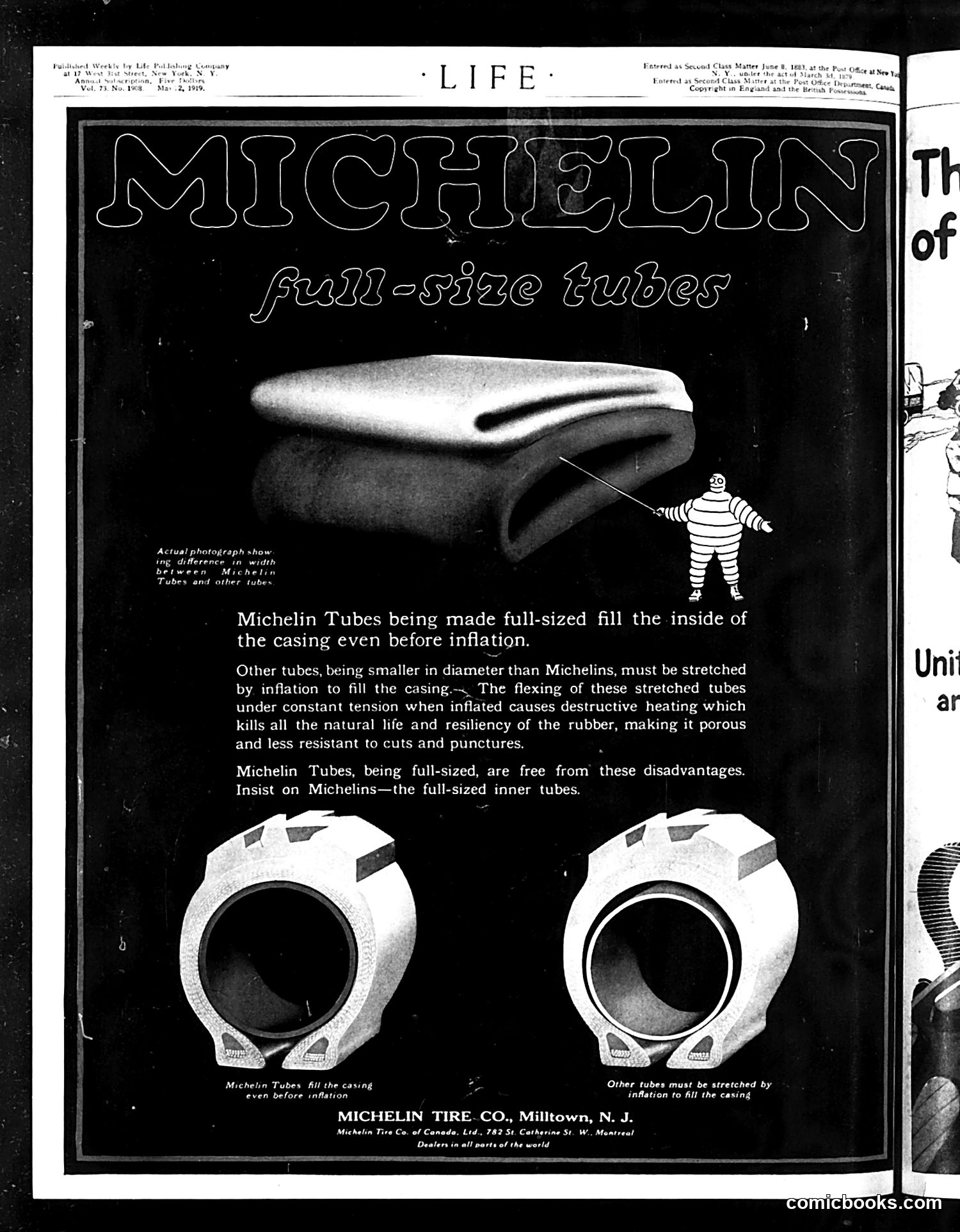
This page is **primarily advertising, not satire or political commentary**. It's a Michelin Tire Company advertisement from *Life* magazine (dated May 2, 1908). The ad promotes Michelin's "full-size tubes" for automobile tires. The imagery compares Michelin tubes (shown filling a tire casing completely before inflation) against competitor tubes that require stretching during inflation. The accompanying text argues that stretched tubes experience destructive heating that damages rubber resilience. The Michelin Man mascot appears for scale comparison. There is no political cartoon or satire here—this is straightforward product marketing emphasizing Michelin's manufacturing advantage and superiority over competing tire products of the era.
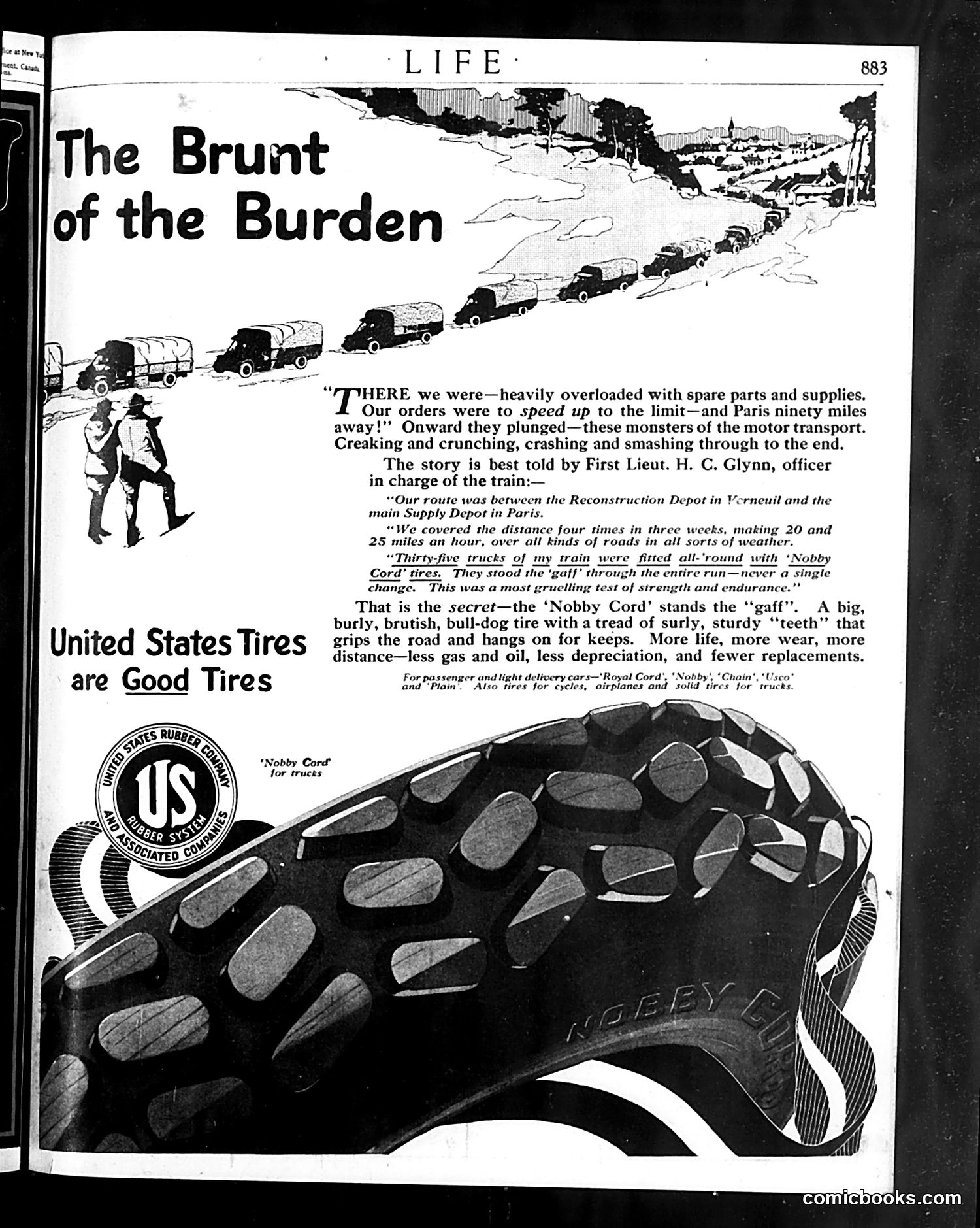
This is primarily a **commercial advertisement**, not political satire. It depicts a supply convoy of 25 trucks traveling 25 miles per hour from Versailles to Paris—likely referencing post-World War I reconstruction efforts. The text credits First Lieutenant C. Glynn for observing how heavily-laden military transport vehicles tested tire durability across poor roads in difficult weather. The advertisement promotes "Nobby Cord" tires as superior for heavy-duty use, emphasizing their sturdy tread pattern visible in the large tire image. The "burden" in the title refers to the trucks' heavy loads during wartime logistics operations, positioning US Tires as reliable equipment for demanding military transportation—a common advertising strategy in the WWI-era period.
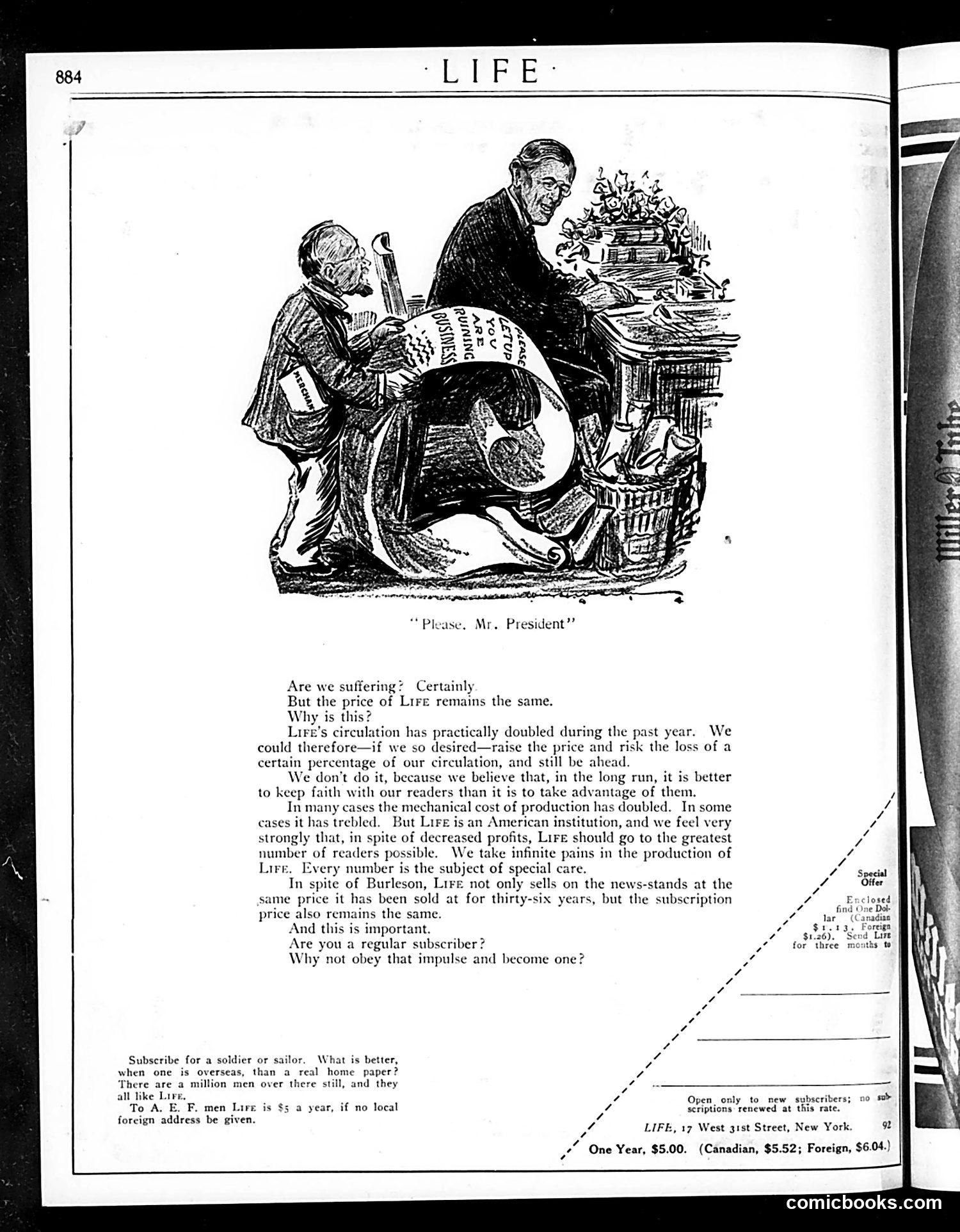
This appears to be a **subscription appeal** rather than political satire. The cartoon shows a man at a desk (likely representing Life magazine's publisher or editor) speaking with a smaller figure, captioned "Please, Mr. President." The accompanying text addresses **wartime economics**: Life's circulation doubled during the past year, but production costs also doubled. Rather than raise prices, Life is keeping subscription rates stable at $5 yearly—the same price for thirty-six years—to maintain faith with readers. The "President" reference likely addresses the U.S. government or the magazine's leadership, appealing for understanding about economic pressures during what appears to be **WWI era** (note the reference to soldiers and sailors overseas). This is essentially a **business plea disguised as editorial commentary**, asking readers to subscribe to support the magazine during inflationary times.
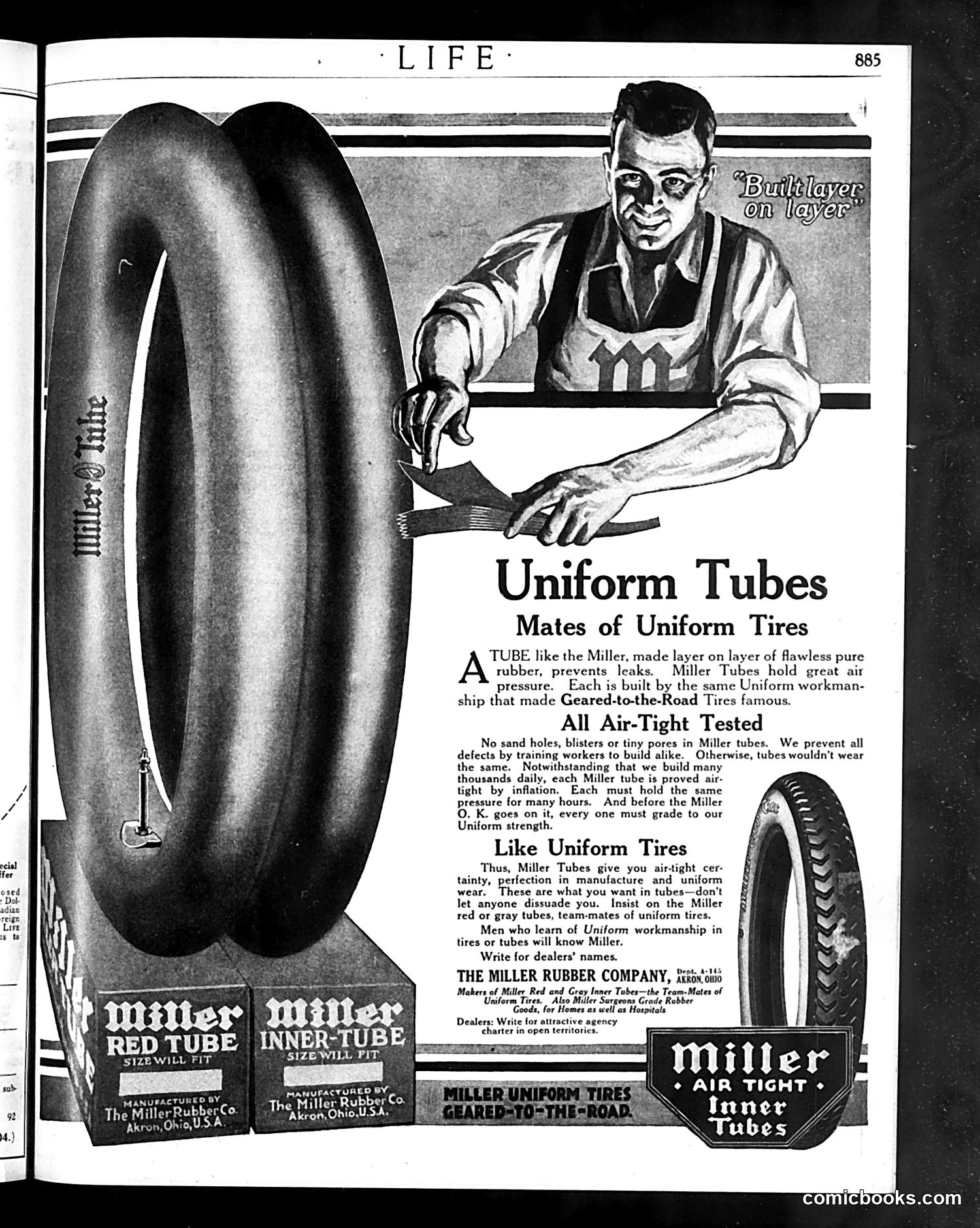
This is **not a political cartoon or satire** — it's a straightforward advertisement for Miller Rubber Company's inner tubes and tires, appearing in Life magazine (page 885). The image shows a workman demonstrating tire quality through the phrase "Built-layer on layer." The ad emphasizes that Miller tubes are manufactured with the same craftsmanship as their famous "Geared-to-the-Road" tires, and claims all tubes are "Air-Tight Tested" with no defects. The visual comparison between the large inner tube (left) and finished tire (right) illustrates product quality and manufacturing standards. This represents early 20th-century industrial advertising, where companies highlighted rigorous testing and skilled workmanship to build consumer confidence in automobile products during the growing automotive market.
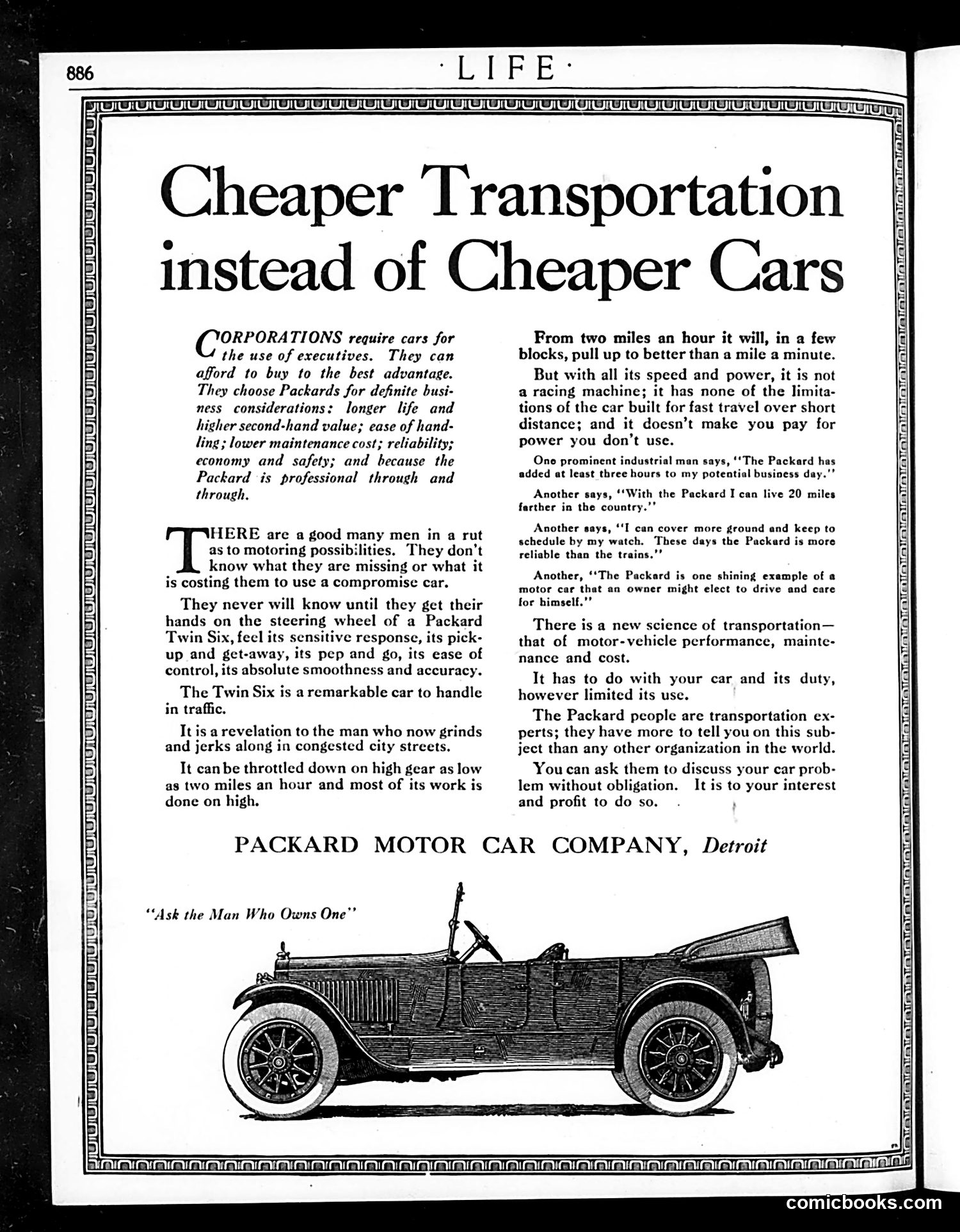
This is **not a satirical cartoon page** but rather a **straightforward advertisement** for the Packard Motor Car Company of Detroit. The ad argues that corporations should buy Packards instead of cheaper cars, claiming superior business value through reliability, durability, and professional appearance. It emphasizes the car's smooth handling, efficiency on high gear at low speeds, and low maintenance costs—positioning the Packard as economical despite higher initial cost. The tagline "Ask the Man Who Owns One" was Packard's actual advertising slogan. The illustration shows a side-profile drawing of a Packard automobile. This represents early automotive advertising targeting business executives, not political satire. The appeal is practical and economic rather than humorous or satirical.
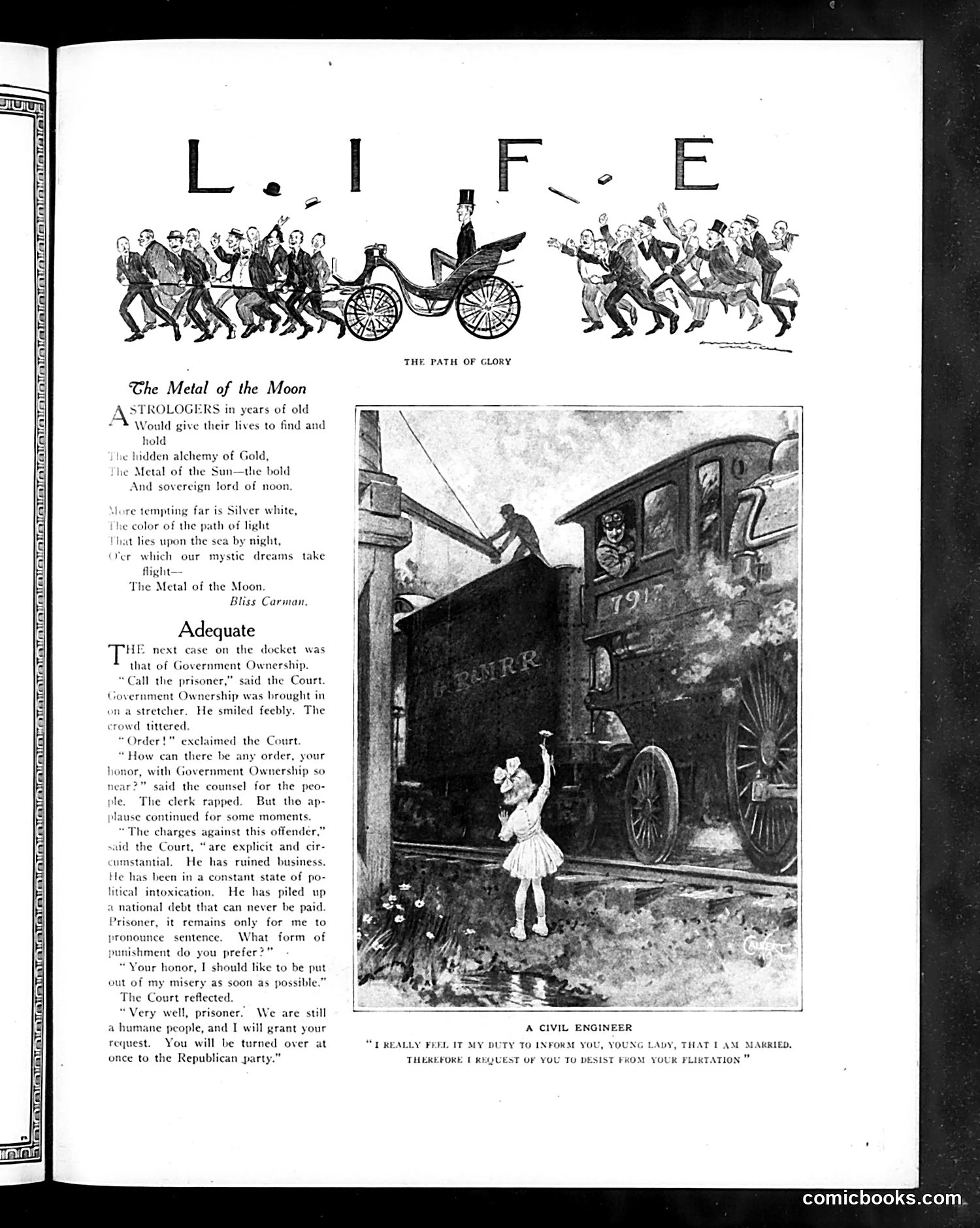
This page presents satirical content about early 20th-century American politics and social issues. **"The Metal of the Moon"** is a poem about alchemical pursuit of wealth and power, using lunar imagery as metaphor for elusive riches. **"Adequate"** is a satirical legal case narrative mocking "Government Ownership" policies. The court scene ridicules socialist or progressive government intervention by having a prisoner represent "Government Ownership" itself—personified as having "ruined business" and created "national debt." The judge offers mercy by transferring the "prisoner" to the Republican party, sarcastically suggesting Republicans will manage government better than interventionist Democrats. **"A Civil Engineer"** illustration depicts a flirtation scene at a train, with the gentleman's caption humorously asserting his marital status to avoid impropriety—typical period social satire about Victorian propriety and gender relations. The overall theme critiques progressive economic policies through humor.
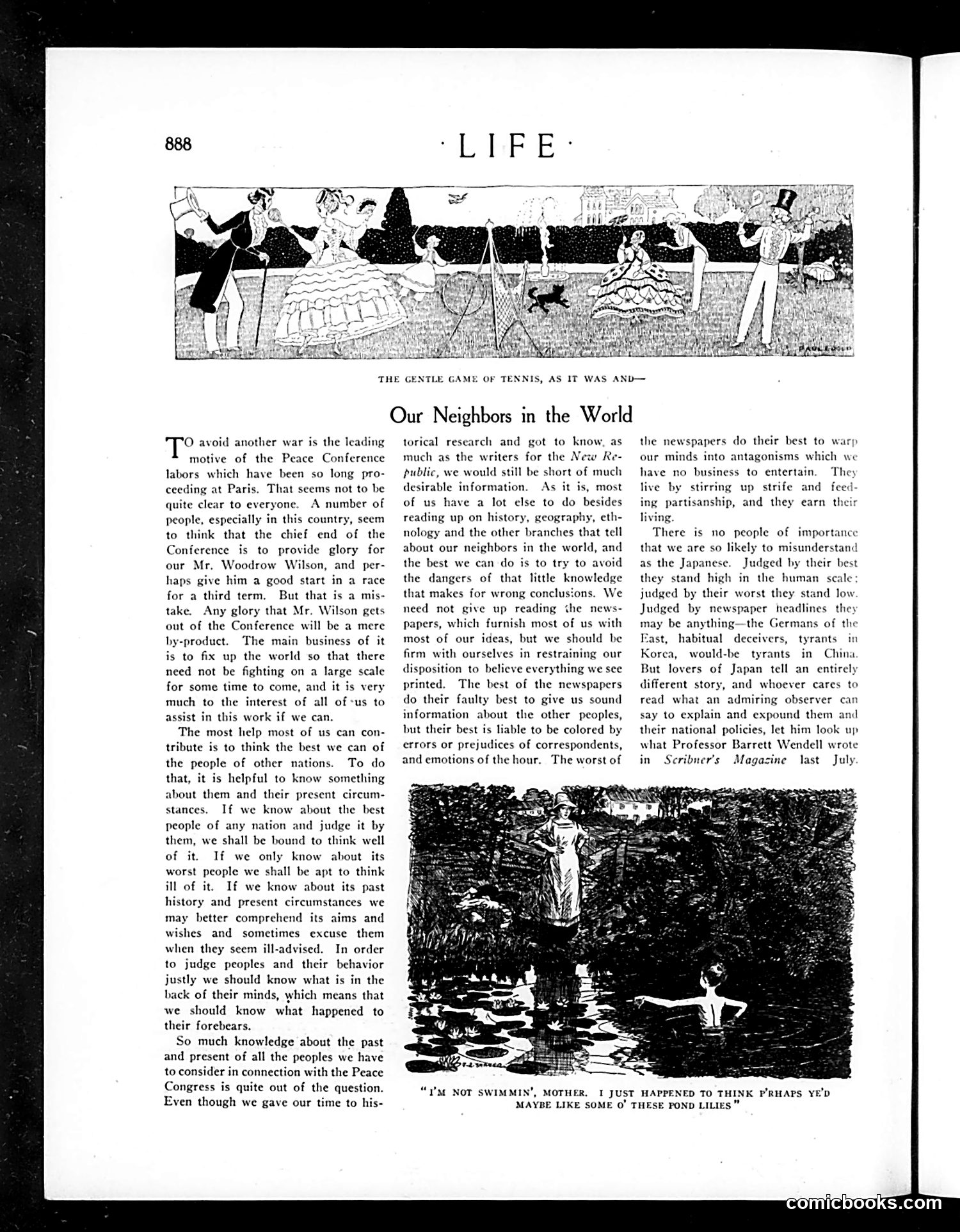
**Top Cartoon:** "The Gentle Game of Tennis, As It Was And—" depicts tennis players in period dress, then evolving into increasingly chaotic modern play, satirizing how the "genteel" sport has become rough and aggressive. **Main Article:** "Our Neighbors in the World" discusses international understanding, arguing that knowledge of other nations' histories and circumstances prevents prejudice. The text specifically references Japanese people as commonly misunderstood, claiming Western observers often judge them unfairly based on limited information. **Bottom Illustration:** Shows a child by a pond observing lilies, with caption: "I'M NOT SWIMMIN', MOTHER. I JUST HAPPENED TO THINK P'HAPS YE'D MAYBE LIKE SOME O' THESE POND LILIES"—a humorous domestic scene of a child's creative excuse-making.
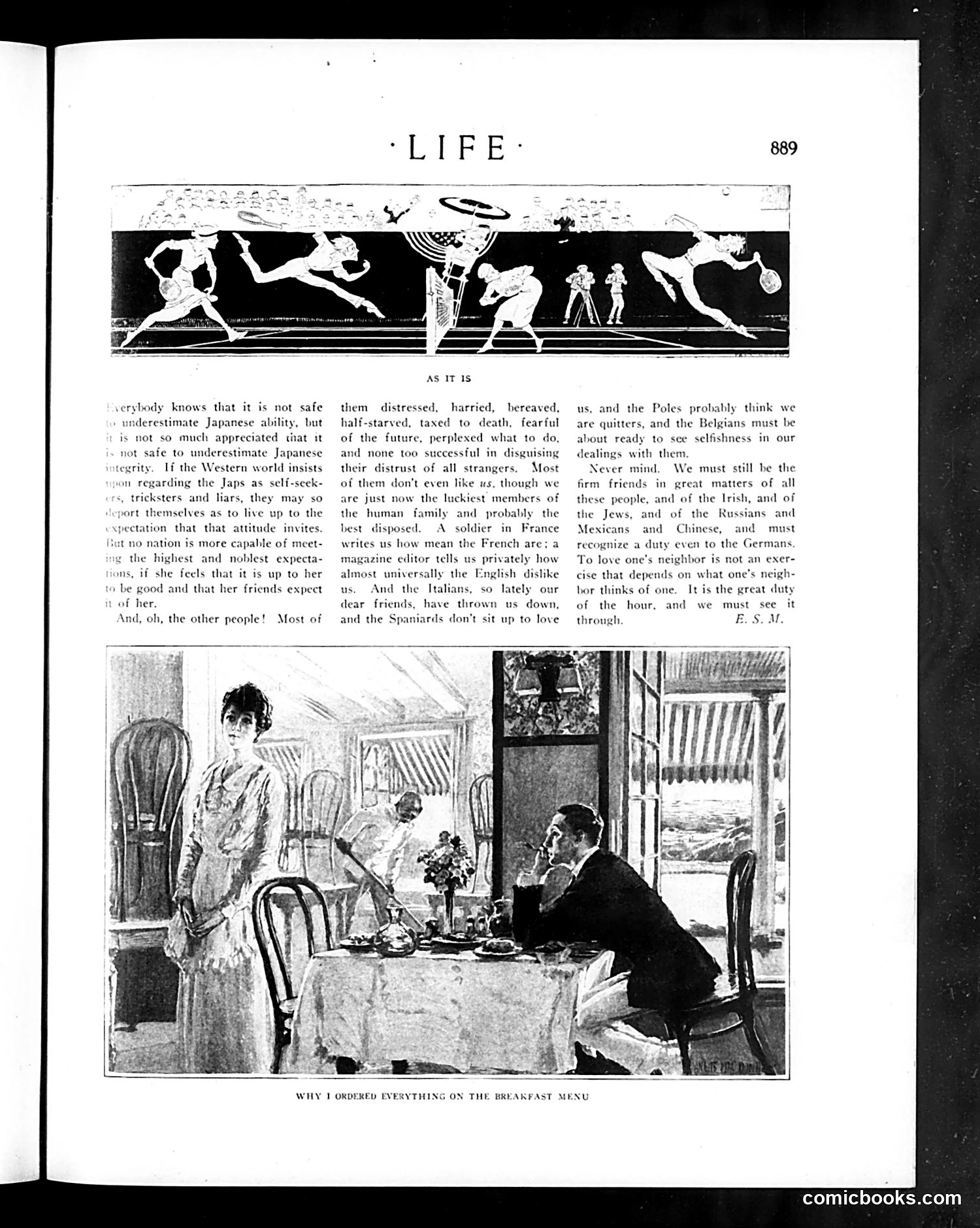
The top frieze depicts various athletic activities in silhouette—gymnastics, baseball, and other sports—suggesting physical vigor and competition. The main article, "As It Is," discusses international relations during what appears to be WWI or its aftermath. The author critiques how different nations view each other negatively: the French dislike Germans, English dislike Italians, and so forth. The piece argues for neighborly duty and mutual respect despite these prejudices. The bottom illustration, captioned "Why I Ordered Everything on the Breakfast Menu," shows a domestic scene of a man and woman at breakfast. The humor appears to rely on an unstated visual joke about the man's nervous or anxious expression, though the specific punchline isn't entirely clear from the image alone.
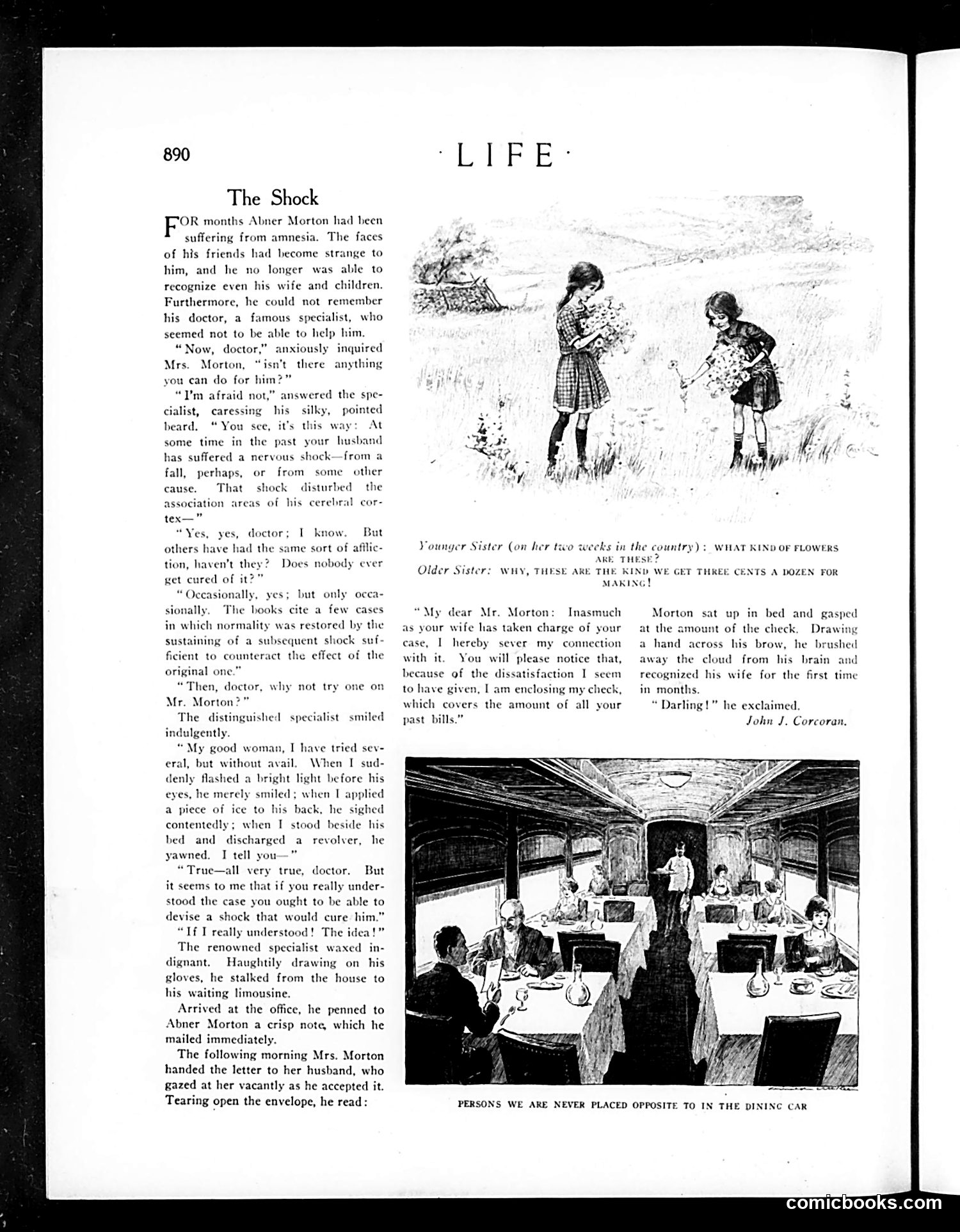
This is a narrative fiction piece, not political satire. The story concerns Abner Morton, who has suffered a nervous shock from an unspecified fall or accident. His doctor explains the condition affects "association areas of his cerebral cortex." The two illustrations show: (1) two young girls in a countryside setting picking flowers, and (2) passengers in a dining car on a train. The narrative focuses on Morton's wife consulting a doctor about her husband's mysterious condition and a letter the doctor sends. The story appears to explore early 20th-century attitudes toward neurology, nervous disorders, and psychological recovery — subjects gaining medical attention during this period. The page demonstrates Life magazine's practice of mixing serialized fiction with illustration.
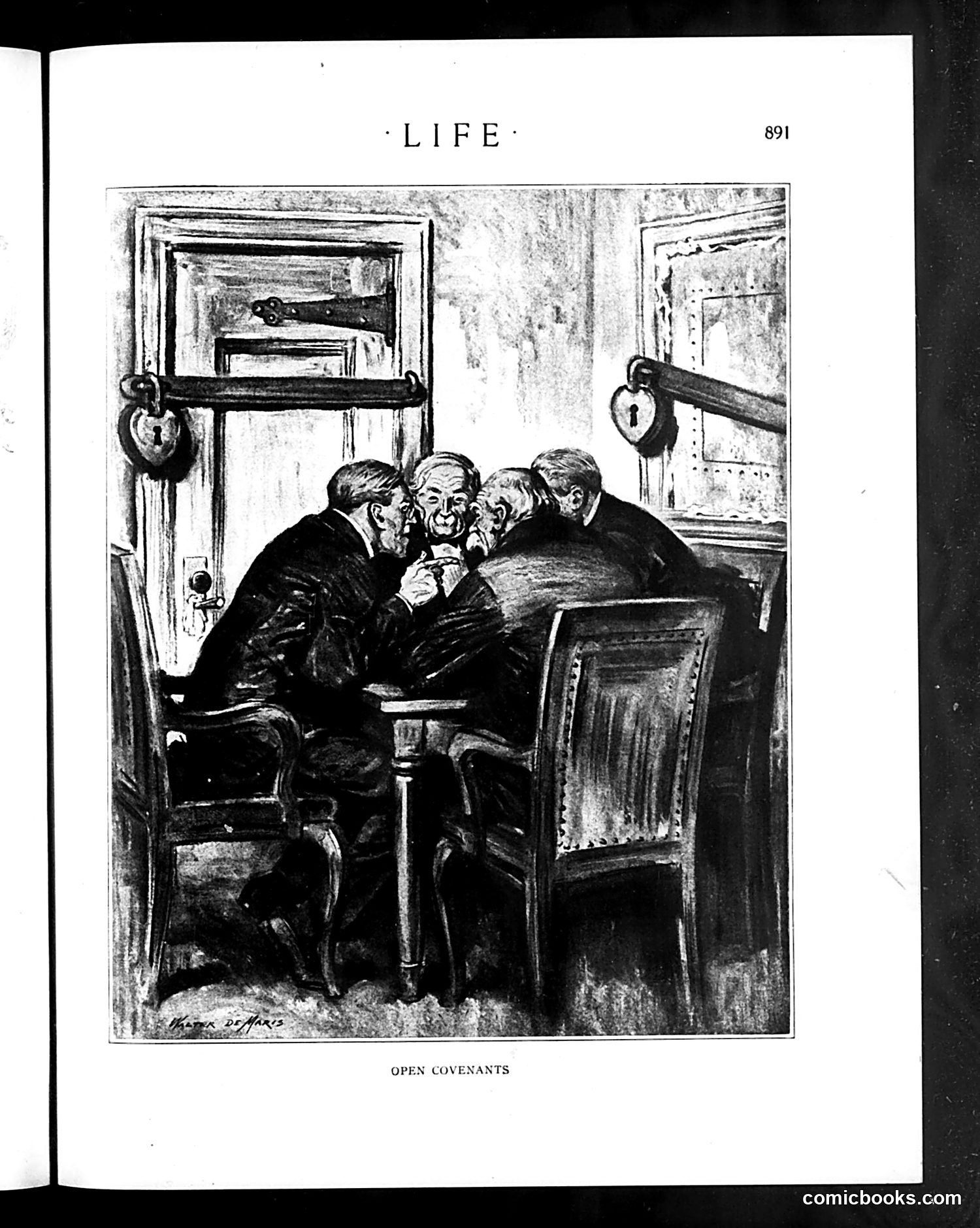
This cartoon depicts four men in a locked room, huddled conspiratorially around a table. The title "Open Covenants" is ironic—a reference to President Woodrow Wilson's famous call for "open covenants, openly arrived at" as part of his Fourteen Points peace proposal after World War I. The satire mocks the gap between Wilson's idealistic rhetoric about transparent diplomacy and the reality of backroom political dealing. The locked doors and heart-shaped padlocks emphasize secrecy, while the men's scheming postures suggest hidden negotiations. The cartoon critiques how diplomatic agreements are actually negotiated behind closed doors, contradicting the stated principle of public transparency in international affairs.
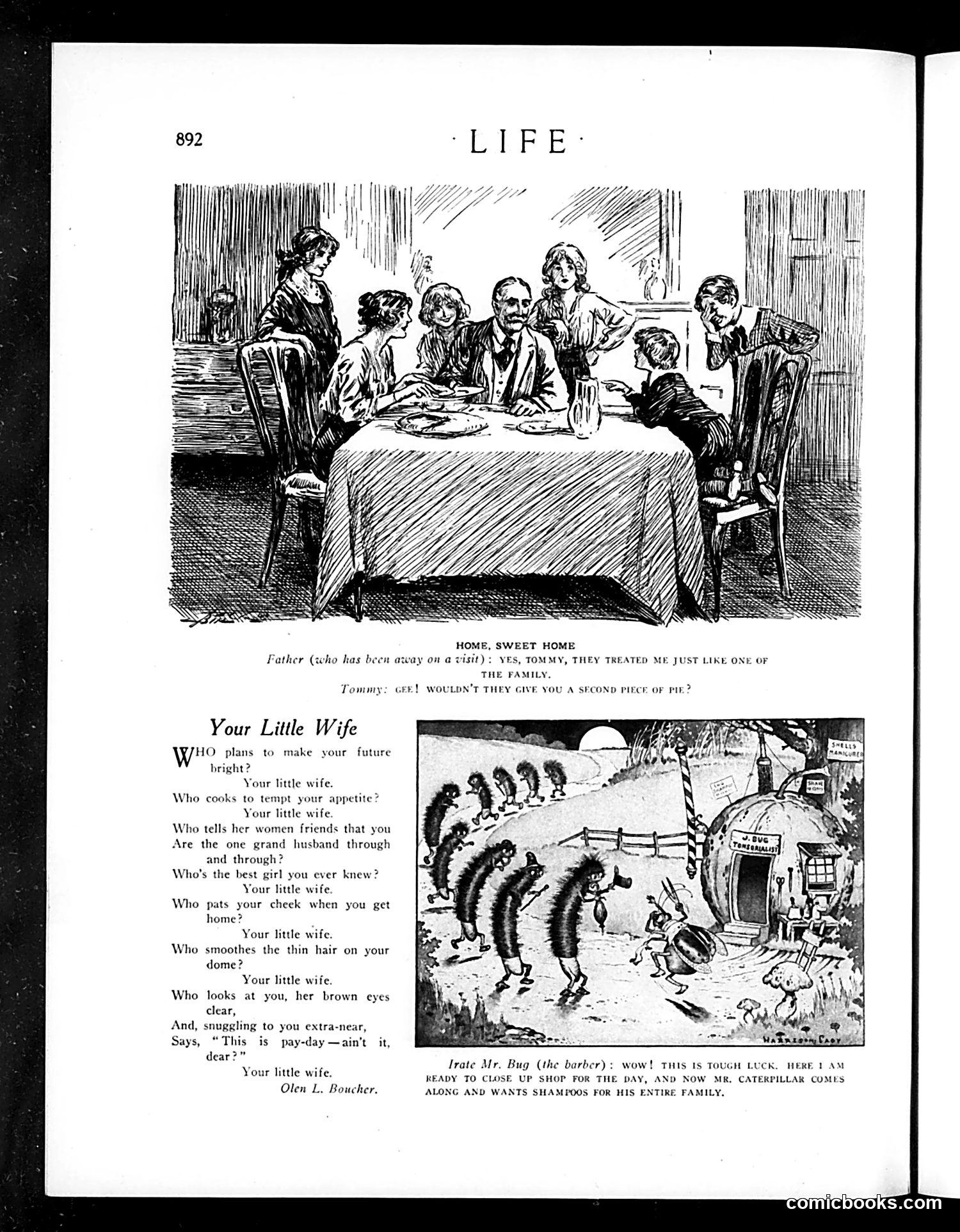
**Top Cartoon ("Home, Sweet Home"):** A family dinner scene where the father has been away (likely on military service, given the reference to a "cuff"). Tommy asks if they'll get a second piece of pie, humorously suggesting the family's modest circumstances and possibly food rationing—likely referencing WWI or post-war austerity. **"Your Little Wife" Poem:** A sentimental piece by Olen L. Boucher celebrating wives' domestic contributions—cooking, emotional support, smoothing "thin hair," and working on payday. Reflects early 20th-century gender roles where women's value centered on homemaking and supporting husbands. **Bottom Cartoon:** A surreal scene of caterpillars approaching a shop, with a barber bug discussing needing shampoo for his "entire family." The humor appears to be absurdist wordplay rather than clear political satire.
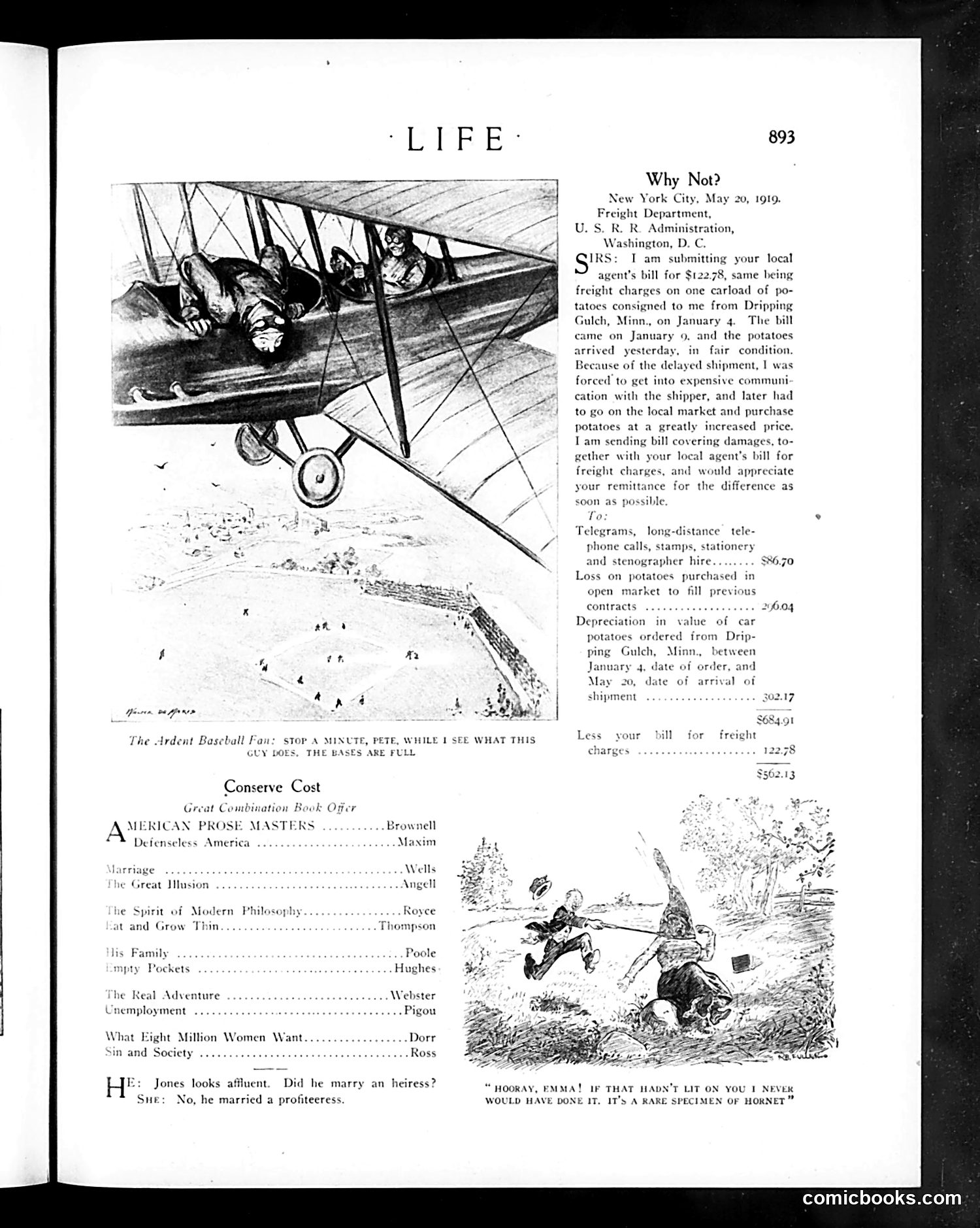
**Top Cartoon**: "The Ardent Baseball Fan" depicts an airplane dropping potatoes on figures below. The caption reads: "STOP A MINUTE, PETE, WHILE I SEE WHAT THIS GUY DOES. THE BASES ARE FULL." This is wartime satire—likely referencing WWI aerial combat, with the "bases" pun comparing military bombing to baseball strategy. **"Why Not?" Letter**: A serious complaint about shipping delays and spoilage of potatoes from Minnesota, resulting in inflated market prices and financial losses. **Bottom Cartoon**: Two figures fishing or hunting, with caption: "HOORAY, EMMA! IF THAT HASN'T LIT ON YOU, I NEVER WOULD HAVE DONE IT. IT'S A RARE SPECIMEN OF HORNET." This is slapstick humor about an insect landing on someone. The page mixes WWI-era satire with domestic complaints and light humor.
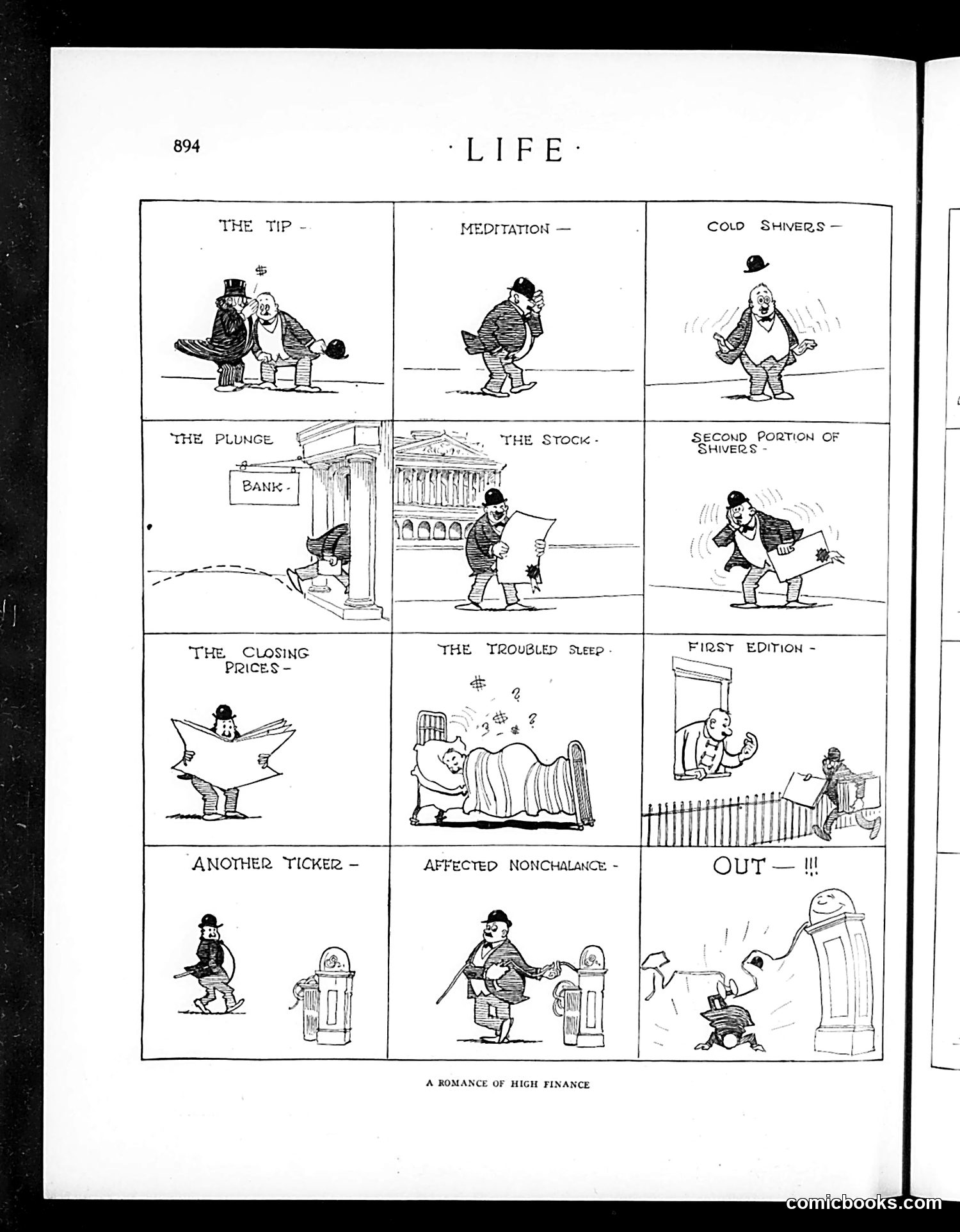
This comic strip satirizes stock market speculation and financial manipulation. The sequence depicts a stereotypical wealthy investor ("The Tip") passing insider information to another speculator, who engages in various anxiety-induced responses ("Meditation," "Cold Shivers," "Troubled Sleep") while awaiting stock performance. The humor culminates in "The Plunge"—showing a figure literally diving into a bank, followed by "The Stock" and subsequent panels showing increasingly desperate financial positions. "The Closing Prices" shows him reading financial news; "Another Ticker" and "Affected Nonchalance" depict continued stress. The final panel, "Out!!!" shows the investor literally ejected from a window or building—a visual metaphor for financial ruin and being forced out of the market after losses. The strip mocks the anxiety, delusion, and ultimate failure inherent in speculative investing.
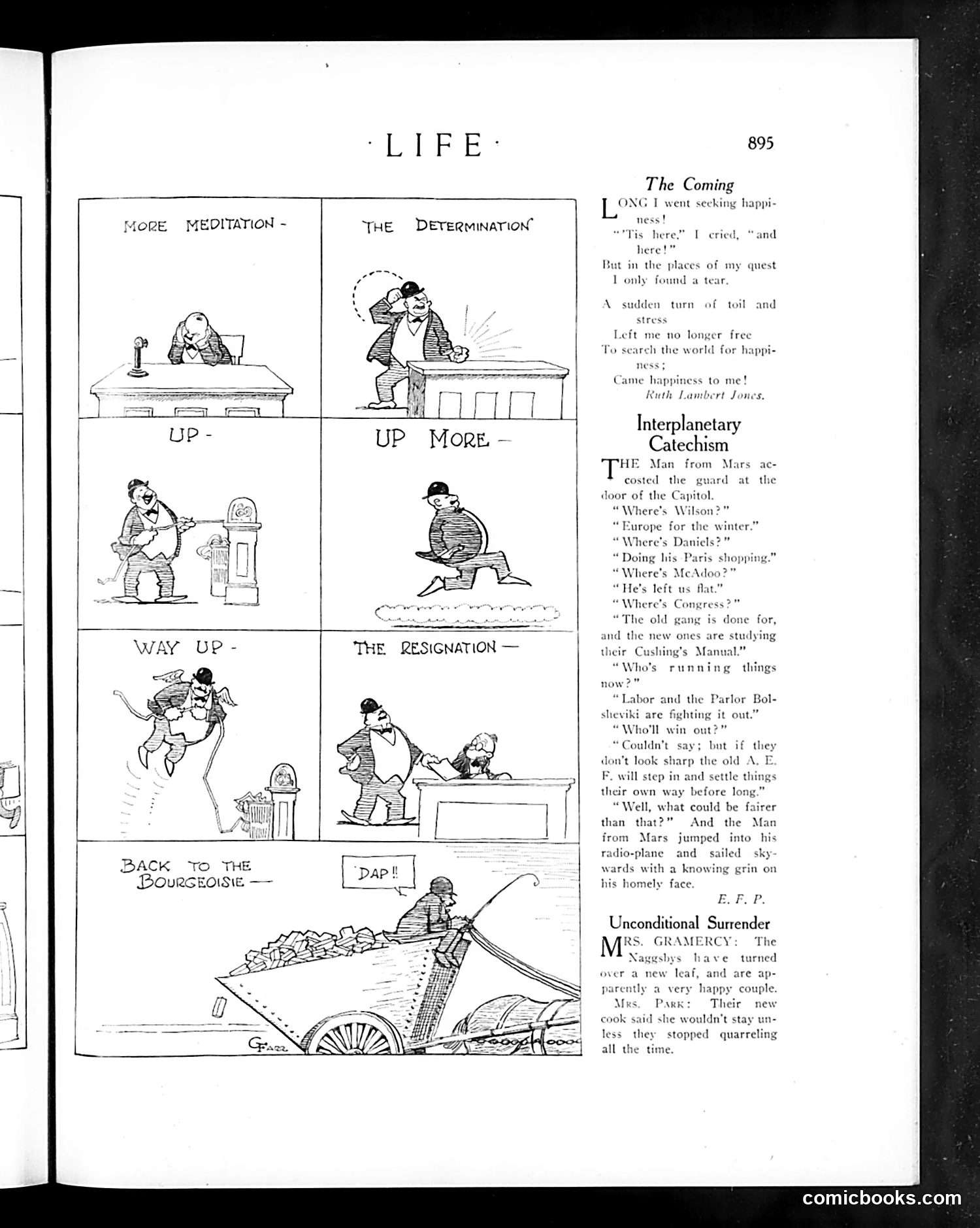
The left side features a six-panel comic strip titled "More Meditation—The Determination" through "Back to the Bourgeoisie," depicting a figure's escalating determination exercises. It appears satirical commentary on self-improvement efforts, showing the protagonist progressively more strained and exhausted before finally collapsing into a cart labeled "DAP!!"—suggesting futility of willpower-based self-transformation. The right side contains three short prose pieces: "The Coming" (a poem by Ruth Lambert Jones), "Interplanetary Catechism" (satirizing Martian bureaucracy through dialogue), and "Unconditional Surrender" (a brief domestic anecdote about quarreling spouses). The cartoon and text together mock self-delusion, government inefficiency, and marital discord—typical Life magazine satirical targets of the era.
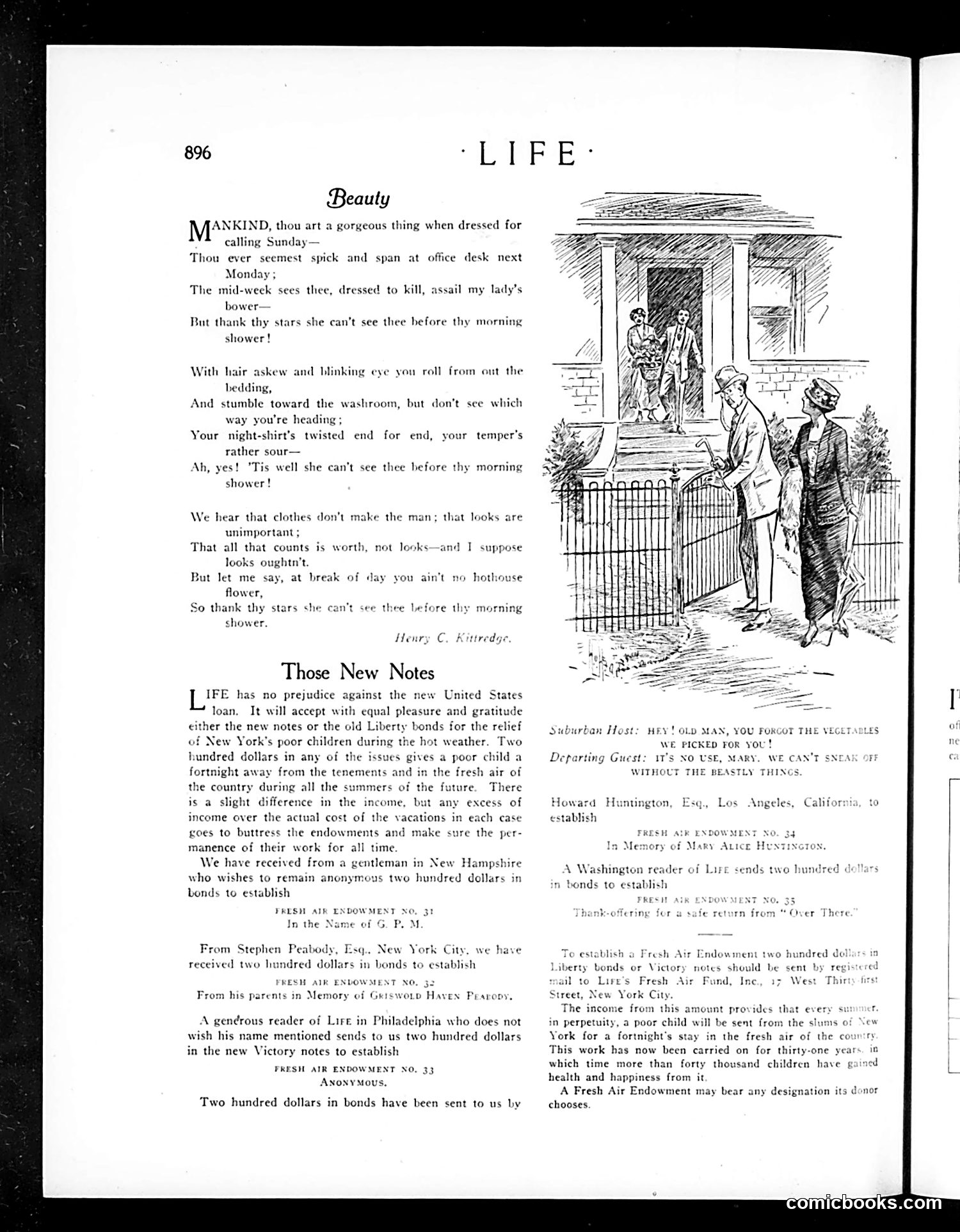
This satirical poem by Henry C. Kitteridge mocks the disconnect between men's public and private appearances. The joke targets masculine vanity and social pretense in early 20th-century America. **The Setup:** The poem addresses "Mankind" ironically, praising how well-dressed and composed men appear on Sundays (calling day) and Mondays at the office—making a good impression on women and society. **The Punchline:** The repeated refrain reveals the reality: before his morning shower, a man is disheveled—hair askew, wearing a twisted nightshirt, stumbling blindly, bad-tempered. The satire is that men benefit greatly from women *not* seeing them in this unglamorous state. **Social Context:** This reflects turn-of-the-century gender dynamics where appearance and propriety were heavily policed, and men's grooming routines were becoming more important. The joke assumes male readers will recognize themselves in this unflattering portrait and find it humorous that their carefully maintained public image collapses in private. The accompanying sketch shows a domestic scene, likely illustrating the contrast humorously.
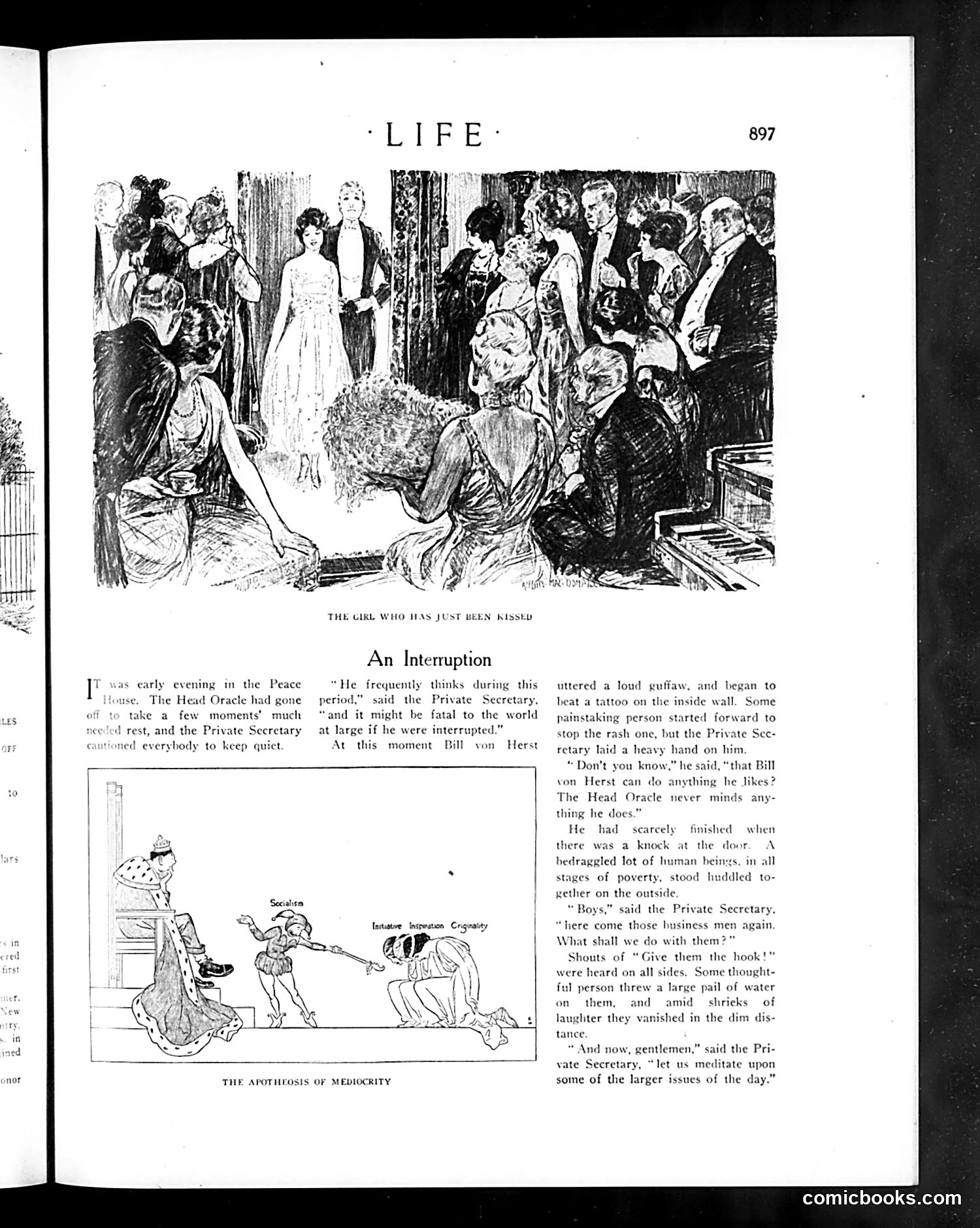
This is a satirical story mocking political leadership and mediocrity. The "Peace House" (likely the White House) contains a "Head Oracle" (the President) who requires absolute silence for contemplation on important matters. The joke centers on **Bill von Herst**, a mediocre figure who disrupts this sacred silence but faces no consequences—the Private Secretary explains the Head Oracle "never minds anything he does," suggesting cronies or incompetent associates enjoy special protection regardless of their behavior. The arrival of poor "business men" seeking help—promptly ejected with water and mockery—satirizes the administration's indifference to ordinary citizens' needs. The cartoon "The Apotheosis of Mediocrity" (bottom) reinforces this theme through caricature, likely depicting the elevation of incompetent figures to power. The satire suggests leadership operates through absurdity and favoritism rather than merit or genuine problem-solving.
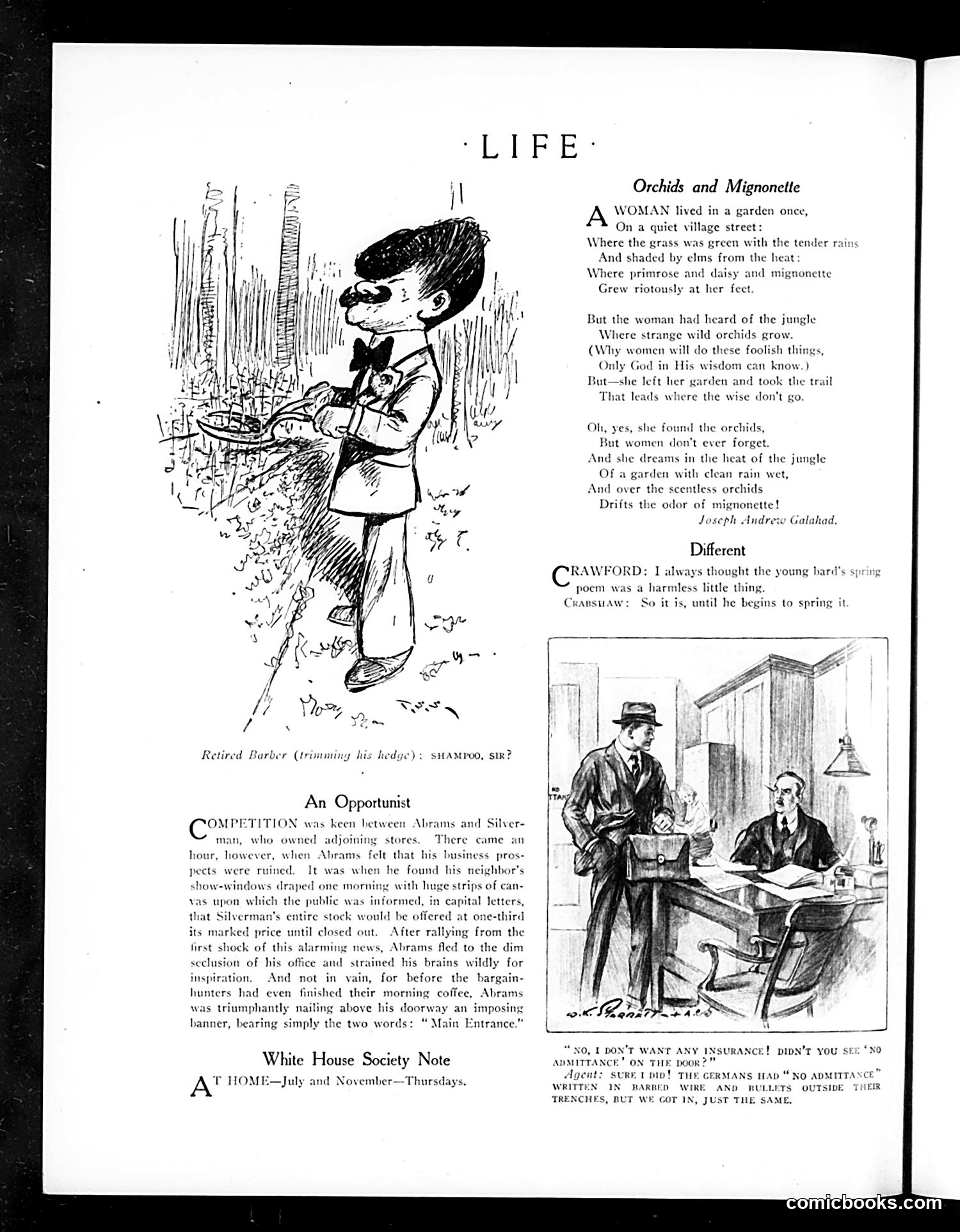
This page contains three satirical pieces: **"Orchids and Mignonette"**: A romantic poem about a woman who abandons her humble garden life to pursue exotic orchids in the jungle, only to miss home. The satire mocks women's supposedly irrational desires for adventure and exotic things over domestic contentment. **"Different"**: A brief joke about a young poet's spring poem being harmless until he starts reciting it publicly—satirizing self-important amateur poets who subject others to their work. **"An Opportunist"**: Satirizes competitive business tactics. When merchant Silverman advertises a stock clearance, rival Abrams counters with a sign reading "Main Entrance"—a clever, minimalist response suggesting Silverman's store isn't worth entering. This mocks commercial one-upmanship. The sketch at bottom appears to reference wartime insurance claims and German trenches, likely from WWI context, though the exact reference is unclear without additional dating.
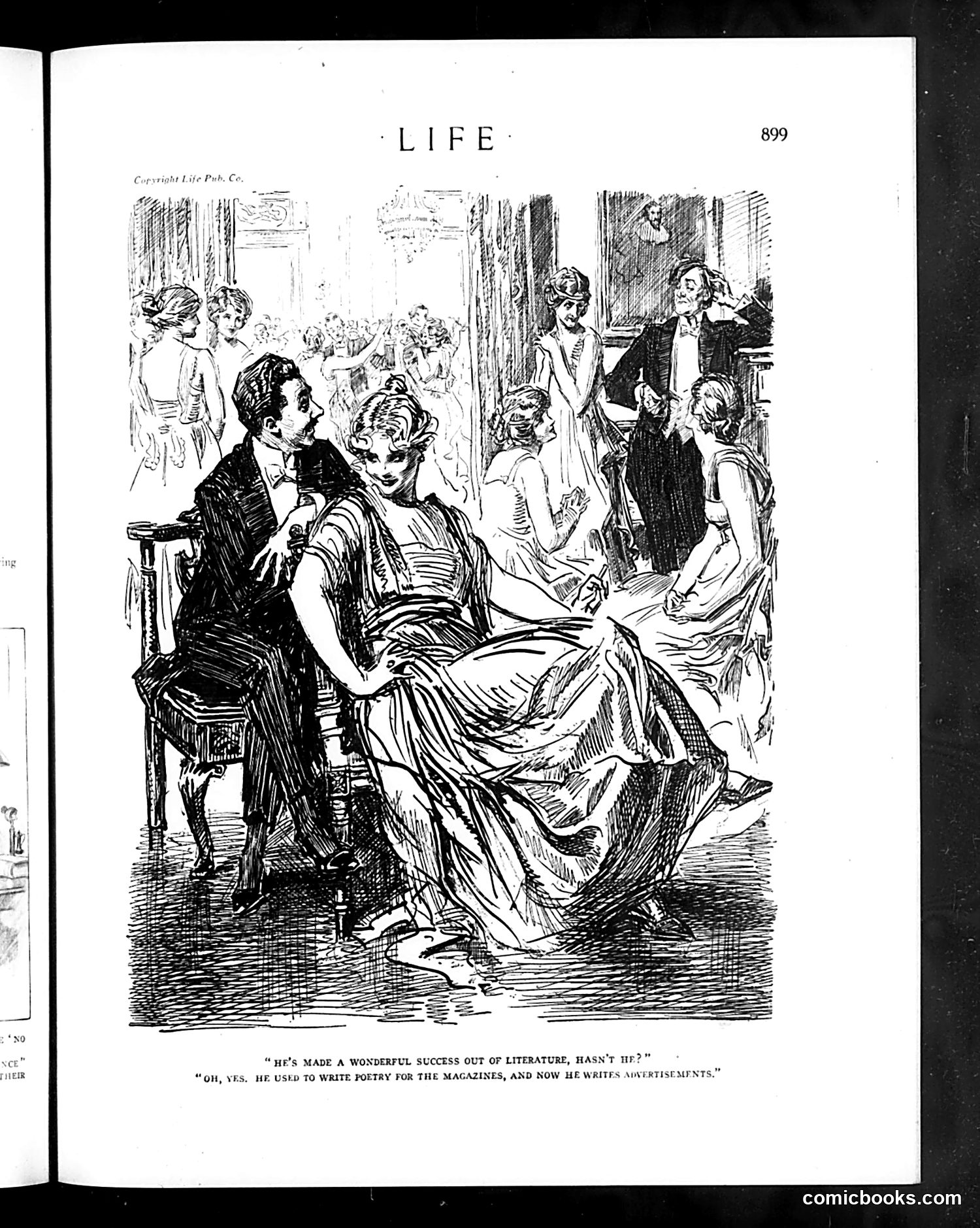
This satire mocks the commercialization of literary talent. Two society women observe a man's career trajectory: he began as a poet publishing in magazines, but now writes advertisements—a fate presented as both comedic and somewhat tragic. The joke targets the tension between "serious" literature and commercial writing. In the early 20th century, advertising was considered an inferior pursuit compared to poetry. The woman's deadpan "wonderful success" is ironic—she's praising what she secretly views as a fall from artistic integrity to mere commerce. The cartoon reflects period anxieties about capitalism's influence on art, and the compromises creative professionals faced to earn income. The sophisticated party setting emphasizes how even educated society circles acknowledge this sell-out, treating it as an expected, if regrettable, social reality.
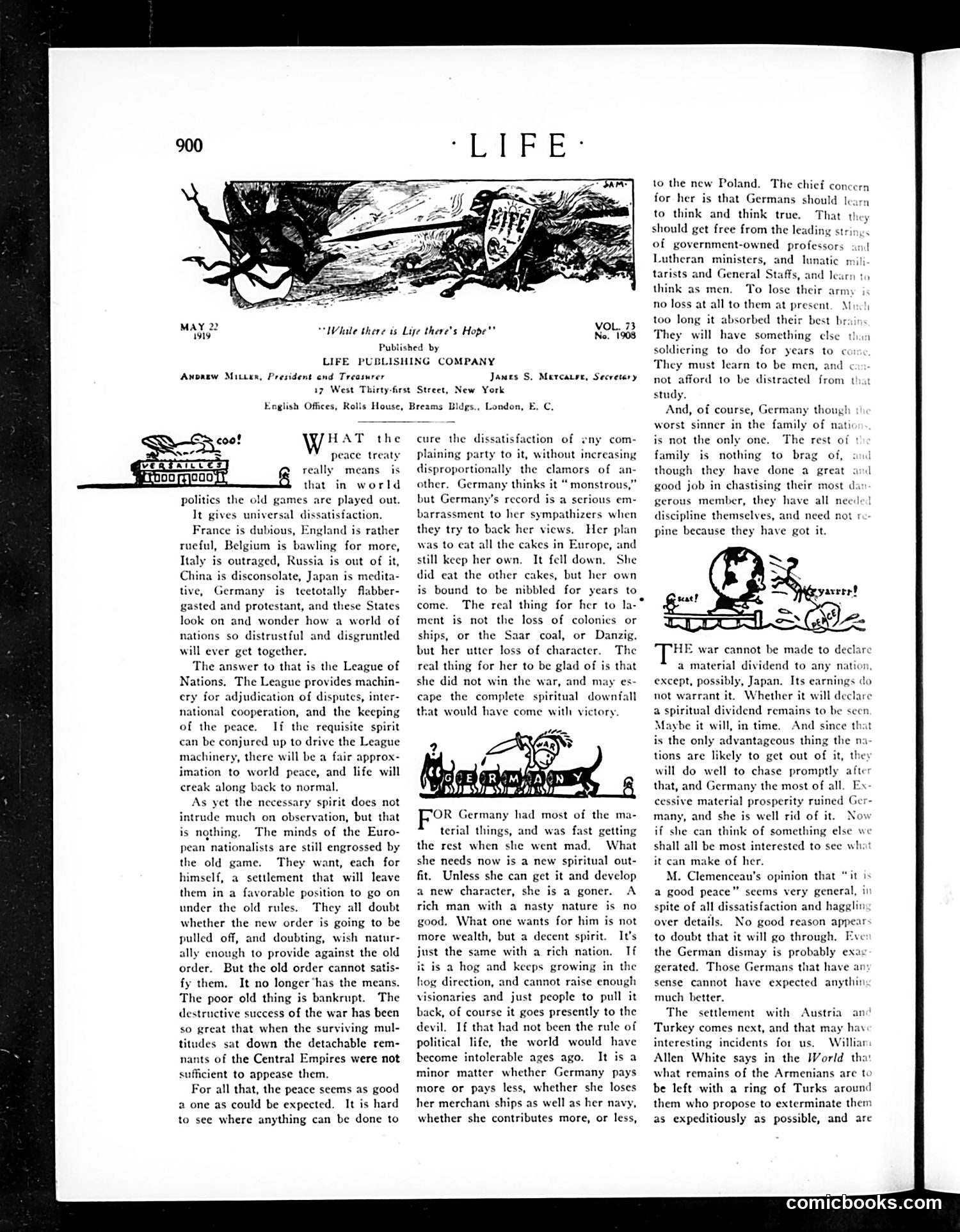
This page contains post-WWI editorial commentary on the peace treaty and League of Nations, with cartoons expressing skepticism about international reconciliation. **The main cartoon** (top) depicts a whale labeled with the League of Nations machinery, illustrating the editorial's point: the League offers hope ("While there is Life there's Hope") for maintaining peace through dispute resolution, but lacks the political will among nations to succeed. **The political context**: The article surveys European dissatisfaction post-Treaty of Versailles—France dubious, Belgium demanding more, Italy outraged, Russia excluded, Germany "flabbergasted." The text argues Germany's real loss isn't territory (colonies, Saar coal, Danzig) but "character" and spiritual standing. **The satire**: Life mocks both the naive optimism around the League and Germany's predicament. Germany wanted to "eat all the cakes in Europe" but lost the war. The author suggests Germany needs moral/spiritual rehabilitation, not just reparations. The smaller cartoon (bottom) humorously depicts this rehabilitation struggle. The page reflects American post-war ambivalence about international cooperation and German punishment.
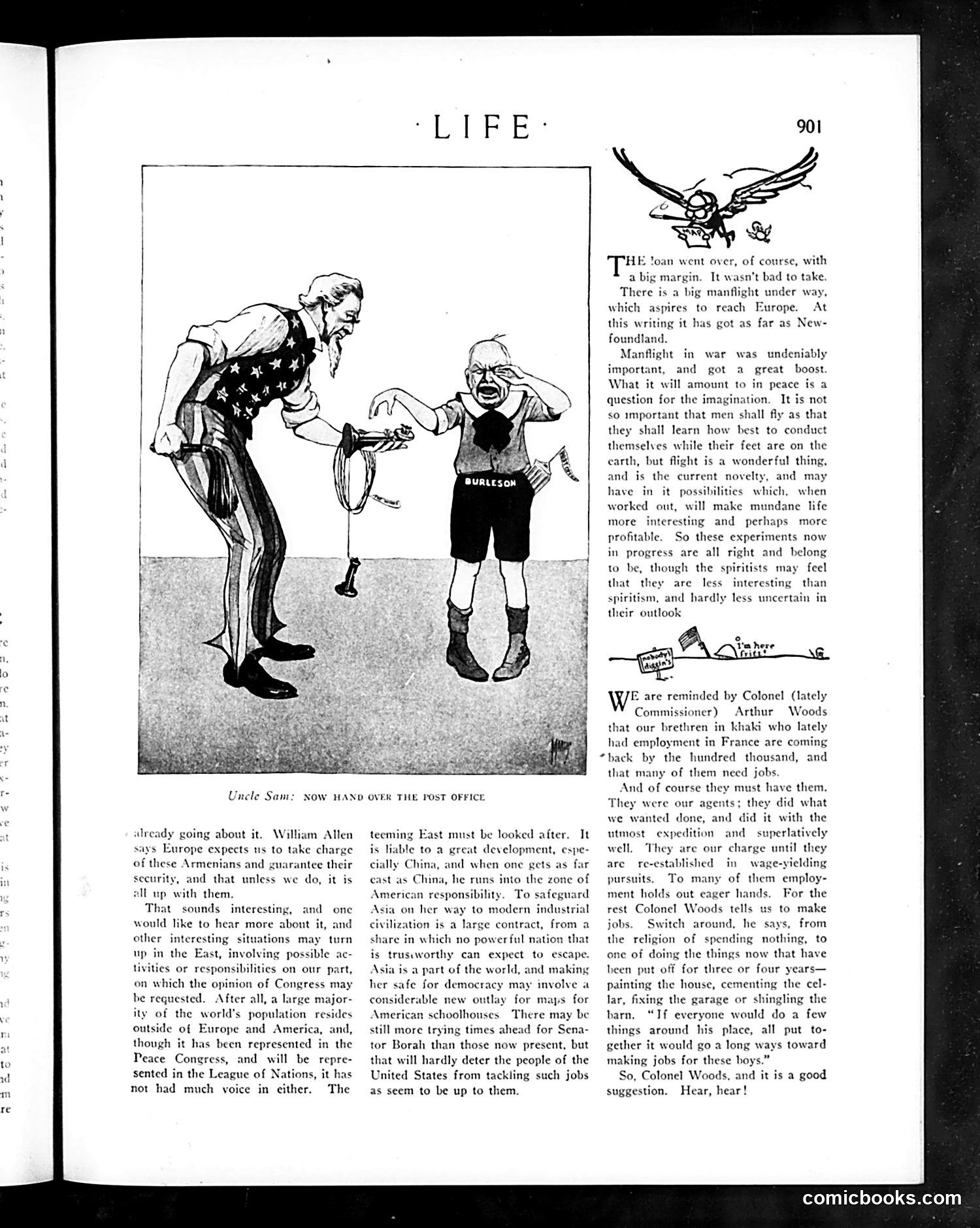
The cartoon depicts **Uncle Sam** (representing the U.S. government) being coerced by a figure labeled **"Burleson"** (likely Postmaster General Albert Burleson) to surrender control of the Post Office. The image satirizes post-war political debates about government expansion and labor. The accompanying text discusses America's new international responsibilities toward Armenia, Asia, and China following WWI, alongside domestic concerns: returning soldiers needing employment, experimental aviation, and infrastructure spending to create jobs. The cartoon's point appears to be criticism of government overreach—specifically, executive branch power consolidation during wartime that persists into peacetime. The joke targets Burleson's control of postal services and reflects broader anxieties about whether wartime governmental authority would be relinquished to private or Congressional control after the war ended.
This sketch depicts a hunched, elderly figure bending over in what appears to be a corridor or institutional setting. The figure's posture suggests physical decline or burden-bearing. The minimal OCR text is largely illegible, making precise identification difficult. Based on the artistic style and "Life" magazine context (American satirical publication), this likely comments on a political or social figure of the era. The exaggerated physical portrayal—hunched back, prominent features—suggests caricature typical of early 20th-century satirical cartooning. The institutional setting (suggested by the linear architectural elements) might reference government or public life. Without clearer text or date verification visible on the page, I cannot definitively identify the specific figure or topical reference intended.
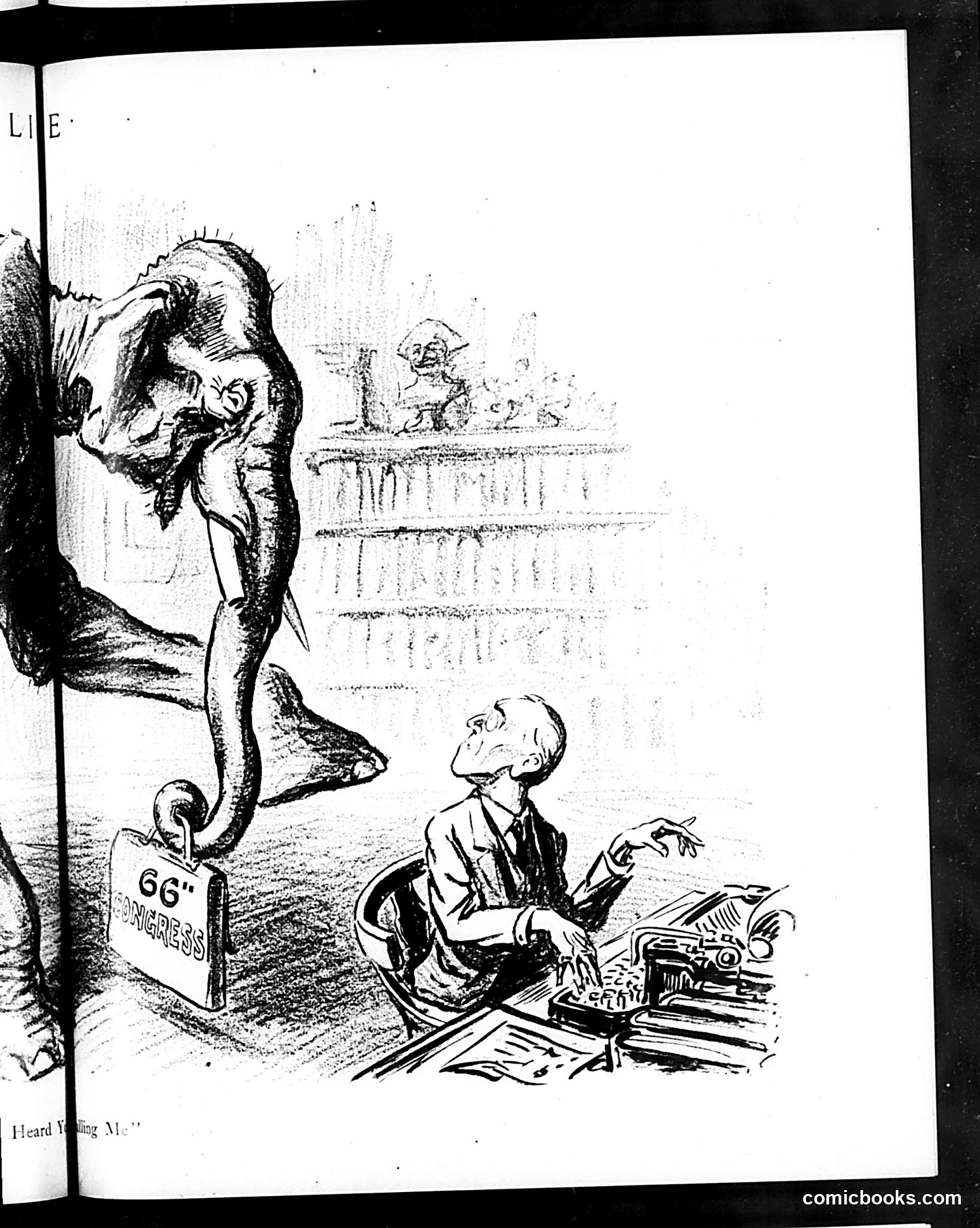
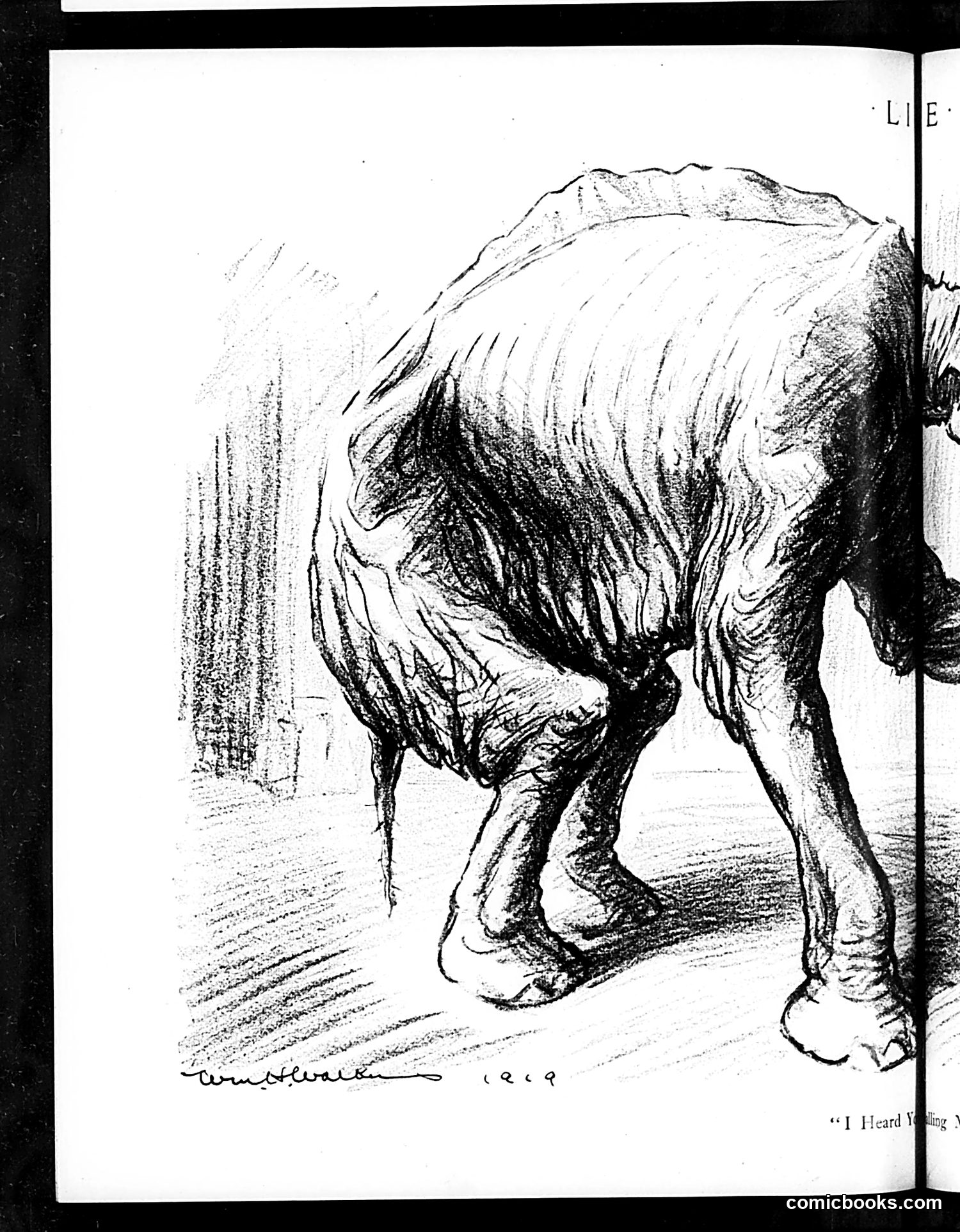
This appears to be a political cartoon from Life magazine's early 20th century, titled "Heard Yelling M..." (text cut off). The image depicts a man at a desk labeled "66th CONGRESS" looking upward in alarm at a large, menacing snake-like creature coiling down from above—likely representing Germany or a German threat. The cartoon satirizes congressional anxiety about German aggression, probably referencing World War I tensions or the lead-up to American involvement. The congressman appears powerless or caught off-guard by the looming danger, while papers and documents scatter across his desk, suggesting governmental chaos or unpreparedness. The exaggerated, serpentine caricature of the German threat was common period propaganda imagery.
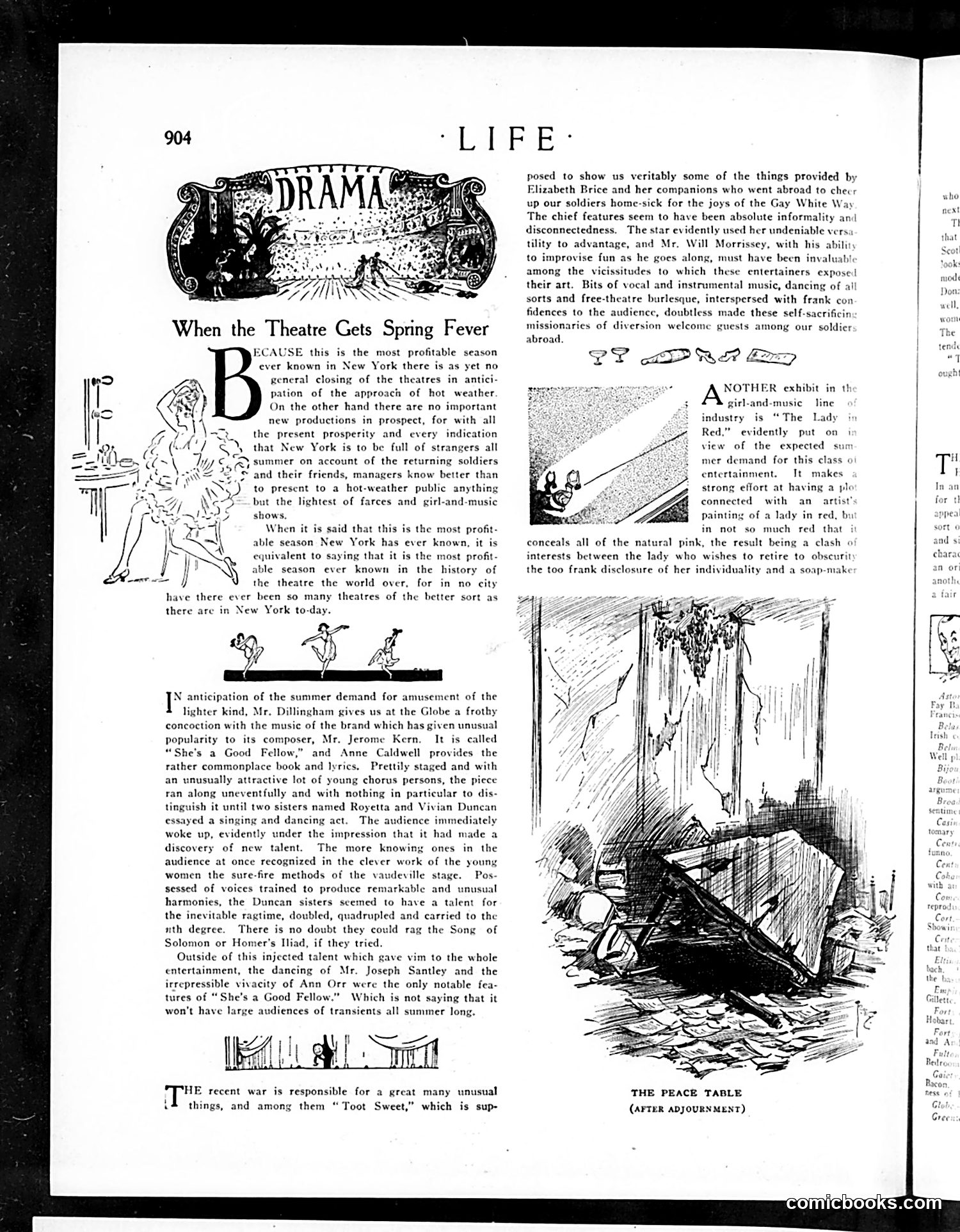
This is a theatre review column about New York's spring theatrical season. The page discusses how, unusually, theatres remain open through summer because of wartime prosperity and returning soldiers seeking entertainment. The column reviews three productions: 1. **"She's a Good Fellow"** — a light musical with Jerome Kern's music, notable mainly for introducing the Duncan sisters, whose vaudeville-style singing and ragtime dancing (performing complex harmonies and syncopated versions of classical pieces) impressed audiences as a "discovery," though experienced observers recognized their vaudeville training. 2. **"Toot Sweet"** — described as a show featuring Elizabeth Brice and companions who entertained soldiers abroad, praised for its informal, disconnected entertainment mixing music, dancing, and comedy (Will Morrissey is noted for his improvisational abilities). 3. **"The Lady in Red"** — a girl-and-music show attempting to capitalize on summer demand. The satire critiques theatre managers capitalizing on summer crowds with lightweight entertainments rather than serious productions.
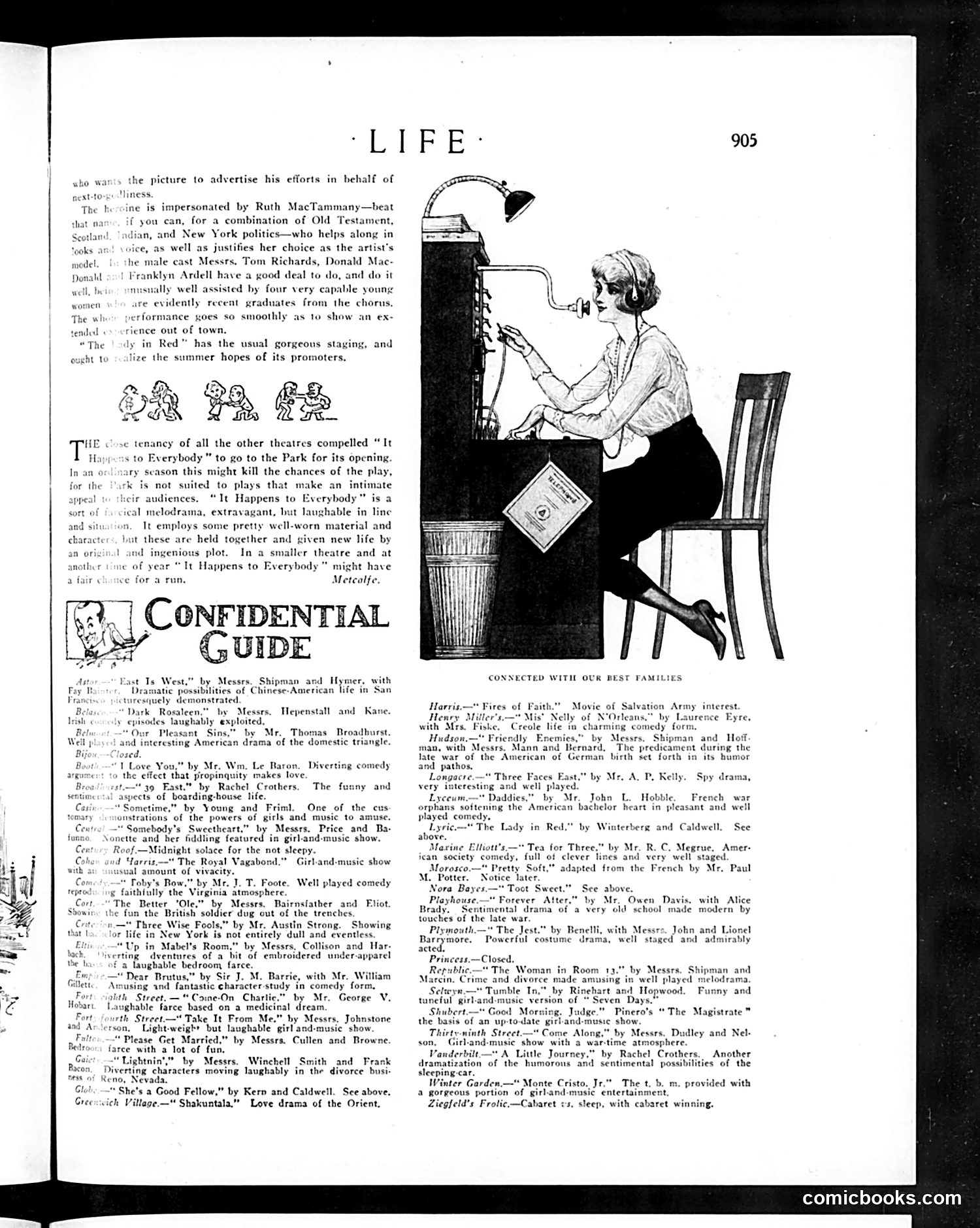
This page is primarily a **theater guide and review column**, not a political cartoon. The single illustration shows a woman operating an early film camera—likely referencing the emerging motion picture industry of the 1920s. The text consists of two sections: 1. **Theater reviews** discussing Broadway productions like "It Happens to Everybody" and "The Lady in Red," analyzing their plots, casts, and commercial viability. 2. **"Confidential Guide"**—a satirical listing of current plays and movies with brief, often tongue-in-cheek descriptions (e.g., "Diverting characters moving laughably in the divorce business of Reno, Nevada"). The social context: This reflects post-WWI American entertainment culture, with references to the nascent film industry competing with live theater. The tone is satirical toward both mediums' formulaic plots and commercial motivations. The illustration symbolizes cinema's growing cultural presence, shown as a modern technology operated by a fashionable woman—suggesting entertainment's democratization and women's expanding roles.
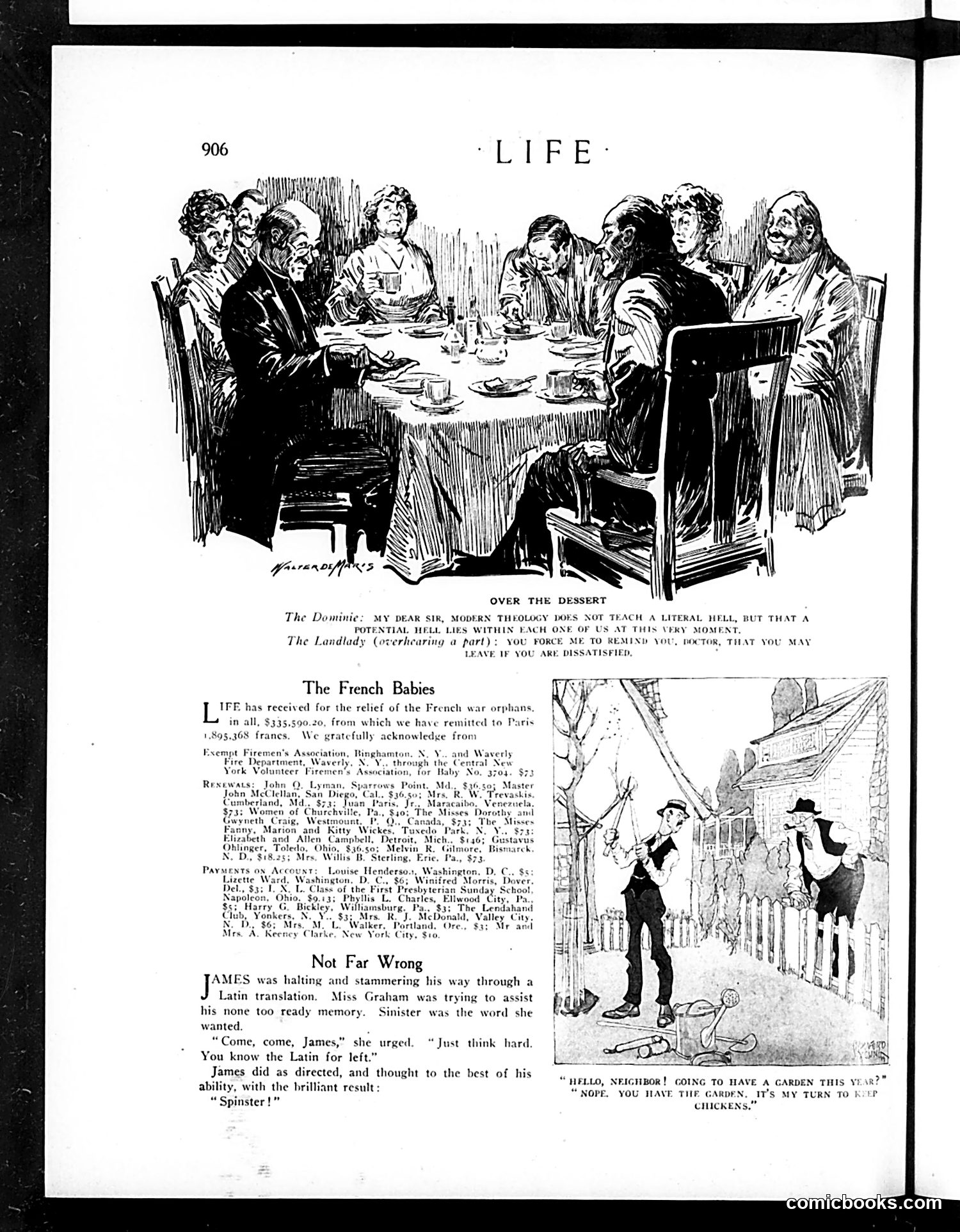
**"Over the Dessert" Cartoon:** This depicts a dinner conversation between a clergyman ("The Dominie") and another man. The clergyman presents modern theological thinking that rejects literal hellfire, arguing instead that hell is a psychological state within each person. The landlady overhears only fragments and, misunderstanding his meaning, threatens to evict him—treating his abstract theological discussion as actual complaint about her establishment. The satire mocks both the pretentiousness of modern religious intellectualism and the landlady's literalist misinterpretation. **"Not Far Wrong" Story:** A schoolboy named James struggles translating Latin. His teacher prompts him to recall the word for "left," and he confidently answers "sinister"—which is indeed the Latin word for left, though in English "sinister" means evil or ominous. The joke plays on the double meaning: technically correct in Latin, darkly amusing in English. **"The French Babies":** This section lists donations to relief for French war orphans, indicating this page includes charitable fundraising content alongside humor.
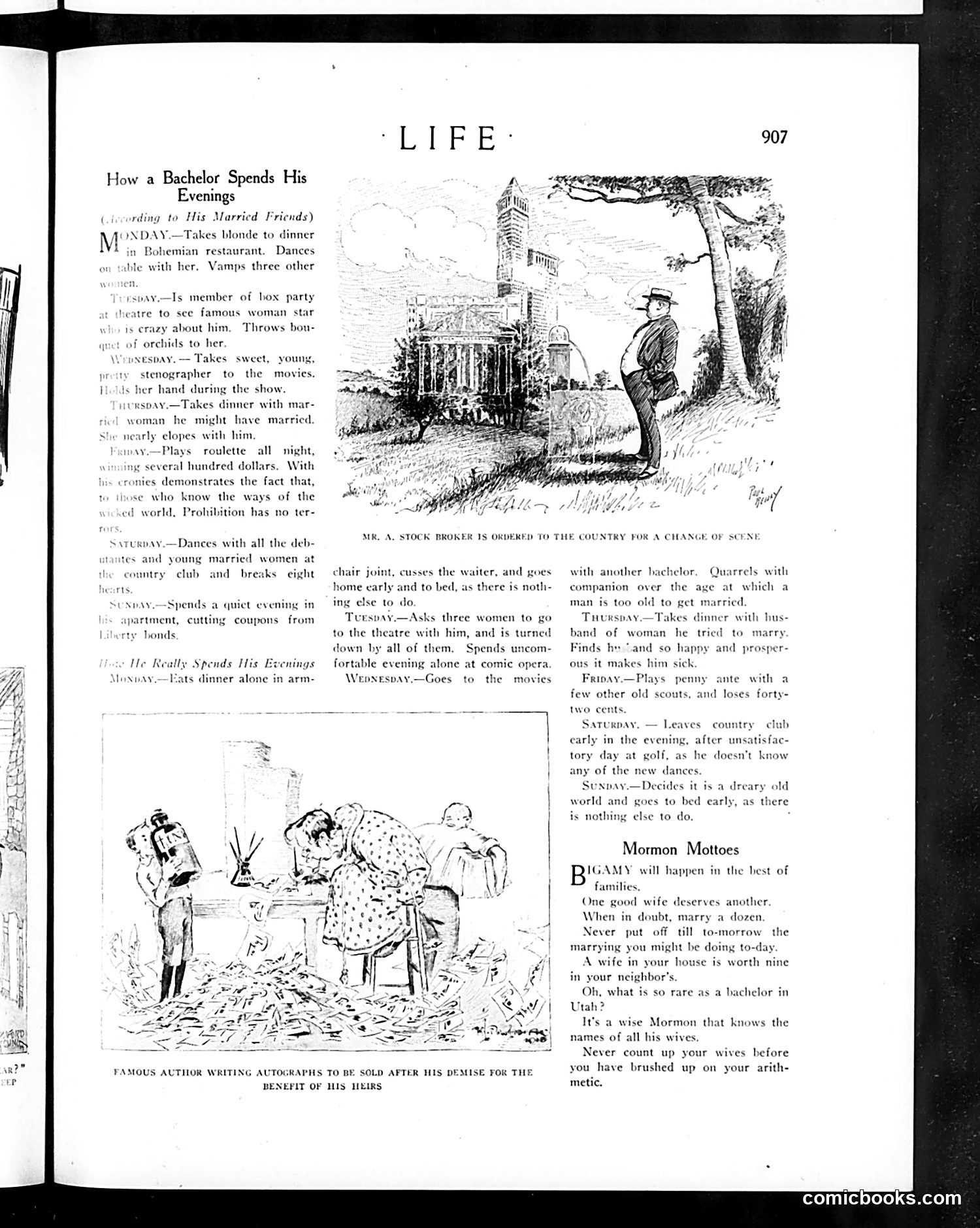
This page satirizes bachelor life through contrasting sections: **"How a Bachelor Spends His Evenings"** presents two columns: what married friends *imagine* bachelors do (glamorous dinners, theater dates with attractive women, roulette gambling) versus reality ("How He Really Spends His Evenings")—eating alone, being rejected by women, attending comic opera solo, arguing with other bachelors about marriage, and spending quiet evenings clipping bond coupons. The joke targets the romantic fantasy married men project onto bachelor life versus the mundane, lonely reality. The illustration of a "famous author writing autographs to be sold after his demise for the benefit of his heirs" satirizes vanity and financial desperation. **"Mormon Mottoes"** is anti-Mormon humor playing on polygamy—the practice that defined the religion until the 1890s ban. The "mottoes" mock both the practice itself and suggest bachelors would find Utah appealing because marriage there means one wife among many, making commitment less binding. This reflects period anti-Mormon prejudice treating polygamy as inherently ridiculous.
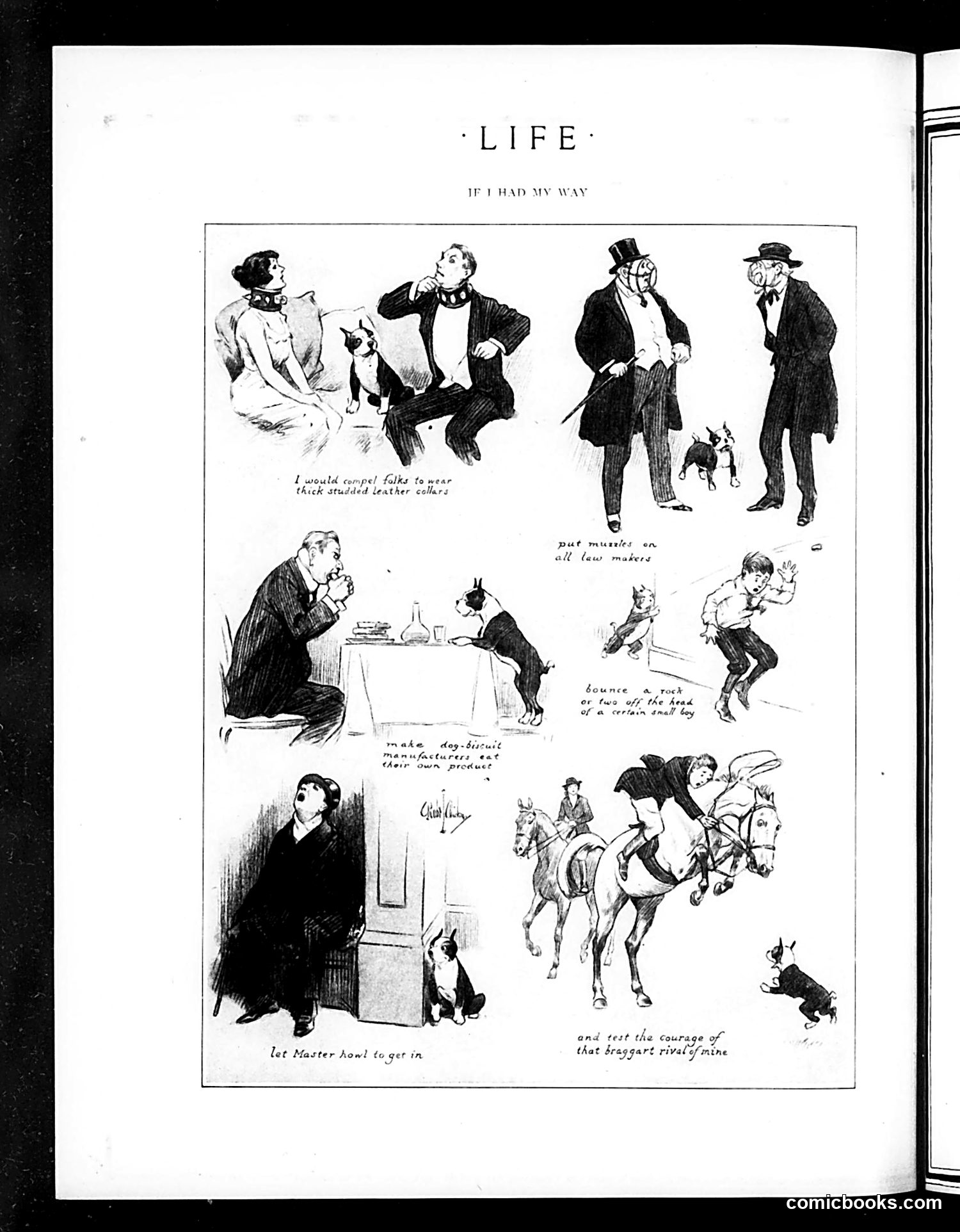
This is a humorous fantasy piece where the cartoonist imagines punitive measures against various annoyances of early 20th-century life. The caricatured figures represent: - **Folks in general** (top left): forced to wear studded leather collars - **"Law makers"** (top right): muzzled like dogs - **"Dog biscuit manufacturers"**: compelled to eat their own product - **"Master howl"**: appears to reference someone who complains excessively, forced into humiliating situations - Bottom scenes show physical indignities: riding mishaps, being thrown from horses The satire targets everyday irritations and social frustrations—bad laws, inferior products, and annoying people—by imagining absurd, degrading punishments. It's social complaint dressed as dark comedy, typical of Life magazine's irreverent humor.
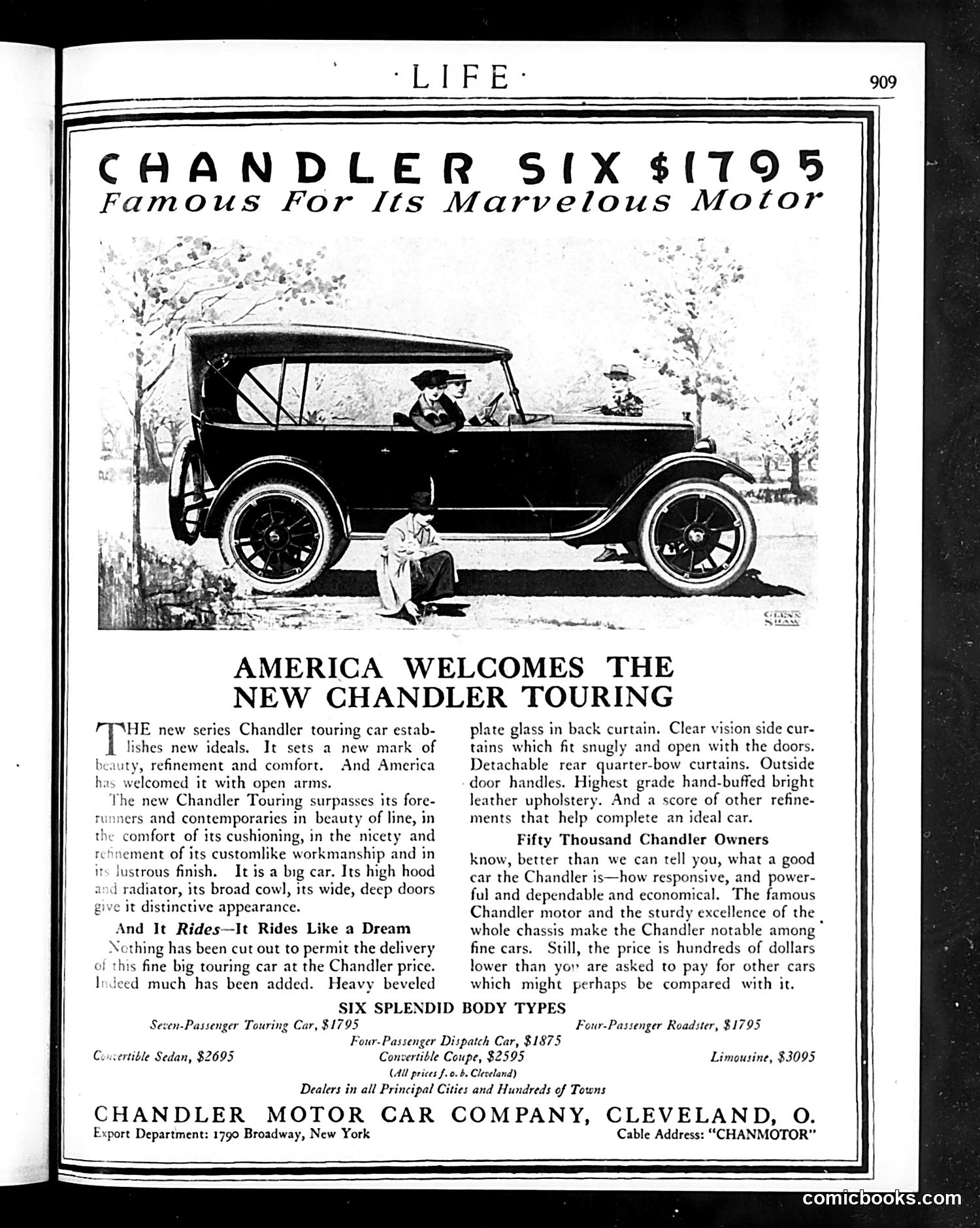
This is **not a cartoon or satire**—it's a straightforward automobile advertisement for the Chandler Motor Car Company, placed in *Life* magazine (page 909). The page promotes the Chandler Six touring car at $1,795, emphasizing its quality, comfort, and affordability compared to competitors. The illustration shows a well-dressed couple admiring the vehicle, a typical marketing approach of the era. Key selling points highlighted: the "marvelous motor," spacious design, leather upholstery, glass curtains, and the claim that "fifty thousand Chandler owners" attest to its reliability. The ad stresses that despite its features, the price undercuts comparable cars. This reflects early-1920s automotive advertising, when cars transitioned from luxury goods to aspirational consumer products for middle-class Americans. The tone is earnest promotion, not satire. *Life* magazine carried such ads alongside its actual humor and social commentary.
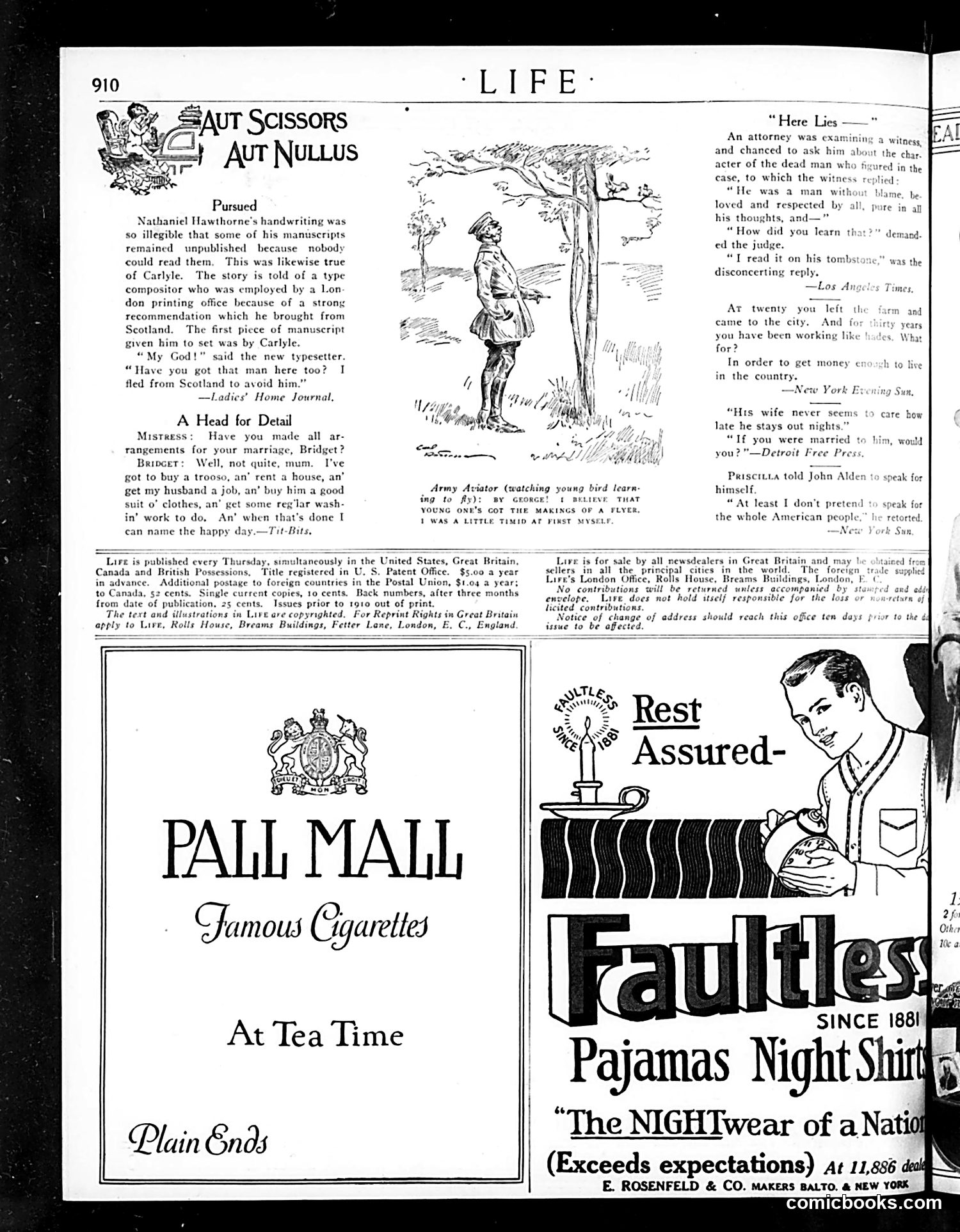
This page from *Life* magazine (circa 1910) contains several humor pieces and advertisements: **"Pursued" and "A Head for Detail"** are brief satirical anecdotes. The first mocks the illegible handwriting of famous authors Hawthorne and Carlyle, claiming a Scottish typesetter fled to America only to encounter Carlyle's manuscripts again. The second jokes about an Irish servant (Bridget) listing her pre-marriage priorities—buying a trousseau, securing her husband employment, obtaining work clothes—revealing working-class women's practical concerns before marriage. **"Army Aviator" cartoon** shows a young bird learning to fly, with the caption joking that the aviator's experience was "a little timid at first myself"—gentle humor about early aviation fears. The page also features advertisements for **Pall Mall cigarettes** and **Faultless pajamas**, typical period marketing. The overall tone reflects *Life*'s satirical approach to social observation—poking gentle fun at literary pretension, class differences, and modern anxieties like aviation.
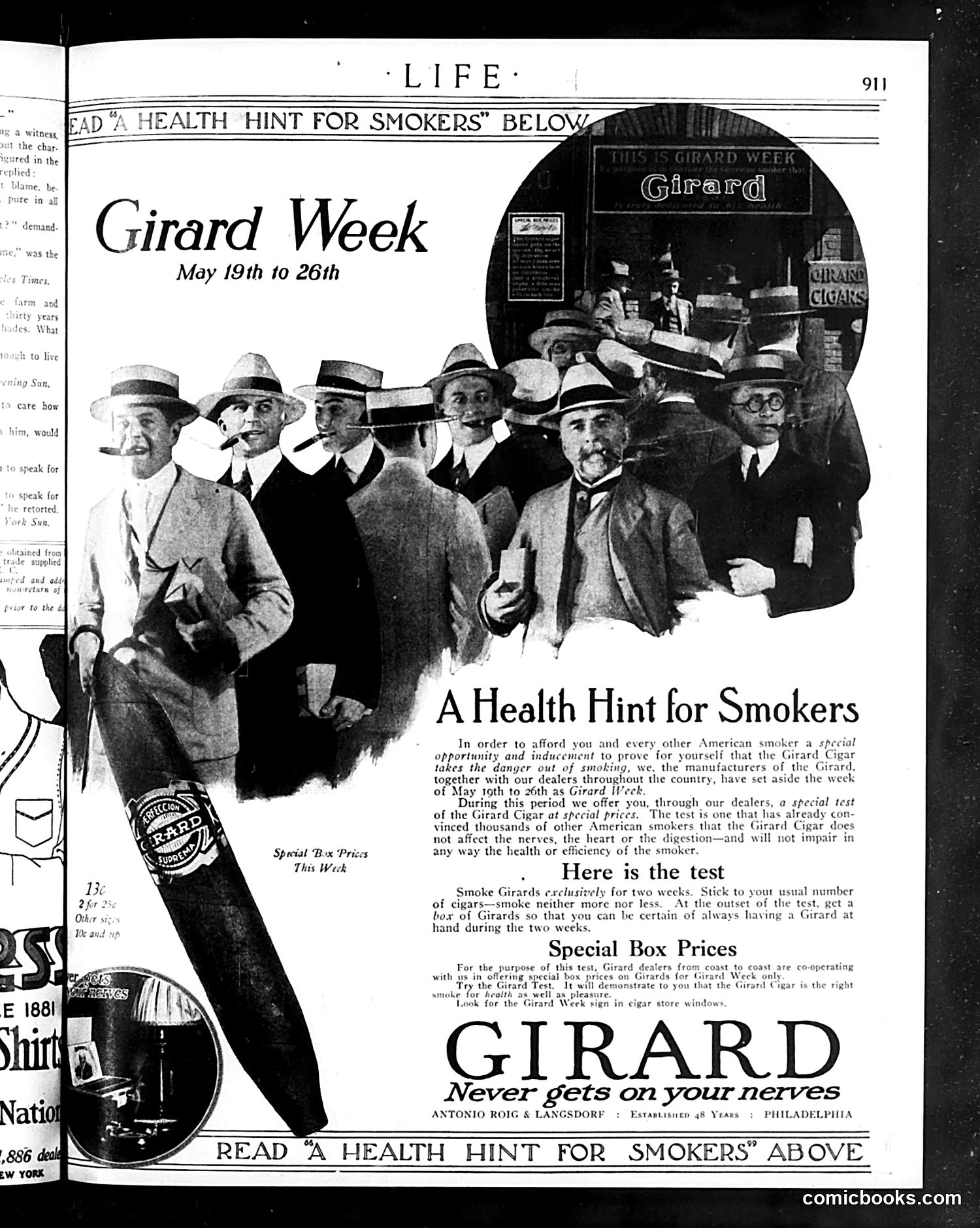
This is **not satire but straightforward advertising** — a Girard cigar company promotion disguised as health messaging. The page exploits early 20th-century medical uncertainty by claiming cigars don't harm "nerves, heart or digestion." The image shows well-dressed men in hats outside a Girard cigar shop, establishing aspirational masculinity. The advertisement challenges smokers to a two-week test: smoke *only* Girards at normal frequency to "prove" they're safe. **The deception:** By framing tobacco as a health product during "Girard Week" (May 19-26), the manufacturer attempts to legitimize smoking when medical concerns about tobacco were emerging. The "health hint" header mockingly positions harmful consumption as beneficial. Modern readers would recognize this as predatory marketing that exploits scientific uncertainty — tactics later banned by cigarette regulations.
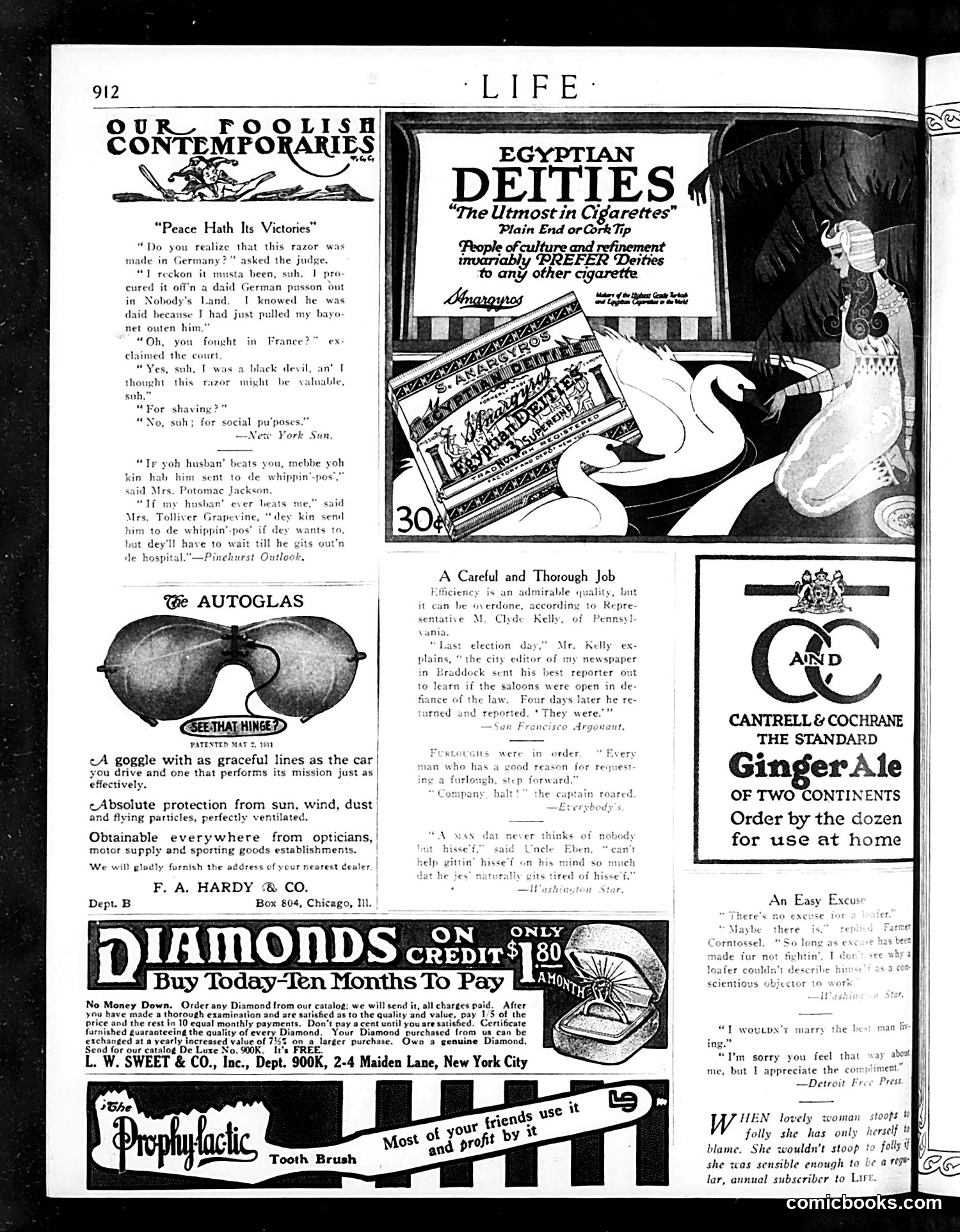
This page contains primarily **advertisements and filler content** rather than political cartoons. The main items are: **"Our Foolish Contemporaries"** (upper left): A brief satirical dialogue about a razor supposedly taken from a dead German soldier during WWI. The joke plays on the soldier's claim he used it "for social purposes" rather than shaving—implying it was a weapon. This reflects post-WWI attitudes toward Germany. **Egyptian Deities Cigarettes ad** (center): Features an Art Deco illustration of a woman in Egyptian-style dress. The ad claims cigarettes appeal to "people of culture and refinement"—typical period advertising that used aspirational imagery and pseudo-sophistication to market cigarettes. **Other advertisements** include AutoGlas goggles, diamonds on credit, Prophylactic toothbrushes, and Ginger Ale—standard commercial content with no satirical purpose. The page reflects early 1920s American consumer culture and lingering WWI sentiment, but contains minimal actual political or social satire beyond the brief opening dialogue.
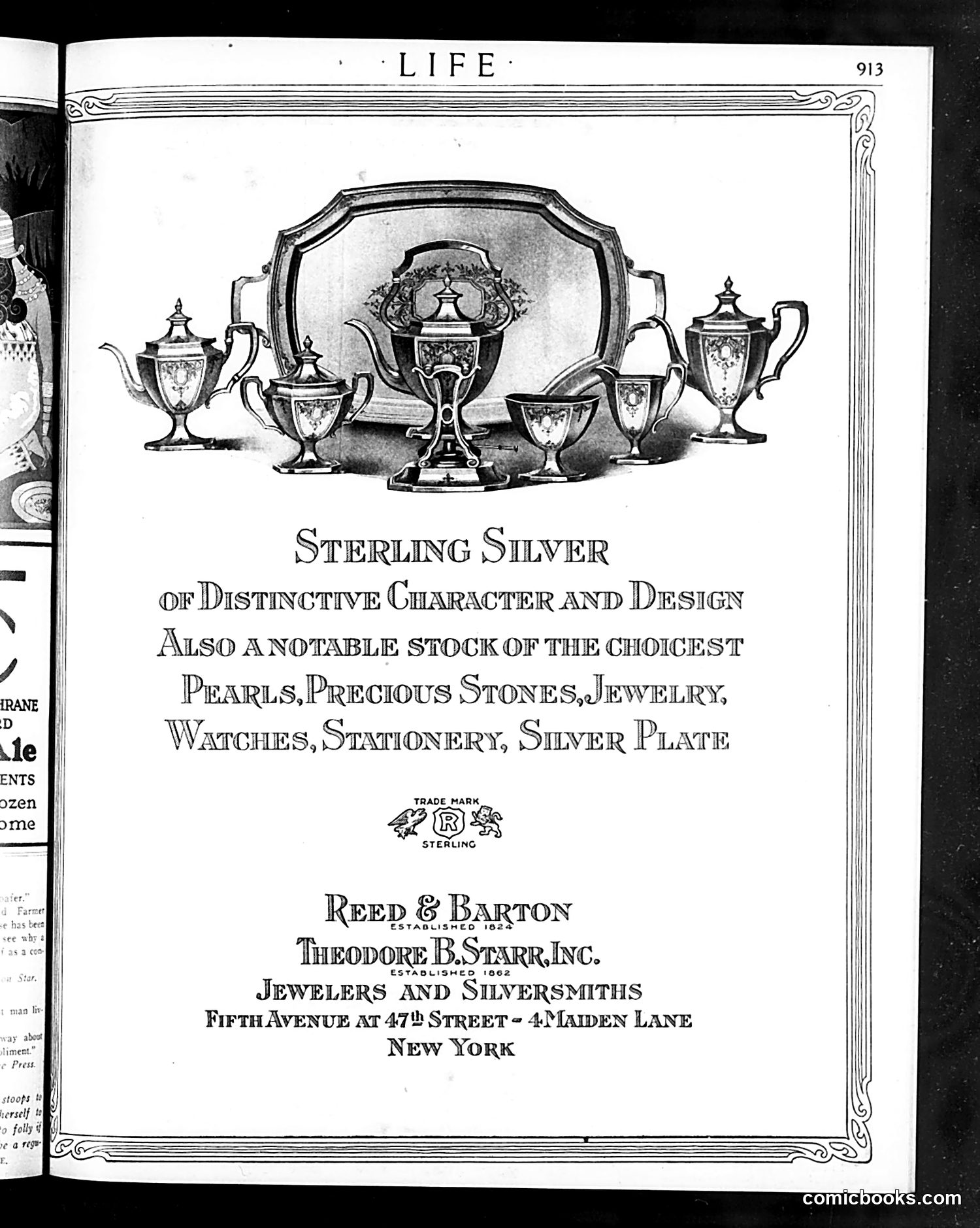
This is **not a cartoon or satirical content** — it's a **full-page advertisement** for Reed & Barton and Theodore B. Starr, Inc., jewelers and silversmiths in New York City. The page features an illustration of an elegant sterling silver tea service (teapot, sugar bowl, cream pitcher, cups, and tray) showcasing the ornate, decorative design typical of high-end tableware from this era. The ad emphasizes their stock of "distinctive character and design" along with pearls, precious stones, jewelry, watches, and stationery. This appears in *Life* magazine as a premium advertisement targeting wealthy consumers interested in luxury goods. The elaborate typography and detailed product illustration reflect early 20th-century advertising aesthetics for upscale merchandise.
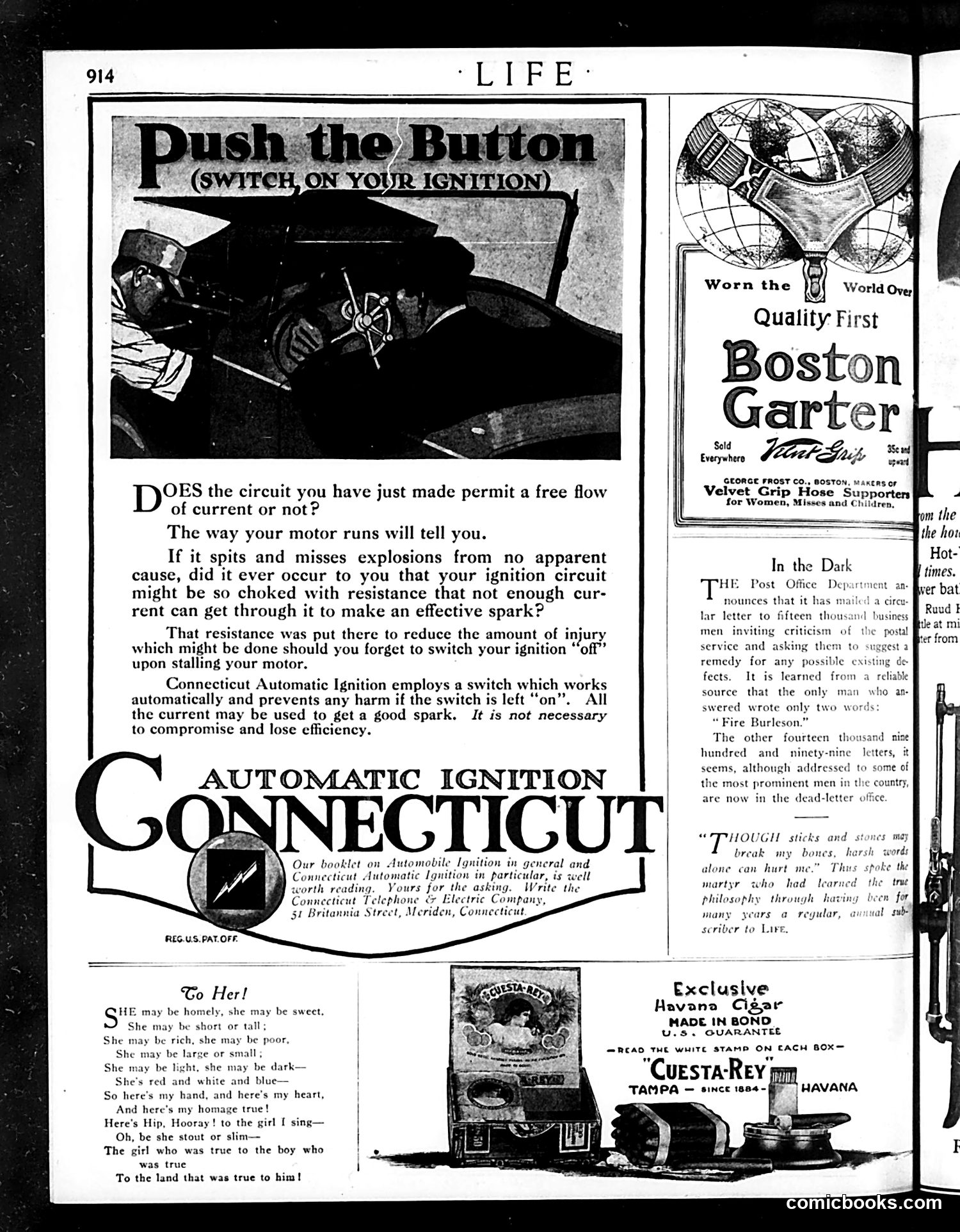
This page is primarily **advertising**, not political satire. The main content promotes Connecticut Automatic Ignition, a car starter system, using a technical explanation of how proper electrical circuits improve motor performance. The ad emphasizes safety—the automatic switch prevents harm if left on accidentally. A secondary section titled "In the Dark" discusses Post Office Department criticism: apparently someone sent a circular letter to 15,000 business leaders soliciting remedies for postal problems, but only two responses arrived. The piece satirizes this poor response rate, suggesting most recipients ignored it. The bottom features patriotic verse ("To Her!") celebrating a girl's loyalty to a boy who was loyal to his country—likely WWI-era content celebrating patriotic devotion. The remaining advertisements promote Boston Garter hosiery supports and Cuesta-Rey Havana cigars. No political figures or caricatures are present; this is straightforward early 20th-century magazine advertising and light editorial commentary.
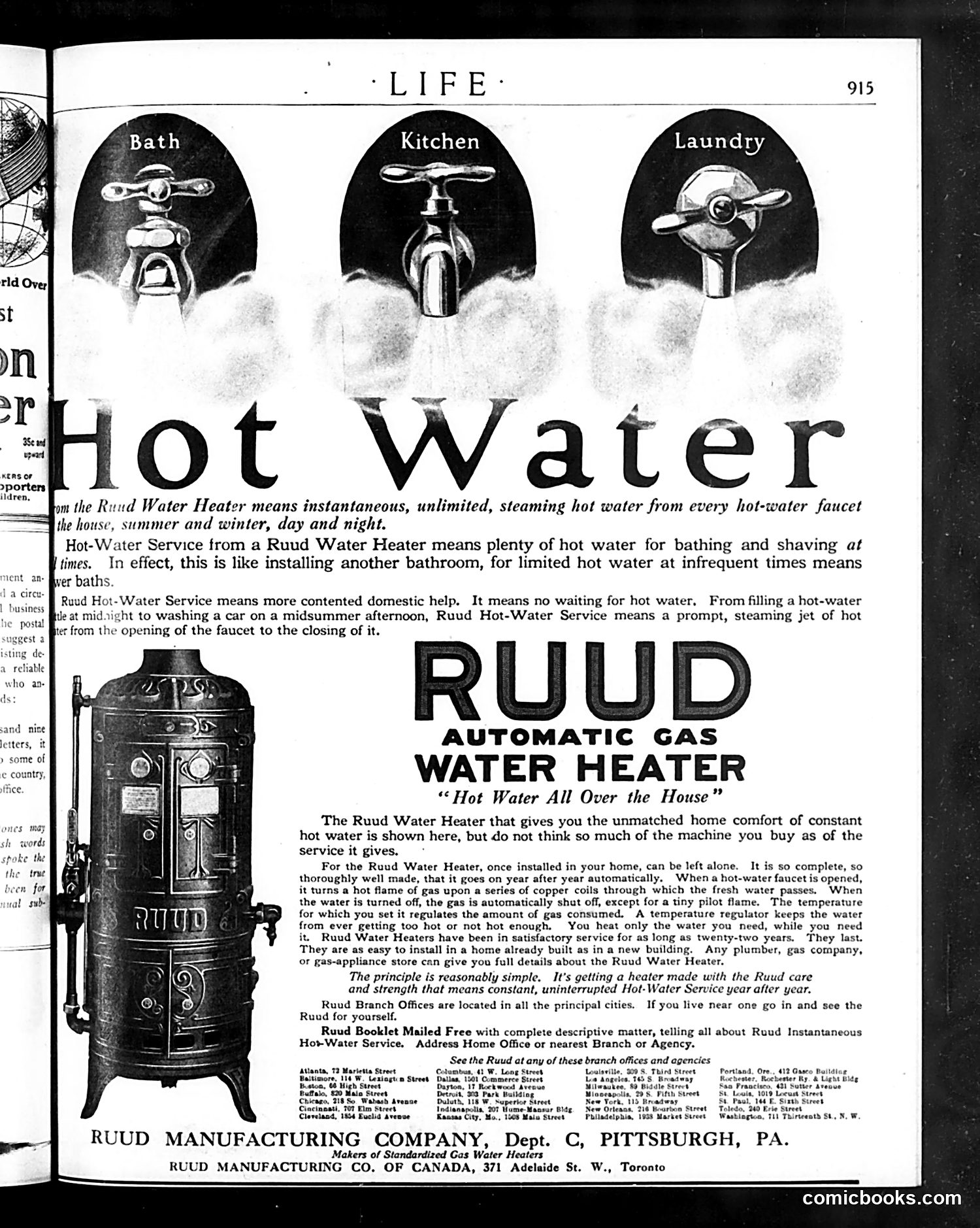
This is a **full-page advertisement**, not satire or political commentary. It promotes the Ruud Automatic Gas Water Heater to American households. The three illustrated faucets at top (Bath, Kitchen, Laundry) demonstrate the product's main selling point: **instant hot water throughout the home**—a genuine luxury for the era when hot water was typically limited and required waiting. The advertisement's social messaging reflects early 20th-century concerns: it emphasizes convenience for housewives and mentions "more contented domestic help," revealing class anxieties about servant retention during labor shortages. The pitch that unlimited hot water is "like installing another bathroom" underscores how scarce this amenity was. The device itself appears as a large cylindrical tank with copper coils and an automatic gas valve—a genuine innovation claiming twenty-two years of reliable service. The copy stresses reliability and ease of installation by "any plumber." This represents straightforward product marketing rather than satirical content—a common feature in *Life* magazine's pages alongside actual editorial cartoons and humor.
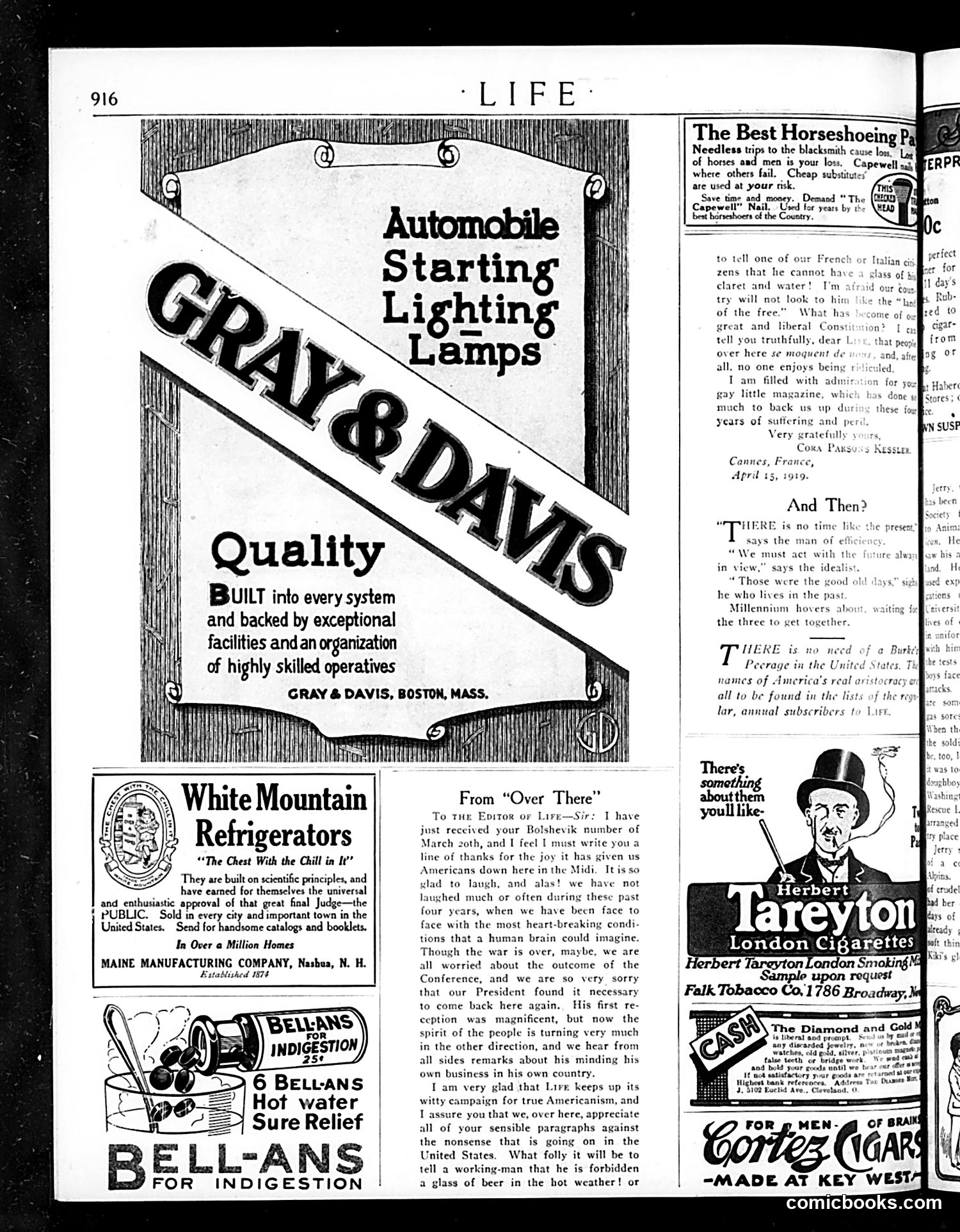
This page is primarily **advertising**, not political satire. It contains four commercial advertisements: 1. **Gray & Davis Automobile Lamps** - promoting starting and lighting systems for automobiles, emphasizing quality manufacturing in Boston. 2. **White Mountain Refrigerators** - highlighting their scientific design and widespread adoption ("In Over a Million Homes"). 3. **Bell-Ans** - an antacid remedy for indigestion, marketed with a simple illustration. 4. **Herbert Tareyton London Cigarettes** and **Cortes Cigars** - tobacco product advertisements. The page also includes a **letter to the editor** from a reader in France (dated April 13, 1919) praising Life's satirical stance on Americanism and criticizing Prohibition—but this is reader correspondence, not editorial content. There are no political cartoons or caricatures on this page. The historical value lies in the advertisements themselves, which reveal what products and health concerns dominated 1919 American consumer culture.
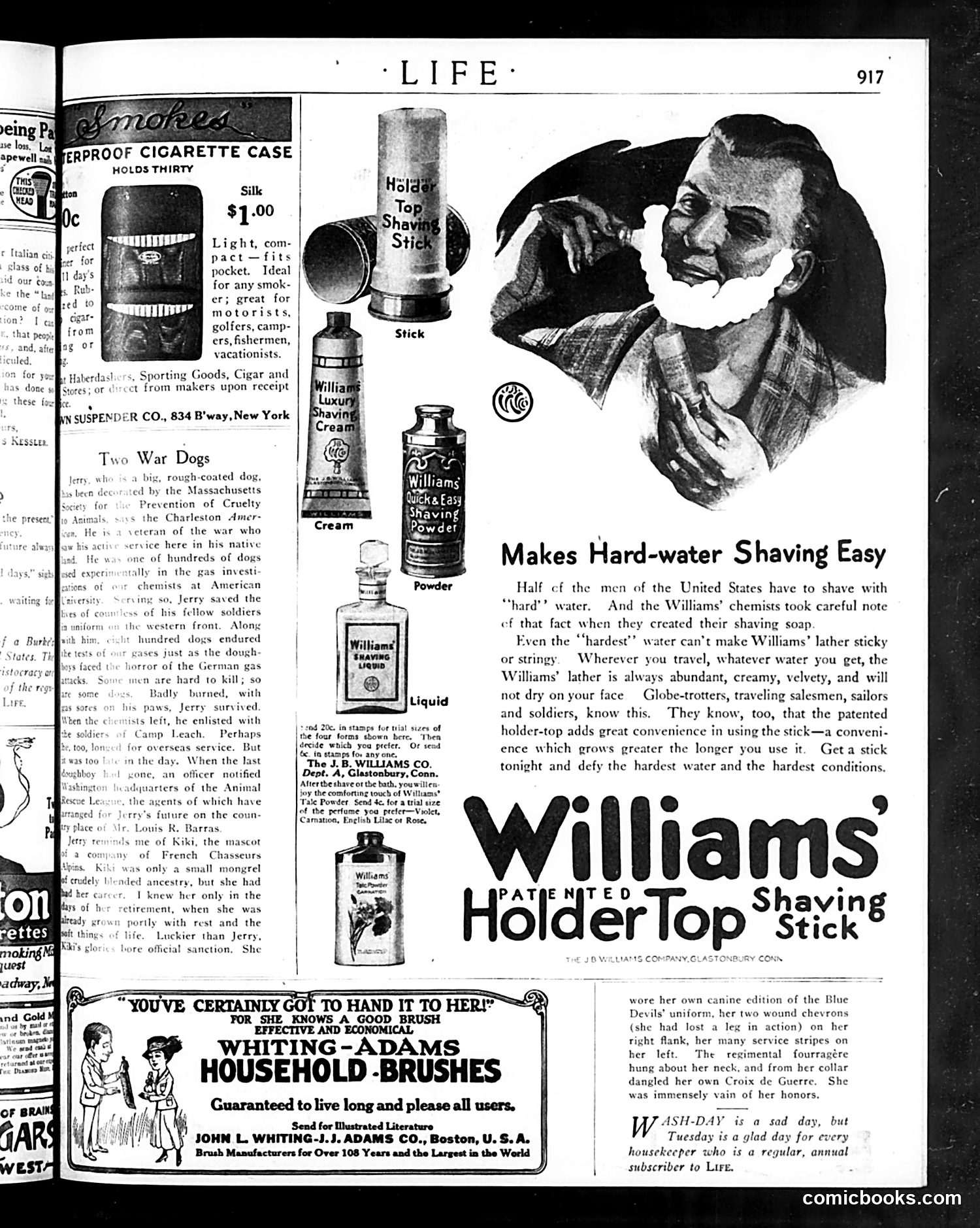
This page is primarily **advertising**, not satire or political commentary. It features commercial product ads for men's grooming items (cigarette case, shaving products, brushes) typical of early 20th-century magazines. The one editorial content is a brief article titled "Two War Dogs" describing military dogs from World War I—specifically "Jerry," a decorated dog who served on the western front and survived gas attacks, and "Kiki," a French Chasseur's mascot dog who lost a leg in combat and wore military honors including the Croix de Guerre. These are **sentimental wartime stories** celebrating animal heroism rather than satire. The accompanying illustration shows a man shaving, supporting the Williams shaving stick advertisement below it. The page reflects post-WWI American culture: nostalgia for the recently-ended war, celebration of military sacrifice (including animals'), and the era's advertising-heavy magazine format.
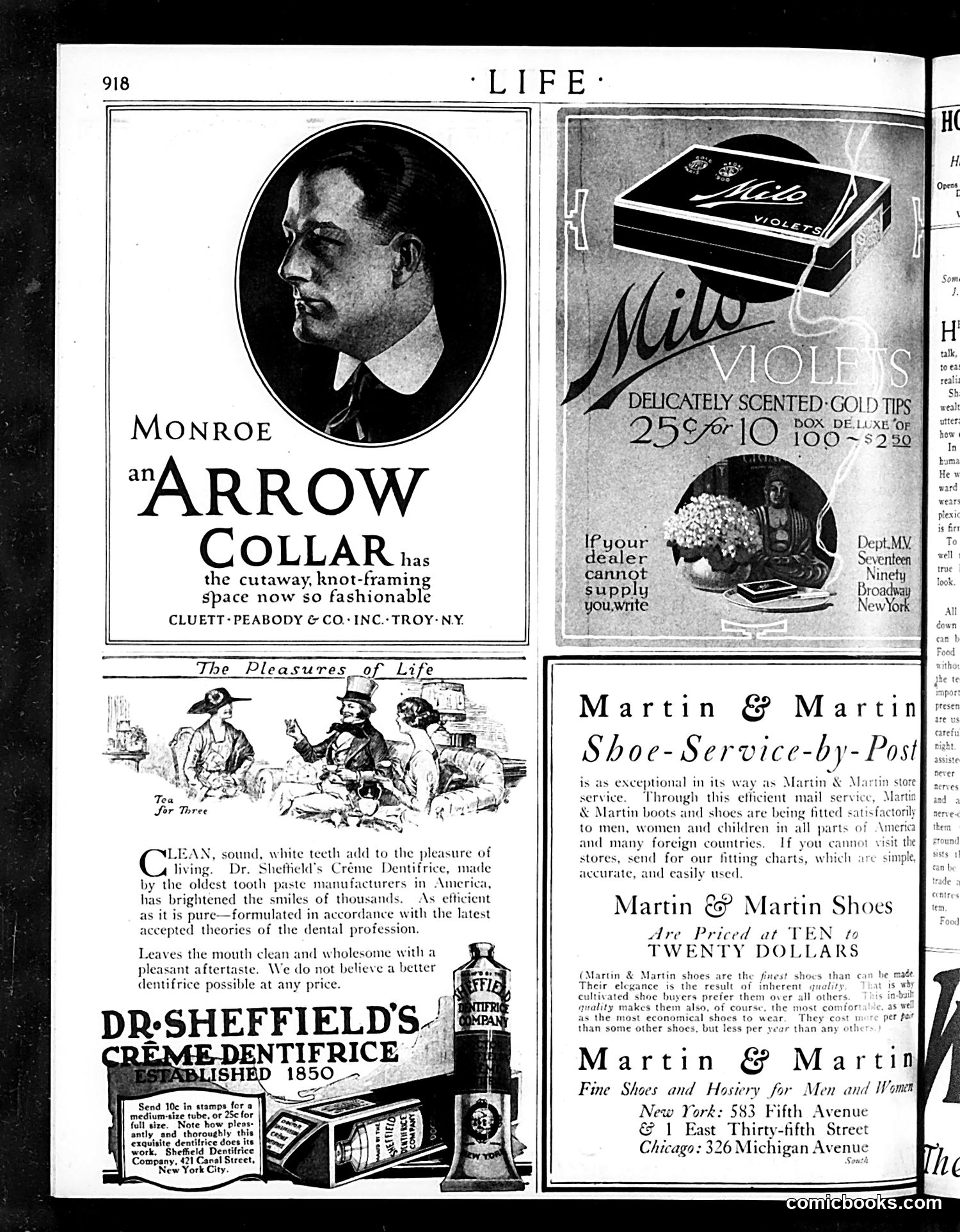
This is primarily an **advertising page** rather than editorial satire. The page contains four distinct ads: 1. **Monroe Arrow Collar** — Features a portrait of a man in profile advertising a detachable shirt collar with fashionable "cutaway, knot-framing space." This was a major collar brand of the era. 2. **Milo Violets** — Scented cigarettes with gold tips, priced at 25¢ for a box. 3. **Dr. Sheffield's Creme Dentifrice** — A tooth paste advertisement emphasizing cleanliness and modern dental science, established 1850. 4. **Martin & Martin Shoes** — Mail-order shoe service, priced $10-20, emphasizing quality and convenience for customers nationwide. The only cartoon element is a small illustration titled "The Pleasures of Life" showing three figures in period dress, but it's largely decorative filler between ads rather than satirical commentary. This page reflects early 20th-century consumer culture and advertising conventions—no political satire is evident.
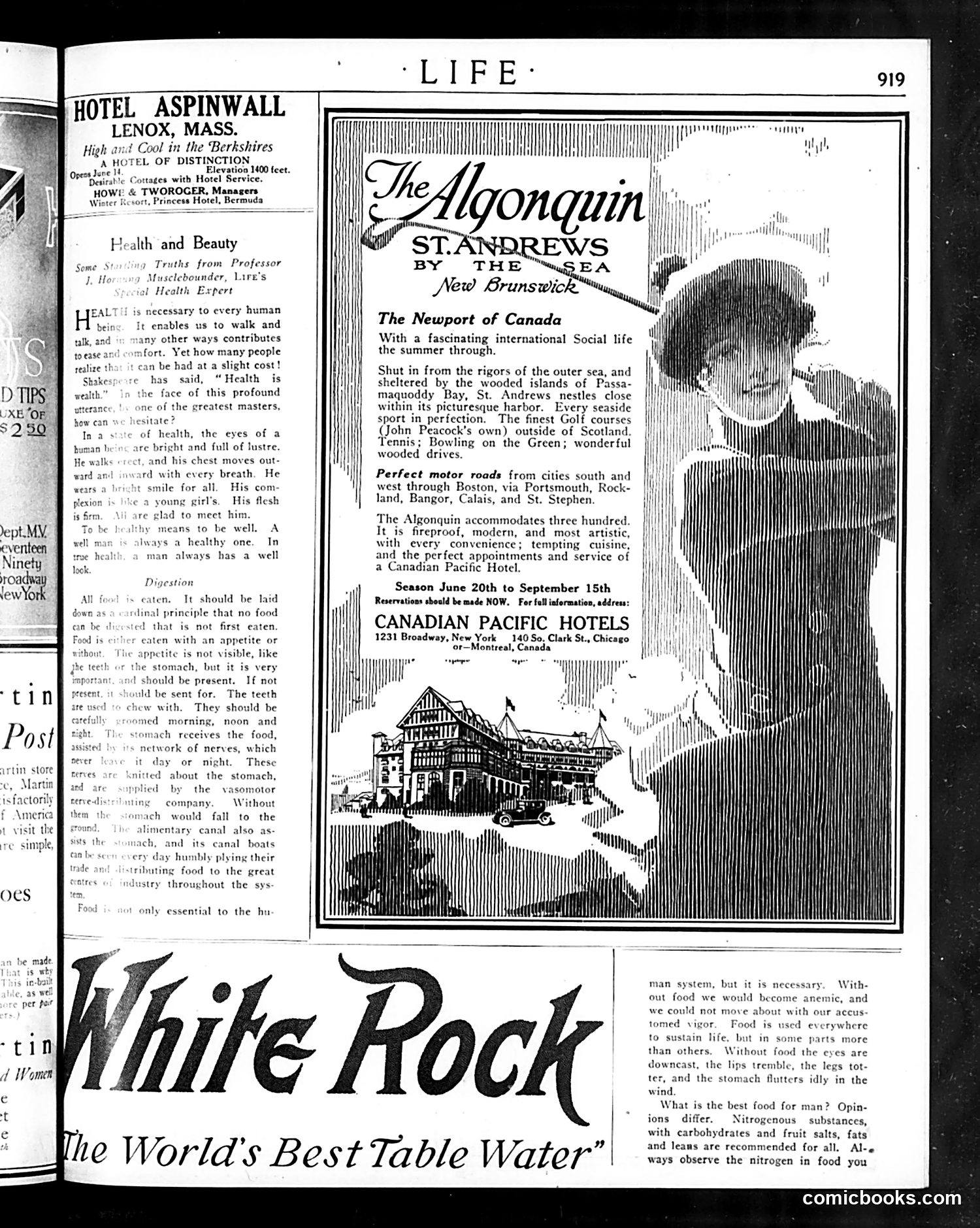
This page is primarily **advertising and lifestyle editorial content**, not political satire. The main feature is an advertisement for **The Algonquin, St. Andrews by the Sea** in New Brunswick, Canada—a luxury resort hotel marketed as "The Newport of Canada" (referencing the wealthy American resort town). It emphasizes leisure activities (golf, tennis, motor roads) and modern amenities. The left column contains a serious health column titled "Health and Beauty," discussing nutrition and digestion, apparently by a Professor of health—standard wellness advice of the era. At the bottom is an advertisement for **White Rock table water**, using the brand's famous logo/imagery. There is **no political cartoon or satire on this page**. It represents typical 1920s Life magazine content: upscale travel advertising, health advice, and product promotion targeting affluent readers. The "satirical magazine" framing doesn't apply here—this appears to be a straightforward commercial and editorial page.
This is **not a cartoon or satire**—it's a straightforward **advertisement for advertising itself**, placed by *Life* magazine's advertising department. The piece argues that reading advertisements provides genuine educational value beyond mere product promotion. It claims ads teach readers about quality goods, culture (music, books), nutrition, fashion, health, and domestic management. For a modern reader, this reads as almost comically earnest self-promotion. Today we understand advertising as persuasion designed to drive consumption, often through manipulation. This early 20th-century text presents ads as a **public service**—a neutral information source. The irony is unintentional: the ad itself demonstrates advertising's actual purpose—to convince you that advertisements deserve your attention and trust. The claim that ads are "valuable" to readers is precisely the kind of pitch modern readers would recognize as self-interested marketing rather than genuine educational benefit.
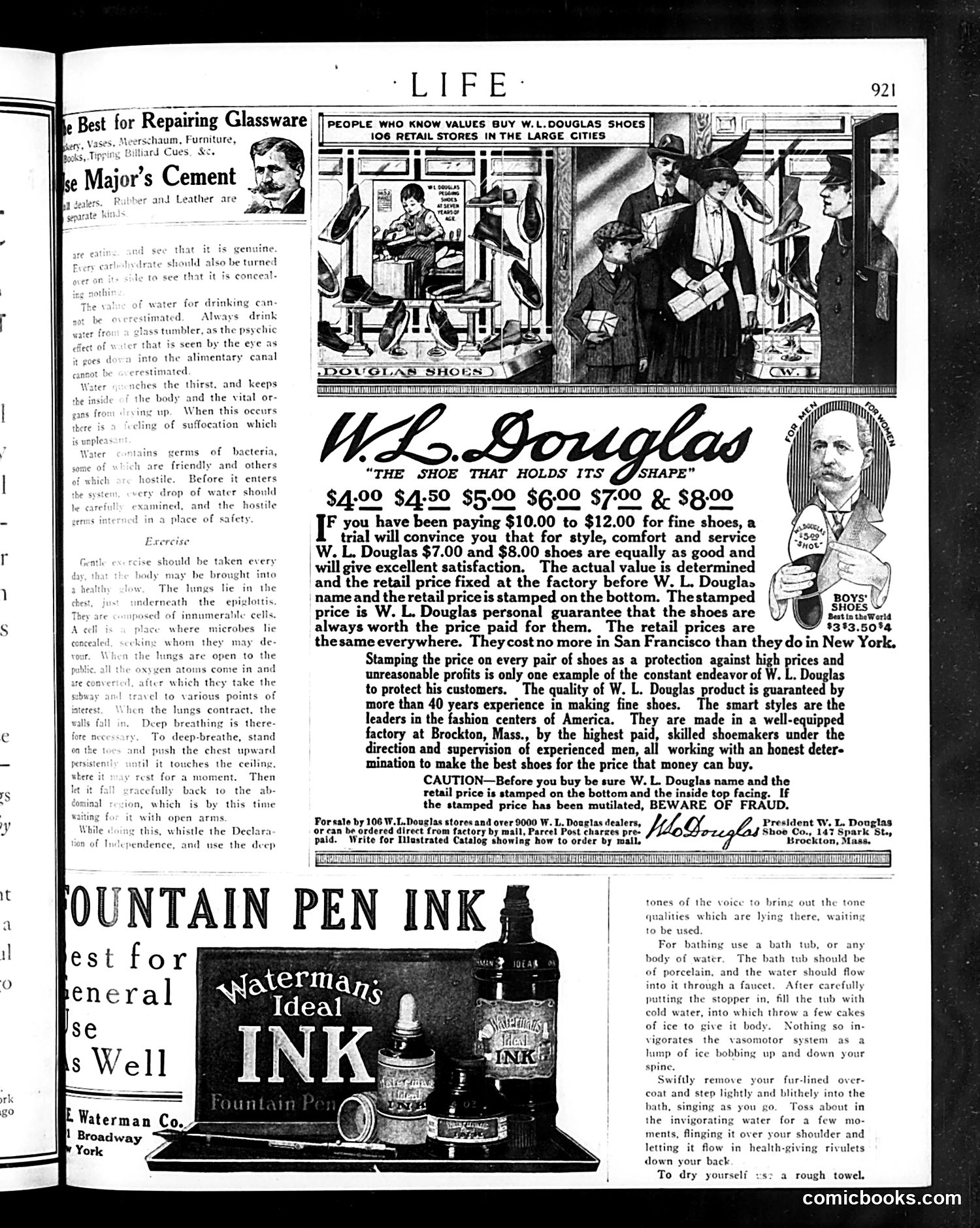
This page is primarily **advertising**, not satire. The dominant content is a large W.L. Douglas Shoes advertisement featuring an illustration of men in a shoe store. The ad emphasizes that Douglas shoes are "THE SHOE THAT HOLDS ITS SHAPE" and cost $4.00-$8.00, claiming this represents excellent value compared to competing $10-$12 shoes. The advertisement includes a cautionary note about counterfeit Douglas shoes, warning consumers to verify the stamped price on the bottom—a practical concern in early 20th-century retail. Below this is a Waterman's Ideal Fountain Pen Ink advertisement. The left side contains partial text about health topics (water purity, exercise), but is cut off. There is **no political satire or cartoon** on this page—it is a straightforward commercial publication page typical of *Life* magazine's mixed advertising-and-editorial format.
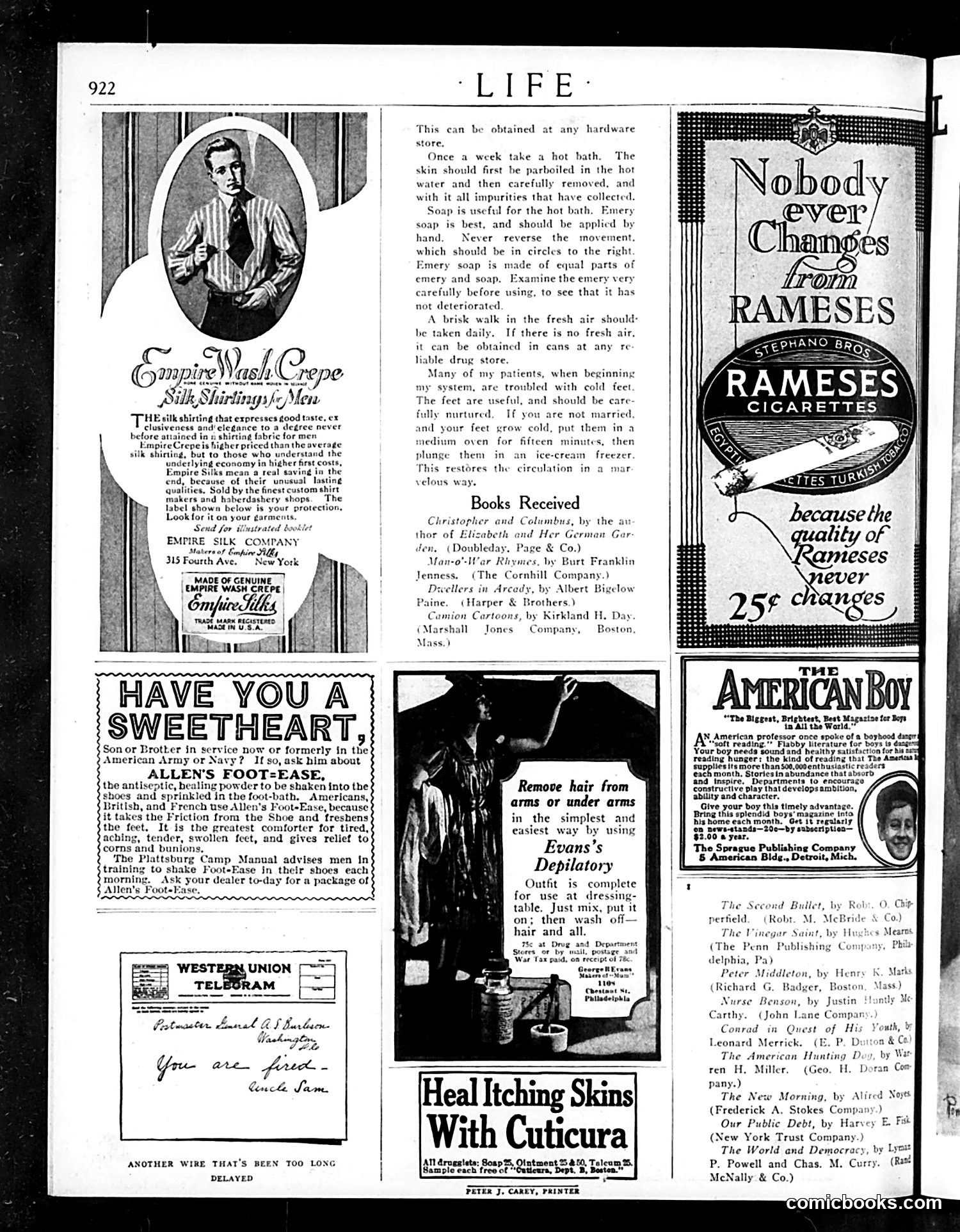
This page is primarily **advertisements and book reviews**, not political satire. The ads target soldiers and veterans, reflecting post-WWI concerns: **Key Content:** - **Empire Wash Crepe silk shirts** marketed for their quality and durability - **Allen's Foot-Ease powder** explicitly advertised to soldiers and veterans serving in WWI armies (American, British, French mentioned), addressing foot problems from military service - **Western Union telegram** appears to be a humorous note about delayed communication - **Evans's Depilatory** and **Cuticura** skin products for personal grooming - **The American Boy magazine** advertisement emphasizing wholesome reading for youth - **Books Received** section listing recent publications **Historical Context:** The prominent marketing to servicemen reflects the page's publication during or immediately after World War I, when soldiers' welfare was a public concern. The ads assume readers have family members in military service and appeal to that patriotic connection. The page contains **no political cartoons or satirical commentary**—it's straightforward commercial and literary content typical of Life magazine's editorial mix.