
Life, 1919-05-22 · page 8 of 42
Life — May 22, 1919 — page 8: what you’re looking at
What you’re looking at
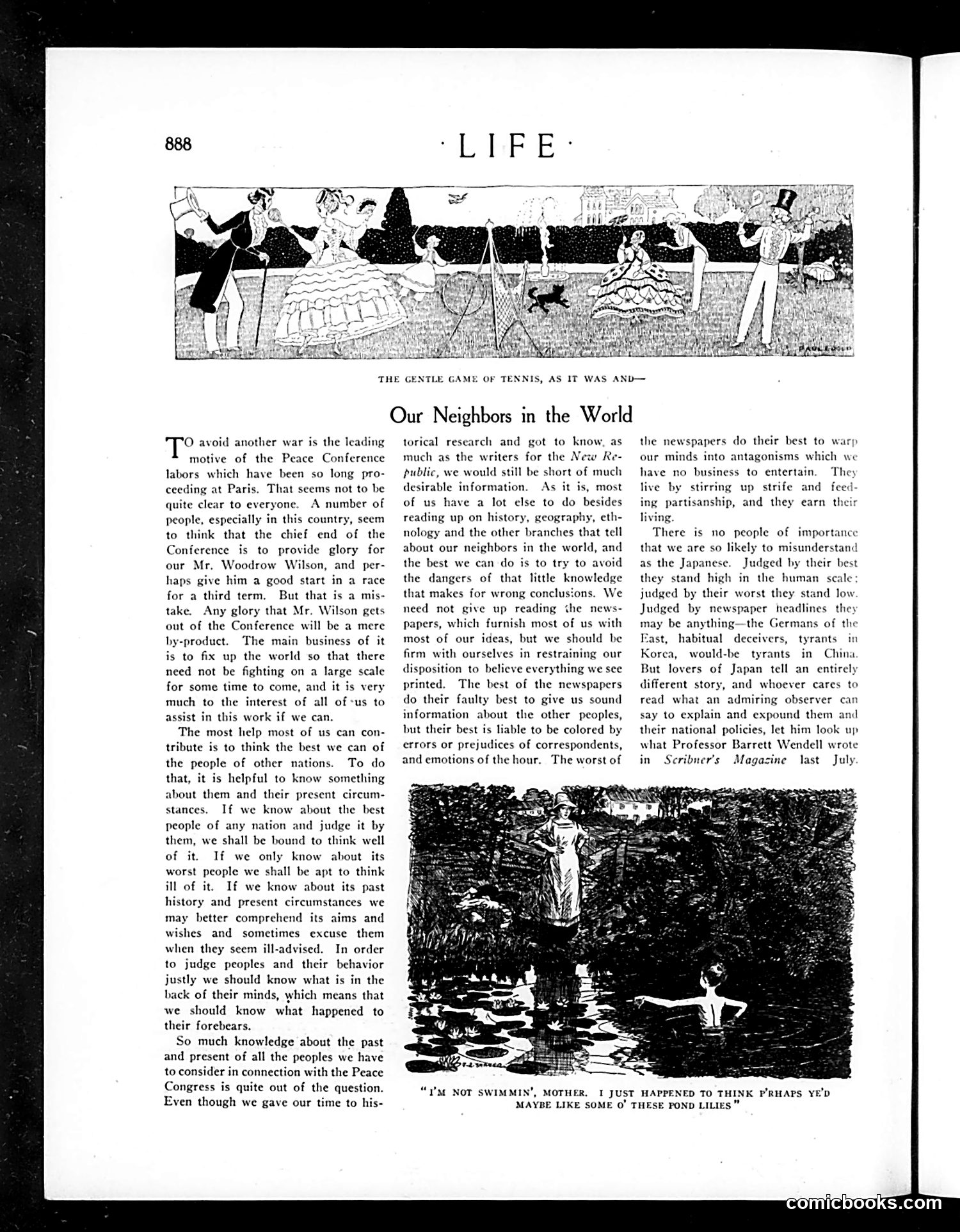
**Top Cartoon:** "The Gentle Game of Tennis, As It Was And—" depicts tennis players in period dress, then evolving into increasingly chaotic modern play, satirizing how the "genteel" sport has become rough and aggressive. **Main Article:** "Our Neighbors in the World" discusses international understanding, arguing that knowledge of other nations' histories and circumstances prevents prejudice. The text specifically references Japanese people as commonly misunderstood, claiming Western observers often judge them unfairly based on limited information. **Bottom Illustration:** Shows a child by a pond observing lilies, with caption: "I'M NOT SWIMMIN', MOTHER. I JUST HAPPENED TO THINK P'HAPS YE'D MAYBE LIKE SOME O' THESE POND LILIES"—a humorous domestic scene of a child's creative excuse-making.
📄 Transcribed text from this page (OCR, searchable)
Machine-transcribed from the original scan — historical spelling and the odd misread are preserved.
THE GENTLE GAME OF TEND 'O avoid another war is the leading motive of the Peace Conference labors which have been so long pro- ceeding at Paris. That seems not to be quite clear to everyone. A number of people, especially in this country, seem to think that the chief end of the Conference is to provide glory for our Mr. Woodrow Wilson, and per- haps give him a good start in a race for a third term. But that is a mis- take. Any glory that Mr. Wilson gets out of the Conference will be a mere by-product. The main business of it is to fix up the world so that there need not be fighting on a large scale for some time to come, and it is very much to the interest of all of -us to assist in this work if we can. The most help most of us can con- tribute is to think the best we can of the people of other nations. To do that, it is helpful to know something about them and their present circum- stances. If we know about the best people of any ion and judge it by them, we shall be bound to think well of it. If we only know about its worst people we shall be apt to think ill of it. If we know about its past history and present circumstances we may better comprehend its aims and wishes and sometimes excuse them when they seem ill-advised. In order to judge peoples and their behavior justly we should know what is in the back of their minds, which means that we should know what happened to their forebears. So much knowledge about the past and present of all the peoples we have to consider in connection with the Peace Congress is quite out of the question. Even though we gave our time to his- Our Neighbors in the World torical research and got to know, as much as the writers for the New Re- public, we would still be short of much desirable information. As it is, most of us have a lot else to do besides reading up on history, geography, eth- nology and the other branches that tell about our neighbors in the world, and the best we can do is to try to avoid the dangers of that little knowledge that mal need not give up reading the news- papers, which furnish most of us with most of our ideas, but we should be firm with ourselves in restraining our disposition to believe everything we see printed. The best of the newspapers do their faulty best to give us sound information about the other peoples, but their best is liable to be colored by errors or prejudices of correspondents, and emotions of the hour. The worst of s for wrong conclusions. We I'M NOT SWIMMIN’, MOTHER. I JUST HAPPENED Is, AS IT WAS AND— the newspapers do their best to warp our minds into antagonisms which we They tee have no business to entertain, live by stirring up strife and ing partisanship, and they earn th living. There is no people of importance that we are so likely to misunderstand as the Japanese. Judged by their best they stand high in the human scale judged by their worst they stand low Judged by newspaper headlines they may be anything—the Germans of the East, habitual deceivers, tyrants in Korea, would-be tyrants in) China But lovers of Japan tell an entirely different story, and whoever cares to read what an admiring observer can say to explain and expound them and their national policies, let him look up what Professor Barrett Wendell wrote in Scribner's Magazine last July TO THINK P'RHAPS YE'D MAYBE LIKE SOME 0’ THESE POND LILIES”