
A complete issue · 42 pages · 1919
Life — March 6, 1919
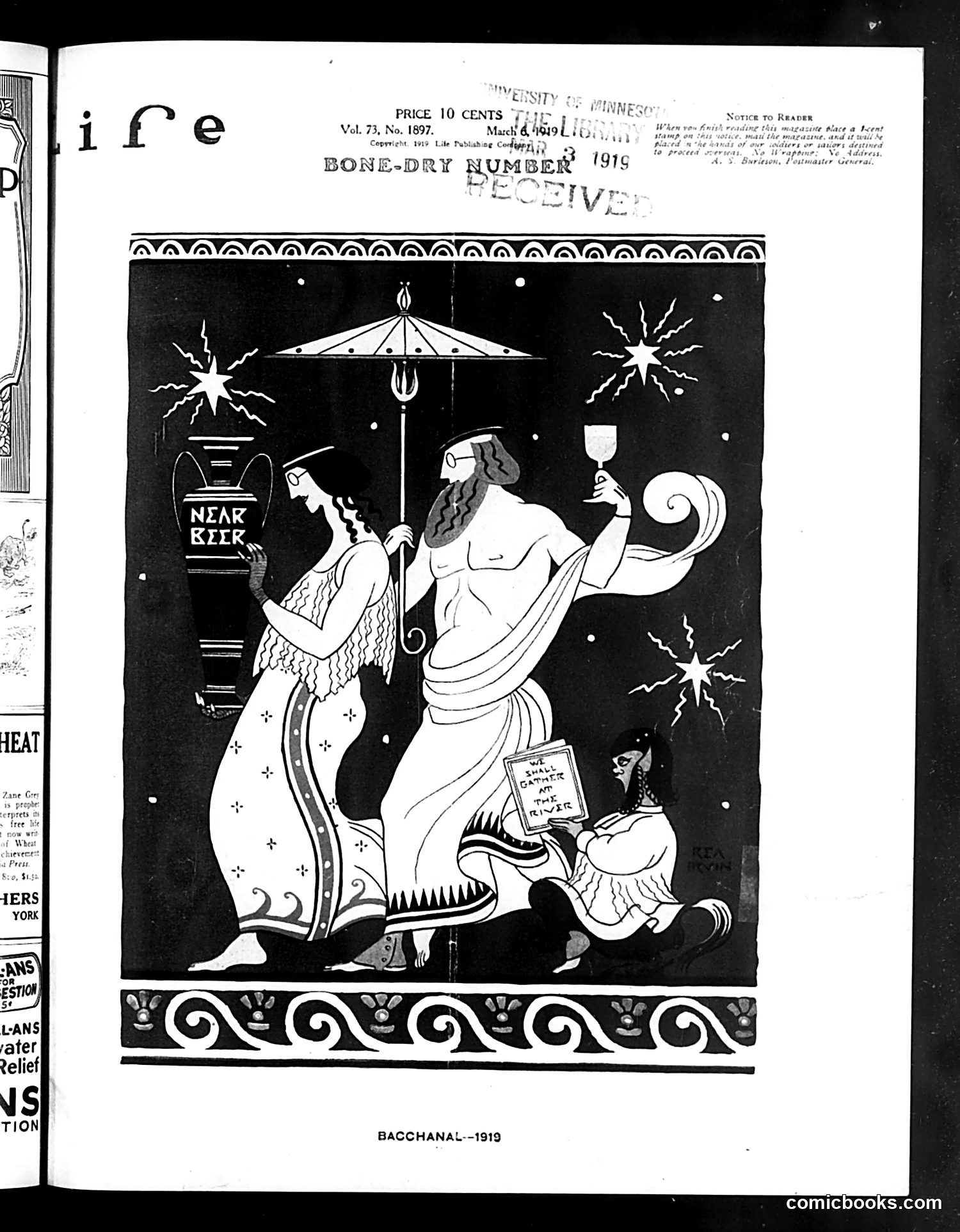
This illustration depicts a classical bacchanalian scene—a raucous celebration associated with Bacchus, the Roman god of wine. The image shows nude or partially-draped figures in revelry: drinking, dancing under an umbrella-like canopy, with a "Near Beer" vessel visible. The 1919 date is significant: this references **Prohibition**, which took effect in January 1919. The satire mocks the law's likely ineffectiveness—despite the constitutional ban on alcohol, Americans would continue indulging in "near beer" (low-alcohol substitutes) and illicit drinking. The classical imagery elevates this commentary, sarcastically suggesting that wine-drinking civilization itself cannot be suppressed by legislation. The cartoon critiques Prohibition as futile social engineering.
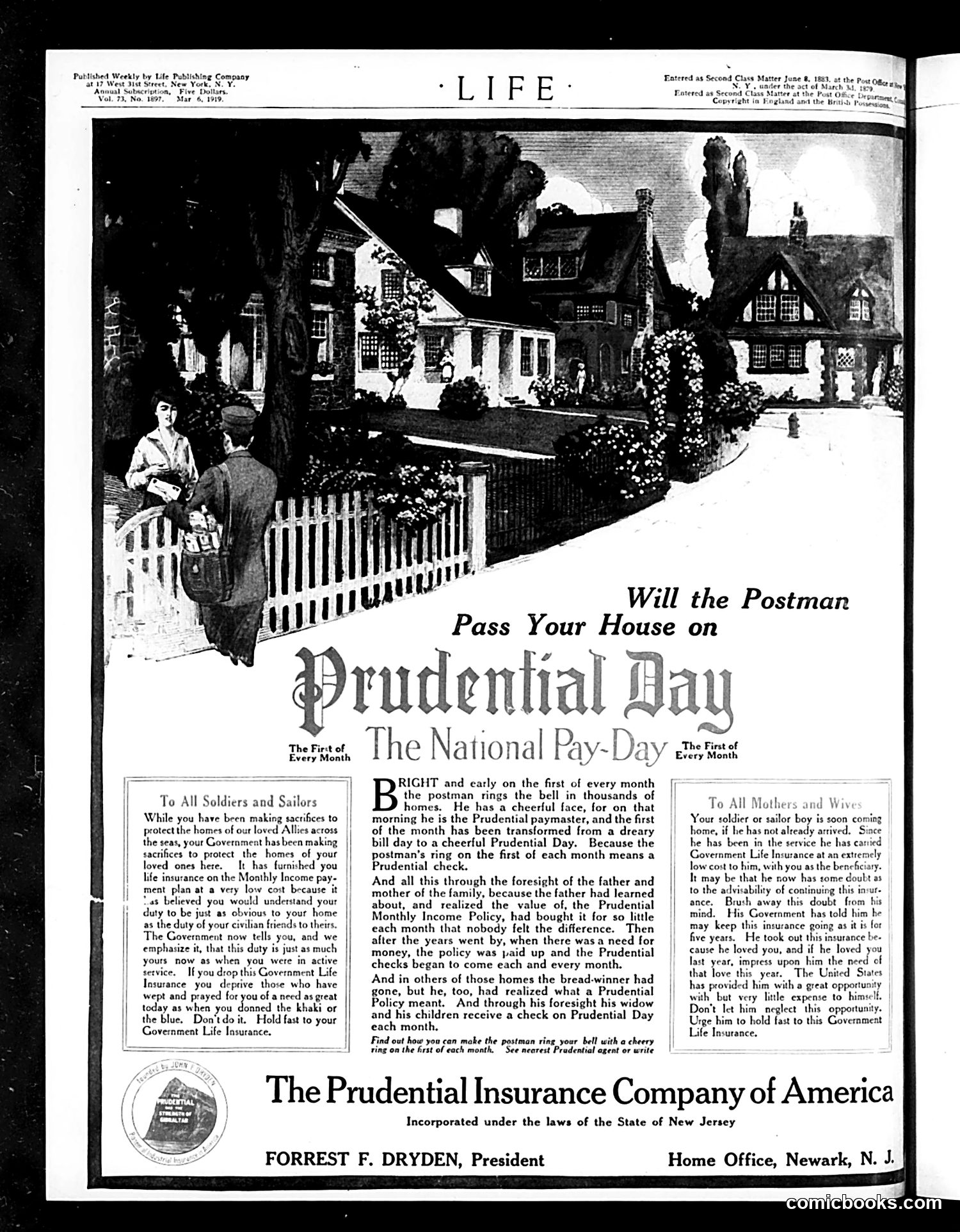
This page is primarily **advertising**, not satire or editorial content. It's a full-page advertisement for the Prudential Insurance Company of America promoting their "Prudential Day" — described as "The National Pay-Day" occurring on the first of every month. The illustration shows an idyllic suburban scene with a postman delivering mail, designed to evoke comfort and security. The ad targets three audiences with separate text blocks: soldiers and sailors, and mothers and wives—emphasizing how Prudential's monthly insurance payouts provide financial security and peace of mind for families, particularly those with loved ones in military service (suggesting WWI-era publication). The appeal is emotional rather than humorous: insurance as patriotic protection.
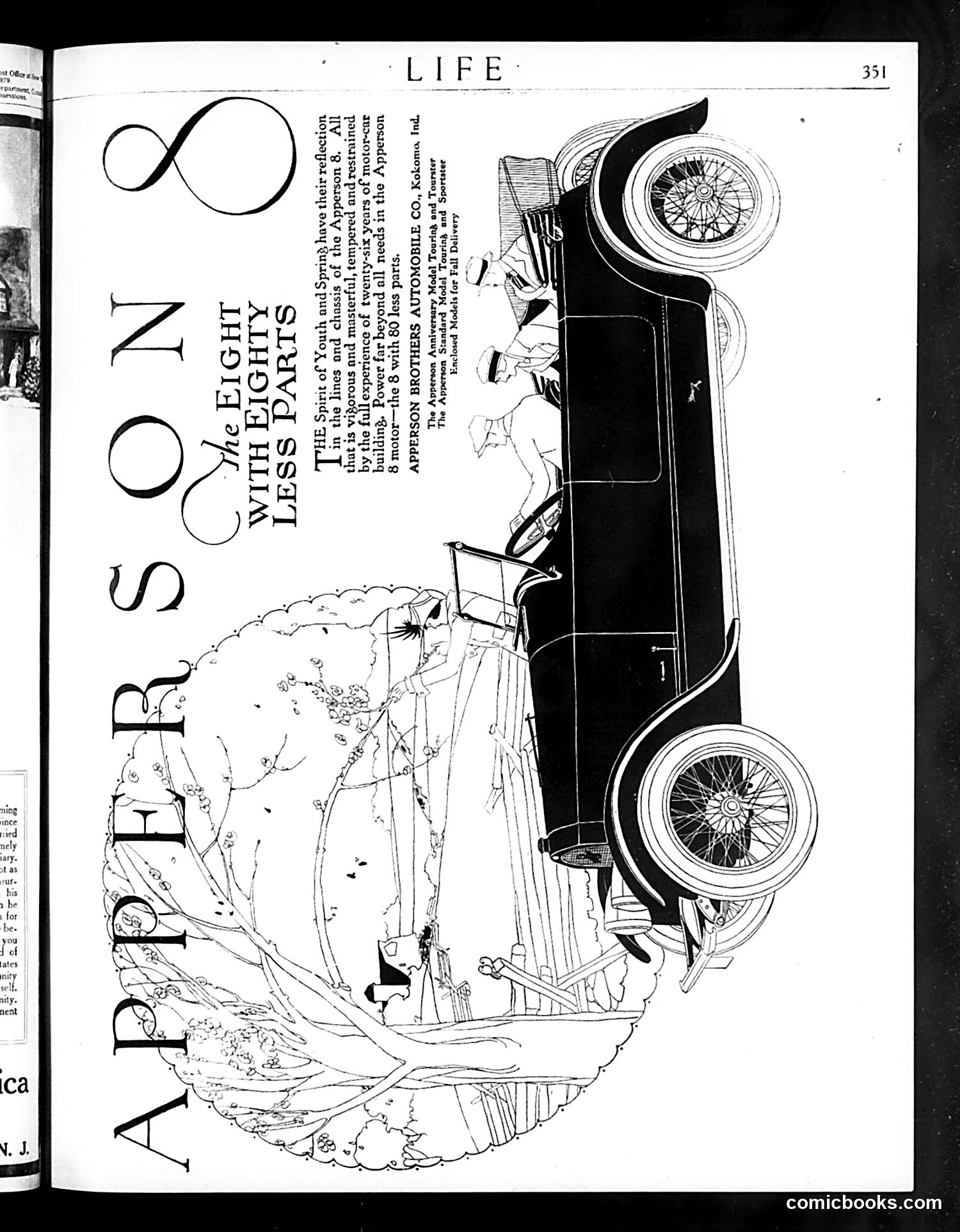
This page (351 from Life magazine) is primarily **a Bison automobile advertisement**, not political satire. The ad features an early automobile (appears to be from the 1910s-1920s era based on the design) shown in side profile with prominent spoke wheels. The tagline reads "**With EIGHT LESS PARTS**" — emphasizing mechanical simplicity as a selling point. The decorative border illustration depicts a bison (the animal), likely chosen as a brand metaphor suggesting American strength, reliability, and power. The text mentions "The Spirit of Youth" and references to engineering advantages. This is straightforward commercial advertising rather than political commentary. The humor, if any, lies in the visual contrast between the rugged buffalo and the modern motorcar — not in social or political satire that modern readers would need contextual explanation to understand.
This is an editorial announcement rather than a cartoon. LIFE magazine declares it cannot produce its usual cheerful satirical content because the editors feel "too bone-dry"—emotionally exhausted. They're addressing what appears to be a serious national crisis, likely related to Prohibition (referenced as "chronological alcoholic oasis"), suggesting this was published during the dry years (1920-1933). The editors hint this may be the magazine's final issue, expressing feeble hope that readers will awaken to "what the American people have not yet fully awakened to." The Latin phrase "Morituri Salutamus!" ("We who are about to die salute you") reinforces their tone of resignation and impending doom about national circumstances.
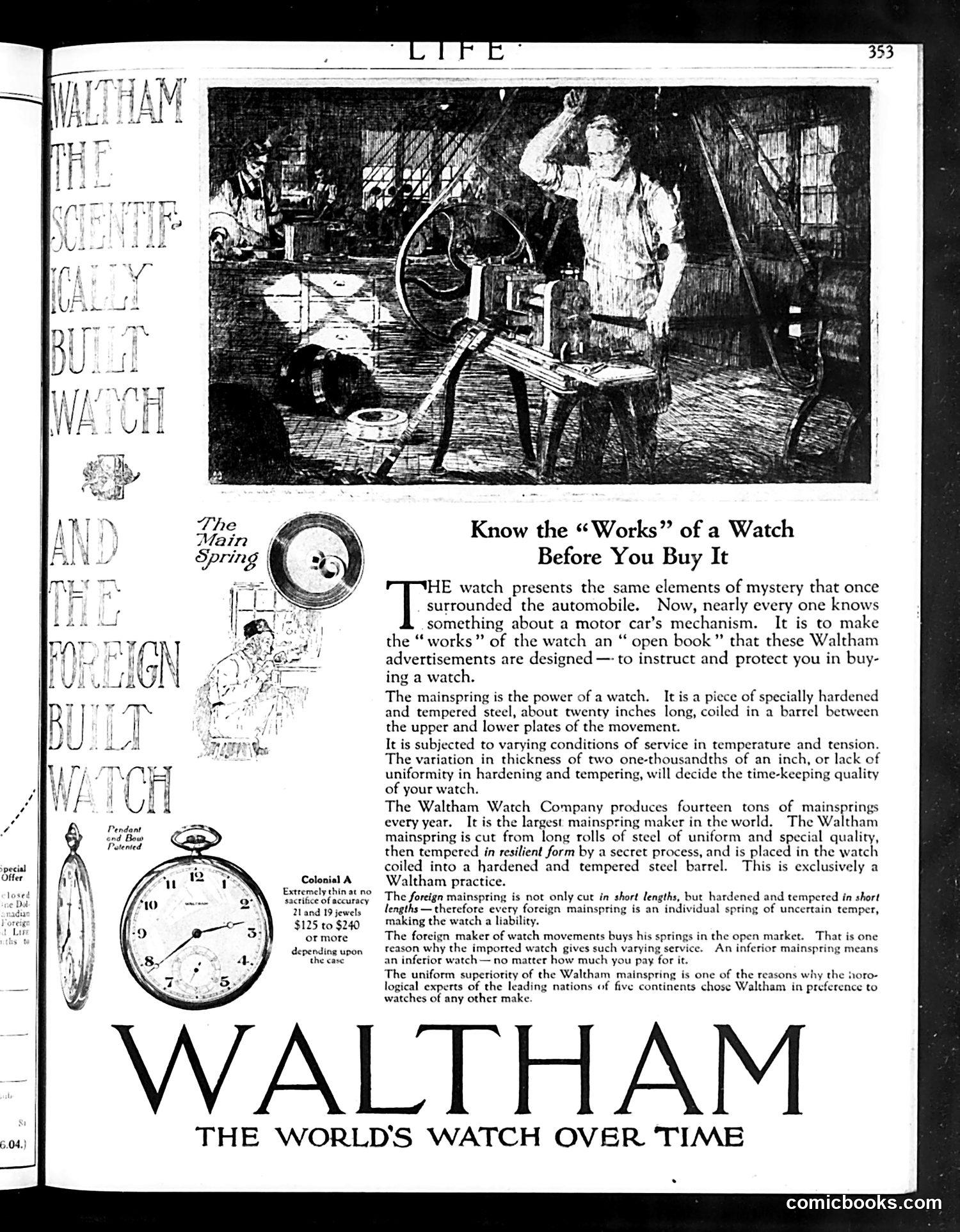
This page is primarily a **Waltham Watch advertisement**, not satire or political commentary. The advertisement educates consumers about watch mechanics, using the tagline "Know the 'Works' of a Watch Before You Buy It." The top image shows a factory workshop scene where workers examine watch components. The left sidebar contains technical diagrams of watch parts, including "The Main Spring" and a "Colonial A" pocket watch design. The text explains Waltham's manufacturing expertise—claiming they produce fourteen tons of mainsprings annually and are "the largest mainspring maker in the world." It emphasizes quality control through precise hardening and tempering processes. This is straightforward product advertising typical of early 20th-century *Life* magazine, designed to build consumer confidence through technical credibility rather than humor or satire.
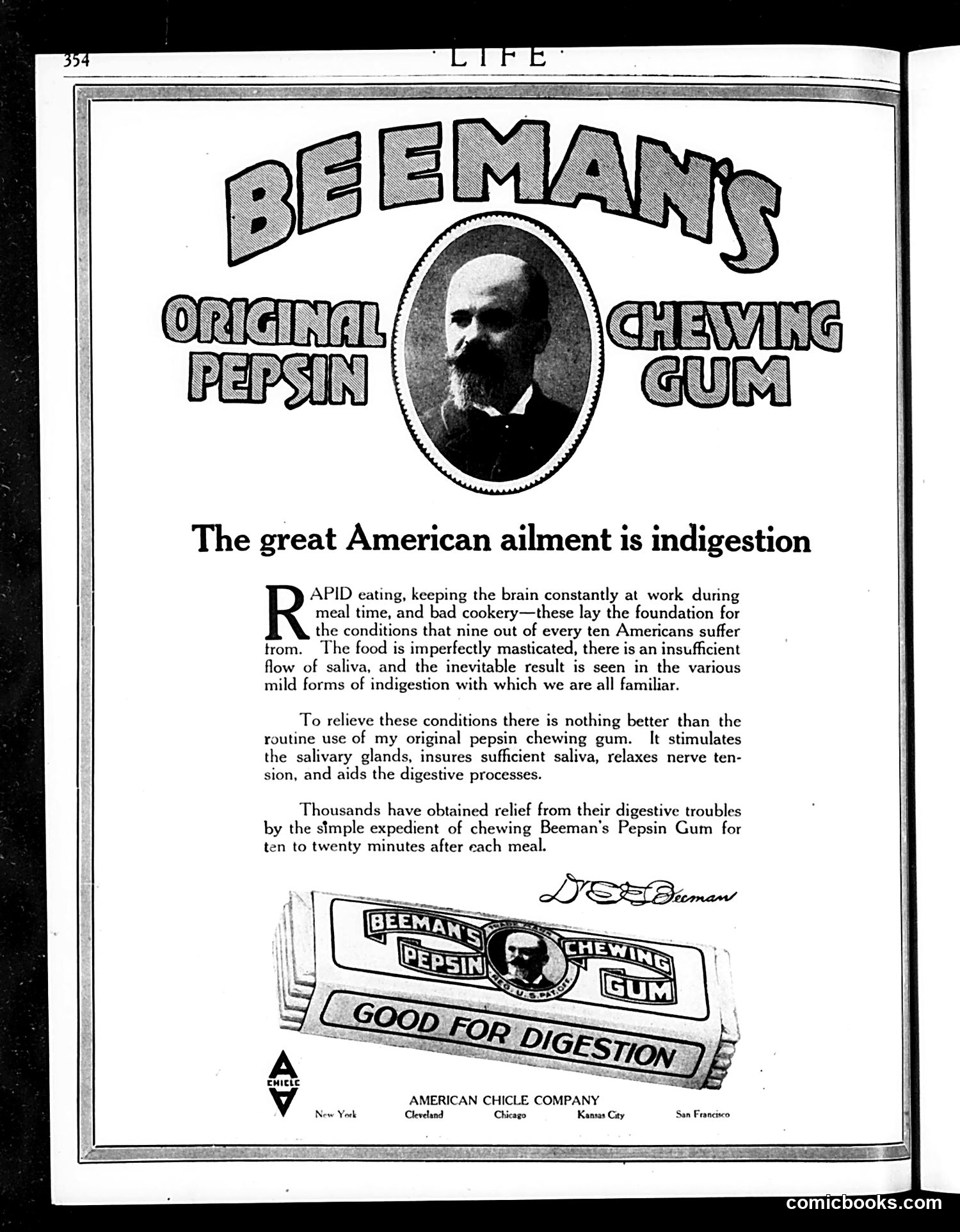
This is a **straightforward advertisement**, not satire. It promotes Beeman's Pepsin Chewing Gum as a digestive aid, featuring a bearded man (likely the product's founder or namesake) in an oval portrait. The ad claims pepsin gum relieves indigestion—described as "the great American ailment"—by stimulating saliva production and aiding digestion. It recommends chewing for 10-20 minutes after meals. This reflects early 20th-century medical marketing when digestive remedies (often containing questionable ingredients) were heavily advertised. The appeal to "thousands" of satisfied users is typical promotional language. The page appears to be a paid advertisement rather than editorial content from Life magazine.
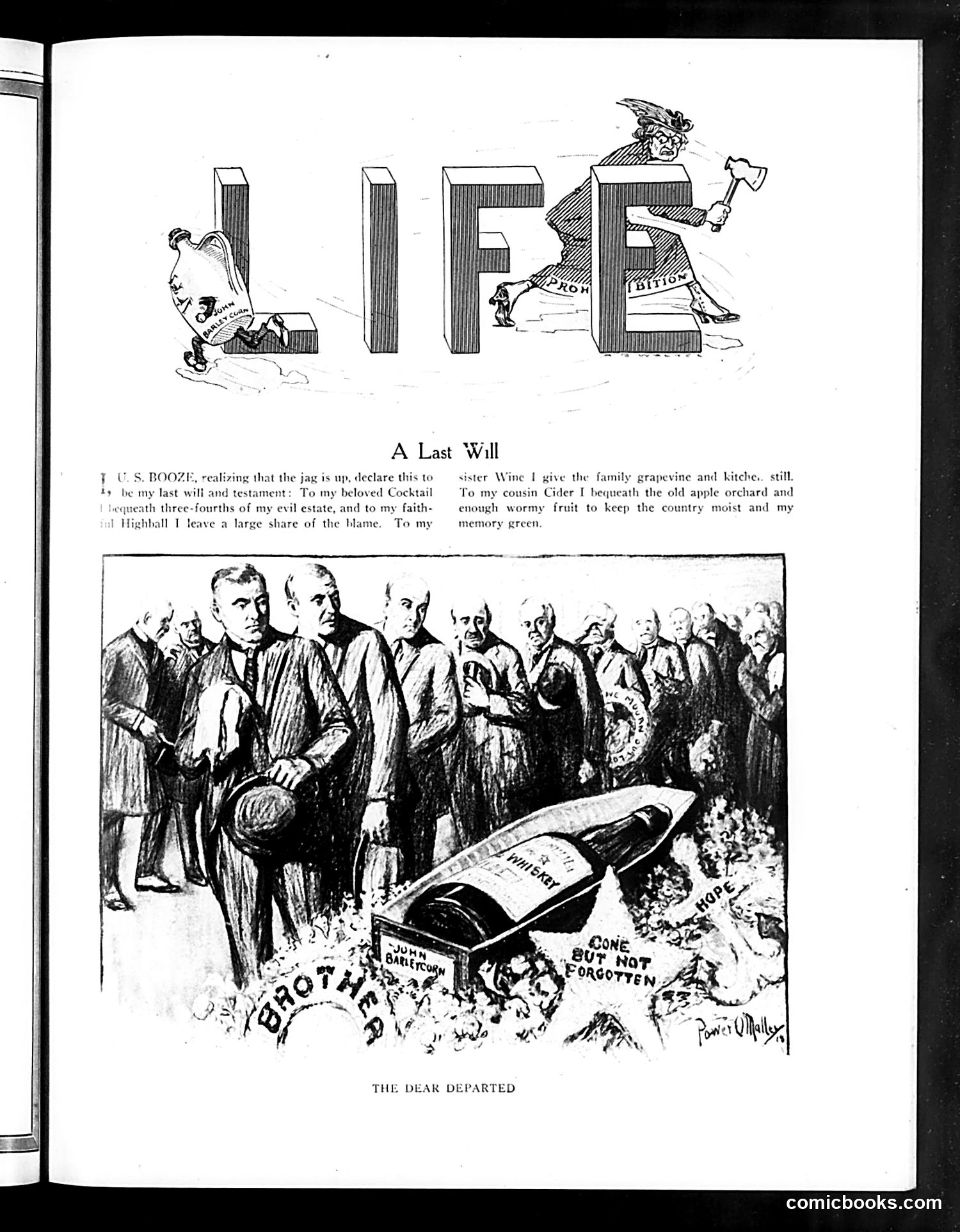
This page satirizes the death of Prohibition in America. The top "LIFE" letters feature caricatured figures—likely politicians and temperance advocates—collapsing or reacting dramatically as Prohibition ends. The bottom cartoon, "The Dear Departed," depicts a funeral scene for Prohibition itself. The coffin is labeled "WHISKEY" with text reading "GONE BUT NOT FORGOTTEN," while mourners gather around. Additional bottles labeled "BROTHER" suggest related alcohol products also being laid to rest or memorialized. The satire mocks both the failed prohibition policy and those who championed it, treating the legal end of alcohol prohibition as a death to be ceremonially mourned. The cartoon implies the defeat of temperance advocates' long-standing efforts through humorous inversion—presenting their loss as a funeral.
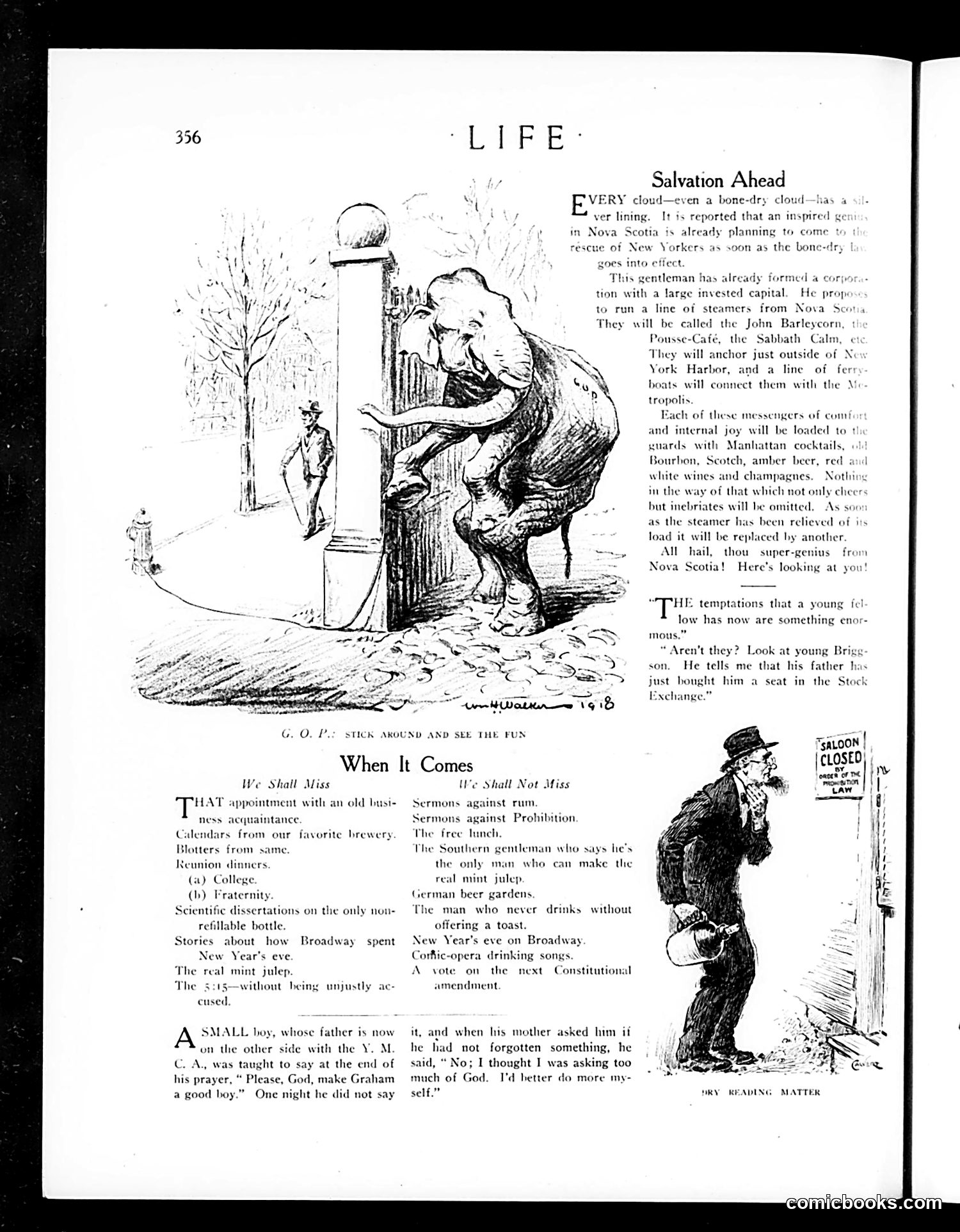
**Main Cartoon ("Stick Around and See the Fun"):** A large, disheveled figure clings to a lamppost while a smaller man walks away. This appears to satirize a drunk or inebriated person unable to leave, likely mocking those who resist Prohibition enforcement. **"Salvation Ahead" Article:** References an entrepreneur planning steamship service from Nova Scotia to New York, marketing it as a way to smuggle alcohol ("messengers of comfort") past Prohibition laws. The joke satirizes how Prohibition created loopholes and illegal commerce. **"When It Comes" Section:** Lists things people will miss (breweries, old acquaintances) versus won't miss under Prohibition, alongside things they *won't* miss (sermons, temperance lectures). This mocks both Prohibition advocates and its critics. **"Dry Reading Matter" Cartoon:** A figure reads near a "Saloon Closed" sign, likely referencing life after Prohibition implementation. The page satirizes the imminent Prohibition era (1920-1933).
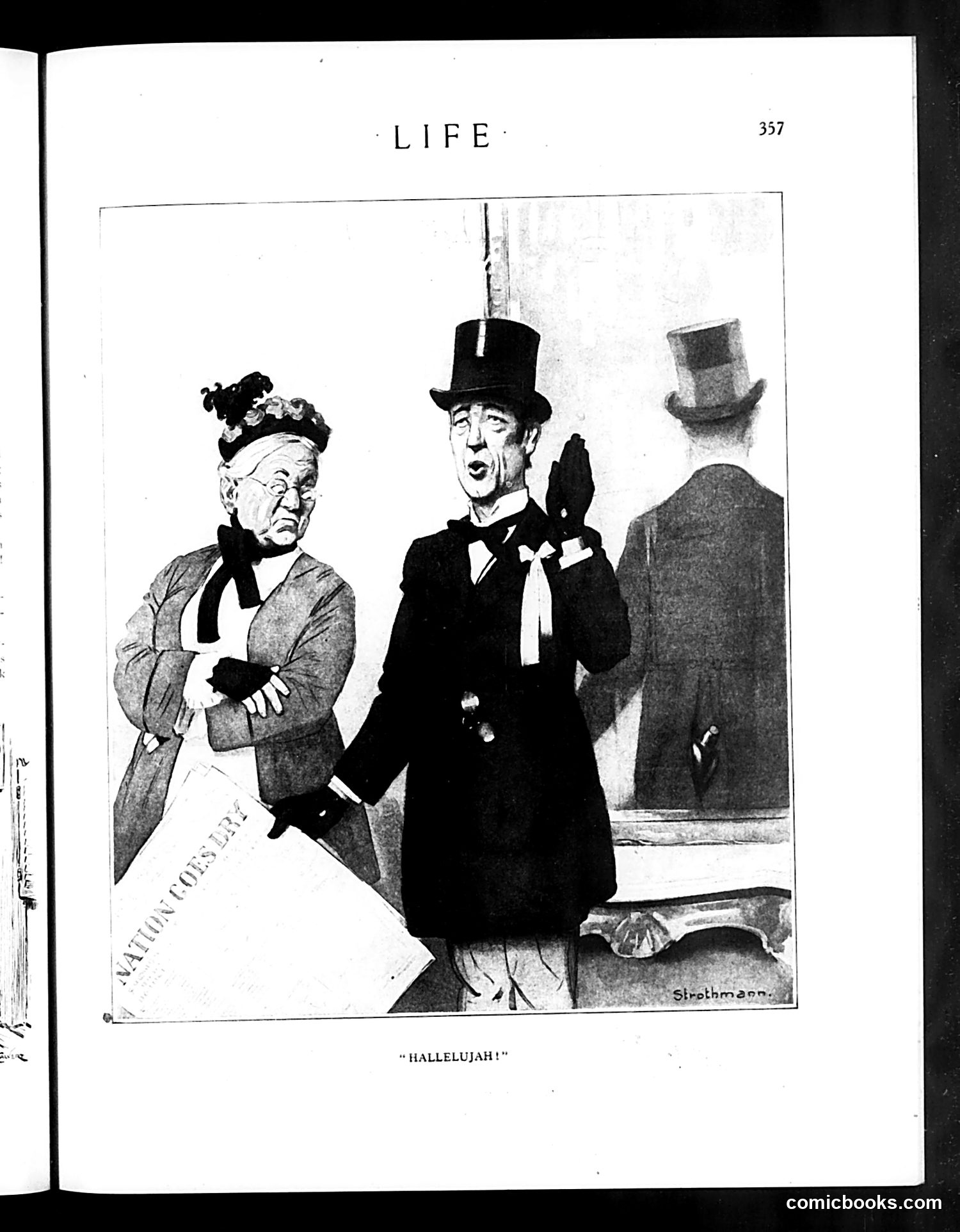
This cartoon by Strothmann depicts three formally dressed men in what appears to be a formal or religious setting. The central figure, wearing a top hat and appearing to sing or shout "Hallelujah," is shown with exaggerated expression. The man on the left holds what appears to be a document labeled "SUBSCRIPTION" (partially visible), while a third figure stands in the background. The satire likely mocks either religious enthusiasm, formal social pretension, or possibly a specific contemporary event involving subscription campaigns or fundraising. The "Hallelujah" exclamation suggests ironic commentary on overwrought enthusiasm or false piety. Without additional context about the specific date and events, the precise target remains unclear, though the cartoon critiques some form of social or commercial hypocrisy.
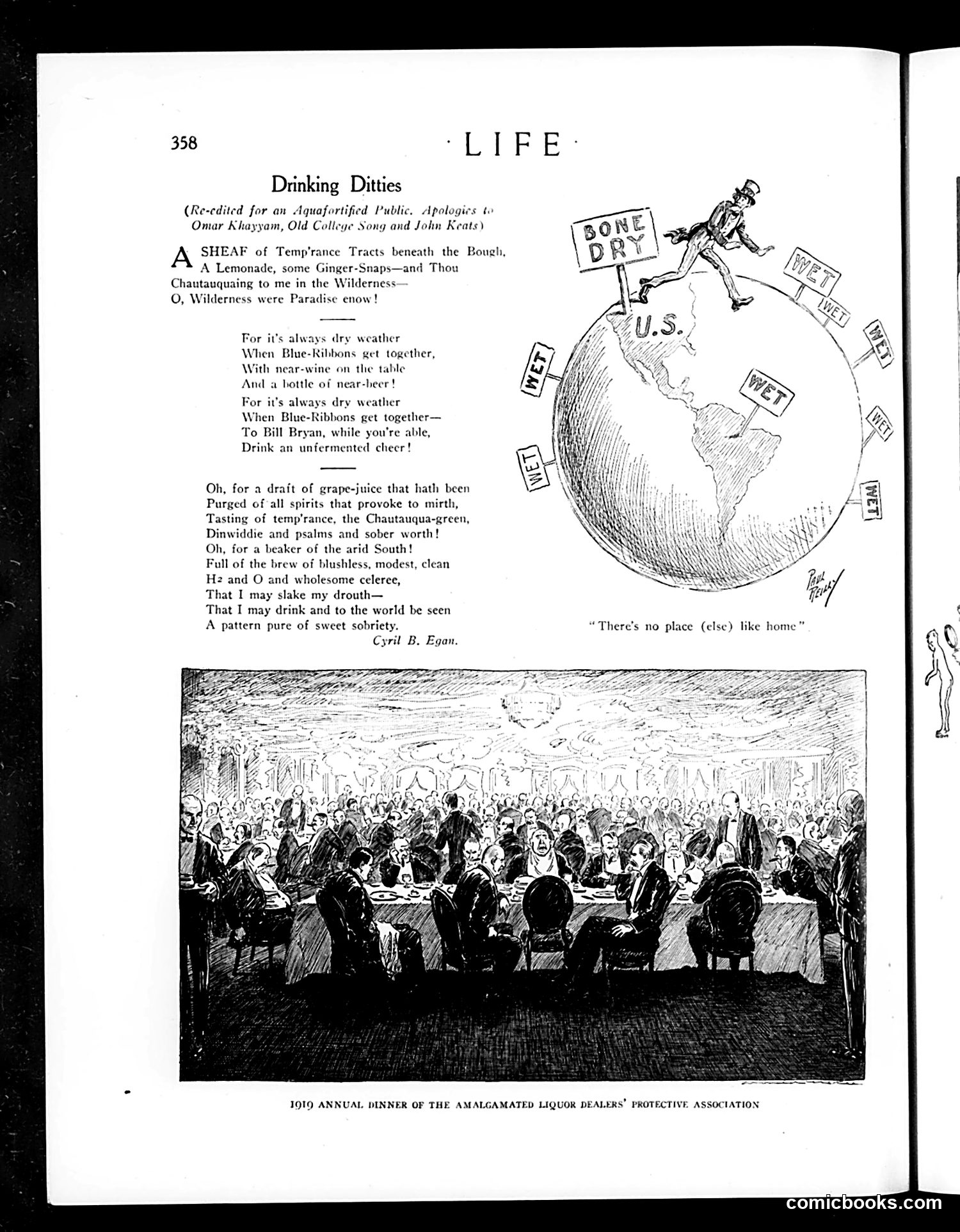
This Life magazine page satirizes the Prohibition era (note the "BONE DRY" figure riding the U.S. map). The poem by Cyril B. Egan mockingly celebrates "dry weather" and calls for alcohol-free alternatives like grape juice, sarcastically praising "uninfected cheer" and "sweet sobriety." The accompanying illustrations include a figure straddling America with prohibition signs, and a large gathering labeled "1919 ANNUAL DINNER OF THE AMALGAMATED LIQUOR DEALERS' PROTECTIVE ASSOCIATION"—suggesting liquor dealers were secretly convening despite Prohibition's legal onset (1920). The satire targets both Prohibition advocates' unrealistic idealism and the hypocrisy of those in the alcohol industry supposedly affected by the impending ban. The nostalgic tone mocks those mourning alcohol's loss.
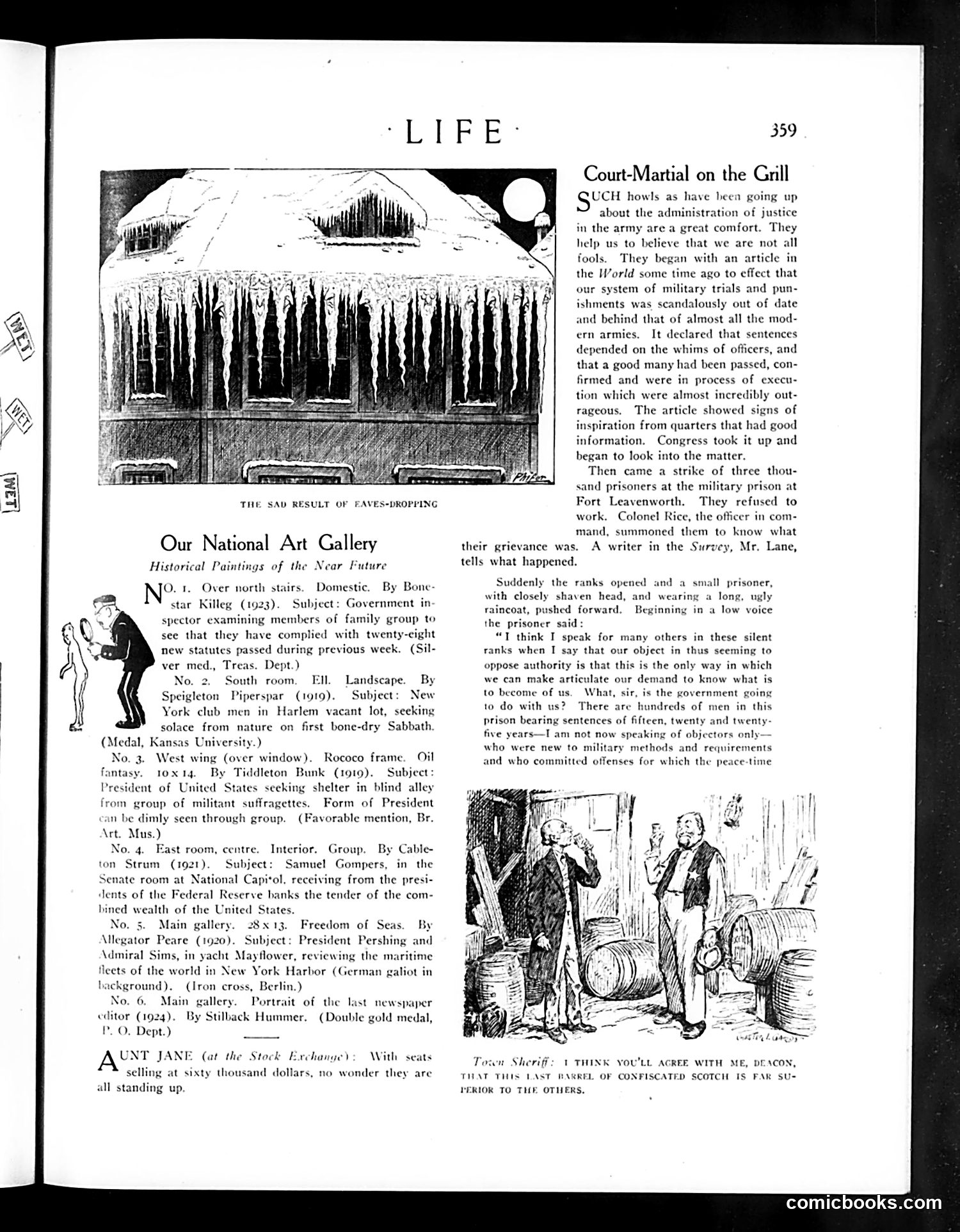
This article discusses military justice reform. The main illustration shows icicles hanging from what appears to be a prison structure, titled "The Sad Result of Eaves-Dropping." The accompanying text describes a strike by 3,000 prisoners at Fort Leavenworth who refused work to protest harsh sentences. A prisoner confronts Colonel Rice, demanding better conditions and claiming their punishment for wartime offenses is unjust. The "eaves-dropping" image appears to be satirical wordplay—the literal icicles suggest frozen conditions or surveillance ("eaves-dropping"). The article criticizes the military's harsh court-martial system and suggests reforms are needed. The cartoon on the right shows a prison confrontation, though specific figures are unclear from image quality alone.
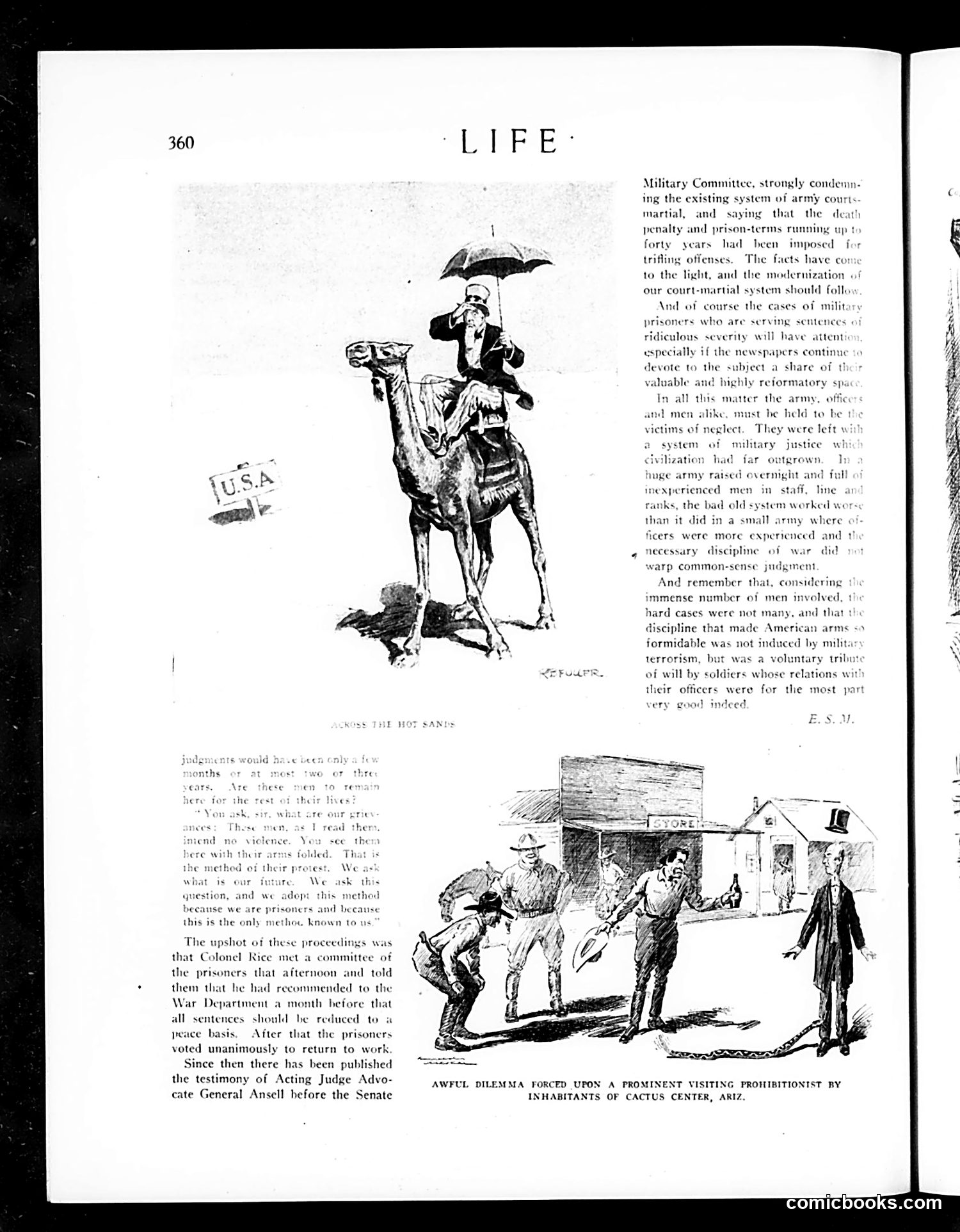
**Top Cartoon ("Across the Hot Sands"):** A man in business attire rides a camel through a desert, holding an umbrella and a U.S.A. banner. This appears to satirize American commercial or diplomatic expansion into foreign (likely Middle Eastern) territories—depicting the businessman as unprepared for harsh conditions yet persistently advancing American interests abroad. **Bottom Cartoon:** Titled "Awful Dilemma Forced Upon a Prominent Visiting Prohibitionist by Inhabitants of Cactus Center, Ariz.," this mocks Prohibition advocates visiting the American Southwest. A well-dressed prohibitionist faces a dilemma presented by locals, likely suggesting the difficulty of enforcing temperance laws in frontier regions where alcohol consumption remained culturally entrenched. Both cartoons use geographic displacement to satirize American ideological conflicts.
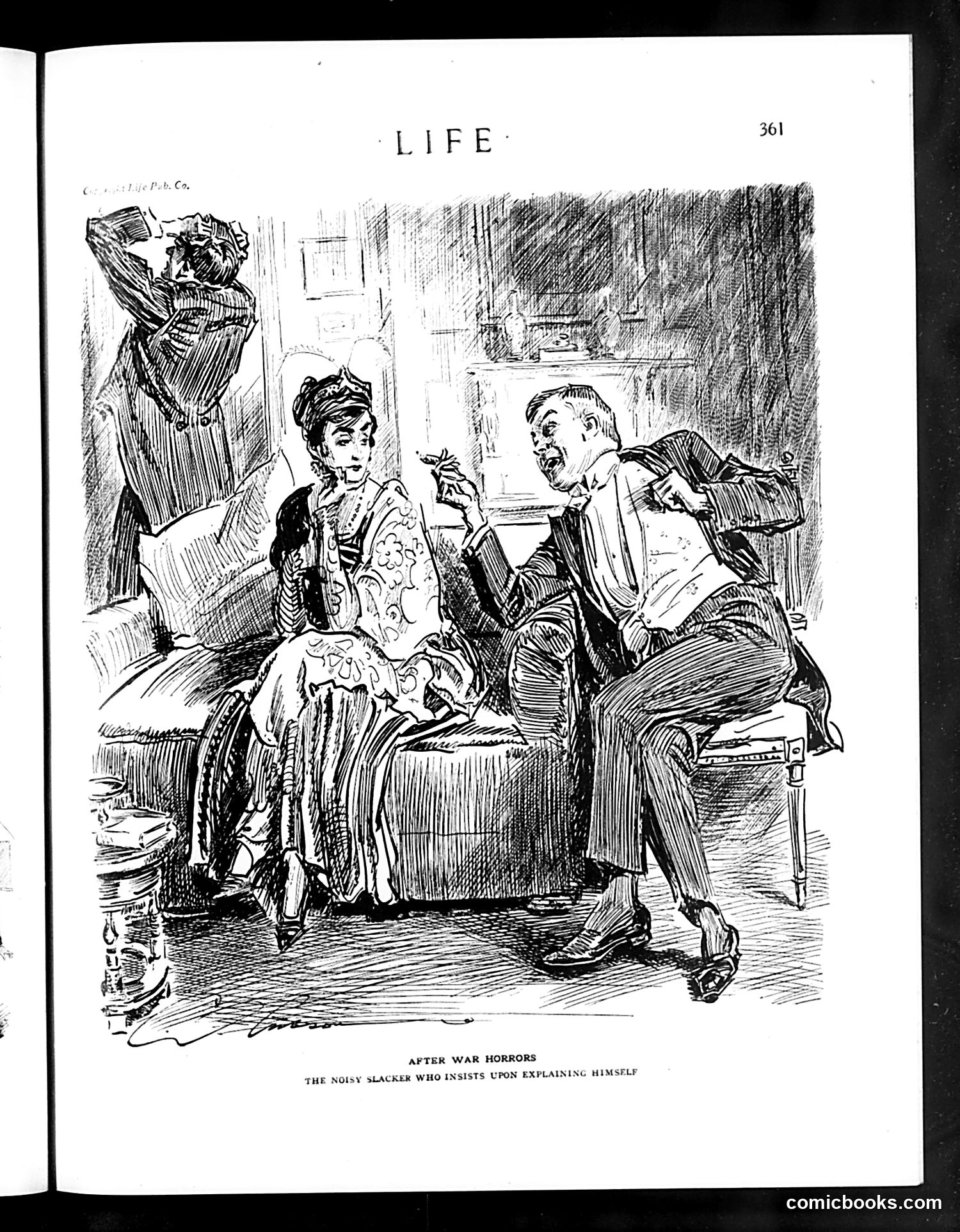
This satirical cartoon depicts a social scene where three well-dressed figures interact in what appears to be a parlor or social gathering. The caption indicates the figure on the right represents a "noisy slacker"—someone who avoided military service during World War I. The satire targets men who shirked their war duty, then attempted to justify or explain their absence from combat to those who had served or lost loved ones. The cartoon ridicules such excuses as unwelcome and inappropriate in post-war social settings. The "horrors" reference suggests survivors and families dealing with war trauma, making the slacker's self-justifications particularly tone-deaf and irritating to decent society.
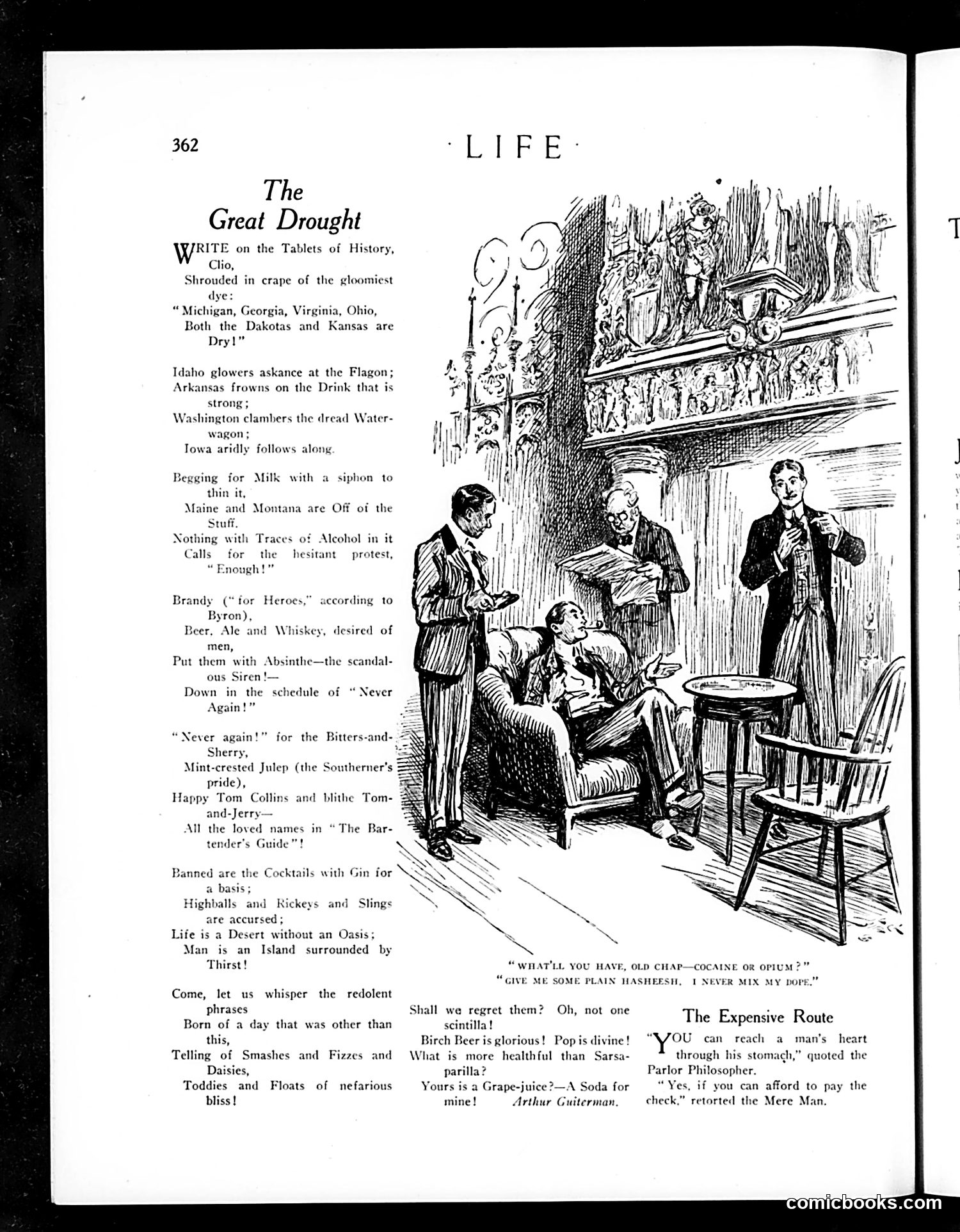
The left page is a satirical poem about Prohibition, listing American states suffering drought conditions while mocking alcohol bans. It references banned drinks (cocktails, gin, beer, whiskey, absinthe) and famous bartender guides, suggesting Prohibition has created a "desert" of deprivation. The poem laments lost cocktail names and drinking culture. The cartoon below depicts four men in what appears to be an illicit drinking scene. One reclines while others stand nearby. The caption reads: "What'll you have, old chap—cocaine or opium?" / "Give me some plain hashish, I never mix my dope." This darkly satirizes unintended consequences of Prohibition: rather than eliminating intoxication, it supposedly drove people toward harder drugs and narcotics.
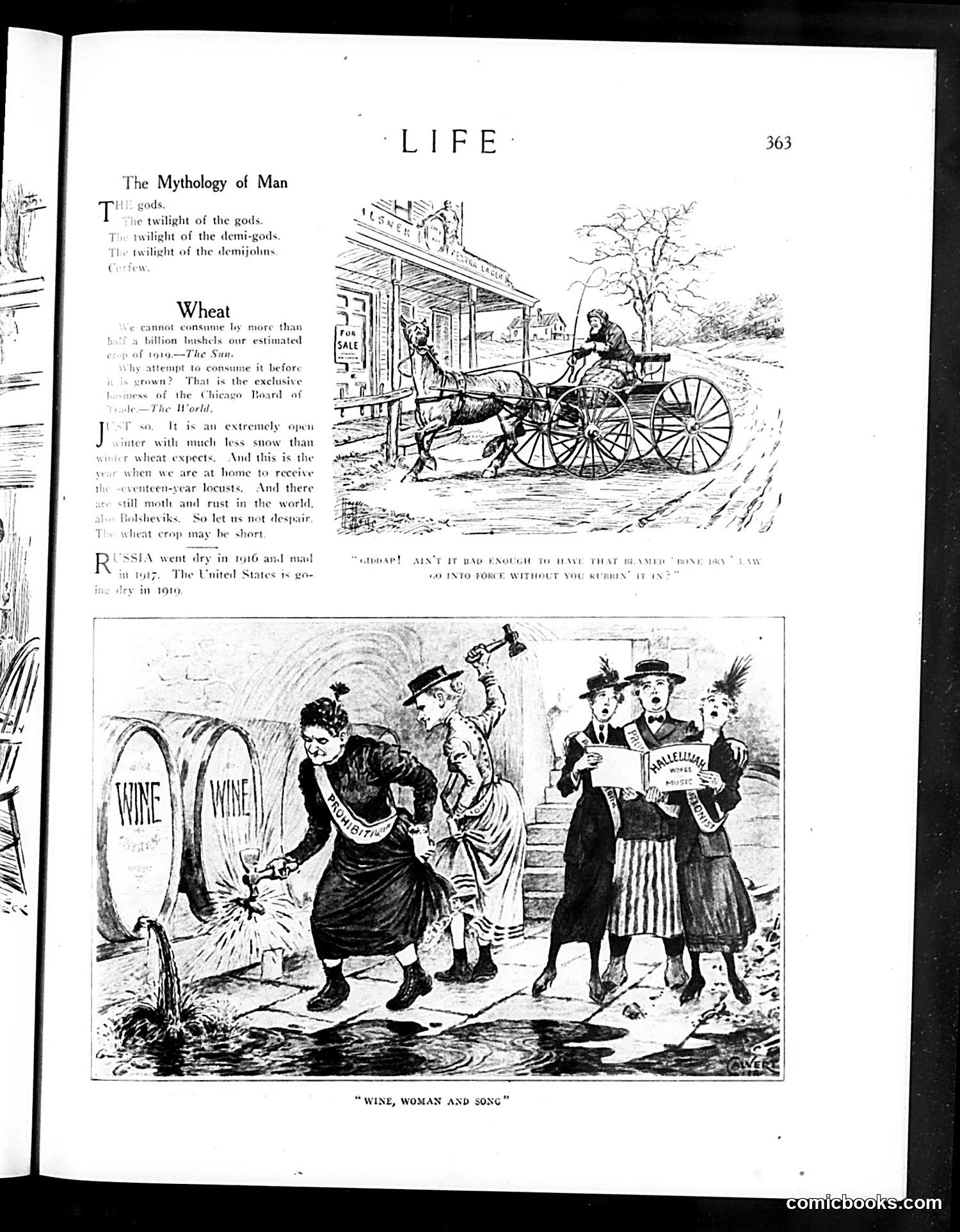
**"The Mythology of Man" section** discusses wheat production and Russian/American grain supplies around 1916-1917, likely referencing WWI food shortages. **Top cartoon**: Shows a farmer with a horse-drawn wagon at a grain elevator marked "SALT," with the caption suggesting someone tried to force wheat sales without consent—satirizing grain market manipulation or price controls during wartime. **Bottom cartoon, "Wise, Woman and Song"**: Depicts a woman at wine barrels with men examining what appears to be "Prohibition" documentation. This satirizes the temperance movement and Prohibition debate, mocking how wine (associated with European culture and women) was being restricted. The figures' expressions suggest mockery of those enforcing alcohol restrictions. Both cartoons critique government interference in commerce and personal freedoms during the WWI era.
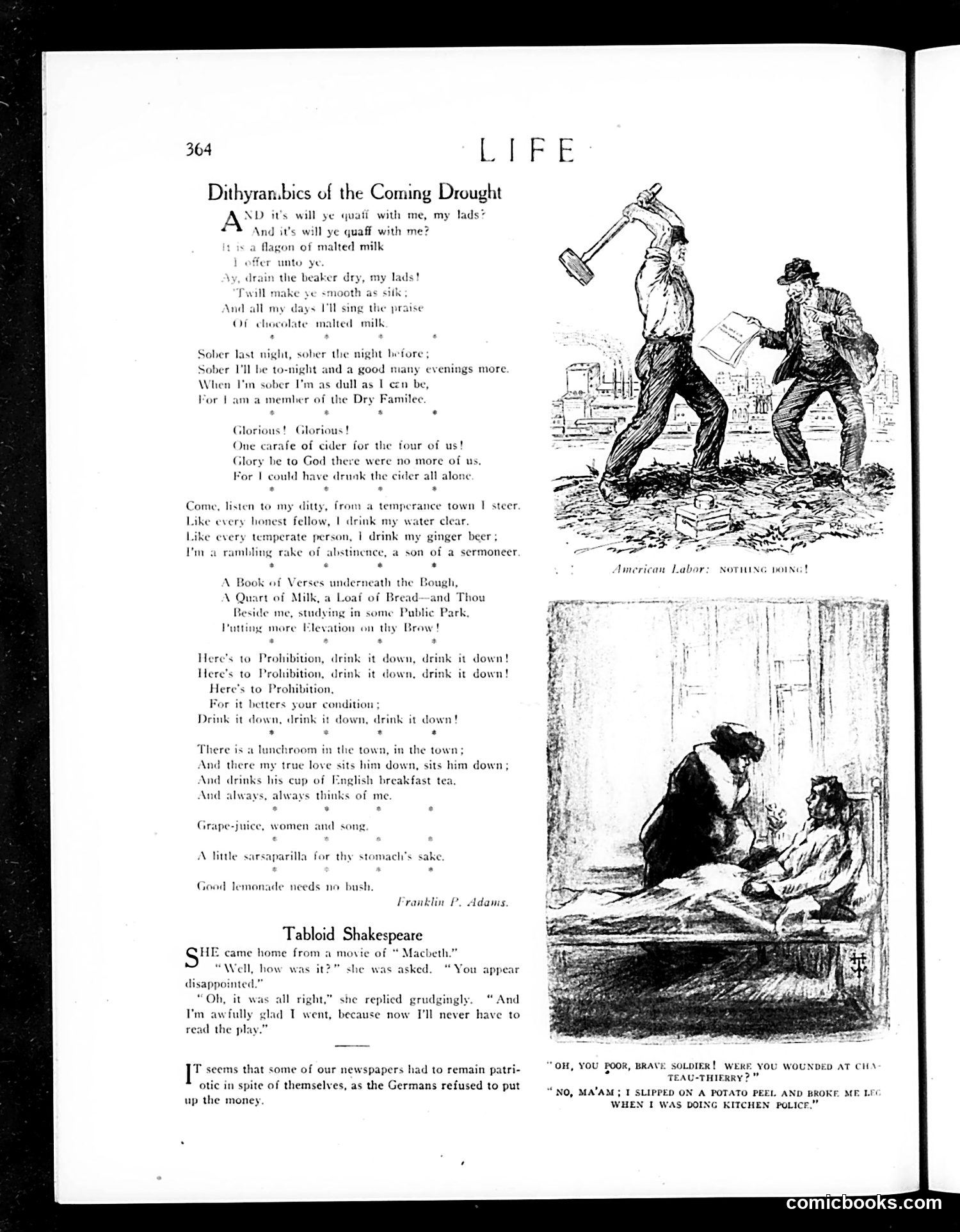
This page satirizes **Prohibition** (the 1920-1933 ban on alcohol). The central poem mocks the coming "dry" era by cataloging absurd substitute drinks—malted milk, ginger beer, cider, sarsaparilla, grape juice, lemonade—that people claim will replace alcohol. The repeated refrain "Here's to Prohibition, drink it down" is ironic: you can't actually drink prohibition itself. The top cartoon shows **American laborers** toasting with these substitute beverages instead of real alcohol, captioned "Nothing doing!"—expressing working-class skepticism about Prohibition's appeal. The bottom illustration appears to depict a domestic/working-class scene, possibly related to Prohibition's enforcement challenges. The "Tabloid Shakespeare" section mocks contemporary culture: a woman sees *Macbeth* on film and is relieved she'll never need to read the actual play—satirizing both mass media's displacement of literature and modern impatience with serious art. The overall tone is cynical about Prohibition's imminent passage and its expected failure to change behavior.
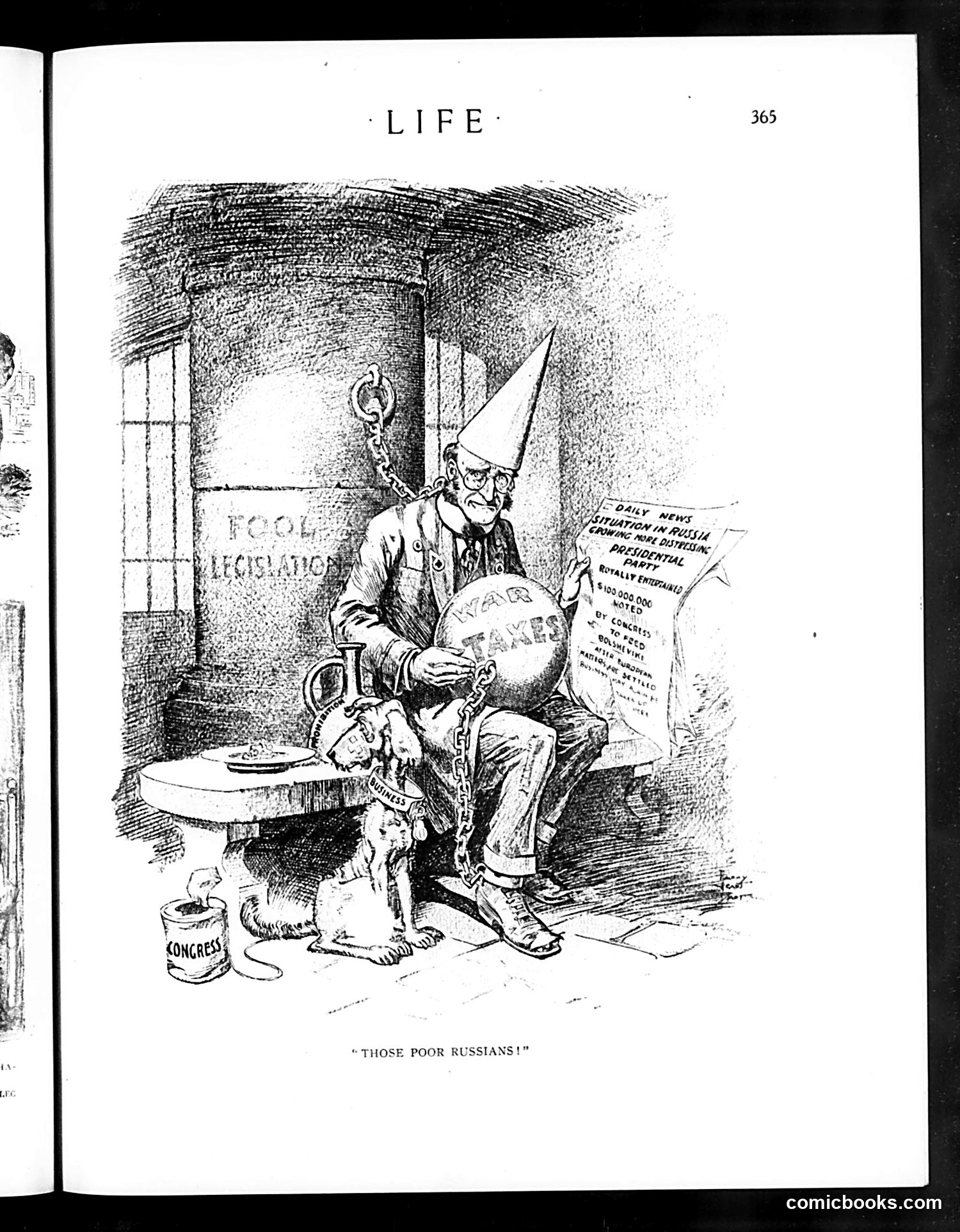
This Life magazine cartoon depicts a figure wearing a pointed hat (suggesting a fool or jester) sitting in what appears to be a government office ("Fool Legislation" visible on the wall). The figure holds a globe labeled "MARKETS" while reading documents about Congressional legislation, daily news, and financial matters. A small dog sits at their feet near a container labeled "CONGRESS." The satire targets American legislative incompetence regarding international trade and economic policy. The "fool" figure represents Congress or American leadership making foolish decisions that harm Russian markets or trade relations. The caption's sarcastic sympathy for "those poor Russians" suggests American policymakers are inadvertently damaging Russian interests through their bumbling legislative actions—likely referencing early 20th-century trade or diplomatic tensions.
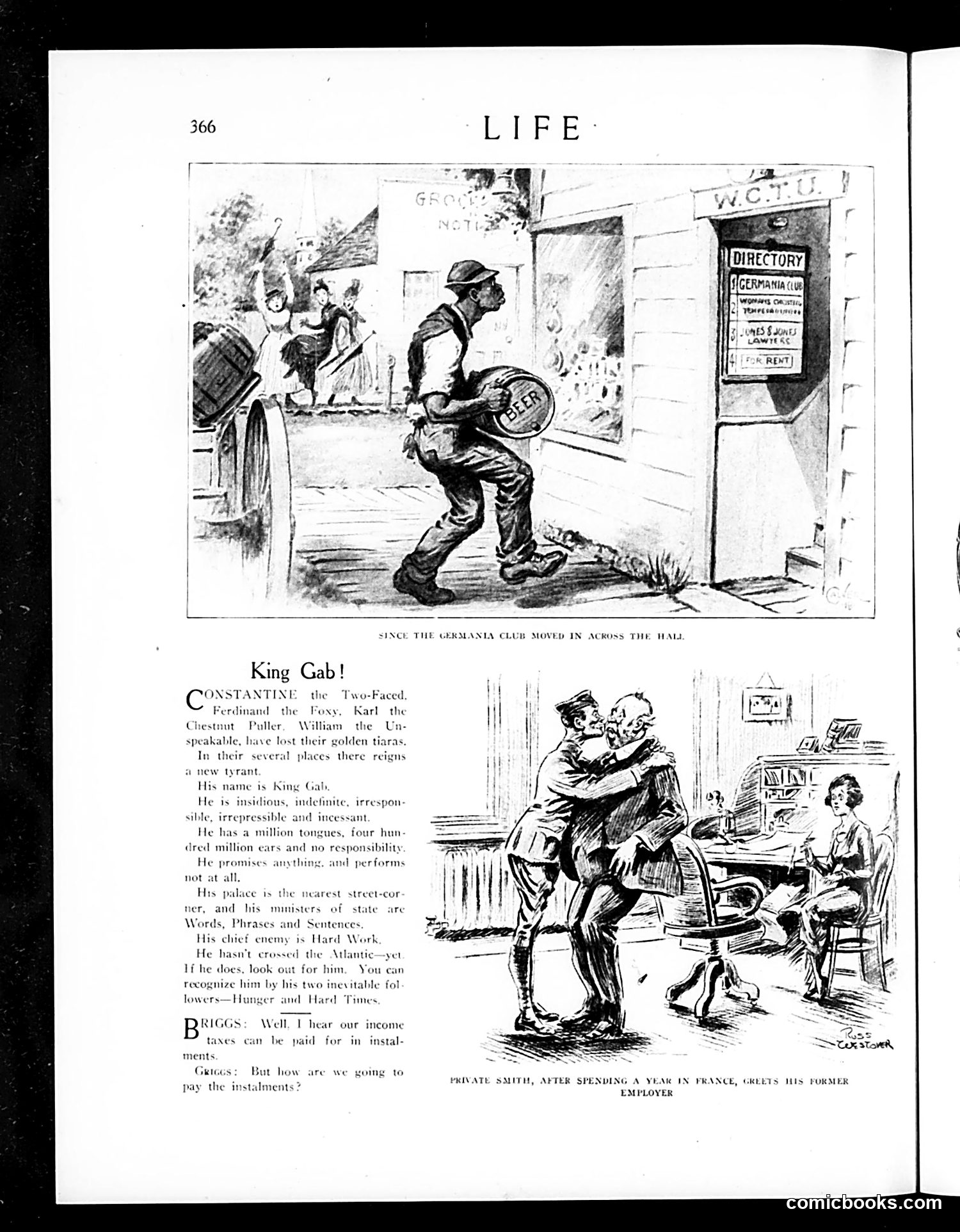
The page contains two satirical pieces from *Life* magazine: **Top cartoon**: Shows a cab driver (representing the "Germania Club") moving across a hallway, observed by onlookers. The caption suggests this references German immigrants or German-American establishments relocating, likely during or after World War I when anti-German sentiment was high in America. **"King Gab!" section**: A satirical piece personifying excessive talk and gossip as a tyrannical ruler. It mocks habitual talkers who make promises but deliver nothing, comparing them unfavorably to previous "tyrants" (likely political figures—names appear corrupted by OCR). The joke is that this new "king" operates from street corners, has millions of ears/followers, and relies on "Words, Phrases and Sentences" rather than action. **Bottom cartoon**: Shows a returning WWI soldier ("Private Smith") enthusiastically greeting his former employer, who appears less than thrilled to see him. The humor lies in the contrast between the soldier's warm welcome home and the employer's cool reception—suggesting tension between returning veterans and those who remained on the home front.
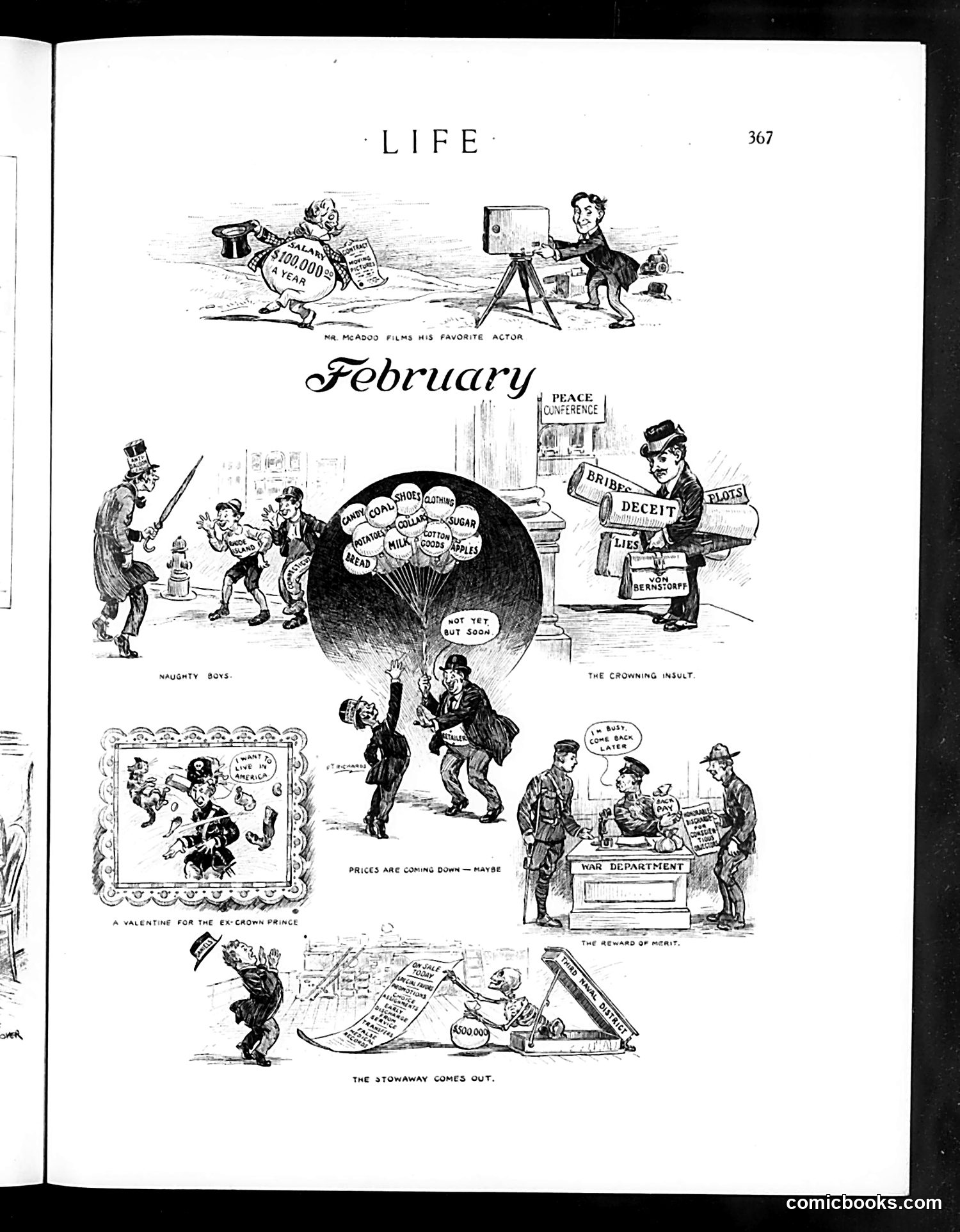
This page contains satirical cartoons addressing early 20th-century American concerns. "The Crowning Insult" depicts a figure labeled "Bernstorff" (likely German Ambassador Johann von Bernstorff) surrounded by accusations—"Bribes," "Deceit," "Lies"—reflecting anti-German sentiment, possibly during WWI tensions. "Naughty Boys" shows children misbehaving, likely commenting on political figures acting immaturely. "Prices Are Coming Down—Maybe" uses a large balloon labeled with consumer goods to satirize economic anxiety about inflation or deflation. "The Stowaway Comes Out" depicts a figure emerging from hiding, suggesting exposure of secret dealings or hidden agendas. "The Reward of Merit" and "A Valentine for the Ice Crown Prince" appear to mock incompetence or unpopular leadership through domestic or romantic metaphors. The cartoons collectively reflect wartime anxieties about foreign diplomacy, economic instability, and political corruption.
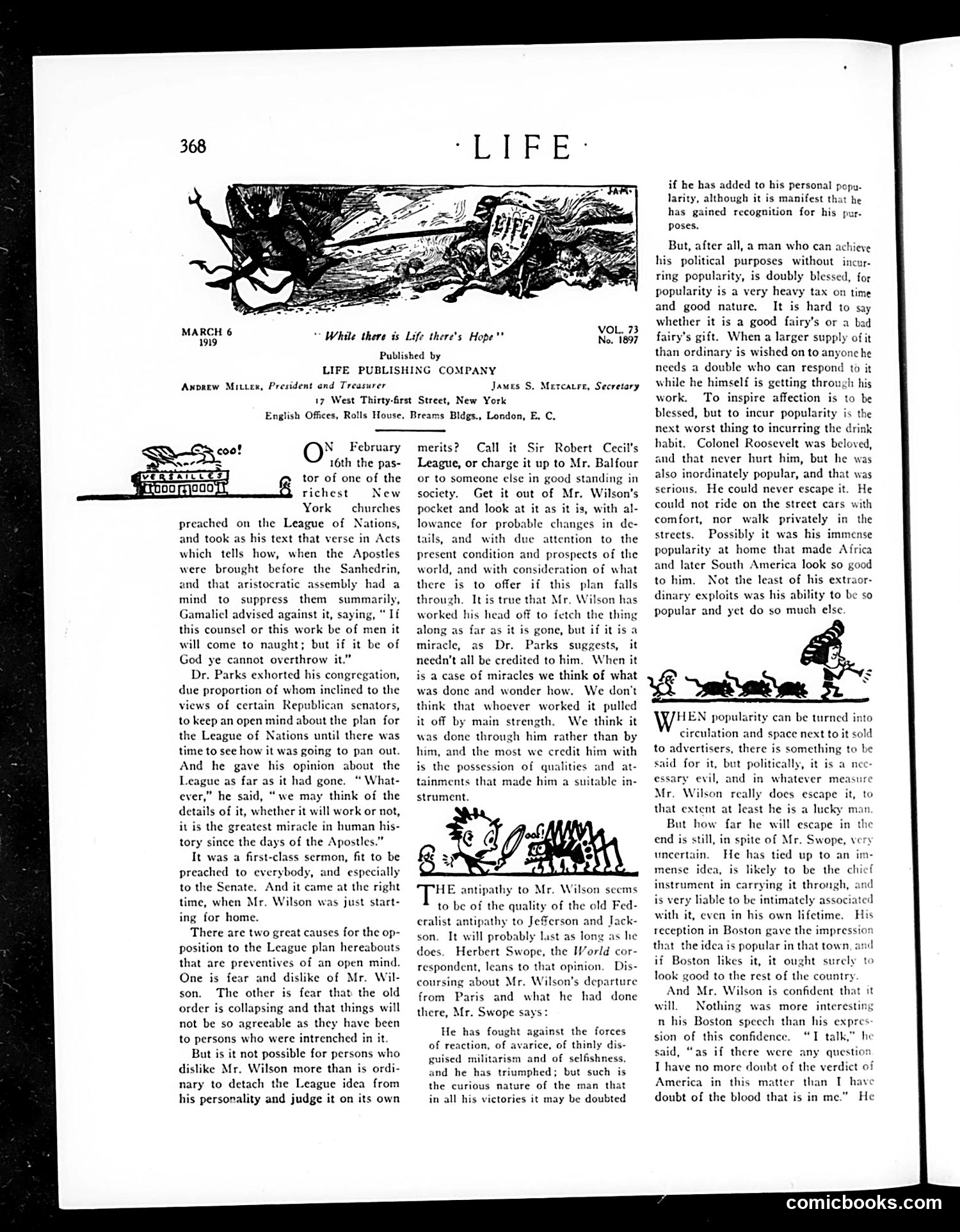
This page discusses President Woodrow Wilson's League of Nations proposal, written as Wilson returns from Paris peace negotiations after World War I. **The Context:** The article argues that opposition to the League stems from two sources: personal dislike of Wilson and fear of social change. A prominent New York minister (Dr. Parks) called the League "the greatest miracle in human history since the Apostles," but this hasn't persuaded skeptics. **The Satire's Point:** The author makes an ironic observation about Wilson's political effectiveness: he can achieve his policy goals without gaining personal popularity—a rare and "doubly blessed" achievement. However, Wilson's very unpopularity may undermine the League's success, since it becomes entangled with personal animosity toward him rather than judged on merits. **Historical Reference:** The cartoons appear to mock resistance from Republicans and "old order" interests threatened by the League concept. The piece advocates for separating the League idea from Wilson's personality to enable rational debate.
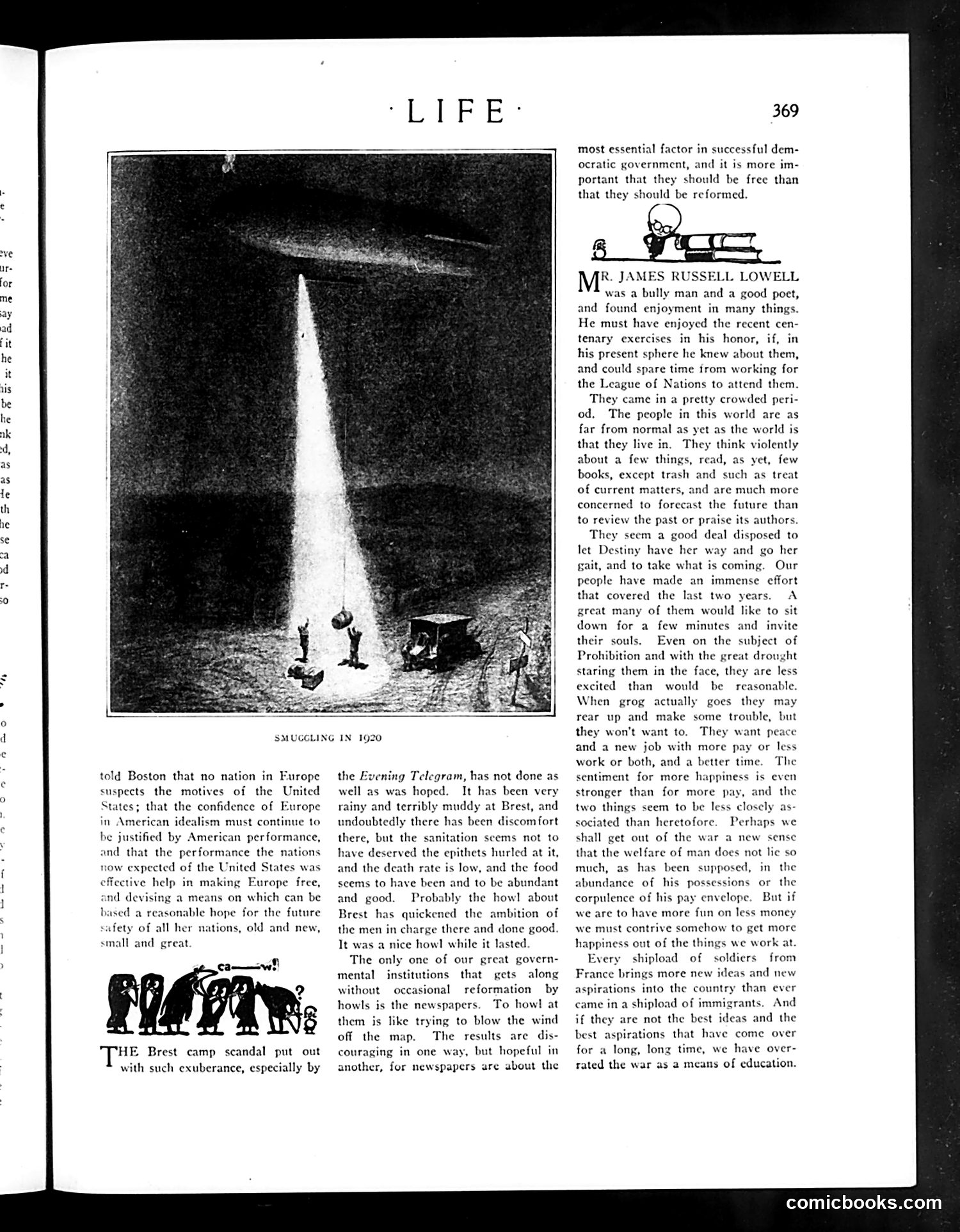
This page from Life magazine (page 369) contains two satirical cartoons and commentary from around 1920. **"Smuggling in 1920"** (top image): Shows figures operating a light beam or searchlight during Prohibition. The satire mocks the absurdity of the newly enacted alcohol ban—the "smugglers" are openly using obvious equipment, suggesting that illegal liquor trafficking will be impossible to hide or stop, making Prohibition enforcement inherently comic. **Bottom cartoon**: Depicts what appears to be political or military figures with exaggerated features, likely referencing the "Brest camp scandal"—a controversy over conditions at the American military camp in Brest, France after World War I. The text criticizes sensationalist newspaper coverage that exaggerated problems there. The accompanying essay discusses post-WWI American idealism, newspaper freedom, Prohibition's coming effects, and soldiers returning with new ideas. The overall tone reflects 1920s skepticism about reform efforts and faith in democratic institutions.
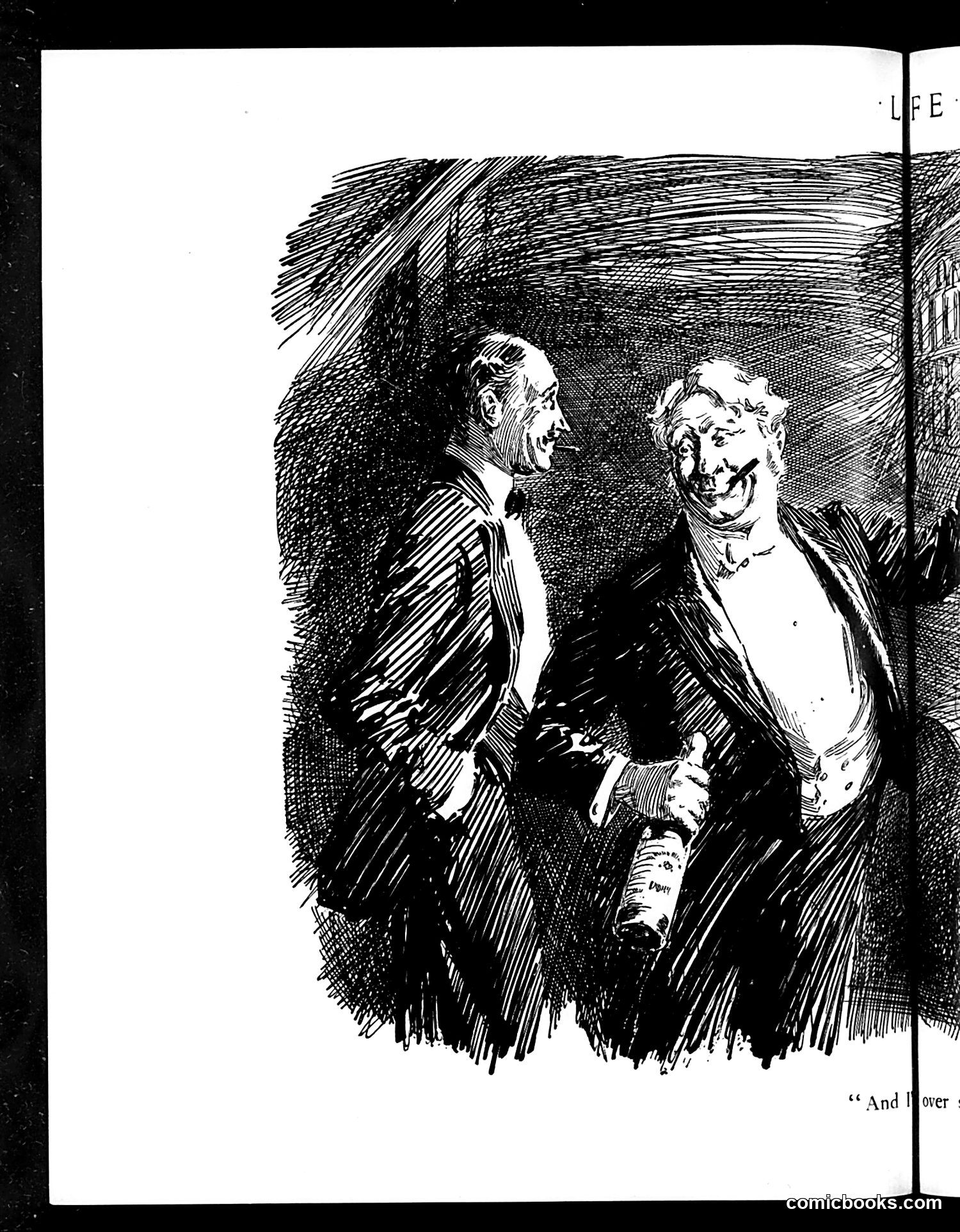
This is a sketch-style illustration showing two men in formal evening wear (tuxedos) in what appears to be an interior setting. The man on the right is prominently featured, depicted with exaggerated facial features typical of satirical caricature. The caption begins "And [over" (likely cut off). Without the complete caption or additional context, the specific satirical target is unclear. However, the formal dress and caricatured style suggest this mocks prominent public figures—possibly politicians or society figures of the era when *Life* magazine was active. The exaggerated physiognomy was common in period satire. The page header reads "LIFE," confirming this is from the satirical publication. The comicbooks.com credit suggests this is digitized public-domain material. **I cannot definitively identify these figures or the exact joke without the complete caption.**
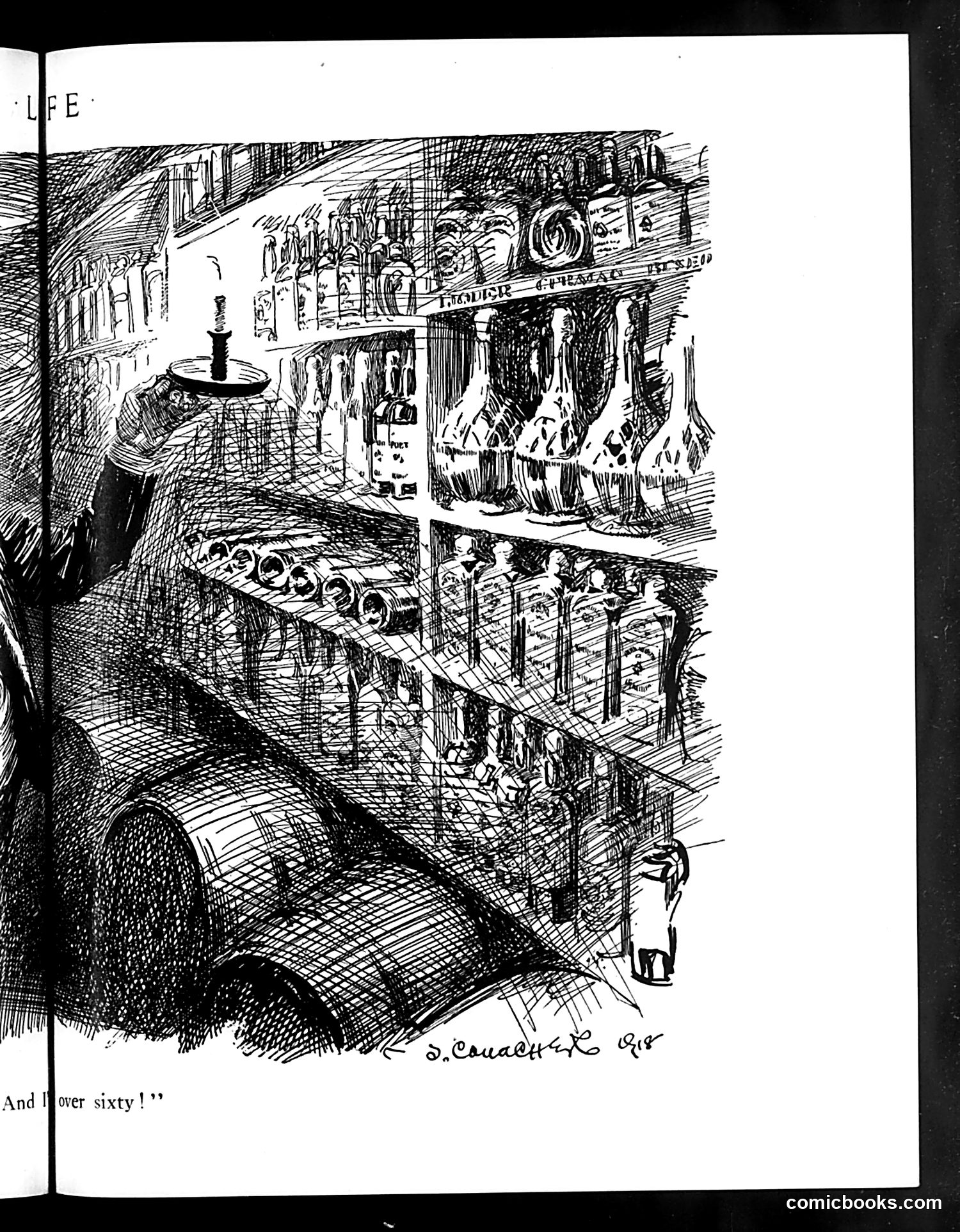
This is an ink sketch depicting what appears to be a crowded urban street scene or marketplace, drawn in a cross-hatched style typical of early-to-mid 20th century illustration. The drawing shows multiple levels—upper storefronts with signage, middle sections with people and goods, and lower areas with figures and activity. The artist's signature appears at the bottom. The caption "And I over sixty!" suggests commentary on age or longevity, though without additional context, the specific satirical target is unclear. The busy, layered composition may be satirizing urban commerce, consumerism, or crowded city life. Without identifying the specific publication date or artist more clearly, the precise political or social reference remains difficult to determine with certainty.
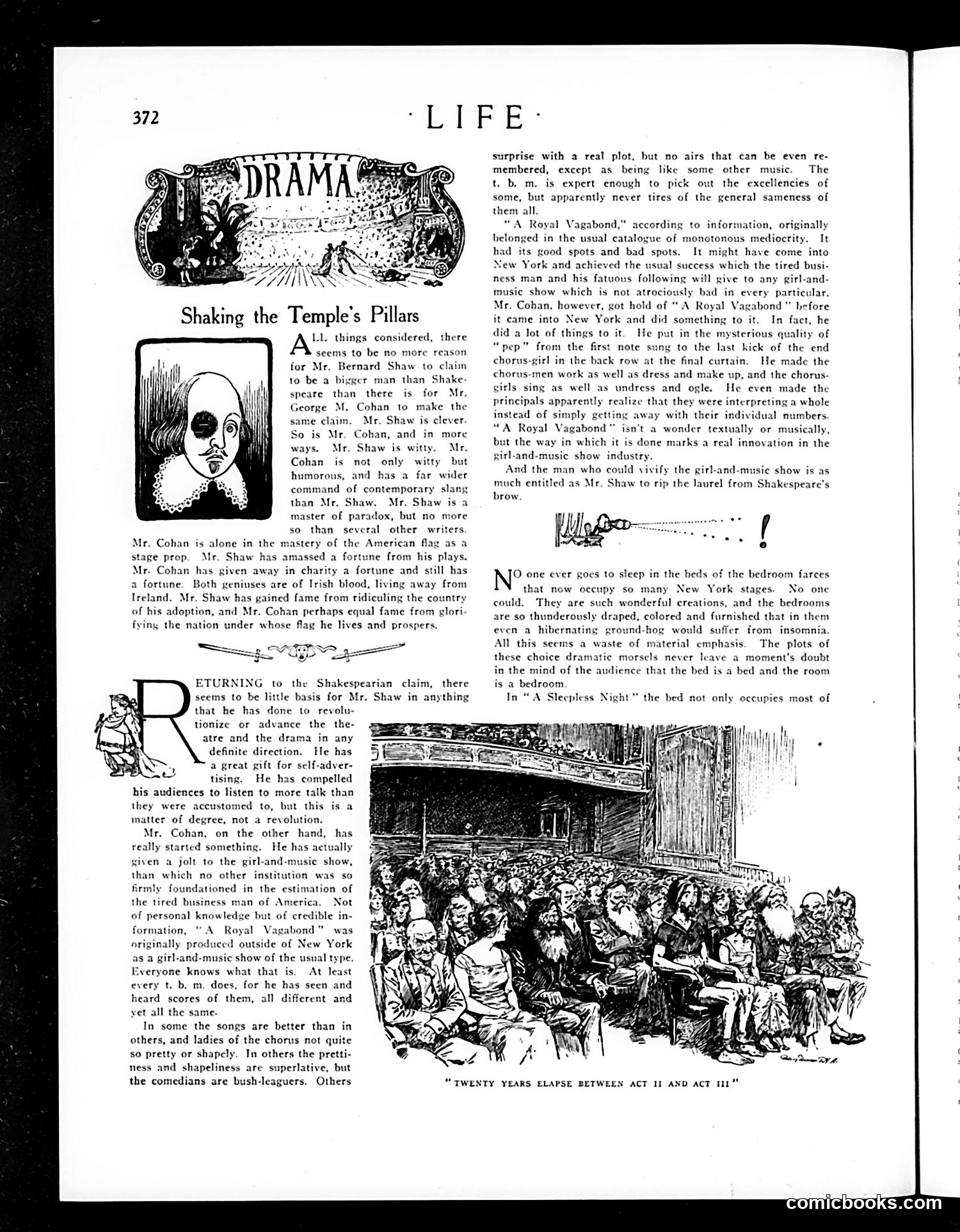
This article compares **George Bernard Shaw** (caricatured in the portrait) and **George M. Cohan**, debating which deserves greater status than Shakespeare. The satire argues Shaw's claim to greatness rests mainly on self-promotion and making audiences listen to excessive dialogue—"a matter of degree, not a revolution." Cohan, by contrast, actually innovated theater by injecting "pep" into the tired "girl-and-music show" formula, transforming a mediocre production ("A Royal Vagabond") into something with real vitality. The writer notes Cohan gave away fortunes to charity while Shaw accumulated wealth, and that Cohan glorifies his adopted nation while Shaw ridicules his. The conclusion: Cohan deserves equal claim to theatrical greatness because he genuinely revolutionized an entire theatrical genre, whereas Shaw merely talks loudly about revolution.
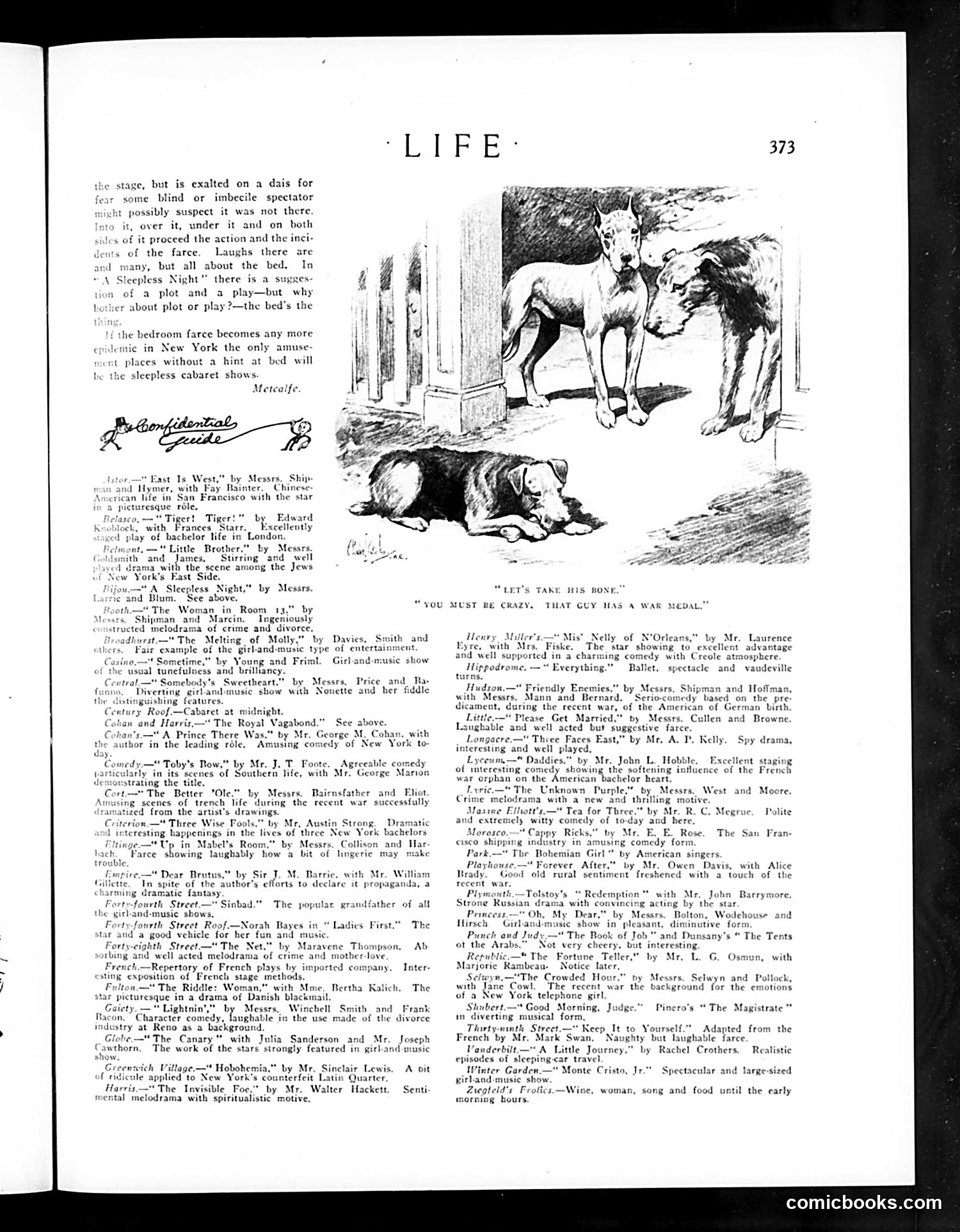
This page is primarily a theater review section from *Life* magazine. The cartoon at the bottom depicts two dogs—one standing, one lying down—with the caption "LET'S TAKE HIS BONE" and "YOU MUST BE CRAZY, THAT GUY HAS A WAR MEDAL." The satire targets post-World War I attitudes: a dog with a war medal (representing a decorated veteran) possesses something the other dog wants to steal. The humor lies in the absurdity—the standing dog suggests theft from someone who has earned military honors, while the other dog protests that such a person deserves respect and protection due to their service. This likely comments on social attitudes toward war veterans during the 1918-1920 period, possibly mocking either callous disregard for veterans' sacrifices or satirizing exaggerated deference to military service. The dog metaphor simplifies the ethical question into obvious terms for comedic effect.
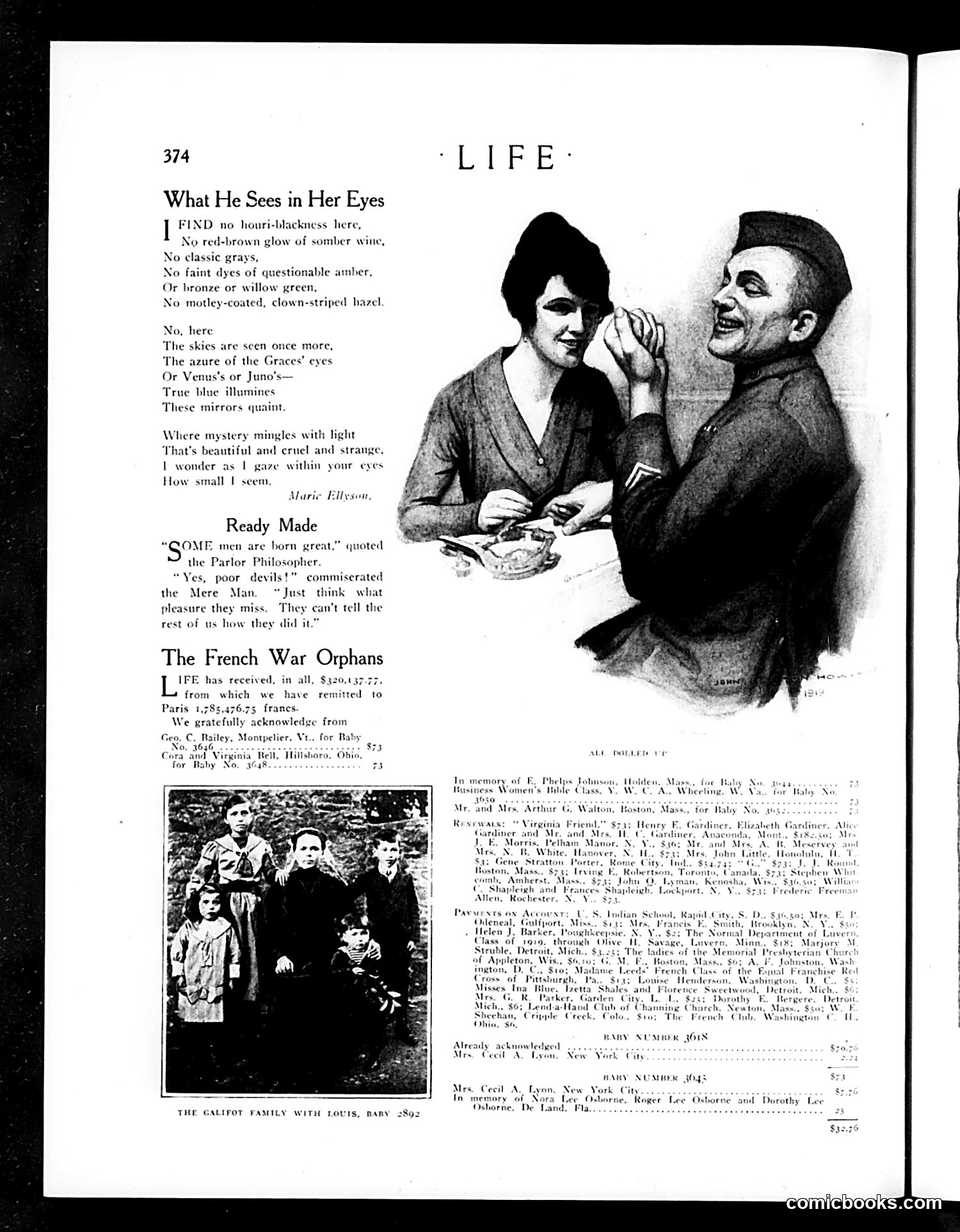
This page contains three distinct items: **Main Illustration & Poem**: A romantic drawing of a couple gazing at each other accompanies a poem by Marie Ellyson rejecting conventional descriptions of a woman's eyes (comparing them unfavorably to wine, amber, hazel). Instead, the poem praises her eyes as pure "true blue"—innocent, mysterious, and beautiful. The satire appears gentle: poking mild fun at overwrought romantic poetry and clichéd descriptions. **"Ready Made" Humor**: A brief joke about "great men" where a Parlor Philosopher quotes that "some men are born great," and the "Mere Man" responds that poor fellows who achieve greatness miss the pleasure of *telling others* how they did it—gentle mockery of self-made men's boasting. **"The French War Orphans"**: A charitable fundraising section listing donations to aid French orphans, with the Califot family photograph. This reflects post-WWI American philanthropy toward European relief. The page mixes satire, sentiment, and charitable appeals typical of Life's era.
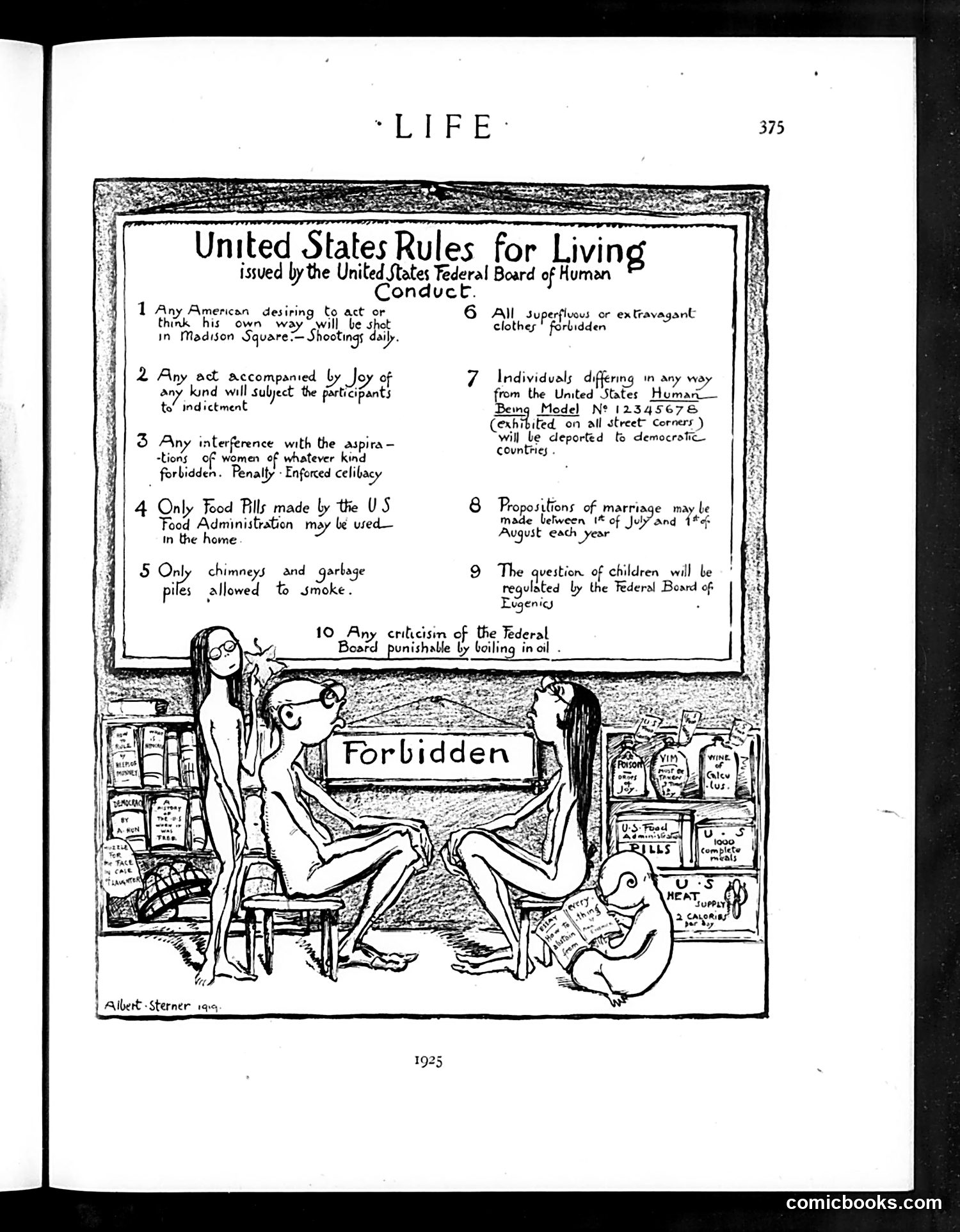
This satirical cartoon by Albert Sterner mocks excessive government regulation and control. The fake "Federal Board of Human Conduct" issues absurd rules: shooting dissenters in Madison Square; punishing joy; enforcing celibacy; controlling food, marriage timing, and reproduction through eugenics; and boiling critics in oil. The illustration shows women in a domestic space labeled "Forbidden," surrounded by government-approved products, emphasizing how intrusive regulations would penetrate private life. This likely responds to **Prohibition** (alcohol bans), **food rationing** from WWI, and growing **eugenics advocacy**—policies that expanded federal power into personal choices. The extreme punishments parody authoritarian government. Sterner critiques how well-intentioned regulations can become tyrannical overreach into fundamental freedoms: thought, emotion, bodily autonomy, and family planning.
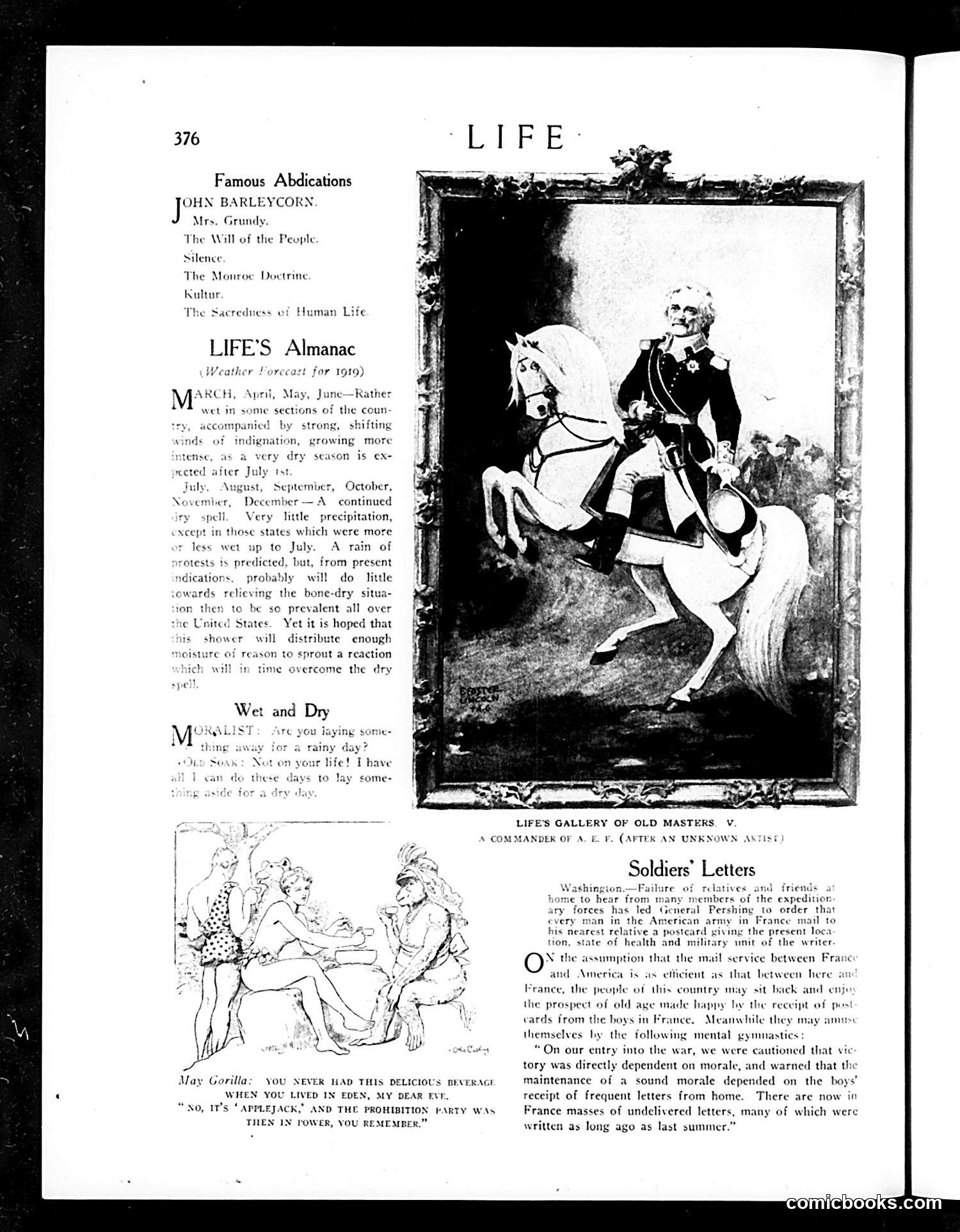
This page satirizes post-WWI American anxieties through multiple pieces: **"Famous Abdications"** lists abstract concepts (John Barleycorn, Mrs. Grundy, Monroe Doctrine) as if they've resigned—likely mocking how traditional values seemed abandoned after WWI. **The weather forecast** is darkly comic: predicting a "dry spell" (Prohibition) with "protests" but little relief—satirizing the futility of opposing Prohibition's passage in 1919. **The equestrian portrait** appears to mock a military commander (labeled "After an Unknown Artist"), likely satirizing General Pershing or military leadership broadly. **"Soldiers' Letters"** criticizes mail service failures to troops in France—soldiers supposedly needed frequent letters for morale, yet masses of letters remain undelivered months after arrival. The accompanying dialogue about "Applejack" and Prohibition is a tangential joke. The overall tone is cynical about the post-war period: institutional failure, social prohibition, and disconnected leadership.
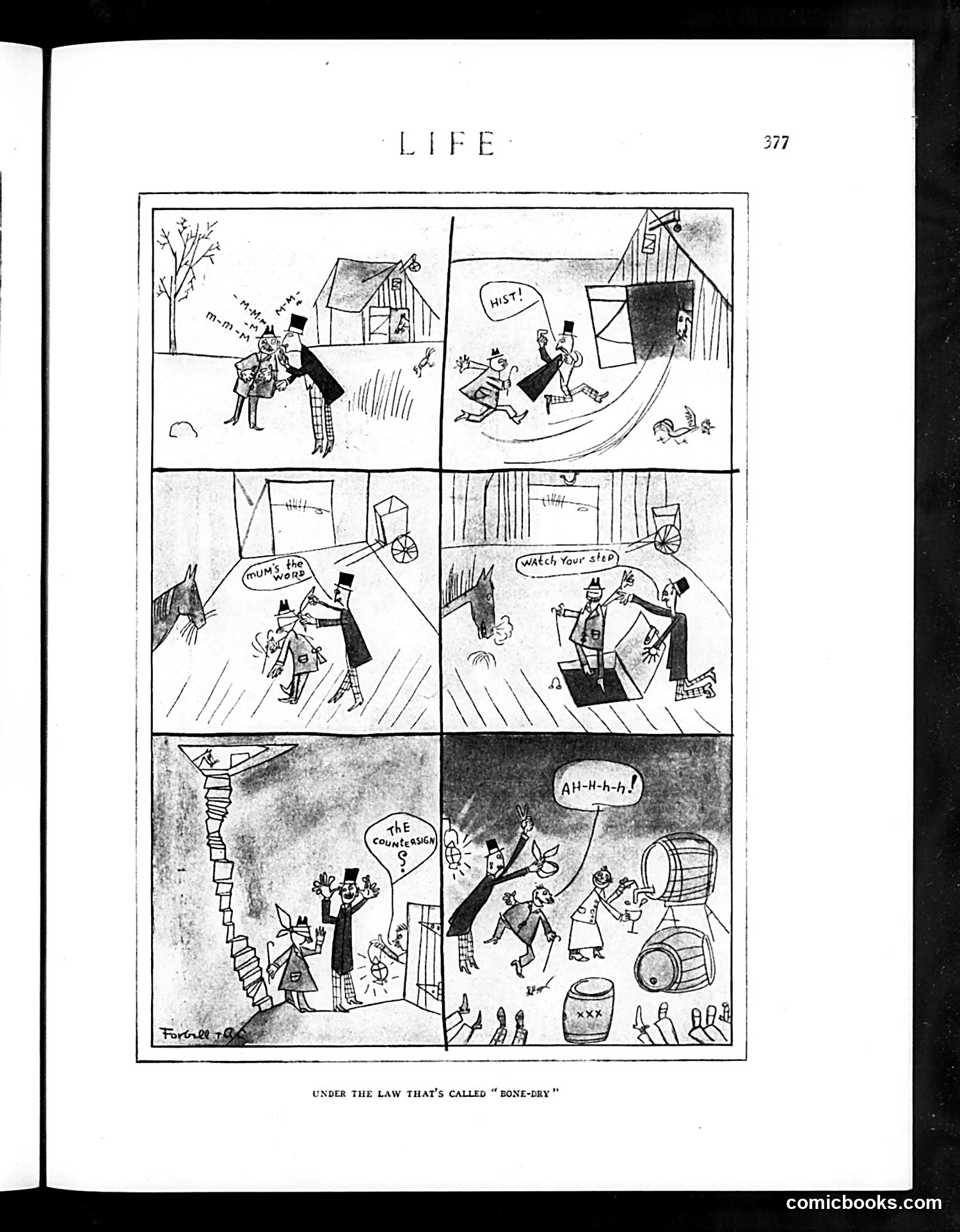
This six-panel comic satirizes Prohibition enforcement. The title references "bone-dry" laws—strict alcohol prohibition statutes. The narrative follows a man attempting to hide liquor from authorities. Panel progression shows: him sneaking bottles past officials ("Must!"), running from enforcement ("Watch your step!"), hiding in a cellar ("Mom's the word"), discovering a secret speakeasy ("The counterspell"), and finally participating in a crowded underground drinking operation with barrels marked "XXX" (indicating illegal liquor). The satire mocks Prohibition's practical failure—despite strict laws, illegal alcohol production and consumption thrived through hidden speakeasies and underground networks. The "counterspell" reference suggests people found magical-seeming ways around enforcement, highlighting the law's ineffectiveness and the public's determination to circumvent it.
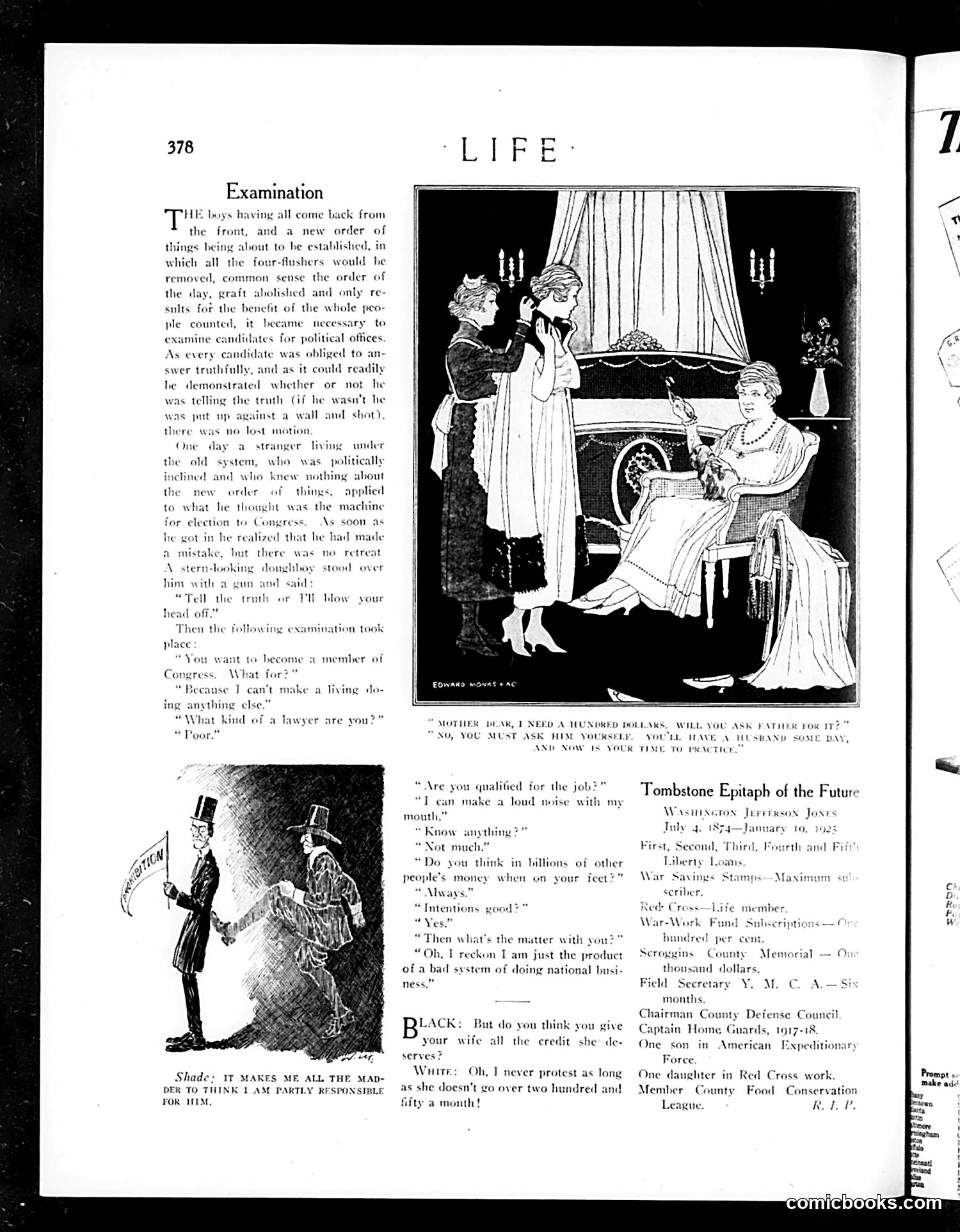
This page satirizes post-World War I congressional candidate qualification standards. The main cartoon mocks the notion that returning soldiers would establish a meritocratic system to replace corrupt politicians ("four-flushers"). The central scene shows an examination where a candidate—described as a product of "bad system of doing national business"—answers absurdly revealing questions: he can't make a living elsewhere, makes "loud noise," thinks in "billions of other people's money," and has good "intentions." Despite obvious unfitness, he appears acceptable for Congress, suggesting the new system is equally corrupt. The lower cartoon ridicules wives' financial dependence and materialistic expectations. The "Tombstone Epitaph" section appears to be an obituary template for a public figure, listing wartime service credits and patriotic contributions—likely mocking how such accomplishments are commemorated. Overall: post-war idealism about reformed politics is cynically undercut; nothing actually changes in how unqualified people enter office.
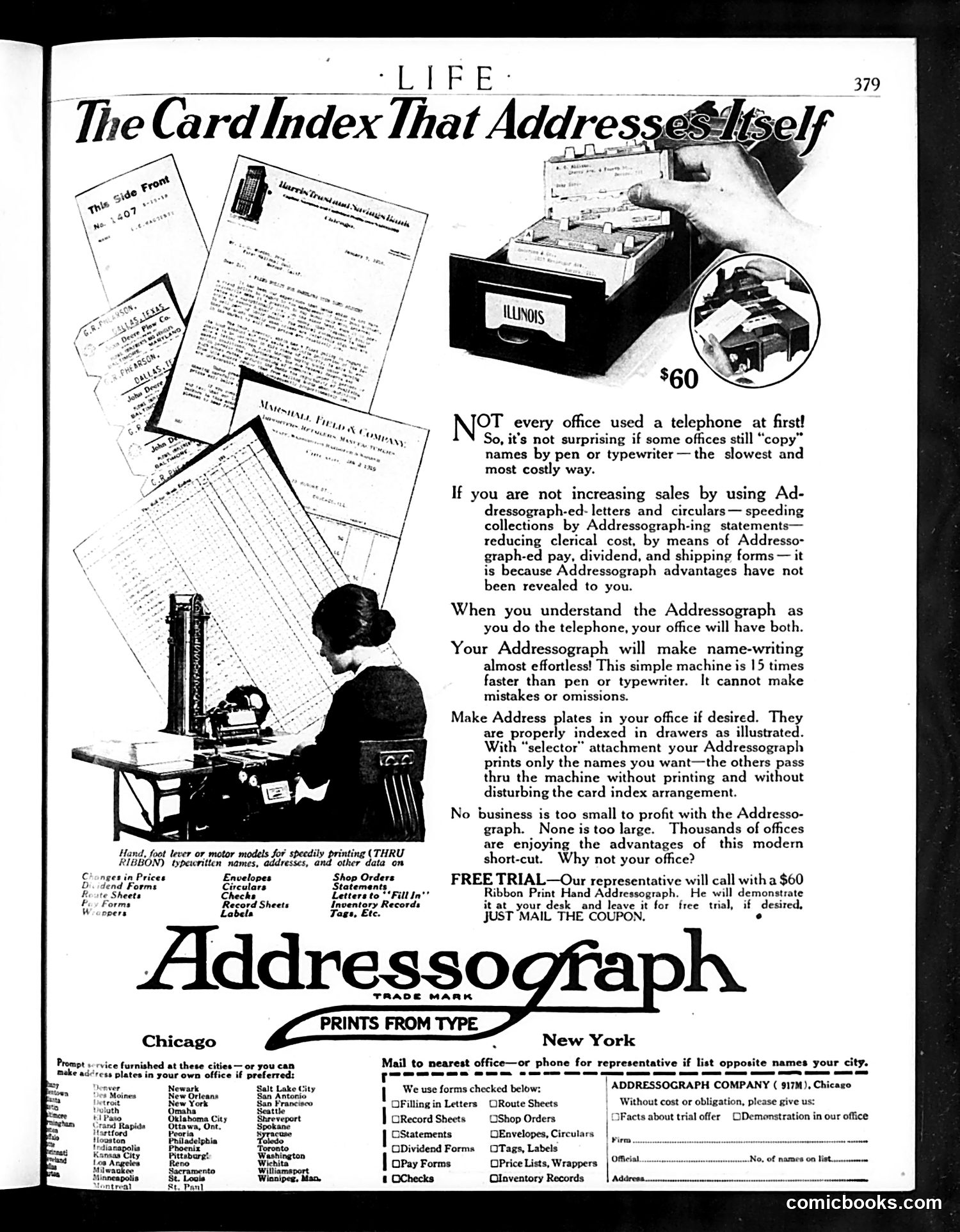
This is a **full-page advertisement**, not political satire. It promotes the Addressograph, an early mechanical addressing machine designed to print names and addresses on letters and forms. The humor is subtle and comparative: the ad opens by noting that "not every office used a telephone at first," implying that just as telephones eventually became standard office equipment, so too will the Addressograph. The photograph shows a woman operating the machine while various documents (letters, forms, sheets) fan out above her—a visual metaphor for efficient mail handling. The sales pitch emphasizes that manually writing addresses by "pen or typewriter" is "the slowest and most costly way," while the Addressograph is "15 times faster" and "cannot make mistakes or omissions." For modern readers, this represents pre-digital-era office automation—essentially the 20th-century equivalent of today's mail-merge software. The $60 price tag and free trial offer were typical 1920s-30s marketing tactics to encourage business adoption of labor-saving machinery.
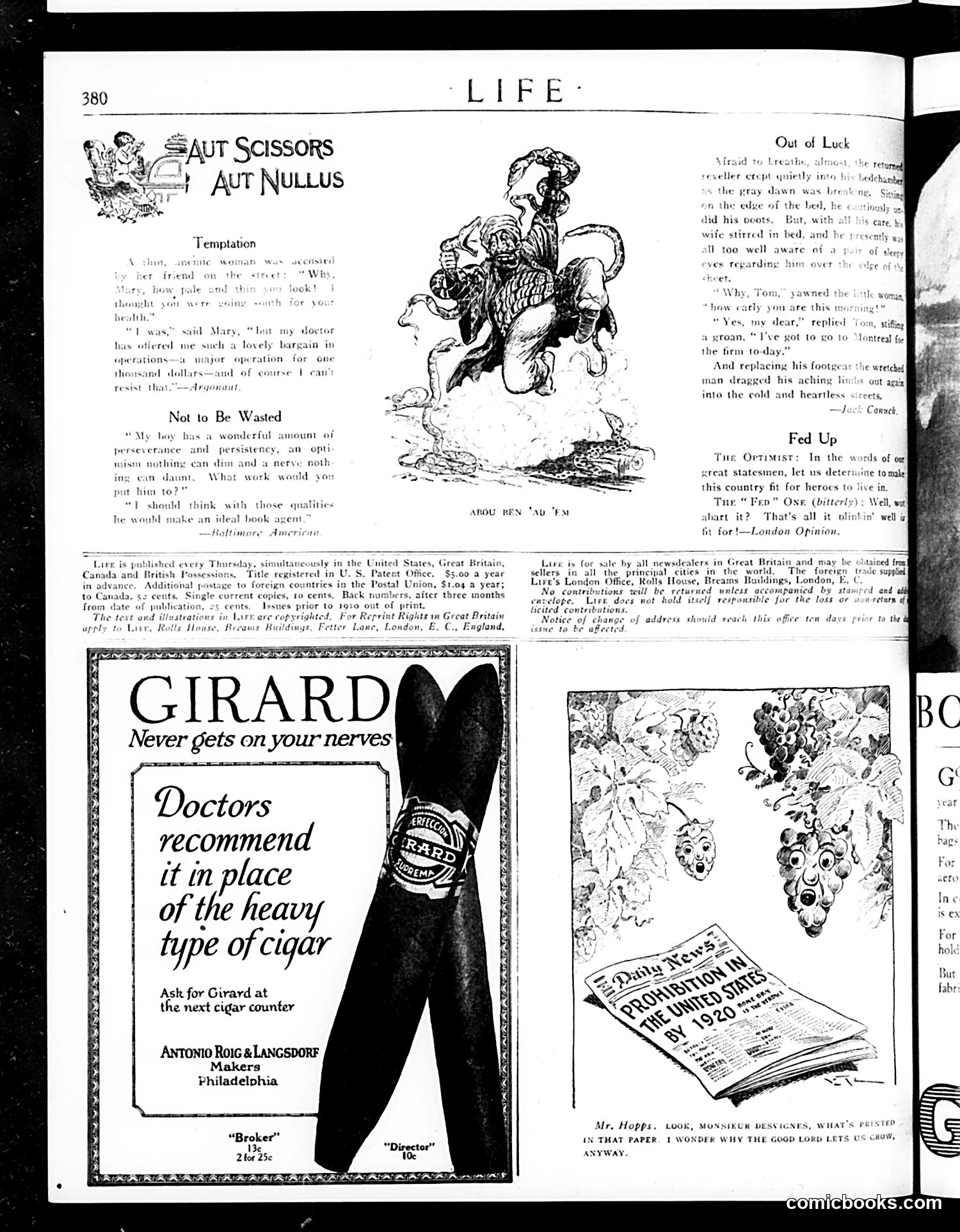
This page contains several satirical cartoons and advertisements typical of Life's early 20th-century humor. **"Aut Scissors / Aut Nullus"** presents a central cartoon of a demon-like figure, likely referencing temptation or vice. The surrounding short pieces ("Temptation," "Not to Be Wasted," "Out of Luck," "Fed Up") are brief social comedies about daily frustrations—a woman tempted by an operation she can't afford, a man losing his job, marital discord. **"Fed Up"** contrasts an optimist politician promising to make the country "fit for heroes to live in" (a post-WWI reference) with a cynical "Pro" character dismissing such promises as hollow rhetoric. The **Girard cigar advertisement** claims doctors recommend it as a lighter alternative to heavy cigars—a period marketing tactic before tobacco health warnings. The bottom cartoon mocks a man reading a newspaper about Prohibition (1920), questioning why God permits such "crowd" behavior—satire on the unpopular alcohol ban's social consequences.
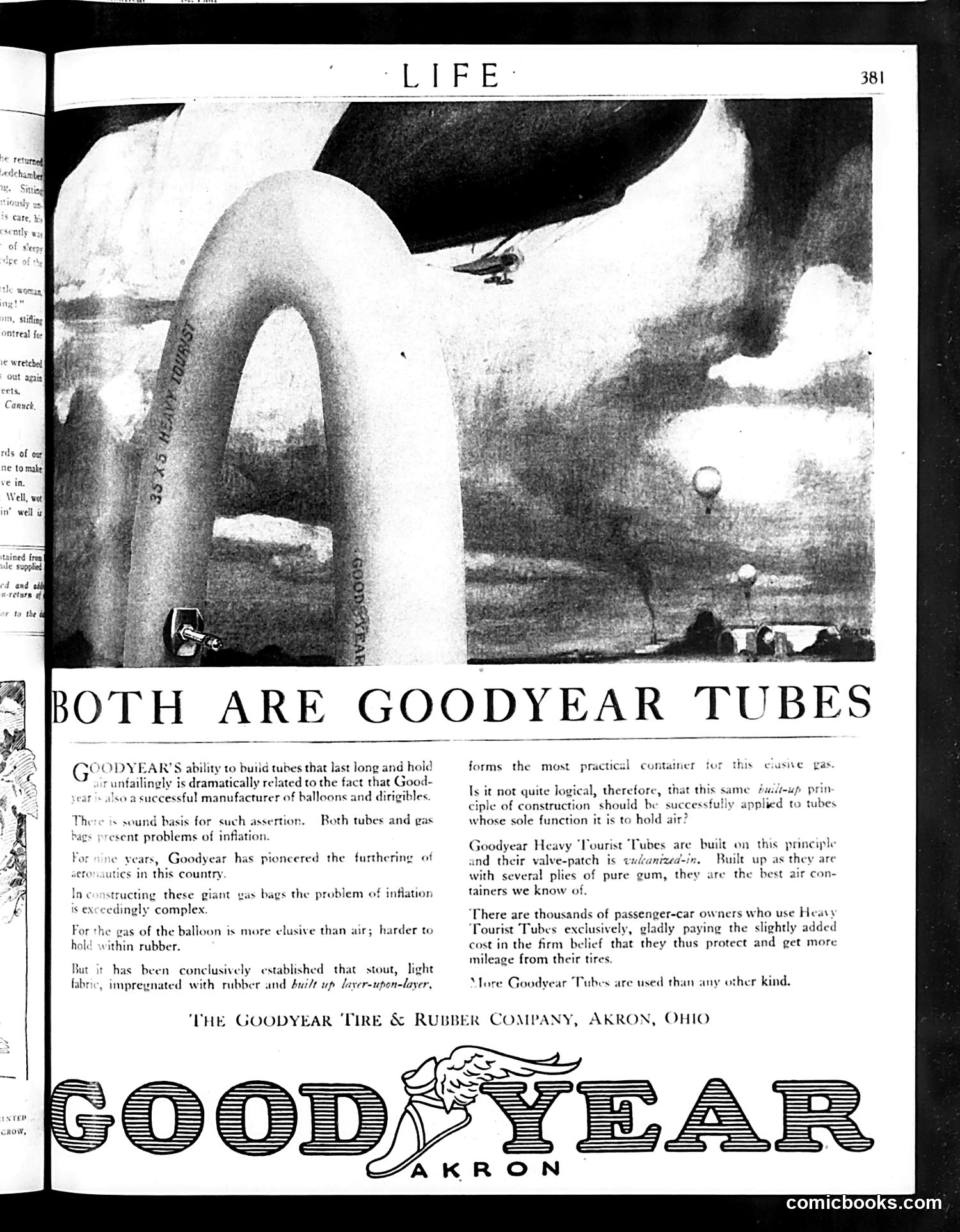
This is **not a political cartoon but a commercial advertisement** for Goodyear tires, specifically their "Heavy Tourist Tubes." The page uses a visual analogy to make its sales pitch: the photograph shows massive industrial gas bags/dirigible envelopes alongside an airplane, illustrating Goodyear's expertise in balloon and airship construction. The headline "Both Are Goodyear Tubes" draws a parallel between these aeronautical containers and automobile tire tubes. The argument is straightforward marketing logic: if Goodyear successfully builds pressure-resistant bags for balloons and dirigibles (complex inflation challenges), their principles logically apply to tire tubes, which must also reliably contain air. The text emphasizes durability, multiple rubber layers, and superior construction. This reflects early 20th-century consumer culture, where manufacturers leveraged technological prowess in one field to build brand trust in another. The dirigible reference dates this to roughly the 1920s-1930s, when airships represented cutting-edge technology.
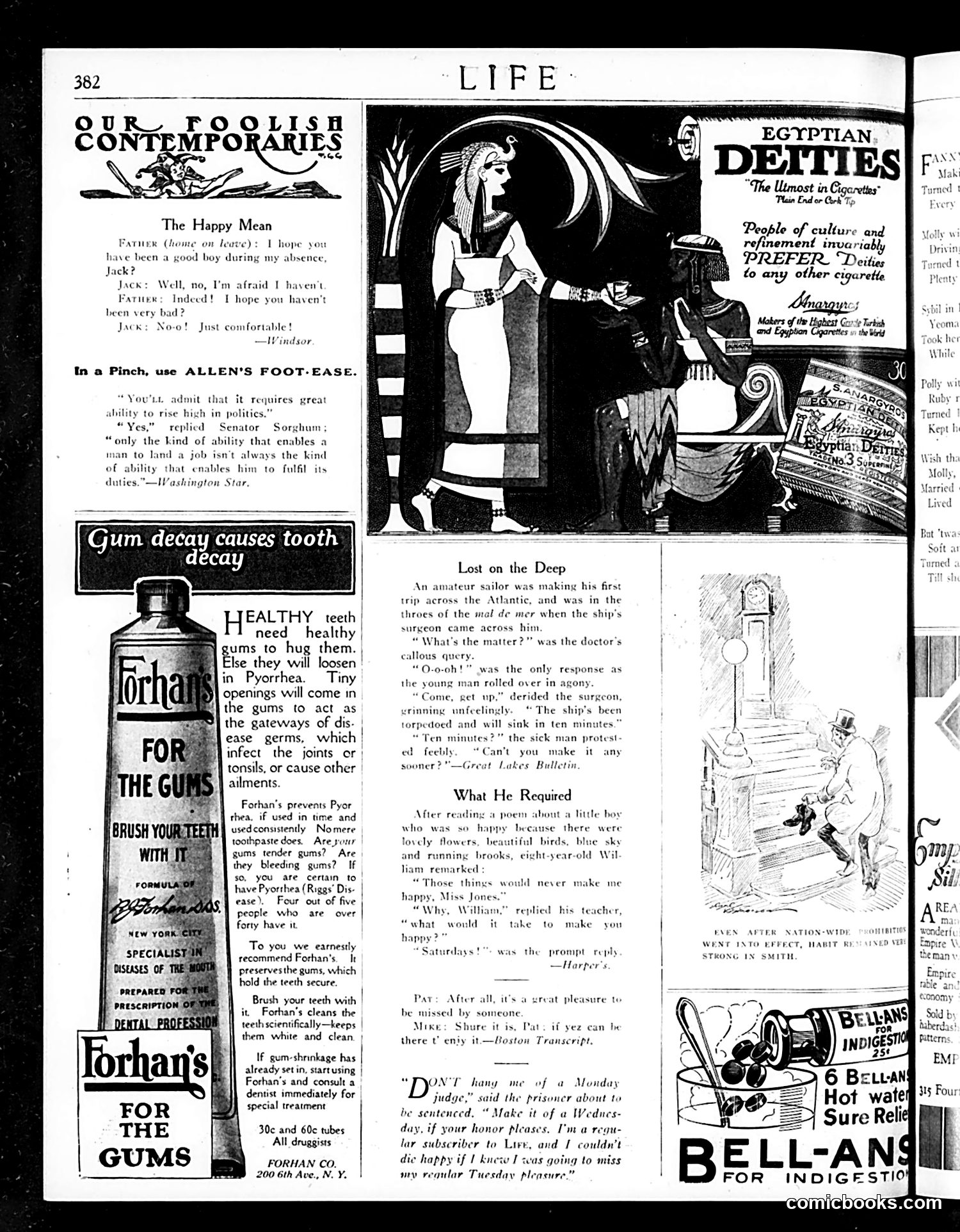
This page is primarily **advertising and humorous filler content** rather than political cartoons. The satirical pieces are brief jokes about everyday life: 1. **"The Happy Mean"** mocks parental naivety—a father asks if his son has been "good," and the boy cheerfully admits he's been "just comfortable," implying he's been neither virtuous nor misbehaving, just pleasantly idle. 2. **"In a Pinch"** satirizes political incompetence—a Senator acknowledges that getting a job requires different skills than actually performing it competently. The remaining content is **vintage product advertisements** (Forhan's toothpaste for gum disease, Bell-Ans for indigestion) interspersed with humorous anecdotes about a seasick sailor, a schoolboy preferring Saturdays to poetry, and a prisoner timing his execution around his *Life* magazine subscription. The large **Egyptian Deities advertisement** is unrelated satire. This page reflects early 20th-century magazine format: light humor mixed with aggressive patent-medicine marketing.
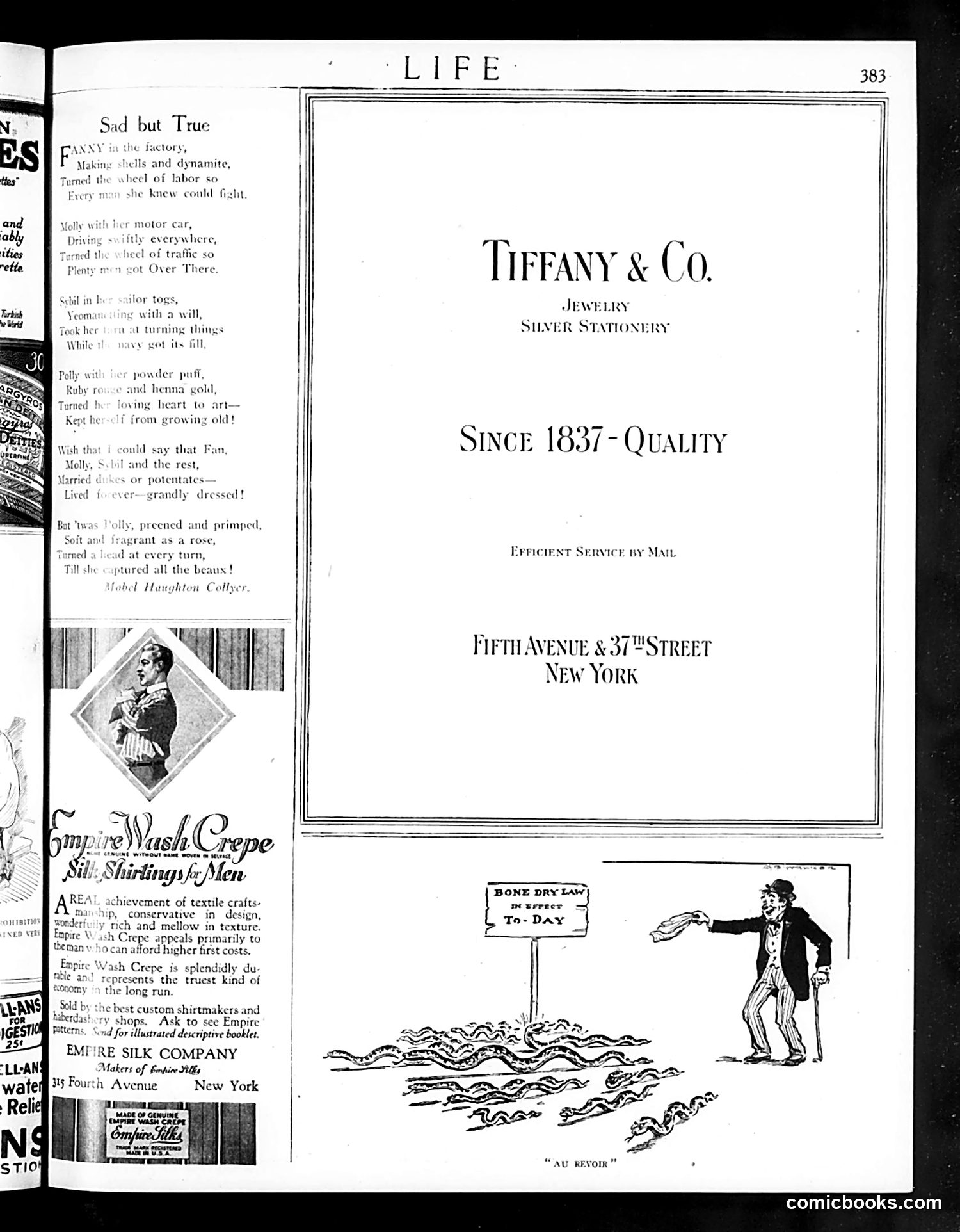
This page is primarily **advertising** for luxury brands (Tiffany & Co., Empire Silk Company) interspersed with editorial content. The main poem, "Sad but True," by Mabel Haughton Collyer, contrasts women's wartime labor with peacetime vanity. It describes women working in factories making ammunition and driving taxis during what appears to be WWI, then sardonically notes how peacetime returned them to frivolous concerns—primping, romance, and luxury goods. The poem's tone suggests ironic critique: women proved capable during wartime but society expected them to resume ornamental roles afterward. The small cartoon at bottom shows a man gesturing at a pile of bottles labeled "Bone Dry Law in Effect To-Day," captioned "Au Revoir" (goodbye). This references **Prohibition**, which went into effect January 17, 1920. The figure bids farewell to alcohol, which became illegal that day. Together, these pieces reflect post-WWI American society: women's changing roles and the dramatic social shifts of 1920.
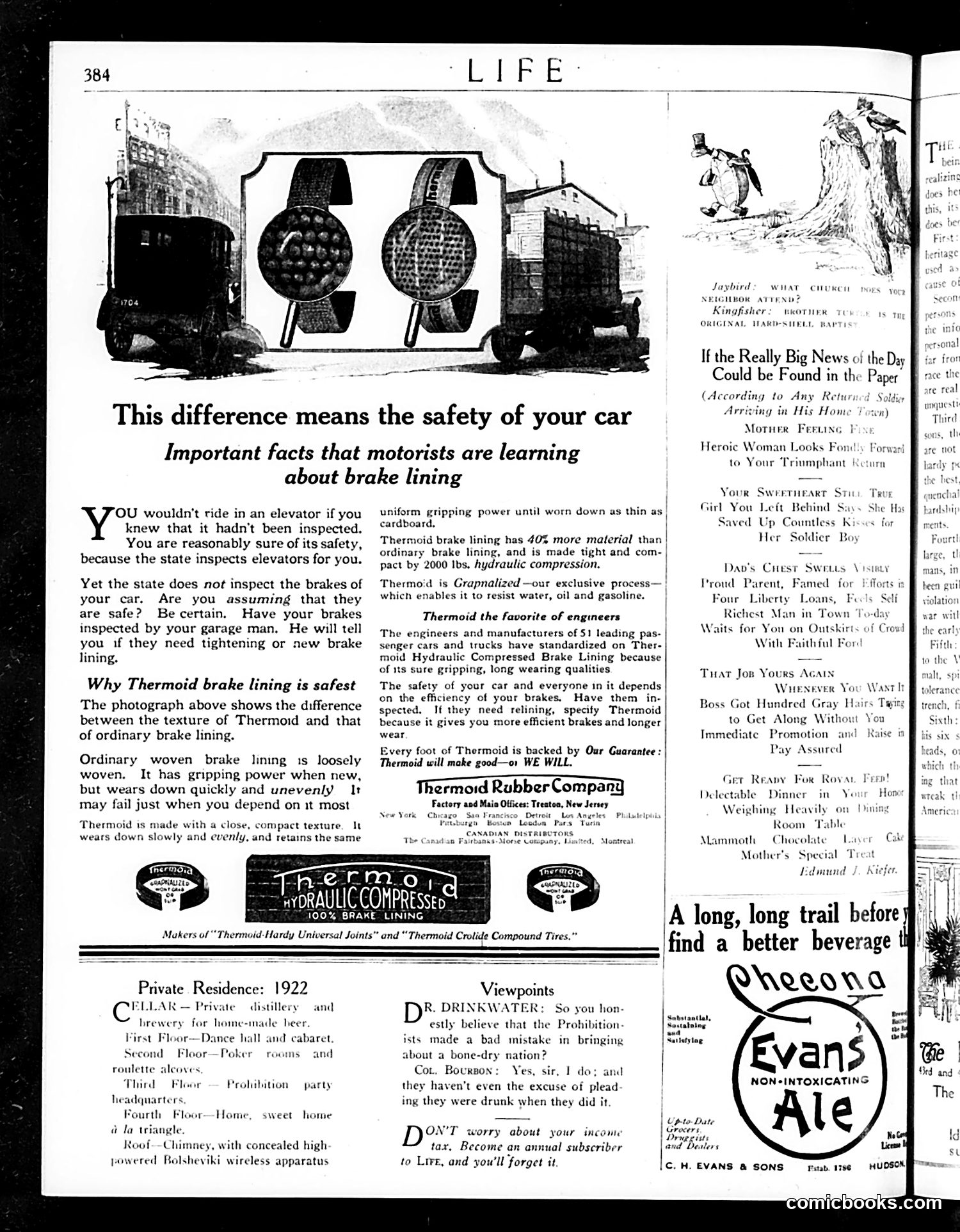
This page is primarily **advertising for Thermoid brake lining**, a car safety product. The main visual shows two circular brake linings side-by-side—one loosely woven (ordinary), one tightly compressed (Thermoid)—to demonstrate superior durability and safety. The ad's argument: unlike elevators, which states inspect for safety, car brakes go uninspected. Thermoid's "40% more material" and hydraulic compression make it wear evenly and last longer than ordinary linings. The lower section contains satirical vignettes mocking **Prohibition enforcement** (1920s alcohol ban). A "Private Residence" diagram shows a hidden speakeasy with poker rooms and a "Bolsheviki wireless" (suggesting communist smuggling networks). A dialogue between characters debates whether Prohibition was a mistake—a common joke reflecting public frustration with the unpopular law. The page also advertises **Sheona Evans Ale**, a non-intoxicating beverage—a product category that emerged as Prohibition workaround. Overall: practical automotive advertising combined with contemporary social satire about Prohibition's failures.
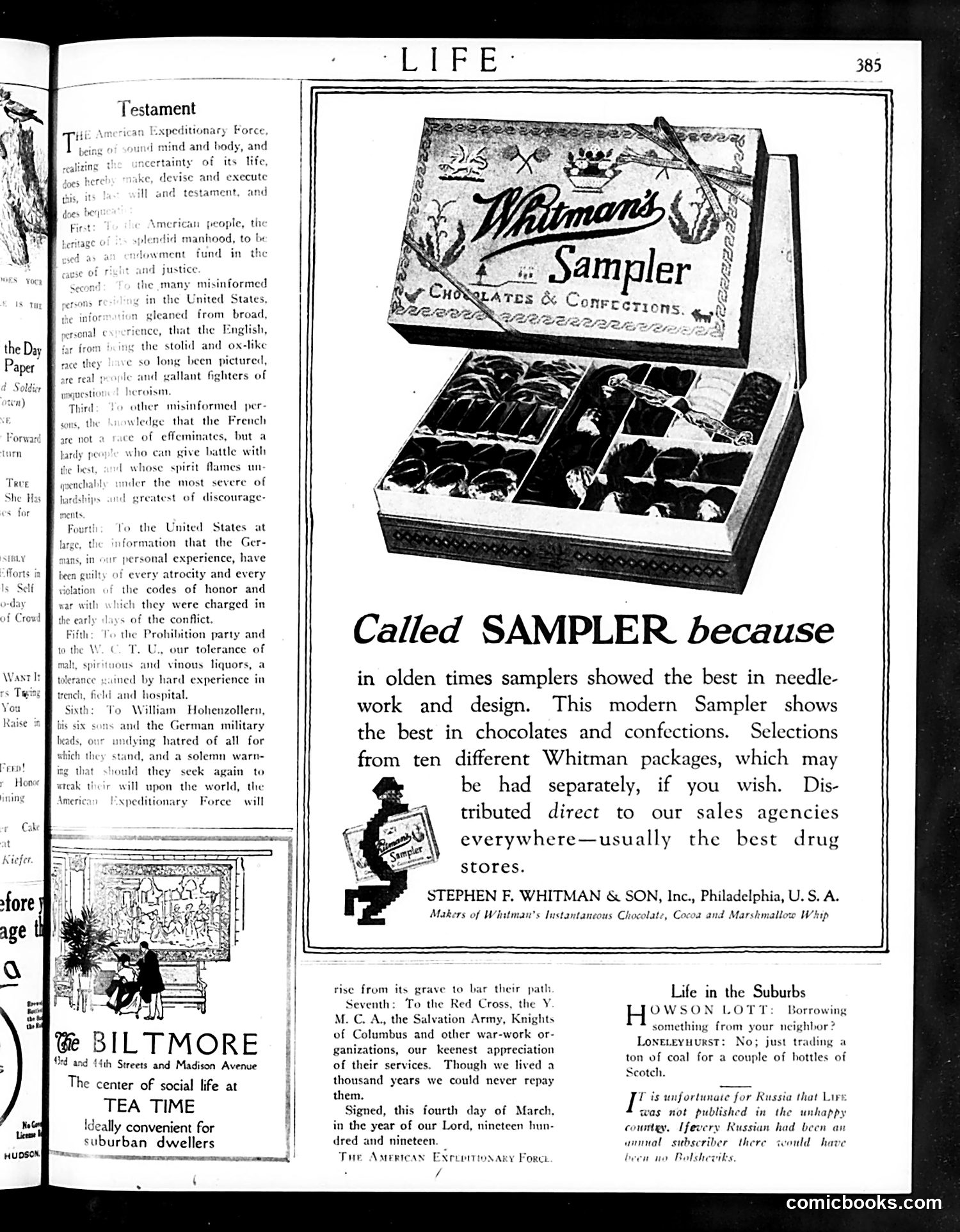
This page is primarily **advertising** rather than political satire. The dominant content is a Whitman's Sampler chocolate advertisement that uses historical imagery—comparing modern chocolates to antique needlework samplers—to market candy as a quality product. The left column contains a serious **"Testament"** piece (likely from WWI era, based on references to "American Expeditionary Force" and dated March 4, 1919) listing seven principles, including appreciation for the Red Cross and military organizations. This is earnest propaganda, not satire. At bottom, two brief humor items appear: a "Life in the Suburbs" joke about trading coal for Scotch whisky, and a comment suggesting Russian Bolshevism wouldn't have occurred if *Life* magazine had circulated there—likely satirizing the magazine's own cultural importance while obliquely mocking the Russian Revolution as preventable through American media influence.
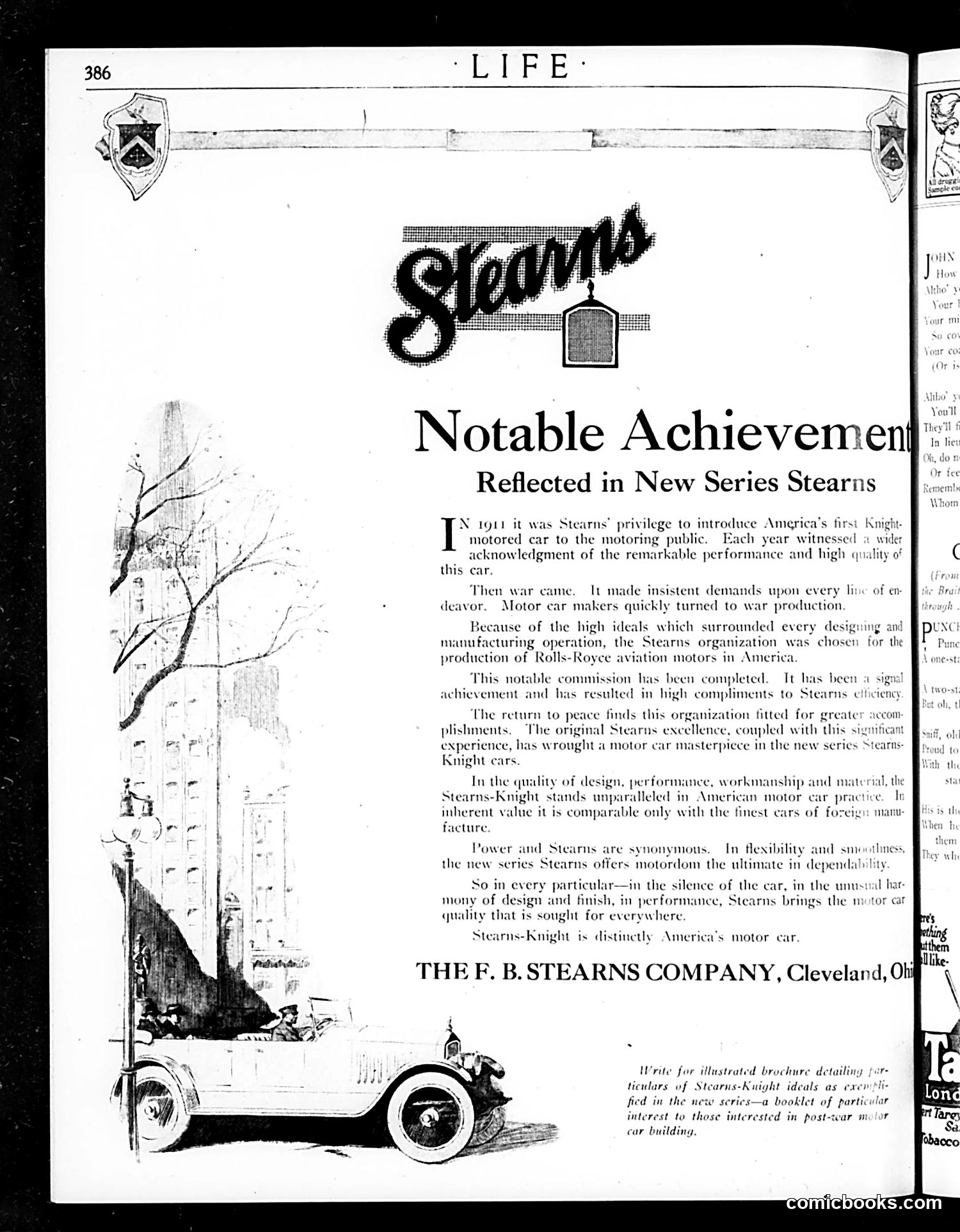
This is a **full-page advertisement** for the Stearns-Knight motor car, not political satire. The F.B. Stearns Company of Cleveland uses the post-WWI moment to market their new vehicle line. The ad's strategy: position Stearns as patriotically duty-bound. During World War I, the company suspended civilian car production to manufacture Rolls-Royce aviation engines for the war effort—presented here as a badge of honor demonstrating "high ideals." Now with peace restored, Stearns claims this wartime engineering experience has enhanced their civilian cars, making the new Stearns-Knight superior to competitors. The repeated emphasis on quality, American craftsmanship, and comparison to "finest cars of foreign manufacture" appeals to post-war nationalist sentiment. The left illustration depicts an urban street scene, anchoring the aspirational product to American city life. This is corporate advertising leveraging patriotism to rebuild market share after wartime disruption.
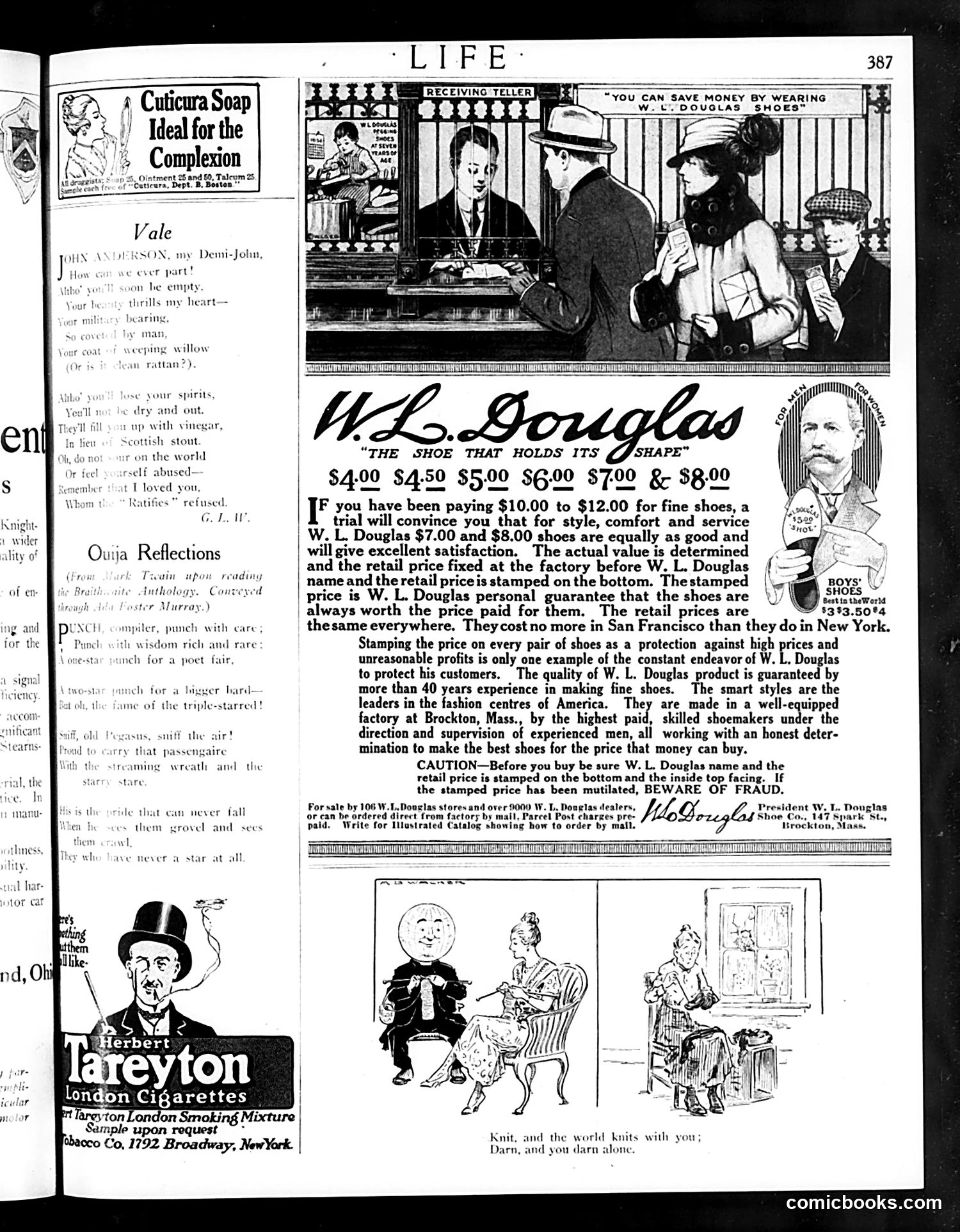
This page is **primarily advertising**, not political satire. The dominant content is a W.L. Douglas shoe advertisement (circa 1910s-1920s based on style). The ad's pitch targets middle-class consumers suspicious of price-gouging: Douglas stamps his guaranteed retail price directly on shoes as proof against inflated markups. The accompanying illustration shows a bank teller (suggesting trustworthiness) and shoppers examining shoes—establishing credibility through transparency. The ad emphasizes that his $7-8 shoes equal competitors' $10-12 shoes. The **left column** contains poetry fragments labeled "Vale" and "Ouija Reflections"—typical Life magazine literary filler of the era. Below is a **Herbert Tareyton cigarettes ad** featuring a mustachioed gentleman. The **bottom cartoon** shows knitting-related domestic humor with the caption "Knit, and the world knits with you; / Darn, and you darn alone"—likely WWI-era (referencing women's wartime knitting efforts), with a play on Emerson's "Laugh, and the world laughs with you." No significant political figures or satire appear here.
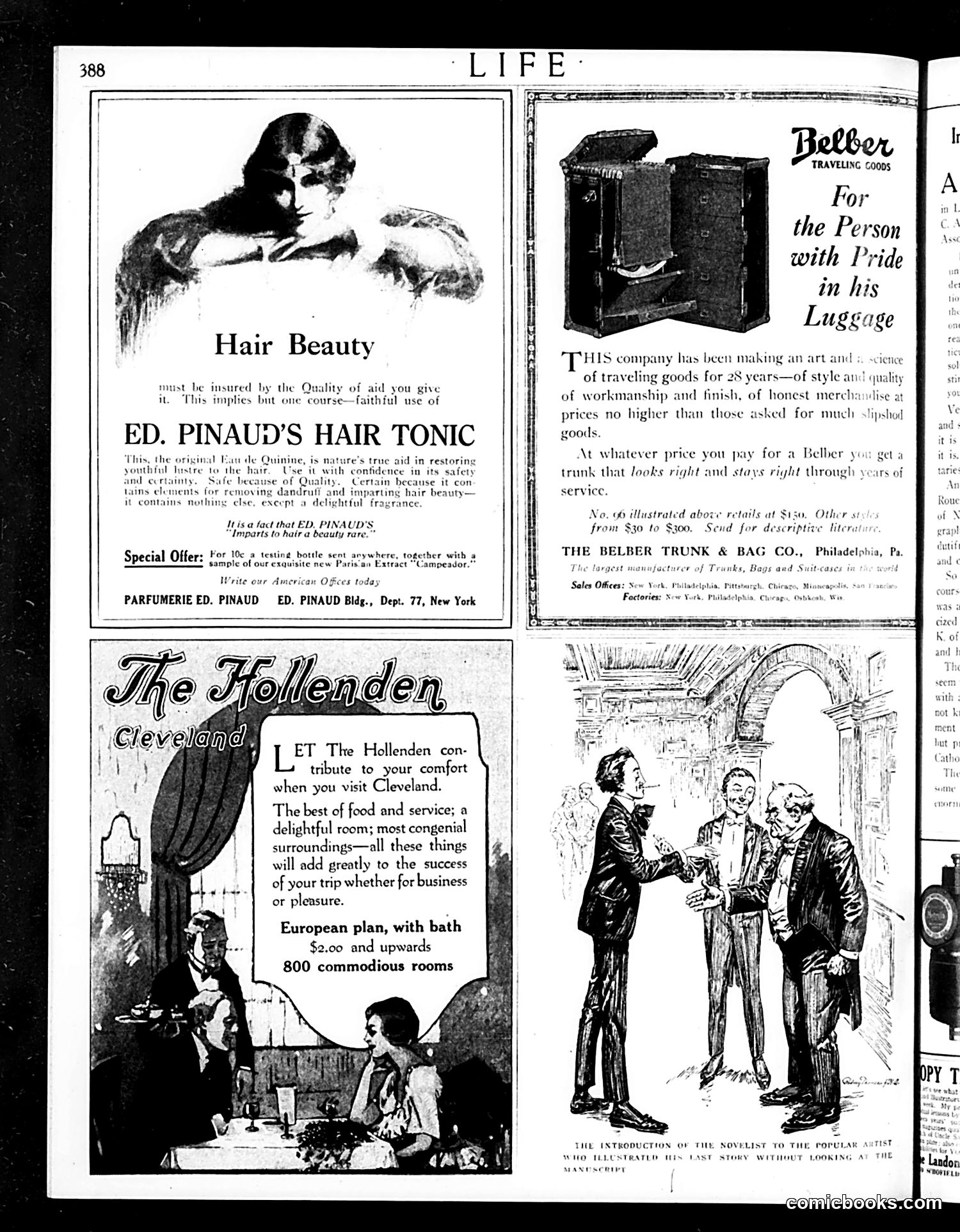
This page consists primarily of **advertisements** interspersed with one illustration at bottom right. The ads promote: - **Ed. Pinaud's Hair Tonic** (French beauty product claiming to restore youthful hair) - **The Hollenden Hotel** in Cleveland (offering European-plan accommodations) - **Belber Traveling Goods/Trunks** (luggage marketed to people concerned with status) The illustration at page bottom appears to show **two men meeting**, with a caption referencing "the novelist" being introduced to "the [person] who illustrated his last story without looking at the manuscript." This suggests a satirical joke about careless or inattentive illustration work—the illustrator apparently created artwork for the writer's story without bothering to read the actual manuscript, implying either laziness or absurd professional standards. The page is typical early 20th-century *Life* content: mixing consumer advertising with light social satire about artistic and professional pretensions.
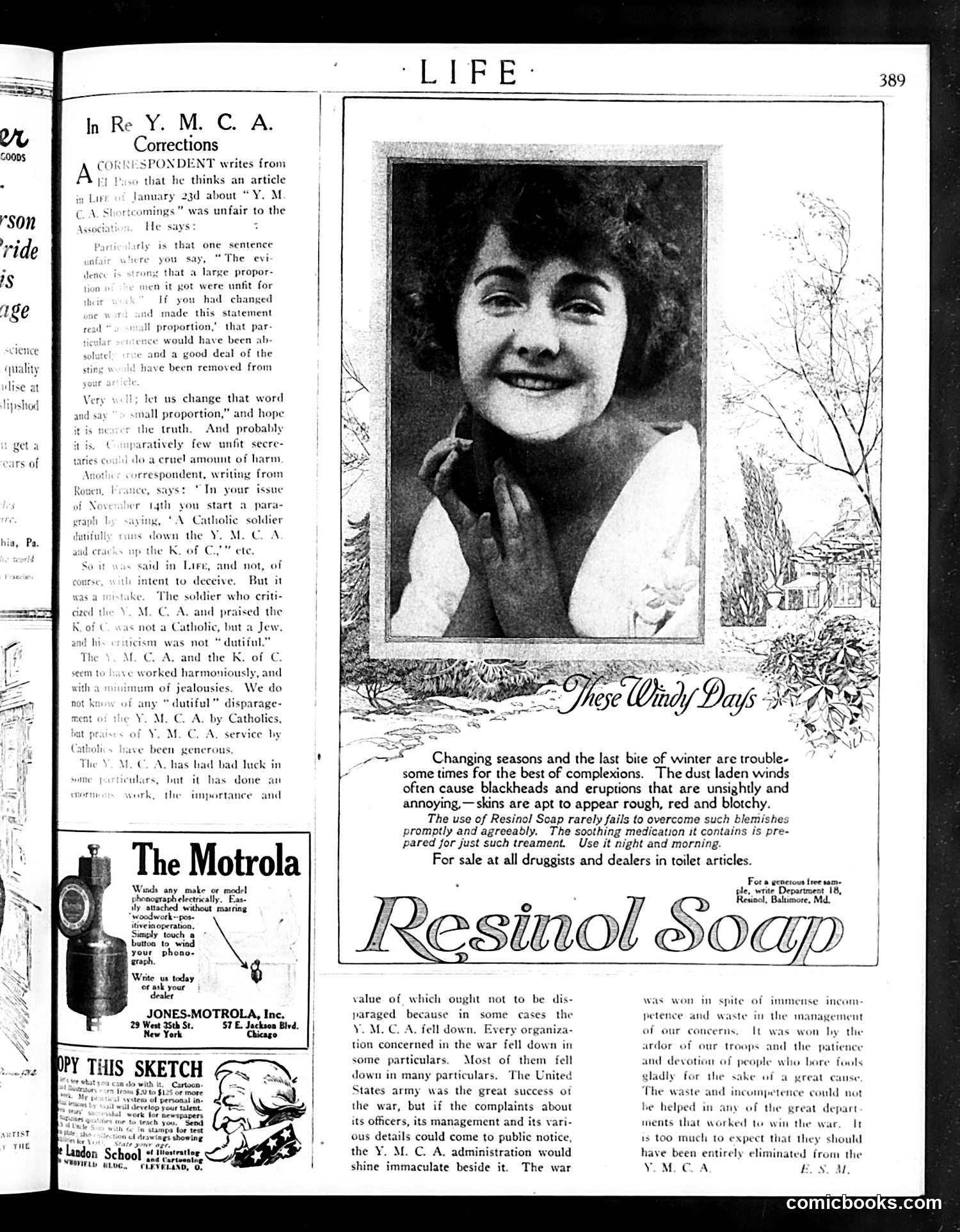
This page is primarily **letters to the editor and advertisements**, not political satire. The main content addresses a **Y.M.C.A. controversy** from an earlier Life article (January 23rd). A correspondent defends the Y.M.C.A. against criticism, arguing that one unfair sentence implied too many unfit workers. The letter clarifies that a Catholic soldier who criticized the Y.M.C.A. was actually Jewish, and disputes the characterization as "dutiful" critique. The writer argues both the Y.M.C.A. and Knights of Columbus worked harmoniously during wartime, and that the Y.M.C.A.'s occasional failures shouldn't overshadow its service—even the U.S. Army had management problems. The page includes advertisements for **The Motrola** (a phonograph attachment) and **Resinol Soap** (for winter skin problems). The Y.M.C.A. debate reflects post-WWI disputes over wartime organization effectiveness and sectarian tensions.
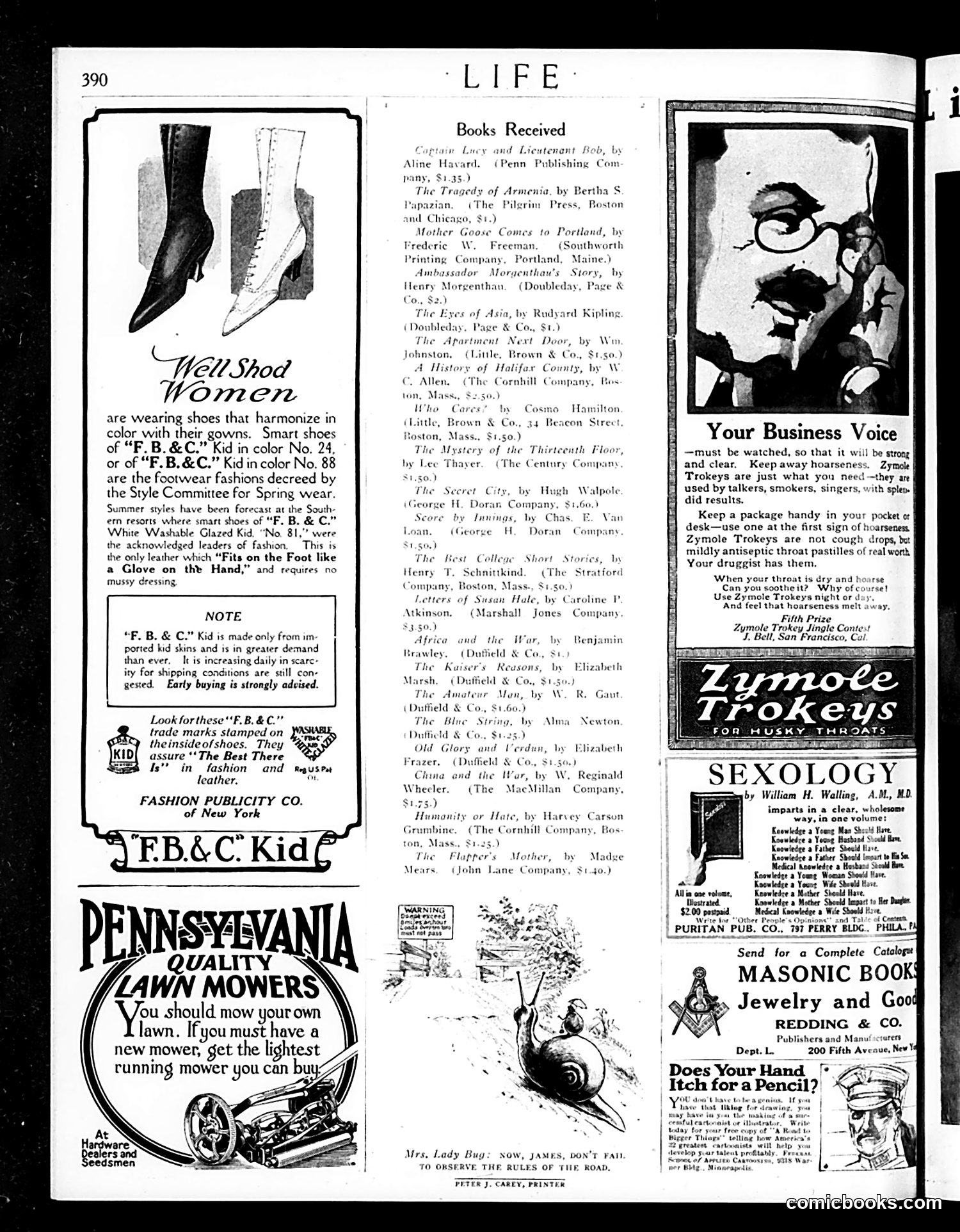
This page is primarily **advertising** with a "Books Received" section. The cartoons are minimal. **Main Content:** - **"Well Shod Women"** ad: Promotes F.B.&C. Kid leather shoes in fashionable colors for spring/summer wear, claiming they're scarce due to WWI shipping congestion—a timely sales pitch. - **Pennsylvania Lawn Mowers** ad: Encourages men to purchase lightweight mowers, appealing to wartime self-sufficiency (likely as servants/laborers were conscripted). - **Small cartoon** (bottom center): Shows a woman ("Mrs. Lady Buy") warning "James" to observe road rules—a humorous domestic scene about safe driving. - **"Your Business Voice"** and **"Zymole Trokeys"** ads: Sell throat lozenges to speakers and singers. - **Other ads** include a sexology book and masonic jewelry. **Context:** This reflects early 1900s consumer culture and wartime adjustments, with advertising exploiting both fashion consciousness and practical wartime shortages.