
Life, 1919-03-06 · page 20 of 42
Life — March 6, 1919 — page 20: what you’re looking at
What you’re looking at
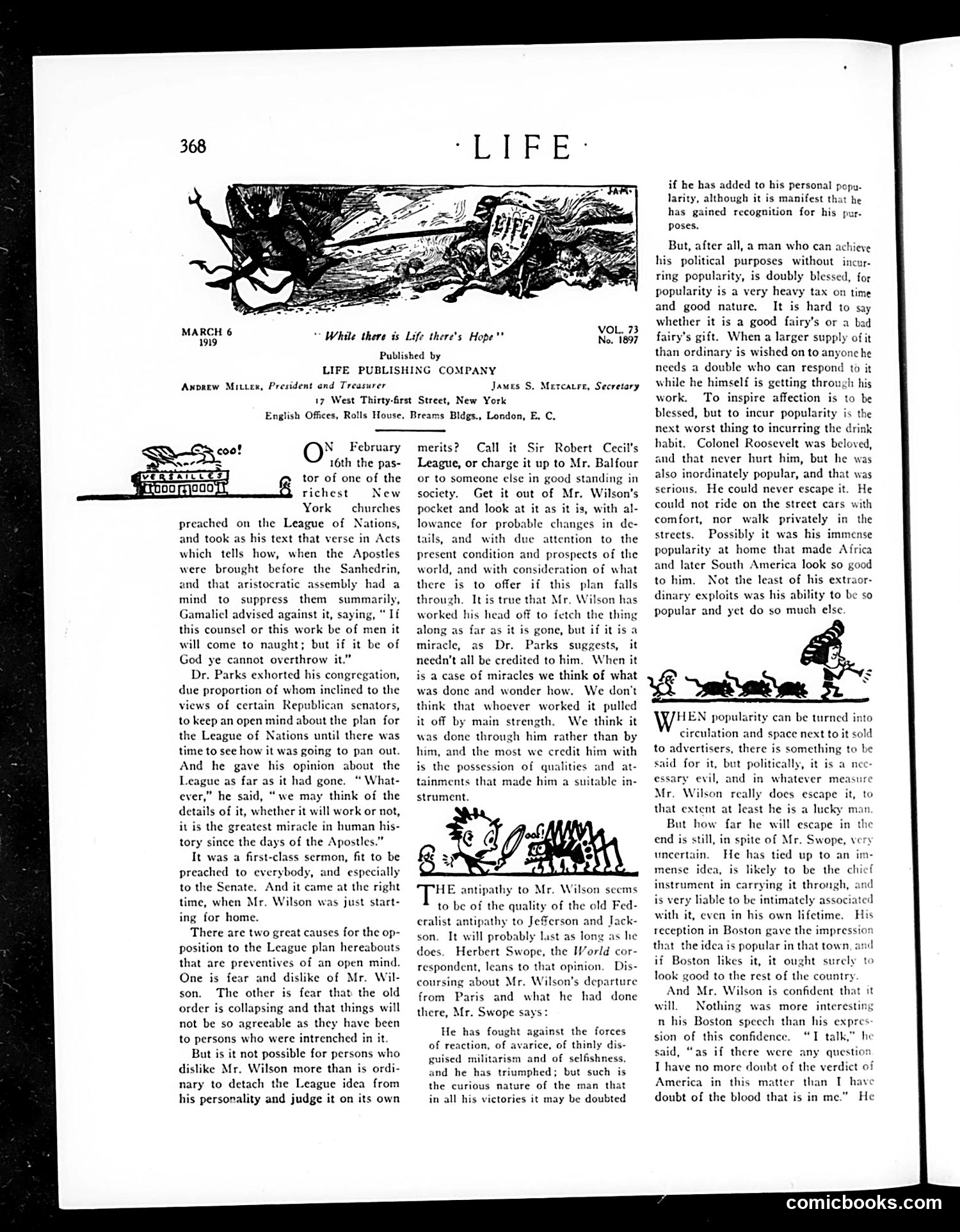
This page discusses President Woodrow Wilson's League of Nations proposal, written as Wilson returns from Paris peace negotiations after World War I. **The Context:** The article argues that opposition to the League stems from two sources: personal dislike of Wilson and fear of social change. A prominent New York minister (Dr. Parks) called the League "the greatest miracle in human history since the Apostles," but this hasn't persuaded skeptics. **The Satire's Point:** The author makes an ironic observation about Wilson's political effectiveness: he can achieve his policy goals without gaining personal popularity—a rare and "doubly blessed" achievement. However, Wilson's very unpopularity may undermine the League's success, since it becomes entangled with personal animosity toward him rather than judged on merits. **Historical Reference:** The cartoons appear to mock resistance from Republicans and "old order" interests threatened by the League concept. The piece advocates for separating the League idea from Wilson's personality to enable rational debate.
📄 Transcribed text from this page (OCR, searchable)
Machine-transcribed from the original scan — historical spelling and the odd misread are preserved.
MARCH 6 199 While there is Life there's Hope"* VOL. 73 No. 1897 Published by LIFE PUBLISHING COMPANY Anpraew Miter, President and Treasurer Janets S. Mercatre, Secretary 17 West Thirty-first Street, New York English Offices, Rolls House, Breams Bldgs., London, EC. February O een 16th the pas- vegtarcce sy @ tor of one of the joo fz\000 Ty, richest New York — churches preached on the League of Nations, and took as his text that verse in Acts which tells how, when the Apostles were brought before the Sanhedrin, nd that aristocratic assembly had a mind to suppress them summarily Gamalicl advised against it, saying, “If this counsel or this work be of men it will come to naught; but if it be of God ye cannot overthrow it.” Dr. Parks exhorted his congregation, due proportion of whom inclined to the views of certain Republican senators, to keep an open mind about the plan for the League of Nations until there was time to see how it was going to pan out. And he gave his opinion about the League as far as it had gone. “ What- ever,” he said, “we may think of the details of it, whether it will work or not, it is the greatest miracle in human his- tory since the days of the Apostles.” It was a first-class sermon, fit to be preached to everybody, and especially to the Senate. And it came at the right time, when Mr. Wilson was just start- ing for home. There are two great causes for the op- position to the League plan hereabouts that are preventives of an open mind. One is fear and dislike of Mr. Wil- son. The other is fear that the old order is collapsing and that things will not be so agreeable as they have been to persons who were intrenched in it But is it not possible for persons who dislike Mr. Wilson more than is ordi- nary to detach the League idea from his personality and judge it on its own merits? Call it Sir Robert Cecil's League, or charge it up to Mr. Balfour or to someone else in good standing in society. Get it out of Mr. Wilson’s pocket and look at it as it is, with al- lowance for probable changes in de- tails, and with due attention to the present condition and prospects of the world, and with consideration of wha there is to offer if this plan falls through. Itis true that Mr. Wilson has worked his head off to fetch the thin along as far as it is gone, but if it is miracle, as Dr. Parks suggests, it necdn’t all be credited to him. When it is a case of miracles we think of what was done and wonder how. We don't think that whoever worked it pulled it off by main strength. We think it was done through him rather than by him, and the most we credit him with is the possession of qualities and at- tainments that made him a sui strument. ble in- HE antipathy to Mr. Wilson seems to be of the quality of the old Fed- cralist antipathy to Jefferson and Jack- son. It will probably lust as long as he does. Herbert Swope, the World cor- respondent, leans to that opinion. Dis- bout Mr. Wilson’s departure what coursing from Paris and there, Mr. Swope he had done He has fought against the forces of reaction, of avarice, of thinly dis- guised militarism and of selfishness, and he has triumphed; but such is the curious nature of the man that in all his victories it may be doubted if he has added to his personal popu- larity, although it is manifest that he has gained recognition for his poses. But, after all, a man who can ach his political purposes without in ring popularity, is doubly blessed, for popularity is a very heavy tax on time and good nature. It is hard to say whether it is a good fairy’s or a bad fairy’s gift. When a larger supply of it than ordinary is wished on to anyone he needs a double who can respond to it while he himself is getting through his work. To inspire affection is to be blessed, but to incur popularity is the next worst thing to incurring the drink habit. Colonel Roosevelt was beloved, and that never hurt him, but he was also inordinately popular, and that was serious. He could never escape it. He could not ride on the street cars with comfort, nor walk privately in the streets. Possibly it was his immense popularity at home that made Airica and later South America look so good to him. Not the least of his extraor- dinary exploits was his ability to be so popular and yet do so much else HEN popularity can be turned into circulation and space next to it sold to advertisers, there is something to be uid for it, but politically, it is a nec- y evil, and in whatever measure Wilson really does escape it, to that extent at least he is a lucky man But how far he will escape in end is still, in spite of Mr. Swope, very uncertain. He has tied up to an im- mense idea, is likely to be the chief instrument in carrying it throngh, is very liable to be intimately associat with it, even in his own lifetime. His reception in Boston gave the impressit that the idea is popular in that town, a if Boston likes it, it ought surely look good to the rest of the country And Mr, Wilson is confident th will Nothing was more interesting n his Boston speech than his ex sion of this confidence. “T talk,” said, “as if there were any question I have no more doubt of the verdict of America in this matter than Tha doubt of the blood that is in me.” and He comicbooks.com