
A complete issue · 34 pages · 1918
Life — October 31, 1918
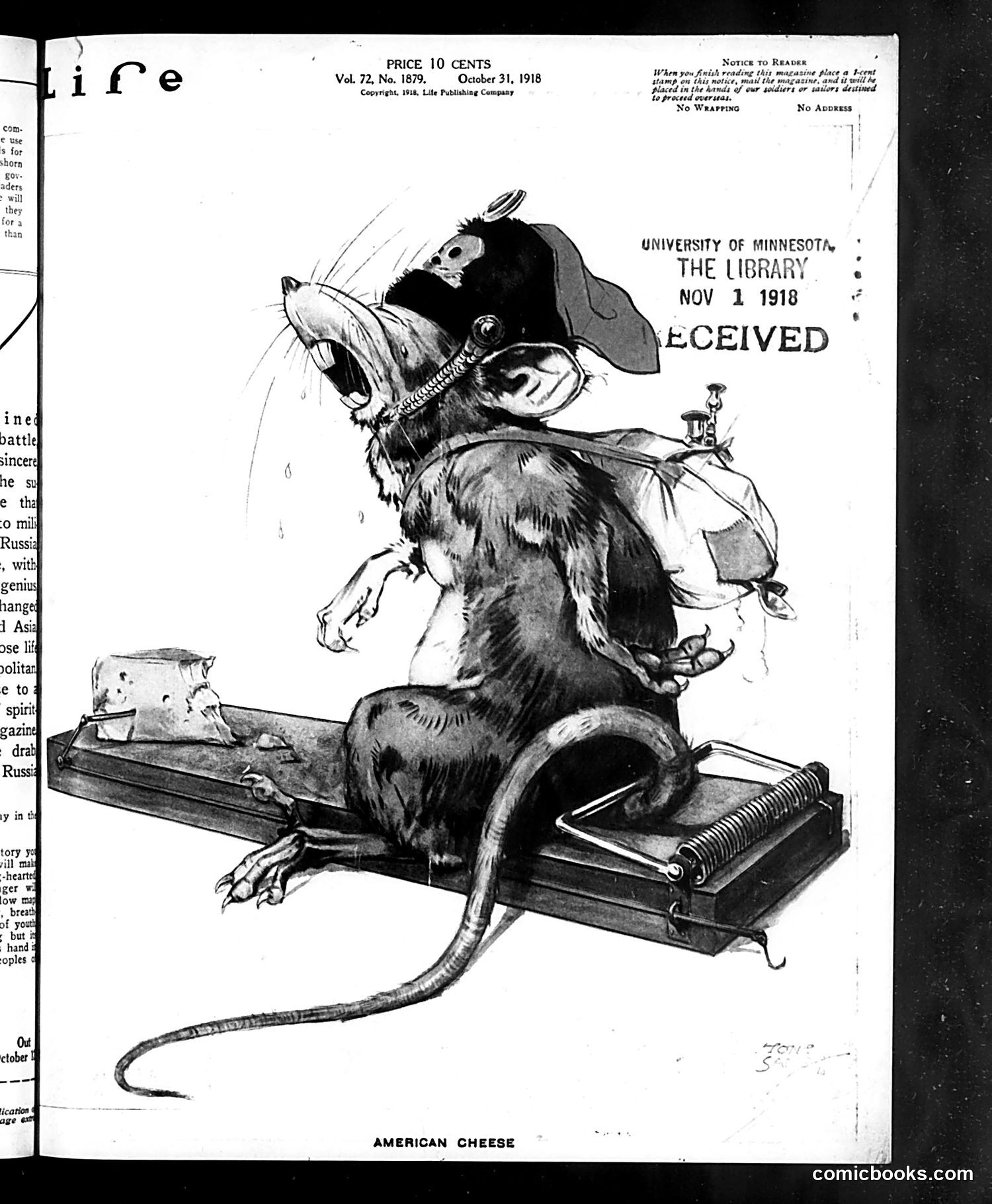
This cartoon depicts a rat perched atop mousetraps, with a tiny figure (appearing to be a soldier or military man) sitting on the rat's back. The rat wears a hat and collar, suggesting anthropomorphization of a political figure or enemy nation. The title "American Cheese" identifies the bait—a reference to American prosperity or resources. Published during WWI's final weeks (November 1918 armistice was imminent), this likely satirizes either German war strategy, American industrial output as a lure, or perhaps profiteering. The rat trapped by its own greed for American resources suggests commentary on enemy miscalculation or American advantage. Without additional context, the specific political target remains unclear, though the WWI timing is definitive.
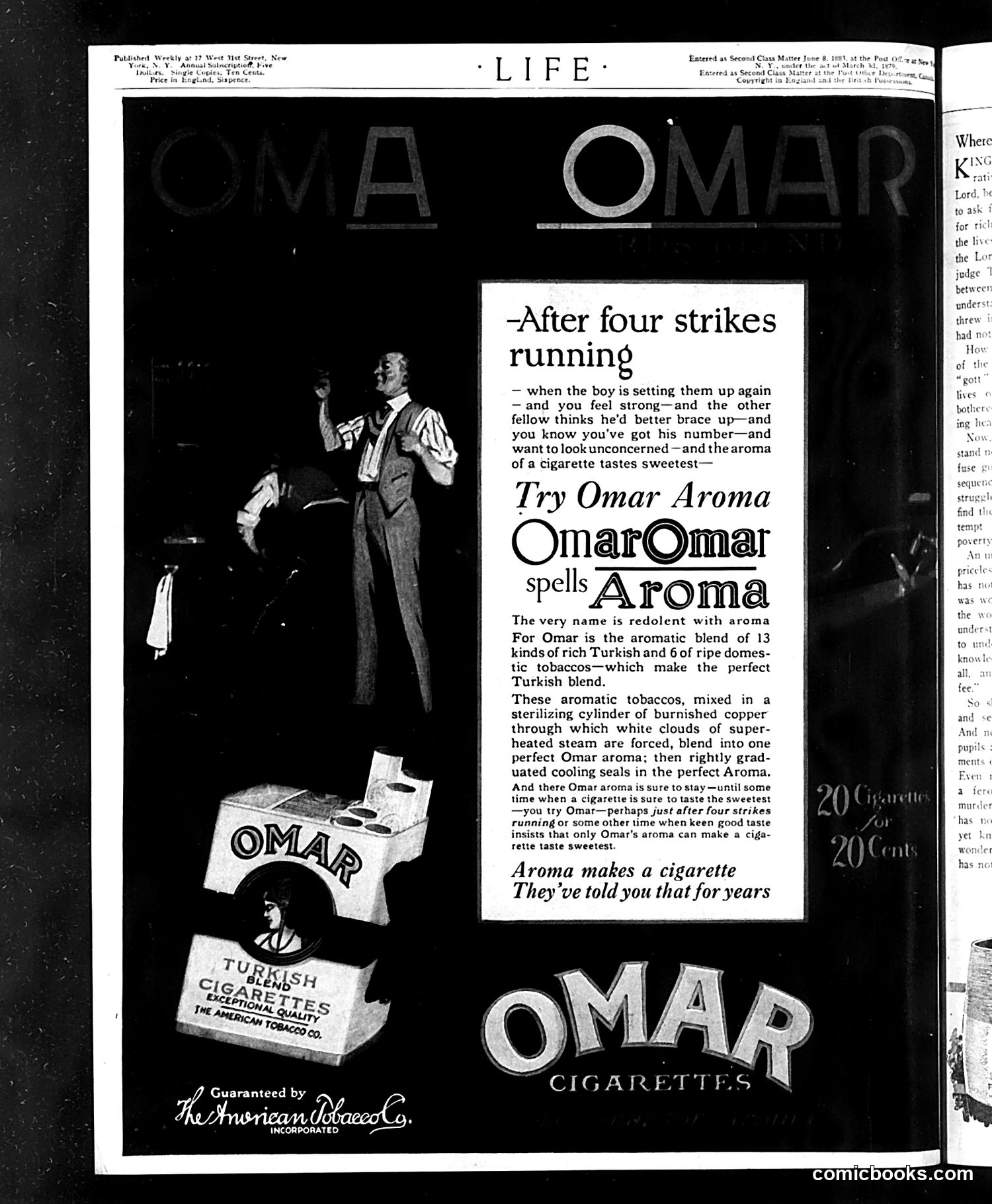
This page is primarily a **cigarette advertisement**, not political satire. It promotes "Omar Aroma" cigarettes made by The American Tobacco Company. The ad features two illustrated men in what appears to be a baseball scene—one batting, another pitching or catching. The copy plays on sports imagery, suggesting that smoking Omar cigarettes provides confidence during high-pressure moments ("after four strikes running"). The advertisement emphasizes the cigarettes' aromatic blend of Turkish and domestic tobaccos. The humor is lighthearted and commercial rather than satirical—using relatable scenarios (athletic competition, wanting to appear calm under pressure) to market the product to male consumers. This represents early 20th-century advertising that would be considered unethical today due to health concerns about tobacco.
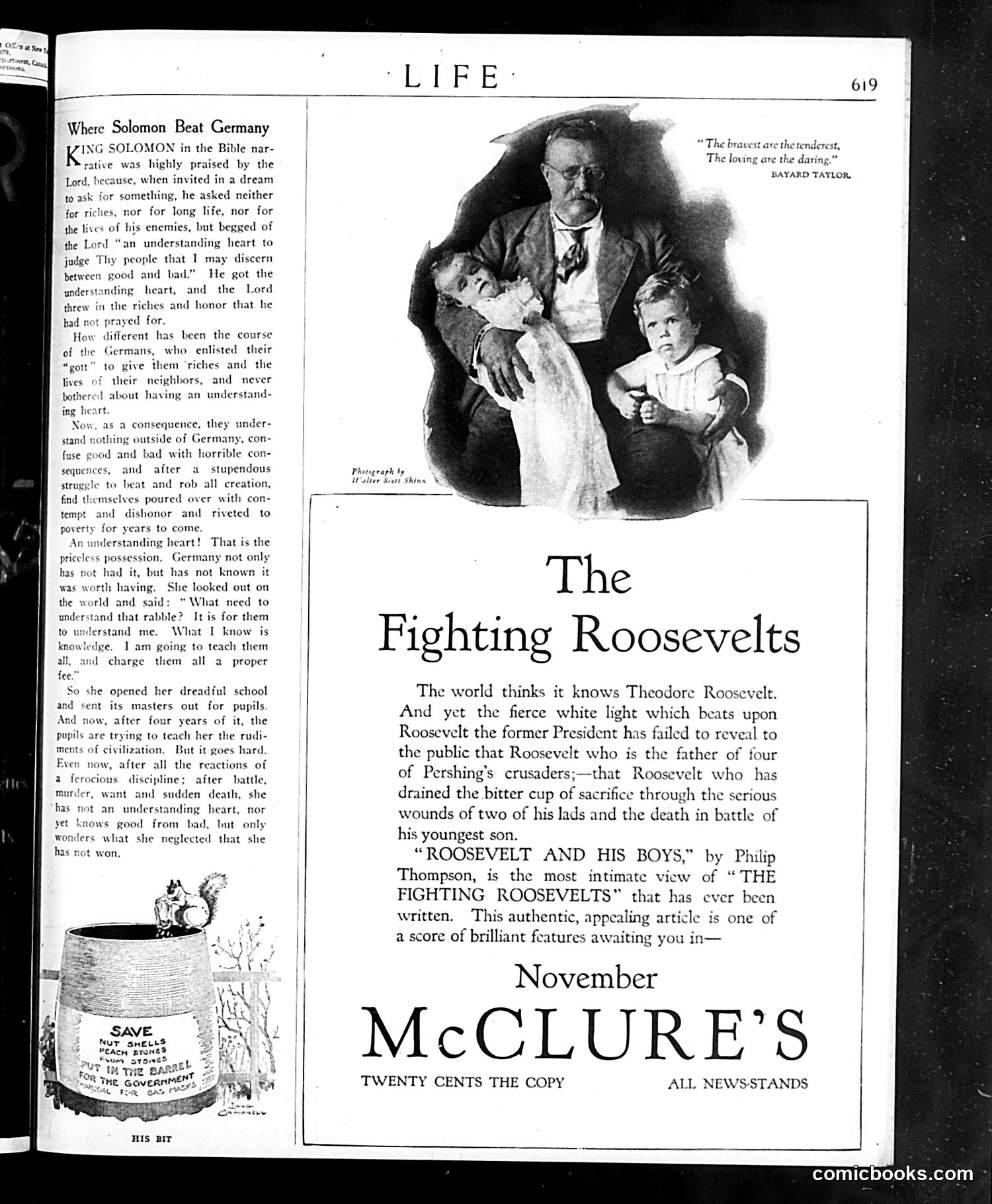
The page contains two distinct elements: **Left side:** A satirical article titled "Where Solomon Beat Germany" critiques German militarism. It contrasts King Solomon's biblical wisdom—asking God for an "understanding heart" to judge people fairly—with Germany's approach of pursuing military might and conquest while neglecting moral judgment. The piece suggests Germany's aggressive "gott" (god) mentality has led to consequences including "contempt and dishonor" spanning years. **Right side:** Advertisement for an upcoming *McClure's* magazine article titled "The Fighting Roosevelts," featuring a portrait photograph of Theodore Roosevelt with two young boys. The ad promotes Philip Thompson's piece "Roosevelt and His Boys," highlighting Roosevelt's personal sacrifices—sons wounded in battle, one killed—alongside his public prominence. The layout juxtaposes moral philosophy against American patriotic pride.
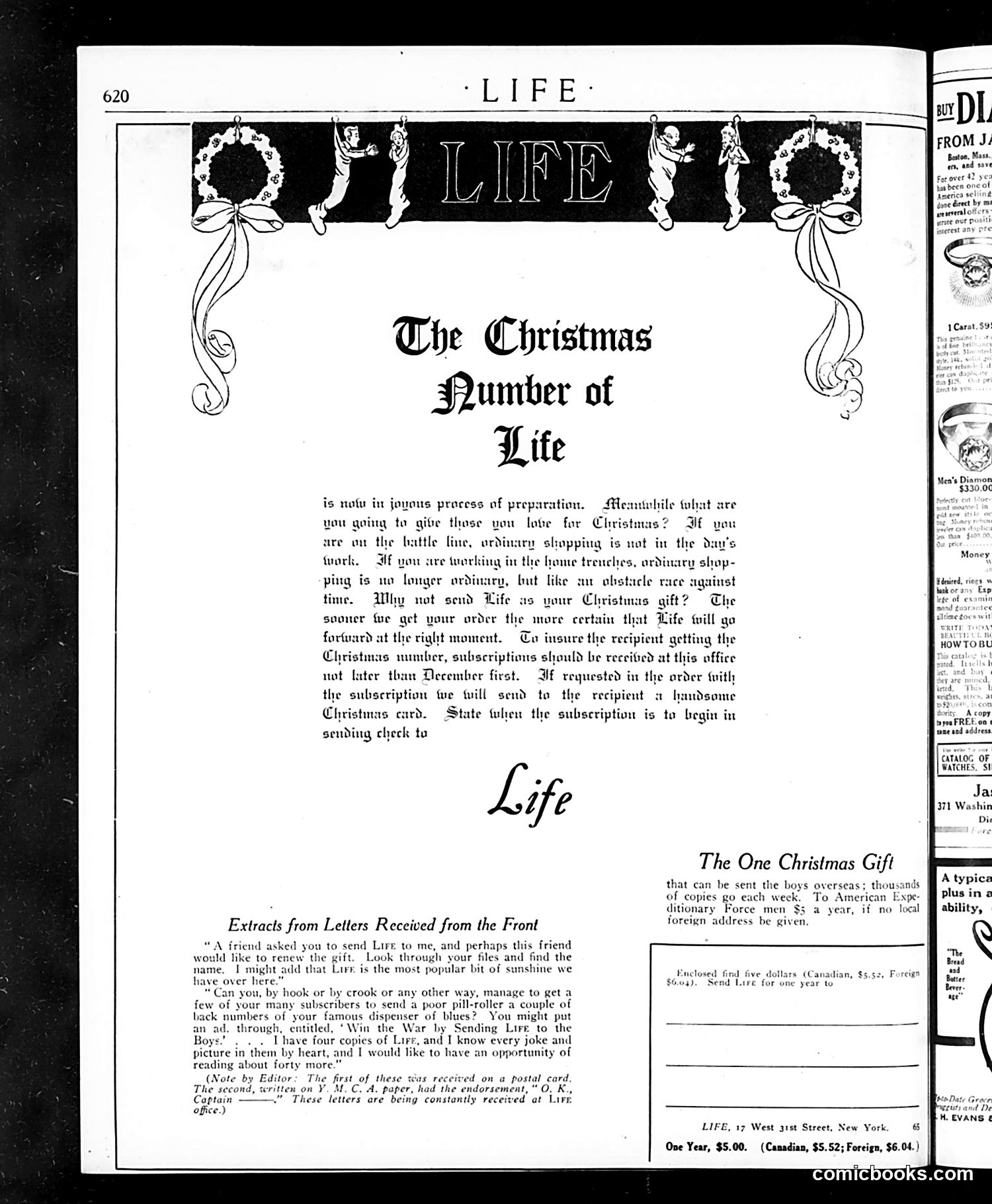
This page is primarily **promotional content**, not satire or political commentary. It's a Christmas subscription drive for *Life* magazine itself. The decorative header features cherubs and holly wreaths framing the *Life* masthead—standard holiday design for the era. The main text encourages readers to give *Life* subscriptions as Christmas gifts, emphasizing reliability ("the sooner we get your order the more certain that Life will go forward at the right moment"). Below, "Extracts from Letters Received from the Front" shows reader testimonials praising the magazine, with a note that these are genuine letters frequently received. The final section advertises pricing: one year for $5.00 (domestic) or $5.52-$6.04 (foreign). **This is essentially a vintage magazine advertisement masquerading as editorial content.**
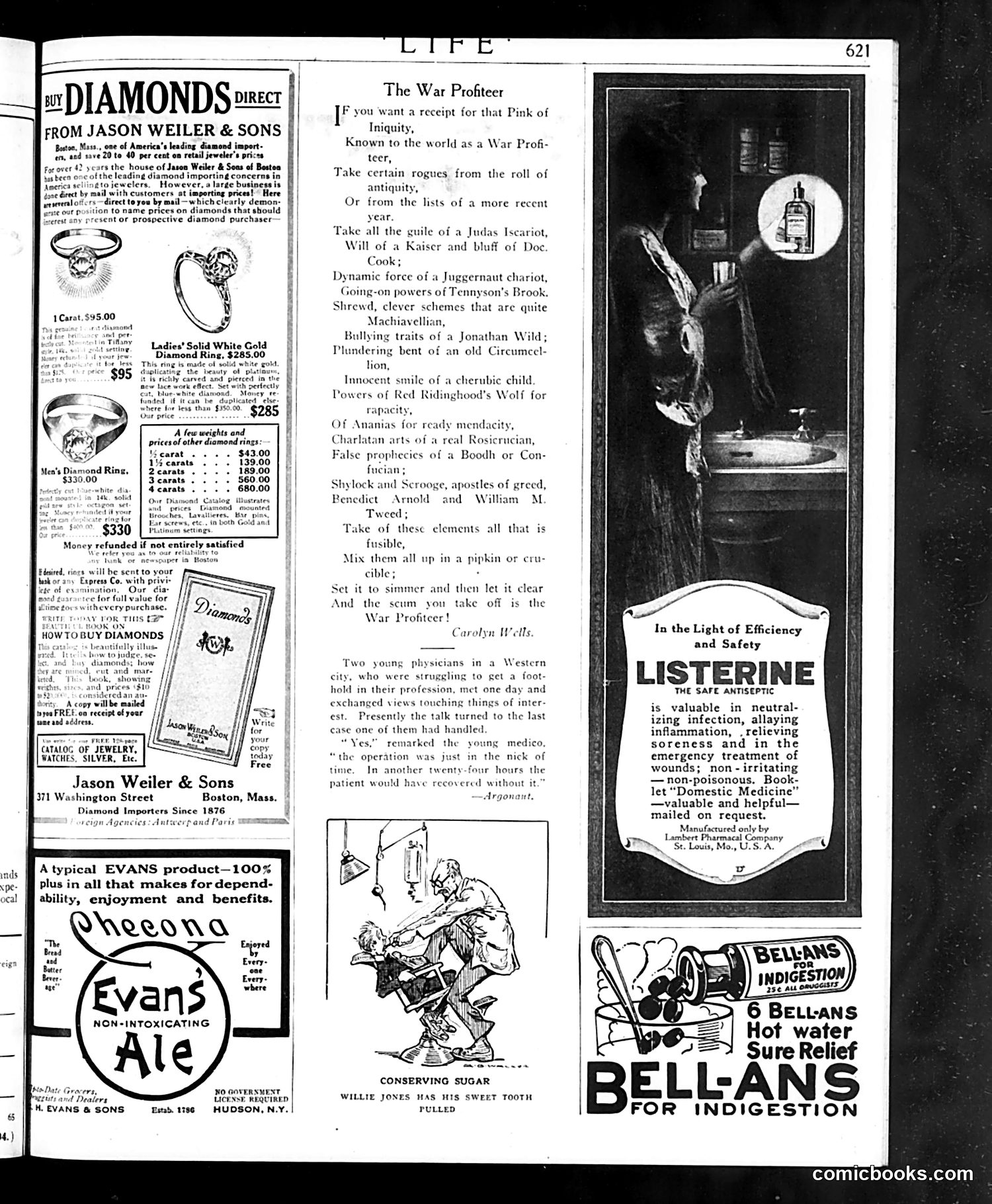
This page is primarily **advertising with one satirical poem and cartoon**. **"The War Profiteer" poem** by Carolyn Wells satirizes someone accumulating wealth through wartime. It's a recipe-style mockery listing ingredients like "guile of a Judas Iscariot," "schemes of Machiavelli," and "greed" to be mixed and simmered—suggesting war profiteers deliberately combined corruption and ruthlessness for profit. The accompanying cartoon shows a figure in shadow counting money, reinforcing the theme. **Below that**: A short anecdote about two physicians discusses a surgical operation's timing—apparently making a joke about medical fees or procedure costs. **Remainder**: Magazine advertisements (diamonds, Evans ale, Listerine, Bell-ans antacid) occupy most space. The satirical content critiques **wartime financial exploitation**, a common Life magazine theme during WWI era.
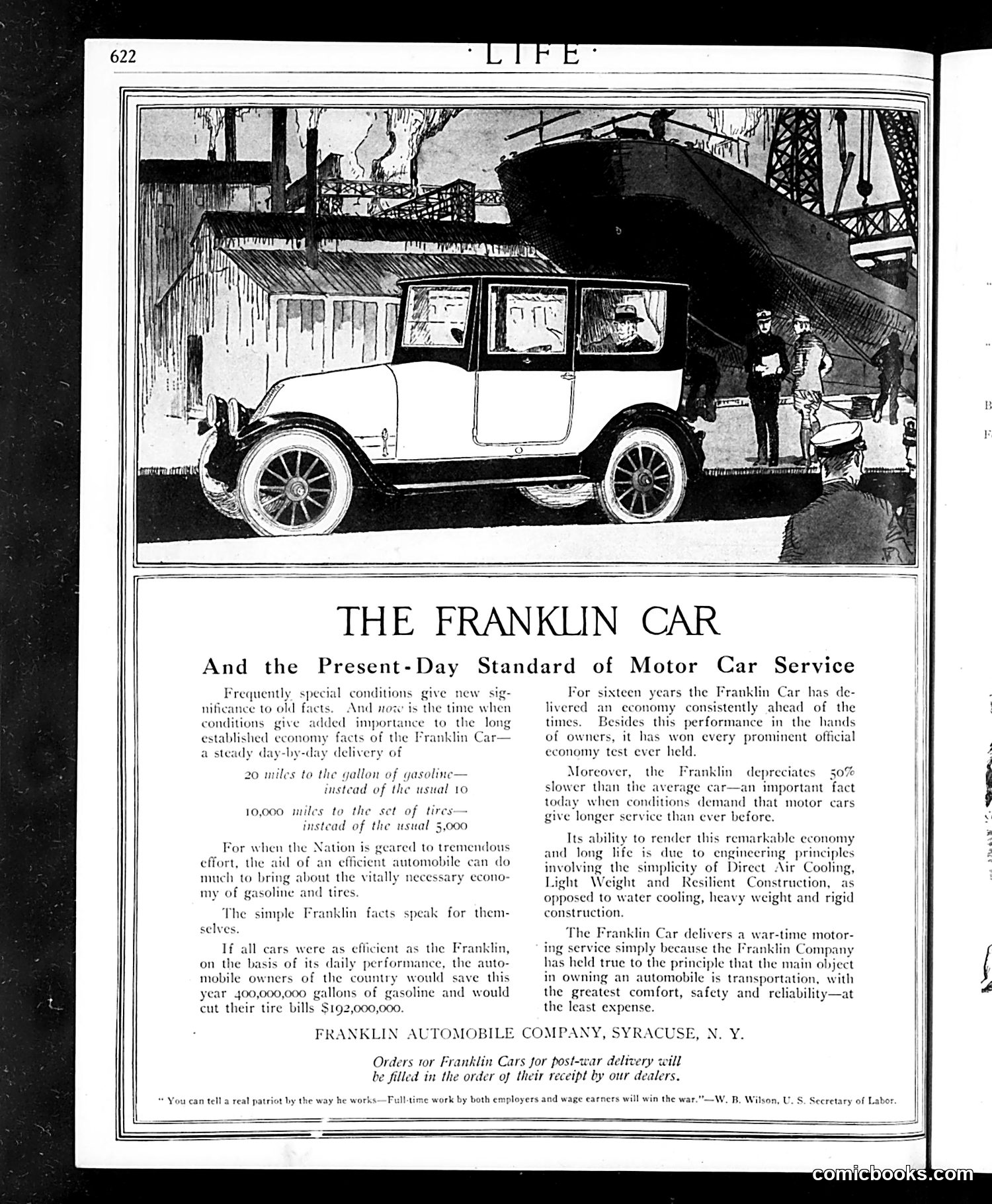
This page is **primarily an advertisement**, not satire. It promotes the Franklin Car, manufactured in Syracuse, New York. The ad emphasizes the car's fuel efficiency (20 miles per gallon versus 10,000 miles per tire set versus the usual 5,000), durability, and economic value. It highlights that the Franklin depreciates slower than average cars and has won economy tests. The ad references wartime conditions (mentioning "war-time motor service" and a quote from Secretary of Labor W.B. Wilson about patriotic work), suggesting this advertisement dates to the **World War I era**, when fuel and tire conservation were national concerns. The illustration shows a well-dressed couple beside the automobile in what appears to be an industrial or dock setting, positioning the Franklin as a practical, economical choice for concerned citizens.
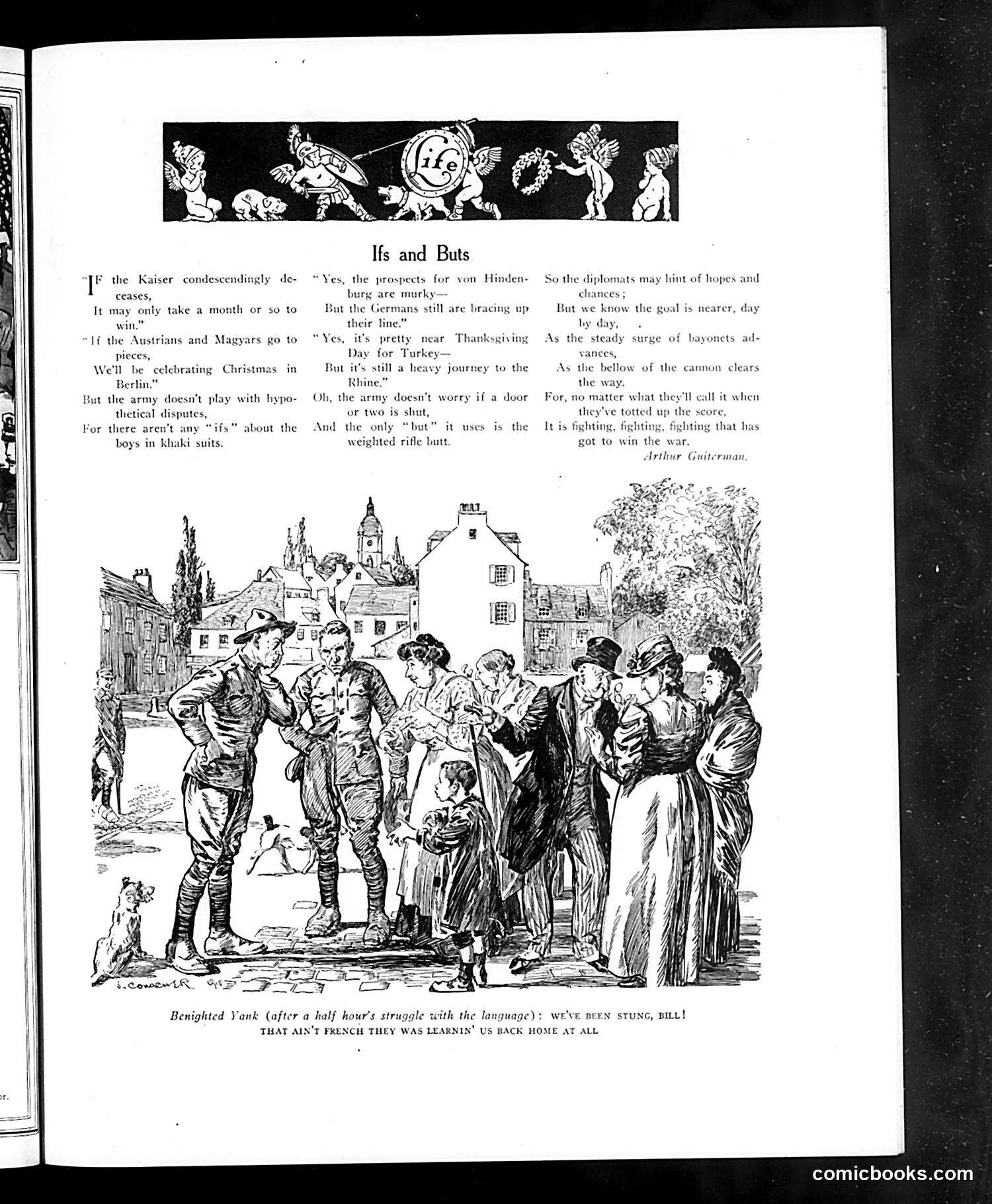
This page satirizes Allied optimism about World War I. The dialogue at top presents conditional scenarios: if Austria-Hungary fragments, if German lines break near the Rhine—each followed by cautionary counterpoints. The poem by Arthur Guiterman emphasizes that despite diplomatic hopes, military victory requires actual fighting. The illustration shows a "Benighted Yank" (American soldier) attempting French with locals. The caption's joke—"we've been stung, Bill! That ain't French they was learnin' us back home at all"—reflects American soldiers' frustration with language barriers and training inadequacy when deployed to Europe. Together, the content mocks both overconfident war predictions and practical unpreparedness of American forces, suggesting gaps between theory and battlefield reality.
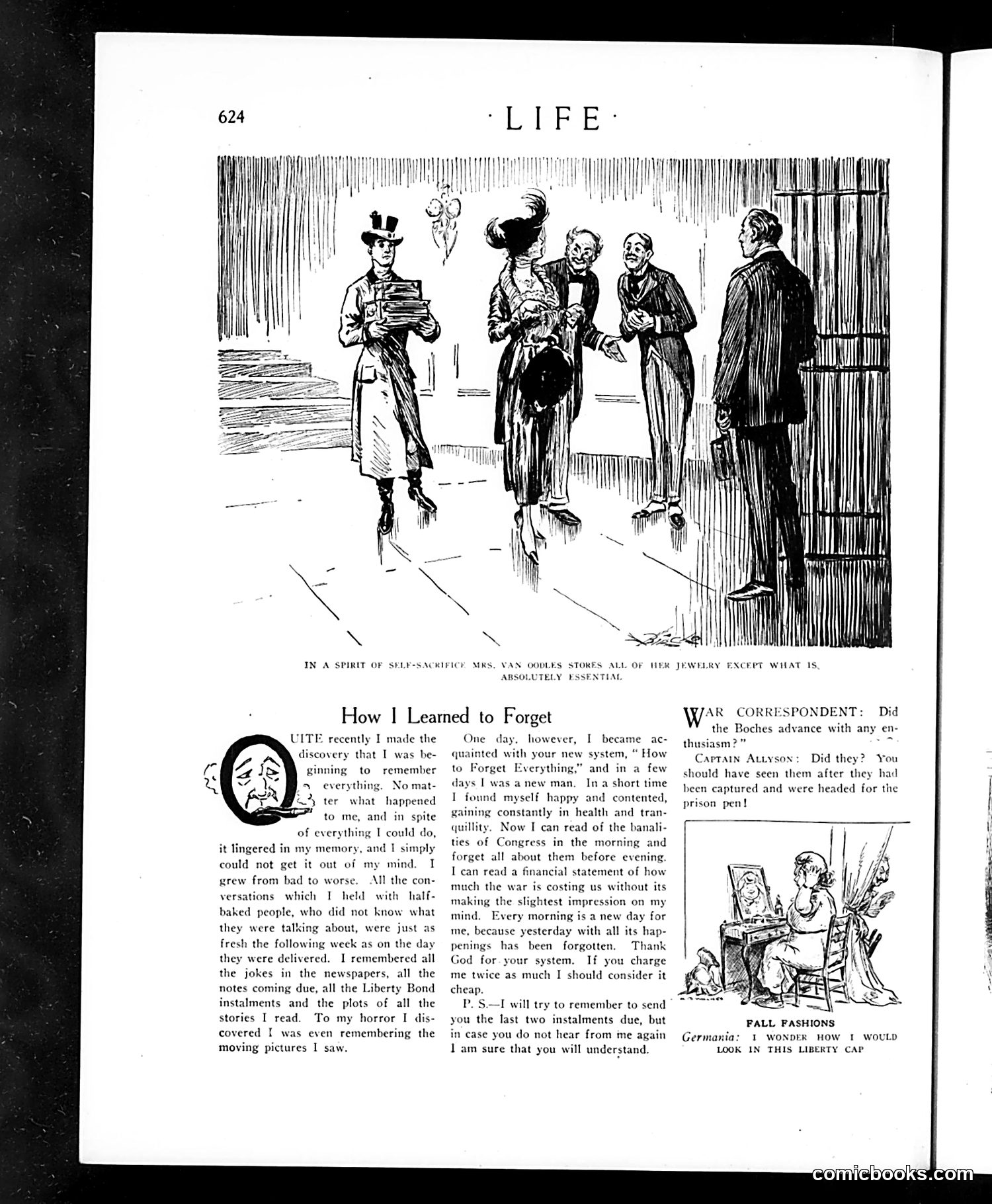
**Top Cartoon:** Depicts a woman (Mrs. Van Oddes) entering what appears to be a jewelry store or establishment, while several men in formal attire observe. The caption indicates she's storing jewelry "except what is absolutely essential"—satirizing wartime sacrifice and rationing during what appears to be World War I. **Main Article:** "How I Learned to Forget" describes someone adopting a memory-loss system to cope with wartime anxiety. The writer deliberately forgets disturbing news about war costs, Liberty Bond payments, and casualty reports to maintain mental peace. **Right Section:** A brief military dialogue between a war correspondent and Captain Allyson about the Boches (German forces), plus a "Fall Fashions" cartoon about a Liberty Cap. The page satirizes both civilian wartime denial and the absurdity of maintaining normalcy during conflict.
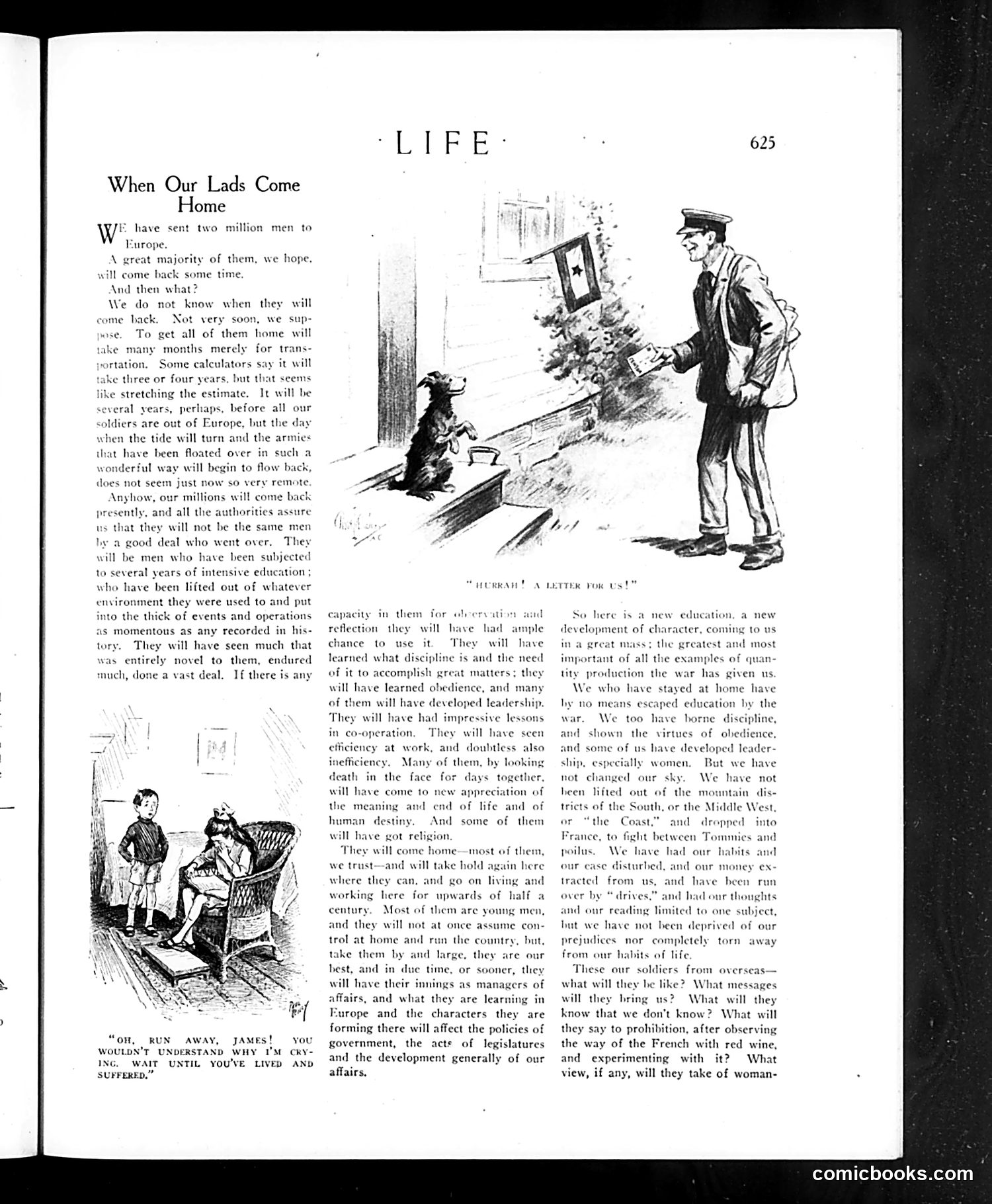
This page presents two related illustrations about soldiers returning from World War I. The article discusses the anticipated homecoming of two million American troops sent to Europe, expressing uncertainty about reintegration timelines and the soldiers' changed character after years of warfare and military discipline. The top cartoon shows a dog greeting a returning soldier at a doorway, captioned "Hurrah! A letter for us!" The bottom illustration depicts two women (likely wives or mothers) discussing the soldiers' return. The satire addresses anxiety about how war-hardened veterans—now trained in obedience, leadership, and having witnessed death—would readjust to civilian life and whether they'd accept civilian authority or struggle with displacement and changed perspectives after their transformative wartime experiences.
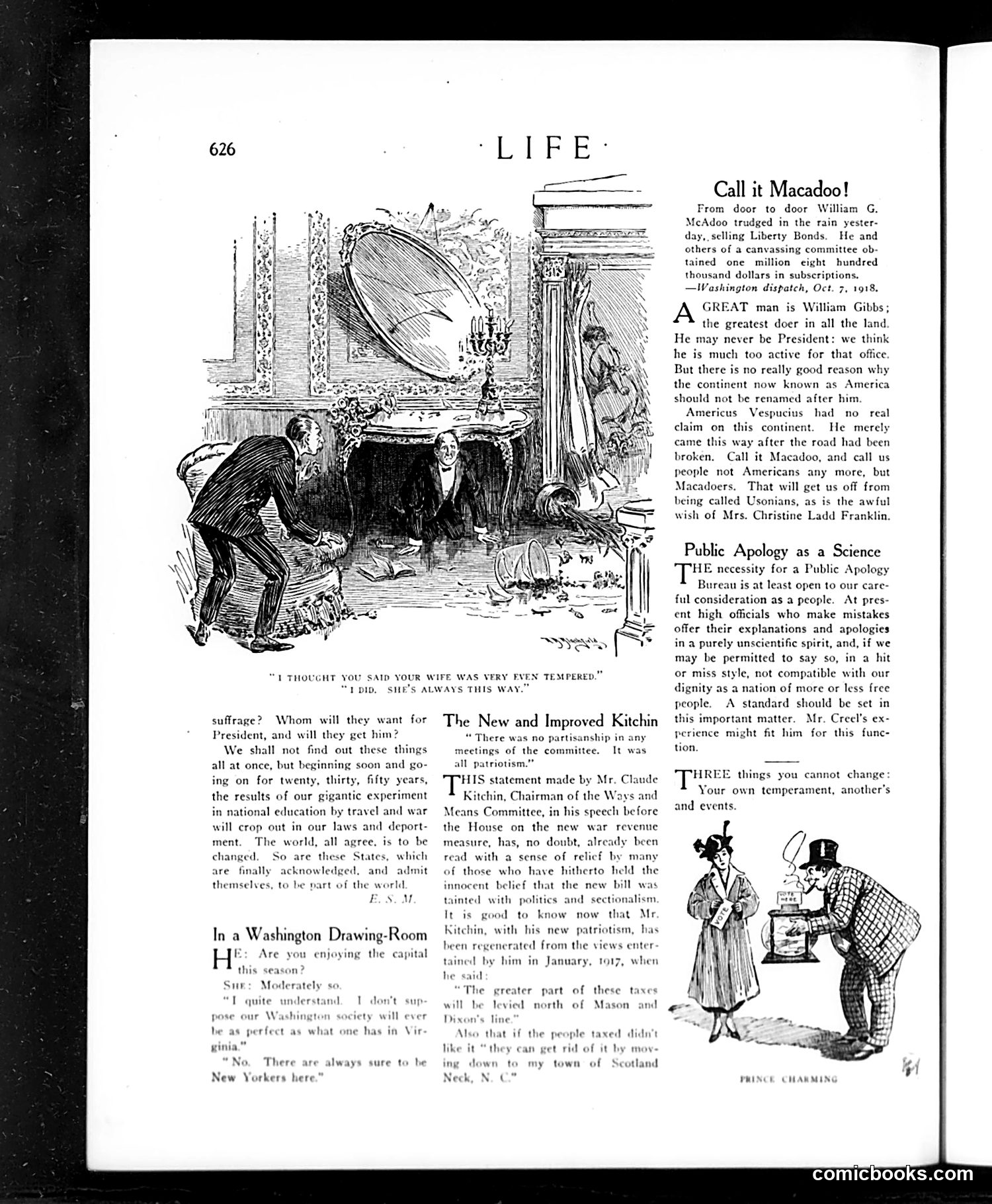
This page from *Life* magazine (October 7, 1918) contains political commentary and satirical cartoons about post-WWI America. **"Call it Macadoo!"** argues that America should be renamed "Macadoo" instead of "America," as a tribute to William Gibbs McAdoo (Treasury Secretary and prominent Democrat). The piece dismisses Americus Vespucius's historical claim and humorously suggests this would distinguish Americans from "Macadoors." **"Public Apology as a Science"** mocks government officials who make mistakes then offer weak explanations, arguing high standards of accountability are needed. **"In a Washington Drawing-Room"** is a brief satirical dialogue about Washington society's pretensions. **"The New and Improved Kitchen"** discusses tax policy changes under Chairman Claude Kitchin, praising his patriotic stance on war revenue measures. The cartoons use visual humor to support these political commentaries typical of *Life*'s satirical approach.
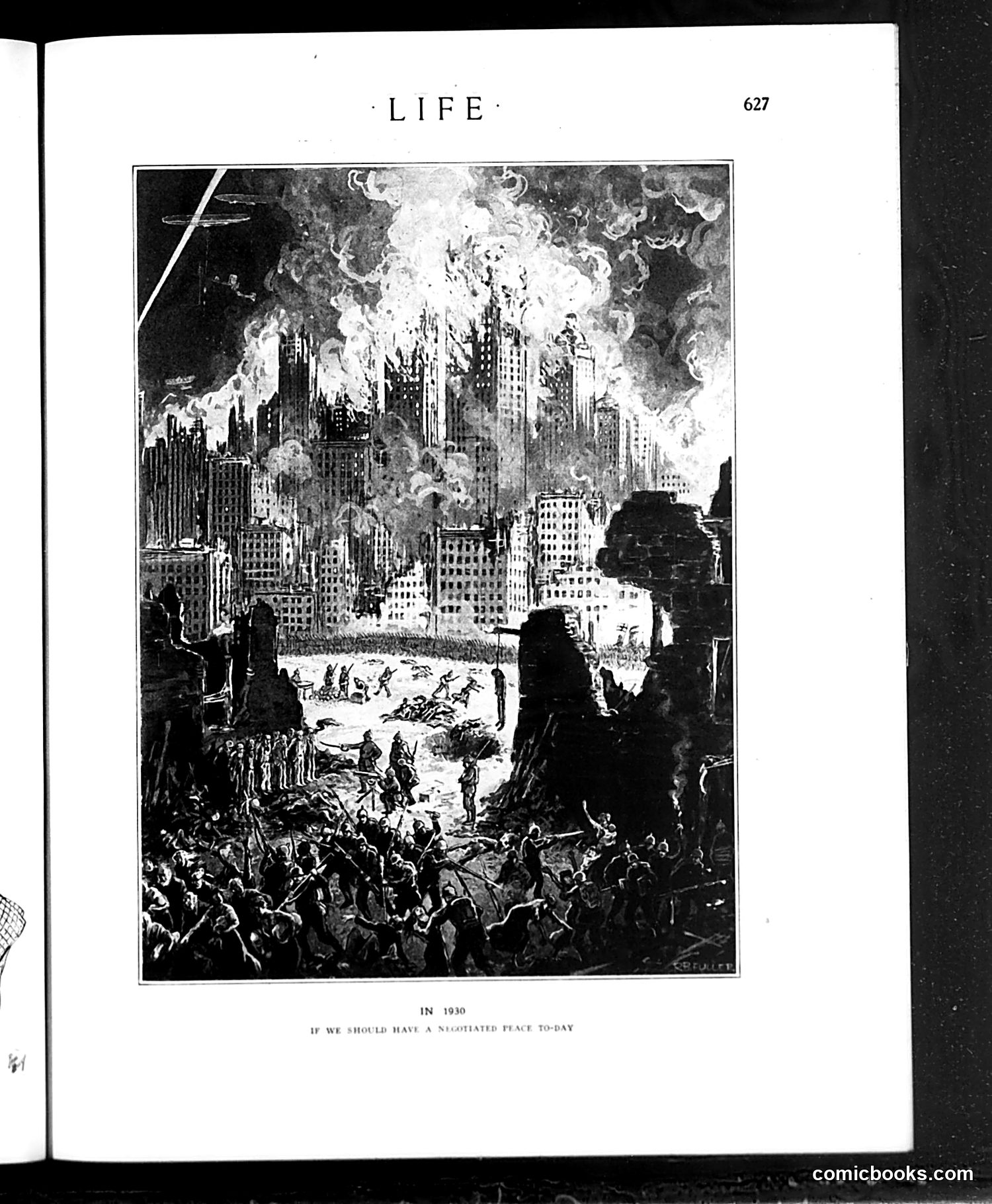
This is a satirical illustration titled "In 1930 If We Should Have a Negotiated Peace To-Day," depicting a dystopian urban nightmare. The image shows a major American city (likely New York, given the skyline) engulfed in massive fires and explosions, with crowds of people fleeing in panic below towering skyscrapers. The satire appears to warn against pursuing peace negotiations without proper terms or strength—suggesting that a "negotiated peace" achieved through weakness or compromise would lead to catastrophic consequences. The destruction visualizes the artist's belief that inadequate peace agreements fail to prevent future conflict and devastation. Published in 1930, this reflects post-WWI anxieties about international diplomacy's failures and growing concerns about another potential war.
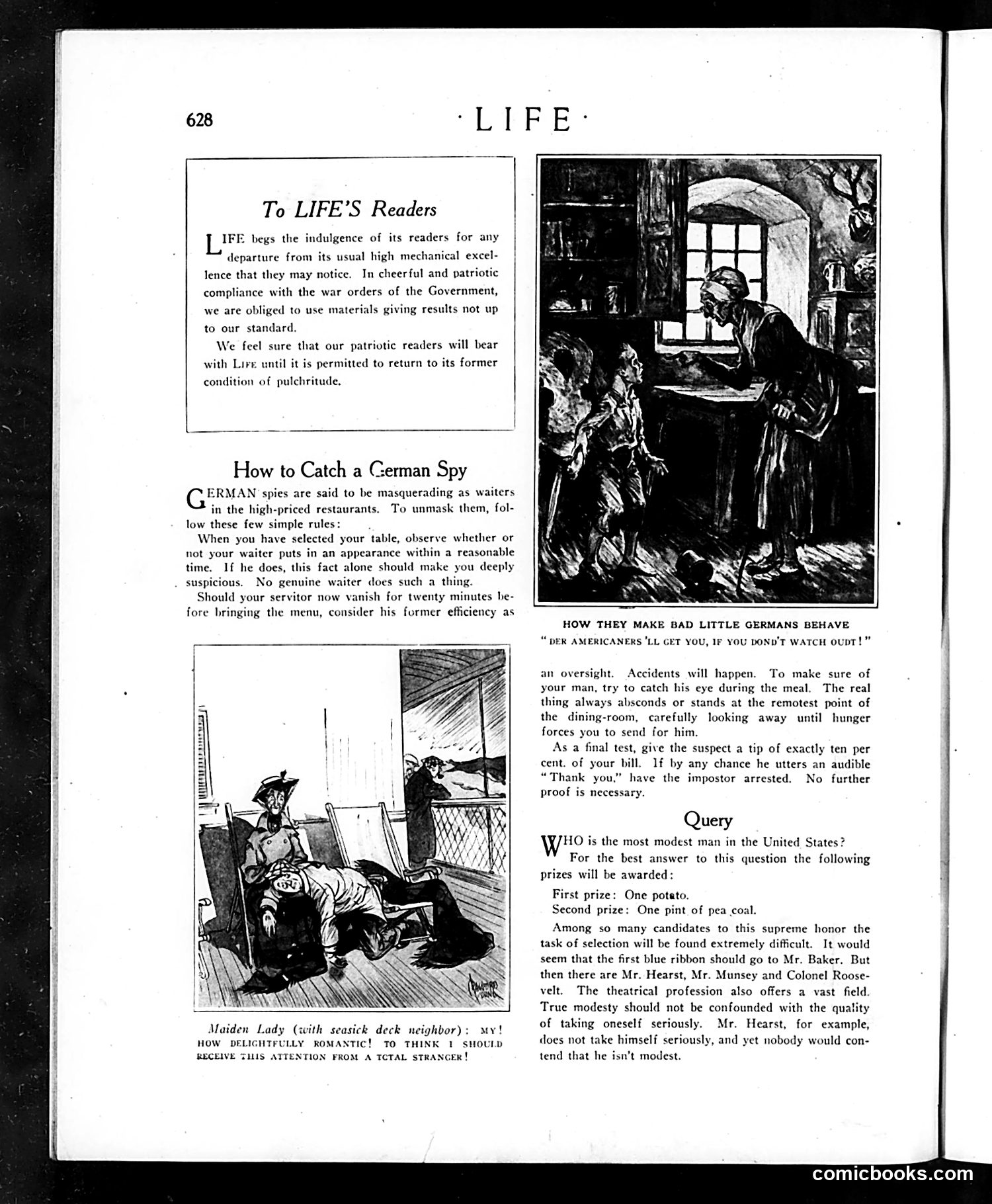
This page contains **wartime propaganda satire from World War I** (indicated by the "German spy" content and patriotic framing). **"How to Catch a German Spy"** mocks German espionage by offering absurdist detection rules: observing waiter punctuality, disappearances, and tipping etiquette as spy indicators. The cartoon below shows a "Maiden Lady (with seasick deck neighbor): sly!" - satirizing paranoid civilian suspicions of ordinary people as potential spies. **"How They Make Bad Little Germans Behave"** depicts German child-rearing, using crude ethnic stereotyping to portray German parenting as harsh discipline. The **"Query"** section humorously asks "Who is the most modest man in the United States?" while listing political/theatrical figures, ultimately suggesting no one truly embodies modesty. This reflects America's WWI-era spy hysteria and anti-German sentiment, using humor to reinforce patriotic vigilance and mock both German spies and German culture.
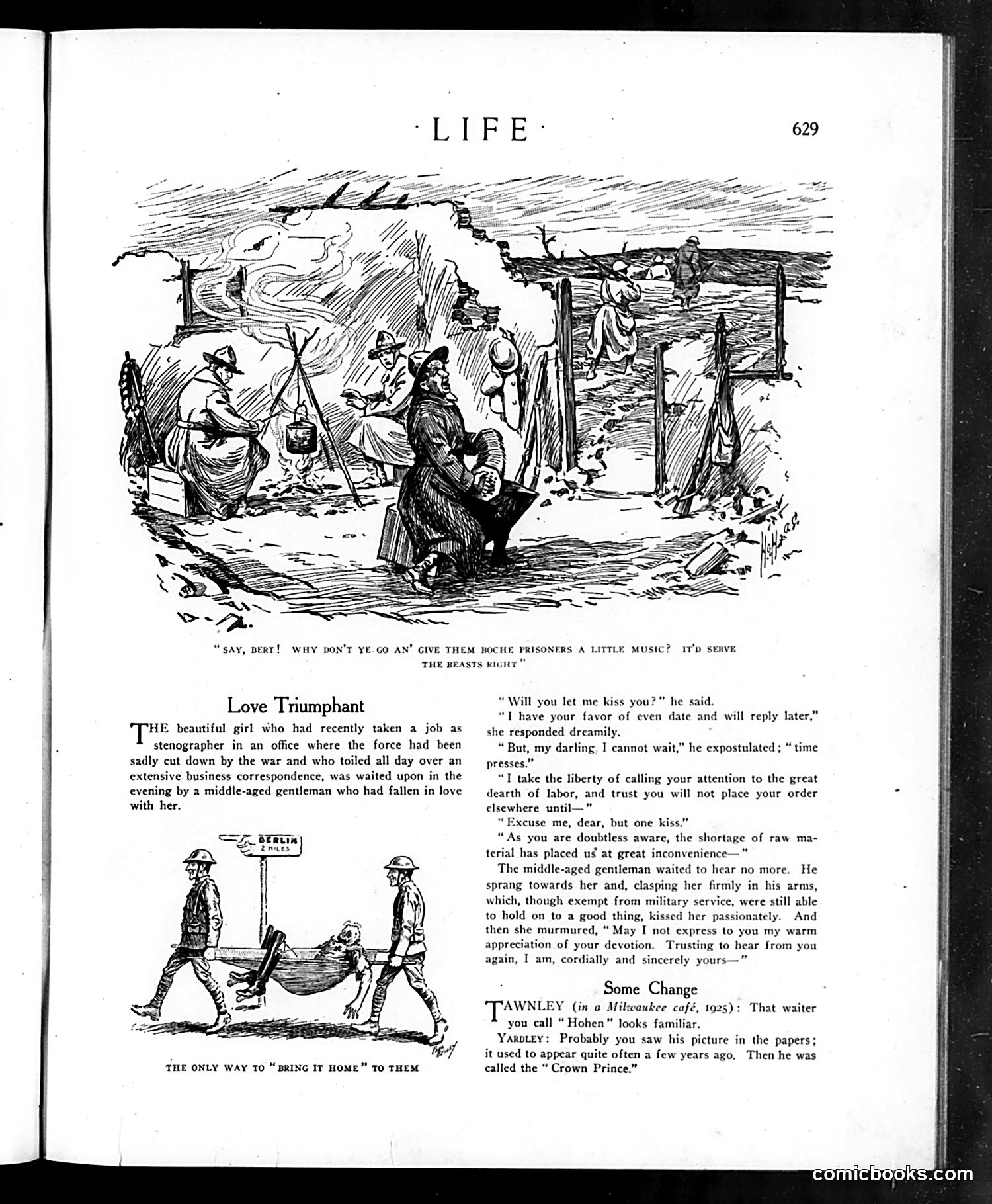
This page contains two satirical pieces from Life magazine's humor section. **"Love Triumphant"** depicts a wartime romance between a stenographer and a middle-aged gentleman during WWI (referenced by the war causing business correspondence stress). The sketch shows soldiers carrying a stretcher labeled "Berlin," illustrating the caption's dark humor: the only way to "bring it home" to prisoners is through music—a grim joke about military hardship. **"Some Change"** is a brief dialogue between Milwaukee café patrons (Tawley and Yardley) discussing a waiter nicknamed "Hohen" who was formerly photographed as the "Crown Prince"—likely referencing the German Crown Prince's fall from prominence after WWI's conclusion, now reduced to working menial jobs. Both pieces use wartime displacement and social upheaval for comedic effect.
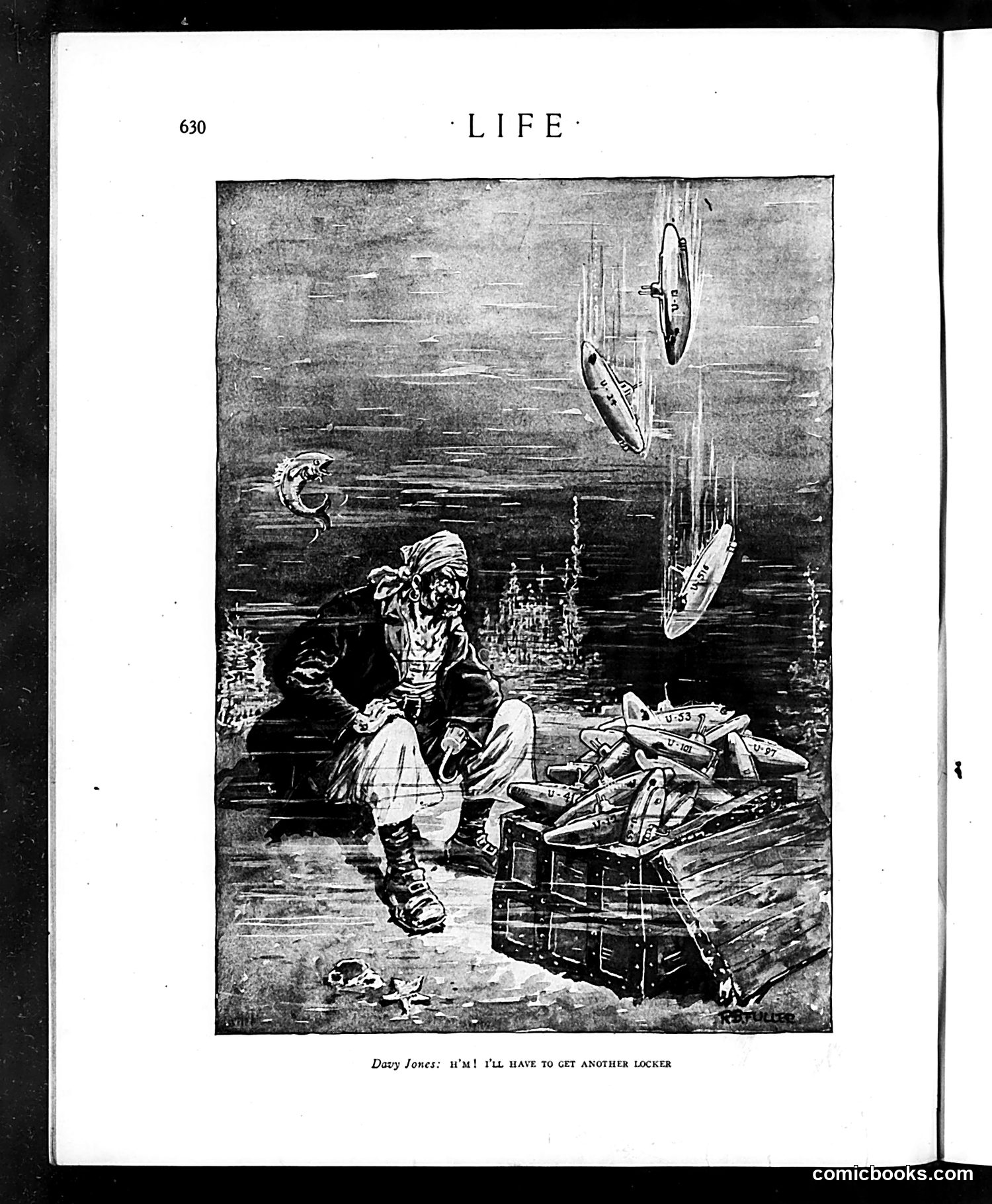
This is a cartoon titled "Davy Jones: 'W'! I'LL HAVE TO GET ANOTHER LOCKER'" from Life magazine (page 630). The image depicts a sailor or naval figure examining military aircraft (marked with U.S. insignia) that appear to have crashed or sunk underwater. The character appears to be Davy Jones, the mythological figure associated with the ocean and sailors lost at sea ("Davy Jones's Locker" being slang for the ocean floor/death). The cartoon is a wartime satire—likely from WWII era—commenting on military losses. The joke plays on the traditional phrase "Davy Jones's Locker" (where lost sailors end up) while showing destroyed American military equipment accumulating on the seafloor. The sailor's quip about needing "another locker" darkly jokes that losses are so extensive that even mythological storage space is overflowing, critiquing military waste or combat casualties.
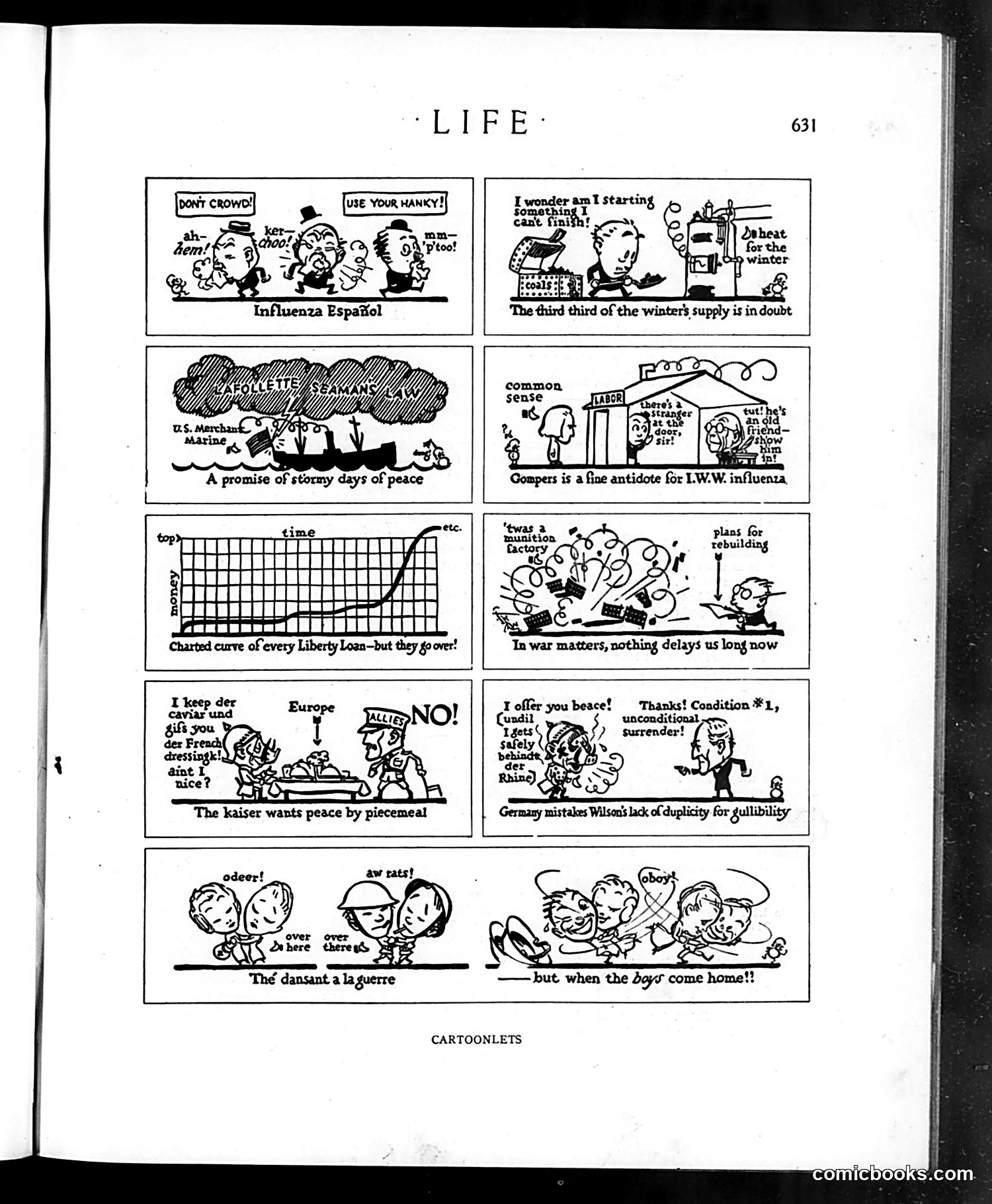
This page contains WWI-era political cartoons satirizing wartime conditions and diplomacy: 1. **"Influenza Español"** mocks crowded public spaces during the 1918 flu pandemic. 2. **"Winter's supply"** jokes about fuel/heating shortages on the home front. 3. **"Stormy days of peace"** depicts U.S. merchant marines facing submarine threats. 4. **Liberty Loan chart** satirizes the climbing debt from war bonds. 5. **"The Kaiser wants peace by piecemeal"** shows Germany's negotiation tactics, with the Kaiser offering conditional surrender while France resists. 6. **"The dansant à la guerre"** contrasts civilian dancing ("over here") with soldiers' experiences ("over there"). 7. **Final panel**: Wives/girlfriends eagerly await soldiers' homecoming ("when the boys come home!!"). The cartoons blend home-front hardships with military themes and romantic anticipation typical of 1918 American satire.
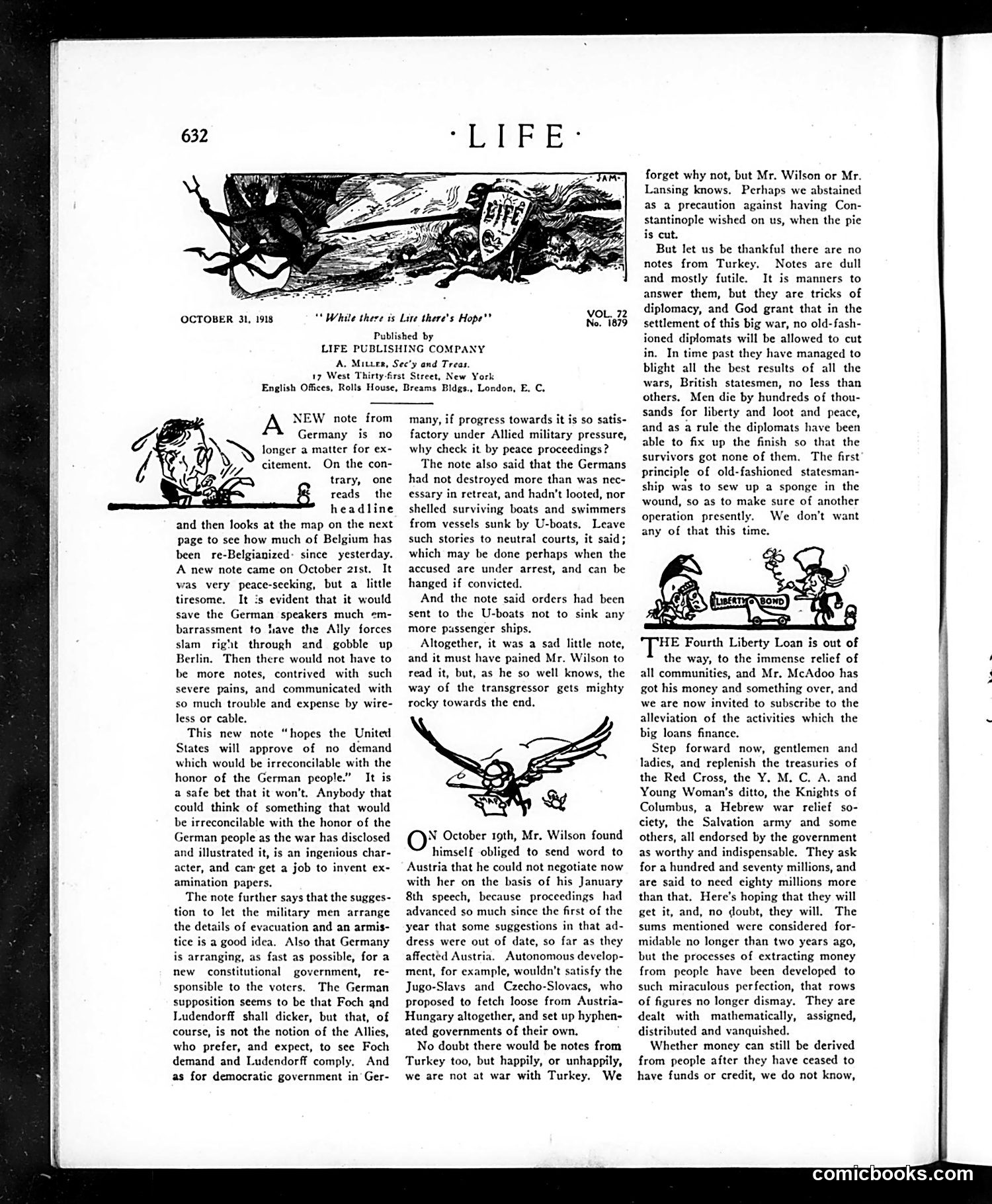
This October 1918 Life magazine page satirizes Germany's peace notes as the war neared its end. The cartoons mock German diplomatic efforts—depicted as pathetic, desperate attempts to negotiate surrender while claiming honor. The **main cartoon** (top left) shows a skeletal, diseased figure labeled "Germany," illustrating the nation's collapse. The article dismisses German peace notes as transparent lies: Germany claims it didn't loot Belgium or shell drowning sailors, but the author sarcastically suggests these defenses should go to "neutral courts" where the accused "can be hanged if convicted"—implying their guilt is obvious. The satire targets German hypocrisy: they propose new "democratic government" while still demanding negotiations as equals, when the Allies simply want unconditional surrender. The author ridicules this as pointless—like asking an enemy general to *dicker* rather than *demand* terms. The secondary cartoon (right) shows **Liberty Loan** fundraising, urging Americans to support relief organizations during the final war push. The overall message: Germany's diplomatic notes are futile stalling tactics from a defeated, morally bankrupt nation.
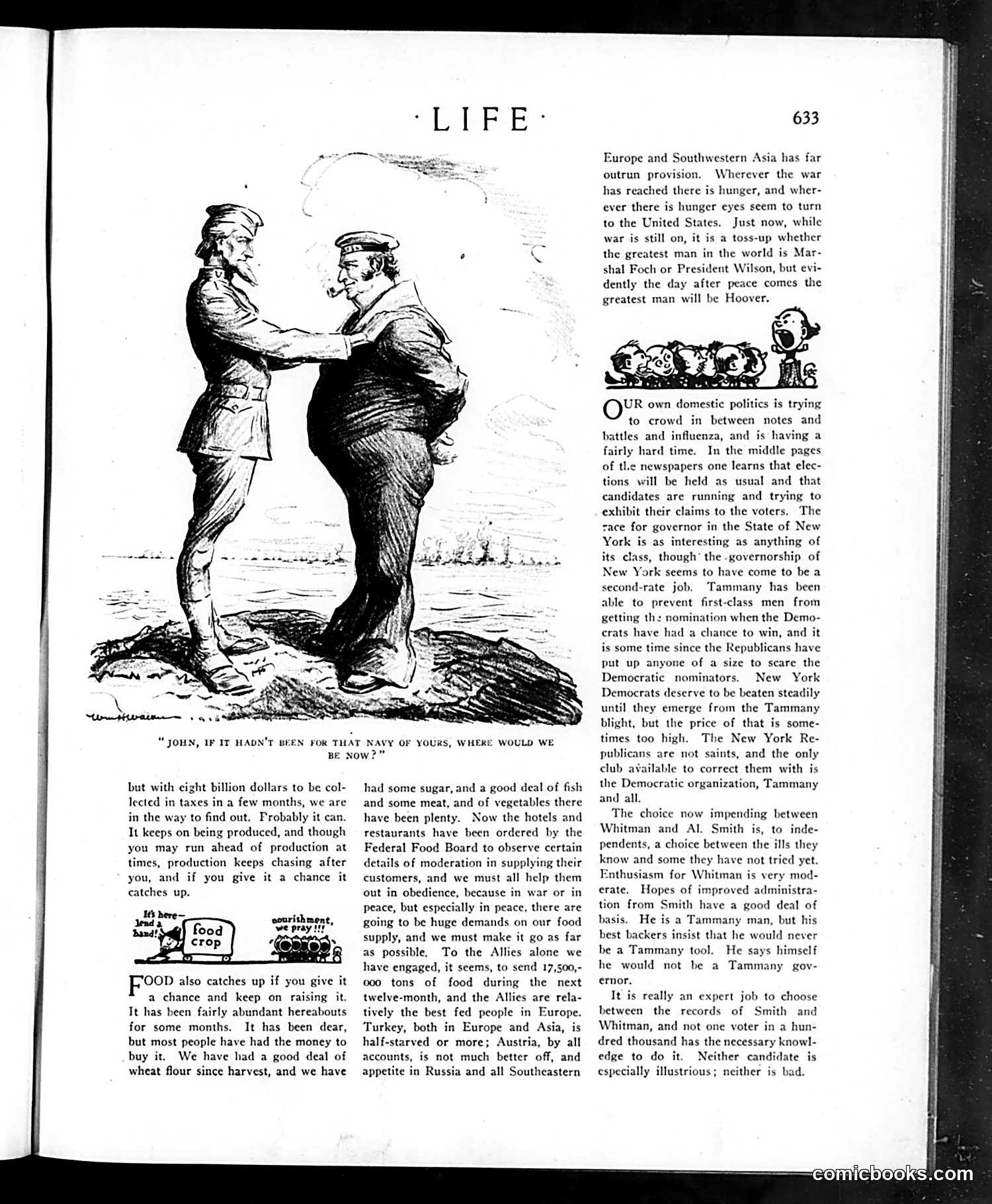
The main cartoon depicts two figures in conversation, with the caption "John, if it hadn't been for that navy of yours, where would we be now?" This appears to be a post-World War I political commentary. One figure likely represents a military or political leader (possibly Navy Secretary Josephus Daniels or similar), while "John" seems to address a civilian authority figure. The satire suggests irony: while the Navy was credited with wartime success, the accompanying text warns that massive post-war taxation and food production challenges loom ahead—implying the Navy's victory may create new domestic problems. The article discusses President Wilson and Herbert Hoover's likely post-war prominence, while also addressing domestic politics, particularly New York's gubernatorial race between Whitman and Al. Smith (a Tammany Hall Democrat). The broader point: Americans must grapple with serious economic realities even as political campaigns proceed.
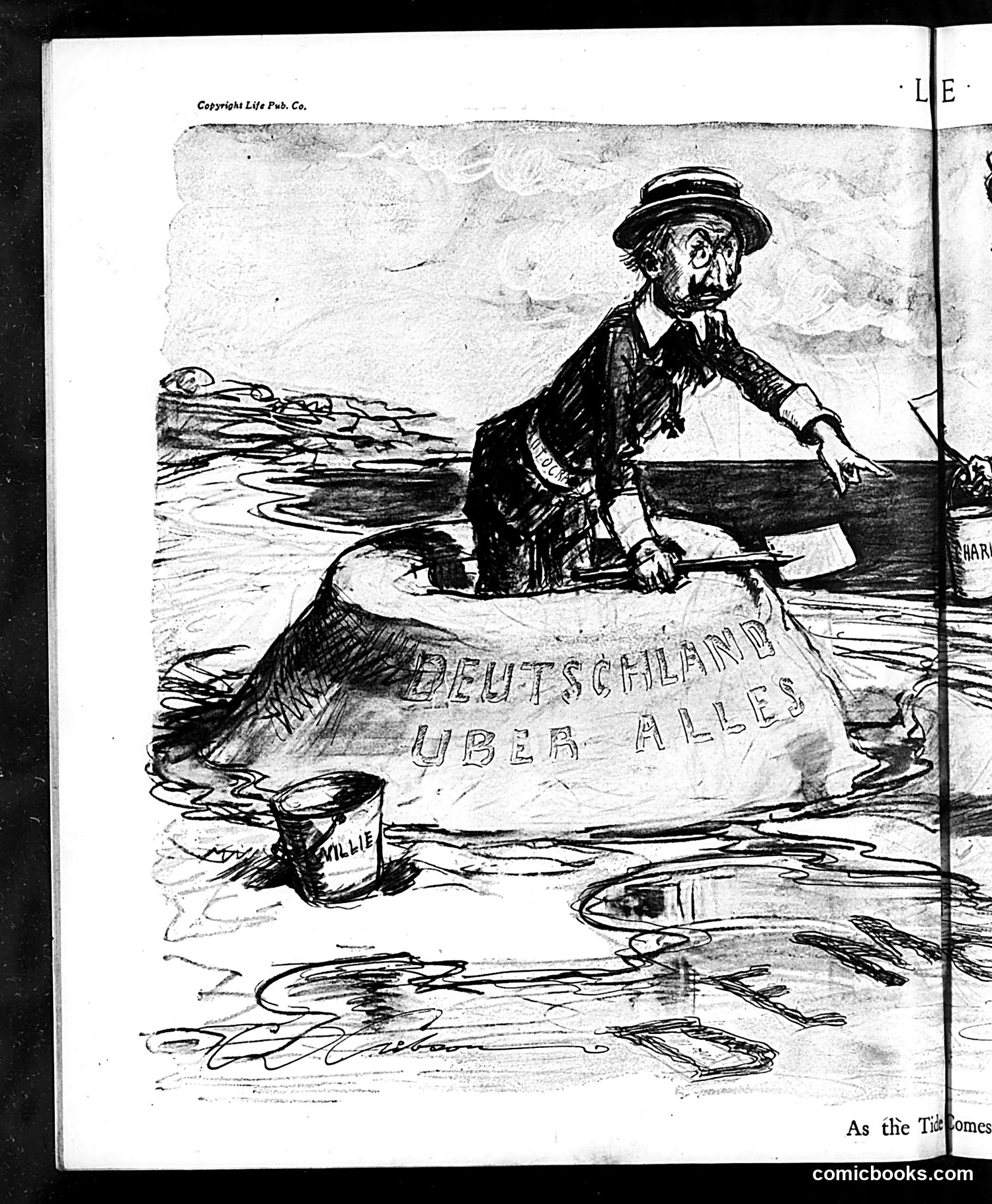
This political cartoon depicts a figure in old-fashioned clothing sitting in water, appearing to be sinking or struggling. A banner reading "DEUTSCHLANDS ÜBER ALLES" (Germany Above All) is visible, referring to a phrase from the German national anthem historically associated with German nationalism and militarism. The cartoon appears to satirize Germany's imperial ambitions or military situation, likely from the early 20th century context. The figure's distressed posture in the water suggests Germany is in trouble—possibly drowning in its own nationalist ideology or facing military defeat. The inclusion of a bucket labeled "WILLIE" (likely referring to Kaiser Wilhelm II) reinforces this as commentary on German leadership and imperial policy. The satire criticizes German nationalism and its consequences.
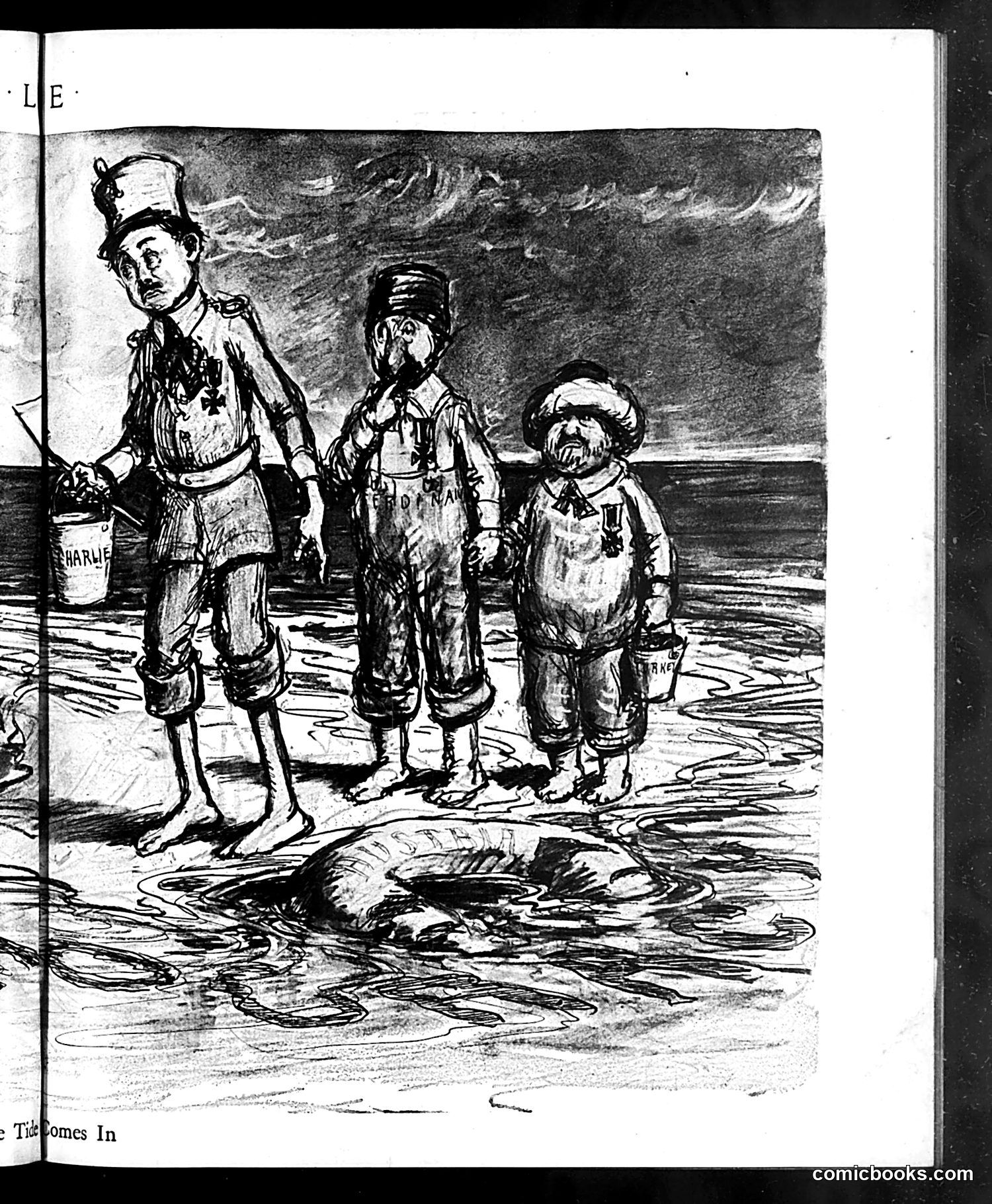
This appears to be a political cartoon from *Life* magazine depicting three military figures standing over a dead body in water. The leftmost figure wears a tall hat and holds what appears to be a bucket labeled "CHARLIE" (likely referring to France, as "Charlie" may reference French identity). The figures are drawn in exaggerated, caricatured style typical of early 20th-century satire. The cartoon likely comments on military conflict or casualties, possibly referencing World War I involvement or international relations involving France and other Allied powers. The dead body in water suggests naval warfare or maritime disaster. However, without a visible date or caption, I cannot definitively identify the specific historical event or figures being satirized.
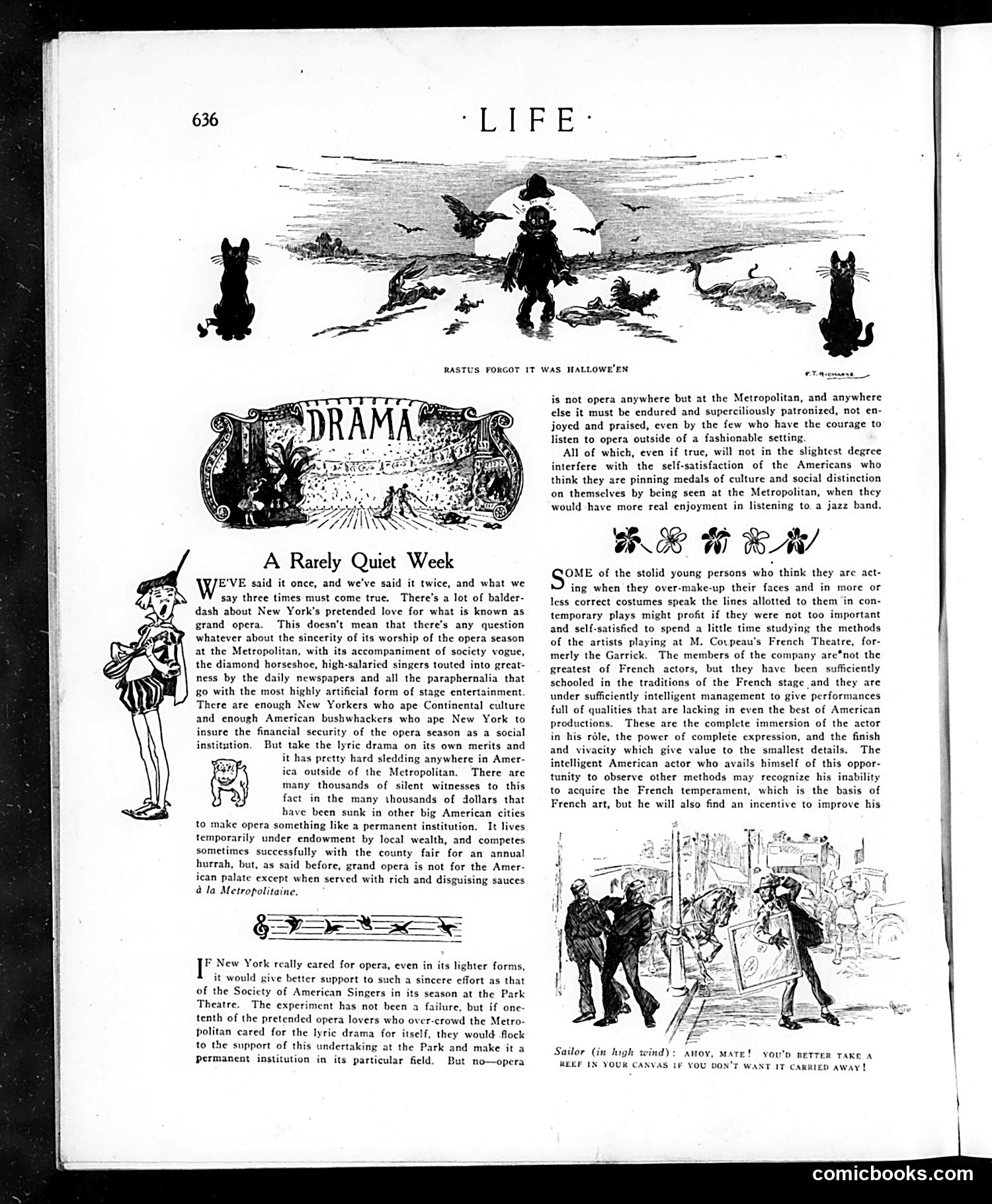
This page attacks New York's pretentious opera culture. The main article mocks wealthy New Yorkers who attend the Metropolitan Opera to display social status rather than appreciate music. The author argues that opera survives financially only through society patrons and endowments, not genuine public love—evidence being that opera companies fail elsewhere in America without aristocratic support. The satire's target: Americans who "ape Continental culture" and use the Metropolitan Opera as a status symbol, when they'd actually prefer jazz bands. The piece contrasts this with sincere efforts like the Park Theatre's Society of American Singers, which struggles without the Met's social cachet. A secondary criticism targets young theatrical actors who over-rely on makeup and affectation rather than studying French stage methods emphasizing complete immersion and expressiveness. The bottom cartoon (caption partially visible) appears to joke about sailors and canvas, likely unrelated commentary. The tone is withering social critique dressed as light commentary.
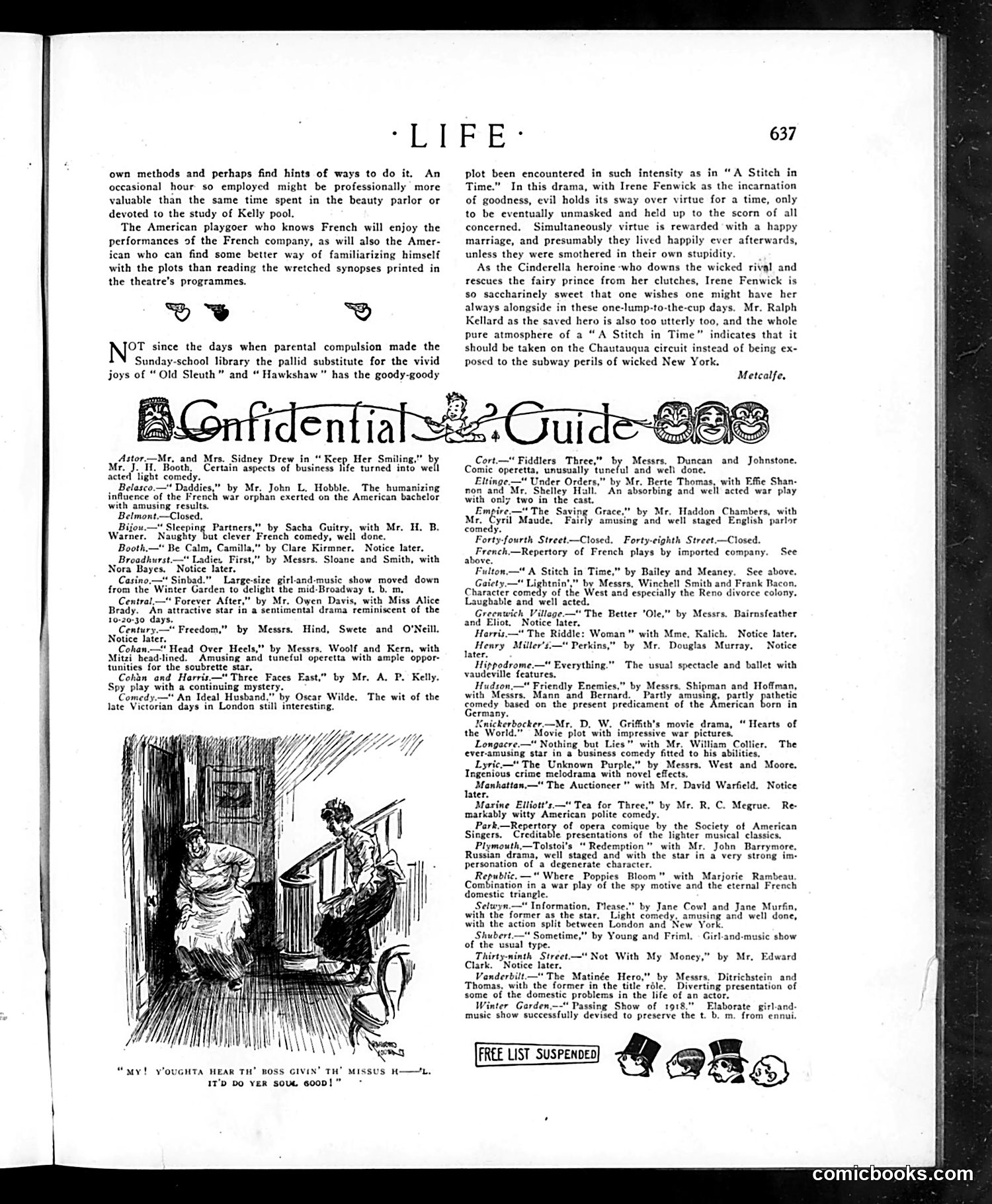
This page from *Life* magazine is primarily a theater review guide listing current Broadway productions with brief critical assessments. The main cartoon depicts a domestic scene where a woman eavesdrops on an angry man (presumably her husband, "the boss") berating someone—the caption suggests the humor lies in her imagining how such a scolding would benefit her own soul. The theatrical reviews are satirical, often dismissive. One entry critiques "A Stitch in Time," mocking its saccharine morality play formula where virtue triumphs and the heroine (actress Irene Fenwick) is so "saccharinely sweet" the reviewer suggests the play belongs on the Chautauqua circuit (wholesome touring shows) rather than exposed to "wicked New York" audiences. The satire targets melodramatic theater conventions of the era—implausibly pure heroines, predictable moral resolutions, and overwrought sentiment that the sophisticated urban audience supposedly found tedious.
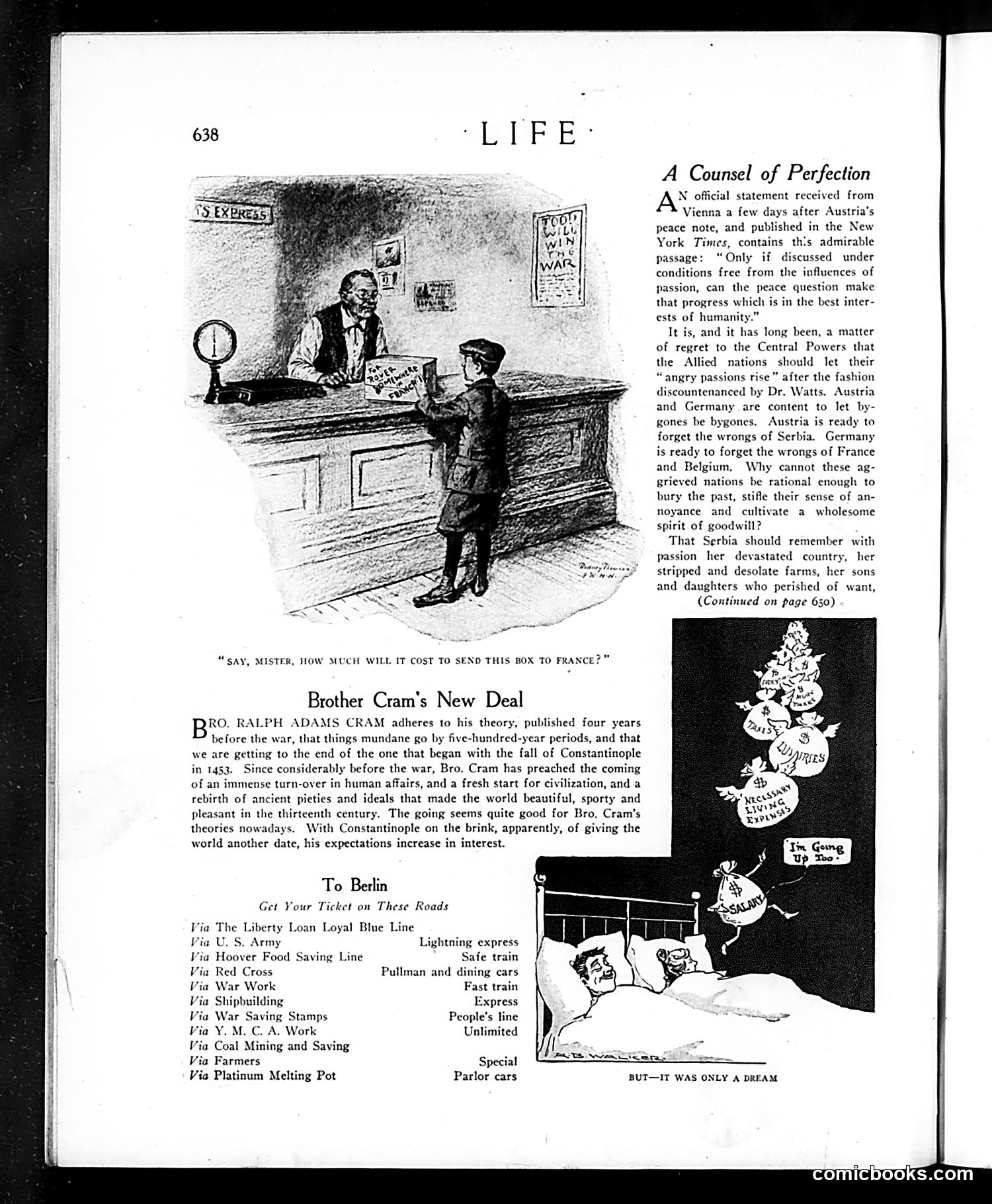
**Top Cartoon ("Say, Mister, how much will it cost to send this box to France?"):** A man at a post office counter asks about shipping costs to France, holding what appears to be a bomb or explosive device. This satirizes Austria-Hungary's audacious peace proposal (referenced in the article above), suggesting the Central Powers' call for rational, passion-free peace negotiations is absurd hypocrisy—they've devastated Allied nations and now ask victims to "bury the past" without consequence. **"A Counsel of Perfection" Article:** Life mocks Austria's official statement claiming the Allies should discuss peace without "angry passion." The text sarcastically notes that Austria and Germany want forgiveness while Serbia, France, and Belgium suffered massive destruction and casualties. The satire: how can victims rationally ignore devastation? **Bottom Cartoon ("But—it was only a dream"):** A soldier dreams of traveling to Berlin via absurd routes (War Bonds, Red Cross, Food Saving, etc.). Upon waking, the dream evaporates—satirizing American propagandistic optimism about war's end as pure fantasy.
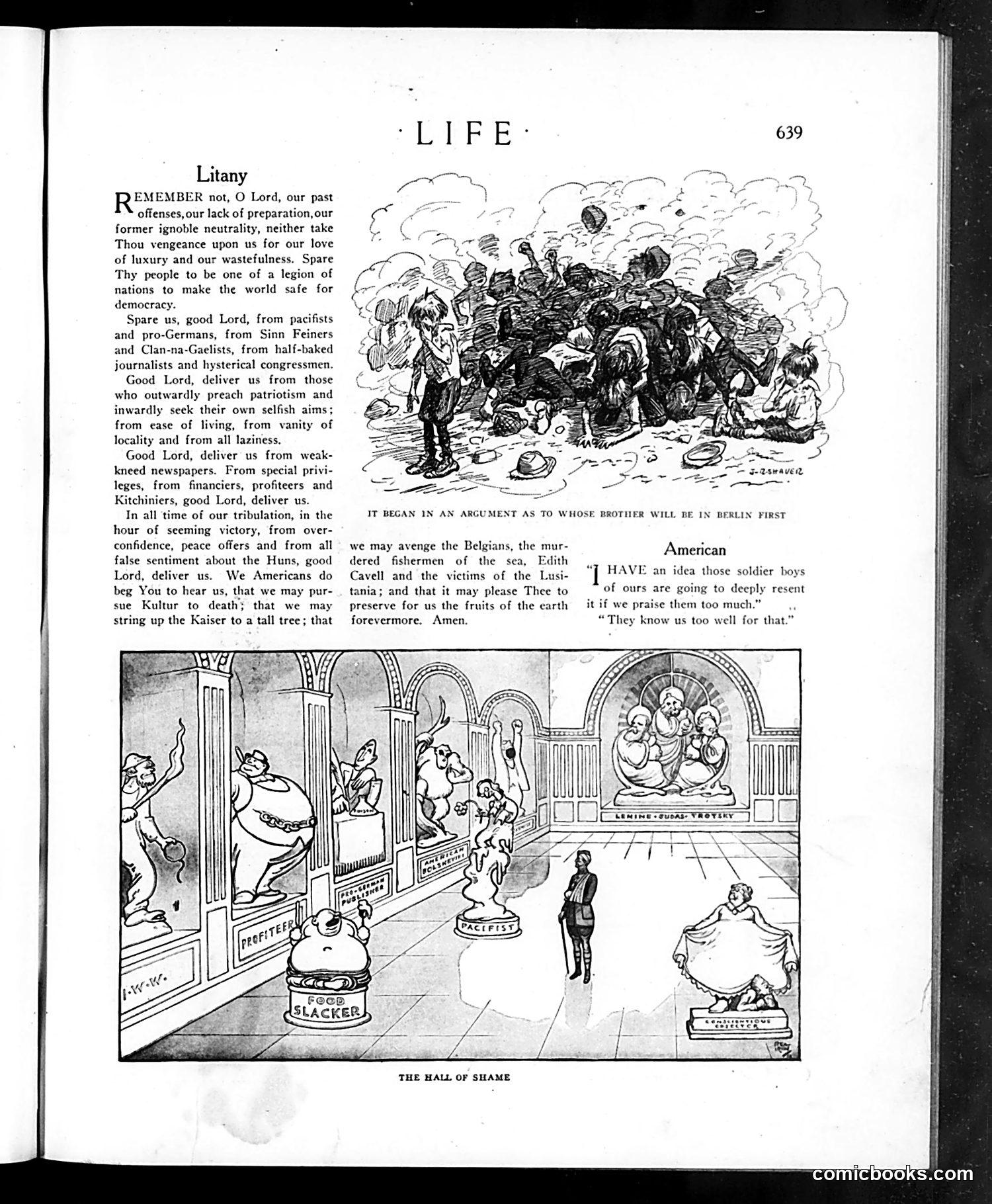
This page contains two distinct satirical pieces from America's involvement in World War I. **"Litany"** is a mock prayer sarcastically listing what Americans should pray for: deliverance from pacifists, pro-Germans, profiteers, and weak newspapers. It references real WWI figures—Edith Cavell (executed nurse), the Lusitania (torpedoed ship)—and mocks American self-righteousness about fighting to make "the world safe for democracy." The tone suggests Life viewed American war enthusiasm as hypocritical, given prior neutrality and materialism. **"The Hall of Shame"** cartoon depicts figures labeled with names (OCR unclear but likely political/military leaders) displayed like museum exhibits. The title and figures on pedestals suggest these are people Life blamed for war decisions or failures—possibly pacifists, profiteers, or politicians. One soldier observes them. Both pieces criticize American society: false patriotism, profiteering, and selective blame-assignment for the war. The satire targets elite hypocrisy more than the war itself.
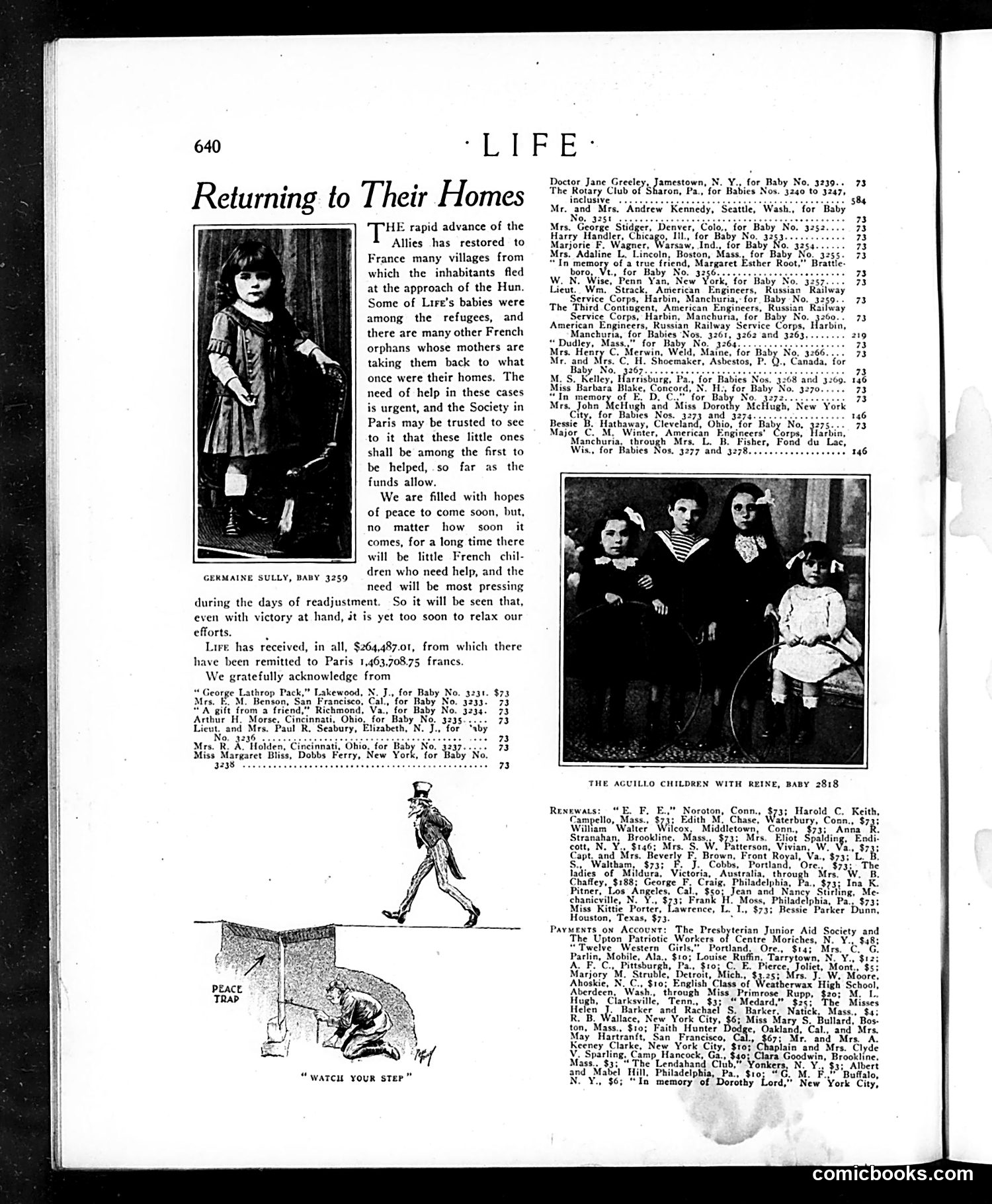
This page documents **Life magazine's charitable campaign for French war orphans** during or just after World War I. The main text describes how Allied advances have allowed French refugees—including orphaned children—to return home after fleeing Hun (German) invasion. The article emphasizes urgent need: many French children lack mothers and require sustained aid "even with victory at hand." Life has fundraised $264,487.01, remitting over 1.4 million francs to Paris relief efforts. **The photographs** show: - Germaine Sully (Baby 3259), a French orphan - The Aguillo children with "Reine" (Baby 2818) **The cartoons** ("Watch Your Step," "Peace Trap") appear to warn against complacency—the figure stepping carefully suggests vigilance is still needed despite war's end. The bulk of the page lists **donors' names and amounts** ($73-$188 contributions), showing how American readers "adopted" French babies through financial sponsorship—a common WWI-era charitable mechanism.
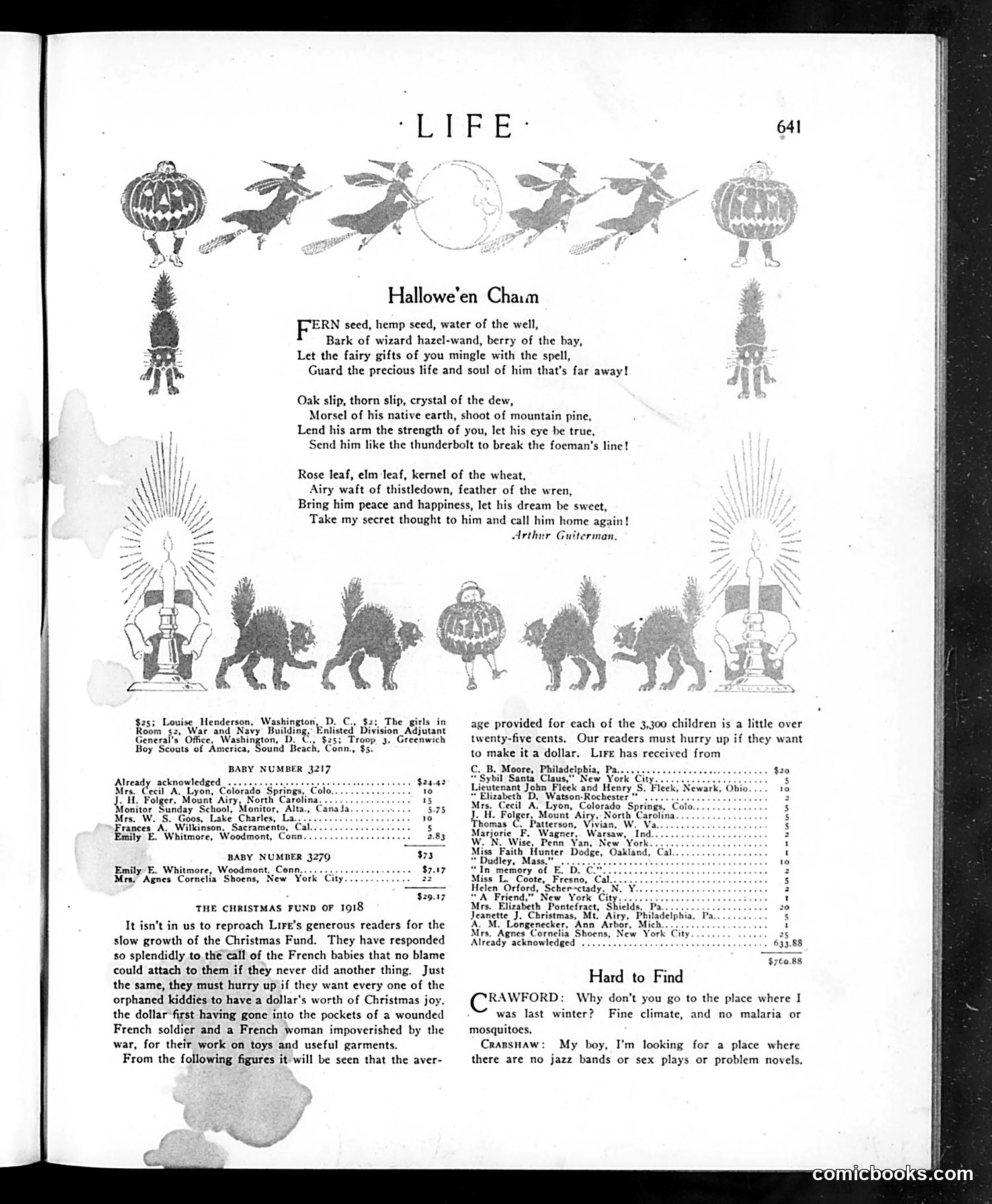
This page from *Life* magazine (circa 1918, based on references to WWI) contains two main elements: **"Hallowe'en Charm"**: A poem by Arthur Guiterman presenting a protective spell for soldiers fighting in World War I. The illustrated borders feature witches, jack-o'-lanterns, broomsticks, and magical imagery. This is sentimental patriotic verse—using Halloween's magical associations to invoke supernatural protection for "him that's far away" (soldiers on the front lines). The rhetoric about lending "strength" and breaking "the foeman's line" makes the military purpose explicit. **"The Christmas Fund of 1918"**: An appeal for donations to provide French orphans with Christmas gifts, listing contributors and amounts. The magazine notes it's raised money slowly and urges readers to hurry donations so each of 3,300 children receives a dollar's worth of gifts. **"Hard to Find"**: A brief satirical dialogue where Crawford seeks a place with "fine climate, no malaria," and Crasshaw quips about finding nowhere without "jazz bands or sex plays or problem novels"—poking fun at social anxieties about modern entertainment corrupting society. The page primarily documents wartime charitable fundraising and patriotic sentiment.
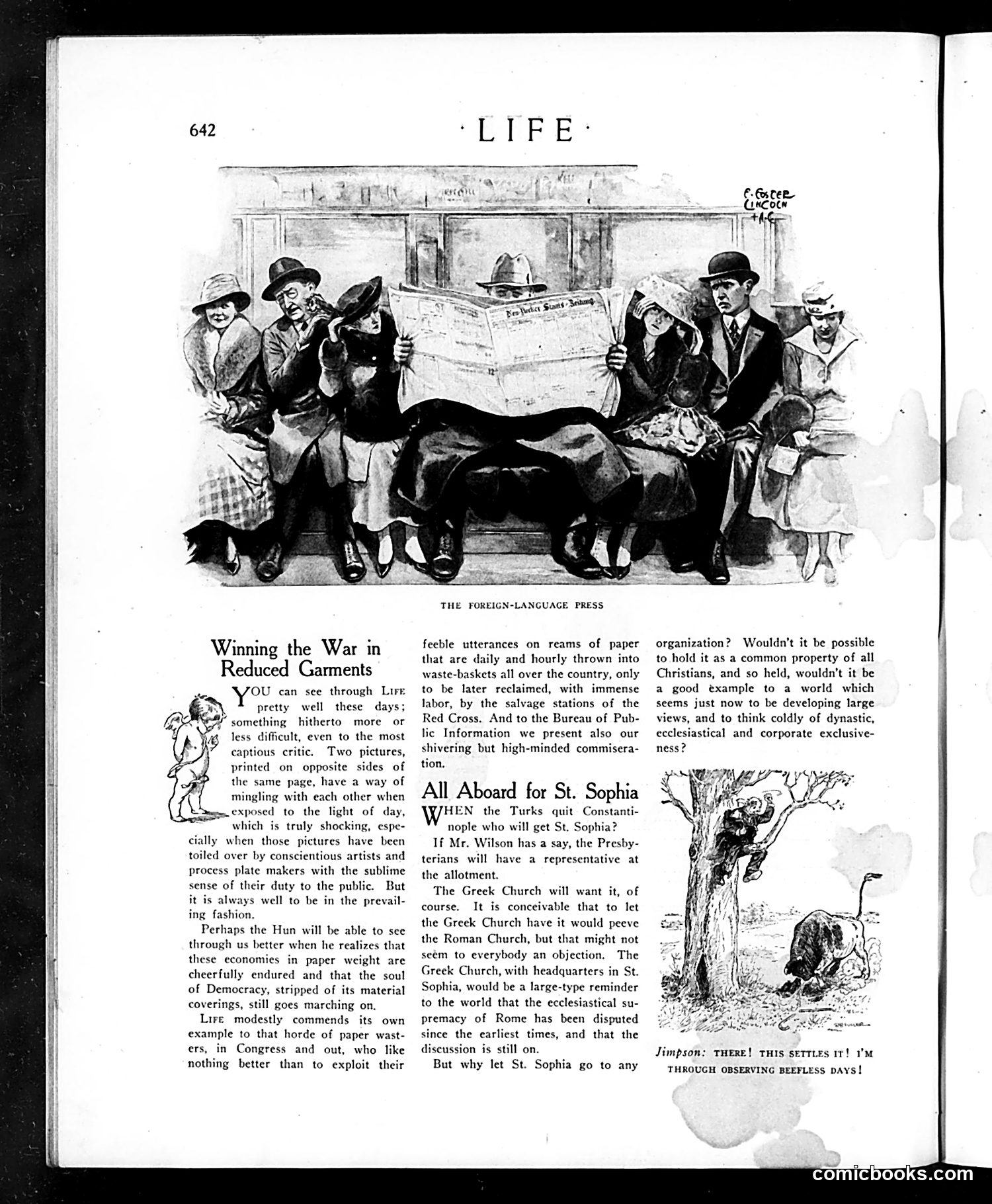
The top cartoon depicts foreign-language newspapers during WWI, shown as figures huddled around a large newspaper. "The Foreign-Language Press" satirizes immigrant media outlets, likely suggesting they were suspected of disloyalty or spreading propaganda during wartime. The main article "Winning the War in Reduced Garments" mocks Life magazine's own paper conservation efforts (thinner stock causing image bleed-through), while sarcastically praising them as patriotic sacrifice. It also criticizes wasteful politicians and government agencies who generate unnecessary paperwork despite conservation appeals. "All Aboard for St. Sophia" addresses post-WWI territorial questions: who will control Istanbul's famous Byzantine church once Ottoman rule ends? The piece proposes it become common property of all Christians rather than claimed by specific denominations—a plea for post-war cooperation over competitive nationalism. The small comic "Jimpson" jokes about meatless days (wartime rationing), showing someone exasperated enough to quit the practice entirely.
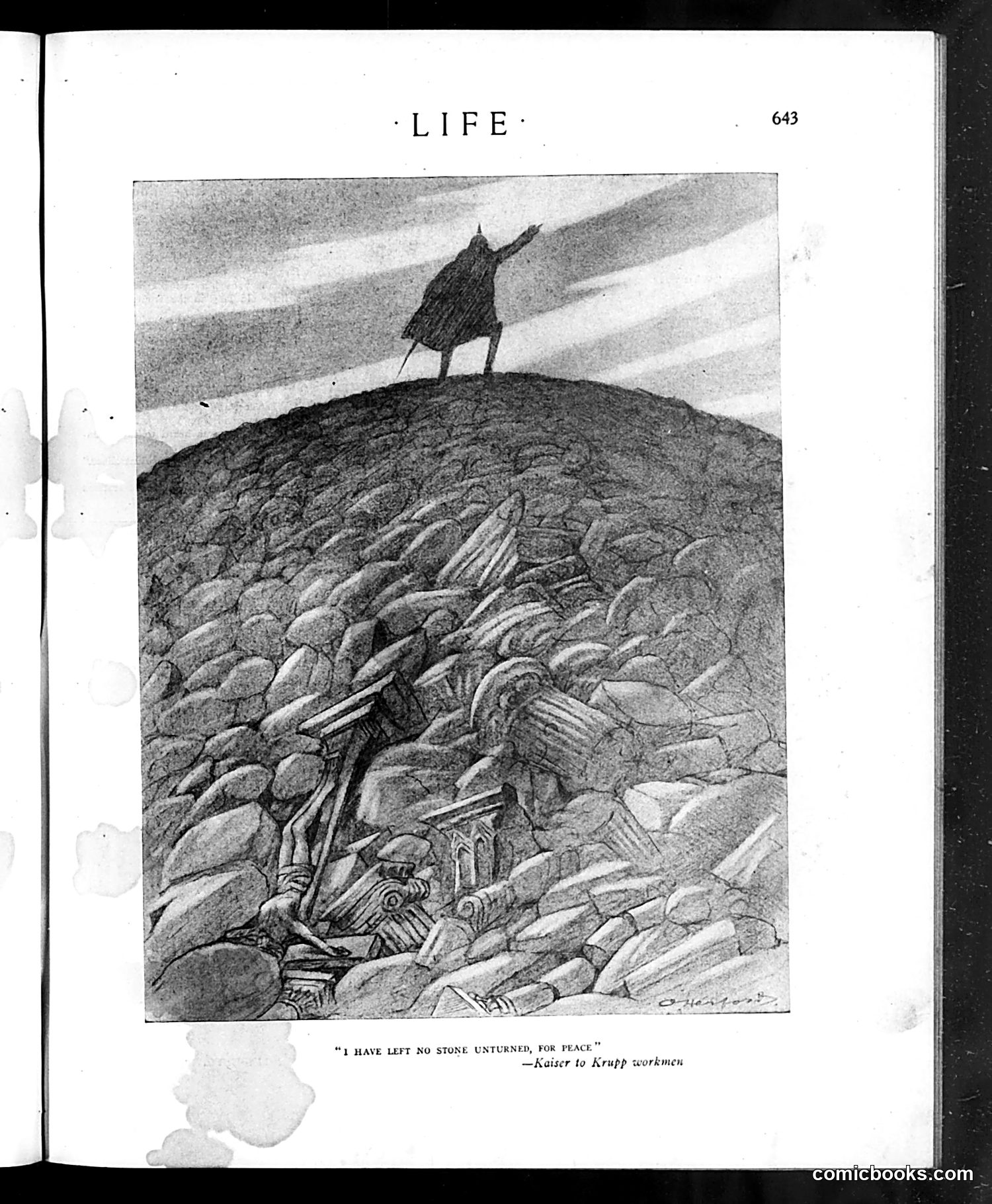
This satirical cartoon depicts Kaiser Wilhelm II (German emperor) standing atop a devastated landscape of dead soldiers, rubble, and destruction. The quote attributes to him a statement to Krupp (Germany's major munitions manufacturer): "I have left no stone unturned, for peace." The satire is bitter irony—the Kaiser claims to seek peace while literally surrounded by the carnage his military policies created. "No stone unturned" (meaning exhaustive effort) becomes grotesquely literal: the "stones" are actually fallen soldiers and war debris. This appears to be WWI-era propaganda criticizing German leadership and the arms industry's complicity in the war's destruction. The dark humor condemns the Kaiser's responsibility for massive casualties while maintaining a facade of peaceful intentions.
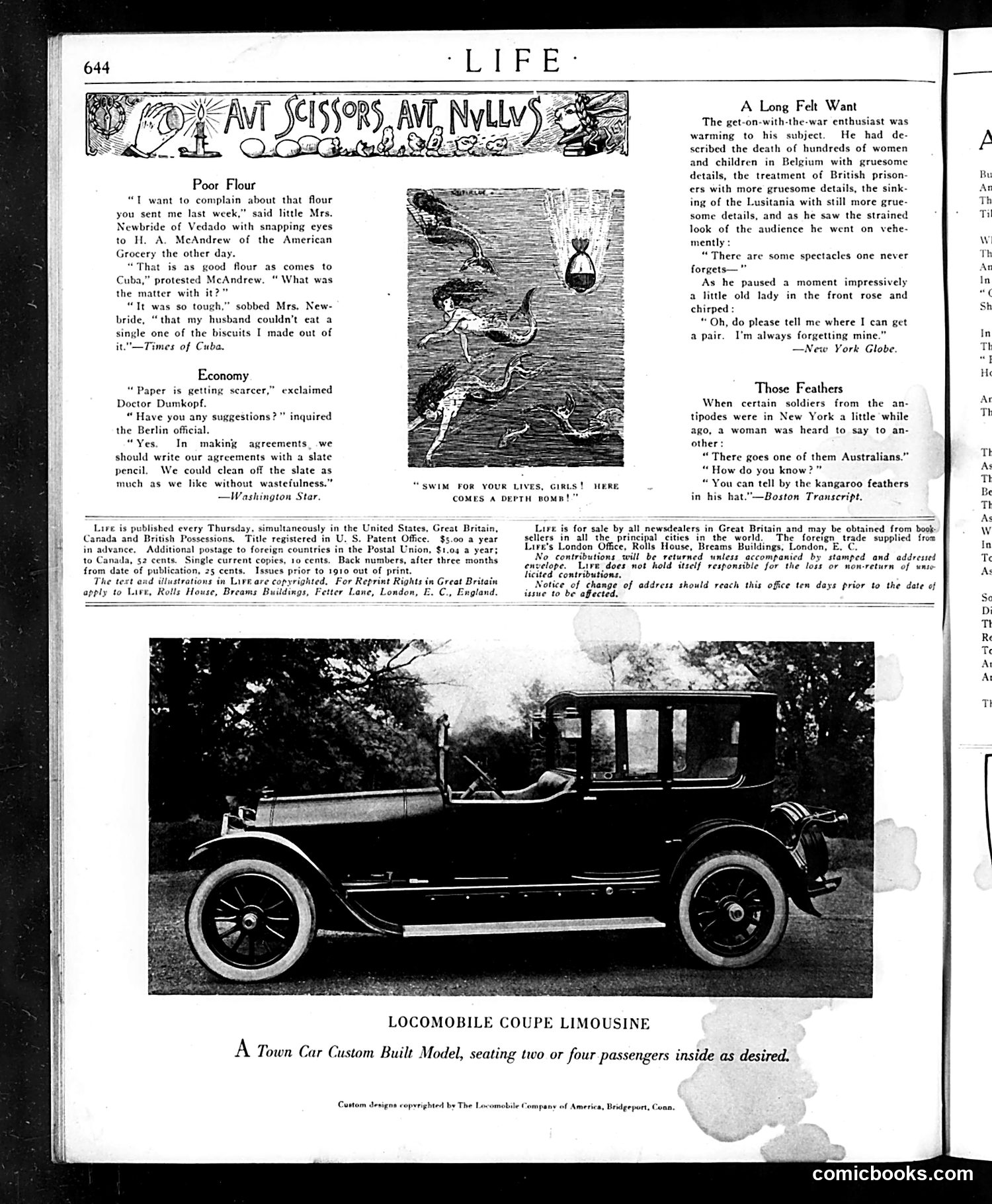
This page from Life magazine contains three brief satirical items: **"Poor Flour"** mocks Cuban-American relations through a domestic complaint—a newlywed criticizes imported flour so tough her husband cannot eat the biscuits. The joke relies on the absurdity of the complaint and implied criticism of trade quality. **"Economy"** is a German war joke. A Berlin official asks for paper-saving suggestions; a doctor proposes writing agreements in slate pencil so they can be "cleaned off" without waste. The satire targets German bureaucratic efficiency and implies cynicism about treaties—they can be erased as easily as slate markings. This appears WWI-era, likely mocking German diplomatic flexibility. **"Those Feathers"** jokes about American unfamiliarity with Australian soldiers during WWI. A woman identifies an Australian soldier by "kangaroo feathers" in his hat—a humorous confusion suggesting Americans couldn't distinguish Australian from other troops, or didn't understand Australian military insignia. The page also advertises a Locomobile automobile. The satirical tone targets wartime attitudes, international relations, and American cultural knowledge.
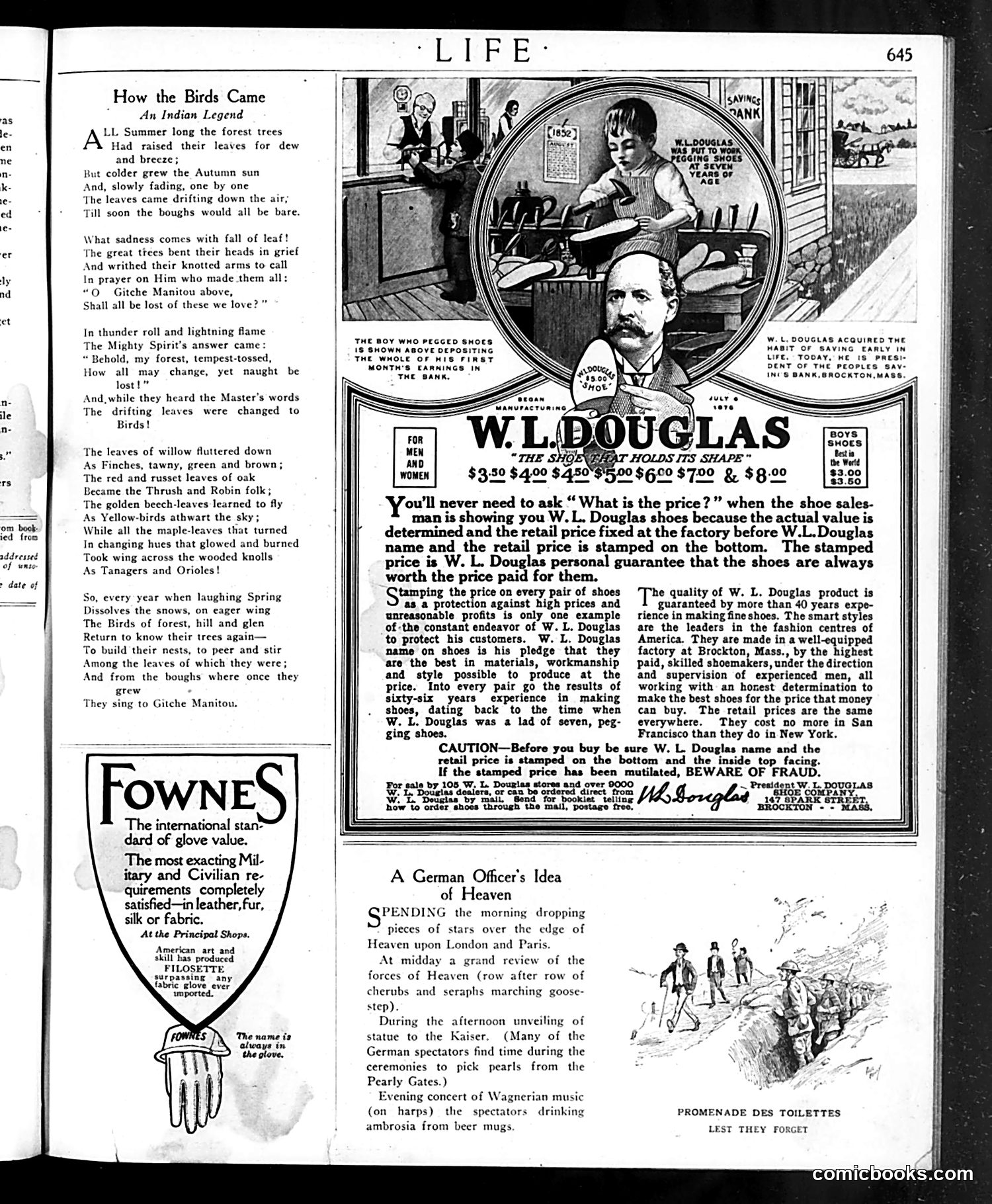
This page contains mostly **advertising and a literary poem**, with minimal political content. The main feature is "How the Birds Came: An Indian Legend"—a romanticized Native American creation myth (credited to "Gitche Manitou," the Ojibwe/Anishinaabe spirit) explaining how autumn leaves transform into birds. It presents Indigenous spirituality in the sentimental, nostalgic style typical of early 20th-century American popular culture. The **dominant content** is a large W.L. Douglas shoe advertisement emphasizing price transparency and quality—the company stamps retail prices on shoes as a "guarantee" against fraud and inflation profiteering. This reflects Progressive Era consumer protection concerns. Smaller ads promote **Fownes gloves** (marketed for military/civilian use, likely WWI-era) and reference "A German Officer's Idea of Heaven" (a satirical wartime piece, now mostly cut off). The page is primarily **commercial**, using the Indian legend poem as editorial padding around advertisements. The satire is minimal here—mostly the gloves ad's wartime marketing angle.
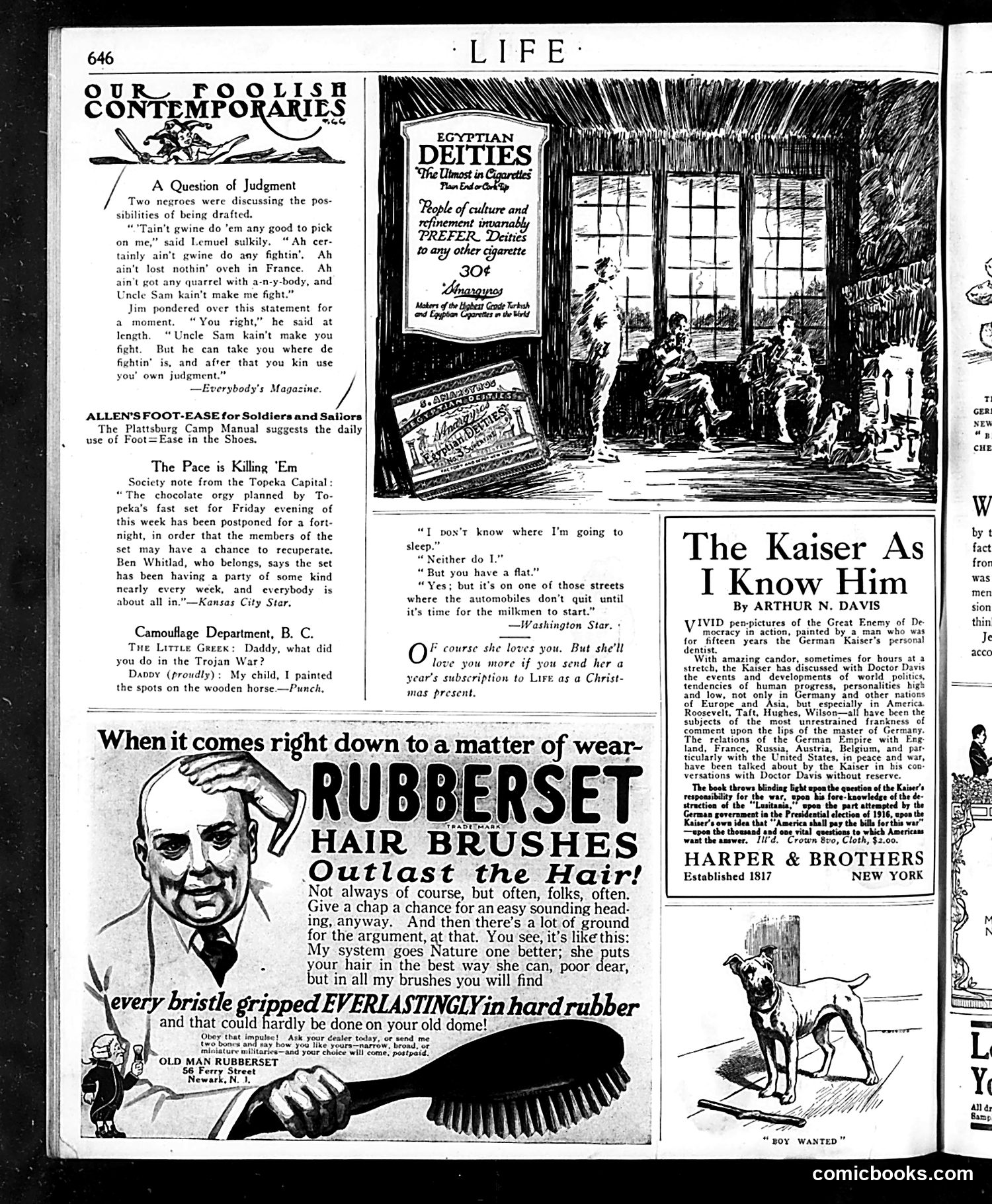
This page contains period-specific satirical content reflecting World War I-era America: **"A Question of Judgment"** presents a dialogue between two African American men discussing military draft resistance, using dialect humor common to the era. The satire critiques selective service logic: one man argues Uncle Sam can't force him to fight, while his friend counters that while Sam can't make him fight, he can deploy him where fighting occurs—leaving judgment to the individual soldier. **"The Kaiser As I Know Him"** advertises a book by Arthur N. Davis describing his alleged private conversations with the German Kaiser about world politics, American figures (Roosevelt, Taft, Wilson), and Germany's war responsibility. This appears designed to capitalize on wartime anti-German sentiment. The remaining content includes period advertisements (Rubberset Hair Brushes, Foot-Ease for soldiers) and lightweight humor pieces typical of Life magazine's satirical approach during WWI, mixing social commentary with commercial messaging.
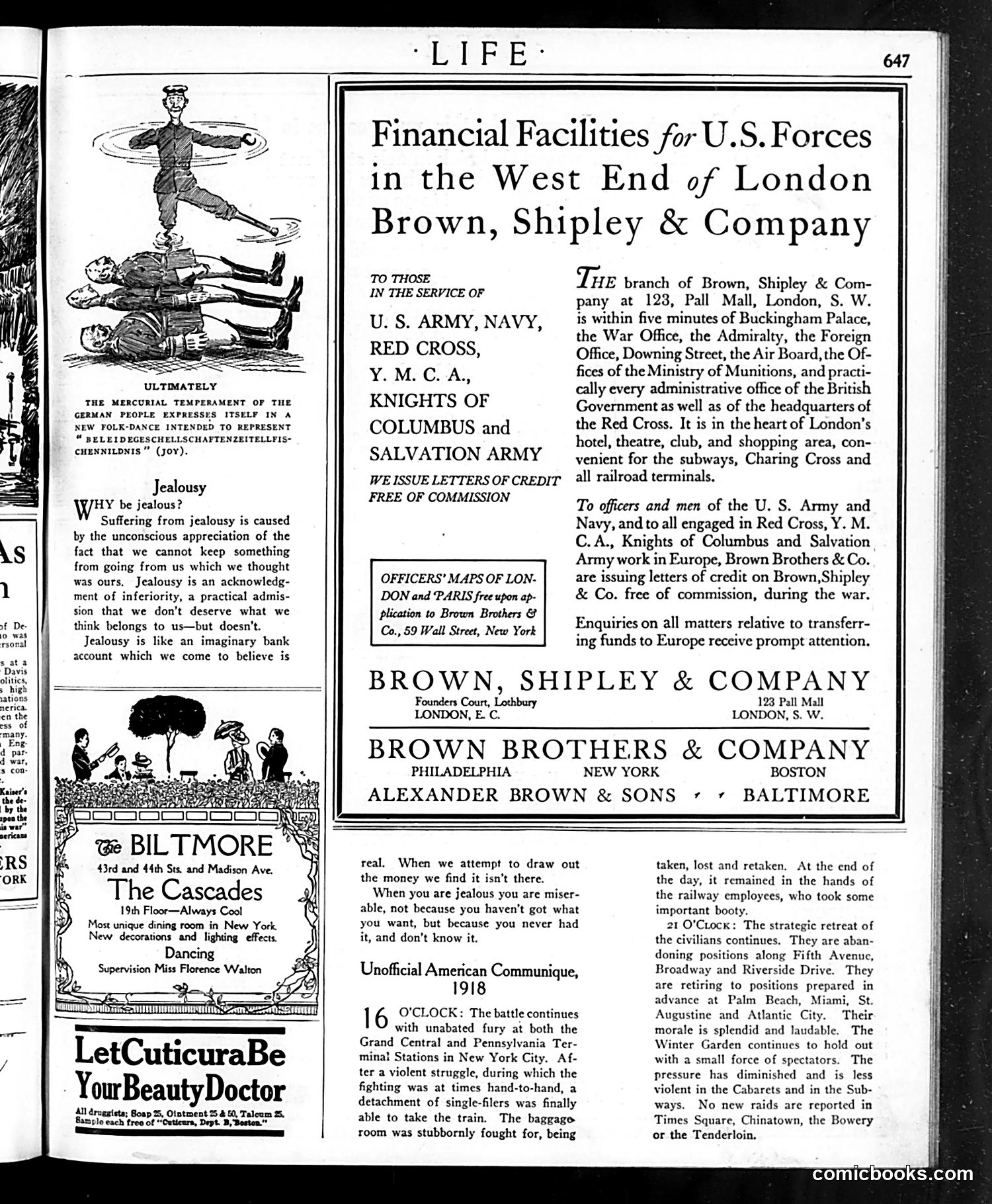
This page combines advertisements with satirical content about WWI-era America. **The Main Cartoon (upper left):** A grotesque figure labeled with German text represents the "mercurial temperament of the German people," depicting them as inherently unstable and prone to violence—a wartime propaganda caricature reinforcing anti-German sentiment during WWI. **"Jealousy" Essay:** A philosophical piece critiquing jealousy as an admission of inferiority, using banking metaphors. The tone is cynical, dismissive humor typical of Life's social commentary. **"Unofficial American Communique":** Satirizes NYC's chaotic train stations (Grand Central and Pennsylvania Terminal) by mock-reporting the crowd scrambles as military battle—with "hand-to-hand fighting" and "strategic retreats." It humorously compares desperate commuters to soldiers, reflecting wartime anxieties and everyday urban frustrations. **Advertisements:** Banking/financial services for American servicemen in London, plus luxury hotel and beauty product ads targeting affluent readers. The page reflects 1918 American culture: wartime propaganda, class-consciousness, and urban absurdism.
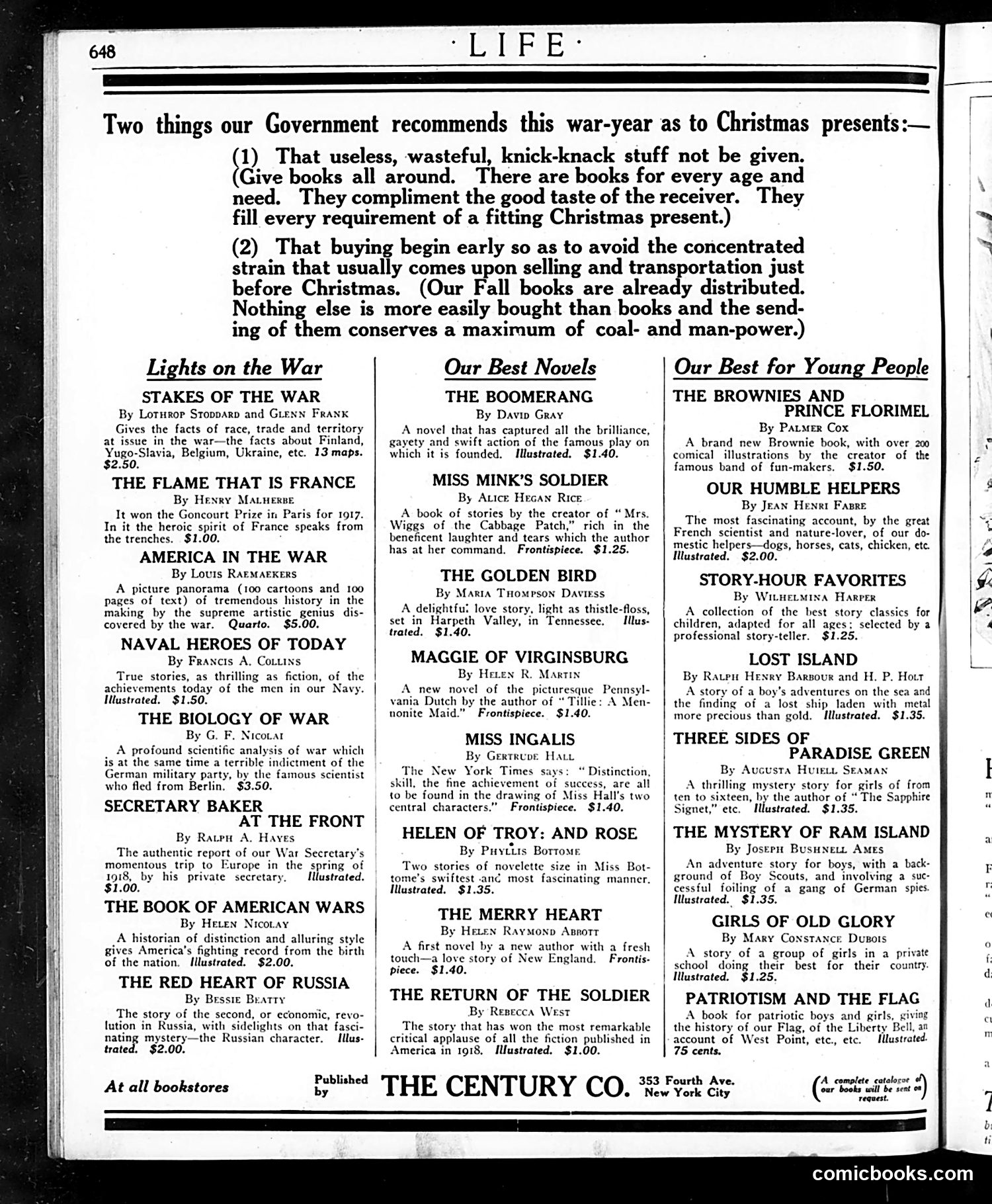
This is a wartime advertisement page (likely WWI era, given references to 1918) masquerading as public service messaging. The government and The Century Co. publishing house jointly recommend books as Christmas gifts, framing this as patriotic conservation—buying books avoids "concentrated strain" on transportation and coal supplies needed for the war effort. The "Lights on the War" section lists non-fiction books about WWI's causes, military operations, and personalities (Secretary of War Baker), positioning reading as civic engagement. The fiction sections offer escapism and moral uplift. The satirical point: wartime rationing is being repackaged as virtue. Rather than restrict consumption, authorities encourage *book* consumption specifically—it's efficient, patriotic, and improves the receiver morally. For modern readers, this reveals how governments use propaganda to make sacrifice feel like good taste and smart shopping during crises.
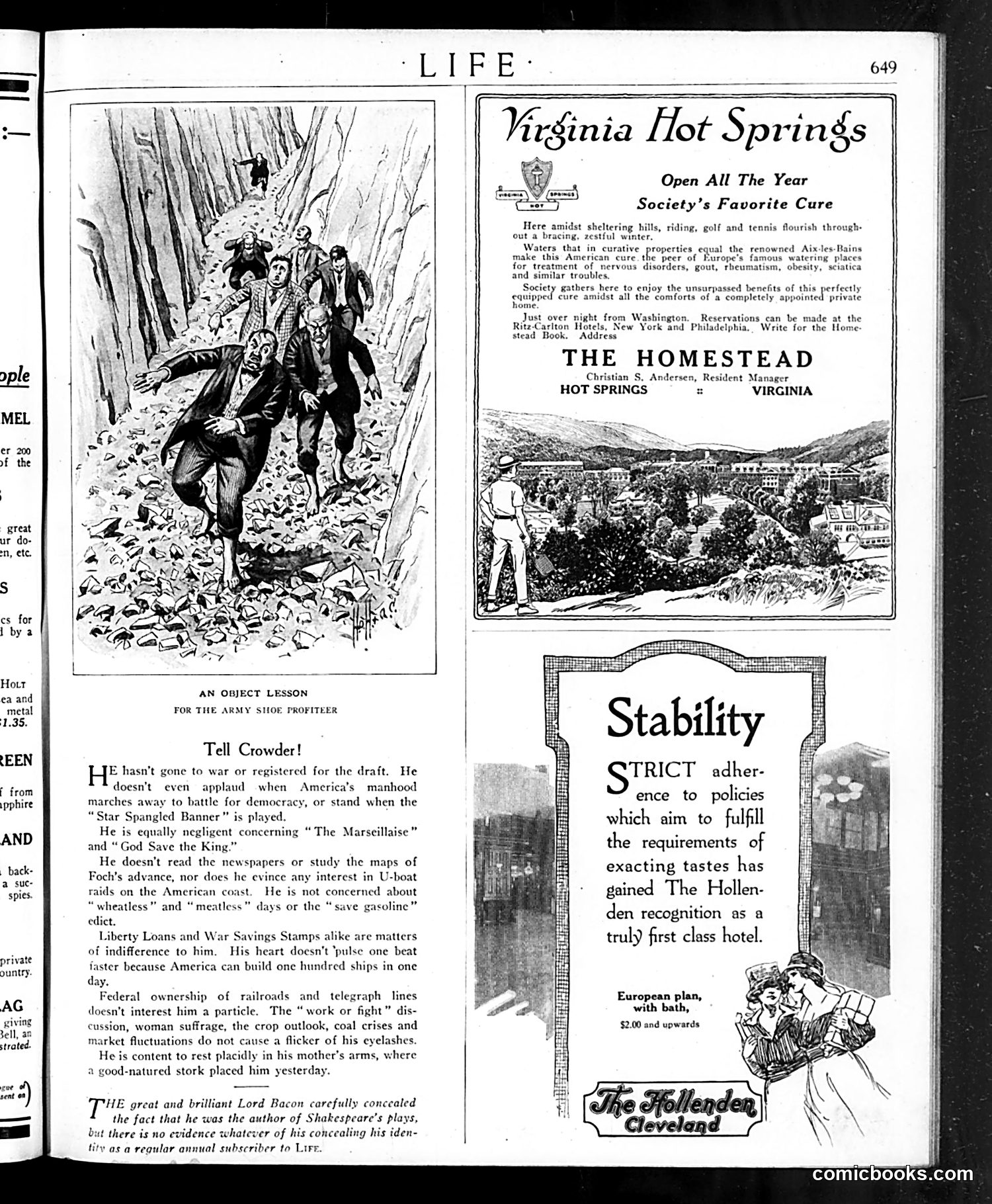
**Main Content:** This page features a political cartoon titled "An Object Lesson for the Army Shoe Profiteer," accompanied by advertisements for Virginia Hot Springs and The Hollenden hotel. **The Cartoon:** The left illustration depicts a character labeled "Tell Crowder!" sliding down a mountainside amid an avalanche. General Enoch Crowder (not explicitly named but referenced) oversaw draft administration during WWI. The cartoon satirizes a draft dodger or war profiteer—someone indifferent to America's war effort, unpatriotic (doesn't applaud the national anthem), unconcerned with war news, and apathetic about Liberty Bonds or fuel conservation. The cascade suggests consequences catching up with such a person. **Historical Context:** This is WWI-era satire (Life was strongly pro-war). "Tell Crowder!" sarcastically calls out such shirkers to military authorities. The cartoon shames those profiting from war while avoiding service or sacrifice. **Advertisements:** Occupy roughly half the page, typical for Life's revenue model.
This essay by Agnes Repplier uses **bitter irony** to mock Germany's defensive justifications for its World War I conduct. The piece sarcastically presents Germany's perspective: that Belgium, France, and Britain are ungrateful and unreasonable for resenting invasion, destruction, and atrocities. Repplier's argument is deeply sarcastic—she suggests Germany has been *generous* in its brutality, and victim nations are illogical for their anger. The essay culminates in mocking the United States for the "absurd" notion that wrongs to other nations should provoke American sympathy and military response. The title ironically frames Germany's demand for forgiveness as a "counsel of perfection"—an impossibly high moral standard. By amplifying Germany's actual propaganda arguments to absurdity, Repplier exposes their moral bankruptcy. Written for *Life* magazine in 1919 (post-Armistice), this targets American readers skeptical of European entanglement, using satire to argue that American intervention was morally justified.