
Life, 1918-10-31 · page 17 of 34
Life — October 31, 1918 — page 17: what you’re looking at
What you’re looking at
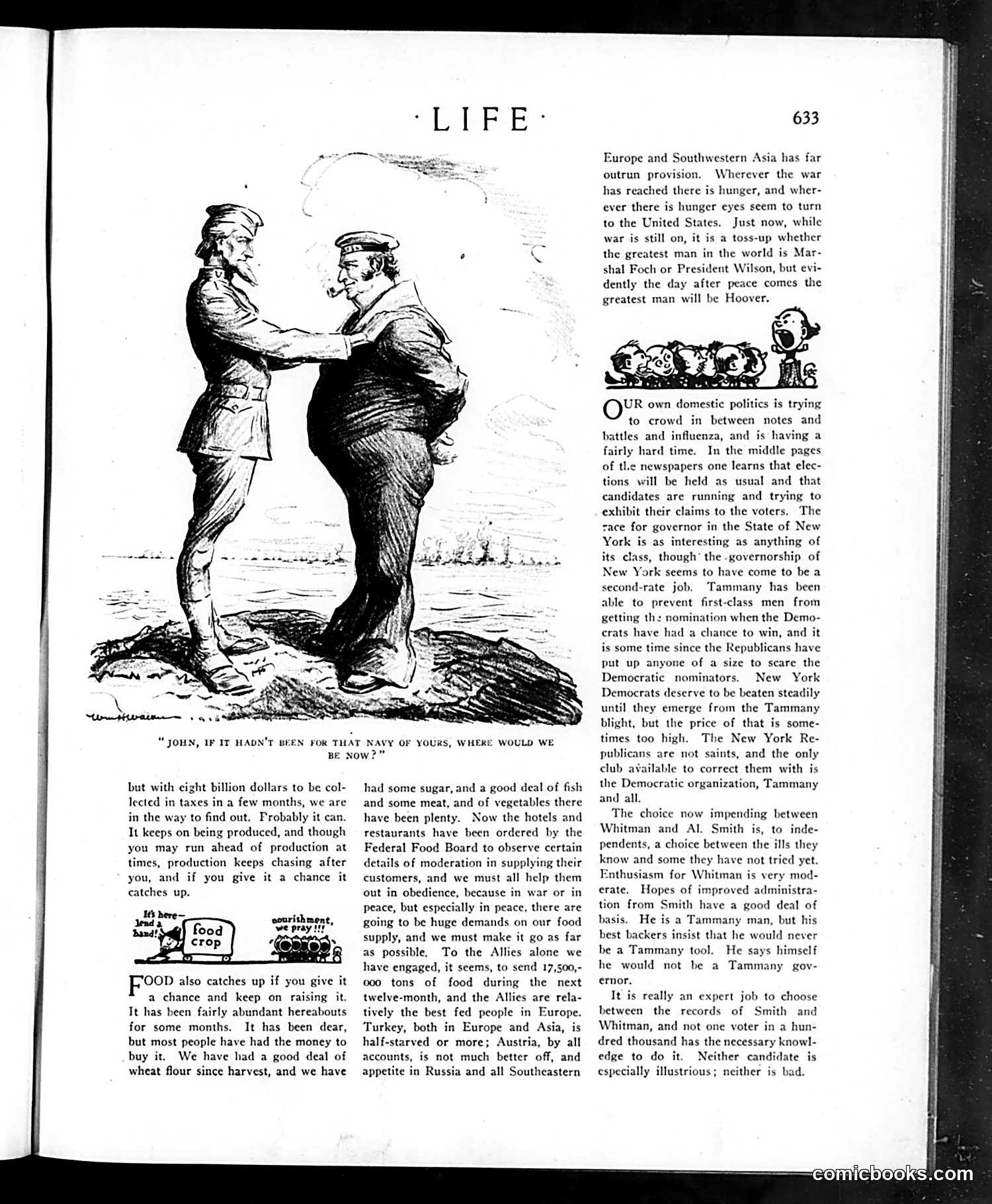
The main cartoon depicts two figures in conversation, with the caption "John, if it hadn't been for that navy of yours, where would we be now?" This appears to be a post-World War I political commentary. One figure likely represents a military or political leader (possibly Navy Secretary Josephus Daniels or similar), while "John" seems to address a civilian authority figure. The satire suggests irony: while the Navy was credited with wartime success, the accompanying text warns that massive post-war taxation and food production challenges loom ahead—implying the Navy's victory may create new domestic problems. The article discusses President Wilson and Herbert Hoover's likely post-war prominence, while also addressing domestic politics, particularly New York's gubernatorial race between Whitman and Al. Smith (a Tammany Hall Democrat). The broader point: Americans must grapple with serious economic realities even as political campaigns proceed.
📄 Transcribed text from this page (OCR, searchable)
Machine-transcribed from the original scan — historical spelling and the odd misread are preserved.
sa.and “JOHN, IF IT HADN'T BEEN FOR THAT NAVY OF YOURS, WHERE WOULD WE BE Now? but with cight billion dollars to be col- lected in taxes in a few months, we are in the way to find out. Probably it can. It keeps on being produced, and though you may run ahead of production at times, production keeps chasing after you, and if you give it a chance it catches up. F00P also catches up if you give it a chance and keep on raising it. Tt has been fairly abundant hereabouts for some months. It has been dear, but most people have had the money to buy it. We have had a good deal of wheat flour since harvest, and we have had some sugar, and a good deal of fish and some meat, and of vegetables there have been plenty. Now the hotels and restaurants have been ordered by the Federal Food Board to observe certain details of moderation in supplying their customers, and we must all help them out in obedience, because in war or in peace, but especially in peace, there are going to be huge demands on our food supply, and we must make it go as far as possible, To the Allies alone we have engaged, it seems, to send 17,500,- ooo tons of food during the next twelve-month, and the Allies are rela- tively the best fed people in Europe. Turkey, both in Europe and Asia, is half-starved or more; Austria, by all accounts, is not much better off, and appetite in Russia and all Southeastern 633 Europe and Southwestern Asia has far outrun provision. Wherever the war has reached there is hunger, and wher- ever there is hunger eyes seem to turn to the United States. Just now, while war is still on, it is a toss-up whether the greatest man in the world is Mar- shal Foch or President Wilson, but evi- dently the day after peace comes the greatest man will be Hoover. UR own domestic politics is trying to crowd in between notes and battles and influenza, and is having a fairly hard time. In the middle pages of tle newspapers one learns that elec- tions will be held as usual and that candidates are running and trying to exhibit their claims to the voters. The race for governor in the State of New York is as interesting as anything of its class, though’ the governorship of New York seems to have come to be a second-rate job. Tammany has been able to prevent first-class men from getting the nomination when the Demo- crats have had a chance to win, and it is some time since the Republicans have put up anyone of a size to scare the Democratic nominators. New York Democrats deserve to be beaten steadily until they emerge from the Tammany blight, but the price of that is some- times too high. The New York Re- publicans are not saints, and the only club available to correct them with is the Democratic organization, Tammany and all. The choice now impending between Whitman and Al. Smith is, to inde- pendents, a choice between the ills they know and some they have not tried yet. Enthusiasm for Whitman is very mod- erate. Hopes of improved administra- tion from Smith have a good deal of basis. He is a Tammany man, but his best backers insist that he would never be a Tammany tool. He says himself he would not be a Tammany gov- ernor. It is really an expert job to choose between the records of Smith and Whitman, and not one voter in a hun- dred thousand has the necessary knowl- edge to do it. Neither candidate is especially illustrious; neither is bad.