
Life, 1918-10-31 · page 20 of 34
Life — October 31, 1918 — page 20: what you’re looking at
What you’re looking at
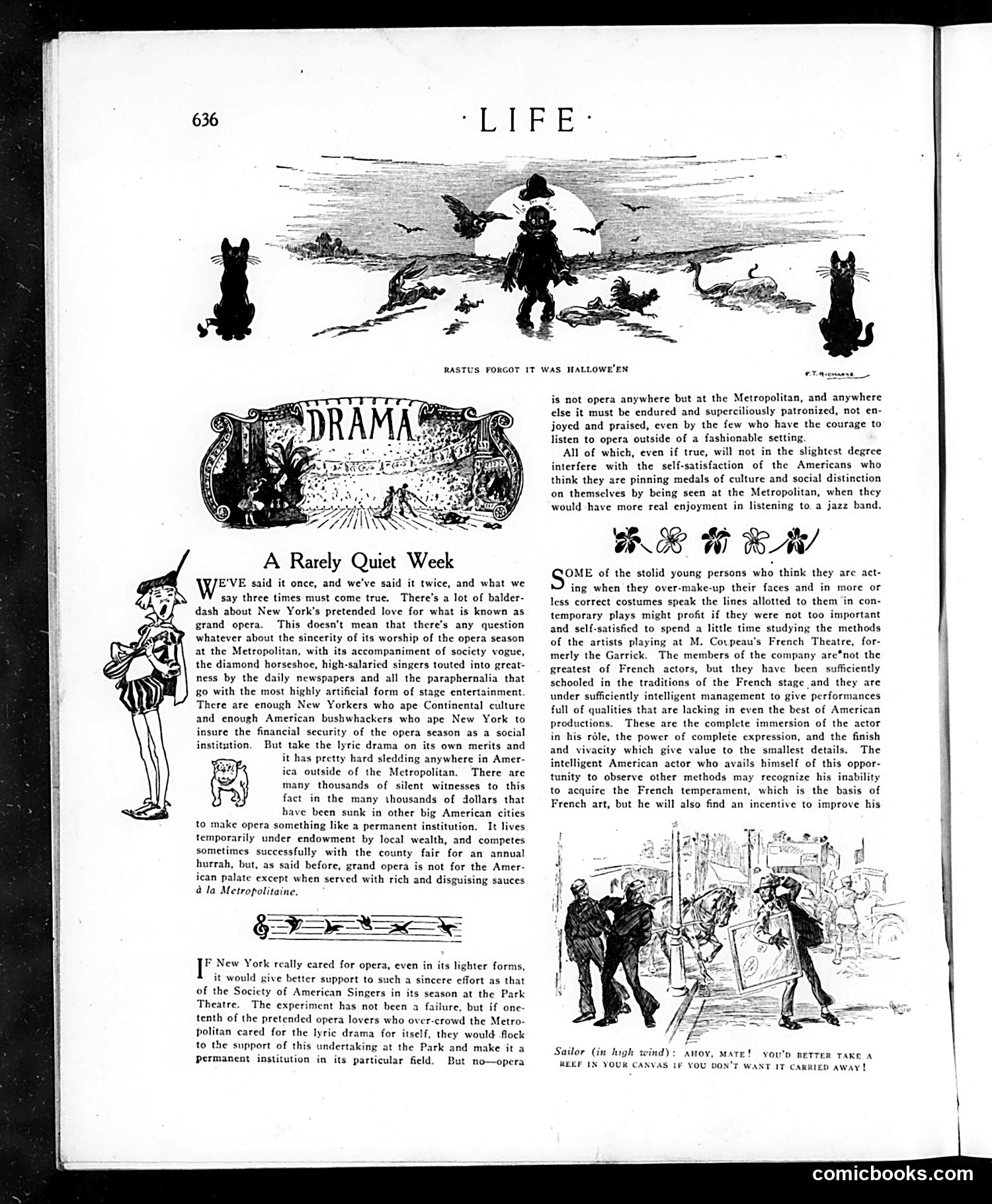
This page attacks New York's pretentious opera culture. The main article mocks wealthy New Yorkers who attend the Metropolitan Opera to display social status rather than appreciate music. The author argues that opera survives financially only through society patrons and endowments, not genuine public love—evidence being that opera companies fail elsewhere in America without aristocratic support. The satire's target: Americans who "ape Continental culture" and use the Metropolitan Opera as a status symbol, when they'd actually prefer jazz bands. The piece contrasts this with sincere efforts like the Park Theatre's Society of American Singers, which struggles without the Met's social cachet. A secondary criticism targets young theatrical actors who over-rely on makeup and affectation rather than studying French stage methods emphasizing complete immersion and expressiveness. The bottom cartoon (caption partially visible) appears to joke about sailors and canvas, likely unrelated commentary. The tone is withering social critique dressed as light commentary.
📄 Transcribed text from this page (OCR, searchable)
Machine-transcribed from the original scan — historical spelling and the odd misread are preserved.
A Rarely Quiet Week Weve said it once, and we've said it twice, and what we say three times must come true. There's a lot of balder- dash about New York's pretended love for what is known as grand opera. This doesn’t mean that there’s any question whatever about the sincerity of its worship of the opera season at the Metropolitan, with its accompaniment of society vogue, the diamond horseshoe, high-salaried singers touted into great- ness by the daily newspapers and all the paraphernalia that go with the most highly artificial form of stage entertainment There are enough New Yorkers who ape Continental culture and enough American bushwhackers who ape New York to insure the financial security of the opera season as a social institution. But take the lyric drama on its own merits and it has pretty hard sledding anywhere in Amer- outside of the Metropolitan. There are many thousands of silent witnesses to this fact in the many thousands of dollars that have been sunk in other big American cities to make opera something like a permanent institution. It lives temporarily under endowment by local wealth, and competes sometimes successfully with the county fair for an annual hurrah, but, as said before, grand opera is not for the Amer- ican palate except when served with rich and disguising sauces 4 la Metropolitaine. (35 ]Se— [F New York really cared for opera, even in its lighter forms, it would give better support to such a sincere effort as that of the Socicty of American Singers in its season at the Park Theatre. The experiment has not been a failure, but if one- tenth of the pretended opera lovers who over-crowd the Metro- politan cared for the lyric drama for itself, they would flock to the support of this undertaking at the Park and make it a Permanent institution in its particular field. But no—opera is not opera anywhere but at the Metropolitan, and anywhere else it must be endured and superciliously patronized, not en- joyed and praised, even by the few who have the courage to listen to opera outside of a fashionable setting. All of which, even if true, will not in the slightest degree interfere with the self-satisfaction of the Americans who think they are pinning medals of culture and social distinction on themselves by being seen at the Metropolitan, when they would have more real enjoyment in listening toa jazz band. TR Wt Ba OME of the stolid young persons who think they are act- ing when they over-make-up their faces and in more or less correct costumes speak the lines allotted to them in con- temporary plays might profit if they were not too important and self-satisfied to spend a little time studying the methods of the artists playing at M. Copeau's French Theatre, for- merly the Garrick. The members of the company are*not the greatest of French actors, but they have been sufficiently schooled in the traditions of the French stage and they are under sufficiently intelligent management to give performances full of qualities that are lacking in even the best of American productions. These are the complete immersion of the actor in his réle, the power of complete expression, and the finish and vivacity which give value to the smallest details. The intelligent American actor who avails himself of this oppor- tunity to observe other methods may recognize his inability to acquire the French temperament, which is the basis of French art, but he will also find an incentive to improve his Sailor (in high wind): anoy, Mate! you’ netter TA REEF IN YOUR CANVAS 1F YOU DON'T WANT IT CARRIED AWay ! comicbooks.com