
Life, 1918-10-31 · page 22 of 34
Life — October 31, 1918 — page 22: what you’re looking at
What you’re looking at
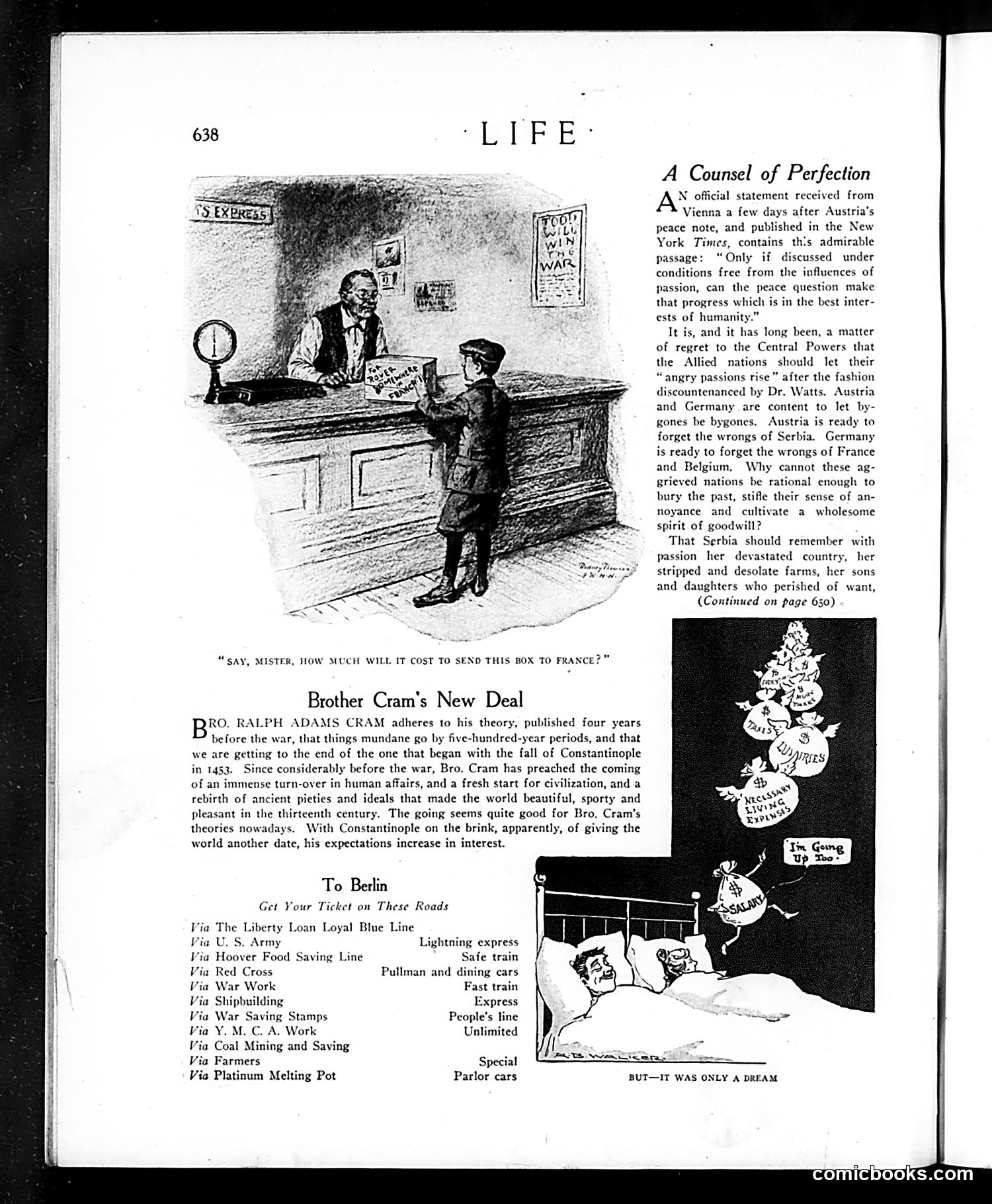
**Top Cartoon ("Say, Mister, how much will it cost to send this box to France?"):** A man at a post office counter asks about shipping costs to France, holding what appears to be a bomb or explosive device. This satirizes Austria-Hungary's audacious peace proposal (referenced in the article above), suggesting the Central Powers' call for rational, passion-free peace negotiations is absurd hypocrisy—they've devastated Allied nations and now ask victims to "bury the past" without consequence. **"A Counsel of Perfection" Article:** Life mocks Austria's official statement claiming the Allies should discuss peace without "angry passion." The text sarcastically notes that Austria and Germany want forgiveness while Serbia, France, and Belgium suffered massive destruction and casualties. The satire: how can victims rationally ignore devastation? **Bottom Cartoon ("But—it was only a dream"):** A soldier dreams of traveling to Berlin via absurd routes (War Bonds, Red Cross, Food Saving, etc.). Upon waking, the dream evaporates—satirizing American propagandistic optimism about war's end as pure fantasy.
📄 Transcribed text from this page (OCR, searchable)
Machine-transcribed from the original scan — historical spelling and the odd misread are preserved.
A Counsel of Perfection N official statement received from Vienna a few days after Austria’s peace note, and published in the New York Times, contains this admirable passage: “Only if discussed under conditions free from the influences of passion, can the peace question make that progress which is in the best inter- ests of humanity.” It is, and it has long been, a matter of regret to the Central Powers that the Allied nations should let their “angry passions rise” after the fashion discountenanced by Dr. Watts. Austria and Germany are content to let by- gones be bygones. Austria is ready to forget the wrongs of Serbia. Germany is ready to forget the wrongs of France and Belgium. Why cannot these ag- grieved nations be rational enough to bury the past, stifle their sense of an- noyance and cultivate a wholesome spirit of goodwill? That Serbia should remember with ion her devastated country, her stripped and desolate farms, her sons and daughters who perished of want, (Continued on page 650) “SAY, MISTER, HOW MUCH WILL IT COST TO SEND THIS BOX TO FRANCE? Brother Cram’s New Deal RO. RALPH ADAMS CRAM adheres to his theory, published four years before the war, that things mundane go by five-hundred-year periods, and that we are getting to the end of the one that began with the fall of Constantinople in 1453. Since considerably before the war, Bro. Cram has preached the coming of an immense turn-over in human affairs, and a fresh start for civilization, and a rebirth of ancient pieties and ideals that made the world beautiful, sporty and pleasant in the thirteenth century. The going seems quite good for Bro, Cram’s theories nowadays. With Constantinople on the brink, apparently, of giving the world another date, his expectations increase in interest. To Berlin Get Your Ticket on These Roads Via The Liberty Loan Loyal Blue Line Via U. S. Army Lightning express Via Hoover Food Saving Line Safe train Via Red Cross Pullman and dining cars Via War Work Fast train Via Shipbuilding Express Via War Saving Stamps People’s line Via Y. M,C. A. Work Unlimited Via Coal Mining and Saving Via Farmers Special Via Platinum Melting Pot Parlor cars BUT—IT WAS ONLY A DREAM