
A complete issue · 34 pages · 1918
Life — August 29, 1918
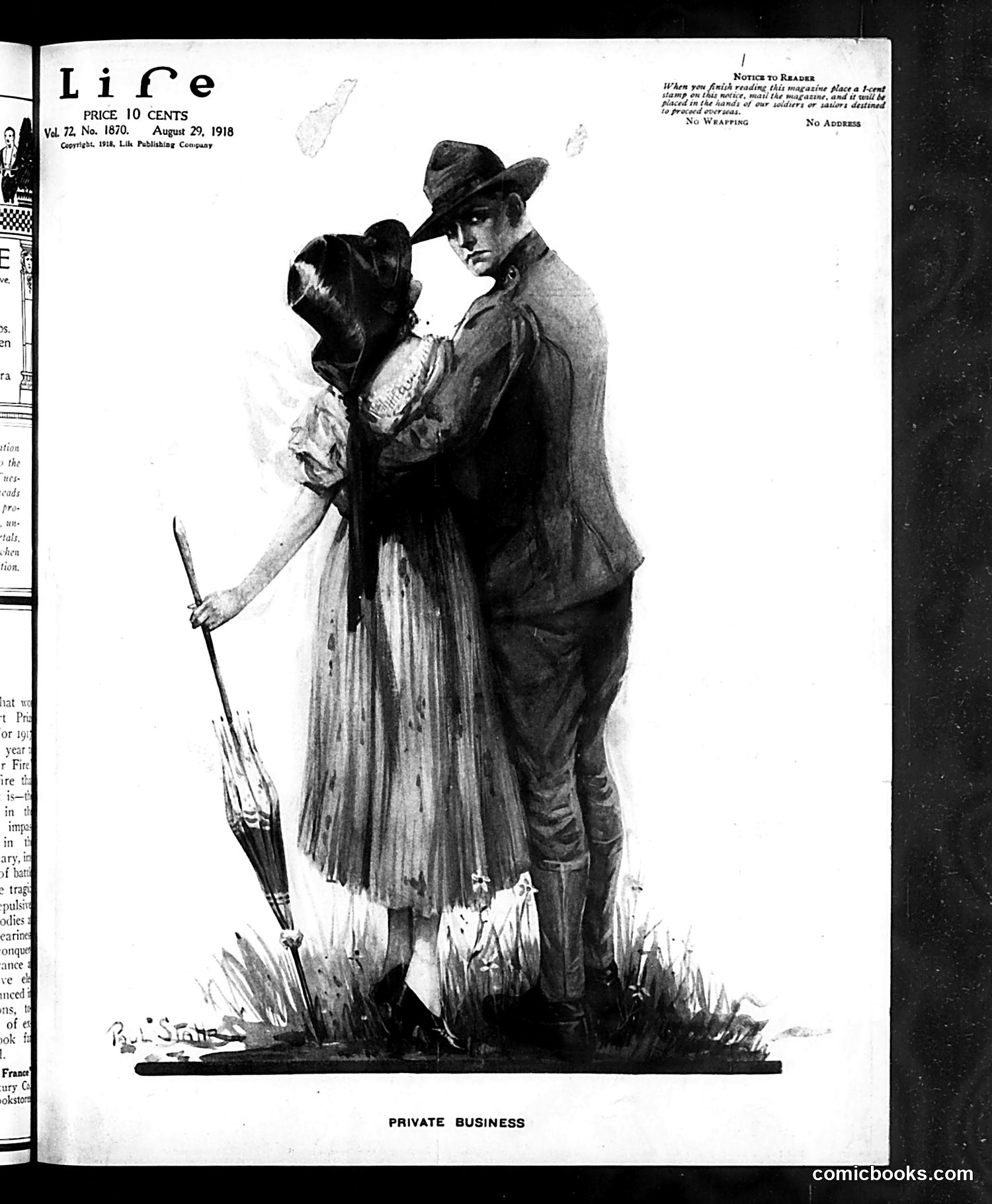
This illustration by P. S. Sinnott depicts a couple in an intimate embrace outdoors. The man wears a cowboy hat and dark clothing; the woman holds a parasol and wears a light dress. The title "Private Business" suggests the cartoon comments on personal romantic or intimate matters. Given the 1918 date—near the end of World War I—this may satirize the idea of soldiers and civilians pursuing private romantic interests while the nation was at war. Alternatively, it could simply be humorous commentary on courting customs of the era. Without additional context from the magazine's surrounding content, the specific satirical target remains unclear.
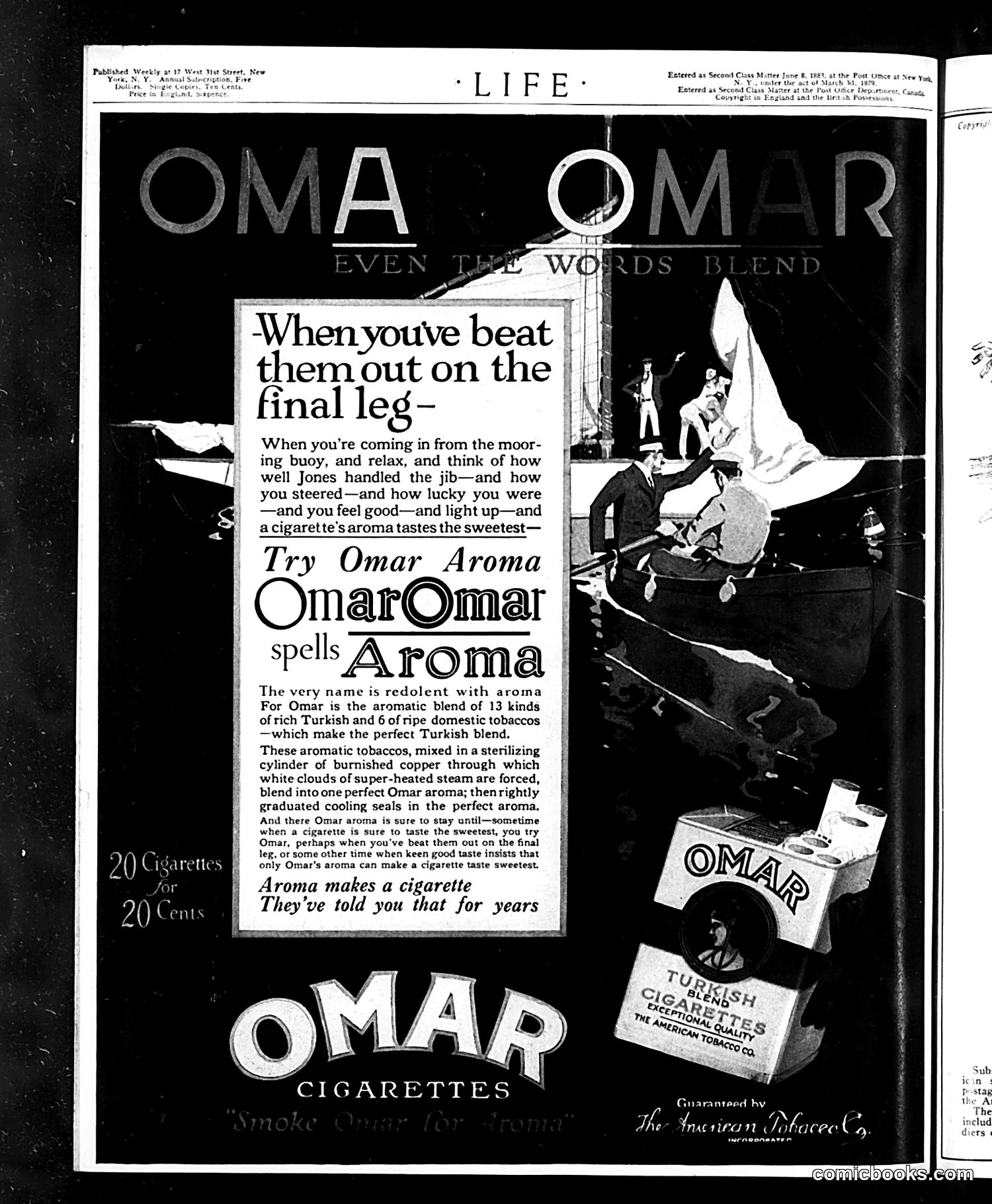
This is primarily a **cigarette advertisement**, not political satire. The page promotes Omar brand cigarettes, a Turkish blend product manufactured by The American Tobacco Co. The ad uses a sporting/leisure narrative: it depicts someone returning from hunting or moorland activities, feeling accomplished and wanting to relax with a cigarette. The accompanying illustration shows what appears to be a **boating or water sport scene**, suggesting the aspirational lifestyle associated with the product. The copy emphasizes Omar's aromatic quality, describing it as a blend of Turkish and domestic tobaccos. The prominent text "Aroma makes a cigarette They've told you that for years" represents the advertising claim differentiating this brand. This reflects **early 20th-century advertising practices** before tobacco health warnings, when cigarettes were marketed as luxury leisure products associated with success and relaxation.
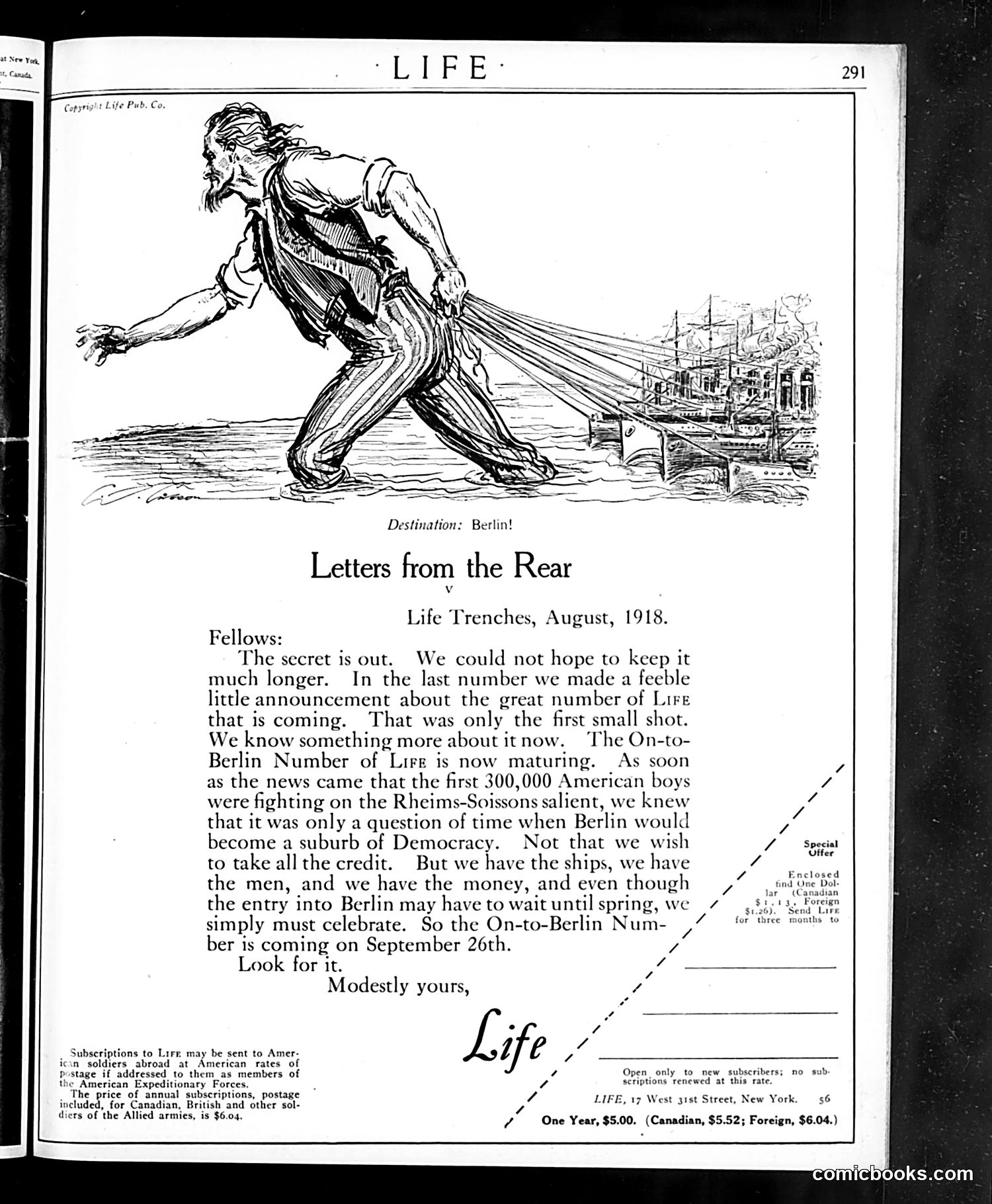
The cartoon depicts a bearded man straining to pull a rope extending toward a distant harbor city (labeled "Destination: Berlin"). The accompanying text celebrates the imminent "On-to-Berlin Number" of *Life* magazine, referencing the recent arrival of 300,000 American troops fighting on the Rheims-Soissons front during World War I's final offensive. The satire mocks American confidence that military victory and occupation of Berlin are inevitable—merely a matter of time and effort. The straining figure represents the collective American/Allied war effort being pulled toward German defeat. The tone is boastful, claiming *Life*'s prophetic role in predicting Berlin's fall and celebrating American military and financial superiority. This reflects August 1918's optimism before the November armistice.
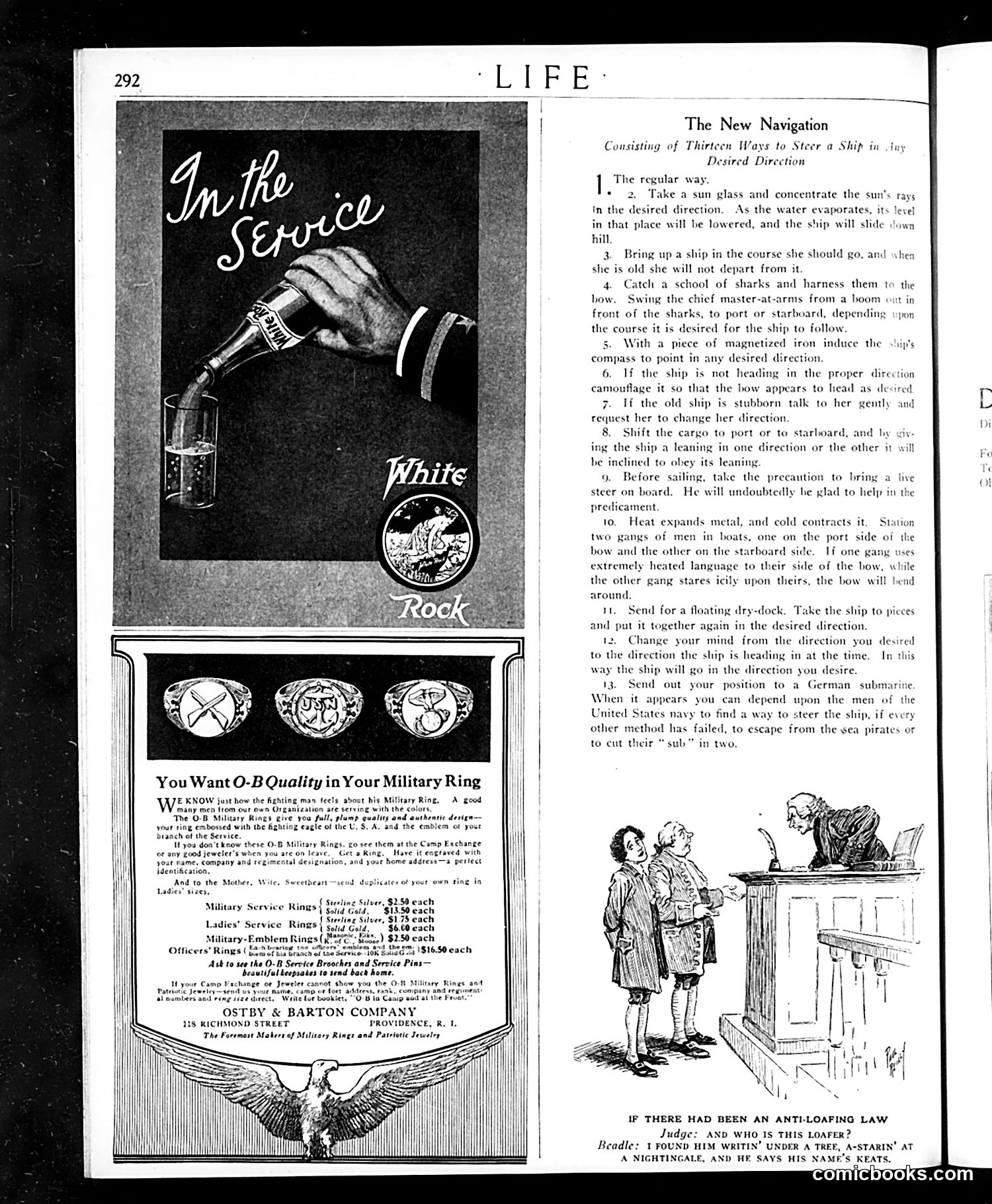
This page is primarily **commercial advertising** rather than political satire. The left side features a **White Rock beverage advertisement** showing a hand pouring the drink, with three military rings displayed below. The ad promotes "O-B Quality" military rings from Ostby & Barton Company, targeting servicemen and their families. The right side contains "The New Navigation," a humorous instructional piece offering thirteen facetious methods to steer a ship in any desired direction—clearly satirical advice (using sun glasses, harnesses sharks, magnetized iron, etc.). Below is a cartoon captioned "If There Had Been an Anti-Loafing Law," depicting what appears to be a judge questioning a loafer, with a literary reference to Browning's poem about a nightingale. The page blends period advertising with light satirical humor typical of Life magazine's format.
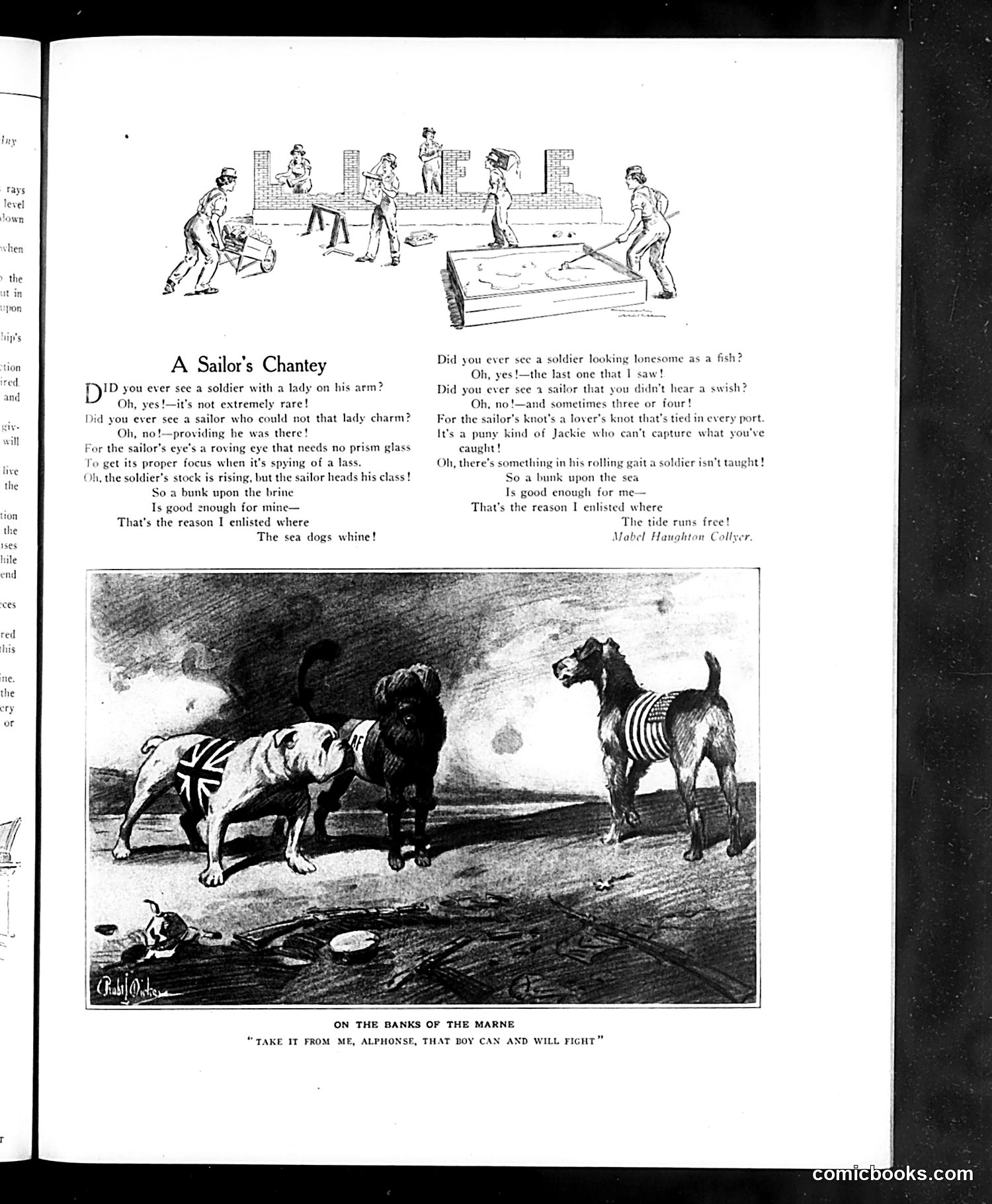
The top poem satirizes recruitment messaging during World War I. It mocks the romanticized depiction of sailors, questioning whether enlisting is truly worthwhile. The speaker claims to have enlisted because "The tide runs free"—suggesting sailors enlist for freedom or adventure rather than patriotic duty, which undercuts propaganda promoting military service as noble. The bottom cartoon, captioned "On the Banks of the Marne / 'Take it from me, Alphonse, that boy can and will fight,'" depicts dogs wearing military insignia, likely representing British and German forces during WWI combat. This anthropomorphized commentary appears to satirize how nations breed their populations for warfare, treating soldiers like trained animals destined to fight.
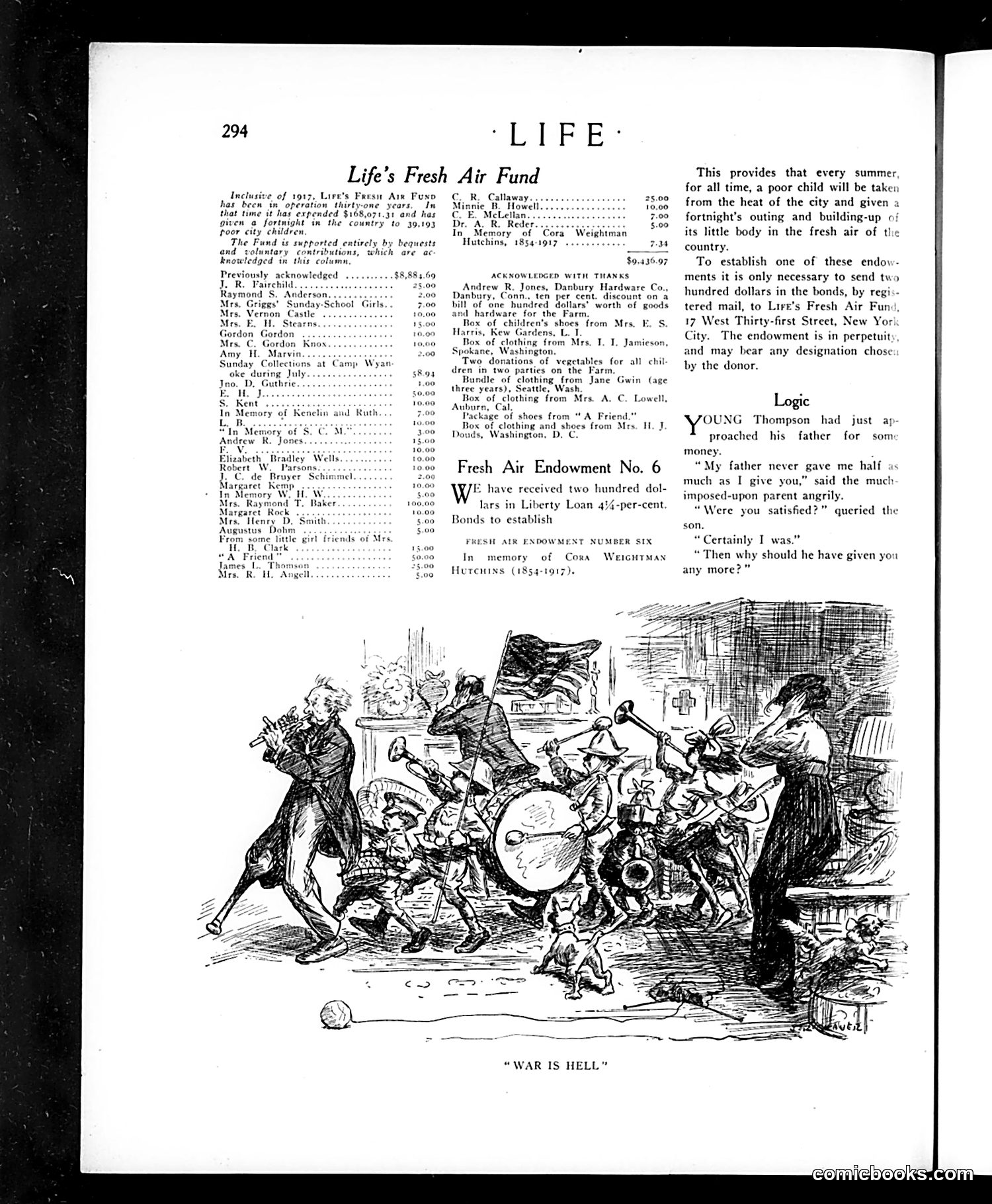
This page contains two distinct sections: **Upper portion**: A charitable fundraising list for "Life's Fresh Air Fund," documenting donations to send poor urban children to the countryside for summer health benefits. The contributors and amounts are listed, representing a charitable campaign. **Lower portion**: A satirical cartoon titled "War is Hell" depicting chaos and discord. The image shows figures in conflict—adults and children engaged in destructive, combative behavior with musical instruments and violence. The caption's ironic title suggests this domestic scene of familial or social chaos is being compared to actual warfare. The satire appears to contrast the idealistic charity work (Fresh Air Fund) described above with the harsh reality of urban poverty and family dysfunction depicted below, highlighting society's ongoing social problems despite charitable efforts.
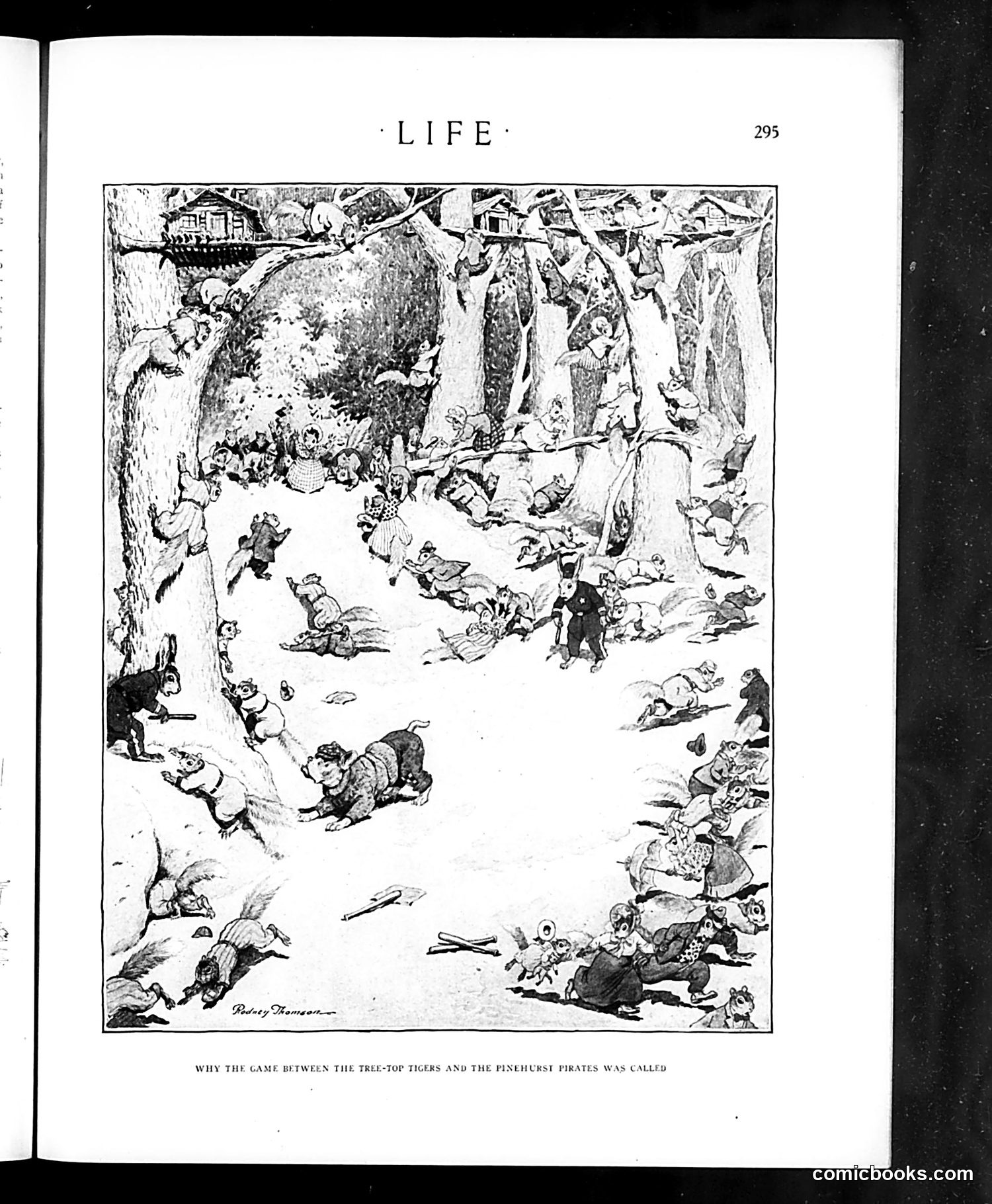
This is a humorous illustration titled "Why the Game Between the Tree-Top Tigers and the Fishurst Pirates Was Called," depicting a chaotic scene in what appears to be a clearing or canyon surrounded by large trees. The cartoon shows numerous small figures engaged in mayhem—fighting, falling, and general disorder. The satire appears to mock a sporting event (likely baseball, given the "game" reference) that descended into chaos. The team names—"Tree-Top Tigers" and "Fishurst Pirates"—are whimsical and appear invented for comedic effect rather than referencing actual historical teams. The illustration is signed by what appears to be Henry Hueston (or similar), a period cartoonist. The joke likely plays on how such disputes or unruly behavior could cause an official to cancel proceedings, though the specific historical reference remains unclear.
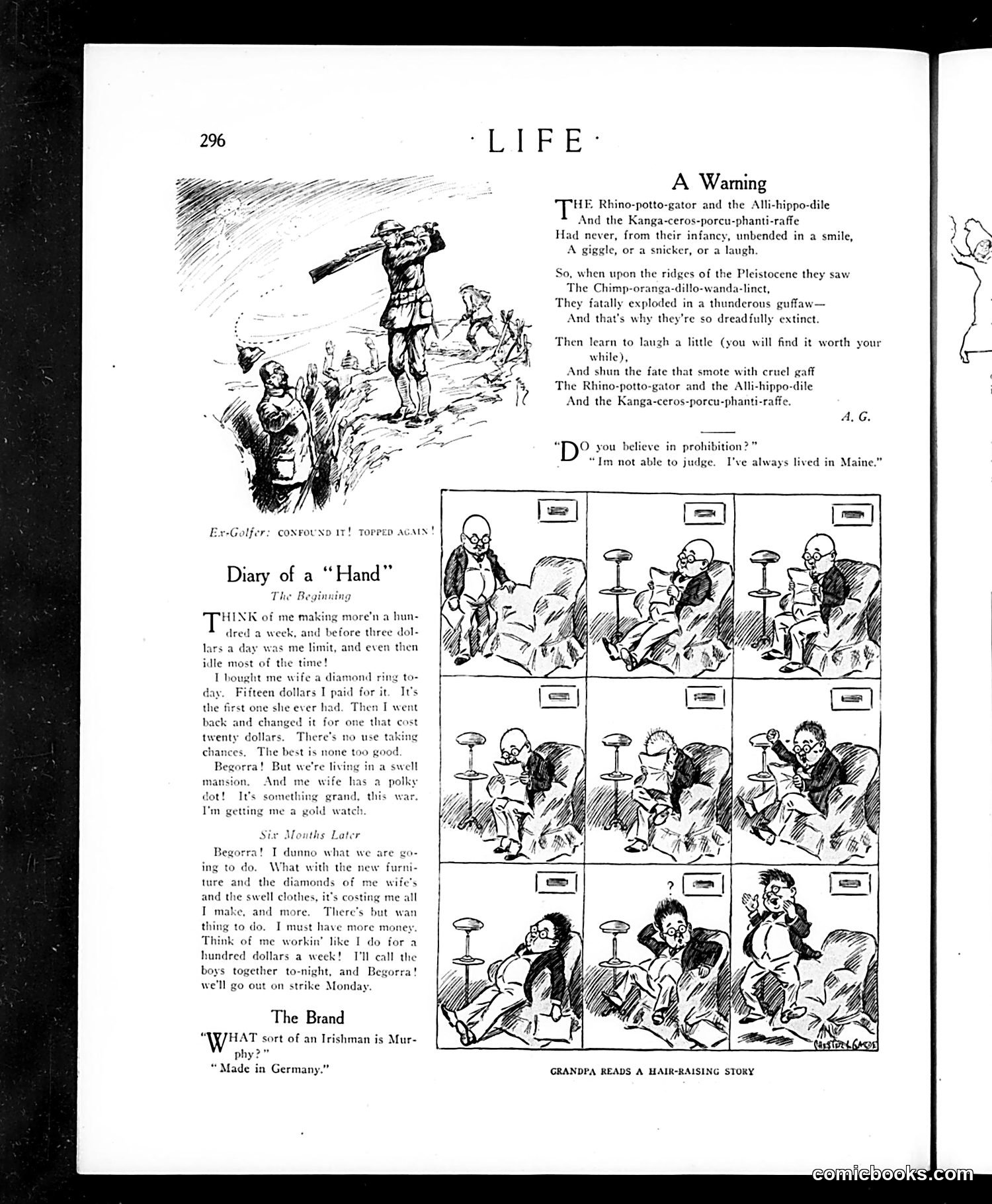
This page contains three distinct humorous pieces: **"A Warning"** (top): A nonsensical poem mocking extinct animals with made-up names like "Rhino-potto-gator" and "Chimp-oranga-dillo." The joke warns against laughing at these creatures, implying their extinction resulted from mockery—absurdist humor. **"Diary of a 'Hand'"**: A working-class man laments earning only $15 weekly, which he spent on a diamond ring. Now facing expenses for mansion furnishings, he demands higher wages—likely satirizing labor disputes and workers' economic struggles. **"Grandpa Reads a Hair-Raising Story"** (comic strip): Shows an elderly man reading to what appears to be a fearful child, with the child's reactions growing increasingly distressed across panels—visual humor about scary bedtime stories. The page reflects early 20th-century concerns about labor, consumer culture, and family entertainment.
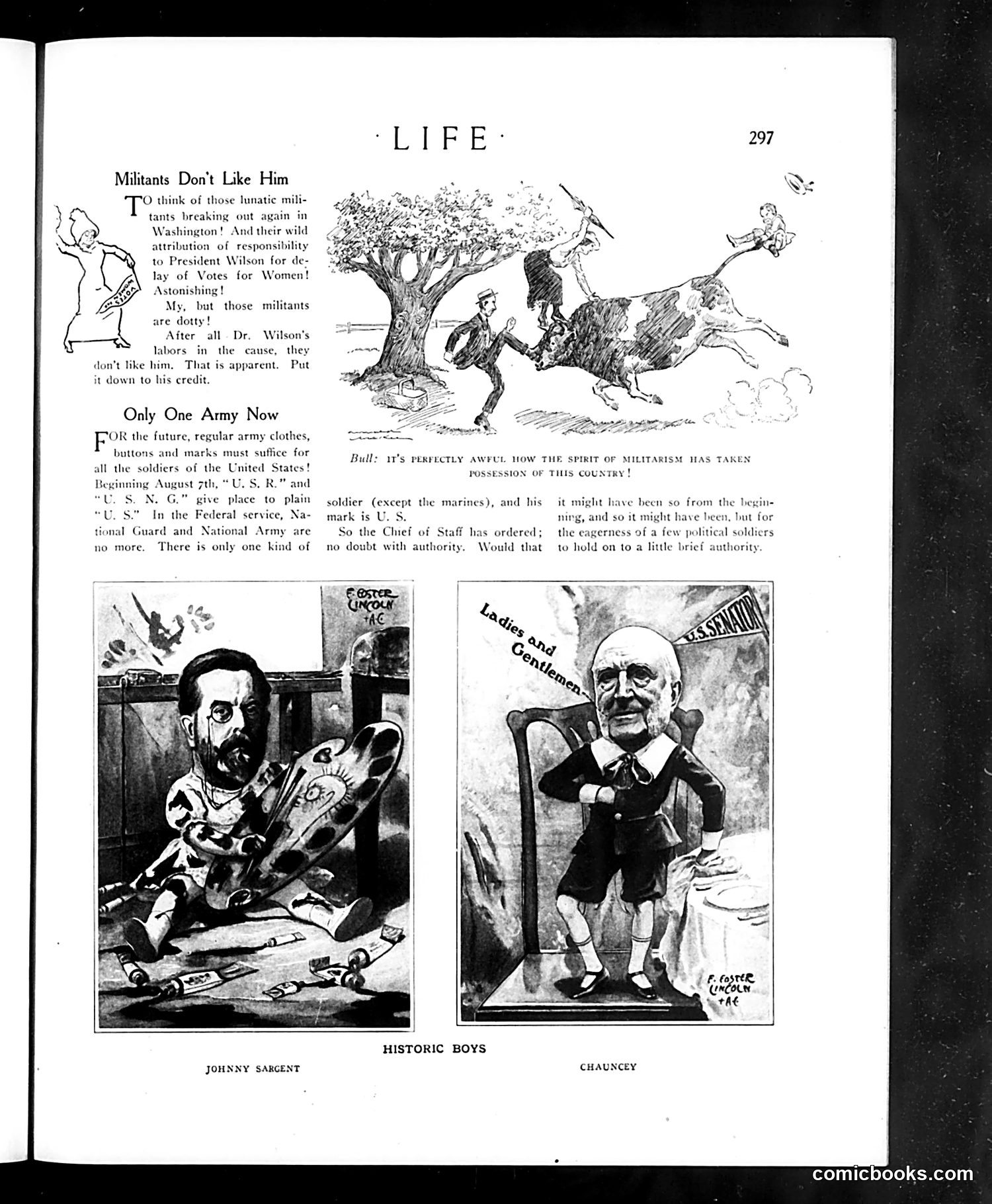
This page critiques labor activists' opposition to President Wilson despite his support for women's suffrage. The top cartoon shows a figure being kicked by a donkey labeled "militarism," illustrating how political militancy has seized the country. The section "Only One Army Now" discusses military uniform standardization beginning August 7th, consolidating U.S. Army, National Guard, and Marine distinctions into one "U.S." designation. Below, "Historic Boys" presents two caricatures: **Johnny Sargent** (left) and **Chauncey** (right), depicted as childish figures playing with toys/weapons. These appear to satirize prominent political or labor figures as immature "boys" whose militant posturing is presented as petulant rather than serious. The overall message: militant activists are unreasonable children disrupting national unity during wartime.
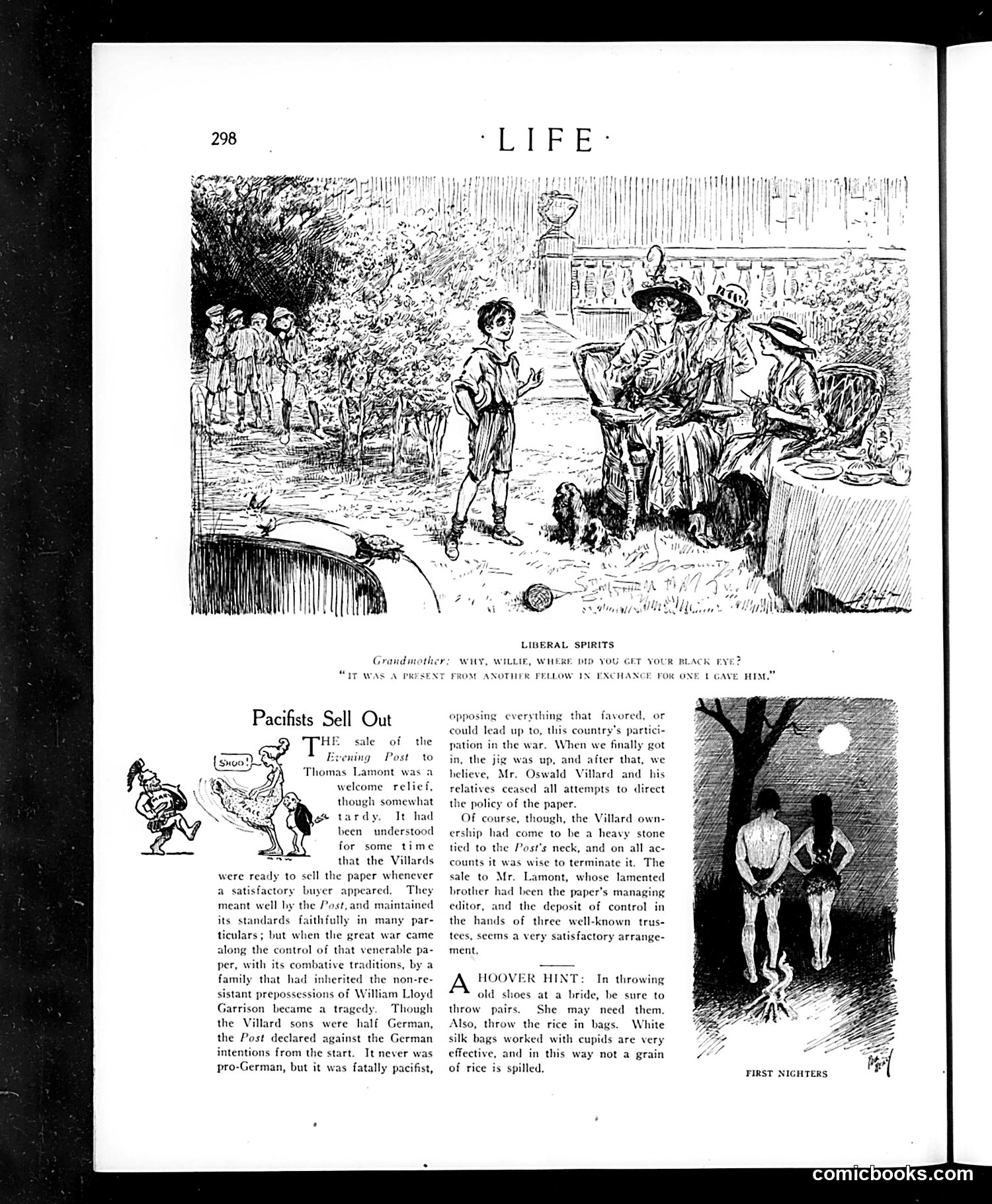
**Top Cartoon ("Liberal Spirits"):** A grandmother confronts a boy about a black eye, implying he received it in a fight. The boy claims it was a "present from another fellow in exchange for one I gave him"—a veiled reference to reciprocal violence or conflict. The caption satirizes pacifist ideology by highlighting the contradiction between professed non-violence and actual physical altercations. **Main Article ("Pacifists Sell Out"):** Criticizes the sale of the *Evening Post* newspaper to Thomas Lamont. The text describes how the Villard family, pacifist owners, reluctantly sold the paper during WWI, abandoning their anti-war editorial stance. The article suggests financial pressures compromised pacifist principles—a satirical jab at perceived hypocrisy among peace advocates during wartime.
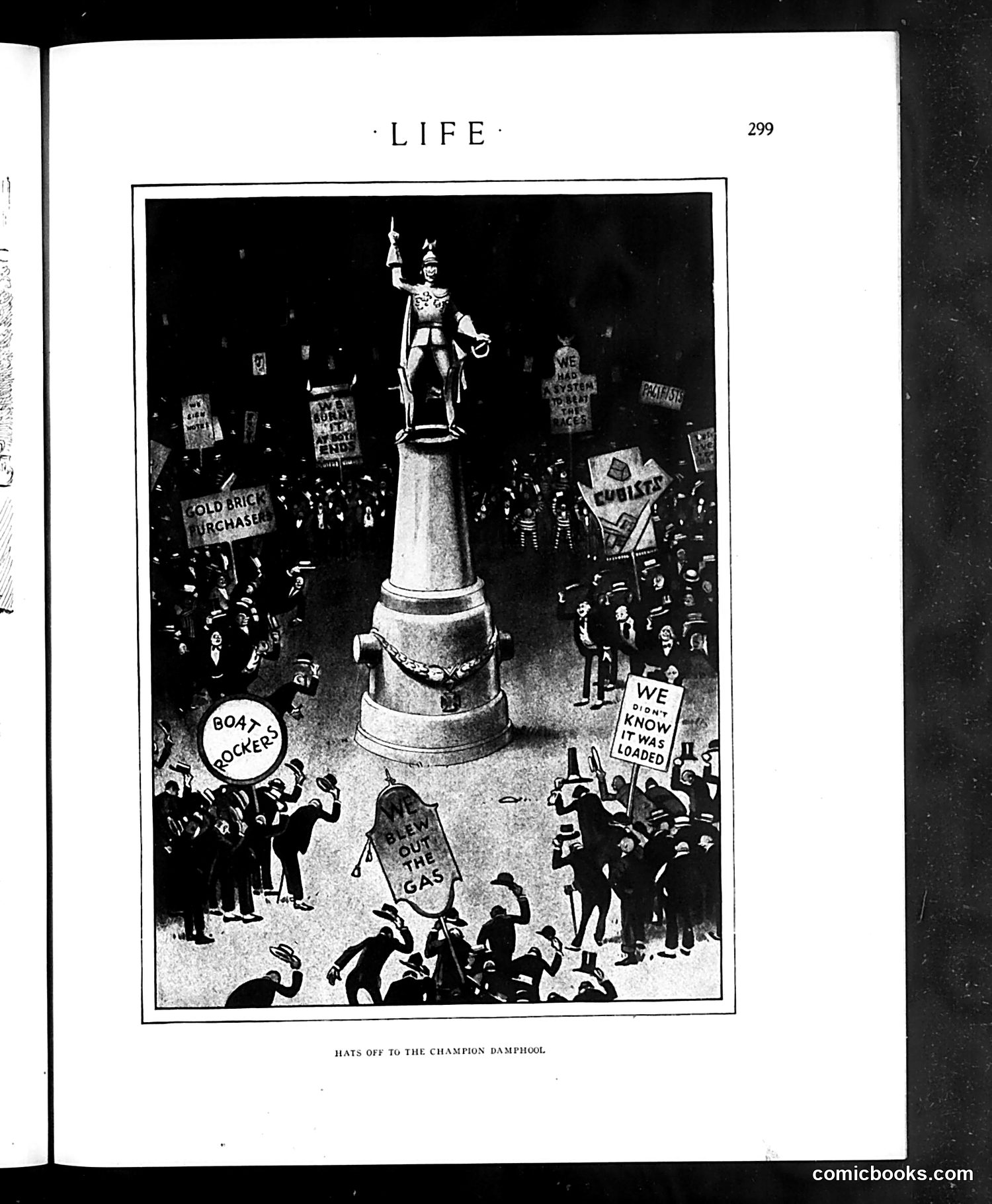
This satirical cartoon depicts a large monument surrounded by a crowd holding protest signs. The figure atop the pedestal wears military regalia with distinctive headgear, suggesting it represents a political or military leader being mocked as a "dampfool" (likely a pun on "damp" or incompetence). Visible protest signs include "BOAT ROCKER," "WE DIDN'T KNOW IT WAS LOADED," and "RUN OUT THE GAS," suggesting criticism of the figure's handling of a specific crisis or scandal. The crowd's chaotic energy and numerous banners indicate public outcry. Without the magazine's date visible, the specific historical event remains unclear, but the cartoon satirizes a leader whose controversial actions drew widespread public protest and ridicule.
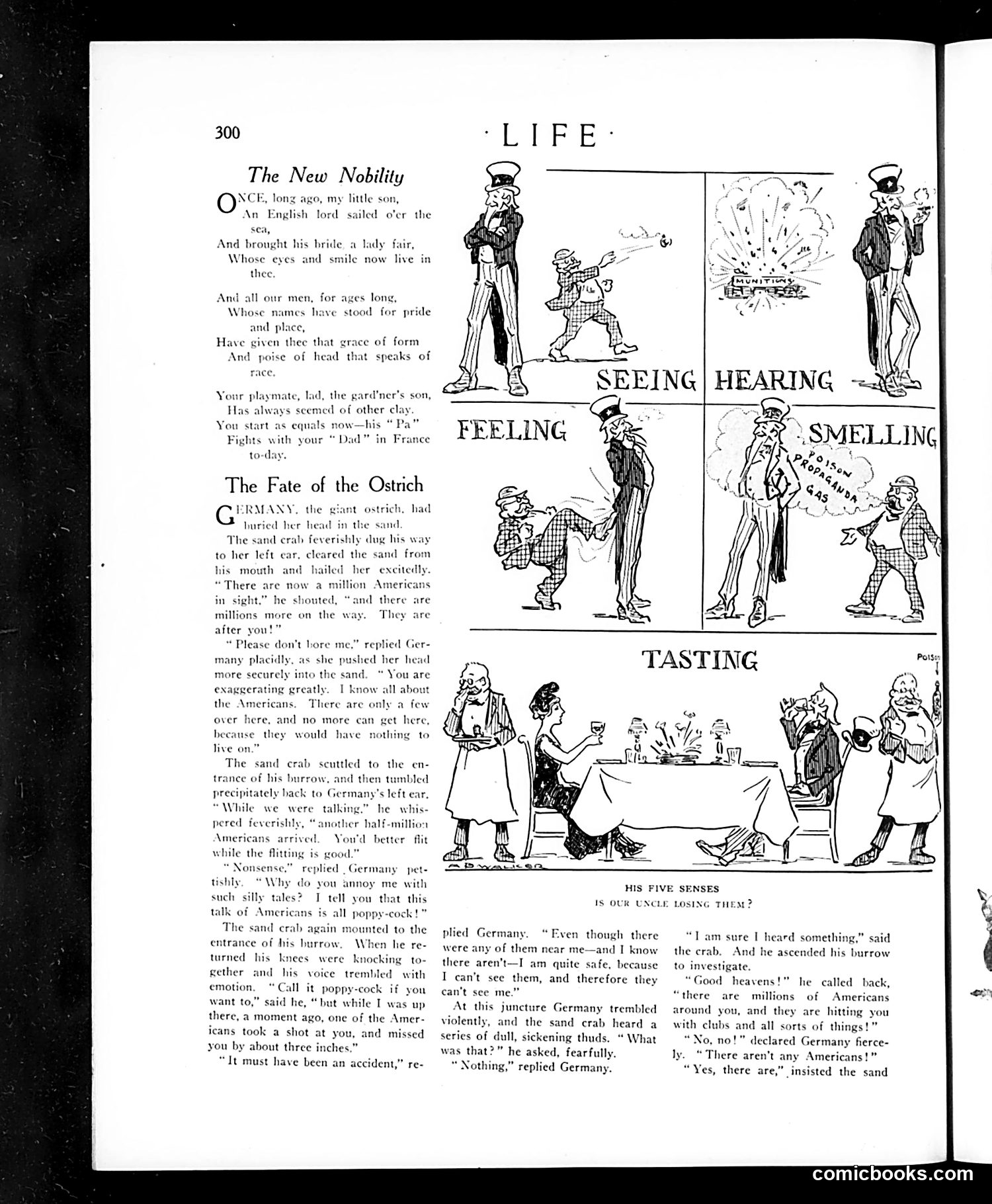
**"The New Nobility"** satirizes class mobility during World War I. The poem describes an English nobleman whose son married a lady of humble origins, and all their formerly aristocratic men now fight as equals in France. The point: war erases social hierarchy—a gardener's son fights alongside lords. This mocks old class pretensions. **"The Fate of the Ostrich"** uses Germany as a personified ostrich and a sand crab as America. Germany buries her head in sand, claiming ignorance of American troops arriving ("millions more on the way"). The satire suggests Germany denies obvious military reality—the approaching American Expeditionary Forces during WWI—clinging to false hopes while dismissing uncomfortable truths. Both pieces critique willful blindness to wartime realities.
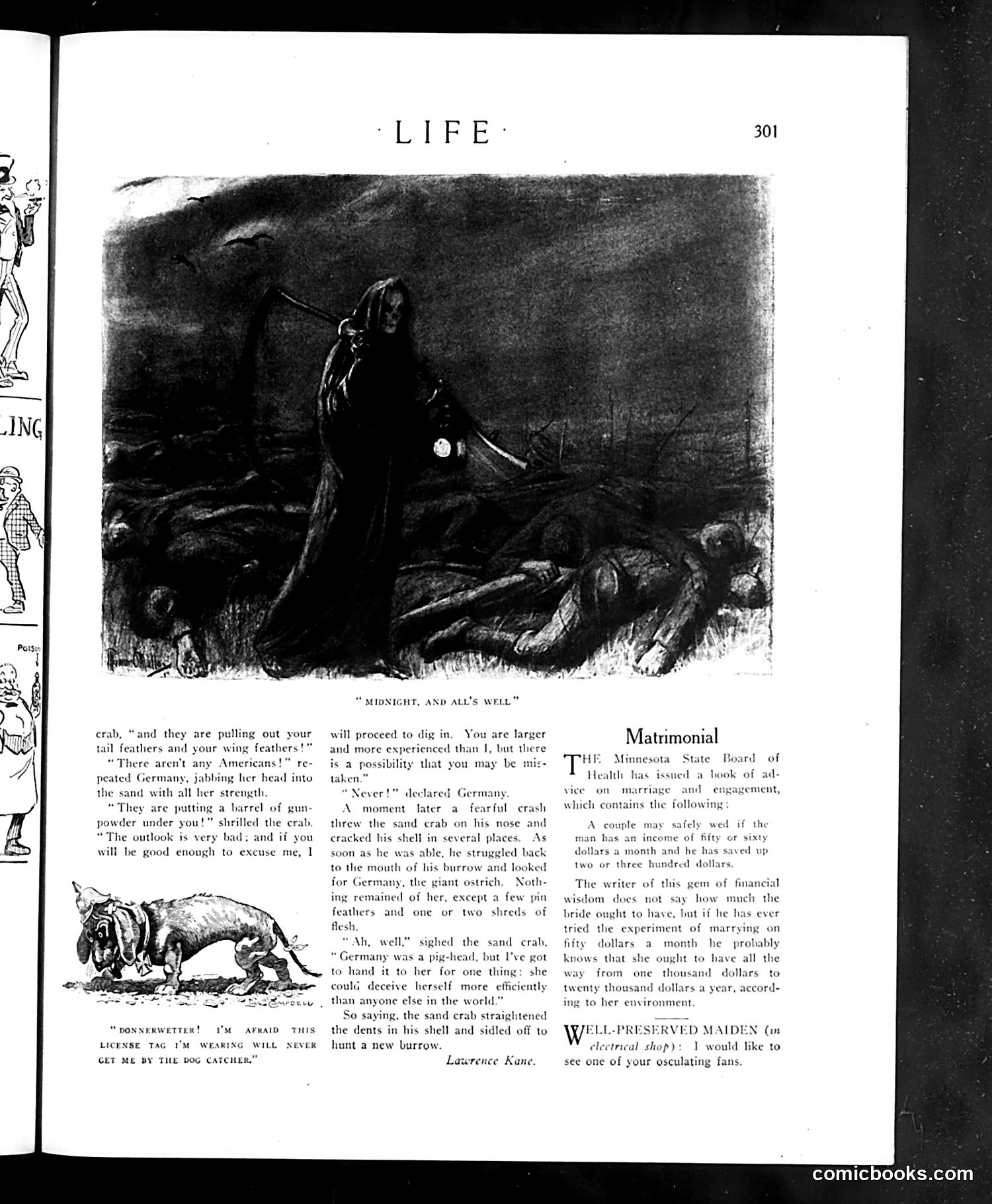
**Main Cartoon ("Midnight, and All's Well"):** The dark illustration depicts a figure in robes (appearing to represent Death or Grim Reaper) standing over fallen bodies on a battlefield at night. This is a WWI commentary on the human cost of war—specifically the nighttime casualties and carnage. **Text Story ("Dosserwetter!"):** A humorous anecdote by Lawrence Kane about a sand crab and ostrich engaging in combat. Germany is represented as the pig-headed ostrich, satirizing German stubbornness during WWI conflict. **"Matrimonial" Section:** A tongue-in-cheek advice column about marriage finances, suggesting a couple could marry on fifty dollars monthly—satirizing middle-class economic anxieties of the era. This page combines anti-German WWI sentiment with domestic humor typical of Life's satirical approach.
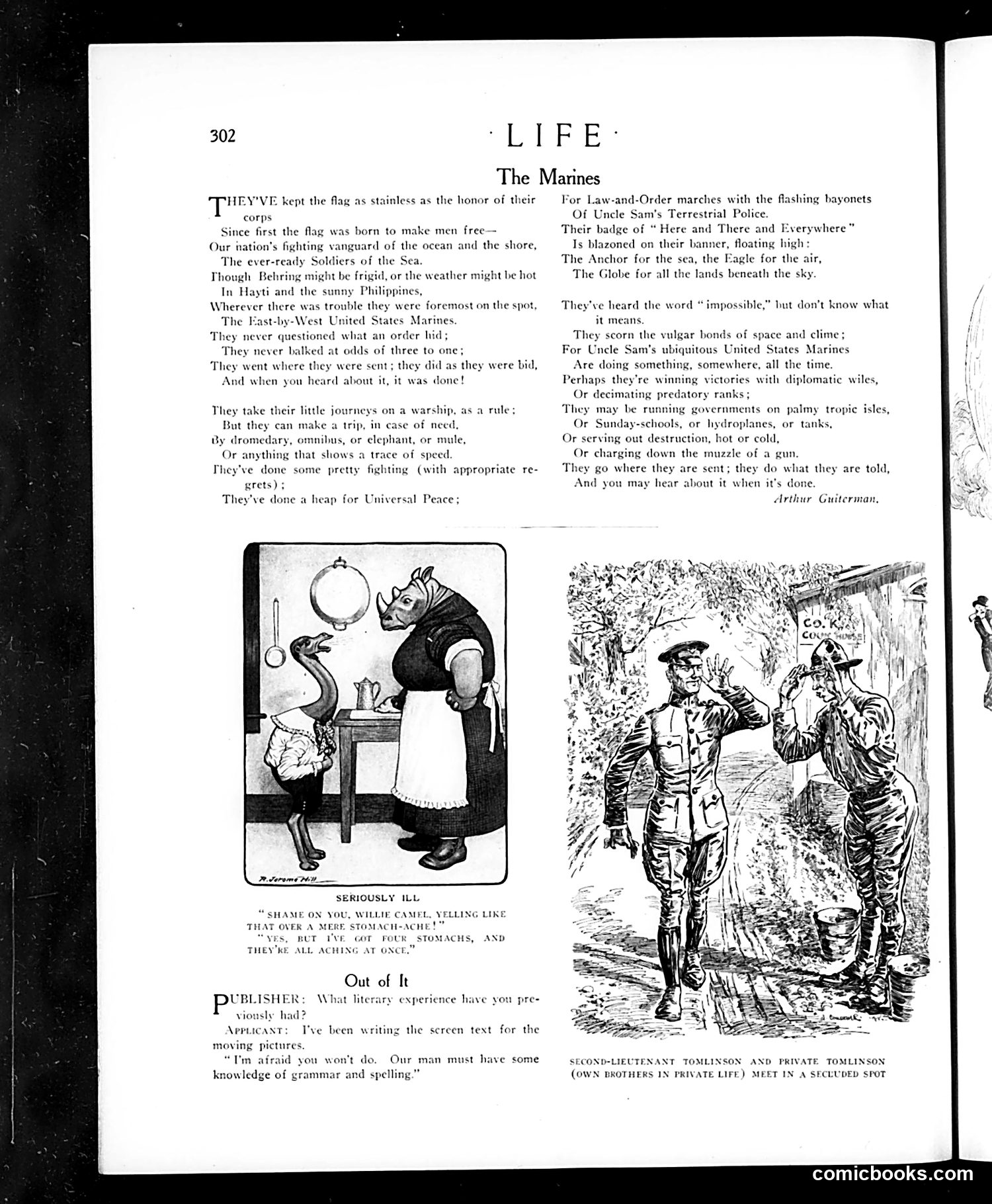
This page contains two distinct pieces: **"The Marines"** — A poem praising U.S. Marines for their global service and discipline, celebrating their role in maintaining order and peace. **"Seriously Ill" cartoon** — Shows a sick camel complaining about stomach aches to a nurse, with the caption mocking someone who has eaten "camels, yelling like that over a mere stomach-ache." The humor derives from the absurdity of the situation and the camel's exaggerated complaint. **"Out of It" interview** — A brief comic exchange where a publisher questions an applicant about literary experience. The applicant claims screenwriting work, but the publisher dismisses this, insisting the candidate needs "knowledge of grammar and spelling" — satirizing Hollywood's perceived lack of literary standards. The right illustration shows two military officers meeting in vegetation, labeled as brothers encountering privately.
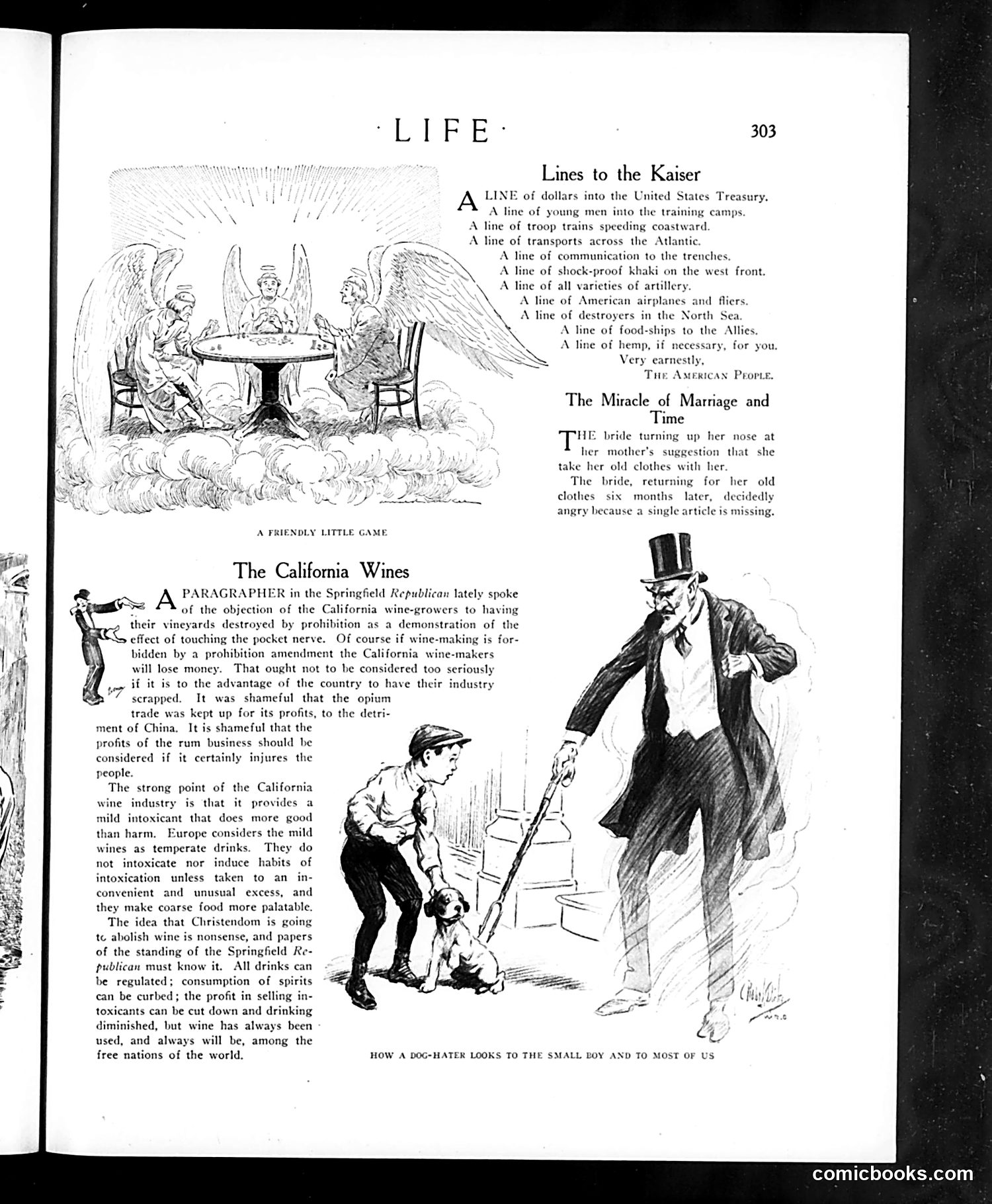
This page contains three distinct pieces: **"Lines to the Kaiser"** — A poem addressing Kaiser Wilhelm II during WWI, listing American military and supply contributions to the Allied effort (troops, ships, artillery, destroyers). The tone is earnest rather than satirical. **"The Miracle of Marriage and Time"** — A brief humorous anecdote about a bride upset over a missing article of clothing, suggesting marital discord develops quickly. **"The California Wines"** — An article defending California's wine industry against Prohibition, arguing mild wines provide social benefit. The accompanying cartoon shows a well-dressed man and boy with a dog, captioned "How a dog-hater looks to the small boy and to most of us," satirizing those who oppose wine as out of touch with ordinary people's values.
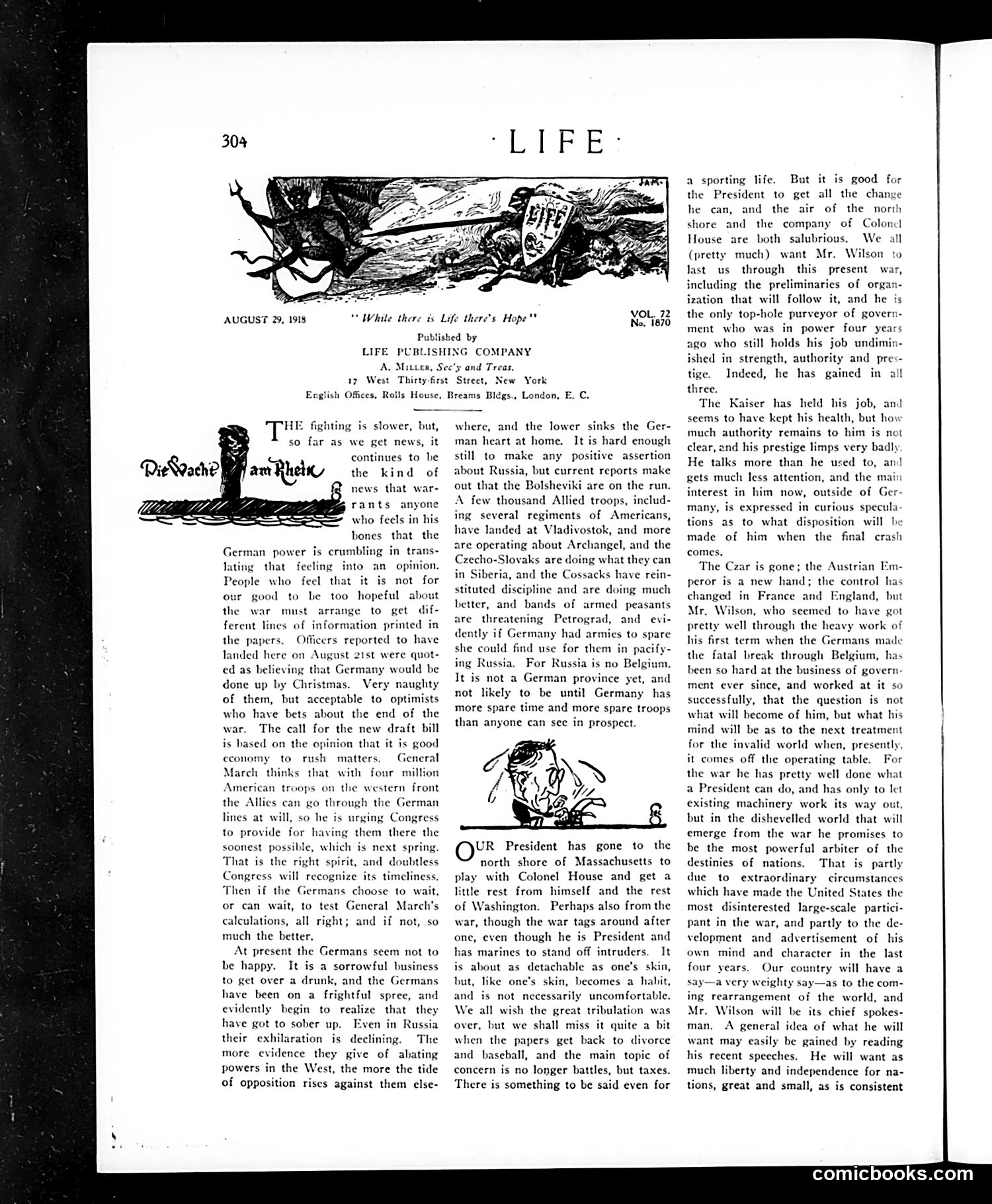
This editorial page, dated near World War I's end, contains a political cartoon titled "Die Rache am Rheine" (Revenge on the Rhine) depicting German military collapse. The cartoon shows a skeletal or death-like figure, likely representing Germany, in distress. The accompanying text discusses American military prospects: General March's confidence that four million Allied troops can break German lines by spring, and optimism about Germany's exhaustion. The piece references recent American landings at Vladivostok and operations against Bolshevik Russia, treating these interventions as positive developments. The editorial also covers President Wilson's brief vacation to Massachusetts with Colonel House, suggesting he deserves rest despite the war's demands. The author humorously notes that once peace comes, Americans will miss the war as a newspaper topic, replacing battle coverage with divorce and baseball scandals and tax disputes. The overall tone is cautiously optimistic about Allied victory while subtly mocking German morale collapse.
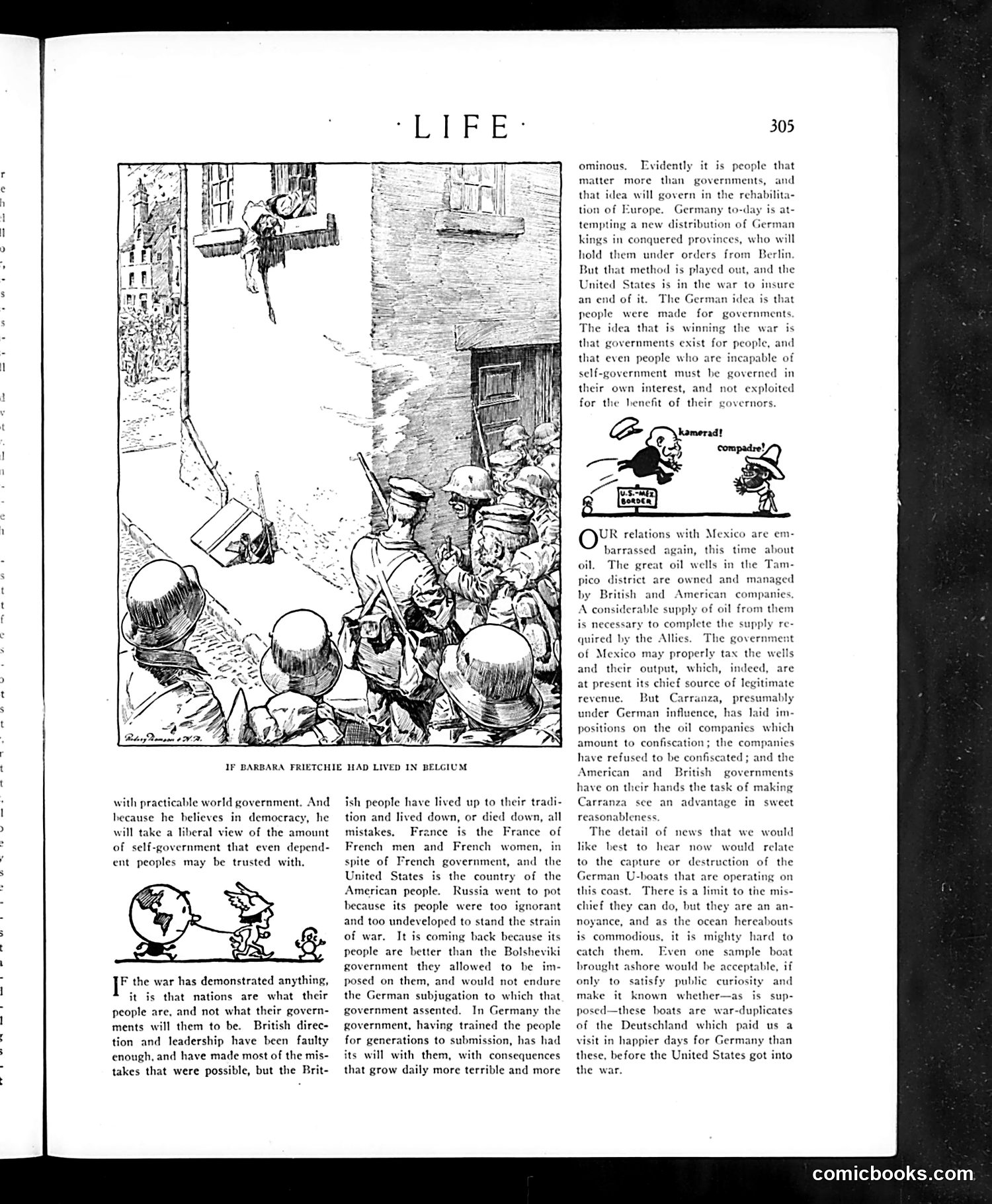
**Main Cartoon: "If Barbara Frietchie Had Lived in Belgium"** This references the famous Civil War poem where Barbara Frietchie defiantly waves the American flag at Confederate troops. The cartoon imagines her doing the same to German soldiers occupying Belgium during WWI. The image shows civilians being brutalized by armed German troops in a Belgian street—a stark contrast to the poem's romantic defiance. The satire highlights Germany's brutal occupation policies and suggests that such civilian resistance would be crushed, not heroically tolerated as in American legend. **Accompanying Editorial Text** The page argues that nations reflect their *people's* character, not just government policy. It contrasts democratic nations (Britain, France, America) whose populations transcend governmental failures, with Germany and Russia, where populations have been either subjugated or too undeveloped to resist. The piece asserts America fights so governments exist "for people," not vice versa. **Secondary Item: Mexico/Oil** A brief note criticizes Mexican leader Carranza (allegedly German-influenced) for confiscatory oil taxation, complicating Allied supply lines.
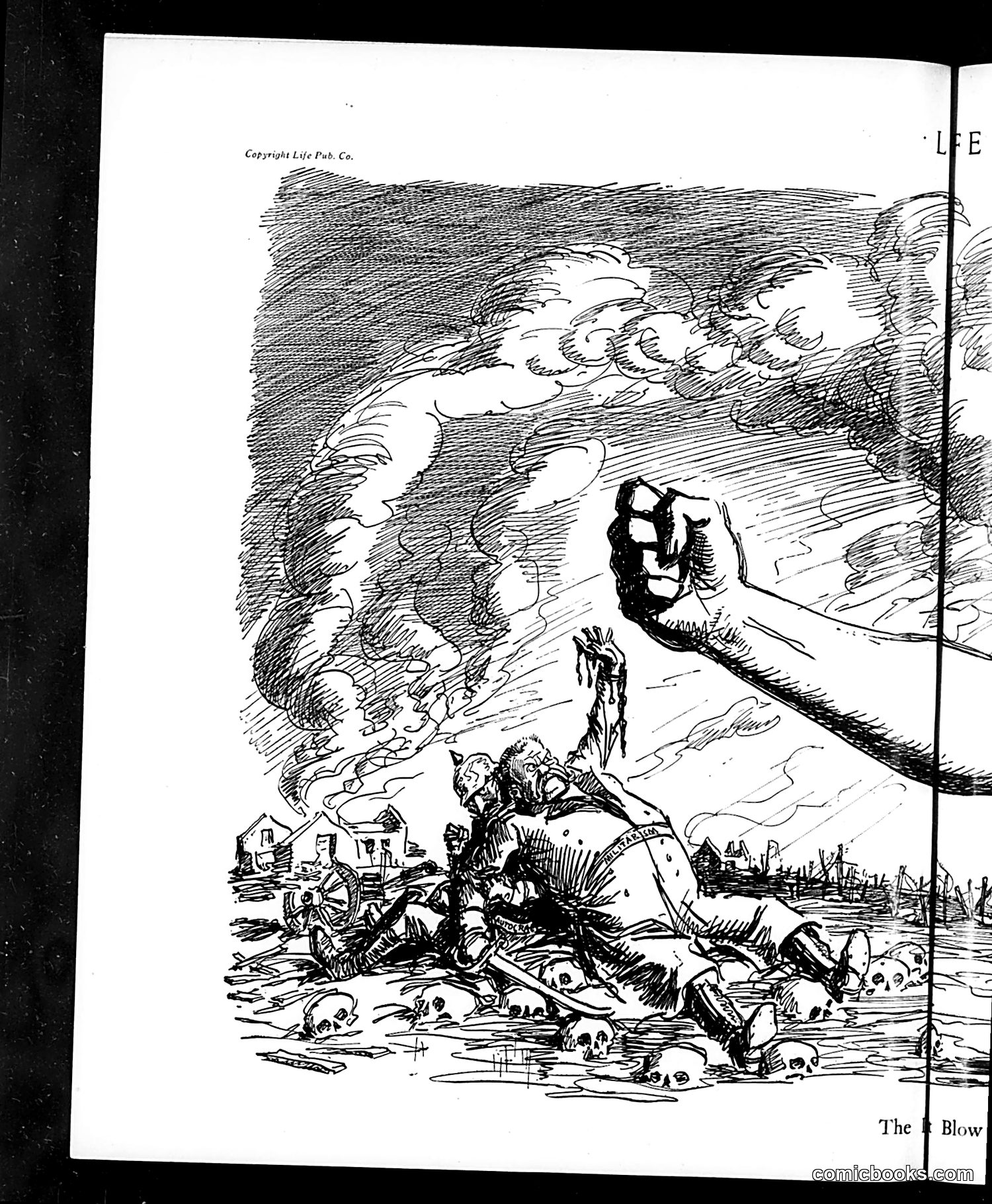
This political cartoon depicts a dramatic scene of death and destruction. A large skeletal hand emerges from clouds above, pointing downward at a battlefield littered with human skulls and corpses. Below, soldiers on horseback and foot soldiers appear to be in combat or fleeing amid the carnage. The cartoon's title appears to be "The Blow" (visible at bottom right). The imagery—the skeletal hand, abundant skulls, and military violence—suggests this is an anti-war satire, likely commenting on the destructive consequences of military conflict. The personification of death as an active force controlling warfare conveys the artist's message about the futility and horror of war. The "Copyright Life Pub. Co." attribution confirms this is from *Life* magazine's satirical content. However, without clearer text or additional context, the specific historical conflict or political target remains unclear.
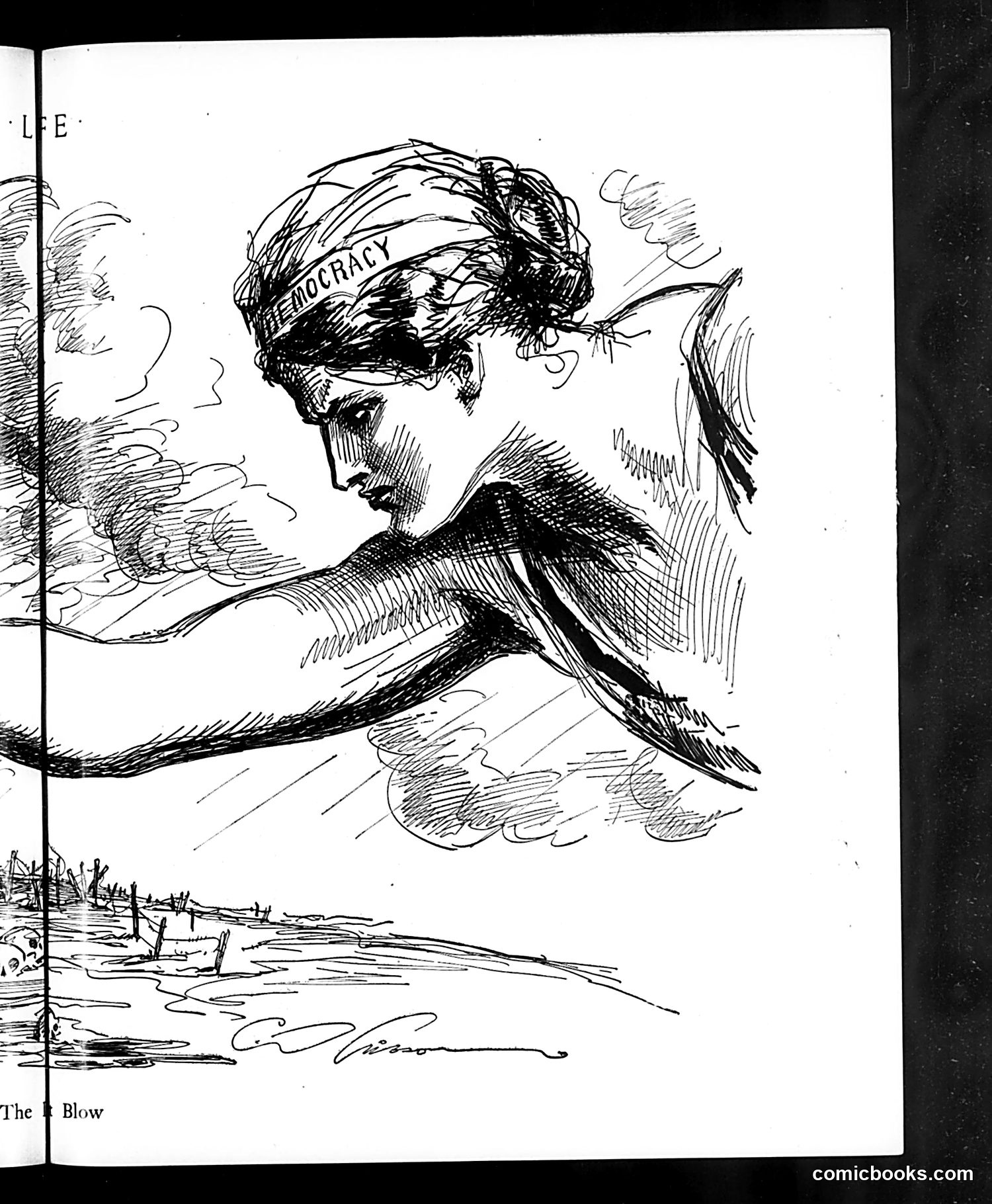
This satirical cartoon depicts a blindfolded figure wearing a headband labeled "DEMOCRACY" being struck or "blown" by an unseen force. The figure appears to be recoiling from impact, suggesting democracy is under attack or being damaged. The sketch style and composition suggest this is commentary on a threat to democratic institutions or values. The blindfold emphasizes democracy's vulnerability or inability to see danger approaching. The dramatic action conveys urgency and alarm about political circumstances. Without a clear date visible on this page, the specific historical event referenced remains unclear—it could reference fascism, authoritarianism, or domestic political crisis from the early-to-mid 20th century when *Life* magazine was actively satirizing threats to American democracy.
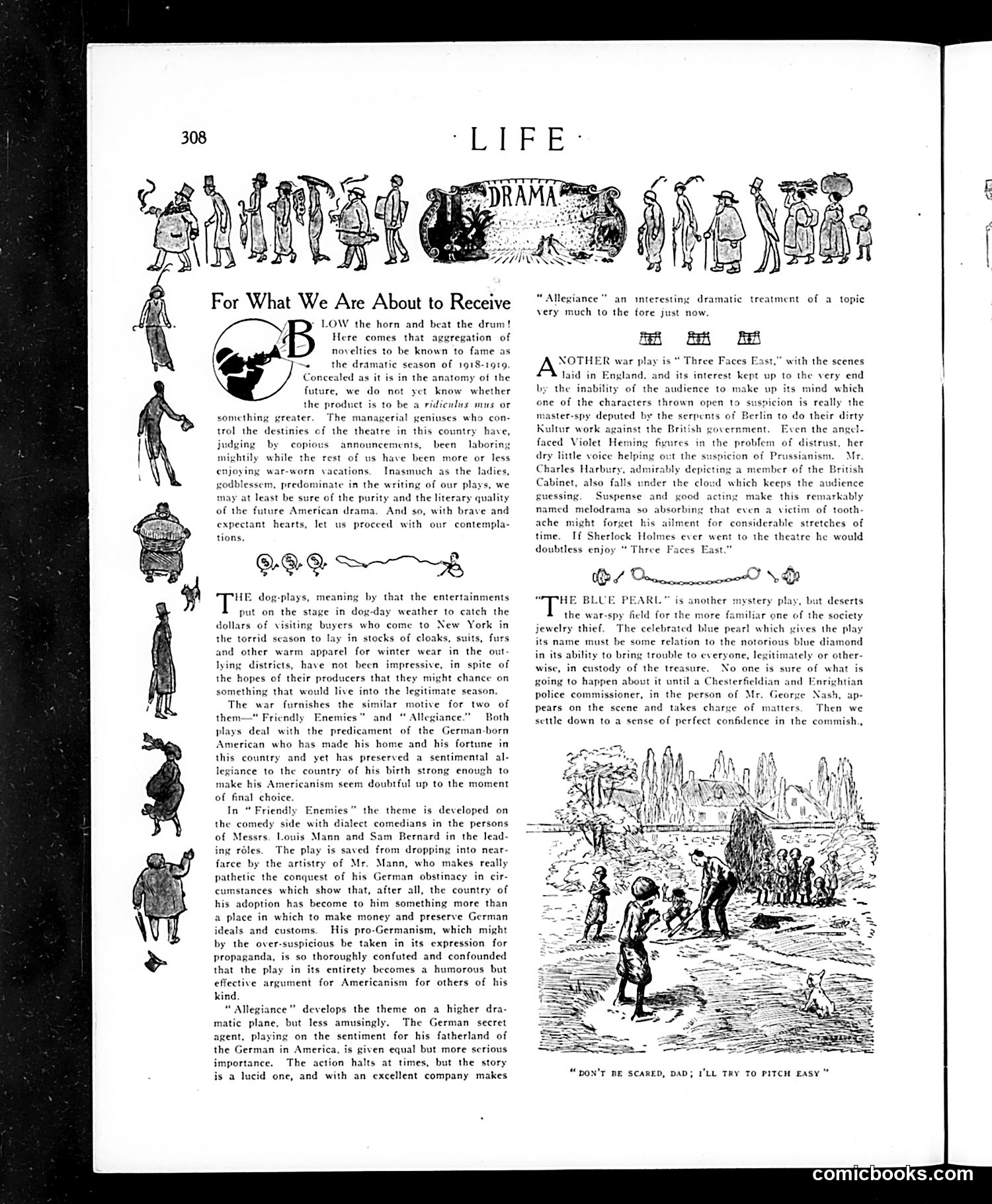
This page reviews new Broadway plays, primarily focused on **German-American identity during World War I**—a politically charged topic in 1918-1919 America. The satirical introduction mocks theatrical producers for flooding the market with plays, joking that female playwrights at least guarantee "purity" (a period stereotype). The main reviewed plays—"Friendly Enemies," "Allegiance," and "Three Faces East"—all explore the same anxiety: **German-born Americans whose loyalty to their adopted country remains suspect**. The first two plays explicitly address this dilemma. "Three Faces East" uses this suspicion as dramatic mystery, with even innocent-looking actress Violet Heming cast under suspicion as a possible German spy. The subtext is clear: during WWI, German-Americans faced intense scrutiny and accusations of disloyalty. These plays both dramatize and attempt to resolve that tension—showing German-Americans ultimately choosing America, thereby providing reassurance (and propaganda) to anxious audiences about immigrant patriotism.
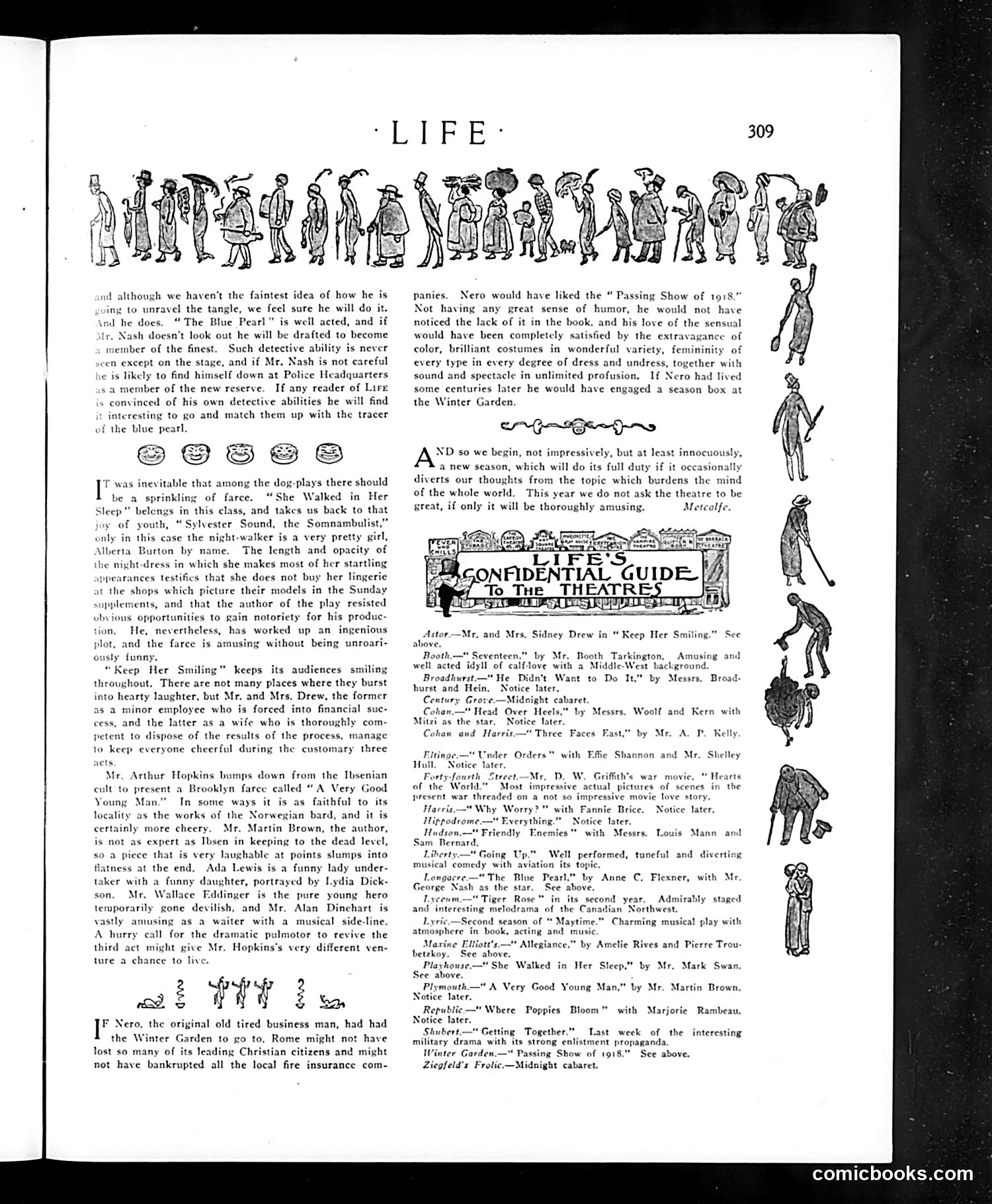
This page reviews Broadway productions from what appears to be 1918, using satirical commentary typical of *Life* magazine's style. The key satire involves a comparison between the Roman emperor Nero and modern theatre audiences. The **Nero reference** is the primary joke: the text suggests that if Nero had access to the Winter Garden theatre's "Passing Show of 1918," with its extravagant costumes, beautiful women, and spectacle, he wouldn't have persecuted Christians or bankrupted Rome—he'd simply attend theatre instead. This mocks both the vapidity of contemporary musical theatre (all "sound and spectacle in unlimited profusion") and implicitly critiques audiences for seeking shallow entertainment rather than meaningful art. The reviews themselves mock several productions—"A Very Good Young Man" is criticized for inconsistent quality, while "Keep Her Smiling" is praised for consistent (if not hearty) laughter. The overall tone suggests theatre's purpose during wartime (1918) should be merely diverting, not challenging.
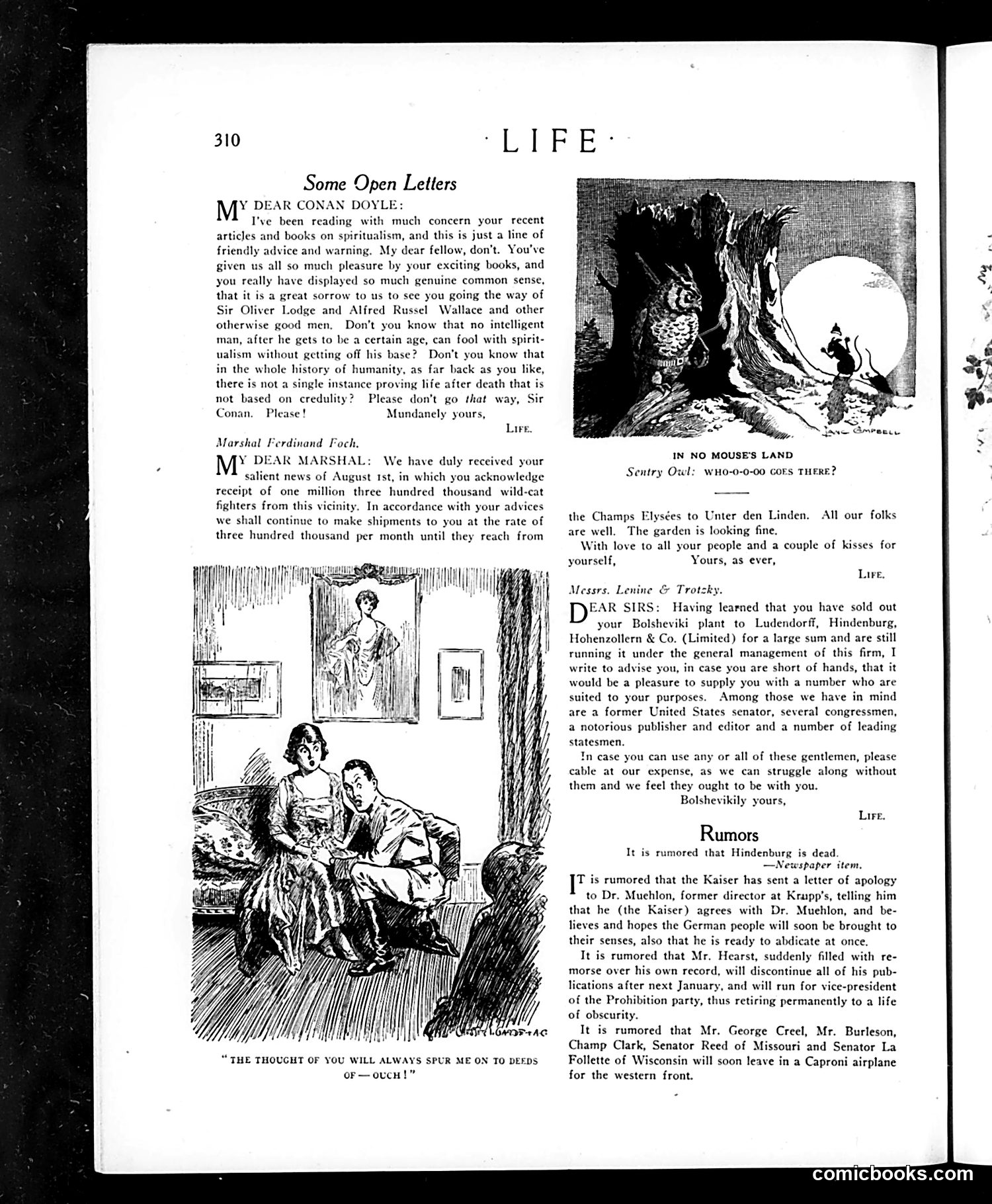
This page contains satirical "open letters" mocking prominent figures of WWI-era America (circa 1918). **The Letters Mock:** 1. **Arthur Conan Doyle** — criticized for embracing spiritualism despite his celebrated rationality as creator of Sherlock Holmes. The letter warns that intelligent men shouldn't pursue such "credulity" in old age. 2. **Marshal Foch** (French WWI commander) — joking that America is shipping "wild-cat fighters" (presumably undisciplined American soldiers) to help the French advance toward Berlin. 3. **Lenin and Trotsky** — darkly suggesting they've "sold" the Bolshevik revolution to German commanders, offering to supply them with American politicians, congressmen, and publishers deemed undesirable. **The cartoon** shows an owl sentry challenging someone in "No Mouse's Land" — a pun on "No Man's Land" (WWI trench warfare terminology). **The Rumors section** contains invented gossip about German surrender, William Randolph Hearst's supposed moral reformation, and American political figures supposedly enlisting for the western front. The satire targets wartime incompetence, spiritualism's appeal to the educated, and suspected German-Bolshevik cooperation.
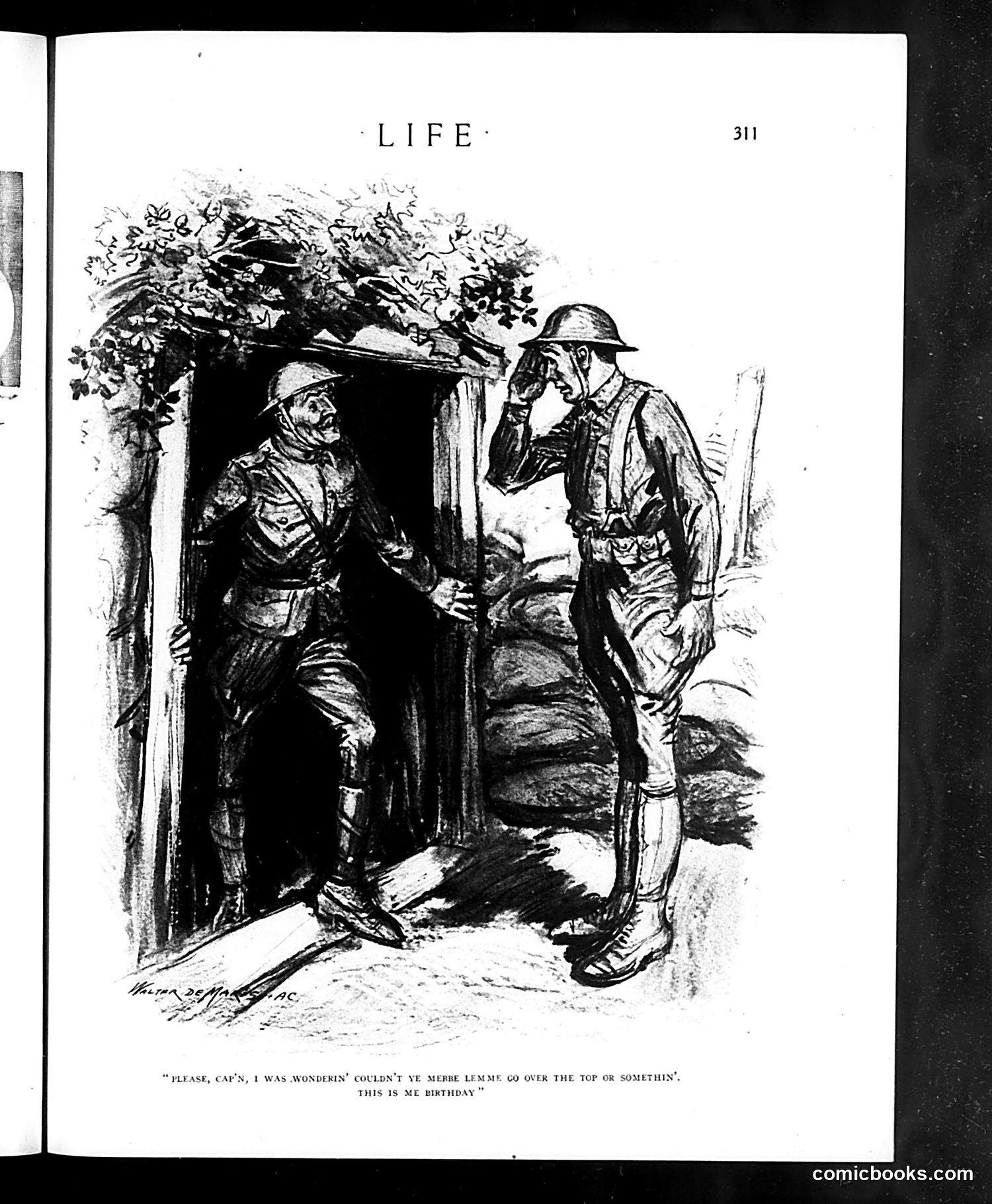
This is a WWI-era cartoon depicting a soldier in a trench requesting permission from his captain to go "over the top"—military slang for climbing out of the trench to attack enemy positions, an extremely dangerous action with high casualty rates. The dark humor hinges on the soldier's reason: it's his birthday. The satire mocks the absurdity of trench warfare's mechanized death, where a soldier would desperately seek combat as a birthday "treat." It also suggests the desperation soldiers felt in the trenches and the grim gallows humor used to cope with constant danger. The illustration's style and subject matter confirm this is wartime satire, likely from *Life* magazine's WWI period (1917-1918).
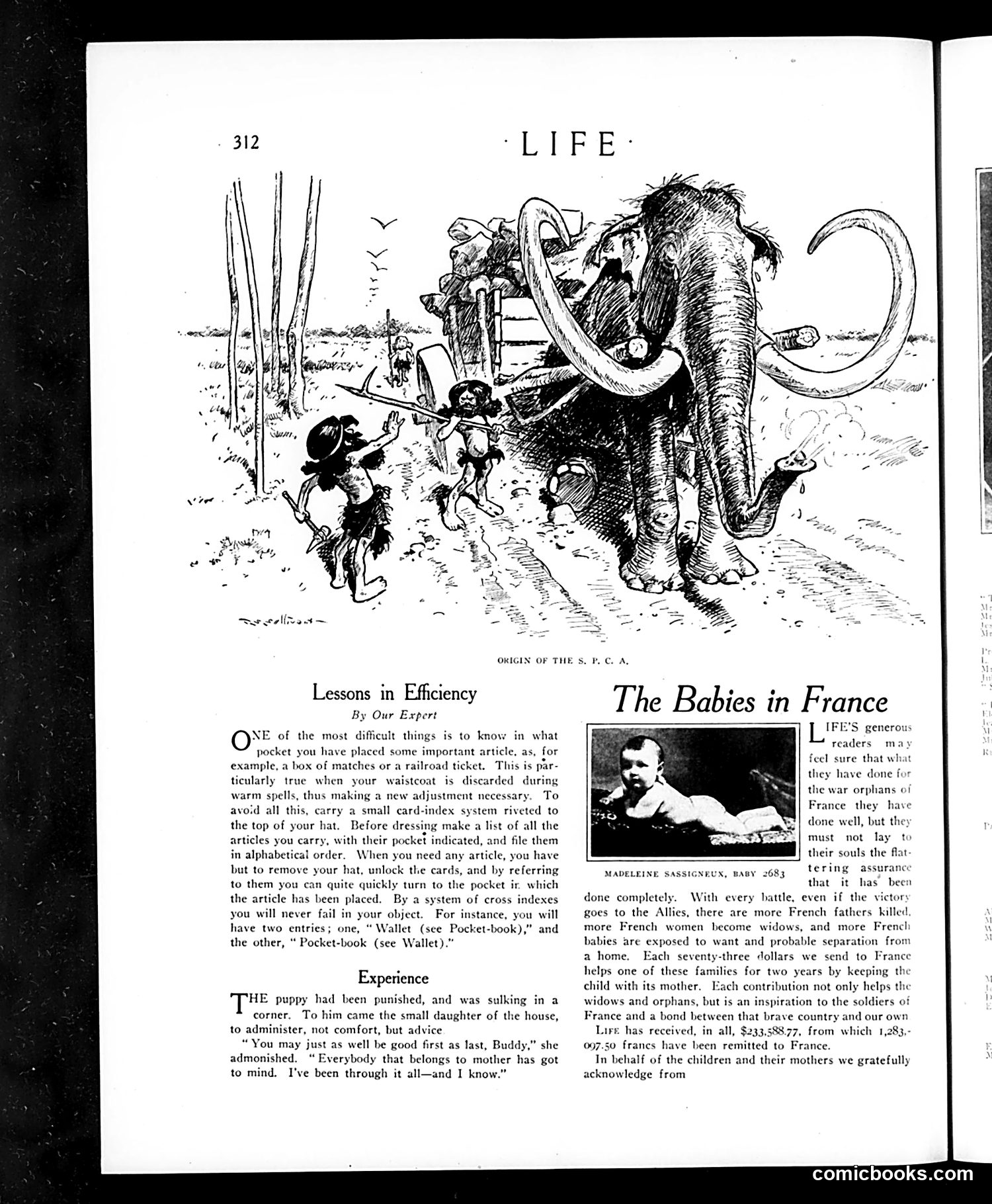
The page contains three satirical pieces from *Life* magazine: **"Origin of the S.P.C.A."** (top cartoon): A humorous visual joke depicting a mammoth being ridden/controlled by small humans, captioned as the origin of the Society for the Prevention of Cruelty to Animals—suggesting absurdly that animal welfare began with prehistoric humans managing large beasts. **"Lessons in Efficiency":** Satirizes obsessive organizational systems by mocking someone who carries a hat-mounted card-index system just to track where they've placed pocket items like matches or tickets. It's absurdist humor about over-engineering simple problems. **"Experience":** A brief anecdote where a punished puppy receives advice from a child, humorous because the child speaks with unwarranted authority about obedience. **"The Babies in France":** An earnest fundraising appeal (not satirical) for war orphans, requesting donations to support French widows and fatherless children separated by WWI casualties. The photo shows one beneficiary child. The page mixes light comedy with serious charitable messaging typical of wartime *Life* magazine content.
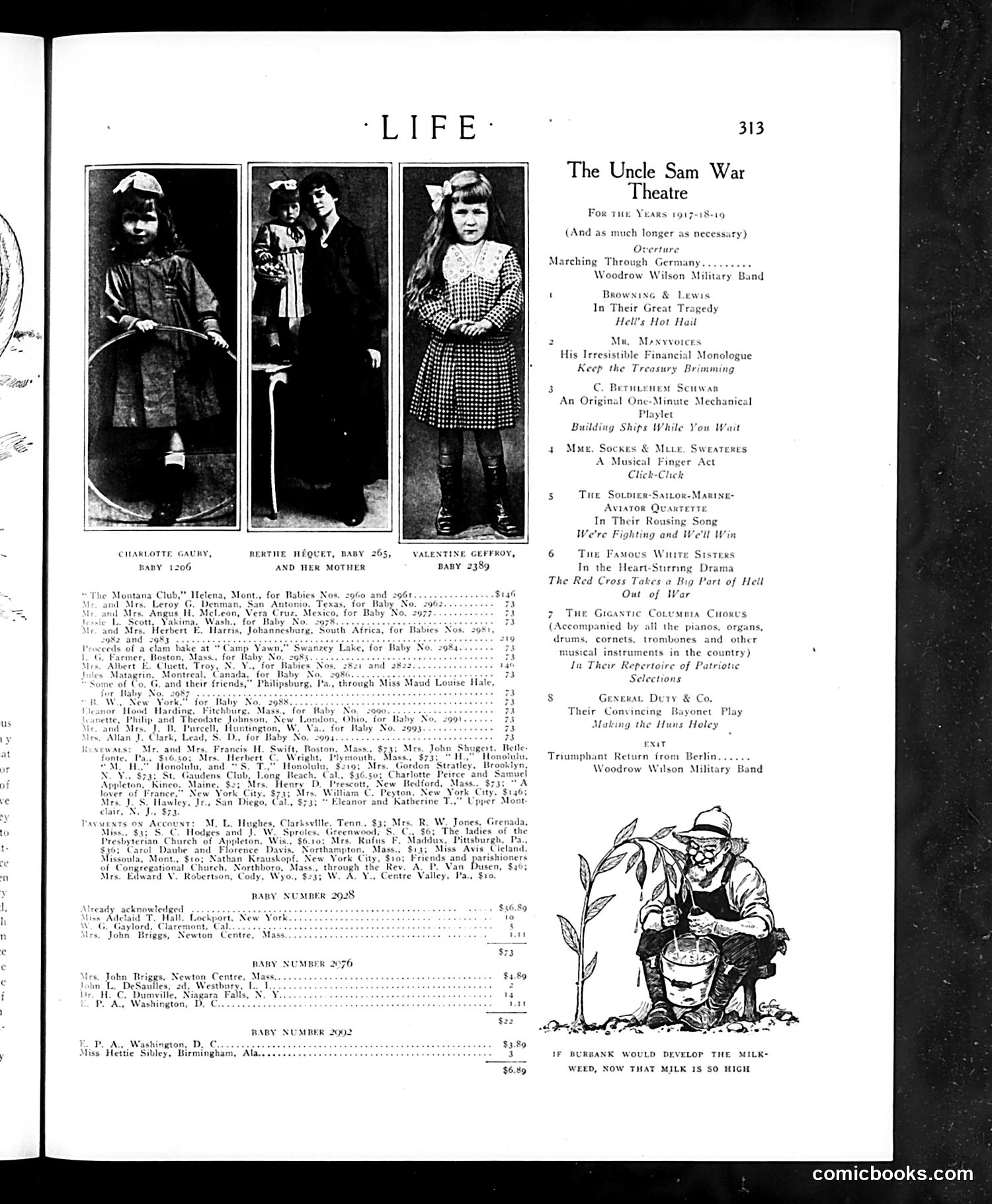
This page satirizes American mobilization during World War I (1917-1919) by presenting the war effort itself as a theatrical production. The "playbill" on the right mocks how the government packaged patriotic messaging for public consumption. The satire targets: - **Financial exploitation**: "Keep the Treasury Brimming" suggests endless war-funding demands - **Propaganda theater**: Military bands, patriotic songs ("We're Fighting and We'll Win"), and staged heroism - **Casualty euphemism**: "The Red Cross Takes a Big Part of Hell / Out of War" darkly jokes about casualties - **Military absurdity**: "Making the Huns Holey" (puns on killing) and "Triumphant Return from Berlin" (premature victory claims) The bottom cartoon about Luther Burbank developing a "milk-weed" when "milk is so high" references wartime inflation and food shortages—another critique of war's domestic hardships. The left side lists baby naming donations, suggesting Life magazine's simultaneous role as both satirist and participant in patriotic fundraising.
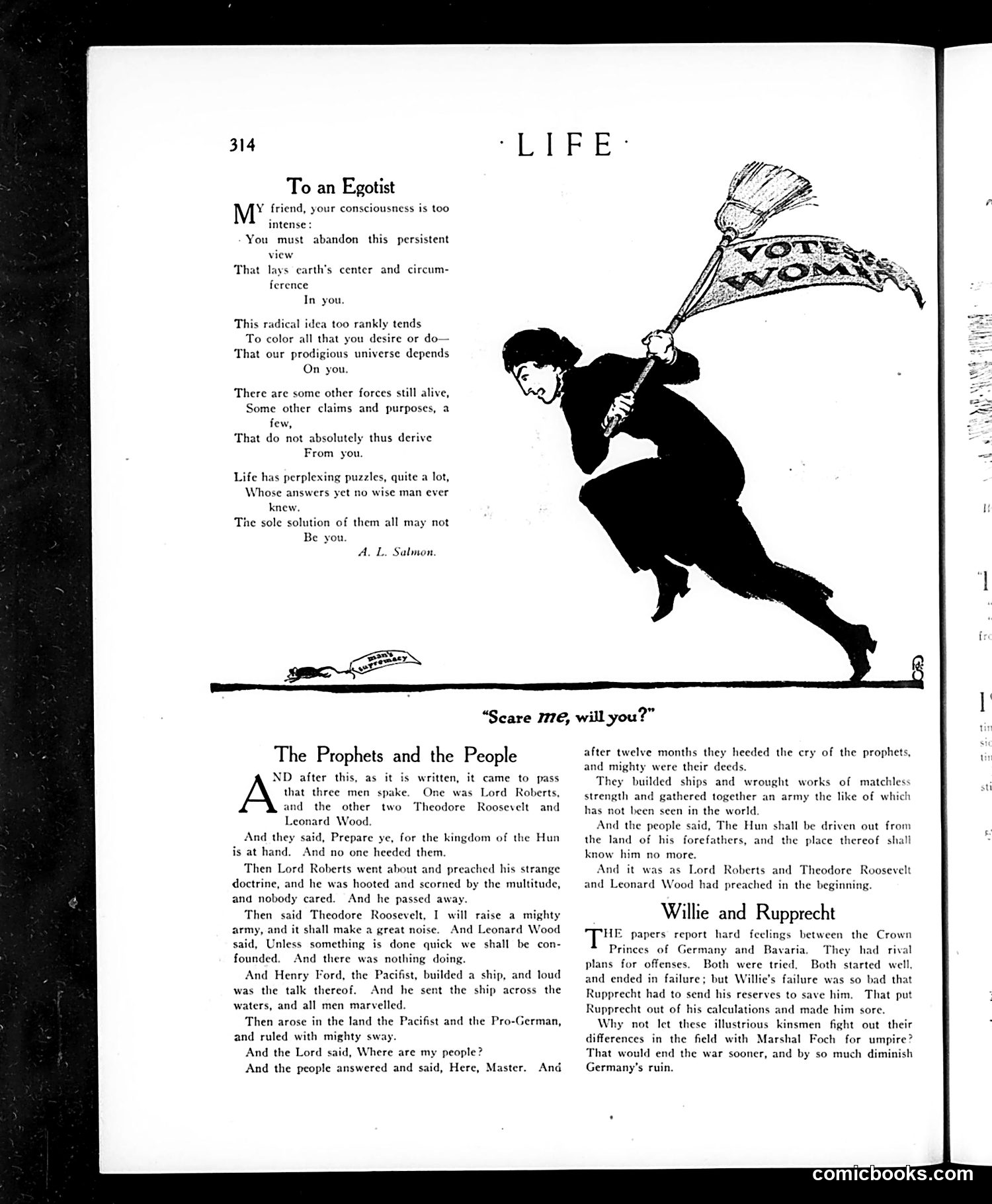
**"To an Egotist"** (top): A poem mocking self-centered individuals who believe the universe revolves around them. The accompanying silhouette cartoon shows a figure striking a dramatic pose while seemingly oblivious to a small creature at ground level—a visual joke about the egotist's inflated self-importance and blindness to anything outside their own concerns. **"The Prophets and the People"**: A biblical-style parable about pre-WWI American resistance to military preparedness. Lord Roberts, Theodore Roosevelt, and Leonard Wood warned of German danger (the "Hun"), but were ignored. Only after twelve months did Americans heed the call and mobilize. Henry Ford's pacifist "peace ship" represents misguided opposition to war preparation. The passage appears to validate the interventionists' earlier warnings. **"Willie and Rupprecht"**: A satire suggesting the German Crown Princes (Wilhelm II's son and Bavaria's crown prince) quarrel over military strategy, with one needing rescue from the other. The author proposes letting them settle differences under French Marshal Foch's observation—a darkly humorous suggestion to end the war quickly.
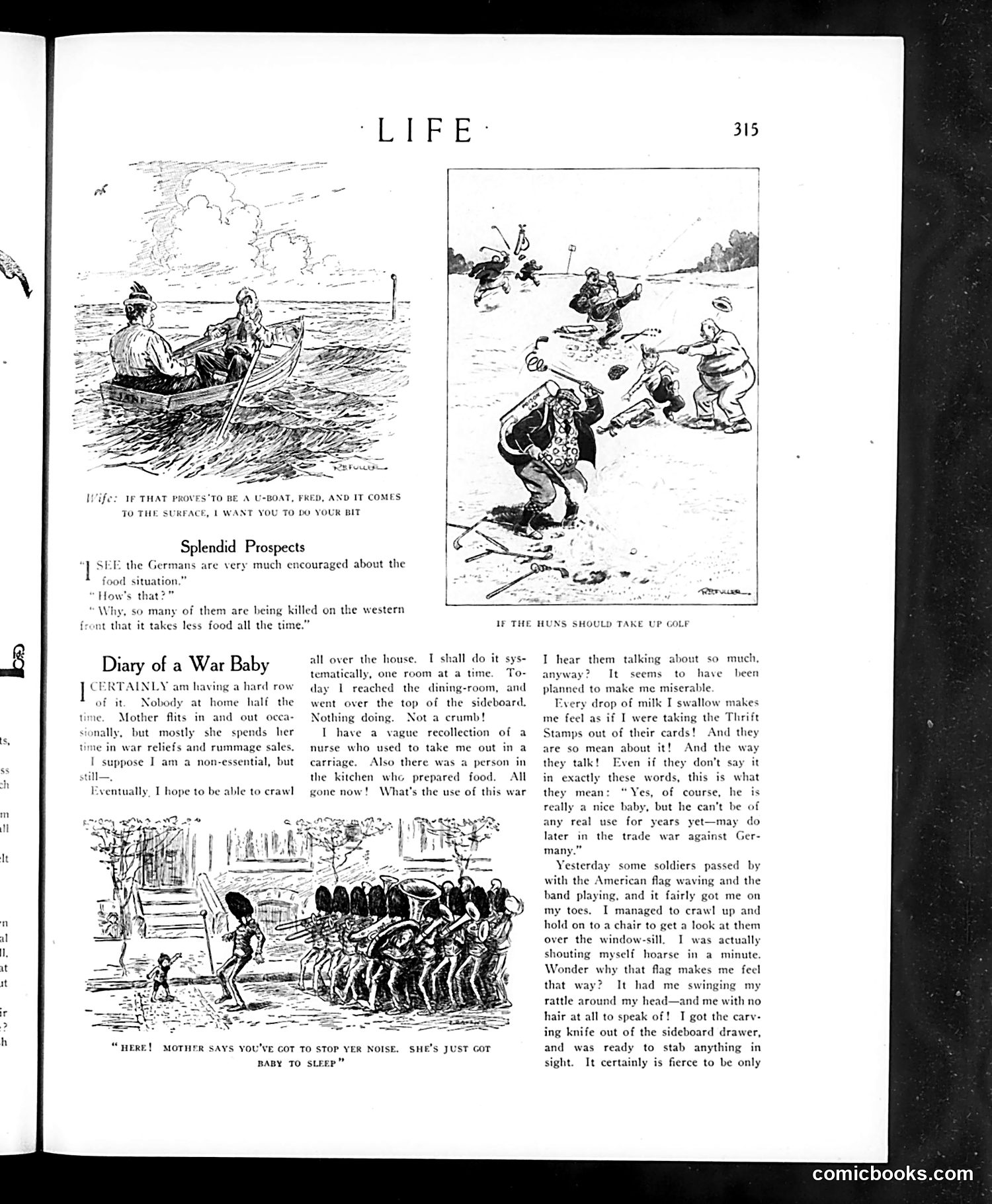
This page contains three pieces of wartime humor from America during World War I: **"Splendid Prospects"**: A bitter joke about German casualties—so many German soldiers are dying on the Western Front that Germany has less mouths to feed, thus solving their food shortage problem. **"If the Huns Should Take Up Golf"**: The title references Germans ("Huns," a common WWI-era slur) and imagines them abandoning warfare for leisure, depicted as children playing on a beach instead of fighting. **"Diary of a War Baby"**: A domestic satire where an American baby describes wartime home life—mother's constant war relief work, rationing (milk associated with Thrift Stamps/war bonds), and the baby's passionate patriotic reaction to seeing American soldiers and flags. The humor comes from the baby's primitive but earnest patriotism and the absurdity of treating an infant as complicit in war efforts. All three pieces reflect American home-front attitudes: gallows humor about enemy losses, mockery of Germans, and the total mobilization of civilian life—even babies—for the war effort.
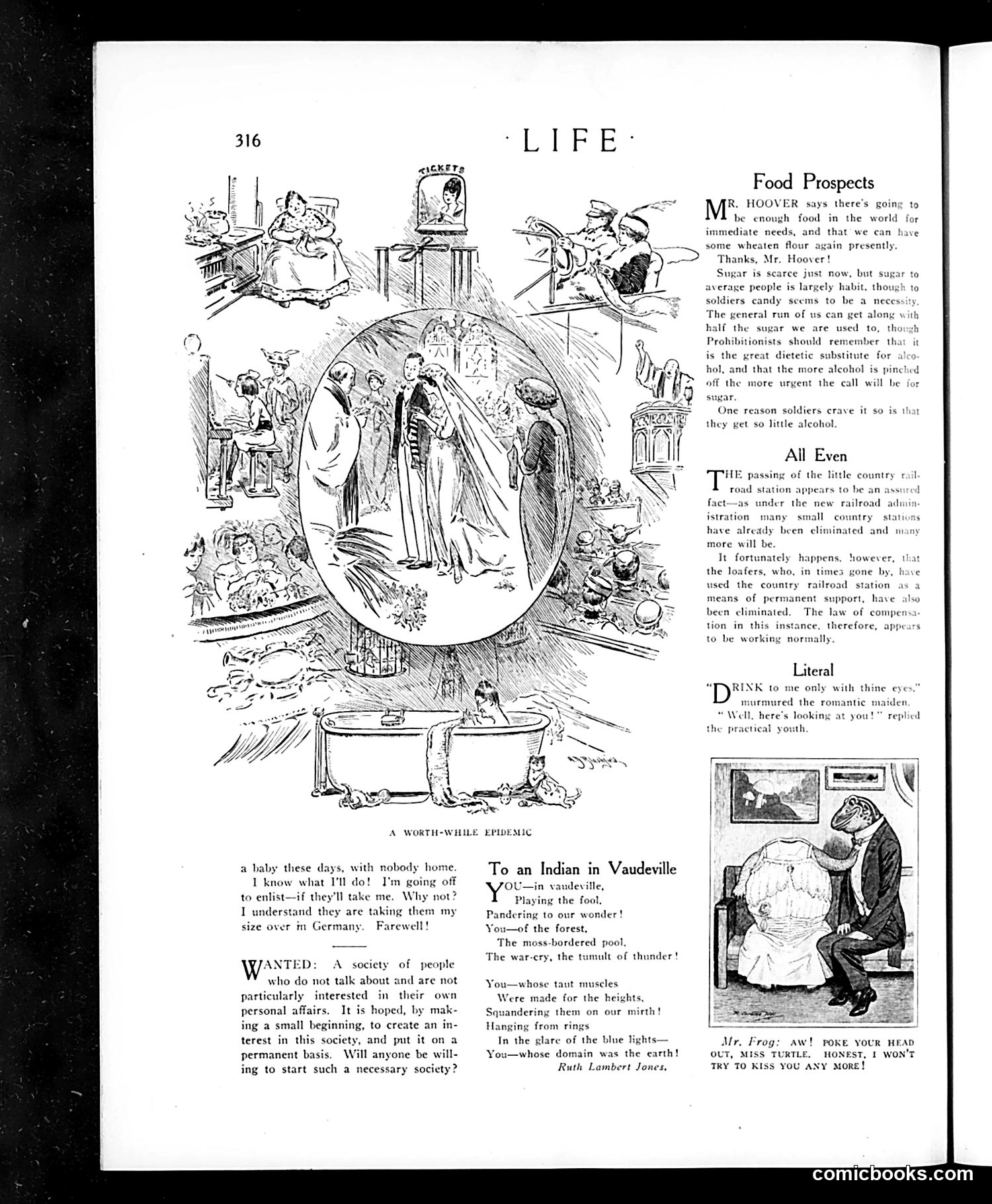
This page from *Life* satirizes American home-front conditions during World War I. The central cartoon depicts food rationing—specifically sugar scarcity—through Hoover's (Herbert Hoover, Food Administrator) assurances that supplies exist. The satire mocks both the rationing itself and the government's optimistic messaging about substituting alcohol prohibition for sugar needs. "All Even" jokes about rural railroad station closures under new administration, noting that while small-town stations disappear, so do the "loafers" who depended on them—a dark humor about displacement. Additional items include romantic versus pragmatic takes on drinking ("thine eyes" versus "looking at you"), a poem romanticizing Native Americans in vaudeville performance, and a small cartoon about enlisting for military service. The "wanted" section satirizes social gossip culture by seeking people *uninterested* in personal affairs—a jab at small-town busybodies. Overall, the page reflects wartime anxieties about rationing, rural change, and social disruption.
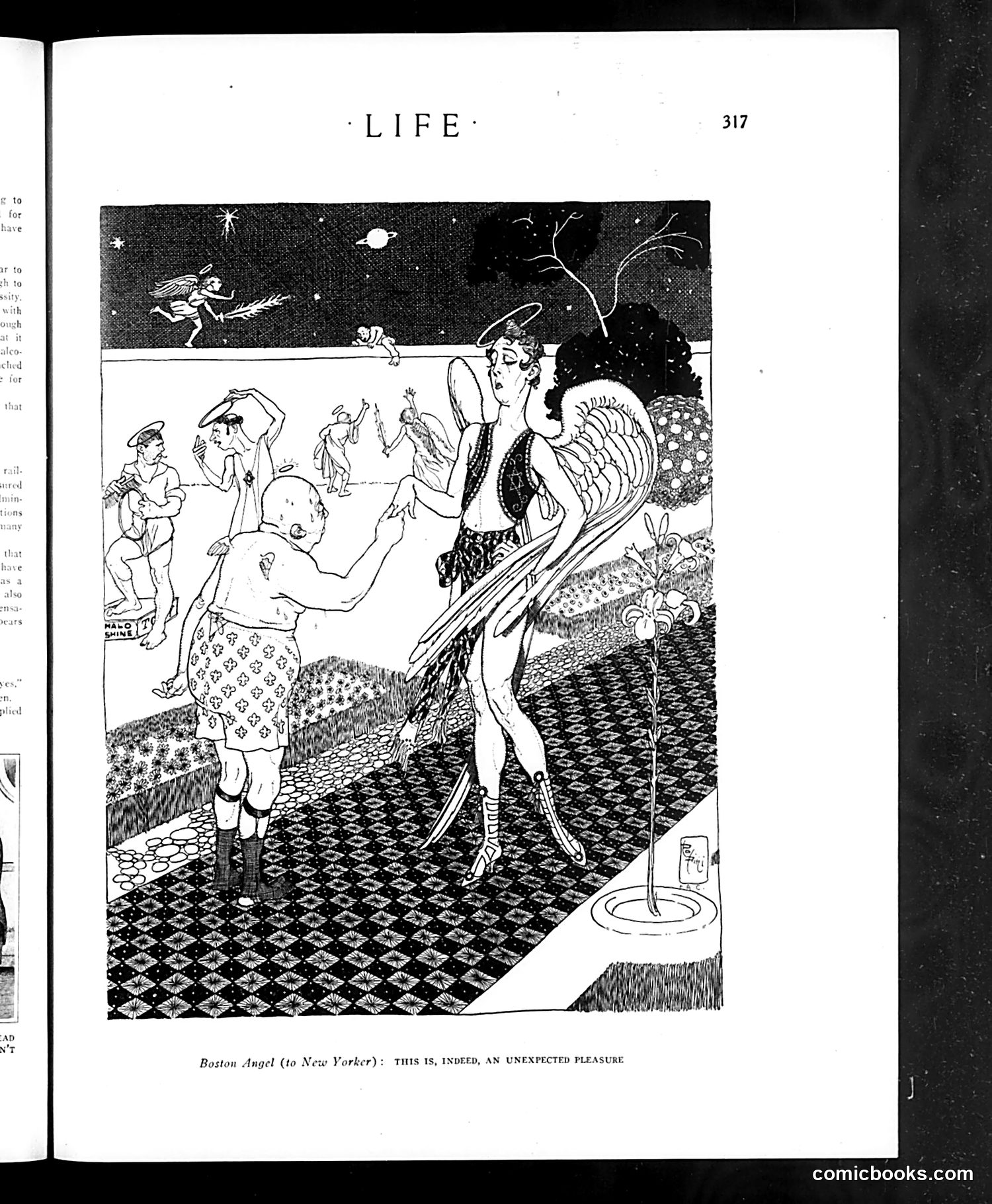
This satirical cartoon contrasts two female figures: a "Boston Angel" (identified in the caption) and an implied New Yorker. The Boston woman appears demure and conservatively dressed, while the other figure is depicted as a fairy or winged creature in revealing clothing, engaged in what appears to be golf or a similar recreational activity. The joke plays on regional stereotypes: Boston was associated with Puritan propriety and moral conservatism, while New York represented modern, looser social attitudes. The Boston woman's comment—calling the New Yorker's behavior an "unexpected pleasure"—suggests sardonic surprise at encountering such uninhibited conduct. The cartoon satirizes the cultural clash between traditional New England values and the more liberated attitudes of Jazz Age New York society.
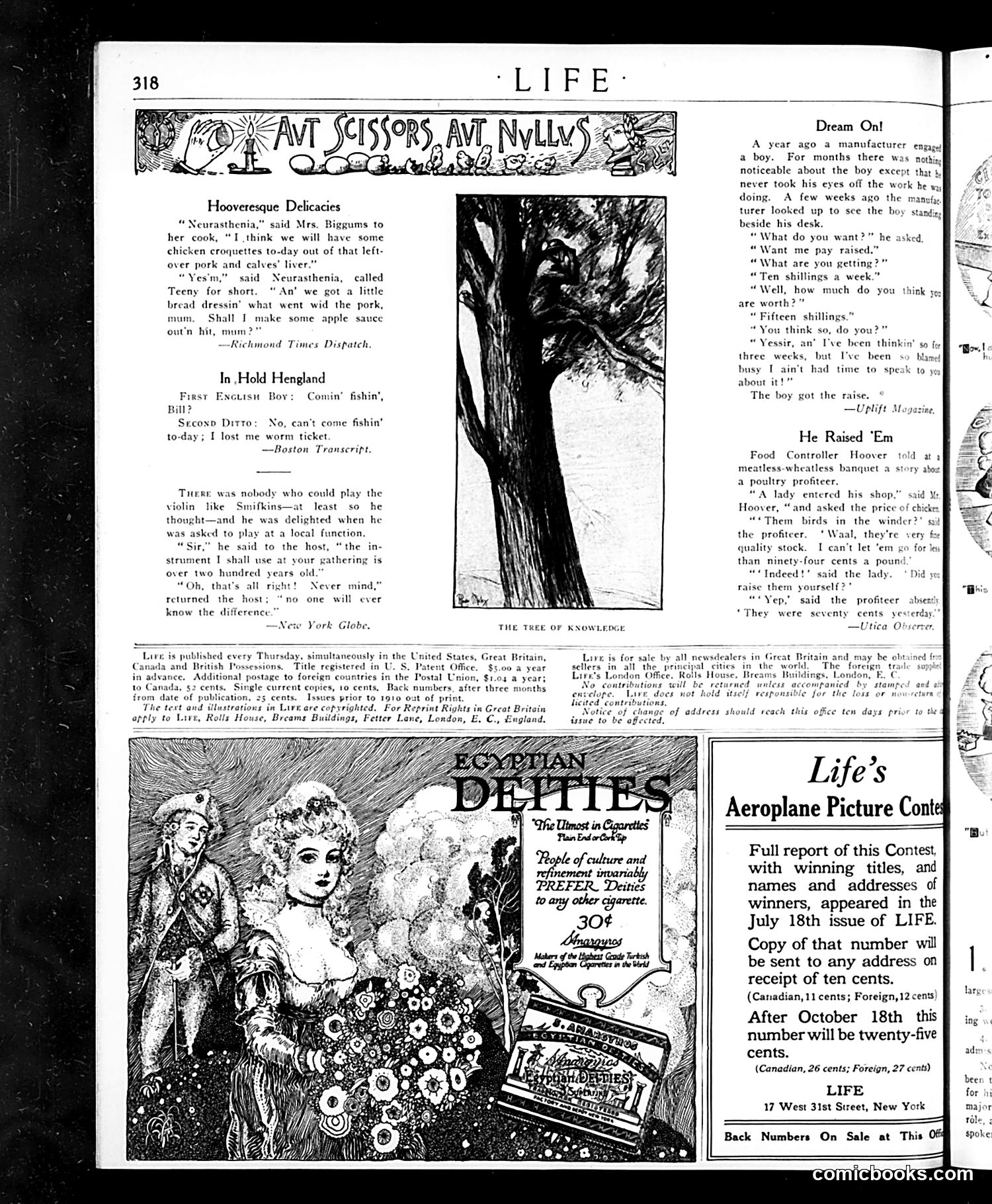
This page contains several brief humorous anecdotes typical of Life's satirical style, plus advertisements. **"Hooveresque Delicacies"** mocks food rationing during WWI by showing a cook creatively repurposing leftover ingredients—the title references Food Controller Herbert Hoover's rationing program, suggesting Americans had to make do with improvised dishes. **"In Hold Hengland"** jokes about British bureaucracy: a boy can't go fishing because he's lost his "worm ticket," satirizing excessive wartime regulations. **"He Raised 'Em"** features Hoover telling an anecdote about a profiteer who raised chicken prices from 70 to 94 cents per pound, then claims he "raised them himself"—a pun mocking both wartime price-gouging and the double meaning of "raise." The page's tone targets wartime shortages, food controllers, and profiteers exploiting rationing. The tree illustration titled "The Tree of Knowledge" appears decorative rather than satirical. The page is primarily editorial content with period advertisements for Egyptian Deities cigarettes and a Life aeroplane photo contest.
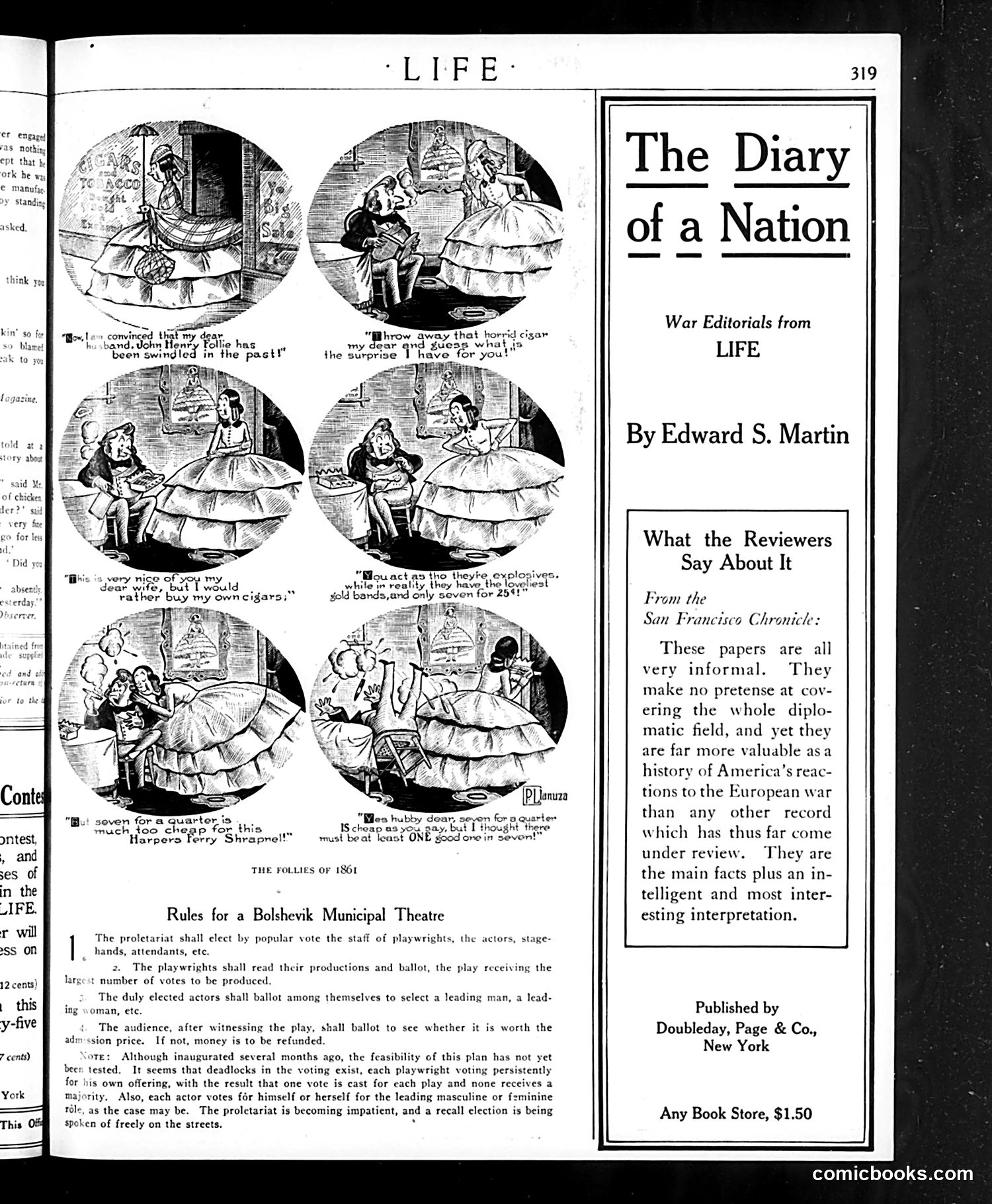
This page contains two distinct satirical pieces: **Left side—"The Follies of 1861"**: Six circular vignettes depicting domestic scenes with couples debating trivial matters (cigars, jewelry, expense). The satire mocks petty marital squabbles during the Civil War era, suggesting Americans fiddled over minor domestic concerns while the nation faced existential conflict. **Bottom section—"Rules for a Bolshevik Municipal Theatre"**: This satirizes Soviet revolutionary governance by outlining absurd democratic voting procedures for theater production. The joke: strict egalitarian voting creates paralyzing deadlock—each playwright votes only for themselves, actors vote for themselves, audiences demand refunds—rendering the system unworkable. It mocks both Bolshevik ideology and bureaucratic inefficiency. **Right side**: Advertisement for *The Diary of a Nation*, war editorials by Edward S. Martin, published by Doubleday, Page & Co., priced at $1.50. The overall page suggests Life's satirical critique of both domestic frivolousness during wartime and revolutionary communist governmental failures.
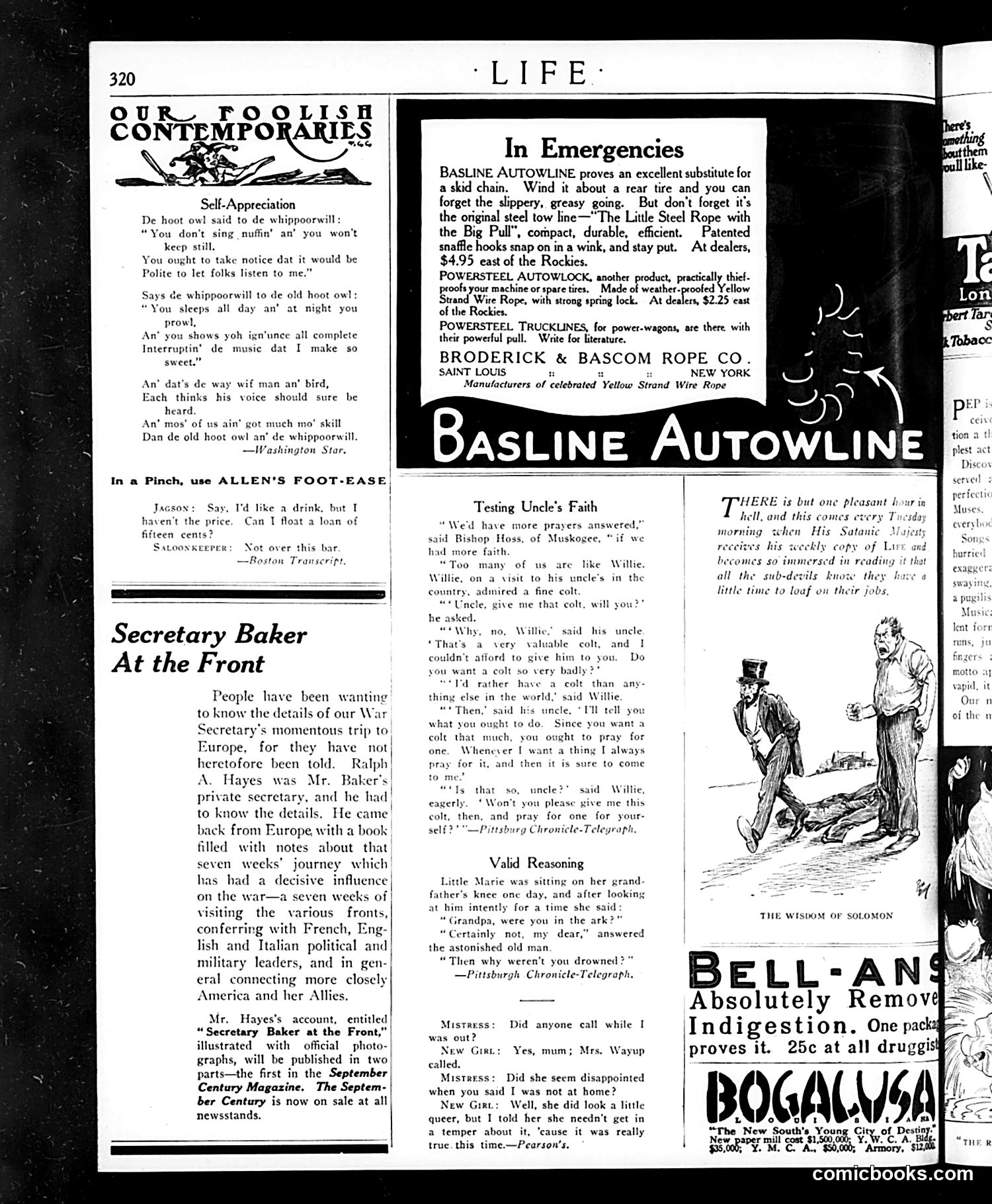
This page is primarily **advertising and filler content** rather than political satire. It contains: **Advertisements**: Multiple product ads (Basline Autowline rope, Allen's Foot-Ease, Bell-Ans indigestion remedy) dominate the layout. **Humorous Sketches**: Several brief, unrelated jokes appear: - "Self-Appreciation" compares quarrelsome humans to birds - "In a Pinch" depicts a barkeeper refusing a customer credit - "Testing Uncle's Faith" and "Valid Reasoning" are moral anecdotes about faith and logic **Feature Article**: "Secretary Baker at the Front" announces publication details about War Secretary Newton Baker's European tour, with Ralph Hayes's forthcoming account in *Century Magazine*. The content reflects early WWI-era American life—practical wartime goods, light domestic humor, and news about government officials. There is no identifiable political cartoon or sustained satire on this page; it's a standard issue of *Life* magazine serving as both humor publication and advertising medium.
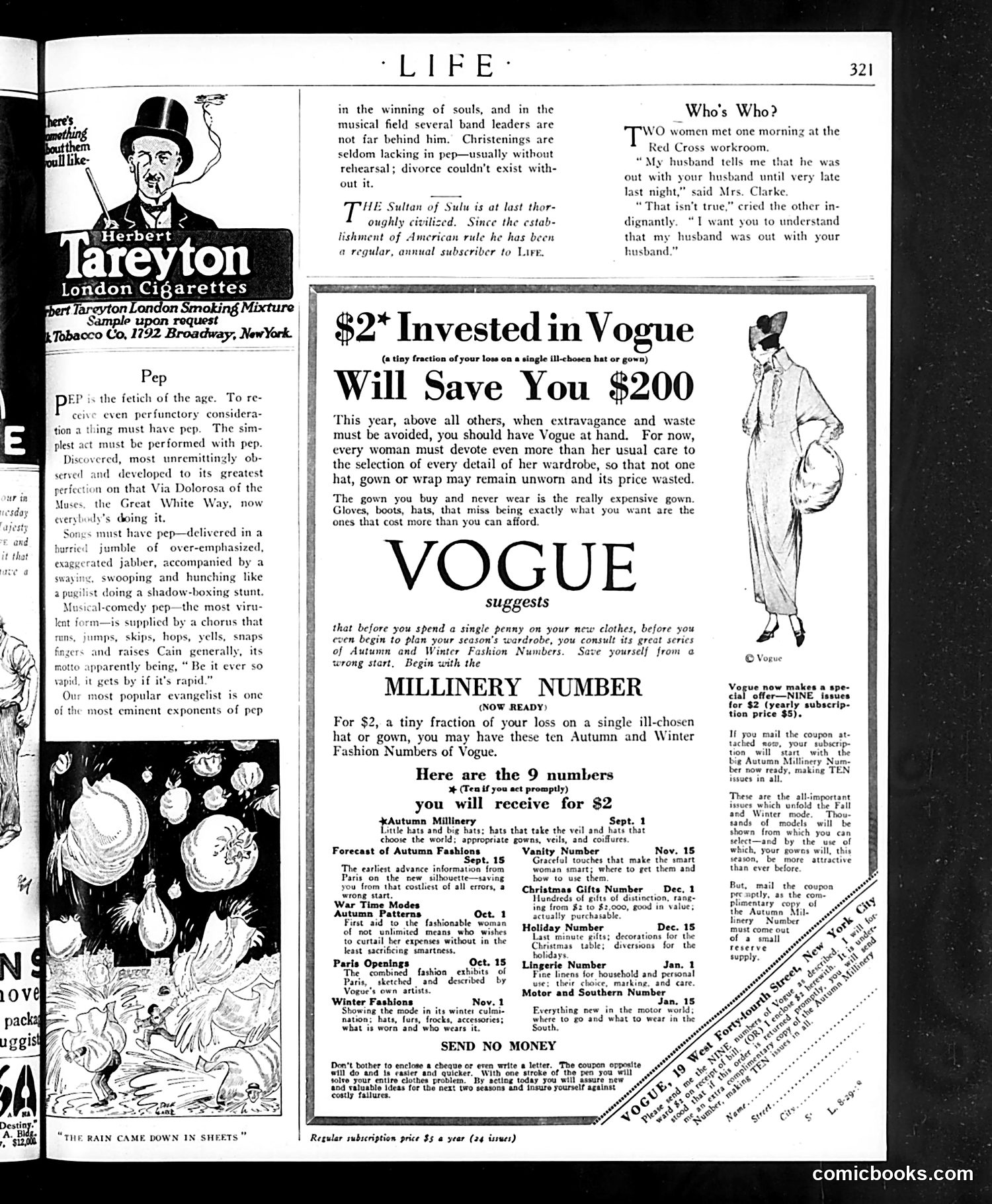
This page combines satire with advertising. The **"Who's Who?" joke** mocks marital infidelity: two women at a Red Cross workroom accuse each other's husbands of being out late together, then one indignantly "clarifies" that her husband was actually out with the *other woman's* husband—implying both couples' spouses are having affairs together. It's a dark joke about wartime morality. The **Tareylon Cigarettes ad** and **"Pep" essay** on the left mock American obsession with energetic showiness. "Pep" satirizes how everything from chorus girls to divorce requires flashy, exaggerated performance. The large **Vogue advertisement** is a legitimate pitch: for $2, readers receive ten fashion numbers instead of buying individual issues, saving money during wartime when "extravagance and waste must be avoided." This appeals to Depression/WWI-era thriftiness while promoting Vogue's authority on fashion choices. The **Sultan of Sulu reference** (top) notes he's now "civilized" because he subscribes to *Life* magazine—mock-serious commentary on American cultural imperialism.
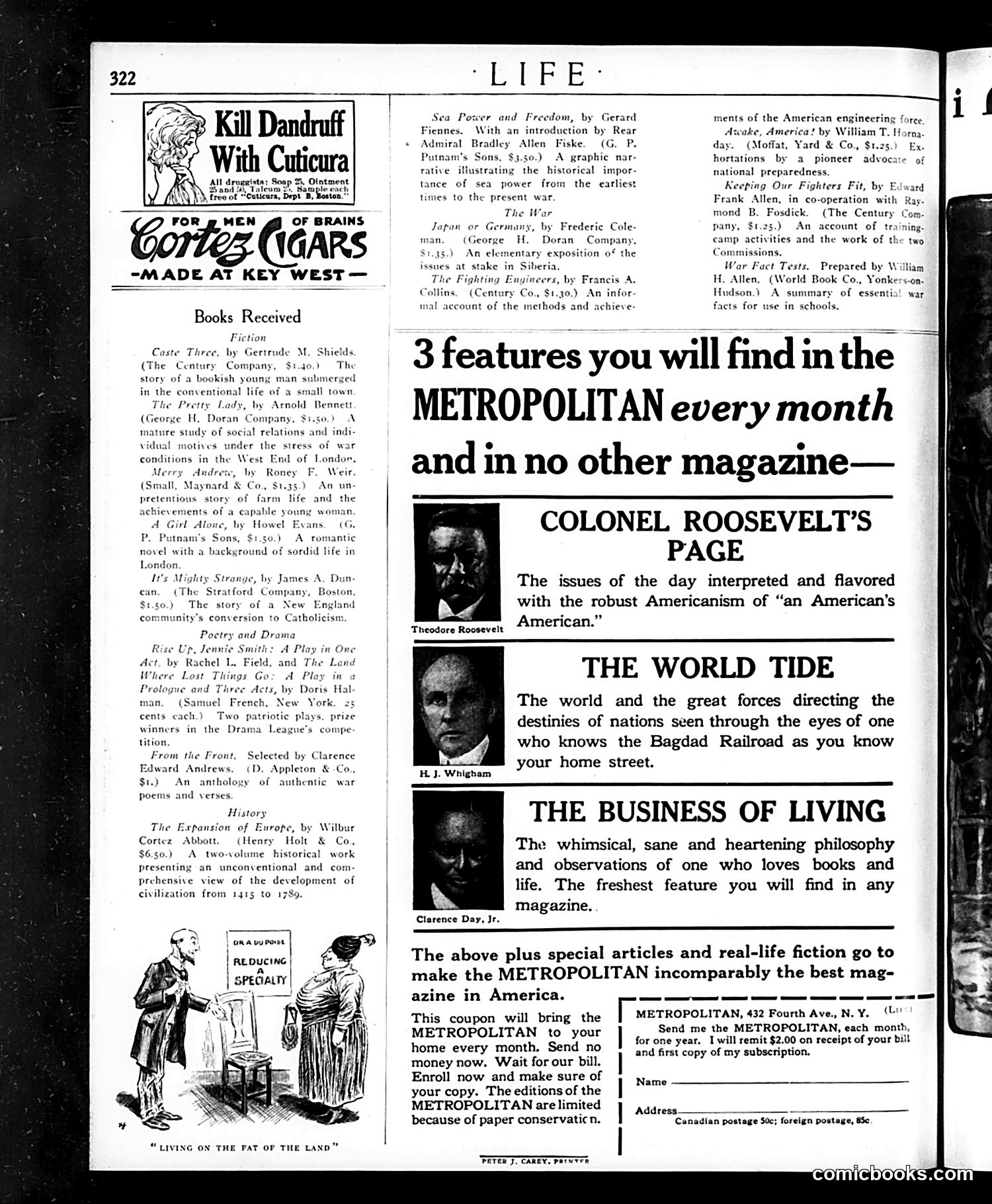
This page is primarily **advertising and book reviews** rather than satirical content. The dominant feature is a Metropolitan Magazine advertisement promoting three regular columns: 1. **Colonel Roosevelt's Page** — featuring Theodore Roosevelt's political commentary with "robust Americanism" 2. **The World Tide** — international affairs analysis (notably referencing the "Bagdad Railroad," a geopolitical concern during WWI) 3. **The Business of Living** — a lighter philosophy column by Clarence Day, Jr. The small cartoon at bottom left ("Living on the Fat of the Land") appears to show someone obtaining rationed goods, likely satirizing wartime rationing or food scarcity—a relevant concern during World War I. The "Books Received" section lists contemporary war-related and preparedness titles, reflecting American concerns circa 1917-1918. The overall page reflects wartime-era publication concerns and advertising strategy.