
Life, 1918-08-29 · page 12 of 34
Life — August 29, 1918 — page 12: what you’re looking at
What you’re looking at
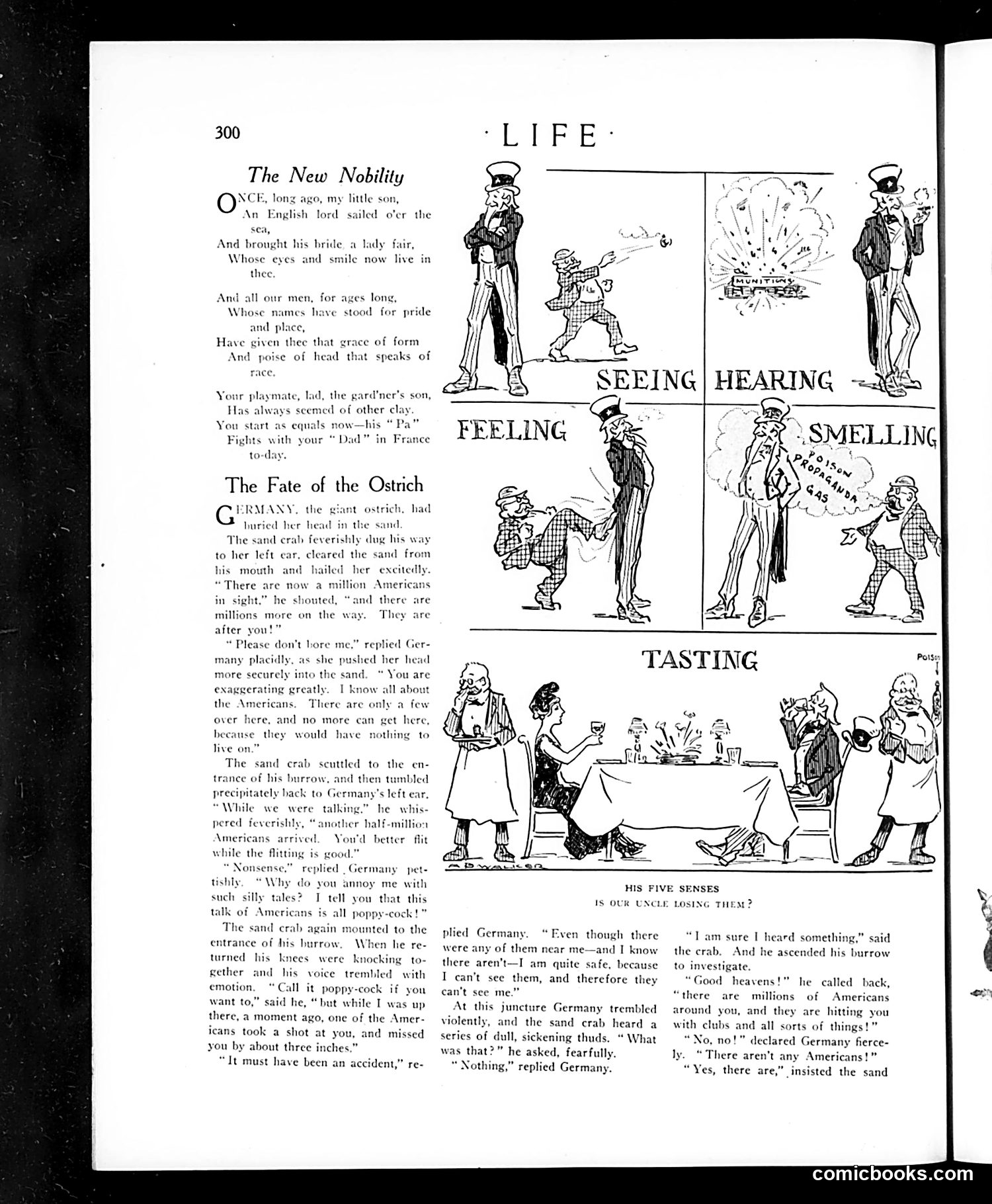
**"The New Nobility"** satirizes class mobility during World War I. The poem describes an English nobleman whose son married a lady of humble origins, and all their formerly aristocratic men now fight as equals in France. The point: war erases social hierarchy—a gardener's son fights alongside lords. This mocks old class pretensions. **"The Fate of the Ostrich"** uses Germany as a personified ostrich and a sand crab as America. Germany buries her head in sand, claiming ignorance of American troops arriving ("millions more on the way"). The satire suggests Germany denies obvious military reality—the approaching American Expeditionary Forces during WWI—clinging to false hopes while dismissing uncomfortable truths. Both pieces critique willful blindness to wartime realities.
📄 Transcribed text from this page (OCR, searchable)
Machine-transcribed from the original scan — historical spelling and the odd misread are preserved.
300 The New Nobility NCE, long ago, my little son, An English lord sailed o'er the sea, And brought his bride a lady: fair, Whose eyes and smile now live in thee. And all our men, for ages long, Whose stood for pri and place, Have given thee that And poise of hea race names have race of form 1 that speaks of Your playmate, lad, the gard’ner’s son, Has always seemed of other cl You start as equals now—his “ Fights with your “Dad” in France to-day The Fate of the Ostrich ERMANY, the g had luried her head The sand crab feverishly ft car, cleared the sand fre his mouth her exit re now a million Ameri “and there are They are ostrich, the sand dug his way to her | and hailed * There in sight.” he shouted, millior after you!” “ Please don't hore me,” replied Ger- more on the way. as she pushed her head “You are all abo ya few many placidly more securely into the sand egerating greatly. 1 know There are exd the Americans. over here, and no more can get here, hecause they would have nothing to live on.” The sand crab scuttled to the en- of his by and then tumbled tely hack to Germany's left ear, trane pre “While pered feverishly, we were J” he half-million Americans arrived. You'd better flit while the flitting is good.” Konsense,” replied Germany tishly. “Why do you annoy me with such silly tales? I tell you that th The sand crab again mounted to the pete talk of Americans is all poppy- entrance of his burrow. When he re- turned gether were knocking to- and trembled with emotion. “Call it poppy-cock if you want to,” said he, “but while I was up there, a moment ago, one of the Amer- icans took a shot at you, you by about three inches “It must have been an accident,” re- his knees his voice nd missed IS OUR UNCLE plied Germany. “Even though there ny of them near me—and I know there aren't—I am quite safe, because I can’t see them, and therefore they can't see me.” At this juncture Germany trembled violently, and the sand crab heard a series of dull, sickening thuds. “What was that?” he asked, fearfully, " Nothing,” replied Germany. LOSING THEM? “Tam sure I heard something,” said the crab, And he ascended his burrow to investigate. ‘ood he: called back, are millions of Americans around you, and they are hitting you with clubs and all sorts of things!” o, no!” declared Germany fierce- ly. “There aren't any Americans!” “Yes, there are,” insisted the sand ens!" he “there comicbooks.com