
Life, 1918-08-29 · page 20 of 34
Life — August 29, 1918 — page 20: what you’re looking at
What you’re looking at
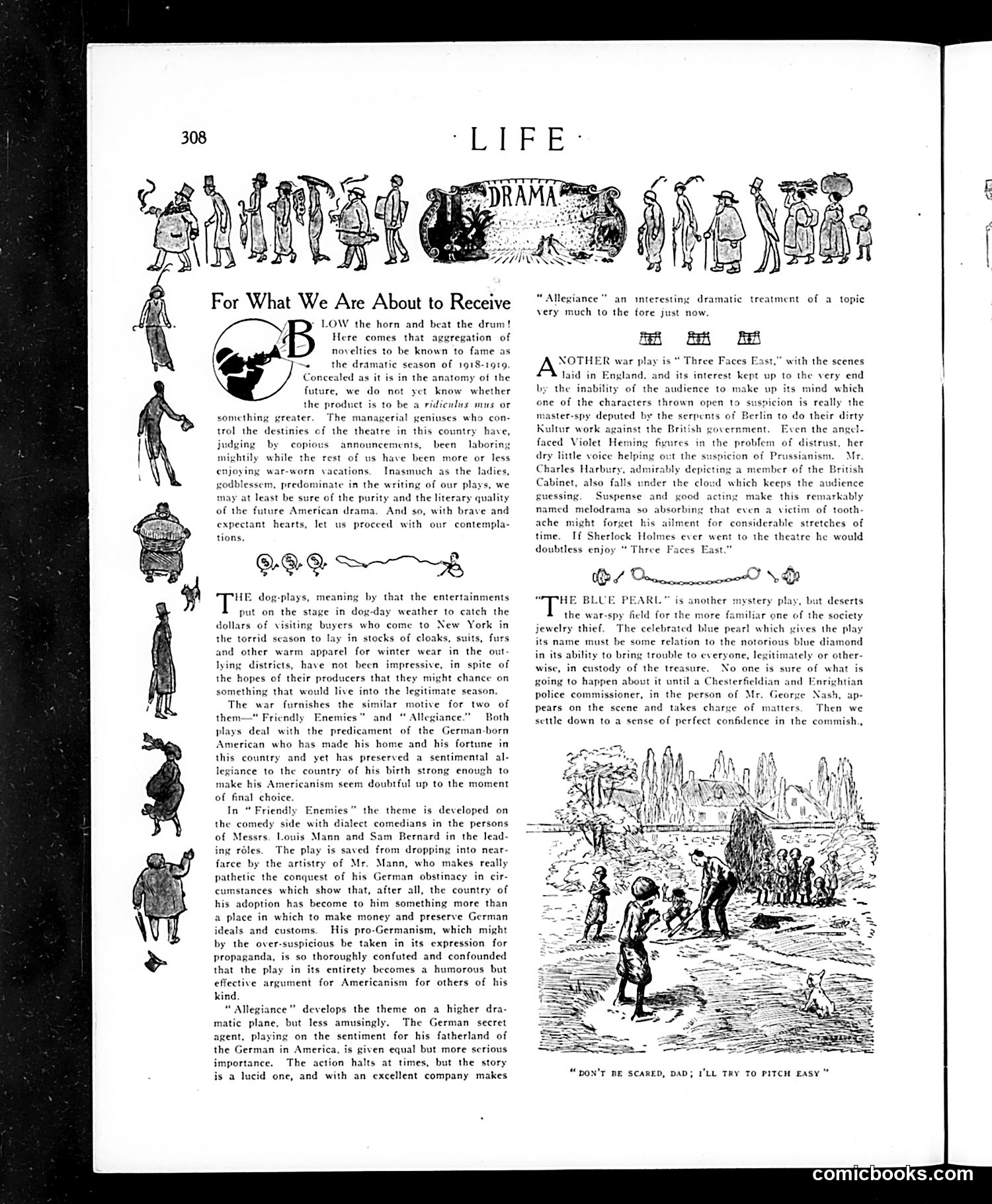
This page reviews new Broadway plays, primarily focused on **German-American identity during World War I**—a politically charged topic in 1918-1919 America. The satirical introduction mocks theatrical producers for flooding the market with plays, joking that female playwrights at least guarantee "purity" (a period stereotype). The main reviewed plays—"Friendly Enemies," "Allegiance," and "Three Faces East"—all explore the same anxiety: **German-born Americans whose loyalty to their adopted country remains suspect**. The first two plays explicitly address this dilemma. "Three Faces East" uses this suspicion as dramatic mystery, with even innocent-looking actress Violet Heming cast under suspicion as a possible German spy. The subtext is clear: during WWI, German-Americans faced intense scrutiny and accusations of disloyalty. These plays both dramatize and attempt to resolve that tension—showing German-Americans ultimately choosing America, thereby providing reassurance (and propaganda) to anxious audiences about immigrant patriotism.
📄 Transcribed text from this page (OCR, searchable)
Machine-transcribed from the original scan — historical spelling and the odd misread are preserved.
ZINN For What We Are About to Receive y LOW the horn and beat the drum! Here comes that aggregation of ( novelties to be known to fame as the dramatic season of 1918-1919 Concealed as it is in the anatomy of the future, we do not yet know whether the product is to be a ridiculus mus or something greater. The managerial geniuses who con- trol the destinies cf the theatre in this country have, judging by copious announcements, been laboring ghtily while the rest of us have been more or less njoying war-worn vacations, Inasmuch as the ladies, odblessem, predominate in the writing of our plays, we nay at least be sure of the purity and the literary quality of the future American drama. And so, with brave and expectant hearts, let us procced with our contem ODD S~ HB HE dog-plays, meaning by that the entertainments put on the stage in dog-day weather to catch the dollars of visiting bayers who come to New York in the torrid season to lay in stocks of cloaks, suits, furs and other warm apparel for winter wear in the out lying districts, have not been impressive, in spite of the hopes of their producers that they might chance on something that would live into the legitimate season. The war furnishes the similar motive for two of them—" Friendly Enemies” and “ Allegiance.” Both plays deal with the predicament of the German-born American who has made his home and his fortune in this country and yet has preserved a sentimental al- nce to the country of his birth strong enough to make his Americanism seem doubtful up to the moment of final choice. In “Friendly Enemies” the theme is developed on the comedy side with dialect comedians in the persons of Messrs. Louis Mann and Sam Bernard in the lead ing roles. The play is saved from dropping into near- farce by the artistry of Mr. Mann, who makes really pathetic the conquest of his German obstinacy in cir- cumstances which show that, after all, the country of his adoption has become to him something more than a place in which to make money and preserve German ideals and customs. His pro-Germanism, which mig! by the over-suspicious be taken in its expression for propaganda, is so thoroughly confuted and confounded that the play in its entirety becomes a humorous but effective argument for Americanism for others of his kind Allegiance” develops the theme on a higher dra- matic plane, but less amusingly. The German secret agent, playing on the sentiment for his fatherland of the German in America, is given equal but more serious importance. The action halts at times, but the story is a lucid one, and with an excellent company makes tions. r SS “Allegiance” an interesting dramatic treatment of a topic very much to the fore just now. em mi RA NOTHER war play is “ Three Faces East,” with the scenes laid in England, and its interest kept up to the very end by the inability of the audience to make up its mind which one of the characters thrown open to suspicion is really the master-spy deputed by the serpents of Berlin to do their dirty Kultur work against the British government. Even the angel faced Violet Heming figures in the probfem of distrust, her dry little voice helping ovt the suspicion of Prussianism. Mr. Charles Harbury, admirably depicting a member of the British Cabinet, also falls under the cloud which keeps the audience guessing. Suspense and good acting make this remarkably named melodrama so absorbing that even a victim of tooth- ache might forget his ailment for considerable stretches of time. If Sherlock Holmes ever went to the theatre he would doubtless enjoy “ Three Faces East.” Bf On one SO “THE BLUE PEARL” is another mystery play, but deserts the war-spy field for the more familiar one of the society jewelry thief. The celebrated blue pearl which gives the play its name must be some relation to the notoriows blue diamond in its ability to bring trouble to everyone, legitimately or other- wise, in custody of the treasure. going to happen about it until a Chesterfieldian and Enrightian one is sure of what is police commissioner, in the person of Mr. George Nash, ap- pears on the ne and takes charge of matters. Then we settle down to a sense of perfect confidence in the commish., “DON'T BE SCARED, DAD; ILL TRY TO PITCH Easy” comicbooks.com