
Life, 1918-08-29 · page 21 of 34
Life — August 29, 1918 — page 21: what you’re looking at
What you’re looking at
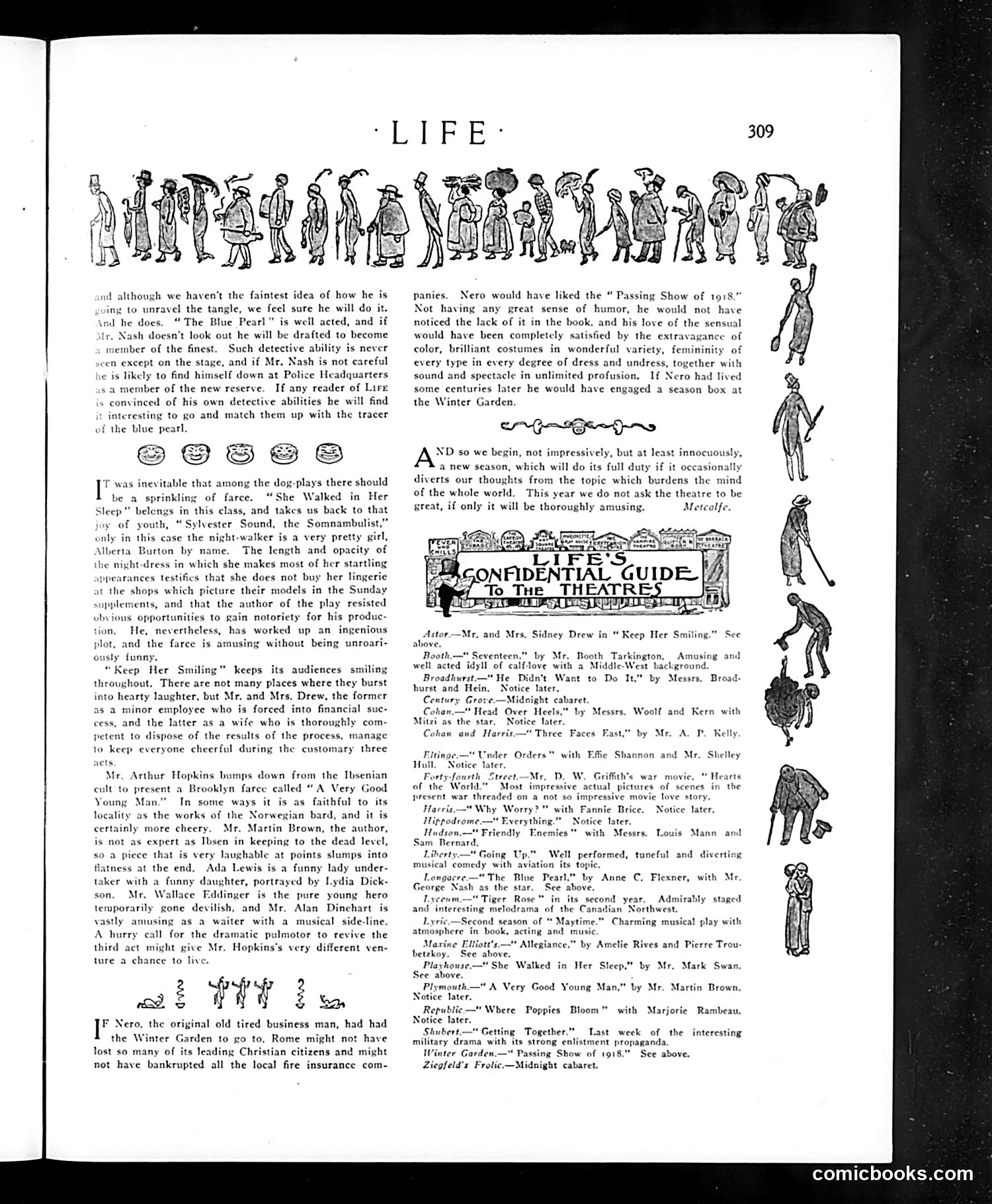
This page reviews Broadway productions from what appears to be 1918, using satirical commentary typical of *Life* magazine's style. The key satire involves a comparison between the Roman emperor Nero and modern theatre audiences. The **Nero reference** is the primary joke: the text suggests that if Nero had access to the Winter Garden theatre's "Passing Show of 1918," with its extravagant costumes, beautiful women, and spectacle, he wouldn't have persecuted Christians or bankrupted Rome—he'd simply attend theatre instead. This mocks both the vapidity of contemporary musical theatre (all "sound and spectacle in unlimited profusion") and implicitly critiques audiences for seeking shallow entertainment rather than meaningful art. The reviews themselves mock several productions—"A Very Good Young Man" is criticized for inconsistent quality, while "Keep Her Smiling" is praised for consistent (if not hearty) laughter. The overall tone suggests theatre's purpose during wartime (1918) should be merely diverting, not challenging.
📄 Transcribed text from this page (OCR, searchable)
Machine-transcribed from the original scan — historical spelling and the odd misread are preserved.
although we haven't the faintest idea of how he is ing to unravel the tangle, we feel sure he will do Lhe does. “The Blue Pearl” is well acted, and if h doesn’t look out he will be drafted to become mber of the finest. Such detective ability is never seen except on the stage, and if Mr, Nash is not careful ¢ is likely to find himself down at Police Headquarters sa member of the new reserve. If any reader of Lire s convinced of his own detective abilities he will find interesting to go and match them up with the tracer of the blue pearl. [T vss ines itable that among the dog-plays there should be a sprinkling of farce. “She Walked in Her Sleep” belongs in this class, and takes us back to that joy of youth, “Sylvester Sound, the Somnambulist,” only in this case the night-walker is a very pretty girl, Alberta Burton by name. The length and opacity of the night-dress in which she makes most of her startling ppearances testifies that she does not buy her lingerie st the shops which picture their models in the Sunday ements, and that the author of the play resisted us opportunities to gain notoriety for his produc- on. He, nevertheless, has worked up an ingenious plot, and the farce is amusing without being unroari- ously funny. Keep Her Smiling” keeps its audiences smiling throughout, There are not many places where they burst into hearty laughter, but Mr, and Mrs. Drew, the former as a minor employee who is forced into financial suc- cess, and the latter as a wife who is thoroughly com- petent to dispose of the results of the process, manage to keep everyone cheerful during the customary three Mr. Arthur Hopkins bumps down from the Ibsenian cult to present a Brooklyn farce called “A Very Good Young Man.” In some ways it is as faithful to its locality as the works of the Norwegian bard, and it certainly more cheery. Mr. Martin Brown, the author, is not as expert as Ibsen in keeping to the dead level, soa piece that is very laughable at points slumps into flatness at the end, Ada Lewis is a funny lady under- taker with a funny daughter, portrayed by Lydia Dick- son. Mr. Wallace Eddinger is the pure young hero temporarily gone devilish, and Mr. Alan Dinchart is vastly amusing as a waiter with a musical side-tine. A hurry call for the dramatic pulmotor to revive the third act might give Mr. Hopkins’s very different ven- ture a chance to live. wi PEP ie Nero, the original old tired business man, had had the Winter Garden to go to, Rome might not have lost so many of its leading Christian citizens and might not have bankrupted all the local fire insurance com- panies, Nero would have liked the “ Passing Show of 1918." Not having any great sense of humor, he would not have noticed the lack of it in the book, love of the sensual would have been completely satisfied by the extravagance of color, brilliant costumes in wonderful variety, femininity of every type in every degree of dress and undress, together with sound and spectacle in unlimited profusion, If Nero had lived some centuries later he would have engaged a season box at the Winter Garden. GG D so we begin, not impressively, but at least innocuously, a new season, which will do its full duty if it occasionally diverts our thoughts from the topic which burdens the mind of the whole world. This year we do not ask the theatre to be great, if only it will be thoroughly amusing. Metcalfe. IFE'S ONFIDENTIAL GUIDE iA To Toe THEATRE, jliter—Mr, and Mrs, Sidney Drew in “Keep Her Smiling.” See above. Booth.—" Seventeen.” by Mr. Booth Tarkington, Amusing and well acted idyll of caiflove with a Middle-West background. Broadhurst—" He Didn't Want to Do It,” by Messrs, Broad- hurst and Hein, Notice later. Century Grove.—Midnight cabaret. Cok Head Over Heels," by Messrs, Woolf and Kern with Mitzi as the star. Notice later. Cohan and Harris. Three Faces Fast,” by Mr. A. P. Kelly “Under Orders” with Effie Shannon and Mr. Shelley ice later. fourth Stre Mr. D. W. Griffith's war movie, “ Hearts of the World.” Most impressive actual pictures of scenes in the present war threaded on a not so impressive movie love story. Harris—" Why Worry?" with Fannie Brice. Notice later. Hippodrome.—" Everything.” Notice later. Hudson.—" Friendly Enemies with Messrs. Louis Mann and Sam Rernard. Liberty.—" Going Up." Well performed, tuneful and diverting musical comedy with a: ion its toy Longecre—“ The Blue Pearl” b George Nash as the star. See above. Lyceum.—" Tiger Rose in its second year, Admirably staged and interesting melodrama of the Canadian Northwest. Lyric,—Second season of “ Maytime.” Charming musical play with atmosphere in book, acting and music. Maxine Eltiott’s.—" Allegiance,” by Amelie Rives and Pierre Trou- betzkoy. See above. gc azhouse—" She Walked in Her Sleep,” by Mr. Mark Swan, See above. Plymouth.—" A Very Good Young Man,” by Mr. Martin Brown, Notice later. Republic— Where Pop Bloom" with Marjorie Rambeau, Notice later. Shubert-—" Getting Together.” Last week of the interesting military drama with its strong enlistment propaganda Winter Garden.—" Passing Show of 1918." See above. Ziegfeld's Frotic.—Midnight cabaret. Anne C, Flexner, with Mr. comicbooks.com