
A complete issue · 40 pages · 1918
Life — January 17, 1918
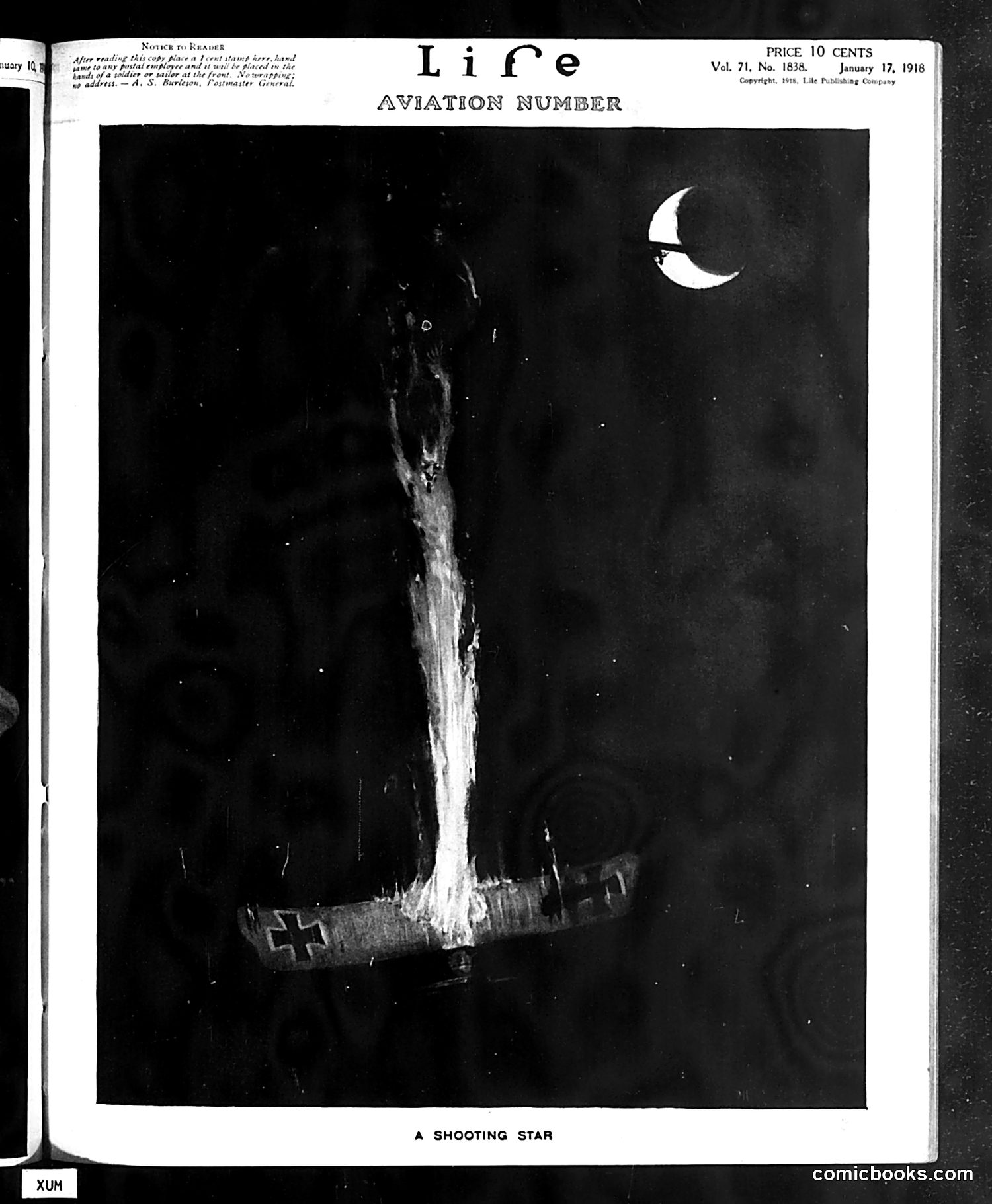
This is Life's "Aviation Number" from World War I. The image shows a German military aircraft (identifiable by the Iron Cross marking on its wing) trailing flames and smoke as it falls through a night sky, with a crescent moon visible above. The caption "A Shooting Star" is a darkly ironic term for a burning, descending aircraft. This satirizes German air power during WWI—depicting a German plane being shot down. The imagery celebrates Allied aerial victories at a time when air combat was still relatively new to warfare. Published during American involvement in WWI (1917-1918), this represents American patriotic sentiment and mockery of enemy military technology, presenting enemy losses as almost beautiful spectacles.
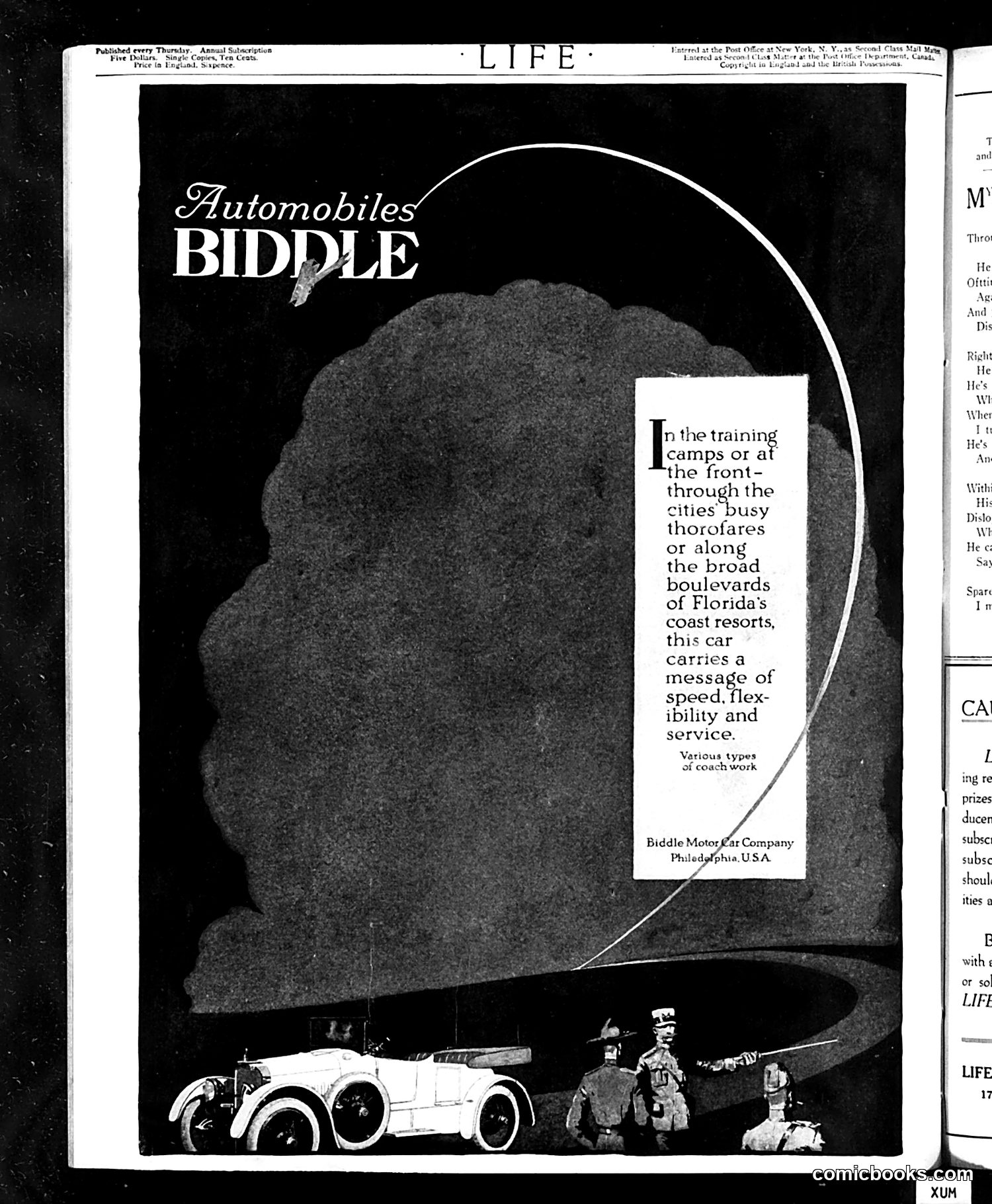
This page is primarily a **Biddle Motor Car Company advertisement**, not political satire. The ad features a stylized silhouette of what appears to be a military or authority figure (possibly a general or official, given the formal stance), with a racing car shown at the base. The text emphasizes the Biddle automobile's "speed, flexibility and service," marketed particularly for use "in the training camps or at the front" and "through the cities' busy thoroughfares or along the broad boulevards of Florida's coast resorts." The military imagery suggests this advertisement **targets World War I-era concerns**, positioning the Biddle as both practical for wartime needs and suitable for peacetime leisure travel. The figure's silhouette creates dramatic visual impact rather than satirizing a specific person.
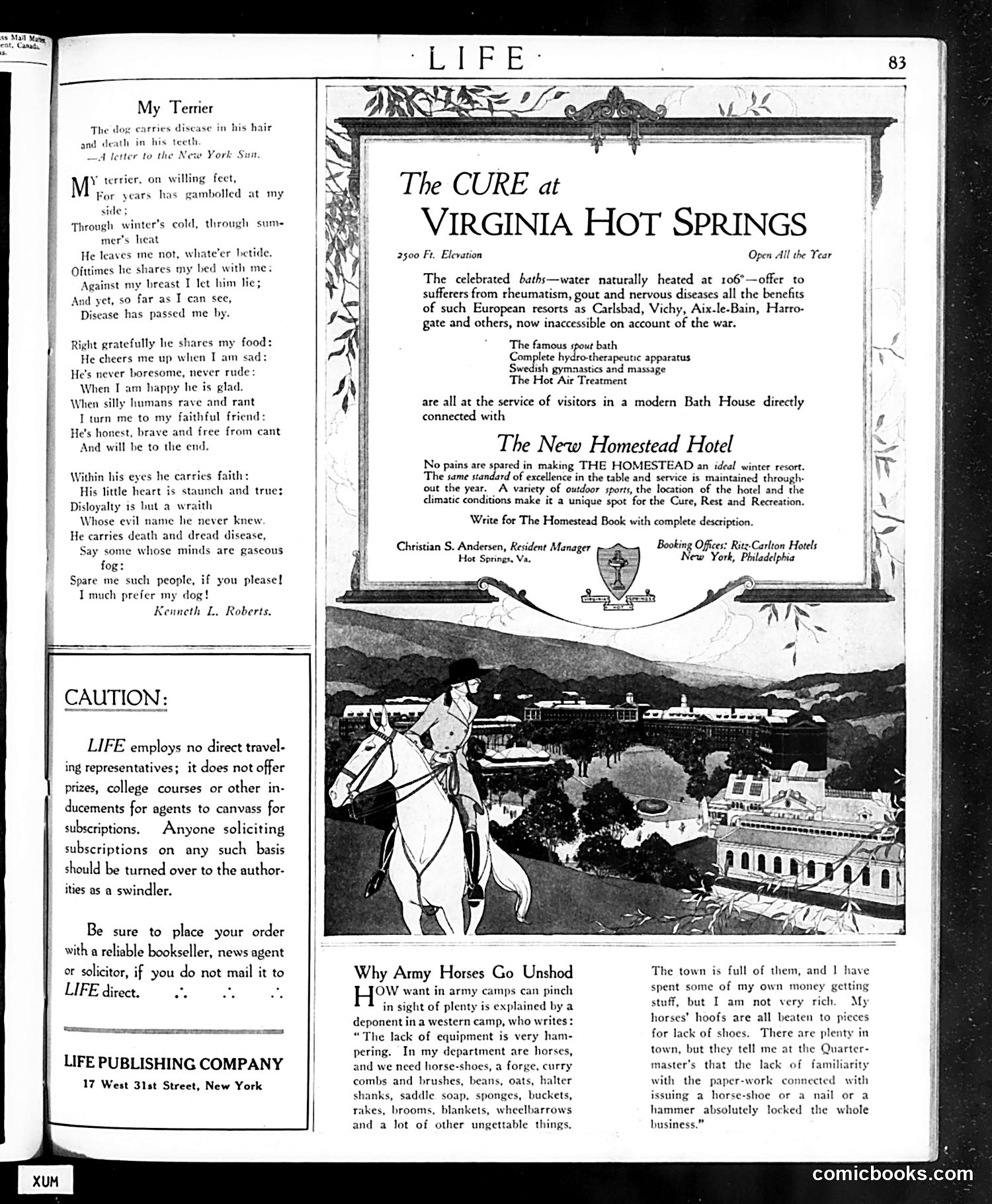
This page combines literary content with period advertising and social commentary: **Left side:** A poem titled "My Terrier" by Kenneth L. Roberts celebrates a dog's loyalty and faithfulness, contrasting the dog's honest devotion favorably with humans who "rave and rant." **Right side:** An advertisement for Virginia Hot Springs resort promotes therapeutic bathing facilities, positioning this as an alternative to European spa destinations now inaccessible (likely due to WWI). **Bottom:** An article titled "Why Army Horses Go Unshod" explains military equipment shortages—horses lack horseshoes because the Quartermaster's department cannot supply them, forcing soldiers to improvise or leave animals unshod, damaging their hooves. The page reflects post-WWI American concerns: nostalgia for simpler pleasures (the dog), domestic tourism promotion, and material scarcities affecting military readiness.
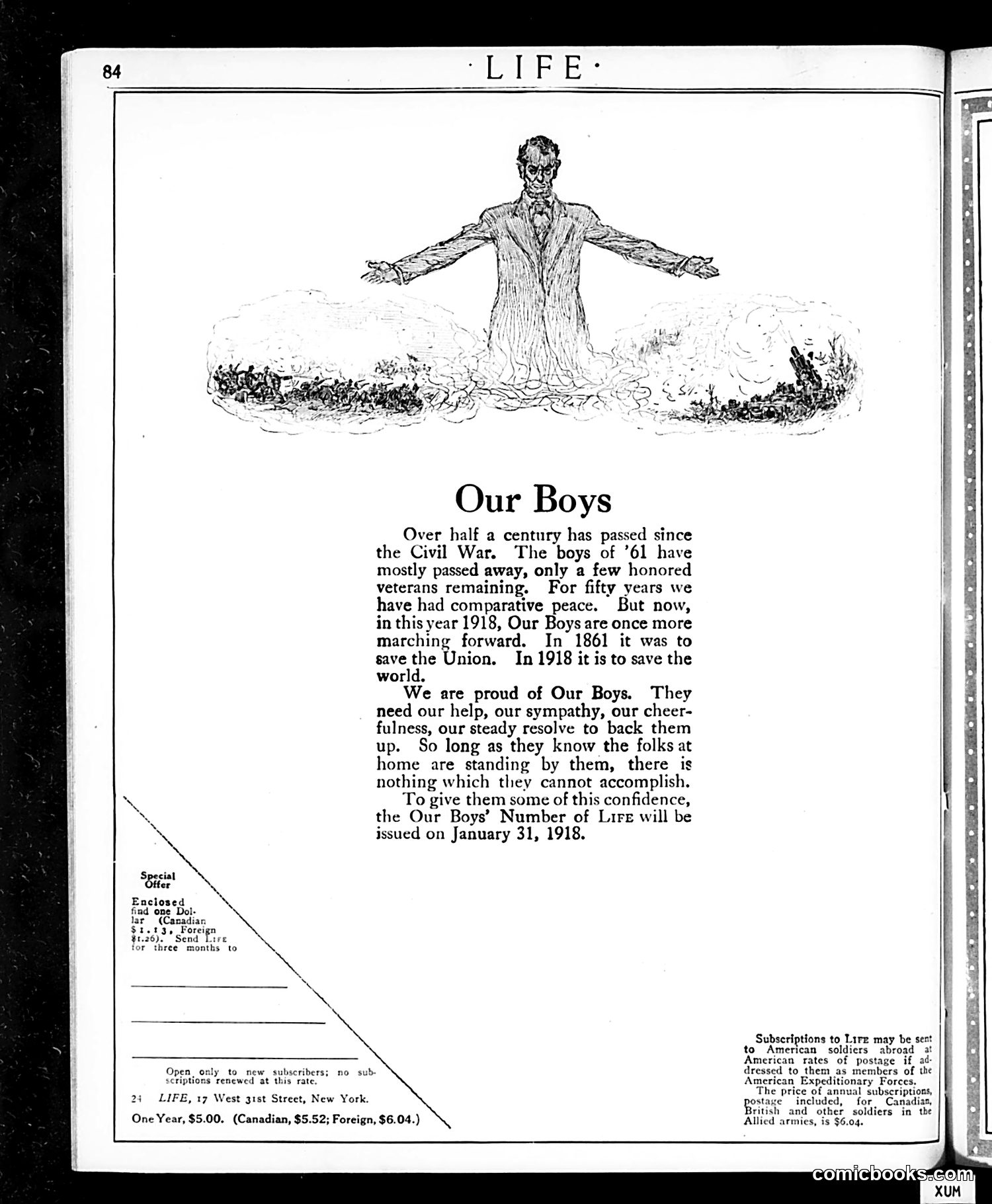
This is primarily a **recruitment advertisement** rather than satire or political cartoon. The illustration shows a ghostly figure—likely representing the spirit of Civil War soldiers ("the boys of '61")—with arms outstretched in a blessing or exhortation gesture. The text explicitly compares past sacrifice: Civil War soldiers fought to "save the Union" in 1861, while current soldiers (1918) fight to "save the world" in World War I. The message appeals to patriotic continuity and emotional support for American soldiers abroad. It's designed to encourage home-front backing and subscriptions to *Life* magazine through an "Our Boys' Number" (January 31, 1918). This reflects typical American WWI-era propaganda emphasizing generational duty and national obligation.
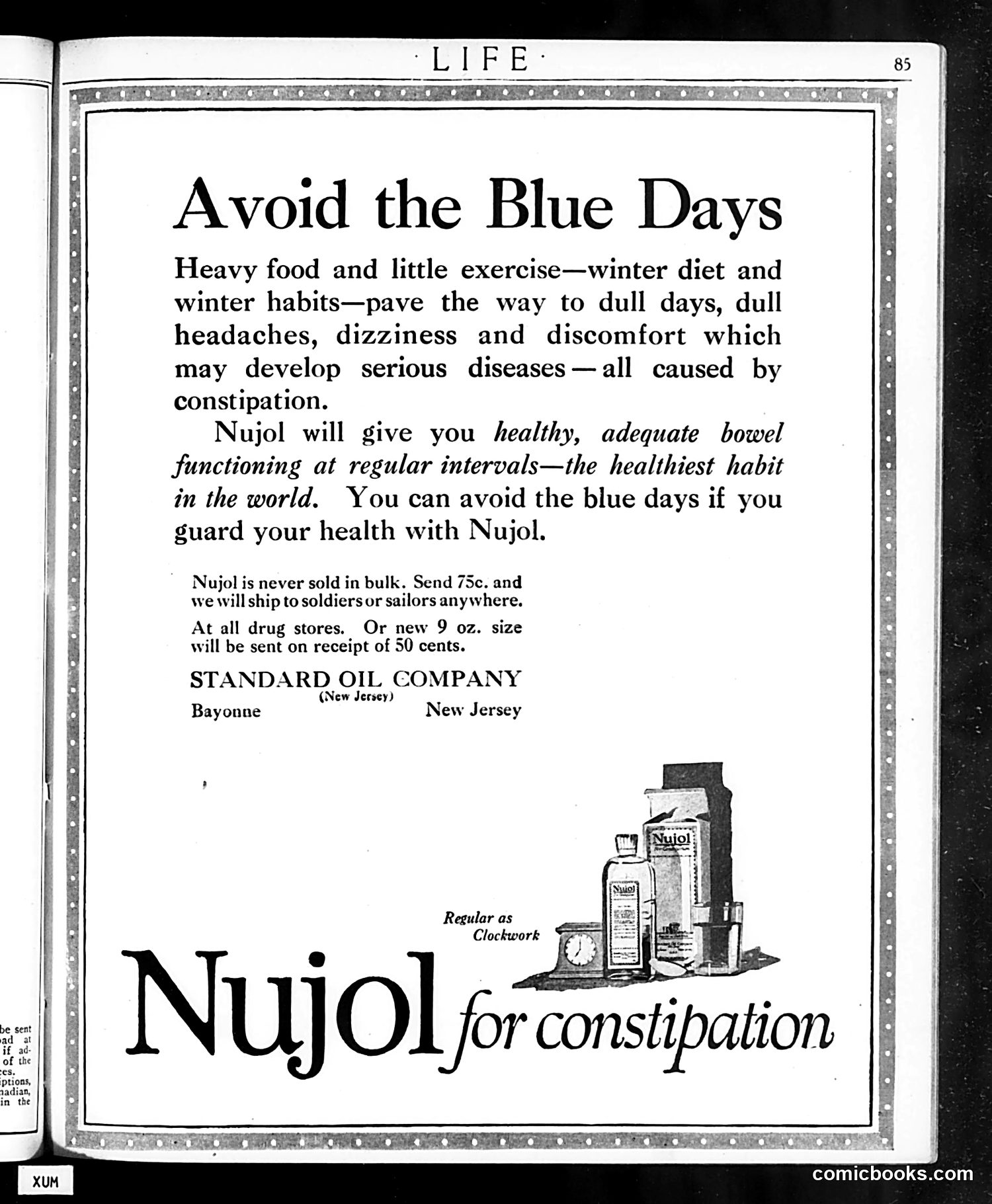
This is a straightforward **advertisement, not satire or political commentary**. The page promotes Nujol, a laxative product made by Standard Oil Company (New Jersey), based in Bayonne. The ad uses health anxiety as a sales pitch, claiming that winter's heavy food and sedentary habits cause constipation, leading to "blue days," headaches, and dizziness. Nujol promises to restore "healthy, adequate bowel functioning at regular intervals." The visual shows product bottles next to a clock, emphasizing regularity. Pricing information ($0.75 bulk, $0.50 for 9 oz.) and special mention of military shipping reflect the era's conventions. This represents vintage patent-medicine marketing—before modern FDA regulations limited health claims.
This is **not a cartoon or satire page**, but rather a **wartime advertisement** from Packard Motor Car Company, likely from World War II era. The ad argues that automobile production serves the war effort by emphasizing: - Packard's conversion of factory facilities to government military equipment production - How reliable transportation (motor cars) is essential to the war effort, comparable to telephones and trucks - That Packard engineers and workers have volunteered for military service - Development of aircraft motors using "Twin Six principles" The "political" point is **corporate patriotism**: Packard positions itself as a committed partner in winning the war, not merely a civilian car manufacturer. This reassures the public that industrial companies are sacrificing profits for national defense—a common messaging strategy during wartime rationing and conversion.
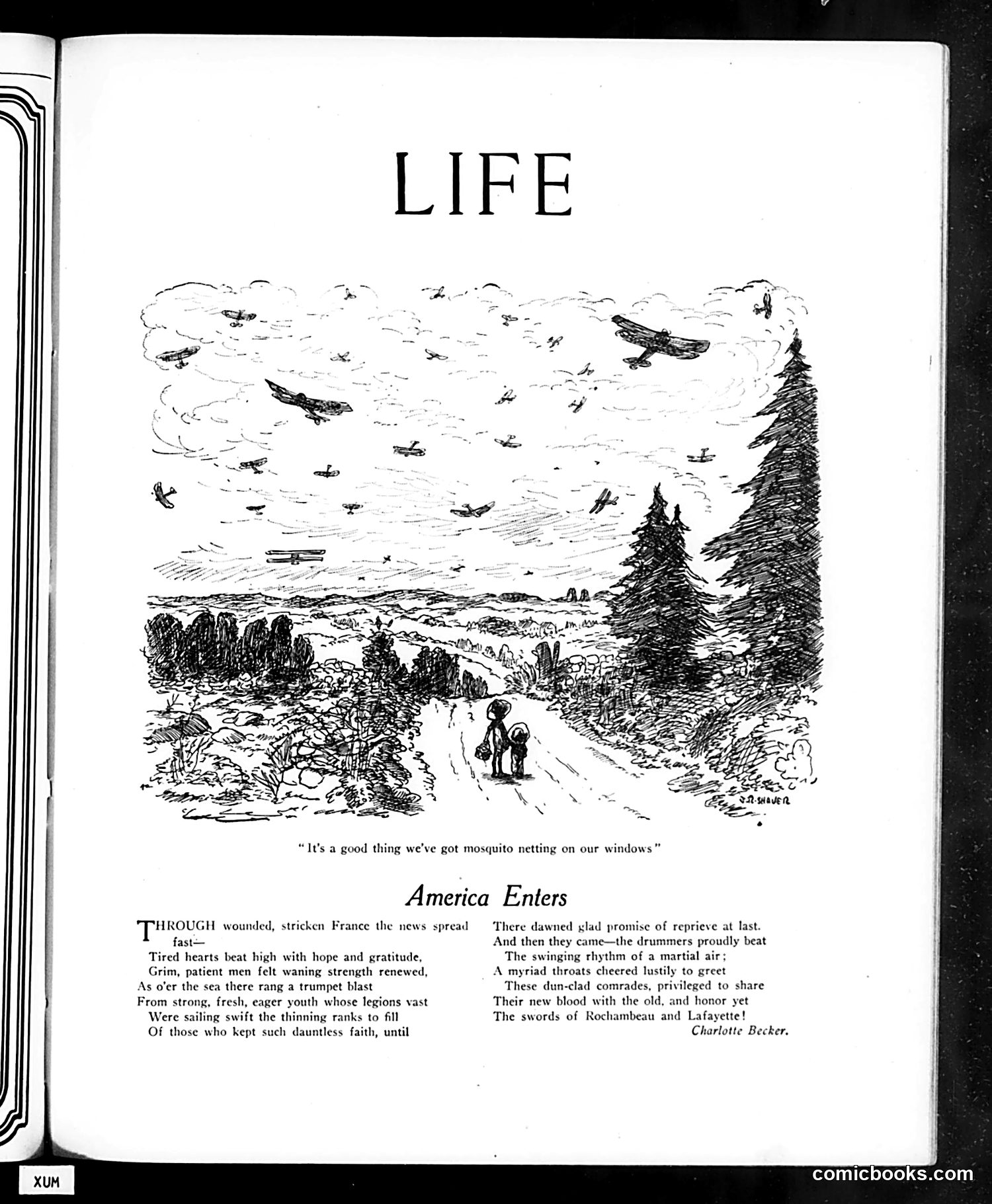
This page celebrates America's entry into World War I. The illustration shows a pastoral American landscape with aircraft overhead—representing military mobilization—while two figures walk a country road, suggesting ordinary citizens witnessing extraordinary times. The poem by Charlotte Becker emphasizes American idealism: "wounded, stricken France" needs help, and young American soldiers represent "fresh" vigor joining battle-tested European forces. References to "Rochambeau and Lafayette" invoke the French alliance during the American Revolution, positioning current intervention as historical continuity. The cartoon caption—"It's a good thing we've got mosquito netting on our windows"—appears ironic or darkly humorous about home-front concerns versus the gravity of war abroad. The overall page presents American entry as noble rescue of an ally.
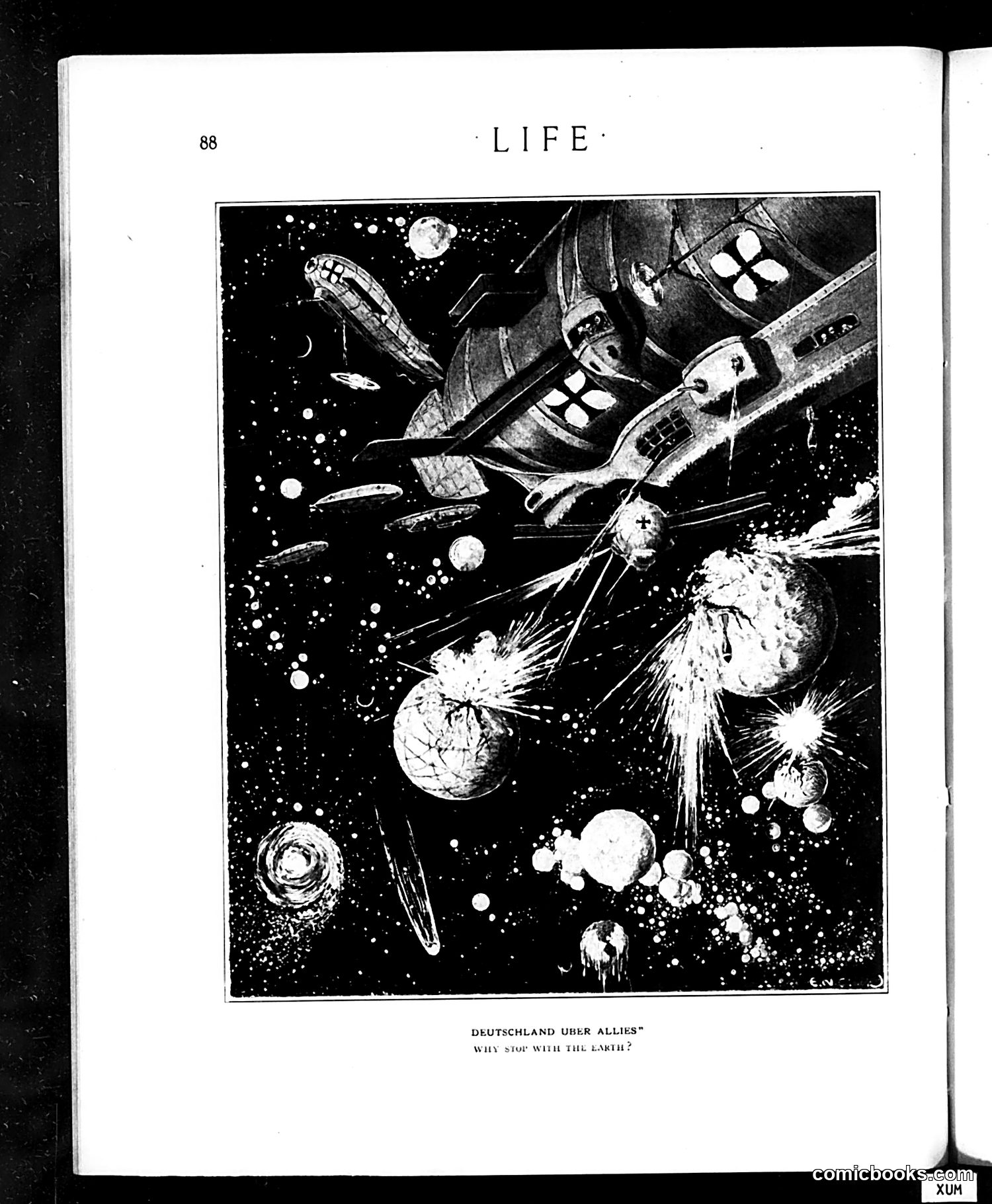
This is a satirical illustration titled "Deutschland Über Alles" with the subtitle "Why Stop with the Earth?" The cartoon depicts a German military vessel or spacecraft amid planets, stars, and celestial bodies. The imagery suggests German imperial ambitions extending beyond earthly conquest into space itself. The phrase "Deutschland Über Alles" (Germany Above All) references the German national anthem and Nazi ideology emphasizing German superiority. The satire mocks German expansionist ambitions by literalizing the slogan—suggesting Germans won't be satisfied conquering Earth but aspire to dominate the cosmos. This appears to be American commentary on Nazi Germany's territorial aggression, likely from the World War II era, using science fiction absurdity to criticize totalitarian ideology and endless conquest mentality.
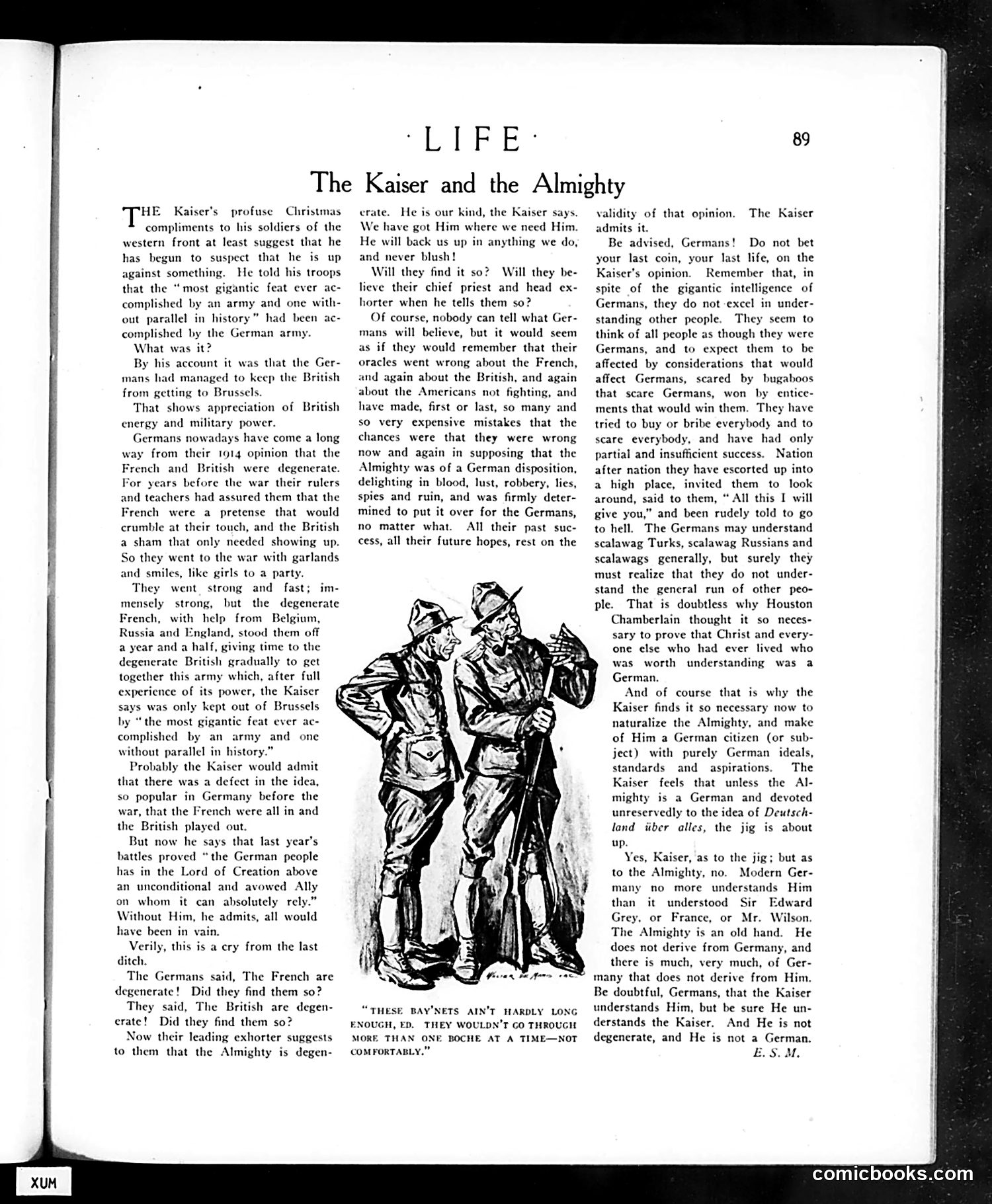
This satirical article critiques Kaiser Wilhelm II's wartime rhetoric and his claims of divine favor. The central illustration shows two figures in military dress—likely representing the Kaiser and a military advisor—in conversation. The text mocks the Kaiser's Christmas message to troops claiming God supports Germany's war effort. The article sarcastically dissects German military confidence despite repeated battlefield failures against the French, British, Russians, and Americans. The satire's core point: the Kaiser increasingly invokes religious justification for German aggression, even as military reality contradicts his boasts of success. The author suggests this theological posturing reveals German desperation rather than divine endorsement, portraying the Kaiser as delusional about both military prospects and Germany's moral standing.
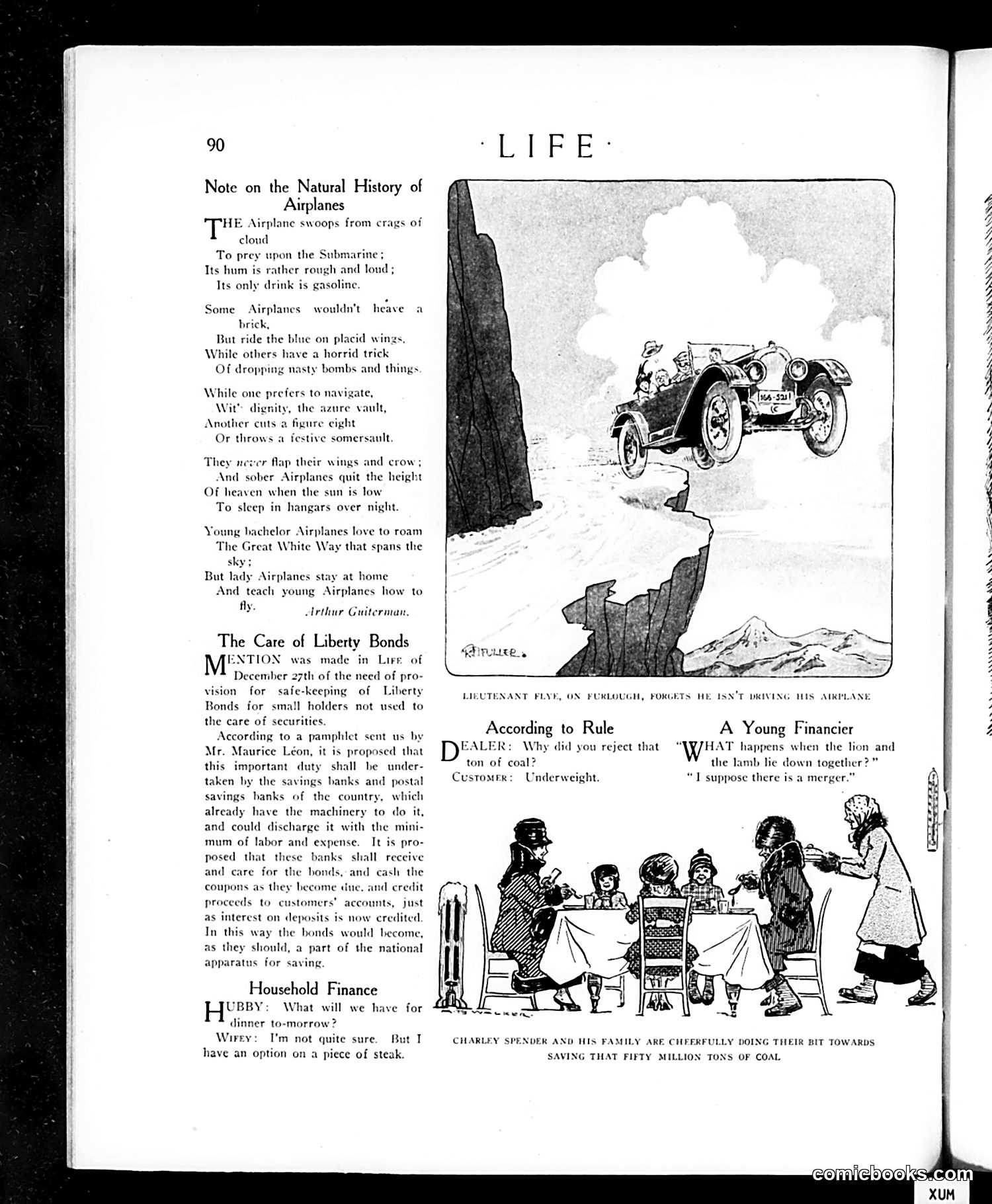
This page contains three distinct satirical pieces: 1. **"Note on the Natural History of Airplanes"** (Arthur Guiterman poem): A humorous mock-scientific treatment of airplanes as creatures, with jokes about their behavior and habits. 2. **"The Care of Liberty Bonds"**: A serious article about financial stewardship of Liberty Bonds (war bonds sold to civilians during WWI), proposing that savings banks manage them for small holders. 3. **Bottom cartoon**: Titled "Charley Spender and His Family," depicting a family discussing coal conservation. The caption notes they're "cheerfully doing their bit towards saving that fifty million tons of coal"—satirizing wartime rationing efforts and domestic sacrifice campaigns during WWI, showing the contrast between official exhortation and household reality.
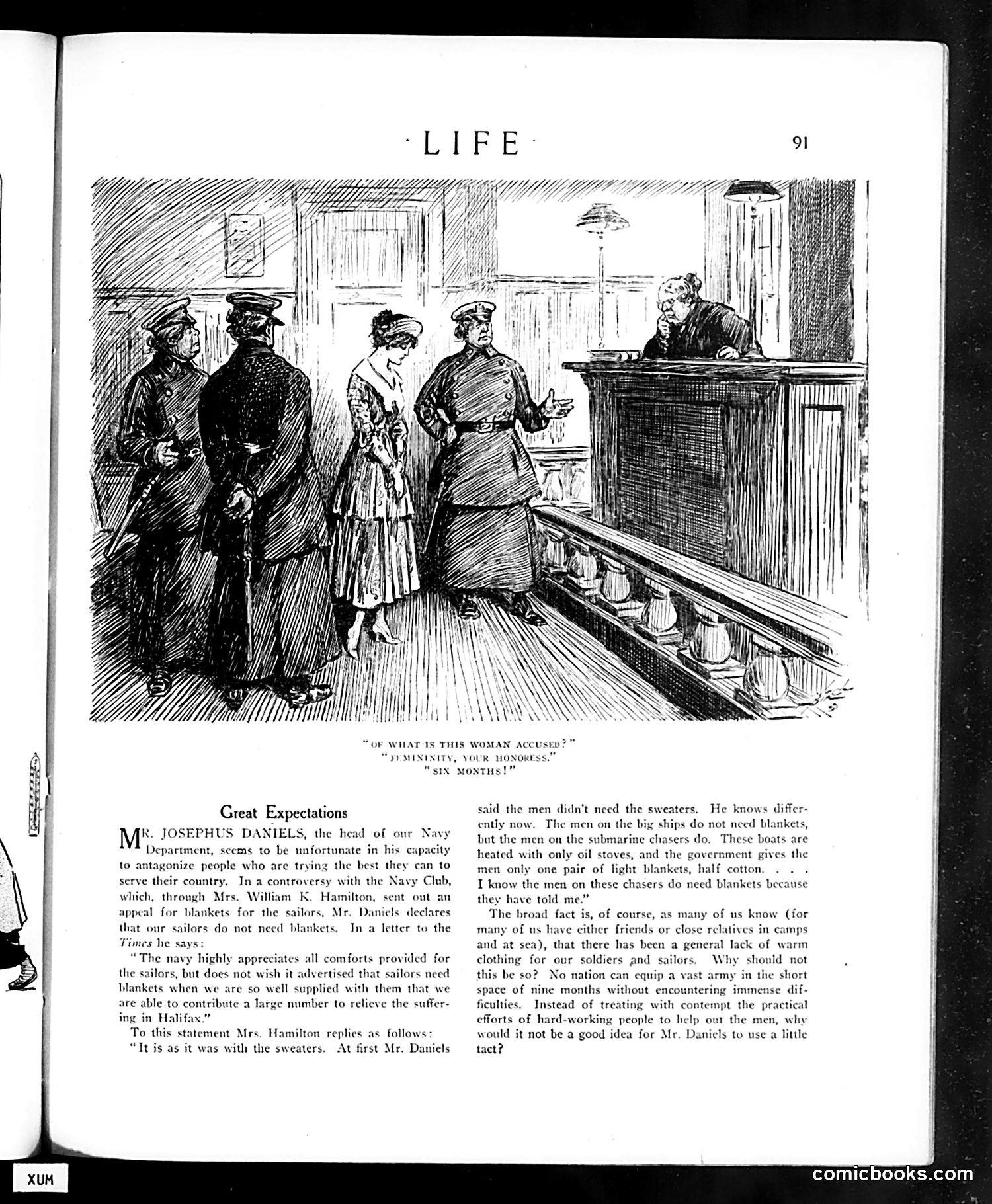
This cartoon satirizes the Navy Department's response to complaints about inadequate clothing for sailors. The scene shows what appears to be a Navy official (at the desk) dismissing concerns from visitors—likely Mrs. William K. Hamilton and others advocating for sailors' welfare. The satire centers on bureaucratic dismissiveness: officials claim sailors don't need blankets or sweaters, citing that ships have stoves. Mrs. Hamilton's reply—"It is as it was with the sweaters"—suggests previous promises went unfulfilled. The cartoon mocks how government authorities ignore practical hardship, instead offering excuses while citizens attempt to address soldiers' genuine suffering. The title "Great Expectations" implies hollow promises to those serving the country.
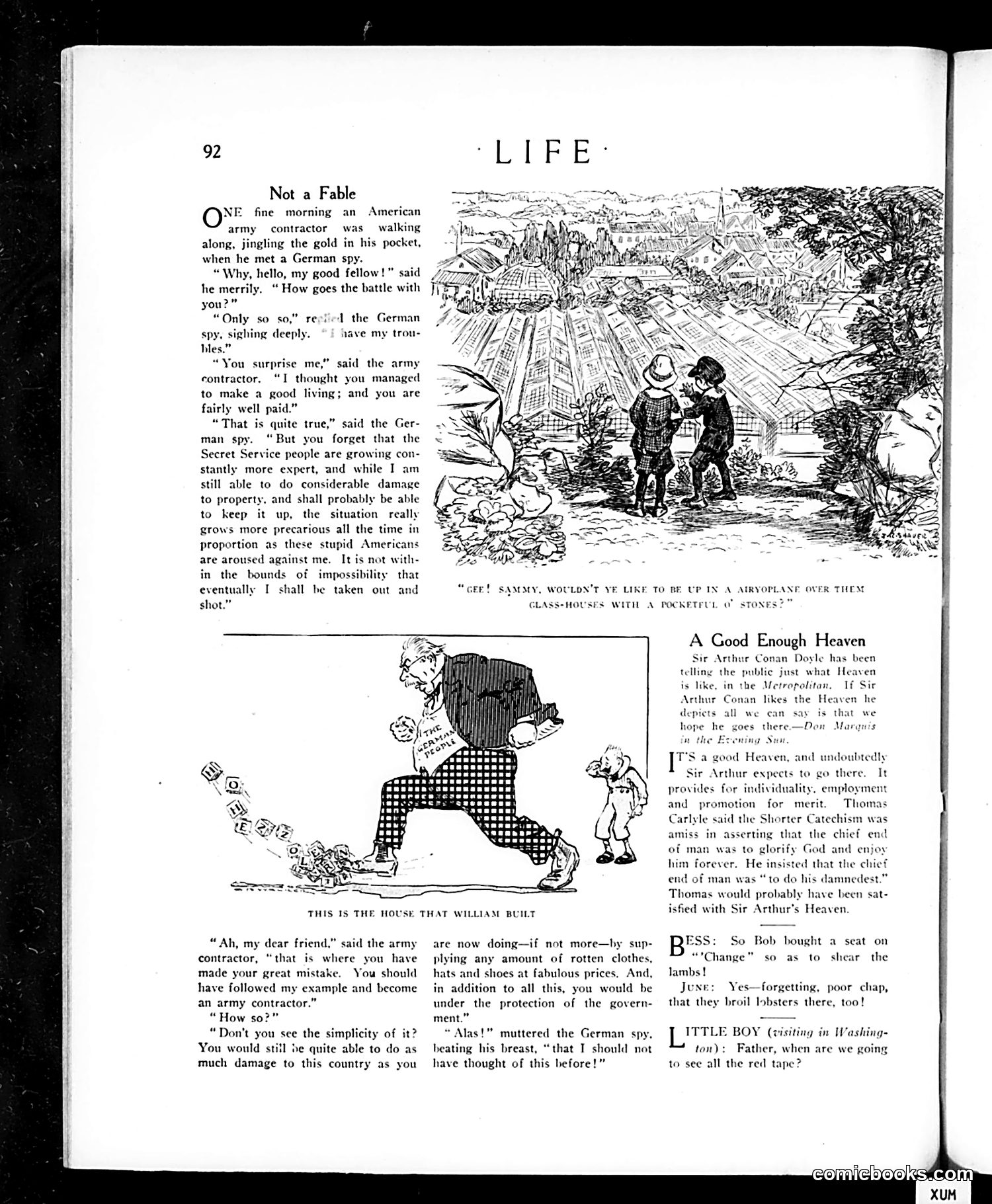
This page contains two distinct pieces: **"Not a Fable"** (top): A satirical dialogue between an American army contractor and a German spy during WWI. The contractor boasts about profiting from the war while claiming to be a patriot. The spy suggests this greed makes America vulnerable—the satire's point being that war profiteers prioritize personal wealth over national security, potentially endangering the country. **"A Good Enough Heaven"** (right): A humorous piece about Sir Arthur Conan Doyle's description of Heaven in the *Metropolitan* magazine, mocking both Doyle's vision and Thomas Carlyle's strict religious ideals. The jokes suggest Heaven as envisioned by these figures would be tediously conformist. Both pieces satirize contemporary figures and values during the WWI era.
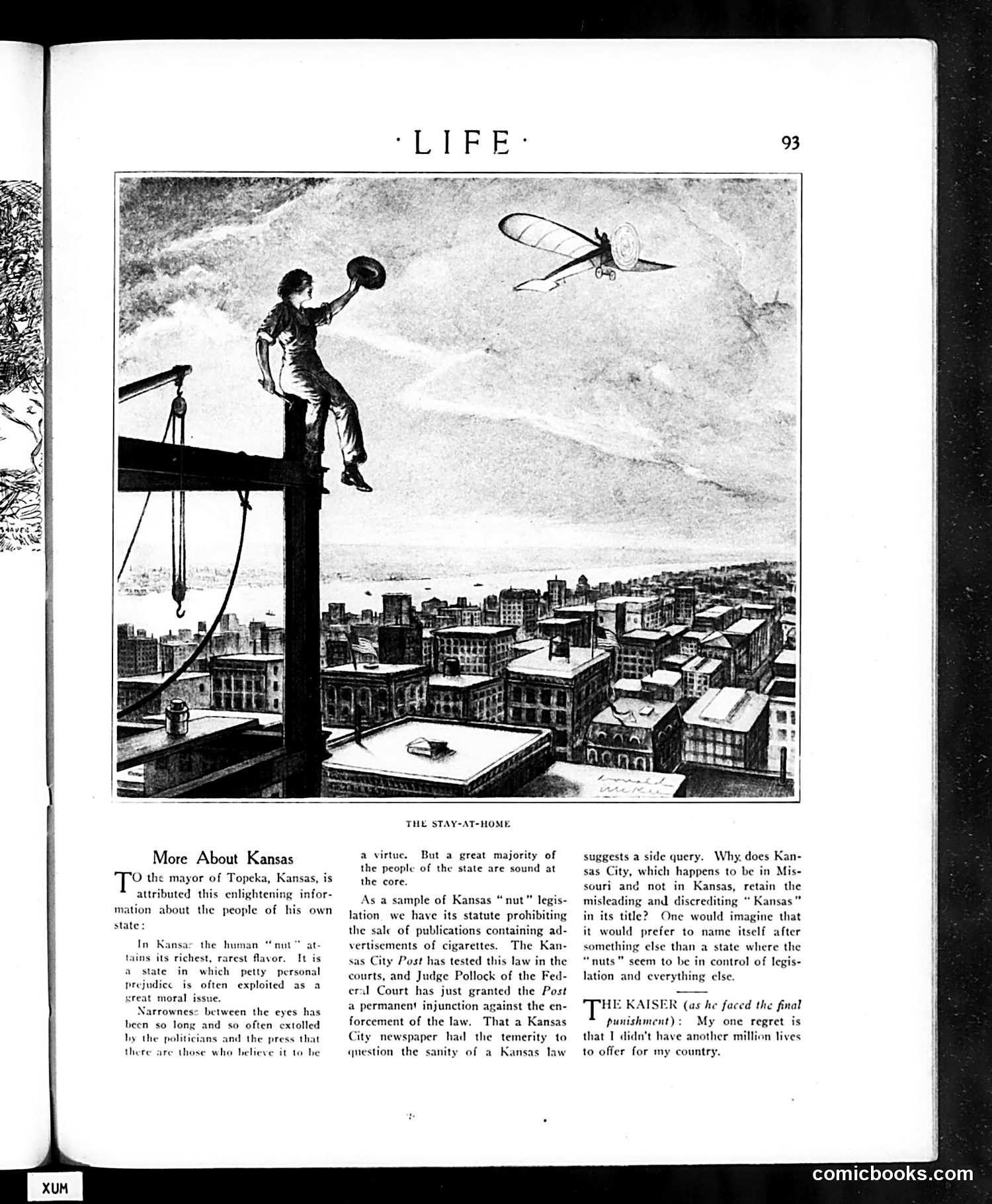
**The Image:** A man stands on a rooftop observation platform with a telescope, spotting an airship flying over a cityscape. The satirical title is "The Stay-at-Home." **The Joke:** This cartoon mocks the contradiction between domestic restriction and technological ambition. The man is literally "staying at home" (remaining in his own city), yet modern aviation allows him to observe distant horizons without traveling—he's simultaneously grounded and reaching outward through technology. **Context:** Published during aviation's early era (when airships were cutting-edge), this reflects contemporary fascination with flight technology. The cartoon suggests that modern citizens could experience the world vicariously through mechanical observation rather than actual travel, a commentary on how technology was reshaping human experience and the meaning of "staying home."
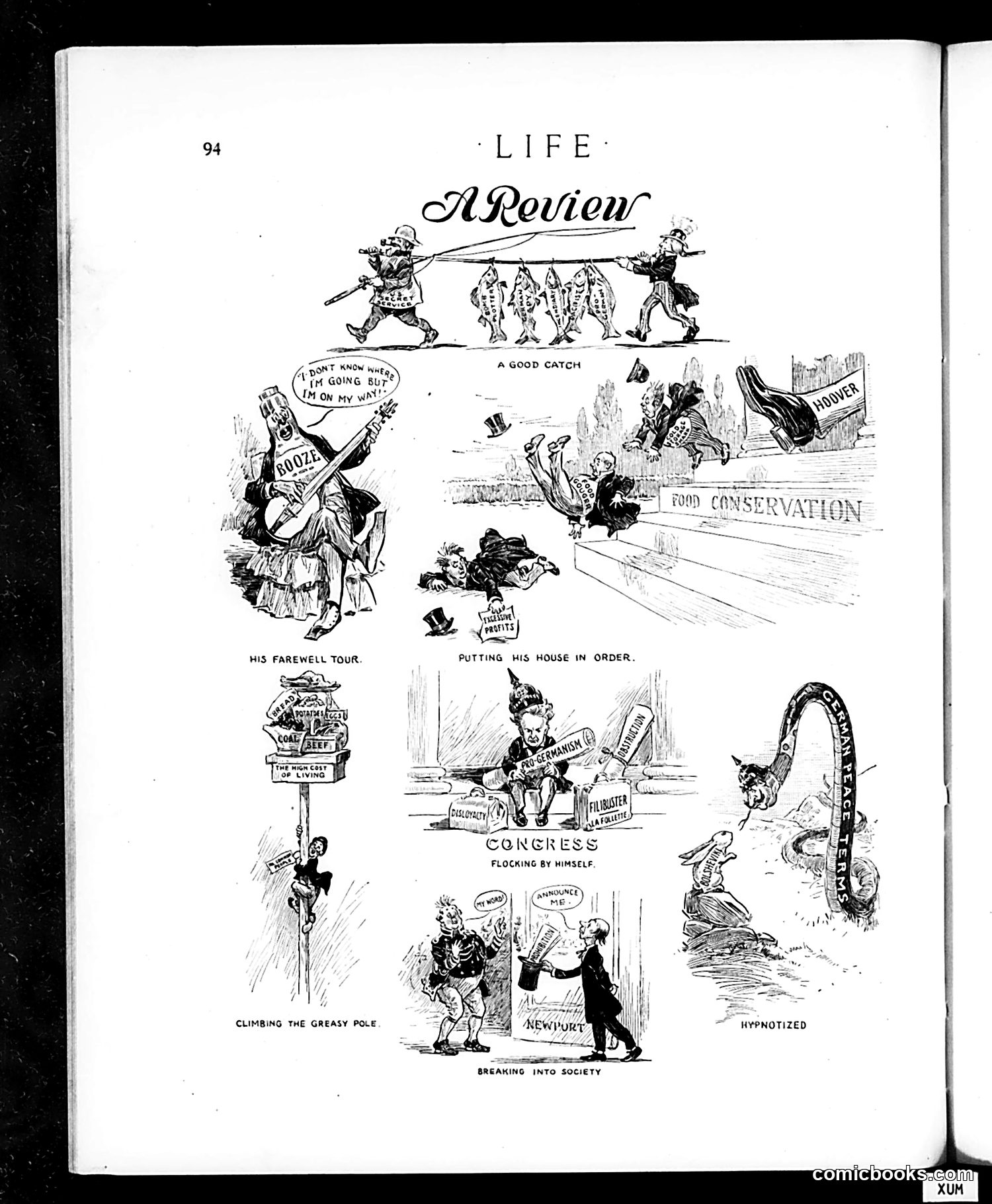
This page presents "A Review" of contemporary social and political issues through nine interconnected cartoon vignettes. The central themes appear to critique: **"A Good Catch"** - satirizes fishing/catching (likely referencing political or social targets) **"His Farewell Tour"** - depicts a figure with a bottle labeled "BOOZE" during Prohibition era, mocking someone's departure **"Food Conservation"** - criticizes wartime rationing policies **"Congress Flocking by Himself"** - mocks Congressional dysfunction **"Climbing the Greasy Pole"** and **"Breaking into Society"** - satirize social climbing and class barriers **"Putting His House in Order"** - appears political commentary **"Hypnotized"** - critiques susceptibility to manipulation The cartoons collectively mock Prohibition enforcement, food rationing, political ineptitude, and social pretension—typical concerns of 1910s-1920s American satire.
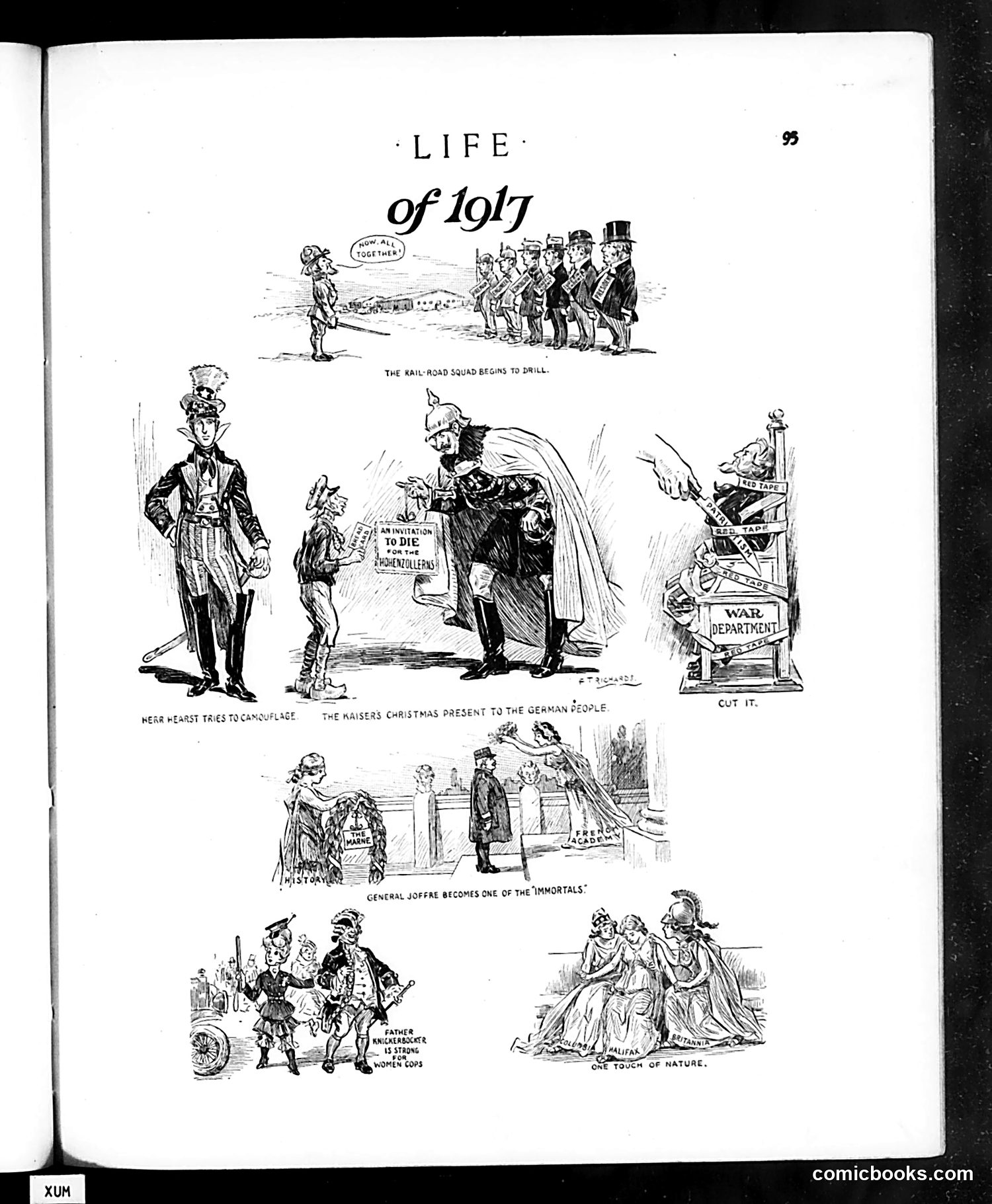
This satirical page mocks events from 1917, likely World War I's final year. The cartoons depict: **Top panel**: "The Rail-Road Squad Begins to Drill" - appears to reference military conscription or mobilization. **Middle section**: - "Herr Heast Tries to Camouflage" - mocking German leadership's attempts at deception - "The Kaiser's Christmas Present to the German People" - showing a gift box labeled "A present to die for the Fatherland," sarcastically critiquing German wartime sacrifice - "Cut It" - War Department cutting through bureaucracy **Lower panels**: - "General Joffre Becomes One of the Immortals" - honoring the French general - "One Touch of Nature" - showing wartime separation's human cost The page satirizes American wartime leadership, German propaganda, and the harsh realities of 1917 combat through dark humor and political commentary.
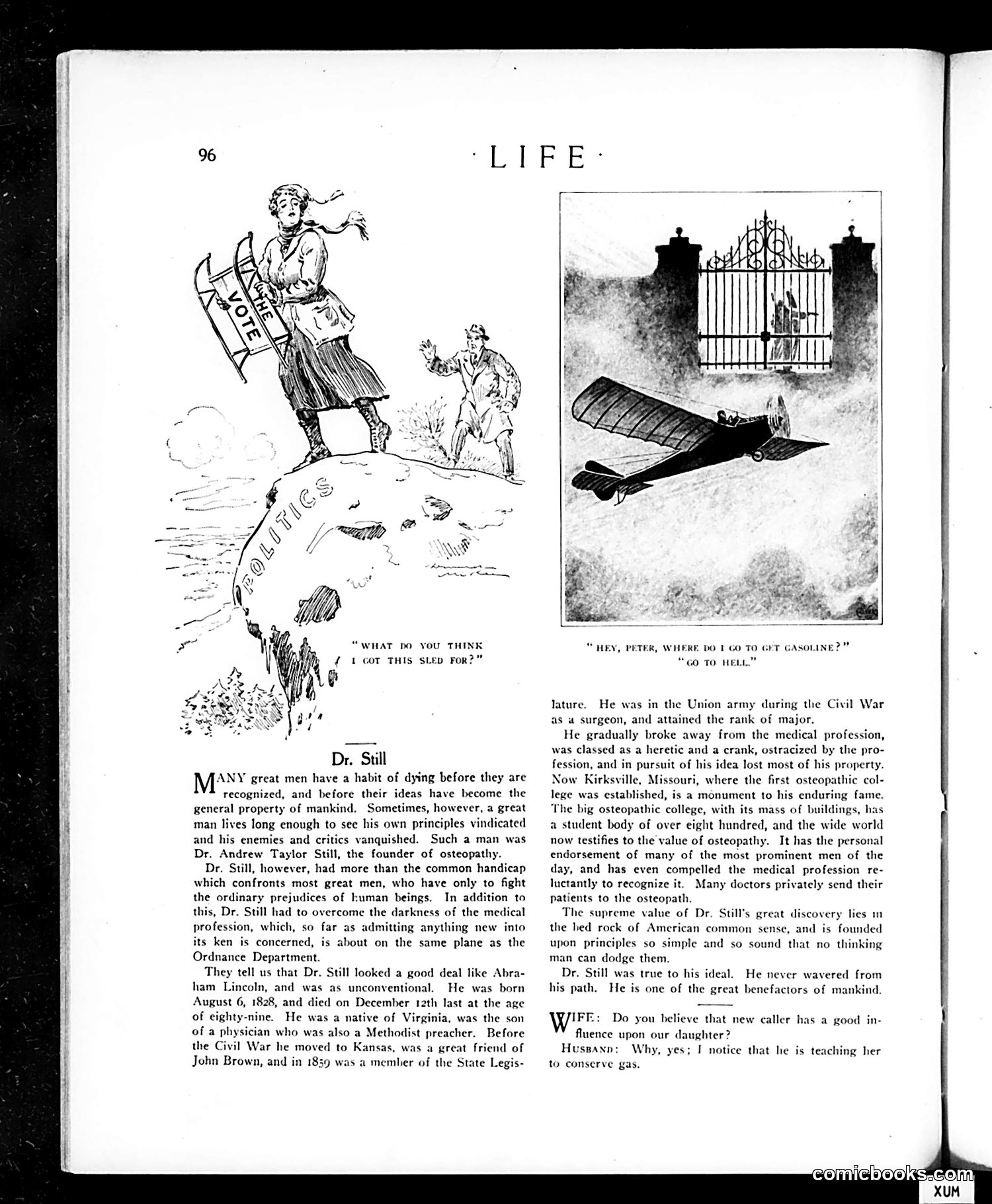
This page celebrates Dr. Andrew Taylor Still, founder of osteopathy, presenting him as a vindicated visionary who overcame medical establishment resistance. The biographical text emphasizes his Lincoln-like unconventionality and pioneering work despite professional ostracism. The left cartoon mocks "Politics" as a sled—satirizing political opportunism and instability. The right cartoon jokes about wartime gasoline rationing (likely WWI era): a man asks "Peter" where to get gasoline; the punchline "Go to Hell" suggests either unavailability or profiteering. The bottom dialogue about the "new caller" teaching gas conservation is vintage Life satire—presenting wartime sacrifice as romantic courtship, gently mocking how young couples frame patriotic duty as personal interest. Together, these pieces blend serious biographical tribute with sharp commentary on medical dogmatism, political expediency, and home-front rationing culture.
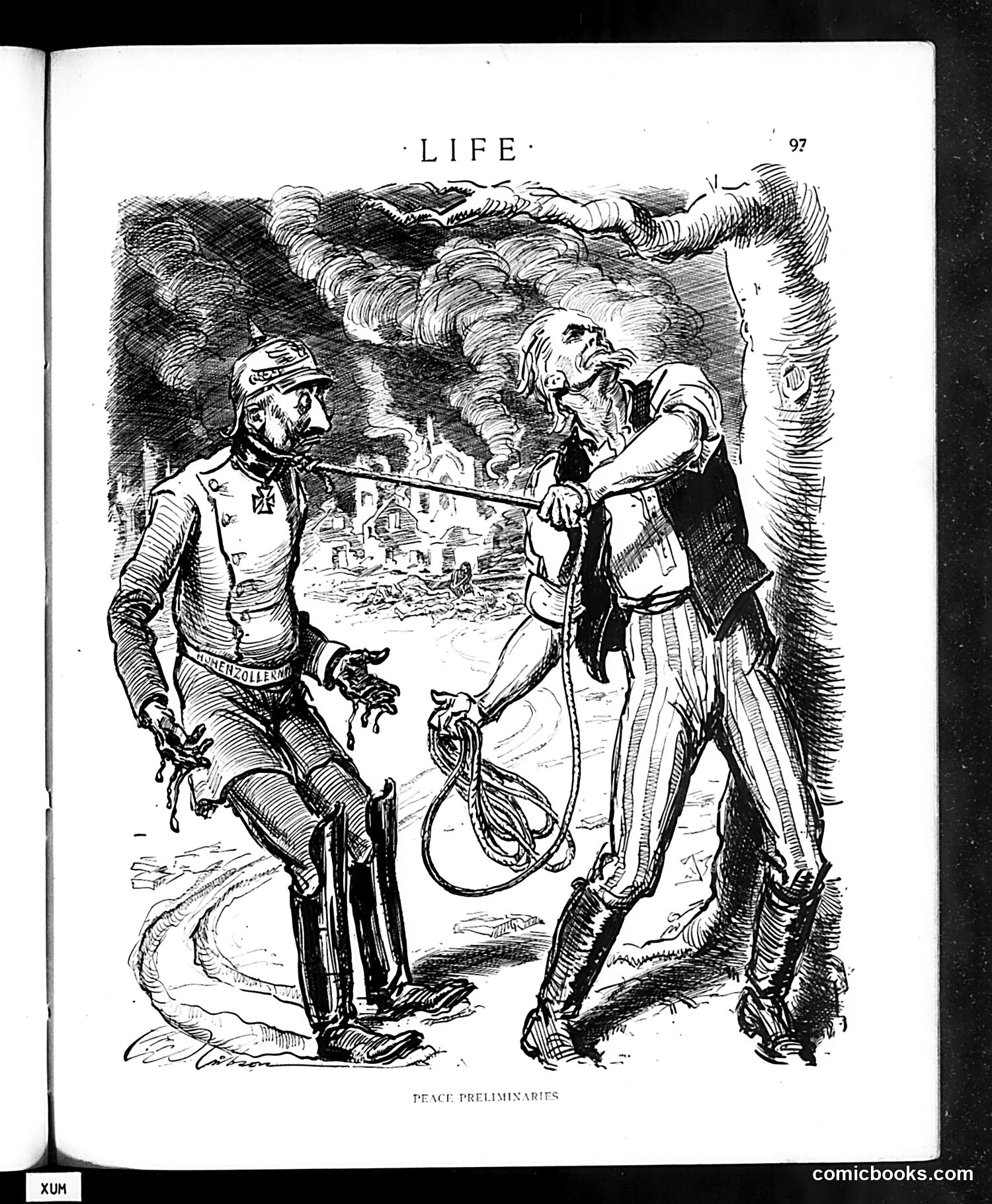
This cartoon depicts two military officers in what appears to be WWI-era uniforms negotiating peace terms. The figure on the left wears a distinctive military uniform with medals, while the older, bearded officer on the right holds a rope—likely representing the terms or conditions of peace negotiations. The title "Peace Preliminaries" suggests this satirizes early peace discussions, possibly following World War I. The rope held by one figure may symbolize that one party seeks to "tie up" or control the other through negotiations. The setting appears to be a war-torn landscape visible in the background. The cartoon's satire likely mocks the complications and power dynamics of peace negotiations—suggesting that reaching preliminary agreement requires careful, almost theatrical posturing between adversaries.
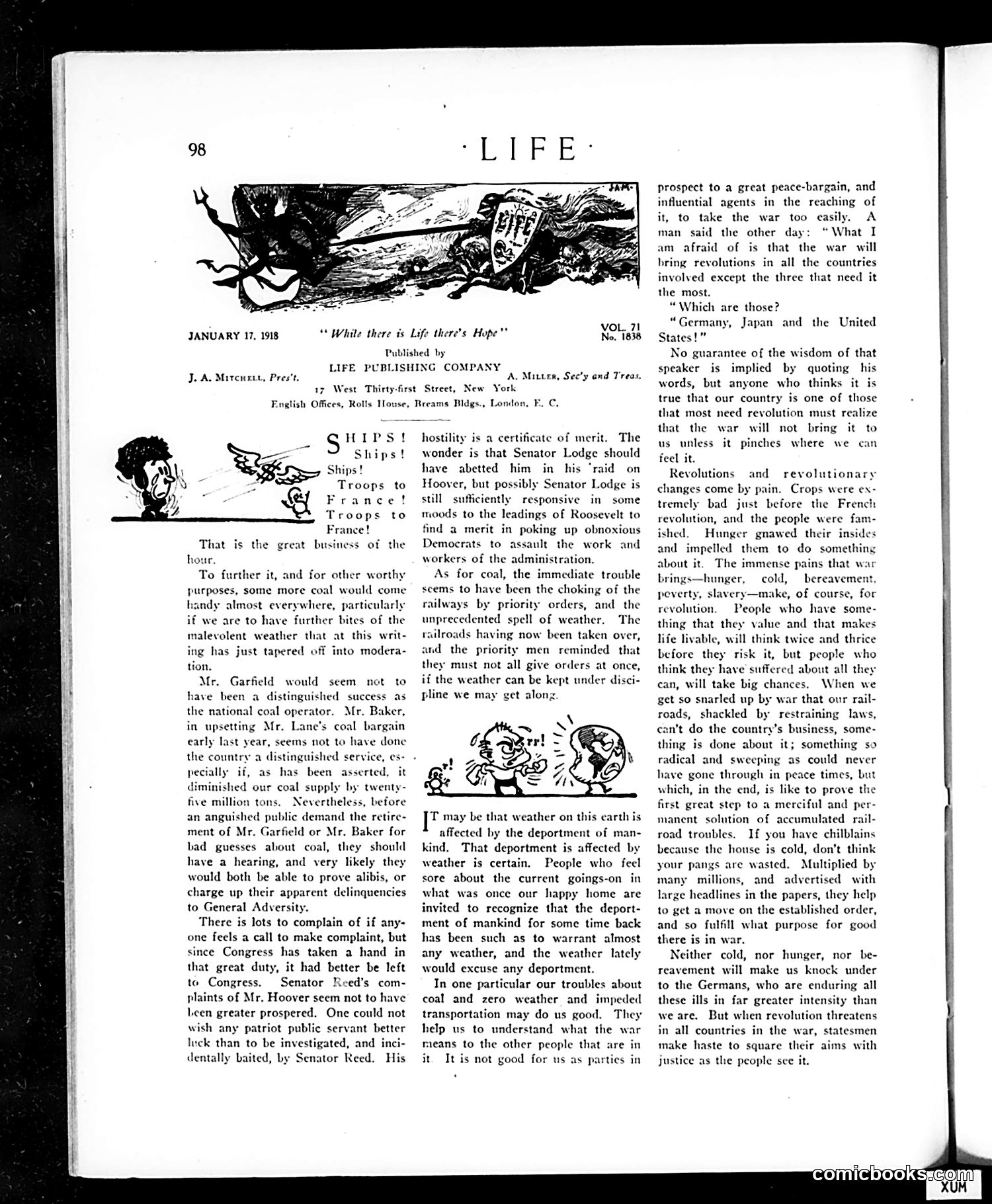
This page features editorial commentary on America's World War I efforts during a critical supply crisis. **The Cartoon:** The "SHIPS! SHIPS! TROOPS to France!" graphic emphasizes the urgent wartime priorities of 1918—military transport and troop deployment. **Key Political Figures Referenced:** - **Mr. Garfield and Mr. Baker**: Coal administrators blamed for mismanaging fuel supplies (a critical shortage affecting the war effort) - **Senator Reed**: Critic of **Herbert Hoover** (wartime administrator), with the text noting Senator Lodge's unexpected support for Reed's investigations - **Senator Lodge**: A Republican leader, apparently still influenced by Theodore Roosevelt's political faction **The Satire's Point:** The editorial critiques civilian complaints about coal shortages and weather disruptions while acknowledging legitimate administrative failures. It argues Americans need to accept wartime hardship as evidence the conflict reaches home—and that America (like Germany and Japan) needs revolutionary change if it survives the war without internal upheaval. The piece uses weather and coal scarcity as metaphors for necessary national suffering.
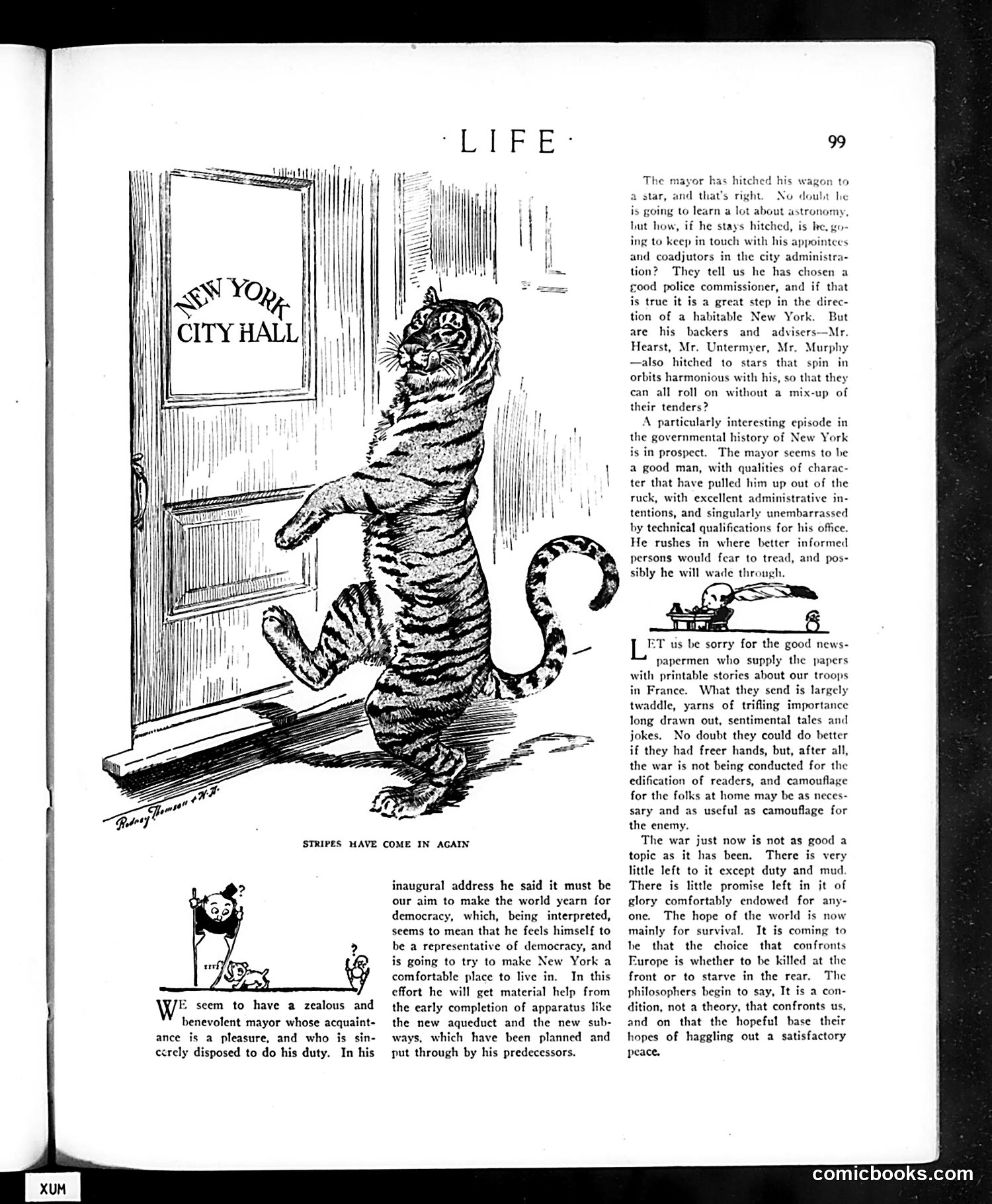
The main cartoon depicts a tiger entering New York City Hall, captioned "STRIPES HAVE COME IN AGAIN." This is political satire about a newly elected mayor (identity unclear from text alone, though the article discusses his inauguration and ambitions). The tiger symbolizes corruption or political "stripes"—suggesting that despite the mayor's earnest inaugural promises to make New York "a comfortable place to live," the same old corrupt political machines remain in power. The text sarcastically notes he'll rely on "apparatus like the new aqueduct and new subways" planned by predecessors, while questioning whether his powerful backers (Hearst, Untermyer, Murphy—likely political/business figures of the era) share his democratic ideals or will cause "mix-ups." The article criticizes the mayor as well-intentioned but dangerously inexperienced—"rushing in where better informed persons would fear to tread." The secondary commentary addresses WWI reporting, lamenting that war correspondents must provide sanitized, trivial stories rather than hard truths about suffering and stalemate.
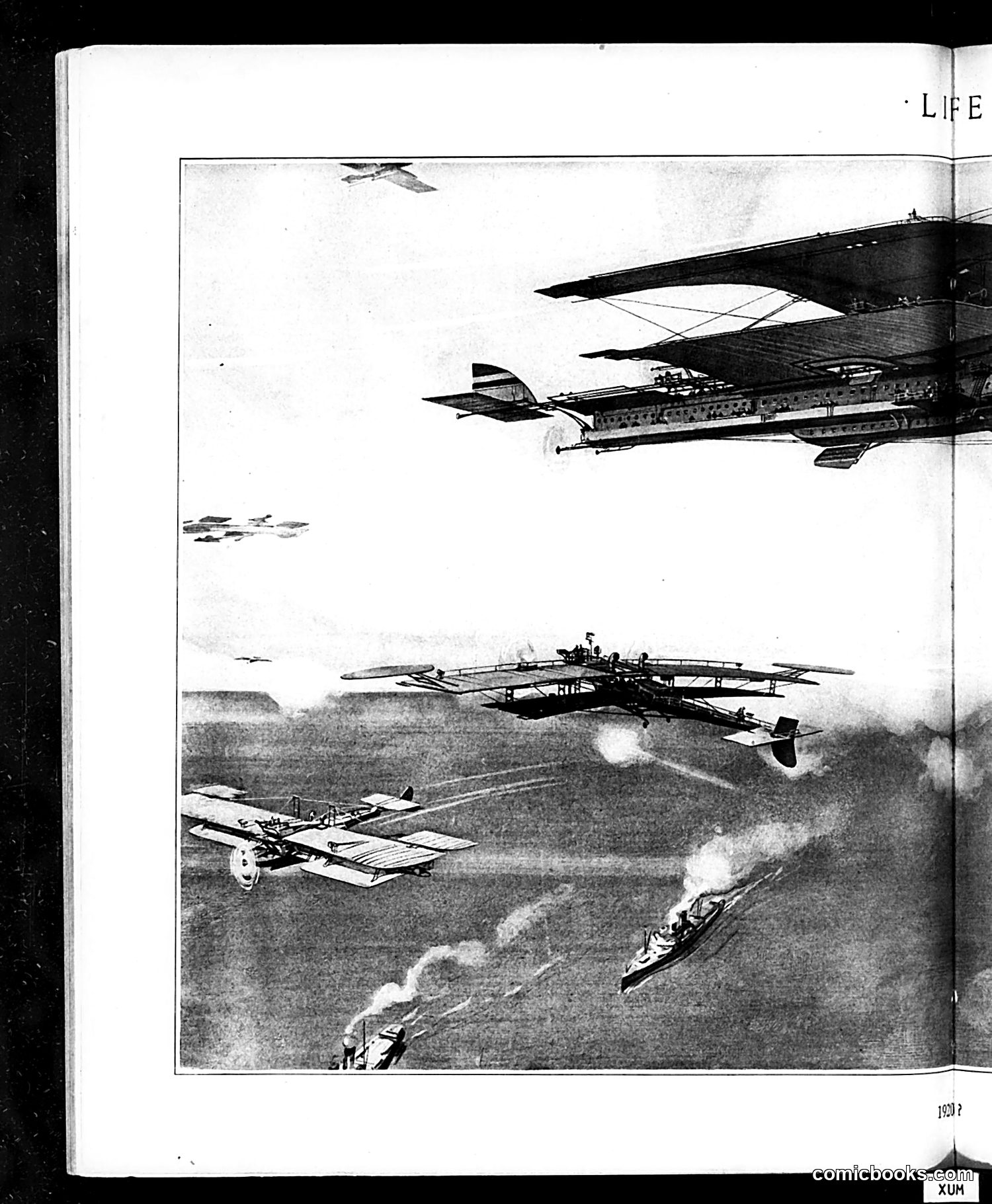
I can see this is a page from LIFE magazine featuring an illustration of early aviation. The image shows multiple aircraft in flight above a landscape with ships below on water. The aircraft appear to be various designs from the early era of aviation - some appear to be experimental or military aircraft with distinctive wing configurations. However, the OCR text provided is blank or illegible, so I cannot read any accompanying article, caption, or satirical commentary that would explain the specific political or social point being made. Without the text content, I can only note that this appears to be documenting early aviation developments, possibly military-related given the ship imagery, but I cannot identify specific figures, events, or the satirical intent without readable accompanying text or clearer context clues in the image itself.
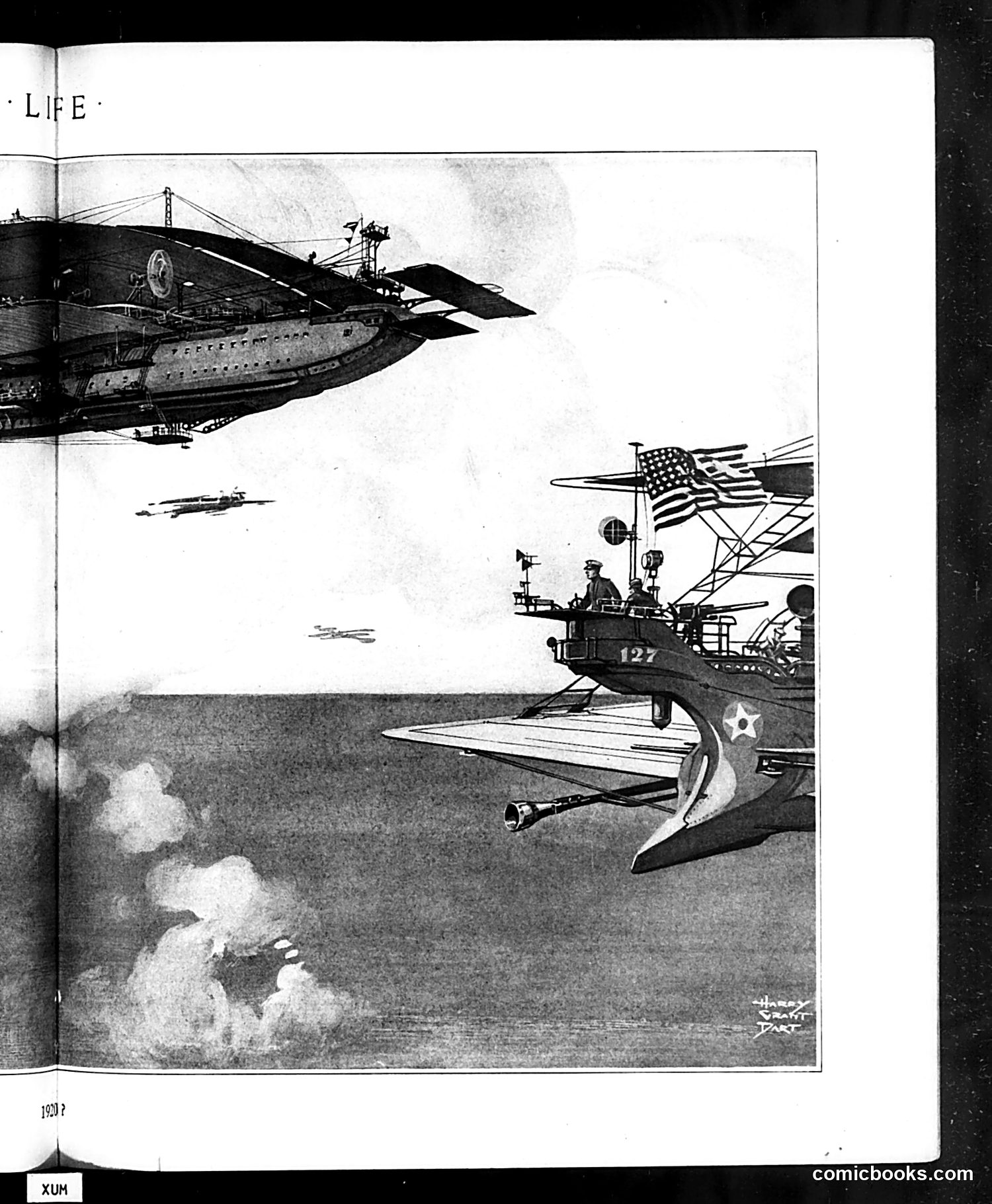
This page from *Life* magazine shows a military illustration depicting American naval and aerial vessels. The image features a U.S. Navy patrol boat (marked "127") with an American flag prominently displayed, alongside military aircraft and what appears to be a larger naval vessel in the background. The illustration appears to be patriotic propaganda or recruitment material rather than satire. It celebrates American military power and readiness, likely from the World War II era based on the vessel design and artistic style. The dramatic composition emphasizes naval and air superiority. Without additional OCR text or caption content visible on this page, the specific satirical point—if any—remains unclear. This may simply be a serious military illustration rather than political commentary.
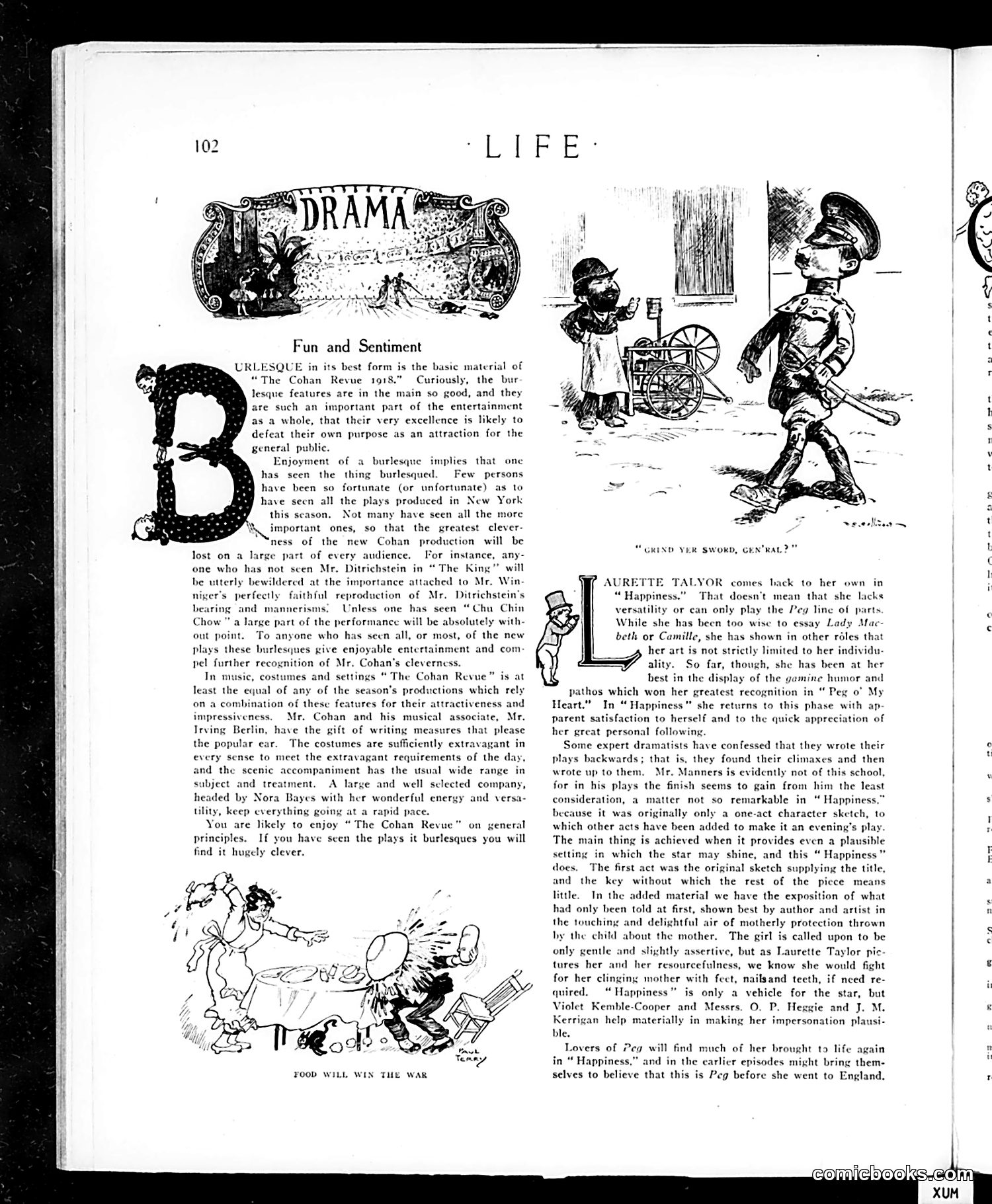
This page reviews two theatrical productions. The main article discusses "The Cohan Revue of 1918," a burlesque show by George M. Cohan featuring music by Irving Berlin. The critic notes the revue's excellent production values—costumes, scenery, and performances by Nora Bayes—but argues its humor depends on audiences having seen the plays it parodies (like "The King" and "Chu Chin Chow"). The review concludes most theatergoers will enjoy it regardless. The secondary review covers Laurette Taylor in "Happiness," praising her return to the comedic-pathetic roles that made her famous in "Peg o' My Heart." The critic observes the play was originally a one-act sketch expanded into a full evening, with Taylor's performance of maternal protection being the emotional centerpiece. The cartoons (depicting soldiers and civilians) appear unrelated to these reviews, likely illustrating the patriotic "Food Will Win the War" campaign.
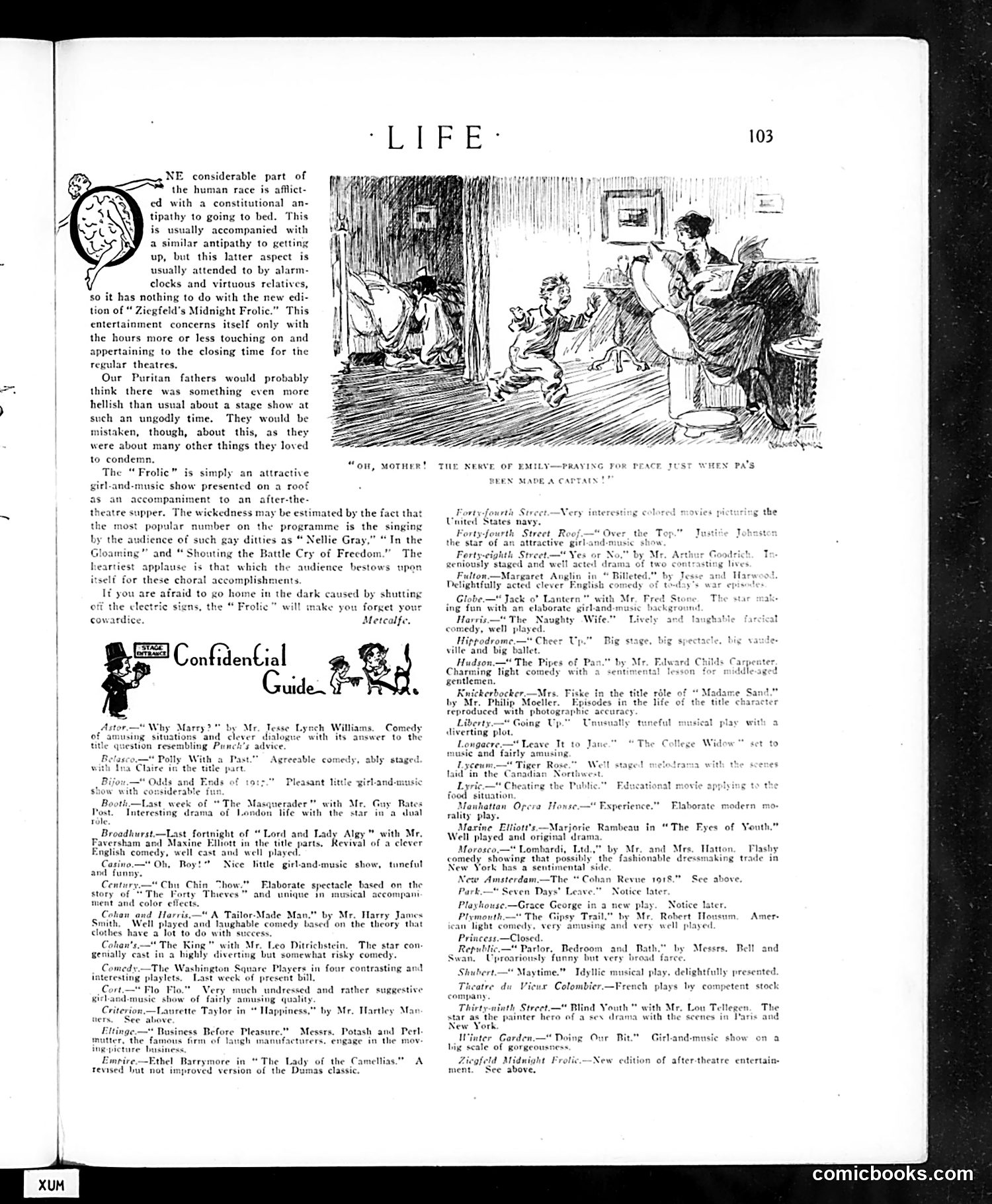
This page from *Life* magazine contains a theater review column and one accompanying cartoon. The cartoon's caption reads: "Oh, Mother! The Nerve of Emily—Praying for Peace Just When Pa's Been Made a Captain!" **The Satire:** The joke targets the disconnect between wartime military service and domestic life. A young woman (Emily) is praying for peace at the precise moment her father has received a military promotion to captain—presumably during or around World War I. The humor lies in the irony: her prayer for peace contradicts her father's professional interest in the war continuing (which would justify his new rank and possibly increase his status/pay). **The Social Commentary:** This mocks both the earnest pacifism of some civilians and the militaristic ambitions of others during wartime, suggesting hypocrisy in American attitudes toward conflict. The rest of the page comprises straightforward theater reviews of current Broadway productions, with no additional political content visible.
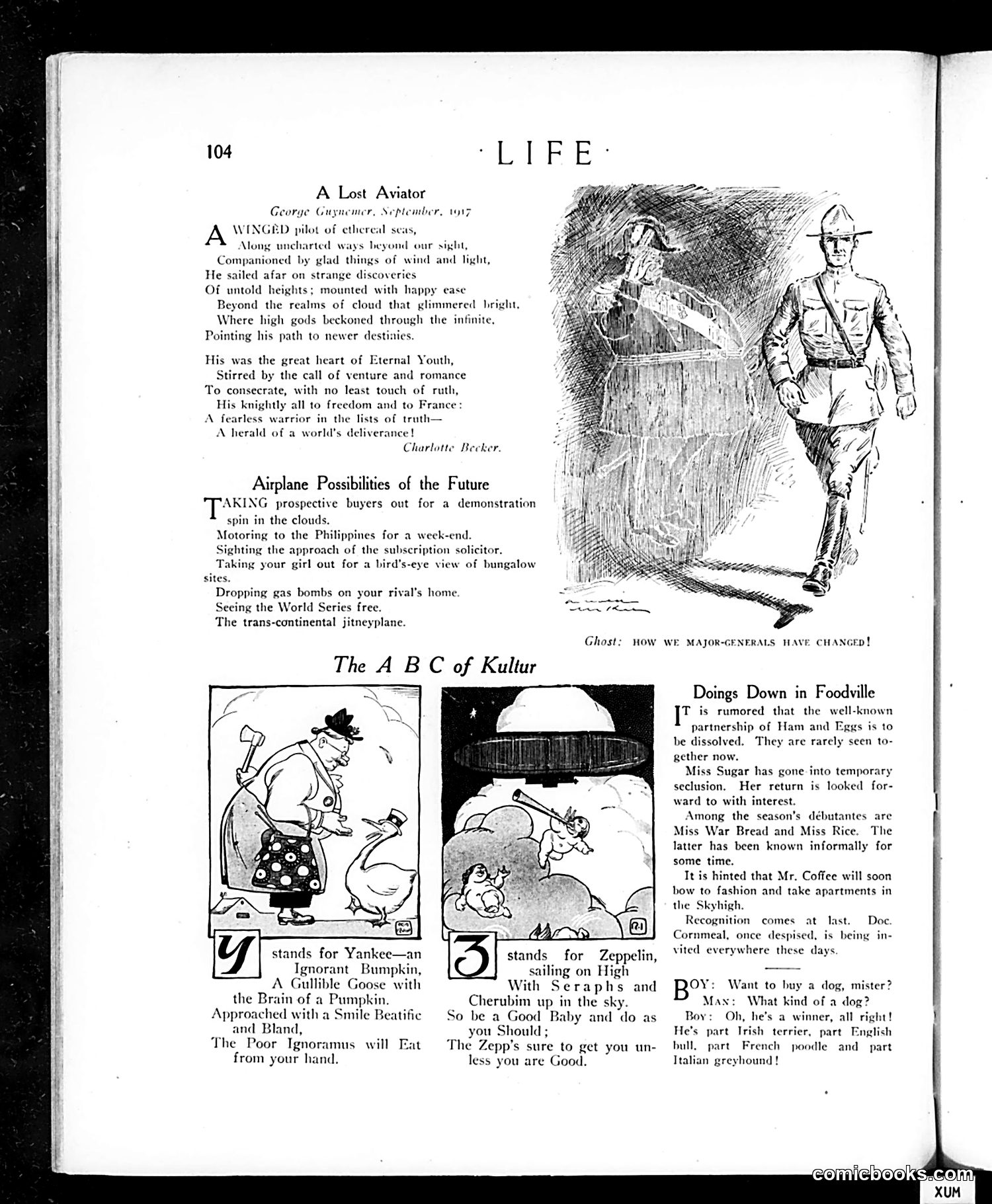
This 1917 *Life* magazine page contains WWI-era satire: **"A Lost Aviator"**: A tribute poem to Georges Guynemer, a famous French fighter pilot who died in September 1917. The text celebrates him as a heroic, idealistic young man who sacrificed himself for France during the war. **"Airplane Possibilities of the Future"**: Satirical predictions mixing mundane uses (taking dates, visiting relatives) with dark military applications (dropping gas bombs on rivals' homes)—reflecting contemporary anxiety about aviation's weaponization. **"The ABC of Kultur"**: Anti-German propaganda cartoons. "Kultur" (German culture) is depicted as arrogant ignorance. The "Y" shows a Yankee outsmarting a pompous German; the "Z" references Zeppelins (German airships used in bombing raids). **"Doings Down in Foodville"**: Personified foods (Ham, Eggs, Sugar, Coffee) reflect WWI rationing and food shortages affecting American civilians. **The dog joke**: Satirizes American ethnic stereotypes through a mongrel dog described by multiple national origins—a common period humor trope.
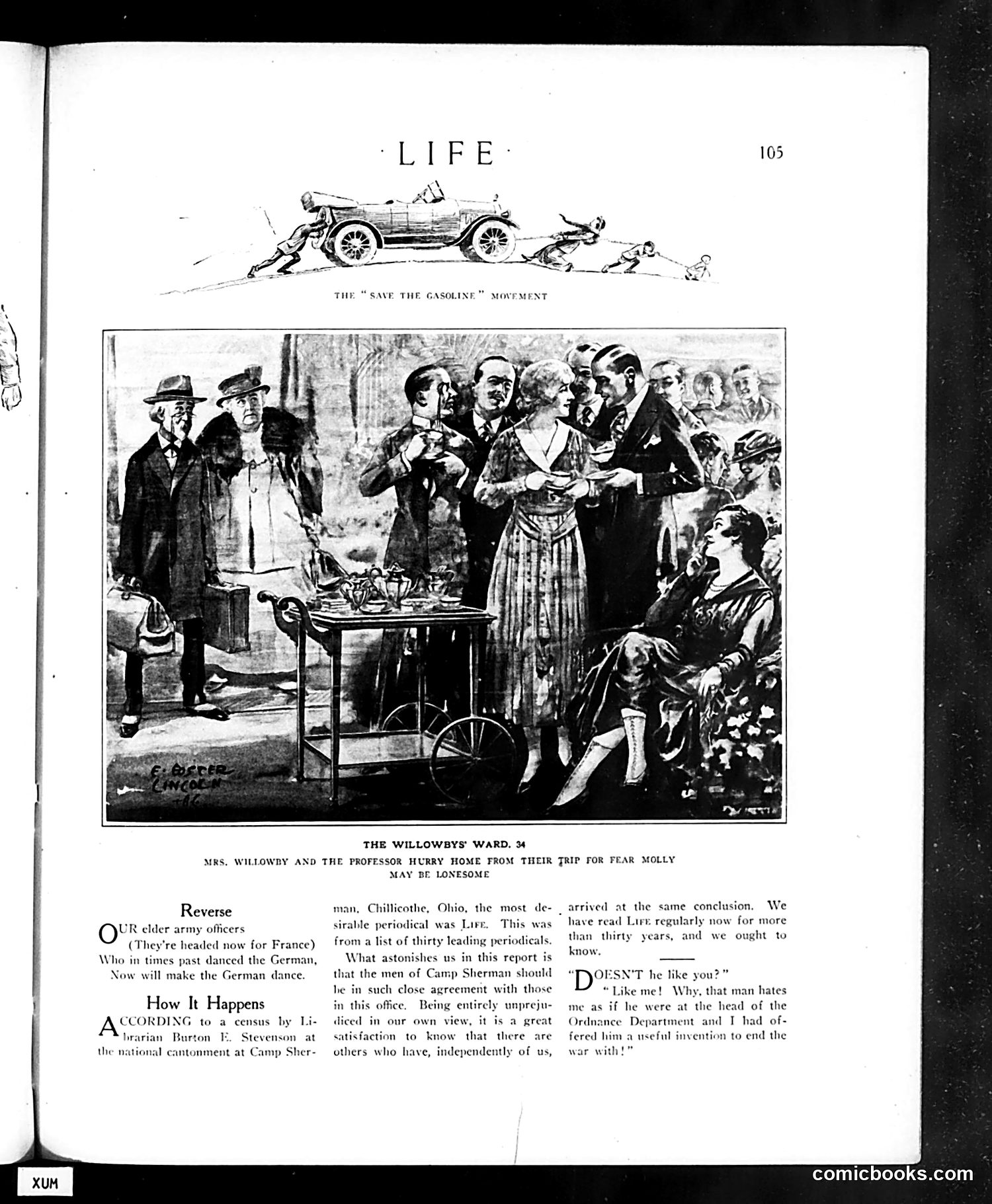
This page combines wartime satire with self-promotion. The top cartoon illustrates the "Save the Gasoline Movement"—a real WWI-era conservation effort—showing people literally pulling a car by rope, humorously suggesting extreme fuel rationing. The main illustration, "The Willowbys' Ward," depicts a domestic scene where Professor and Mrs. Willowby rush home from an outing, apparently fearing their ward Molly will be lonely without them—mocking middle-class anxieties during wartime disruptions. Below, the text celebrates that soldiers at Camp Sherman, Ohio ranked *Life* magazine as their most-desired periodical among thirty options. The magazine boasts about this validation, with characteristic self-congratulatory humor. The final joke suggests a man who dislikes the narrator as intensely as an Ordnance Department official would reject a proposed war-ending invention—implying bureaucratic resistance to innovation. The page reflects 1918 American life: gasoline rationing, military camps, and magazines' role in home-front morale.
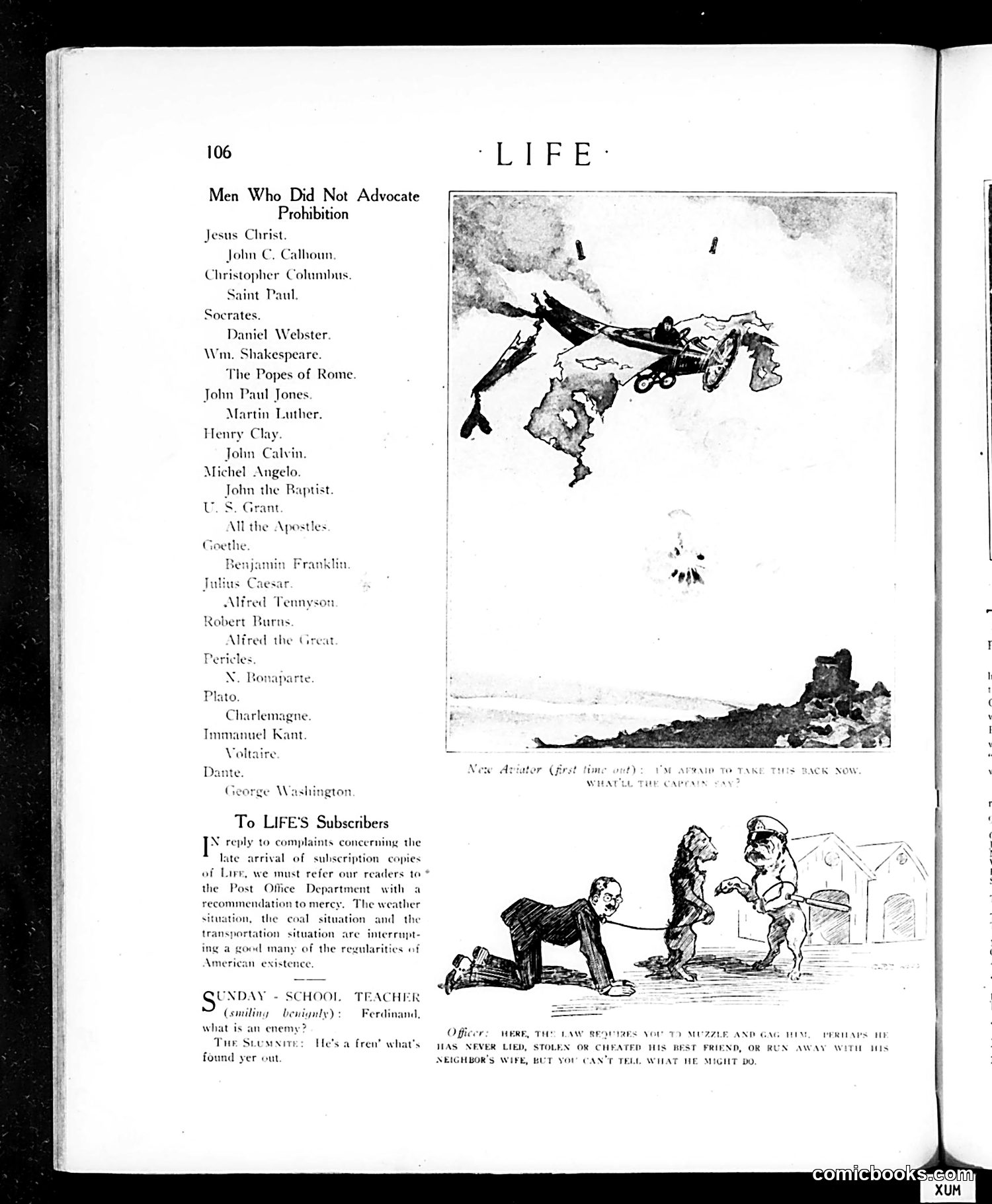
**Main Content:** The page features two satirical pieces: 1. **"Men Who Did Not Advocate Prohibition"** — a list of historical and religious figures (Jesus, Shakespeare, the Popes, etc.) presented ironically during America's Prohibition era (1920-1933). The satire suggests these great men somehow survived and achieved greatness *without* promoting alcohol bans, mocking prohibitionists' claims that banning alcohol was necessary for civilization. 2. **Sunday School Dialogue** — A teacher asks a child "Ferdinand" to define "enemy." The boy responds his enemy is "a fren' what's found yer out." An officer then demands the boy be muzzled because he's honest—never lied, stolen, or cheated, yet "you can't tell what he might do." **The Joke:** The cartoon satirizes unfair suspicion and censorship of innocent people, suggesting authorities punish honesty itself out of paranoia about potential wrongdoing.
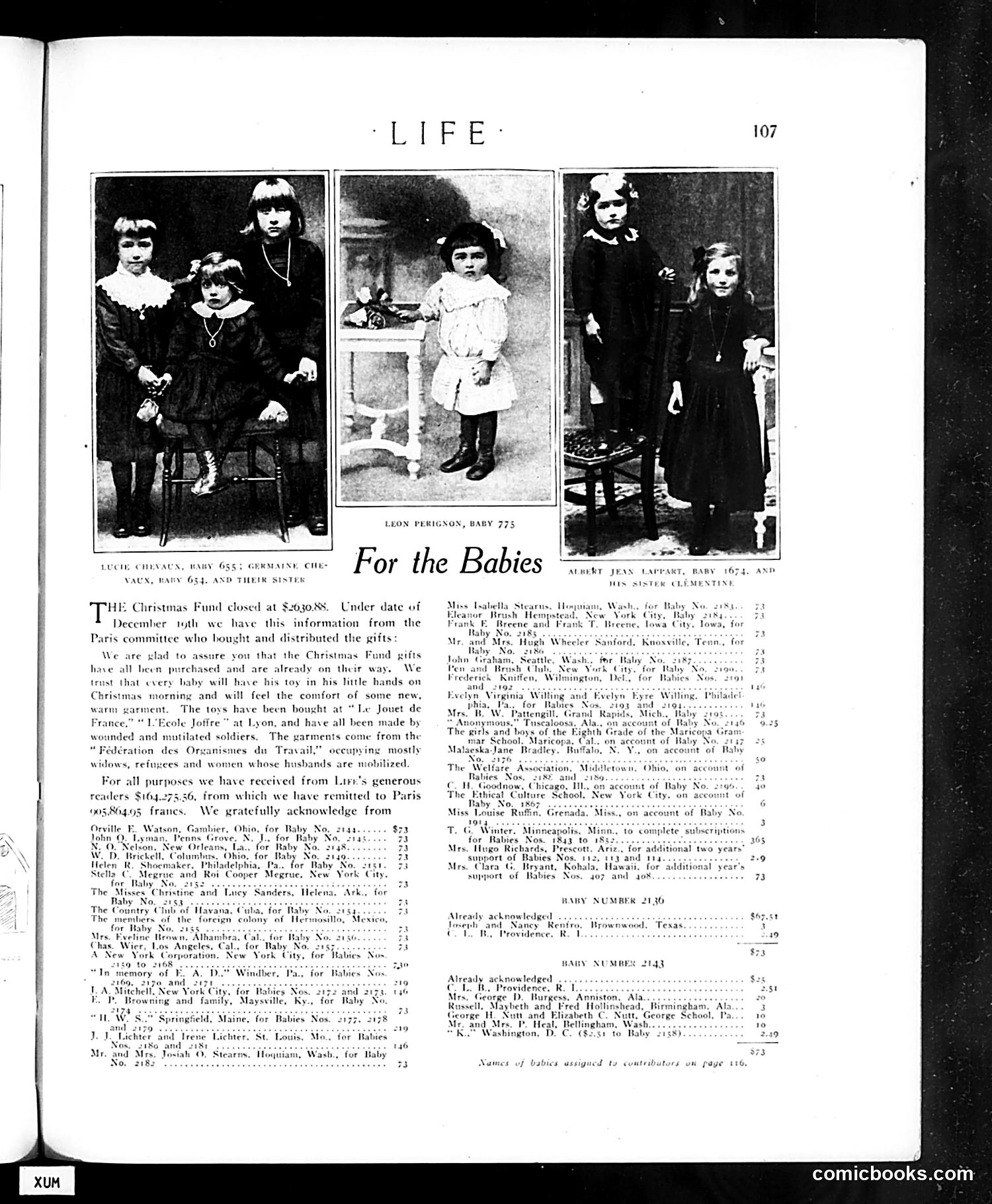
This page documents Life magazine's Christmas charity fund for babies in war-torn France during World War I. Rather than satire, it's a earnest charitable appeal showing three photographs of children (identified as "Leon Perignon, Baby 775" and others) who received gifts purchased and distributed by the Paris committee. The text explains that toys were bought from "Le Jouet de Travail" (a workshop for wounded and mutilated soldiers) and garments came from widows, refugees, and women whose husbands were mobilized. Life's readers contributed donations ($16,275.36 total), which the magazine publicly acknowledges by listing donor names and the specific babies they supported. This represents Life's wartime charitable mission—using its platform to aid vulnerable civilian children caught in the European conflict, with transparent accounting of contributions.
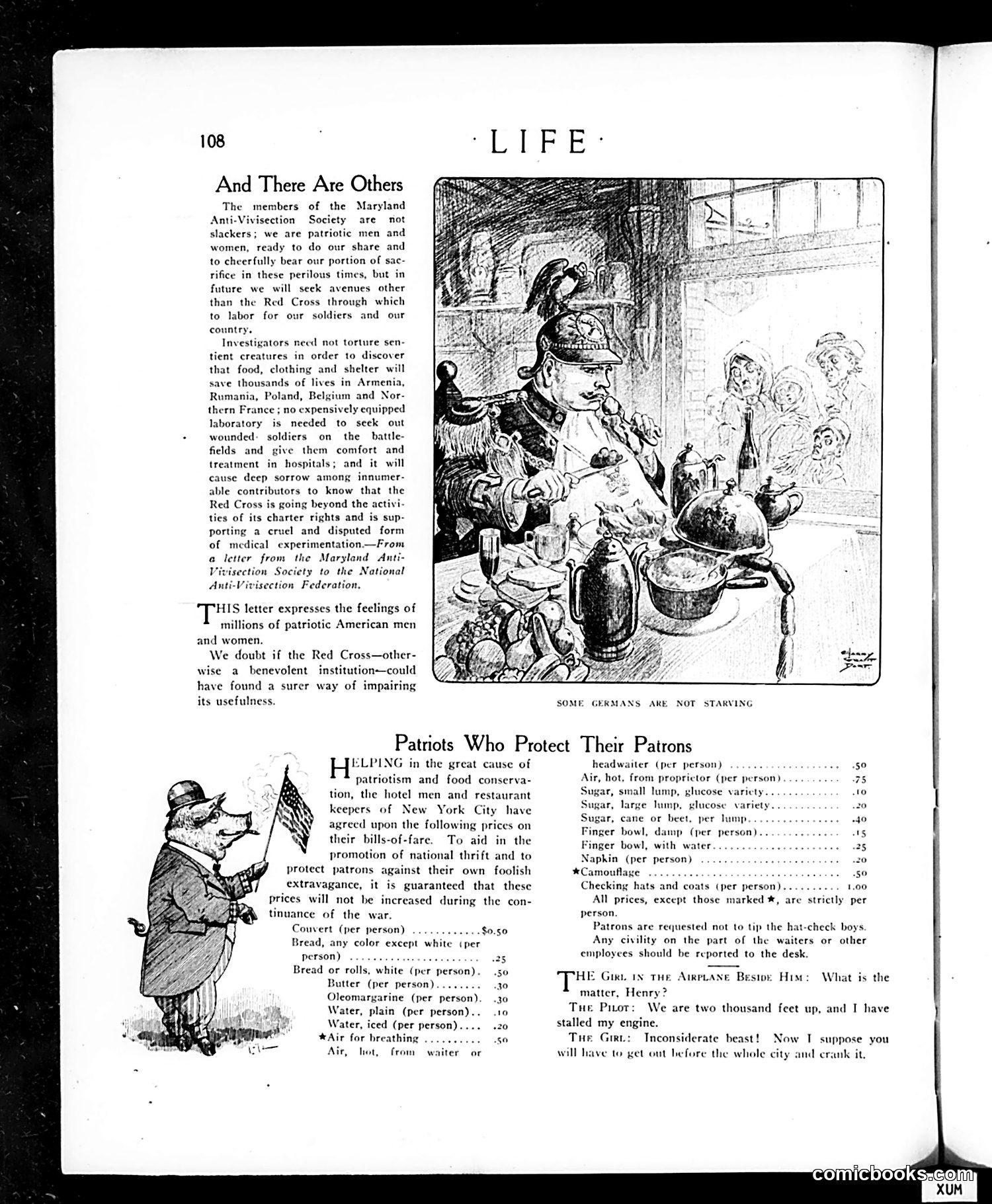
This page contains two satirical pieces critiquing WWI-era American institutions: **Top Section:** Life publishes a letter from the Maryland Anti-Vivisection Society attacking the Red Cross for allegedly funding animal experimentation, arguing resources should instead aid wounded soldiers and civilians in war-torn regions (Armenia, Romania, Poland, Belgium, France). Life sides with the critics, suggesting the Red Cross is damaging its own reputation. **Bottom Section ("Patriots Who Protect Their Patrons"):** This is biting satire of New York hotel and restaurant owners who claim to support food conservation and protect customers from "foolish extravagance" by fixing menu prices—then charge exorbitant fees for items like water, bread, and air ("Air for breathing"). The joke: these "patriots" exploit patriotism to maintain wartime profits while appearing virtuous. Items marked with asterisks are apparently complimentary, highlighting the absurdity of what's actually paid versus free. Both pieces mock hypocrisy: institutions claiming patriotic sacrifice while advancing their own interests.
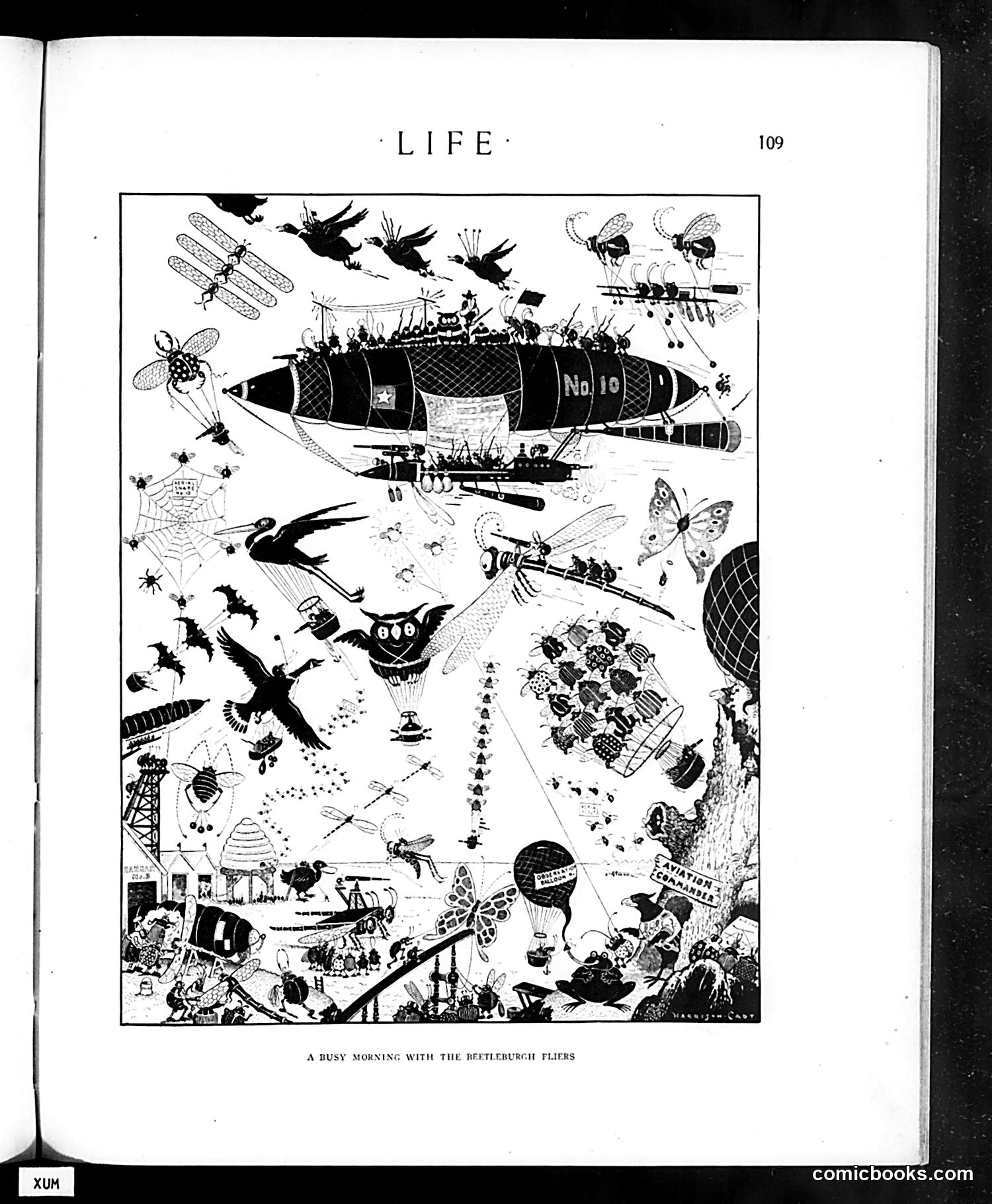
This is a whimsical satirical illustration depicting an imaginary aerial community of insects and fantastical flying machines. The central airship labeled "No. 19" appears to be a passenger vessel surrounded by various flying creatures—dragonflies, bees, butterflies, and birds—alongside mechanical contraptions including what appear to be early aircraft designs. The satire likely mocks contemporary fascination with aviation technology and modernization circa early 20th century, presenting a humorous "insect civilization" with their own bustling aerial commerce and industry. The chaotic composition with numerous vessels, creatures, and structures creates comedic commentary on industrial progress and urban congestion, imagining how even insects might adopt human technological ambitions. The subtitle's playful neologism "Beetleburgh" reinforces this mock-serious anthropomorphization of insect life.
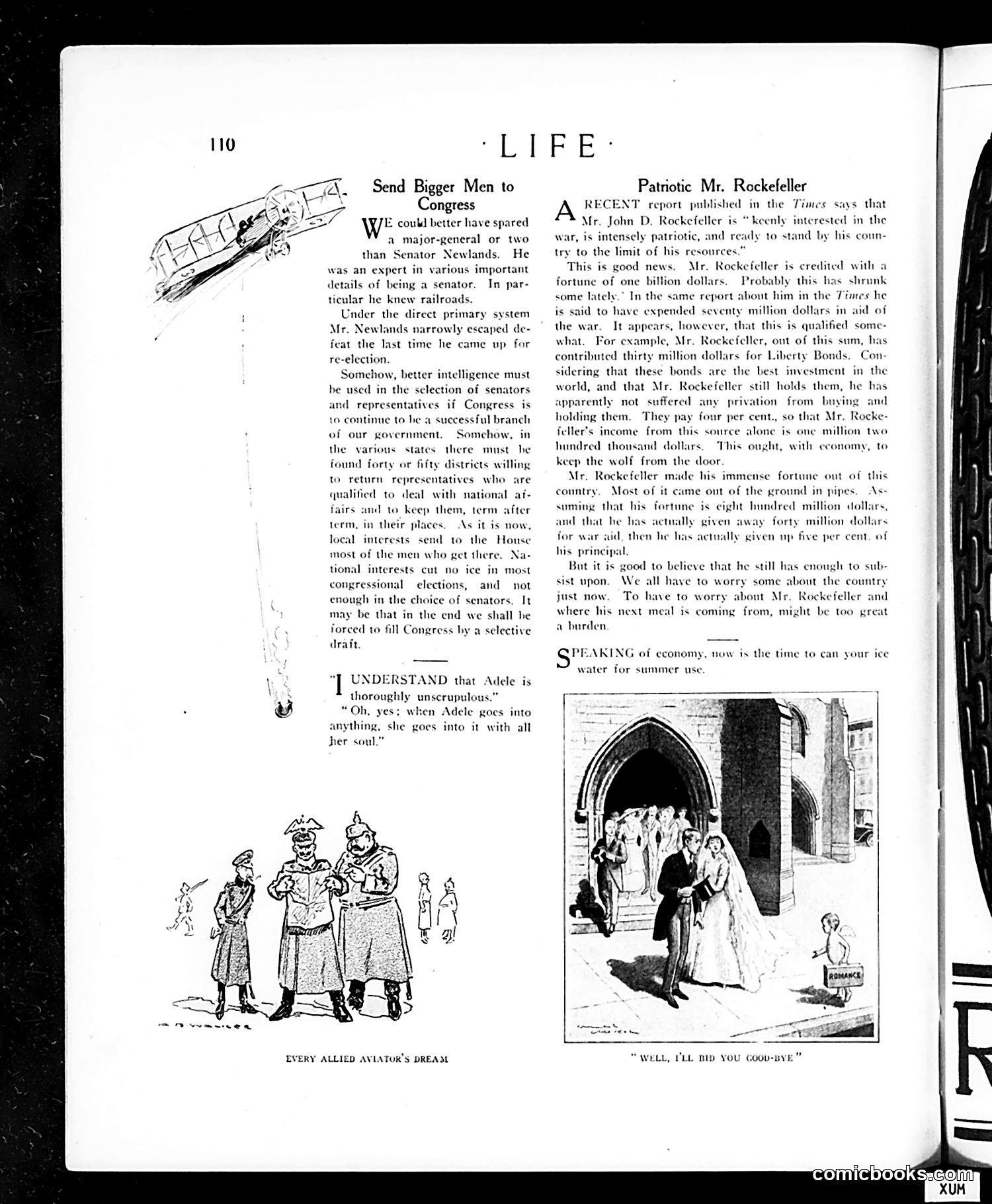
This page contains two distinct satirical pieces: **"Send Bigger Men to Congress"** criticizes how senators and representatives are selected. The text argues that Senator Newlands, despite his railroad expertise, barely survived re-election under the direct primary system. The satire contends that Congress is filled based on local interests rather than national qualifications, suggesting a "selective draft" might be necessary to improve legislative quality. **"Patriotic Mr. Rockefeller"** mocks John D. Rockefeller's claimed patriotism during World War I. The piece notes that while reports credit him with $70 million in war aid, much consists of Liberty Bonds (profitable investments paying 4% interest, generating $1.2 million annually). The satire calculates he's donated only 5% of his $800 million fortune, sarcastically expressing concern about his financial welfare. The cartoon bottom-left titled "Every Allied Aviator's Dream" appears to reference war-related humor, while the illustration shows a farewell scene.
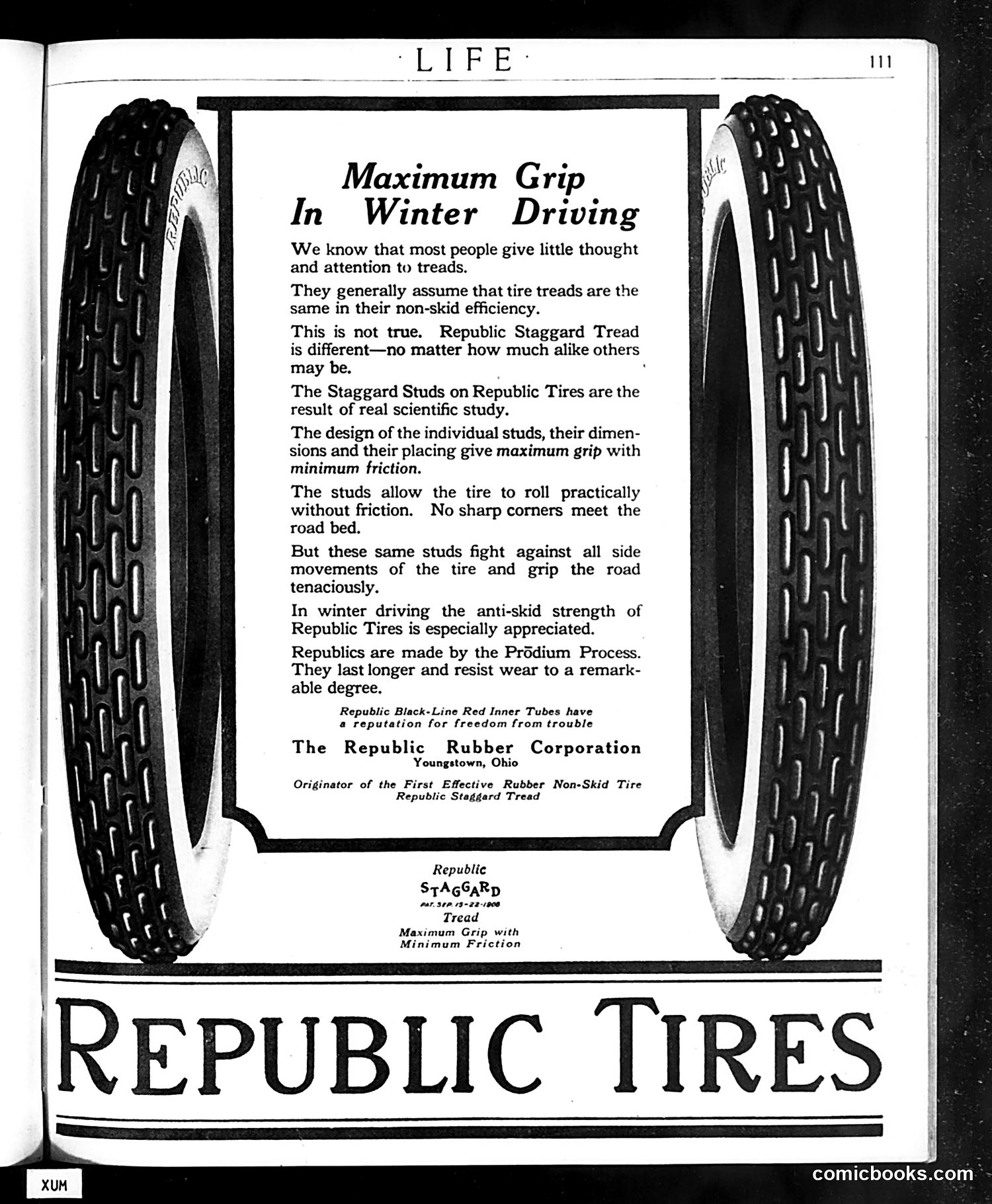
This is not a cartoon or satire—it is a **straight advertisement** for Republic Tires, published in *Life* magazine (page 111). The page displays two large tire images flanking promotional text. Republic Rubber Corporation of Youngstown, Ohio markets their "Staggard Tread" tire, emphasizing its superior winter-driving safety through scientifically-designed studs that provide "maximum grip with minimum friction." The ad claims Republic tires were the "Originator of the First Effective Rubber Non-Skid Tire" and that their proprietary "Prödium Process" manufacturing makes them more durable than competitors. There is no satire here—this represents early automotive advertising targeting consumers concerned with winter road safety, a genuine practical issue for 1920s drivers.
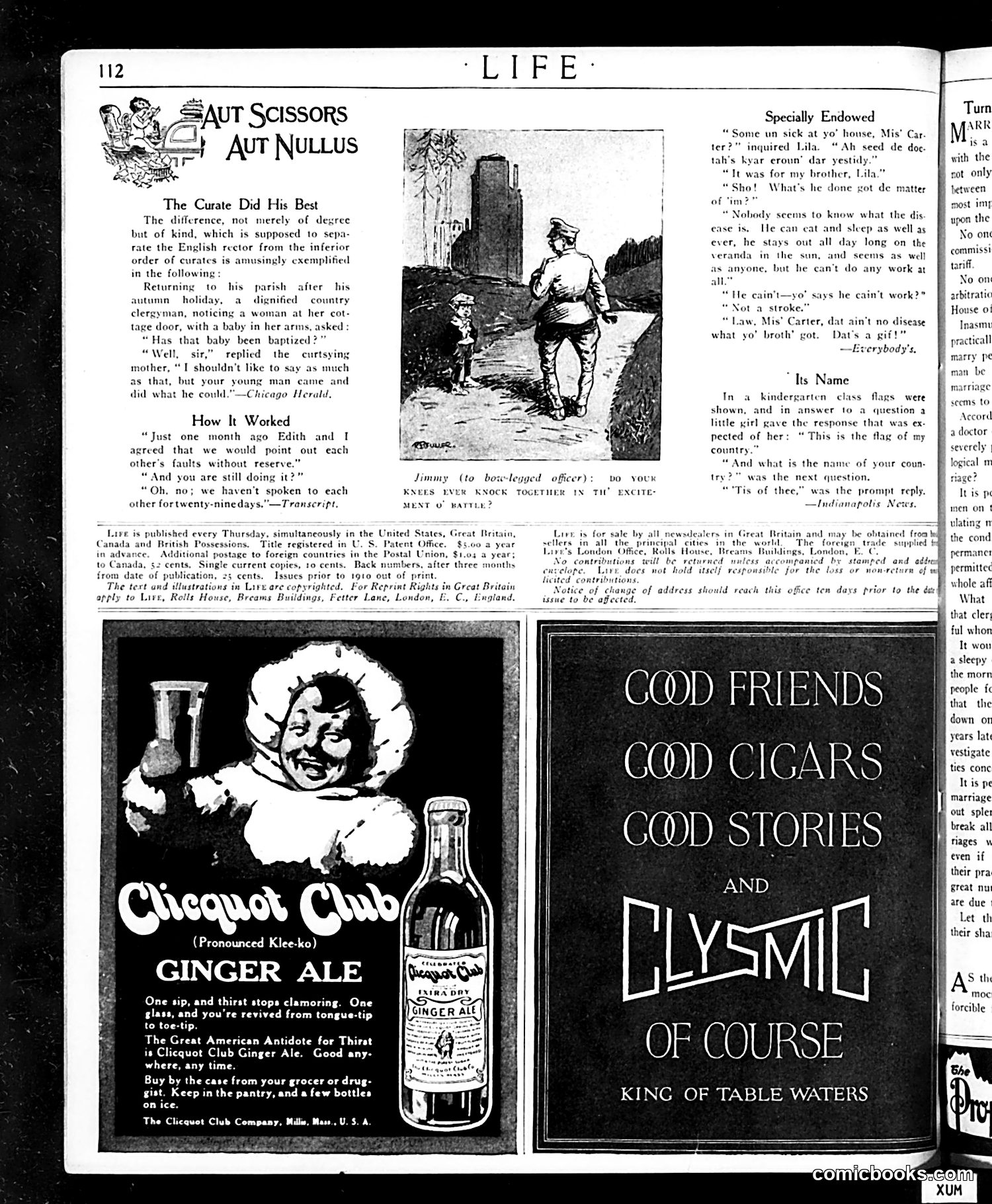
This page contains **humorous anecdotes and advertisements** rather than political cartoons. The main comic content includes: 1. **"The Curate Did His Best"**: A joke about class distinction in the Church of England. A country clergyman asks a woman if her baby was baptized. She replies that the junior curate ("your young man") "did what he could"—implying the curate performed an incomplete or inadequate baptism. The humor lies in the snobbish presumption that lower-ranking clergy perform their duties poorly. 2. **"How It Worked"**: A domestic humor piece about a couple who agreed to point out each other's faults but stopped speaking after 29 days—satirizing marital conflict resolution. 3. **"Its Name"**: A children's joke where a kindergartener, asked her country's name, replies "Tis of thee" (from the patriotic song "America"). The page also contains period advertisements for **Clicquot Club Ginger Ale** and **Clysmic table water**, typical of early 20th-century magazine advertising.
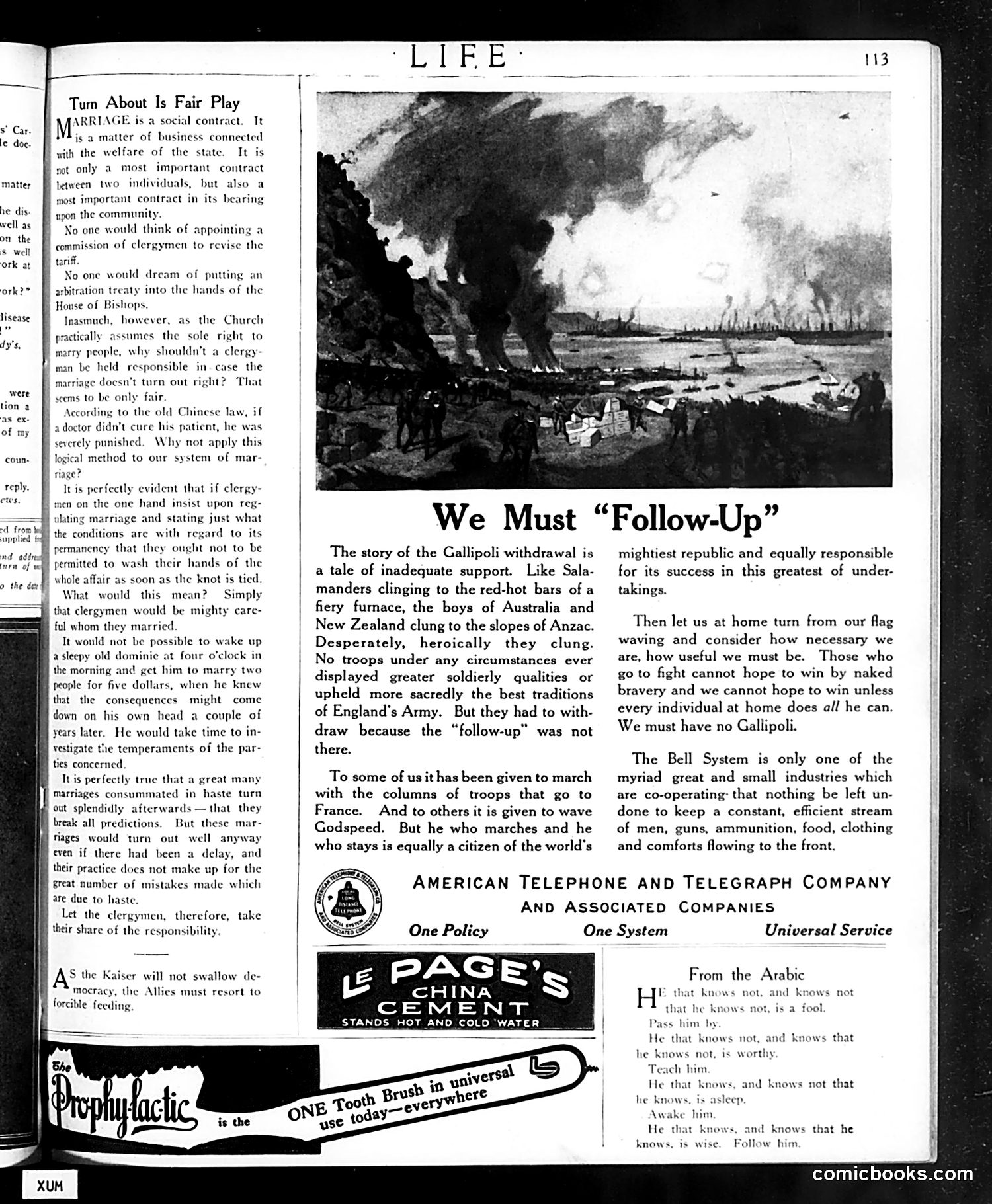
This page contains two distinct pieces of commentary on World War I: **"Turn About Is Fair Play"** (left column) is satirical social commentary proposing that clergymen who perform marriages should bear legal responsibility if those marriages fail—just as doctors face punishment under old Chinese law for patient deaths. The author argues this would make clergy more cautious about hasty marriages, especially quickie ceremonies performed for minimal fees at odd hours. **"We Must 'Follow-Up'"** (center) is serious wartime advocacy. It discusses the Gallipoli campaign's failure, attributing Australian and New Zealand troops' withdrawal to inadequate supply and support ("follow-up"), not lack of courage. The piece urges American home-front workers to maintain full industrial production for the war effort, warning against complacency. It concludes with an American Telephone & Telegraph advertisement emphasizing their role in supporting troops—using the war effort to boost corporate image. The photograph shows what appears to be a WWI battlefield landscape with smoke and devastation, supporting the serious wartime messaging.
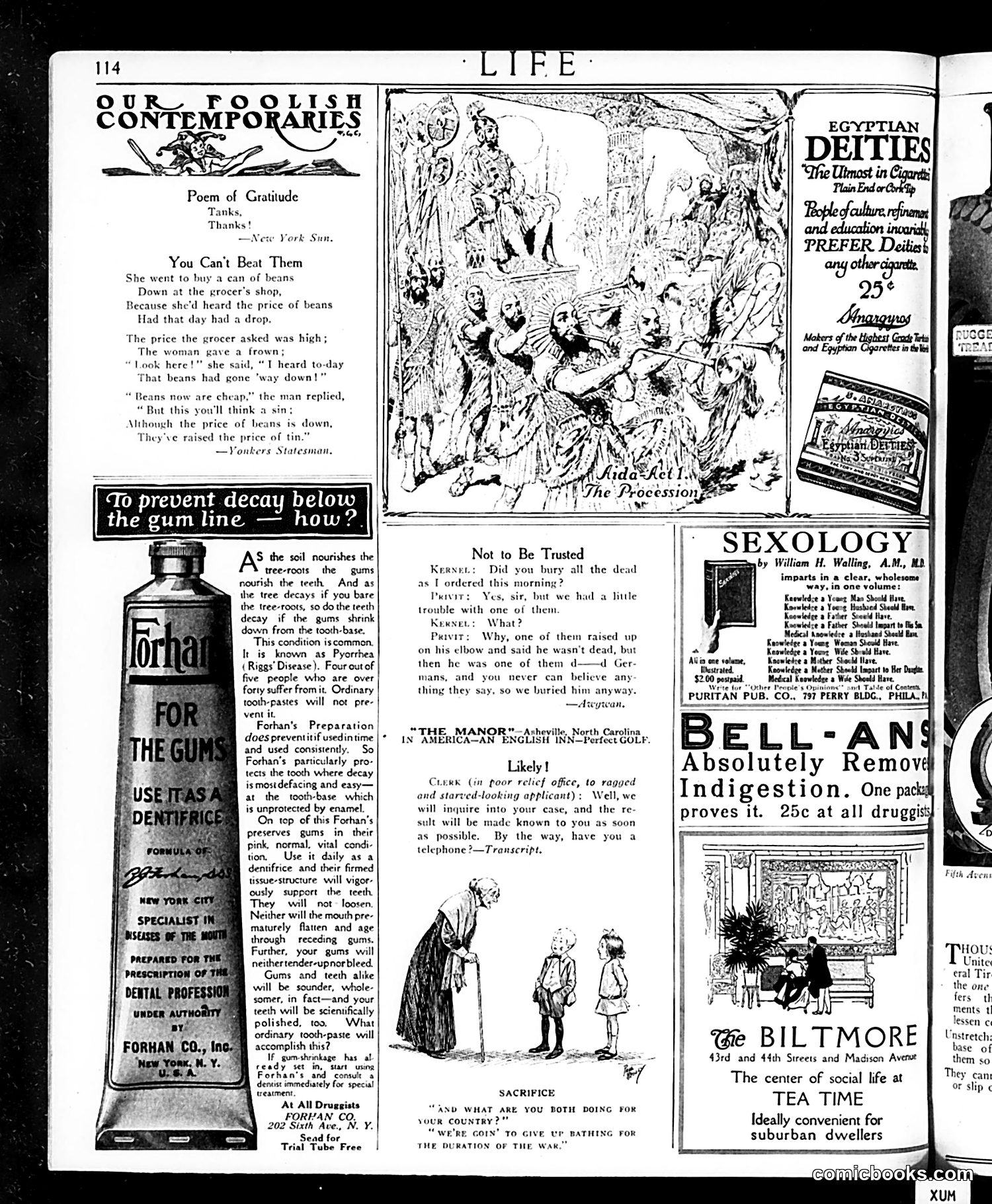
This page from *Life* (a satirical magazine) features several discrete pieces of social commentary typical of the era: **"You Can't Beat Them"** satirizes consumer frustration with inflation. A woman learns beans have dropped in price, but the grocer has raised the tin can price to compensate—mocking how retailers offset price cuts elsewhere, leaving customers no better off economically. **"Not to Be Trusted"** is a dark wartime joke (likely WWI-era based on context). A gravedigger buries a wounded German soldier alive because "you never can believe anything they say"—playing on anti-German sentiment and the grim absurdity of warfare. **"Sacrifice"** depicts a mother and child discussing wartime rationing, with the child promising to give up bathing "for the duration of the war"—satirizing how civilians frame minor inconveniences as patriotic sacrifice. The page is otherwise filled with period advertisements (dental products, hotels, "Sexology" books) typical of the era.
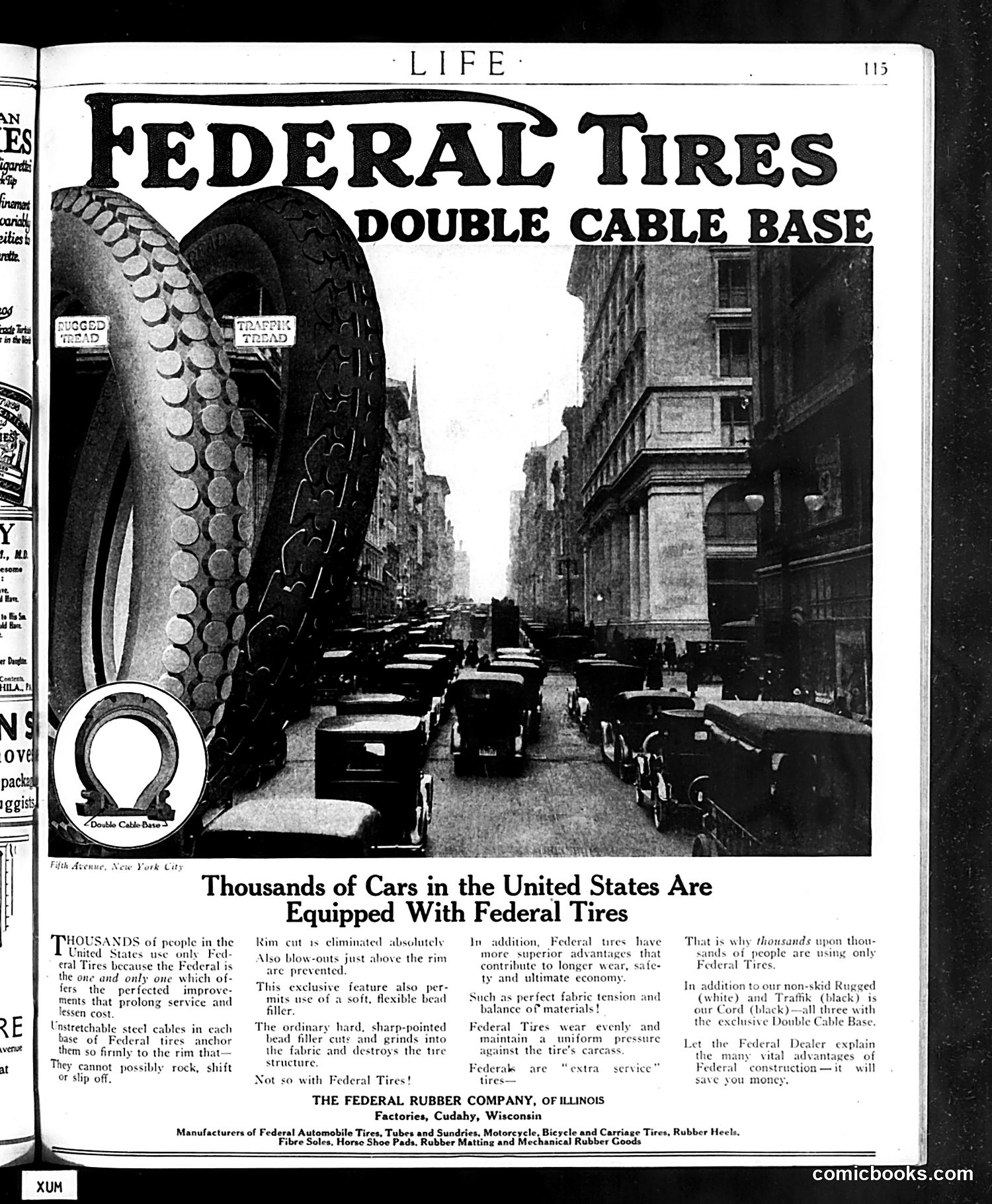
This is **not a cartoon or satire**, but rather a **straightforward product advertisement** for Federal Tires, published in *Life* magazine (page 115). The image shows oversized tires dominating a New York City street filled with automobiles, meant to emphasize the product's prominence and reliability. The ad claims Federal Tires are used by "thousands" of American cars and highlights technical features: an "unstretchable cable base" that prevents the tire from slipping on the rim, resistance to blowouts, and even wear. The text emphasizes durability and cost-effectiveness—standard advertising claims of the era. The company manufactured various rubber products and operated factories in Cudahy, Wisconsin. There is no political commentary or satire present. This represents typical early-20th-century automotive advertising, when tire quality was a genuine selling point as automobile ownership expanded.
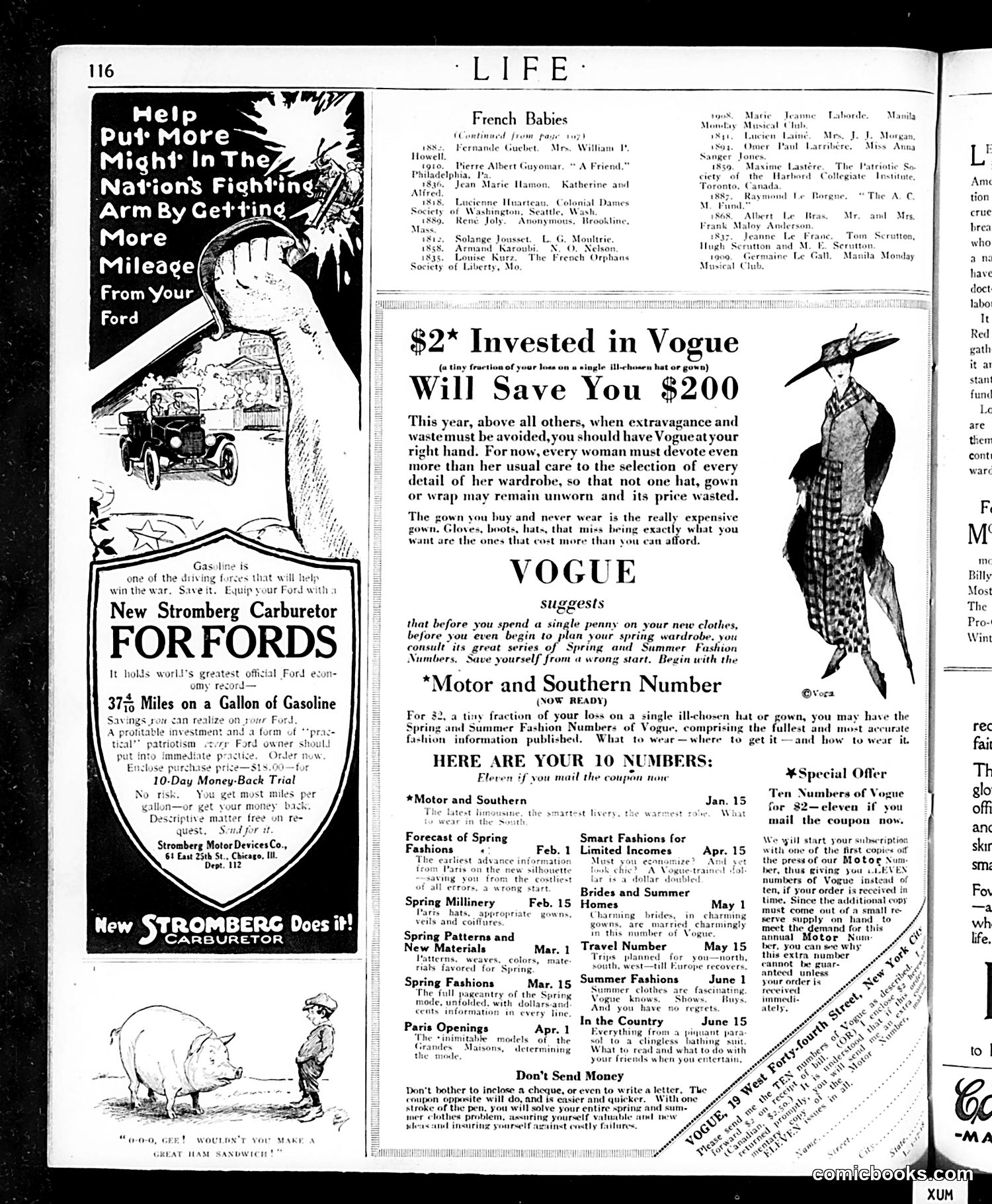
This page combines **WWI patriotic advertising** with **fashion magazine marketing**. ## Left Side: War Effort Advertising The Ford Motor Company and Stromberg Carburetor ads appeal to patriotic duty, urging Americans to equip their Fords for military efficiency. The ad claims 37 miles per gallon and frames fuel conservation as supporting "the nation's fighting arm." The pig cartoon at bottom is a crude joke about making "a great ham sandwich"—likely referencing food rationing or waste during wartime. ## Right Side: Vogue Fashion Promotion The page advertises a special deal: ten issues of *Vogue* magazine for $2 (roughly $200 in value, according to the copy). The pitch is **consumption through restraint**—women should carefully plan wardrobes to avoid waste, consulting *Vogue's* fashion guides. This frames luxury shopping as patriotic thrift during wartime. ## The Irony The juxtaposition is striking: patriotic conservation messaging on the left contrasts with fashion industry marketing on the right. Both claim to serve the war effort, though their actual purpose is selling products. This reflects how WWI commercialism wrapped itself in patriotic language.
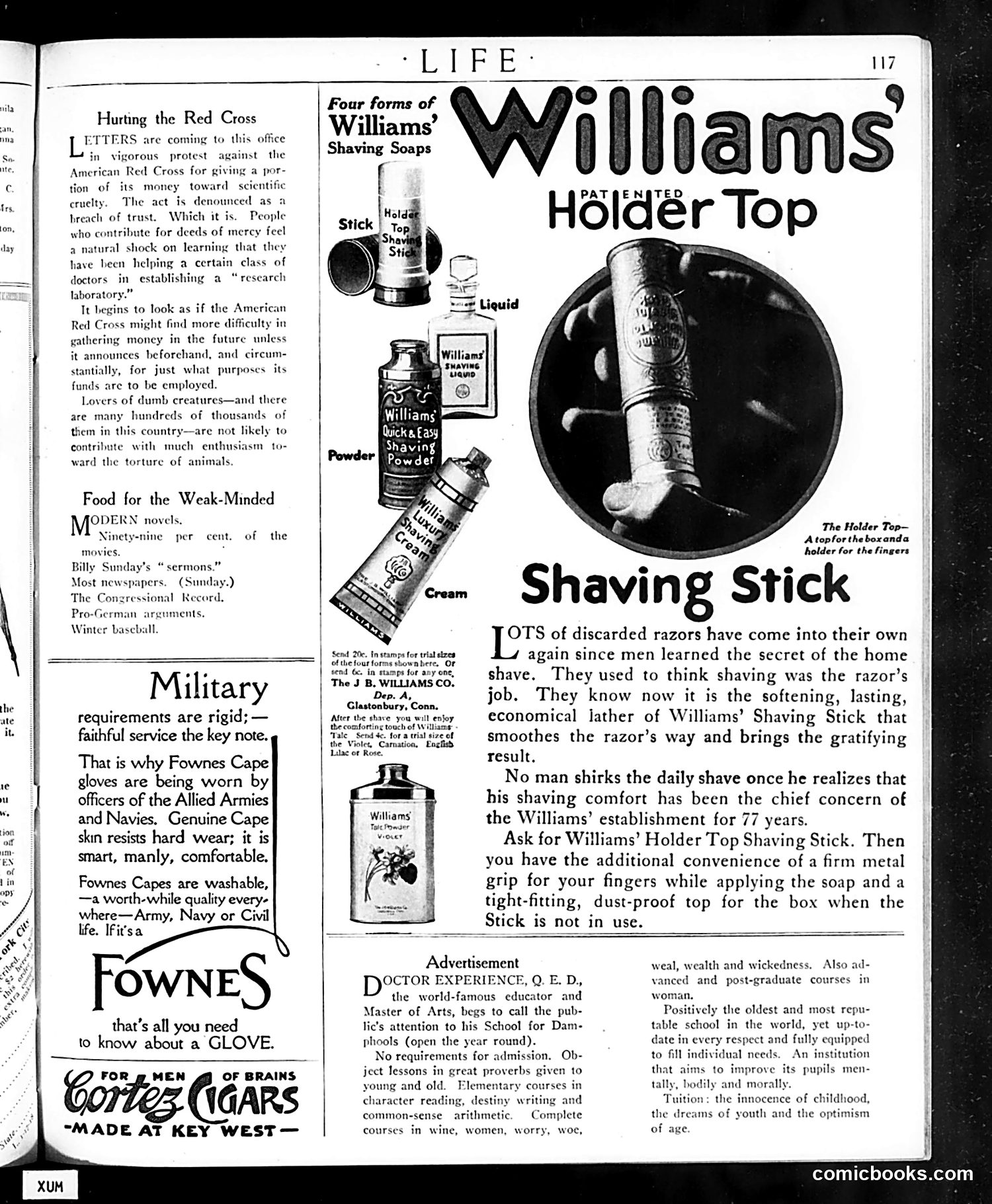
This page contains **editorial commentary and advertisements**, not political cartoons. The main editorial section **"Hurting the Red Cross"** criticizes the American Red Cross for funding animal experimentation. The author argues this betrays donors' trust, as contributors believed their money supported humanitarian aid. The piece warns the Red Cross will struggle fundraising unless it publicly discloses how donations are used—appealing to animal welfare advocates described as "many hundreds of thousands" in America. The page also includes a satirical advertisement for "Doctor Experience's School for Damphools," mocking correspondence schools and self-help courses as fraudulent. The fake school promises teaching on character, destiny, and general life matters with deliberately absurd credibility claims. The remaining content comprises genuine period advertisements: Fownes gloves (marketed to military officers), Williams' Shaving Stick products, and Cortes cigars. The Red Cross critique reflects early 20th-century tensions between animal rights advocacy and medical research ethics.
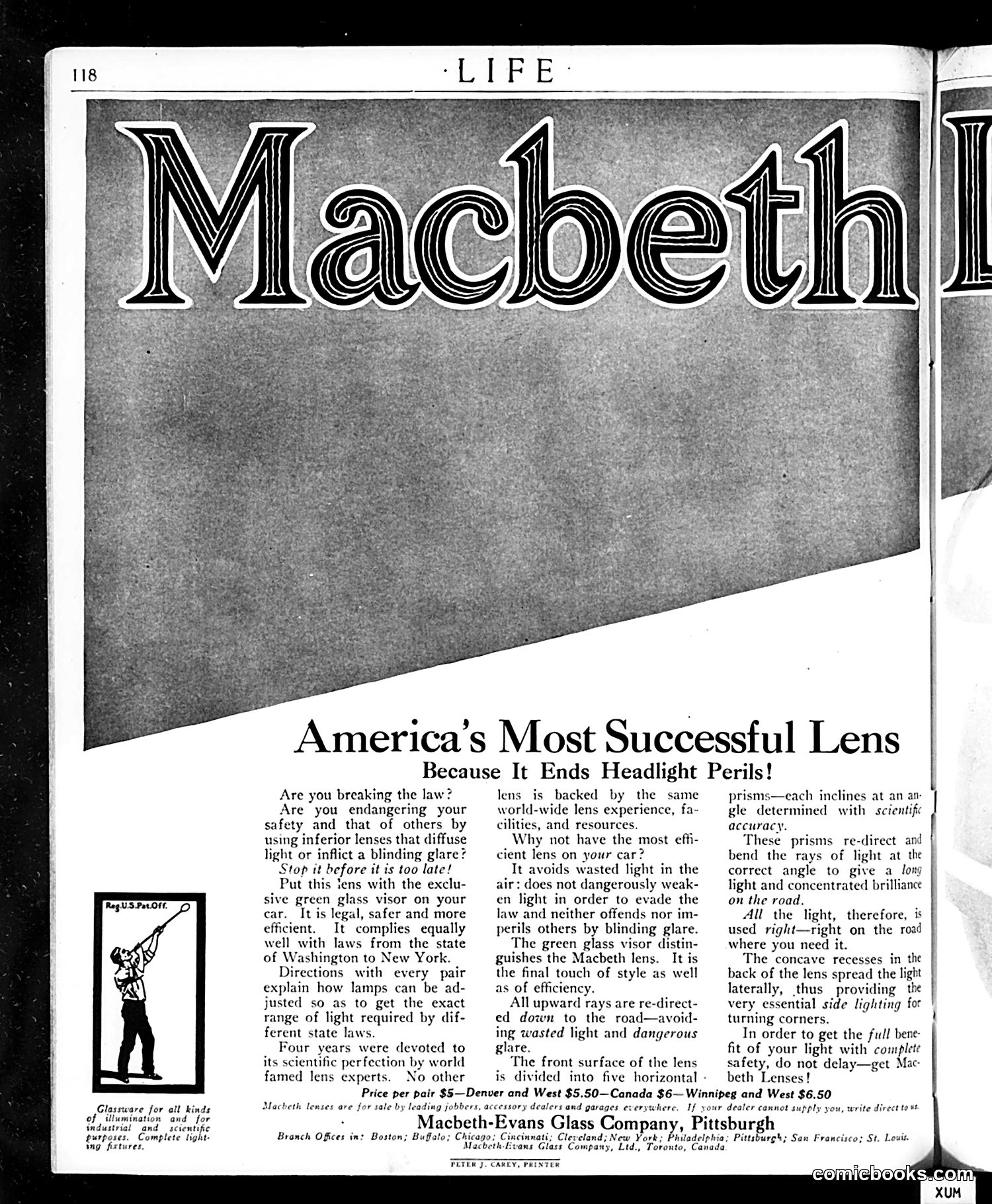
This page is primarily a **car headlight lens advertisement**, not political satire. It promotes the "Macbeth lens" with a green glass visor, marketed as America's safest automotive headlight solution. The ad addresses genuine early 20th-century concerns: car headlights were poorly regulated and caused accidents by blinding oncoming drivers. The advertisement claims the Macbeth lens complies with varying state laws (Washington to New York) while providing adequate illumination through scientific prism design that redirects light downward. The small cartoon in the bottom left corner appears to show a figure with a spotlight—likely illustrating the headlight safety issue the product addresses. This reflects an era when automotive safety standards were still developing and manufacturers competed on safety claims.
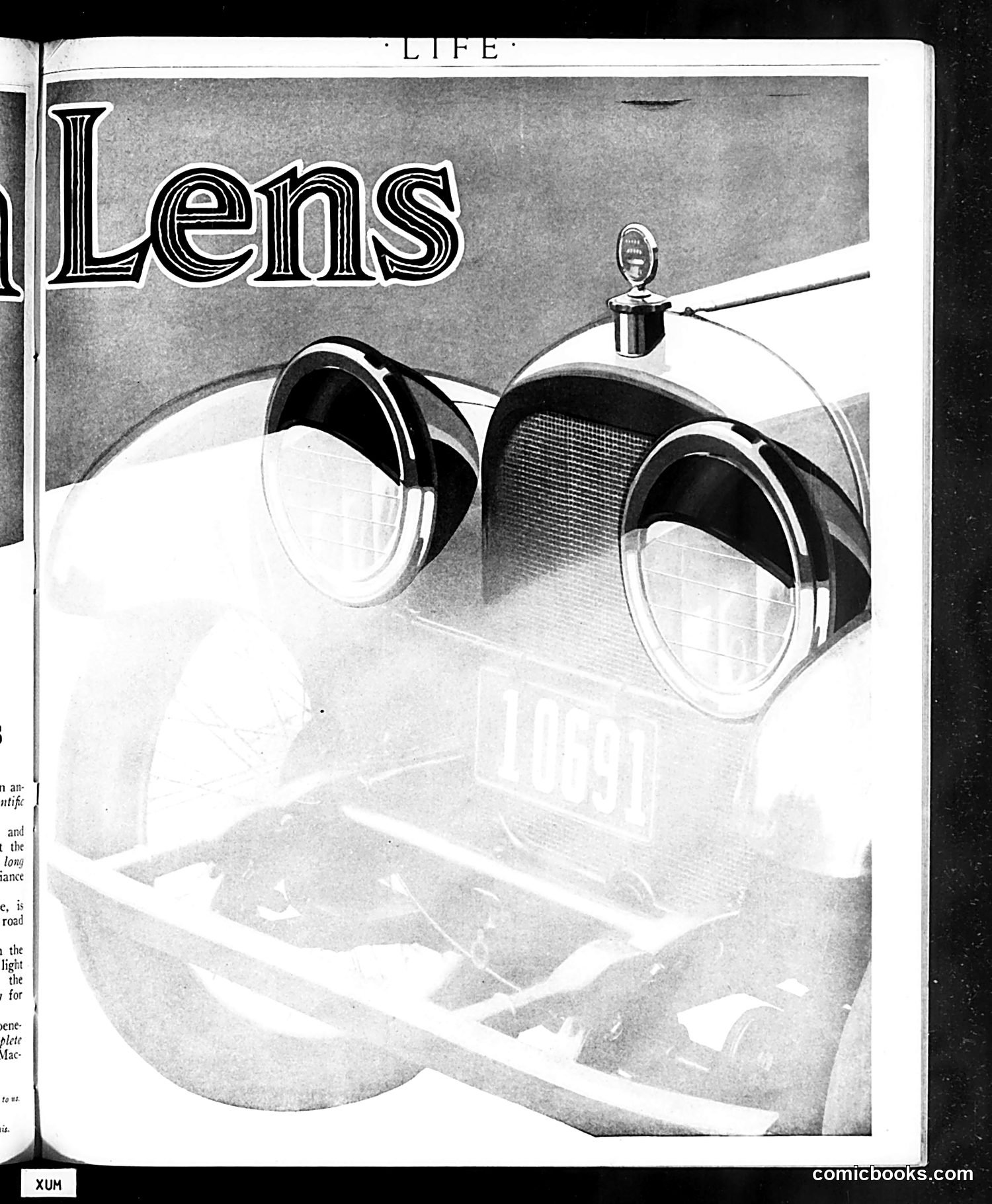
This appears to be a product advertisement page from *Life* magazine featuring automobile headlights or lamps. The large word "Lens" dominates the top, and the image shows close-up technical details of what appear to be car headlights with their reflective mechanisms visible. The OCR'd text fragments are too incomplete to determine specific satirical content or political messaging. Without readable body text explaining the advertisement's context or any visible caricatures, I cannot identify what social commentary or joke this page may contain. This appears to be primarily a straightforward product advertisement rather than political satire, though the incomplete text prevents confirmation of the advertisement's specific claims or humorous angle.
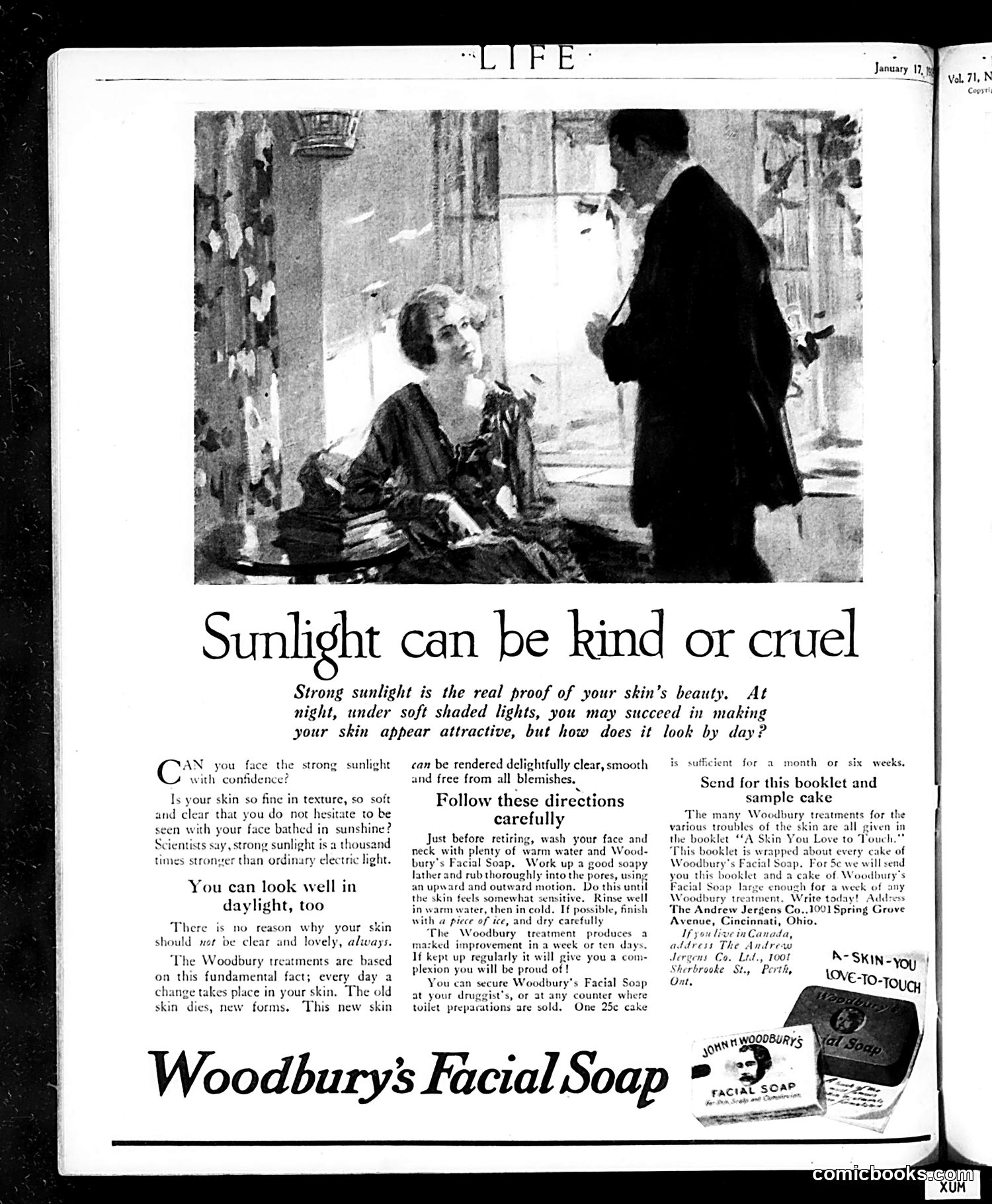
This is **primarily a product advertisement**, not political satire. It's a Woodbury's Facial Soap ad from Life magazine (January 1921, based on the visible date). **The "Sunlight" Premise:** The ad uses a dramatic before/after scenario: a woman's skin may look acceptable in soft evening light, but sunlight harshly reveals imperfections. This creates anxiety—a common advertising tactic—suggesting only Woodbury's soap can create skin worthy of daylight scrutiny. **The Social Message:** The ad reflects 1920s beauty standards emphasizing flawless, "clear" skin as essential for women's acceptability and confidence. The implicit message: women should feel shame about their skin unless it passes the "sunlight test." **The Mechanism:** Instructions promise results within a week through daily facial washing with Woodbury's soap, with the offer of a free sample booklet to encourage trial. There is no political satire here—it's straightforward commercial persuasion using social anxiety about appearance as the selling point.