
Life, 1918-01-17 · page 22 of 40
Life — January 17, 1918 — page 22: what you’re looking at
What you’re looking at
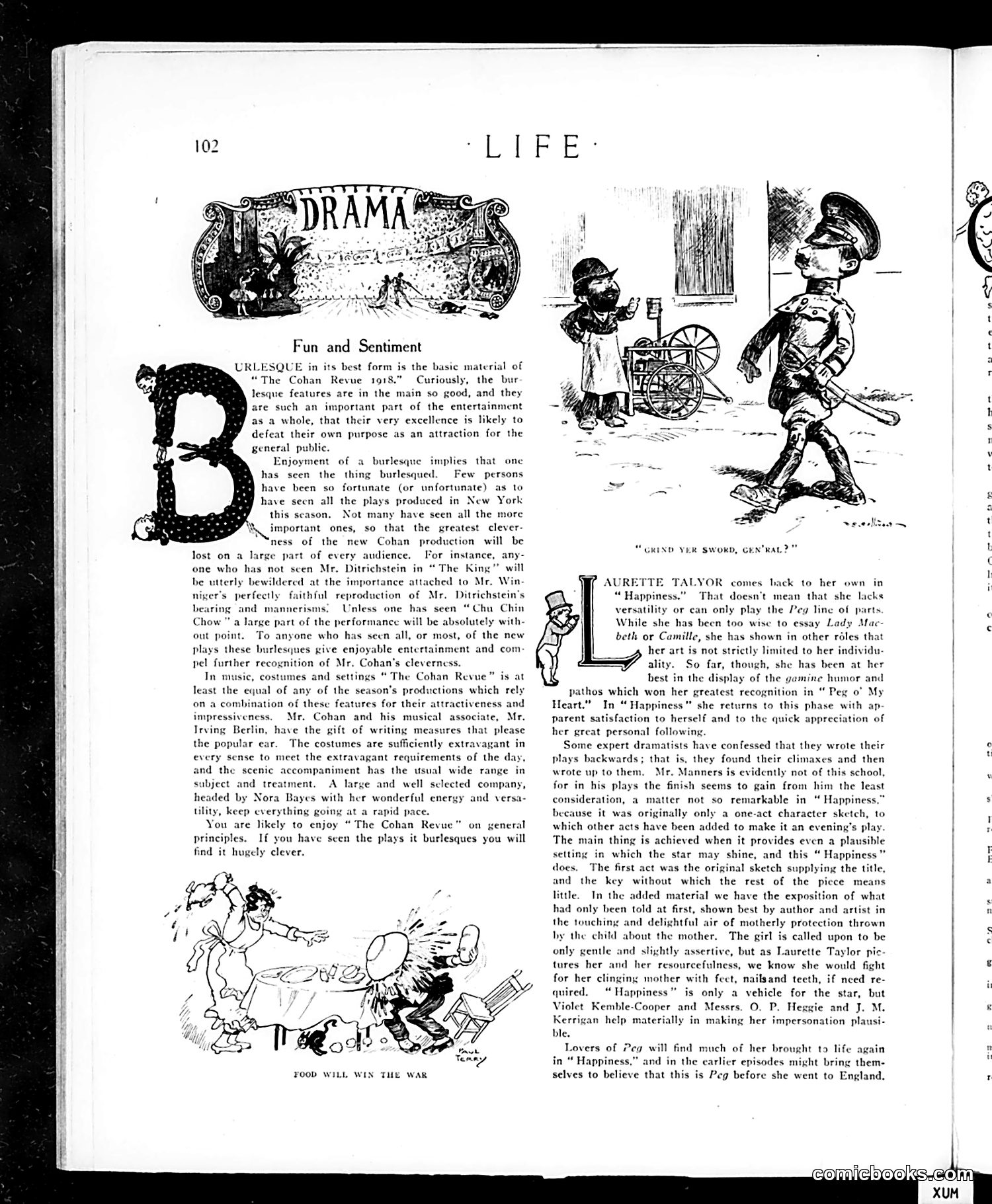
This page reviews two theatrical productions. The main article discusses "The Cohan Revue of 1918," a burlesque show by George M. Cohan featuring music by Irving Berlin. The critic notes the revue's excellent production values—costumes, scenery, and performances by Nora Bayes—but argues its humor depends on audiences having seen the plays it parodies (like "The King" and "Chu Chin Chow"). The review concludes most theatergoers will enjoy it regardless. The secondary review covers Laurette Taylor in "Happiness," praising her return to the comedic-pathetic roles that made her famous in "Peg o' My Heart." The critic observes the play was originally a one-act sketch expanded into a full evening, with Taylor's performance of maternal protection being the emotional centerpiece. The cartoons (depicting soldiers and civilians) appear unrelated to these reviews, likely illustrating the patriotic "Food Will Win the War" campaign.
📄 Transcribed text from this page (OCR, searchable)
Machine-transcribed from the original scan — historical spelling and the odd misread are preserved.
Fun and Sentiment QUE in its best form is the basic material of The Cohan Revue 1918." Curiously, the bur lesque features are in the main so good, and they are such an important part of the entertainment as a whole, that their very excellence is likely to defeat their own purpose as an attraction for the general public. Enjoyment of a burlesque implies that one has seen the thing burlesqued. Few persons have been so fortunate (or unfortunate) as to have seen all the plays produced in New York this season, Not many have seen all the more important ones, so that the greatest clever- ness of the new Cohan production will be lost on a large part of every audience. For instance, any- one who has not scen Mr. Ditrichstein in “The King” wi be utterly bewildered at the importance attached to Mr, Win- niger’s perfectly faithful reproduction of Mr. Ditrichstein’s bearing and mannerisms, Unless one has seen “Chu Chin Chow "a Jarge part of the performance will be absolutely with out point. To anyone who has seen all, or most, of the new plays these burlesques give enjoyable entertainment and com- nition of Mr. Cohan’s cleverness. In music, costes and settings “The Cohan Revue” is at least the equal of any of the season's productions which rely on a ion of these features for their attractiveness and impressiveness. Mr. Cohan and his musical associate, Mr. Irving Berlin, have the gift of writing measures that please the popular ear. The costumes are sufficiently extravagant in every sense to meet the extravagant requirements of the day, and the scenic accompaniment has the usual wide range in subject and treatment. A large and well sclected company, headed by Nora Bayes with her wonderful energy a tility, keep everything going at a rapid pace. You are likely to enjoy “The Cohan Revue” on general principles. If you have scen the plays it burlesques you will find it hugely clever. further rece combina dd versa- FOOD WILL WIN THE WAR “GRIND VER SWORD, GEN'RAL?” AUR LYOR comes back to her own in “Happiness.” That doesn’t mean that she lacks versatility or can only play the Peg line of parts While she has been too wise to essay Lady Mac- beth or Camille, she has shown in other rales that her art ali best in the display of the yamine humor and pathos which won her greatest recognition in “ Peg o” My Heart.” In “ Happiness" she returns to this phase with ap parent satisfaction to herself and to the quick appreciation of her great personal following Some expert dramatists have confessed that they wrote their plays backwards; that is, they found their climaxes and then not strictly limited to her individu- So far, though, she has been at her wrote up to them, Mr. Manners is evidently not of this school, for in his plays the finish seems to gain from him the least consideration, a matter not so remarkable in.“ Happiness.” because it was originally only a one-act character sketch, to which other acts have been added to make it an evening's p The main thing is achieved when it provides even a plausible setting in which the star may shine, and this “ Happiness” does. The first act was the original sketch supplyi and the key without which the rest of the picce means little. In the added material we have the exposition of w had only been told at first, shown best by author and artist in the touching and delightful air of motherly protection thrown hy the child about the mother. The girl is called upon to be only gentle and slightly assertive, but as Laurette Taylor pic- tures her and her resourcefulness, we know she would fight for her clinging mother with fect, nailsand teeth, if need re- quired. “Happiness” is only a vehicle for the star, but Violet Kemble-Cooper and Messrs. O. P. Heggie and J. M. Kerrigan help materially in making her impersonation plausi- ble. Lovers of Peg will find much of her brought to life again in “ Happiness,” and in the earlier episodes might bring them- selves to believe that this is Peg before she went to England. te t t t i 1 i