
Life, 1918-01-17 · page 19 of 40
Life — January 17, 1918 — page 19: what you’re looking at
What you’re looking at
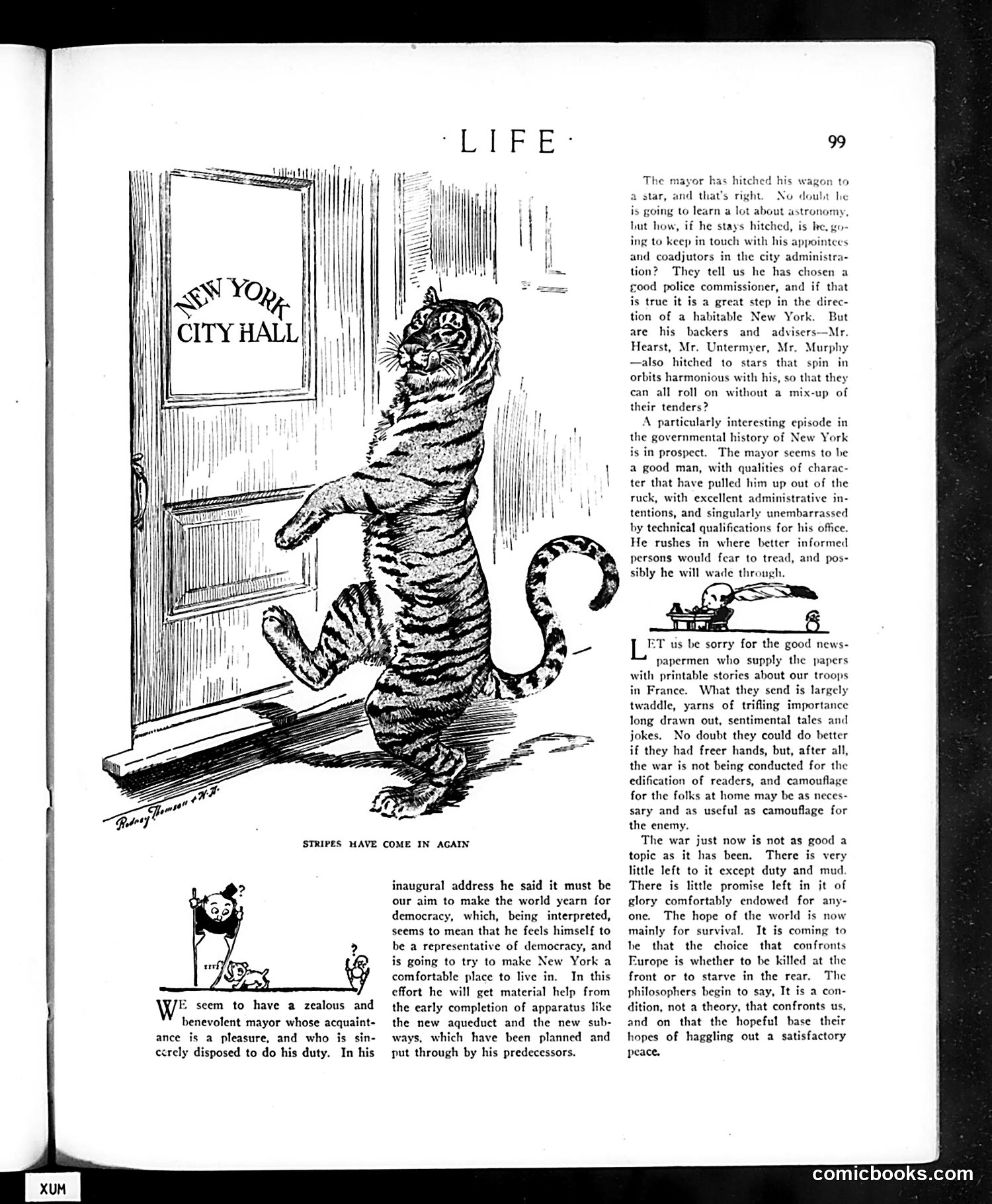
The main cartoon depicts a tiger entering New York City Hall, captioned "STRIPES HAVE COME IN AGAIN." This is political satire about a newly elected mayor (identity unclear from text alone, though the article discusses his inauguration and ambitions). The tiger symbolizes corruption or political "stripes"—suggesting that despite the mayor's earnest inaugural promises to make New York "a comfortable place to live," the same old corrupt political machines remain in power. The text sarcastically notes he'll rely on "apparatus like the new aqueduct and new subways" planned by predecessors, while questioning whether his powerful backers (Hearst, Untermyer, Murphy—likely political/business figures of the era) share his democratic ideals or will cause "mix-ups." The article criticizes the mayor as well-intentioned but dangerously inexperienced—"rushing in where better informed persons would fear to tread." The secondary commentary addresses WWI reporting, lamenting that war correspondents must provide sanitized, trivial stories rather than hard truths about suffering and stalemate.
📄 Transcribed text from this page (OCR, searchable)
Machine-transcribed from the original scan — historical spelling and the odd misread are preserved.
"1.1 PE * STRIPES MAVE COME IN AGAIN seem to have a zealous and benevolent mayor whose acquaint- ance is a pleasure, and who is sin- cerely disposed to do his duty. In his inaugural address he said it must be our aim to make the world yearn for democracy, which, being interpreted, seems to mean that he feels himself to be a representative of democracy, and is going to try to make New York a comfortable place to live in. In this effort he will get material help from the early completion of apparatus like the new aqueduct and the new sub- ways, which have been planned and put through by his predecessors. 99 is going to learn a lot about astronomy, but how, if he stays hitched, is he. ing to keep in touch with his appointees and coadjutors in the city administra- tion? They tell us he has chosen a good police commissioner, and if that is true it is a great step in the direc- tion of a habitable New York. But are his backers and advisers—Mr. Hearst, Mr. Untermyer, Mr. Murphy —also hitched to stars that spin in orbits harmonious with his, so that they can all roll on without a mix-up of their tenders? A particularly interesting episode in the governmental history of New York is in prospect. The mayor seems to be a good man, with qualities of charac- ter that have pulled him up out of the ruck, with excellent administrative in- tentions, and singularly unembarrassed by technical qualifications for his office. He rushes in where better informed persons would fear to tread, and pos- sibly he will wade through. = L T tis be sorry for the good news- papermen who supply the papers with printable stories about our troops in France. What they send is largely twaddle, yarns of trifling importance long drawn out, sentimental tales and jokes. No doubt they could do better if they had freer hands, but, after all, the war is not being conducted for the edification of readers, and camouflage for the folks at home may be as neces- sary and as useful as camouflage for the enemy. The war just now is not as good a topic as it has been. There is very little left to it except duty and mud. There is little promise left in it of glory comfortably endowed for any- one. The hope of the world is now mainly for surv: It is coming to be that the choice that confronts Europe is whether to be killed at the front or to starve in the rear. The philosophers begin to say, It is a con- dition, not a theory, that confronts us, and on that the hopeful base their hopes of haggling out a satisfactory peace, comicbooks.com