
Life, 1918-01-17 · page 18 of 40
Life — January 17, 1918 — page 18: what you’re looking at
What you’re looking at
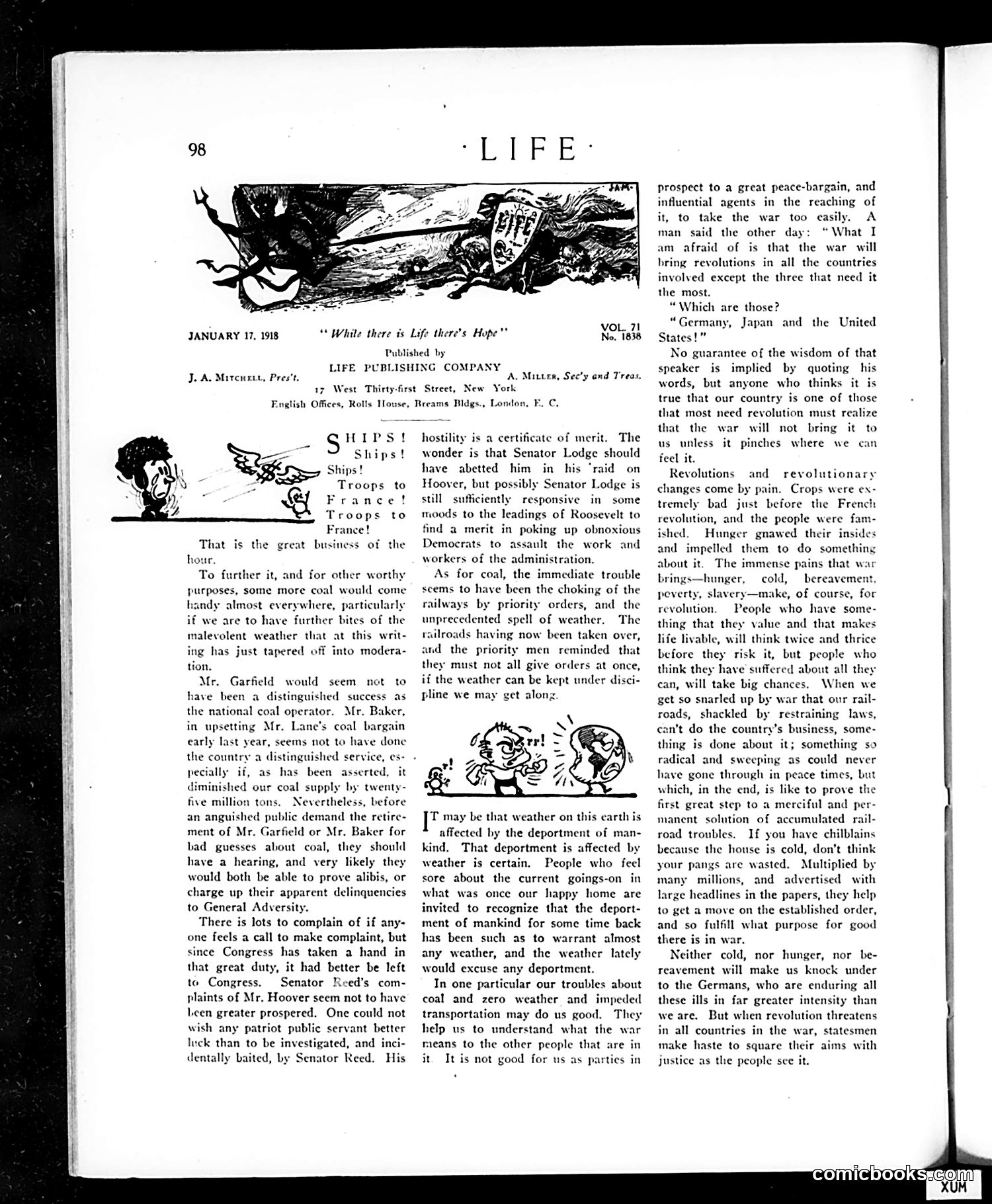
This page features editorial commentary on America's World War I efforts during a critical supply crisis. **The Cartoon:** The "SHIPS! SHIPS! TROOPS to France!" graphic emphasizes the urgent wartime priorities of 1918—military transport and troop deployment. **Key Political Figures Referenced:** - **Mr. Garfield and Mr. Baker**: Coal administrators blamed for mismanaging fuel supplies (a critical shortage affecting the war effort) - **Senator Reed**: Critic of **Herbert Hoover** (wartime administrator), with the text noting Senator Lodge's unexpected support for Reed's investigations - **Senator Lodge**: A Republican leader, apparently still influenced by Theodore Roosevelt's political faction **The Satire's Point:** The editorial critiques civilian complaints about coal shortages and weather disruptions while acknowledging legitimate administrative failures. It argues Americans need to accept wartime hardship as evidence the conflict reaches home—and that America (like Germany and Japan) needs revolutionary change if it survives the war without internal upheaval. The piece uses weather and coal scarcity as metaphors for necessary national suffering.
📄 Transcribed text from this page (OCR, searchable)
Machine-transcribed from the original scan — historical spelling and the odd misread are preserved.
JANUARY 17, 1918 ‘* While there ts Life there's Hope"" Published by LIFE J. A. Mircurit, Pres’t. PUBLISHIN COMPANY A. Minter, Secty and Treas, 17 West. Thirty-first. Street, New York English Offices, Rolls House, Rreams Bldgs., London, F.C. HIPS! Ships! ie Ships! Troops to & France! Troops to France! That is the great business of the hour, To further it, and for other worthy purposes, some more coal would come handy almost everywhere, particularly if we are to have further bites of the malevolent weather that at this writ- ing has just tapered off into modera- tion, Mr. Garfield would seem not to have been a distinguished success as the national coal operator. Mr. Baker, in upsetting Mr. Lane’s coal bargain early last year, seems not to have done the country a distinguished service, es- pecially if, as has been asserted, it diminished our coal supply by twenty- five million tons. Nevertheless, before an anguished public demand the retire- ment of Mr. Garfield or Mr. Baker for bad guesses about coal, they should have a hearing, and very likely they would both be able to prove alibis, or charge up their apparent delinquencies to General Adversity. There is lots to complain of if any- one feels a call to make complaint, but since Congress has taken a hand in that great duty, it had better be left to Congress. Senator Reed’s com- plaints of Mr. Hoover seem not to have een greater prospered. One could not wish any patriot public servant better luck than to be investigated, and inci- dentally baited, by Senator Reed. His hostility is a certificate of merit. The wonder is that Senator Lodge should have abetted him in his ‘raid on Hoover, but possibly Senator Lodge is still sufficiently responsive in some moods to the leadings of Roosevelt to find a merit in poking up obnoxious Democrats to ault the work and workers of the administration. As for coal, the immediate trouble seems to have been the choking of the railways by priority orders, and the unprecedented spell of weather. The railroads having now been taken over, and the priority men reminded that they must not all give orders at once, if the weather can be kept under disci pline we may get along T may be that weather on this earth is affected by the deportment of man- kind. That deportment is affected by weather is certain. People who feel sore about the current goings-on in what was once our happy home are invited to recognize that the deport- ment of mankind for some time back has been such as to warrant almost any weather, and the weather lately would excuse any deportment. In one particular our troubles about coal and zero weather and impeded transportation may do us good. They help us to understand what the war mieans to the other people that are in it It is not good for us as parties in Prospect to a great peace-bargain, and influential agents in the reaching of it, to take the war too casil A man said the other day: “What I m afraid of is that the war will bring revolutions in all the countries involved except the three that need it the most. “Which are those? “Germany, Japan and the United States!” No guarantee of the wisdom of that speaker is implied by quoting his words, but anyone who thinks it is true that our country is one of those that most need revolution must realize that the war will not us unless it pinches feel it. Revolutions and revolutionary changes come by pain. Crops were ex- tremely bad just before the French revolution, and the people were fam- ished. Hunger gnawed their insides and impelled them to do something about it. The immense pains that war brings—hunger, cold, — bereavement, peverty, slavery—make, of course, for revolution. People who have some- thing that they value and that makes life livable, will think twice and thrice before they risk it, but people who think they have suffered about all they can, will take big chances. When we get so snarled up by war that our rail- roads, shackled by restraining laws, can’t do the country’s business, some- thing is done about it; something so radical and sweeping as could never ¢ gone through in peace times, but which, in the end, is like to prove the first great step to a merciful and per- manent solution of accumulated rail- road troubles. If you have chilblains because the house is cold, don’t think your pangs are wasted. Multiplied by many millions, and advertised with large headlines in the papers, they help to get a move on the established order, and so fulfill what purpose for good there is in war. Neither cold, nor hunger, nor be- reavement will make us knock under to the Germans, who are enduring all these ills in far greater intensity than we are. But when revolution threatens in all countries in the war, statesmen make haste to square their aims with justice as the people see it. bring it to where we can