
Life, 1918-01-17 · page 16 of 40
Life — January 17, 1918 — page 16: what you’re looking at
What you’re looking at
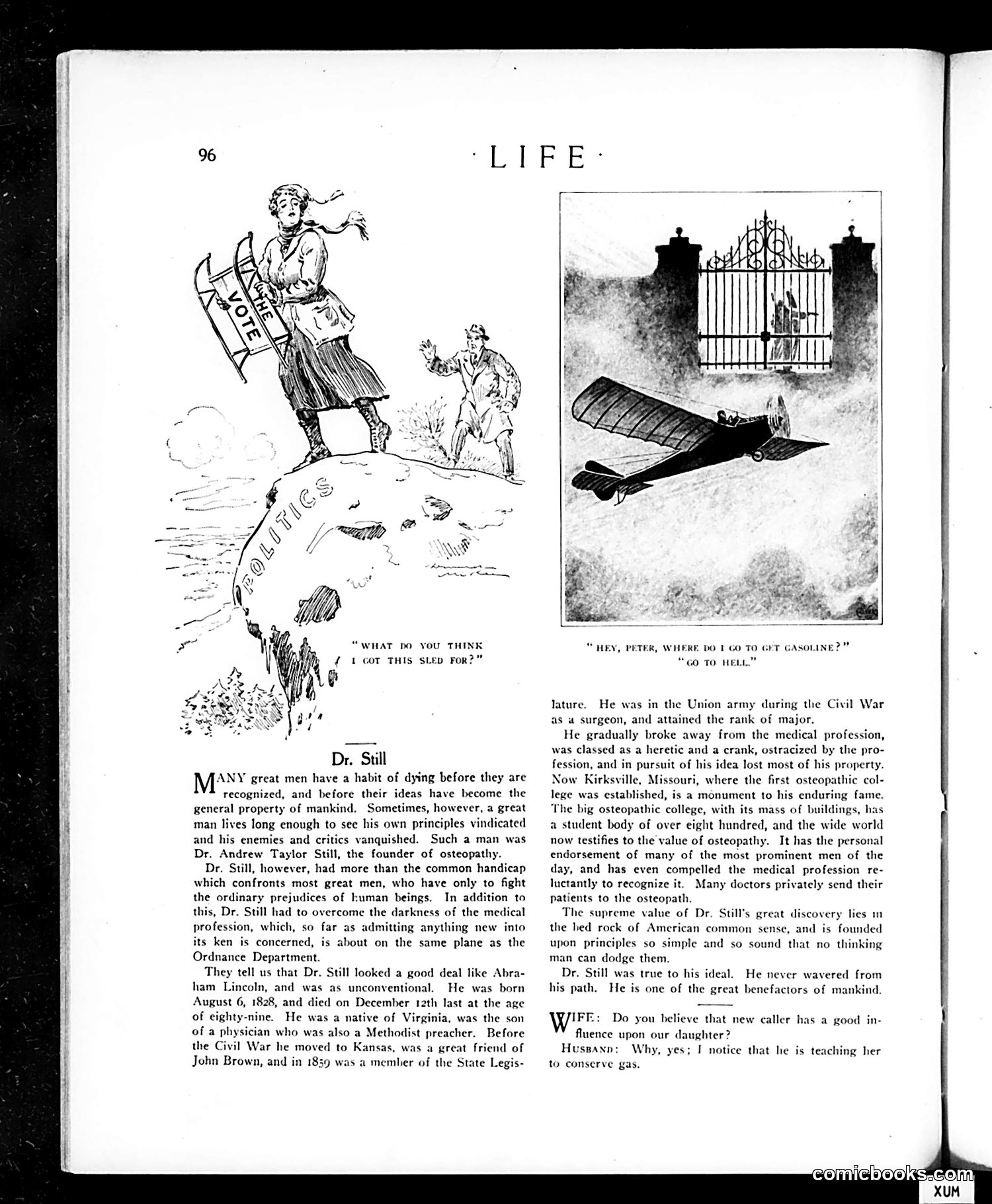
This page celebrates Dr. Andrew Taylor Still, founder of osteopathy, presenting him as a vindicated visionary who overcame medical establishment resistance. The biographical text emphasizes his Lincoln-like unconventionality and pioneering work despite professional ostracism. The left cartoon mocks "Politics" as a sled—satirizing political opportunism and instability. The right cartoon jokes about wartime gasoline rationing (likely WWI era): a man asks "Peter" where to get gasoline; the punchline "Go to Hell" suggests either unavailability or profiteering. The bottom dialogue about the "new caller" teaching gas conservation is vintage Life satire—presenting wartime sacrifice as romantic courtship, gently mocking how young couples frame patriotic duty as personal interest. Together, these pieces blend serious biographical tribute with sharp commentary on medical dogmatism, political expediency, and home-front rationing culture.
📄 Transcribed text from this page (OCR, searchable)
Machine-transcribed from the original scan — historical spelling and the odd misread are preserved.
“WHAT pO YOU THINK 1 GOT THIS SLED FoR?” Dr. Still M NY great men have a habit of dying before they are recognized, and before their ideas have become the general property of mankind. Sometimes, however, a great man lives long enough to see his own principles vindicated and his enemies and critics vanquished. Such a man was Dr. Andrew Taylor Still, the founder of osteopathy. Dr. Still, however, had more than the common handicap which confronts most great men, who have only to fight the ordinary prejudices of kuman beings. In addition to this, Dr. Still had to overcome the darkness of the medical profession, which, so far as admitting anything new into its ken is concerned, is about on the same plane as the Ordnance Department. They tell us that Dr. Still looked a good deal like Abra- ham Lincoln, and was as unconventional. He was born August 6, 1828, and died on December 12th last at the age nine. He was a native of Virginia, was the son cian who was also a Methodist preacher. Before the Civil War he moved to Kansas, was a great friend of John Brown, and in 1839 was a member of the State Legis- “ HEY, PETER, WHERE DO 1 GO TO GET GASOLINE?” “Go To MeL.” lature. He was in the Union army during the Civil War as a surgeon, and attained the rank of major. He gradually broke away from the medical profession, was classed as a heretic and a crank, ostracized by the pro- fession, and in pursuit of his idea lost most of his property. Now Kirksville, Missouri, where the first osteopathic col- lege was established, is a monument to his enduring fam The big osteopathic college, with its mass of buildings, has a student body of over eight hundred, and the wide world now testifies to the value of osteopathy. It has the personal endorsement of many of the most prominent men of the day, and has even compelled the medical profession re- luctantly to recognize it. Many doctors privately send their patients to the osteopath. The supreme value of Dr. Still’s great discovery lies m the hed rock of American common sense, and is founded upon principles so simple and so sound that no thinking man can dodge them. Dr. Still was true to his ideal. He never wavered from his path. He is one of the great benefactors of mankind. IFE: Do you believe that new caller has a good in- fluence upon our daughter? Hussaxn: Why, yes; I notice that he is teaching her to conserve gas.