
A complete issue · 40 pages · 1917
Life — December 20, 1917
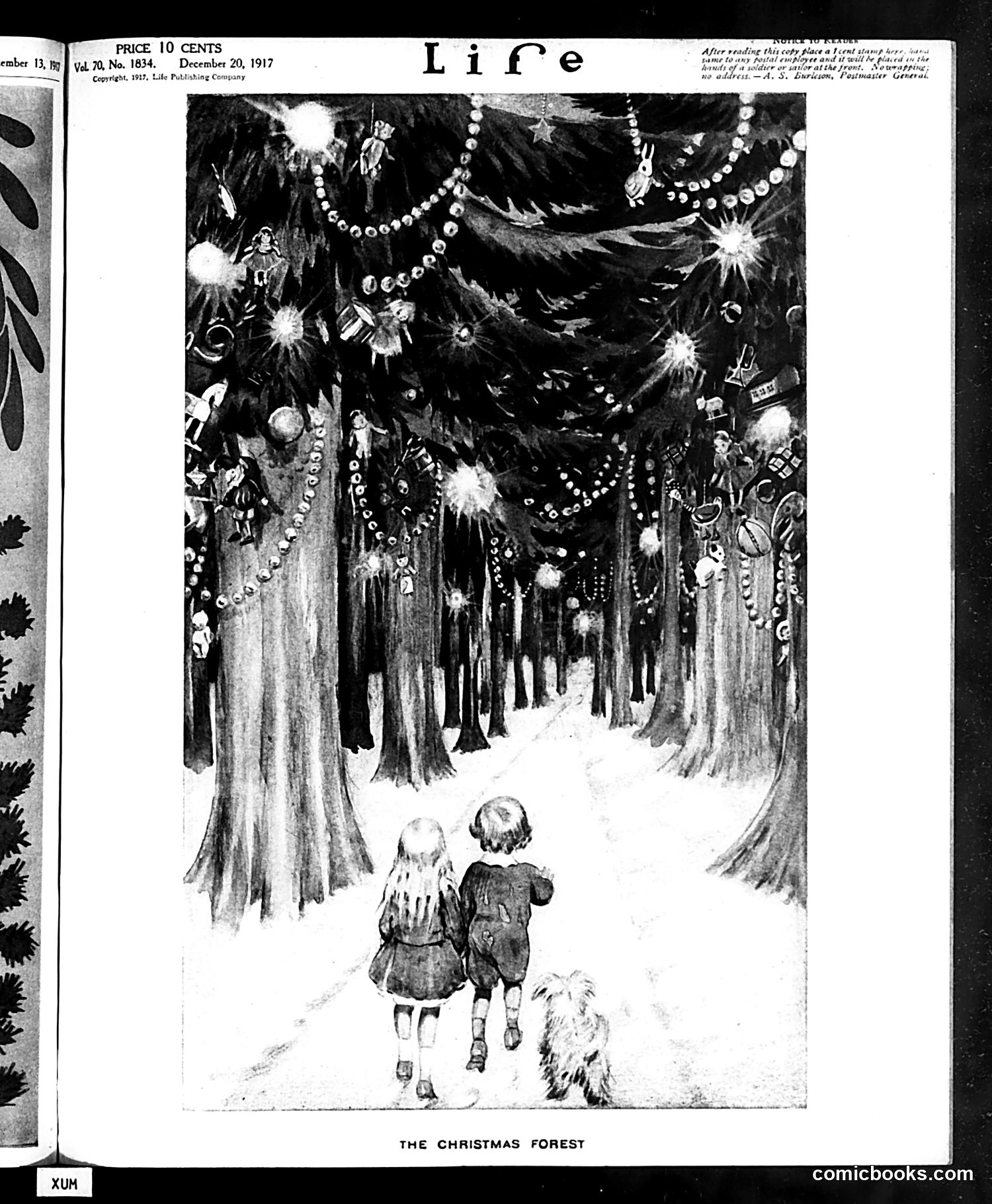
This illustration depicts two children and a small dog walking through a snow-covered forest decorated with Christmas ornaments and lights. The trees are strung with pearl garlands and glowing stars, while small figures appear throughout the canopy above. The image is pure seasonal fantasy—a whimsical Christmas story illustration rather than political satire. It represents the escapist, magical Christmas imagery common in early 20th-century American popular culture, encouraging readers to imagine an enchanted winter wonderland. Published during World War I (1917), this escapist holiday content likely provided welcome relief from wartime concerns, offering readers an imaginative refuge in childhood wonder and festive joy rather than contemporary political events.
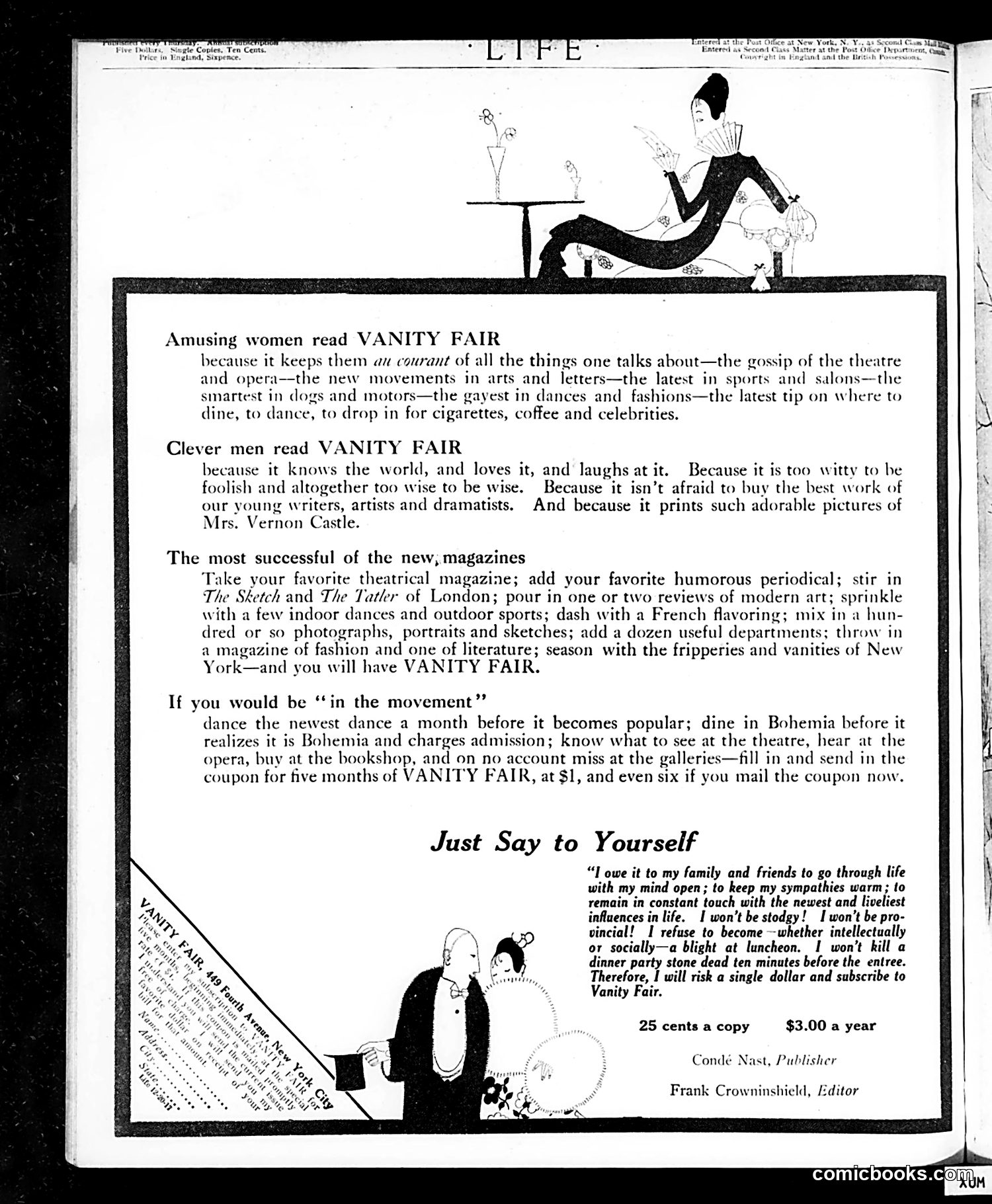
This page is primarily an **advertisement for Vanity Fair magazine** rather than political satire. The ad uses humor to pitch the publication to different audiences: - **"Amusing women"** will enjoy gossip about theater, opera, and celebrity - **"Clever men"** appreciate its wit and support of young artists/writers - The magazine combines theatrical coverage, art reviews, fashion, and indoor/outdoor sports content The illustration shows a stylishly dressed woman reclining, embodying the magazine's sophisticated aesthetic. The bottom section includes a testimonial from someone justifying a $1 subscription to stay "in the movement" and keep current with cultural trends. The satire is gentle—mocking the aspirational desire to appear cultured and socially aware rather than critiquing any political figure or event.
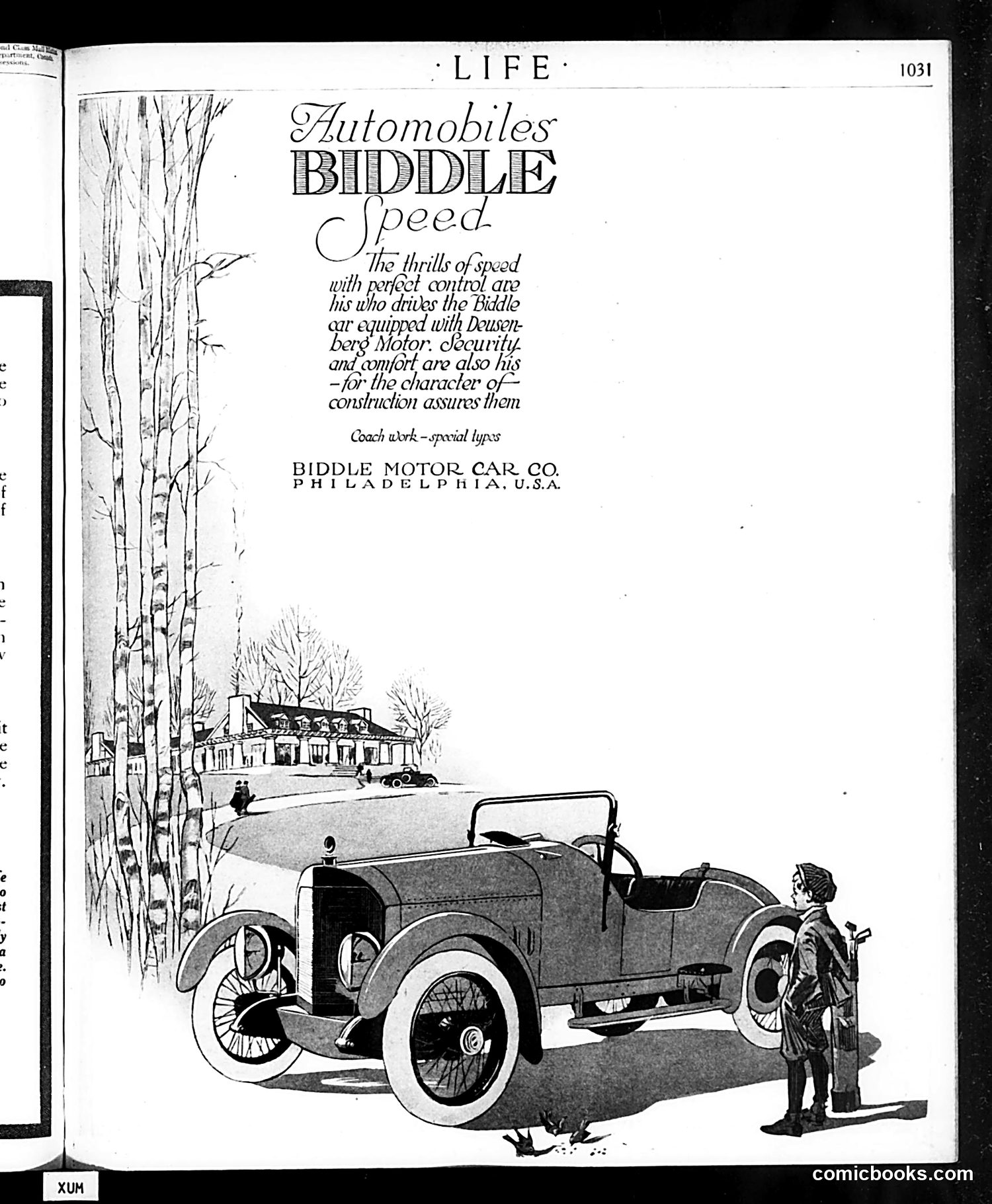
This is a **straight automobile advertisement**, not satire or political commentary. The Biddle Motor Car Company of Philadelphia is marketing their "Biddle" automobile by emphasizing performance features—specifically speed with control, security, and comfort. The ad uses aspirational lifestyle imagery: a sporty open-air roadster positioned near a stately home with bare birch trees, suggesting wealth and sophistication. Well-dressed figures admire the vehicle, reinforcing its status appeal. The headline plays on the double meaning of "biddle" (the brand name) and "biddle" as a verb, but this appears to be simple wordplay rather than satire. This represents typical 1920s automotive advertising emphasizing leisure, status, and mechanical advancement to affluent consumers.
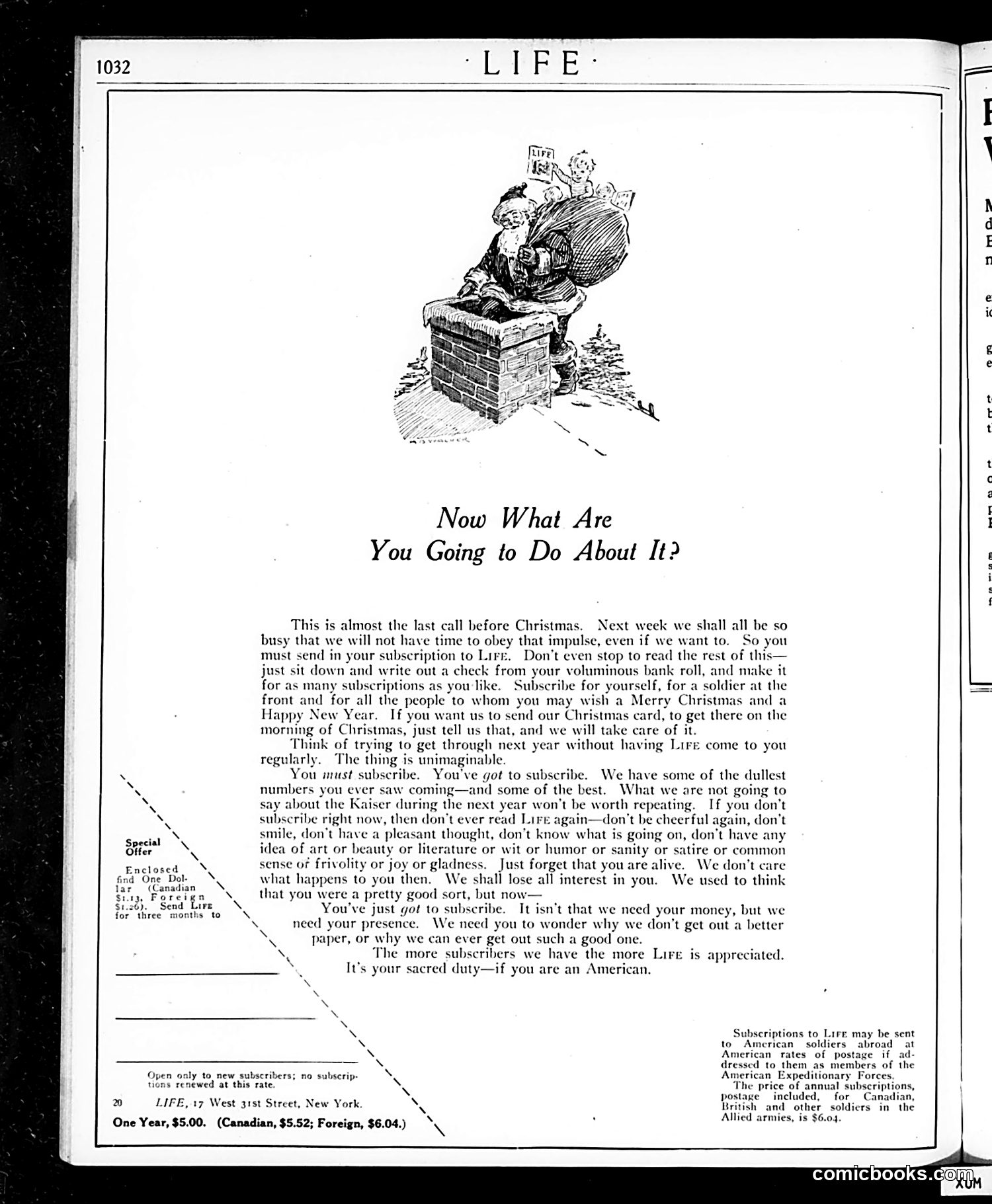
This page is primarily a subscription appeal rather than a satirical cartoon. The illustration shows Santa Claus emerging from a chimney with a large sack—a conventional Christmas image used as decoration for the pitch. The text is a direct fundraising appeal timed for the pre-Christmas season. Life magazine is urging readers to subscribe immediately, warning that they may not receive the magazine regularly next year without current subscriptions. The appeal uses emotional language, emphasizing that readers' "presence" and support matter to the publication, and appeals to patriotism ("your sacred duty—if you are an American"). The "Special Offer" box advertises discounted subscription rates. This is essentially a business solicitation disguised as urgent editorial content, not satire.
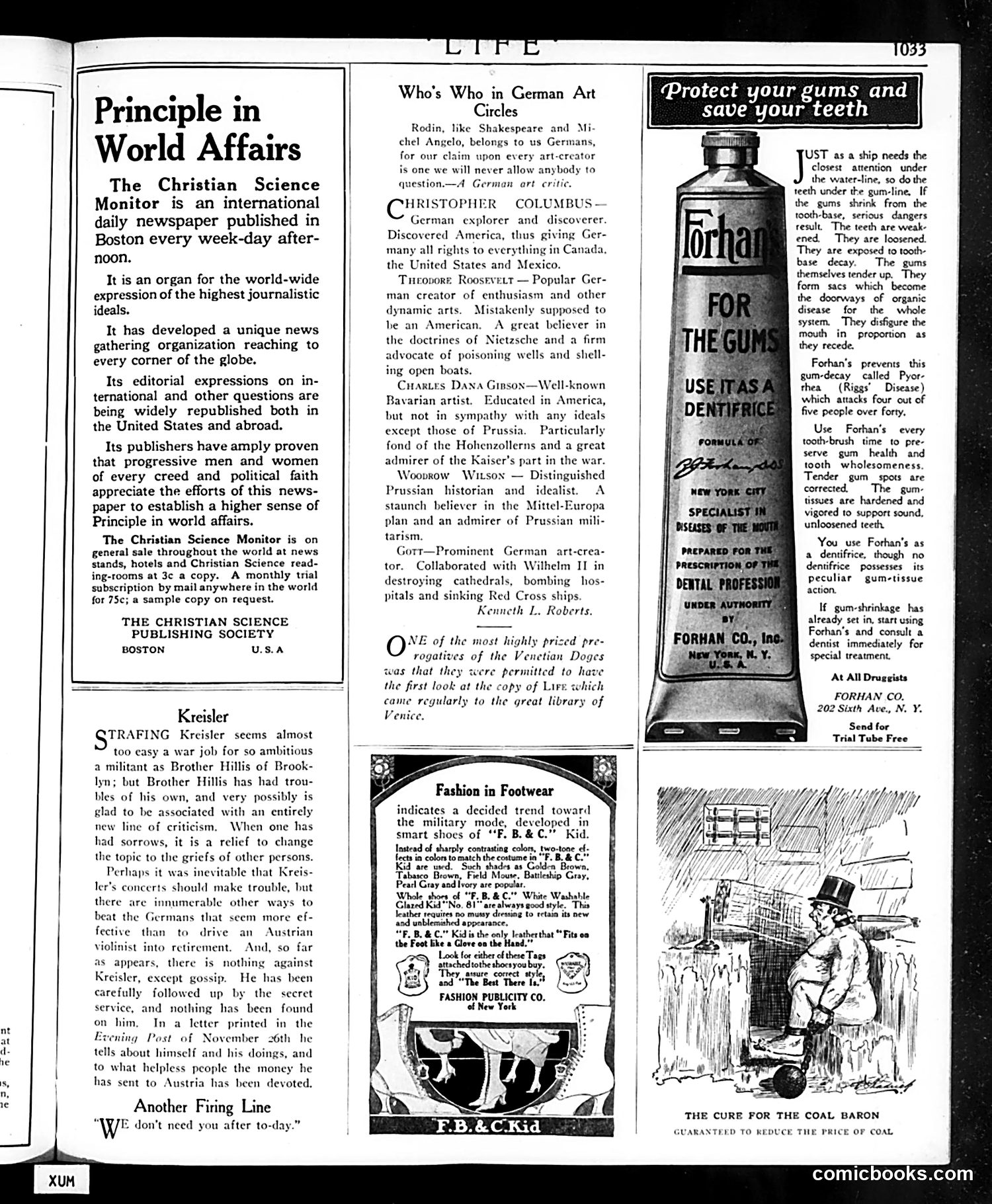
This page is primarily **advertising and editorial content** rather than political satire. The left column discusses **Strafing Kreisler**, apparently addressing criticism of violinist Fritz Kreisler's wartime activities or associations. It defends him against "gossip" while acknowledging "troubles of his own." The center features "**Who's Who in German Art Circles**"—biographical sketches of German artists (Rodin, Roosevelt, Gibson, Wilson) with commentary on their Germanophilia or controversial beliefs, likely reflecting post-WWI American attitudes toward German culture and influence. The right side is a **Forhan's toothpaste advertisement** claiming to prevent gum disease, with a small cartoon ("The Cure for the Coal Baron") about coal prices. The "**Fashion in Footwear**" section promotes children's shoes. Overall, this reflects 1920s concerns about German cultural influence and American commercialism.
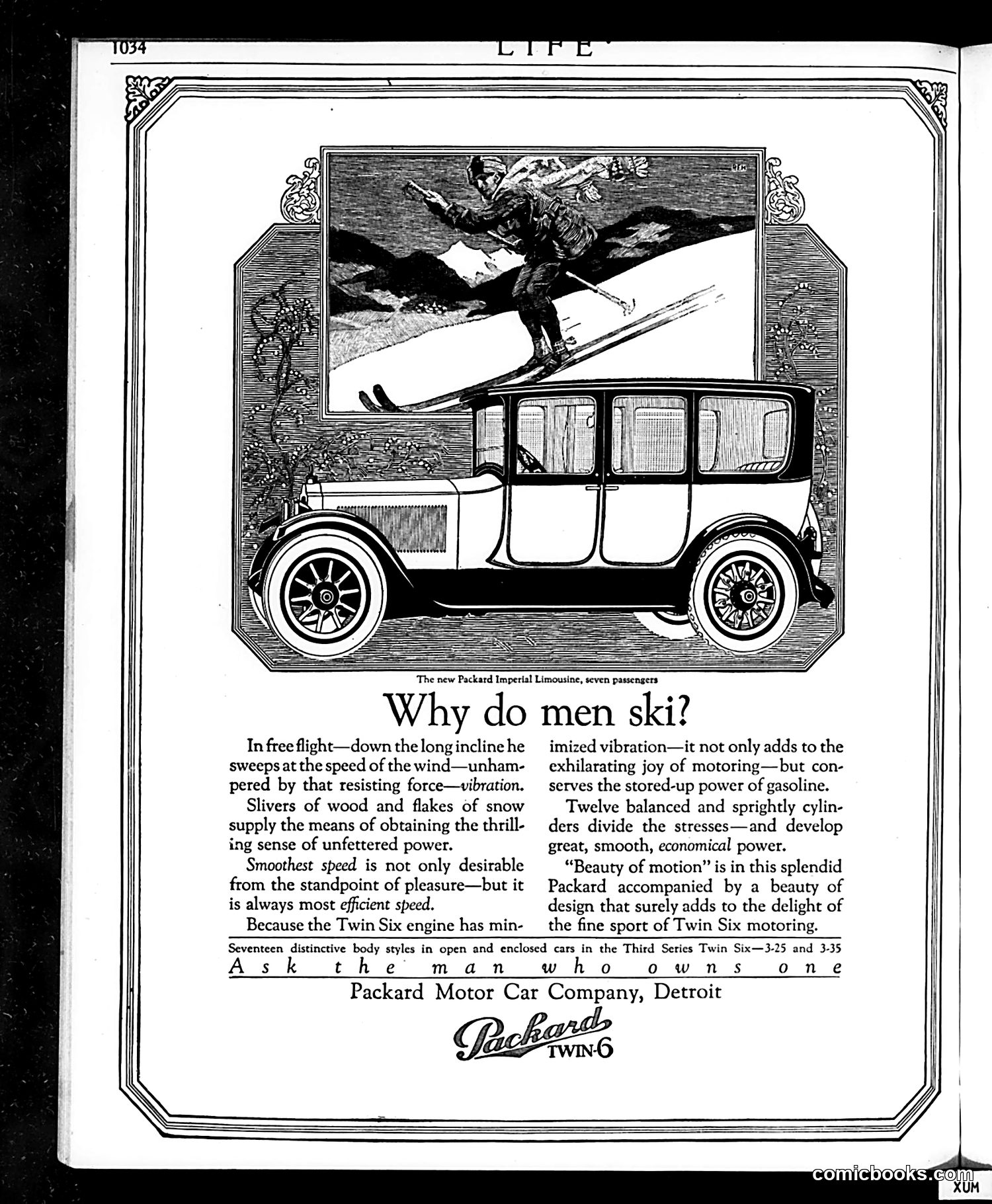
This page is primarily a **Packard automobile advertisement**, not a political cartoon. It appears from the *Life* magazine archives (page 1034). The ad uses a visual comparison: a skier in free flight down a snowy slope positioned above a Packard Imperial Limousine. The headline asks "Why do men ski?" to draw a parallel between skiing's thrilling sensation of unimpeded speed and the driving experience offered by Packard's Twin-Six engine. The copy emphasizes engineering features—smooth power, minimal vibration from twelve balanced cylinders—positioning the car as delivering the "thrill" and "beauty of motion" comparable to winter sports. This is straightforward automotive marketing rhetoric from the early automobile era, targeting wealthy consumers who could afford luxury vehicles and leisure skiing.
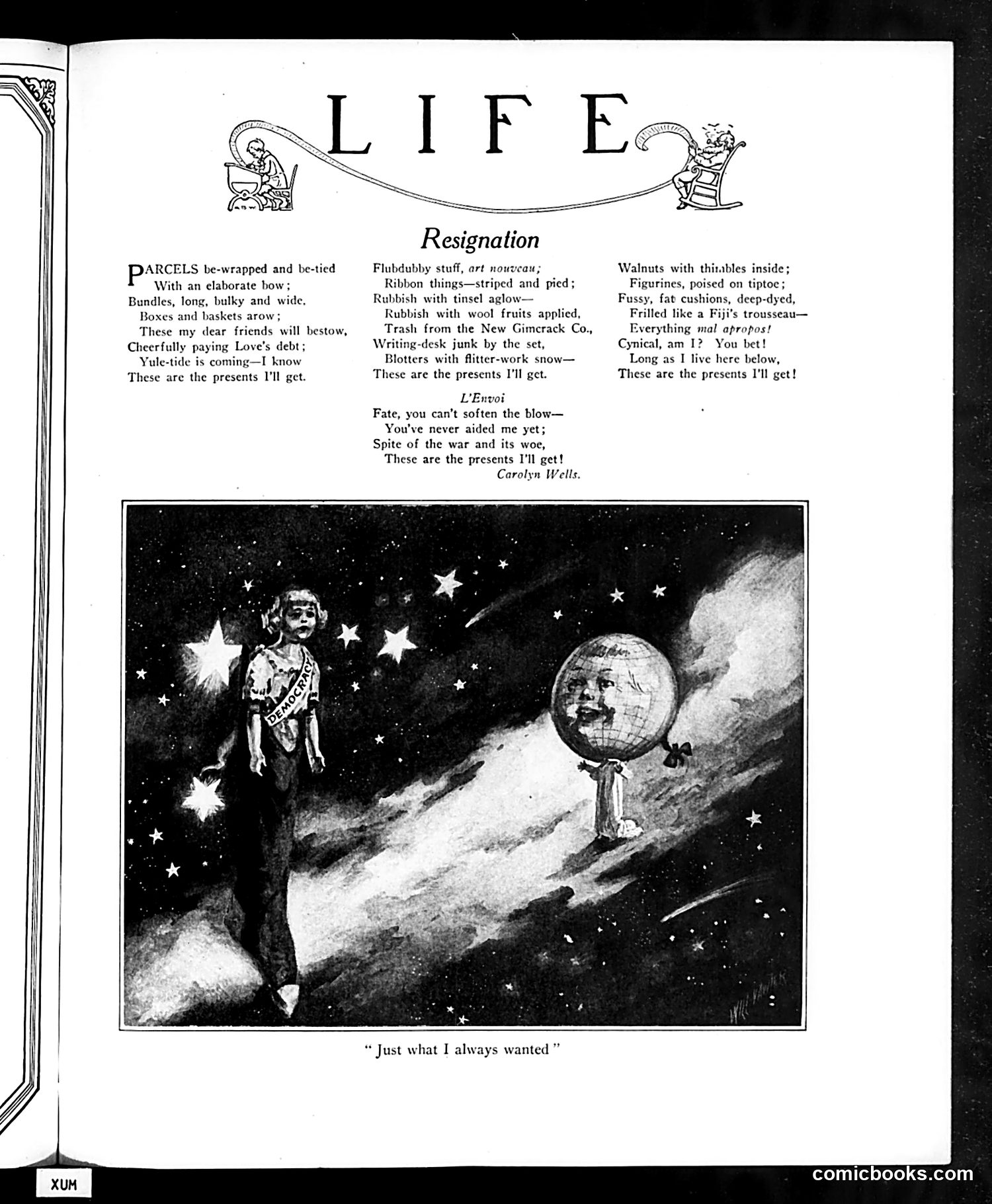
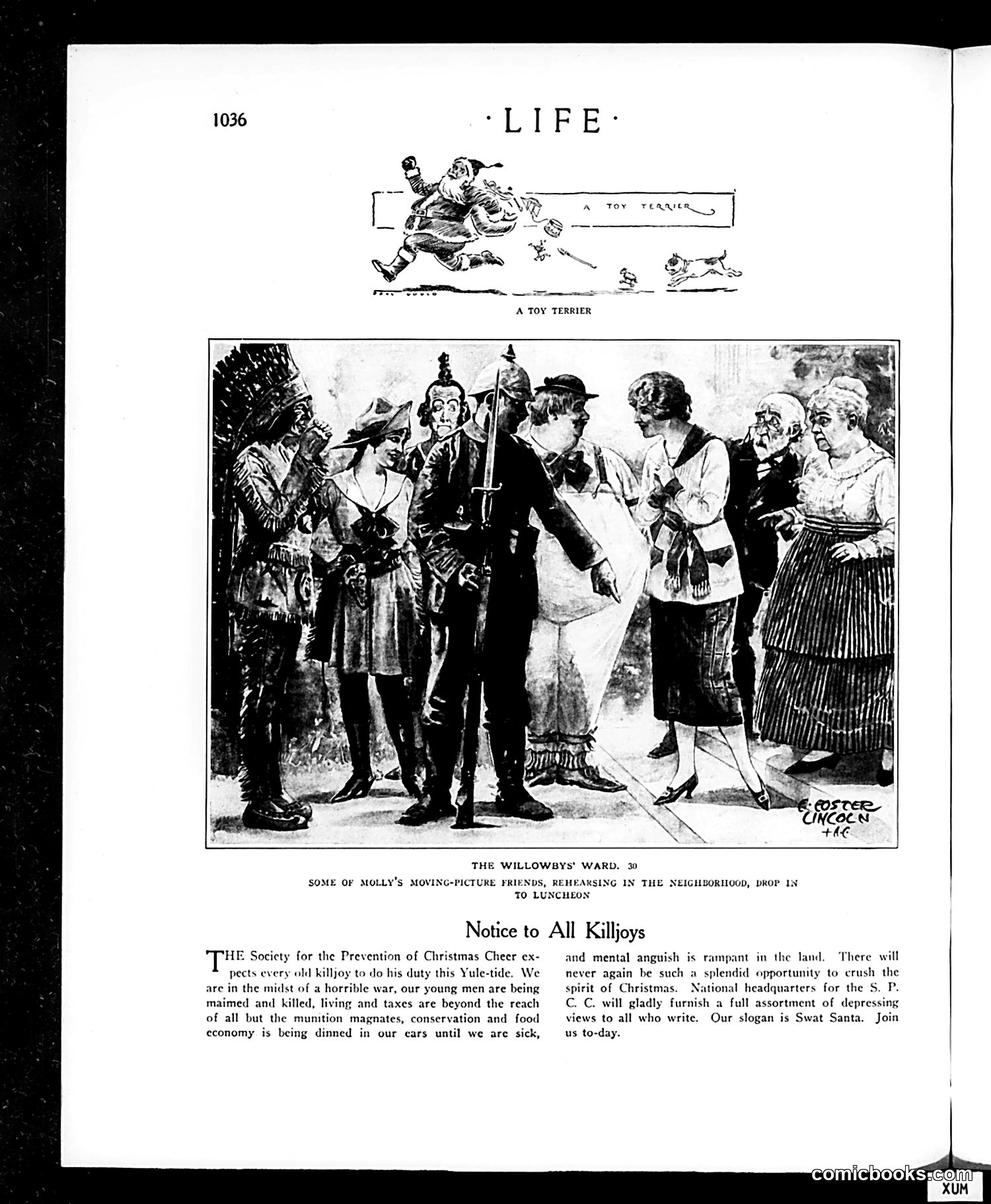
This page contains two separate items: **Top illustration:** A humorous sketch titled "A Toy Terrier" showing a small dog chasing a large figure—likely a visual pun about toy terriers being disproportionately aggressive despite their size. **Main cartoon and article:** "The Willowbys' Ward" depicts a formal gathering where a military or government official appears to be presenting or discussing something with civilians. Below it, the "Notice to All Killjoys" is a satirical piece by the Society for the Prevention of Christmas Cheer, ironically complaining about wartime hardships (rationing, taxation, young men being killed) and sarcastically calling for a "spirit of Christmas" and national unity. The tone mocks those who might complain about sacrifices during wartime—likely WWI era based on the military uniforms and economic references.
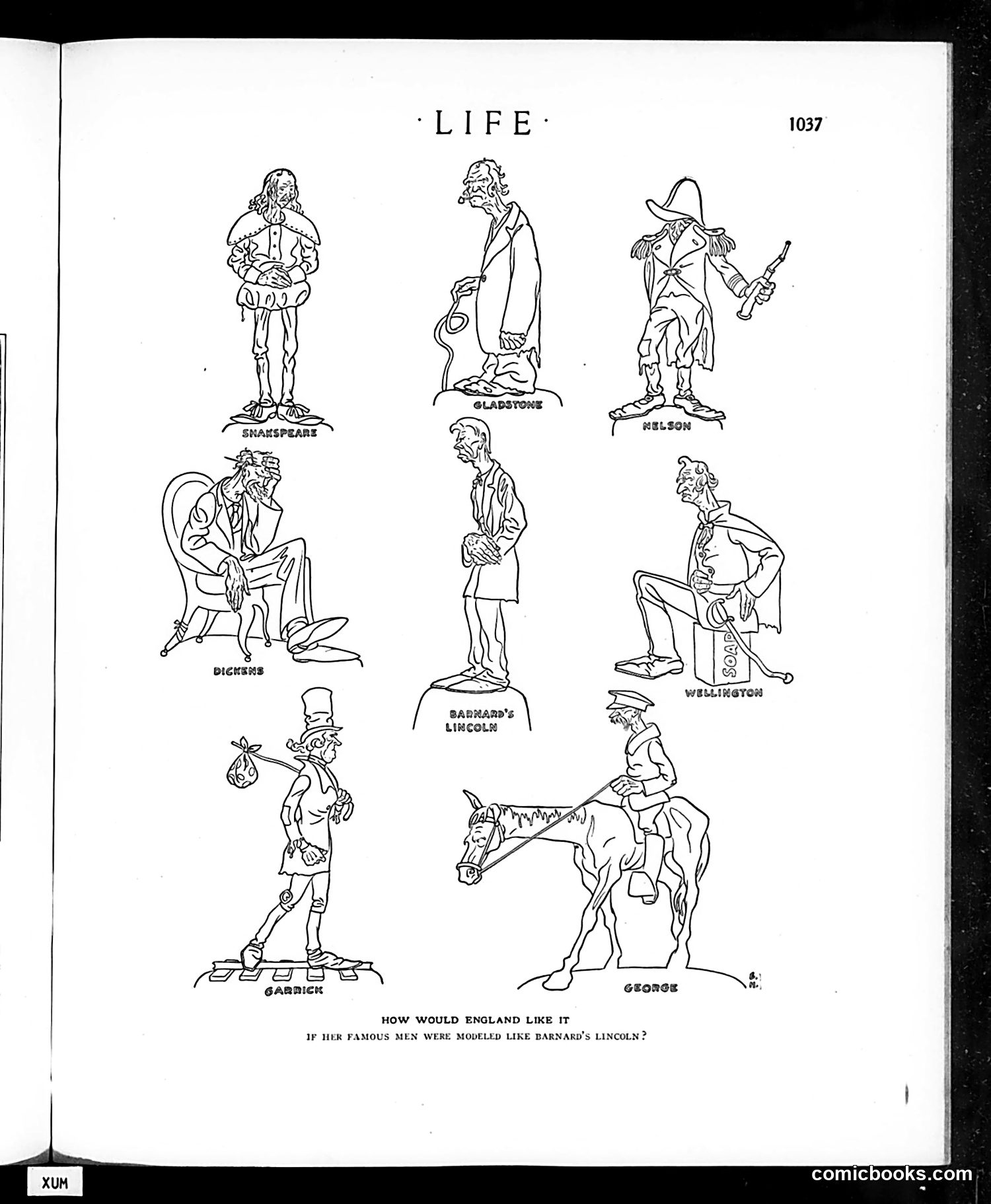
This satirical cartoon from *Life* magazine depicts famous historical English figures reimagined as "Barnard's Lincoln"—presumably referring to a contemporary figure or political model. The caption reads: "HOW WOULD ENGLAND LIKE IT IF HER FAMOUS MEN WERE MODELED LIKE BARNARD'S LINCOLN?" The caricatures shown are Shakespeare, Gladstone, Nelson, Dickens, Sarmard's Lincoln, Wellington, Garrick, and George (on horseback). The satire appears to mock how these celebrated figures would appear if styled or modeled after an unflattering depiction of Lincoln. Without clearer context about "Barnard's Lincoln," the joke likely criticized either a specific artwork, sculpture, or portrayal—suggesting that England's greatest figures would look ridiculous if subjected to similar treatment.
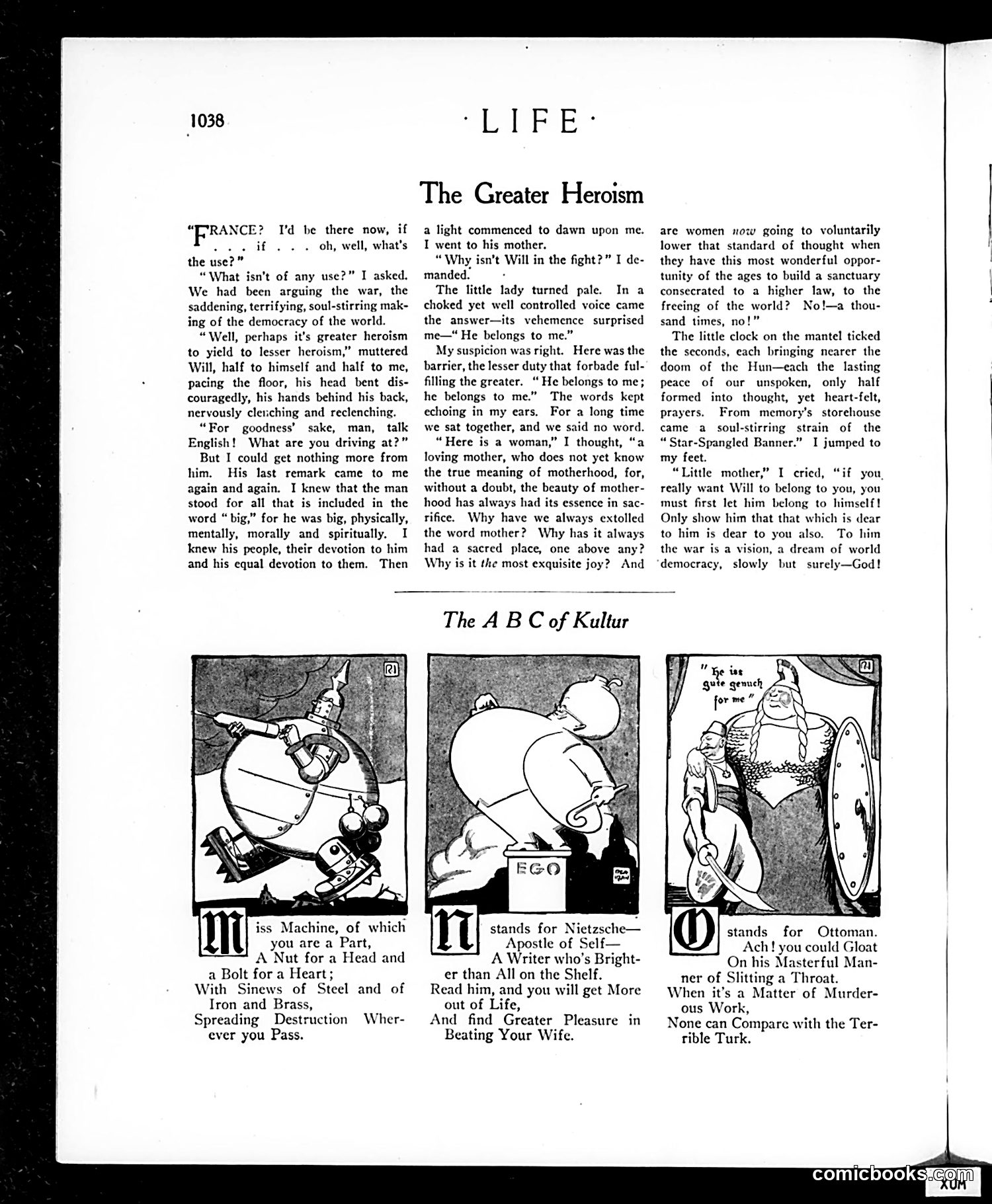
This three-panel cartoon mocks German militarism and philosophy during World War I, using the letter system to spell "M-U-O" (appearing to be "MUO" or a play on German "Kultur"). **Panel M**: A mechanical war machine crushes human figures—satirizing German militarism as dehumanizing industrial destruction. **Panel U**: Labeled "stands for Nietzsche—Apostle of Self," showing a bloated figure atop "EGO"—mocking the philosopher's ideas as promoting brutal egoism. The caption sarcastically suggests reading Nietzsche leads to wife-beating and life-satisfaction. **Panel O**: "Ottoman" reference, comparing Turkish and German brutality as equivalently barbaric. The overall satire equates German "Kultur" (culture) with militarism, egotistical philosophy, and savagery—a common American wartime propaganda trope dismissing German intellectual traditions as justifications for violence.
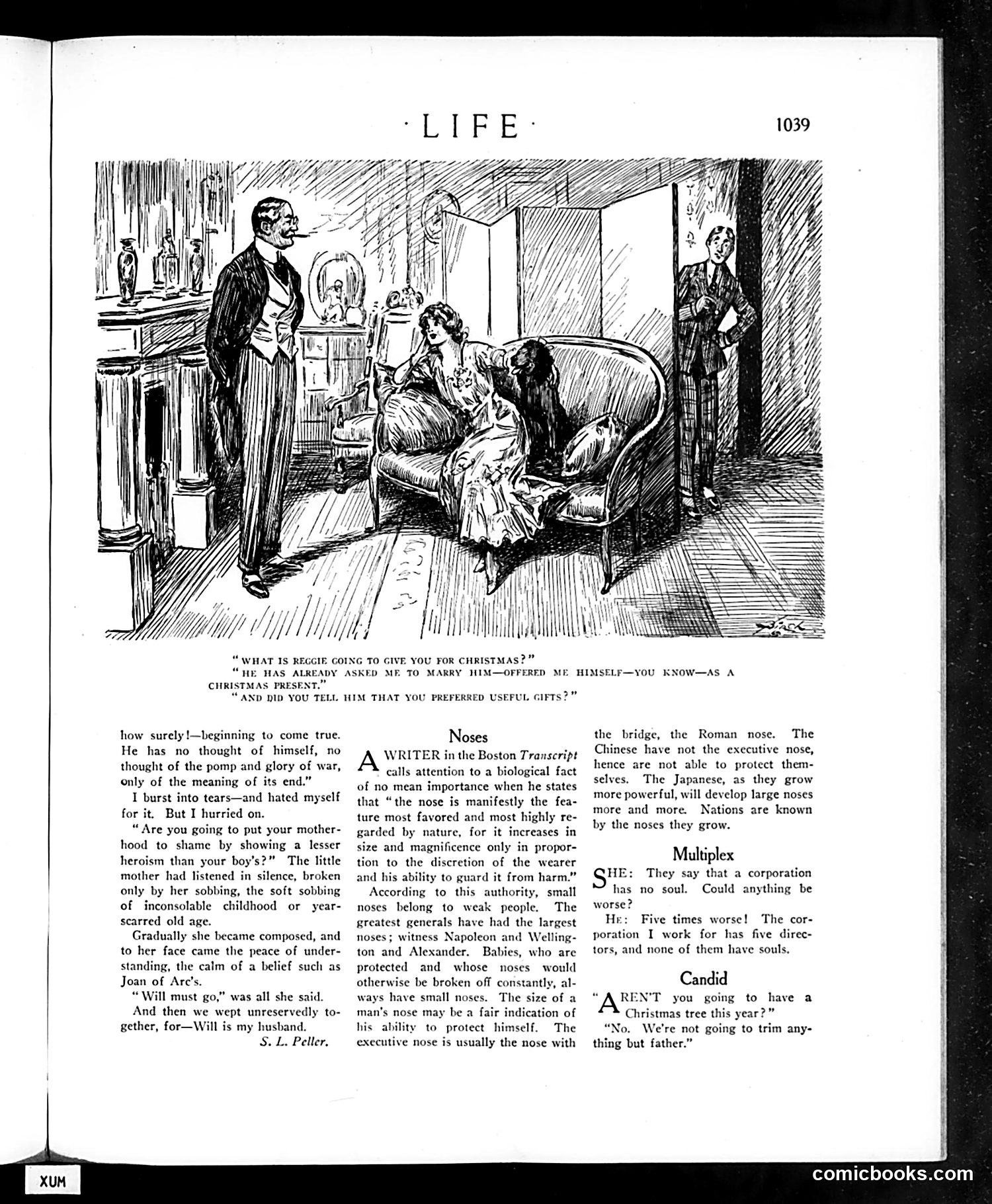
The main cartoon depicts a domestic scene where a woman sits with children while a man stands nearby. The caption indicates someone has proposed marriage as a Christmas gift, offering himself "as a Christmas present." The cartoon satirizes the commodification of marriage proposals and the awkwardness of romantic gestures presented as holiday gifts. The woman's composed expression suggests mild bemusement at this crude romantic overture. Below are three short humorous pieces: "Noses" discusses how large noses indicate prominent historical figures; "Multiplex" jokes about a corporation's lack of soul; and "Candid" presents a brief exchange about Christmas tree decorations. These pieces represent typical Life magazine humor—domestic situations, social commentary, and quick witticisms reflecting early-to-mid 20th century American middle-class concerns and sensibilities.
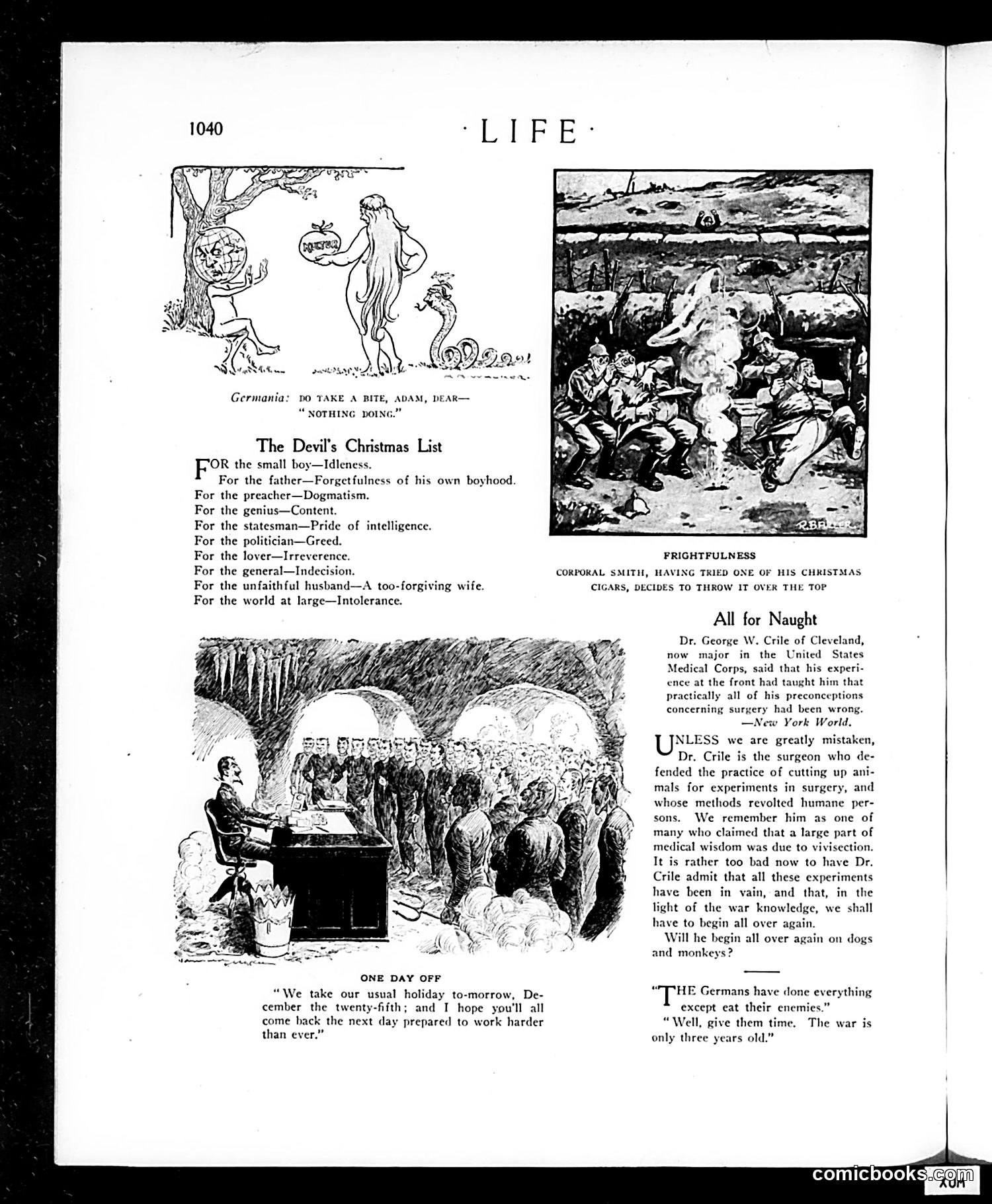
This page contains anti-German propaganda from World War I. "The Devil's Christmas List" mocks German leaders by wishing them character flaws (greed for politicians, indecision for generals, etc.). The cartoon labeled "One Day Off" depicts a German military commander addressing troops in a cave, sarcastically suggesting even the enemy gets holiday breaks. The piece "All for Naught" criticizes Dr. Crile, apparently a surgeon who conducted vivisection experiments on animals for medical research. The text suggests his prewar theories proved wrong, making his cruel methods pointless. The final quote mocking Germans' age—"The war is only three years old"—suggests Germans are morally immature. The overall page uses humor to reinforce wartime hostility toward Germany and critique civilian practices deemed unethical.
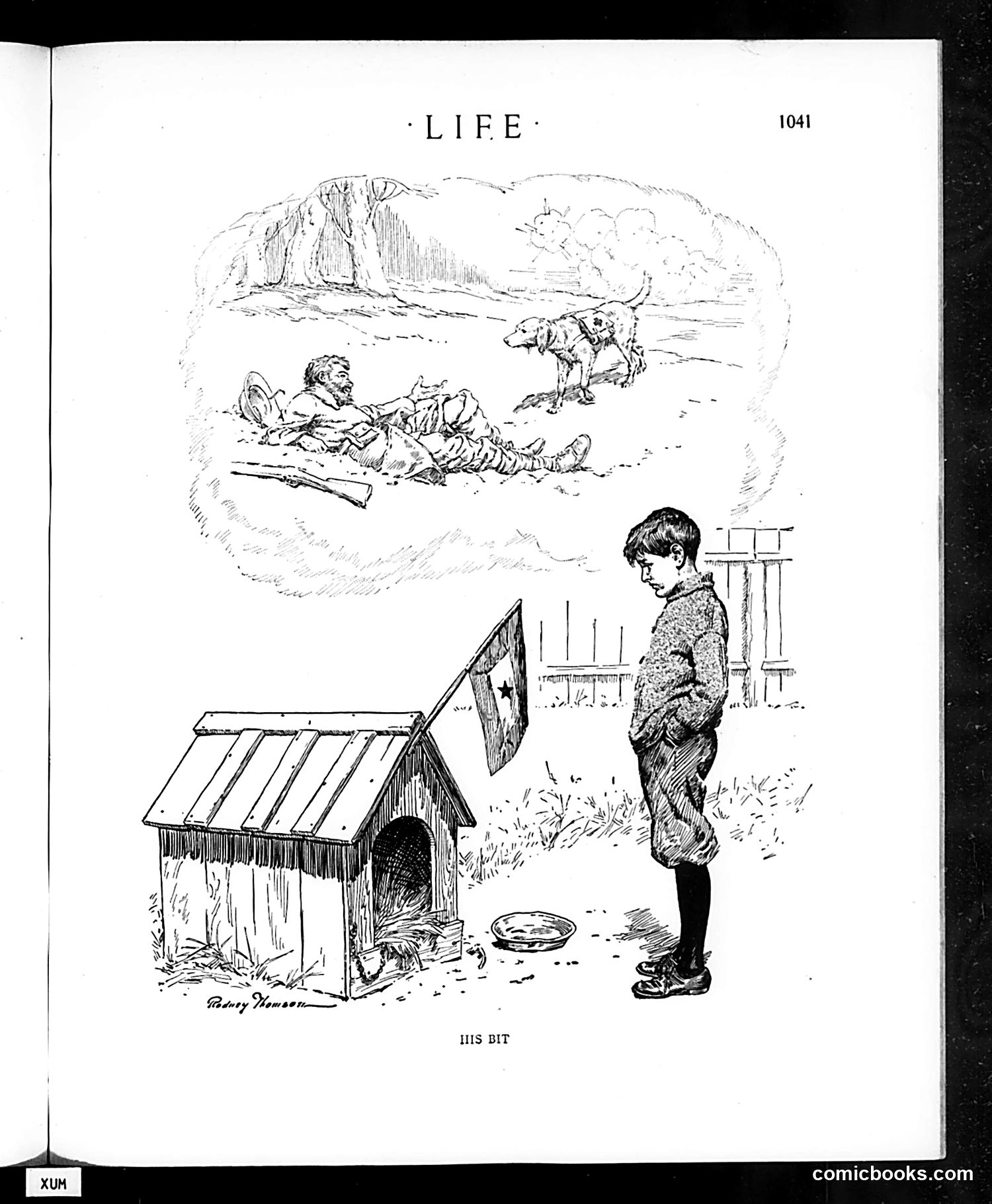
This cartoon depicts a young boy feeding a dog outside a doghouse while daydreaming (shown in the thought bubble above). His fantasy imagines himself as a soldier in combat—lying wounded alongside another soldier, with a dog nearby on a battlefield with cliffs in the background. The satire contrasts the boy's humble present duty ("his bit") of caring for a pet with his romanticized vision of military heroism. This likely reflects WWI-era sentiment, when citizens were encouraged to contribute to the war effort. The cartoon gently mocks how children fantasized about glorious combat while performing mundane domestic tasks, suggesting the gap between wartime romantic ideals and actual responsibility.
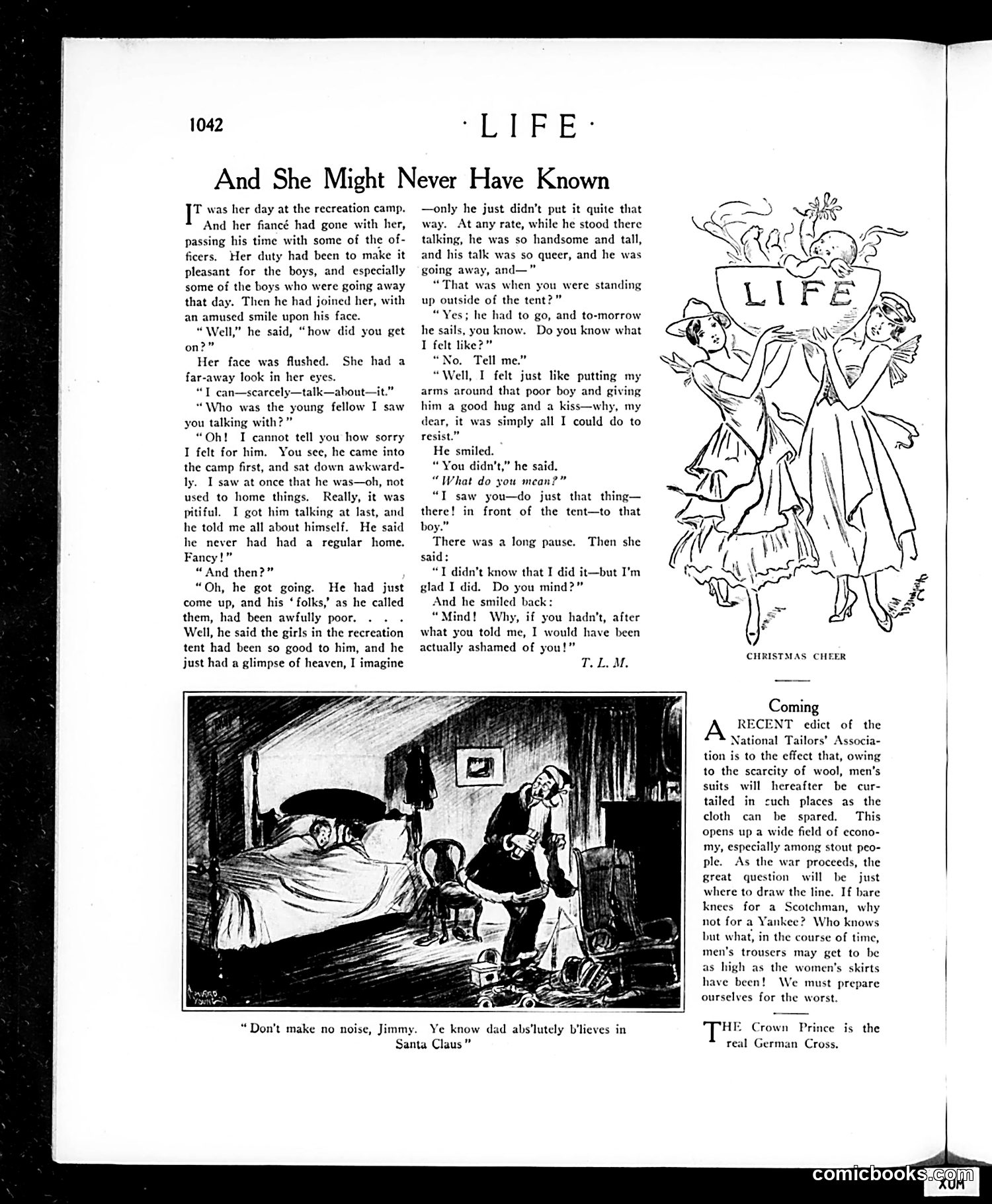
This page contains a short romantic story titled "And She Might Never Have Known," depicting a young woman's realization that her fiancé has been visiting a recreation camp and felt compassion for a poor boy there. The narrative explores her emotional response to learning he hugged the child. The accompanying illustration shows a domestic bedroom scene with the caption "Don't make no noise, Jimmy. Ye know dad alu'lutely b'lieves in Santa Claus," depicting working-class characters, likely satirizing class differences and parenting approaches. The page also includes a brief notice about the National Tailors' Association considering curtailing men's suits due to wool scarcity, and a single-line reference to "The Crown Prince is the real German Cross," appearing to reference World War I-era politics.
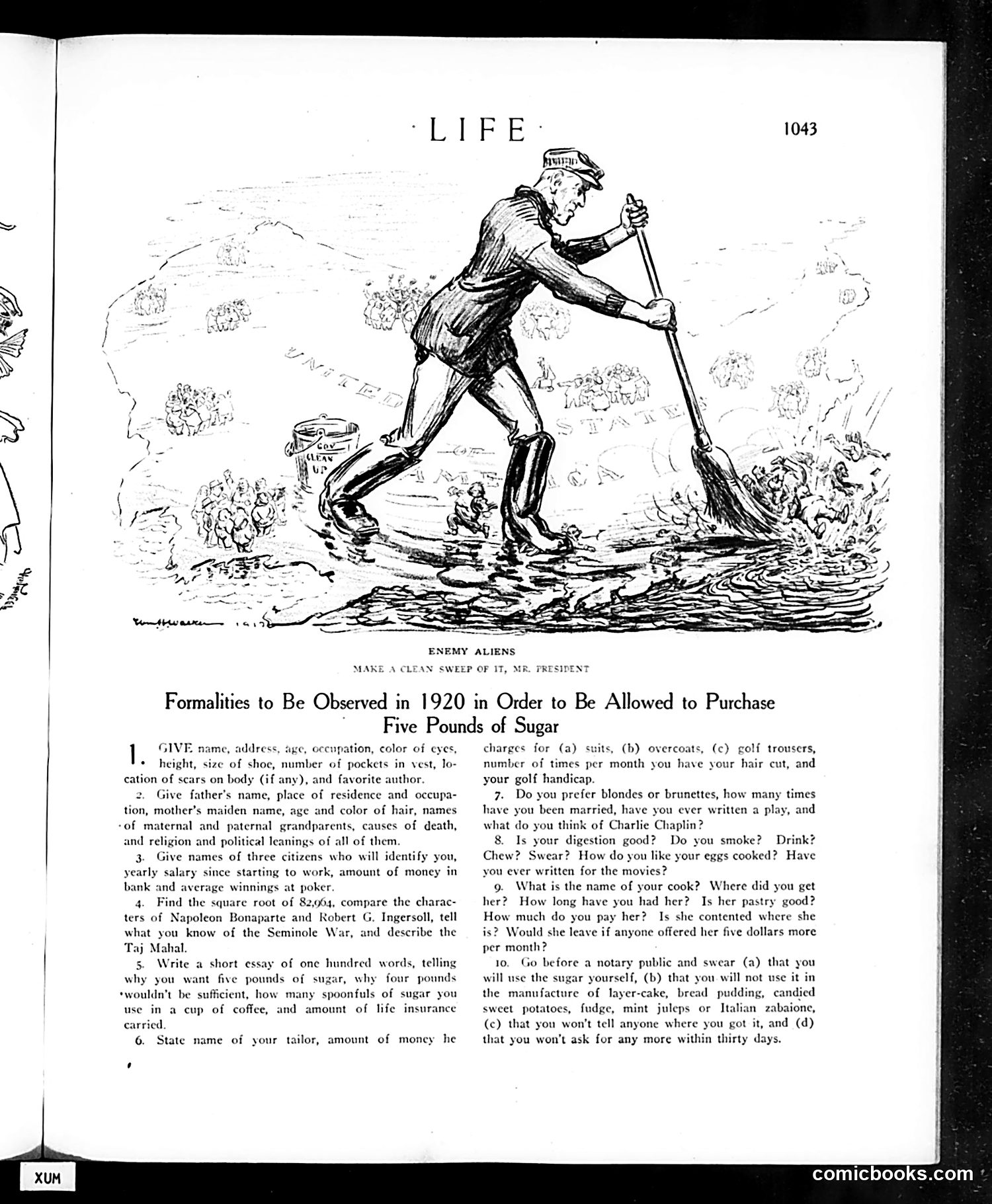
This 1920 Life magazine cartoon depicts a caricatured figure using a broom to sweep away groups of people labeled as "enemy aliens." The figure appears to represent either the President or an immigration official enforcing post-WWI xenophobic policies. The accompanying "Formalities to Be Observed in 1920" text satirizes the absurdly invasive bureaucratic requirements imposed on foreigners seeking to purchase even five pounds of sugar—requiring detailed personal information, family histories, financial records, and notarized oaths about sugar use. The cartoon criticizes both the sweeping deportation/exclusion of foreign nationals after World War I and the intrusive, seemingly punitive regulatory framework targeting "enemy aliens," reflecting America's nativist sentiment during the Red Scare period.
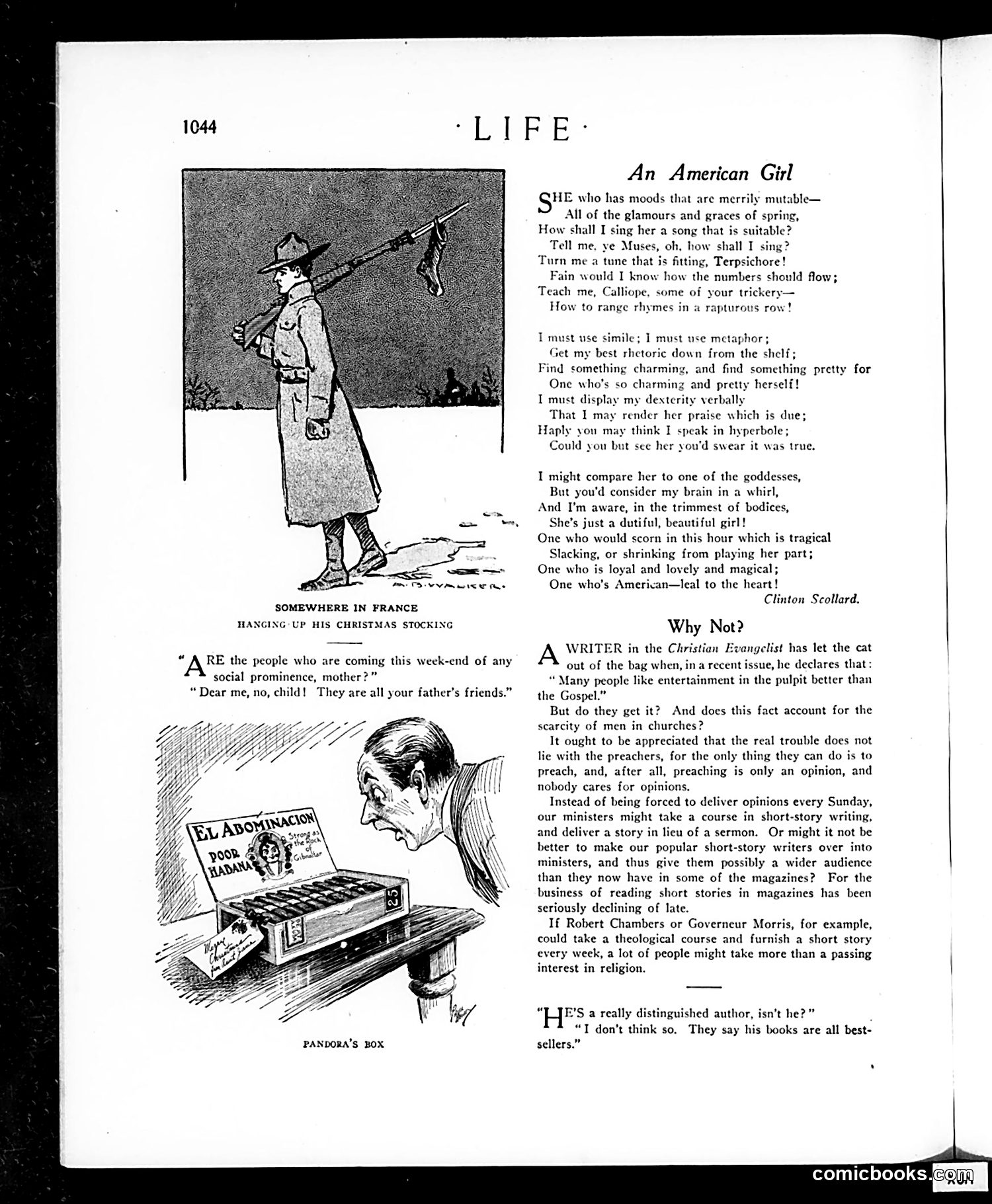
**Content Overview:** This page contains a poem "An American Girl" by Clinton Scollard praising an idealized American woman, accompanied by two separate satirical cartoons. **Top Cartoon ("Somewhere in France"):** Shows a soldier hanging a Christmas stocking while abroad during World War I—likely referencing American troops deployed in France. The humor centers on maintaining holiday traditions despite wartime displacement. **Bottom Cartoon ("Pandora's Box"):** A mother reassures her child that weekend guests are "all your father's friends," not actual people of social prominence. The illustration shows a cigar box labeled "El Abominacion / Poor Habana," suggesting the humor derives from the father's questionable taste in companions or cigars. **"Why Not?" Essay:** A satirical piece arguing that churches suffer declining male attendance because sermons (mere opinions) bore people. The writer suggests replacing preachers with popular short-story authors like Robert Chambers or Gouverneur Morris to make religion more entertaining—a tongue-in-cheek critique of both clergy and commercialized entertainment culture.
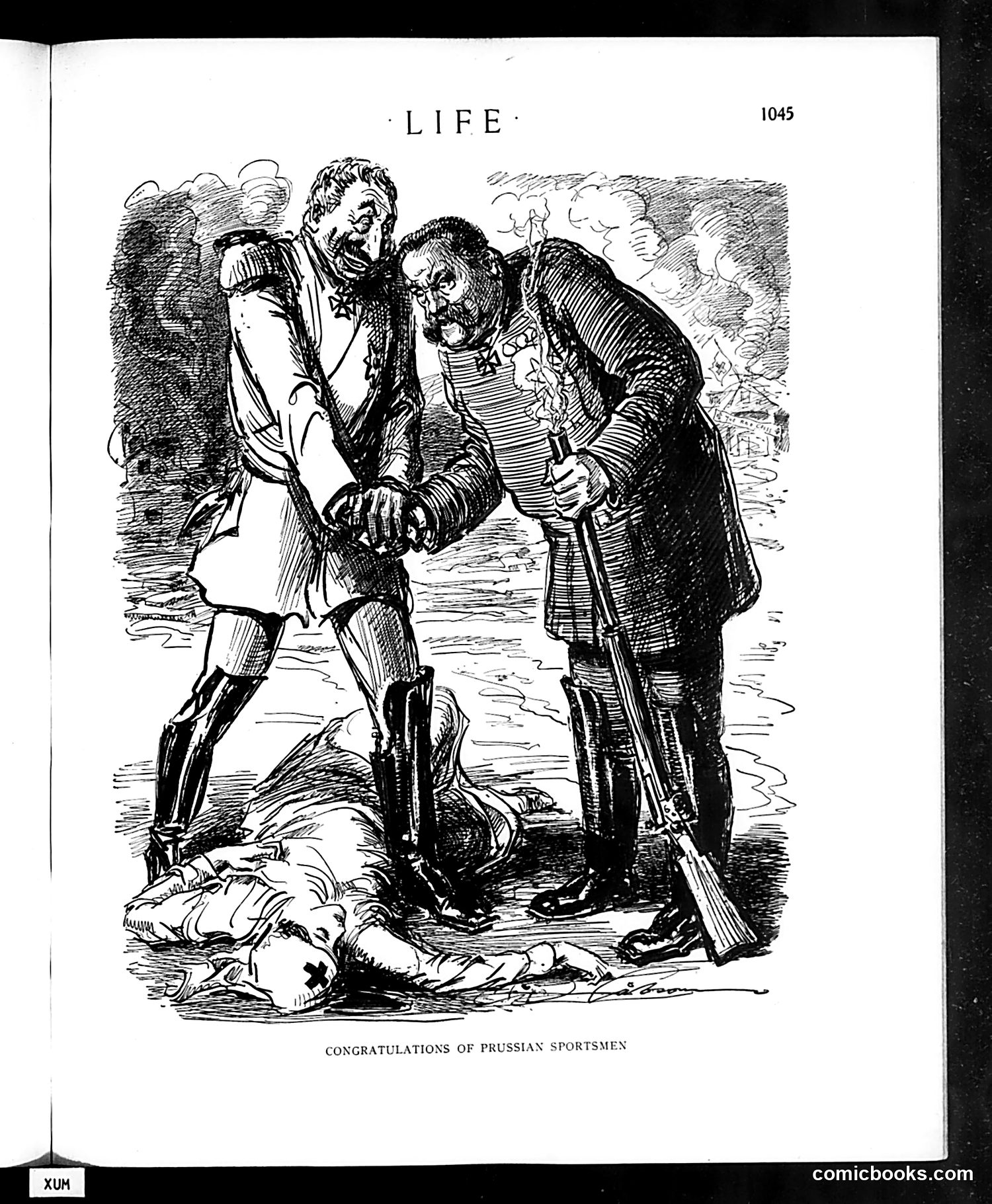
This satirical cartoon from *Life* magazine depicts two military officers in Prussian uniforms standing over a fallen soldier, shaking hands in congratulation. The caption reads "Congratulations of Prussian Sportsmen." The cartoon appears to be Cold War-era commentary on Prussian/German militarism, using dark irony. The "sportsmen" framing sarcastically characterizes military violence as a casual sporting competition rather than serious warfare. By showing celebration over a fallen soldier, the cartoon critiques Prussian military culture as callous and morally bankrupt—treating combat deaths as victories to be celebrated rather than tragic necessities. The satire targets Germanic militaristic values as inhumane and grotesque.
This page analyzes President Woodrow Wilson's recent Congressional address during World War I. The editorial praises Wilson's speech as superior to Lord Lansdowne's (British politician) recent letter calling for peace negotiations, arguing Wilson's words carry more force because they reflect genuine conviction backed by national power. The key political context: Wilson committed America to total victory, explicitly stating Germany's "intolerable menace" must be "crushed" and that peace would come only after Germany's defeat—rejecting Lansdowne's moderate position favoring negotiated settlement. The cartoons (appears to show Uncle Sam figures) likely mock empty political rhetoric—the editorial emphasizes that Wilson's effectiveness stems from sincerity, not mere eloquence. The concluding joke suggests war-duration predictions should require financial backing to discourage baseless speculation. This reflects 1917 American hawkish sentiment favoring unconditional victory over compromise peace.
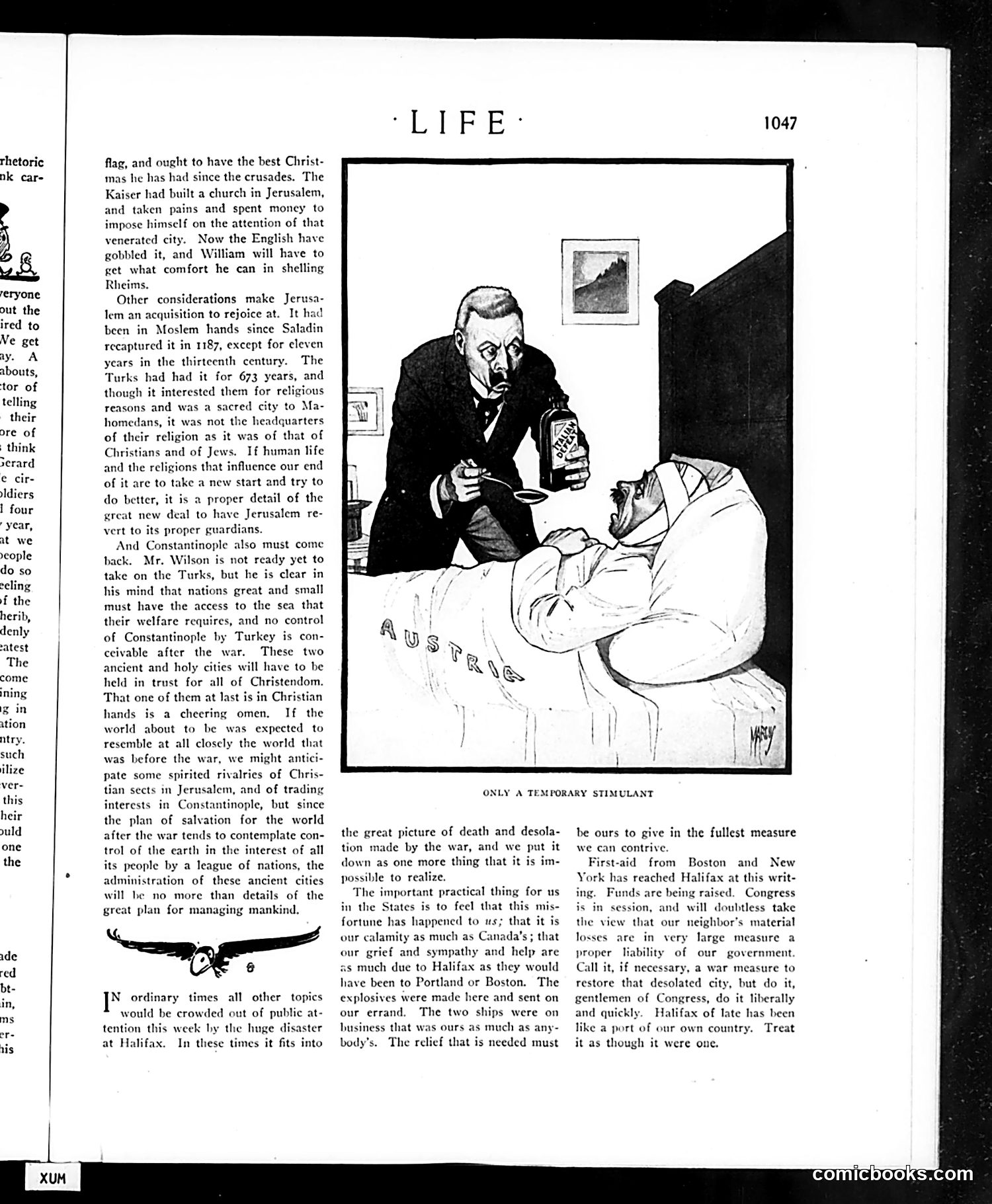
This page discusses the WWI Halifax Explosion (December 1917), when two ships collided in Halifax harbor, killing roughly 2,000 people. The accompanying cartoon, titled "Only a Temporary Stimulant," depicts a doctor or official administering medicine to a bedridden patient labeled "AUSTRIA"—representing Austria-Hungary, a Central Powers nation. The satire suggests that whatever temporary relief or stimulus Austria receives will not cure its fundamental ailment. The text discusses Jerusalem's capture from Ottoman control and Constantinople's future status, reflecting American strategic thinking about post-war territorial reorganization. The cartoon implies Austria-Hungary's condition is terminal despite interventions—a dark commentary on the Central Powers' inevitable defeat and the empire's impending collapse, which historically occurred in 1918.
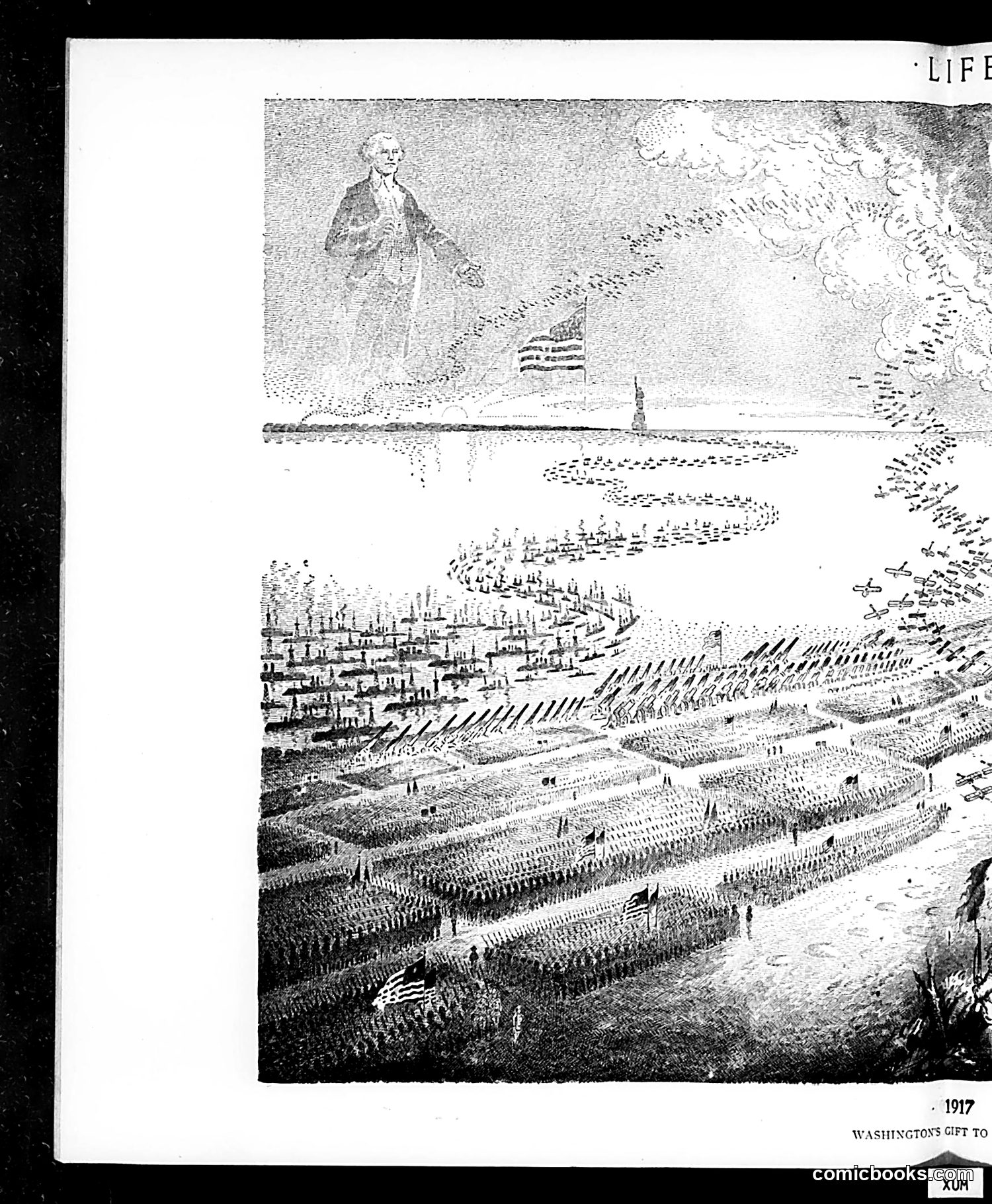
This 1917 Life magazine page depicts a patriotic allegorical scene titled "Washington's Gift to [America]" (text cut off). The illustration shows George Washington's ghostly figure hovering above a vast military encampment with organized rows of troops and American flags. Below spreads a city skyline, likely representing Washington D.C. or a major American city. The image appears to commemorate American military mobilization during World War I (the U.S. entered in April 1917). Washington's spirit symbolically "gifts" or blesses the massive armed forces assembled below—visualizing the nation's military buildup and patriotic commitment to the war effort. The composition suggests continuity between the founding generation's legacy and current national mobilization.
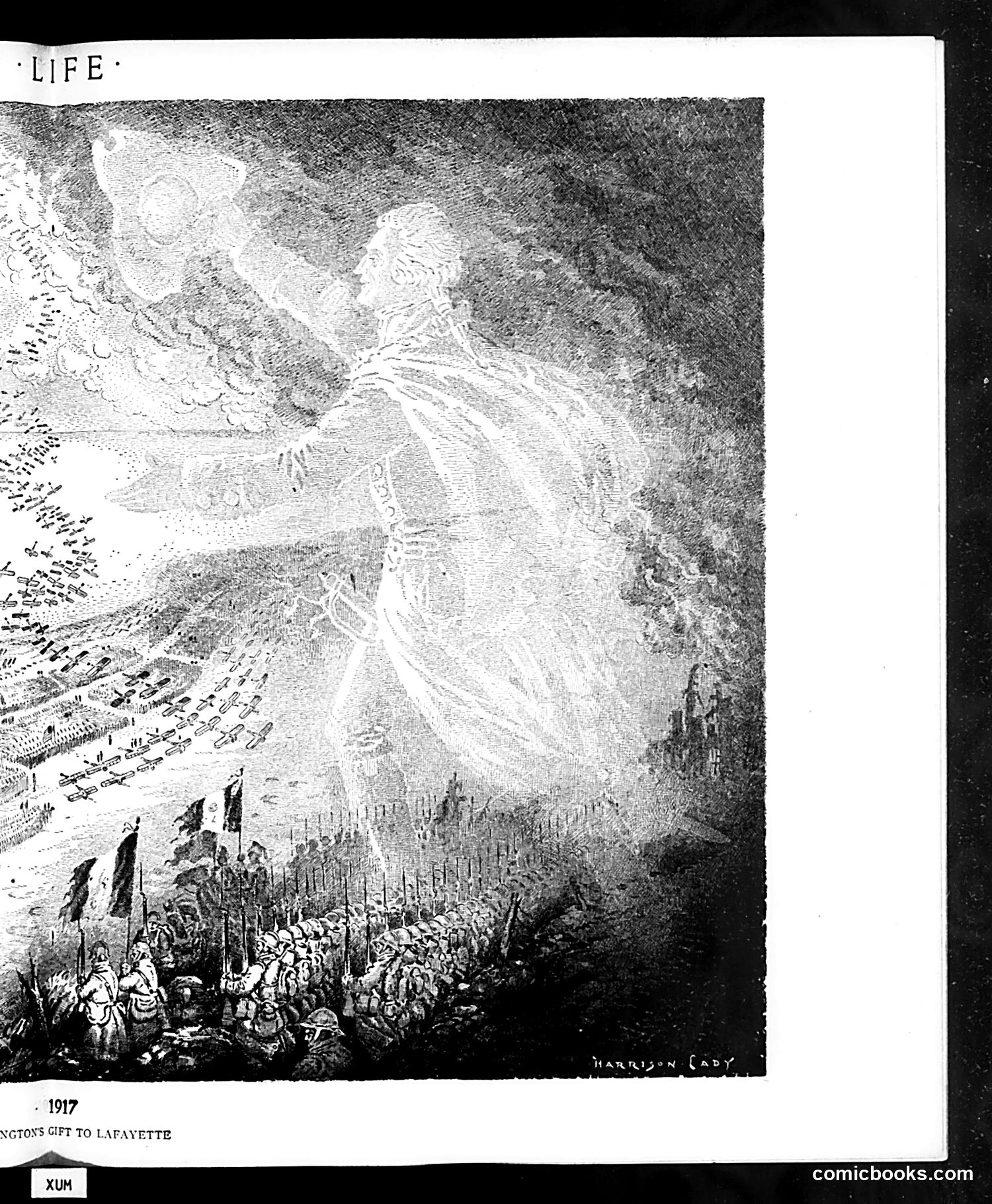
This 1917 Life magazine cartoon by Harrison Cady depicts "Washington's Gift to Lafayette"—likely referencing American military aid to France during World War I. The image shows a massive angelic or allegorical figure (possibly representing America or Liberty) descending from the heavens above a crowd of soldiers carrying rifles and flags below. The cartoon celebrates American support for the French, invoking the historical relationship between George Washington and the Marquis de Lafayette (French Revolutionary War ally). The "gift" appears to be American military assistance or troops, shown as a divine blessing. The composition—with heavenly light, masses of soldiers, and symbolic imagery—emphasizes the scale and moral significance of American intervention in the European war.
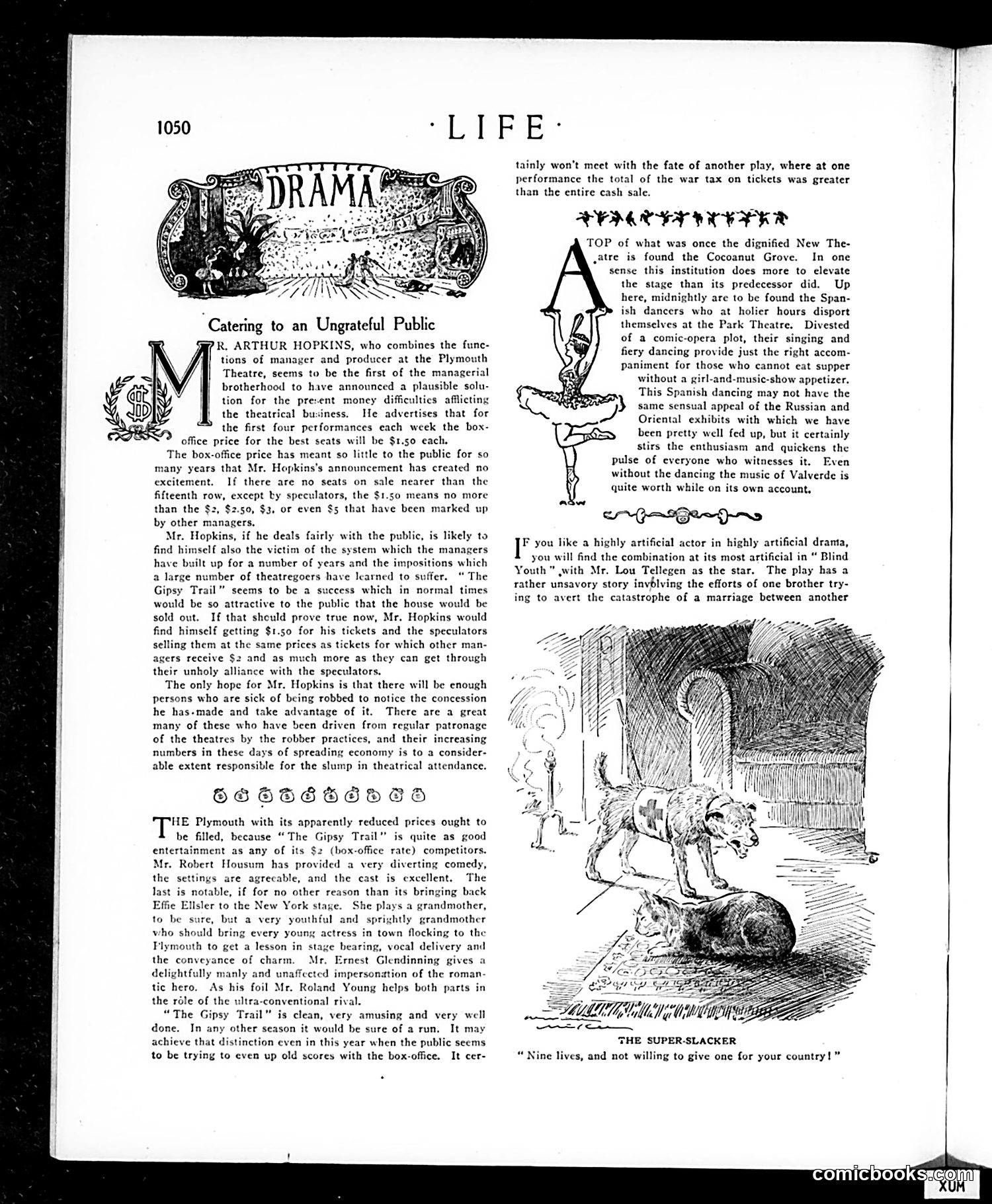
This page critiques theatrical box-office practices during an economic downturn (appears to be post-WWI era, given reference to "war tax"). **Main Article:** Arthur Hopkins, manager of the Plymouth Theatre, has announced reduced ticket prices ($1.50 vs. standard $2-$5) to attract audiences. The writer argues this gesture is largely symbolic—speculators have monopolized good seats and resell them at inflated prices anyway, undermining Hopkins's attempt to help regular theatergoers. The piece blames speculator-manager collusion for driving away audiences and contributing to theater industry decline. **The Cartoon ("The Super-Slacker"):** Shows a dog refusing to leave a building, with caption "Nine lives, and not willing to give one for your country!" This appears to mock those unwilling to serve during wartime. **Secondary Review:** Praises "The Gipsy Trail" at the Plymouth as quality entertainment, and notes the Cocoanut Grove nightclub above the New Theatre, where Spanish dancers perform—suggesting entertainment venues have diversified into nightlife competition. The overall message: systemic corruption prevents genuine price relief for ordinary theatergoers.
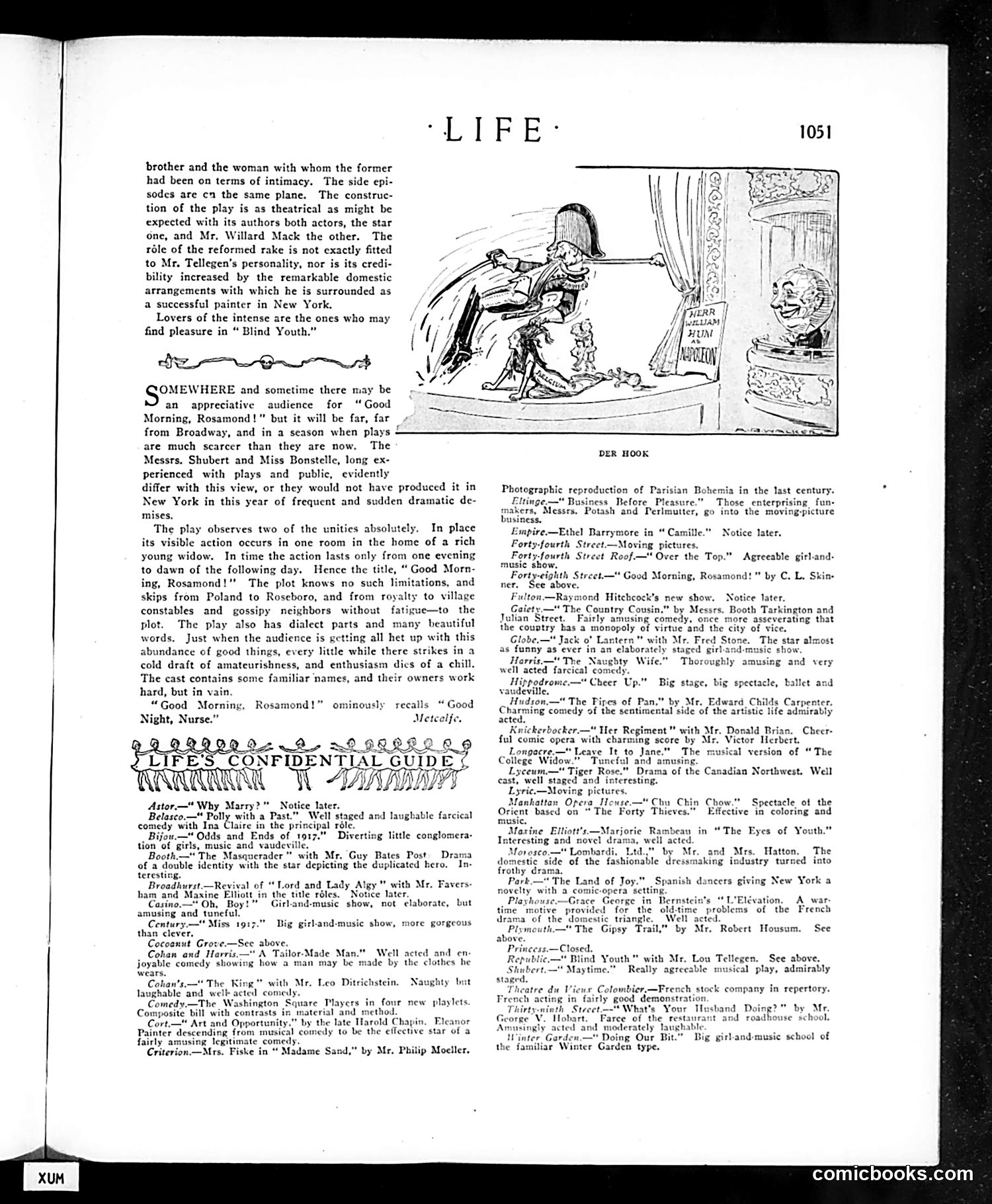
This sketch depicts a theatrical scene labeled "Der Hook," described in the caption as a "photographic reproduction of Parisian Bohemia in the last century." The drawing shows a woman reclining dramatically on a bed or couch while a skeletal or death-like figure looms nearby, with period furnishings visible. The image satirizes Romantic-era theatrical clichés about bohemian Paris—the melodramatic poses, the morbid aesthetics, and the exaggerated emotionalism associated with 19th-century artistic life. The grotesque death figure suggests mockery of overblown theatrical tragedy. This appears in *Life*'s theater review section, likely criticizing contemporary productions that relied on tired stereotypes of bohemian decadence rather than genuine artistic innovation. The satire targets both the source material's theatrical excess and modern productions recycling such worn-out aesthetic tropes.
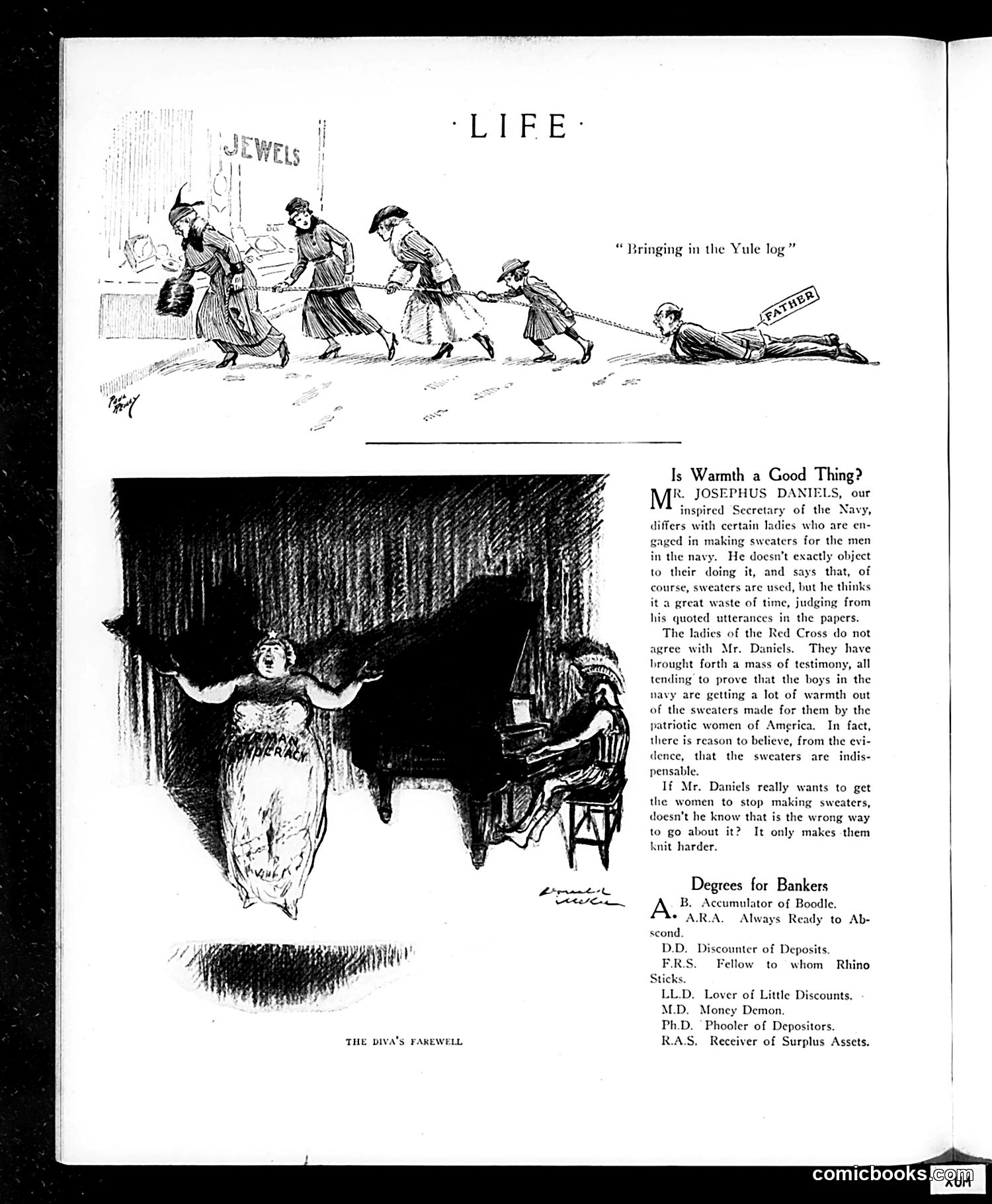
This page satirizes Secretary of the Navy Josephus Daniels, who publicly criticized women's efforts to knit sweaters for naval servicemen during World War I, calling it wasteful. The Red Cross women disagreed, providing testimonies that the sweaters were essential for warmth. Life's satire works on two levels: First, the top cartoon shows women energetically "bringing in the Yule log"—a metaphor suggesting that criticizing their charitable work only strengthens their resolve to knit harder. Second, the "Degrees for Bankers" section mocks financial institutions with fake academic titles like "Accumulator of Boodle" and "Phooler of Depositors"—wordplay satirizing banker dishonesty and greed. The lower illustration ("The Diva's Farewell") appears unrelated to the main text, possibly a separate satirical piece about opera singers or performers.
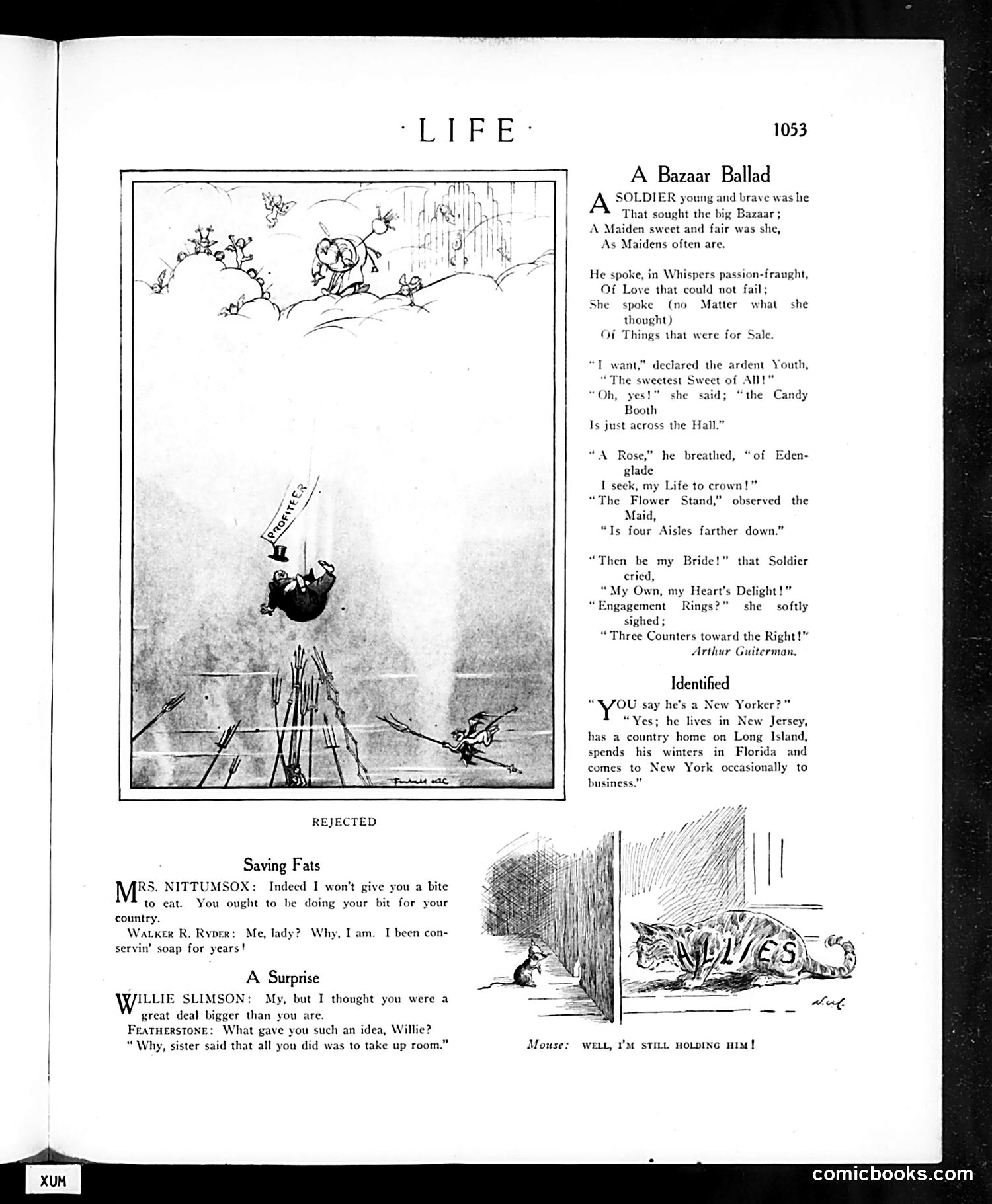
This page contains three separate satirical pieces from WWI-era America (likely 1917-1918, based on wartime references): **"Saving Fats"**: A woman refuses to feed a man claiming he "serves soap." The joke satirizes wartime rationing and conservation efforts—she demands he do his patriotic duty, while he tries to argue his soap work is essential. The humor lies in the absurd claim that making soap counts as war service. **"A Surprise"**: A man appears shrunken; his friend attributes this to the man "taking up room" (likely a fat joke). The satire mocks either weight-loss or suggests someone became less substantial/important. **"A Bazaar Ballad"** (by Arthur Guiterman): A soldier courts a maiden at a charity bazaar, but she redirects all his romantic declarations toward merchandise locations—the candy booth, flower stand, and engagement rings counter. The satire mocks both commercialism and women's indifference to romance, suggesting fundraising events reduced sentiment to sales. **"Identified"**: A deadpan joke about a "New Yorker" who actually lives in New Jersey, Long Island, and Florida—satirizing wealthy commuters' rootlessness. The mouse cartoon's caption "Well, I'm still holding him!" likely refers to a cat-and-mouse chase.
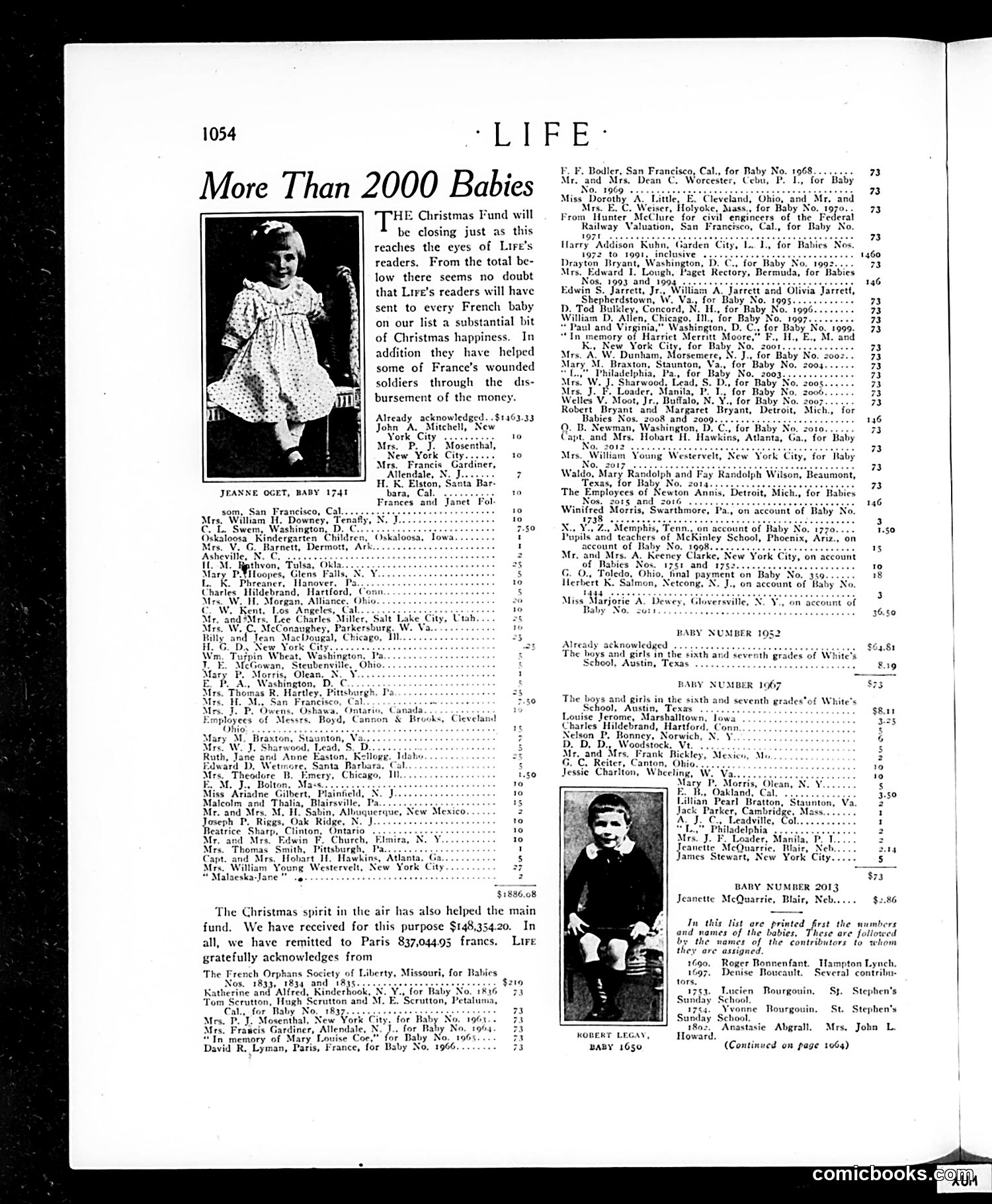
This is a **fundraising appeal page** from *Life* magazine documenting donations to the magazine's Christmas Fund for French babies and wounded soldiers after World War I. The two photographs show babies sponsored through the fund—Jeanne Oget (Baby 1741) and Robert Logan (Baby 1630)—representing the over 2,000 French infants receiving aid from American *Life* readers. **The content is not satirical.** Rather, it's a serious charitable accounting listing contributors' names, hometowns, and donation amounts (typically $10 or $73 per baby sponsored). The text reports that readers have collectively sent $148,334.20 to aid French orphans and wounded soldiers, with a total of 837,044.93 francs remitted to Paris. This reflects *Life*'s role during the interwar period as both a satirical publication and an active participant in American charitable causes supporting Allied nations' post-WWI recovery.
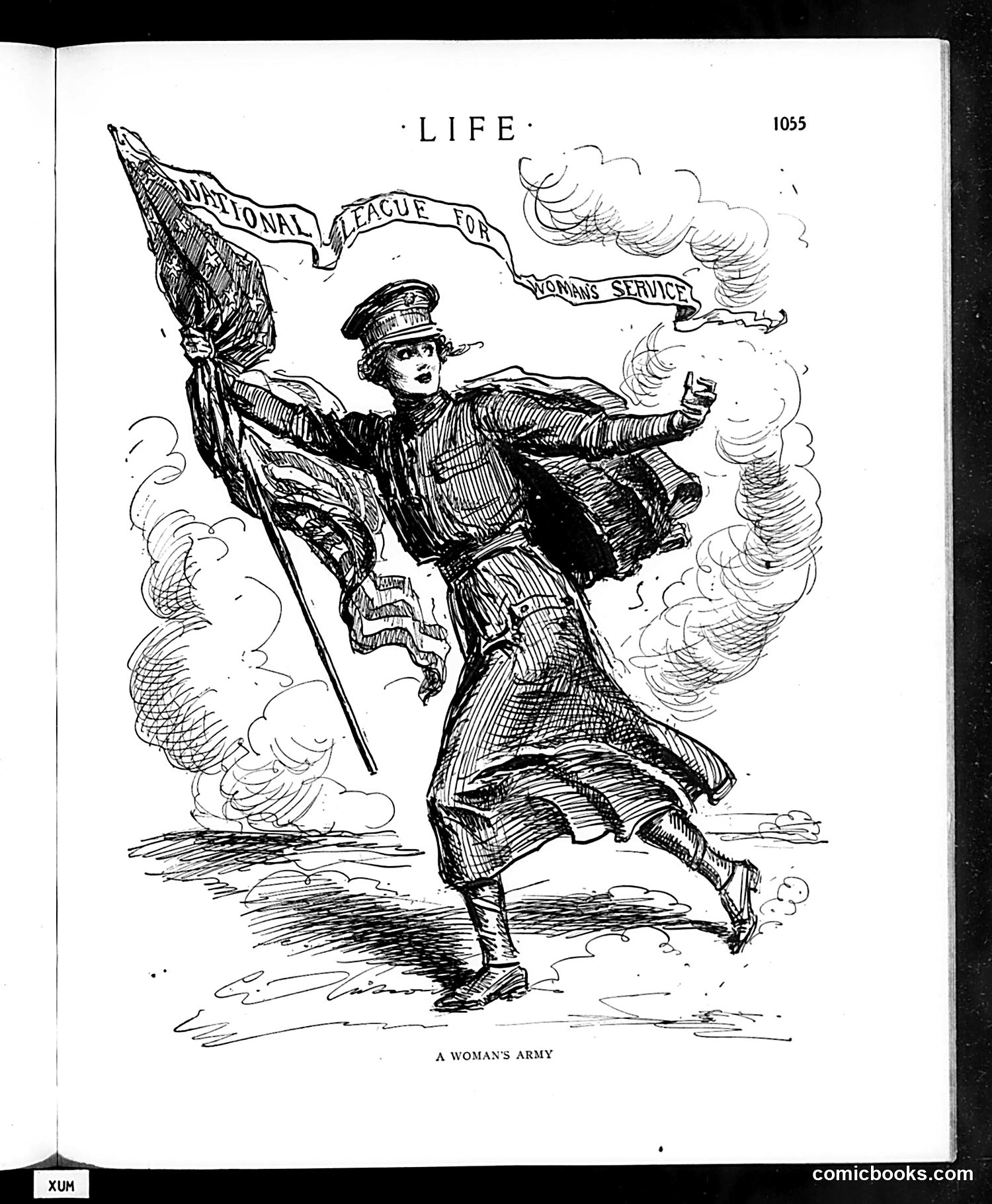
This satirical illustration from *Life* magazine depicts a female soldier in military uniform, energetically wielding a flag banner labeled "National League for Women's Service." The banner's ribbons trail behind her against clouds of smoke or gunfire. The cartoon appears to satirize women's military or quasi-military organizations active during the World War I era. "A Woman's Army" references organized women's service initiatives—likely the National League for Women's Service or similar patriotic women's groups—which mobilized women for support roles during wartime. The satire likely mocks either the militaristic pretensions of these civilian women's organizations or, conversely, celebrates women's expanded public roles during wartime. The dynamic, energetic pose suggests either admiration for women's patriotic mobilization or gentle mockery of their enthusiasm for service.
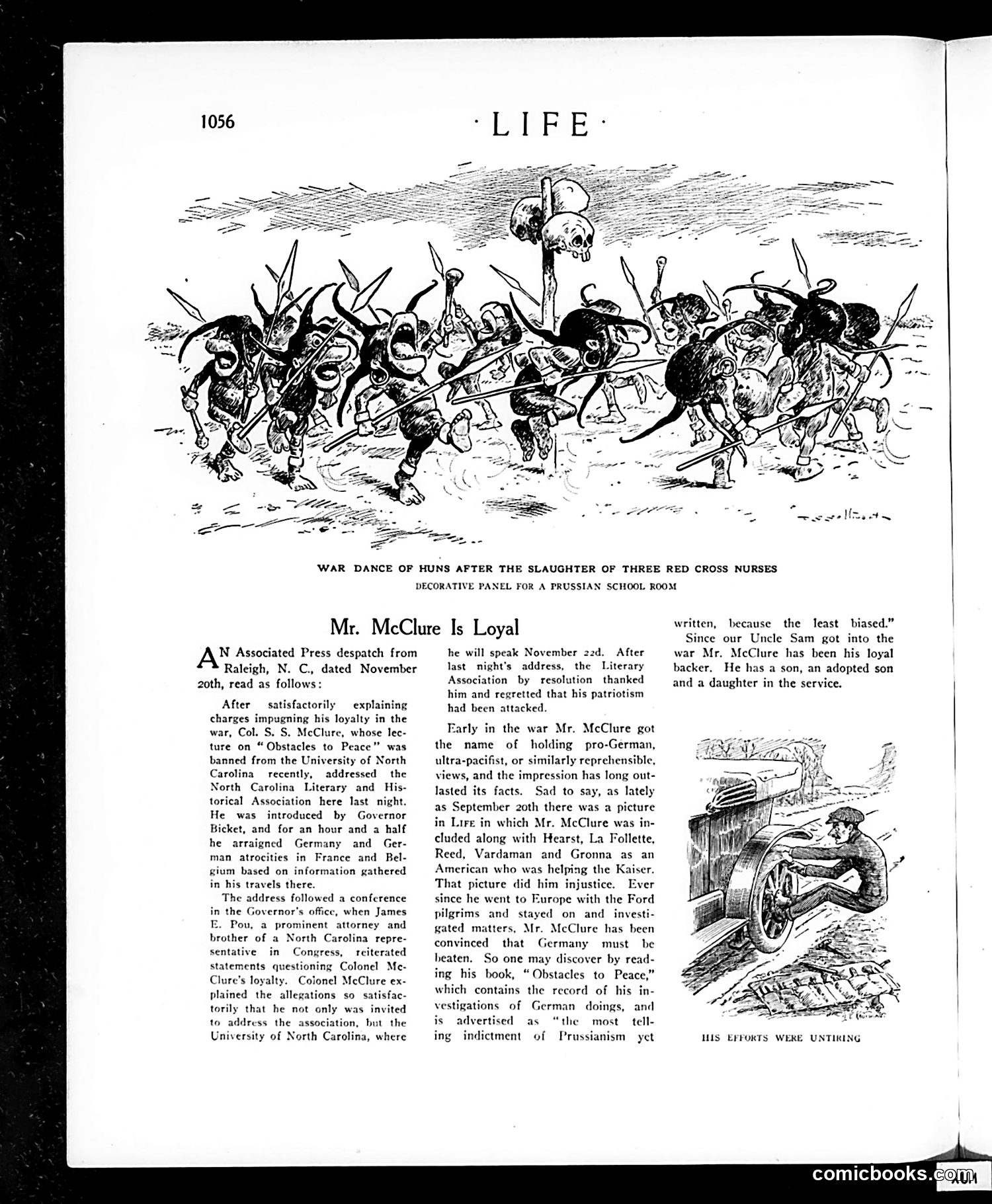
**The Top Cartoon:** Depicts Germans ("Huns") as savage, barbaric dancers celebrating after killing Red Cross nurses. This is WWI propaganda—the exaggerated caricature and atrocity claim were meant to dehumanize Germans and justify American war effort. Red Cross workers were civilians, making their portrayal as victims especially inflammatory. **The Article:** Defends Colonel S.S. McClure against accusations of disloyalty. He'd been labeled "pro-German" early in WWI for pacifist views, but now supports the war effort and has family members serving. The article rehabilitates his reputation after *Life* itself had previously grouped him with supposed Kaiser-sympathizers (Senator La Follette, etc.). **Historical Context:** This reflects 1917-1918 American WWI fervor, when pacifism or early war skepticism could trigger loyalty questions. The propaganda cartoon exemplifies how wartime media demonized enemies through crude racial caricatures and atrocity narratives—methods modern readers recognize as manipulative.
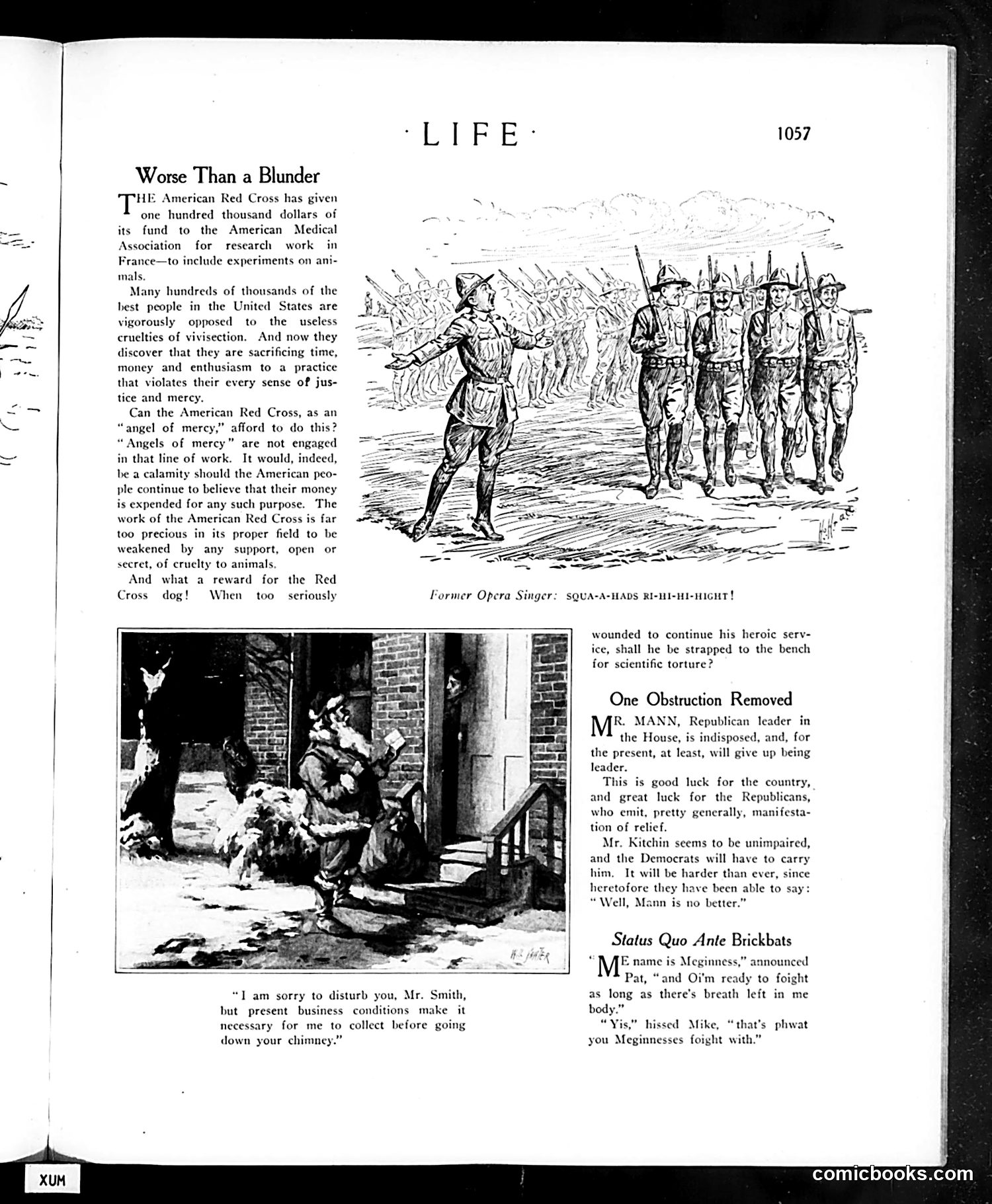
**"Worse Than a Blunder"** criticizes the Red Cross for donating $100,000 to the American Medical Association for animal research in France. The satire argues this contradicts the Red Cross's identity as an "angel of mercy"—the organization should not support vivisection (animal experimentation), which violates public values of compassion. The accompanying illustration of a soldier with bayonets reinforces the irony: even a war dog wounded in service would be betrayed if strapped down for scientific torture. **"One Obstruction Removed"** celebrates Republican congressman Mann's illness forcing him to step down as House leader. The joke mocks Mann by noting Democrats previously used him as a convenient excuse ("Well, Mann is no better"), implying his absence actually improves Republican prospects. **"Status Quo Ante Brickbats"** appears to be a brief humorous exchange with ethnic Irish dialect humor typical of the era, though its specific reference is unclear from the text alone.
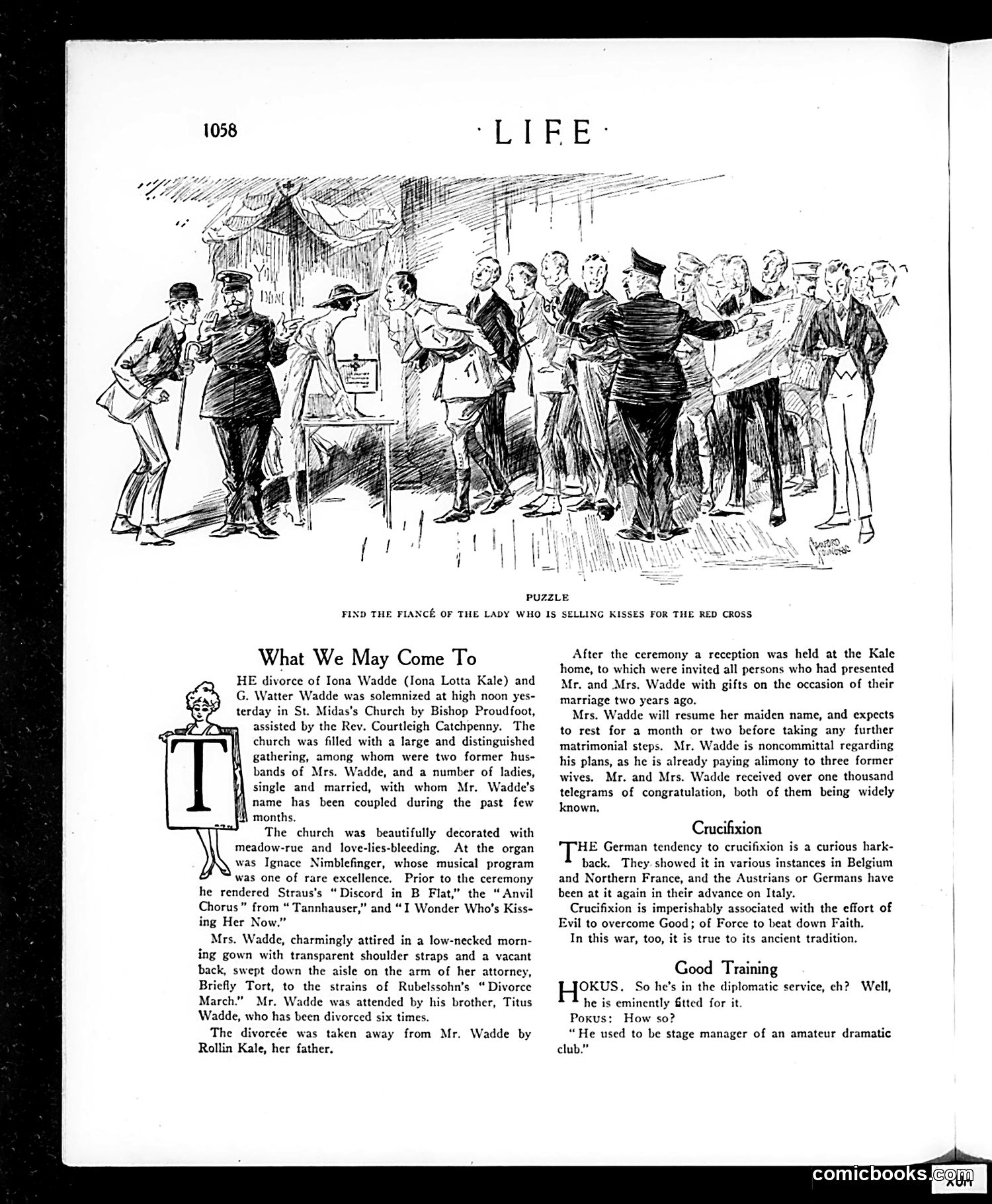
This satirical piece mocks modern divorce culture through exaggerated naming and circumstance. The fictional Mrs. Iona Wadde (a pun on "Iona Lotta Kale"—suggesting she's after money) divorces G. Watter Wadde after just two years, already planning her next marriage. The satire emphasizes the absurdity through mock-serious details: the ceremony includes two of her *former* husbands, Mr. Wadde is already paying alimony to three ex-wives, and they receive 1,000 congratulatory telegrams for their divorce. The joke targets the casualness of divorce and serial marriage among the wealthy elite. Character names are deliberately ridiculous ("Bishop Proudfoot," "Rev. Catchpenny," attorney "Briefly Tort") to underscore the frivolity. The top puzzle invites readers to identify a woman selling Red Cross kisses—likely a contemporary fundraising event—suggesting war charity coexists with moral laxity among the privileged.
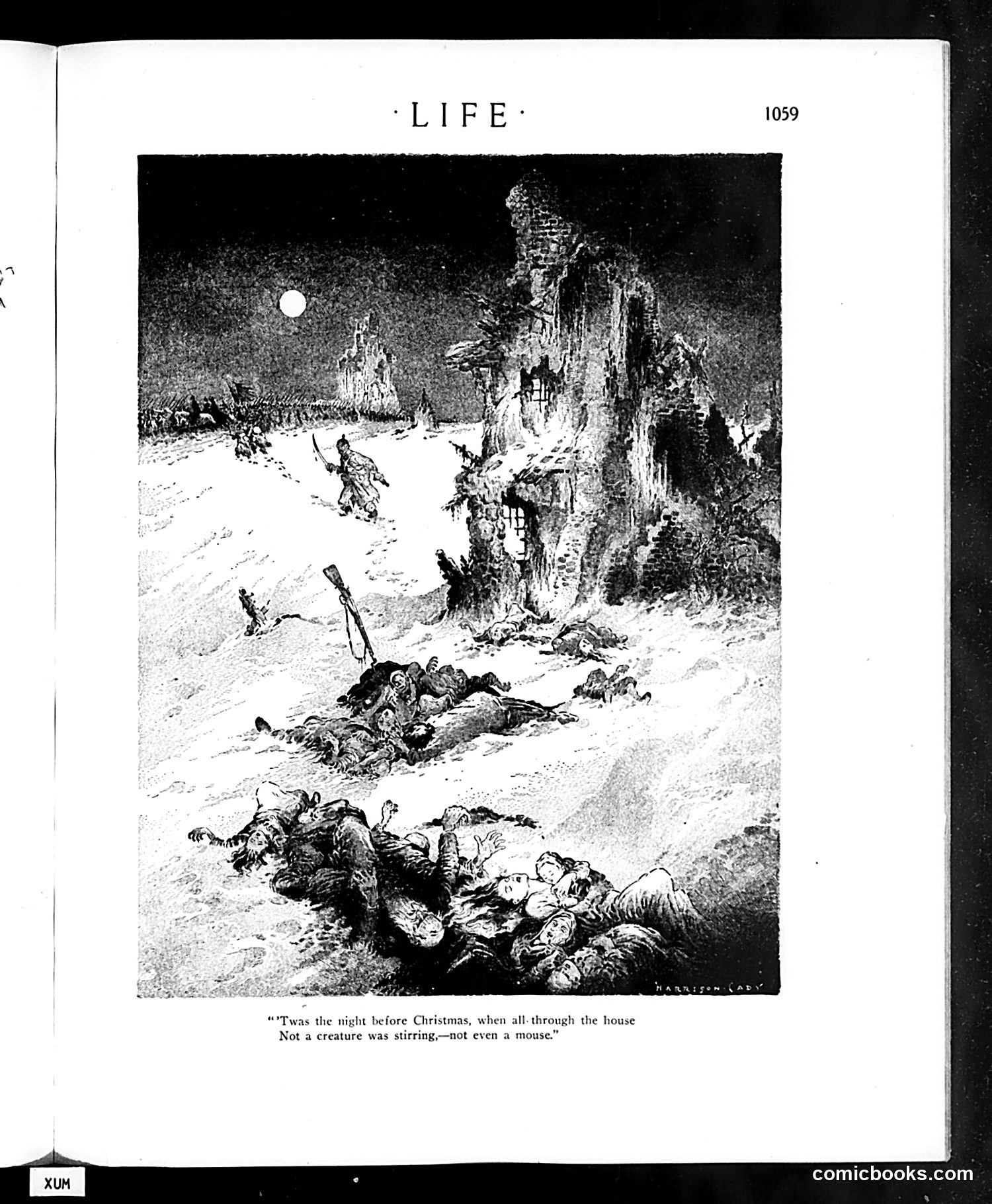
This illustration appears to be a dark, grotesque reimagining of the famous opening lines from "'Twas the Night Before Christmas." Rather than a cozy holiday scene, the artist (signed Harrison Cady) depicts a nightmarish landscape: dead bodies lie scattered across snow-covered ground in the foreground, a ruined castle or fortress looms in the background, and a full moon illuminates the desolate scene. Military forces are visible in the distance. The satire subverts the beloved children's poem by replacing domestic Christmas warmth with imagery of war, death, and destruction. This likely critiques the devastation of World War I or reflects post-war disillusionment—transforming a symbol of peace and innocence into one of violence and horror. The juxtaposition between cherished holiday sentiment and brutal reality creates pointed social commentary.
This story satirizes early 20th-century women's suffrage activism. Mr. Ackton's wife returns from a week of suffragette campaigning, energized by the movement's possibilities for women. The satire operates on two levels: First, Ackton initially appears to support her equality, philosophically accepting her "taking the man's part." But the punchline reveals his hypocrisy—while she was away pursuing political rights, he dismissed the nurse caring for their baby, claiming parental authority. The joke criticizes both sides: the wife's idealistic fervor about grand possibilities blinds her to immediate domestic realities, while the husband's apparent progressivism masks traditional control. His final comment—that her absence transferred responsibility to him, justifying his unilateral decisions—exposes how easily men could weaponize equality rhetoric to reassert dominance. This reflects genuine anxieties of the era: women entering public life while men controlled household decisions, and debates over whether suffrage threatened family stability.
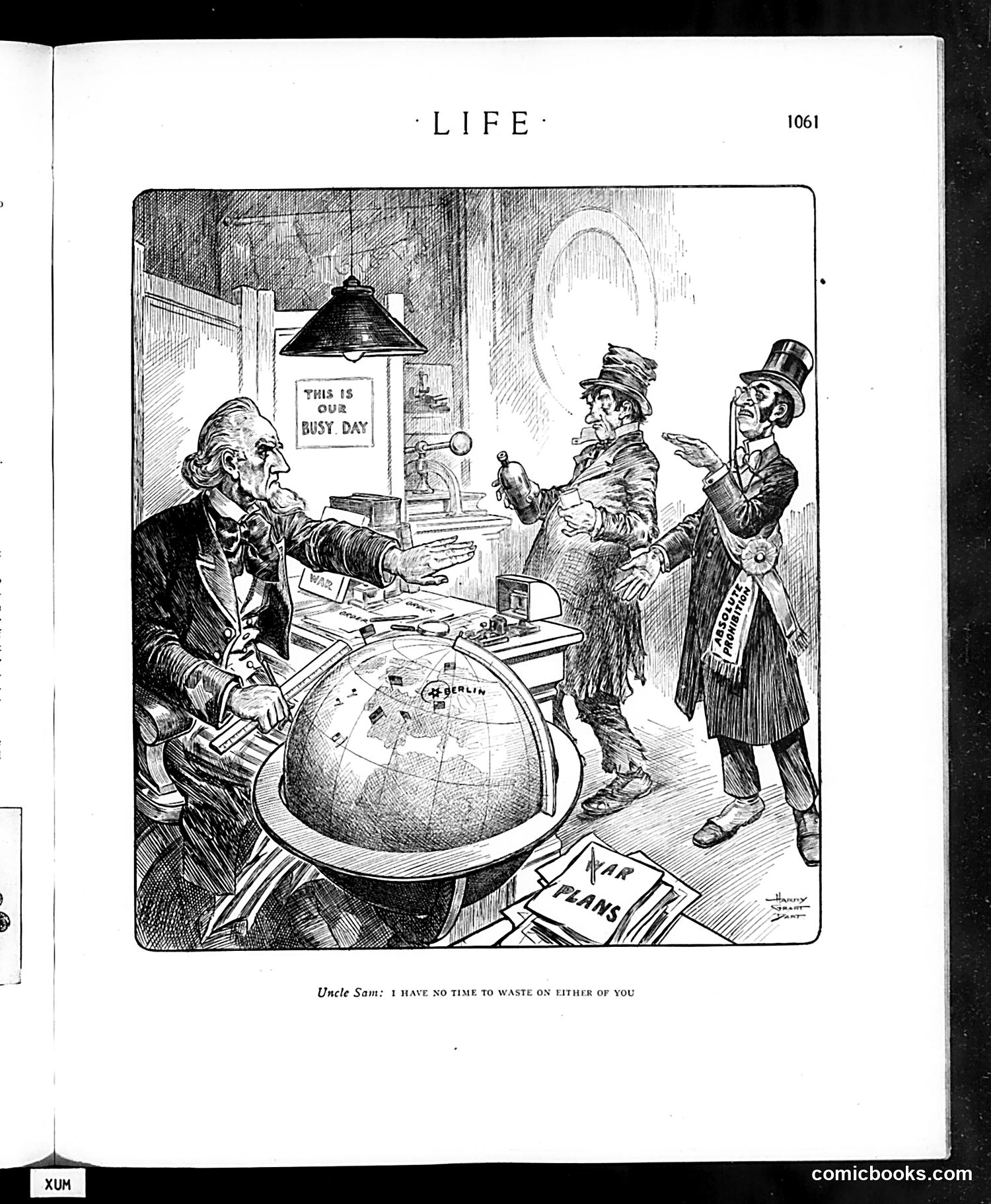
This cartoon depicts **Uncle Sam** (representing the United States government) seated at a desk during what's labeled "THIS IS OUR BUSY DAY," dismissing two well-dressed gentlemen in top hats. A globe marked "BERLIN" sits prominently on the desk, alongside documents labeled "WAR PLANS." The cartoon satirizes American isolationism or non-involvement in European affairs, likely referencing pre-World War I or interwar tensions. Uncle Sam's curt rejection ("I HAVE NO TIME TO WASTE ON EITHER OF YOU") suggests he's rebuffing diplomatic overtures or complaints from European powers, refusing to be drawn into their conflicts despite their appeals. The "busy day" sign ironically emphasizes America's preoccupation with domestic matters over international diplomacy, mocking the nation's reluctance to engage with Old World politics.
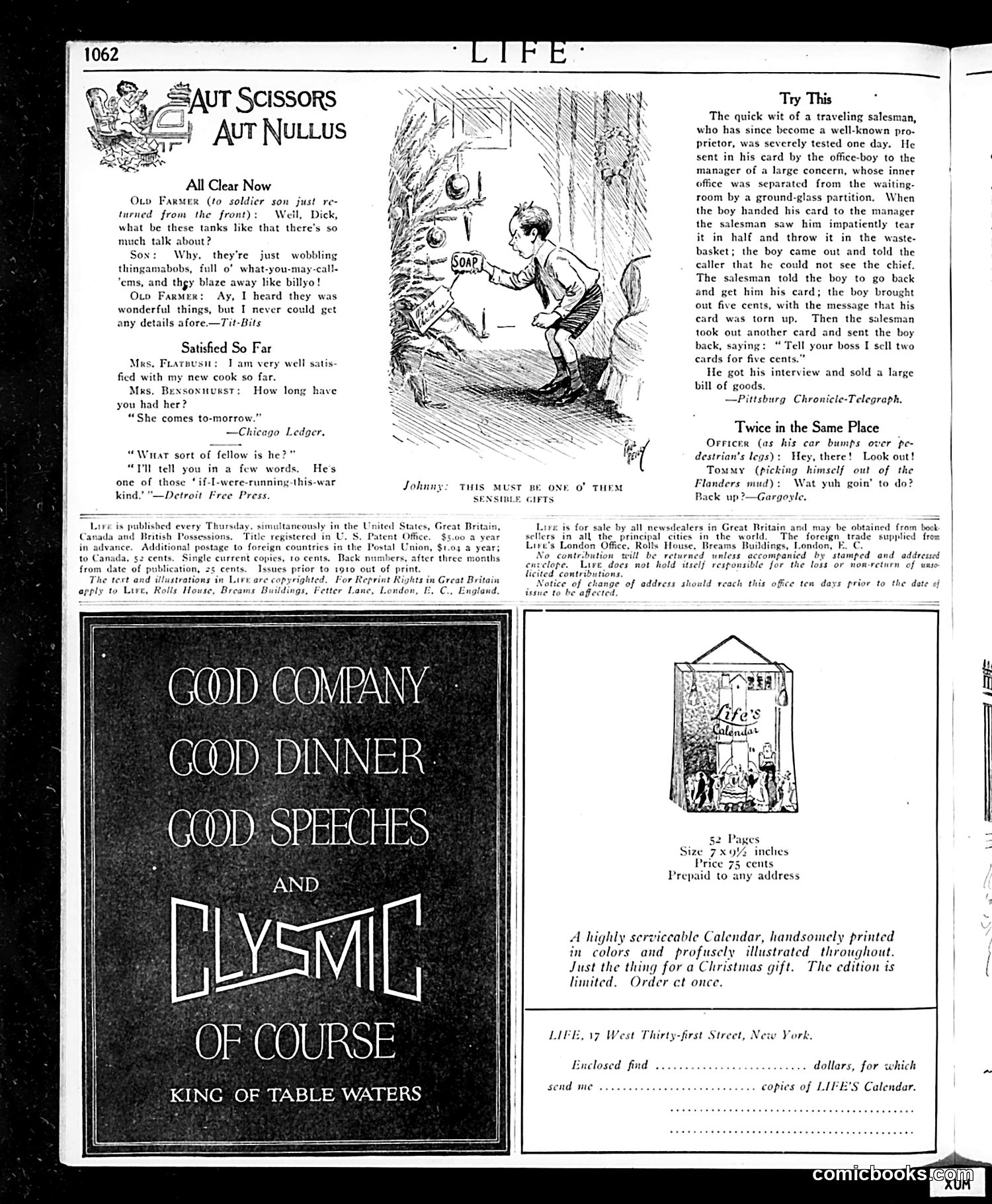
This page contains **four separate humorous sketches** rather than political cartoons: 1. **"All Clear Now"**: A WWI-era joke where an old farmer questions his soldier son about tanks. The son's colorful but vague description ("wobbling thingamabobs...blaze away like billyo") mirrors how ordinary people understood new military technology through fragmentary wartime reports. 2. **"Satisfied So Far"**: A domestic humor piece about a new cook—a common topic in early 20th-century magazines about household staff. 3. **"Try This"**: An anecdote about a traveling salesman's quick wit. When a manager tears up his card, the salesman sends back five cents with a message: "Tell your boss I sell two cards for five cents"—a clever reversal that earns him an interview. 4. **"Twice in the Same Place"**: A WWI trench humor sketch. An officer hits a soldier with his car in Flanders mud; the soldier sarcastically asks if he should back up—implying he's already been run over before in the same spot. The page also includes advertisements for Lysol and a Life calendar. The humor predominantly references **World War I** and early 20th-century domestic life.
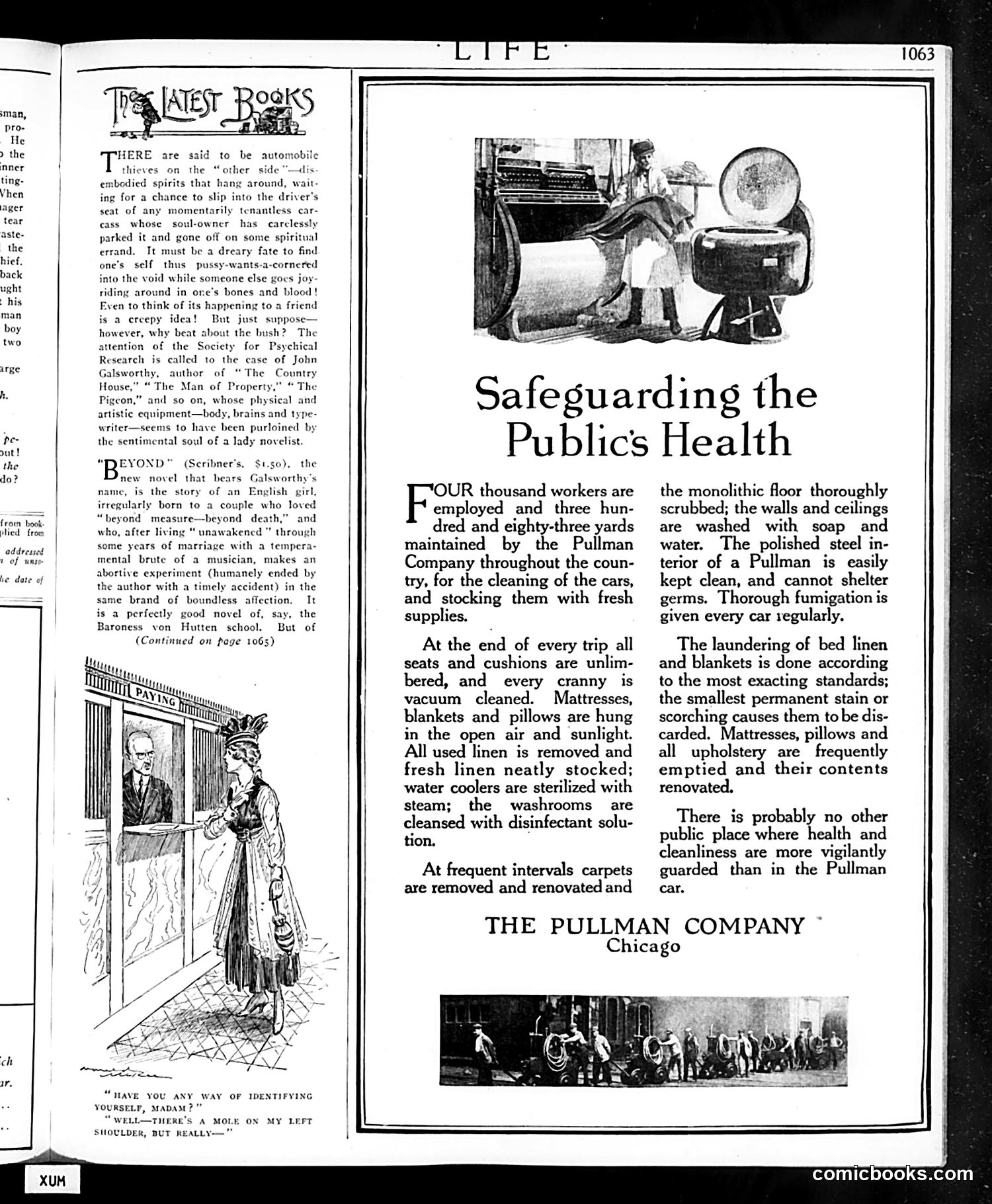
This page contains **two distinct elements**: a book review section on the left and a **Pullman Company advertisement** on the right. The left side mocks author John Galsworthy, suggesting his literary voice has been "possessed" or stolen by "the sentimental soul of a lady novelist"—a satirical claim that his new novel *Beyond* lacks his usual authorial strength and instead resembles work by a female writer of the "Baroness von Hutten school." The cartoon shows a woman at a train window; the caption's joke about identifying "yourself" by "a mole on my left shoulder" plays on the supernatural possession theme. The right side is straightforward corporate advertising for the **Pullman Company**, emphasizing the hygiene standards of their railroad sleeping cars. It lists specific cleaning practices—vacuum cleaning, sterilization, linen laundering—to reassure travelers about health and sanitation. This likely responds to early 20th-century public health concerns about disease transmission in shared public transportation.
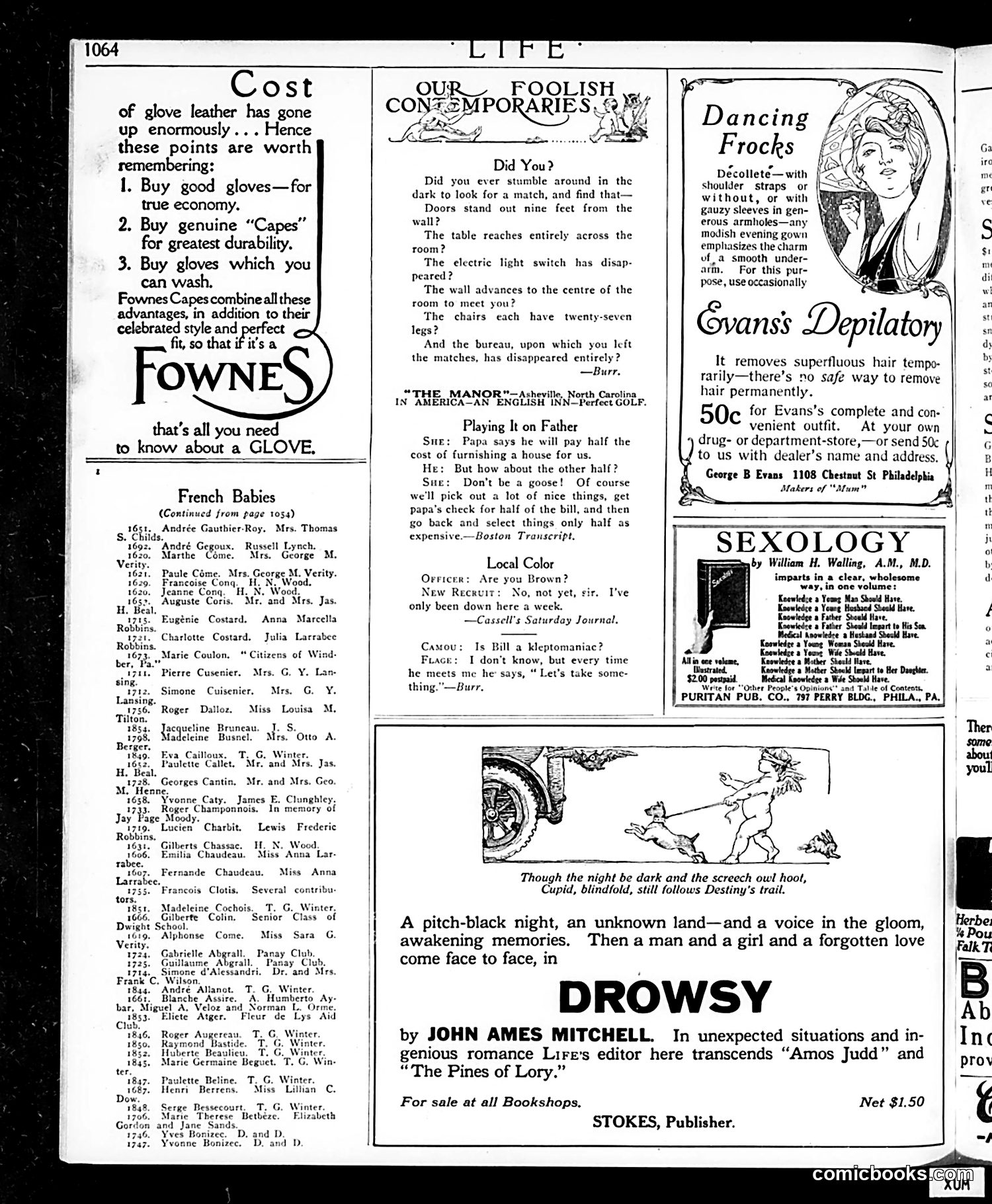
This page is primarily **advertising and filler content**, typical of early 20th-century magazines. The substantive elements are: **Main Advertisement:** Fownes gloves, emphasizing economy and durability during a period of rising leather costs—likely referencing wartime inflation or post-WWI economic pressures. **Humor Sections:** Multiple brief jokes under "Our Foolish Contemporaries," including: - A dark-humor piece about disorientation (possibly relating to wartime blackouts) - "Playing It on Father"—a domestic comedy about a daughter manipulating her father's offer to fund half a house's furnishings - "Local Color" and "Camou"—mild wordplay jokes **Product Ads:** Evans's Depilatory (hair removal) and Puritan Publishing promoting sexology books. **Literary Advertisement:** "Drowsy" by John James Mitchell, a romance novel. The page contains a list of French baby names (continued from earlier), suggesting a charity or naming commemorative feature. Overall, this reflects 1920s consumer culture, domestic humor, and emerging women's beauty industries.
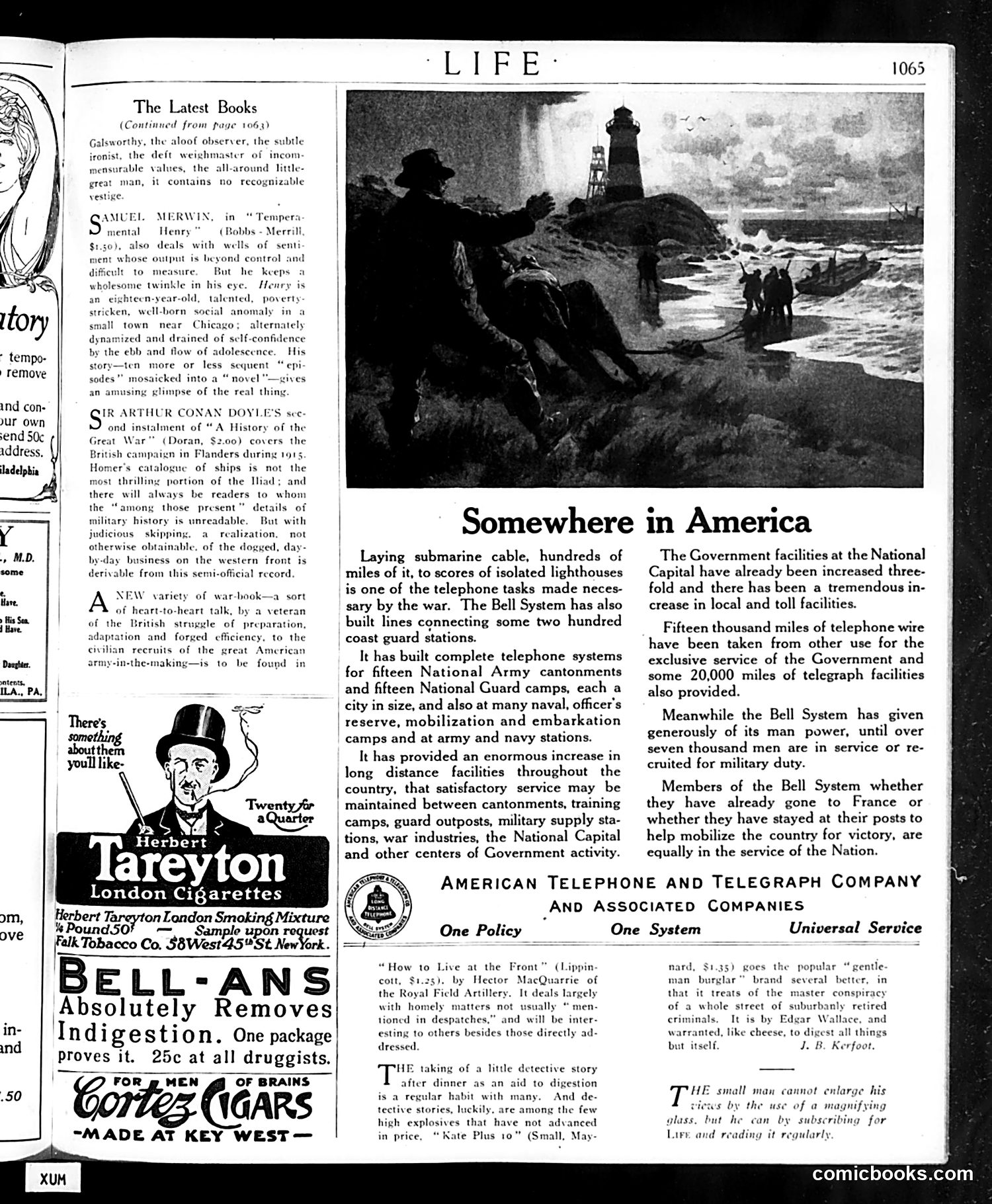
This page mixes book reviews with advertisements and a major Bell System advertisement about wartime telephone infrastructure. **The Book Section** discusses recent publications, including works by John Galsworthy and Sir Arthur Conan Doyle. The reviews praise their literary merit while noting Doyle's war history, though detailed, contains tedious military minutiae. **The Advertisements** include Herbert Tareyton cigarettes and Bell-Ans indigestion remedy—typical period marketing. **The Main Content** is Bell System's patriotic advertisement titled "Somewhere in America," featuring a photograph of lighthouse keepers. The text describes Bell's massive wartime contribution: installing telephone systems at 15 Army cantonments and Guard camps, laying submarine cables to lighthouses, providing 15,000 miles of wire and 20,000 miles of telegraph facilities to the government, and contributing over 7,000 employees to military service. This is **corporate patriotism messaging**—Bell System presenting itself as essential to American victory in World War I, justifying its monopoly status through demonstrated national service.
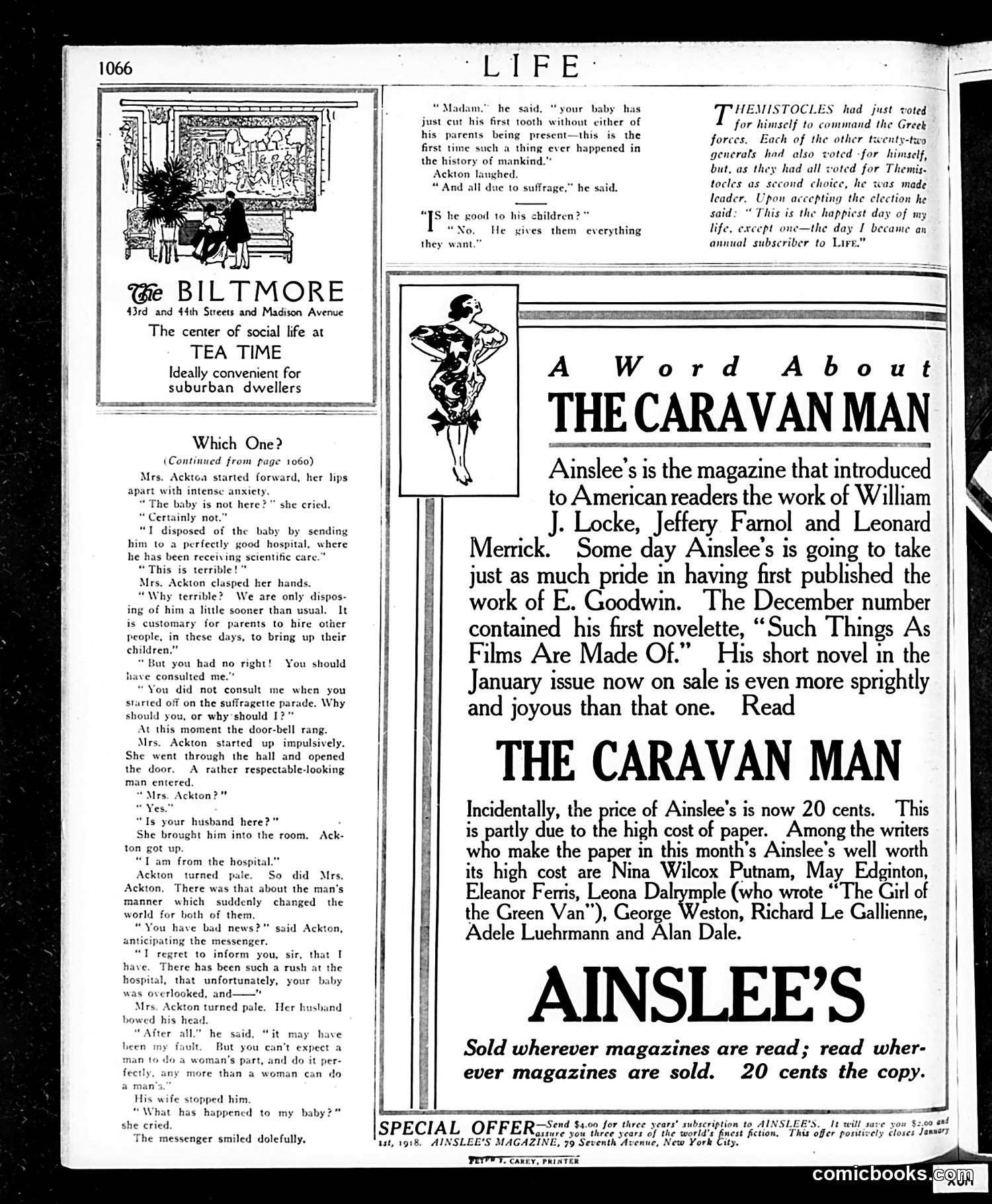
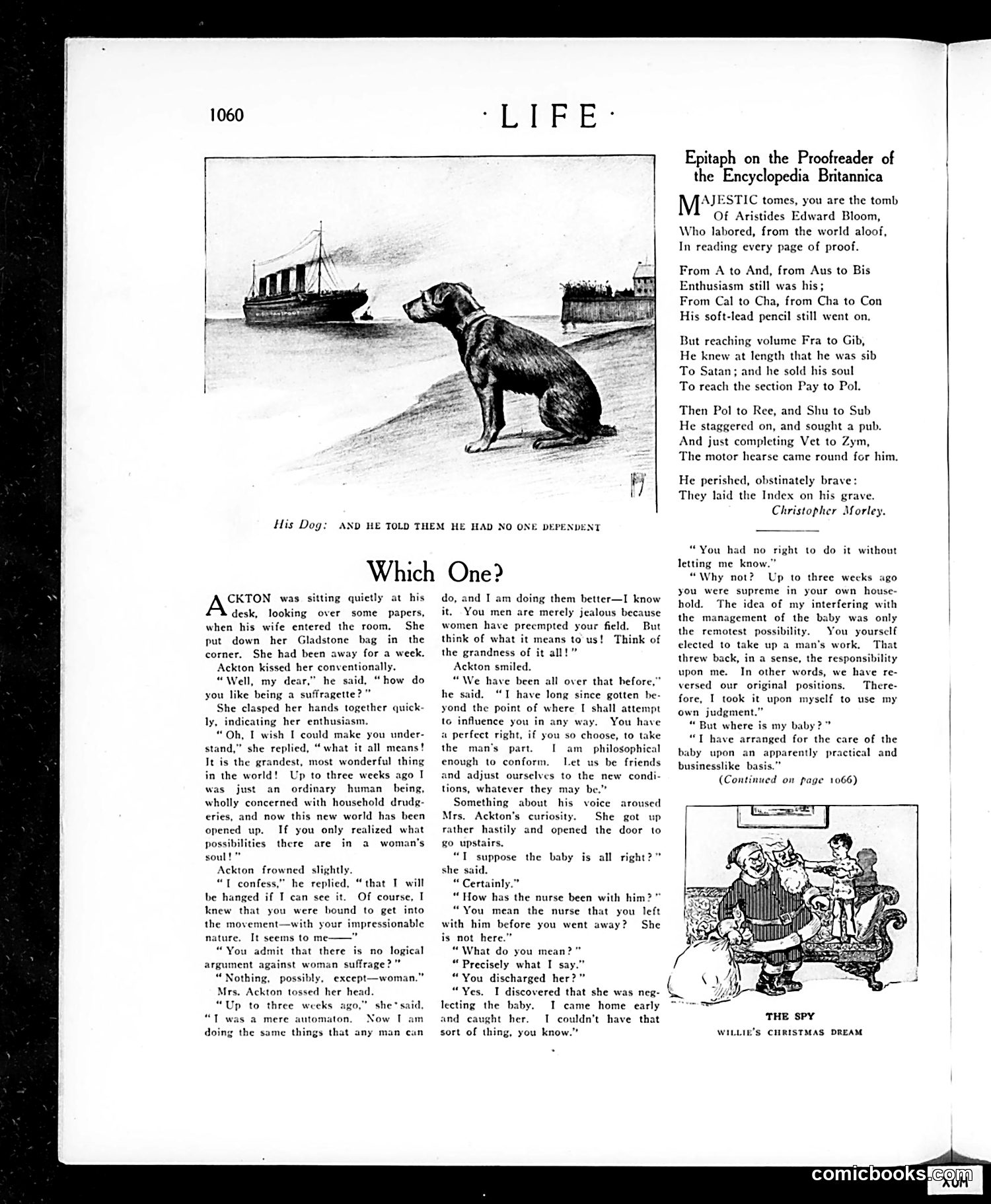
This page contains two distinct pieces of satirical content from an early 20th-century American magazine: **"Which One?" (main story):** A domestic comedy about the Acktons, a married couple experiencing gender-role conflict. Mrs. Ackton is involved in the suffragette (women's voting rights) movement, while Mr. Ackton resents her activism. When their baby is accidentally neglected at a hospital, the joke's punchline—the child cuts his first tooth unattended—undercuts both parents' arguments about who bears responsibility. The satire mocks both women's suffrage activism and the resulting domestic friction. **Advertisement section:** Promotes *Ainslee's* magazine and *The Caravan Man* by E. Goodwin, listing contributing writers. The small Themistocles anecdote is a humorous aside about voting and magazine loyalty, not political commentary. **The Biltmore hotel advertisement** promotes afternoon tea service for suburban visitors. The page reflects pre-1920s attitudes toward women's suffrage as domestic disruption, presenting activism as incompatible with family life.
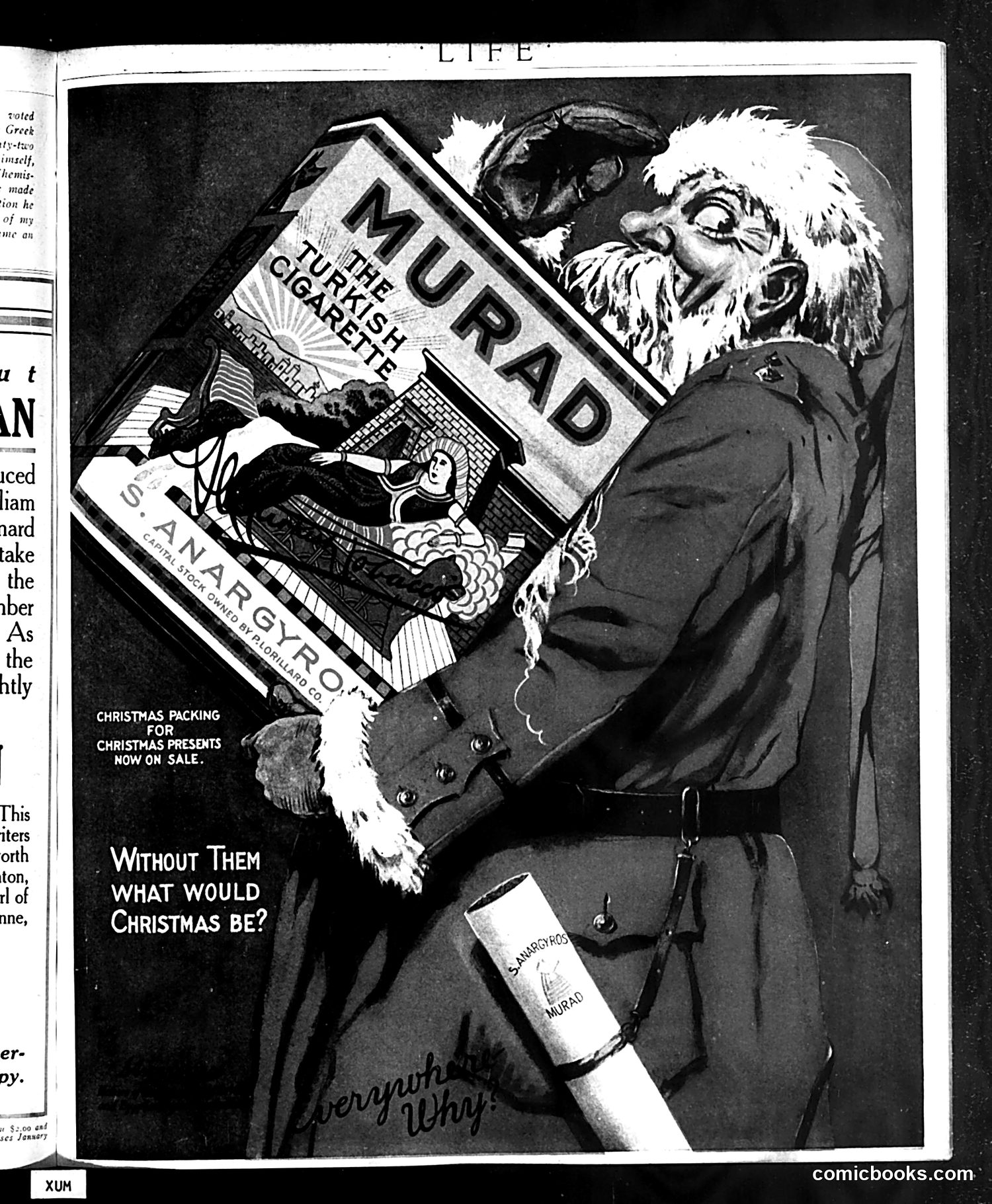
This is a cigarette advertisement disguised as holiday-themed content. The image shows Santa Claus holding prominent packages of "Murrad" Turkish cigarettes, with a smaller package of "Sana-Gyr" brand also visible. The ad's rhetorical question—"Without them, what would Christmas be?"—sarcastically suggests cigarettes are essential to holiday celebration. The caption "Christmas packing for Christmas presents now on sale" uses double meaning: both literal gift-wrapping and the product packaging itself. This reflects early 20th-century tobacco marketing practices, when cigarettes were routinely advertised in mainstream publications without health warnings. The use of Santa Claus to promote the product to a general audience—including implicit appeal to families—would be considered highly unethical today. The ad exploits holiday sentiment to normalize cigarette consumption as a normal, desirable gift.
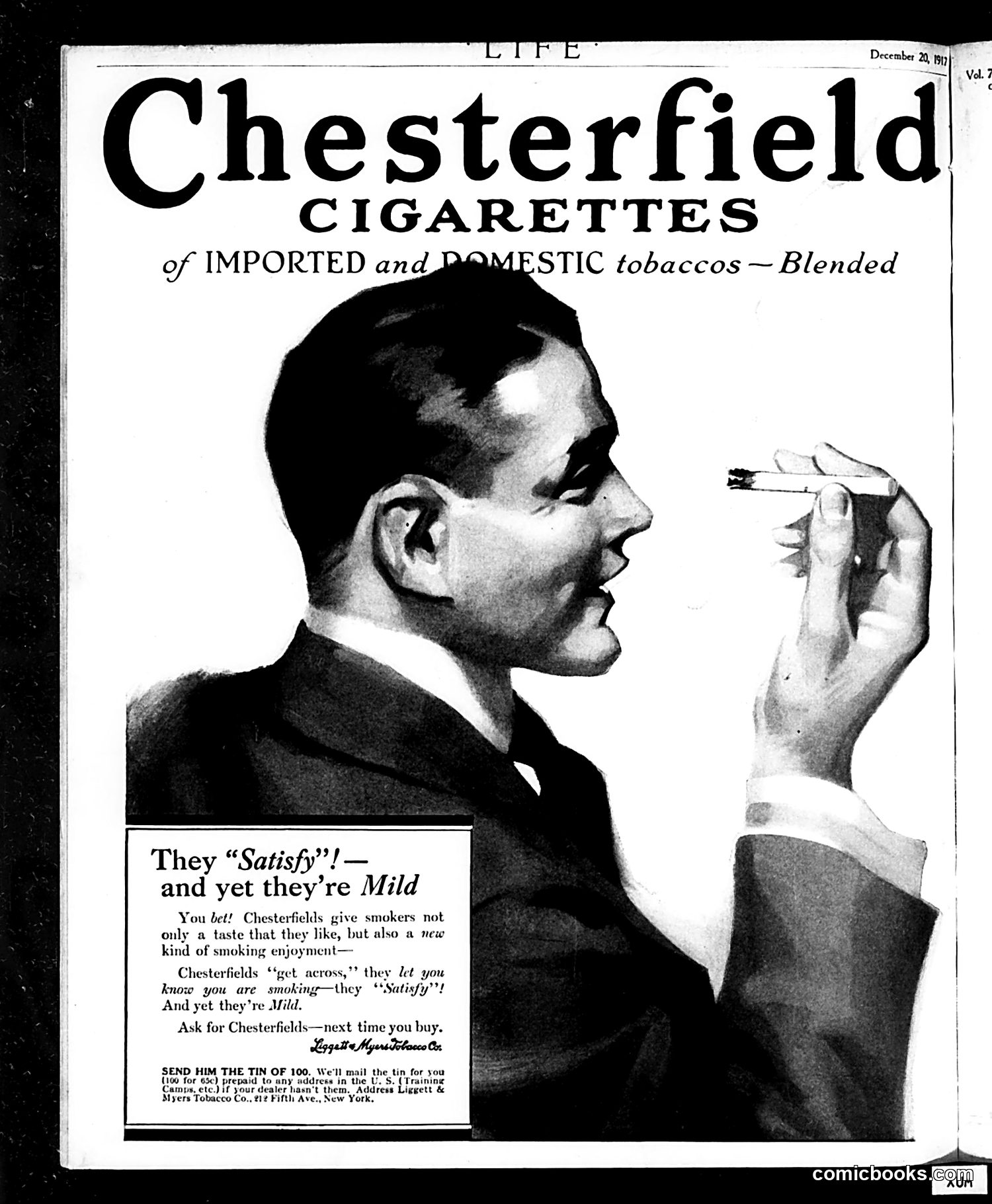
This is a **cigarette advertisement**, not political satire. It appears in *Life* magazine from December 1917, likely during World War I (note the reference to mailing tins to "Training Camps"). The ad features a man in profile smoking a cigarette, promoting Chesterfield's paradoxical selling point: they "Satisfy" smokers with a noticeable taste while remaining "Mild"—positioning the product as offering both satisfaction and smoothness simultaneously. The marketing hook claims Chesterfields "get across," meaning smokers will *feel* they're smoking, distinguishing the brand from competitors. The patriotic appeal includes a special offer to mail tins to soldiers at training camps, leveraging wartime sentiment. No political figures or satire are present; this is straightforward early-20th-century cigarette marketing using a masculine, sophisticated imagery typical of that era.