
Life, 1917-12-20 · page 22 of 40
Life — December 20, 1917 — page 22: what you’re looking at
What you’re looking at
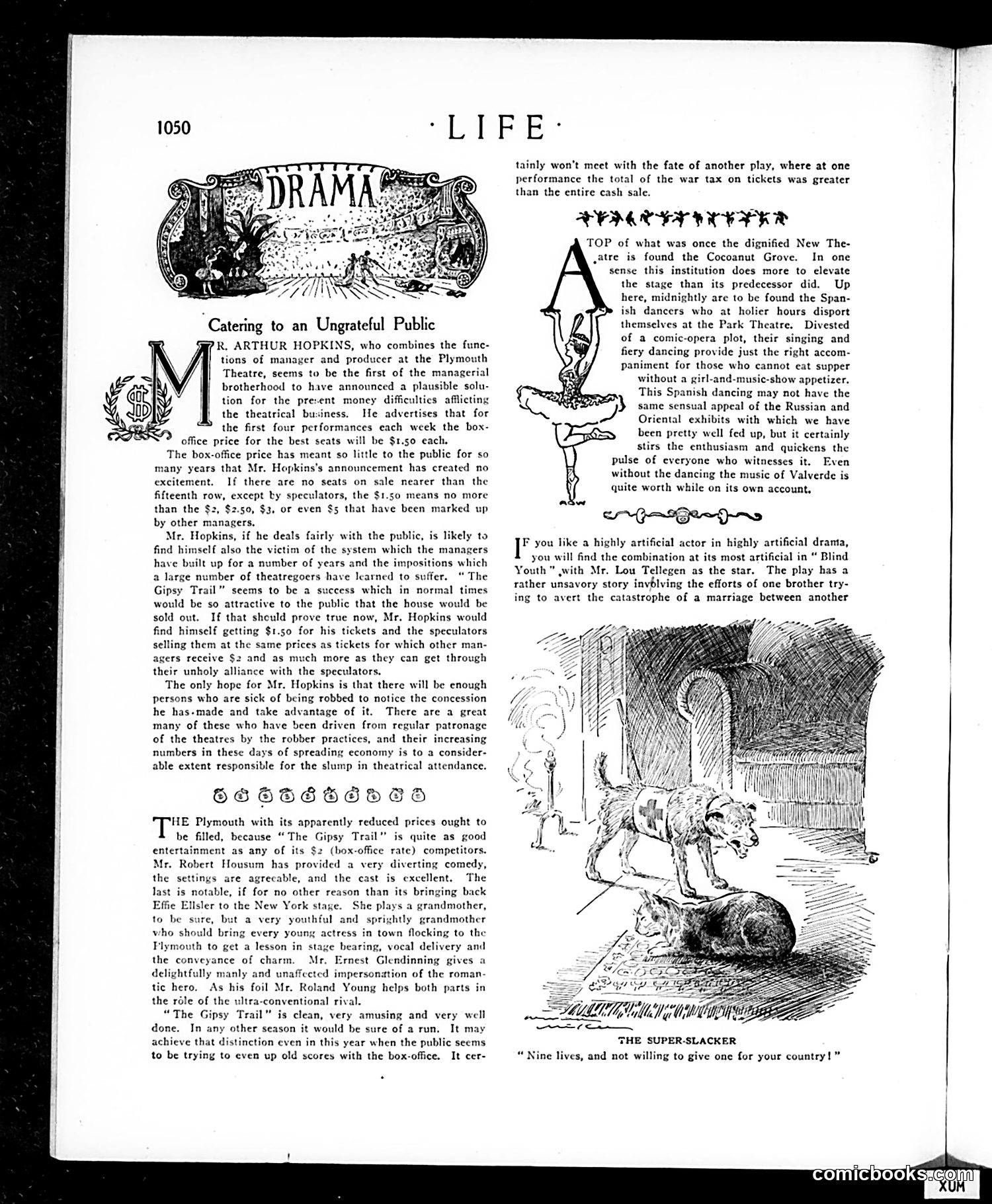
This page critiques theatrical box-office practices during an economic downturn (appears to be post-WWI era, given reference to "war tax"). **Main Article:** Arthur Hopkins, manager of the Plymouth Theatre, has announced reduced ticket prices ($1.50 vs. standard $2-$5) to attract audiences. The writer argues this gesture is largely symbolic—speculators have monopolized good seats and resell them at inflated prices anyway, undermining Hopkins's attempt to help regular theatergoers. The piece blames speculator-manager collusion for driving away audiences and contributing to theater industry decline. **The Cartoon ("The Super-Slacker"):** Shows a dog refusing to leave a building, with caption "Nine lives, and not willing to give one for your country!" This appears to mock those unwilling to serve during wartime. **Secondary Review:** Praises "The Gipsy Trail" at the Plymouth as quality entertainment, and notes the Cocoanut Grove nightclub above the New Theatre, where Spanish dancers perform—suggesting entertainment venues have diversified into nightlife competition. The overall message: systemic corruption prevents genuine price relief for ordinary theatergoers.
📄 Transcribed text from this page (OCR, searchable)
Machine-transcribed from the original scan — historical spelling and the odd misread are preserved.
* Catering to an Ungrateful Public R. ARTHUR HOPKINS, who combines the func- tions of manager and producer at the Plymouth Theatre, seems to be the first of the managerial brotherhood to have announced a plausible solu- tion for the present money difficulties afflicting the theatrical business. He advertises that for the first four performances each week the box- office price for the best seats will be $1.50 each. The box-office price has meant so little to the public for so many years that Mr. Hopkins’s announcement has created no excitement. If there are no seats on sale nearer than the fifteenth row, except by speculators, the $1.50 means no more than the $2, $2.50, $3, or even $5 that have been marked up by other managers. Mr. Hopkins, if he deals fairly with the public, is likely to find himself also the victim of the system which the managers have built up for a number of years and the impositions which a large number of theatregoers have learned to suffer. “ The Gipsy Trail” seems to be a success which in normal times would be so attractive to the public that the house would be sold out. If that should prove true now, Mr. Hopkins would find himself getting $1.50 for his tickets and the speculators selling them at the same prices as tickets for which other man- agers receive $2 and as much more as they can get through their unholy alliance with the speculators. The only hope for Mr. Hopkins is that there will be enough persons who are sick of being robbed to notice the concession he has-made and take advantage of it. There are a great many of these who have been driven from regular patronage of the theatres by the robber practices, and their increasing numbers in these 's of spreading economy is to a consider- able extent responsible for the slump in theatrical attendance. S86BEHSDEO HE Plymouth with its apparently reduced prices ought to be filled, because “The Gipsy Trail” is quite as good entertainment as any of its $2 (box-office rate) competitors. Mr. Robert Housum has provided a very diverting comed: the settings are agrecable, and the cast is excellent. The 1 notable, if for no other reason than its bringing back Effie Ellster to the New York stage. She plays a grandmother, to be sure, but a very youthful and sprightly grandmother who should bring every young actress in town flocking to the Flymouth to get a lesson in stage bearing, vocal delivery and the conveyance of charm. Mr, Ernest Glendinning gives a delightfully manly and unaffected impersonation of the roman- tic hero. As his foil Mr. Roland Young helps both parts in the réle of the ultra-conventional rival. “The Gipsy Trail” is clean, very amusing and very well done. In any other season it would be sure of a run, It may achieve that distinction even in this year when the public seems to be trying to even up old scores with the box-office. It cer- “LE PRE * tainly won't meet with the fate of another play, where at one performance the total of the war tax on tickets was greater than the entire cash sale. REPRE AEF KE TOP of what was once the dignified New The- .atre is found the Cocoanut Grove. In one sense this institution does more to elevate the stage than its predecessor did. Up here, midnightly are to be found the Span- ish dancers who at holier hours disport themselves at the Park Theatre. Divested of a comic-opera plot, their singing and fiery dancing provide just the right accom- paniment for those who cannot eat supper without a girl-and-music-show appetizer. This Spanish dancing may not have the MO REPLY same sensual appeal of the Russian and wy) Oriental exhibits with which we have been pretty well fed up, but it certainly stirs the enthusiasm and quickens the pulse of everyone who witnesses it. Even without the dancing the music of Valverde is quite worth while on its own account, rr GaGenrgpyens F you like a highly artificial actor in highly artificial dranta, you will find the combination at its most artificial in “ Blind Youth” .with Mr. Lou Tellegen as the star. The play has a rather unsavory story invélving the efforts of one brother try- ing to avert the catastrophe of a marriage between another \ tht ave THE SUPER-SLACKER “ Nine lives, and not willing to give one for your country!”