
Life, 1917-12-20 · page 38 of 40
Life — December 20, 1917 — page 38: what you’re looking at
What you’re looking at
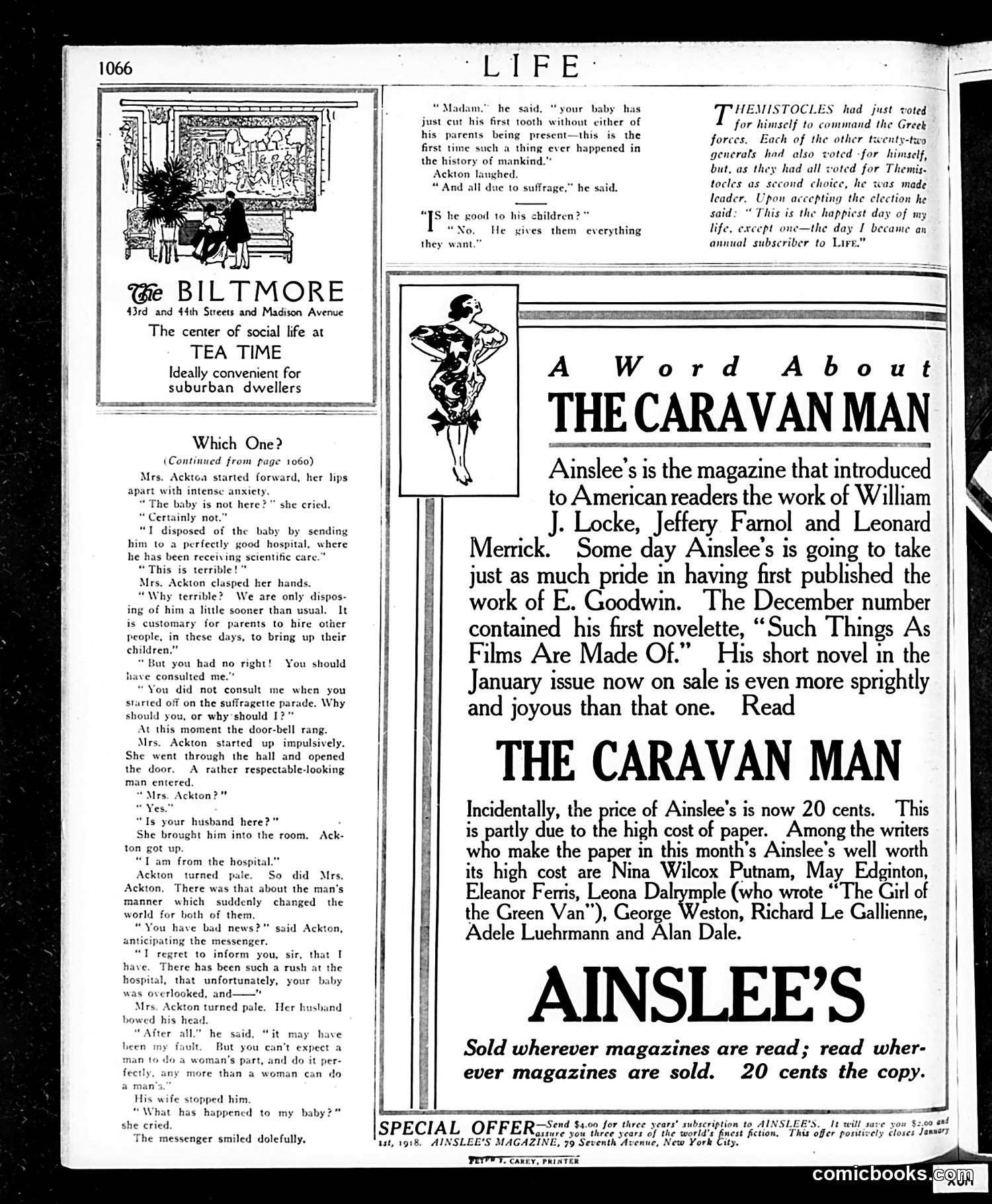
This page contains two distinct pieces of satirical content from an early 20th-century American magazine: **"Which One?" (main story):** A domestic comedy about the Acktons, a married couple experiencing gender-role conflict. Mrs. Ackton is involved in the suffragette (women's voting rights) movement, while Mr. Ackton resents her activism. When their baby is accidentally neglected at a hospital, the joke's punchline—the child cuts his first tooth unattended—undercuts both parents' arguments about who bears responsibility. The satire mocks both women's suffrage activism and the resulting domestic friction. **Advertisement section:** Promotes *Ainslee's* magazine and *The Caravan Man* by E. Goodwin, listing contributing writers. The small Themistocles anecdote is a humorous aside about voting and magazine loyalty, not political commentary. **The Biltmore hotel advertisement** promotes afternoon tea service for suburban visitors. The page reflects pre-1920s attitudes toward women's suffrage as domestic disruption, presenting activism as incompatible with family life.
📄 Transcribed text from this page (OCR, searchable)
Machine-transcribed from the original scan — historical spelling and the odd misread are preserved.
| | j Ge BILTMORE 43rd and 44th Streets and Madison Avenue The center of social life at TEA TIME Ideally convenient for suburban dwellers Fy cameo Which One? (Continued from page 1060) Mrs. Acktoa started forward, her lips anxiety ot he “ Certainly not.” “I disposed of the baby by sending him to a perfectly good hospital, where he has been receiving scientific care.” “This is terrible!” Mrs. Ackton clasped her hands. “Why terrible? We are only dispos- ing of him a little sooner than usual. It is customary for parents to hire other people, in these days, to bring up their children.” “But you had no right! have consulted me.” “You did not consult me when you started off on the suffragette parade. Why should you, or why’should 1?” At this moment the door-bell rang. Mrs. Ackton started up impulsively. She went through the hall and opened the door. A rather respectable-looking man entered. “Mrs. Ackton?” “Is your husband here?” She brought him into the room. ton got up. “Tam from the hospital.” Ackton turned ps o did Mrs. Ackton, There was that about the man’s manner which suddenly changed the world for both of them. “You have bad news?" said Ackton, ng the messenger. I regret to inform you, sir, that T have. There has been such a rush at the hospital, that unfortunately, your baby was overlooked, and—" Mrs. Ackton turned pale. Her husband bowed his h “Afterall my fault she cried. You should Ack- he said, “it may have But you can't expect a man to doa woman's part, and do it per- feetly a man’s His wife stopped him. “What has happened to my baby?” she cried The messenger smiled dolefully. any more than a woman can do LIFE: “Madam,” he said. “your baby has just cut his first tooth without cither of his parents being present—this is the first time such a thing ever happened in the history of mankind.” Ackton laughed. “ And all due to suffrage,” he said. HEMISTOCLES had just voted for himself to command the Greek forces. Each of the other twenty-two generals had also voted -for himself, but, as they had all voted for Themis. | tocles as second choice, he was made | leader. Upon accepting the election he said: “This is the happiest day of my life, except one—the day I became an annual subscriber to Lire.” zood to his children?” He gives them everything they want.” SA Se A Word About THE CARAVAN MAN Ainslee’s is the magazine that introduced to American readers the work of William J. Locke, Jeffery Farol and Leonard Merck. Some day Ainslee’s is going to take just as much pride in having first published the work of E. Goodwin. The December number contained his first novelette, “Such Things As Films Are Made Of.” His short novel in the January issue now on sale is even more sprightly |, and joyous than that one. Read THE CARAVAN MAN Incidentally, the price of Ainslee’s is now 20 cents. This is partly due to the high cost of paper. Among the writers who make the paper in this month's Ainslee’s well worth its high cost are Nina Wilcox Putnam, May Edginton, Eleanor Ferris, Leona Dalrymple (who wrote “The Girl of the Green Van"), George Warton, Richard Le Gallienne, Adele Luehrmann and Alan Dale. AINSLEE’S Sold wherever magazines are read; read wher- ever magazines are sold. 20 cents the copy. SRT EE TT ci SPECIAL OFFER 3S."4,8:°3 £27 three scars’ subscription to A assure you three years of the world’s finest fiction, ust, 1918. AINSLEE'S MAGAZINE, 79 Seventh Avenue, New York City. FIYPWT Canny, PRInTER E'S. It will This offer positiv