
Life, 1917-12-20 · page 23 of 40
Life — December 20, 1917 — page 23: what you’re looking at
What you’re looking at
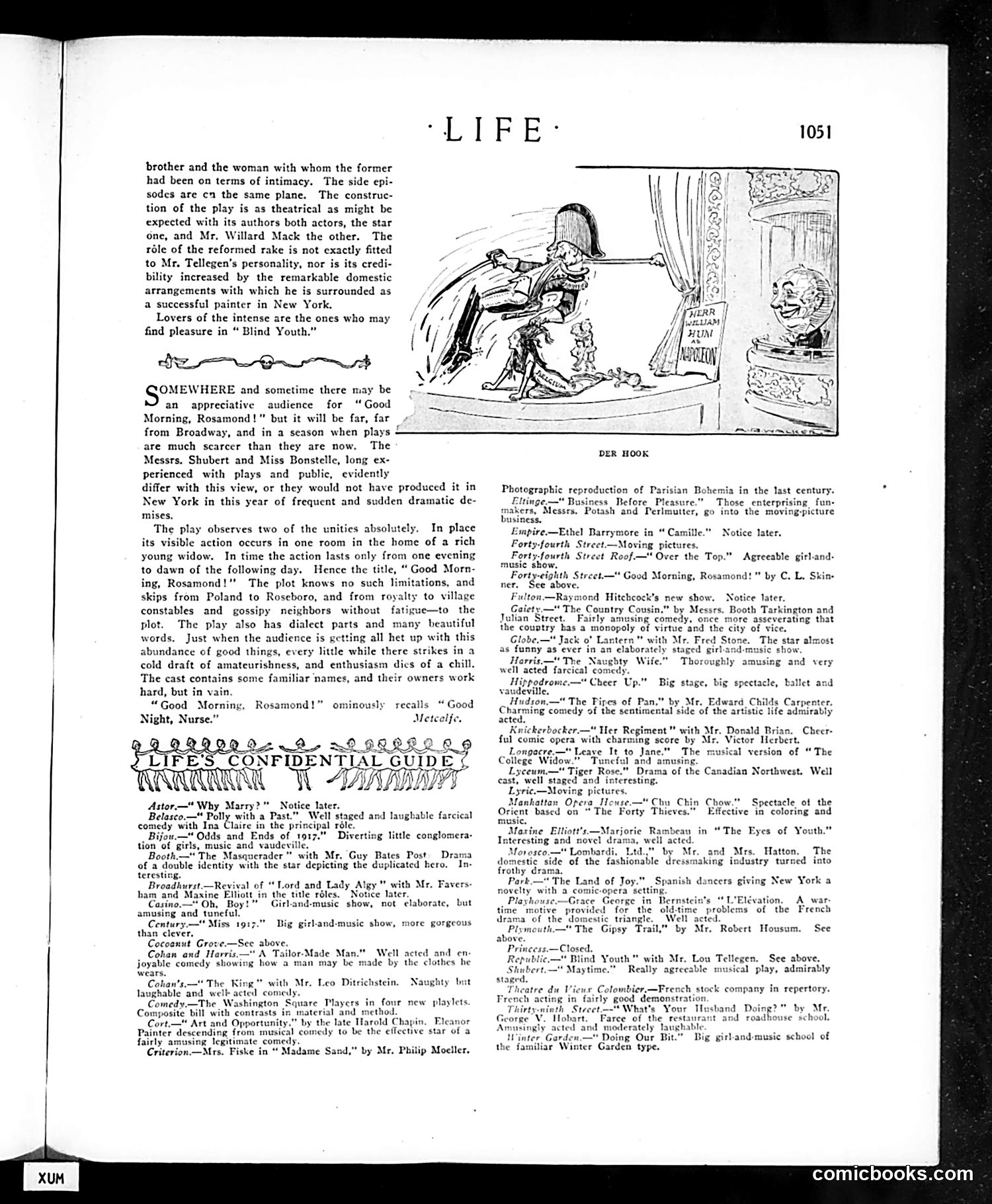
This sketch depicts a theatrical scene labeled "Der Hook," described in the caption as a "photographic reproduction of Parisian Bohemia in the last century." The drawing shows a woman reclining dramatically on a bed or couch while a skeletal or death-like figure looms nearby, with period furnishings visible. The image satirizes Romantic-era theatrical clichés about bohemian Paris—the melodramatic poses, the morbid aesthetics, and the exaggerated emotionalism associated with 19th-century artistic life. The grotesque death figure suggests mockery of overblown theatrical tragedy. This appears in *Life*'s theater review section, likely criticizing contemporary productions that relied on tired stereotypes of bohemian decadence rather than genuine artistic innovation. The satire targets both the source material's theatrical excess and modern productions recycling such worn-out aesthetic tropes.
📄 Transcribed text from this page (OCR, searchable)
Machine-transcribed from the original scan — historical spelling and the odd misread are preserved.
brother and the woman with whom the former had been on terms of intimacy. The side epi- sodes are cn the same plane. The construc- tion of the play is as theatrical as might be expected with its authors both actors, the star one, and Mr, Willard Mack the other. The réle of the reformed rake is not exactly fitted to Mr. Tellegen’s personality, nor is its credi- bility increased by the remarkable domestic arrangements with which he is surrounded as a successful painter in New York. Lovers of the intense are the ones who may find pleasure in “ Blind Youth. ARO Rh OMEWHERE and sometime there may be an appreciative audience for “Good Morning, Rosamond!” but it will be far, far from Broadway, and in a season when plays < are much scarcer than they are now. The Messrs. Shubert and Miss Bonstelle, long ex- perienced with plays and public, evidently differ with this view, or they would not have produced it in New York in this year of frequent and sudden dramatic de- mises. The play observes two of the unities absolutely. In place its visible action occurs in one room in the home of a rich young widow. In time the action lasts only from one evening to dawn of the following day. Hence the title, “ Good Morn- ing, Rosamond!” The plot knows no such limitations, and skips from Poland to Roseboro, and from royalty to village constables and gossipy neighbors without fatigue—to the plot. The play also has dialect parts and many beautiful words. Just when the audience is getting all het up with this abundance of good things, every little while there strikes in a cold draft of amateurishness, and enthusiasm dies of a chill. The cast contains some familiar names, and their owners work hard, but in vain “Good Morning, Rosamond!” ominously Night, Nurse.” recalls “ Good Metcalfe, 2 we rf REQ, CONFIDENTIAL GUID 1 Astor.—" Why Marry?” Notice later. Belasco.— Polly with a Past.” Well staged and laughable far comedy with Ina Claire in the principal réte. Bijou.— Odds and Ends of 1917." Diverting little conglomera- tion of girls, music and vaudeville. Booth.—" The Masquerader” with Mr. Guy Bates Post’ Drama of a double identity with the star depicting the duplicated hero. In- teresting. Broadhurst.—Revi 1 of “Lord and Lad: y" with Mr. Favers- in the title réles. Notice later. Girl-and-music show, not elaborate, but amusing and tuneful. Century.—"" Miss 1917." Dig girland-music show, more gorgeous than clever. Cocoanut Gro: Cohan and Harri joyable comedy showin wears. Cohan’s.—" The King” with Mr. Leo Ditrichstein, laughable and welk acted comedy. Comedy.—The Washington Square Players in fou Composite bill with contrasts in material and method. J Opportunity.” by the late Harold Chay g from musical comedy to be the effec fairly amusing legitimate comedy Criterion.—Mrs. Fiske in“ Madame Sand,” by Mr. Philip Moeller. -—See above. —"A Tailor-Made Man. Well acted and en- x how a man may be made by the clothes he at new playlets 1. Eleanor ve star of a eeLLAM /) xu | St | DER HOOK Photographic reproduction of Parisian Bohemia in the last century. Eltinge —" Business Before, Pleasure.” Those enterprising. fun- makers, Messrs. Potash and Perlmutter, go into the moving-picture business, Empire-—Ethel Barrymore in “Camille.” Notice later. Forty-fourth Strect—Moving pictures. Forty-fourth Street Roof.—" Over the Top.” Agreeable girl-and- music show, Forty-eighth Street." Good Morning, Rosamond! by C. L, Skin« ner, See above. Fulton.—Raymond Hitchcock's new show. Notice later. Gaiety —" The Country Cousin,” by Messrs, Booth Tarkington and Julian Street. Fairly amusing comedy, once more asseverating that the country bas a monopoly of virtue and the city of vice. Globe. —"' Jack o’ Lantern" with Mr. Fred Stone. The star almost as funny as‘ever in an elaborately staged girl-and-music show Harris.—"'The Naughty Wife.” Thoroughly amusing and very well acted farcical comedy. Hippodrome.— Cheer Up.” vaudeville, _ Hudson.—" The Pipes of Pan,” b Charming ‘comedy of the sentimental acted. Big stage, big spectacle, ballet and _Mr. Edward Childs Carpenter. ide of the artistic life admirably “Her Regiment” with Mr. Donald Brian. Cheer- with charming score by Mr. Victor Herbert. _ Longacre. ave It to Jane.” The musical version of “The College Widow."” Tuneful and amusing. Lyceum.—" Tiger Rose.” Drama of the Canadian Northwest. Well cast, well staged and interesting. Lyric.—Moving pictures. fankatten Opera House—* Chu Chin Chow.” Spectacle of the Orient based on “The Forty Thieves.” Evfective in coloring and music, Marine Ettiott "s—Marjorie Rambeau in “The Eyes of Youth.” resting and novel drama, well acted. Morosco.—" Lombardi, Ltd." by Mr. and domestic side of the fashionable dressmaking Mrs. Hatton. The dustry turned into he Land of Joy." Spanish dancers giving New York a a comic-opera setting. —Grace George in Bernstein's “L'Elévation. A_war- J for the old-time problems of the French ic triangle. Well acted. Gipsy Trail,” by Mr, Robert Housum. See ¢s3.—Closed, Blind Youth” with Mr. Lou Tellegen. See above. Rep "Really agreeable musical play, admirably French acting in fairly Thirty-ninth Stecet orge V. Hobart. Farce of the restau! Amusingly acted and moderately laughable :n.—" Doing Our Bit.” Big girl-and-music school of the familiar Winter Garden type. band Doing?” by Mr. 1d roadhouse school, What's You comicbooks.com