
Life, 1917-12-20 · page 18 of 40
Life — December 20, 1917 — page 18: what you’re looking at
What you’re looking at
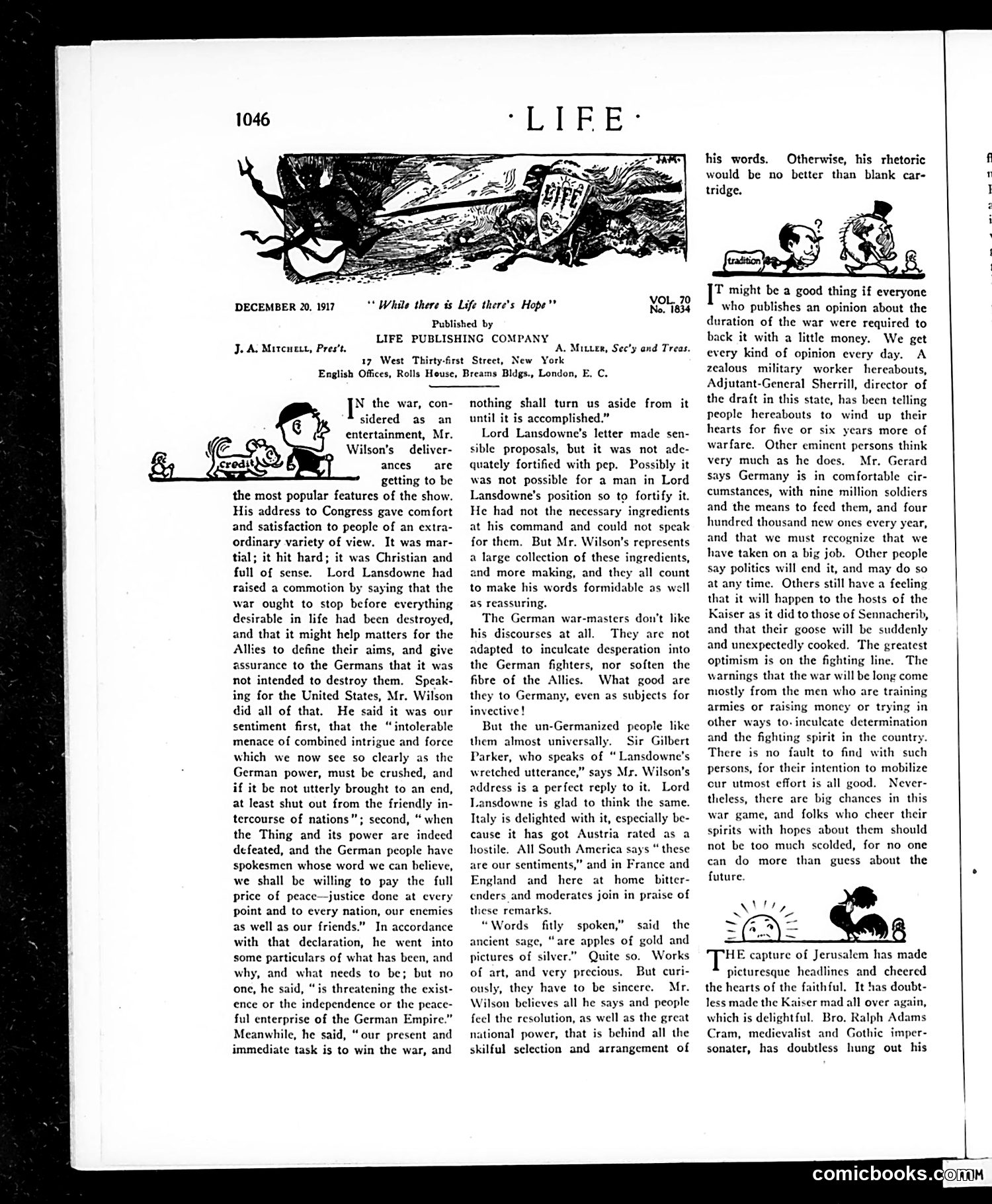
This page analyzes President Woodrow Wilson's recent Congressional address during World War I. The editorial praises Wilson's speech as superior to Lord Lansdowne's (British politician) recent letter calling for peace negotiations, arguing Wilson's words carry more force because they reflect genuine conviction backed by national power. The key political context: Wilson committed America to total victory, explicitly stating Germany's "intolerable menace" must be "crushed" and that peace would come only after Germany's defeat—rejecting Lansdowne's moderate position favoring negotiated settlement. The cartoons (appears to show Uncle Sam figures) likely mock empty political rhetoric—the editorial emphasizes that Wilson's effectiveness stems from sincerity, not mere eloquence. The concluding joke suggests war-duration predictions should require financial backing to discourage baseless speculation. This reflects 1917 American hawkish sentiment favoring unconditional victory over compromise peace.
📄 Transcribed text from this page (OCR, searchable)
Machine-transcribed from the original scan — historical spelling and the odd misread are preserved.
DECEMBER 20. 1917 “While there is Life there's Hope” VOL. 70 No. 1834 Published by LIFE PUBLISHING COMPANY J. A. Mircueut, Pres’t, A. Minter, Sec’y and Treas. 17 West Thirty-first Street, New York English Offices, Rolls House, Breams Bldgs., London, E. C. N the war, con- sidered as an entertainment, Mr. Wilson’s deliver- ances are getting to be the most popular features of the show. His address to Congress gave comfort and satisfaction to people of an extra- ordinary variety of view. It was mar- tial; it hit hard; it was Christian and full of sense. Lord Lansdowne had raised a commotion by saying that the war ought to stop before everything desirable in life had been destroyed, and that it might help matters for the Allies to define their aims, and give assurance to the Germans that it was not intended to destroy them. Speak- ing for the United States, Mr. Wilson did all of that. He said it was our sentiment first, that the “intolerable menace of combined intrigue and force which we now see so clearly as the German power, must be crushed, and if it be not utterly brought to an end, at least shut out from the friendly in- tercourse of nations”; second, “when the Thing and its power are indeed defeated, and the German people have spokesmen whose word we can believe, we shall be willing to pay the full price of peace—justice done at every point and to every nation, our enemies as well as our friends.” In accordance with that declaration, he went into some particulars of what has been, and why, and what needs to be; but no one, he said, “is threatening the exist- ence or the independence or the peace- ful enterprise of the German Empire.” Meanwhile, he said, “our present and immediate task is to win the war, and nothing shall turn us aside from it until it is accomplished.” Lord Lansdowne’s letter made sen- sible proposals, but it was not ade- quately fortified with pep. Possibly it was not possible for a man in Lord Lansdowne'’s position so to fortify it. He had not the necessary ingredients at his command and could not speak for them. But Mr. Wilson’s represents a large collection of these ingredients, and more making, and they all count to make his words formidable as well as reassuring. The German war-masters don't like his discourses at all. They are not adapted to inculcate desperation into the German fighters, nor soften the fibre of the Allies. What good are they to Germany, even as subjects for invective! But the un-Germanized people like them almost universally. Sir Gilbert Parker, who speaks of “ Lansdowne's wretched utterance,” says Mr. Wilson’s address is a perfect reply to it. Lord Lansdowne is glad to think the same. Italy is delighted with it, especially be- cause it has got Austria rated a hostile. All South America says “ these are our sentiments,” and in France and England and here at home bitter- enders and moderates join in praise of these remarks. “Words fitly spoken,” said the ancient sage, “are apples of gold and pictures of silver.” Quite so. Works of art, and very precious. But curi- ously, they have to be sincere. Mr. Wilson believes all he says and people feel the resolution, as well as the great national power, that is behind all the skilful selection and arrangement of his words. Otherwise, his rhetoric would be no better than blank car- tridge. T might be a good thing if everyone who publishes an opinion about the duration of the war were required to back it with a little money. We get every kind of opinion every day. A zealous military worker hereabouts, Adjutant-General Sherrill, director of the draft in this state, has been telling people hereabouts to wind up their hearts for five or six years more of warfare. Other eminent persons think very much as he does. Mr. Gerard says Germany is in comfortable cir- cumstances, with nine million soldiers and the means to feed them, and four hundred thousand new ones every year, and that we must recognize that we have taken on a big job. Other people say politics will end it, and may do so at any time. Others still have a feeling that it will happen to the hosts of the Kaiser as it did to those of Sennacherib, and that their goose will be suddenly and unexpectedly cooked. The greatest optimism is on the fighting line. The warnings that the war will be long come mostly from the men who are training armies or raising moncy or trying in other ways to- inculcate determination and the fighting spirit in the country. There is no fault to find with such persons, for their intention to mobilize cur utmost effort I good. Never- theless, there are big chances in this war game, and folks who cheer their spirits with hopes about them should not be too much scolded, for no one can do more than guess about the future. E capture of Jerusalem has made picturesque headlines and cheered the hearts of the faithful. It has doubt- less made the Kaiser mad all over again, which is delightful. Bro, Ralph Adams Cram, medievalist and Gothic imper- sonater, has doubtless hung out his comicbooks.comfl