
A complete issue · 42 pages · 1911
Life — May 25, 1911
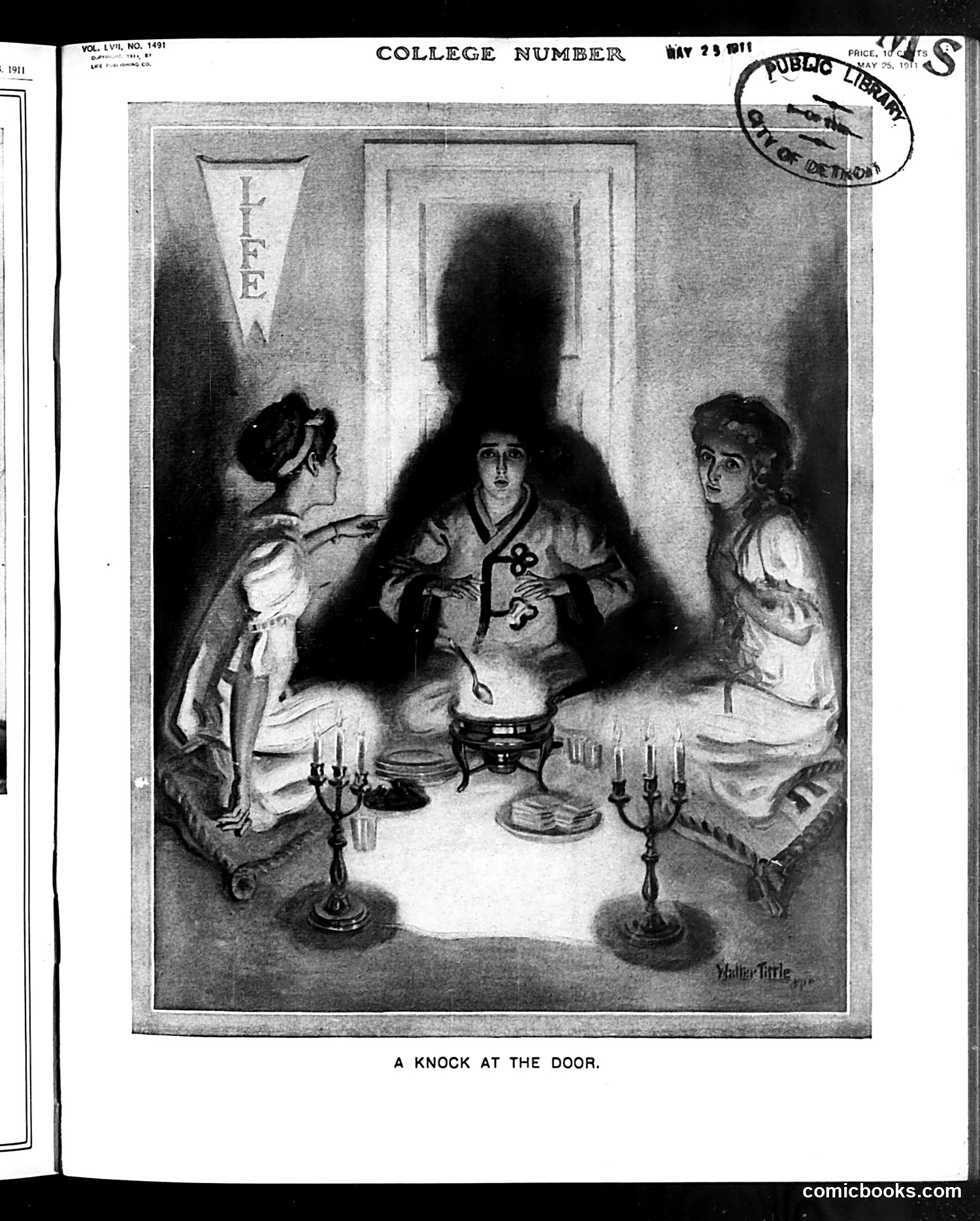
This 1911 *Life* magazine illustration satirizes séance culture—the spiritualist practice of summoning ghosts through mediums, which was popular among wealthy Americans despite widespread fraud. The cartoon depicts three women gathered around a table with candelabras during a séance. A ghostly apparition looms dramatically in the center, wearing what appears to be religious or ceremonial robes. The "LIFE" banner visible suggests this is mocking the spiritualist movement itself. The satire targets the gullibility of séance participants who accepted obvious tricks as genuine supernatural contact. The theatrical staging—the darkness, candles, and the crudely obvious "ghost"—underscores how easily people were deceived by charlatans posing as mediums. The title "A Knock at the Door" likely references the common séance technique of "spirit rapping" to communicate with the dead.
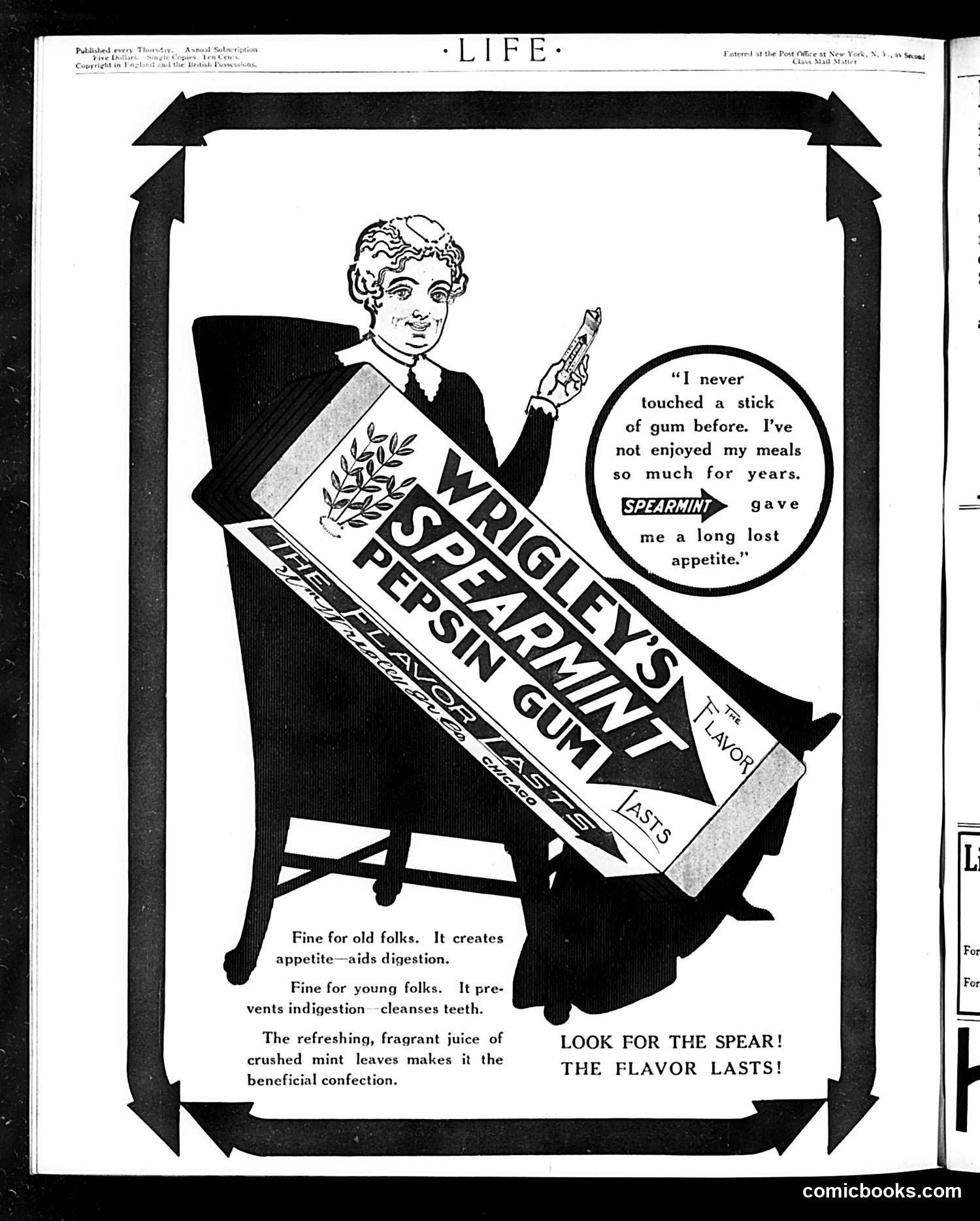
This is an advertisement, not political satire. It promotes **Wrigley's Spearmint Gum**, a brand that still exists today. The ad features a well-dressed man in a chair holding an oversized gum package. The testimonial claims he never chewed gum before but now enjoys meals more and has regained his appetite. The marketing pitch emphasizes the gum's benefits: it "creates appetite" and "aids digestion" for older people, while for younger people it "prevents indigestion" and "cleanses teeth." The "refreshing, fragrant juice of crushed mint leaves" is presented as a "beneficial confection." This reflects early 20th-century advertising claims about gum's medicinal properties—assertions that would face modern regulatory scrutiny. The phrase "The flavor lasts!" emphasizes product durability, a standard selling point.
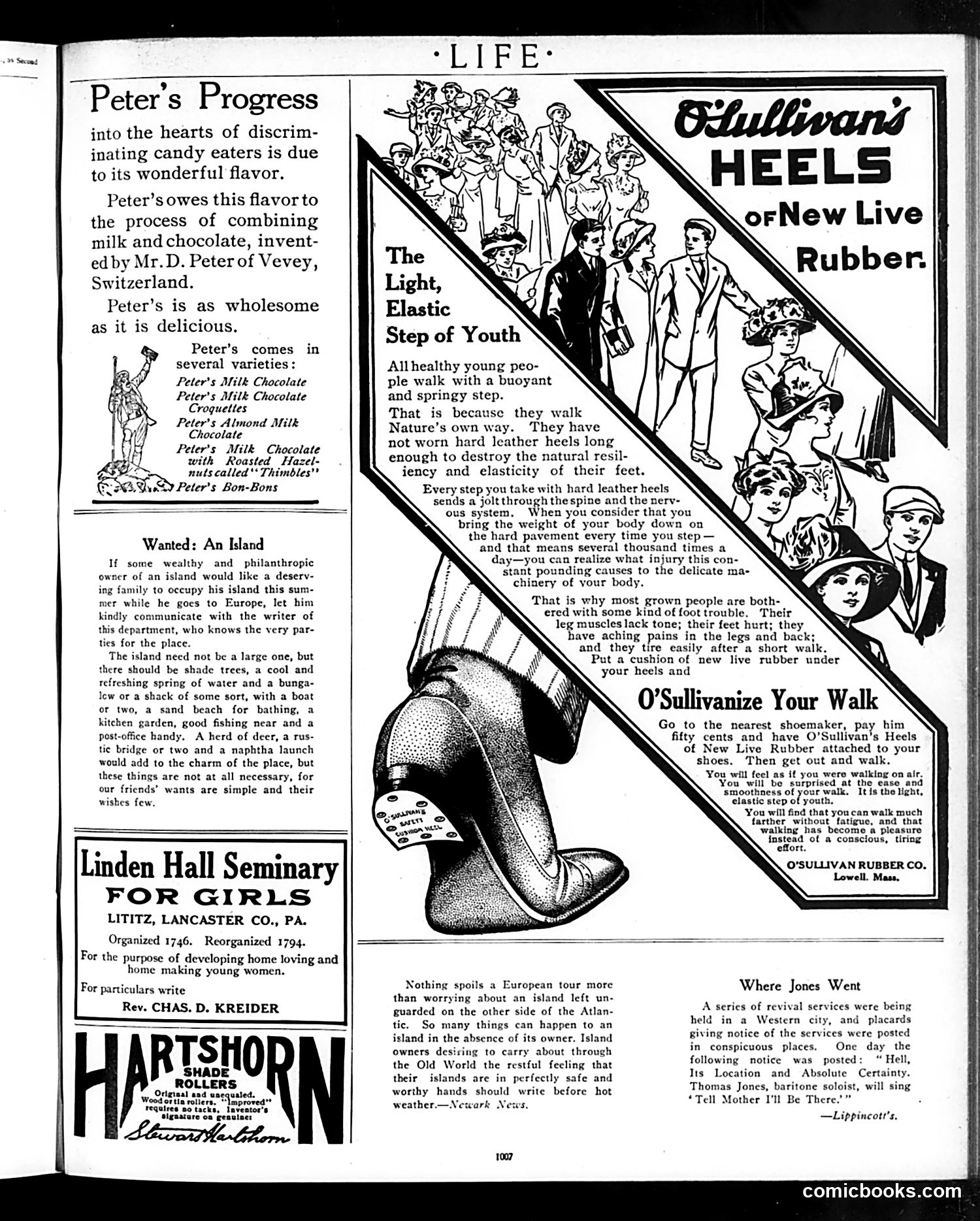
This page is primarily **advertising with minimal editorial content**. The main illustrated advertisement is for O'Sullivan's Rubber Heels, featuring a large detailed drawing of a shoe heel with the product label visible. The ad's satire targets the physical toll of modern urban life: it humorously argues that hard leather heels damage feet and leg muscles, causing pain and fatigue. The solution—O'Sullivan's rubber heels—promises "the light, elastic step of youth" by cushioning impact. The accompanying crowd illustration of well-dressed young people walking reinforces this lifestyle appeal. The page also contains smaller ads for Peter's candy, Linden Hall Seminary, and Hartshodan shade rollers. A brief editorial piece discusses island ownership. This appears to be a standard early-20th-century magazine page mixing commerce with light content.
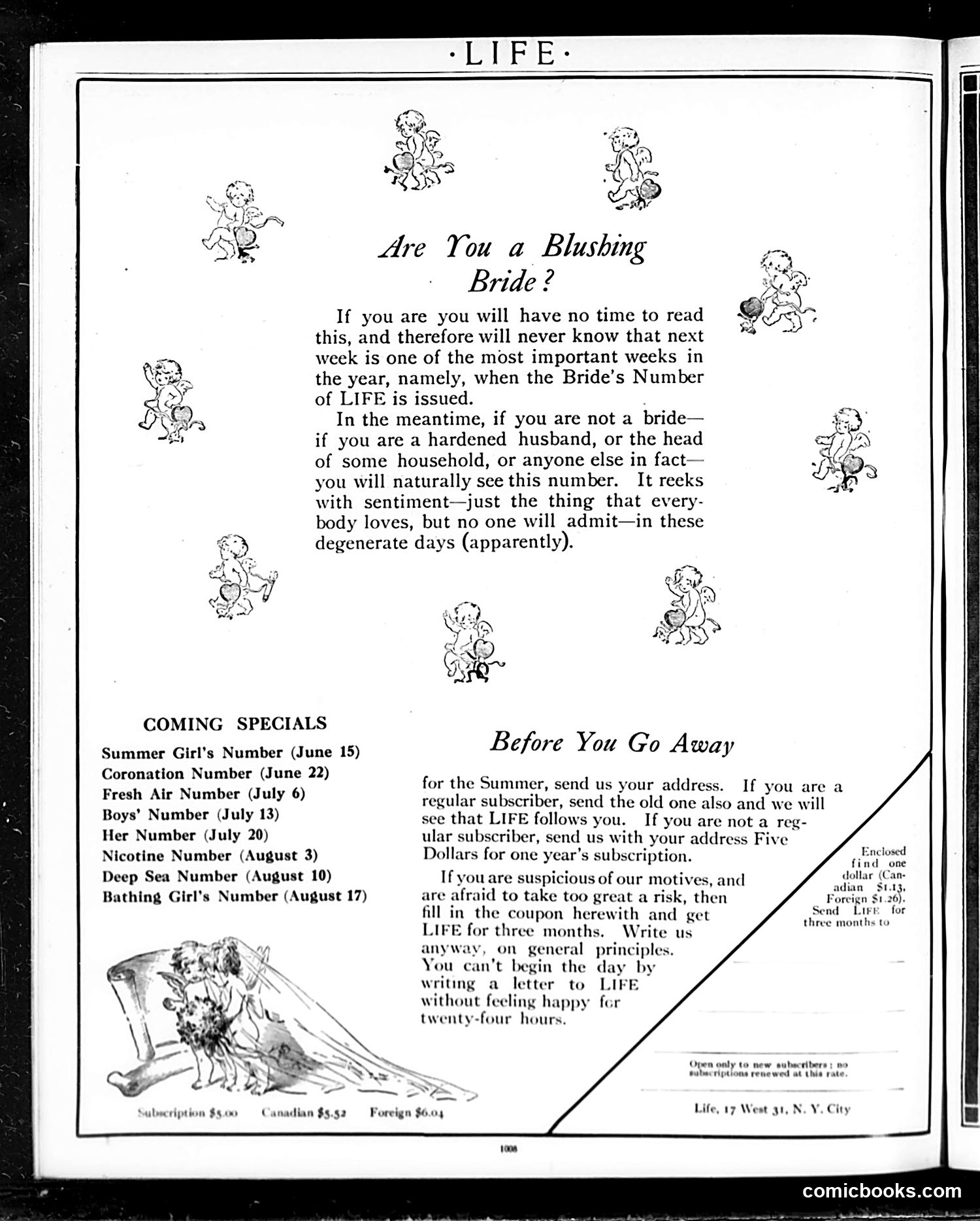
This page is primarily **advertising and subscription promotion** for Life magazine rather than political satire or editorial cartooning. The main content includes: - **"Are You a Blushing Bride?"** — a humorous appeal to readers (especially newly married women) to subscribe, suggesting the upcoming "Bride's Number" is essential reading - **"Coming Specials"** — a list of themed issues (Summer Girl, Coronation, Fresh Air, Boys', etc.) with publication dates - **"Before You Go Away"** — subscription information for summer travelers - A decorative illustration of a bride in a wedding dress at bottom The tone is lighthearted and tongue-in-cheek, poking gentle fun at social conventions around marriage and sentiment, but this is fundamentally a **magazine promotion piece** rather than political commentary or satirical cartooning.
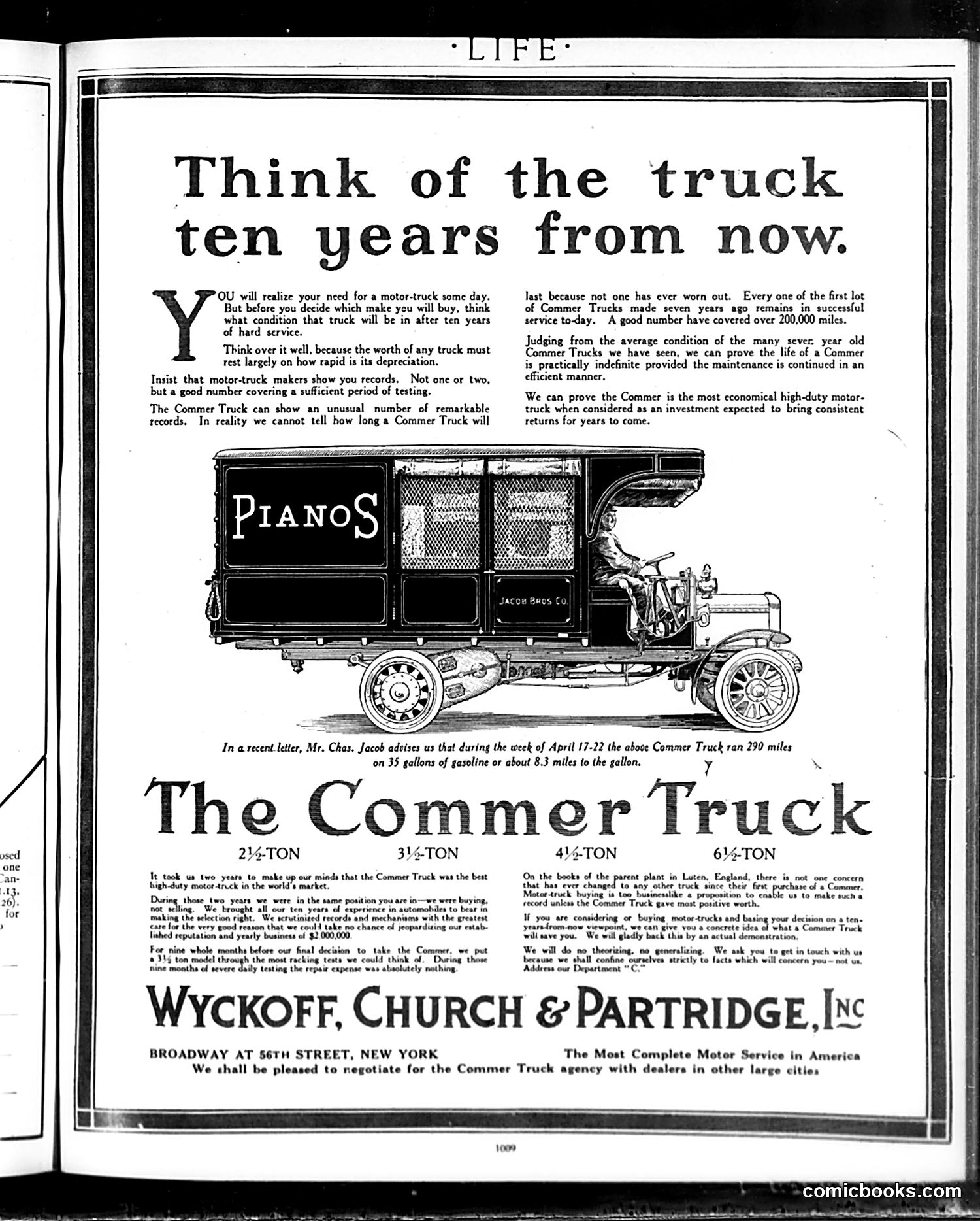
This page is **primarily advertising, not satire or political commentary**. It's a full-page advertisement for the Commer Truck, published by Wyckoff, Church & Partridge, Inc. in New York. The ad uses a sales argument rather than humor or satire: it encourages potential buyers to consider the truck's long-term value and durability. The headline "Think of the truck ten years from now" emphasizes longevity and depreciation rates. The image shows a Commer delivery truck (carrying pianos) from the early automotive era. The ad cites an example of a truck driven 290 miles on 35 gallons of gasoline to demonstrate fuel efficiency. There is no political cartoon or satire present on this page—it's straightforward commercial persuasion aimed at business purchasers considering motor-truck investment.
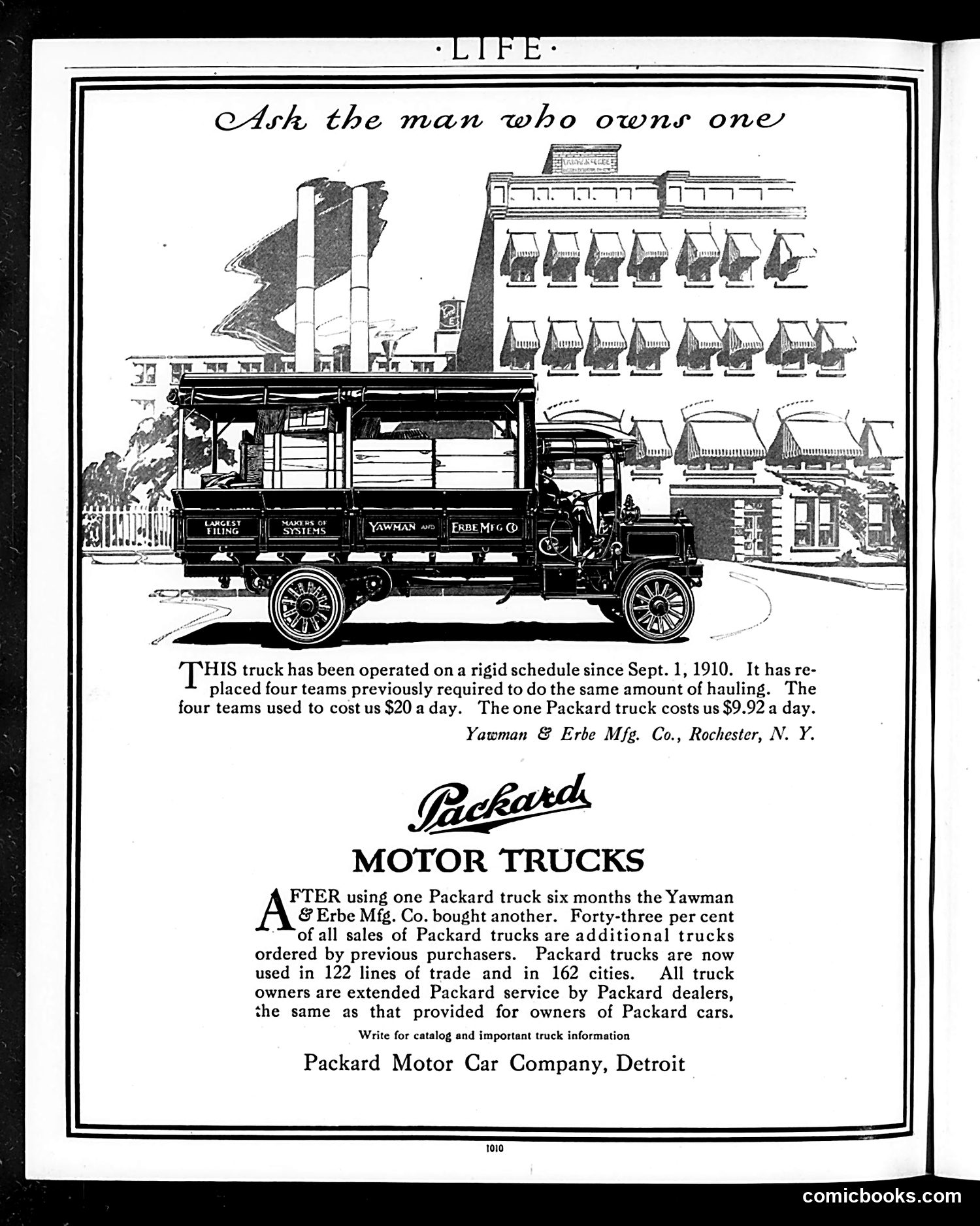
This is **not a cartoon or satire** — it's a straightforward advertisement for Packard Motor Trucks, appearing in *Life* magazine circa 1910. The ad promotes a truck operated by Yawman & Erbe Manufacturing Company in Rochester, New York. The key sales pitch is **economic efficiency**: one Packard truck replaced four horse-drawn teams while costing only $9.92 per day versus $20 daily for the teams it displaced. The illustrated truck showcases the vehicle's capacity and modern design. The ad emphasizes Packard's growing market presence (122 trade lines, 162 cities) and customer loyalty (43% of buyers purchase additional trucks). This reflects early automotive advertising's focus on **demonstrable cost savings** to convince businesses to adopt motorized transport over traditional horse power.
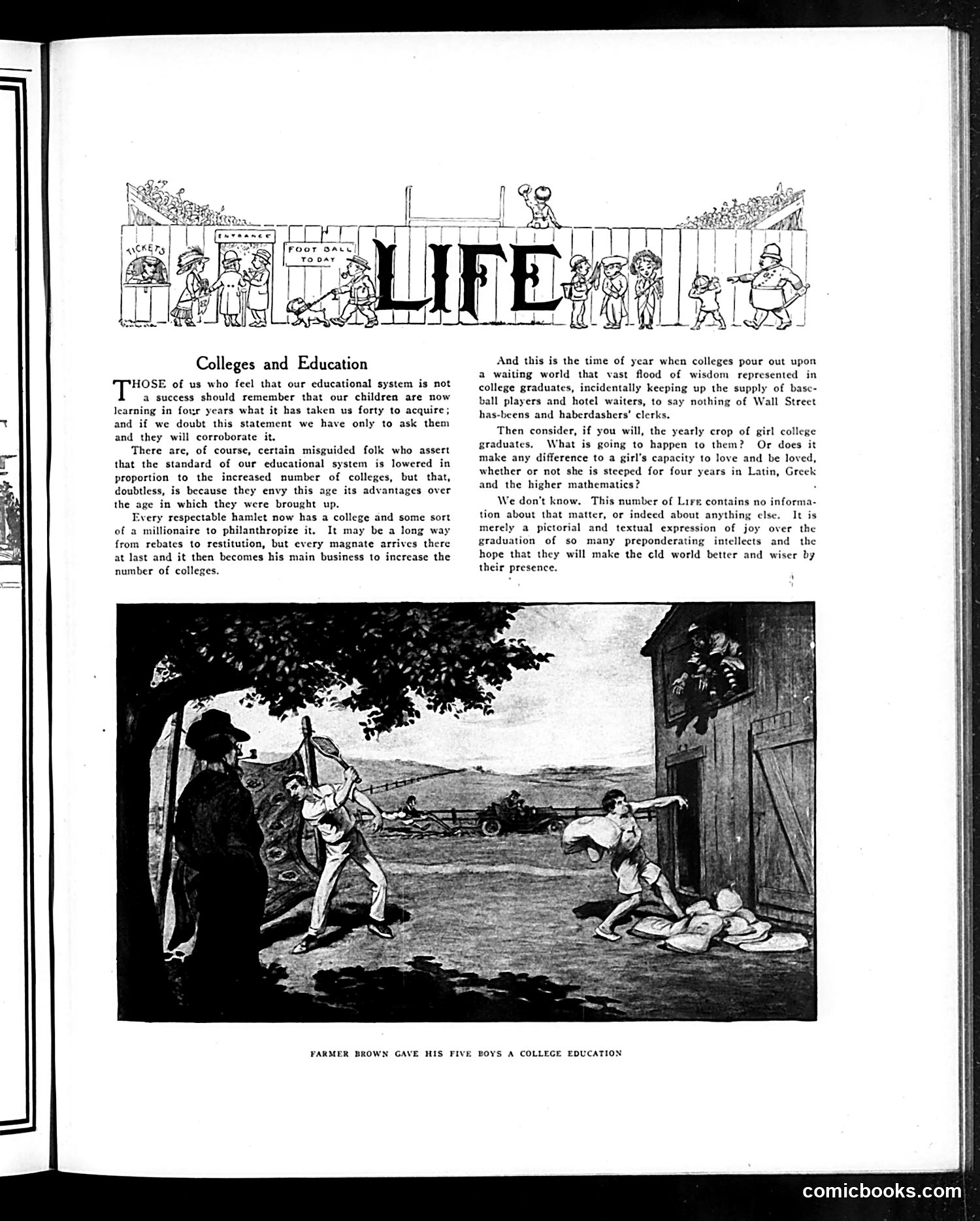
This page critiques the expansion of American colleges in the early 20th century. The text argues that while colleges are proliferating, children are learning in four years what previously took longer, questioning whether increased college numbers genuinely improves education quality. The satirical cartoon at top depicts "LIFE" as a literal institution with various activities—suggesting colleges mirror real life rather than transcending it. The illustration below, captioned "FARMER BROWN GAVE HIS FIVE BOYS A COLLEGE EDUCATION," appears darkly ironic. It shows rural children at play/work rather than in formal academic settings, mocking the gap between promised "college education" and actual rural educational reality—suggesting that merely naming something education doesn't make it so.
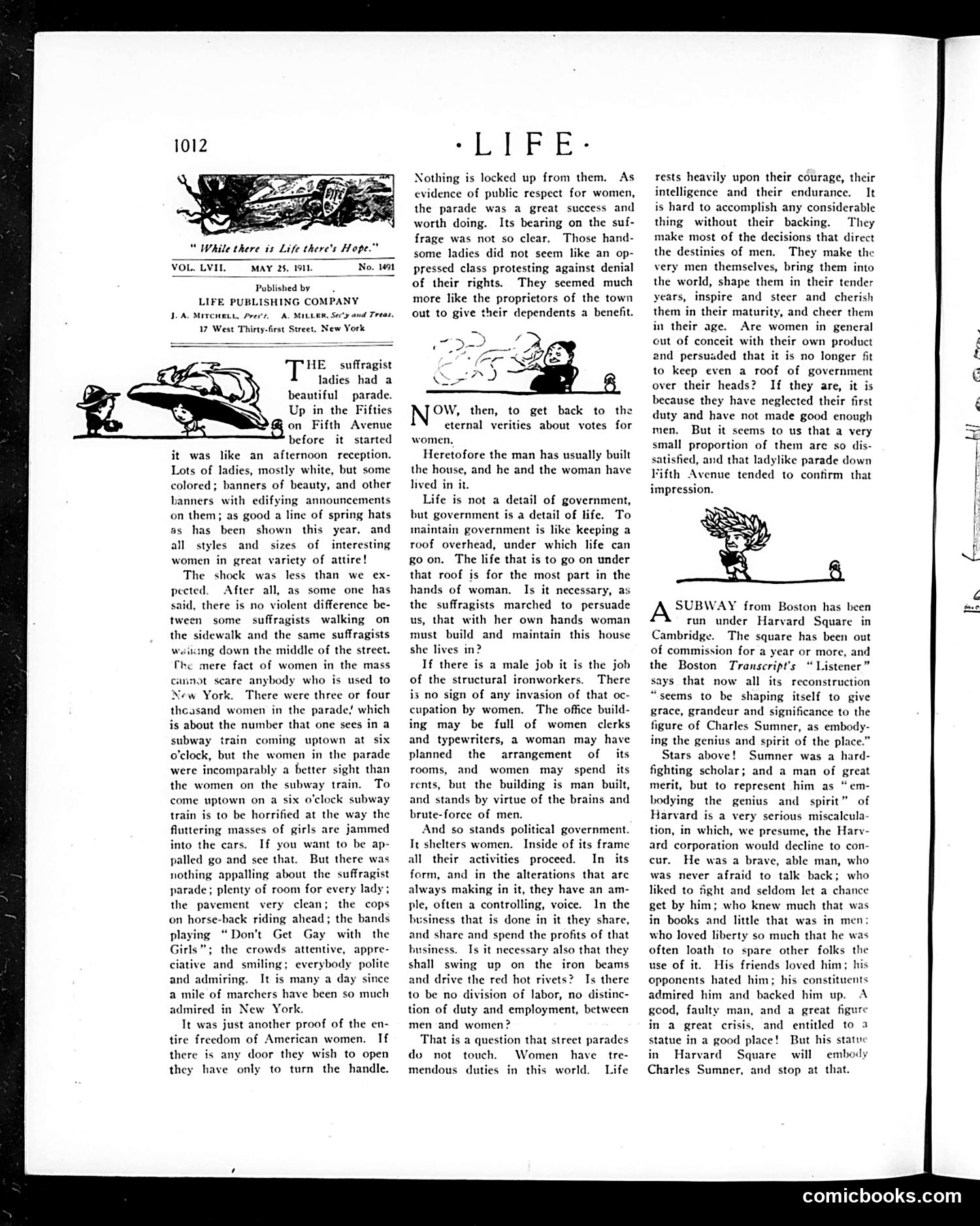
This page discusses the women's suffrage parade held on Fifth Avenue in New York. The text describes the event as a successful demonstration of women's political activism, with well-dressed participants marching to advocate for voting rights. The cartoons (though small and stylized) appear to depict suffragists and their supporters. The article sarcastically debates whether women are equipped for political participation, questioning whether they should concern themselves with "eternal verities about votes" or focus instead on domestic duties. The piece ultimately argues that government is interconnected with daily life, and since women manage households, they should have a voice in governance. The Boston subway construction reference and Charles Sumner tribute contextualize this as serious political commentary on women's emerging public role during the Progressive Era.
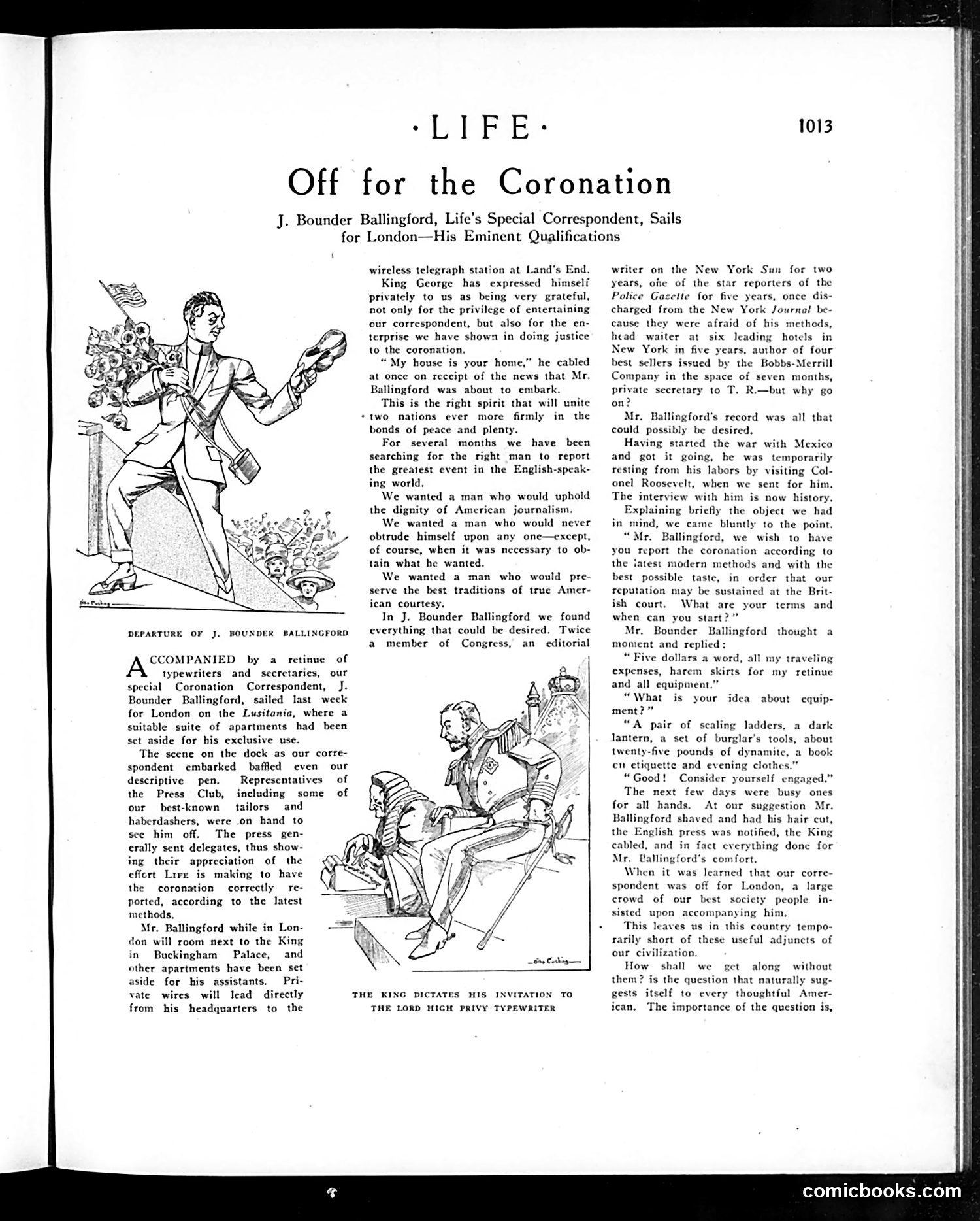
This page satirizes J. Bounder Ballingford, Life's special correspondent sent to cover King George's coronation in London. The cartoon depicts Ballingford as an absurdly over-equipped journalist, surrounded by excessive luggage and supplies. The satire targets pretentious American press coverage of British royal events. Ballingford exemplifies the stereotype of the self-important American reporter—arriving with unnecessarily elaborate equipment, servants, and entourage to cover what should be straightforward reporting. The second illustration shows "the King dictates his invitation to the Lord High Privy Typewriter," further mocking the grandiose preparations surrounding the coronation event itself. The piece humorously questions how American journalism will cover this "greatest event in the English-speaking world" while subtly critiquing both American media excess and British pomp.
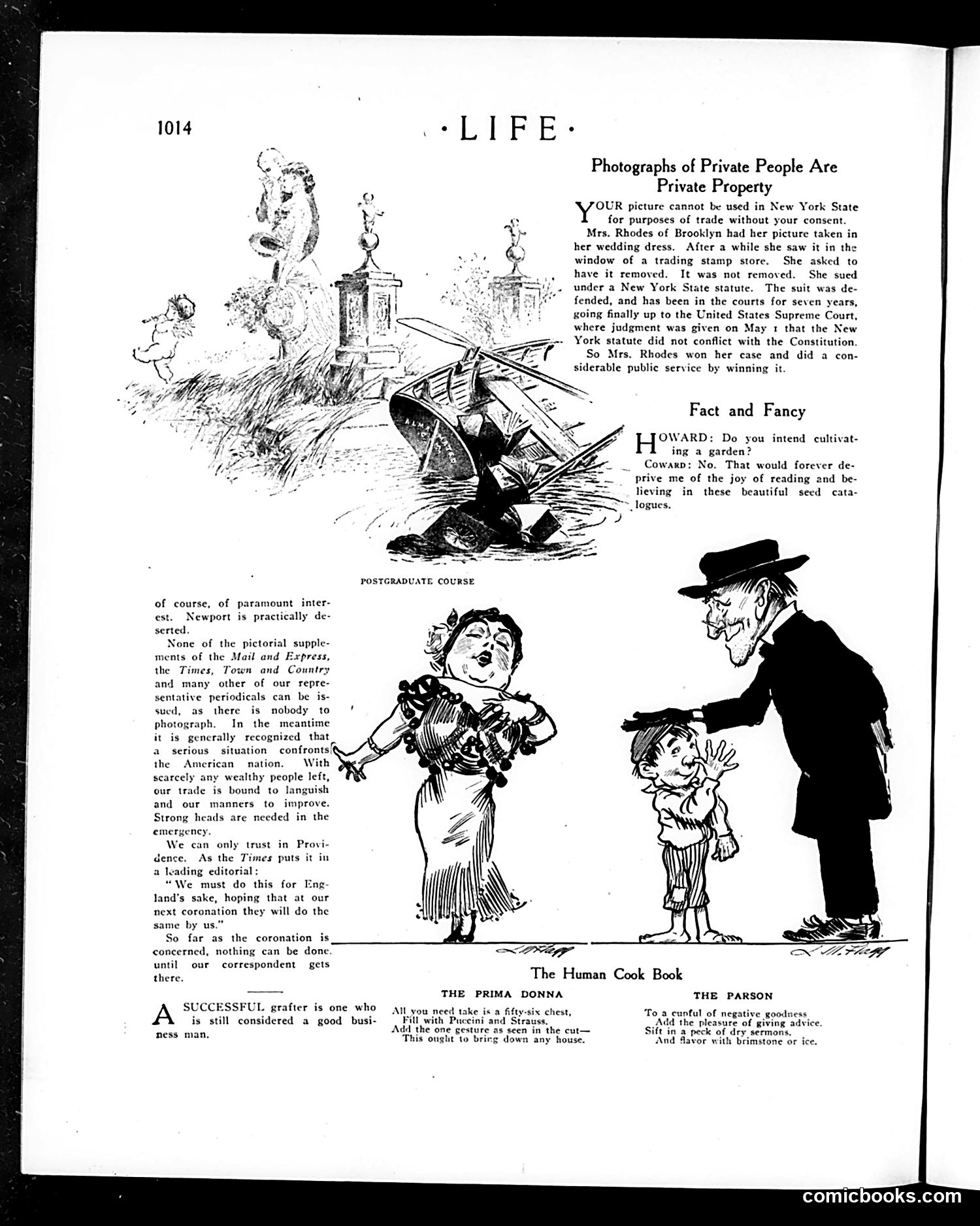
This page contains three distinct sections: **Top Article**: "Photographs of Private People Are Private Property" discusses Mrs. Rhodes of Brooklyn, whose wedding photograph was used without permission by a trading stamp store. The case went to the New York Supreme Court, establishing that the state statute protects private citizens' images from commercial use—a significant privacy rights victory. **Middle Section**: "Postgraduate Course" discusses Newport's social scene and critiques American journalism for lacking serious pictorial content. **Bottom Cartoons**: Two humorous domestic scenes titled "The Human Cook Book"—"The Prima Donna" (woman with baby) and "The Parson" (man with child)—appear to satirize stereotypical family or social types through exaggerated caricature. The page blends serious legal commentary with lighthearted social satire typical of Life magazine's format.
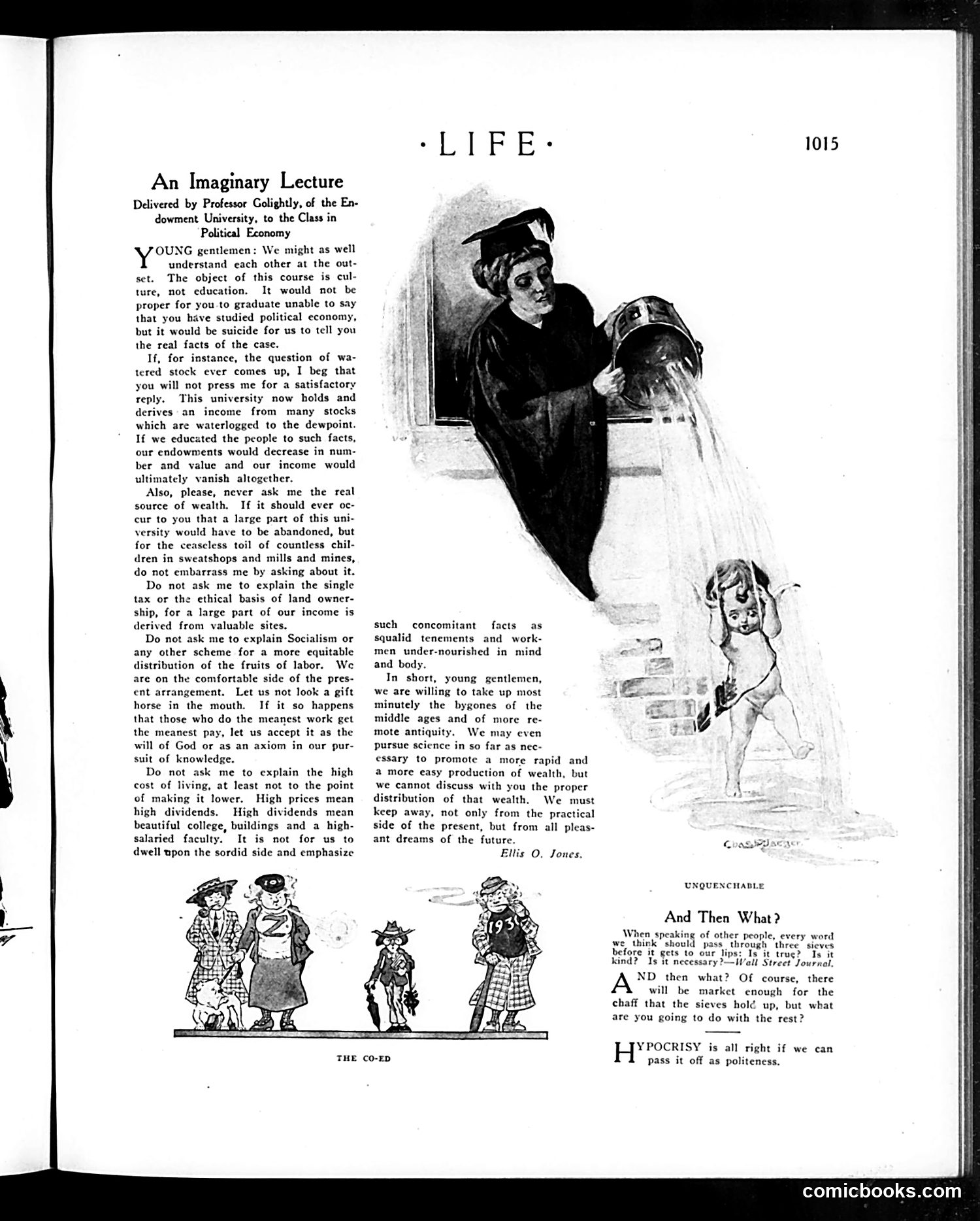
**"An Imaginary Lecture"** presents Professor Golightly addressing Political Economy students. The satire mocks academic evasion of uncomfortable truths about wealth inequality. The professor warns students never to ask about waterlogged stocks, child labor in factories and mines, or the ethical basis of land ownership—essentially instructing them to ignore capitalism's exploitative realities while pursuing "science" of economics. **"The Co-ed"** cartoon below depicts women in period dress, likely satirizing early 20th-century gender dynamics. **"And Then What?"** and **"Hypocrisy"** are brief quips questioning market economics and political dishonesty. The overall message critiques how institutions sanitize economic theory while obscuring its brutal human costs.
This page contains the opening chapters of a serialized short story titled "An Easy Victory," not a political cartoon. The narrative follows Flossie Sparkton, a young woman at Miss Twitchell's fashionable finishing school in America, who receives a note from Peter Shorthead, "the greatest expert in the country, author of 'Bridge,' 'More Bridge,' 'Ye More Bridge,' and 'Bridge Forever.'" Shorthead has wagered he can teach Flossie bridge strategy well enough to win a high-stakes card game. The story satirizes turn-of-the-century American social climbing and competitive gentility—particularly women's education focused on accomplishing parlor games rather than substantive knowledge. The humor derives from Flossie's desperation and the absurdity of treating bridge expertise as a path to social redemption.
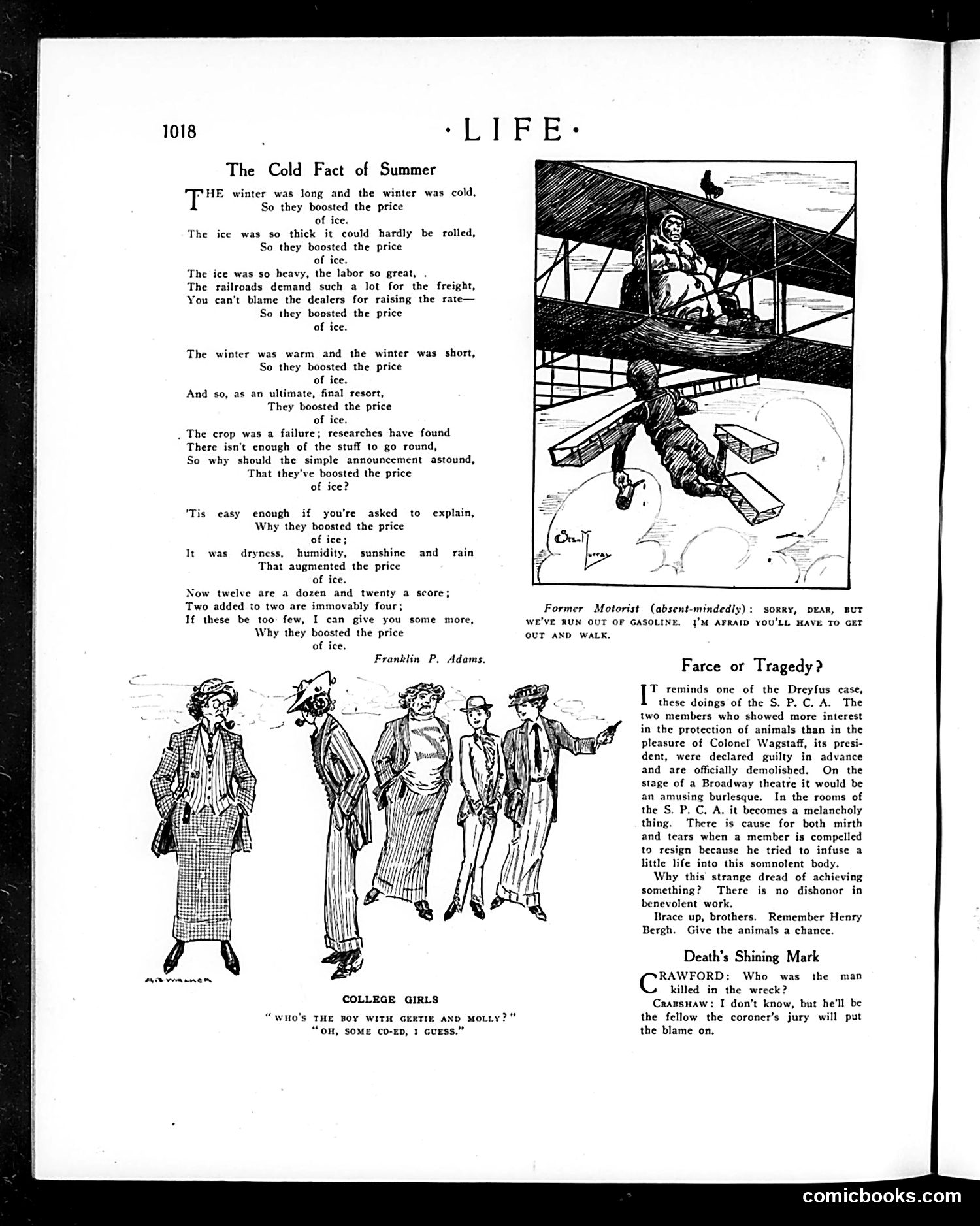
Franklin P. Adams's poem satirizes the ice industry's price-gouging during summer months. Ice was essential for refrigeration before electric cooling existed, making it a necessity rather than a luxury good. The satire's point: no matter the actual conditions—whether winter was harsh or mild, whether ice was abundant or scarce—dealers always raised prices. Adams mocks the contradictory excuses offered: "winter was long and cold" (prices up), then "winter was warm and short" (prices still up). Weather, supply problems, railroad freight costs—every circumstance becomes justification for the same outcome. The accompanying motorist cartoon plays on similar scarcity anxieties: gasoline shortages now paralleling ice shortages, requiring manual labor instead of mechanical convenience. Both items critique exploitation of essential commodities when demand exceeds supply or competition fails.
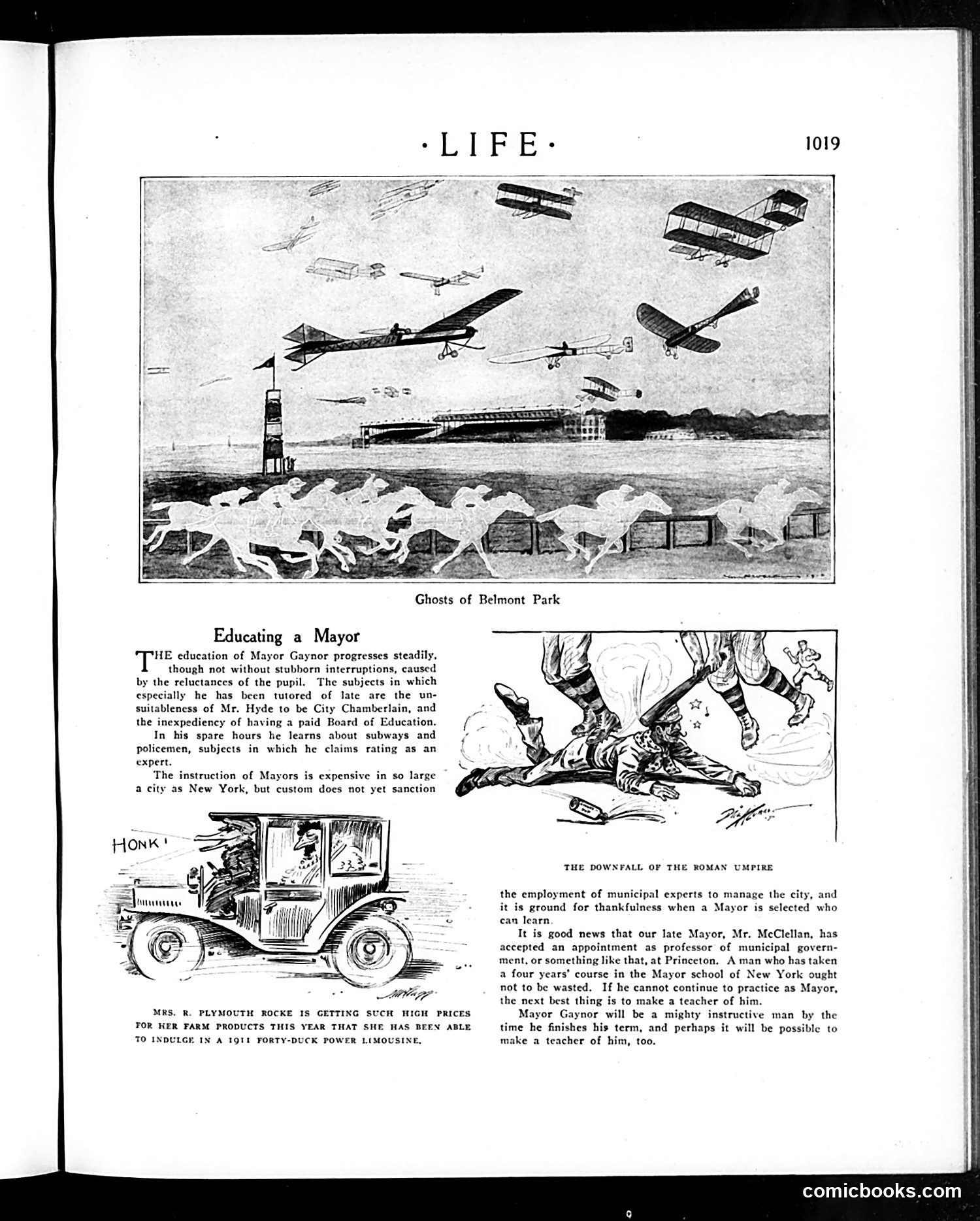
This page satirizes **Mayor William O. Gaynor of New York City**, depicting him as a reluctant student requiring remedial instruction. The article mocks his resistance to reforms, particularly regarding: - **Mr. Hyde's** fitness as City Chamberlain (financial administrator) - A paid Board of Education The satire suggests Gaynor learns only through painful experience rather than foresight. The illustration of a car honking at him reinforces the joke—he's even "educating" himself about modern life slowly. The second piece references his **predecessor, Mayor McClellan**, who accepted a Princeton professorship. The columnist sardonically suggests that since McClellan received a four-year "education" serving as Mayor, he's now qualified to teach municipal government elsewhere. The overall message: New York's mayors require extensive on-the-job training because the city doesn't employ professional municipal experts. This was a Progressive Era critique of amateur political management versus professional administration.
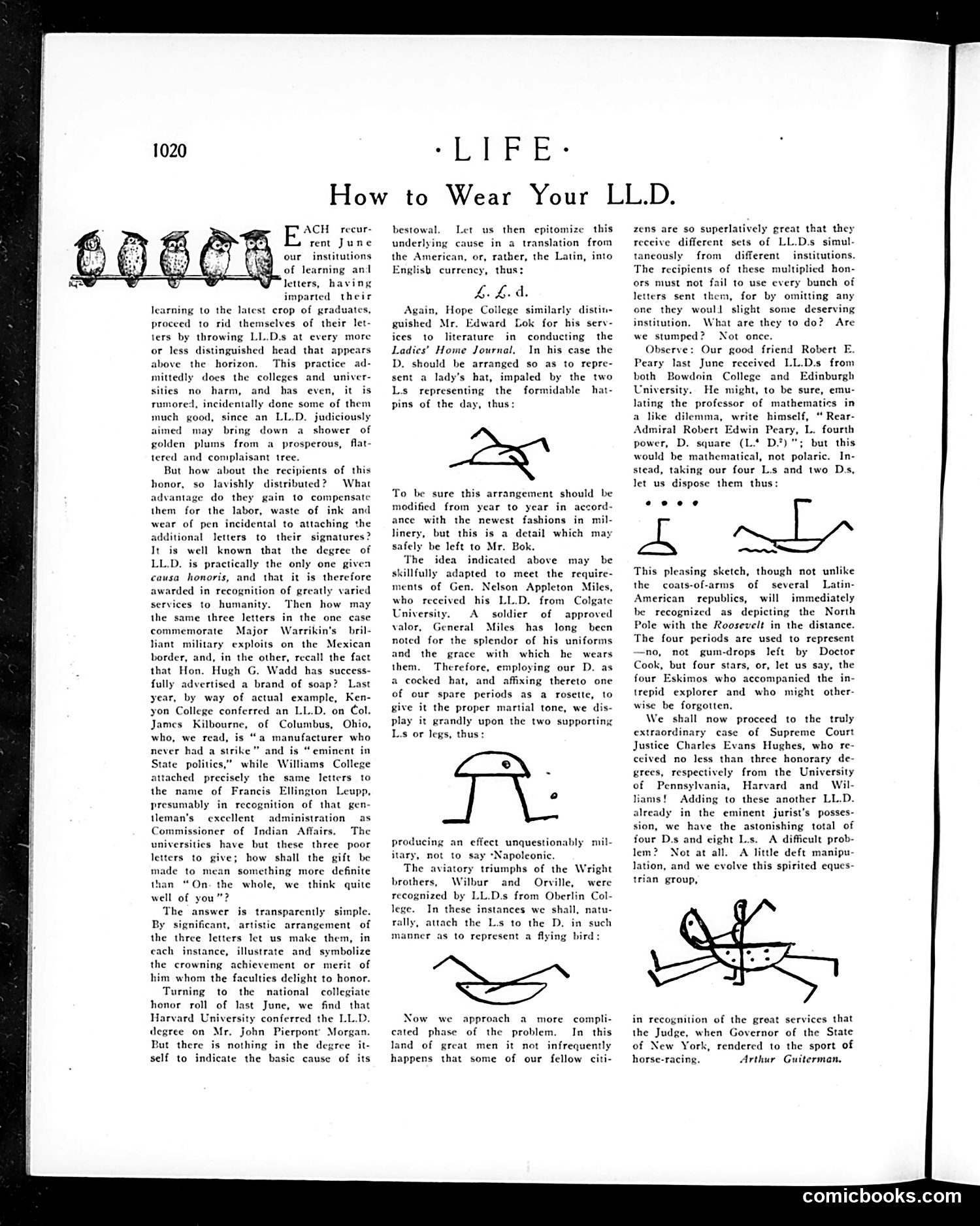
This is a humorous essay mocking the proliferation of honorary doctorates (LL.D. degrees) awarded by American universities to various public figures. The author argues these honors are meaninglessly distributed to people of vastly different accomplishments—from genuine statesmen like J.P. Morgan to soap manufacturers—making the degree essentially meaningless. The satire's solution: arrange the three letters L.L.D. visually to *represent* each honoree's actual claim to fame. Simple sketches show this concept: Morgan's letters become dollar signs (symbolizing his financial power); Edward Bok's (editor of *Ladies' Home Journal*) form a woman's hat with hatpins; General Nelson Miles's become a military figure with a cocked hat and medals. The joke satirizes both universities' crass honor-selling and the absurdity of trying to make generic letters meaningful through creative typography—highlighting how arbitrary these awards actually are.
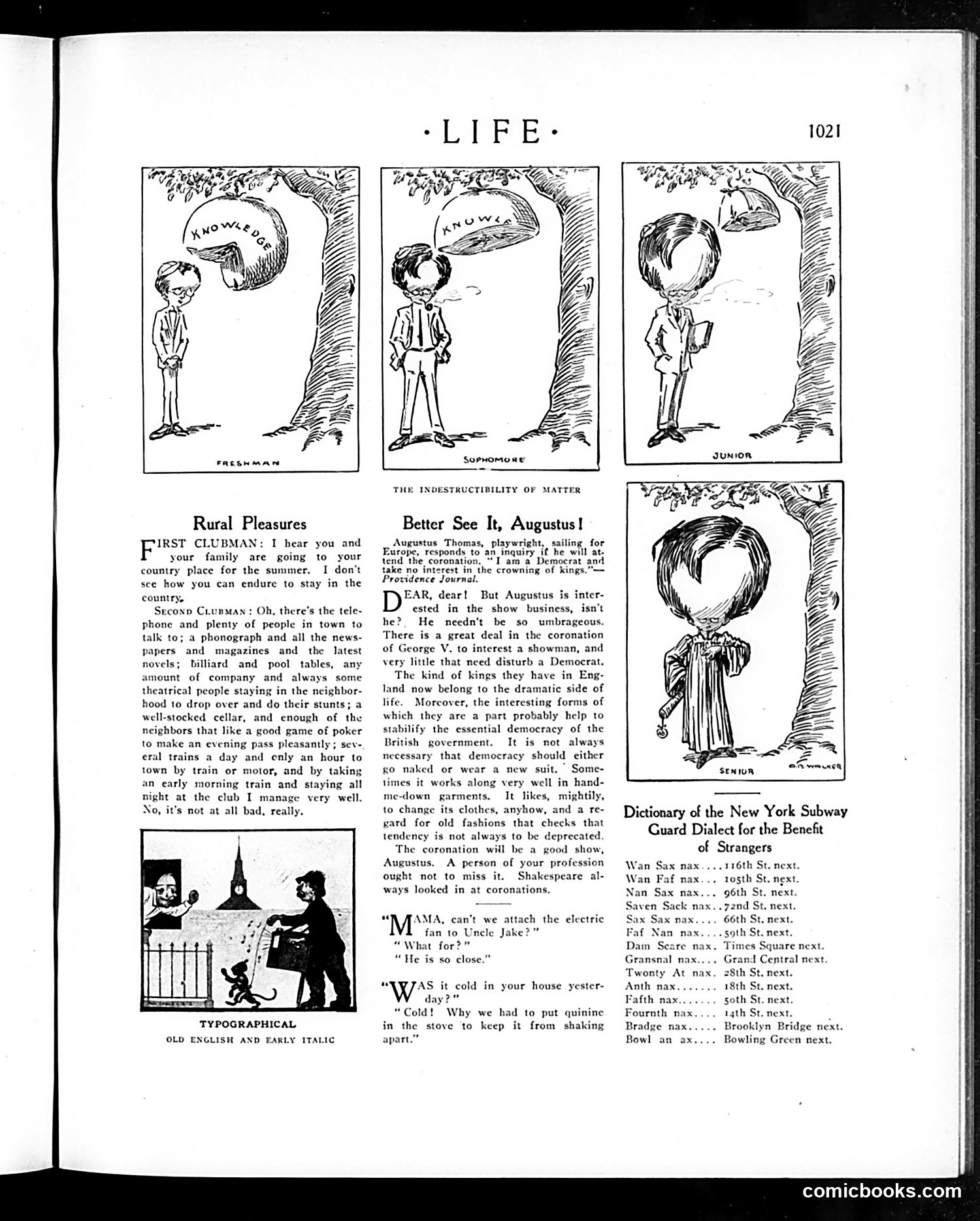
**"The Indestructibility of Matter"** (top comics): This three-panel strip satirizes how students' knowledge expands through education—each panel shows a figure under a tree with a falling object labeled "Knowledge." A freshman gets hit by a small sphere; a sophomore by a larger one; a junior by an even bigger one. The final panel shows a senior completely buried. The joke: education makes problems progressively worse, or knowledge becomes an increasing burden. **"Better See It, Augustus!"** (center): Playwright Augustus Thomas announced he wouldn't attend King George V's coronation because he's a Democrat opposed to monarchy. The editorial response mocks his position as hypocritical—his real interest is theatrical spectacle, not politics. Shakespeare attended coronations for the drama, it argues, so shouldn't a playwright? This satirizes selective moral posturing by artists. **"Rural Pleasures"** and other items fill remaining space with period humor about country living, subway dialects, and domestic inconveniences—typical Light magazine content of the era.
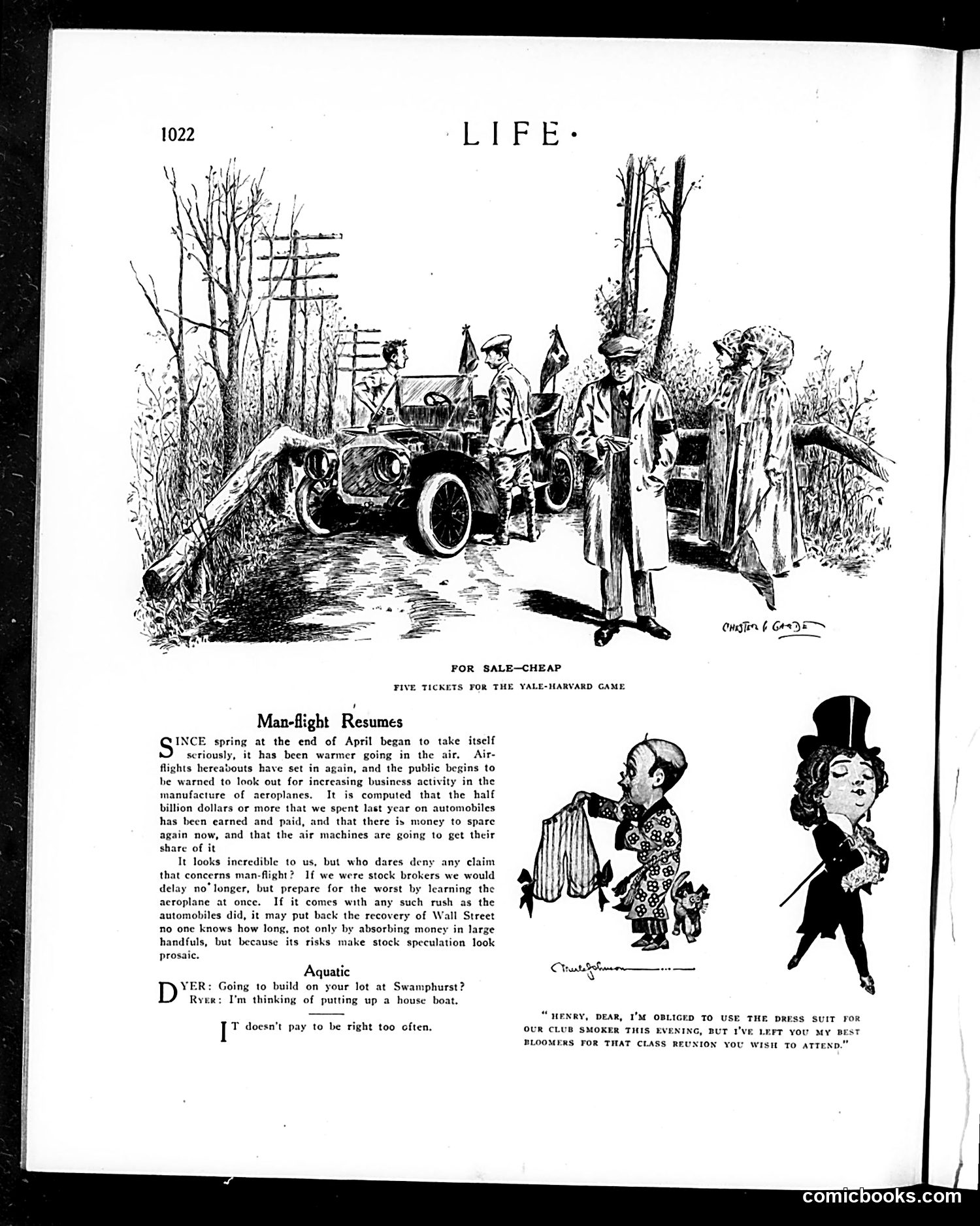
The top cartoon satirizes wealthy leisure: a man offers "five tickets for the Yale-Harvard game" as a cheap sale item—suggesting even premium entertainment has lost value, likely referencing post-WWI economic uncertainty or market saturation among the affluent. "Man-flight Resumes" discusses aviation's commercial future. The text humorously warns that airplane manufacturing will boom like automobiles did, potentially draining investment capital and destabilizing Wall Street through speculation—a prescient concern about new industries disrupting established markets. The "Aquatic" dialogue jokes about suburban real estate: a homeowner considers building a houseboat rather than a traditional house, possibly mocking uncertain economic times or the absurdity of such hedging strategies. The bottom cartoon depicts marital role-reversal humor: a wife borrows her husband's dress suit for a club smoker while offering her "bloomers" (women's athletic wear) for his class reunion—satirizing changing social conventions and women's increasing public participation in the 1920s.
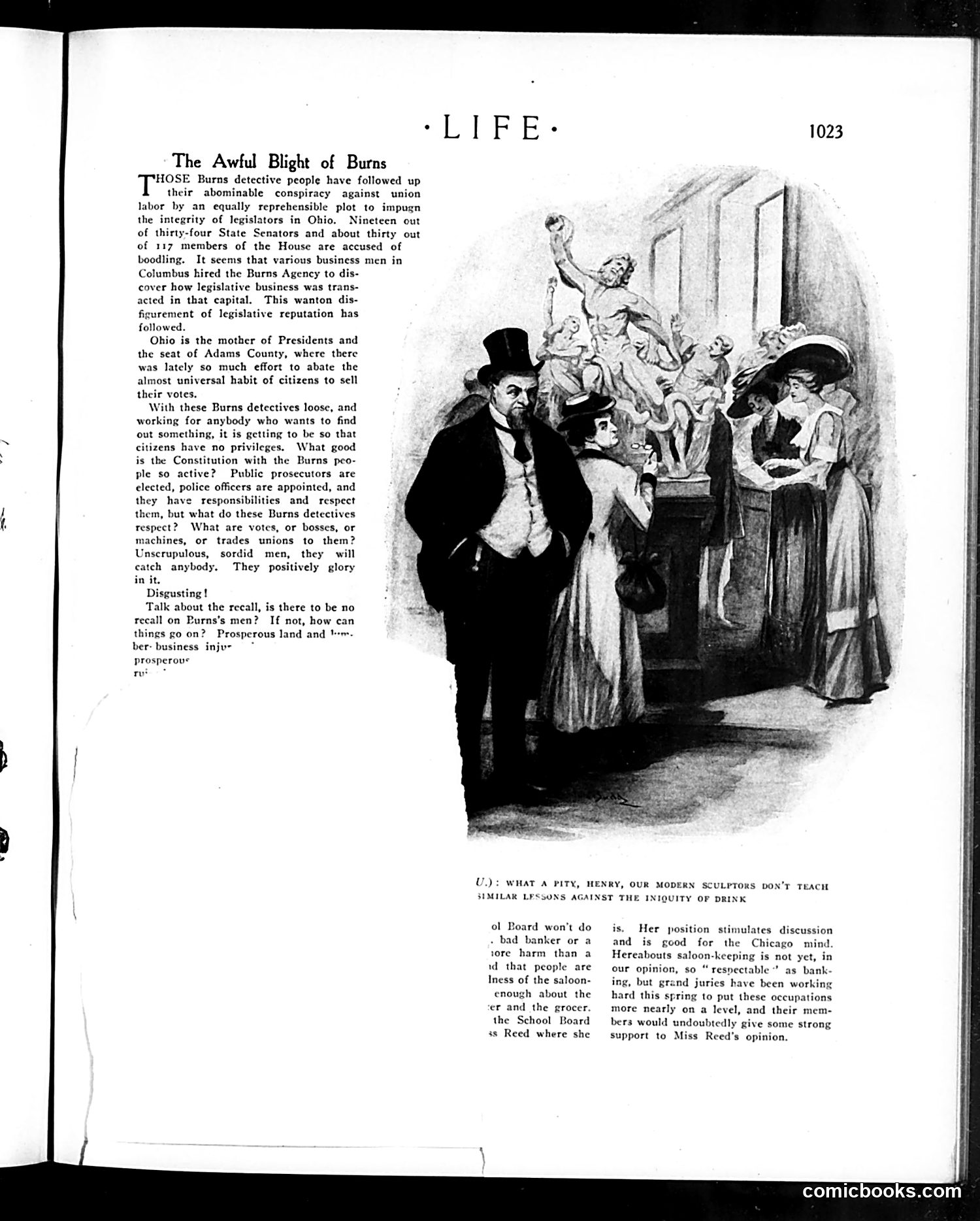
This article satirizes the Burns Detective Agency's investigations into corruption in Ohio's state legislature. The text reveals that Burns operatives, hired by Columbus businessmen, uncovered that roughly 34 state senators and 30+ representatives were engaged in "boodling" (accepting bribes). Life's satire targets the *hypocrisy* of exposing legislative corruption while implying detectives like Burns themselves operate without accountability or respect for constitutional protections. The author sarcastically questions what makes Burns detectives—described as "unscrupulous, sordid men"—morally superior to the corrupt politicians they expose. The accompanying cartoon (caption references "modern sculptors" and "drink") appears to critique how society tackles corruption selectively: addressing saloon-keepers while ignoring worse offenders in banking and public office. The piece reflects Progressive Era tensions over private detective agencies' expanding investigative powers versus democratic oversight.
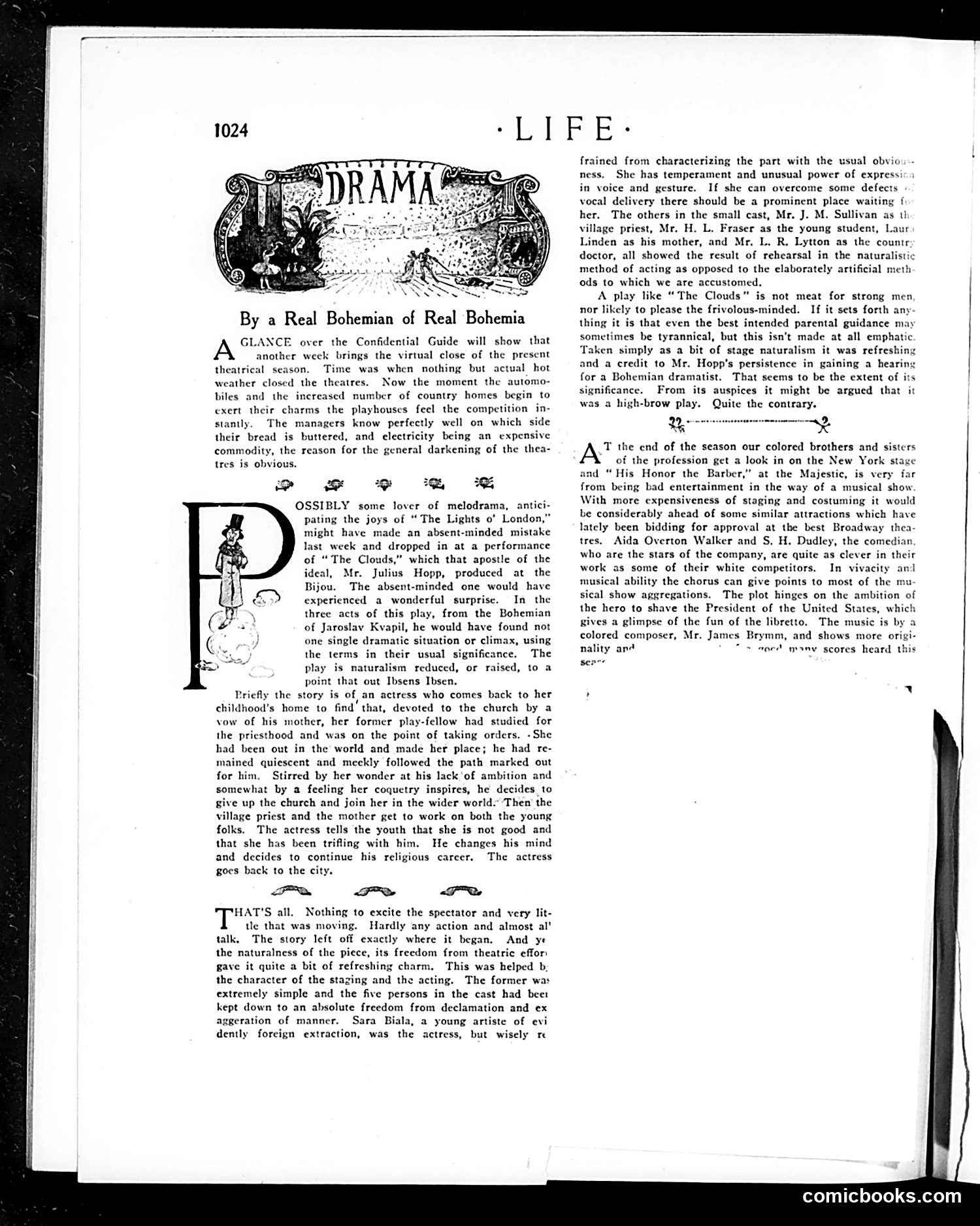
This is a theater review, not a political cartoon. The author critiques a Bohemian play called "The Clouds" by Jaroslav Kvapil, performed at the Bijou theater. The piece satirizes the play's extreme naturalism—it has virtually no dramatic action, climax, or plot development, simply ending where it began. A former actress returns to her village, briefly tempts a would-be priest to abandon his calling, but ultimately leaves unchanged when confronted with her own moral failings. The reviewer notes the play "out-Ibsens Ibsen" (exceeds even Ibsen's naturalistic minimalism) and argues it lacks broad appeal—unsuitable for "strong men" or "frivolous-minded" audiences. However, the author credits the production's refreshing authenticity: simple staging, restrained acting without melodramatic exaggeration, and lead actress Sara Biala's genuine emotional depth despite minor vocal delivery issues. The satire targets pretentious avant-garde theater that prioritizes philosophical naturalism over entertainment value.
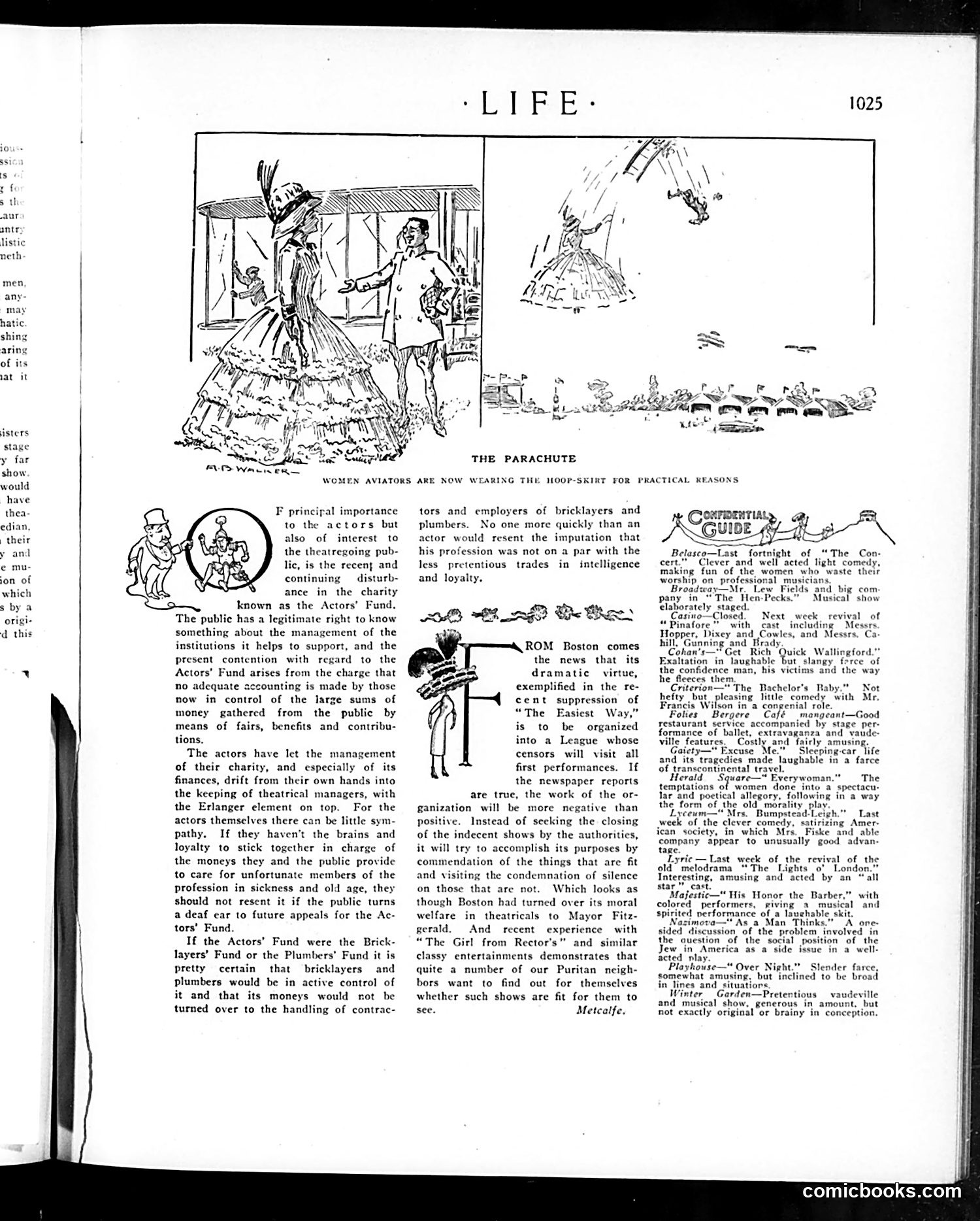
This page discusses the Actors' Fund scandal and Boston theatrical censorship. **The Main Article** criticizes actors for allowing theatrical managers (particularly the "Erlanger element"—likely impresario Abraham Erlanger) to control their charity's finances without proper accounting. The author argues actors should manage their own fund with the same control that bricklayers or plumbers would demand, asserting their profession deserves equal respect. **The Boston Theater Censorship story** reports that Boston is creating a dramatic league with censors to visit performances. Rather than use legal authority to suppress "indecent" shows, they'll use silence as condemnation. The author sarcastically suggests Boston has outsourced morality to Mayor Fitzgerald, noting Bostonians want to judge for themselves (referencing "The Girl from Rector's," apparently a risqué show). **"The Parachute" illustration** shows women aviators wearing hoop skirts for "practical reasons"—obvious satire about fashion impracticality in modern activities.
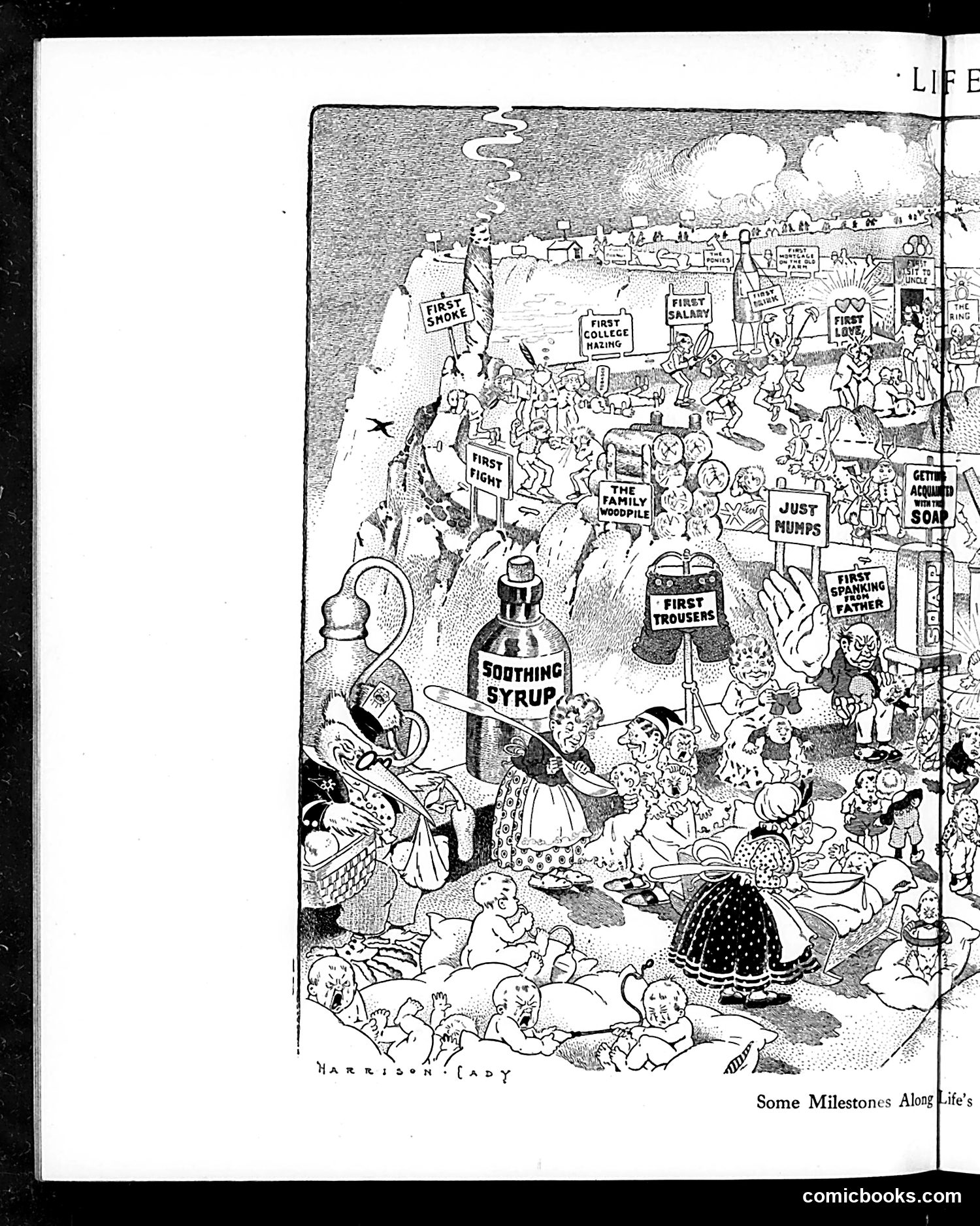
This satirical cartoon depicts the "milestones" of infancy and early childhood through a crowded beach scene. Signs advertise products marketed to parents and babies: "First Smoke," "First Teeth," "First Love," "Soothing Syrup," "First Trousers," and others. The image mocks commercialization of childhood development, suggesting that manufacturers exploit parental anxiety by turning every stage into a marketing opportunity. The large bottle of "Soothing Syrup" (likely containing opiates, common in early 20th-century patent medicines) is particularly significant—satirizing dangerous, unregulated products sold to soothe babies. The cartoon critiques how commercial interests capitalize on parental concerns, transforming natural developmental stages into opportunities for consumption. The caption credit reads "HARRISON CADY," a prominent Life magazine illustrator.
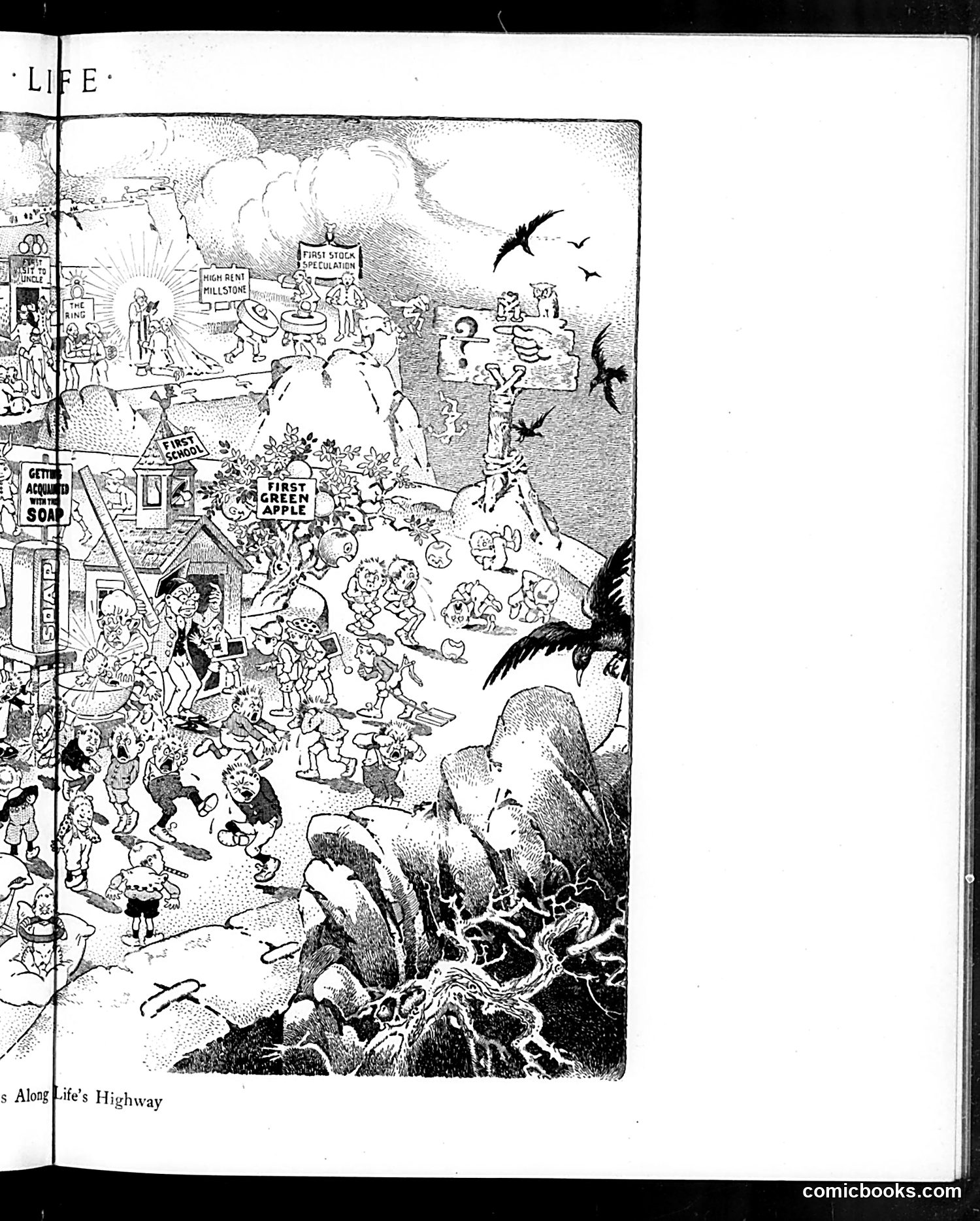
This is a satirical illustration titled "Along Life's Highway" depicting the journey through life as a crowded, chaotic marketplace or fair. The cartoon shows numerous figures navigating various labeled stations and attractions including "First Bend," "First Stock Speculation," "First Green Apple," "First Cigar," and "Getting the Soap," among others. The satire critiques how life presents us with predictable milestones and temptations—often foolish ones (green apples, stock speculation). The crowded composition suggests life's chaos and how people mindlessly follow established paths. The birds and monster-like creatures on the margins may represent dangers or darker forces accompanying human progress. This appears to be early-20th-century commentary on American materialism and conformity.
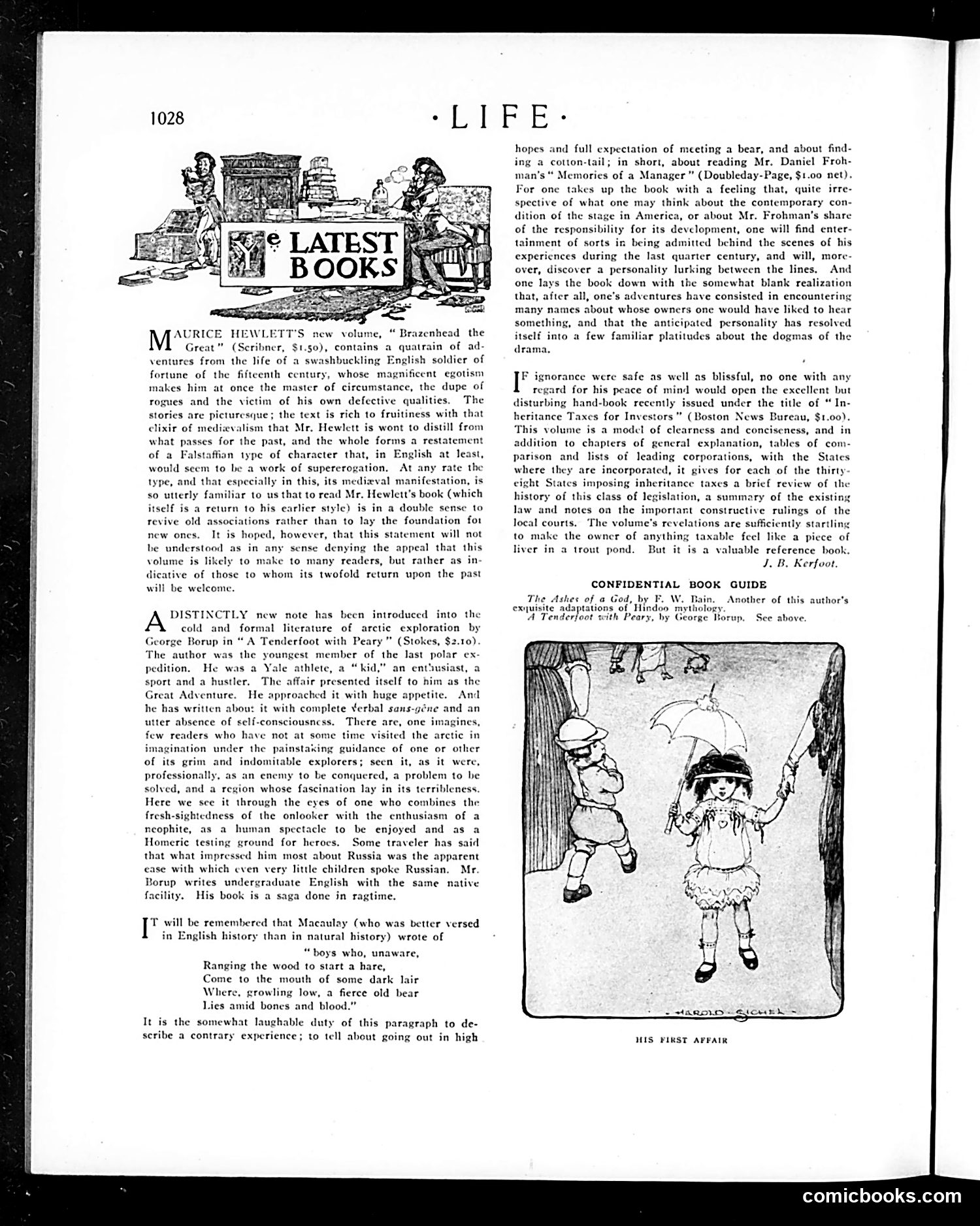
This is a book review section from *Life* magazine featuring three literary notices: 1. **Maurice Hewlett's "The Great Ossinave"** — a medieval adventure novel about an egotistical English soldier of fortune. The reviewer critiques it as merely rehashing familiar Falstaffian character types already well-established in English literature. 2. **George Borup's "A Tenderfoot with Peary"** — an arctic exploration memoir. The reviewer praises Borup's fresh, youthful enthusiasm and informal writing style ("verbal sans-géne") as a refreshing departure from the typical grim, professional tone of polar exploration narratives. He writes like an enthusiastic Yale athlete, not a serious explorer. 3. **Daniel Frohman's "Memories of a Manager"** — theater memoirs. The reviewer uses a Macaulay poem analogy, suggesting readers expect dramatic revelations but find instead disappointingly mundane content. The small illustration labeled "His First Affair" shows children in period dress, likely accompanying one of these book discussions.
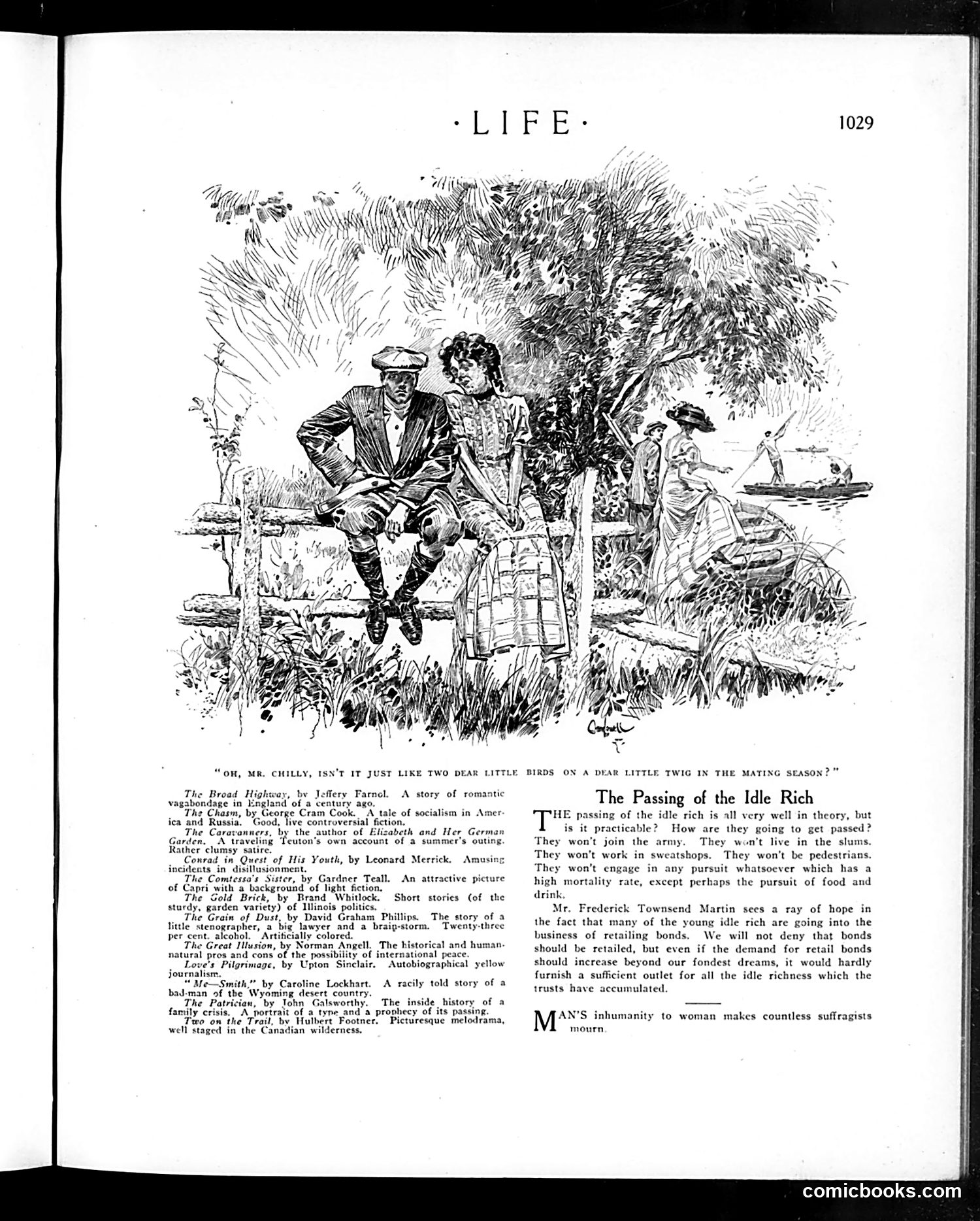
This page from *Life* magazine features a satirical article titled "The Passing of the Idle Rich," accompanied by a sketch showing well-dressed figures by a riverside. The cartoon illustrates the article's central joke: the author questions whether wealthy, idle people can actually be eliminated from society, as some progressives wished. The point is that the rich won't sacrifice themselves through military service, poverty, or dangerous labor—the only ways they might realistically "pass" from existence. The article mocks Frederick Townsend Martin's suggestion that idle rich youth might find purpose in retailing bonds (selling financial instruments). The author sarcastically observes this occupation couldn't possibly absorb all the accumulated wealth and leisured people in America. The caption's romantic reference ("two dear little birds...in the mating season") suggests the sketch depicts courtship among the wealthy class—precisely the kind of frivolous, leisure-focused activity the article criticizes. The satire targets both the impracticality of social reform and the uselessness of the wealthy class itself.
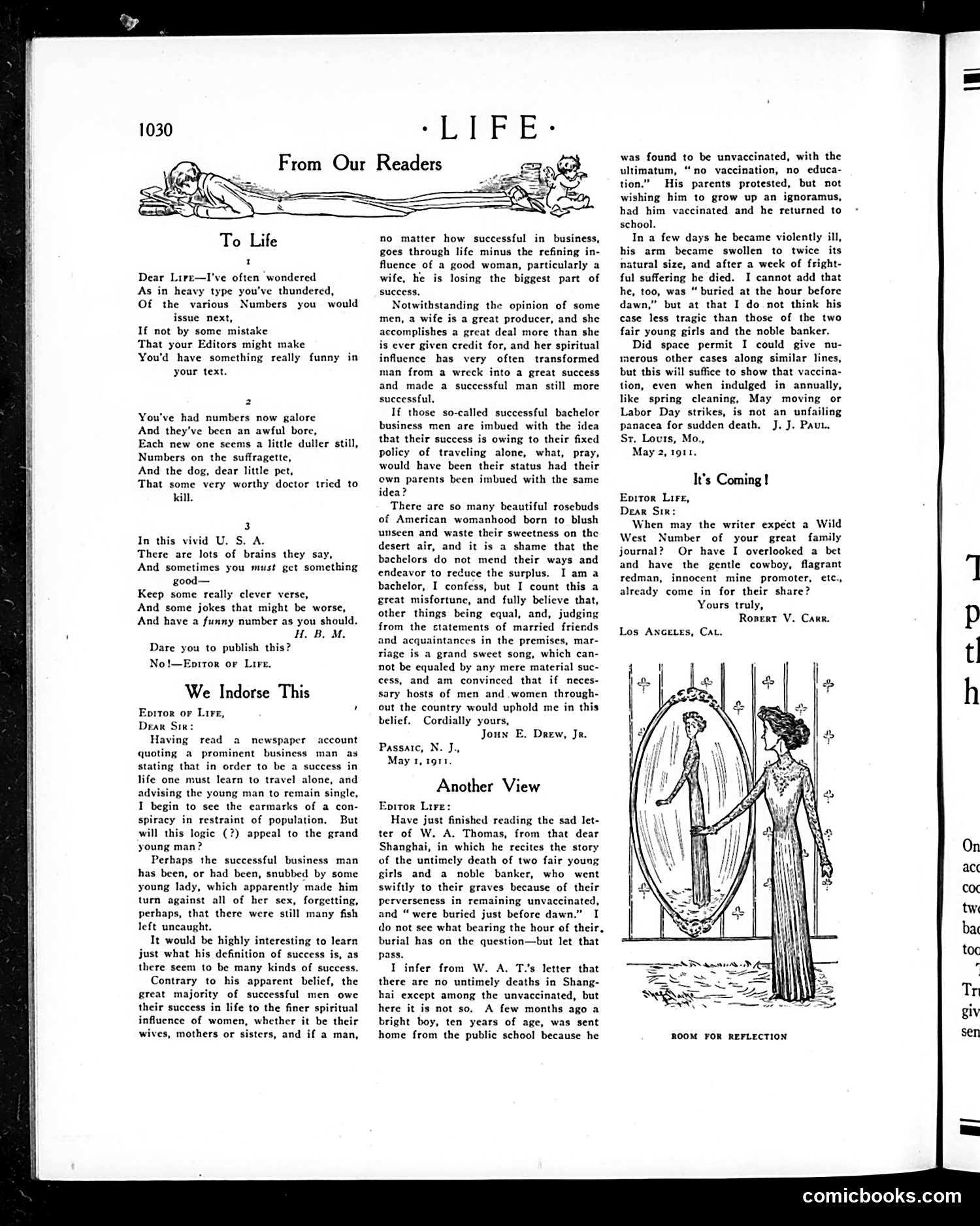
This page presents reader letters debating social issues of the era. The main content concerns **vaccination and bachelorhood**. In "Another View," a reader responds to a previous letter about deaths in Shanghai. A young boy was expelled from school for being unvaccinated; he later died from illness. The letter-writer questions whether vaccination truly prevents death, noting unvaccinated people also die in Shanghai—the implication being that anti-vaccination sentiment may be misguided. The dominant letter defends **marriage and women's roles** against an earlier article promoting bachelorhood for success. The writer argues that successful men actually owe their achievement to women's "spiritual influence," particularly wives, and that remaining single is a "great misfortune." He romanticizes marriage as a "grand sweet song" while criticizing bachelor businessmen. The cartoon illustration ("Room for Reflection") shows a contemplative figure, likely reinforcing themes of introspection on life choices. The page reflects early 20th-century debates: public health (vaccination), marriage ideology, and women's domestic influence—all presented through genuine reader correspondence.

This is **not a cartoon or satire** — it's a straightforward advertisement for Kelly Motor Trucks, appearing in Life magazine (likely early 1900s, based on the vehicle style and "19%" grade reference). The page documents a real **Portland Endurance Contest**, a competitive hill-climb test where multiple truck manufacturers competed. The Kelly truck succeeded where competitors failed: one truck stalled three times, a water-cooled truck overheated ("boiled"), and two other trucks had to reverse back down. The advertisement celebrates this victory as proof of Kelly's superiority, highlighting three claimed advantages: their exclusive Blower-Cooled Engine, superior design and balance, and optimal weight-to-capacity ratio. The copy emphasizes practical benefits — better work performance and lower operating costs — to persuade business owners to purchase Kelly trucks. This reflects early automotive advertising's reliance on competitive demonstrations to establish brand credibility in an emerging industry.
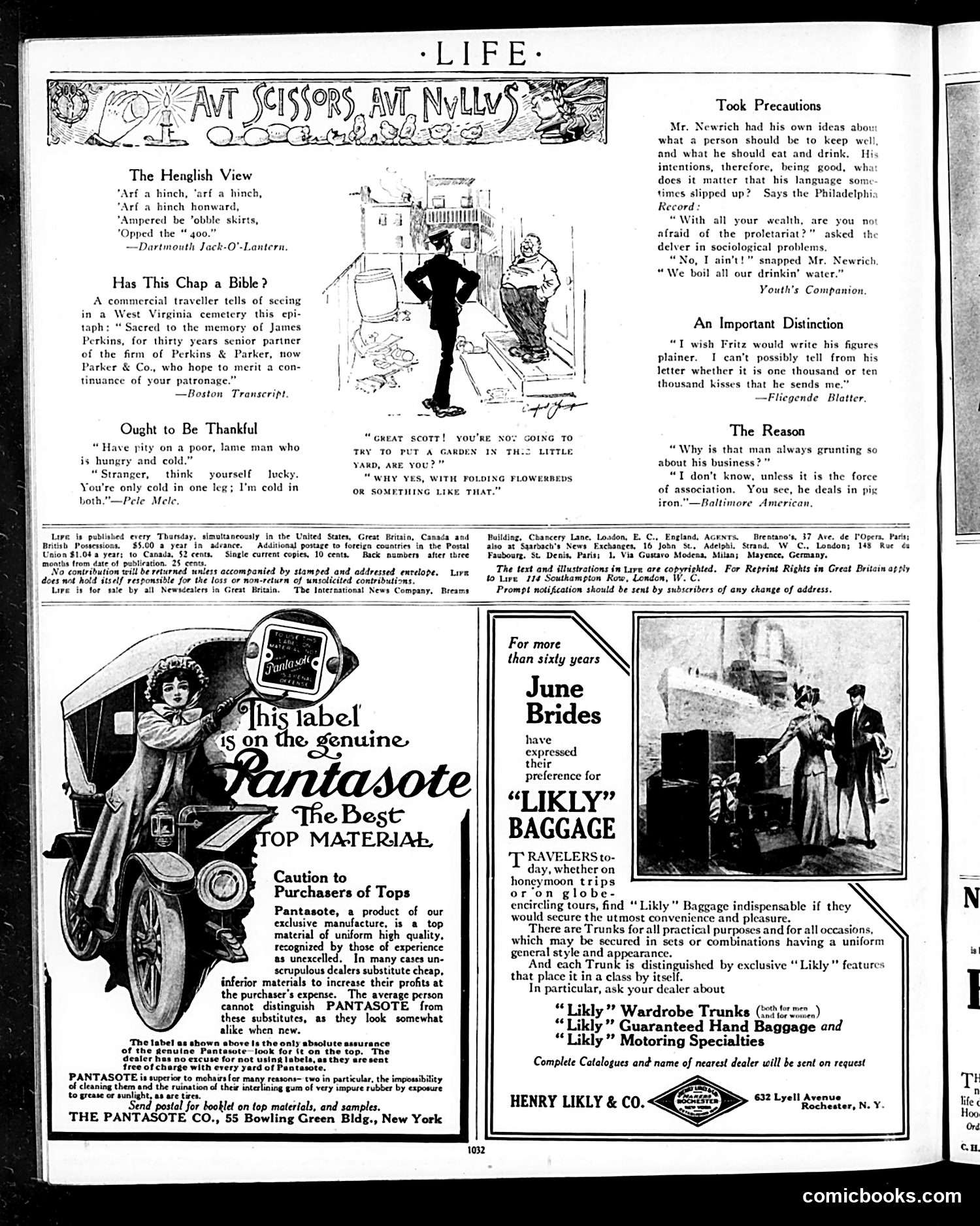
This page from *Life* magazine contains several short humorous items typical of early 20th-century American satire: **"The Henglish View"** mocks British attitudes, using exaggerated cockney dialect to satirize how the English perceived American fashion (specifically hobble skirts and the wealthy "400" social set). **"Has This Chap a Bible?"** presents a cemetery epitaph joke: a tombstone inscription praising a deceased business partner while simultaneously asking the surviving partner to continue patronage—absurd self-interest disguised as tribute. **"Ought to Be Thankful"** is a beggar joke playing on relativity of misery—a poor man with one cold leg consoles himself that at least he's not entirely cold. **"Took Precautions"** satirizes a wealthy nouveau-riche character ("Mr. Newrich") who, despite riches, obsesses over boiling drinking water to avoid proletarian uprising—misplaced anxiety about class threat. The remaining short items offer similar mild social humor about domestic life and relationships. The page is primarily advertising for *Fantasote* boot material and *Likly* luggage, with the satirical content serving as editorial filler between ads.
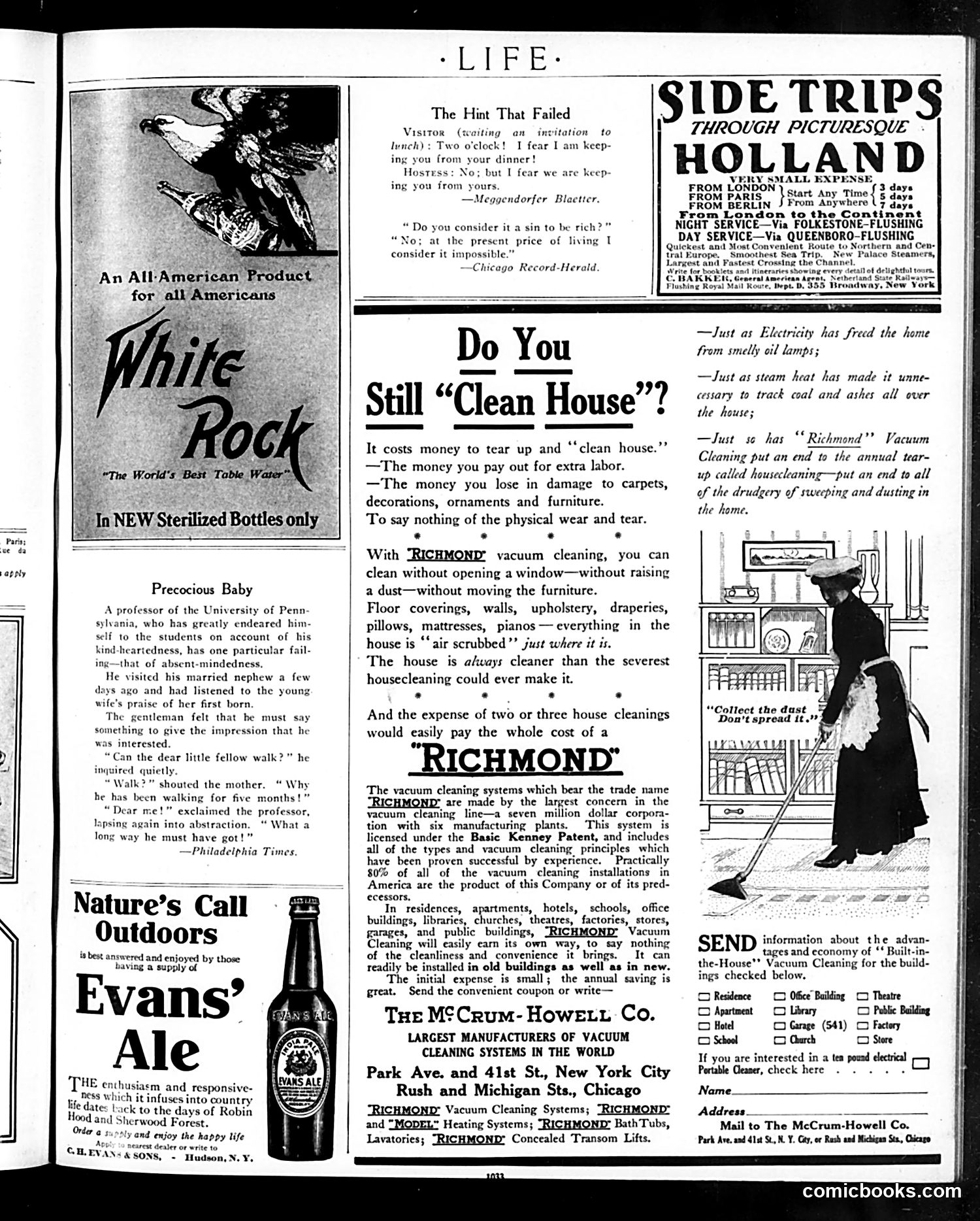
This page is primarily **advertising** from Life magazine, with several short humor pieces and ads interspersed. The cartoons/jokes are brief social observations typical of early 20th-century Life: 1. **"The Hint That Failed"** - A visitor overstays lunch, apologizing for keeping the host from dinner. The hostess quips she fears *he's* missing dinner instead—gentle, non-satirical humor about social awkwardness. 2. **"Precocious Baby"** - An absent-minded professor, amazed a five-month-old can walk, remarks on "what a long way he must have got!"—absurdist humor about the professor's distraction. 3. **Class commentary** - One joke questions whether being rich is sinful given living costs; another jokes that being rich itself is "impossible" at current prices—gentle satire on economic anxiety. The page is dominated by large advertisements for **White Rock mineral water**, **Evans' Ale**, and especially the **Richmond vacuum cleaning system**, marketed as labor-saving technology for the home. These reflect early 1900s consumer culture and modernization.
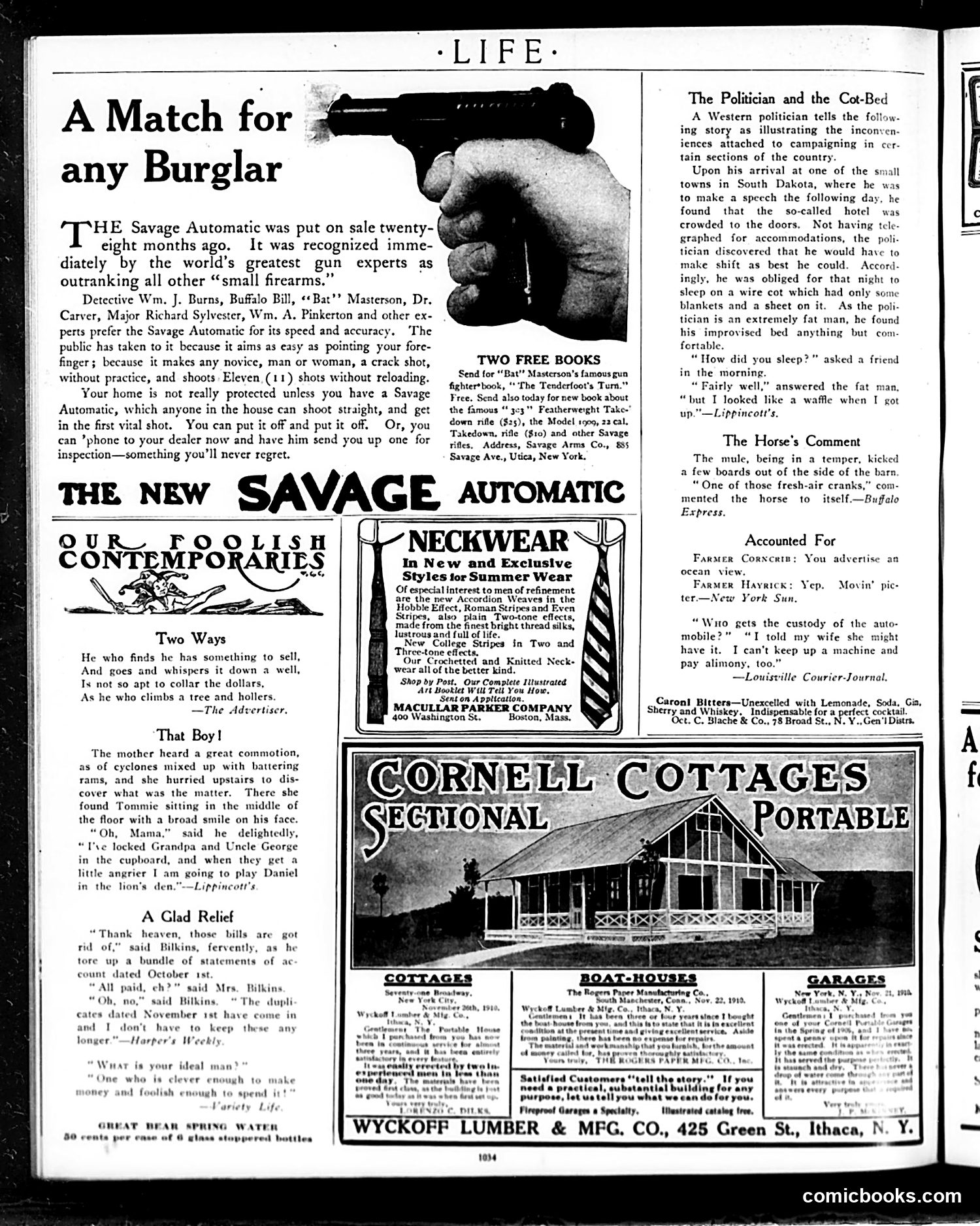
This page from *Life* magazine contains several distinct satirical pieces rather than a unified political cartoon. **"The Politician and the Cot-Bed"** is a humorous anecdote mocking a Western politician's discomfort during a campaign stop in rural South Dakota. The joke targets the gap between politicians' elevated status and harsh frontier realities—the overweight politician attempting to sleep on a wire cot, emerging crumpled "like a waffle." It satirizes both the politician's physical unsuitability for rough conditions and the primitive accommodations in remote towns. The remaining content consists of **product advertisements and humor filler pieces** ("That Boy!", "A Glad Relief," "Our Foolish Contemporaries") typical of *Life*'s format. These include ads for the Savage Automatic rifle and Cornell Cottages, interspersed with brief jokes about marital discord and rural life. The page primarily reflects early-20th-century American attitudes: rural-urban cultural disparities, the speaker's touring circuit, and general domestic comedy rather than sharp political satire.
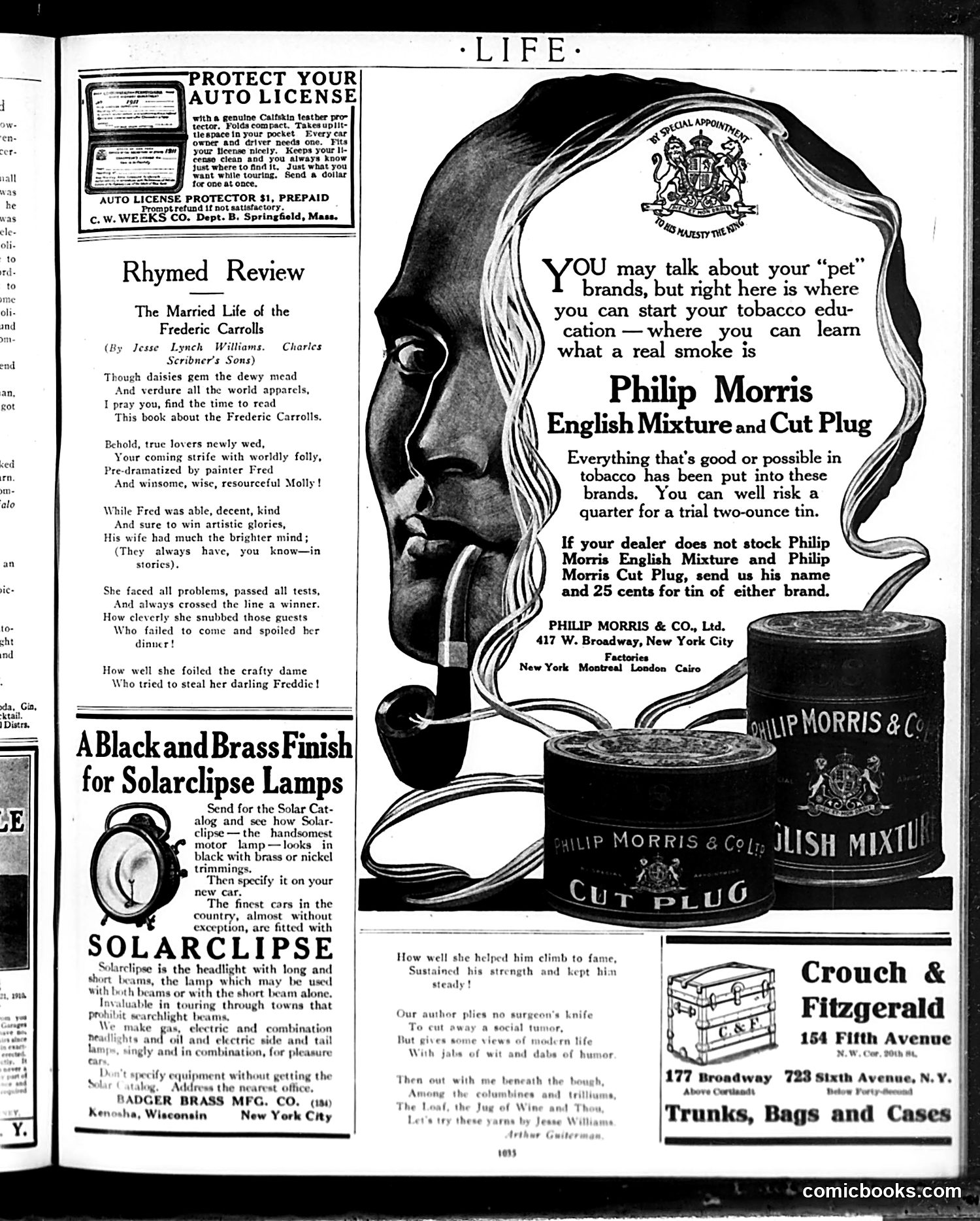
This page is primarily **advertising content** with a literary section. The main elements: **"Rhymed Review"** presents a poem about *The Married Life of the Frederic Carrolls*, a book by Jesse Lynch Williams. The verse humorously depicts a newlywed couple where the wife—clever, resourceful "Molly"—proves the brighter partner, successfully navigating social situations and protecting her husband Fred from scheming rivals. The satire reflects early 20th-century gender dynamics: the joke is that despite traditional expectations, the wife outsmarts everyone. **The advertisements** are period-typical: auto license holders, tobacco products (Philip Morris), motor lamps, and luggage. The Philip Morris ad uses a profile illustration to suggest sophistication and "education" about quality tobacco. There is **no political cartoon** on this page—the visual content serves advertising purposes rather than satire of current events or figures. The "satire" is purely literary and domestic in nature.
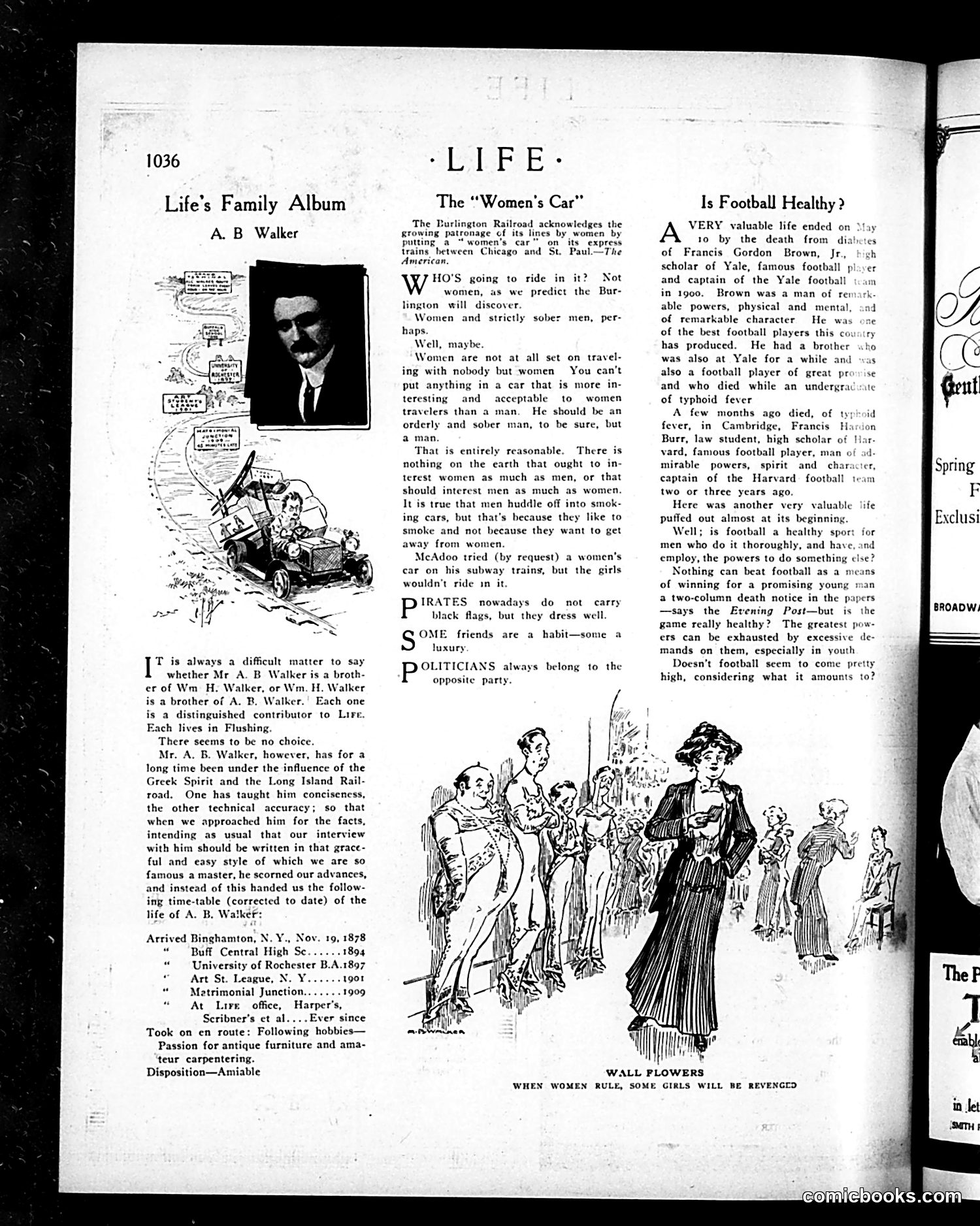
**"The Women's Car"**: This satirizes the Burlington Railroad's new segregated railway car for women travelers. Life argues the plan will fail because women actually *want* to travel with men—not avoid them. The piece mocks the railroad's assumption that women prefer exclusively female company, noting that even McAdoo's subway experiment failed when "the girls wouldn't ride in it." The satire assumes romantic/social interest between genders makes segregation impractical. **"Is Football Healthy?"**: This critiques college football's physical toll, citing recent deaths of two promising Yale/Harvard football players (Francis Gordon Brown Jr. and Francis Hardon Burr) from typhoid fever following their athletic careers. Life questions whether the sport's prestige—earning "a two-column death notice in the papers"—justifies exhausting young men's health when they possess talents for "something else." The satire suggests football demands excessive physical sacrifice. **"Life's Family Album"**: A humorous biographical entry for contributor A.B. Walker, presented as a dry, timeline-format biography—mocking both the subject's preference for precise facts over graceful prose and the magazine's typical biographical style.
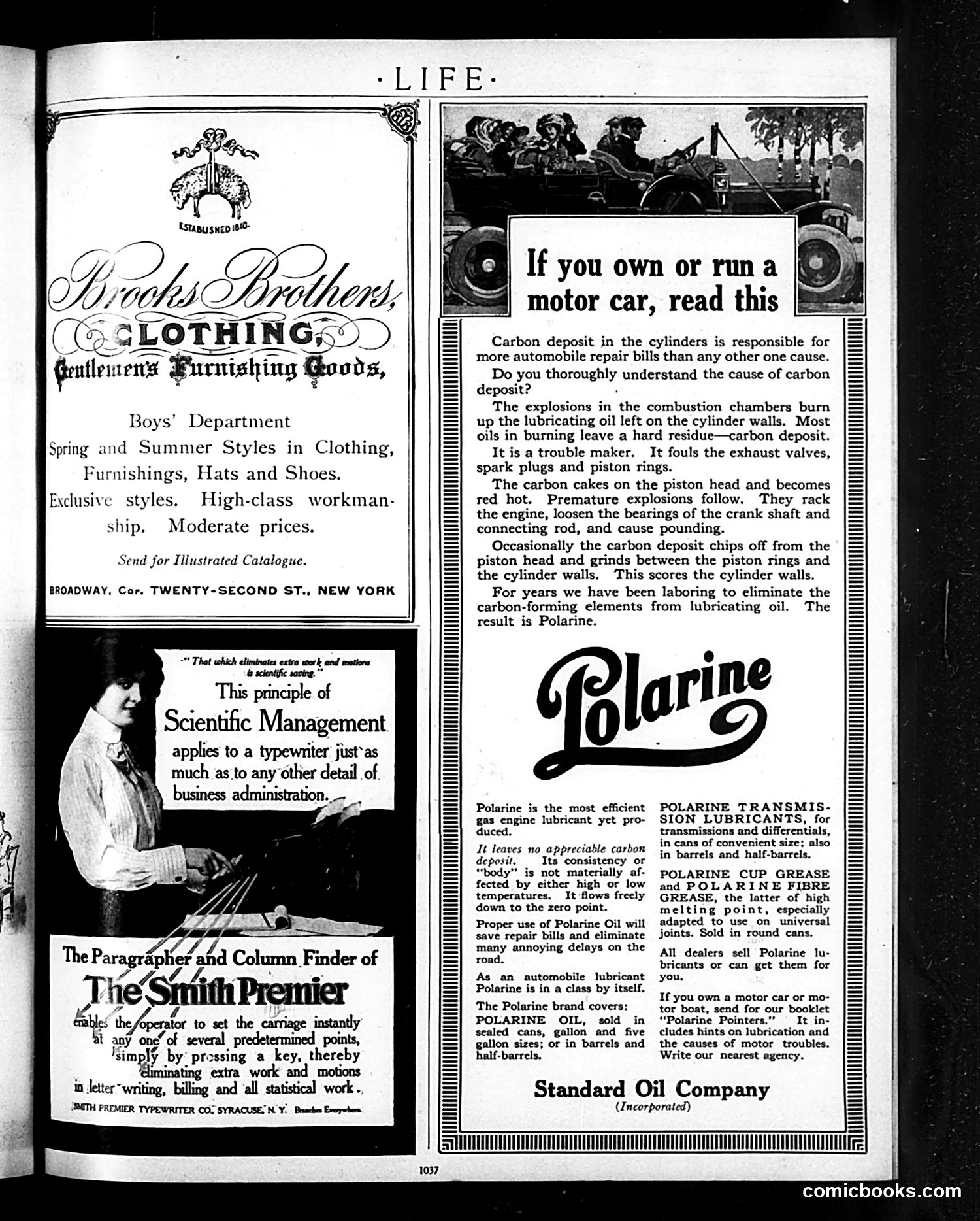
This page contains three unrelated advertisements rather than political cartoons: 1. **Brooks Brothers** (top left): A clothing company advertisement for boys' department, offering spring/summer styles at moderate prices. 2. **Smith Premier Typewriter** (center-left): Promotes the typewriter's "Paragrapher and Column Finder" feature, framing it within the era's "Scientific Management" principle—the idea that eliminating unnecessary motions increases efficiency. This reflects early 20th-century business optimization trends. 3. **Polarine Motor Oil** (right): Standard Oil Company's advertisement addresses a genuine mechanical problem—carbon buildup in engine cylinders—and positions Polarine as the solution. The ad educates readers about engine damage while promoting the product. No satire or political commentary is present. This is a straightforward advertising page typical of *Life* magazine during this period, reflecting contemporary consumer products and business philosophies of the early 1900s.
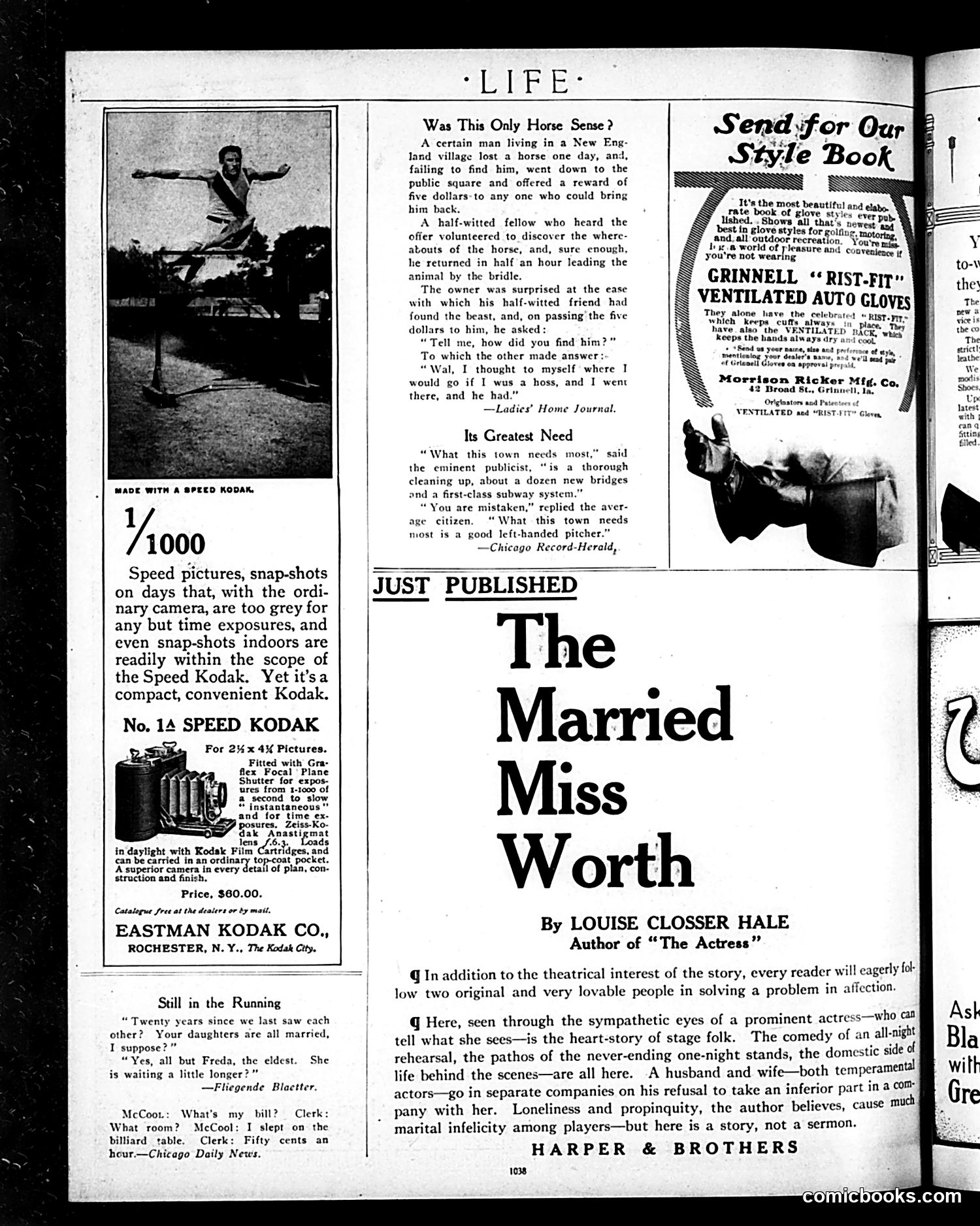
This page blends advertisements with light satirical humor typical of early 20th-century Life magazine. **The main cartoon** ("Was This Only Horse Sense?") presents a folk-wisdom joke: a "half-witted fellow" successfully finds a lost horse by thinking like the horse ("I thought to myself where I wus a hoss, and I went there"). The satire gently mocks pretension—an "eminent publicist" claims the town needs infrastructure improvements, but an average citizen counters that what's *really* needed is a good left-handed pitcher. The implication: practical, humble common sense (or sports) matters more than grandiose public works schemes. **The photo** (top left) shows a dramatic athletic pose labeled "Made with a Speed Kodak," advertising Eastman Kodak's camera technology. **The rest is advertising**: Grinnell auto gloves, and a book announcement for *The Married Miss Worth* by Louise Closser Hale, about theatrical life and romance among actors. The humor is gentle and accessible rather than biting social criticism.
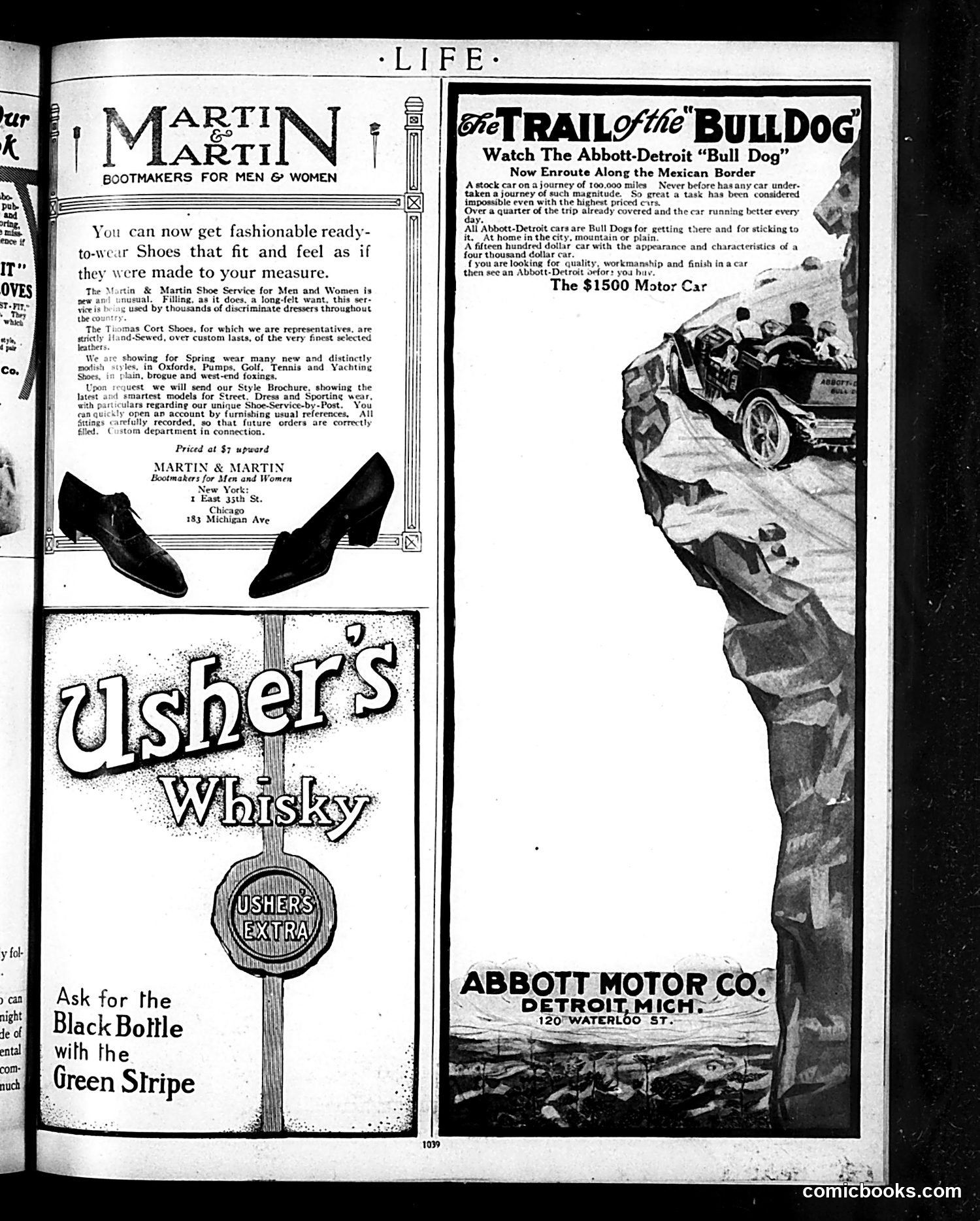
This page contains **three separate advertisements**, not political cartoons or satire. **Left side:** Martin & Martin Bootmakers advertises custom-fitted shoes ($7 upward) for men and women, emphasizing quality hand-sewn construction and a mail-order "Shoe-Service-by-Post." Below that, Usher's Whisky promotes its product in a black bottle with green stripe. **Right side:** Abbott Motor Company advertises the "Bull Dog" automobile—a $1,500 car undertaking a 100,000-mile journey along the Mexican border to demonstrate durability and reliability. The company emphasizes it offers "four thousand dollar car" quality at a lower price point. The Mexican border reference likely reflects contemporary interest in Mexico during the 1910s (possibly related to border tensions or Pancho Villa's activities), which would have made such a publicity stunt newsworthy. The "Bull Dog" name suggests toughness and dependability—marketing language typical of early automotive advertising.
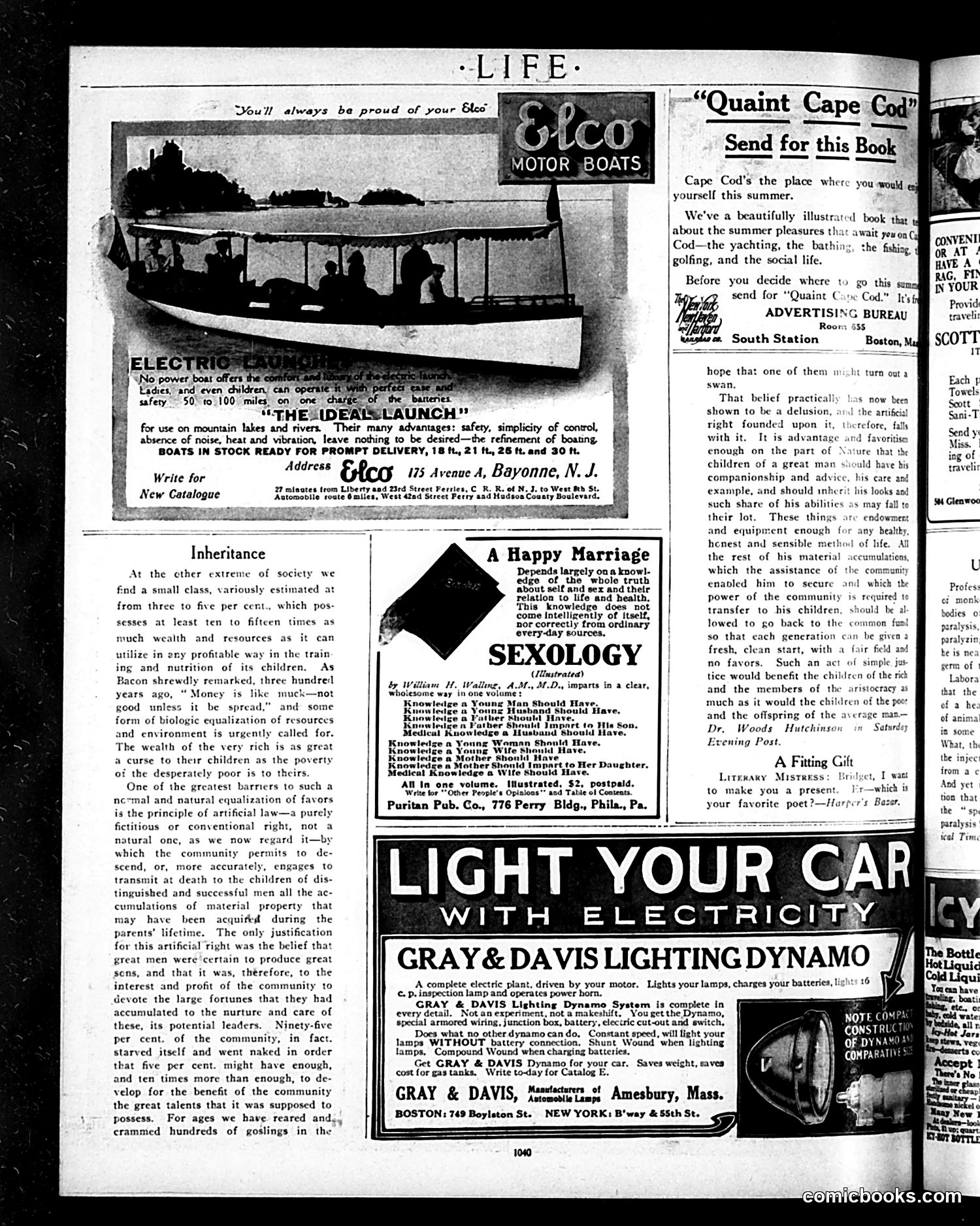
This page is primarily **advertising and editorial content** rather than political satire. The main elements include: **Advertisements:** - Elco Motor Boats (top): Promotes electric launches for safety and ease - Gray & Davis Lighting Dynamo (bottom, large): Car electrical equipment - Sexology book: A medical/educational text on marital relations - Cape Cod tourism promotion - Puritan Publishing book advertisements **Editorial Content:** The "Inheritance" article argues that extreme wealth concentration is socially harmful—that the wealthy's fortunes should not automatically pass to children who may lack merit. The author criticizes the "artificial law" of inheritance, noting that 95% of society sacrificed comfort so 5% could accumulate fortunes for potentially undeserving heirs. **Historical Context:** This appears to be from the Progressive Era (roughly 1900s-1920s), when debates about wealth inequality, inheritance taxes, and social reform were prominent. The article reflects Progressive-era skepticism toward unchecked inheritance and aristocratic privilege. The page contains **no political cartoons**, just standard period advertising and opinion journalism.
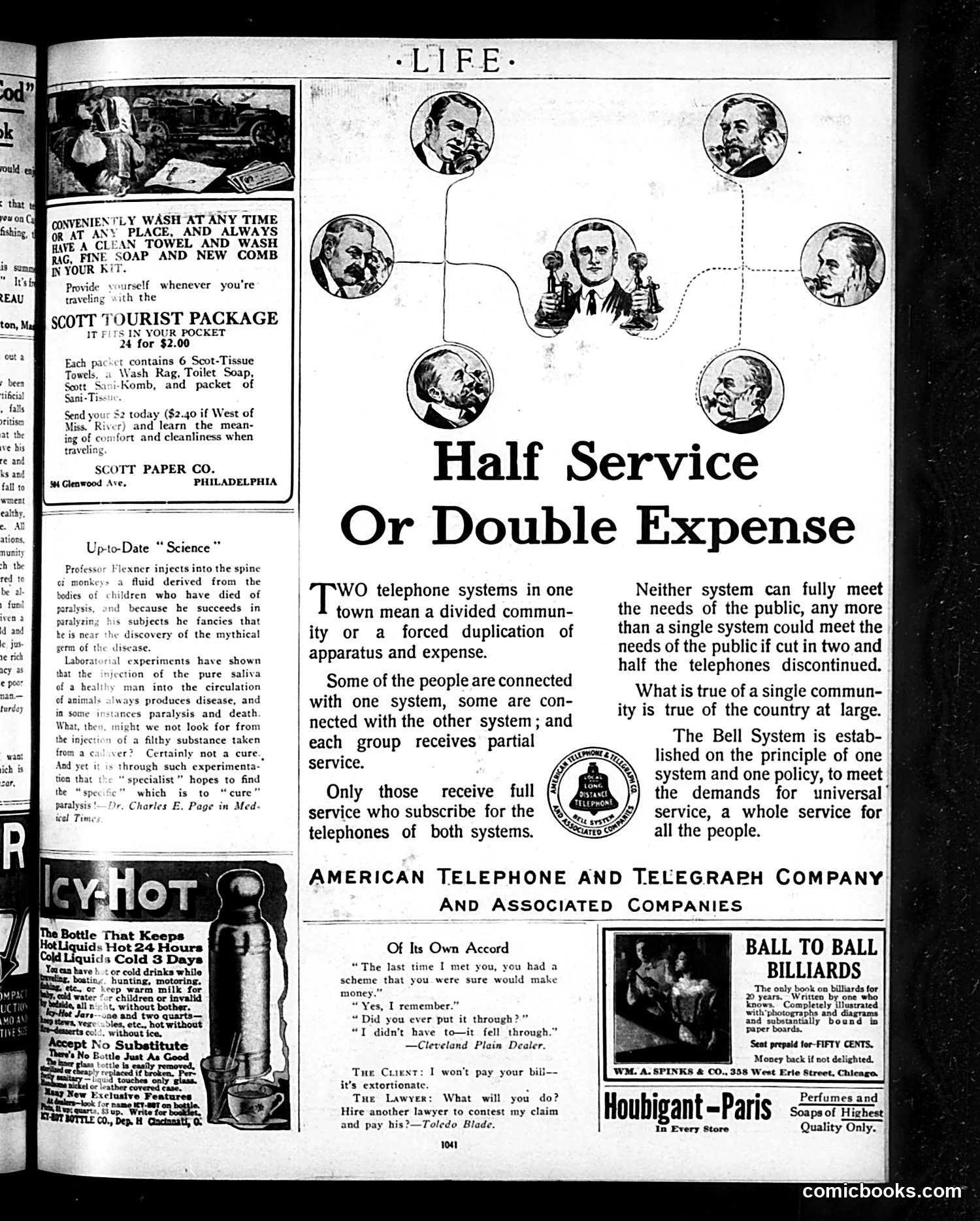
The main advertisement is AT&T's defense of monopoly telephone service. The diagram shows six men's faces connected to a central figure—illustrating how "half service or double expense" results from competing telephone systems in one town. AT&T argues that a single unified system (theirs) serves the public better than fragmented competition, positioning monopoly as efficient and necessary for "universal service." This reflects early 20th-century corporate arguments for consolidation, before antitrust concerns dominated such debates. The company frames divided service as wasteful duplication harming consumers. The page also includes a "Science" critique mocking Professor Flexner's experimental spinal injections on children's bodies, calling his paralysis-inducing tests a misguided search for disease cures—satirizing pseudoscientific medical claims. Two brief jokes about lawyers and bill-collection round out the page, typical of Life's satirical humor.
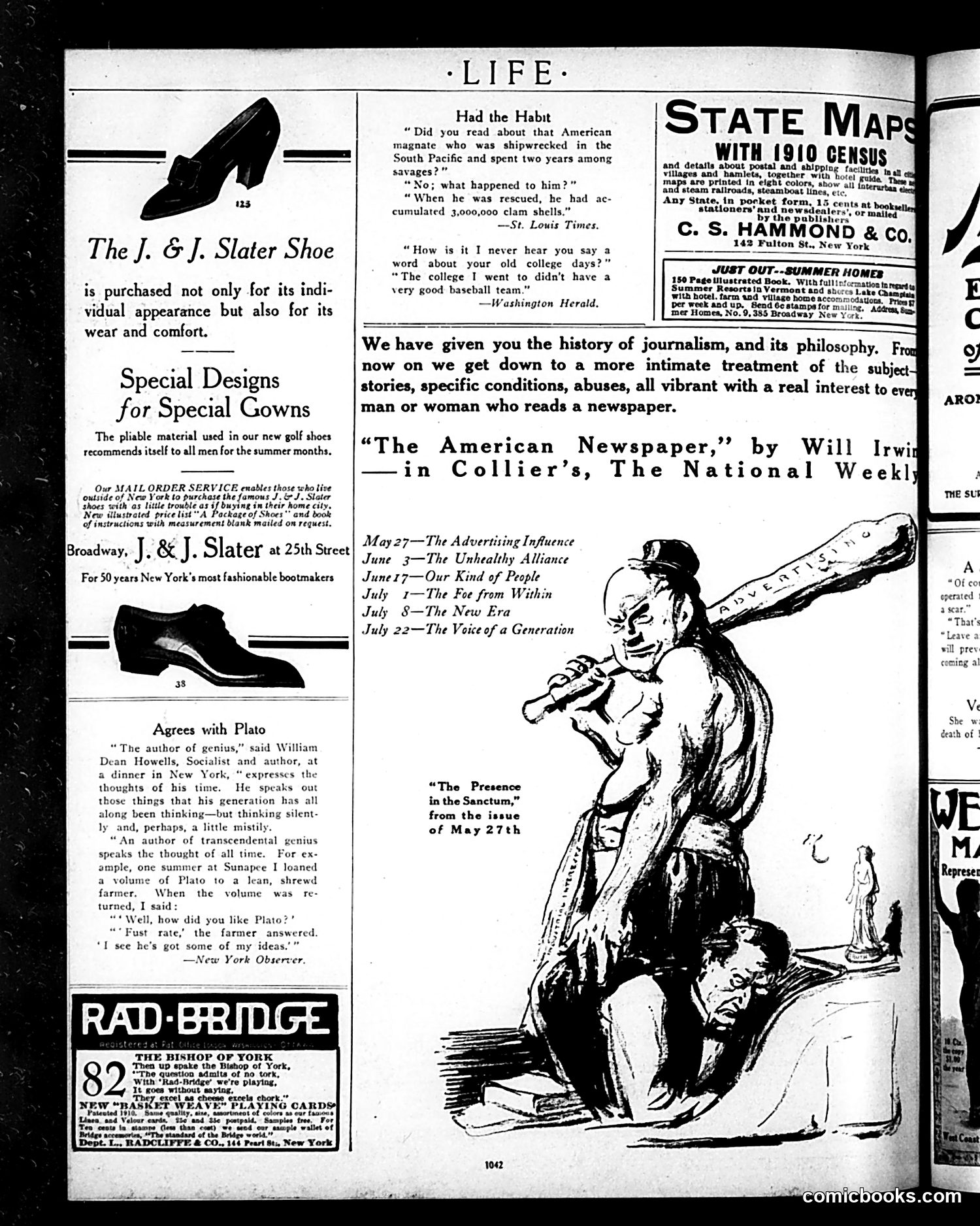
This page is primarily **advertisements and literary content** rather than political satire. However, it contains three brief humorous anecdotes: 1. **"Had the Habit"**: A joke about an American businessman shipwrecked for two years who accumulates 3 million clam shells—satirizing wealthy industrialists' obsessive accumulation of valuables, even in primitive circumstances. 2. **"College Days"**: A man avoids discussing his college because it "didn't have a very good baseball team"—poking fun at American college culture's emphasis on athletics over academics. 3. **"Agrees with Plato"**: A farmer claims Plato expressed thoughts he already had, humorously suggesting that timeless philosophical truths are simply common sense. The page also advertises J&J Slater shoes, state maps with census data, and promotes Will Irwin's serialized journalism series in *Collier's* magazine. The illustration shows a figure in the "Sanctum" (newspaper office), referencing contemporary newspaper culture.
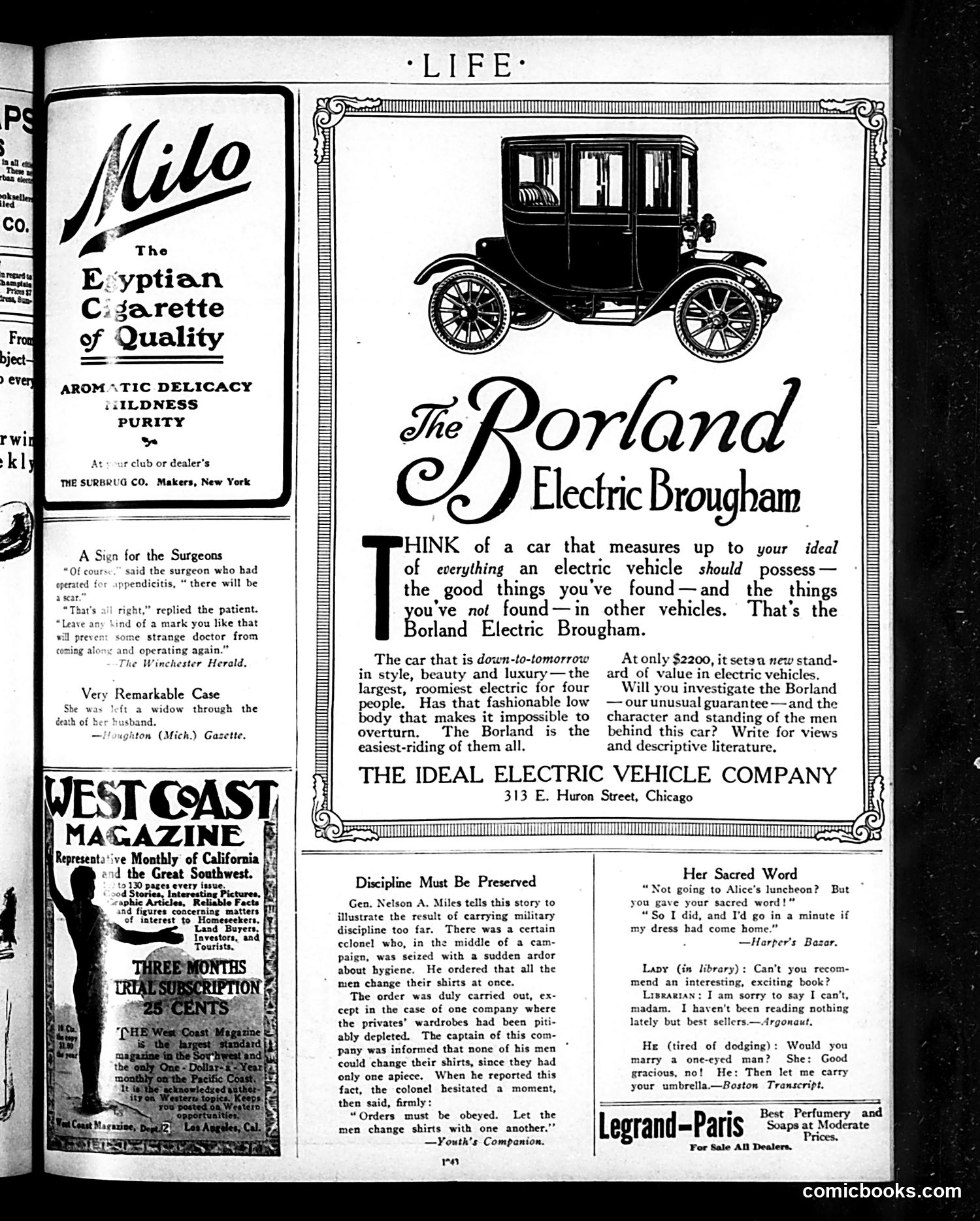
This page from *Life* magazine is primarily **advertisements and humorous anecdotes** rather than political satire. The main advertisement features the **Borland Electric Brougham**, an electric automobile priced at $2,200. This reflects the early 1900s when electric vehicles were fashionable luxury items for the wealthy, competing with gasoline cars. The page includes several brief comic anecdotes: 1. **"A Sign for the Surgeons"** — a joke about surgical scars 2. **"Very Remarkable Case"** — an unclear inheritance joke 3. **"Discipline Must Be Preserved"** — a humorous military story about a colonel ordering soldiers to share shirts when they lack clean ones, satirizing rigid military hierarchy 4. **"Her Sacred Word"** and **"He (tired of dodging)"** — short relationship/domestic humor pieces There are also period product advertisements (Milo cigarettes, West Coast Magazine) typical of the era. The content reflects early 20th-century concerns: automotive innovation, military culture, and domestic life, with gentle rather than sharp satirical commentary.
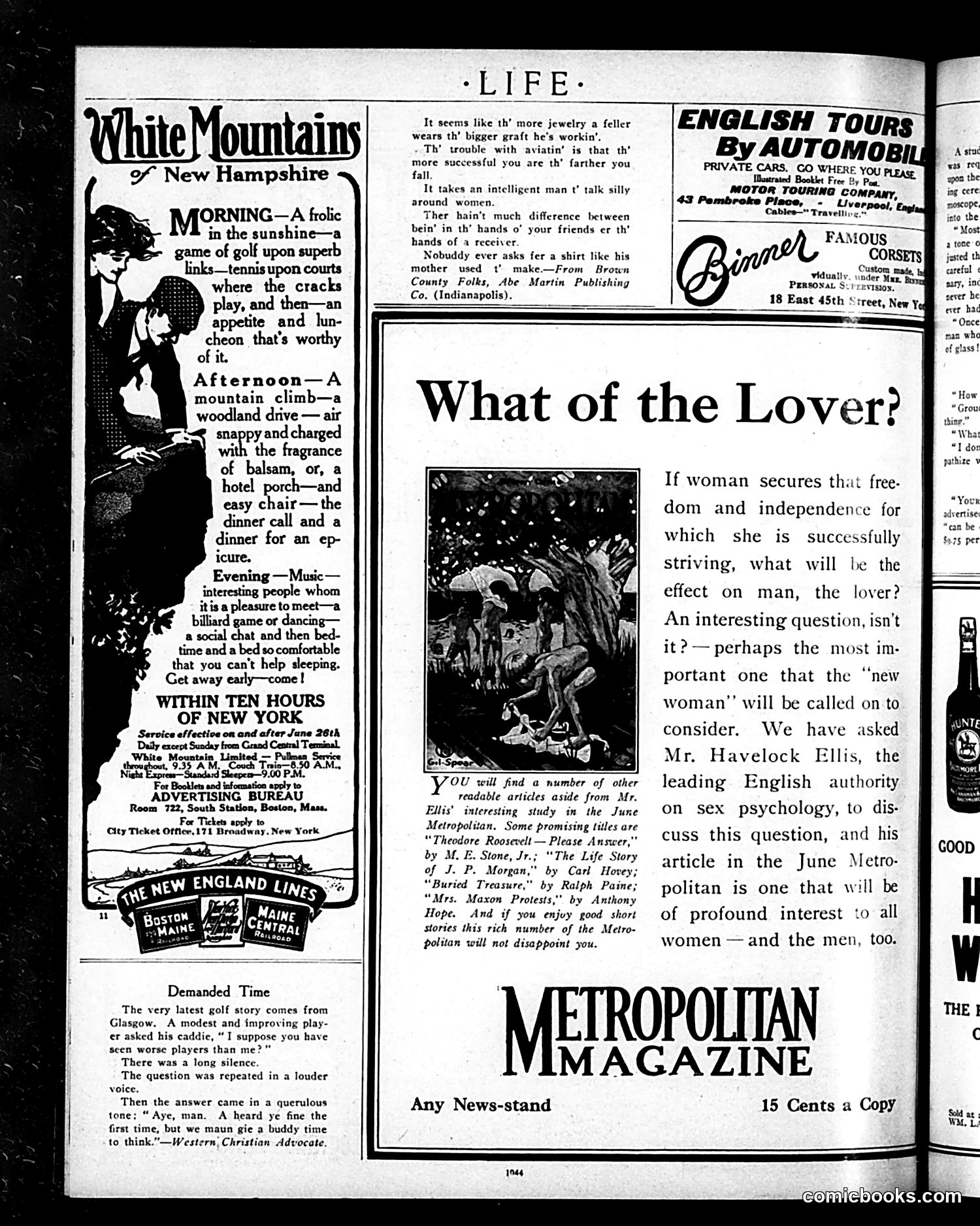
This is a mixed advertising and editorial page from Life magazine (likely early 1900s based on style). **Left side**: A White Mountains tourist advertisement emphasizing leisure activities—golf, tennis, mountain climbing, fine dining—accessible within ten hours of New York via rail. It appeals to affluent leisure travelers. **Center/right**: A Metropolitan Magazine advertisement featuring an article titled "What of the Lover?" that poses a provocative question: if women achieve independence and freedom (a contemporary social debate), how will this affect romantic relationships? The piece invites readers to consult Havelock Ellis, a real English sexologist, for analysis. This reflects genuine 1910s-era anxiety about women's changing social roles. **Bottom left**: A humorous anecdote about Scottish golf, playing on dialect humor and the caddie's deadpan response—typical period comedy. The scattered aphorisms mock various modern anxieties: materialism, aviation risk, women's behavior, and financial vulnerability—reflecting early 20th-century preoccupations.
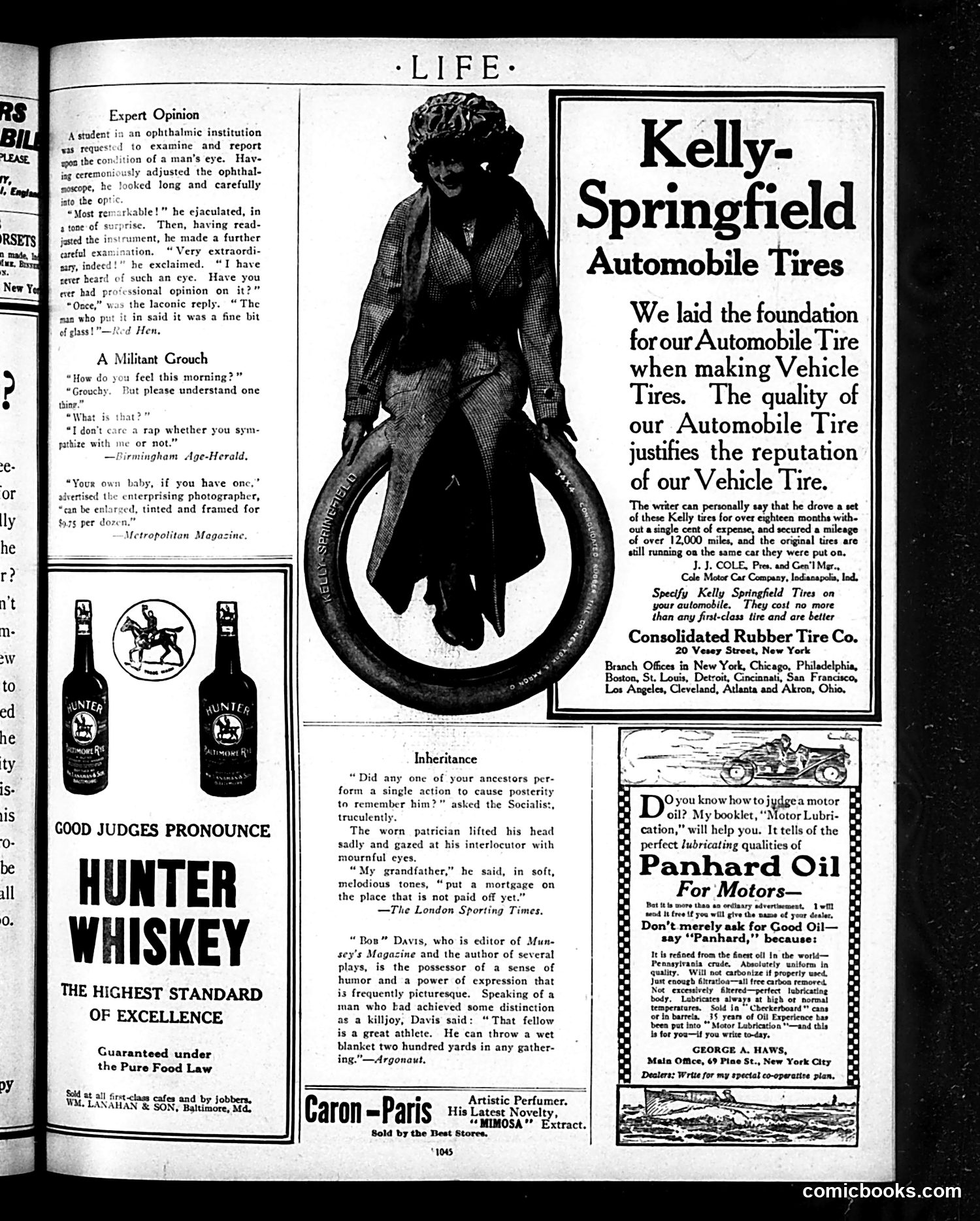
This page is primarily **advertising**, with brief satirical humor pieces interspersed. The main content consists of four advertisements: Hunter Whiskey (emphasizing compliance with Pure Food Law), Kelly-Springfield Automobile Tires, Panhard Oil for motors, and Caron-Paris perfume. The short jokes scattered throughout reflect early 20th-century humor sensibilities: - **"Expert Opinion"**: A student examining an eye thinks it's medically remarkable, only to learn it's a glass prosthetic—mocking overzealous academic pretension. - **"A Militant Grouch"**: Someone irritably insists they don't care if others sympathize with their bad mood—absurdist humor about curmudgeonly indifference. - **"Inheritance"**: A wealthy patrician's only ancestral legacy is an unpaid mortgage—satirizing aristocratic decline and financial ruin masked by old family pride. - **"Bon Davis" anecdote**: Praising someone as a talented "killjoy" who can "throw a wet blanket" far—using exaggeration to mock social party-spoilers. The page reflects pre-WWI American magazine culture mixing commerce with lighthearted social commentary.
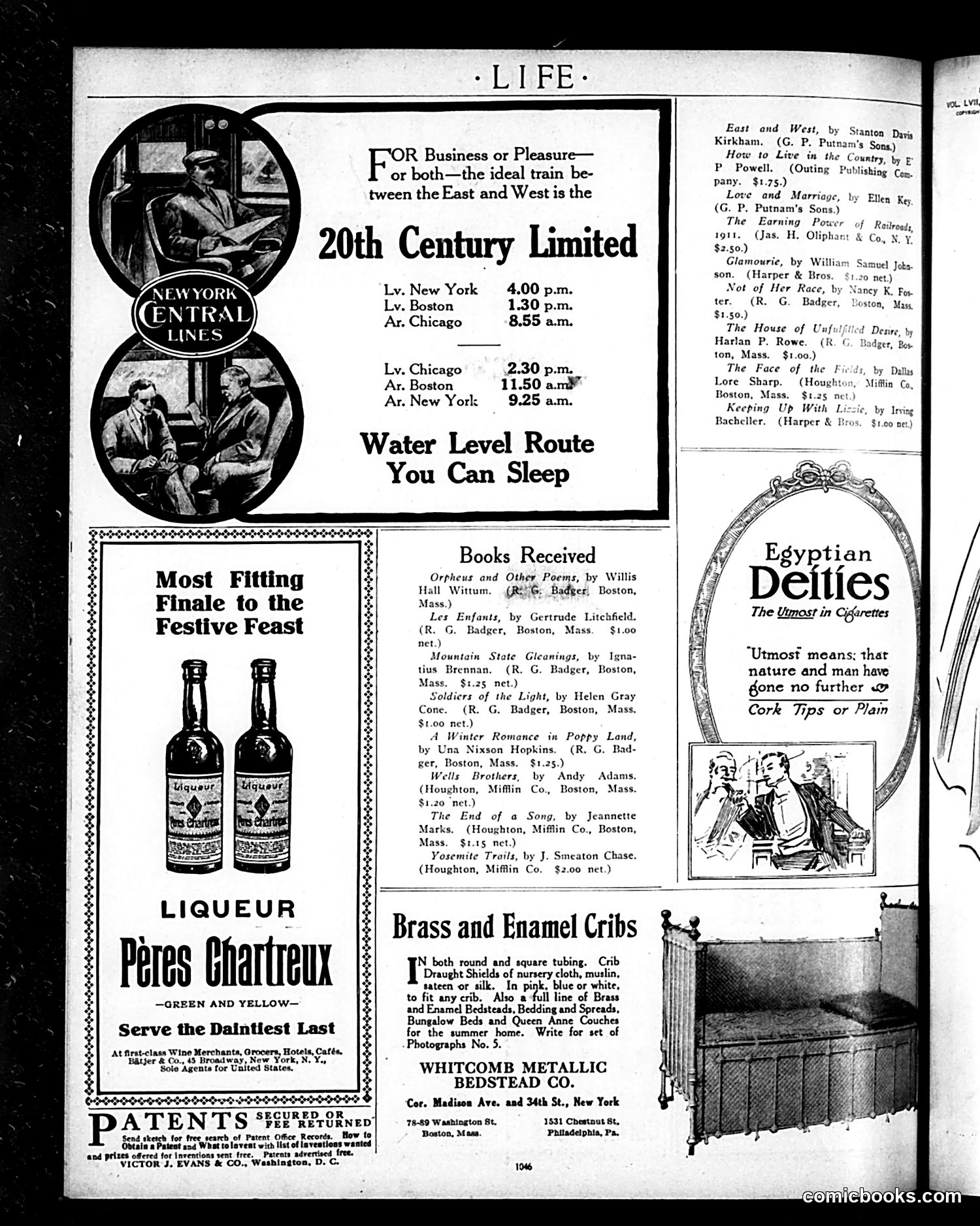
This page is primarily **advertising and book notices**, not satirical content. The main advertisements include: - **20th Century Limited train** (top): Promotes luxury rail service between New York, Boston, and Chicago, emphasizing the "Water Level Route" where passengers can sleep comfortably. - **Pères Chartreux liqueur** (left): Markets this French digestif as the proper "finale to the festive feast"—a high-end after-dinner drink. - **Egyptian Deities cigarettes** (right): Uses "Utmost" (a pun on Egyptian references) to advertise cork-tipped or plain cigarettes. - **Whitcomb Metallic Bedstead Co.** (bottom right): Sells brass and enamel cribs and bedroom furniture. The page also lists recently published books, mostly from Badger and Houghton Mifflin publishers. **No political satire is present.** This appears to be a standard commercial section of *Life* magazine, targeting affluent readers with luxury goods and literary announcements.