
Life, 1911-05-25 · page 16 of 42
Life — May 25, 1911 — page 16: what you’re looking at
What you’re looking at
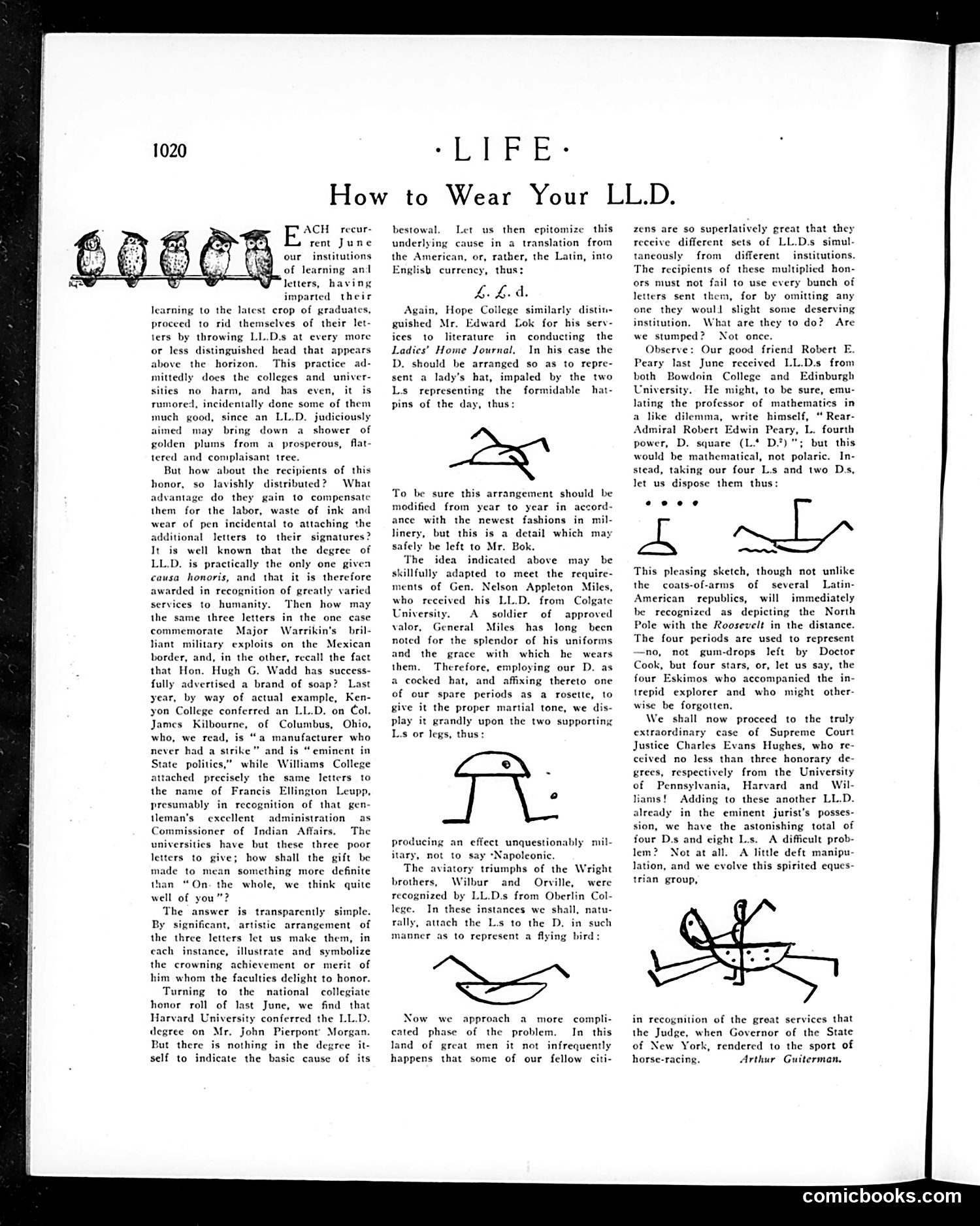
This is a humorous essay mocking the proliferation of honorary doctorates (LL.D. degrees) awarded by American universities to various public figures. The author argues these honors are meaninglessly distributed to people of vastly different accomplishments—from genuine statesmen like J.P. Morgan to soap manufacturers—making the degree essentially meaningless. The satire's solution: arrange the three letters L.L.D. visually to *represent* each honoree's actual claim to fame. Simple sketches show this concept: Morgan's letters become dollar signs (symbolizing his financial power); Edward Bok's (editor of *Ladies' Home Journal*) form a woman's hat with hatpins; General Nelson Miles's become a military figure with a cocked hat and medals. The joke satirizes both universities' crass honor-selling and the absurdity of trying to make generic letters meaningful through creative typography—highlighting how arbitrary these awards actually are.
📄 Transcribed text from this page (OCR, searchable)
Machine-transcribed from the original scan — historical spelling and the odd misread are preserved.
2b PoE How to Wear Your LL.D. ACH recur- rent June our institutions of learning ant letters, having imparted their ning to the latest crop of graduates, proceed to rid themselves of their let- ters by throwing LL.D.s at every more or less distinguished head that appea above the horizon. This practice ad- mittedly does the colleges and univer- sities no harm, and has even, it is rumored, incidentally done some of them much good, since an LL.D. judiciously aimed may bring shower of golden plums from a prosperous, flat- tered and complaisant tree. But how about the recipients of this honor, so lavishly distributed? What advantage do they gain to compensate them for the labor, waste of ink and wear of pen incidental to attaching the additional letters to their signatures? It is well known that the degree of LL.D. is practically the only one given causa honoris, and that it is therefore awarded in recognition of greatly varied services to humanity. Then how may the same three letters in the one case commemorate Major Warrikin's _ bril- liant military exploits on the Mexican border, and, in the other, recall the fact that Hon. Hugh G. Wadd has success- fully advertised a brand of soap? Last year, by way of actual example, Ken- yon College conferred an LL.D. on Col. James Kilbourne, of Columbus, Ohio, who, we read, is “a manufacturer who never had a strike” and is “eminent in State polities,” while Williams College attached precisely the same letters to the name of Francis Ellington Leupp, presumably in recognition of that gen- tleman’s excellent administration as Commissioner of Indian Affairs, The universities have but these three poor letters to give; how shall the gift be made to mean something more definite “On. the whole, we think quite well of you”? The answer is transparently simple. By significant, artistic arrangement of the three letters let us make them, in cach instance, illustrate and symbolize the crowning achievement or merit of him whom the faculties delight to honor. Turning to the national collegiate honor roll of last June, we find that Harvard University conferred the LL.D. degree on Mr. John Pierpont’ Morgan. But there is nothing in the degree it- self to indicate the basic cause of its down than bestowal. Let us then epitomize this underlying cause in a translation from the American, or, rather, the Latin, into English currency, thus: 7 ae a Again, Hope College similarly distin- guished Mr. Edward Lok for his serv- ices to literature in conducting the Ladies’ Home Journal, In his case the D. should be arranged so as to repre- sent a lady’s hat, impaled by the two Ls representing the formidable hat- pins of the day, thus: To be sure this arrangement should be modified from year to year in accord- ance with the newest fashions in m inery, but this is a detail which m safely be left to Mr. Bok. The idea indicated above may be skillfully adapted to meet the require- ments of Gen. Nelson Appleton Miles, who received his LL.D. from Colgate University, A soldier of approved valor, General Miles has long been noted for the splendor of his uniforms and the grace with which he wears them. Therefore, employing our D. as a cocked hat, and affixing thereto one of our spare periods as a rosette, to give it the proper martial tone, we dis- play it grandly upon the two supporting L.s or legs, thus: producing an effect unquestionably mi itary, not to say ‘Napoleonic. The aviatory triumphs of the Wright brothers, Wilbur and Orville, were recognized by LL.D.s from Oberlin Col- lege. In these instances we shall, natu- ly, attach the Ls to the D. in such manner as to represent a flying bird: Now we approach a more compli- cated phase of the problem. In. this land of great men it not infrequently happens that some of our fellow citi- zens are so superlatively great that they receive different sets of LL.D.s simul- taneously from different institutions. The recipients of these multiplied hon- ors must not fail to use every bunch of letters sent them, for by omitting any one they woull slight some deserving institution, What are they to do? Are we stumped? Not once. Observe: Our good friend Robert E. Peary last June received LL.D.s from both Bowdoin College and Edinburgh University. He might, to be sure, emu- lating the professor of mathematics in a like dilemm te himself, “ Rear- Admiral Robert Edwin Peary, L. fourth power, D. square (L* D.#)"; but this would be mathematical, not polaric. In- stead, taking our four Ls and two Ds, let us dispose them thus: ooee ~~~ This pleasing sketch, though not unlike the coats-of-arms of several Latin- American republics, will immediately be recognized as depicting the North Pole with the Roosevelt in the distance. The four periods are used to represent -no, not gum-drops left by Doctor Cook, but four stars, or, let us say, the four Eskimos who accompanied the in- trepid explorer and who might other- wise be forgotten. We shall now proceed to the truly extraordinary case of Supreme Court Justice Charles Evans Hughes, who re- ceived no less than three honorary de- grees, respectively from the University of Pennsylvania, Harvard and Wil- liams! Adding to these another LL.D. already in the eminent jurist’s posses- sion, we have the astonishing total of four D.s and eight L.s. A difficult prob- lem? Not at all. A little deft manipu- lation, and we evolve this spirited eques- trian group, in recognition of the great services that the Judge, when Governor of the State of New York, rendered to the sport of horse-racing. Arthur Guiterman, comicbooks.com