
Life, 1911-05-25 · page 8 of 42
Life — May 25, 1911 — page 8: what you’re looking at
What you’re looking at
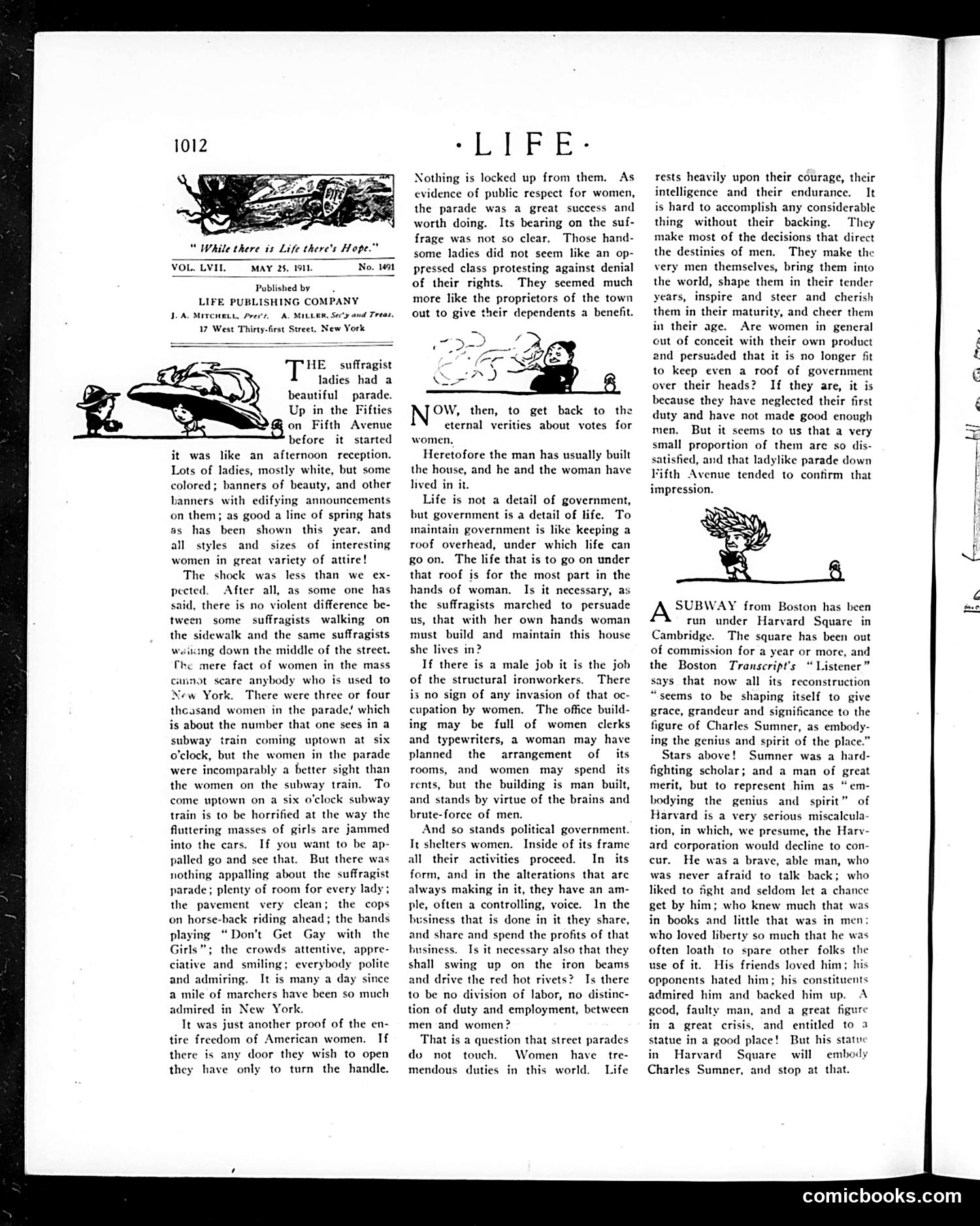
This page discusses the women's suffrage parade held on Fifth Avenue in New York. The text describes the event as a successful demonstration of women's political activism, with well-dressed participants marching to advocate for voting rights. The cartoons (though small and stylized) appear to depict suffragists and their supporters. The article sarcastically debates whether women are equipped for political participation, questioning whether they should concern themselves with "eternal verities about votes" or focus instead on domestic duties. The piece ultimately argues that government is interconnected with daily life, and since women manage households, they should have a voice in governance. The Boston subway construction reference and Charles Sumner tribute contextualize this as serious political commentary on women's emerging public role during the Progressive Era.
📄 Transcribed text from this page (OCR, searchable)
Machine-transcribed from the original scan — historical spelling and the odd misread are preserved.
“ While there is Life there's Hope.” VOL. LVII. No. 1491 MAY 25, 1911. Published by LIFE PUBLISHING COMPANY JA. MITCHELL, Pres’, A. MILLER, Sec’y and Treas, 17 West Thirty-first Street, New York HE | suffragist ladies had a beautiful parade. Up in the ties on Fifth Avenue before it started it was like an afternoon reception. Lots of ladies, mostly white, but some colored; banners of beauty, and other banners with edifying announcements on them; as good a line of spring hats as has been shown this year, and all styles and interesting women in great variety of attire! The shock was less than we ex- pected. After all, as some one has said, there is no violent difference be- tween some suffragists walking on the sidewalk and the same suffragists waiking down the middle of the street. fhe mere fact of women in the mass cainot scare anybody who is used to New York. There were three or four theasand women in the parade/ which is about the number that one sees in a subway train coming uptown at six o'clock, but the women in the parade were incomparably a better sight than the women on the subway train. To come uptown on a six o'clock subway train is to be horrified at the way the fluttering m: s of girls are jammed into the cars. If you want to be ap- palled go and sce that. But there was nothing appalling about the suffragist parade; plenty of room for every lady; the pavement very clean; the cops on horse-back riding ahead; the bands playing “Don’t Get Gay with the Girls”; the crowds attentive, appre- ciative and smiling; everybody polite and admiring. It is many a day since a mile of marchers have been so much admired in New York. It was just another proof of the en- tire freedom of American women. If there is any door they wish to open they have only to turn the handle. sizes of 2 LAP « Nothing is locked up from them. As evidence of public respect for women, the parade was a great success and worth doing. Its bearing on the suf- frage was not so clear. Those hand- some ladies did not seem like an op- pressed class protesting against denial of their rights. They seemed much more like the proprietors of the town out to give their dependents a benefit. OW, then, to get back to the eternal verities about votes for women, Heretofore the man has usually built the house, and he and the woman have lived in it. Life is not a detail of government, but government is a detail of life. To maintain government is like keeping a roof overhead, under which life can goon. The life that is to go on under that roof is for the most part in the hands of woman. Is it necessary, as the suffragists marched to persuade us, that with her own hands woman must build and maintain this house she lives in? If there is a male job it is the job of the structural ironworkers. There is no sign of any invasion of that oc- cupation by women. The office build- ing may be full of women clerks and typewriters, a woman may have planned the arrangement of _ its rooms, and women may spend _ its rents, but the building is man built, and stands by virtue of the brains and brute-force of men. And so stands political government. It shelters women. Inside of its frame all their activities proceed. In_ its form, and in the alterations that are always making in it, they have an am- ple, often a controlling, voice. In the business that is done in it they share, and share and spend the profits of that business. Is it necessary also that they shall swing up on the iron beams and drive the red hot rivets? Is there to be no division of labor, no distinc- tion of duty and employment, between men and women? That is a question that street parades do not touch. Women have tre- mendous duties in this world. Life rests heavily upon their courage, their intelligence and their endurance. It is hard to accomplish any considerable thing without their backing. They make most of the decisions that direct the destinies of men. They make the very men themselves, bring them into the world, shape them in their tender years, inspire and steer and cherish them in their maturity, and cheer them in their age. Are women in general out of conceit with their own product and persuaded that it is no longer fit to keep even a roof of government over their heads? If they are, it is because they have neglected their first duty and have not made good enough men. But it seems to us that a very small proportion of them are so dis- satisfied, and that ladylike parade down Fifth Avenue tended to contirm that impression. SUBWAY from Boston has been tun under Harvard Square in Cambridge. The square has been out of commission for a year or more, and the Boston Transcripts “Listener” says that now all its reconstruction “seems to be shaping itself to give grace, grandeur and significance to the figure of Charles Sumner, as embody- ing the genius and spirit of the place.” Stars above! Sumner was a hard- fighting scholar; and a man of great merit, but to represent him as “em- bodying the genius and spirit” of Harvard is a very serious miscalcula tion, in which, we presume, the Harv- ard corporation would decline to con- cur. He was a brave, able man, who was never afraid to talk back; who liked to fight and seldom Iet a chance get by him; who knew much that was in books and little that was in men: who loved liberty so much that he was often loath to spare other folks the use of it. His friends loved him; his opponents hated him; his constituents admired him and backed him up. A geod, faulty man, and a great figure in a great crisis, and entitled to a statue in a good place! But his statue in Harvard Square will embody Charles Sumner, and stop at that. comicbooks.com