A complete issue · 44 pages · 1911
Life — February 9, 1911
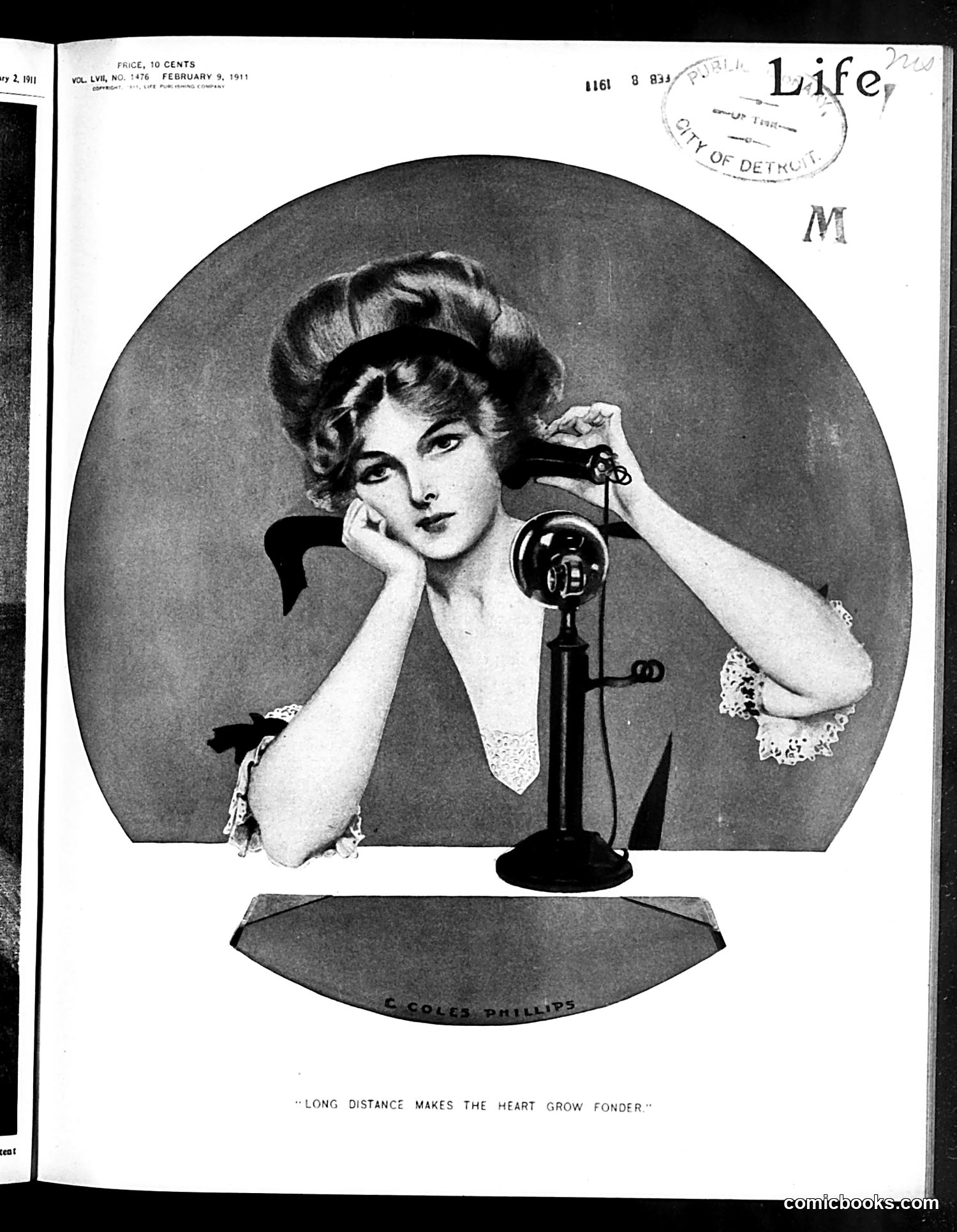
This appears to be a satirical advertisement or illustration rather than a political cartoon. The image shows a woman at an old-fashioned telephone, with the caption "Long distance makes the heart grow fonder." The joke plays on the proverb "absence makes the heart grow fonder," applying it to long-distance telephone communication. This was likely contemporary satire about the novelty and romantic implications of the then-new telephone technology, particularly long-distance calling service. The credit line reads "C. Coles Phillips," a prominent illustrator of the era. The illustration celebrates—or gently mocks—how telephone technology was reshaping courtship and communication, especially for separated couples. The elegant Gibson Girl-style woman and dated telephone equipment anchor this firmly in the early 1900s telecommunications revolution.
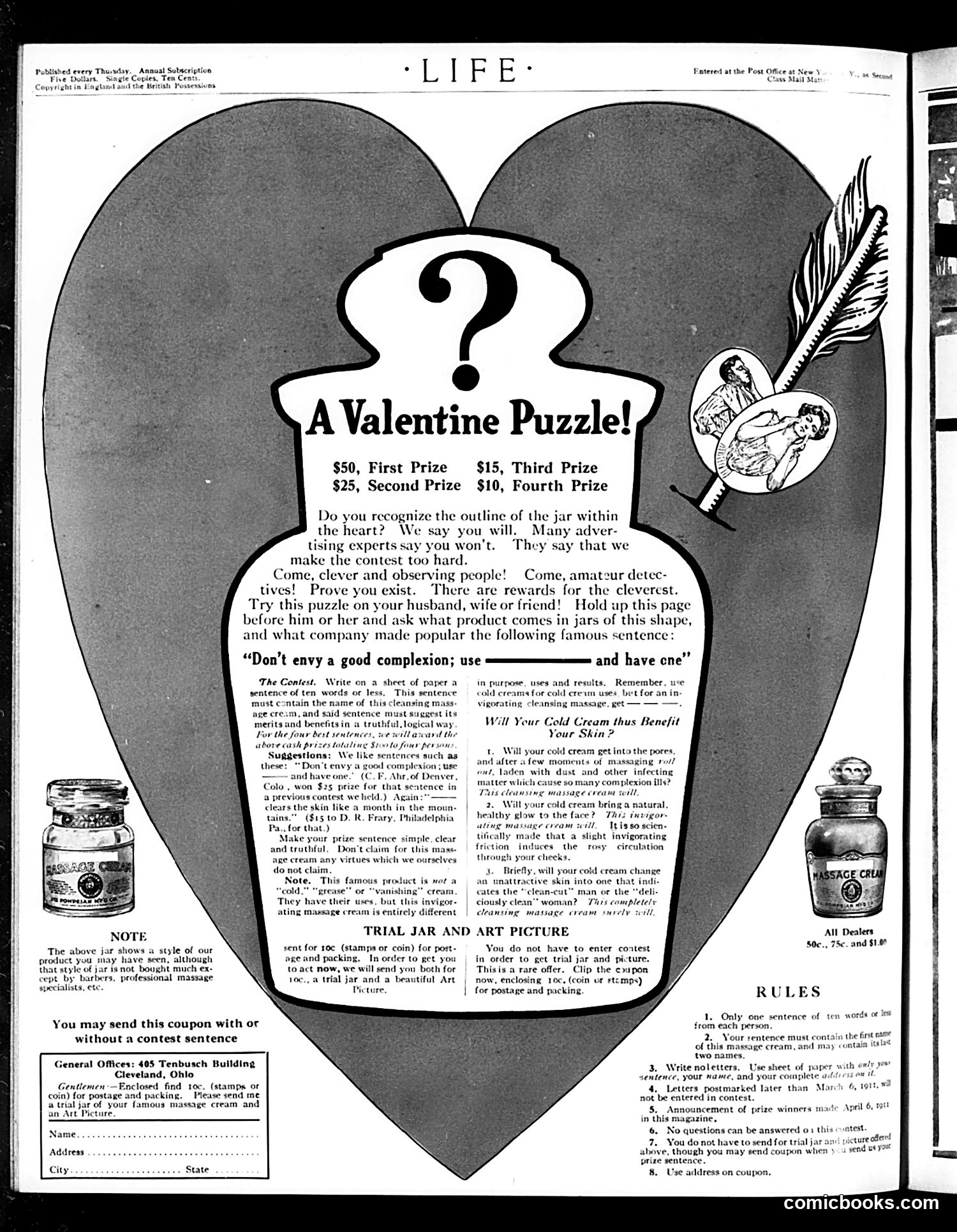
This page is primarily **advertising, not satire**. It presents a Valentine's Day contest for a massage cream product. The large heart-shaped design contains a puzzle asking readers to identify a jar outline—presumably the advertiser's product jar. The contest offers cash prizes ($50 first prize down to $10 fourth prize) and asks contestants to complete an advertising slogan: "Don't envy a good complexion; use ___ and have one." The page includes testimonials praising the cold cream's benefits for skin and complexion. While the puzzle format creates mild entertainment value typical of early 20th-century marketing, this is fundamentally a **product advertisement using a contest mechanism** to engage readers rather than political or social satire.
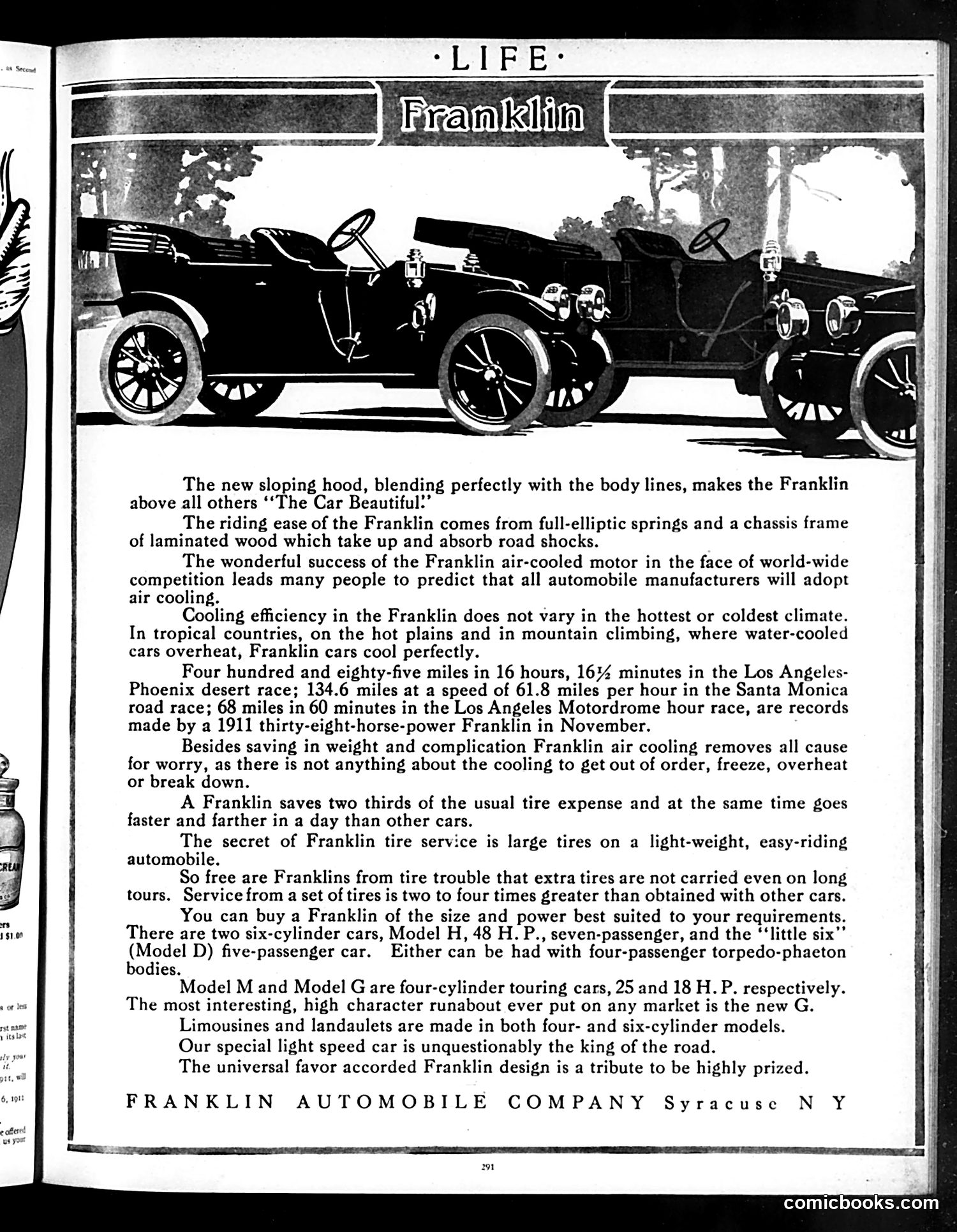
This page is **not a cartoon or satirical content**—it's a **straightforward advertisement** for the Franklin Automobile Company of Syracuse, NY. The image shows three early 1910s automobiles in silhouette. The accompanying text is promotional copy highlighting Franklin's technical features: air-cooled motors, elliptic springs, lightweight construction, and tire durability. It includes performance records (a 485-mile Los Angeles run) and model descriptions (various six- and four-cylinder options). There is no political satire, social commentary, or humor intended. This represents typical early automotive advertising from *Life* magazine, which carried substantial advertising revenue alongside its satirical content.
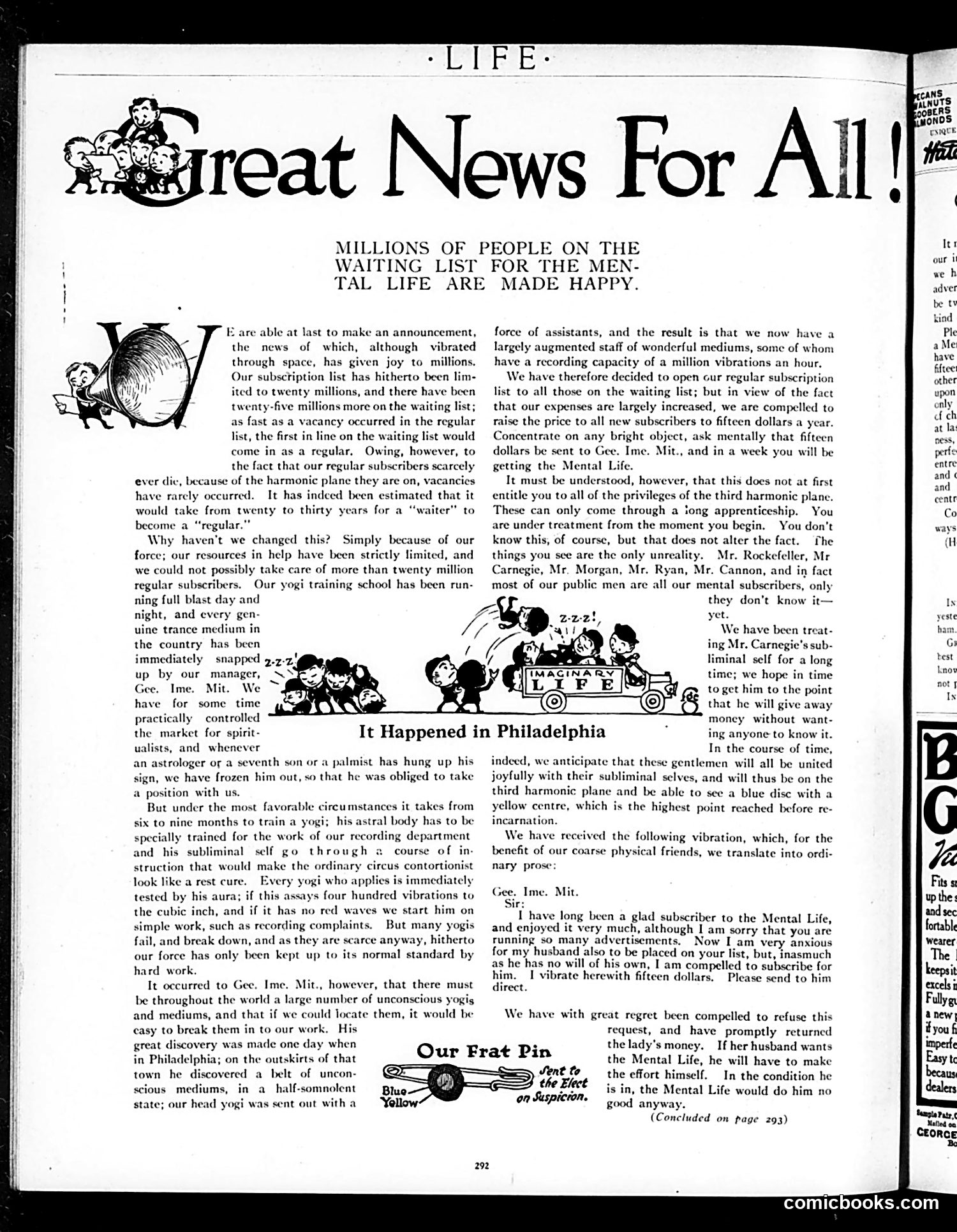
This page satirizes the "Mental Life" subscription service, which claims to connect subscribers with deceased famous figures—apparently wealthy industrialists like Carnegie, Morgan, and Rockefeller—through mediums and astral projection. The cartoon "It Happened in Philadelphia" depicts yogis or spiritualist practitioners, likely mocking the pseudoscientific training required to access this service. The satire targets both the gullible wealthy paying fifteen dollars annually and the con artists operating the scheme. A letter complains the service won't help a woman place her husband on the subscription list without his knowledge or consent—suggesting these services exploited family dynamics and financial disputes. The overall message ridicules early 20th-century spiritualism as an exploitative fraud preying on the bereaved and credulous.
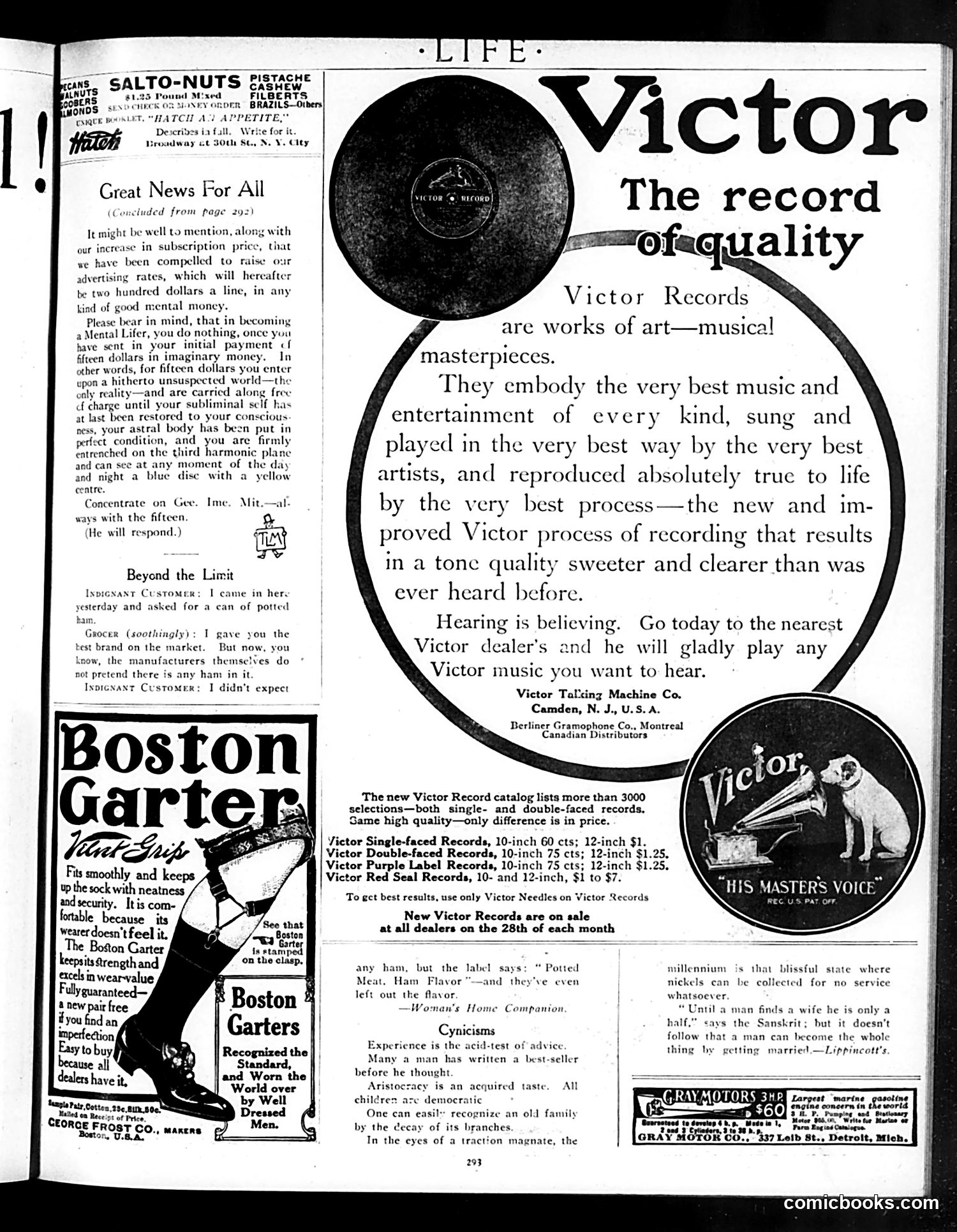
This page is primarily **advertising**, not satire or political commentary. The dominant content features a Victor Records advertisement promoting their phonograph records and the "His Master's Voice" dog logo. The ad emphasizes Victor's superior recording quality and encourages readers to visit dealers. A secondary advertisement promotes **Boston Garters** (men's sock supporters), claiming they keep socks secure without slipping. The page includes brief humorous anecdotes under headers like "Beyond the Limit" and sections on "Cynicism," but these are light, general observations about human nature rather than political satire. The overall page reflects early 1920s consumer culture, showcasing emerging entertainment technology (recorded music) and men's fashion products.
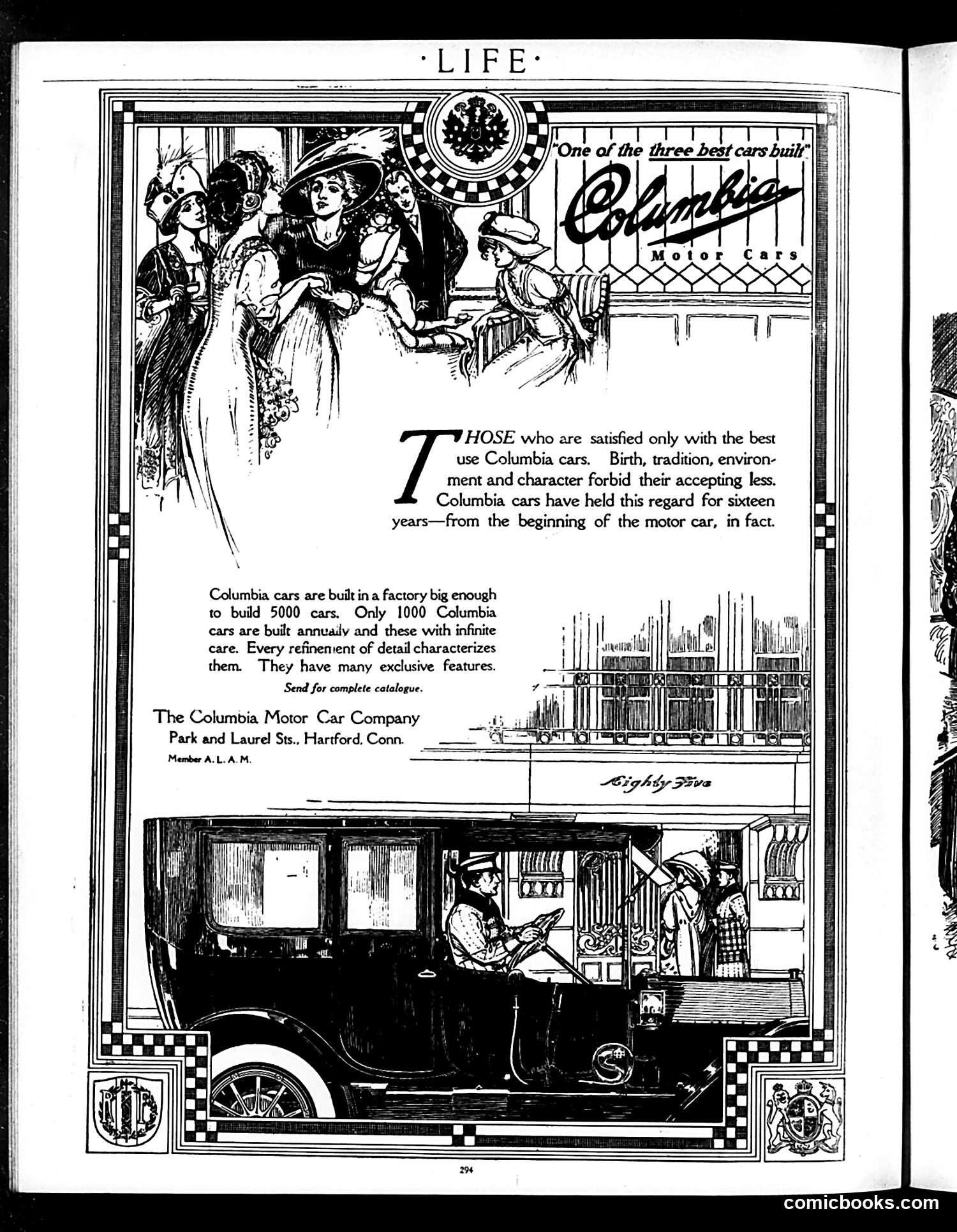
This page is primarily **advertising**, not satire or political commentary. It features a Columbia Motor Cars advertisement from The Columbia Motor Car Company in Hartford, Connecticut. The top illustration shows fashionable women in a showroom examining automobiles—a social scene emphasizing that Columbia cars appeal to discriminating, affluent customers. The text claims Columbia cars represent "the best," with 16 years of manufacturing excellence. The lower illustration depicts a "Eighty-Five" model car in operation, showing the vehicle's interior and mechanical features. The ad's core message: Columbia cars are luxury vehicles for people "satisfied only with the best," produced in limited quantities (only 1,000 annually) with meticulous craftsmanship. This was a premium-market positioning strategy typical of early automotive advertising targeting wealthy consumers.
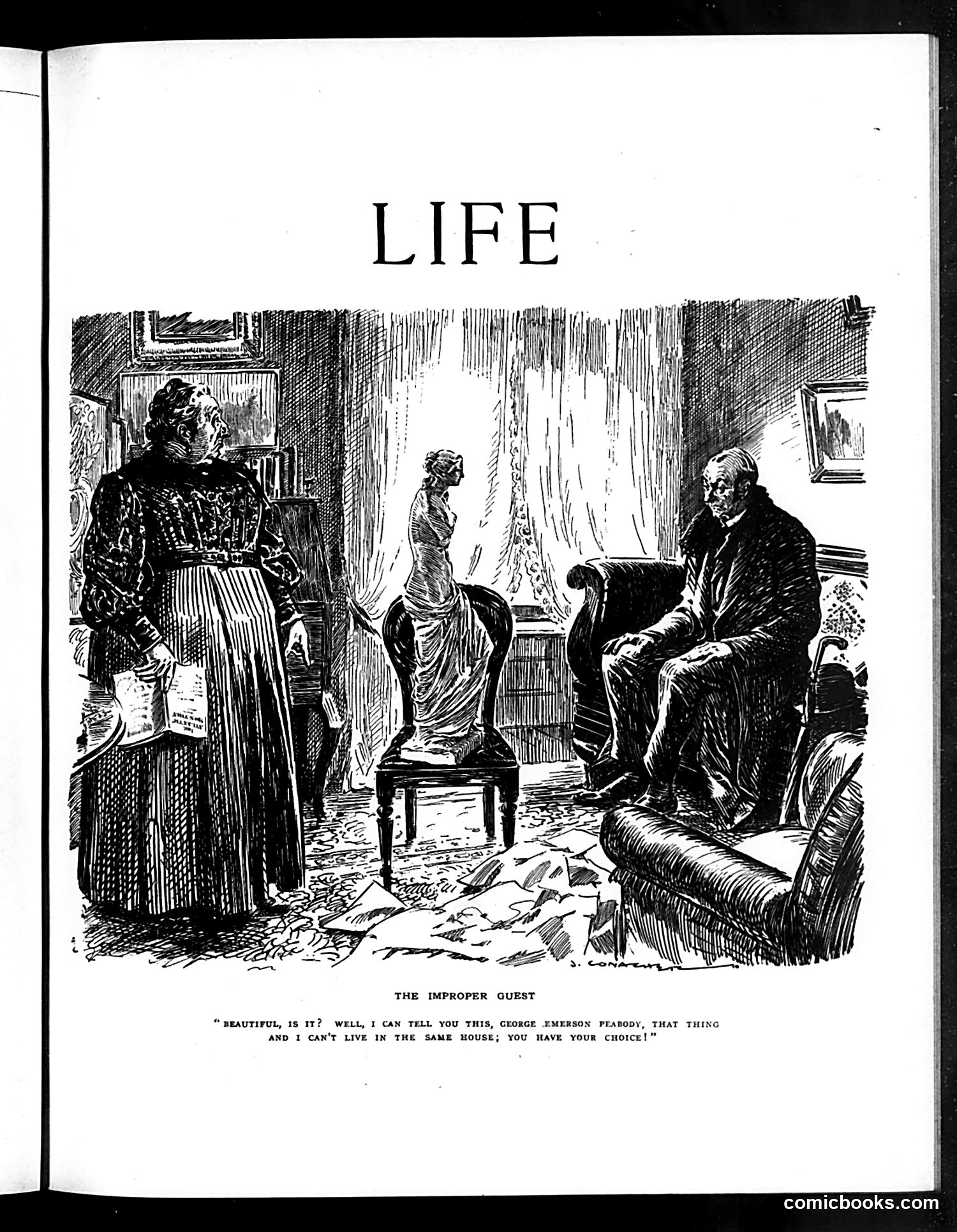
This satirical cartoon depicts a domestic conflict centered on a statue or figurine. A woman (left) confronts two men in what appears to be a parlor, with an ornamental female statue prominent on a chair between them. The caption quotes one man addressing "George Emerson Peabody," claiming the statue and he "can't live in the same house" and giving Peabody an ultimatum to choose. The satire likely mocks Victorian-era social tensions around art, propriety, and domestic life. The "improper guest" appears to reference either the statue (as an inappropriate decoration) or the unnamed visitor, suggesting contemporary debates about aesthetics, morality, or marital disputes over household management and taste. The specific identity of Peabody remains unclear without additional historical context.
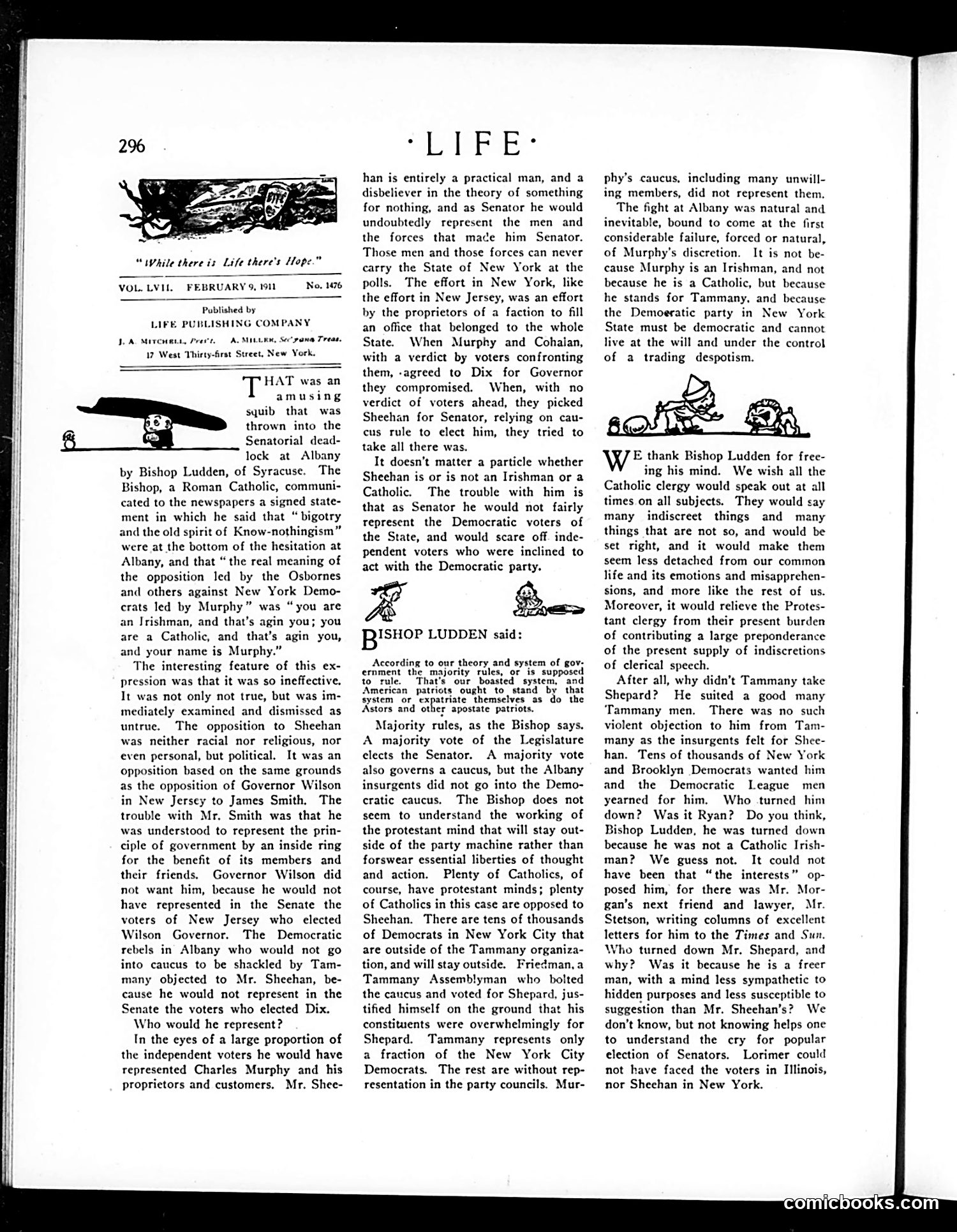
This page from *Life* (February 9, 1911) contains an article by Bishop Ludden criticizing the Senate election of William "Blue-Eyed Billy" Sheehan, a Democratic political operative backed by Charles Murphy's Tammany Hall machine in New York. The satire attacks Sheehan as unfit for Senate because he represents corrupt machine politics rather than the Democratic Party's principles. Bishop Ludden argues that Catholic clergy should speak out on political matters, and questions why Tammany would nominate someone so controversial. The article implies Sheehan lacks the ethical standing to represent New York voters in the Senate. The decorative cartoons (showing figures in apparently distressed positions) appear to illustrate the tumultuous political situation, though their specific meaning requires additional context.
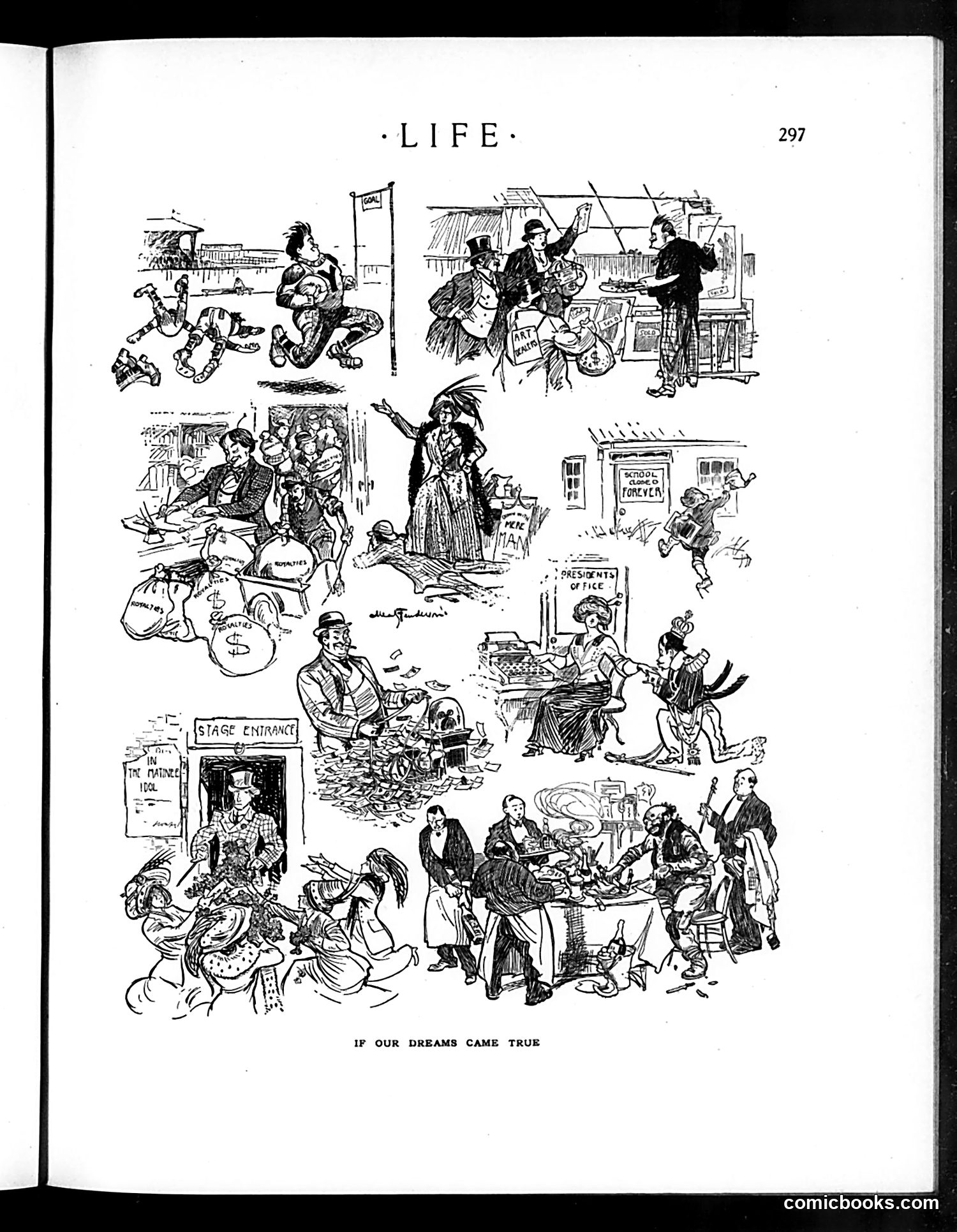
This satirical Life magazine page depicts various fantasy scenarios imagining what would happen if theatrical performers' aspirations were realized. The cartoons show: - Performers receiving standing ovations and accolades - Actors in elaborate costumes and dramatic poses - A "Stage Entrance" scene with performers surrounded by admirers - An office labeled "Presidents of Life" where performers appear to have gained power or influence - Various scenes of theatrical success and recognition The overall satire mocks the grandiose ambitions of stage performers, suggesting the gap between their actual circumstances and their inflated dreams of fame, wealth, and social prominence. The title implies these fantasies are unrealistic—poking fun at performers' optimism and the theatrical world's hierarchies and aspirations during this era of American entertainment.
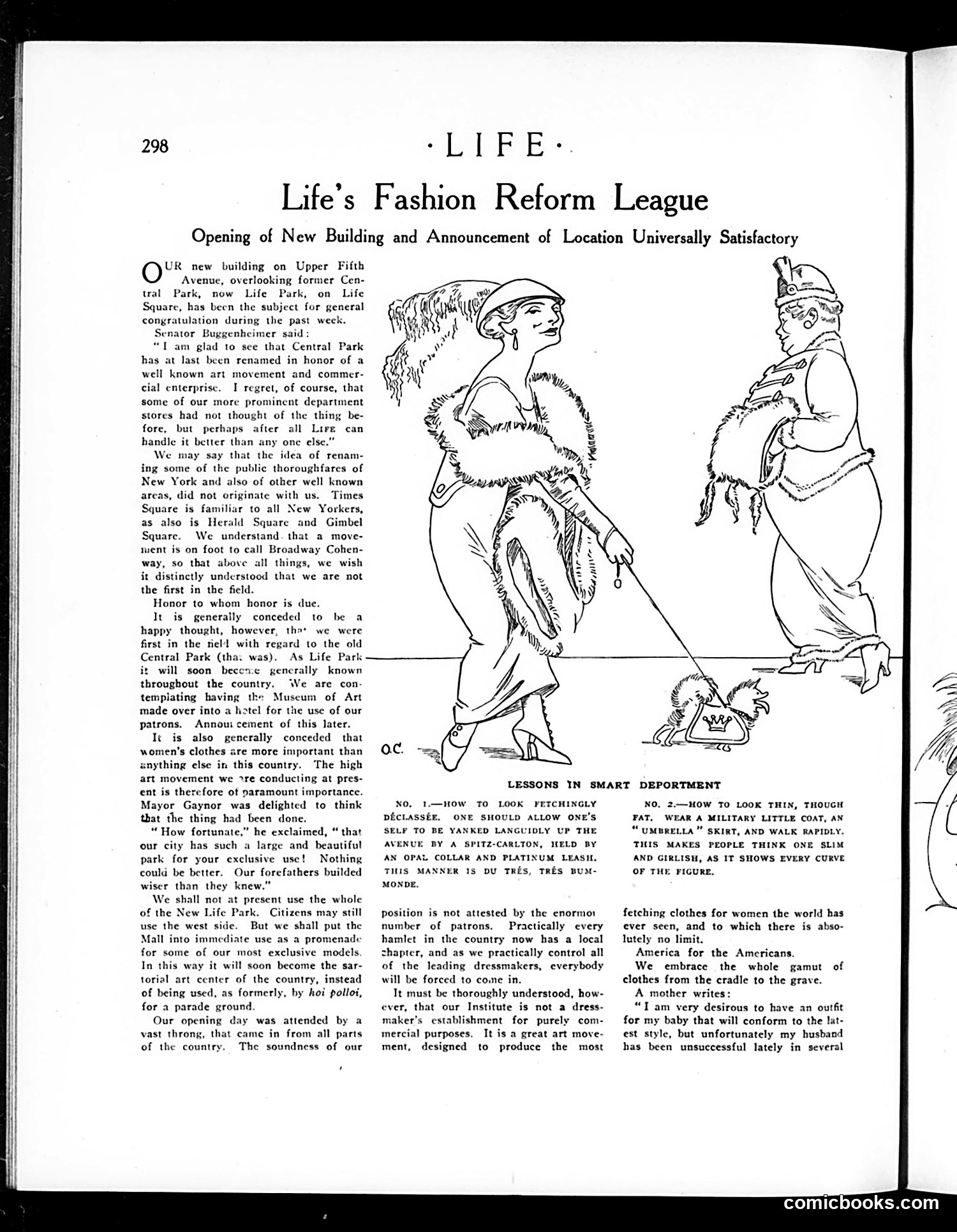
This page mocks the "Fashion Reform League," an early 20th-century movement advocating for more practical women's clothing. The cartoon illustrates the tension between reform ideals and actual fashion practice. The two figures demonstrate the hypocrisy: while reformers claimed to promote sensible dress, fashionable women continued wearing excessive garments—bulky furs, tight corsets, and impractical accessories. The caption "Lessons in Smart Department" sarcastically shows how a woman could appear "slim and graceful" through strategic layering and a military coat, despite being "fat"—exposing the gap between fashion reform rhetoric and the reality of constrictive, appearance-focused clothing women actually wore. The piece critiques both the reform movement's ineffectiveness and women's continued adherence to uncomfortable fashion conventions.
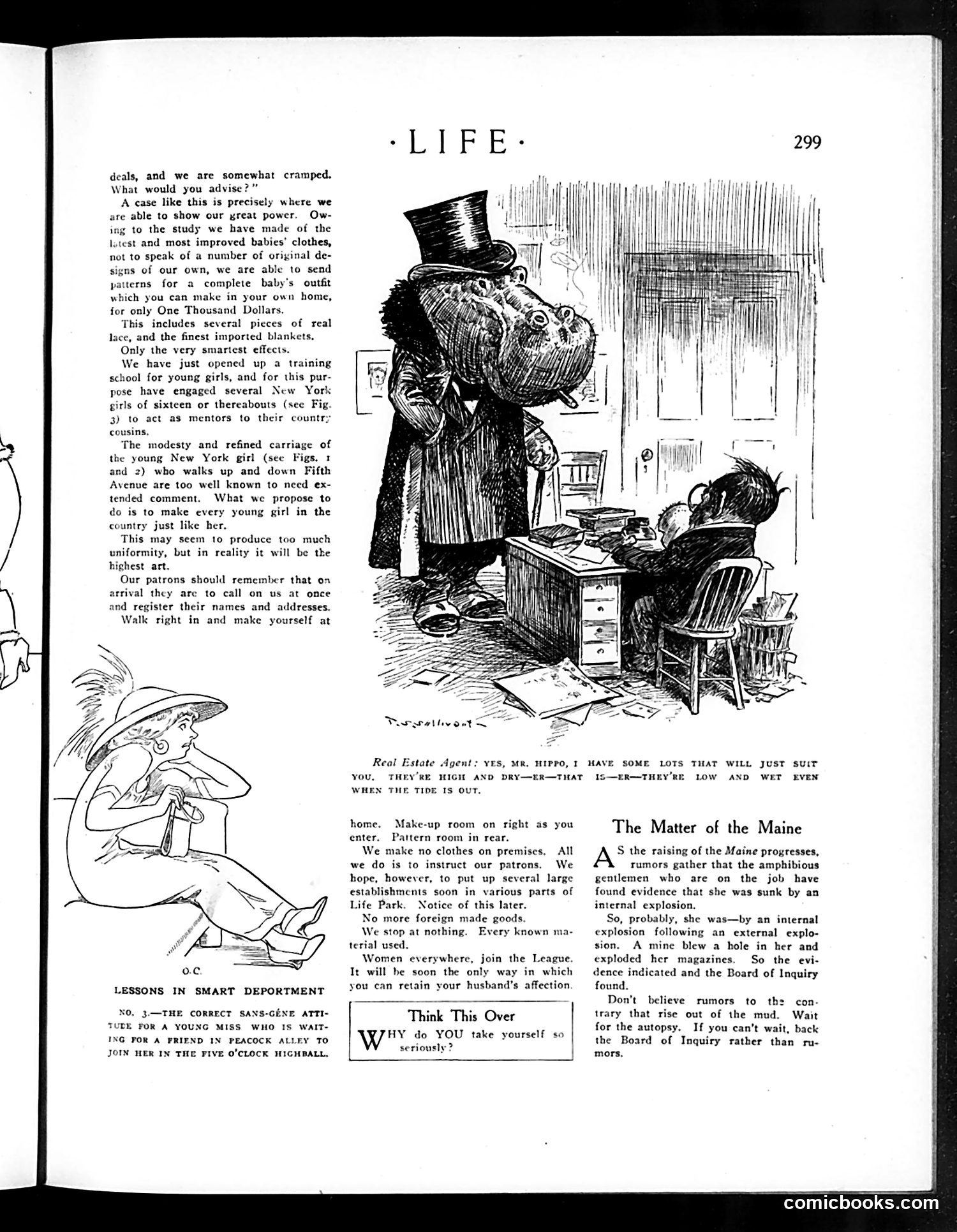
The main cartoon depicts a caricatured figure (appears to be an Irish immigrant based on exaggerated facial features common to period anti-Irish stereotypes) wearing a top hat, standing at a desk labeled as a real estate agent's office. The agent is showing properties to a seated client. The caption reads: "Real Estate Agent: Yes, Mr. Hippo, I have some lots that will just suit you. They're high and dry—er—that is—er—they're low and wet even when the tide is out." This satirizes predatory real estate practices of the era—specifically agents selling worthless or flood-prone properties to naive or immigrant buyers. The "Hippo" reference likely mocks the buyer's appearance or gullibility. The cartoon critiques deceptive business tactics targeting vulnerable populations in early 20th-century America.
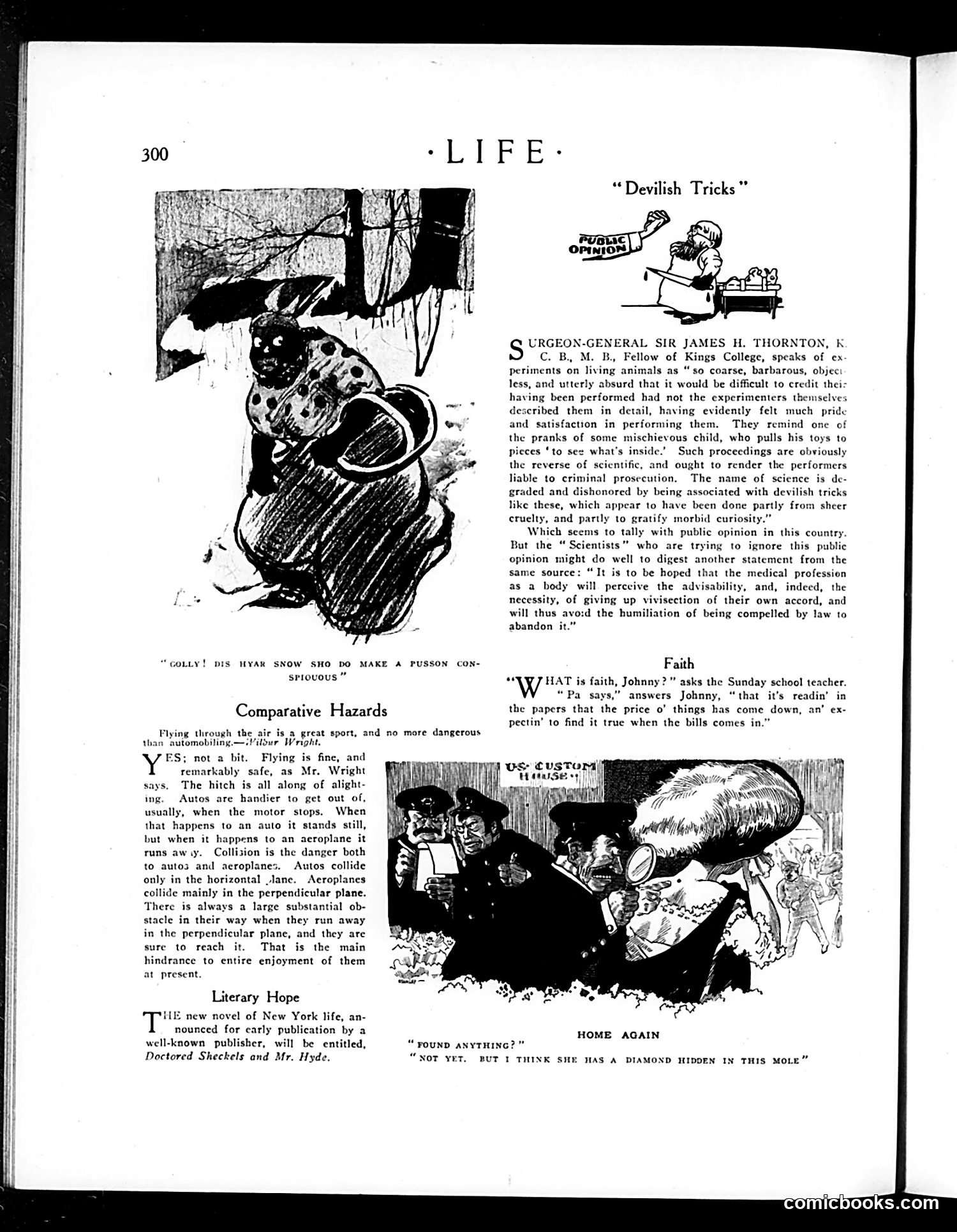
This page contains several satirical pieces criticizing animal experimentation. The top section titled "Devilish Tricks" attacks Surgeon-General Sir James H. Thornton for vivisection experiments, calling them cruel and scientifically dubious. The text argues such practices degrade science and should invite criminal prosecution. "Comparative Hazards" compares airplane safety to automobile collisions, suggesting flying is relatively safer despite public perception. "Faith" is a brief joke about childhood innocence regarding economic hardship. The bottom cartoon, "Home Again," shows a woman discovering a diamond hidden in her mole—a domestic humor piece playing on hidden wealth and marital surprise. The page's primary focus is mocking animal experimentation as pseudoscience conducted from sadism rather than legitimate research.
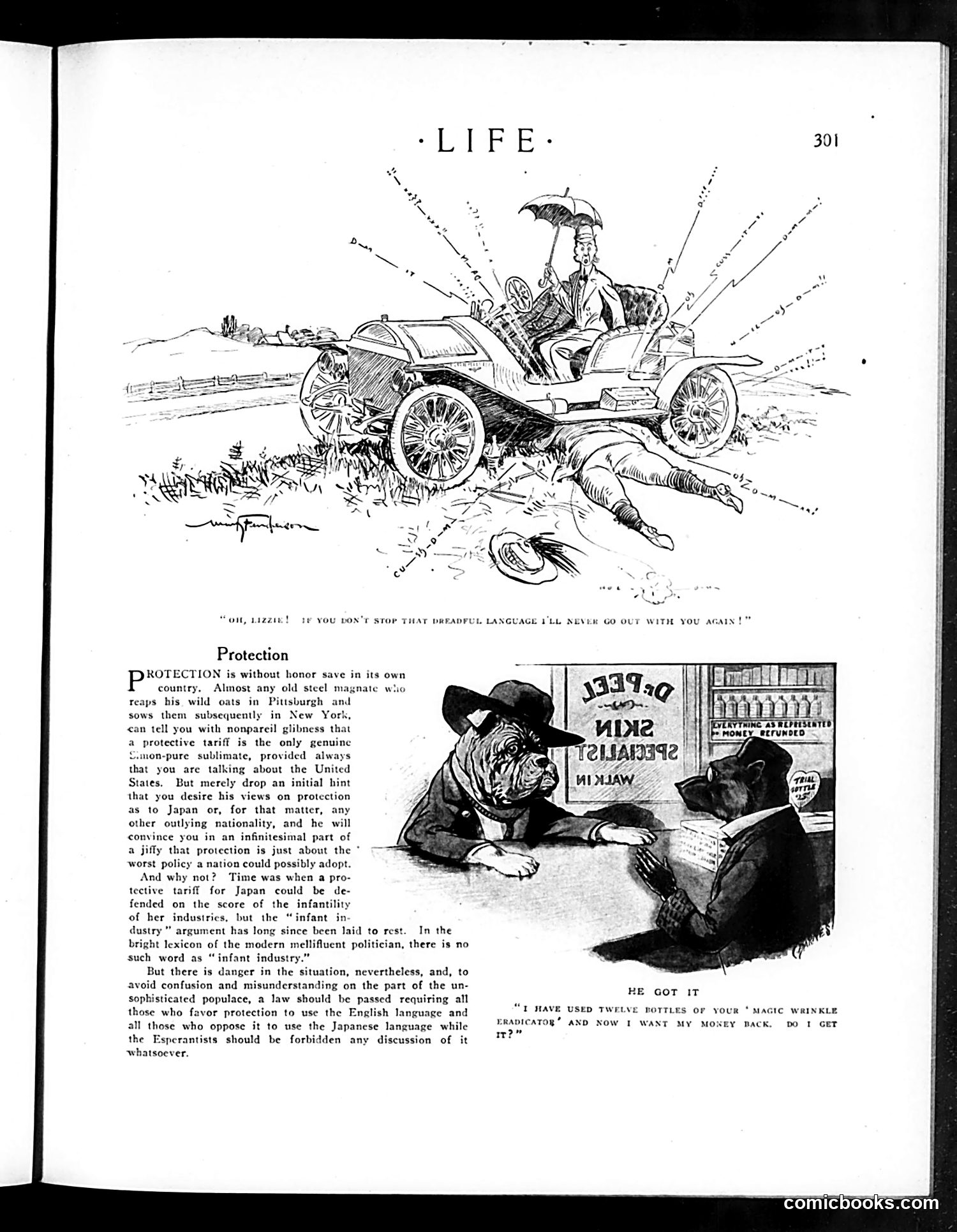
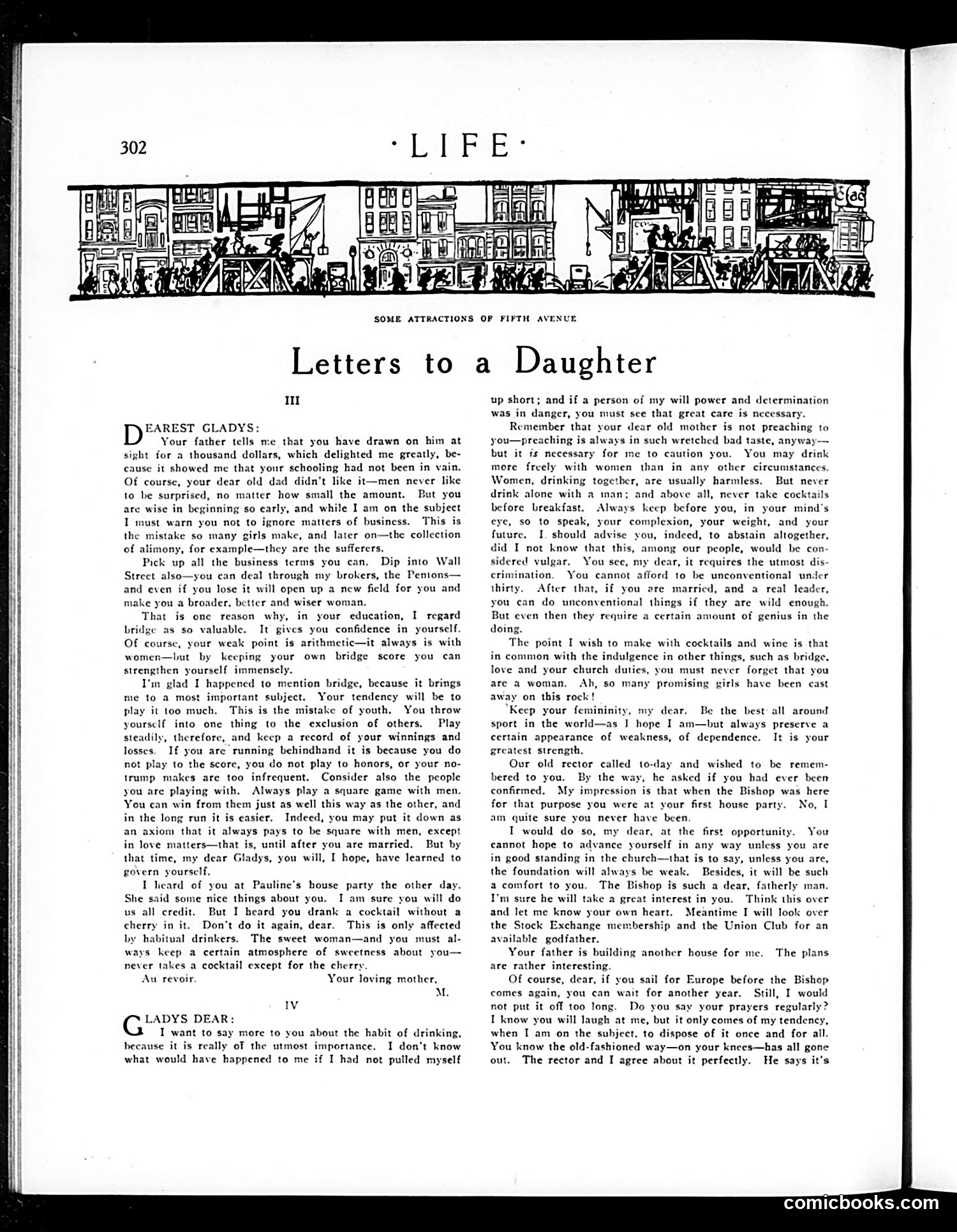
This page contains **advice columns disguised as satirical "Letters to a Daughter"** — a humorous commentary on upper-class American social hypocrisy circa early 1900s. The cartoon strip at top depicts Fifth Avenue attractions (New York's wealthy shopping district), setting the social context. The letters mock wealthy mothers' contradictory guidance to daughters: advice to handle money and play bridge seriously, yet warnings against appearing too independent or unfeminine. The satire peaks in sections about drinking — the mother admits her own struggles with alcohol while instructing her daughter to drink only with women, never alone with men, and only for the cherry garnish (not the drink itself). This captures the era's pretense that respectable women didn't truly drink, merely consumed cocktails as social decoration. The reference to "alimony" hints at divorce's growing prevalence among the wealthy, treated with cynical humor. The piece satirizes how privileged society simultaneously demands women be savvy about money and propriety while insisting they remain decorative and dependent — a contradiction the author highlights through the mother's own obliviousness.
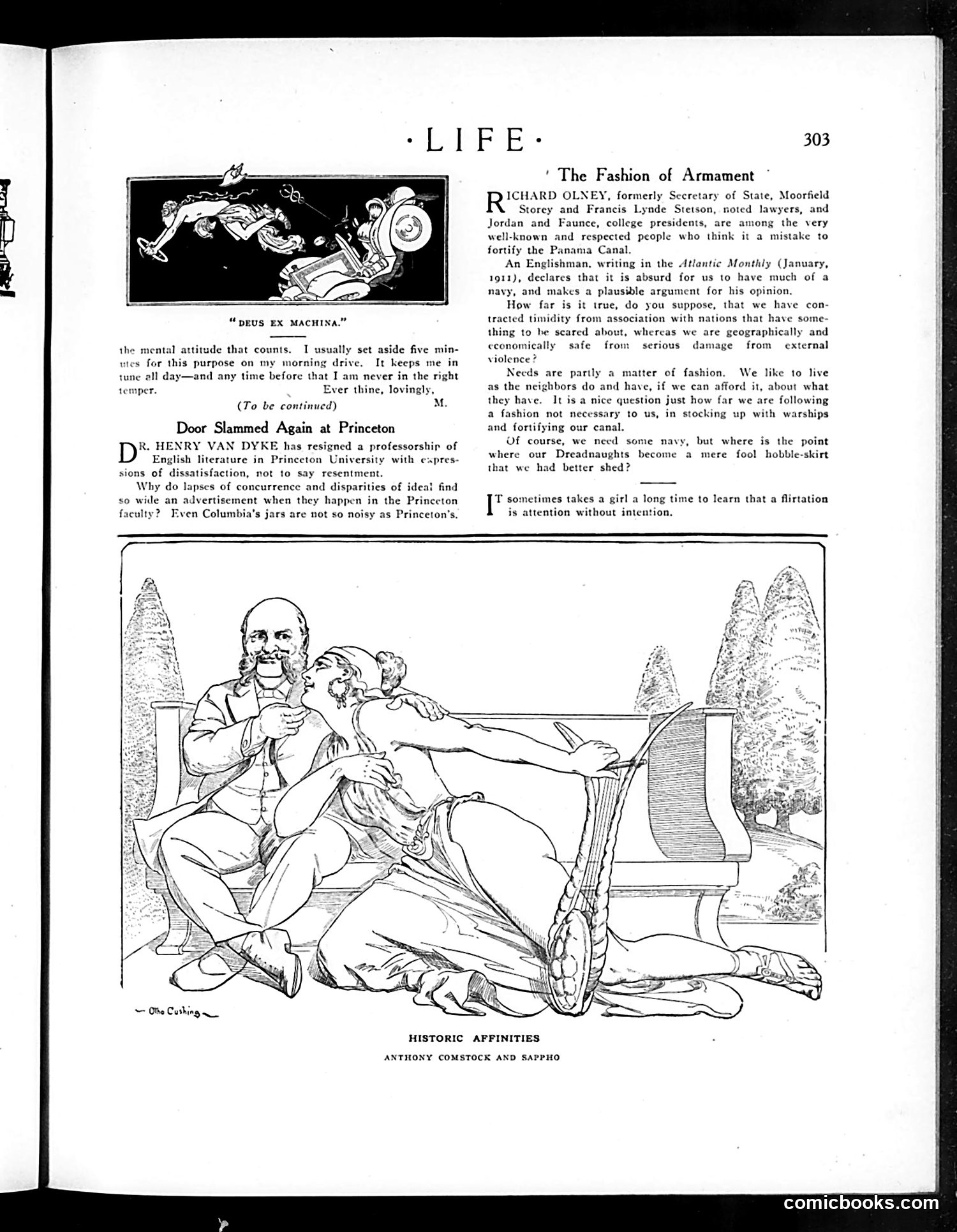
This page contains three distinct pieces of satire: **"Deus Ex Machina"** (top): A brief humorous column about mental attitude and morning drives, offering life advice. **"Door Slammed Again at Princeton"**: A short commentary on Professor Henry Van Dyke's resignation from Princeton University over disagreements with the institution. The satire notes that Princeton's internal disputes receive disproportionate public attention compared to similar conflicts at Columbia University. **"The Fashion of Armament"**: The main article critiques American military buildup, particularly naval expansion and Panama Canal fortification. It cites prominent figures (Richard Olney, Moorfield Storey, Francis Lynde Stetson) who question the necessity of these expenditures. The satire suggests Americans are following foreign military fashion rather than genuine security needs, comparing excessive warships to women's "hobble-skirt" fashion—unnecessary and restrictive. **"Historic Affinities"**: The illustration below, captioned "Anthony Comstock and Sappho," appears to be a satirical comparison, though context is unclear without additional information.
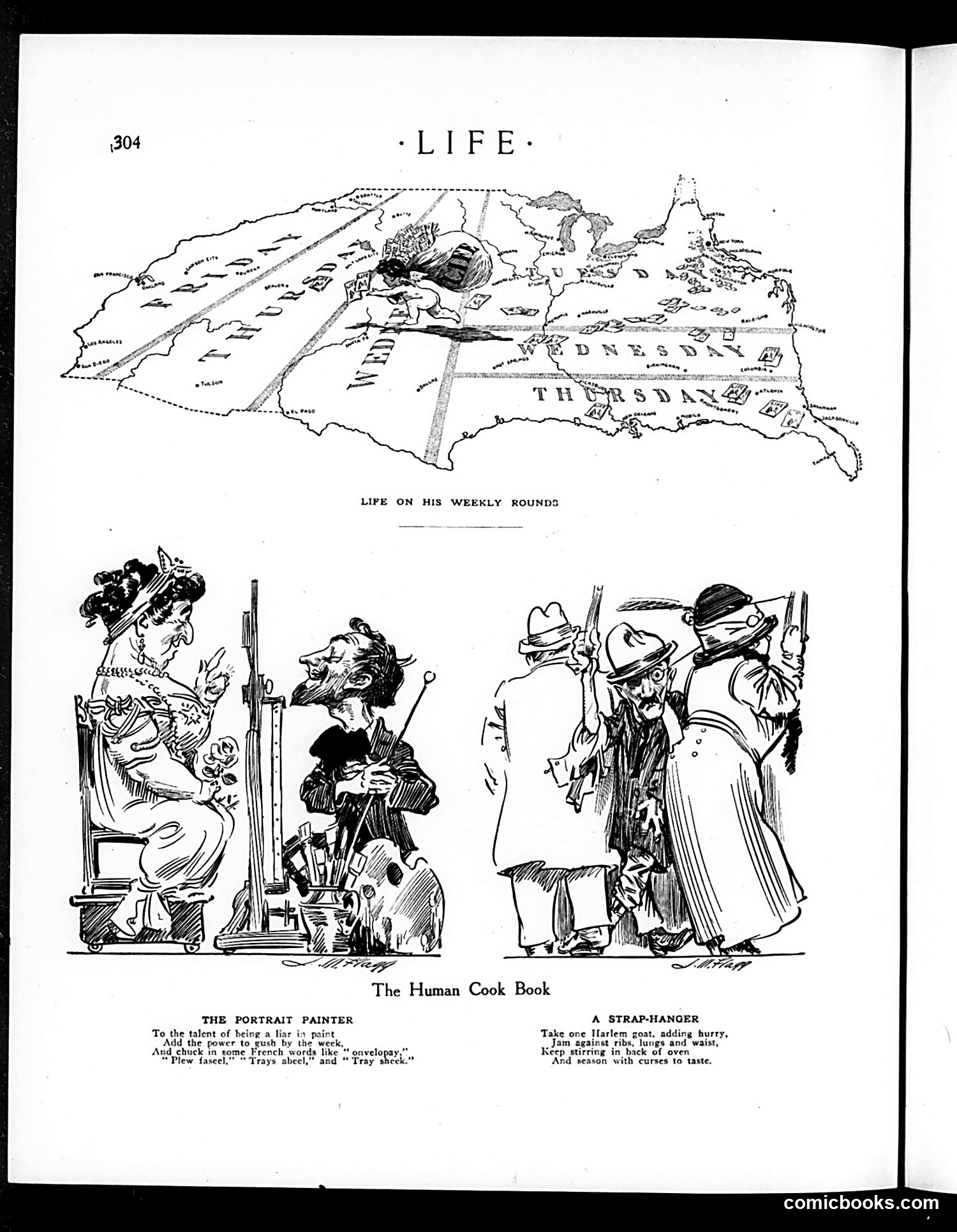
This satirical page presents two caricatured "recipes" mocking professional types. The top map shows a character's weekly route across what appears to be the United States. **"The Portrait Painter"** ridicules society portraitists as fraudulent—literally "liars in paint" who use pretentious French phrases ("onvelopay" for *en voilà*, "Plew faseel" for *plus facile*) to sound sophisticated while charging clients weekly fees. **"A Strap-Hanger"** sarcastically "cooks" a Harlem goat (a reference to working-class transit riders packed into streetcars—"strap-hangers" holding overhead straps) by jamming them together with curses as seasoning. It's crude class satire depicting how ordinary commuters are treated like objects. Both mock pretension and mistreatment of different social classes through the cookbook metaphor—people as ingredients processed for profit or abuse.
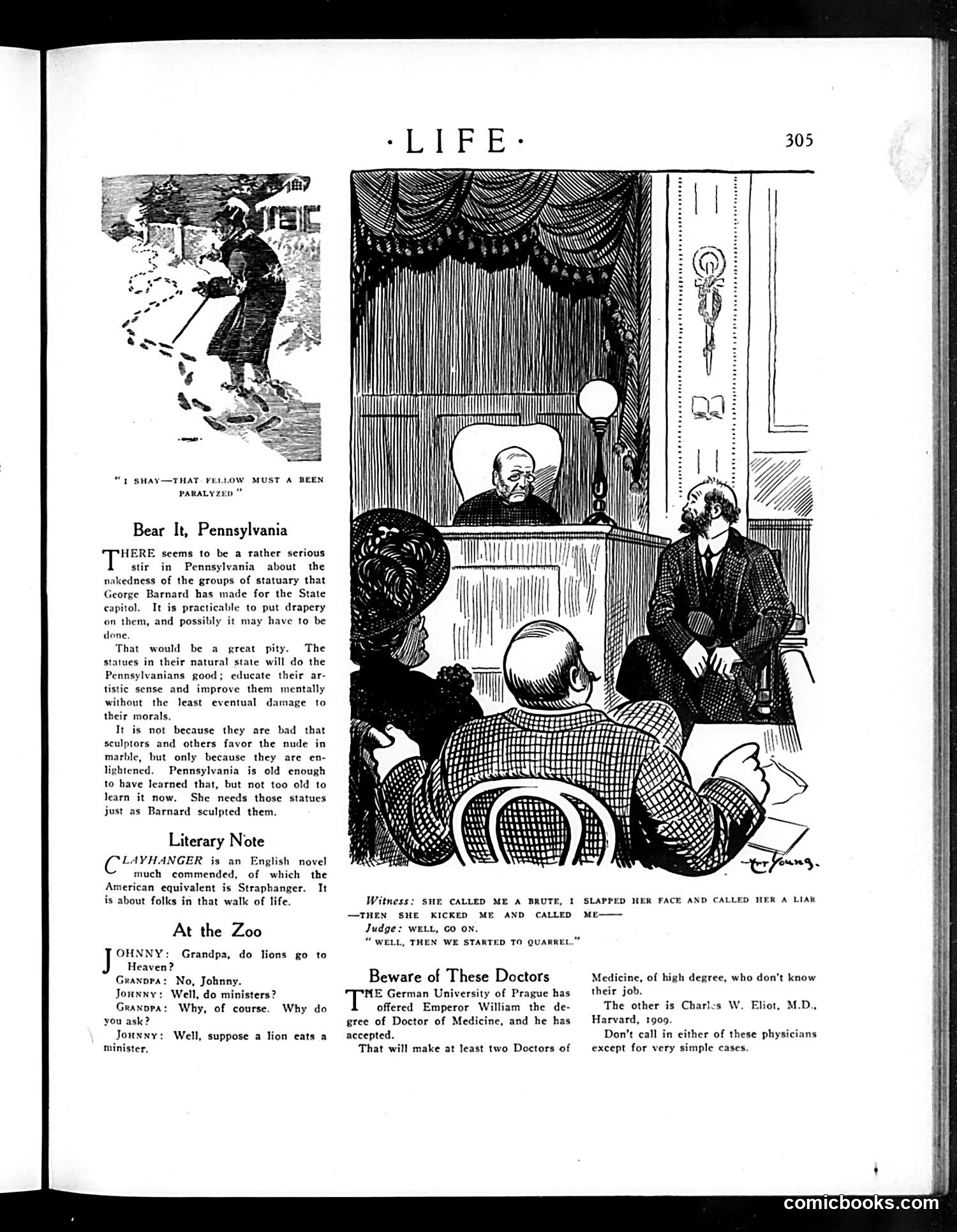
This page contains several satirical pieces typical of *Life* magazine's humor: **"Bear It, Pennsylvania"** defends the nudity in sculptor George Barnard's statues for Pennsylvania's state capitol against local objections. The editorial argues nudity in art educates and refines public taste without moral danger—a progressive position mocking provincial prudishness. **"At the Zoo"** is a brief joke playing on theological logic: if lions don't go to Heaven but ministers do, what happens when a lion eats a minister? The humor relies on the absurdist premise. **The courtroom cartoon** shows a domestic dispute where both parties traded insults and violence. The judge's deadpan "Well, go on" suggests mutual guilt. **"Beware of These Doctors"** satirizes Emperor William II (Germany's kaiser) accepting an honorary Doctor of Medicine degree despite lacking medical knowledge. The jab at Harvard's Charles W. Eliot suggests even prestigious educators award degrees to unqualified men—a critique of credentialism and institutional prestige.
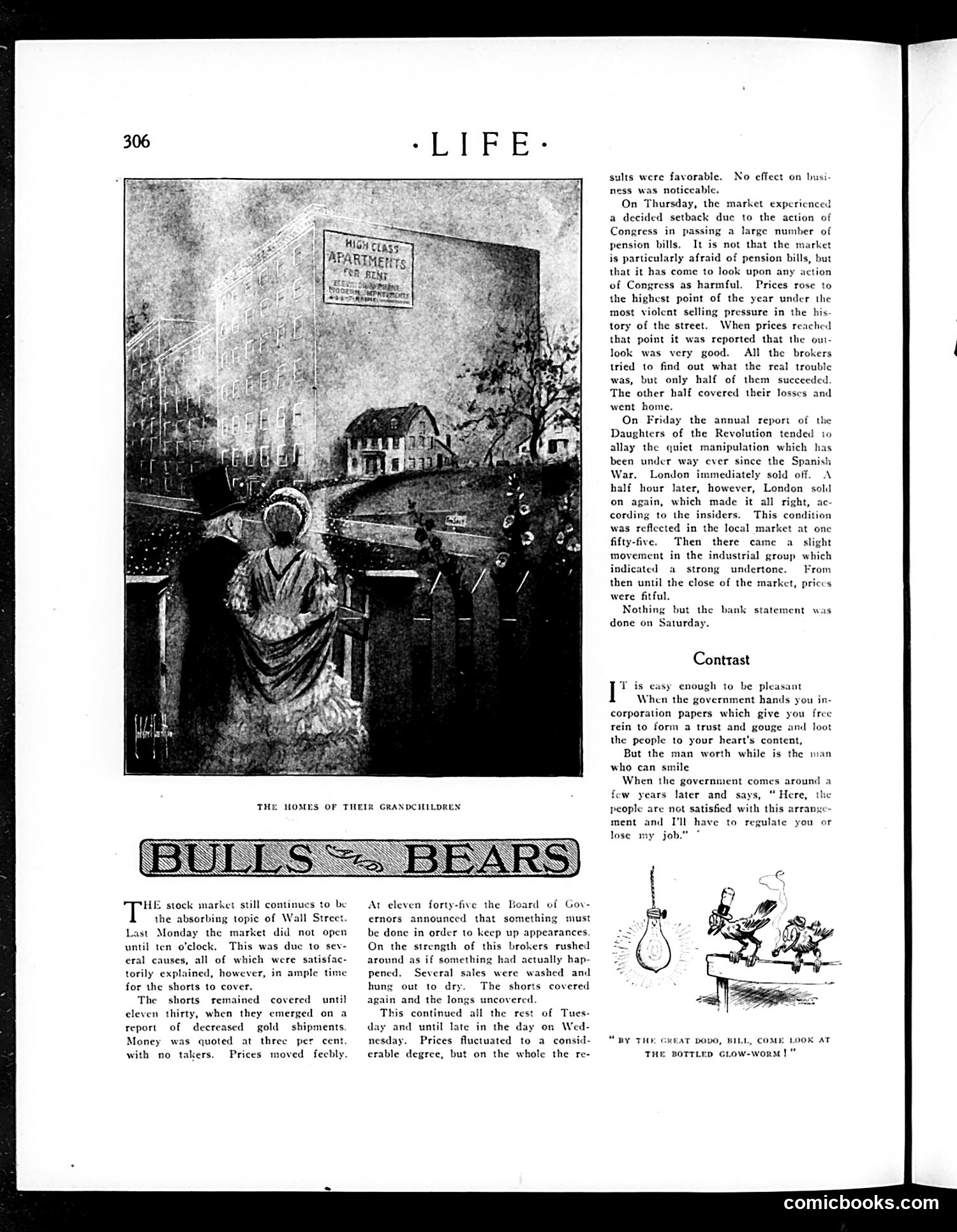
This page satirizes stock market manipulation and volatility during the early 20th century. The "Bulls & Bears" section mocks the market's absurd behavior: prices move based on rumors and official announcements rather than actual conditions. The text notes brokers engage in "washed" sales (fake transactions designed to create false activity) and that Congress passing pension bills causes panic—not from fear of the bills themselves, but because investors distrust any government action. The cartoon below (captioned "By the Great Dodo, Bill, come look at the bottled glow-worm!") appears to satirize gullible investors distracted by worthless novelties while market manipulation occurs. The "Contrast" poem mocks government hypocrisy: officials grant corporations free rein to exploit the public through trusts and monopolies, then later claim credit for regulating them when public outcry forces action. The photograph shows tenement housing, illustrating the human cost of unregulated capitalism.
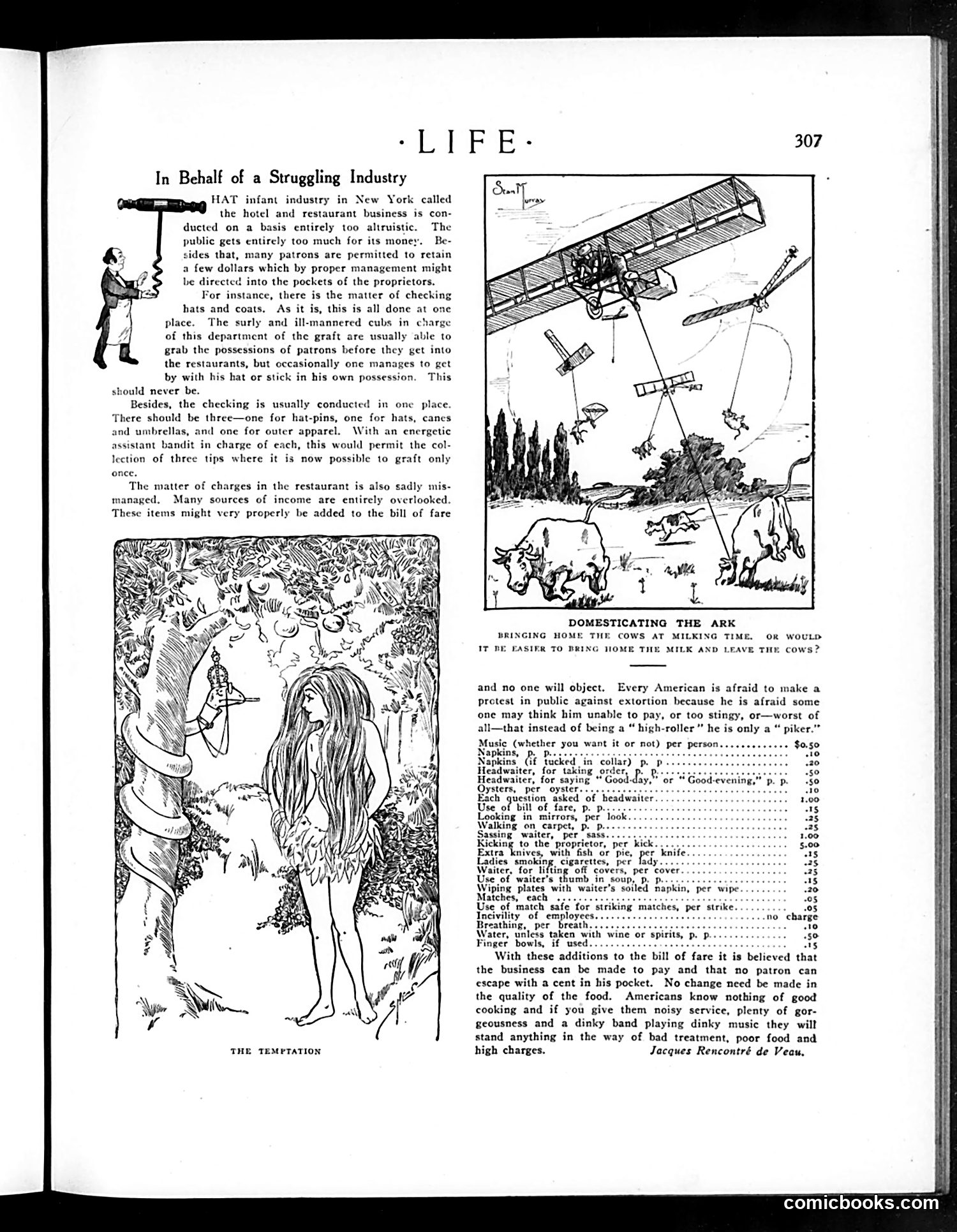
This 1910s *Life* magazine page satirizes restaurant and hotel overcharging in New York City. The main article, "In Behalf of a Struggling Industry," uses mock-serious language to expose how proprietors systematically extract money from patrons through hidden fees and manipulative practices. The satire lists absurd "charges" that should supposedly be added to bills: per-person music fees, napkin rental, payment to headwaiters for basic service, per-oyster costs, even "breathing, per breath." The piece ridicules American diners who won't complain about extortion for fear of appearing poor or stingy ("piker"). The accompanying cartoons—"The Temptation" (a classical nude scene) and "Domesticating the Ark" (aerial delivery of livestock)—appear thematically unrelated, suggesting this was a typical miscellaneous humor page. The satire's core point: restaurants exploit patrons' social anxiety about appearing cheap, making it impossible to protest obvious gouging without losing face.
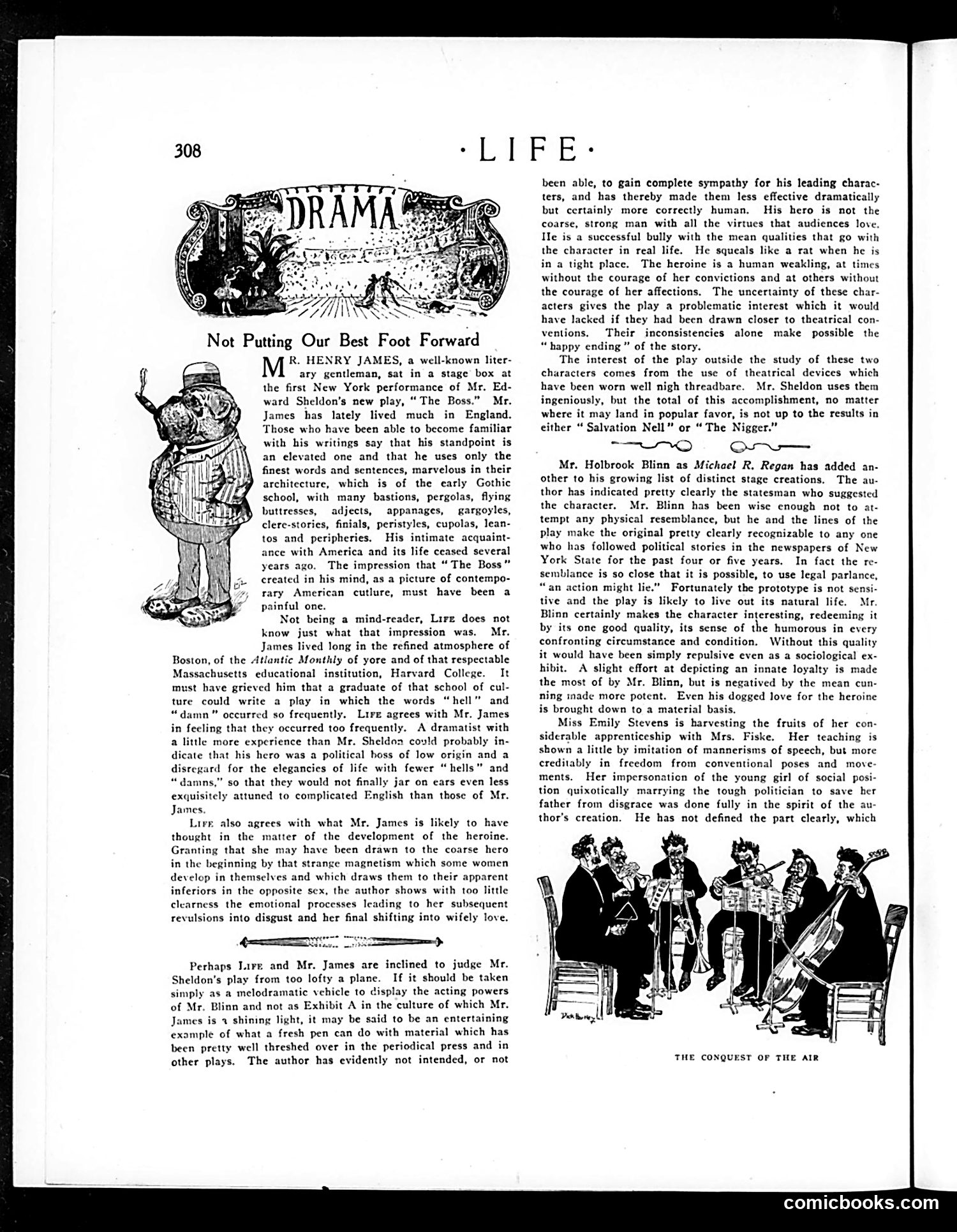
This page reviews Edward Sheldon's play "The Boss," focusing on how Henry James—the famous novelist, then living abroad—likely reacted to it. **The Satire:** Life gently mocks James's refined sensibilities. James, steeped in "early Gothic" architectural language and Boston Brahmin culture, would have been shocked by the play's frequent use of profanity ("hell" and "damn"). Life agrees the language is excessive but defends the play's realism: the characters are deliberately flawed and inconsistent, making them more *human* than typical melodramatic heroes. **The Point:** The magazine pokes fun at James's old-fashioned aesthetic standards while actually endorsing the play's modern, psychologically complex approach to drama. It's a gentle ribbing of literary elitism—suggesting that not everything must meet James's elevated architectural standards to have artistic value. The cartoon (showing musicians) appears unrelated to the text.
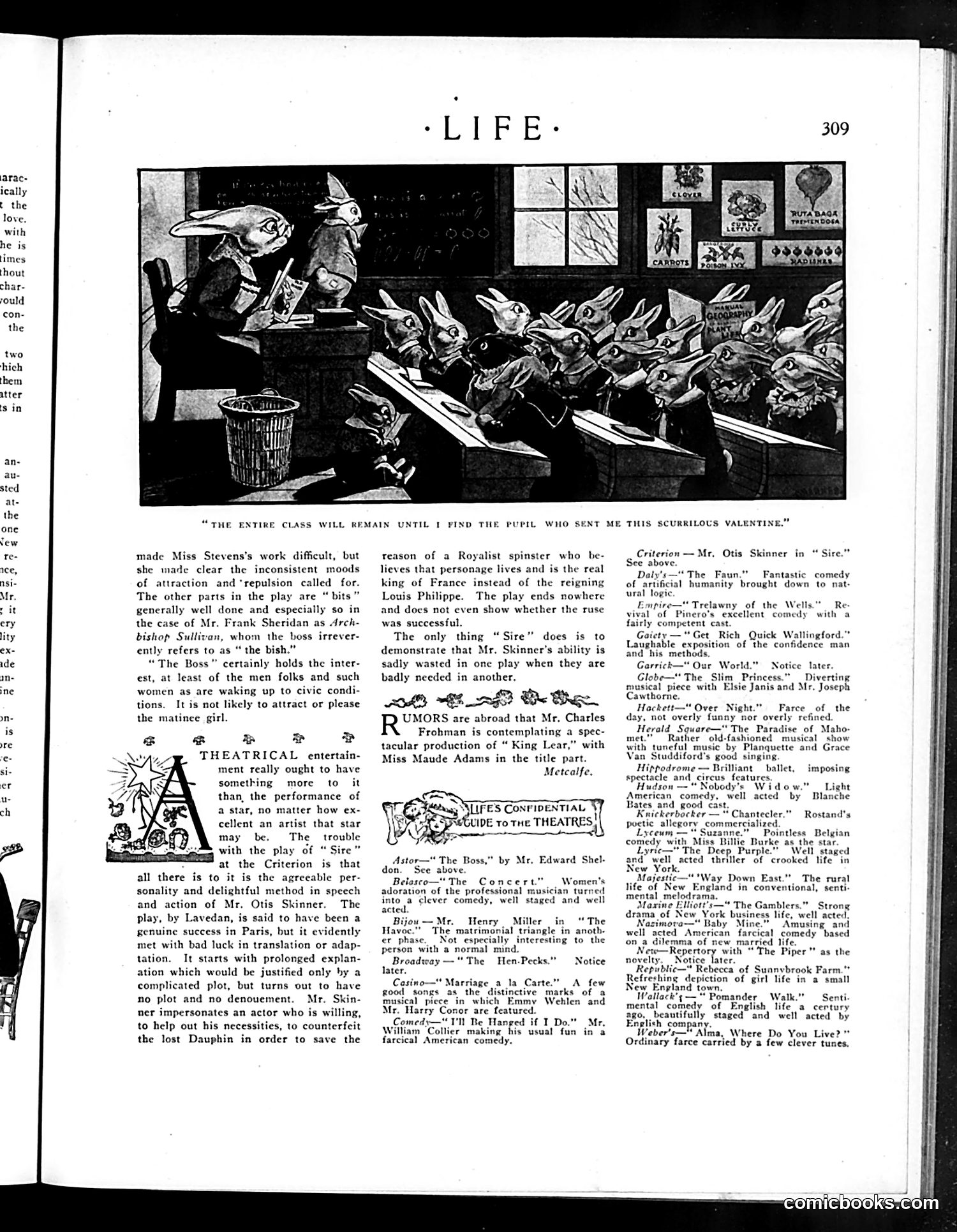
The main cartoon depicts a schoolroom scene where a teacher announces she's keeping the entire class after school until she finds who sent her a "scurrilous Valentine"—a cruel or insulting valentine card. The humor lies in the collective punishment: all students must stay because of one anonymous sender's misdeed. This satirizes both school discipline methods and the Victorian tradition of Valentine's Day exchanges, which could be used as vehicles for mockery rather than romance. The page's lower half reviews theatrical productions, focusing extensively on "Sire," starring actor Otis Skinner. The critic argues the play itself is poorly constructed—it's merely a vehicle for displaying Skinner's charm and acting talent, lacking actual plot or resolution. The review suggests even a talented performer cannot salvage weak material, a common theatrical complaint across eras.
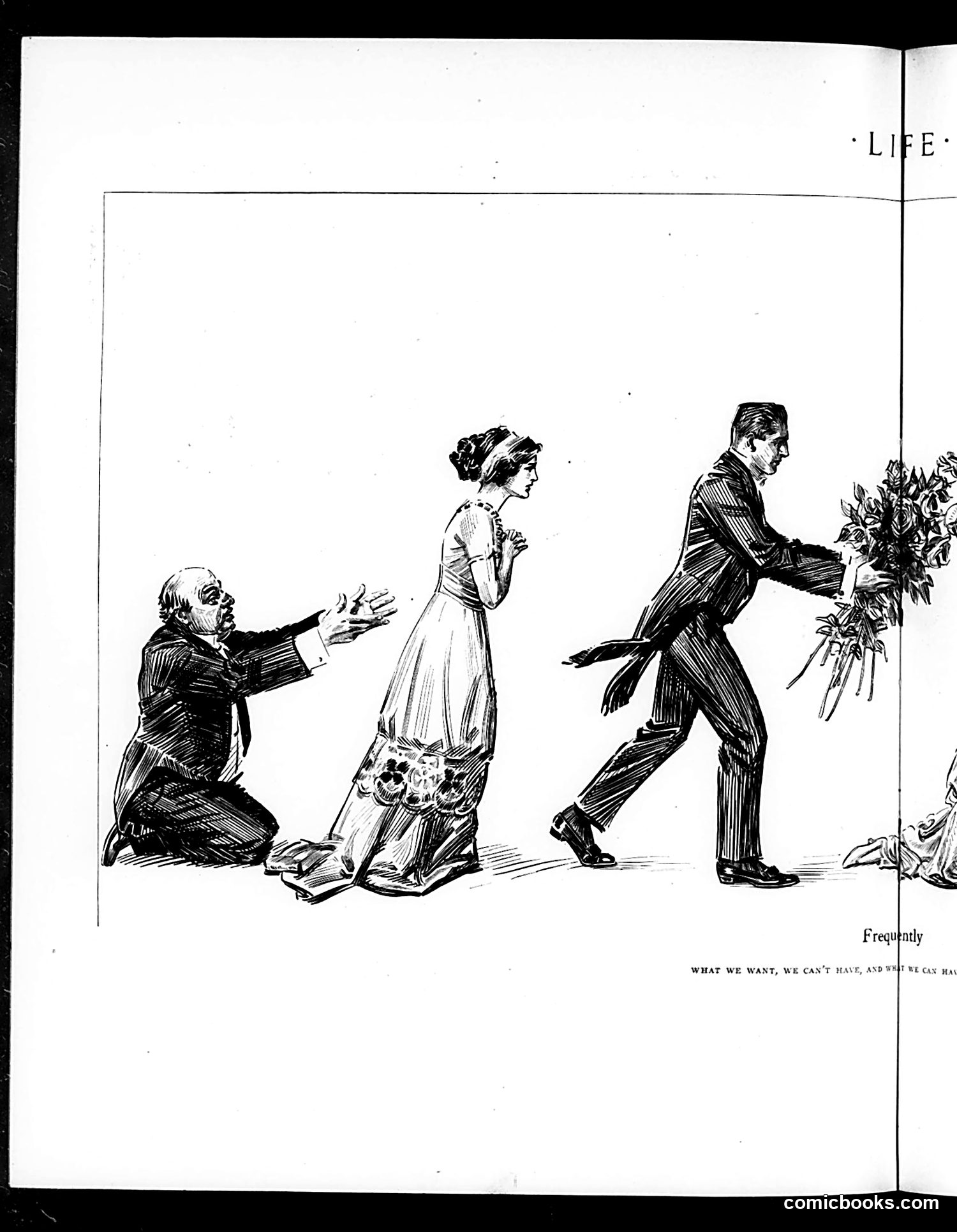
This is a satirical cartoon titled "Frequently" with the caption "What We Want, We Can't Have, and What We Can Have..." The cartoon depicts three figures in a progression: An older man on his knees pleading with a woman in the center, who stands between him and a well-dressed younger man on the right holding flowers. The satire comments on romantic desire and social class or desirability. The implication is that the woman desires the attractive, affluent younger man (who has flowers to offer), while the older man's pleas go unheeded. The cartoon cynically suggests that what people want romantically is often unattainable, while what's actually available to them may be unwanted—a commentary on the frustrations of romantic pursuit and the role of wealth or attractiveness in determining romantic outcomes.
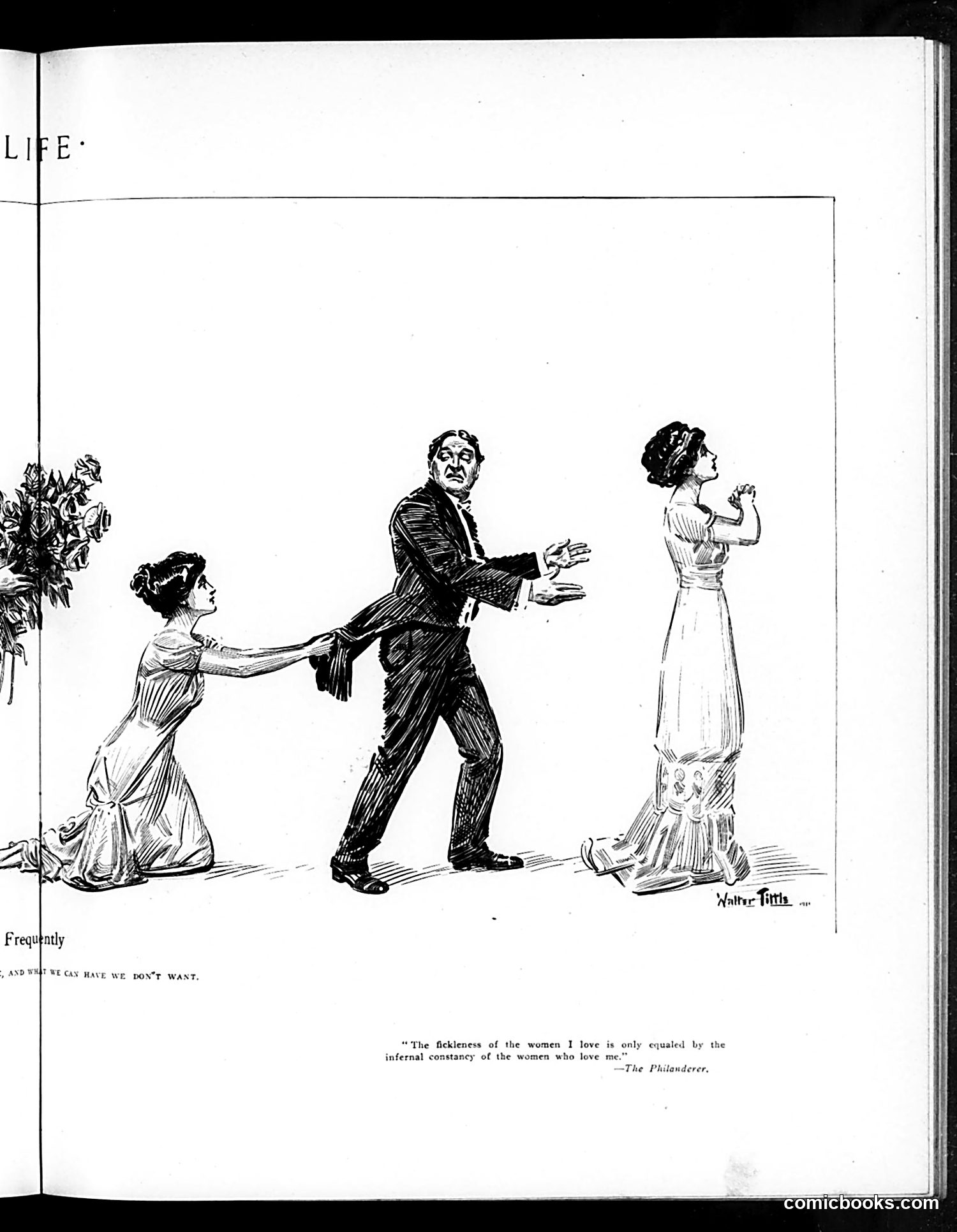
This cartoon satirizes a philanderer—a man who pursues multiple romantic interests. The illustration shows a man caught between two women: one kneeling and grasping his arm (presumably pleading with him), while another stands aloof on the right. The quote, attributed to "The Philanderer," expresses his frustration: the women he desires are inconsistent and leave him, while the women attracted to him remain devoted despite his indifference. The satire mocks his self-pitying hypocrisy—he blames women's "fickleness" while ignoring his own infidelity and poor treatment of them. The caption "Frequently" suggests this is his recurring dilemma, implying he deserves his predicament. This reflects early-20th-century *Life* magazine's sharp commentary on male sexual duplicity and the social dynamics of courtship.
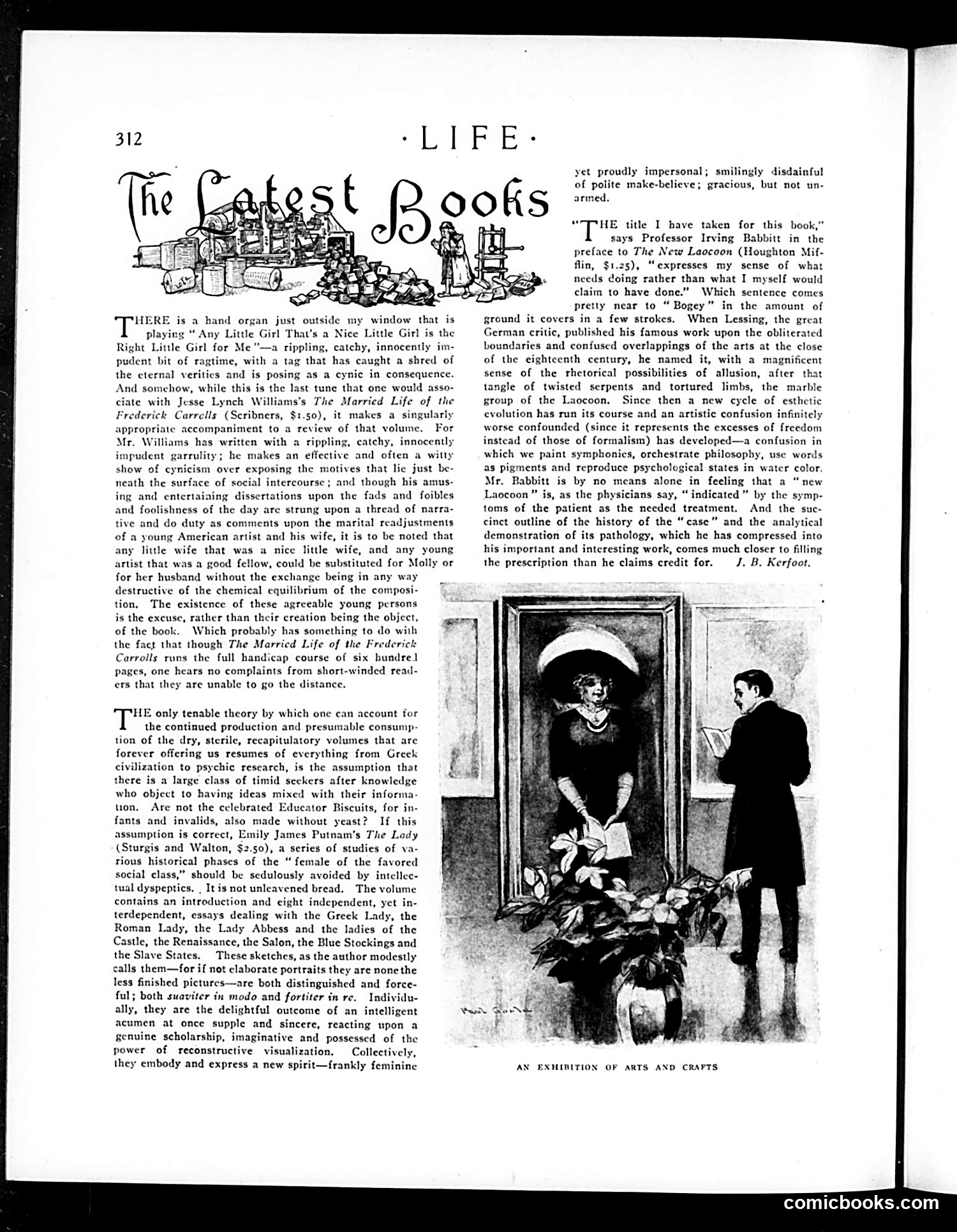
This is a literary review page from *Life* magazine featuring three book reviews. The main content discusses recent publications: 1. **"The Married Life of the Frederick Carrells"** by Jesse Lynch Williams — criticized as superficial entertainment that could substitute any generic "nice little wife" and "good fellow" without changing the work's substance. 2. **"The Lady"** by Emily James Putnam — praised as serious, scholarly essays on women across historical periods (Greek, Roman, Renaissance, etc.), offering genuine intellectual substance rather than "unleavened bread." 3. **"The New Laocoon"** by Irving Babbitt — mentioned briefly at page's end. The illustration shows two figures examining artwork in what appears to be a gallery ("AN EXHIBITION OF ARTS AND CRAFTS"), likely accompanying the cultural commentary. The satire targets the contrast between lightweight popular literature and rigorous scholarship, while celebrating intellectually substantive work by and about women.
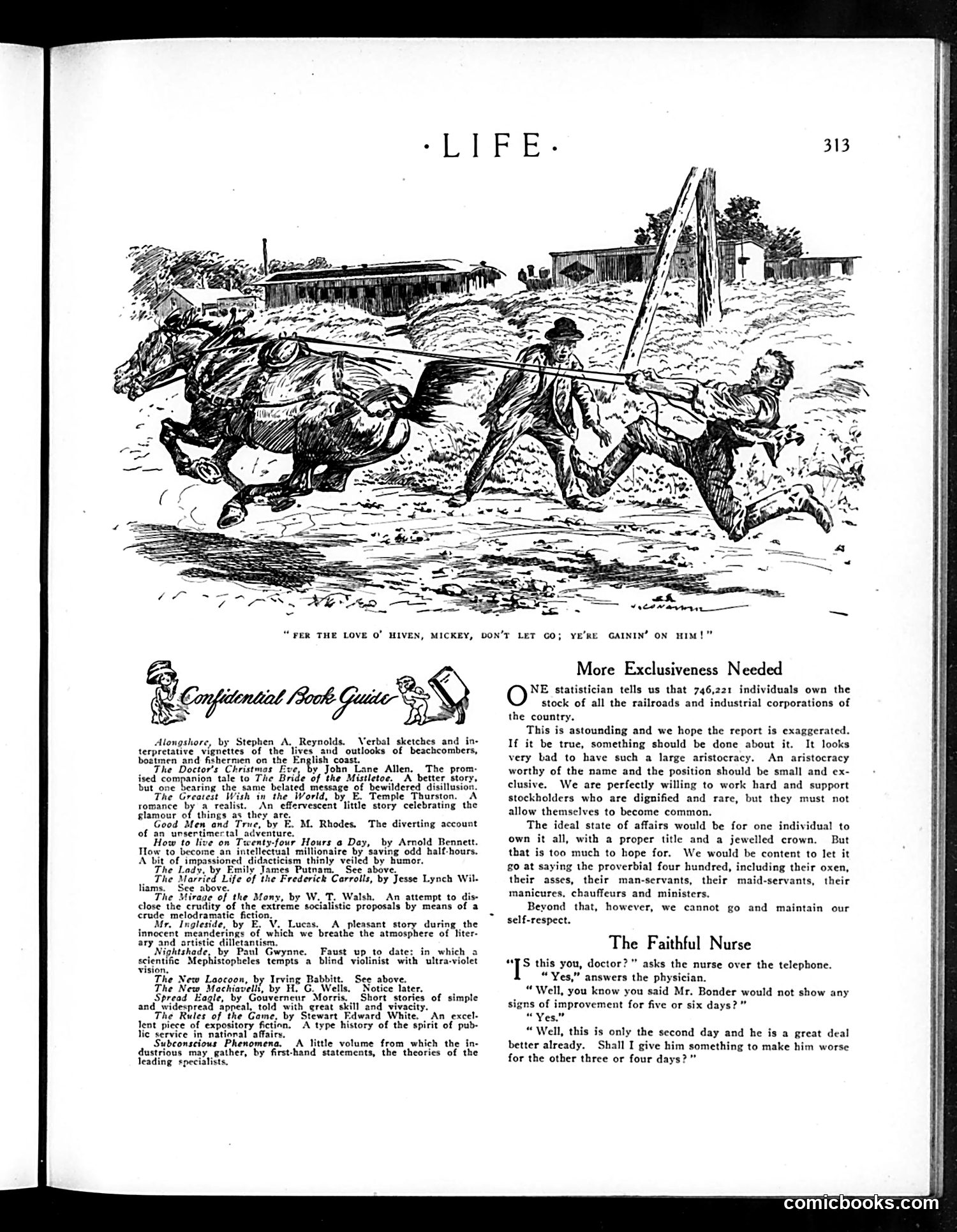
**The Cartoon:** The top illustration shows two men struggling to control a runaway horse, with the caption "Per the love o' hiven, Mickey, don't let go; ye're gainin' on him!" This is a visual gag—the men are *losing* control despite their dialect-heavy insistence they're winning. It's slapstick humor playing on the contrast between what they claim and what's actually happening. **"More Exclusiveness Needed":** This is biting satire about wealth inequality. A statistician reports 746,221 people own all railroad and industrial stock. The writer sarcastically argues this is too *many* wealthy people—there should be far fewer to maintain a "proper" aristocracy. The piece mocks the wealthy's desire for exclusivity by suggesting ideally one person should own everything, then grudgingly accepting "the proverbial four hundred" plus their servants. It's ironic critique of class elitism. **"The Faithful Nurse":** A brief joke about a nurse asking a doctor whether she should give a recovering patient medicine to *worsen* his condition so the doctor's five-to-six-day prognosis remains accurate. Dark humor about medical pride.
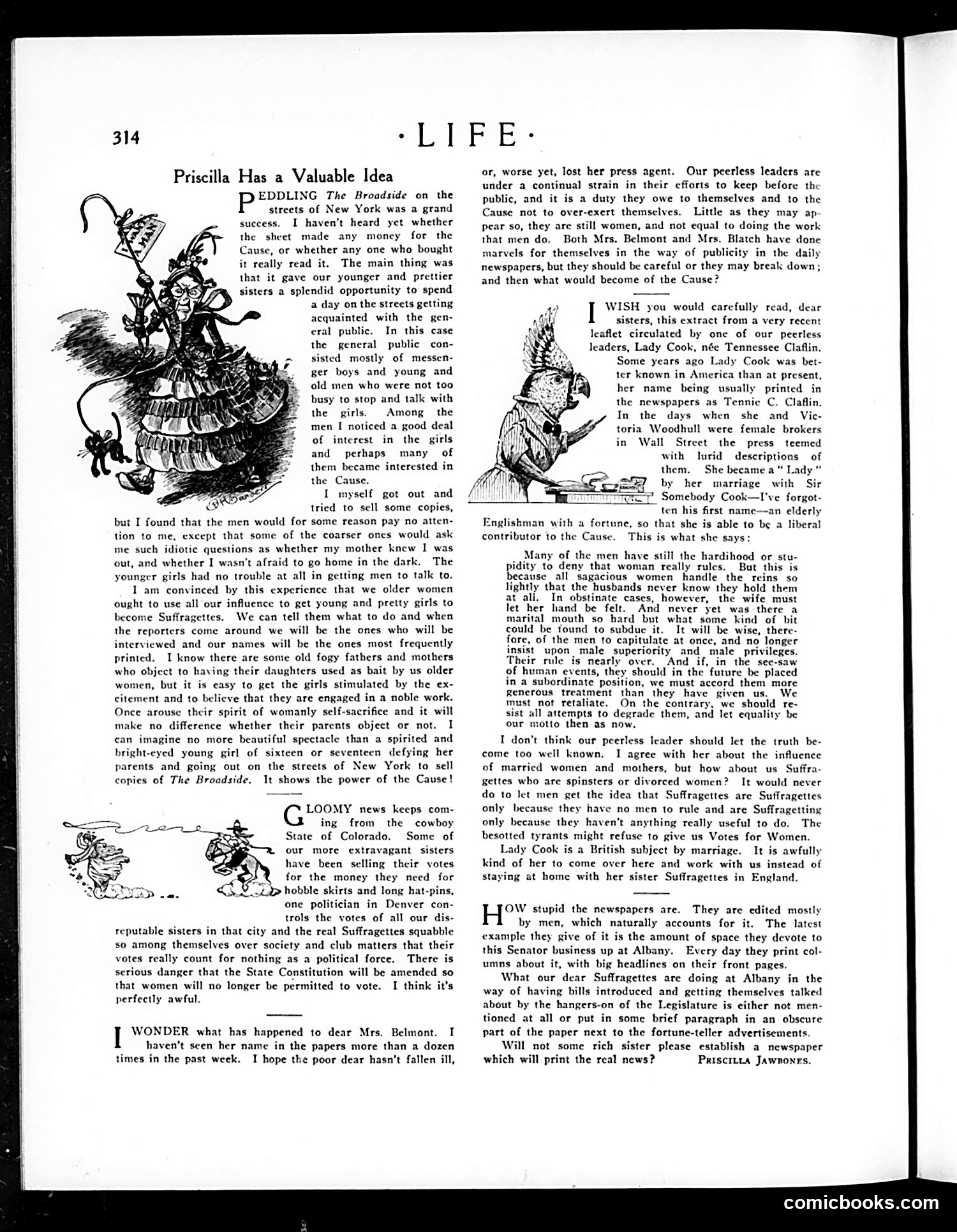
This article by Priscilla Jawbone is satirical commentary on the women's suffrage movement, mocking its tactics and leadership through exaggerated praise. **The cartoon illustrations** show young women selling "The Broadside" (a suffrage publication) on New York streets, attracting male attention. **The satire's targets:** 1. **Exploitation of young women**: Jawbone ironically celebrates using "young and pretty girls" as bait to attract men's attention while older women take credit and receive press coverage—cynically framing this as "noble work." 2. **Suffrage leadership vanity**: She mocks prominent suffragists like Mrs. Belmont and Mrs. Blatch for obsessing over newspaper publicity and their own public image rather than substantive political work. 3. **Colorado's failed women's suffrage**: The piece notes women voters there sold their votes for money and squabbled over social matters, threatening the movement's credibility. 4. **Lady Cook (Tennessee Claflin)**: Jawbone sarcastically introduces a leader with a questionable past, implying dubious character among movement figures. The overall message: the suffrage cause is undermined by vain leadership, manipulation, and moral compromises.
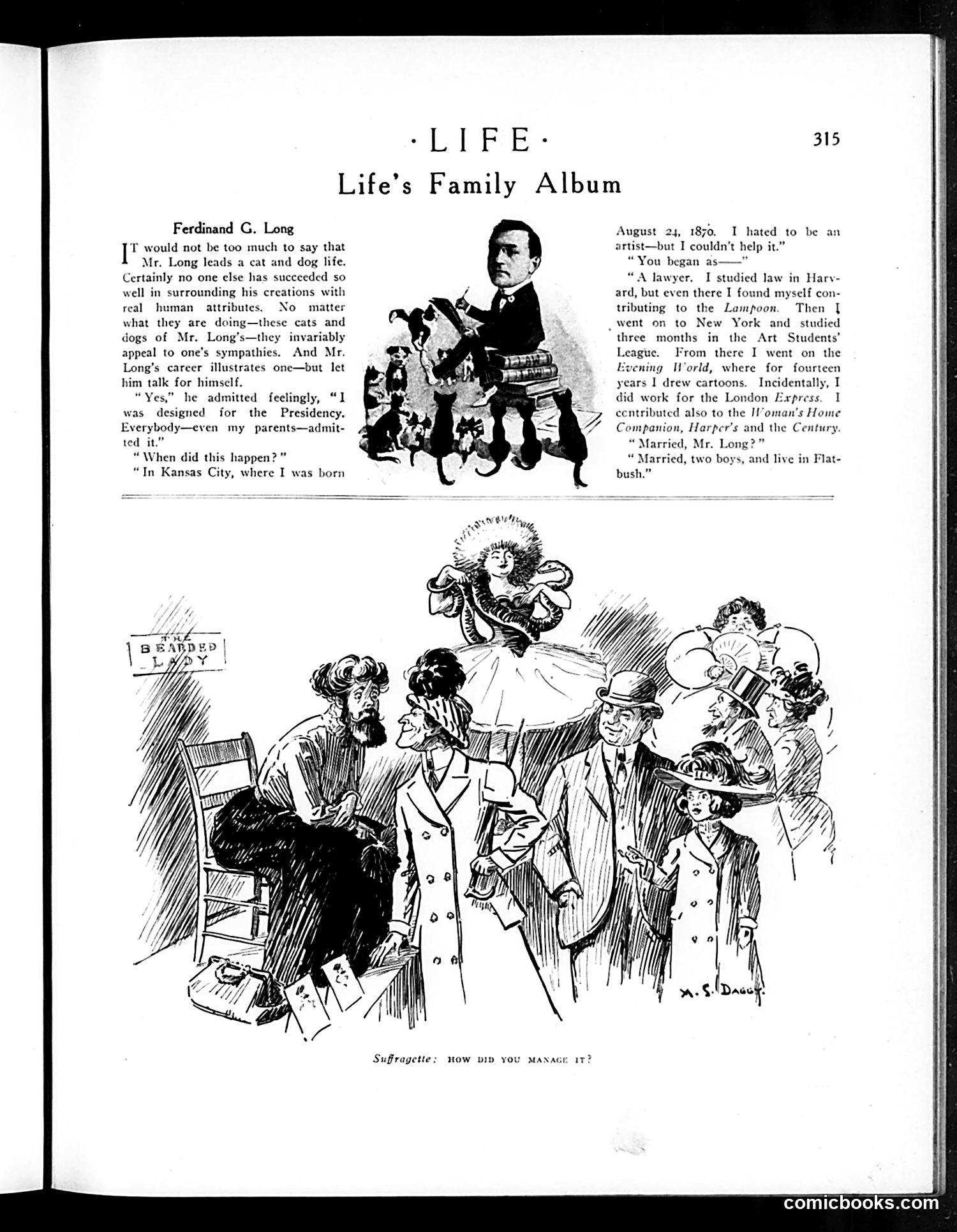
This page profiles cartoonist Ferdinand G. Long, featuring a biographical interview and two illustrations of his work. **Top cartoon:** Shows Long surrounded by anthropomorphized cats and dogs displaying human emotions and behaviors—the subject he's known for depicting. This illustrates his stated specialty: giving animals realistic human attributes that appeal to readers' sympathies. **Bottom cartoon:** Labeled "Suffragette: How Did You Manage It?" appears to be Long's actual cartoon work. It depicts a well-dressed woman (likely a suffragette activist) surrounded by admiring figures in a domestic scene, with the caption suggesting she's successfully "managed" something—possibly gaining social status or influencing others. This reflects early 20th-century American attitudes toward women's suffrage activists, treating the subject with gentle humor rather than hostility. The profile emphasizes Long's career trajectory from aspiring lawyer to successful illustrator across major publications, establishing him as an accomplished cartoonist of the era.
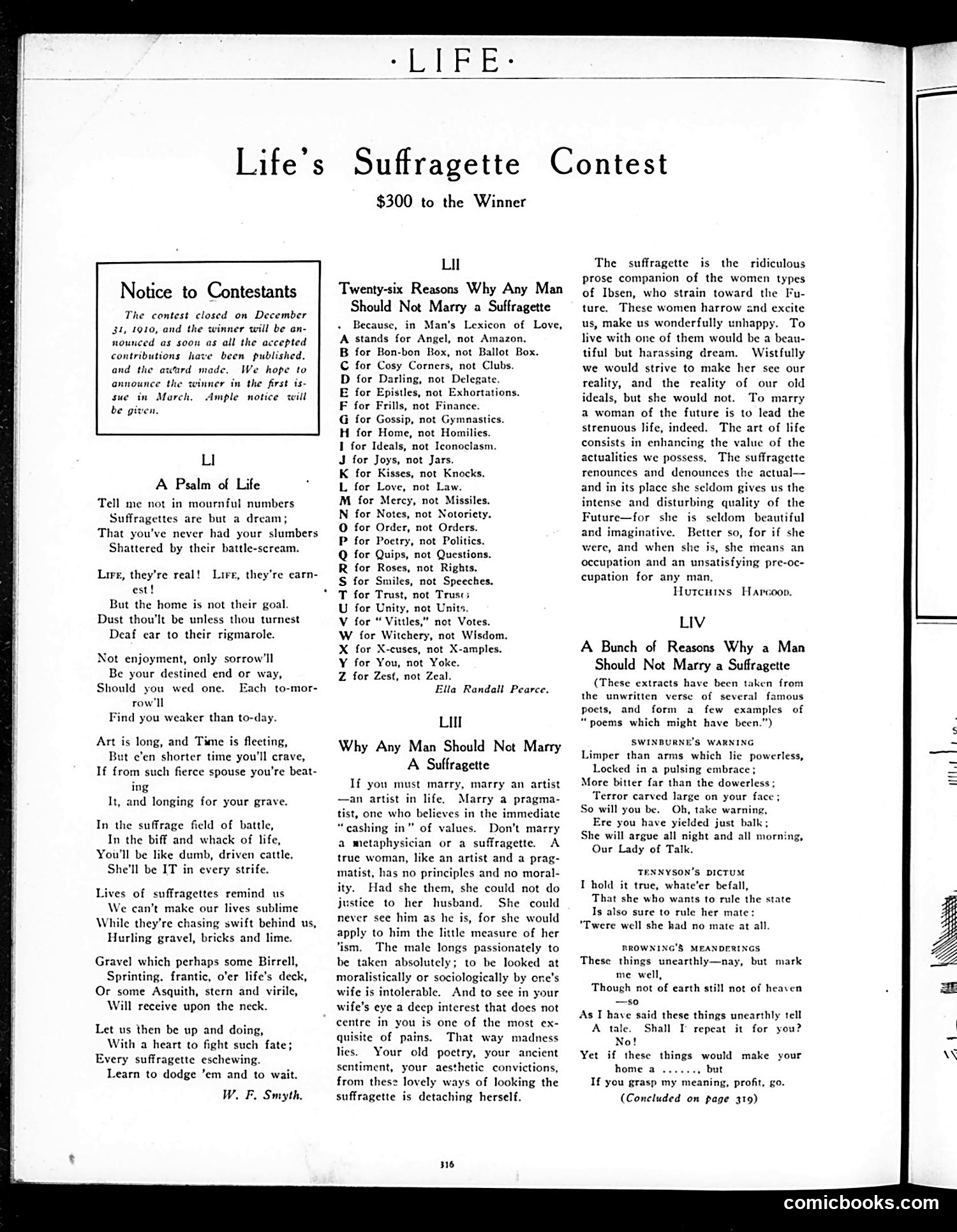
This page satirizes the women's suffrage movement through a mock literary contest ($300 prize). The satire operates on multiple levels: **The "Psalm of Life"** parodies Longfellow's famous poem, warning men that suffragettes are real threats—domestic nightmares who neglect home, physically dominate their husbands, and hurl "gravel, bricks and lime" (referencing actual militant suffragette tactics of the era). **The alphabetical list and essay** present anti-suffrage arguments framed as romantic ideals: women should embody "Angel," not "Amazon"; "Roses, not Rights." The accompanying essay dismisses suffragettes as moralistic, principle-driven "metaphysicians" incompatible with marriage—suggesting that political engagement makes women unfit wives. **The allusions** to British politicians Birrell and Asquith reference real suffragette violence in Britain, implying these men deserved attacks. The satire reveals period anxieties: suffragists were portrayed as unfeminine, dangerous, and fundamentally opposed to domestic roles—a common anti-suffrage rhetorical strategy used to discredit voting rights activism.
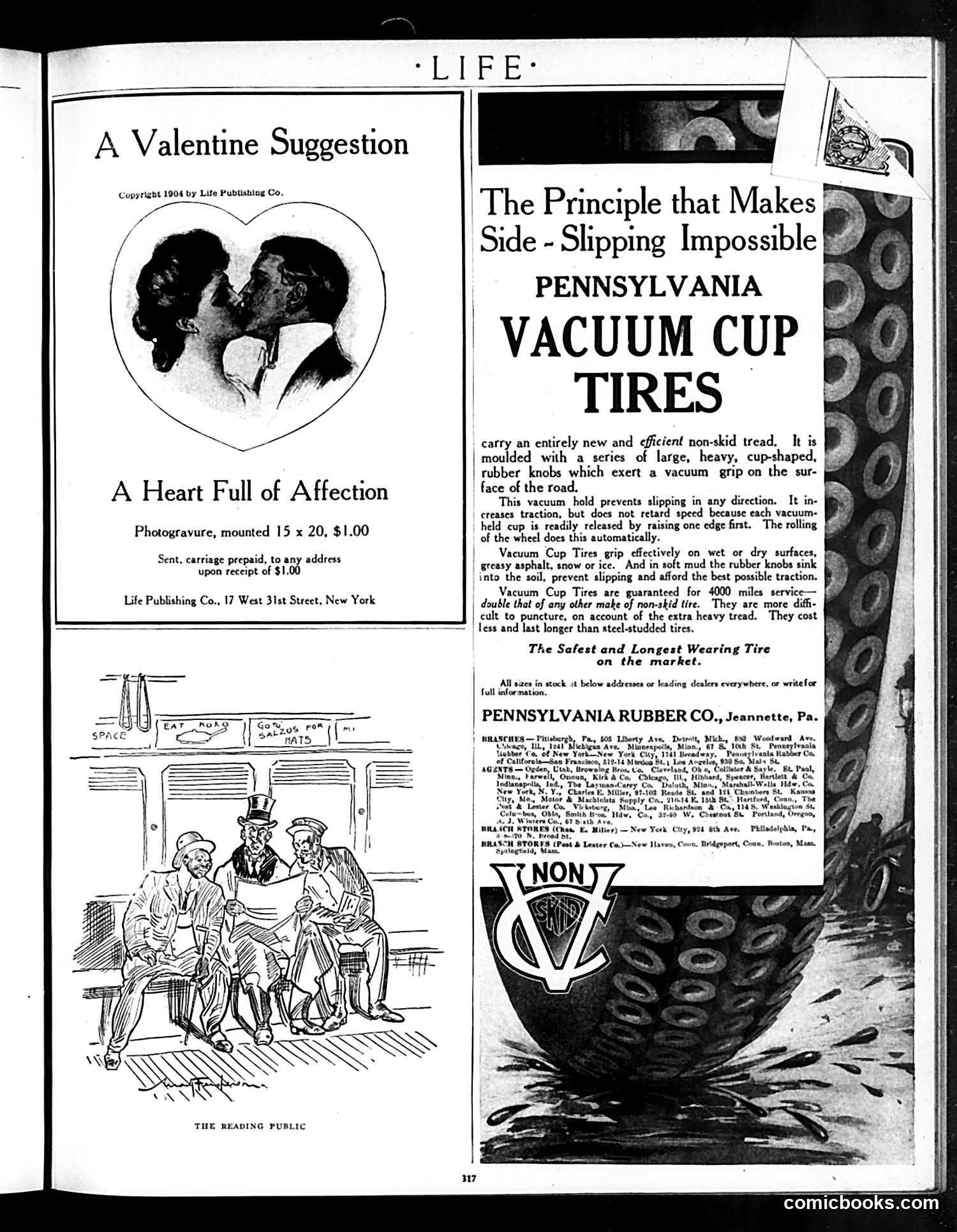
This 1904 *Life* magazine page mixes editorial content with advertising. The left side contains "A Valentine Suggestion"—a sentimental photogravure (romantic image of a kissing couple) available for purchase, and below it a cartoon titled "The Reading Public" depicting three men in a train car reading newspapers, likely satirizing public consumption of news or media habits of the era. The right side is a full-page advertisement for Pennsylvania Vacuum Cup Tires, promoting their non-skid safety features through technical claims about "vacuum grip" and rubber knobs that prevent slipping on wet or icy roads. The ad emphasizes durability (4,000-mile guarantee) and cost-effectiveness compared to competitors. The juxtaposition is typical of *Life*'s format: mixing satirical commentary on contemporary society with commercial advertising—here, romantic sentiment alongside practical automotive innovation, reflecting early 1900s consumer culture.
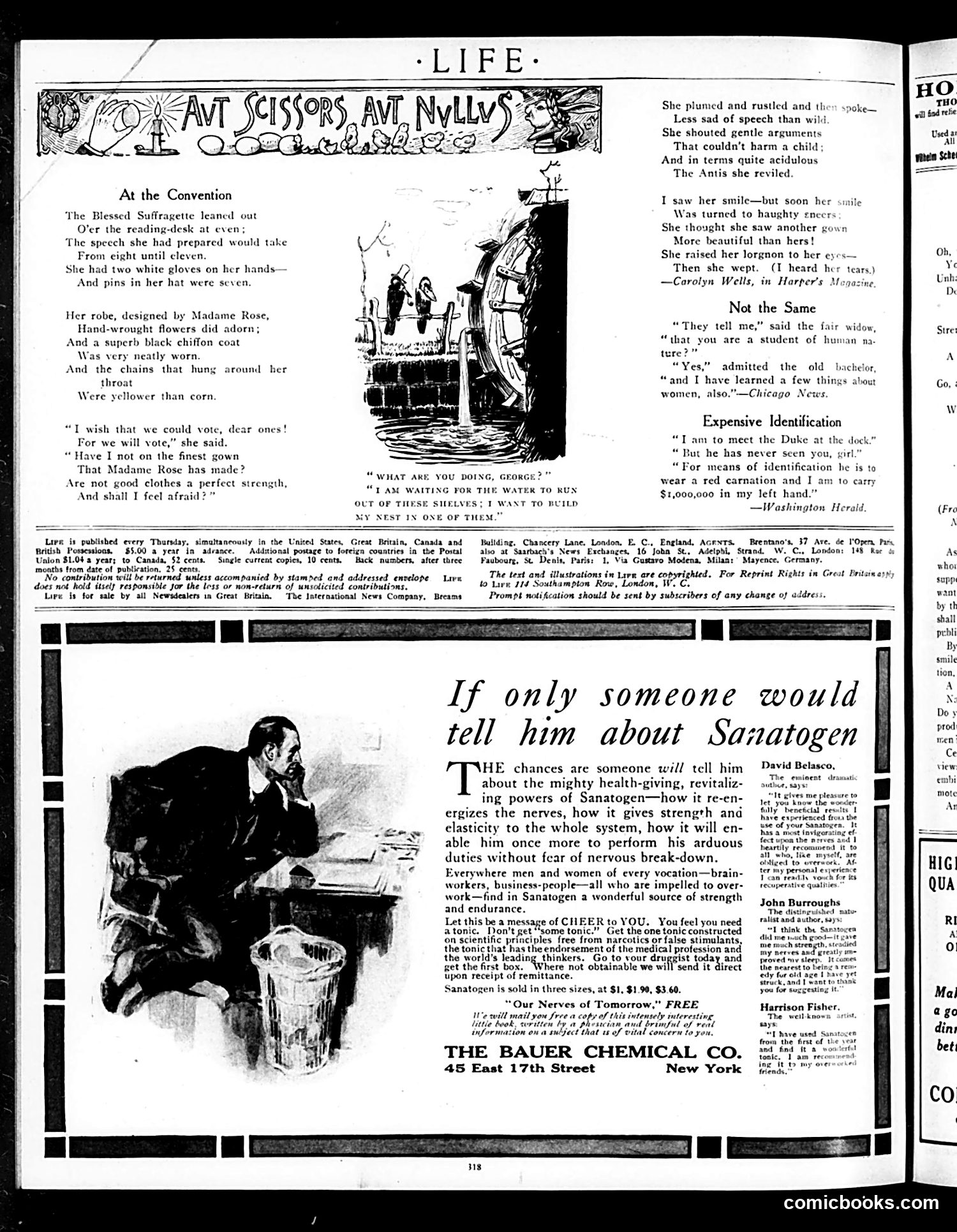
This page contains poetry and short humor pieces celebrating the women's suffrage movement, likely from the early 1910s when suffragism was politically contentious. **"At the Convention"** depicts a well-dressed suffragette at a women's voting rights convention—notable for the detail that she wears "seven" pins in her hat, symbolizing her commitment to the cause. The satire gently mocks her fashion consciousness and vanity even while engaged in serious political activism. **The three brief anecdotes** ("Not the Same," "Expensive Identification") are unrelated society humor pieces, typical of Life's regular satirical content about gender relations. **The large Sanatogen advertisement** is a patent medicine ad typical of the era, claiming health benefits—unrelated to the political content above it. The suffrage poems treat the movement sympathetically while poking gentle fun at participants' earnestness and appearance, reflecting Life's general satirical tone toward contemporary social movements.
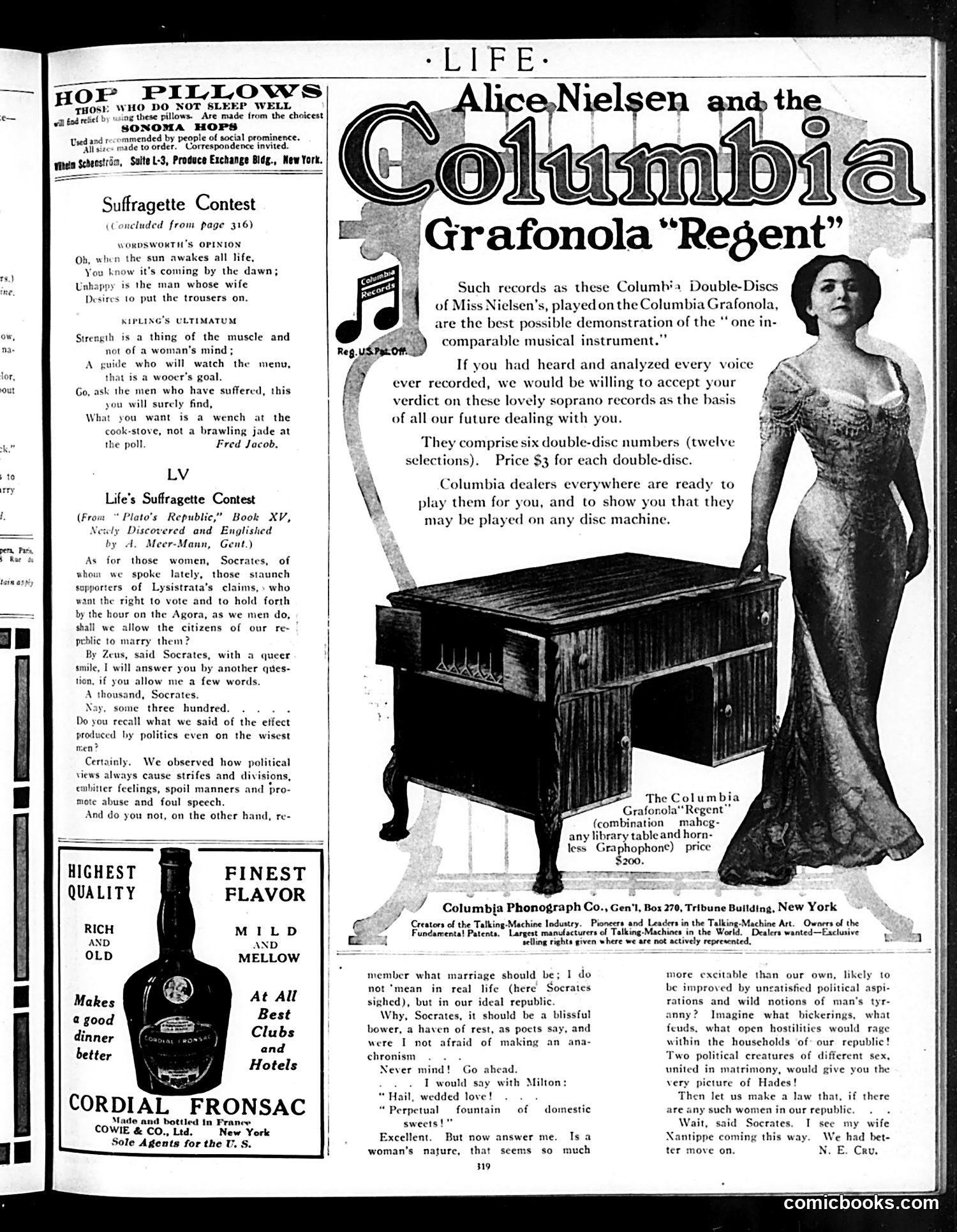
This page contains **satirical commentary on women's suffrage** through a mock-classical dialogue. The "Suffragette Contest" presents quotations attributed to literary figures (Wordsworth, Kipling) opposing women's political participation, followed by a longer piece structured as a Platonic dialogue. The dialogue imagines Socrates debating whether politically-engaged women would make suitable wives. The satire's point: opponents of suffrage feared that politically active women would create domestic conflict and neglect household duties. The fictional "Socrates" warns that women with "uncatisfied political aspirations" would bring "bickerings" and "open hostilities" into marriage. This mocks anti-suffrage arguments by presenting them in elevated classical language, exposing their absurdity. The accompanying advertisements (pillows, phonographs, liquor) are unrelated. The satire defends women's right to vote by ridiculing the reasoning of those who opposed it.
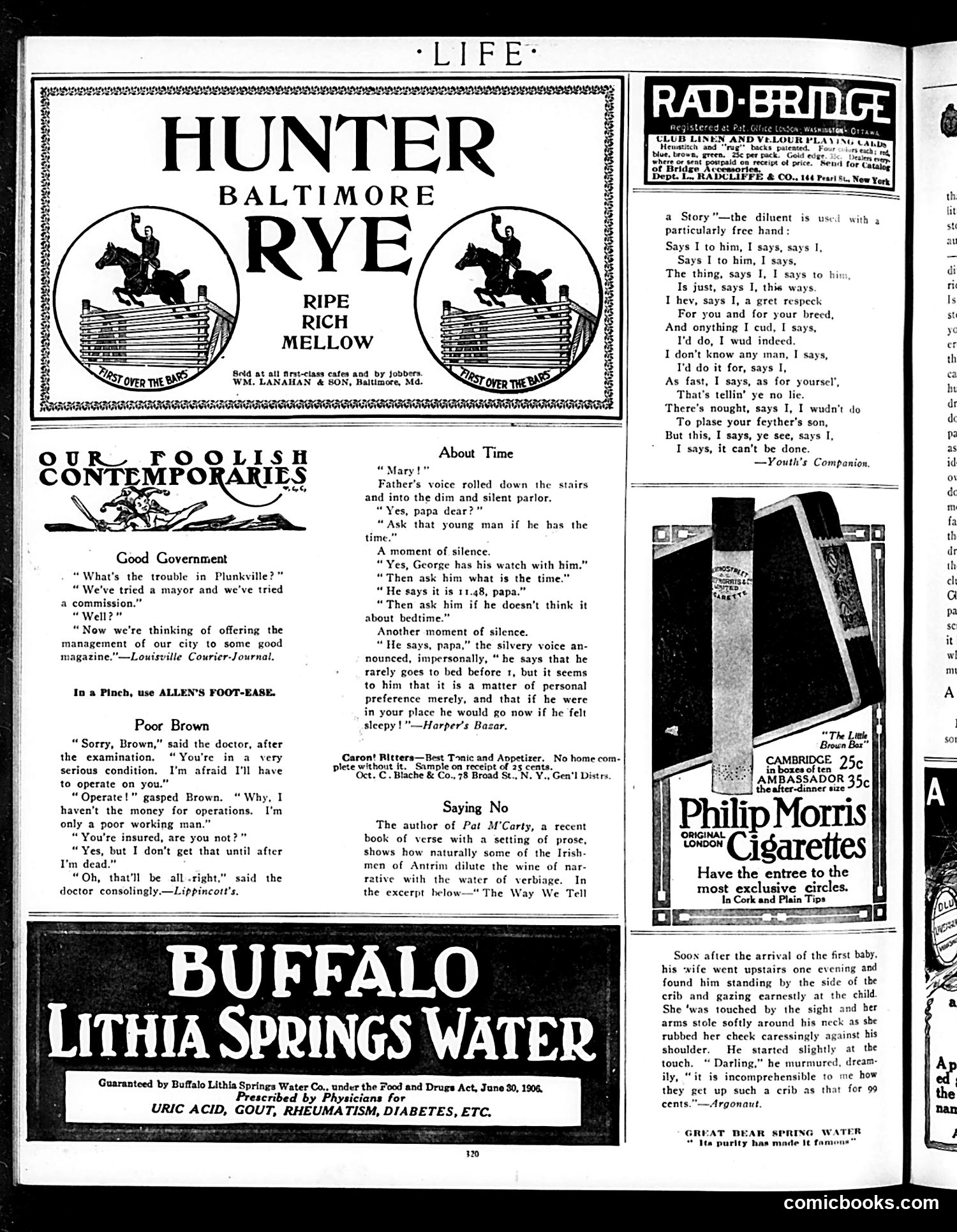
This page is primarily **advertising and humor columns** rather than political cartoons. The main satirical content includes: **"Good Government" joke**: Mocks civic incompetence in "Plunkville," where officials have tried a mayor and commission without success, now considering giving city management to a magazine—absurdist commentary on government dysfunction. **"Poor Brown" anecdote**: Dark satire on poverty and insurance—a dying poor man learns he can't afford operations, but the doctor reassures him since his insurance pays *after death*, making the operation acceptable. Bitter commentary on how medical care is inaccessible to working-class people. **"About Time"**: Gentle humor about a young suitor overstaying his welcome; the father uses his daughter as intermediary to hint bedtime, but the suitor politely declines. **"Saying No"**: Linguistic satire featuring Irish-dialect verse showing verbose, repetitive speech patterns common in Irish storytelling. The page is dominated by period **product advertisements** (whiskey, cigarettes, mineral water) typical of early 1900s Life magazine, which combined social commentary with commercial content.
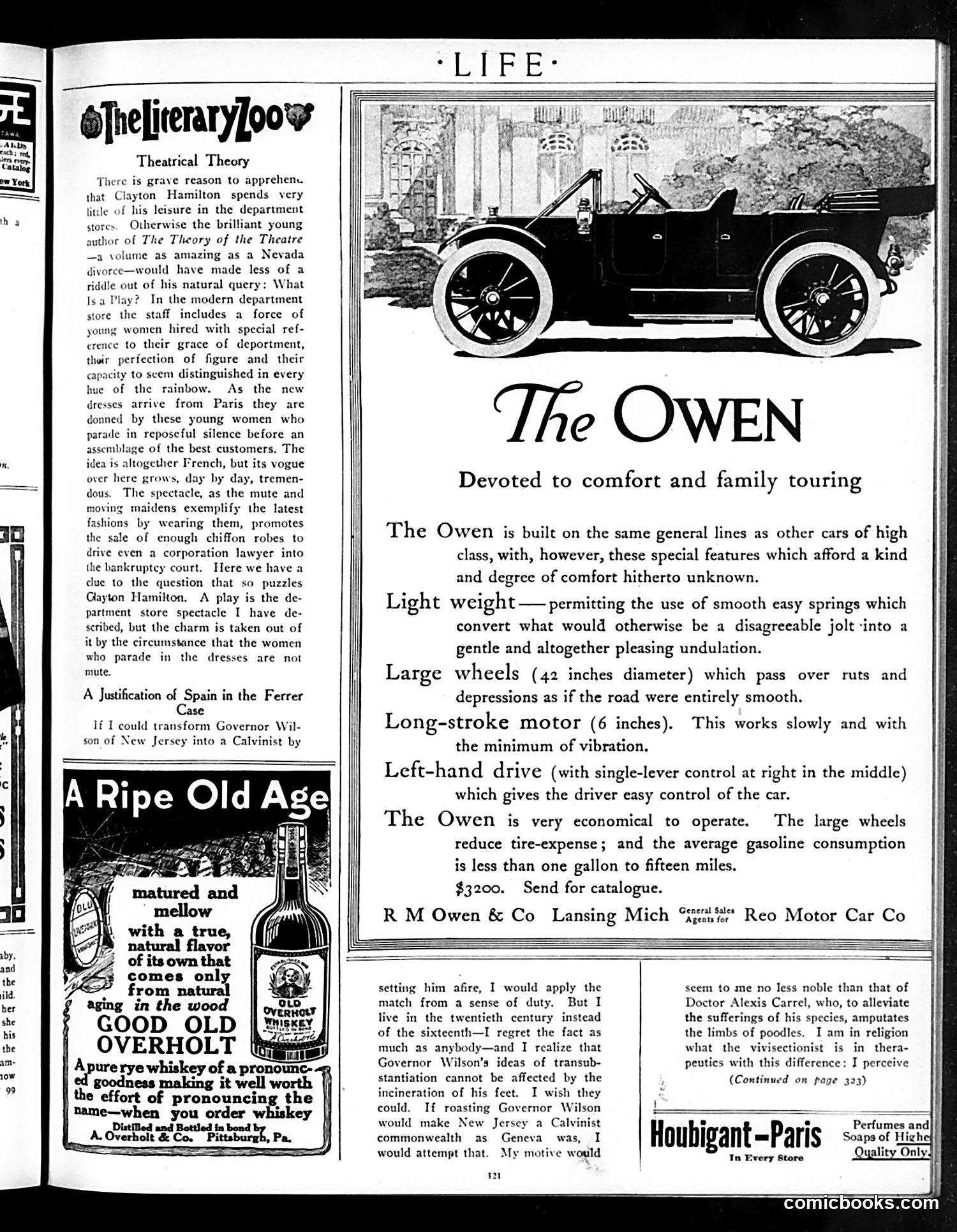
This page from *Life* magazine contains satirical commentary rather than political cartoons. The main content includes: **"The Literary Zoo" section**: A humorous essay by Clayton Hamilton critiques theater theory by comparing a Broadway play to a department store fashion show. The joke is that both involve silent women parading in expensive clothing to impress audiences—except plays are ruined because actresses actually speak, breaking the aesthetic illusion. **"A Justification of Spain in the Ferrer Case"**: This appears to reference Francisco Ferrer, an executed Spanish educator. The author ironically claims he'd only set Governor Wilson of New Jersey on fire "from a sense of duty" if it would convert him to Calvinism—a satirical jab at Wilson's religious rigidity and Spanish religious extremism. The page is primarily **advertising**: an Owen automobile ad emphasizing comfort and economy, and an Overholt whiskey advertisement. The satire targets intellectual pretension, religious dogmatism, and consumer culture's superficiality—typical *Life* magazine concerns of the Progressive Era.
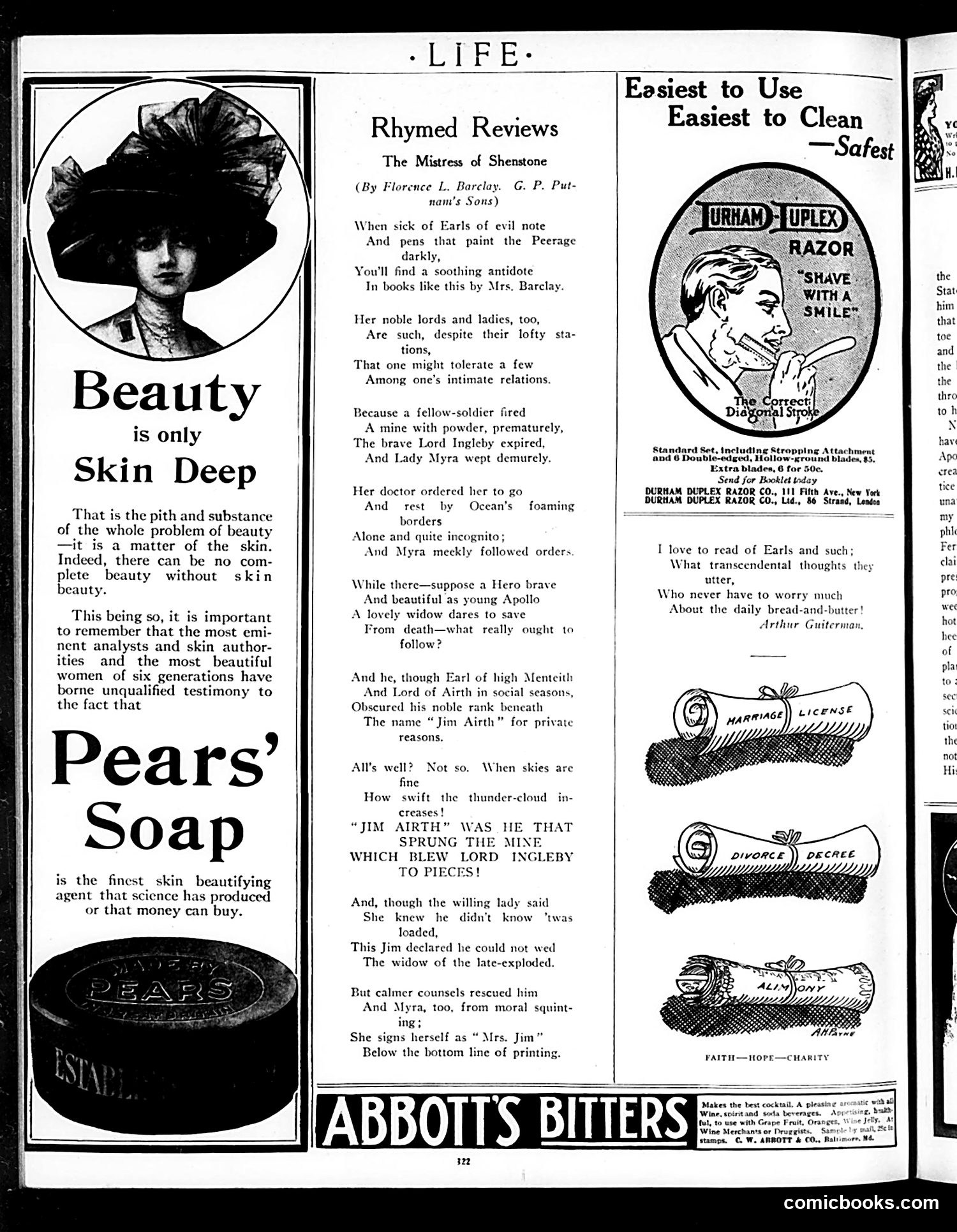
This page is primarily **advertising** interspersed with a book review. The main content includes: **Left side**: A Pears' Soap advertisement claiming beauty is "only Skin Deep" and that Pears' is the finest skin beautifier, featuring a fashionable woman in an elaborate hat. **Center**: A rhymed review of *The Mistress of Shenstone* by Florence L. Barclay, a romantic novel. The reviewer (Arthur Guiterman, credited at bottom) summarizes the plot: a widow and an earl fall in love, but he won't marry her because he—"Jim Airth"—accidentally caused her late husband's death by firing a mine prematurely. They eventually marry anyway. The tone is gently mocking of melodramatic romance novels and their aristocratic characters. **Right side**: Advertisements for Durham Duplex razors and Abbott's Bitters. The satire targets popular sentimental fiction conventions rather than political issues.
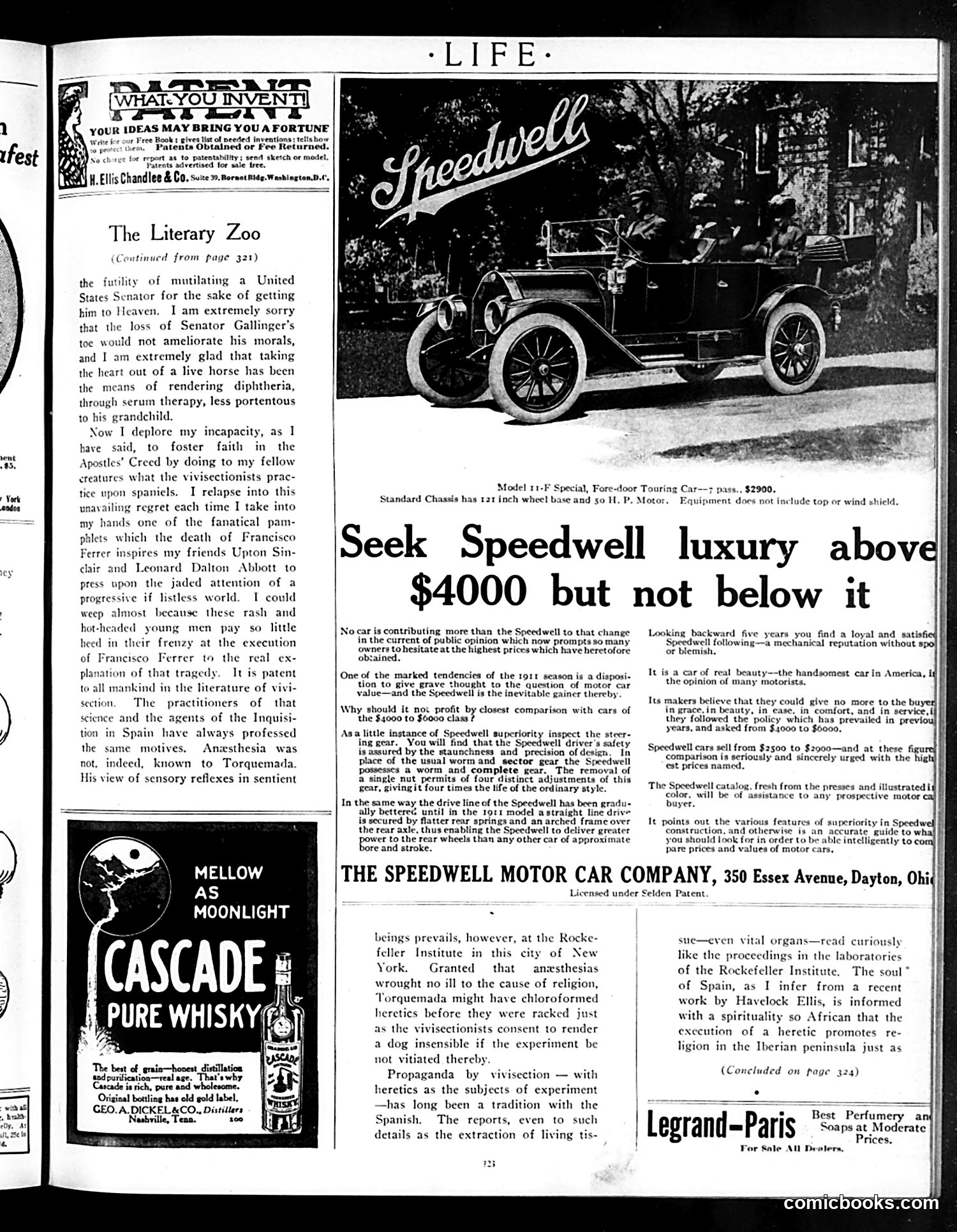
This page contains a serious essay ("The Literary Zoo," continued from page 321) alongside a major automobile advertisement. **The Essay:** The author defends vivisection (animal testing) against critics like Upton Sinclair and Leonard Dalton Abbott, who were protesting the 1909 execution of Spanish anarchist Francisco Ferrer. The writer argues that animal experimentation for medical progress (like serum therapy for diphtheria) is morally justified, and criticizes activists for their emotional fervor over Ferrer's death while overlooking vivisection's humanitarian benefits. The piece references "Senator Gallinger" and compares modern scientific vivisection favorably to Spanish Inquisition torture. **The Advertisement:** A full-page Speedwell automobile ad emphasizes the car's superiority in the $2,500-$2,900 price range, positioning it competitively against higher-priced competitors ($4,000-$6,000 cars). It highlights engineering features (steering gear, drive line) and aesthetic appeal as justification for the premium price. The juxtaposition is notable: serious philosophical debate about animal welfare appears alongside consumer luxury marketing.
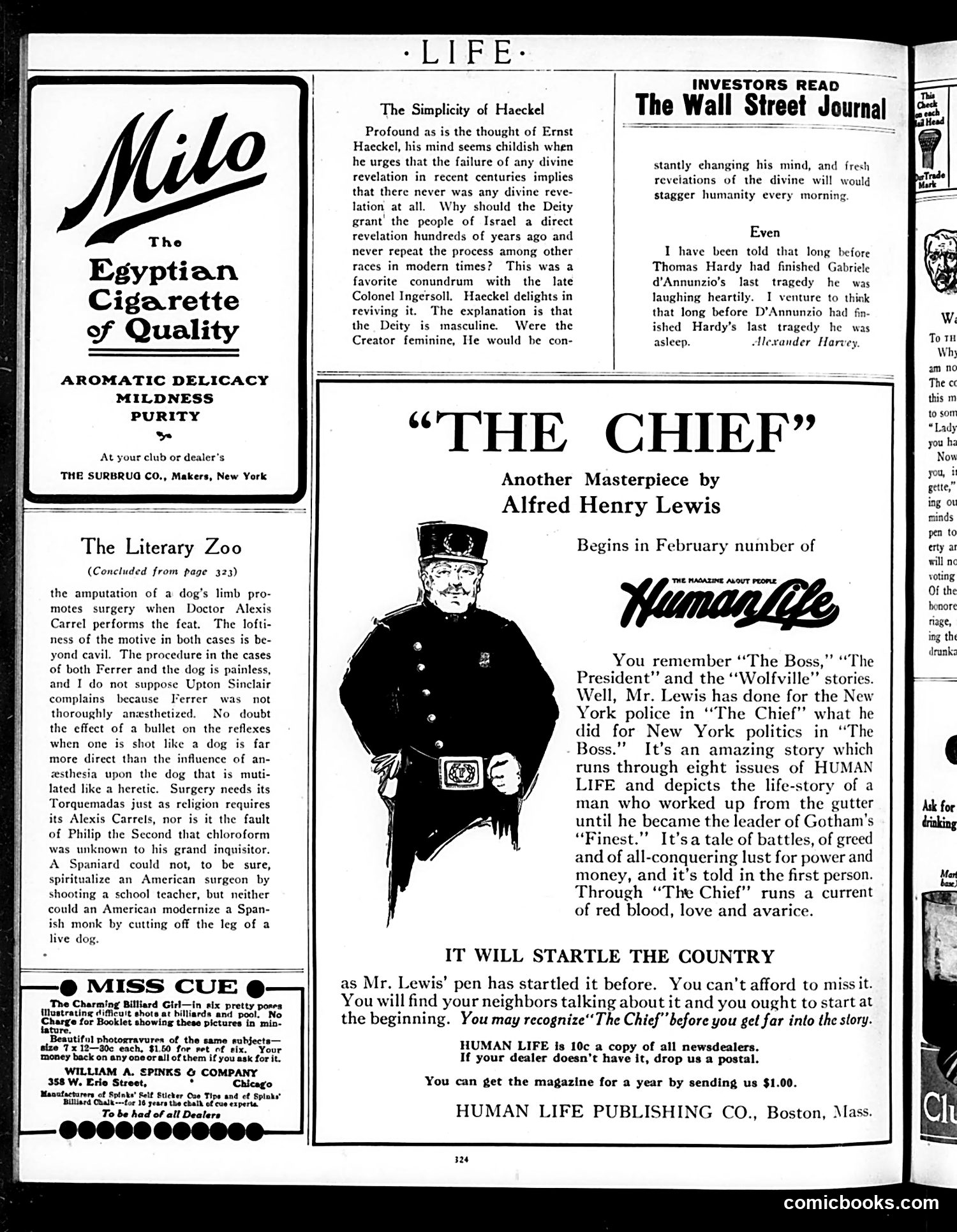
This page contains primarily **advertisements and literary commentary** rather than political cartoons. The main content advertises a serialized story called **"The Chief"** by Alfred Henry Lewis, beginning in *Human Life* magazine. The illustration shows a uniformed police official—likely representing a New York police commissioner or similar authority figure. The advertisement emphasizes that Lewis's story depicts a man's rise "from the gutter" to become leader of Gotham's police force, promising drama involving "power and money" told in first-person narrative. The page also includes literary criticism discussing Ernst Haeckel's religious skepticism and brief reviews of works by Thomas Hardy and Gabriele d'Annunzio. The sidebar content ("The Literary Zoo") critiques arguments about divine revelation and makes satirical points about American modernization versus Spanish religious practices—characteristic of *Life*'s intellectual, somewhat elitist humor. The **Milo cigarette advertisement** and billiards content are standard commercial matter.
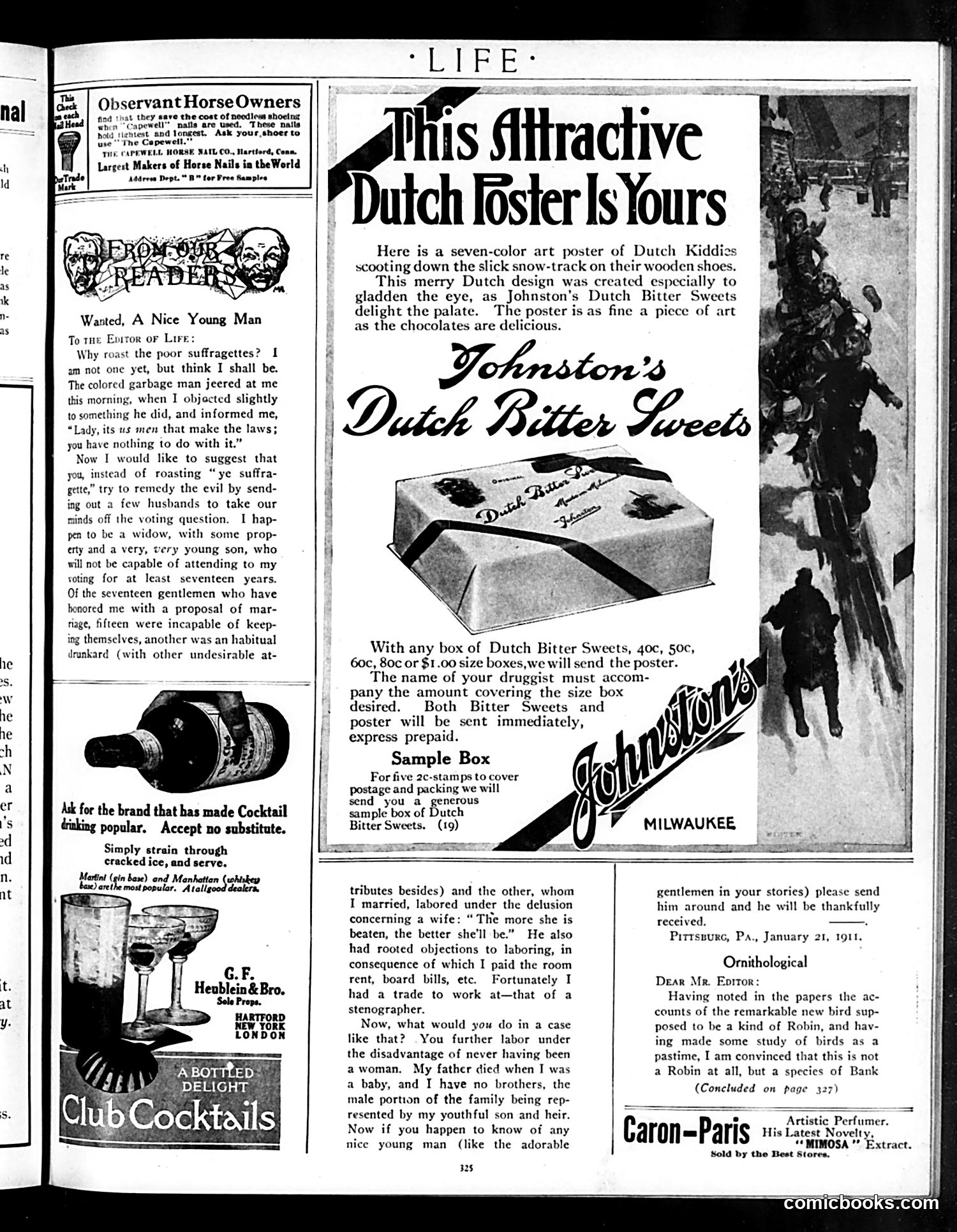
This page is primarily **advertising and letters to the editor**, with minimal political satire. The main content includes: **Advertisement**: Johnston's Dutch Bitter Sweets uses a charming poster of Dutch children on snowy wooden shoes to sell chocolates—a straightforward commercial appeal with no satirical intent. **Reader Letter**: A widow responds to Life's criticism of suffragettes. She sarcastically argues that rather than mocking women seeking voting rights, Life should encourage husbands to marry and support widows—thereby solving women's "voting question" problem. The letter satirizes anti-suffrage arguments by highlighting women's economic dependence on men, the poor quality of available husbands, and domestic abuse ("the more she is beaten, the better she'll be"). **Context**: This reflects the 1910s suffrage debate, where opponents claimed women shouldn't vote because they should depend on male relatives. The letter's dark humor exposes the absurdity of that position. The remaining content comprises cocktail recipes, perfume ads, and ornithological discussion—typical period magazine filler.
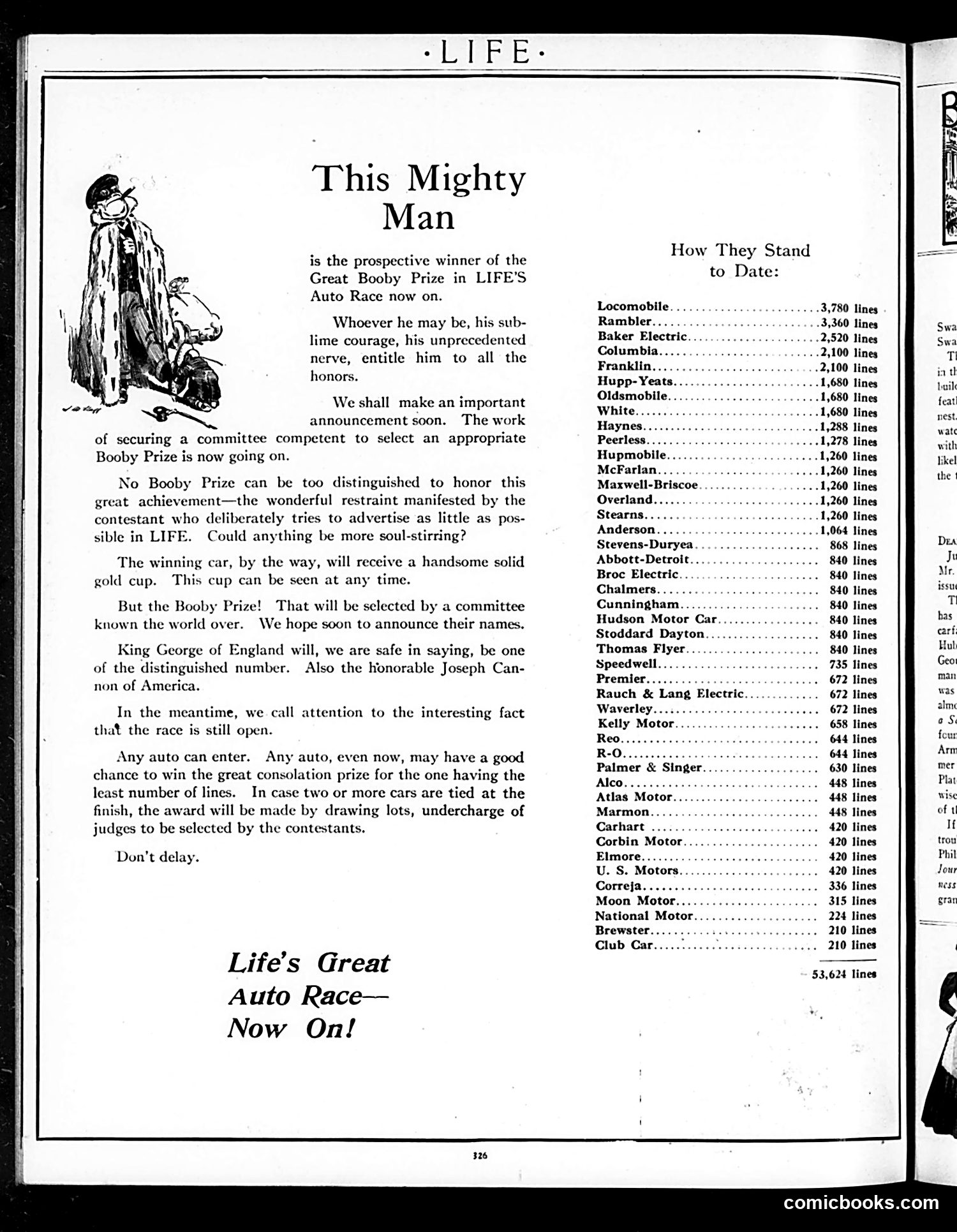
This is a satirical advertisement contest, not a political cartoon. Life magazine is running a humorous competition where automobile manufacturers compete—but with an ironic twist: the "Great Booby Prize" goes to whichever car company advertises *least* in Life magazine, measured by line count. The joke: manufacturers naturally want to advertise heavily to win customers, yet Life is incentivizing the opposite behavior. The page mocks both automotive industry excess and advertising culture itself. References to "King George of England" and Joseph Cannon (a prominent American politician) as prize judges add absurdist humor. The leaderboard shows Locomobile leading with 3,780 lines of advertising—exactly the wrong position if you want the "booby prize." The satire suggests that restraint in advertising is so rare it's laughable, worthy of international recognition.
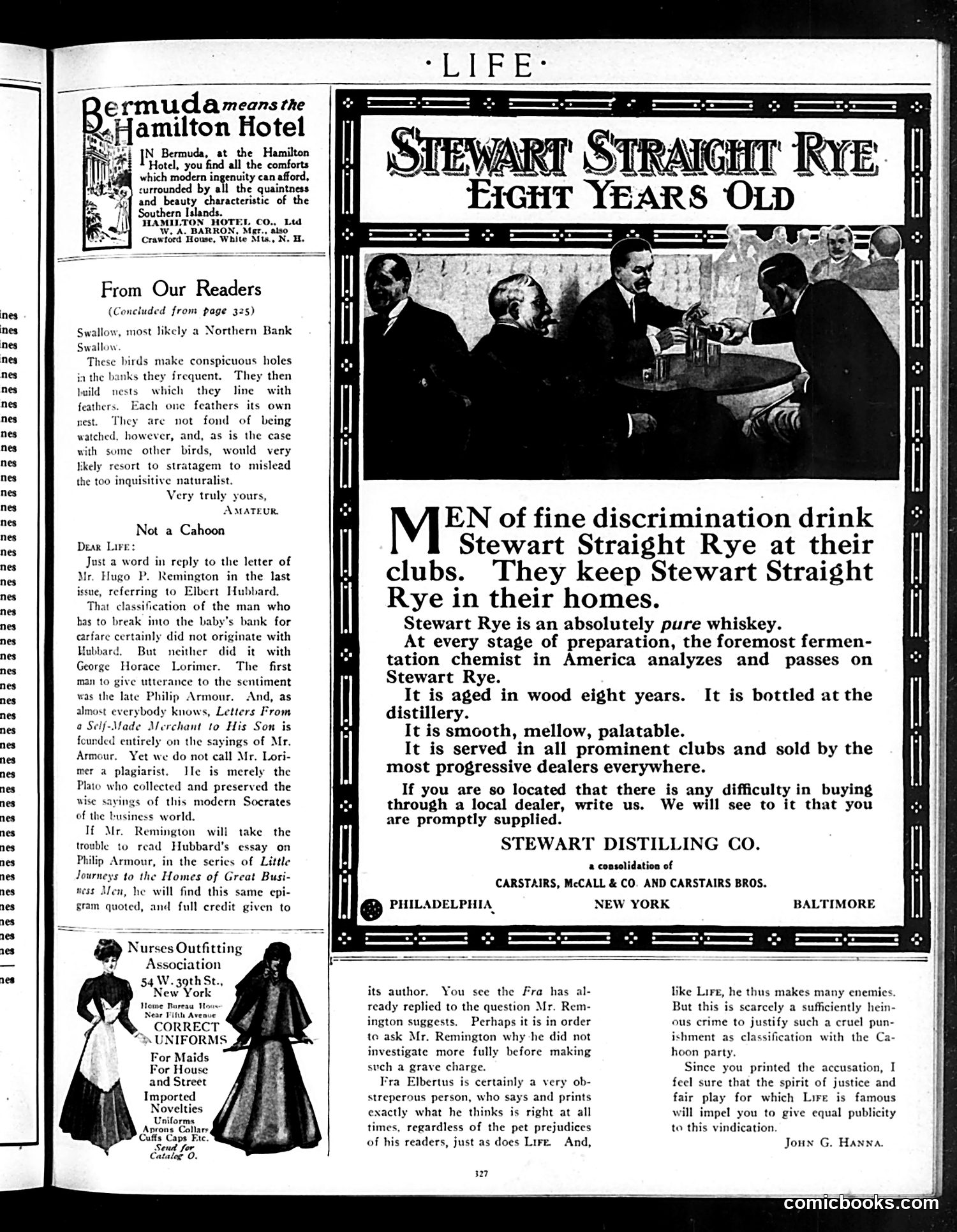
This page is primarily **advertising and reader correspondence**, not political satire. The dominant feature is a large **Stewart Straight Rye whiskey advertisement** showing men in suits at what appears to be a bar or club, targeting wealthy consumers ("men of fine discrimination"). The left side contains: - A hotel advertisement for Bermuda - A "From Our Readers" section featuring letters debating whether Elbert Hubbard (a popular writer/philosopher) plagiarized from Philip Armour when writing about self-made men - A small advertisement for a "Nurses Outfitting Association" **Key context for modern readers:** This predates Prohibition (1920-1933), so alcohol advertising was legal and common. The whiskey ad's emphasis on "clubs" and "homes" reflects a wealthy, exclusive market. The reader letters discuss literary ethics and attribution—concerns about intellectual honesty that remain relevant today. There is no political cartoon on this page; it's a standard magazine page mixing ads and reader debate.
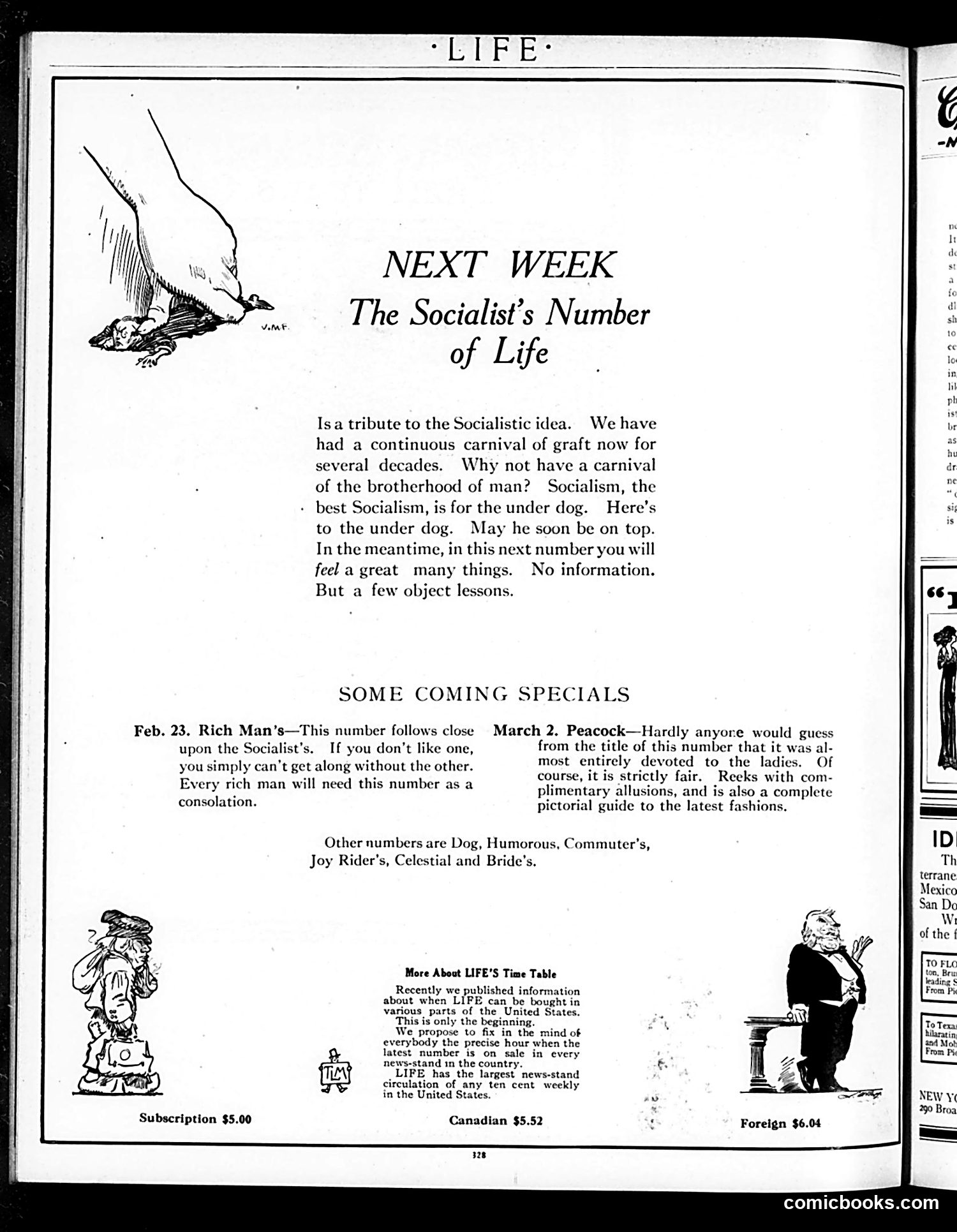
This is a promotional page announcing Life magazine's upcoming "Socialist's Number." The editors frame it as satirical social commentary: after decades of political graft and corruption, why not dedicate an issue to socialism and "the brotherhood of man"? They promise the next issue will be a "Rich Man's Number"—a humorous pairing suggesting the magazine will critique both wealth inequality and socialist ideals. The cartoons (a foot crushing a small figure, left; a well-dressed man at right) likely represent the wealthy and working classes. The page advertises Life's strong newsstand circulation and upcoming themed issues on various topics (Peacock, Dog, Humorous, etc.). This reflects early 20th-century American satirical journalism, where Life magazine presented left-leaning social criticism through humor and illustration. The tone is ironic rather than doctrinaire about socialism itself.
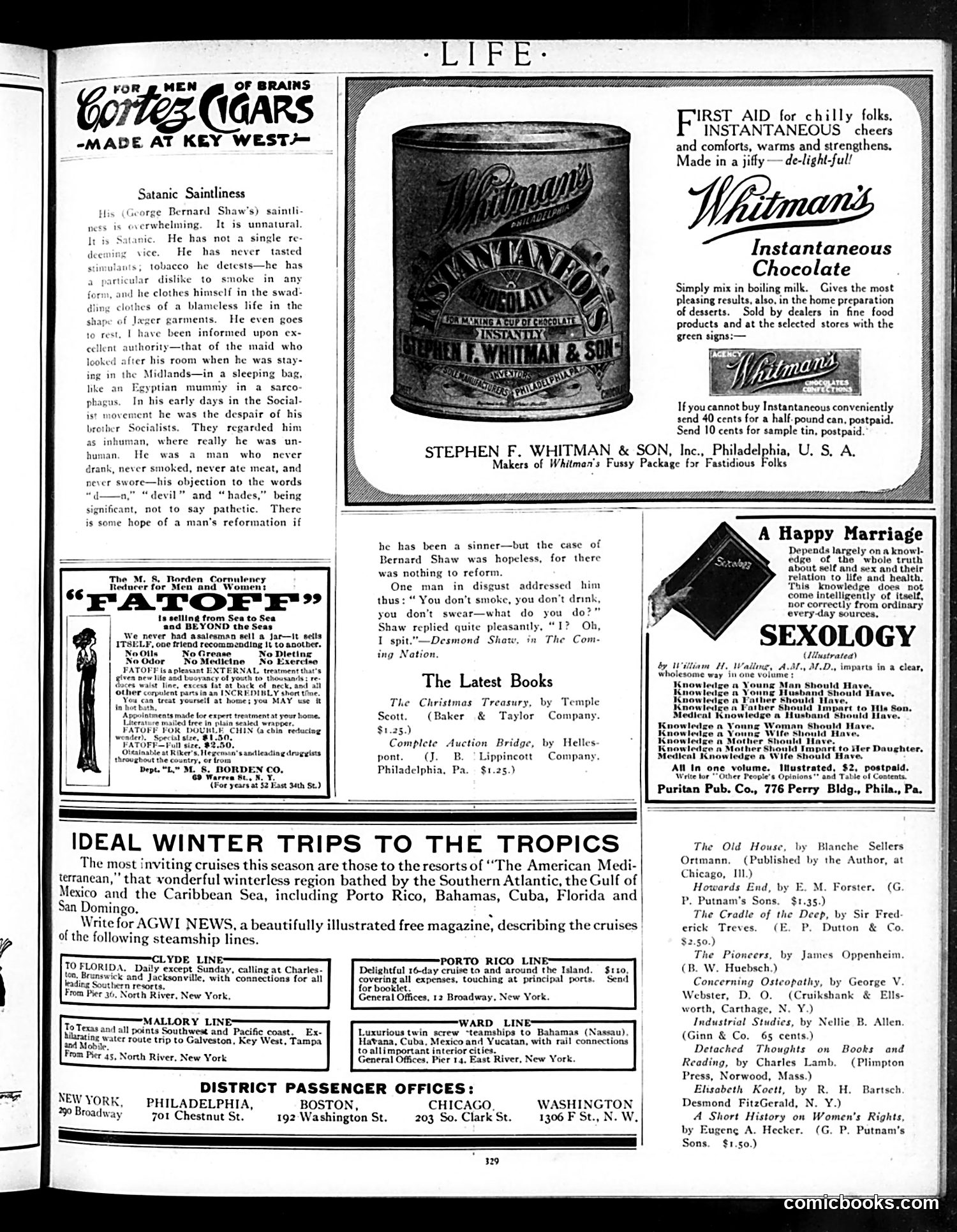
**Main Content:** The dominant feature is a satirical piece on **George Bernard Shaw**, the Irish playwright and socialist. The article criticizes Shaw's excessive virtue—his refusal to smoke, drink, swear, or eat meat—as unnaturally "Satanic" rather than genuinely saintly. The humor lies in the paradox: Shaw's perfect morality makes him *worse*, not better, because genuine reformation requires having *something* to reform from. The anecdote about Shaw replying "I spit" when asked what he does is the punchline—even his vices are trivial. **Context for Modern Readers:** Shaw was a famous public intellectual known for his ascetic lifestyle and socialist views. This piece mocks both his pretentiousness and the socialist movement's disapproval of him (they found him "inhuman"). The satire reflects early 20th-century debates about morality, hypocrisy, and whether virtue without struggle is authentic. **Surrounding Content:** The page is mostly **advertisements** (cigars, weight-loss products, chocolate, books on sex education, and cruise lines)—typical of Life's business model during this era.
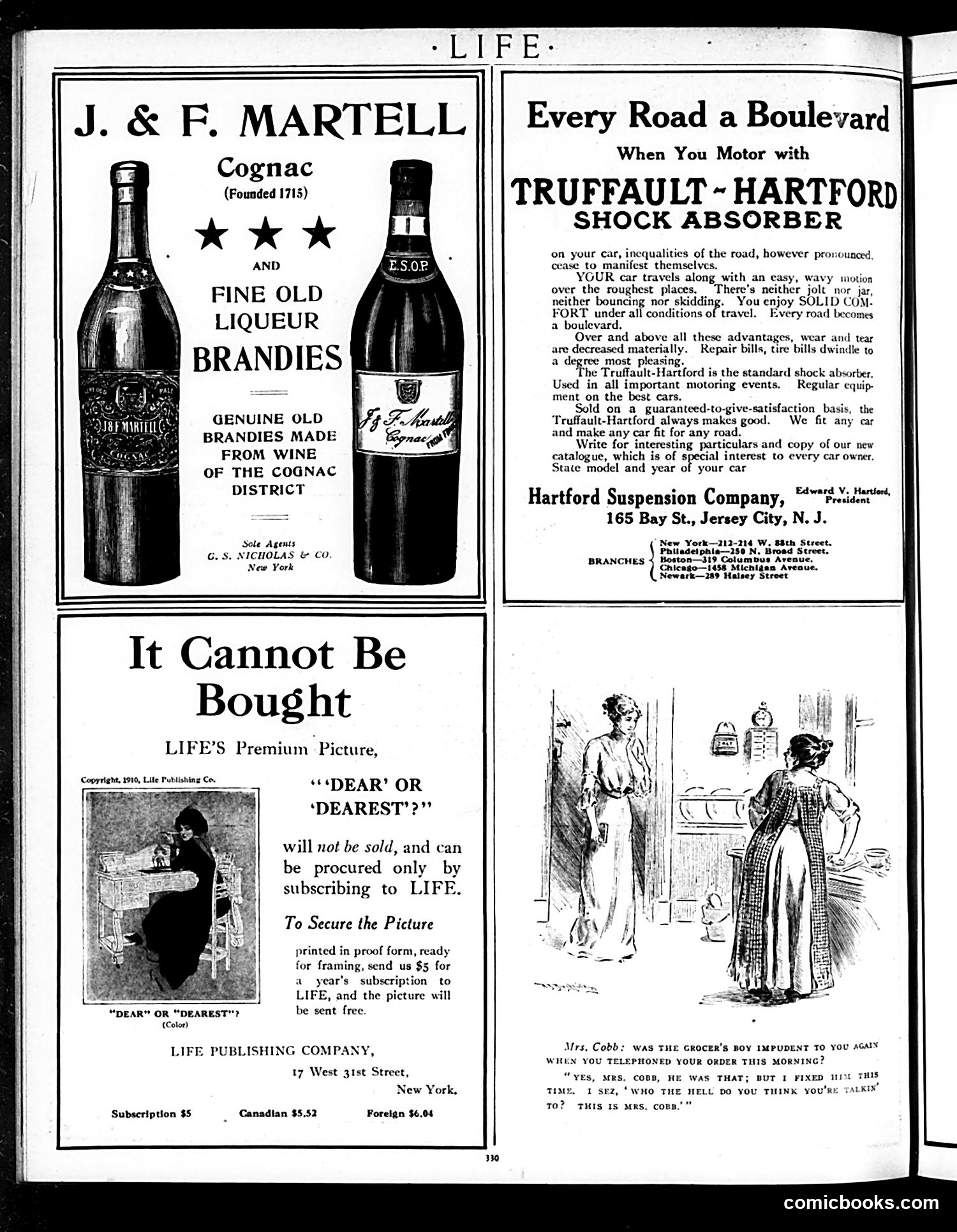
This page consists primarily of **advertisements** rather than satirical cartoons, typical of Life magazine's revenue model. The ads promote luxury goods (Martell Cognac brandy) and automotive technology (Truffault-Hartford shock absorbers), reflecting early 20th-century consumer culture. The only comic content is a small illustration captioned with dialogue between Mrs. Cobb and her servant. The joke appears to center on **class dynamics**: the servant reports speaking imperiously to a grocer's boy, invoking her employer's name to assert authority. The humor lies in the servant mimicking her employer's social pretension—the "punch line" suggesting the servant has adopted Mrs. Cobb's imperious manner when dealing with tradespeople. The cartoon satirizes servants copying their employers' snobbish attitudes toward working-class vendors, reflecting Edwardian-era class consciousness and domestic service hierarchies.
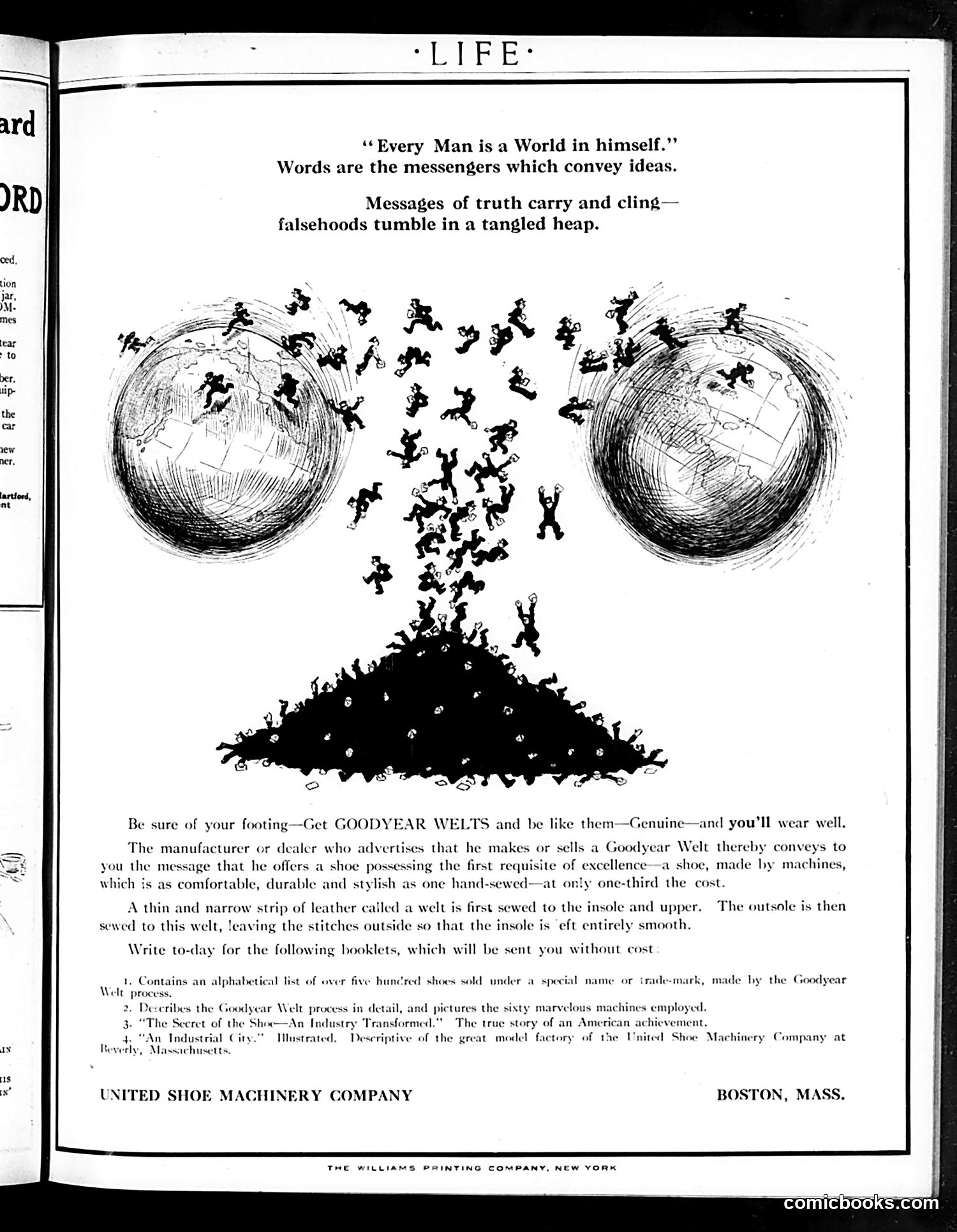
This is primarily a **shoe advertisement**, not political satire. It's a Goodyear Welt shoe company ad using an allegorical illustration. The image shows two globes with figures emerging from a dark mass below, flowing upward between them. This visualizes the opening philosophical quote: "Every Man is a World in himself" and "Words are the messengers which convey ideas." The ad's argument is metaphorical: just as true messages "carry and cling" while falsehoods "tumble in a tangled heap," genuine Goodyear Welt shoes represent truth and quality in manufacturing, contrasted with inferior imitations. The "footing" metaphor connects stability (reliable shoes) to reliable messaging. The ad emphasizes that machine-made Goodyear Welts match hand-sewn quality at one-third the cost—positioning industrial manufacturing as progress and democratization of excellence. It's promoting the United Shoe Machinery Company's factory innovations as an "Industrial City" achievement in early 20th-century American manufacturing pride.