
Life, 1911-02-09 · page 20 of 44
Life — February 9, 1911 — page 20: what you’re looking at
What you’re looking at
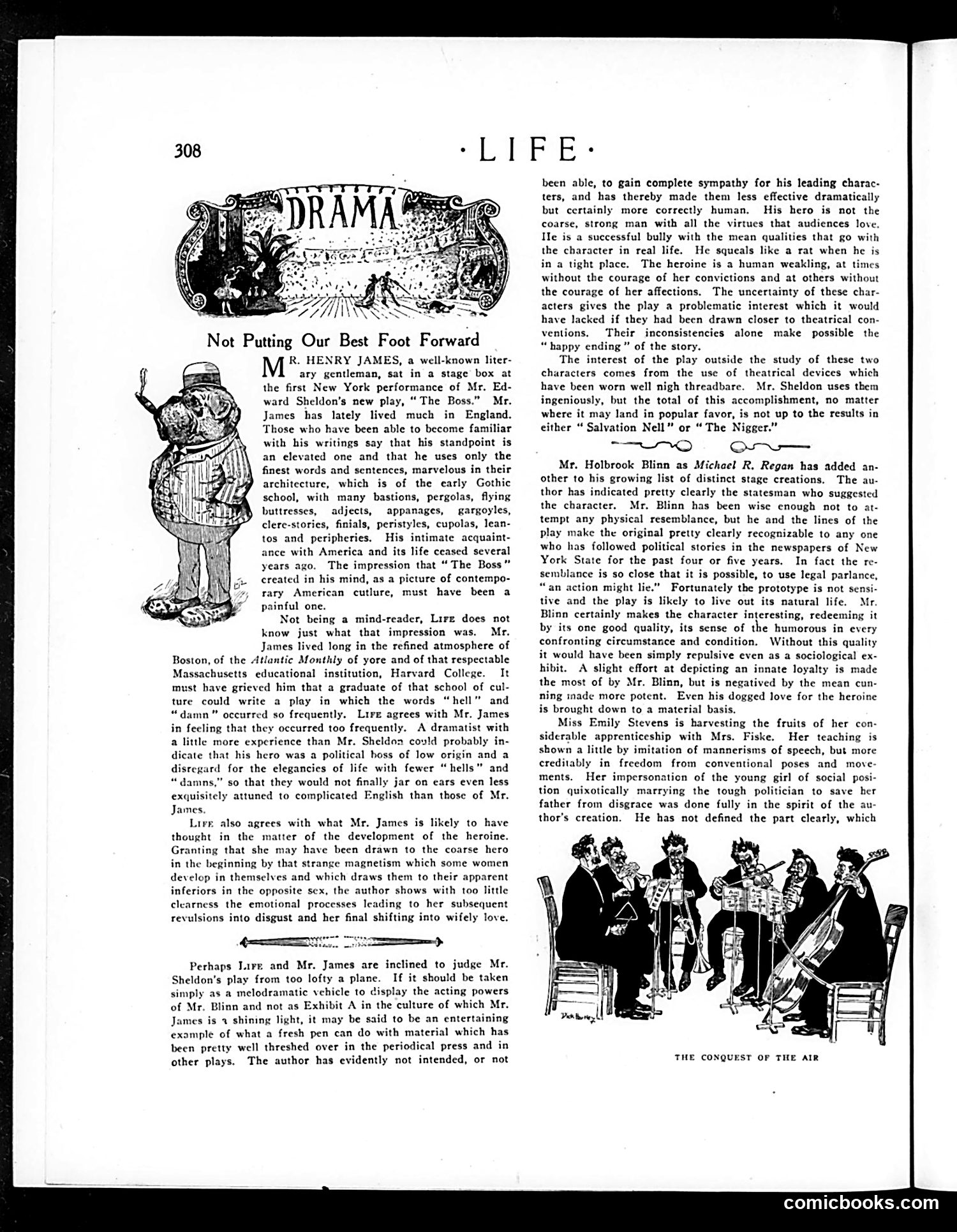
This page reviews Edward Sheldon's play "The Boss," focusing on how Henry James—the famous novelist, then living abroad—likely reacted to it. **The Satire:** Life gently mocks James's refined sensibilities. James, steeped in "early Gothic" architectural language and Boston Brahmin culture, would have been shocked by the play's frequent use of profanity ("hell" and "damn"). Life agrees the language is excessive but defends the play's realism: the characters are deliberately flawed and inconsistent, making them more *human* than typical melodramatic heroes. **The Point:** The magazine pokes fun at James's old-fashioned aesthetic standards while actually endorsing the play's modern, psychologically complex approach to drama. It's a gentle ribbing of literary elitism—suggesting that not everything must meet James's elevated architectural standards to have artistic value. The cartoon (showing musicians) appears unrelated to the text.
📄 Transcribed text from this page (OCR, searchable)
Machine-transcribed from the original scan — historical spelling and the odd misread are preserved.
«LEME * R. HENRY JAMES, a well-known liter- ary gentleman, sat in a stage box at the first New York performance of Mr. Ed- ward Sheldon’s new play, “The Boss.” Mr. James has lately lived much in England. Those who have been able to become familiar with his writings say that his standpoint is an elevated one and that he uses only the finest words and sentences, marvelous in their architecture, which is of the early Gothic school, with many bastions, pergolas, flying buttresses, adjects, appanages, gargoyles, clere-stories, finials, peristyles, cupolas, lean- tos and peripheries. His intimate acquaint- ance with America and its life ceased several years ago. The impression that “The Boss” created in his mind, as a picture of contempo- rary American cutlure, must have been a painful one. Not being a mind-reader, Lire does not know just what that impression was. Mr. James lived long in the refined atmosphere of Boston, of the Atlantic Monthly of yore and of that respectable Massachusetts educational institution, Harvard College. It must have grieved him that a graduate of that school of cul- ture could write a play in which the words “hell” and “damn” occurred so frequently. Lire agrees with Mr. James in feeling that they occurred too frequently. A dramatist with a little more experience than Mr. Sheldoa could probably in- dicate that his hero was a political boss of low origin and a disregard for the elegancies of life with fewer “hells” and “damns,” so that they would not finally jar on ears even less exquisitely attuned to complicated English than those of Mr. James. Lire also agrees with what Mr. James is likely to have thought in the matter of the development of the heroine. Granting that she may have been drawn to the coarse hero in the beginning by that strange magnetism which some women develop in themselves and which draws them to their apparent inferiors in the opposite sex, the author shows with too little clearness the emotional processes leading to her subsequent revulsions into disgust and her final shifting into wifely love. —==. —=S—_,- Perhaps Jare and Mr. James are inclined to judge Mr. Sheldon's play from too lofty a plane. If it should be taken simply as a melodramatic vehicle to display the acting powers of Mr. Blinn and not as Exhibit A in the culture of which Mr. James is 1 shining light, it may be said to be an entertaining example of what a fresh pen can do with material which has been pretty well threshed over in the periodical press and in other plays. The author has evidently not intended, or not been able, to gain complete sympathy for his leading charac- ters, and has thereby made them less effective dramatically but certainly more correctly human. His hero is not the coarse, strong man with all the virtues that audiences love, Ile is a successful bully with the mean qualities that go with the character in real life. He squeals like a rat when he is in a tight place. The heroine is a human weakling, at times without the courage of her convictions and at others without the courage of her affections. The uncertainty of these char- acters gives the play a problematic interest which it would have lacked if they had been drawn closer to theatrical con- ventions, Their inconsistencies alone make possible the “happy ending” of the story. The interest of the play outside the study of these two characters comes from the use of theatrical devices which have been worn well nigh threadbare. Mr. Sheldon uses them ingeniously, but the total of this accomplishment, no matter where it may land in popular favor, is not up to the results in either “ Salvation Nell” or “The Nigger.” SO Owen Mr. Holbrook Blinn as Michael R, Regan has added an- other to his growing list of distinct stage creations. The au- thor has indicated pretty clearly the statesman who suggested the character, Mr. Blinn has been wise enough not to at- tempt any physical resemblance, but he and the lines of the play make the original pretty clearly recognizable to any one who has followed political stories in the newspapers of New York State for the past four or five years, In fact the re- semblance is so close that it is possible, to use legal parlance, “an action might lie.” Fortunately the prototype is not sensi- tive and the play is likely to live out its natural life. Mr. Blinn certainly makes the character interesting, redeeming it by its one good quality, its sense of the humorous in every confronting circumstance and condition. Without this quality it would have been simply repulsive even as a sociological ex- hibit. A slight effort at depicting an innate loyalty is made the most of by Mr. Blinn, but is negatived by the mean cun- ning inade more potent. Even his dogged love for the heroine is brought down to a material basis. Miss Emily Stevens is harvesting the fruits of her con- siderable apprenticeship with Mrs. Fiske. Her teaching is shown a little by imitation of mannerisms of speech, but more creditably in freedom from conventional poses and move- ments. Her impersonation of the young girl of social posi tion quixotically marrying the tough politician to save her father from disgrace was done fully in the spirit of the au- thor’s creation. He has not defined the part clearly, which THE CONQUEST OF THE AIR comicbooks.com