
Life, 1911-02-09 · page 21 of 44
Life — February 9, 1911 — page 21: what you’re looking at
What you’re looking at
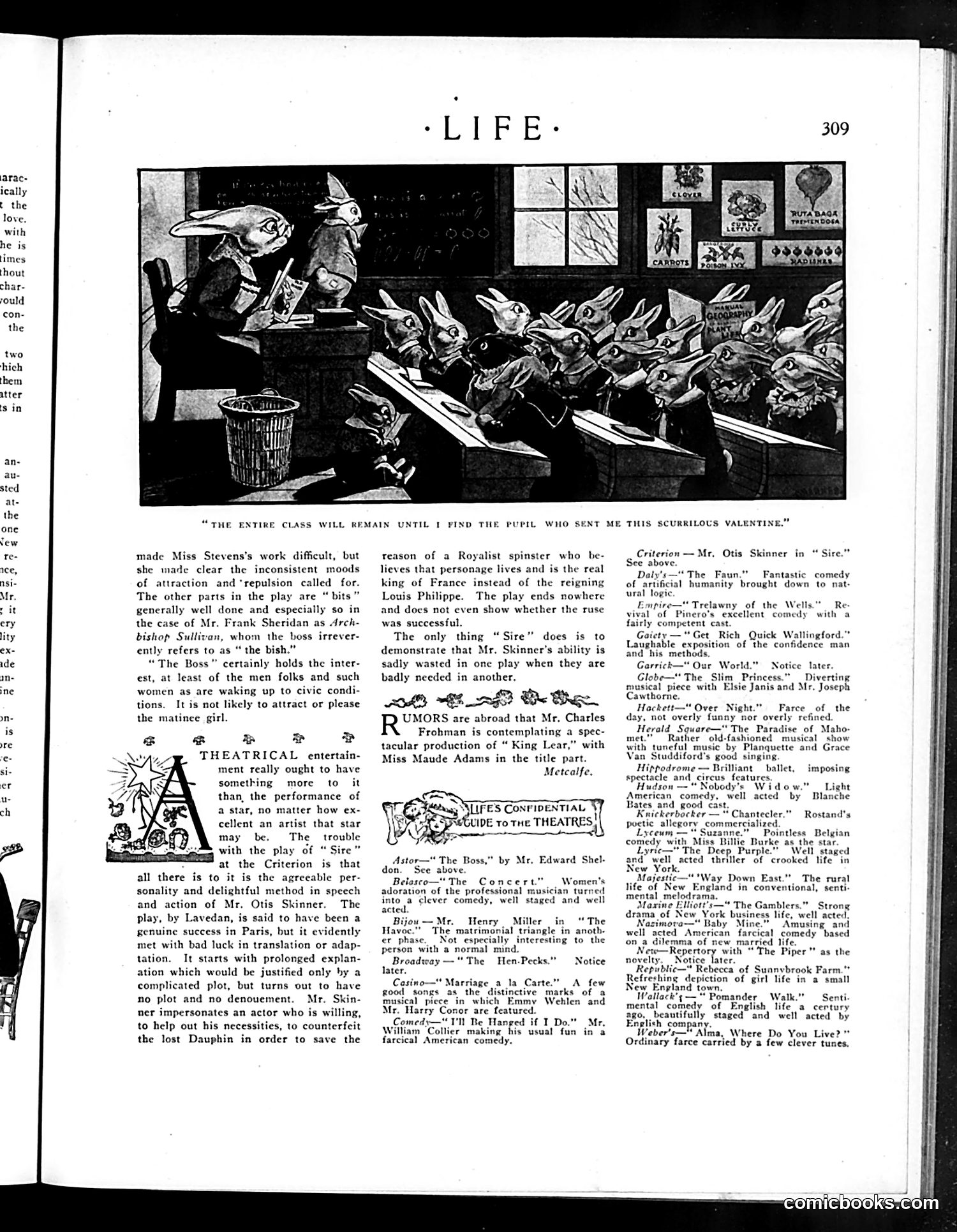
The main cartoon depicts a schoolroom scene where a teacher announces she's keeping the entire class after school until she finds who sent her a "scurrilous Valentine"—a cruel or insulting valentine card. The humor lies in the collective punishment: all students must stay because of one anonymous sender's misdeed. This satirizes both school discipline methods and the Victorian tradition of Valentine's Day exchanges, which could be used as vehicles for mockery rather than romance. The page's lower half reviews theatrical productions, focusing extensively on "Sire," starring actor Otis Skinner. The critic argues the play itself is poorly constructed—it's merely a vehicle for displaying Skinner's charm and acting talent, lacking actual plot or resolution. The review suggests even a talented performer cannot salvage weak material, a common theatrical complaint across eras.
📄 Transcribed text from this page (OCR, searchable)
Machine-transcribed from the original scan — historical spelling and the odd misread are preserved.
arac- ically t the love. with he is imes thout char- ould con- the two hich them atter sin sted ate the one few nce, nsi- Mr. y it ery ity exe de n= ine re & 309 “THE ENTIRE CLASS WILL REMAIN UNTIL I PIND THE PUPIL WHO SENT ME THIS SCURRILOUS VALENTINE.” made Miss Stevens's work difficult, but she made clear the inconsistent moods of attraction and ‘repulsion called for. The other parts in the play are “ ” generally well done and especially so in the case of Mr. Frank Sheridan as Arch- bishop Sullivan, whom the boss irrever- ently refers to as “ the bish.” “The Boss” certainly holds the inter- est, at least of the men folks and such women as are waking up to civic condi- tions. It is not likely to attract or please the matinee girl. & Cd % Ey ® THEATRICAL entertain- ment really ought to have something more to it than, the performance of a star, no matter how ex- cellent an artist that star (Ng) may be. The trouble k ei 5 with the play of “ Sire” at the Criterion is that all there is to it is the agreeable per- sonality and delightful method in speech and action of Mr. Otis Skinner. The play, by Lavedan, is said to have been a genuine success in Paris, but it evidently met with bad luck in translation or adap- tation. It starts with prolonged explan- ation which would be justified only by a complicated plot, but turns out to have no plot and no denouement. Mr. Skin- ner impersonates an actor who is willing, to help out his necessities, to counterfeit the lost Dauphin in order to save the reason of a Royalist spinster who be- lieves that personage lives and is the real king of France instead of the reigning Louis Philippe. The play ends nowhere and docs not even show whether the ruse was successful. The only thing “Sire” does is to demonstrate that Mr. Skinner's ability is sadly wasted in one play when they are badly needed in another. UMORS are abroad that Mr. Charles Frohman is contemplating a spec- tacular production of “ King Lear,” with Miss Maude Adams in the title part. Metcalfe. lek NLIFES ConripeNTIAL = RCGUIDE ro THe THEATRES! hehehehe demas | Astor—" The Boss,” by Mr. Edward Shel- don. See above. Belasco—" The Concert.” adoration of the professional musician into a clever comedy, well staged and well acted. Bijo Mr. Henry Miller in “The Havoc." The matrimonial triangle in anoth- er phase. Not especially interesting to the person with a normal mind. Broadway —“ The Hen-Pecks.” Notice later. Casino—" Marriage a la Carte.” A few good songs as the distinctive marks of a musical piece in which Emmy Wehlen and Mr. Harry Conor are featured. Comedy—“ I'll Be Hanged if I Do.” Mr. William ‘Collier making his usual fun in a farcical American comedy. _ Criterion — Mr, Otis Skinner in “ Sire.” See above. Daly's— The Faun." Fantastic comedy of artificial humanity brought down to nat: Trelawny of the Wells" R nero’s excellent comedy wit fairly competent cast. Gaiety —“ Get Rich Quick Wallingford.” Laughable exposition of the confidence man and his methods Garrick—" Our World.” Notice later. Globe—"* The Slim Princess.” Diverting musical piece with Elsie Janis and Mr. Joseph Cawthorne. Hackett—" Over Night.” Farce of the day, not overly funny nor overly refined. Herald Square—" The Paradise of Maho met.” Rather old-fashioned musical _ show with tuneful music by Planquette and Grace Van Studdiford’s good singing. Hippodrome — Brilliant ballet, imposing spectacle circus features. Hudson Nobody’s Widow." Light American comedy, well acted by Blanche Bates and good cas Knickerbocker —“ Chantecler.” Rostand’s poetic allegory commercialized Lyceum — “ Suzanne. Pointless Belgian comedy with Miss Billie Burke as the star. Lyric—" The Deep Purple.” Well. staged and well acted thriller of crooked life in New York. Majestic—"*Way Down East.” The rural life of New England in conventional, senti- mental melodrama. Maxine Elliott's—* The Gamblers.” Strong. drama of New York business life, well acted, Nazimore—" Baby Mine.” Amusing and well acted American farcical comedy based on a dilemma of new married life. Newe—Repertory with The Piper” as the novelty, Notice later. Republic—* Rebecca of Sunnybrook Farm." Refreshing depiction of girl life in a small New England town, Wallack’s—“ Pomander Walk.” Senti- mental comedy of English life a century ago, beautifully staged and well acted by English company. ; Weber’s—" Alma, Where Do You Live?" Ordinary farce carried by a few clever tunes,