
Life, 1911-02-09 · page 25 of 44
Life — February 9, 1911 — page 25: what you’re looking at
What you’re looking at
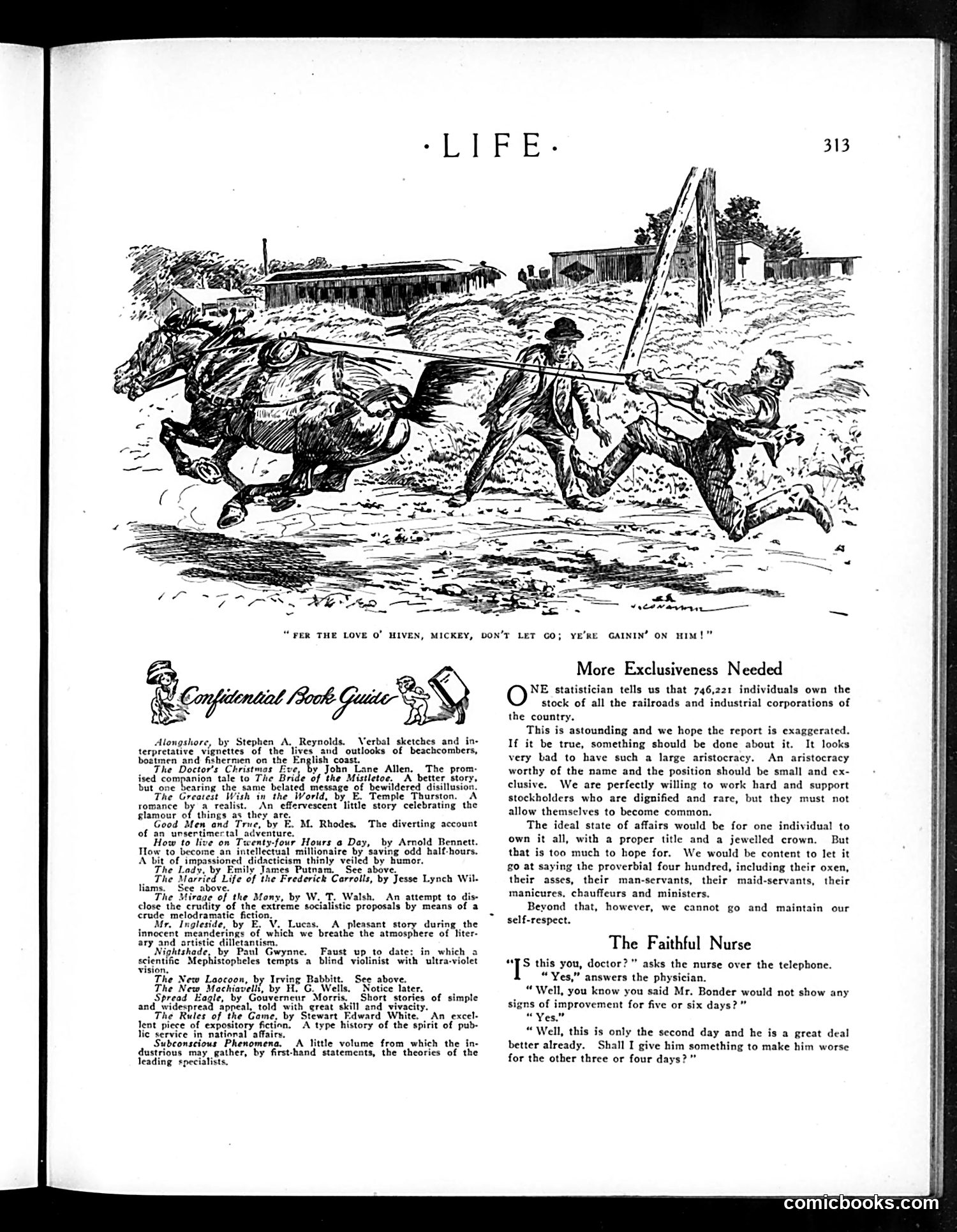
**The Cartoon:** The top illustration shows two men struggling to control a runaway horse, with the caption "Per the love o' hiven, Mickey, don't let go; ye're gainin' on him!" This is a visual gag—the men are *losing* control despite their dialect-heavy insistence they're winning. It's slapstick humor playing on the contrast between what they claim and what's actually happening. **"More Exclusiveness Needed":** This is biting satire about wealth inequality. A statistician reports 746,221 people own all railroad and industrial stock. The writer sarcastically argues this is too *many* wealthy people—there should be far fewer to maintain a "proper" aristocracy. The piece mocks the wealthy's desire for exclusivity by suggesting ideally one person should own everything, then grudgingly accepting "the proverbial four hundred" plus their servants. It's ironic critique of class elitism. **"The Faithful Nurse":** A brief joke about a nurse asking a doctor whether she should give a recovering patient medicine to *worsen* his condition so the doctor's five-to-six-day prognosis remains accurate. Dark humor about medical pride.
📄 Transcribed text from this page (OCR, searchable)
Machine-transcribed from the original scan — historical spelling and the odd misread are preserved.
“ PER THE LOVE 0’ HIVEN, MICKEY, DON’T LET CO; YE’RE GAININ’ ON HIM!” Alongshore, by Stephen A. Reynolds. Verbal sketches and in- terpretative vignettes of the lives and outlooks of beachcombers, boatmen and fishermen on the English coast. The Doctor's Christmas Eve, by John Lane Allen. The prom: ised companion tale to The Bride of the Mistletoe. A better story, but one bearing the same belated message of bewildered disillusion. The Greatest Wish in the World, by E. Temple Thurston. A romance by a realist. | An effervescent littie story celebrating the glamour of things as they are, a Good Men and True, by E. M. Rhodes. The diverting account of an unsertimer tal adventure. How to live on Twenty-four Hours a Day, by Arnold Bennett. Tow to become an intellectual millionaire by saving odd half-hours. A bit of impassioned didacticism thinly veiled by humor. The Lady, by Emily James Putnam. See above. The Married Life of the Frederick Carrolls, by Jesse Lynch Wil- liams. See above. The Mirage of the Mony, by W. T. Walsh, An attempt to dis close the crudity of the extreme socialistic proposals by means of a crude melodramatic fiction. __Mr, Ingleside, by E, V. Lucas. A pleasant story during the innocent meanderings of which we breathe the atmosphere of Hiter- ary and artistic dilletantism. Nightshade, by Paul Gwynne. Faust up to date: in which a scientific Mephistopheles tempts a blind violinist with ultra-violet vision, The New Laocoon, by Irving Babbitt. See above. The New, Machiavelli, by H. G. Wells. Notice later. Spread Eagle, by Gouverneur Morris. Short stories of simple and_widespread apneal, told with great skill and vivacity. The Rules of the Game, by Stewart Edward White. An excel- lent piece of expository fiction. A type history of the spirit of pub- lic service in national affairy. Subconscious Phenomena. A little volume from which the in- dustrious may gather, by first-hand statements, the theories of the leading specialists. More Exclusiveness Needed NE statistician tells us that 746,221 individuals own the stock of all the railroads and industrial corporations of the country. This is astounding and we hope the report is exaggerated. If it be true, something should be done about it. It looks very bad to have such a large aristocracy. An aristocracy worthy of the name and the position should be small and ex- clusive. We are perfectly willing to work hard and support stockholders who are dignified and rare, but they must not allow themselves to become common. The ideal state of affairs would be for one individual to own it all, with a proper title and a jewelled crown. But that is too much to hope for. We would be content to let it go at saying the proverbial four hundred, including their oxen, their asses, their man-servants, their maid-servants, their manicures, chauffeurs and ministers. Beyond that, however, we cannot go and maintain our self-respect. The Faithful Nurse “TS this you, doctor?" asks the nurse over the telephone. “Yes,” answers the physician. “ Well, you know you said Mr. Bonder would not show any signs of improvement for five or six days?” “Yea” “Well, this is only the second day and he is a great deal better already. Shall I give him something to make him worse for the other three or four days?” comicbooks.com