
A complete issue · 40 pages · 1910
Life — August 11, 1910
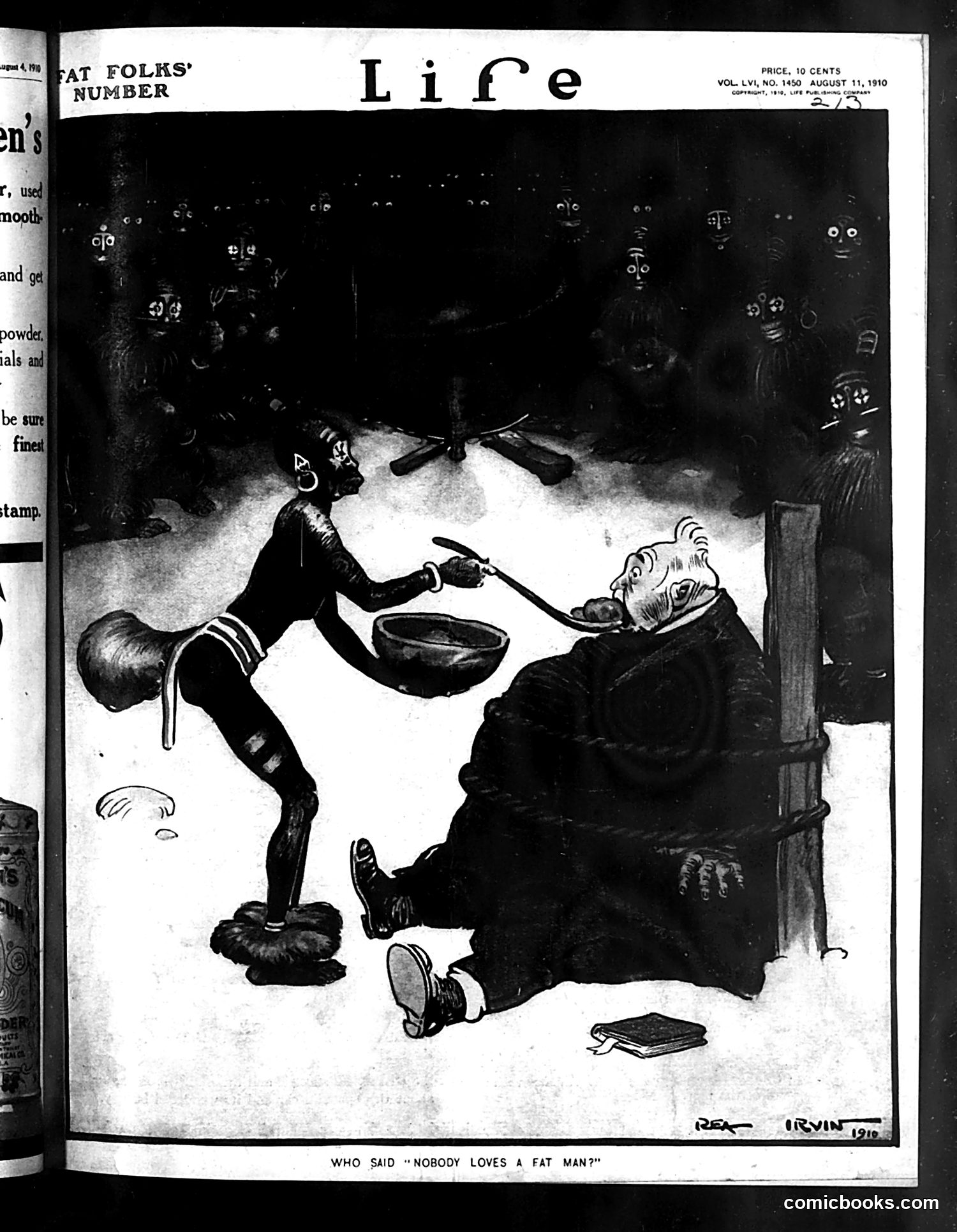
This satirical cartoon depicts a woman force-feeding a portly man from a bowl or ladle, illustrated in exaggerated caricature style. The caption reads "WHO SAID 'NOBODY LOVES A FAT MAN?'" The satire appears to comment on societal attitudes toward obesity and masculinity in the early 1900s. The woman's aggressive feeding—suggesting either domineering behavior or ironic "care"—implies commentary on either domestic power dynamics or the cultural pressures/expectations placed on men regarding weight and appearance. The cartoon likely responds to contemporary debates about body image and gender roles, presenting the "fat man" as a figure of ridicule or pity rather than romantic interest, despite the woman's ostensible "affection" shown through forced feeding.
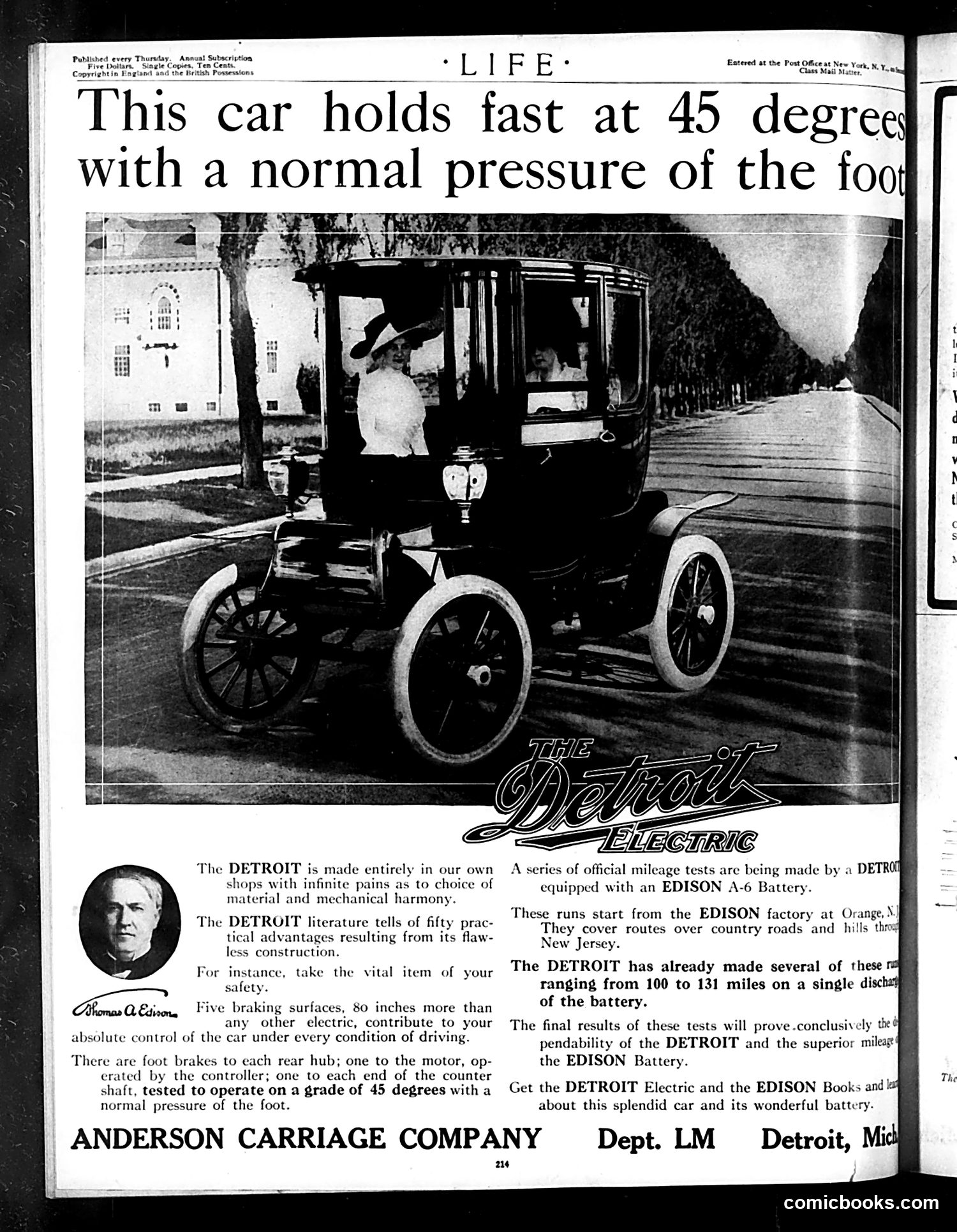
This page is primarily **advertising, not satire or political commentary**. It promotes the Detroit Electric automobile, manufactured by the Anderson Carriage Company in Detroit, Michigan. The advertisement features Thomas A. Edison (identified by portrait and signature), lending his credibility to endorse the vehicle. Edison's involvement suggests this is an early electric car, likely from the 1900s-1910s era when electric vehicles competed with gasoline engines. The ad emphasizes practical features: exceptional braking (five surfaces), foot controls tested at 45-degree angles, and range tests using Edison batteries (100-131 miles per charge). The copy targets safety-conscious buyers, positioning the Detroit Electric as a reliable, technologically advanced choice—with Edison's famous name as crucial validation.
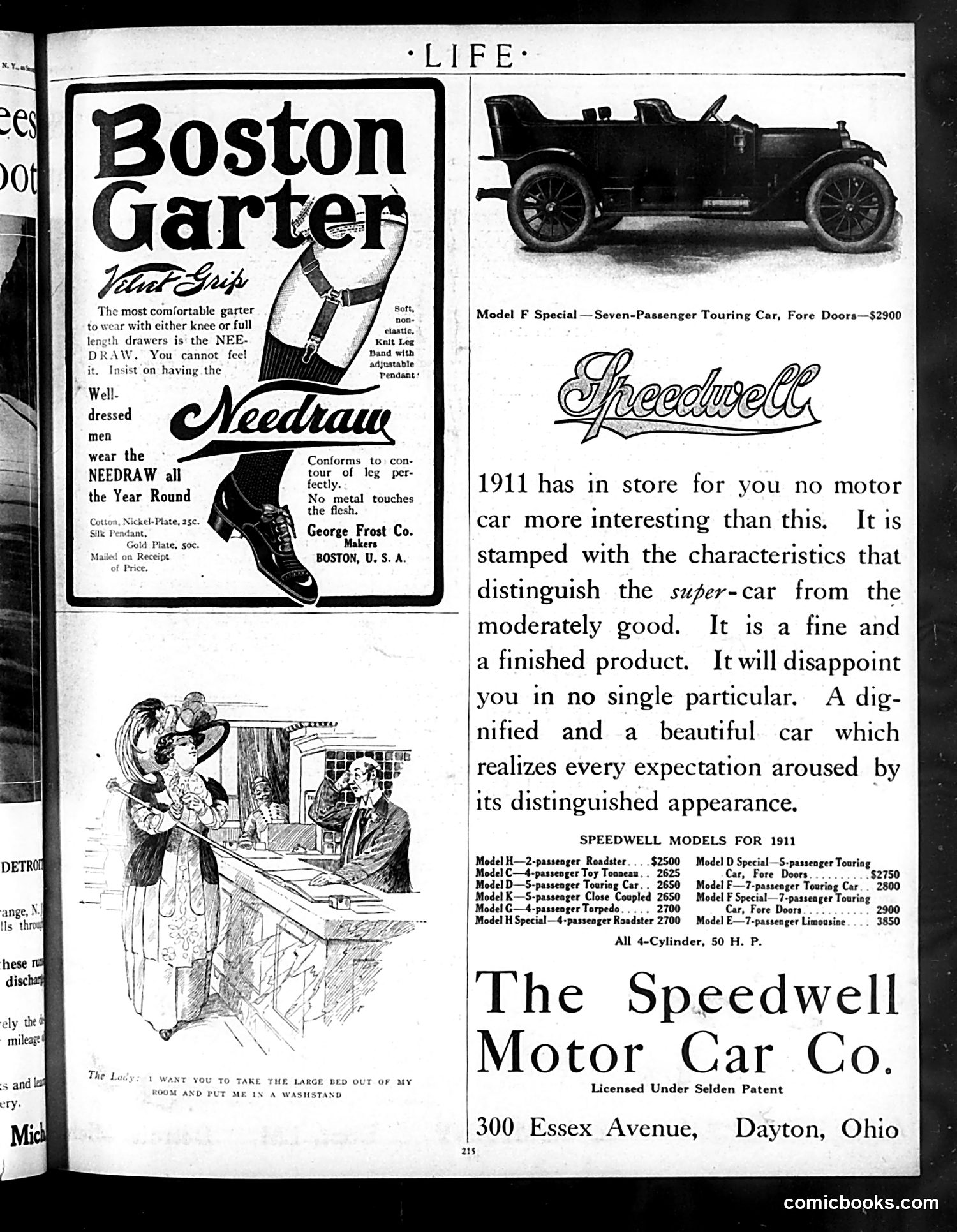
This page is primarily **advertising**, not satire or political commentary. The left side advertises the **Boston Garter** (a men's garter) and **Needraw** brand undergarments from George Frost Co. in Boston. The small cartoon below appears to be generic domestic humor—a woman asking her husband to remove a large bed from her room, presumably to make space. This is lighthearted but unrelated to broader social commentary. The right side features a **Speedwell automobile advertisement** for a 1911 Model F seven-passenger touring car, priced at $2900. The ad emphasizes the car's quality and refined engineering. No political figures, caricatures, or satirical commentary are evident. This is a standard magazine page mixing consumer product advertisements with minor domestic humor.
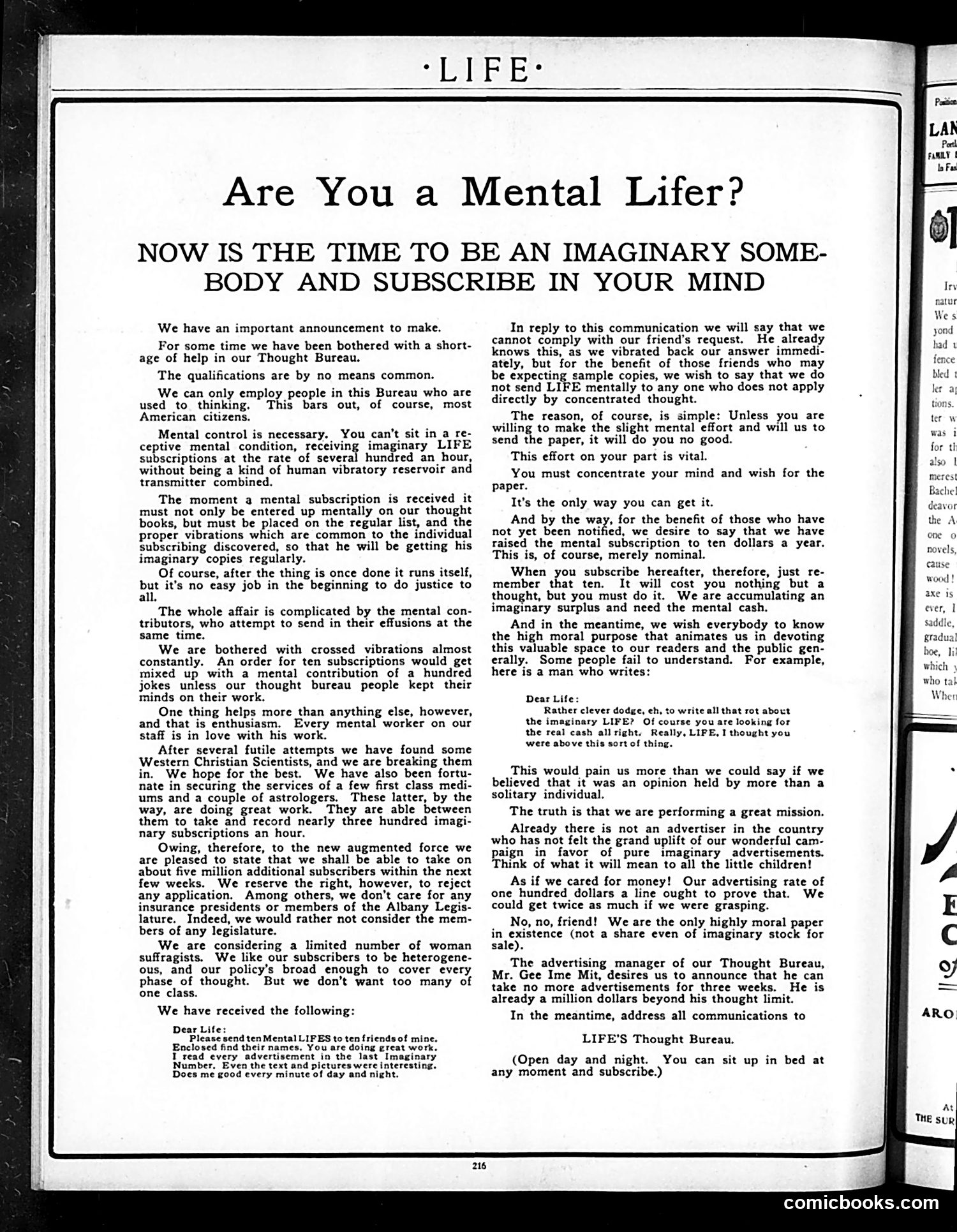
This is not a cartoon or satirical image, but rather a **humorous advertisement or editorial piece** from Life magazine promoting imaginary "Mental LIFE subscriptions." The text satirizes **New Thought and Christian Science movements** popular in the early 20th century—metaphysical belief systems claiming concentrated thought could produce material results. The piece mocks subscribers who believe they can mentally manifest imaginary copies of Life magazine without actually paying for physical ones. The satire targets gullible followers of these movements while also making a **business pitch**: Life wants real subscribers but acknowledges losing some to these "mental" alternatives. The joke is that Life, a materialist publication, must appeal to idealists by pretending their imaginary subscriptions actually work—while ultimately asking readers to subscribe for real.
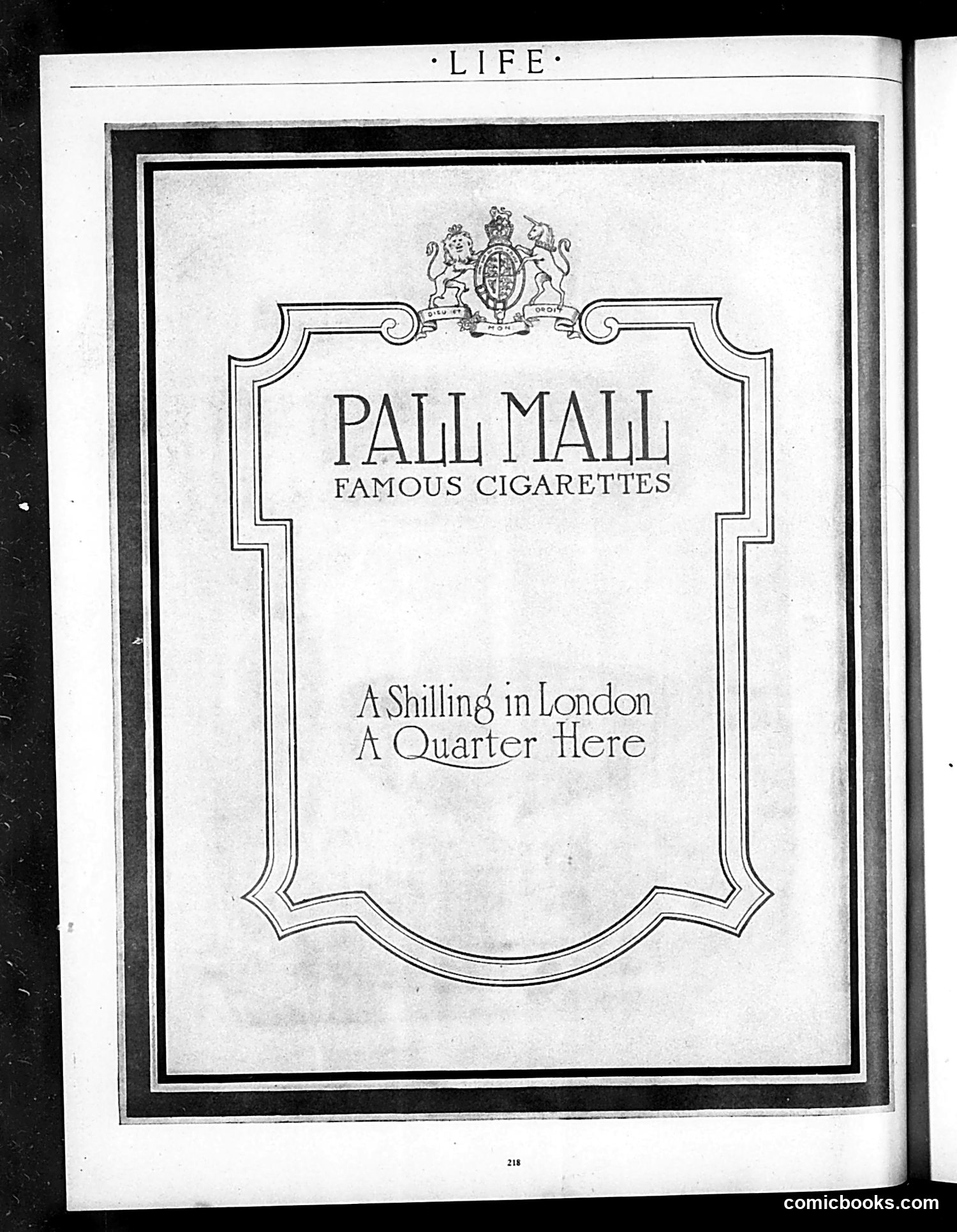
This page is primarily a **cigarette advertisement** for Pall Mall brand, not political satire or a cartoon. It appears in *Life* magazine and features an ornate decorative border with a royal coat of arms at the top, emphasizing the product's prestige. The advertising copy reads "A Shilling in London / A Quarter Here," which compares prices between British and American markets. A shilling was British currency; a quarter (25 cents) was American. This suggests Pall Mall positioned itself as an affordable luxury cigarette—accessible pricing despite aristocratic branding symbolized by the royal imagery. The page demonstrates how early 20th-century *Life* magazine contained substantial advertising revenue alongside editorial content.
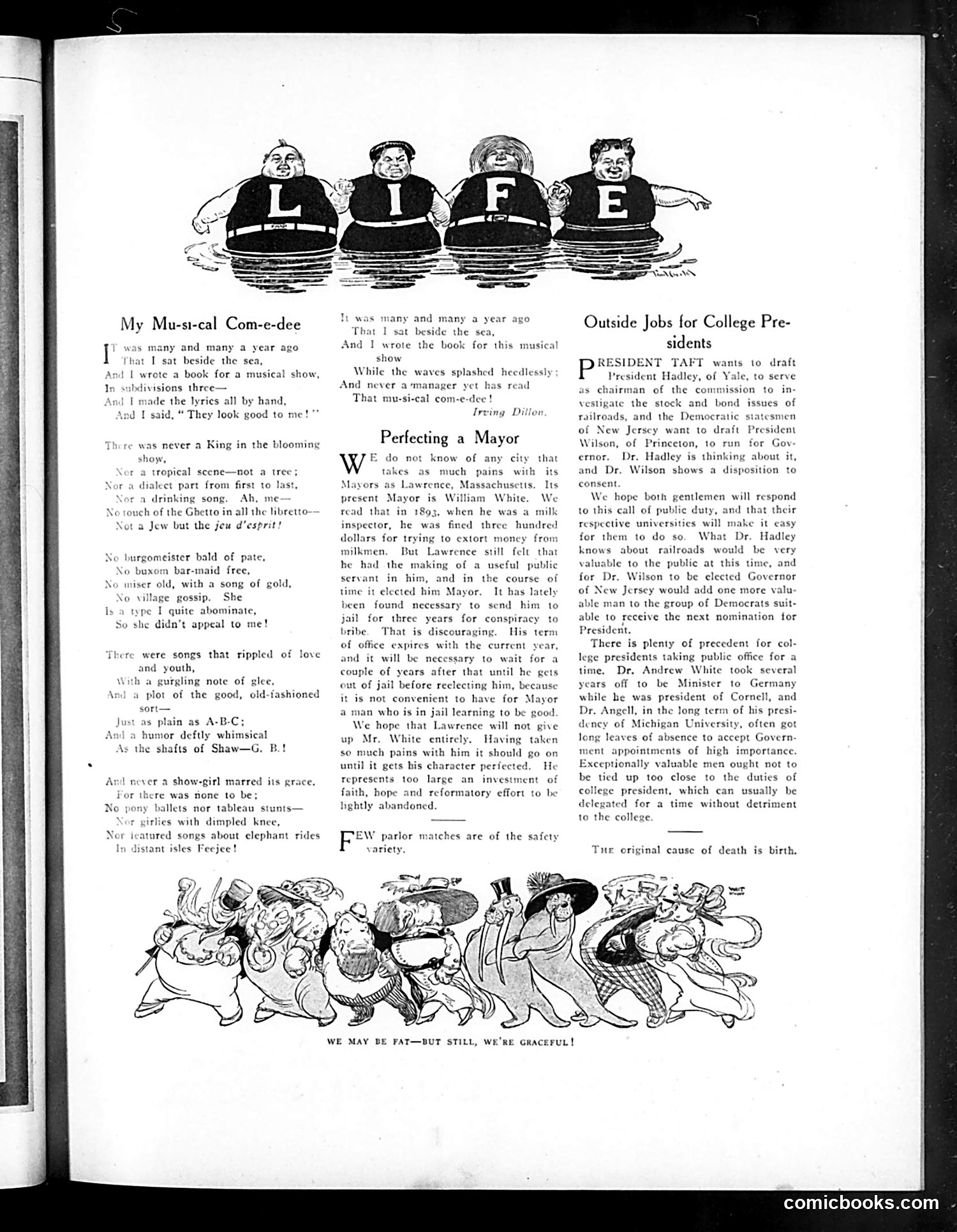
**Top Cartoon - "My Musical Come-dee":** This is a humorous poem about writing a musical show set by the sea. The accompanying illustration shows four rotund figures in water wearing letters spelling "LIFE"—a visual pun on the magazine's own title, suggesting the musical is about life itself. **Middle Articles:** "Perfecting a Mayor" discusses Lawrence, Massachusetts Mayor William White, who was jailed three years for extortion conspiracy. The piece satirizes his criminal past while discussing potential presidential ambitions. "Outside Jobs for College Presidents" proposes that college presidents take government positions, citing President Taft's desire to draft President Wilson. **Bottom Cartoon:** An illustration of dancing, rotund figures with the caption "We may be fat—but still, we're graceful!"—self-deprecating humor about weight and physical appearance.
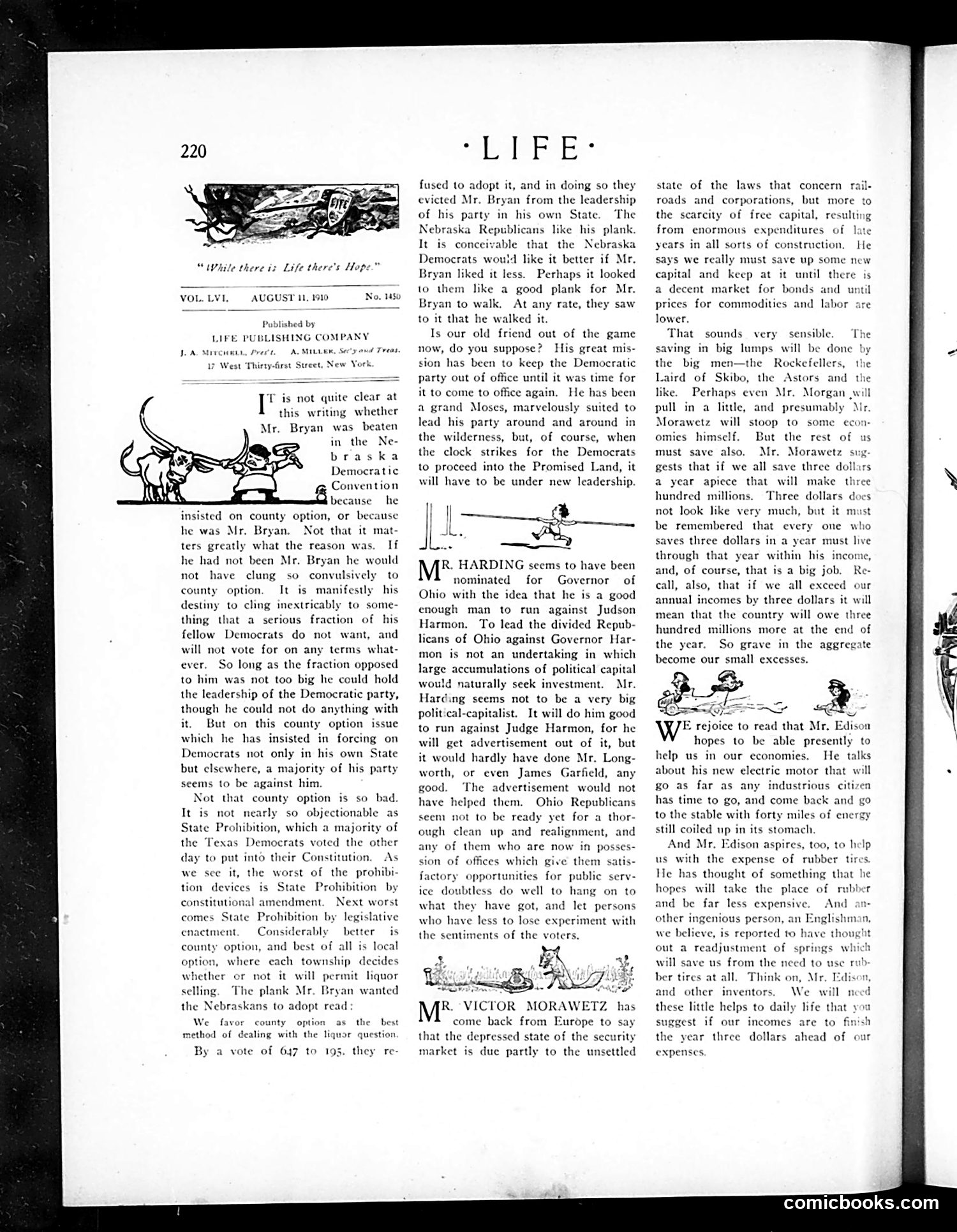
This page contains three editorial sections discussing 1919 Democratic and Republican politics. The **cartoon at top left** shows a donkey (Democratic symbol) being kicked or thrown—likely referencing William Jennings Bryan's loss of influence in the Democratic Party leadership. The text discusses **Mr. Bryan's diminished role**, noting Nebraska Democrats wanted him removed from party leadership. It also covers **Mr. Harding's nomination for Ohio Governor** and critiques Ohio Republicans' readiness for political renewal. The final section praises **Thomas Edison** for proposing industrial efficiency improvements to help national economics, and mentions **Victor Morawetz** returning from Europe to comment on Europe's financial instability. The overall tone is cautiously conservative, favoring "sensible" economic approaches over what the magazine saw as Democratic excess.
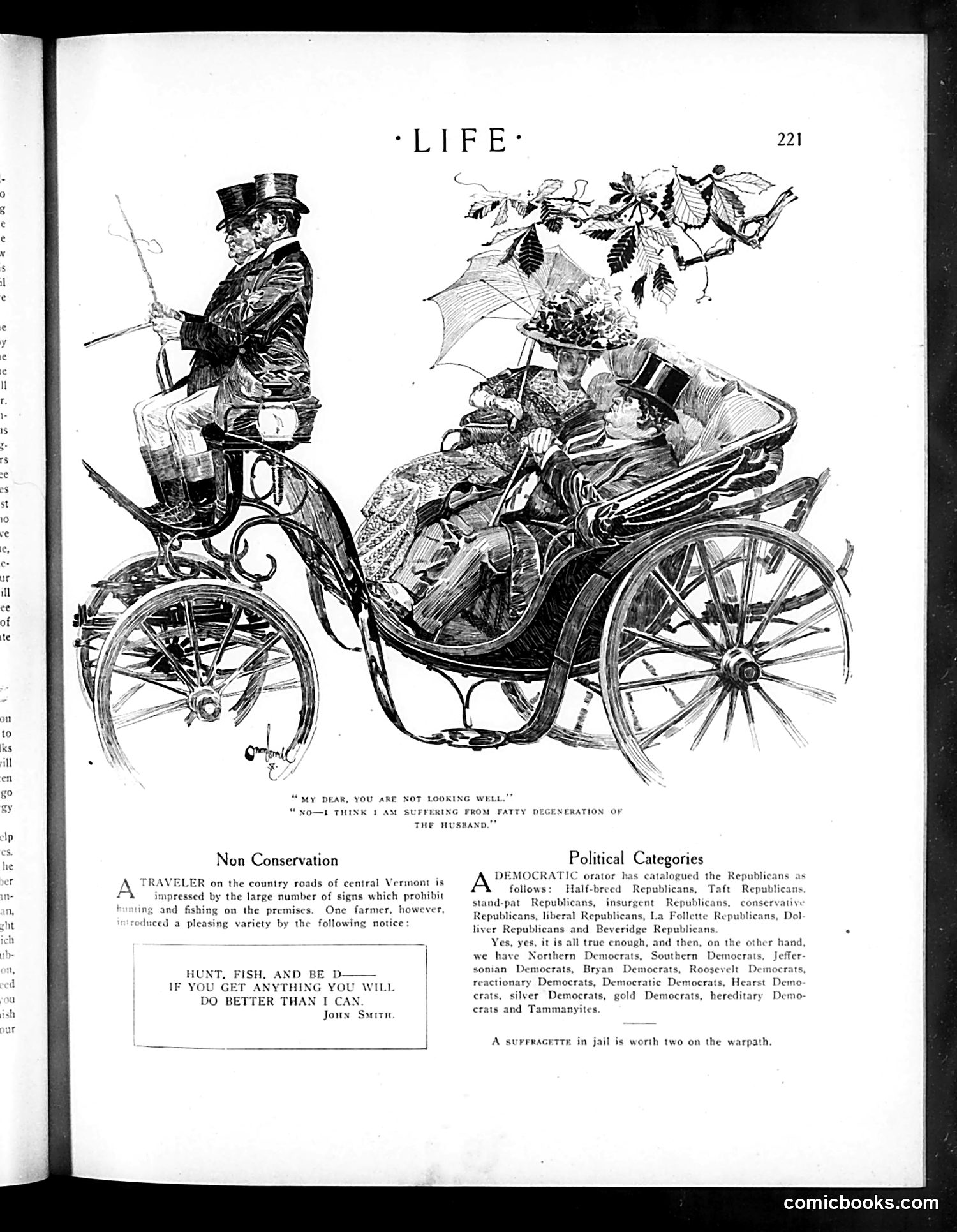
This page contains a satirical cartoon and two brief humor pieces from Life magazine. **The Main Cartoon:** Shows a man on a bicycle-unicycle speaking to a woman in an elaborate carriage pulled by two men. The caption reads: "My dear, you are not looking well. No—I think I am suffering from fatty degeneration of the husband." The satire appears to mock both a husband's declining vigor and a wife's complaints about his physical condition—poking fun at marital dissatisfaction and changing bodies in relationships. **"Non Conservation"** section mocks Vermont's rustic indifference to property rules with a humorous sign attributed to "John Smith." **"Political Categories"** provides satirical classification of Democratic politicians using absurdist terminology (silver Democrats, gold Democrats, etc.), lampooning the party's internal divisions and factionalism. The final line jokes about suffragettes' tactics.
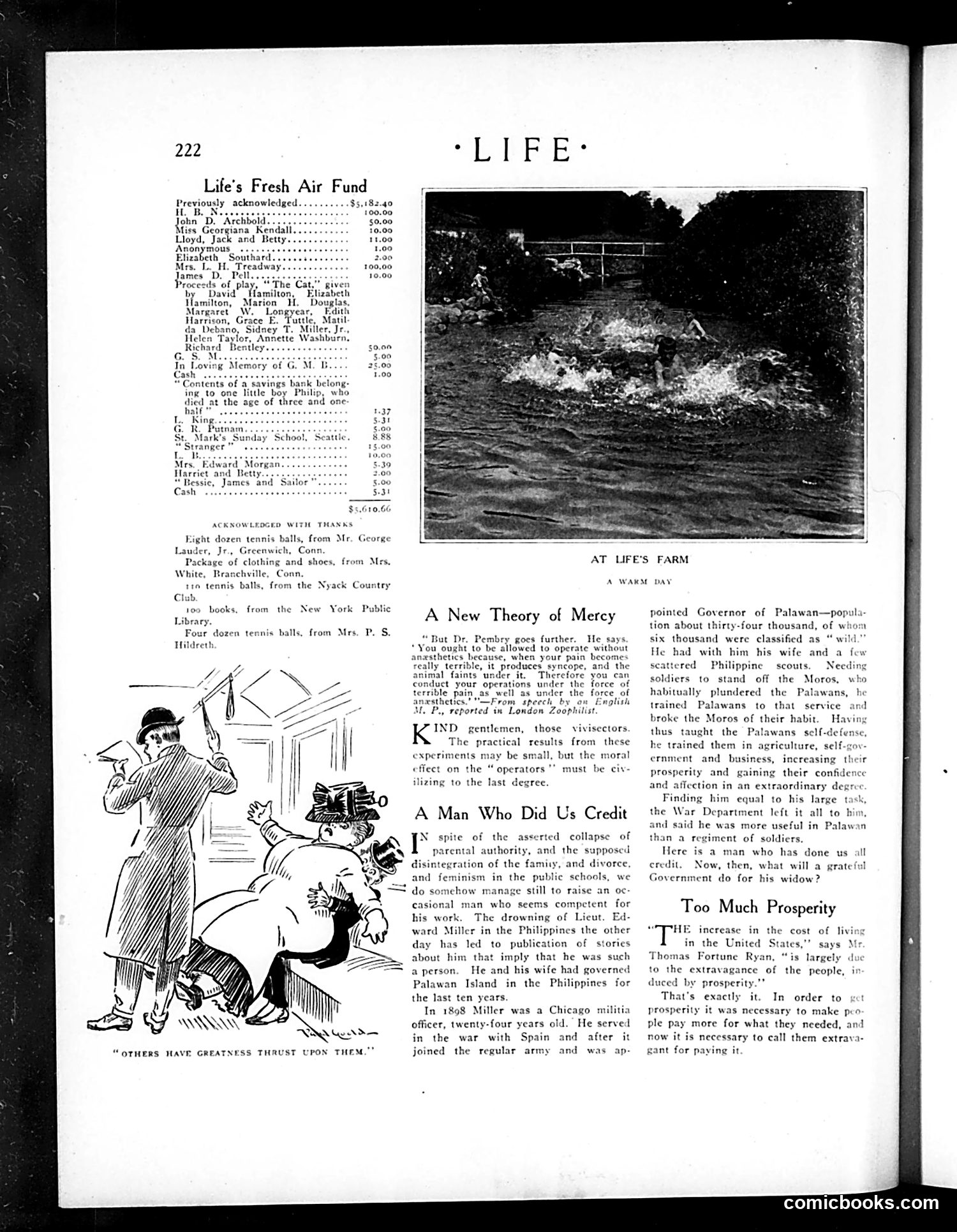
This cartoon satirizes **parental authority and family governance disputes** in early 20th-century America. The image shows a father figure being physically overwhelmed by his wife and children—depicted as literally sitting on and controlling him. The caption, "Others Have Greatness Thrust Upon Them," inverts the Shakespearean phrase about reluctant leadership, suggesting the father has unwanted domestic authority forced upon him rather than actual power. The satire targets contemporary debates about **feminism and changing family dynamics**. Progressive movements were challenging patriarchal family structures, and this cartoon mocks the anxiety some felt about shifting power—portraying the father as comically subordinated rather than naturally commanding.
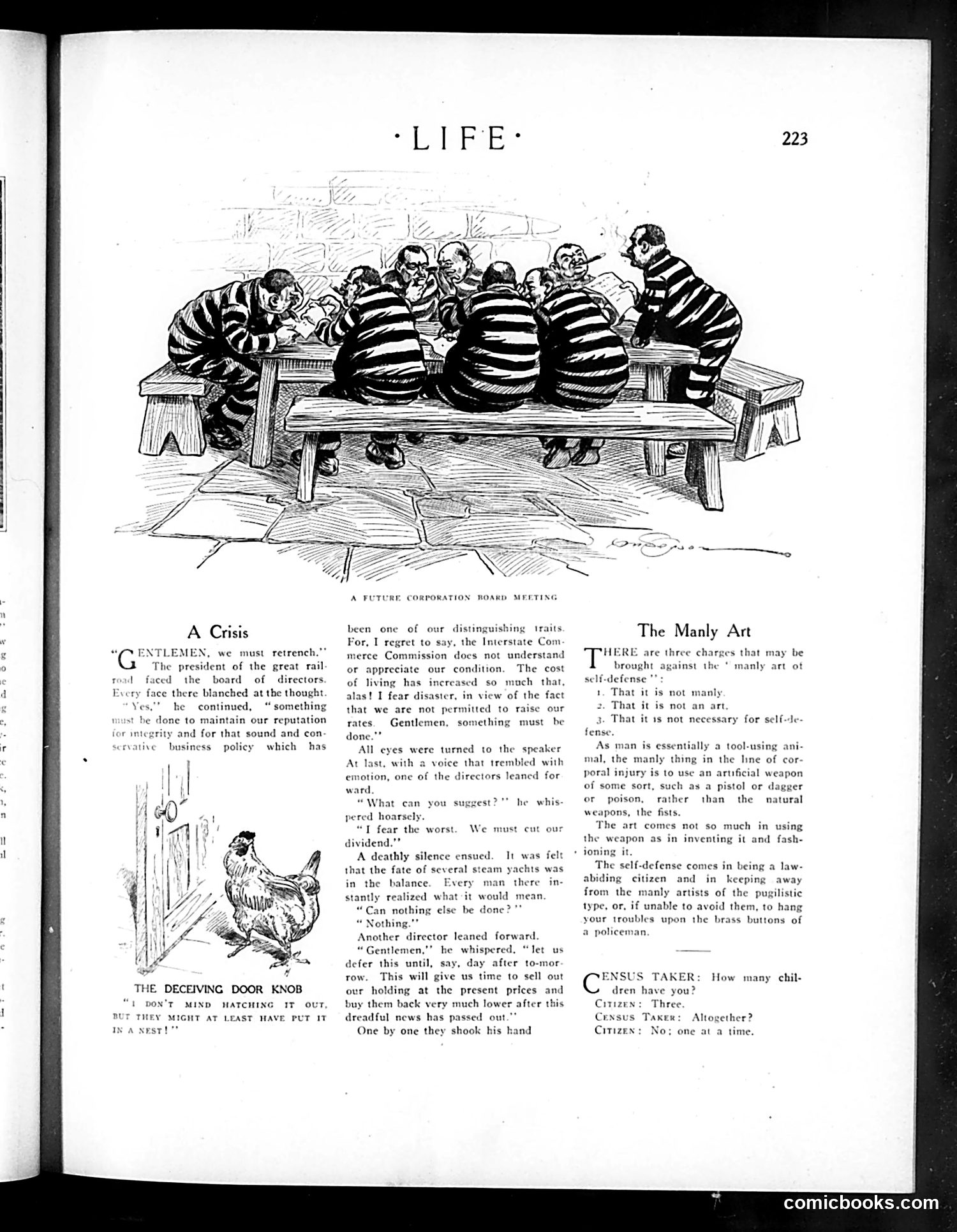
**Top Cartoon: "A Future Corporation Board Meeting"** Shows men in striped prison uniforms seated at a boardroom table, satirizing corporate malfeasance. The implication is that business directors engaged in unethical practices would deserve imprisonment. **"A Crisis" Article** A board of directors discusses financial distress, with one member warning they must "cut our dividend" to survive—likely satirizing corporate greed during economic hardship. **"The Deceiving Door Knob" Illustration** A small cartoon showing a rooster, with text mocking those who don't secure their door knobs, suggesting carelessness or gullibility. **"The Manly Art" Section** Discusses "self-defense"—three charges against it: that it's unmanly, not an art, and unnecessary for law-abiding citizens. This reflects early 20th-century debates about boxing and masculine virtue.
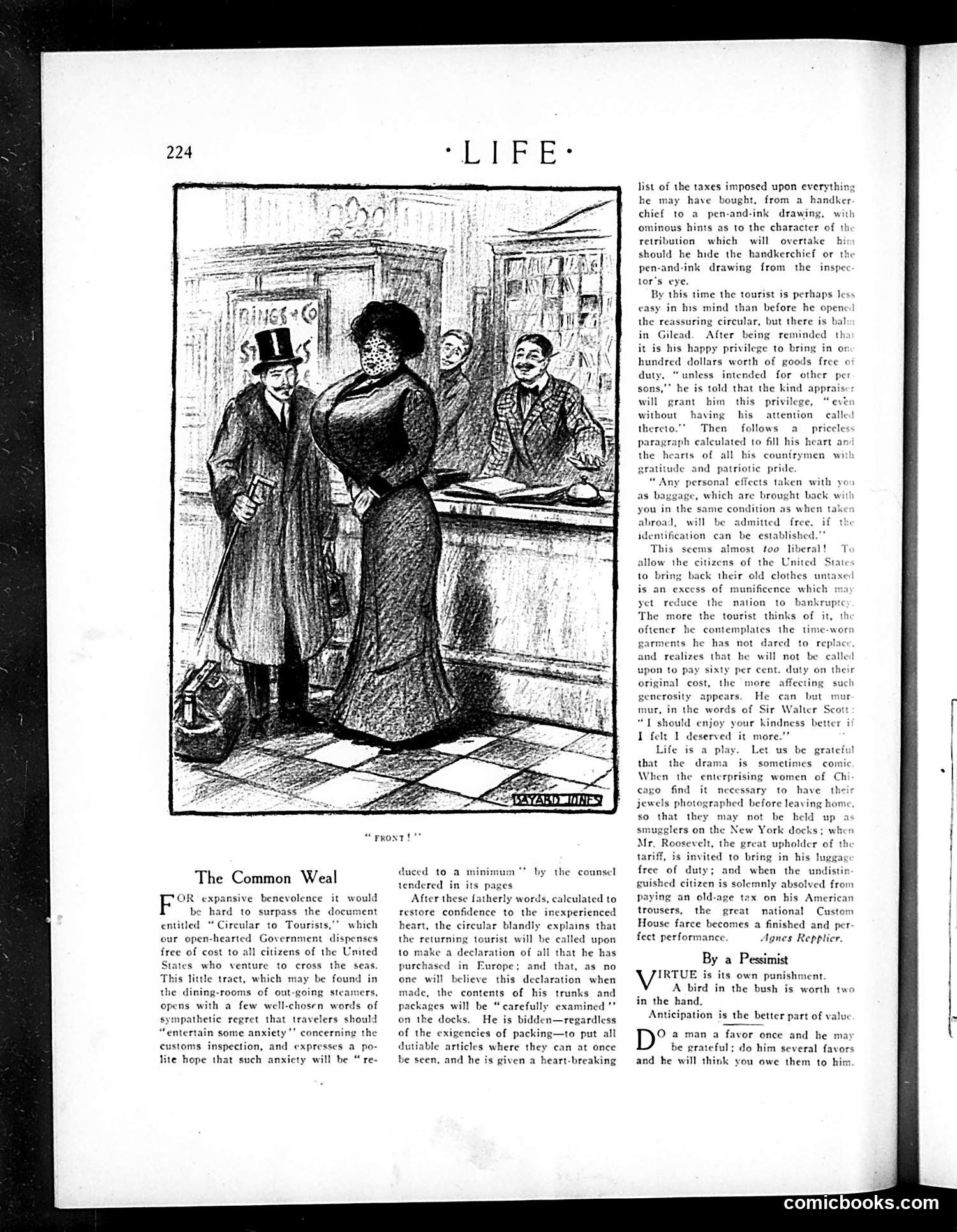
The cartoon titled **"FROST!"** depicts a customs inspection scene. A well-dressed tourist (wearing a top hat) presents baggage to customs officials, who appear skeptical or stern. The accompanying article critiques a government circular allowing American tourists to bring back personal effects duty-free. The satire targets the **hypocrisy and impracticality** of this policy: while presented as benevolent, it creates opportunities for smuggling and tax evasion. The cartoon illustrates the awkward reality—customs inspectors must somehow distinguish legitimate "personal effects" from contraband. The piece argues this "generous" allowance actually invites abuse and could embarrass both travelers and officials, ultimately undermining rather than serving the public good (the "common weal").
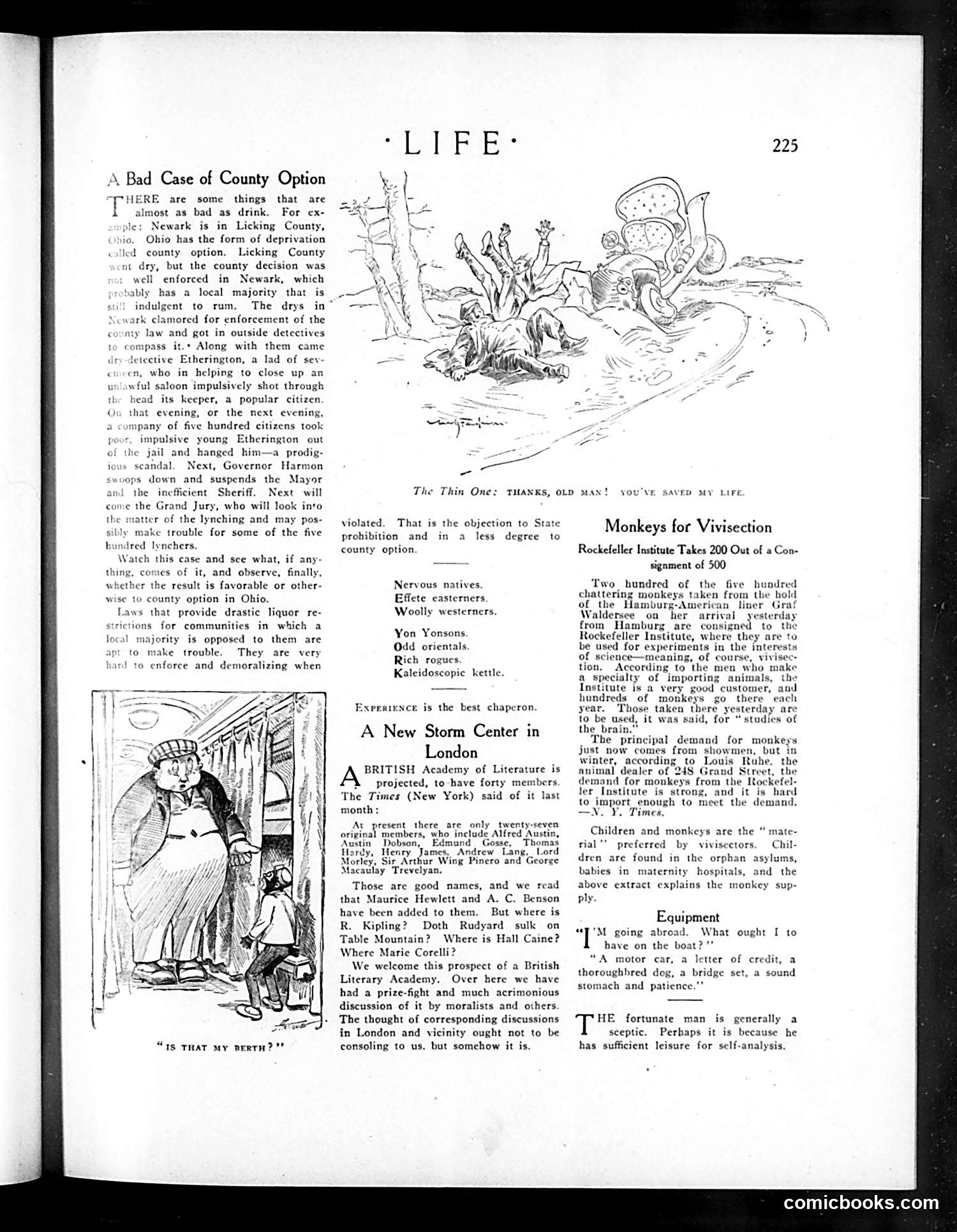
This satirical piece critiques **county option laws** — local prohibition measures that created legal inconsistencies. The text uses Newark, Ohio as an example, where the county banned alcohol sales but enforcement was weak and a popular citizen was lynched for helping close an illegal saloon. The satire argues that county option creates chaos: Governor Harmon must suspend local officials, a grand jury investigates the lynching, and five hundred citizens face legal trouble. The cartoon criticizes these laws as unenforceable and prone to vigilante violence when local majorities disagree with restrictions. The accompanying illustration and caption "Is that my berth?" appears unrelated to the main article, suggesting typical magazine layout mixing political commentary with humorous content.
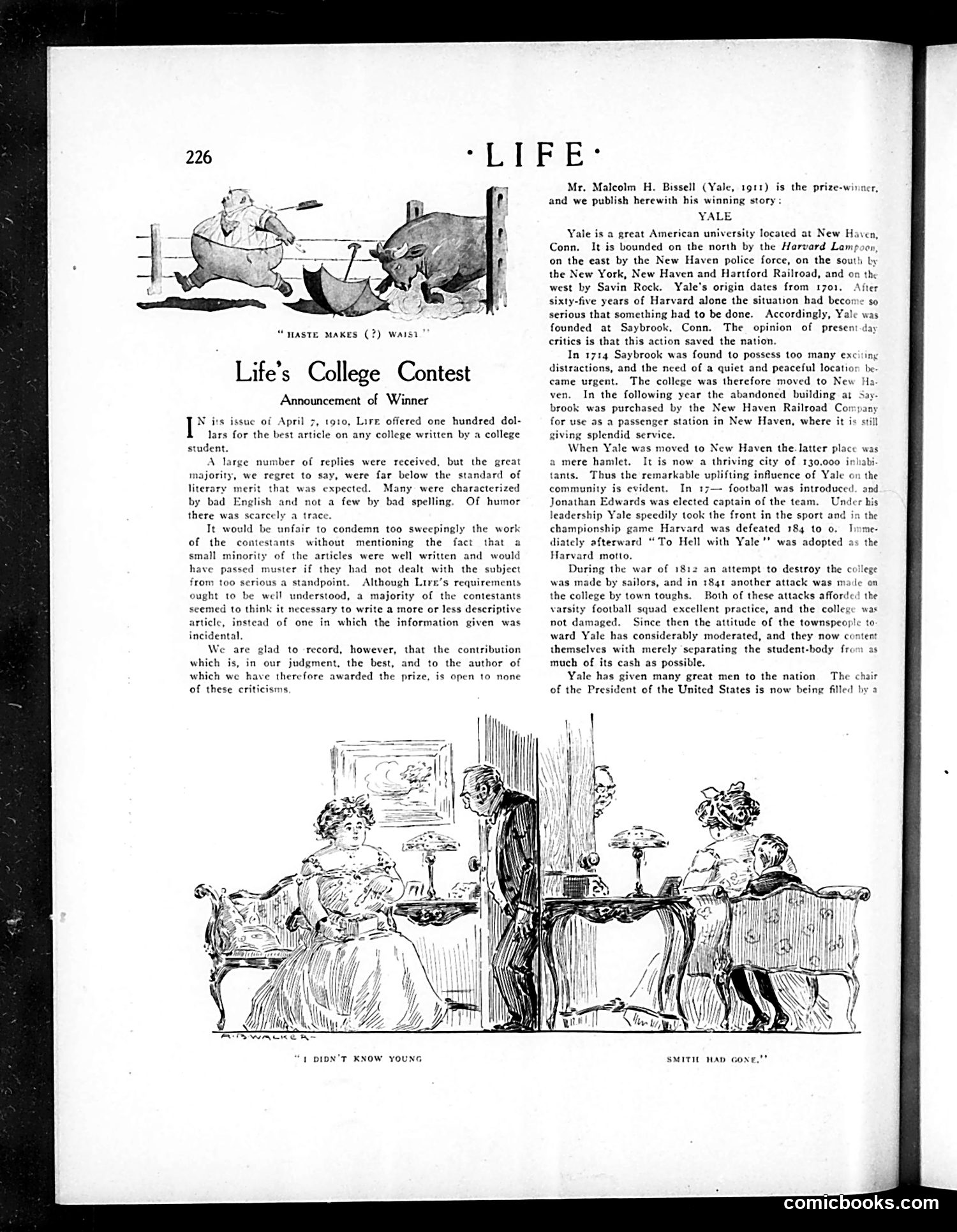
This page announces the winner of Life's college writing contest. The top cartoon ("Haste Makes Waist") depicts two figures in a humorous collision—likely mocking the rushed, sloppy work Life received from most contestants. The winning essay by Malcolm H. Bissell (Yale, 1911) is a satirical "history" of Yale University that uses mock-serious tone to ridicule the institution. It includes absurd "facts": Yale's borders are the Harvard Lampoon and police force; football was introduced in "17—" with Jonathan Edwards as captain; Harvard adopted "To Hell with Yale" as their motto after a 184-0 loss; and Yale's main contribution to New Haven was separating students from their money. The bottom illustration ("I Didn't Know Young Smith Had Gone") shows a social scene, likely commenting on college life or departures. Life's editors note they received many poorly-written entries but praise this one for being genuinely witty rather than earnestly descriptive—the real target of their satire.
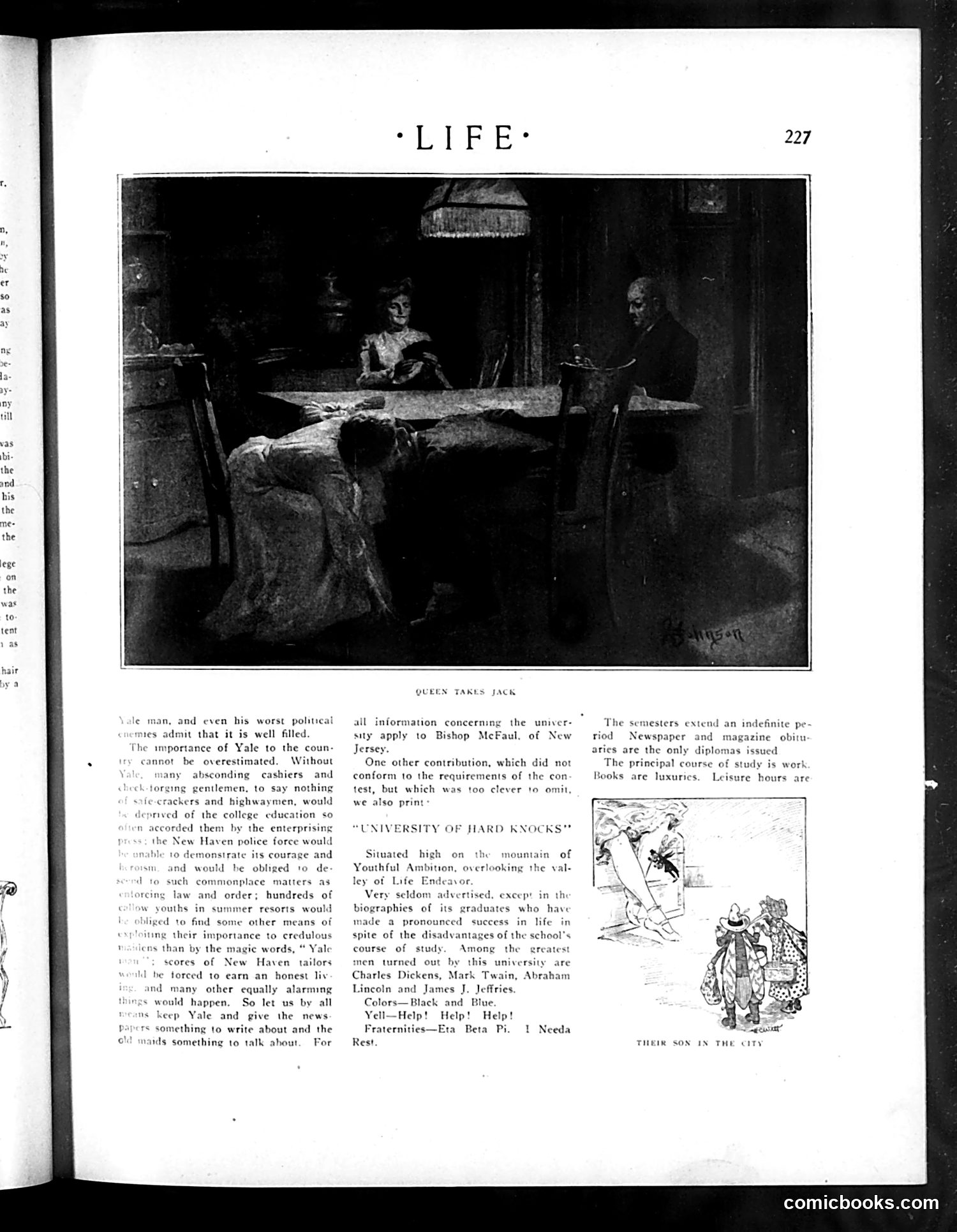
**Top Image ("Queen Takes Jack")**: A satirical illustration showing a woman playing cards with two men at a table. The joke appears to be about a woman winning at cards—"taking jack" (a card) while the men look on. This likely satirizes social anxieties about women's independence or role-playing in leisure activities during this era. **Bottom Text**: A humorous essay praising Yale University's importance to Connecticut, claiming the college prevents crime by keeping young men occupied rather than turning to theft and fraud. The adjacent sidebar parodies the "University of Hard Knocks"—a popular phrase meaning life experience rather than formal education. It lists famous self-made men (Dickens, Twain, Lincoln, Jeffries) who succeeded without traditional schooling, with fraternity names like "Eta Beta Pi" and courses in "Black and Blue" (fighting). The satire mocks both elite college pretension and romanticizes working-class success, typical of *Life* magazine's satirical approach.
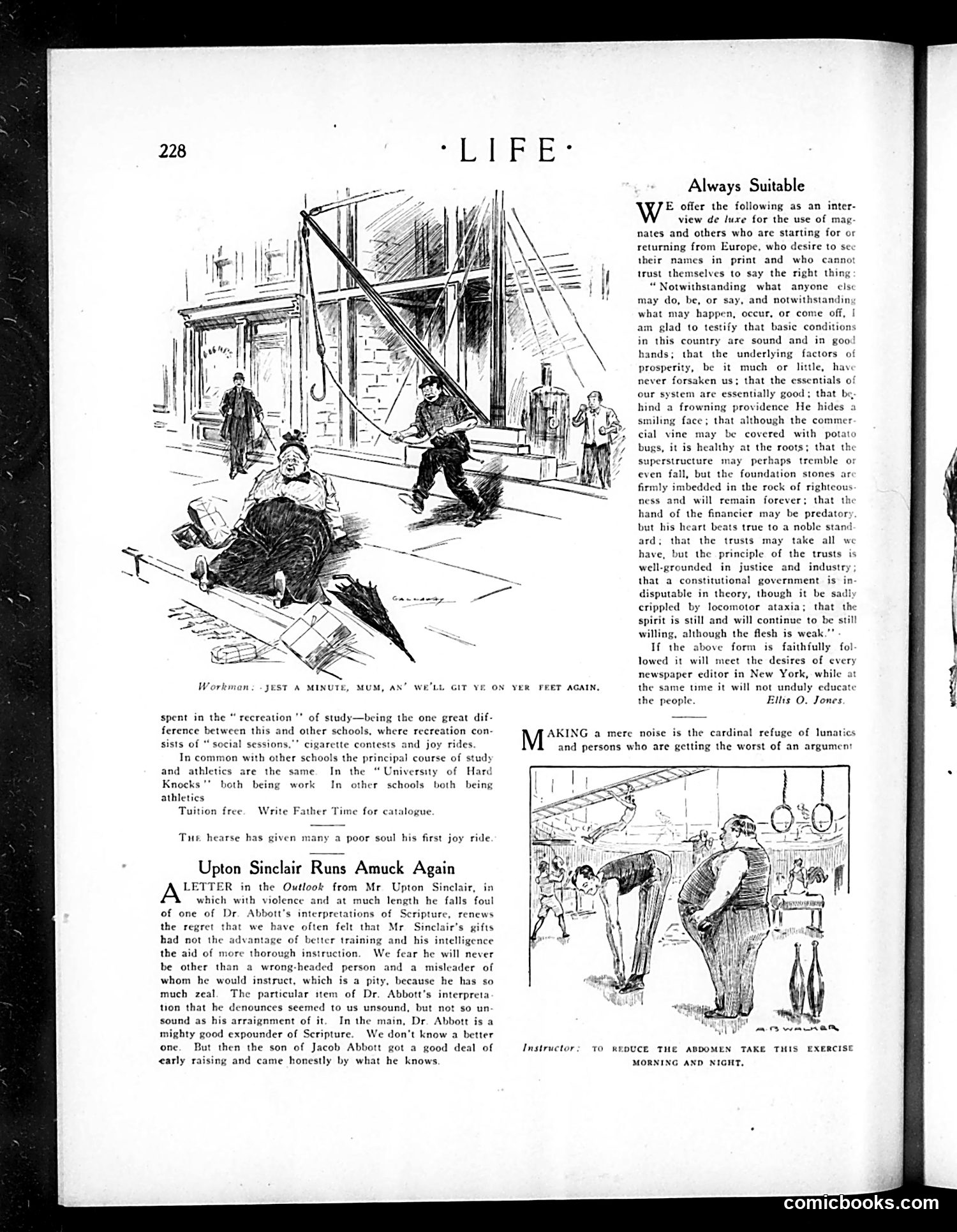
This page contains three distinct satirical pieces: **"Always Suitable"** mocks wealthy Americans returning from Europe who seek flattering newspaper coverage. The text offers a template of empty platitudes—praising the country's "sound" conditions while acknowledging potential collapse—that supposedly satisfies editors without actually informing readers. The satire targets both the vanity of the wealthy and the complicity of press in publishing meaningless puffery. **The workman cartoon** depicts a street scene where a laborer reassures an injured woman he'll "get ye on yer feet again"—likely commentary on working-class decency versus upper-class hypocrisy. **"Upton Sinclair Runs Amuck Again"** criticizes the socialist muckraker for attacking religious interpretation in *The Outlook* magazine. Life's editors dismiss Sinclair as wrongheaded despite acknowledging his opponent's actual errors—a backhanded insult suggesting Sinclair's activism lacks proper education and breeding. The page reflects Life's early-20th-century conservative stance: skepticism toward both radical reformers and the wealthy's self-serving public relations.
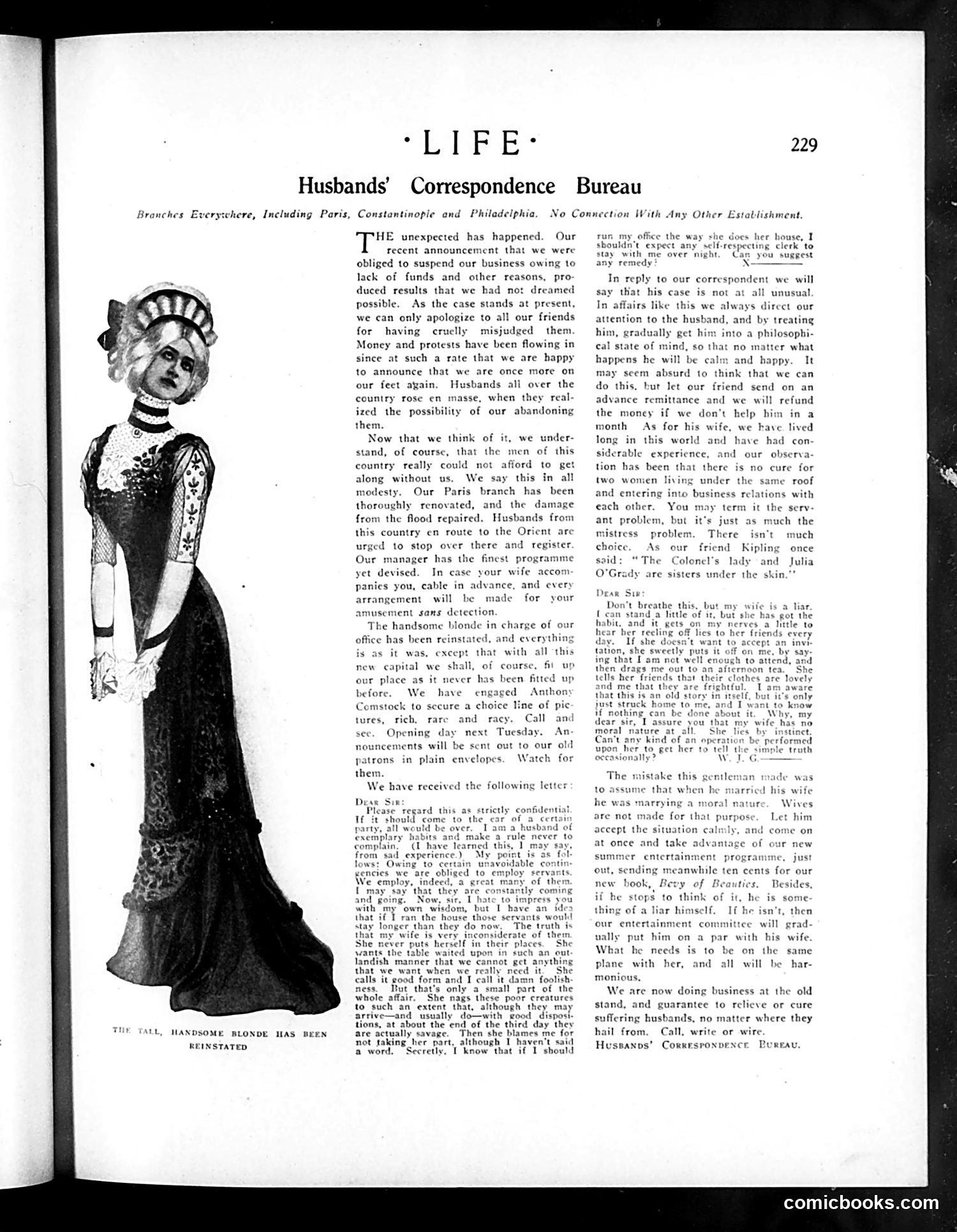
This page satirizes the emerging "advice column" phenomenon by presenting a fictional business bureau supposedly dedicated to helping troubled husbands cope with their wives. **The Setup:** The bureau announces a temporary closure due to financial difficulties, then celebrates its reopening, claiming husbands nationwide rallied to support it—implying men desperately need this service to survive marriage. **The Satire:** The joke targets both unhappy husbands and contemporary anxieties about matrimony. Two complaint letters follow: one from a husband whose wife lies constantly and manipulates him socially; another from a man whose wife mistreats servants and lacks "moral nature." **The Point:** The bureau's responses mock both the complainants and the very concept of marital advice, suggesting wives are fundamentally unchangeable problems. A Kipling quote ("The Colonel's lady and Julia O'Grady are sisters under the skin") ironically suggests all women share identical flaws regardless of class. **Modern Context:** This reflects early-20th-century attitudes treating marriage as a male burden and wives as inherently troublesome—humor that relies on now-outdated misogyny.
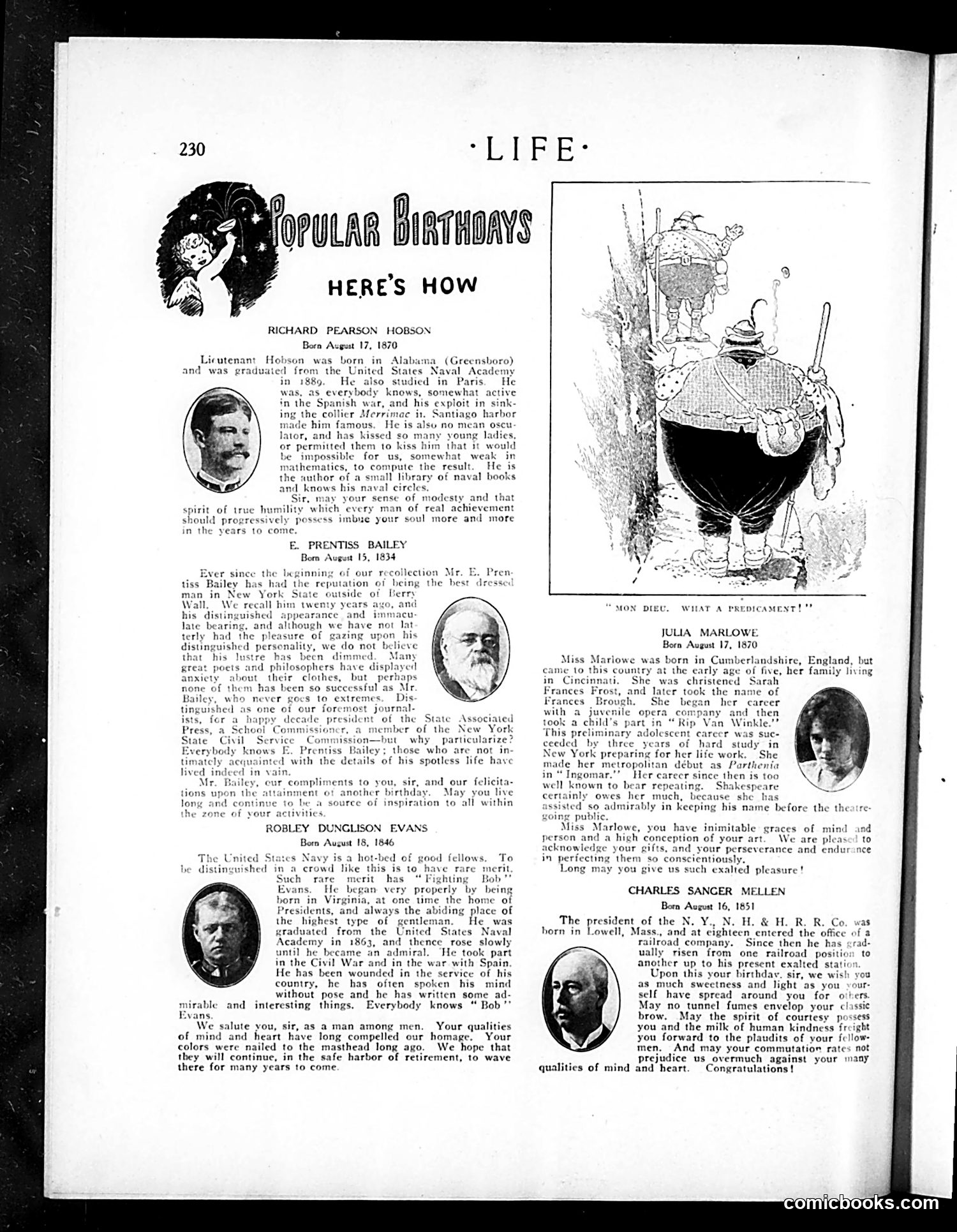
This page celebrates four notable Americans born in August with brief biographical sketches and portrait photographs. The figures are: **Richard Pearson Hobson** (naval officer), praised for his famous exploit sinking the *Merrimac* during the Spanish-American War and his social popularity with women. **E. Prentiss Bailey** (New York politician/administrator), lauded for his impeccable grooming and spotless reputation. **Robley Dunglison Evans** ("Fighting Bob"), a decorated Navy admiral who served in the Civil War and Spanish-American War. **Julia Marlowe** (actress), an acclaimed Shakespearean performer who began as a child performer. The cartoon on the right depicts a comedic scene with French caption "Mon Dieu. What a Predicament!" —likely satirizing some theatrical or social situation. The tone is flattering and congratulatory, typical of Life's early celebrity coverage, celebrating military heroes and cultural figures from America's recent imperial expansion.
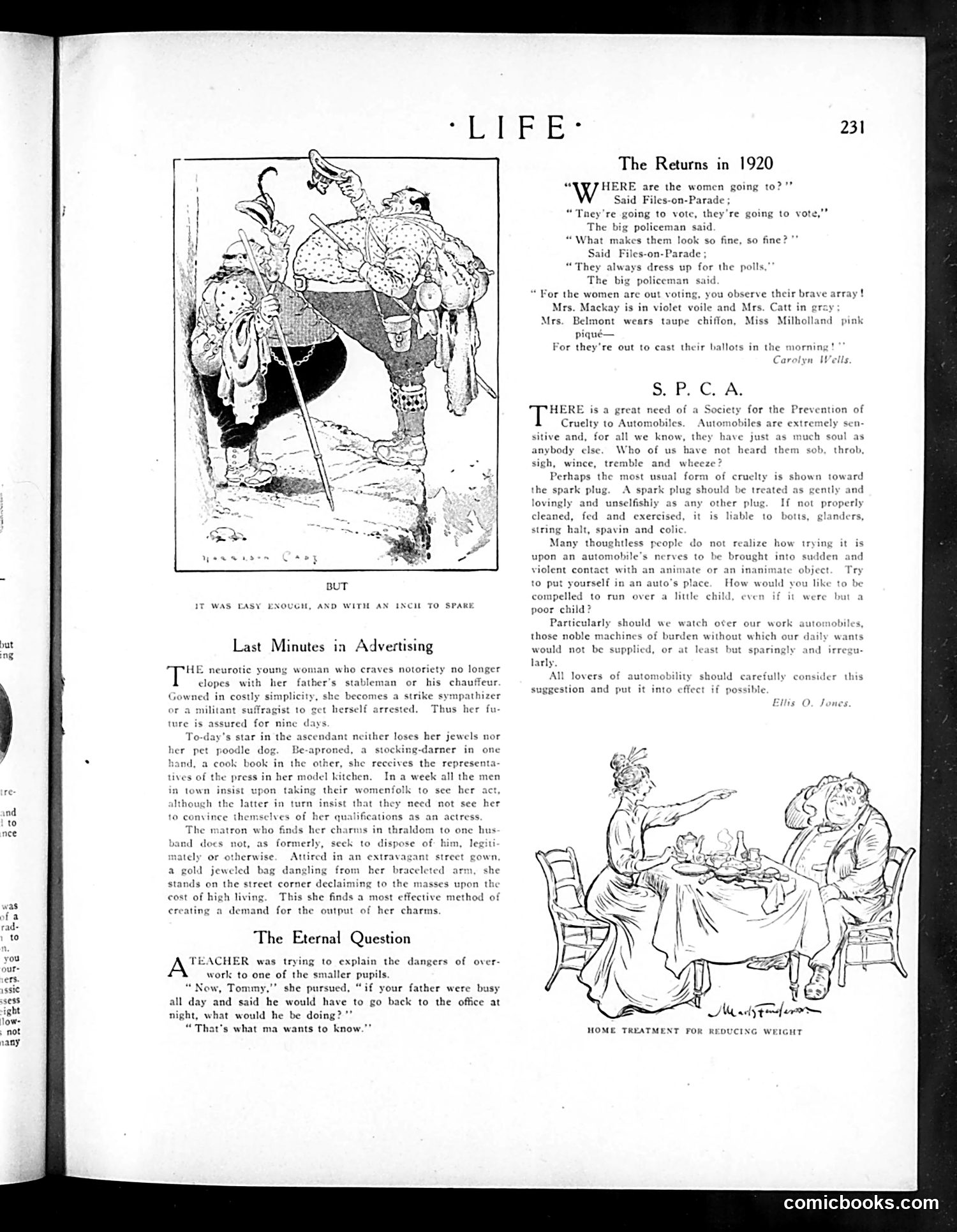
**"The Returns in 1920"** (top cartoon): This celebrates women's newly won right to vote (the 19th Amendment was ratified in 1920). The poem mocks the elaborate fashions women wore to the polls—violet voile, gray, taupe chiffon, pink piqué—treating voting as a social fashion event. Named figures like Mrs. Catt (likely Carrie Chapman Catt, suffrage leader) are referenced. The satire gently pokes fun at the spectacle of women's first voting while acknowledging it as significant. **"Last Minutes in Advertising"**: Satirizes how modern women seeking notoriety pursue unconventional paths—striking, suffrage activism, arrests—rather than traditional scandals. The satire notes that displaying themselves as homemakers (in model kitchens, aproned) or activists creates public demand and press coverage. **"The Eternal Question"**: A brief joke where a boy, asked what his busy father does at the office at night, replies "That's what ma wants to know"—implying marital suspicion about the father's evening whereabouts.
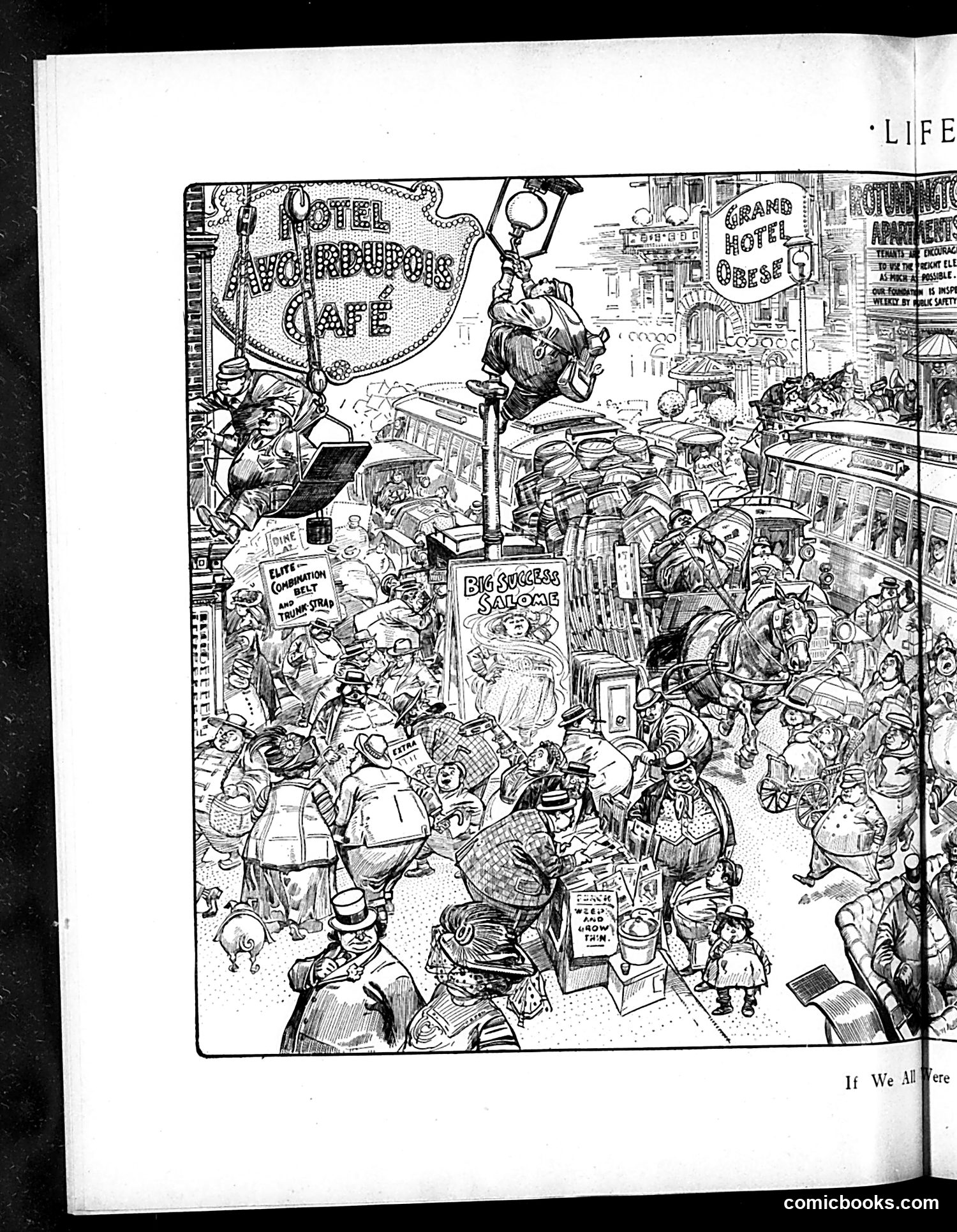
This is a densely detailed satirical illustration depicting a chaotic urban street scene, likely from the early 20th century. The cartoon shows a crowded marketplace or fair with numerous figures, signs advertising products like "Big Success Saloame" and various establishments including hotels and cafes visible in the background architecture. The illustration appears to satirize commercial excess and urban congestion—depicting crowds of people amid advertising signs and commercial activity. The style is characteristic of Life magazine's social commentary, using busy, intricate detail to critique consumer culture and urban chaos. However, the OCR text is largely illegible, making it difficult to identify specific political figures or pinpoint the exact satirical target without additional context about the publication date.
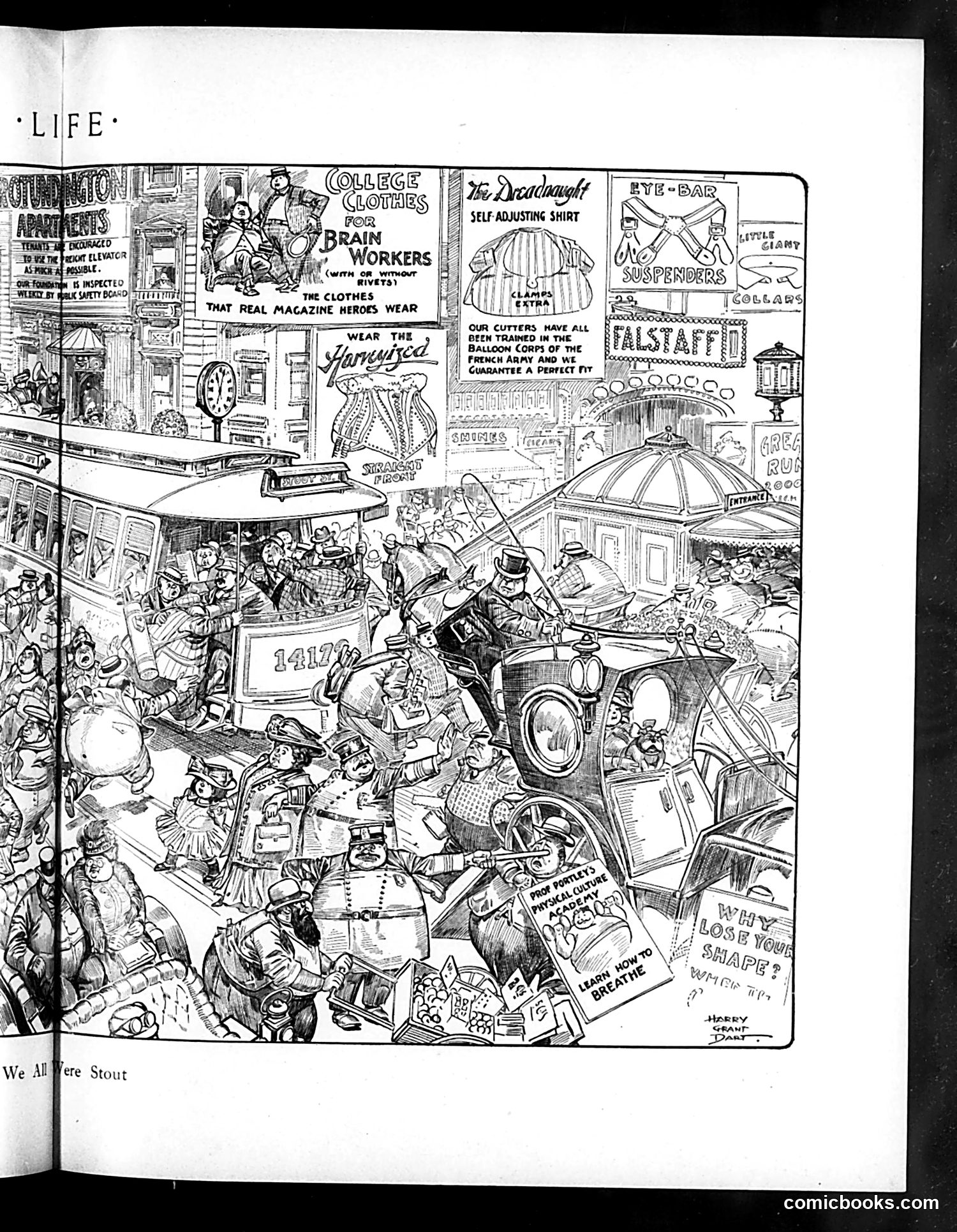
This is a satirical cartoon depicting a chaotic urban street scene crowded with people, vehicles, and advertisements. The main joke appears to center on the advertising slogans visible throughout—particularly clothing ads promising flattering fits ("Self Adjusting Shirt," "Suspenders") to customers described as stout or overweight. The cartoon satirizes both consumer culture and the absurd claims of period advertisements. References to "Brain Workers" and "Magazine Heroes" mock both the pretensions of white-collar labor and advertising's use of idealized figures to sell products. The mention of "Balloon Corps of the French Army" training tailors is deliberately ridiculous, underlining the exaggerated promises advertisers make. The overall chaos suggests the frenzy of urban commercial life and gullible consumers chasing false promises of style and self-improvement through purchasing.
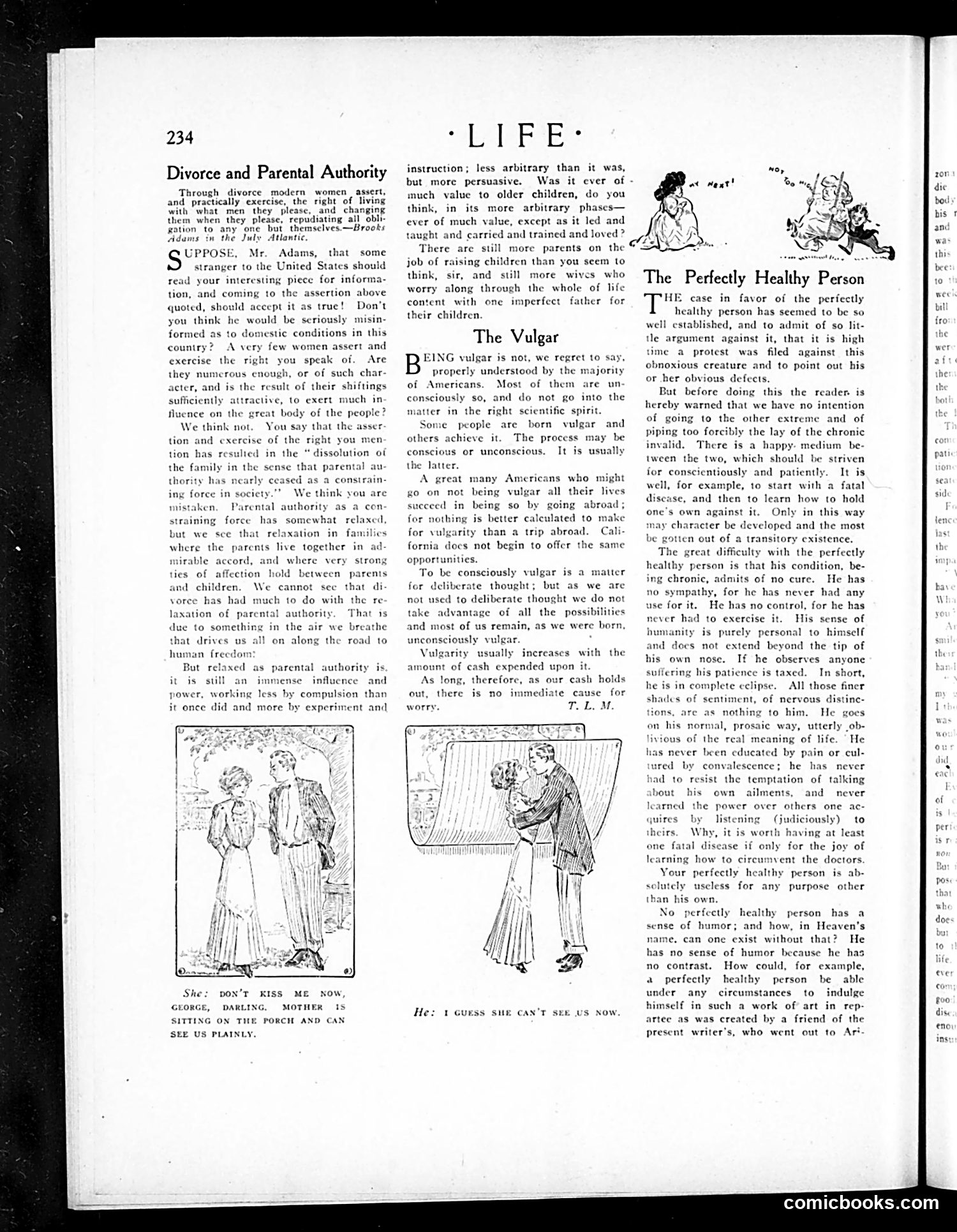
This page contains three satirical pieces from Life magazine (an American humor publication): **"Divorce and Parental Authority"**: A response to Brooks Adams's Atlantic Monthly article claiming divorce has destroyed parental authority. Life's editor argues Adams overstates the case—few women actually exercise such freedom, and relaxed (not dissolved) parental authority stems from broader social changes, not divorce. Parents remain engaged in child-rearing. **"The Vulgar"**: A humorous essay noting Americans often become vulgar through foreign travel, particularly to California. The piece suggests vulgarity correlates with spending money and that most Americans achieve it unconsciously. **Two cartoons**: Both illustrate marital/romantic situations. The first shows a young couple; the second depicts a man and woman, with dialogue about avoiding a mother's view—suggesting discretion about courtship. The page reflects early 20th-century anxieties about changing social norms (divorce, women's independence) and American pretension when traveling abroad, treated with satirical wit rather than moral condemnation.
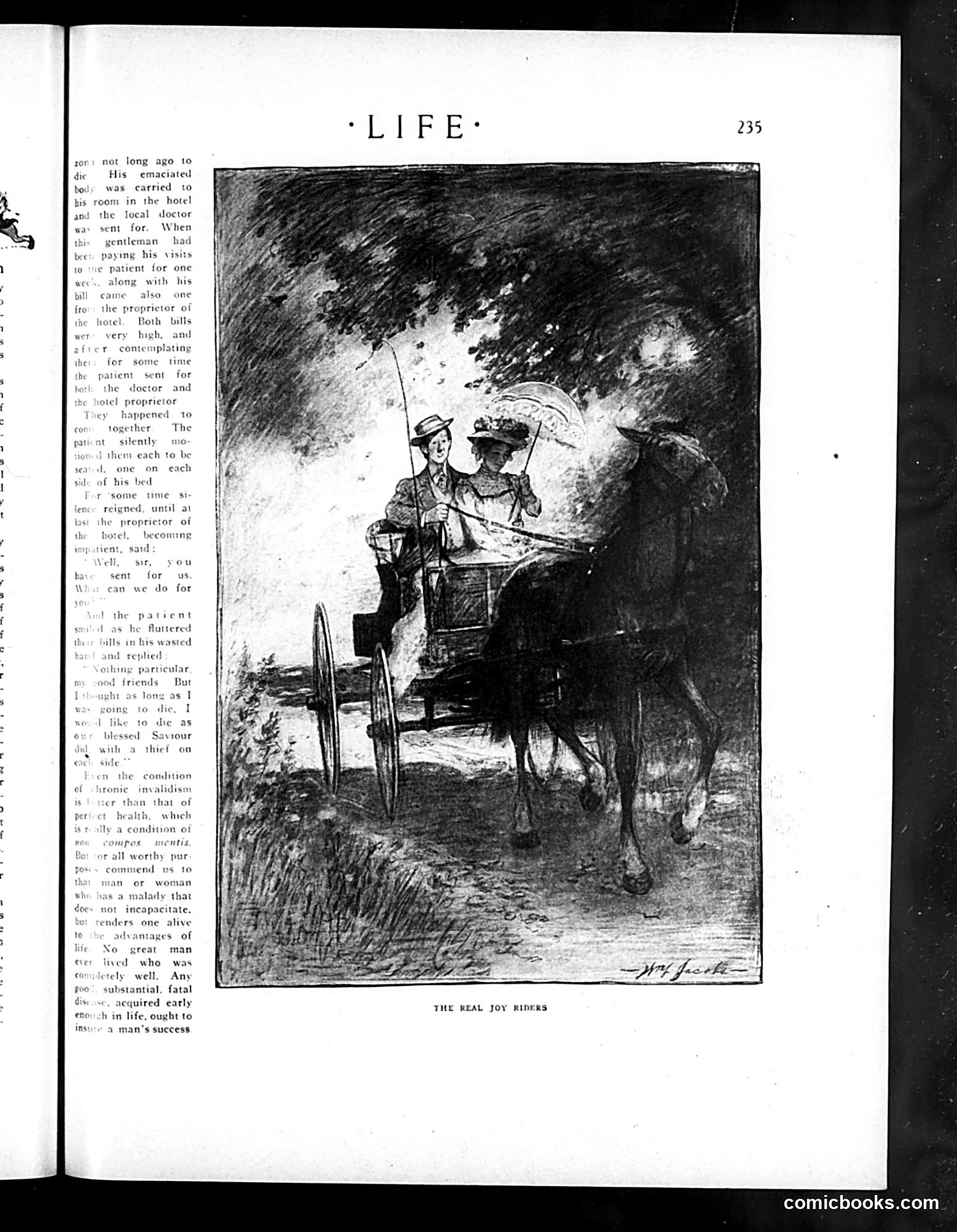
This illustration satirizes wealthy invalids or chronically ill rich people. The caption "The Real Joy Riders" is ironic: the figure shown is being transported in a cart/carriage despite severe illness, yet appears to be enjoying life's pleasures through leisure and mobility that money affords. The accompanying text discusses chronic invalidism as a paradoxical condition—one can be "alive" yet incapacitated, yet still experience advantages unavailable to the healthy poor. The satire suggests that wealth allows the sick to continue "joy riding" (enjoying life) despite their ailments, while the text argues that many successful men have lived with substantial health problems acquired early in life. The cartoon implicitly mocks the privileged class's ability to live comfortably despite poor health, contrasting their circumstances with ordinary people who cannot afford such indulgences.
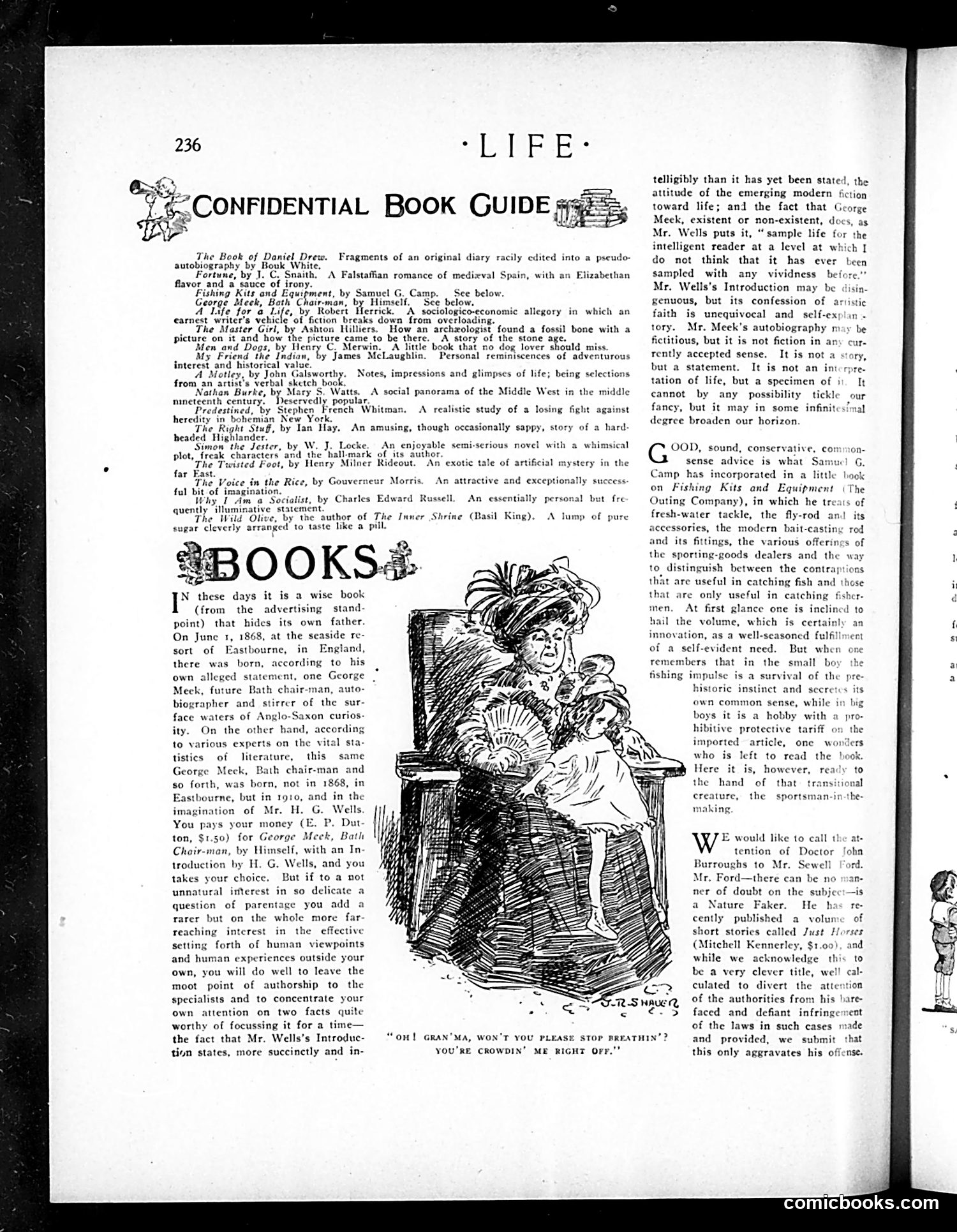
This is a **book review section** from *Life* magazine, not primarily satirical content. The page features: **Main Content:** A "Confidential Book Guide" reviewing contemporary fiction (circa 1910s), including titles about finance (*The Book of Daniel Drew*), adventure (*The Twisted Foot*), and social commentary. **The Cartoon:** A single illustration showing an elderly woman and child crowded together, with the child saying "Gran'ma, won't you please stop breathin'? You're crowdin' me right off." This is a humorous domestic scene illustrating cramped living conditions—likely commenting on working-class or tenement housing rather than making a specific political point. **The H.G. Wells Discussion:** The text debates whether "George Meek, Bath Chair-man" is a real autobiography or a fictional creation by H.G. Wells, ultimately arguing that the book's literary merit matters more than its authenticity. The page reflects *Life's* role as a literary and cultural commentary magazine, blending book criticism with gentle social humor rather than sharp political satire.
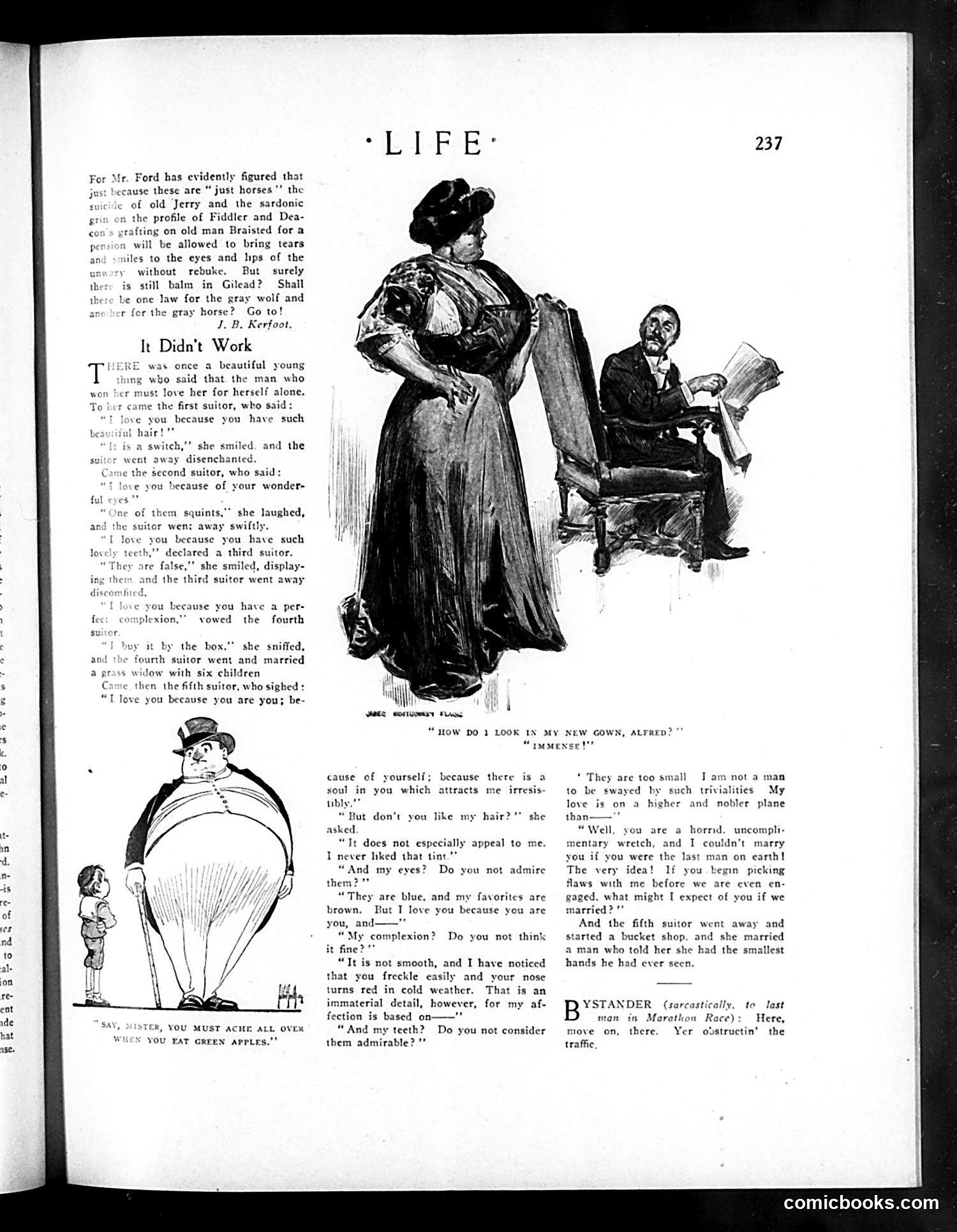
This page contains two satirical pieces typical of early 20th-century American humor: **"It Didn't Work"** mocks romantic idealism. A young woman declares she wants to be loved "for herself alone," but systematically rejects suitors who offer genuine, unconditional affection—praising her character despite noting her physical flaws (false teeth, freckles, small eyes). She ultimately marries a man who flatters her superficially. The satire targets both female vanity and the impossibility of achieving the romantic ideal she claimed to want. **The cartoons** include a caption-joke about eating green apples causing stomach aches, and "The Bystander" sketch mocking a marathon runner blocking traffic—suggesting the absurdity of prioritizing endurance sports over practical city life. The opening text references Henry Ford and horse-drawn carriages, likely critiquing Ford's dismissal of traditional transportation as "just horses" while advocating automobiles.
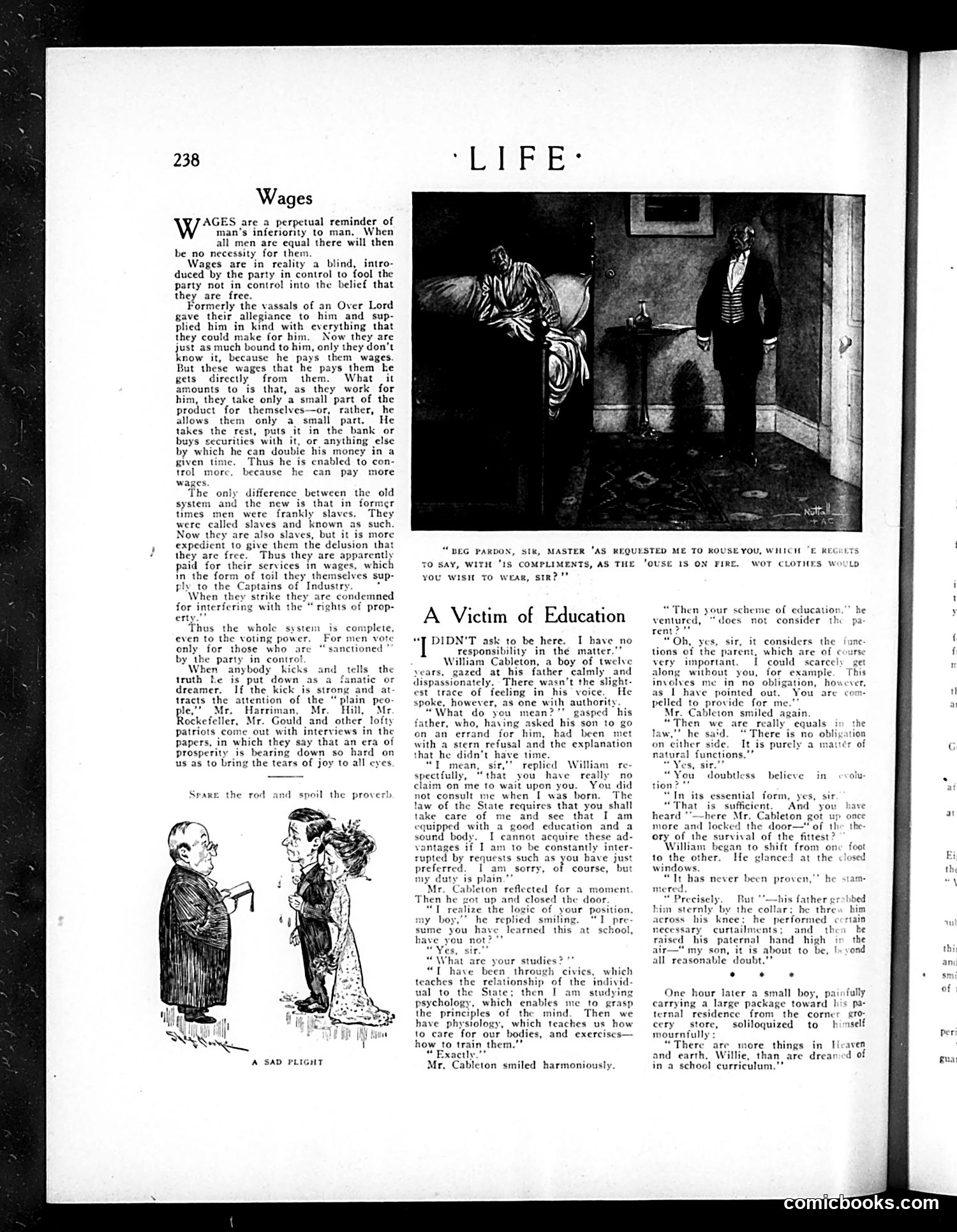
**The "Wages" Section (Left):** This is radical political commentary attacking capitalism. The text argues that modern wages are merely a disguised form of slavery—workers receive only a small portion of their labor's value while employers (the "Captains of Industry") pocket the rest. It criticizes the illusion of freedom that wages create, comparing it unfavorably to feudalism where exploitation was at least honest. The rhetoric mentions railroad magnates (Harriman, Hill, Gould) as examples of exploitative wealth accumulation. **The Main Story, "A Victim of Education" (Right):** This satirizes modern educational philosophy. A twelve-year-old boy named William Cableton refuses his father's errand, citing his legal right to education and bodily care as superseding parental authority. He speaks in the language of civics and psychology lessons. The satire mocks how progressive education (emphasizing individual rights and scientific principles) has created a child so intellectually confident yet emotionally detached that he coldly asserts legal abstractions over filial duty—making him absurdly impractical and disrespectful. The page contrasts systemic economic exploitation with educational philosophy producing emotionally stunted, rights-obsessed children.
This is a satirical short story by R.W. Sneddon depicting a dystopian future where gender roles are reversed. The narrative presents a society where women hold institutional power through a "Civic Marriage Director" and state marriage board, while men are assigned as "husband-slaves" to women based on bureaucratic examination. The satire targets early-20th-century feminist movements by imagining an exaggerated, inverted world: women control marriage licensing, conduct financial interrogations, and maintain authority over men's activities (including censoring newspapers and restricting music choices). The protagonist—a "Marriageable Bachelor"—is forcibly assigned to Miss Grikurst and subjected to inspection and domestic servitude. The joke relies on contemporary anxieties about women's suffrage and changing gender relations. By presenting female authority as absurdly totalitarian, the piece mocks contemporary fears that granting women voting rights would lead to female domination. It's anti-feminist satire using hyperbolic role reversal as its comedic mechanism.
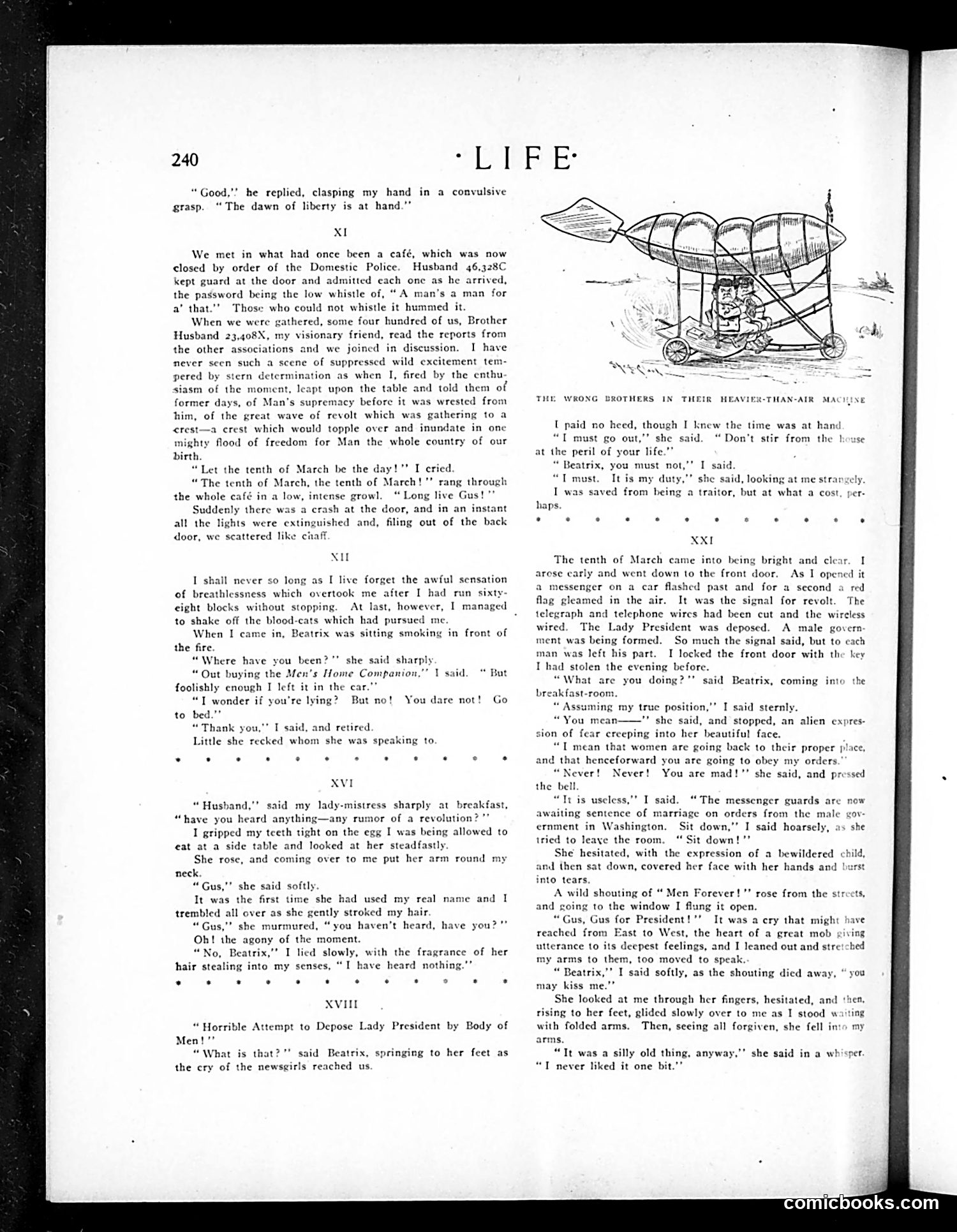
This page contains a serialized dystopian story alongside a small illustration labeled "The Wrong Brothers in Their Heavier-Than-Air Machine"—an obvious satirical reference to the Wright Brothers' aviation achievement. The narrative depicts a future matriarchal society where women hold political power (a "Lady President") and men are subjugated, assigned numbers instead of names, and eat separately at meals. The protagonist participates in a secret male-led revolution planned for "the tenth of March." The cartoon illustration mocks early aviation through crude, comedic design—likely satirizing both the Wright Brothers' actual contraption and the idea that such a "wrong" inversion of power dynamics (men rebelling against female rule) is as absurd and poorly-engineered as a comically malfunctioning flying machine. This appears to be early-20th-century satire addressing anxieties about women's suffrage and changing gender roles, presenting female political dominance as ridiculous and fundamentally backward.
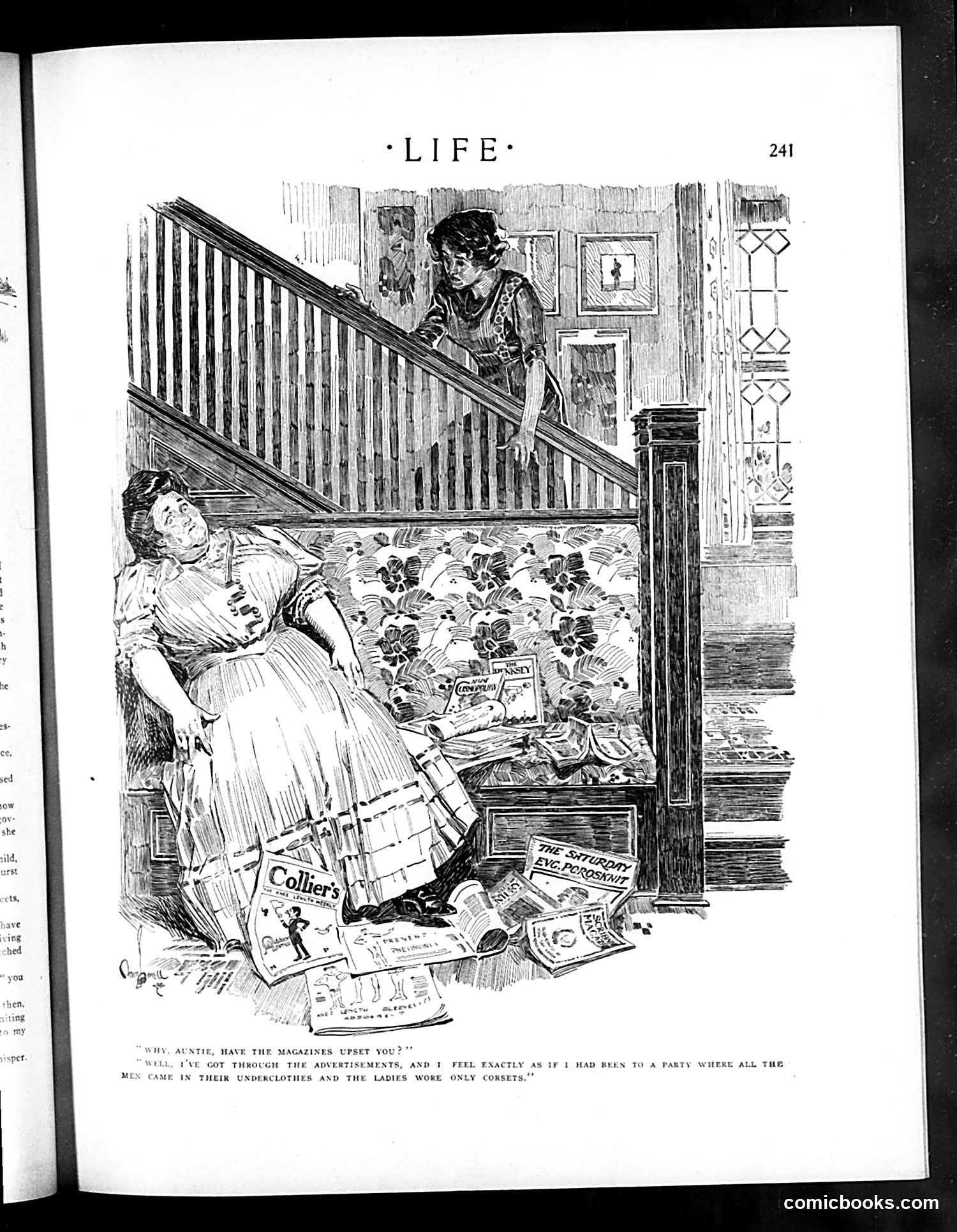
This is a satirical cartoon mocking magazine advertisements of the era (likely early 1900s). An older woman ("Auntie") lies on a bed surrounded by magazines, visibly distressed. Her niece asks why she's upset. The joke: Auntie complains that after viewing all the advertisements, she feels as though she attended a party where men wore only underwear and women wore only corsets—meaning the ads feature extremely scantily-clad models in states of undress. The satire targets two things: (1) the increasingly revealing and sexually suggestive nature of magazine advertising, and (2) the shock this causes to older, more conservative sensibilities. The cartoon criticizes advertisers for using near-nude imagery to sell products, presented here as scandalous to Victorian-era propriety.
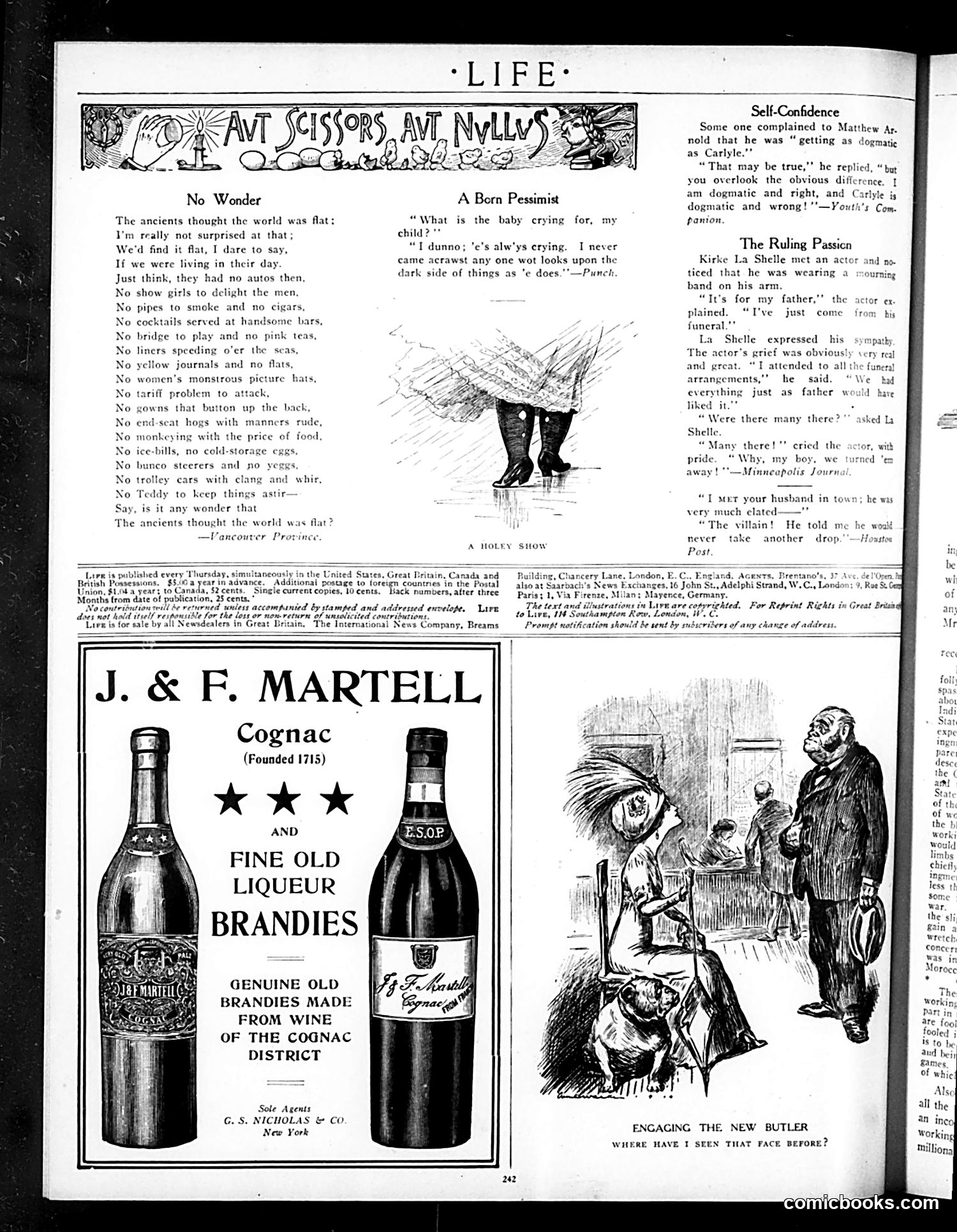
This page contains several humorous short pieces typical of early 20th-century satirical journalism: **"No Wonder"** is a poem listing modern conveniences and problems (automobiles, show girls, cocktails, newspapers, tariffs, fashion) that didn't exist in ancient times, concluding that ancients thought the world flat because they lacked these distractions—implying modern life is absurdly complicated. **"A Born Pessimist"** depicts working-class characters discussing a crying baby with dark humor about life's miseries. **"The Ruling Passion"** presents an anecdote about an actor so consumed with theatrical concerns that even mourning his father becomes about audience size and production quality—satirizing theatrical egotism. **"Self-Confidence"** is a brief anecdote where Matthew Arnold claims superiority to Thomas Carlyle by asserting he is "dogmatic and right" while Carlyle is "dogmatic and wrong"—poking fun at intellectual vanity. The page also features a large **J. & F. Martell Cognac advertisement** and a cartoon titled "Engaging the New Butler" (caption suggests recognizing someone's face), illustrating a domestic hiring scene.
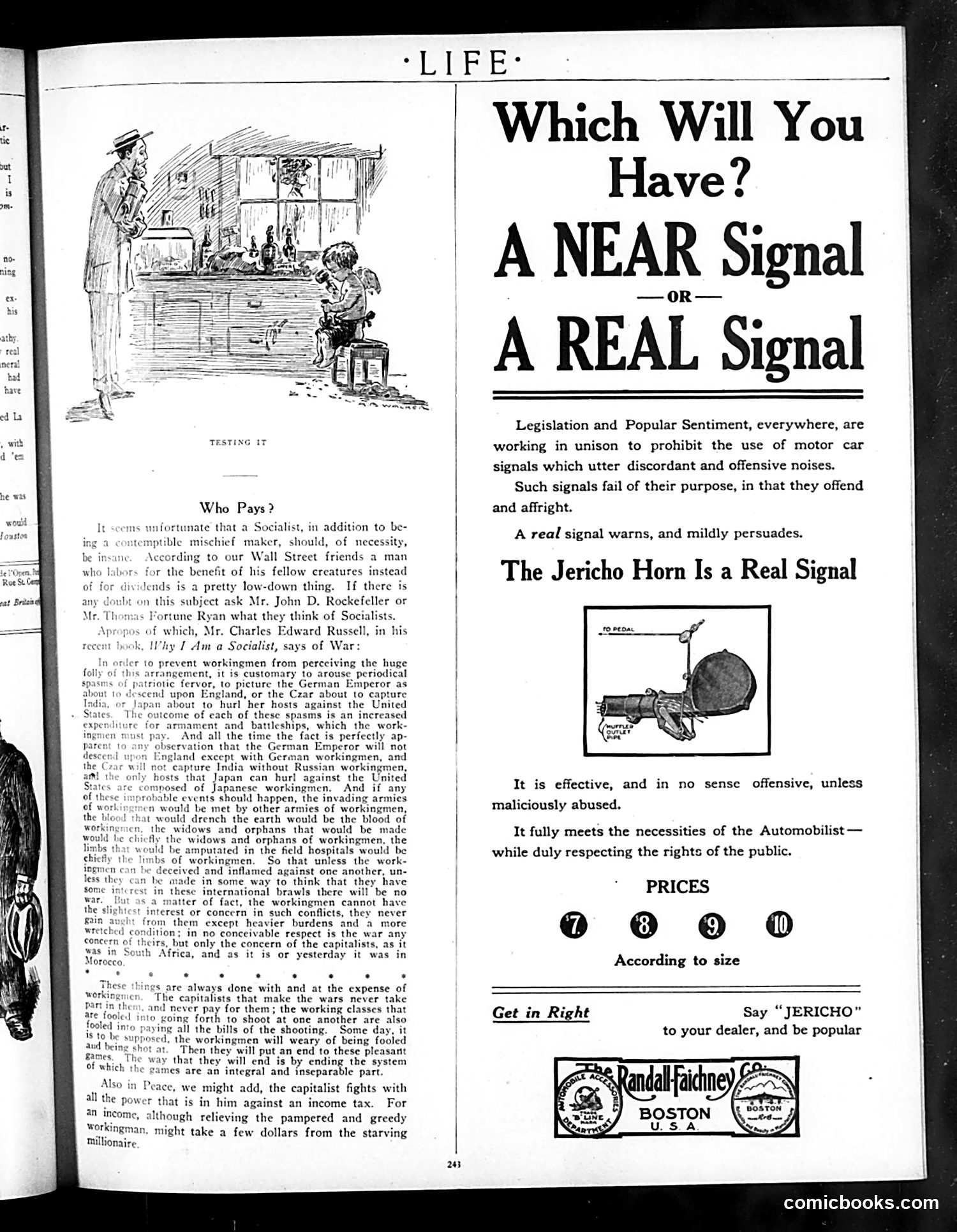
The page contains two distinct elements: **Left side:** A political essay (attributed to socialist Charles Edward Russell) argues that **workers shouldn't fight wars** since capitalists profit while working people suffer the casualties, widowhood, and orphaning. The piece critiques how governments manufacture patriotic fervor to manipulate workers into conflicts that serve only wealthy interests—specifically mentioning the German Emperor, the Czar, and imperial rivalries. It concludes capitalists resist income taxes that would actually help the poor. **Right side:** A full-page advertisement for the **Jericho Horn**, a car horn/signal device. The ad cleverly frames itself as a civic solution by claiming "near signals" (apparently loud, obnoxious horns) are being legislatively banned, while positioning the Jericho Horn as a "real signal"—effective yet inoffensive and respectful of public rights. **The irony:** The advertisement's rhetoric about civility and social responsibility sits uncomfortably alongside the socialist screed condemning capitalist exploitation—likely intentional satire by Life magazine, contrasting consumer goods marketing with calls for workers' revolution.
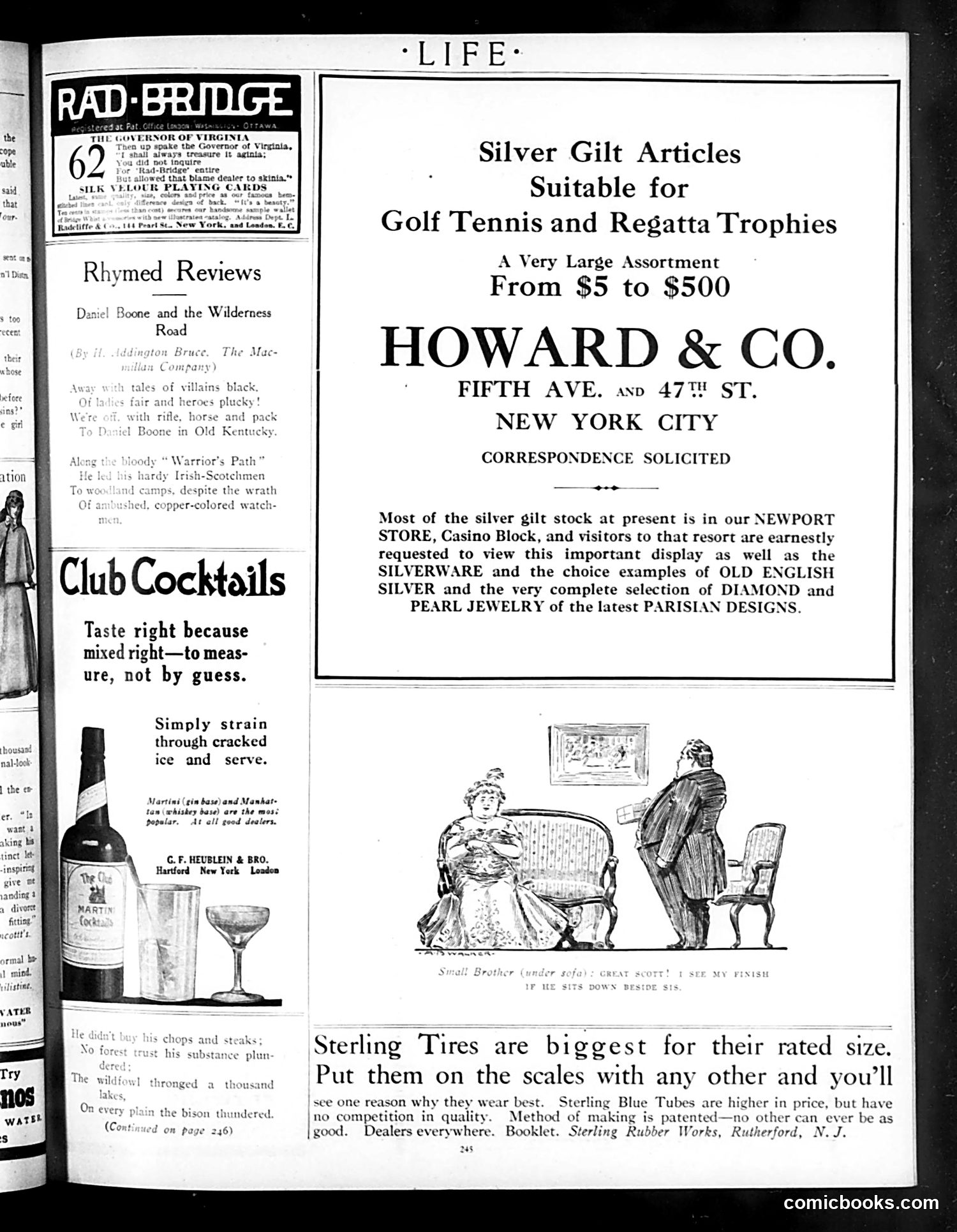
This page is primarily **advertising and light entertainment**, not political satire. The small cartoon at top left appears to reference the Governor of Virginia and Daniel Boone, likely a humorous "Rhymed Review" of a book about Boone's frontier adventures. The sketch shows domestic figures (a woman and man in period dress) with the caption about "Small Brother" sitting beside someone—a gentle domestic joke, not political commentary. The bulk of the page features **advertisements**: Howard & Co. (luxury silver trophies for wealthy sportspeople), Club Cocktails (spirits), and Sterling Tires (automobiles). These ads target affluent readers—references to Newport resorts, golf, tennis, and regatta trophies indicate an elite audience. The "Rad-Bridge" playing cards ad at top-left appears unrelated. **For modern readers**: This reflects a pre-Prohibition era (cocktails advertised freely) when Life magazine catered to the wealthy upper class, mixing light literary humor with luxury goods marketing.
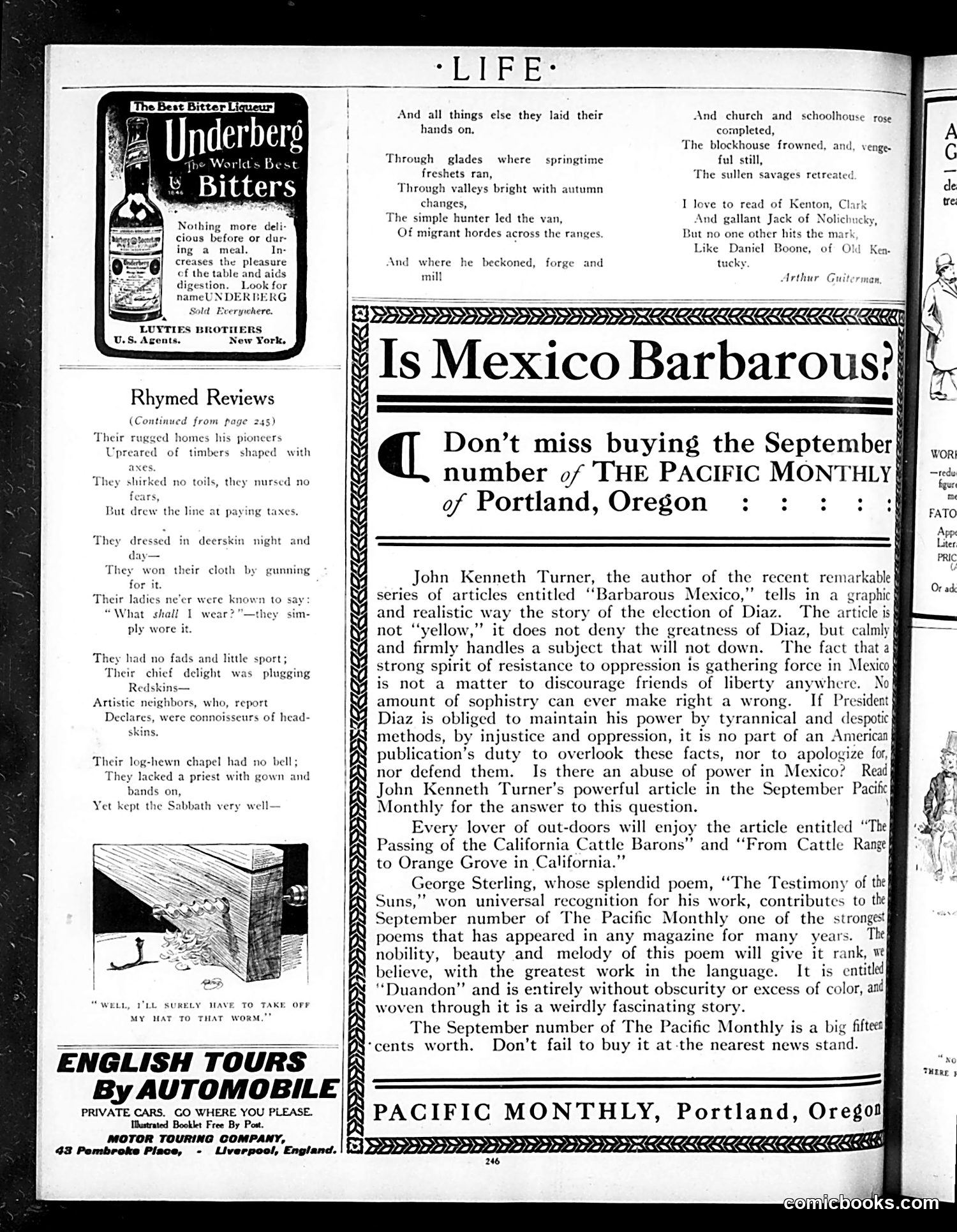
This page contains poetry and advertising rather than political cartoons. The "Rhymed Reviews" section presents satirical verse about American pioneer settlers—likely mocking their rough character, violence toward Native Americans ("connoisseurs of head-skins"), and hypocritical piety. The poem celebrates Daniel Boone as the ideal frontiersman. The main advertisement promotes the September issue of *Pacific Monthly*, highlighting John Kenneth Turner's article series "Barbarous Mexico," which critiques Mexican President Díaz's authoritarian rule. The ad emphasizes that the publication will not ignore governmental oppression and injustice—asserting that no sophistry can justify tyranny. This represents Progressive-era concern about Mexican political conditions, likely reflecting early-1900s U.S. anxieties about instability south of the border and American editorial responsibility to expose abuses of power.
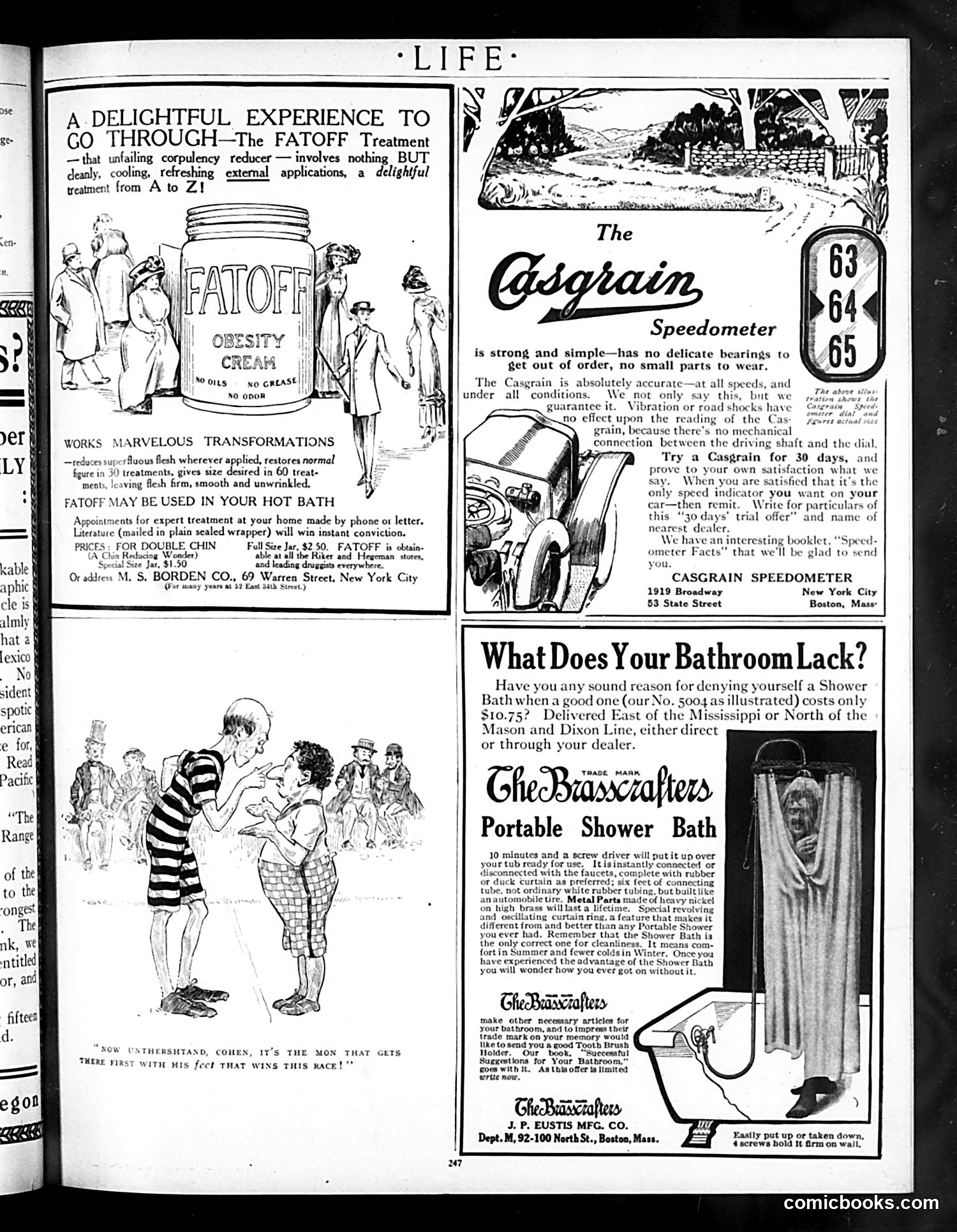
This page consists primarily of **period advertisements** rather than editorial satire or political cartoons. The ads reflect early-20th-century consumer anxieties about appearance and domestic comfort: 1. **FATOFF Obesity Cream**: Promises to reduce "superfluous flesh" in 30-60 treatments. The ad reflects contemporary obsession with weight reduction and the marketing of dubious remedies as scientific solutions. 2. **Casgrain Speedometer**: A straightforward product ad for automotive equipment, emphasizing durability and accuracy. 3. **The Brasscrafters Portable Shower Bath**: Advertises an affordable ($10.75) shower installation for homes lacking modern plumbing. The small cartoon at bottom left shows two people in beach attire with a caption about winning a race "with his feet"—likely a running joke unrelated to the advertisements. **For modern readers**: These ads reveal that early 1900s Americans were marketed weight-loss products, car accessories, and bathroom fixtures much as today, though the claims appear considerably more exaggerated and unsubstantiated by modern standards.
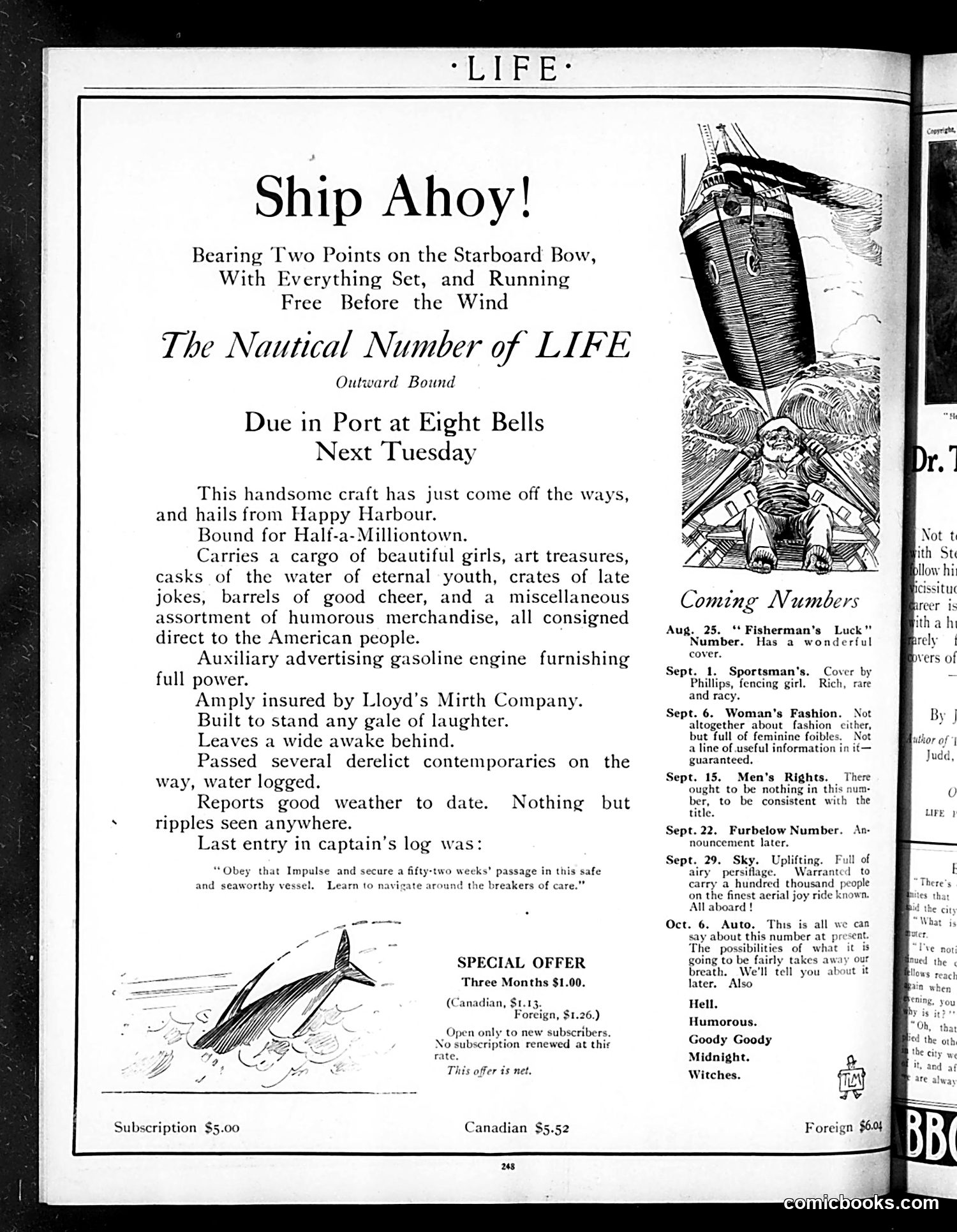
This is a whimsical house advertisement for *Life* magazine itself, disguised as a nautical shipping notice. The "ship" is a metaphor for the magazine's upcoming "Nautical Number," personified as a vessel carrying cargo of "beautiful girls, art treasures," "late jokes," and "barrels of good cheer"—essentially promising humorous entertainment to American readers. The humor lies in the mock-serious maritime language describing what is really just a humor magazine. References to "Lloyd's Mirth Company" (playing on Lloyd's insurance), "water-logged" competitor publications, and warnings to "navigate around the breakers of care" satirize both nautical formality and the magazine's competition. The subsequent "Coming Numbers" list announces themed issues (Fashion, Men's Rights, Automobiles, etc.), positioning *Life* as a comprehensive guide to contemporary American leisure and social trends. The special subscription offer ($1.00 for three months) targets new readers.
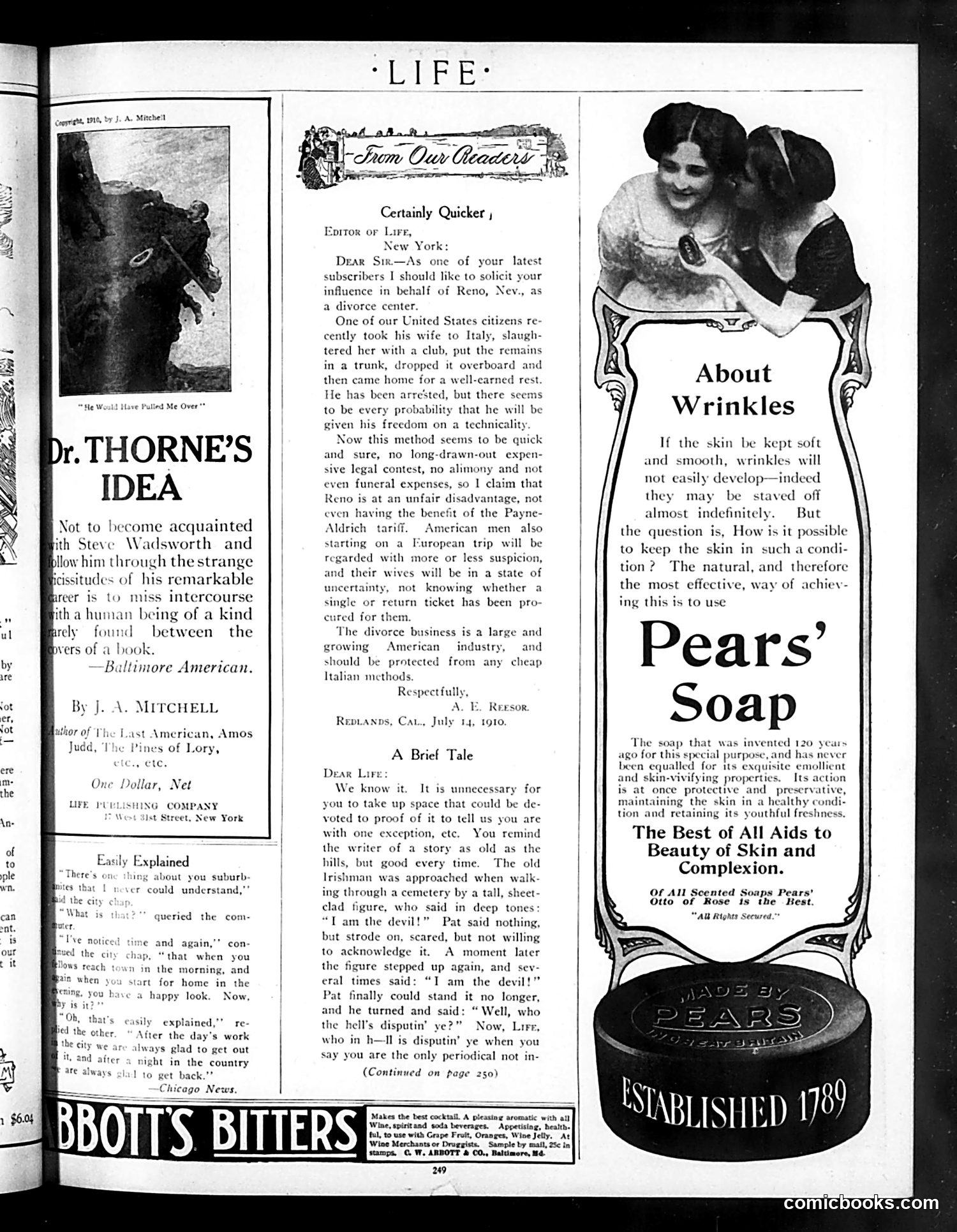
**Left column:** J.A. Mitchell's piece satirizes extreme judicial leniency. It mocks a real case where an American murdered his wife in Italy, dumped her body overboard, yet faced possible acquittal on "technicality." The satire suggests Reno, Nevada (famous for easy divorces) should advertise murder as cheaper than divorce proceedings—no alimony, no funeral costs. The piece critiques both lenient courts and America's divorce industry by proposing murder as a "competitive advantage" over Italian legal methods. **Center:** Two reader letters. One defends *Life* magazine's editorial authority; another presents a joke about an Irishman confronting the Devil—undermining *Life's* self-importance by suggesting they claim exclusivity without justification. **Right:** A *Pears' Soap* advertisement promising wrinkle prevention through skin care—typical period beauty marketing with pseudo-scientific claims about "emollient" properties. The page blends satire about American justice/divorce culture with self-promotional humor and commercial advertising.
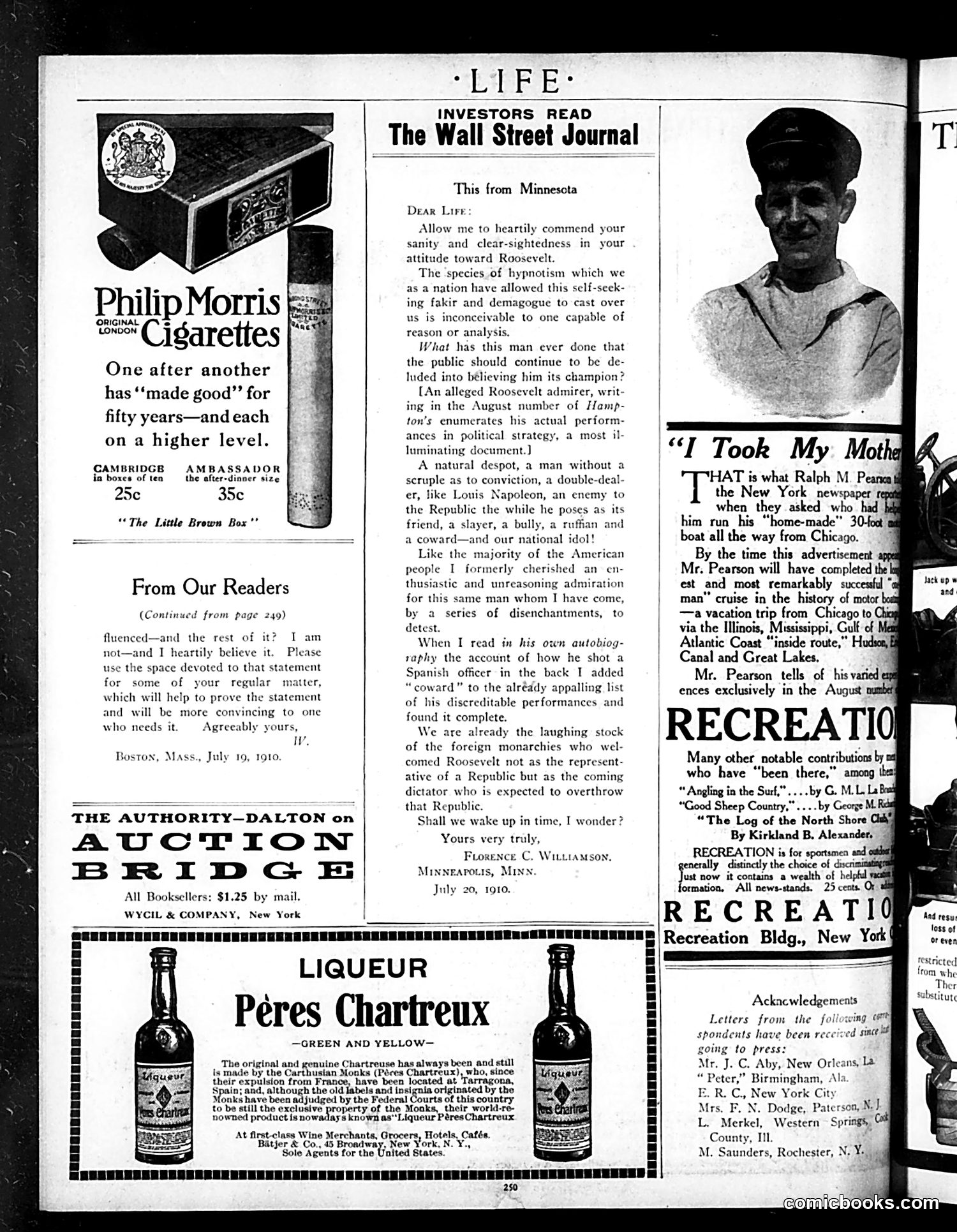
This page features a letter to *Life* magazine attacking President Theodore Roosevelt as a hypocritical demagogue and would-be dictator. The Minnesota correspondent condemns Roosevelt as a "self-seeking fakir," comparing him to Louis Napoleon (a dictator). The letter specifically attacks Roosevelt's autobiography, citing an incident where he shot a Spanish officer "in the back," which the writer characterizes as cowardly. The writer expresses disenchantment with Roosevelt, having once admired him, and claims America has become "the laughing stock of foreign monarchies" who see Roosevelt as a coming dictator, not a republican leader. The passage illustrates the deep political division over Roosevelt's presidency, with *Life* magazine apparently aligned with critics who viewed his leadership as authoritarian and morally compromised.
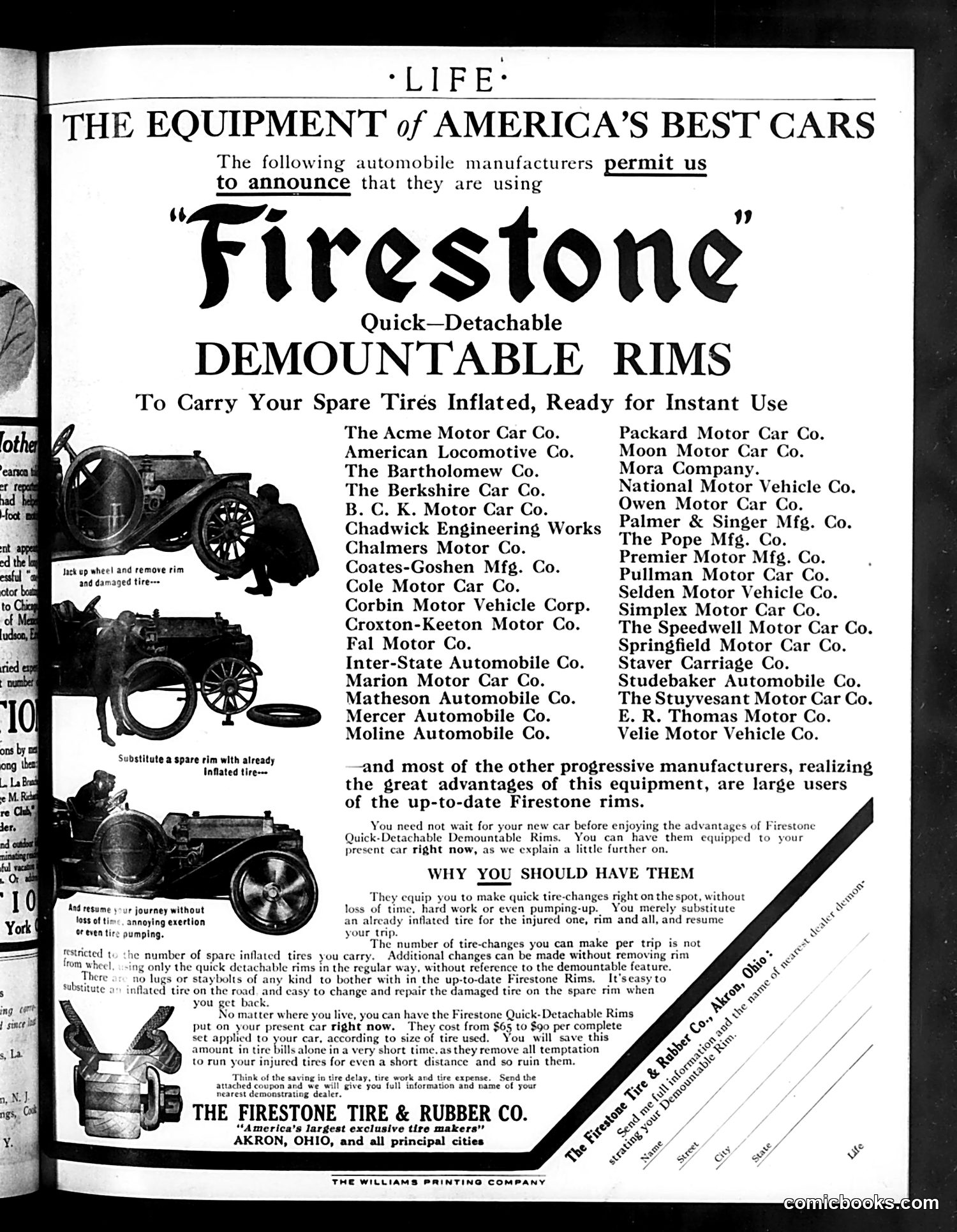
This is primarily **advertising, not satire**—a full-page promotional piece for Firestone's quick-detachable automobile rims, circa early 1910s. The illustrated vignettes on the left show the practical advantage: drivers could swap out damaged tires without laboriously removing the entire rim, a genuine innovation for the era when tire failures were frequent and tire-changes were genuinely difficult, time-consuming work. The lengthy list of car manufacturers endorsing the product reflects the fragmented early auto industry—dozens of now-forgotten marques (Studebaker, Packard, and Mercer were among the few that survived). The advertisement leverages these endorsements as credibility markers. The humor is implicit rather than satirical: the exaggerated relief depicted in the illustrations ("resume your journey without loss of time, annoying exertion or even tire pumping") reflects genuine frustrations of early motoring. Modern readers miss that this solved a real, constant problem before reliable pneumatic tires existed.
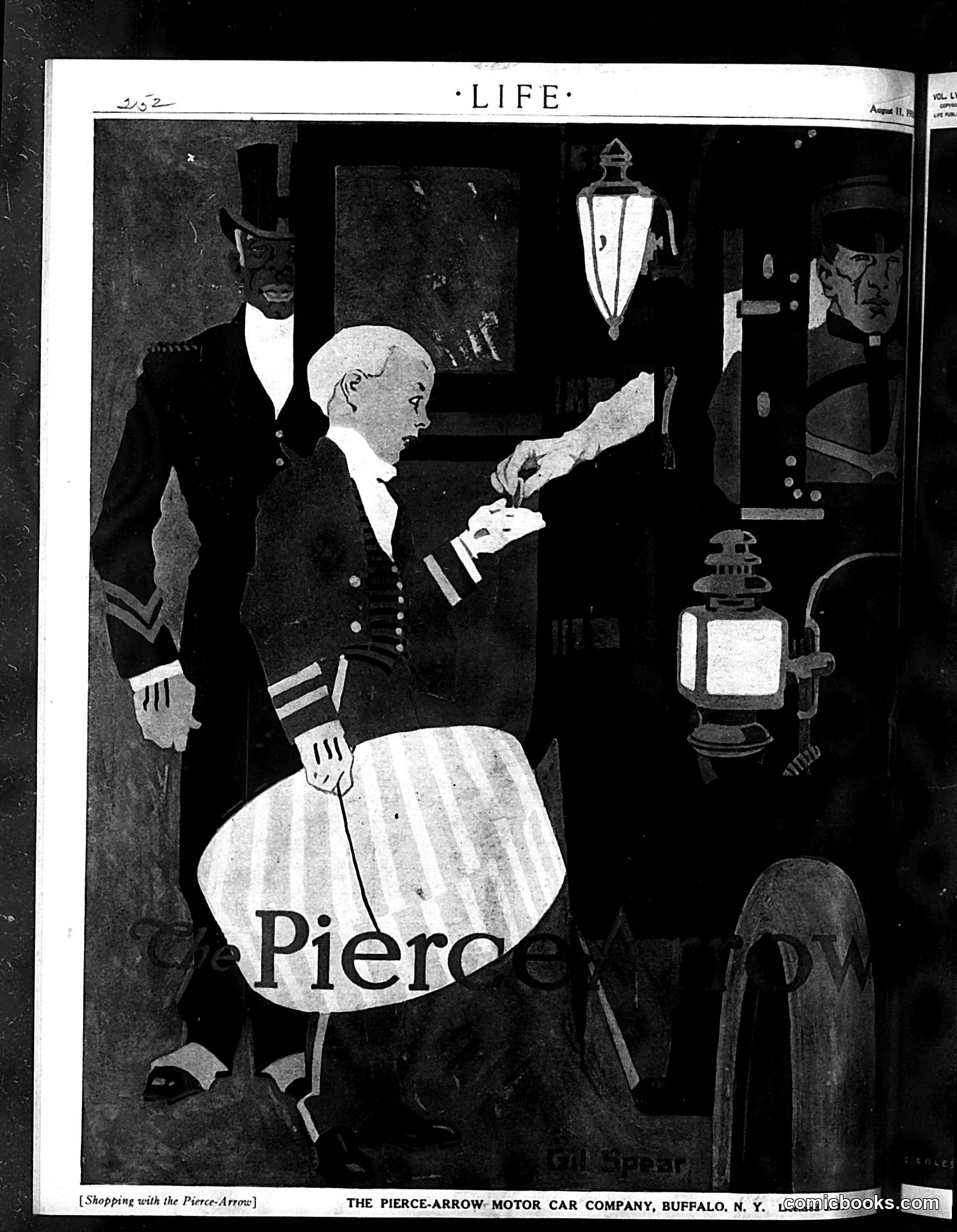
This is **primarily an advertisement**, not political satire. The page promotes the Pierce-Arrow Motor Car Company of Buffalo, New York. The illustration depicts a wealthy gentleman in formal attire (top hat, military-style jacket with decorative buttons) being presented with what appears to be a Pierce-Arrow automobile by uniformed attendants. The car's curved hood is rendered in white, contrasting with the dark background. The caption "Shopping with the Pierce-Arrow" suggests the automobile as a luxury consumer good for the affluent. The formal, almost ceremonial presentation—complete with what appears to be military or formal service staff—emphasizes exclusivity and high status. This reflects early 20th-century advertising positioning automobiles as symbols of wealth and sophistication rather than practical transportation. The satirical undertone (typical of *Life* magazine) may gently mock the pretentiousness of such marketing, but the page functions primarily as paid advertising.