
Life, 1910-08-11 · page 24 of 40
Life — August 11, 1910 — page 24: what you’re looking at
What you’re looking at
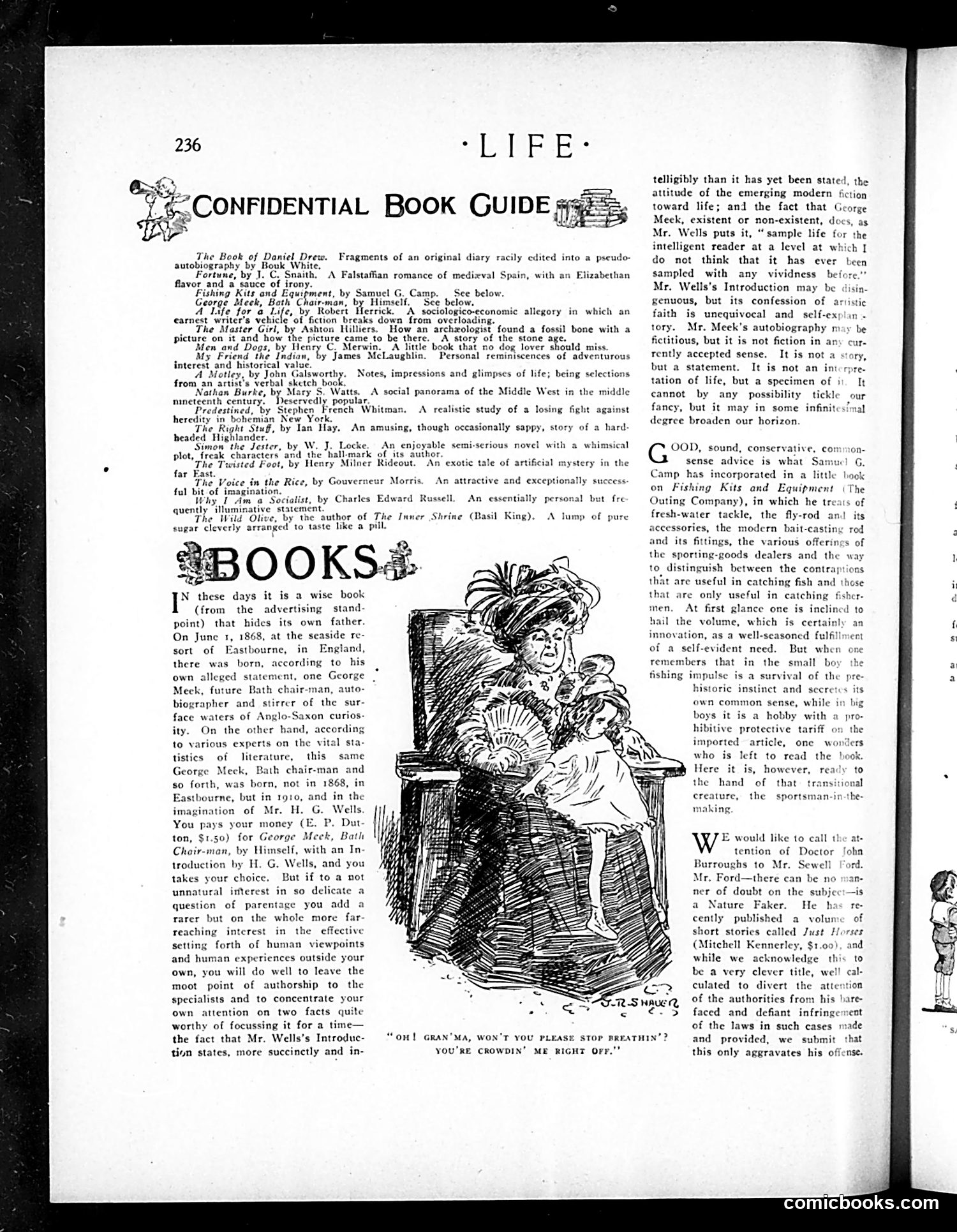
This is a **book review section** from *Life* magazine, not primarily satirical content. The page features: **Main Content:** A "Confidential Book Guide" reviewing contemporary fiction (circa 1910s), including titles about finance (*The Book of Daniel Drew*), adventure (*The Twisted Foot*), and social commentary. **The Cartoon:** A single illustration showing an elderly woman and child crowded together, with the child saying "Gran'ma, won't you please stop breathin'? You're crowdin' me right off." This is a humorous domestic scene illustrating cramped living conditions—likely commenting on working-class or tenement housing rather than making a specific political point. **The H.G. Wells Discussion:** The text debates whether "George Meek, Bath Chair-man" is a real autobiography or a fictional creation by H.G. Wells, ultimately arguing that the book's literary merit matters more than its authenticity. The page reflects *Life's* role as a literary and cultural commentary magazine, blending book criticism with gentle social humor rather than sharp political satire.
📄 Transcribed text from this page (OCR, searchable)
Machine-transcribed from the original scan — historical spelling and the odd misread are preserved.
SEE /% CONFIDENTIAL BOOK GUIDE; “ie = The Book of Daniel Drew. autobiography by Bouk White, Fortune, by J. C, Snaith, flavor and a sauce of irony. Fishing Kits and Equipment, by Samuel G. Camp. | See below. George Meek, Bath Chair-man, by Himself. Sce below. A late for & Life, by, Robert Herrick, A socioloxico-economic allegory in which an earnest writer's vehicle of fiction breaks down from overloading. The Master Girl, by Ashton Hilliers. How an archxologist found a fossil bone with a picture on it and how the picture came to be there. A story of the stone age. Men and Dogs, by Menry C, Merwin. A little book that no dog lover should, miss My Friend the Indian, by James McLaughlin. Personal reminiscences of adventurous interest and historical value. a ‘ A Motley, by John Galsworthy. Notes, impress from an artist's verbal sketch boo Nathan Burke, by Mary S. Watts. nineteenth century, Deservedly popular. Predestined, by Stephen French Whitma: heredity in bohemian New York. The Right Stuf, by Ian Hay. headed Highlander. 4 . eee ‘Simon the Jester, by W. J. Locke, An enjoyable semi-serious novel with a w plot, freak characters’ and the hallmark of its author The Twisted Foot, by Henry Milner Rideout. An exotic tale of artificial mystery in the far East. : The Voice in the Rice, by Gouve ful bit of imagination. Fragments of an original diary racily edited into a pseudo- A Falstaffian romance of medixval Spain, with an Elizabethan s and glimpses of life; being selections A social panorama of the Middle West in the middle A realistic study of a losing fight against ‘An amusing, though occasionally sappy, story of a hard nsical peur Morris, attractive and exceptionally success An essentially personal but fre Why I Am a Socialist, by Charles Edward Russell iluminative statement. The Wild Olive sugar ¢ 8BOOKS# by the author of The Inner Shrine (Basil King). A lump of pure everly arranged to taste like a pill. N these days it is a wise book (from the advertising stand- point) that hides its own father. On June 1, 1868, at the seaside re- sort of Eastbourne, in England, there was cording to his own alleged statement, one George Meck, future Bath chair-man, auto- biographer and stirrer of the sur- face waters of Anglo-Saxon curios. ity. On the other hand, accordin; to various experts on the vital sta- tistics of literature, this same George Meck, Bath chair-man and so forth, was born, not in 1868, astbourne, but in 1910, and in the imagination of Mr. H. G. Wells. You pays your money (E. P. Dut ton, $1.50) for George Meek, Bath Chair-man, by Himself, with an In- troduction by H. G. Wells, and you takes your choice, But if to a not unnatural interest in so delicate a question of parentage you add a rarer but on whole more far reaching interest in the effective setting forth of human viewpoints and human experiences outside your own, you will do well to leave the moot point of authorship to the specialists and to concentrate your own attention on two facts quite worthy of focussing it for a time— the fact that Mr. Wells's Introduc- tion states, more succinctly and in- born, the “on! GRAN'’MA, WON'T You PLEA! YOU'RE CROWDIN’ ME RIGHT OFF." STOP BREATHIN’? telligibly than it has yet been stated, the attitude of the emerging modern fiction toward life; and the fact that George Meck, existent or non-existent, docs, as Mr. Wells puts it, “sample life for the intelligent reader at a level at which | do not think that it has ever been sampled with any vividness before.’ Mr. Wells’s Introduction may be genuous, but its confession of artistic faith is unequivocal and self-explin « tory. Mr. Meek’s autobiography may be fictitious, but it is not fiction in any cur- rently accepted sense. It is not a sory, but a statement. It is not an interpre. tation of life, but a specimen of i) It cannot by any possibility tickle fancy, it may in some infinit degree broaden our horizon. our nal OOD, sound, conservative, common- sense advice is what Sa G. Camp has incorporated in a little hook on Fishing Kits and Equipment (The Outing Company), in which he treats of fresh-water tackle, the fly-rod anil its accessories, the modern bait-casting rod and its fittings, the various offerings of the sporting-goods dealers and the w to distinguish between the contraptions that are useful in catching fish and those that are only useful in catching fisher- men, At first glance one is inclined to hail the volume, which i innovation, as a well-seasoned fulfill me of a self-evident need. But when on remembers that in the small boy fishing impulse is a survival of the pre- historic instinct and sccretes its certainly an own common sense, while in b boys it is a hobby with a pro- hibitive protective tariff on the imported article, one who is left to read the boo! Here it is, however, ready to the hand of that transitional creature, the sportsman-i making. wonilers E would like to call 1! tention of Doctor Burroughs to Mr. Sewell Mr. Ford—there can be no ner of doubt on the subjec a Nature Faker. He has cently published a volur short stories called Just Horses (Mitchell Kennerley, $1.00), and while we acknowledge this to be a very clever title, well cal- culated to divert the attention of the authorities from his bare- faced and defiant infringement of the laws in such cases made and provided, we submit that this only aggravates his offense. John comicbooks.com