
Life, 1910-08-11 · page 22 of 40
Life — August 11, 1910 — page 22: what you’re looking at
What you’re looking at
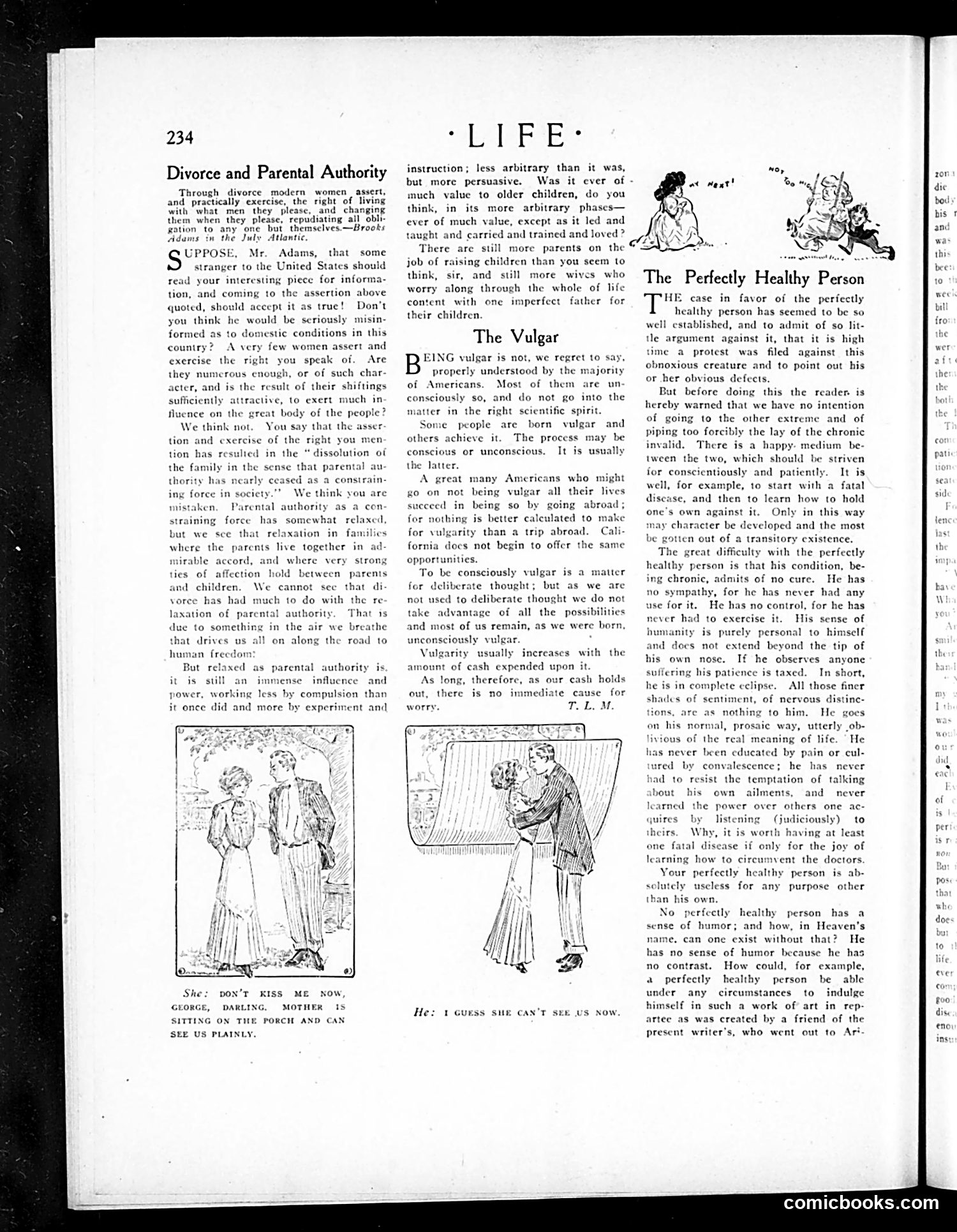
This page contains three satirical pieces from Life magazine (an American humor publication): **"Divorce and Parental Authority"**: A response to Brooks Adams's Atlantic Monthly article claiming divorce has destroyed parental authority. Life's editor argues Adams overstates the case—few women actually exercise such freedom, and relaxed (not dissolved) parental authority stems from broader social changes, not divorce. Parents remain engaged in child-rearing. **"The Vulgar"**: A humorous essay noting Americans often become vulgar through foreign travel, particularly to California. The piece suggests vulgarity correlates with spending money and that most Americans achieve it unconsciously. **Two cartoons**: Both illustrate marital/romantic situations. The first shows a young couple; the second depicts a man and woman, with dialogue about avoiding a mother's view—suggesting discretion about courtship. The page reflects early 20th-century anxieties about changing social norms (divorce, women's independence) and American pretension when traveling abroad, treated with satirical wit rather than moral condemnation.
📄 Transcribed text from this page (OCR, searchable)
Machine-transcribed from the original scan — historical spelling and the odd misread are preserved.
234 Divorce and Parental Authority Through divorce modern women assert, and practically exercise, the right of living with what men they please, and changing m when they please, repudiating all obli- gation to any one but themselves.—Hrooks dams in the July Atlantic, UPPOSE, Mr. Adams, that some stranger to the United States should read your interesting piece for informa- tion, and coming quoted, should accept it as true! Don't you think he would be seriously misin- formed as to domestic conditions in this country? A very few women assert and exercise the right you speak of. Are they numerous cnough, or of such char- acter, and is the result of their shiftings sufficiently attractive, to exert much in the assertion above fluence on the great body of the people? We think not. You say that the asser tion and exercise of the right you men tion has resulted in the the family in the sense that parental au. ssolution of thority has nearly ceased as a constrain- We think you are Parental authority as a con ing force in society.’ straining force has somewhat relaxed, but we sce that relaxation in where the parcnts live together mirable accord, and where very strong ties of affection hold between parents and children. We cannot sec that di vorce has had much to do with the re laxation of parental authority. That is due to something in the air we breathe that drives us all on along the road to human free But relaxed as parental authority is it is still an immense influence and power, working less by compulsion than it once did and more by experiment and “EIR ES instruction; less arbitrary than it was, but more persuasive. Was it ever of much value to older children, do you think, in its more arbitrary phases— ever of much value, except as it led and taught and carried and trained and loved ? There are still more parents on the job of raising children than you seem to think, sir, and still more wives who worry along through the whole of life content with one imperfect father for their children The Vulgar BE NG vulgar is not, we regret to properly understood by the majority of Americans. Most of them are un. consciously so, and do not go into the matter in the right scientific spirit. Sonie people are born vulgar and others achieve it. The process may be conscious or unconscious. It is usually the latter, great many Americans who might go on not being vulgar all their lives succeed in being so by going abroad; for nothing is better calculated to make for vulgarity than a trip abroad. C: fornia docs not begin to offer the s opportunities. To be consciously vulgar is a matter thought; but as we are not used to deliberate thought we do not ake advantage of all the possibilities and most of us remain, as we were born, unconsciously vulgar Vulgarity usually increases with the amount of cash expended upon i As long, therefore, as our cash holds out, there is no for deliber: worry. ©. She: pox’? KISS ME NOW, GEORGE, DARL MOTHER 1S SITTING ON THE PORCH AND CAN SEE US PLAINLY. He: 1 GUESS SHE CAN'T SEE US Now. The Perfectly Healthy Person HE case in favor of the perfectly healthy person has seemed to be so well established, and to admit of so lit- tle argument against it, that it is high time a protest was filed against this obnoxious creature and to point out or her obvious defects. But before doing this the reader is hereby warned that we have no intention of going to the other extreme and of piping too forcibly the lay of the chroni invalid. There is a happy: medium be- tween the two, which should be striven ior conscientiously and patiently. It is well, for example, to start with a fatal disease, and then to learn how to hold one’s own against it. Only in this way may character be developed and the most en out of a transitory existence. The great difficulty with the perfectly healthy person is that his condition, be- ing chronic, admits of no cure. He has no sympathy, for he has never had any use for it. He has no control, for he has never had to exercise it. His sense of humanity is purely personal to himself and does not extend beyond the tip of his own nose. If he observes anyone suffering his patience is taxed. In short, he is in complete eclipse. All those finer sh. of sentiment, of nervous distine- tions, are as nothing to him. He goes on his normal, prosaic way, utterly ob- ivious of the real meaning of life. “He s never been educated by pain or cul- red by convalescence; he has never nad to resist the temptation of talking bout his own ailments, and never learned the power over others one ac- quires by listening (judiciously) to theirs. Why, it is worth having at least one fatal disease if only for the joy of learning how to circumvent the doctors. Your perfectly healthy person is ab- solutely useless for any purpose other an his own, No perfectly healthy person has a sense of humor; and how, in Heaven's name. can one exist without that? He has no sense of humor because he has no contrast. How could, for example, 1 perfectly healthy person be able under any circumstances to indulge himself in such a work of art in rep: artee as was created by a friend of the present writer's, who went out to Ari- foo dise enc ins comicbooks.com