
Life, 1910-08-11 · page 26 of 40
Life — August 11, 1910 — page 26: what you’re looking at
What you’re looking at
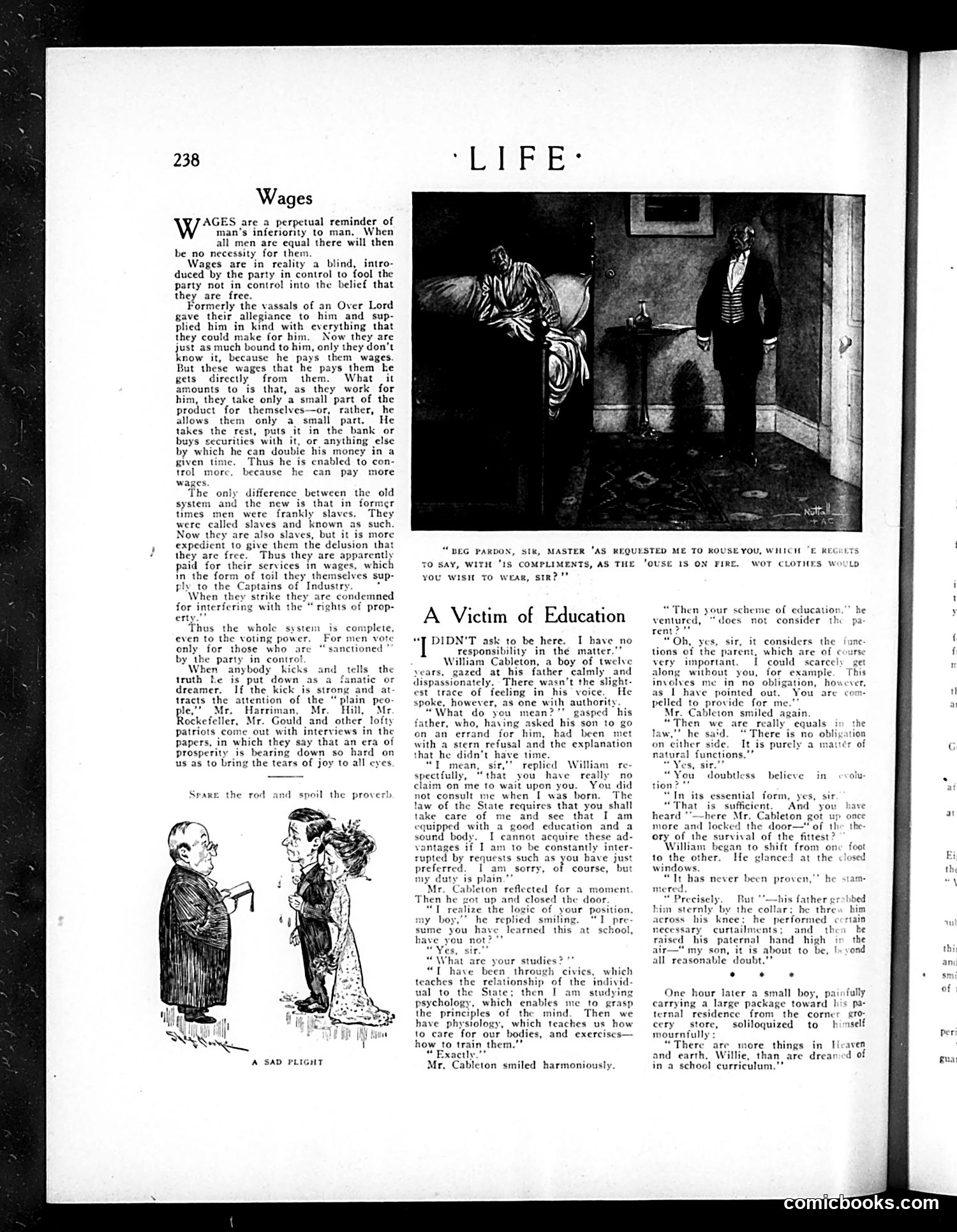
**The "Wages" Section (Left):** This is radical political commentary attacking capitalism. The text argues that modern wages are merely a disguised form of slavery—workers receive only a small portion of their labor's value while employers (the "Captains of Industry") pocket the rest. It criticizes the illusion of freedom that wages create, comparing it unfavorably to feudalism where exploitation was at least honest. The rhetoric mentions railroad magnates (Harriman, Hill, Gould) as examples of exploitative wealth accumulation. **The Main Story, "A Victim of Education" (Right):** This satirizes modern educational philosophy. A twelve-year-old boy named William Cableton refuses his father's errand, citing his legal right to education and bodily care as superseding parental authority. He speaks in the language of civics and psychology lessons. The satire mocks how progressive education (emphasizing individual rights and scientific principles) has created a child so intellectually confident yet emotionally detached that he coldly asserts legal abstractions over filial duty—making him absurdly impractical and disrespectful. The page contrasts systemic economic exploitation with educational philosophy producing emotionally stunted, rights-obsessed children.
📄 Transcribed text from this page (OCR, searchable)
Machine-transcribed from the original scan — historical spelling and the odd misread are preserved.
Wages AGES are a perpetual reminder of man’s inferionty to man. When all men are equal there will then be no necessity for them. ; Wages are in reality a blind, intro- duced by the party in control to fool the party not in control into the belief that they are free. Formerly the vassals of an Over Lord gave their allegiance to him and sup- plied him in kind with everything that they could make for him. Now they are just as much bound to him, only they don’t know it, because he pays them wages. But these wages that he pays them ke gets directly. from them. What it amounts to is that, as they work for him, they take only’a small part of the product for themselves—or, rather, he allows them only a small part. He takes the rest, puts it in the bank or buys securities with it, or anything else by which he can double his money in a given time. Thus he is enabled to con- trol more, because he can pay more wages. The only difference between the old system and the new is that in former times men were frankly slaves. Thi were called slaves and known as such Now they are also slaves, but it is more expedient to give them the delusion that they are free. Thus they are arently paid for their services in wages, which in the form of toil they themselves sup- ply to the Captains of Industry . When they strike they are condemned for interfering with the “rights of prop- erty Thus the whole system is even to the voting power. For men vote only for those who are “ sanctioned by the party in controt When anybody kicks and tells the truth be is put down as a fanati dreamer. If the kick is strong and at tracts the attention of the “plain peo. rt. Harriman, Mr. Hill, Mr. ler, Mr. Gould and other’ lofty patriots come out with interviews in the papers, in which they say that an era of prosperity is bearing down so hard on us as to bring the tears of joy to all eves. Spare the spoil the proverb A SAD PLIGHT “BEG PARDON, Sk, MASTER 'AS REQUESTED ME TO ROUSE YOU, WHICH "E RE TO SAY, WITH 1S COMPLIMENTS, AS THE you wisit To wear, str??? A Victim of Education “T DIDN'T ask to be here. I have no responsibility in the matter.’? William Cableton, a boy of twel years, gazed at his father calmly an dispassionately, There wasn’t the sligh est trace of feeling in his voice. He spoke, however, as one with authority What do you mean?" gasped his father, who, having asked his son to go on an errand for him, had been met with a stern refusal and the explanation that he didn’t have time. “T mean, sir,'’ replied William re spectfully, “that you have really claim on me to wait upon you. Yo! not consult me when I was born. law of the State requires that you shall take care of me and see that I am equipped with a good education and a sound body. I cannot acquire these ad- vantages if I am to be constantly inter- rupted by requests such as you have just preferred. sorry, of course, but my duty Mr. € reflected for a moment Then he and closed the door. “T realize the logic of your ition, my boy,’’ he replied smiling. “1 pre sume you learned this at school, ave you no “Yes, sir. “What are your studies?" “T have been through civics, which teaches the relationship of the individ- ual to the State; then I am. studying psychology, which enables me to grasp the principles of the mind. Then we have physiology, which teaches us how to care for our bodies, and exercises— how to train ther “ Exactly.’” Mr. Cableton smiled harmoniously. "OUSE 1S ON FIRE. WoT CLOTHES W “Then your scheme of educat ventured, “does not consider rent?” “Oh, yes, sir, it considers the tions of the parent, which are of « very important. [ could scarce! along without you, for example involves me in’ no’ obligation, hov as I have pointed out. Yow are pelled to provide for me."” Mr. Cableton smiled again “Then we are really equals law," he said. “There is no obli on cither side. It is purely an natural functions,’” “Yes, sir.’ “You doubtless tio " believe in In its essential form, yes, sir “That is sufficient. And’ you heard "—here Mr. Cableton got uy more and locked the door—" of th ory of the survival of the fittest? William began to shift from on to the other. He glanced at the windows. “Tt has never Precisely. But ‘'—his father er im sternly by the collar; he thre across his knee: he performed « necessary curtailments; and th raised his paternal hand high air—" my son, it is about to be, | all reasonable doubt.’’ o 8 6 been proven, One hour later a small boy, pai carrying a large package toward | ternal residence from the cornc cery store, soliloquized to | mournfully: There are more things in I and earth, Willie, than are drear in a school curriculum.’ This ver, Comicbooks.com