
A complete issue · 32 pages · 1909
Life — November 25, 1909
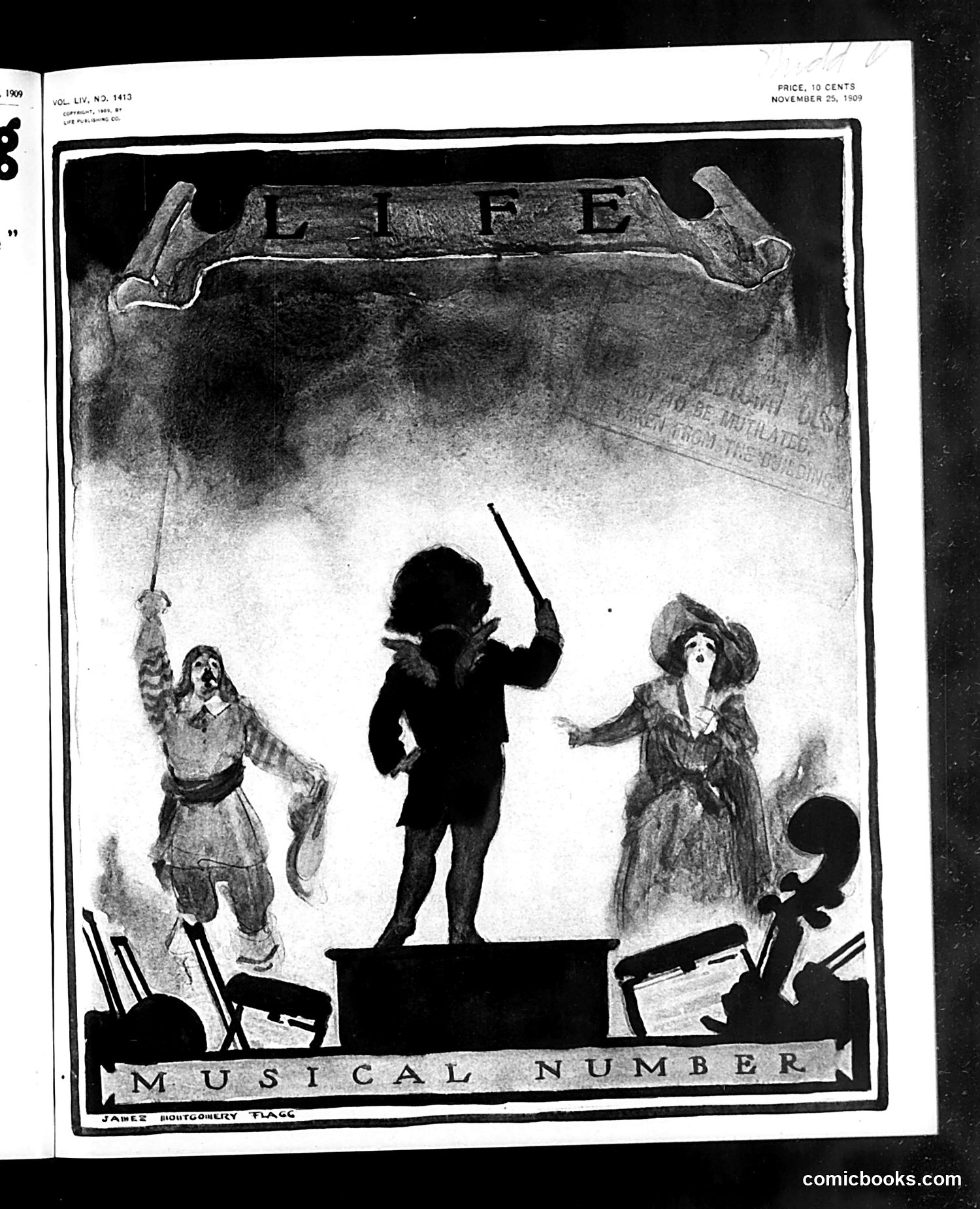
**November 25, 1909** This is a satirical illustration titled "Musical Number" by James Montgomery Flagg. It depicts a conductor (center, silhouetted) leading three caricatured figures who appear to be performing or responding to his baton. The figures have exaggerated features typical of early 20th-century satirical art. The setup suggests commentary on orchestrated control or coordination of disparate elements—possibly political figures or social groups being "conducted" or manipulated by a central authority figure. Without additional contextual text visible, the specific political reference remains unclear, though the theatrical staging and conductor metaphor suggest satire about leadership, control, or the coordination of competing interests during the 1909 period.
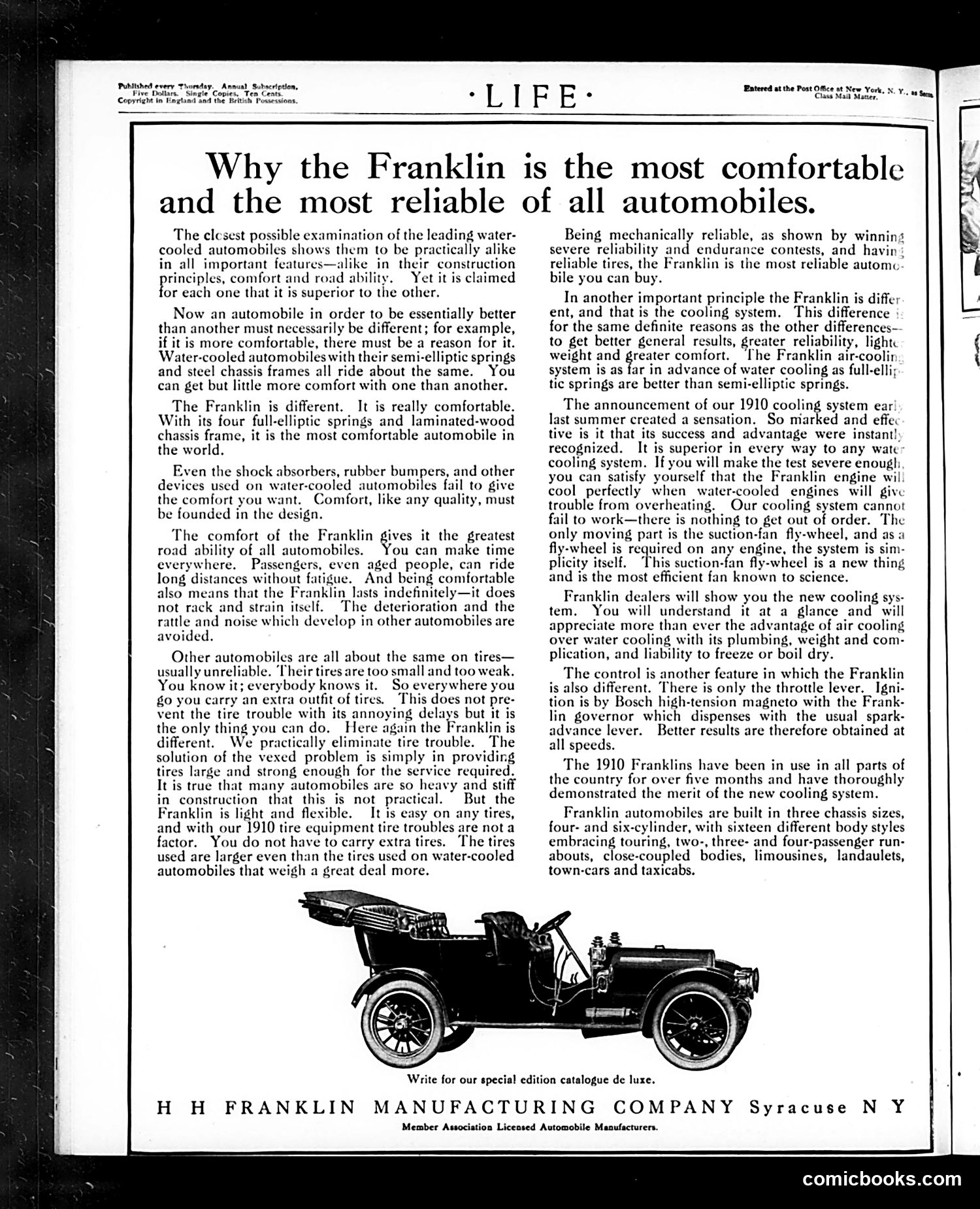
This page is **not a cartoon or satire** — it's a straightforward **automobile advertisement** for the Franklin Manufacturing Company of Syracuse, New York. The ad promotes the Franklin automobile's superiority through claims about comfort and reliability. Key selling points include: - Four full-elliptic springs and laminated-wood chassis for comfort - An innovative air-cooling system (advertised as their 1910 breakthrough) - Lightweight, flexible construction requiring smaller tires - Bosch high-tension magneto ignition - Multiple chassis sizes for different vehicle types The small illustration at bottom shows a Franklin touring car with the door open. This represents typical early-1900s automotive advertising emphasizing mechanical innovation and engineering advantages rather than humor or social commentary.
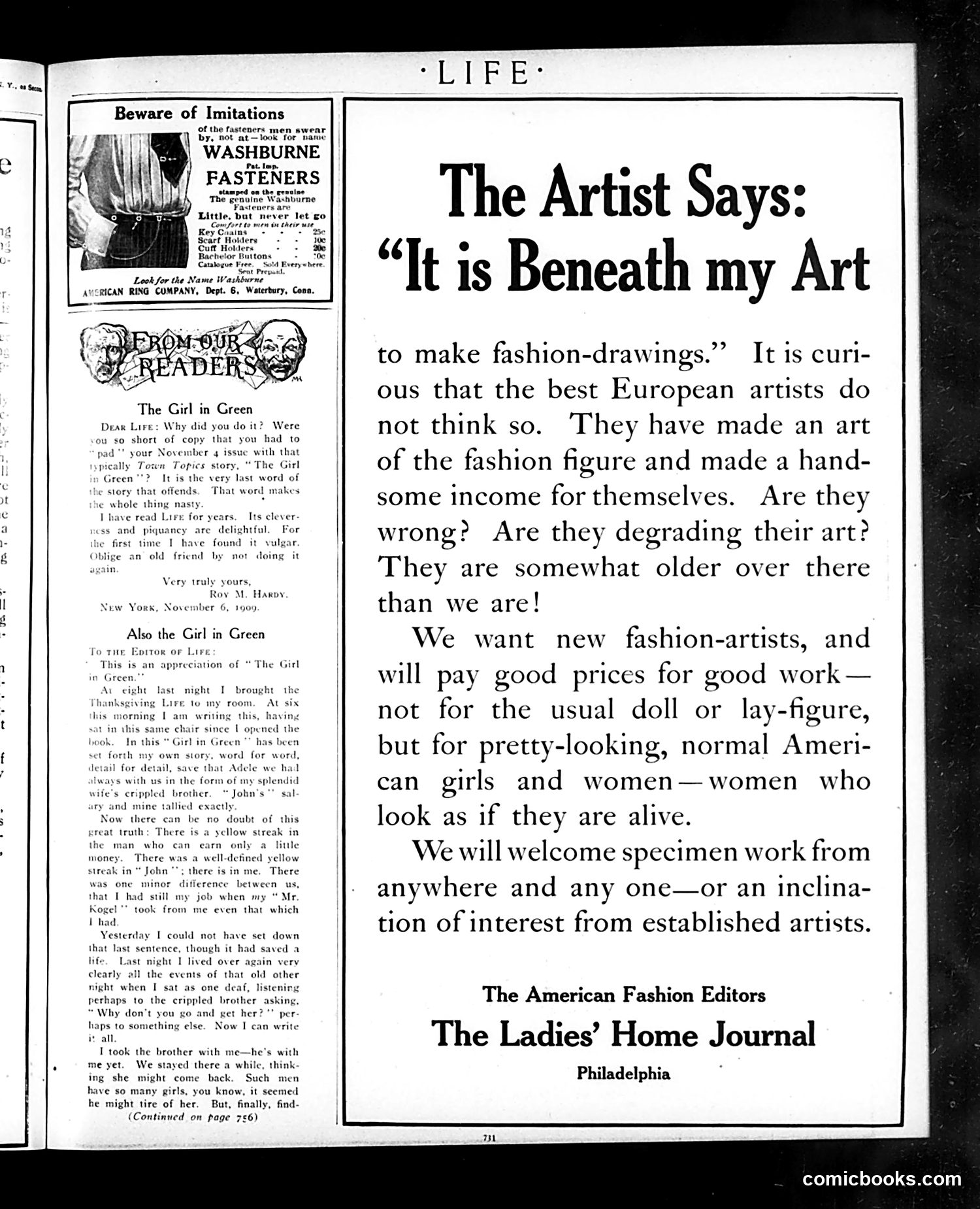
This page contains primarily **advertising and editorial content** rather than political satire. The main advertisement (top left) promotes **Washburne Fasteners**, warning against imitations—a straightforward commercial appeal to consumers. The bulk of the page features "**The Artist Says**," an editorial from *The Ladies' Home Journal* recruiting fashion illustrators. It argues that creating fashion drawings is legitimate artistic work, countering apparent skepticism about the artistic merit of fashion illustration. The editors note that European artists already pursue this lucrative field and seek American talent who can draw "pretty-looking, normal American girls and women—women who look as if they are alive." The "From Our Readers" section contains reader letters, including one about "The Girl in Green" story. This reflects early 20th-century debates about commercial versus fine art—fashion illustration's cultural legitimacy wasn't yet firmly established.
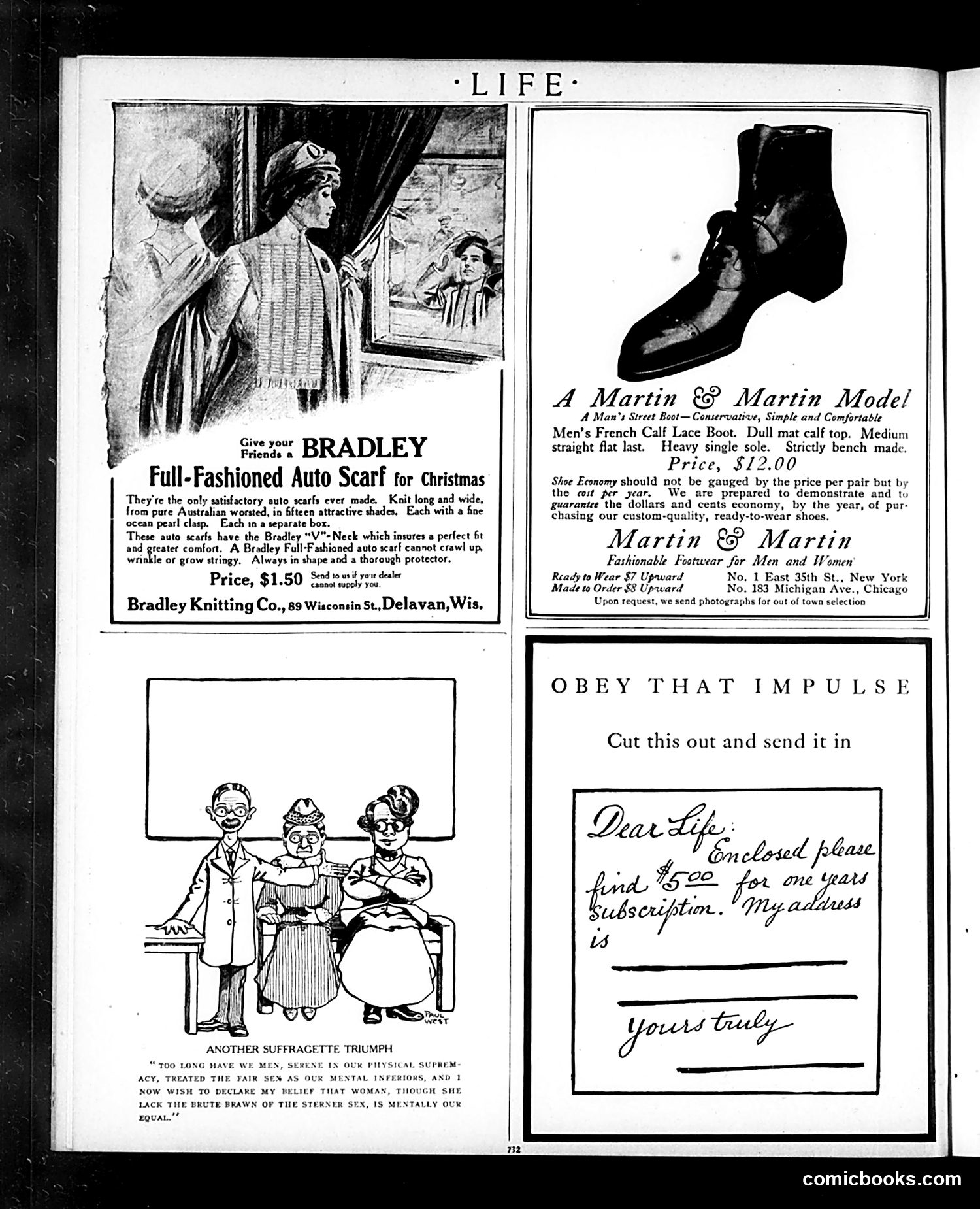
This page is primarily **advertising**, not political satire. The main content includes: 1. **Bradley Knitting Co.** ad for auto scarves ($1.50) 2. **Martin & Martin** footwear advertisement for men's French calf lace boots ($12.00) The only satirical element is a small cartoon labeled **"Another Suffragette Triumph"** showing three figures (apparently a man and two women) with a caption asserting women's mental equality to men. This appears to be **anti-suffrage satire**—mocking the women's suffrage movement by suggesting women's claimed equality is absurd or unproven. The bottom section is a subscription solicitation template ("Obey That Impulse"), inviting readers to send $5.00 for a year's subscription. The page reflects early 20th-century magazine formatting mixing commerce with light political humor.
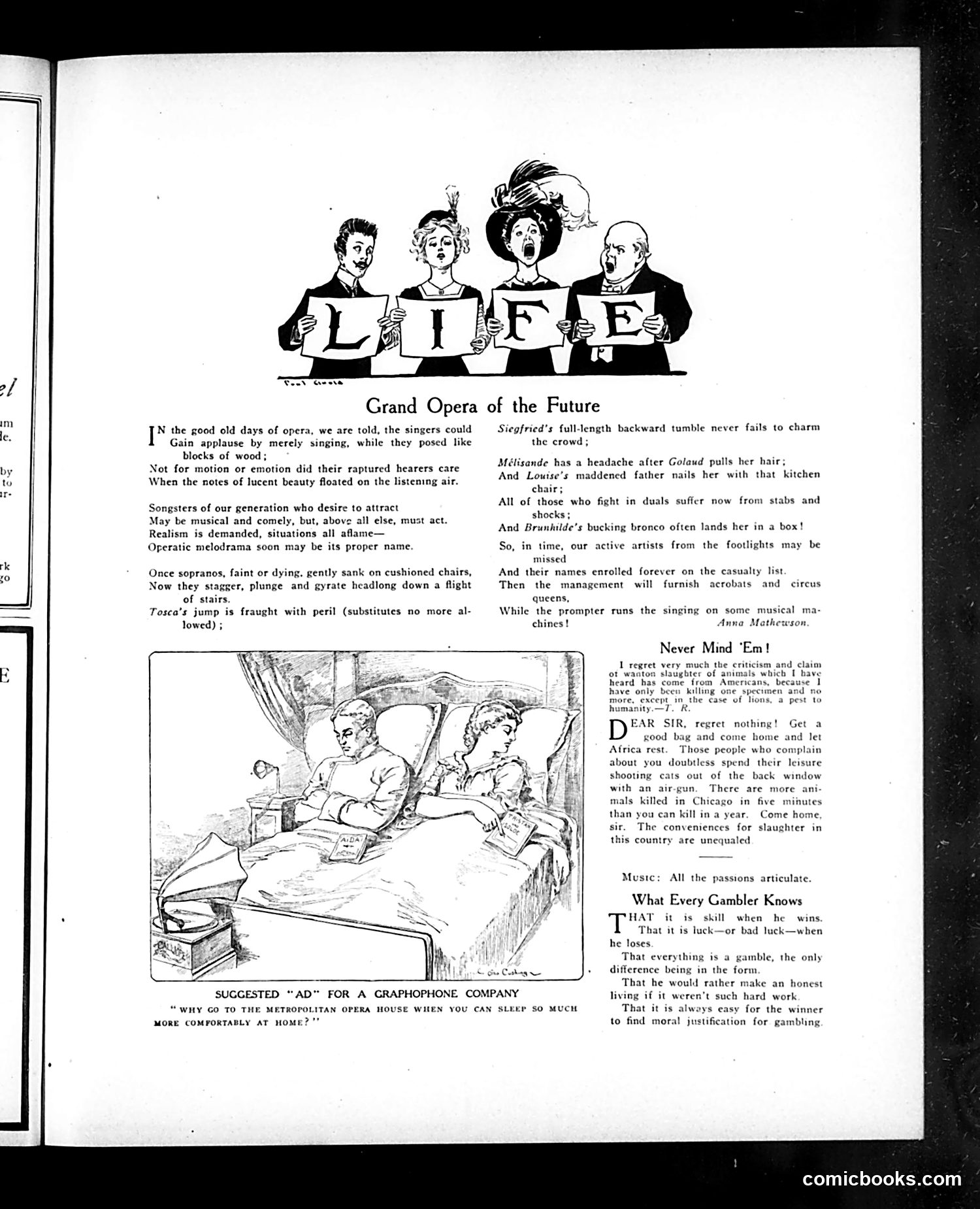
**"Grand Opera of the Future"** satirizes modern opera's decline. The cartoon depicts four singers holding letters spelling "LIFE," mocking how contemporary opera has abandoned traditional beauty for comedic spectacle. The text complains that singers now prioritize slapstick humor—tumbling down stairs, physical comedy—over vocal artistry. The accompanying illustrated advertisement for a graphophone (early phonograph) deepens the satire: "Why go to the Metropolitan Opera House when you can sleep so much more comfortably at home?" This suggests opera has become so tedious that listeners prefer recorded music at home. The page mocks how modern entertainment prioritizes entertainment value and novelty over traditional artistic merit—a recurring satirical target in early 20th-century Life magazine.
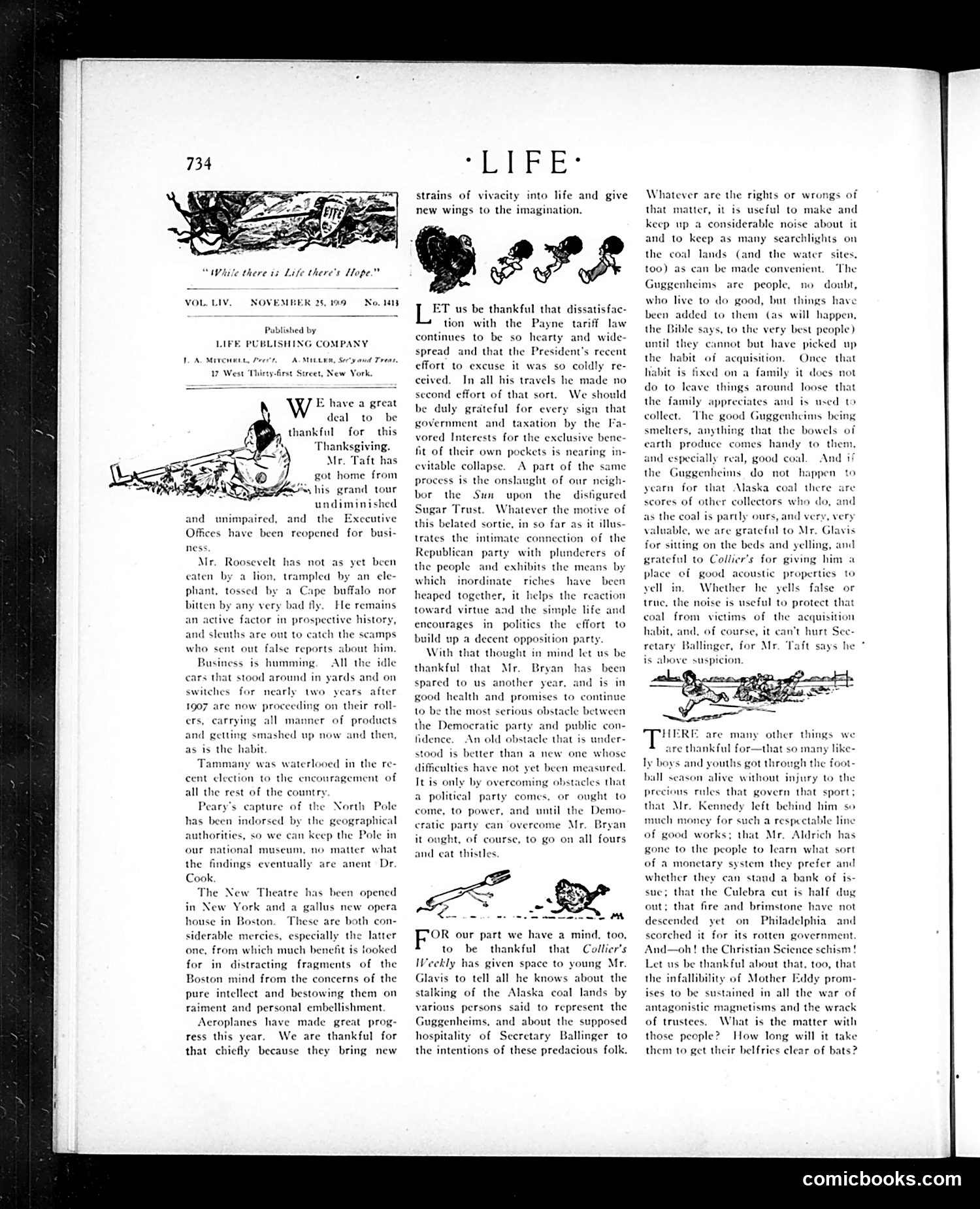
This editorial page contains three cartoons addressing early-20th-century political issues: **Top cartoon** ("Where there is Life there's Hope"): Appears to satirize the Payne tariff law and the President's handling of dissatisfaction with it, suggesting government benefits plunderers more than ordinary citizens. **Middle cartoon**: Depicts a figure (likely Roosevelt, based on textual reference) positioned awkwardly, possibly mocking his political stance or recent activities. **Bottom cartoon**: Shows a reclining figure, likely related to Democratic Party criticism mentioned in the text regarding Mr. Bryan and political opposition. The editorial praises the government's efforts against trusts (the Sugar Trust is specifically mentioned) while critiquing both Republican plunderers and Democratic resistance to administration policies. The tone is cautiously supportive of Roosevelt's reform efforts.
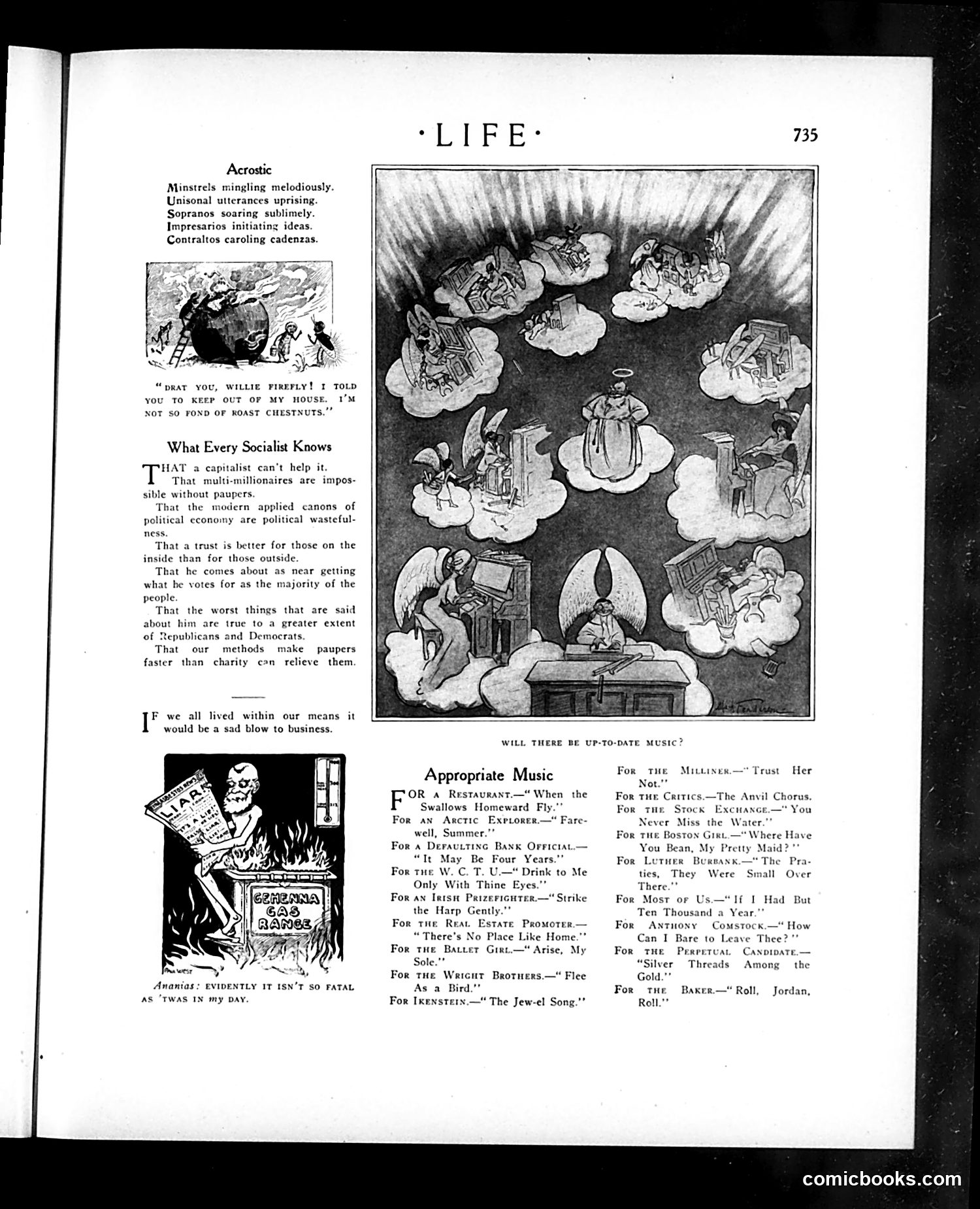
This page combines political satire with humor about economic inequality. The main cartoon depicts angels in heaven engaged in various earthly pursuits—banking, gambling, leisure activities—satirizing the afterlife concept through a socialist lens. The "What Every Socialist Knows" section mocks socialist economic theory, presenting contradictory statements (capitalists are "imposable without papers," trusts help insiders, applied economics is "wasteful," etc.) to ridicule socialist logic and claims. The lower section titled "Appropriate Music" pairs professions with song titles—a joke format matching jobs to suggestive or ironic music selections. This appears designed as light political and social commentary. Overall, the page uses satire to critique both socialism and capitalism while maintaining humorous distance from serious economic debates of the era.
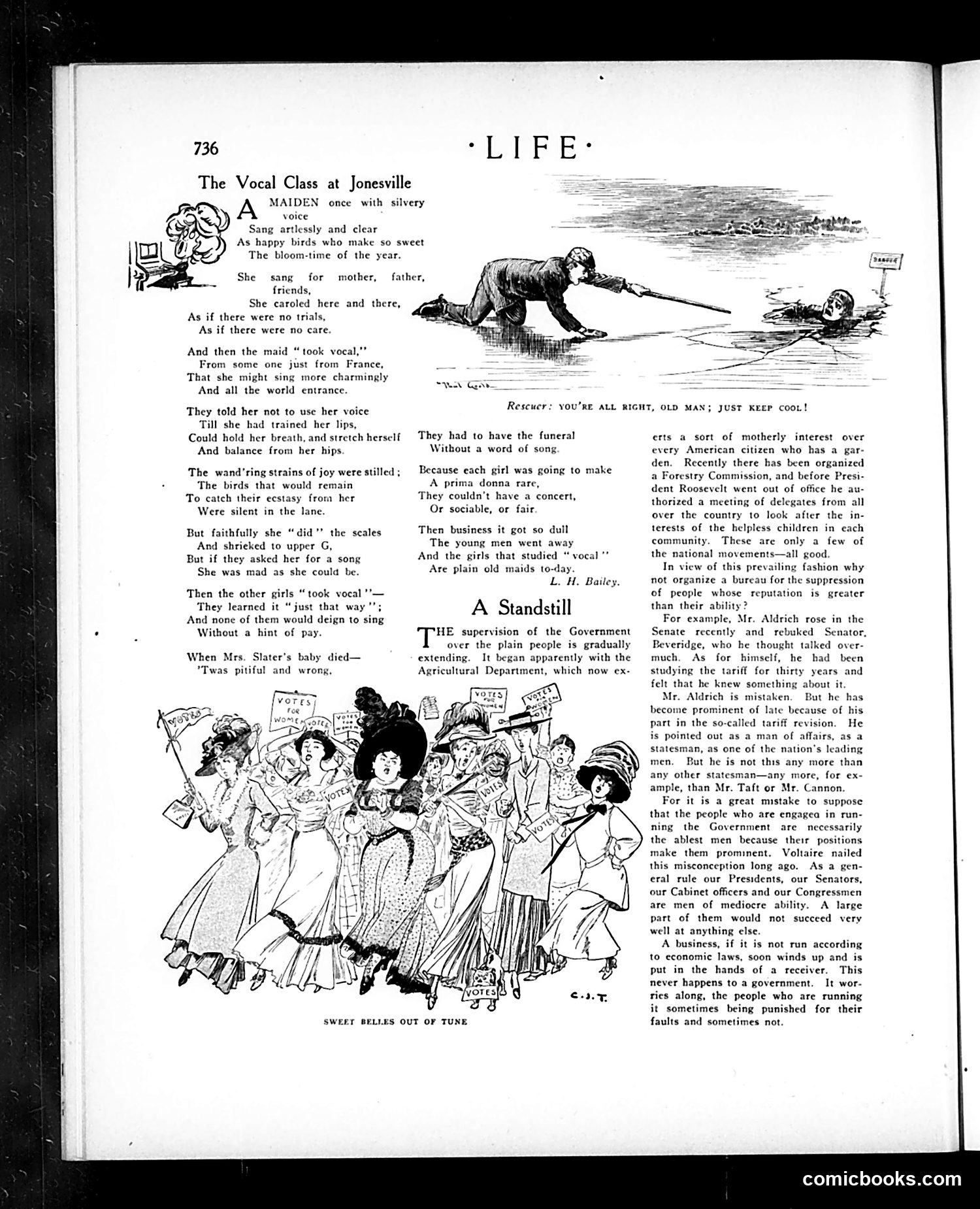
This page contains two satirical pieces. "The Vocal Class at Jonesville" is a poem mocking women's singing groups, suggesting their voices were unpleasant and their ambitions misguided—a dig at amateur female performers. "A Standstill" discusses government inefficiency, specifically criticizing the Agricultural Department's expanding oversight of "plain people." The accompanying cartoon "Sweet Belles Out of Tune" depicts women voting or participating in civic activities (visible "votes" signs), satirizing women's political engagement as chaotic and unharmonious. The satire reflects early-20th-century anti-suffrage and anti-progressive sentiment—mocking both women's public participation and government expansion as ridiculous, excessive, and destabilizing to proper order.
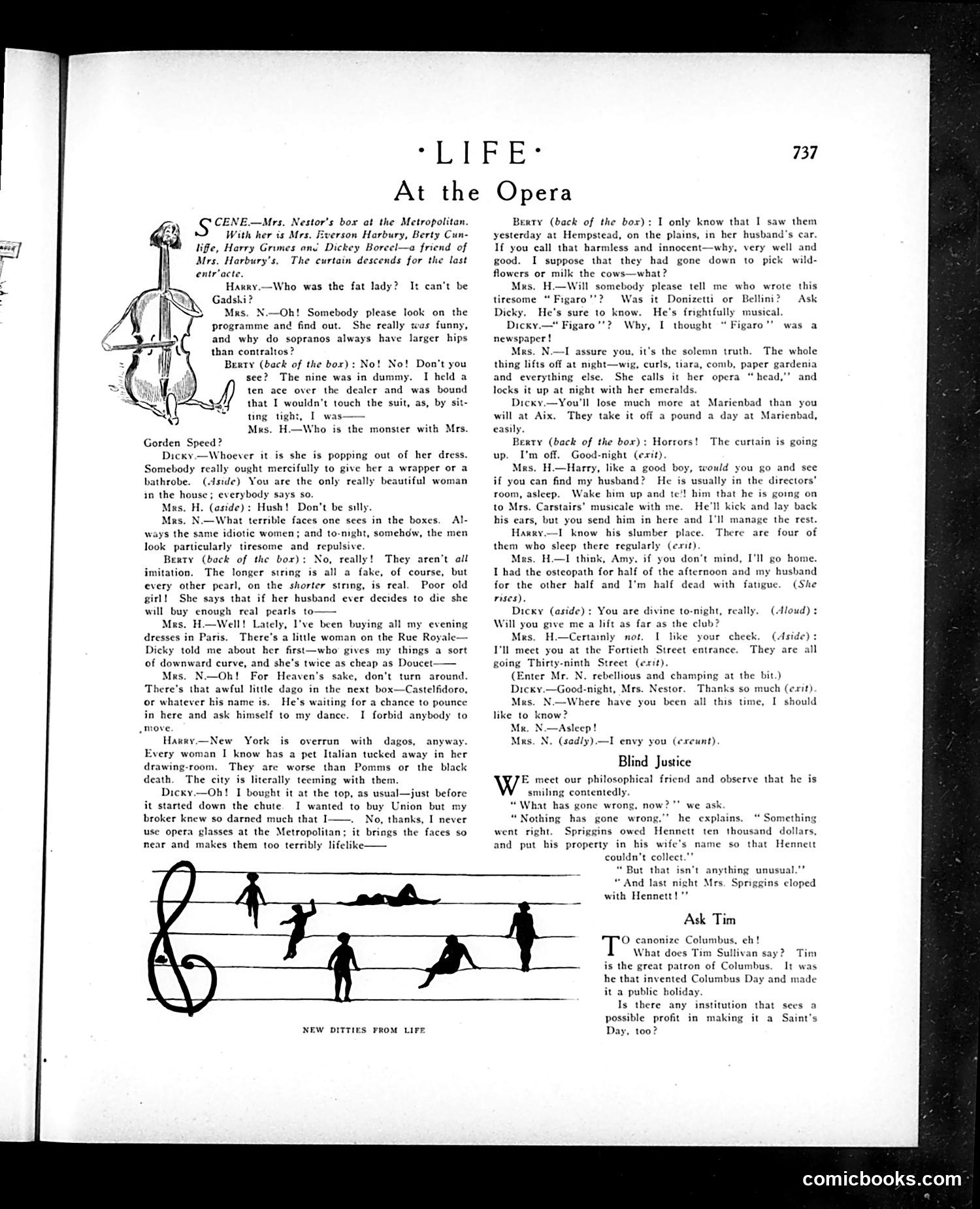
This is a satirical dialogue about opera-goers, not a political cartoon. The humor targets the pretensions and superficiality of wealthy opera attendees. The conversation mocks: - **Social climbing**: Characters obsess over who wears what and the status of being seen at the opera - **Gossip and scandal**: References to "Figaro" (the opera), infidelity, and social intrigue - **Physical appearance**: Mean-spirited comments about a "fat lady" and women's bodies - **Marital discord**: Husbands sleeping through performances while wives socialize The illustration below shows figures on musical staff lines, visually punning on opera's connection to music. The overall satire suggests that for many attendees, the opera serves as a venue for social performance rather than genuine artistic appreciation. It's mockery of upper-class manners and values.
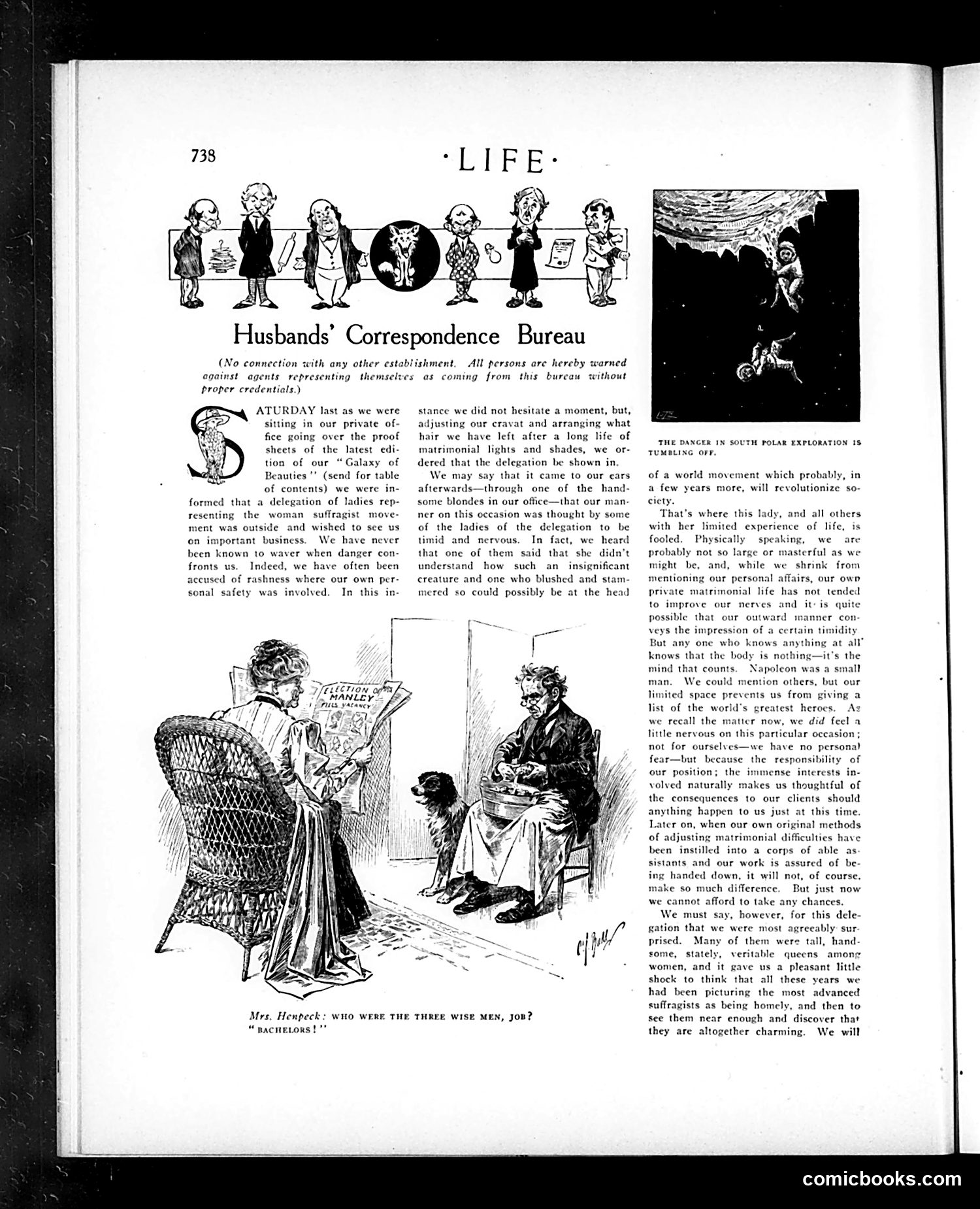
This is a satirical advice column mockup titled "Husbands' Correspondence Bureau." The header illustration shows various caricatured figures representing different husband "types." The main cartoon depicts Mrs. Henpeck confronting three men, with the caption "WHO WERE THE THREE WISE MEN, JOB? 'BACHELORS!'" The satire targets henpecked husbands—men dominated by their wives. The joke references the biblical Job (a man of suffering) and the Three Wise Men, suggesting that the only truly "wise" men are bachelors who avoid marriage altogether. The column warns husbands against involving themselves in their wives' affairs, emphasizing that domestic life creates anxiety and nervousness—particularly when wives are involved in public movements or delegations. The satire mocks both nagging wives and the anxieties of married men in early 20th-century domestic life.
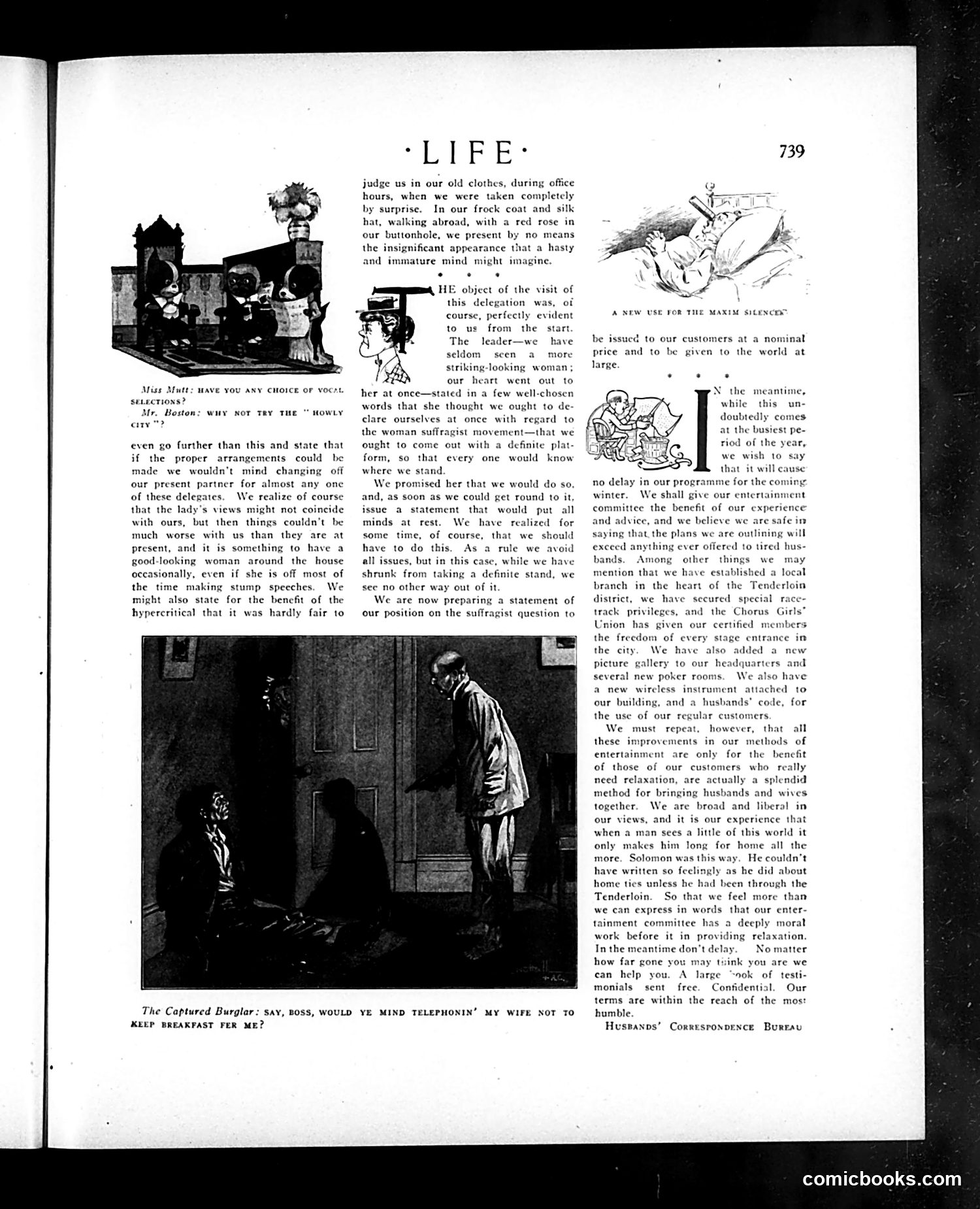
This page contains two illustrated vignettes satirizing domestic life and gender relations: **Top left cartoon** ("Have you any choice of vocal soloists?") depicts a woman auditioning singers, mocking the era's expectation that affluent women would patronize the arts while remaining largely ornamental. **Bottom illustration** ("The Captured Burglar") shows a burglar confronted by a homeowner, with dialogue suggesting the burglar pleads: "Say, boss, would ye mind telephonin' my wife not to keep breakfast fer me?" This satirizes working-class domestic anxiety—even criminals prioritize notifying wives about meals—poking fun at both marital obligation and the burglar's mundane domestic concerns despite his criminal predicament. The surrounding text discusses a women's suffrage delegation visit, indicating this issue engaged contemporary debates about women's rights and roles.
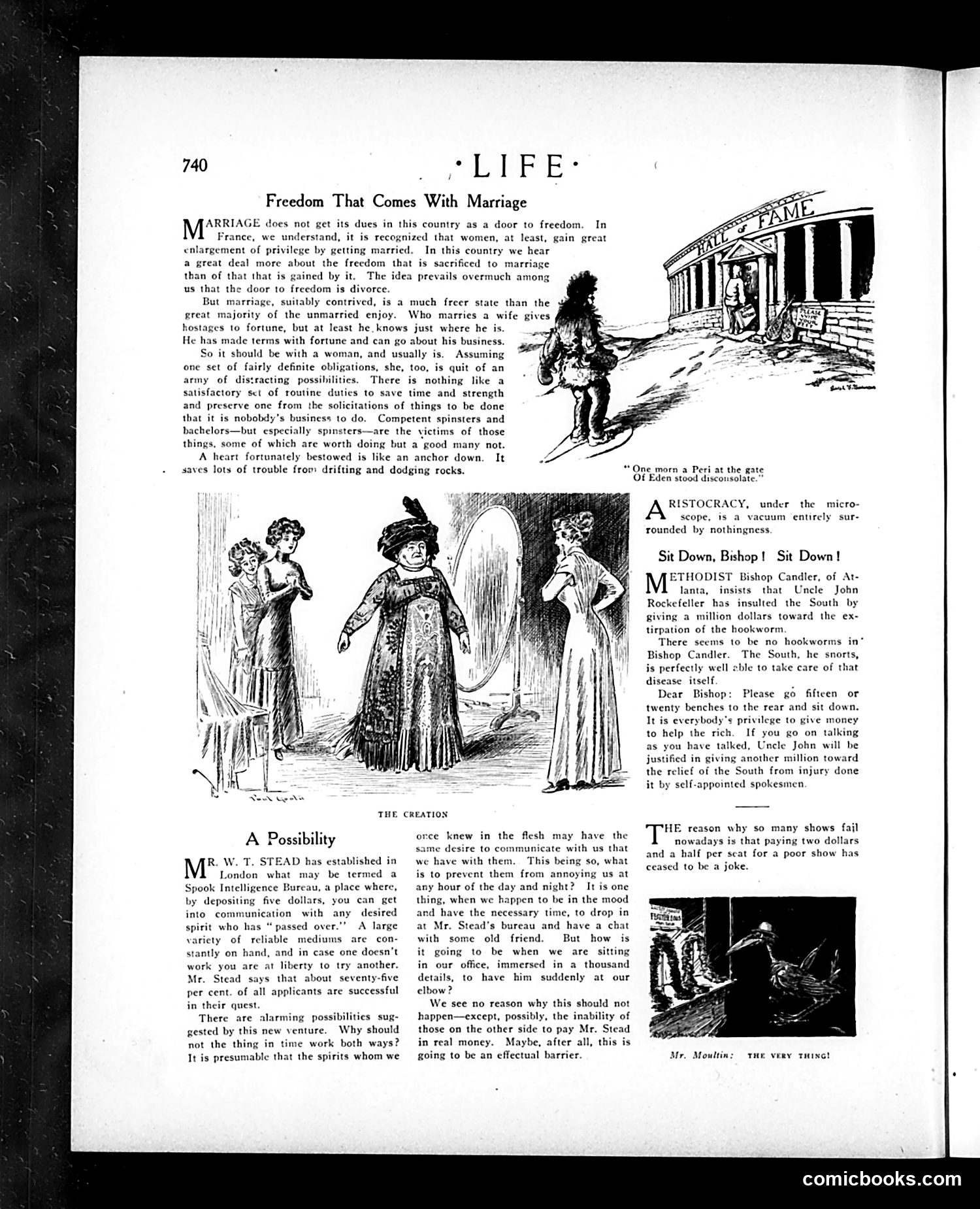
This Life magazine page satirizes early 20th-century social issues through three pieces: **"Freedom That Comes With Marriage"** argues marriage paradoxically restricts freedom more than it liberates, especially for women. The text claims married men gain more freedom than unmarried men enjoy, but married women lose significantly. **"The Creation"** illustration depicts a woman admiring herself in a mirror—a classical artistic reference to vanity, likely satirizing female narcissism. **"A Possibility"** discusses Mr. Stead's "Spook Intelligence Bureau"—apparently a spiritualist séance service in London where clients pay to communicate with deceased spirits. The satire questions why this dubious venture hasn't already failed, suggesting gullibility about supernatural claims. The page reflects Progressive-era skepticism toward both traditional marriage constraints and spiritualist fraud.
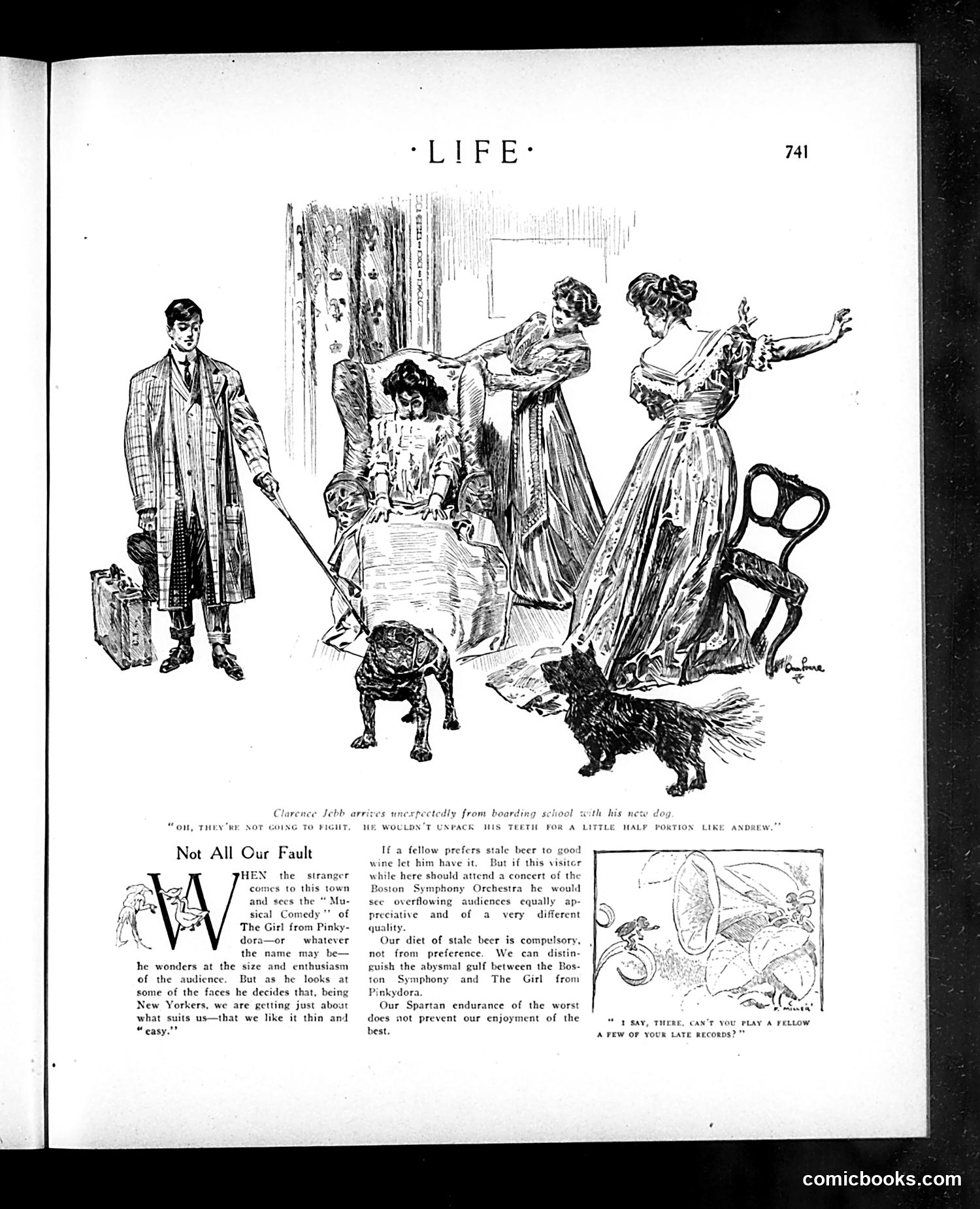
This page features two satirical pieces from *Life* magazine (page 741): **Upper illustration:** Titled "Clarence Jebb arrives unexpectedly from boarding school with his new dog," depicts a young man's arrival home, where his family reacts with exaggerated dismay at his new pet. The humor targets upper-class domestic disruption—the dog's presence creates chaos among the fashionable women and household, suggesting anxiety about unexpected changes to refined domestic order. **Lower article:** "Not All Our Fault" compares attending "The Girl from Pinkydale" (a musical comedy) to drinking stale beer—both are mediocre but tolerable. The satire mocks theatrical audience expectations and theater-goers' resignation to low-quality entertainment, suggesting New Yorkers accept substandard performances without complaint, making poor taste seem socially acceptable among the cultured class.
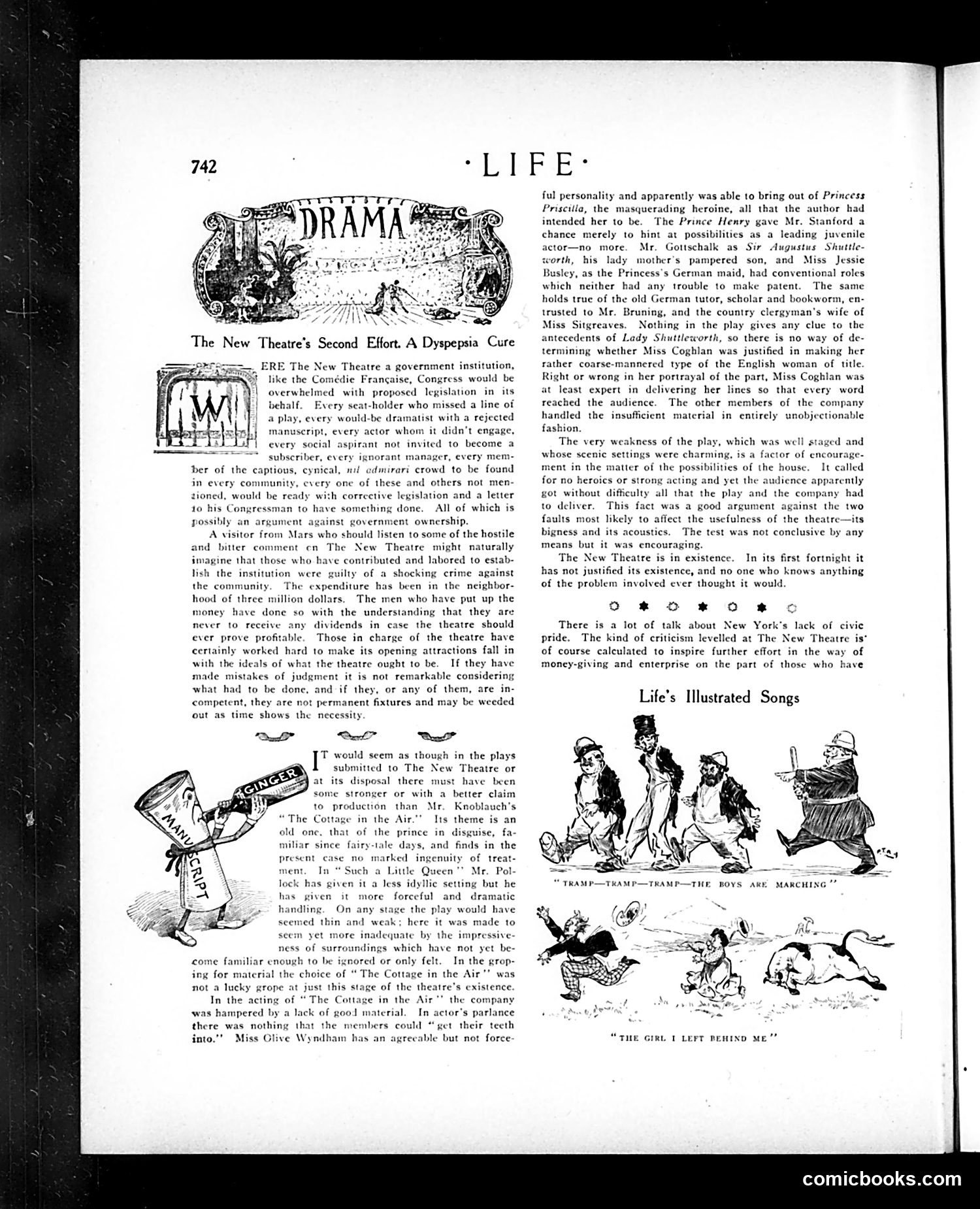
This page critiques **The New Theatre's** second production, "The Cottage in the Air," a play about a disguised princess. The reviewer argues the production is weak despite impressive staging and resources. **The Satire:** The opening section mocks government arts funding by imagining if The New Theatre were publicly owned—Congress would be flooded with complaints from disgruntled theatergoers, failed playwrights, and rejected actors demanding legislation. This satirizes democratic tendency toward frivolous complaints and bureaucratic interference. **The Criticism:** The play itself is dismissed as derivative (a tired "prince in disguise" fairy tale). The reviewer notes impressive sets and conscientious effort don't compensate for thin material. Actors like Miss Wyndham performed well with limited roles, but the script gave them little to work with. **The Point:** Even well-intentioned, well-funded theatrical ventures fail with poor material—a critique of The New Theatre's judgment, not its mission.
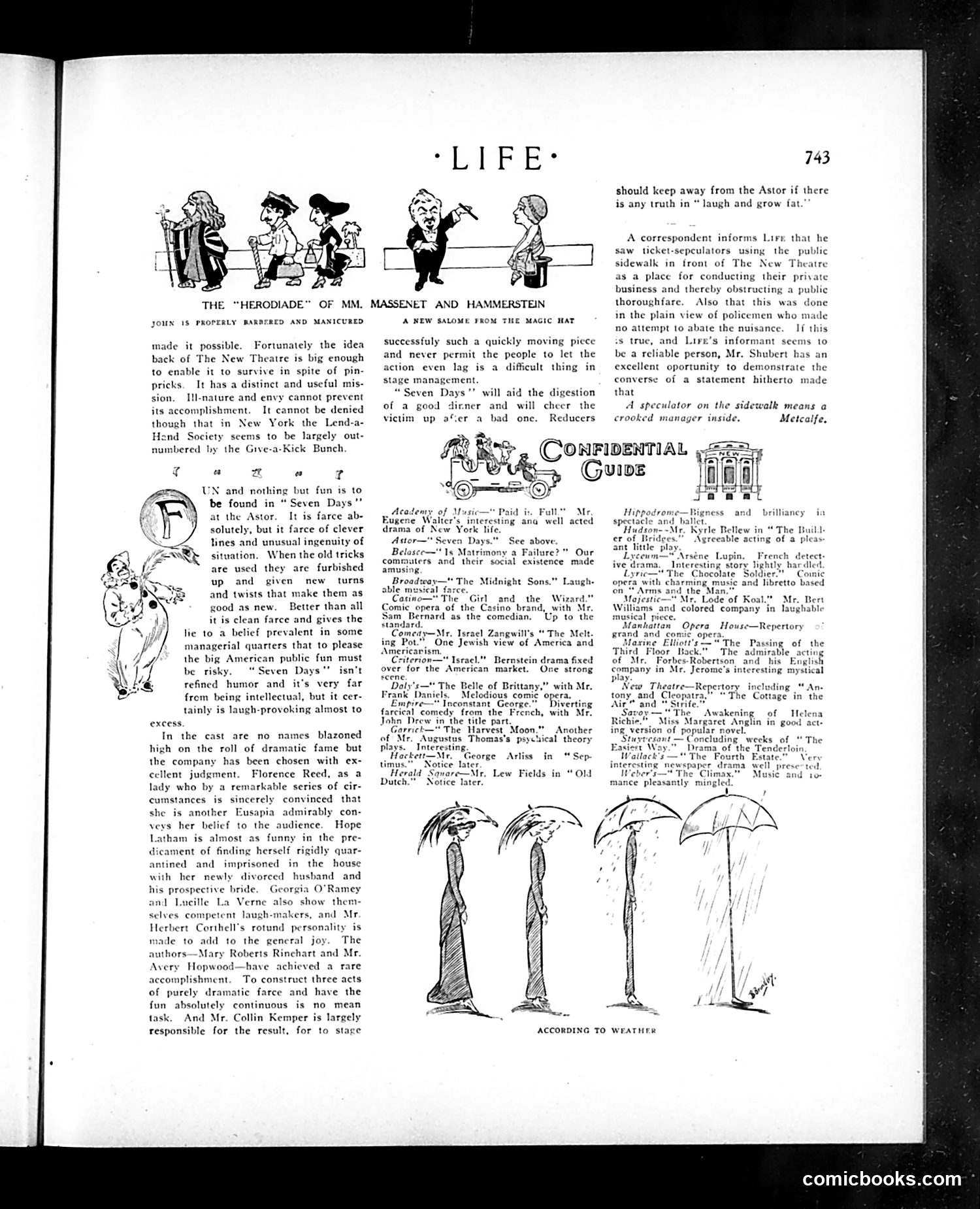
This page reviews New York theatrical productions from the early 1900s. The top cartoon depicts figures labeled "Herodiade" of Massenet and Hammerstein—a reference to the operatic work being "barbered and manicured" (refined or altered). The main text discusses "Seven Days," a farce at the Astor Theatre by Mary Roberts Rinehart and Avery Hopwood. The reviewer praises it as clever, clean fun that challenges the notion that American audiences require risqué material for entertainment. The cast includes Florence Reed and Hope Latham in comedic situations. A sidebar note criticizes ticket scalpers operating outside The New Theatre while police ignore them—suggesting corrupt management allows this public obstruction. The "Confidential Guide" section briefly reviews other Broadway productions including comic operas and dramas, maintaining the satirical tone characteristic of *Life* magazine's theater criticism of the era.
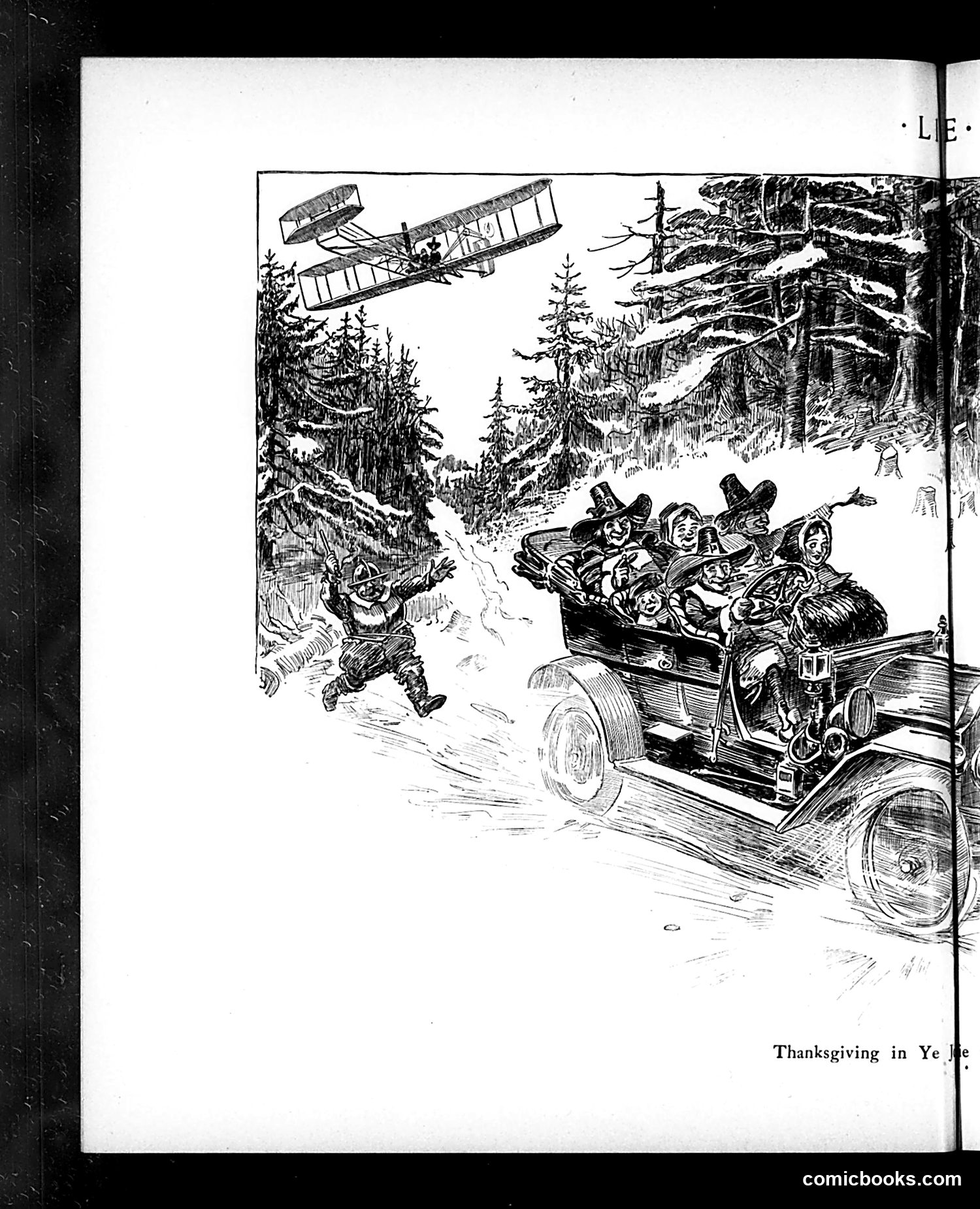
This satirical illustration depicts a chaotic Thanksgiving scene with anachronistic humor. An early airplane flies overhead while a group of people in an old-fashioned automobile speeds through a snowy forest landscape, seemingly fleeing or pursuing something. A lone figure on foot (left) gestures urgently. The joke appears to be about the contrast between "ye olde" (old-fashioned) Thanksgiving traditions and modern technology—likely mocking how contemporary life (automobiles, aviation) has disrupted or transformed traditional holiday celebrations. The frantic energy and crowded car suggest the modern chaos of holiday travel, a satirical commentary on how Thanksgiving had become a rushed, mechanized affair rather than a serene, traditional gathering.
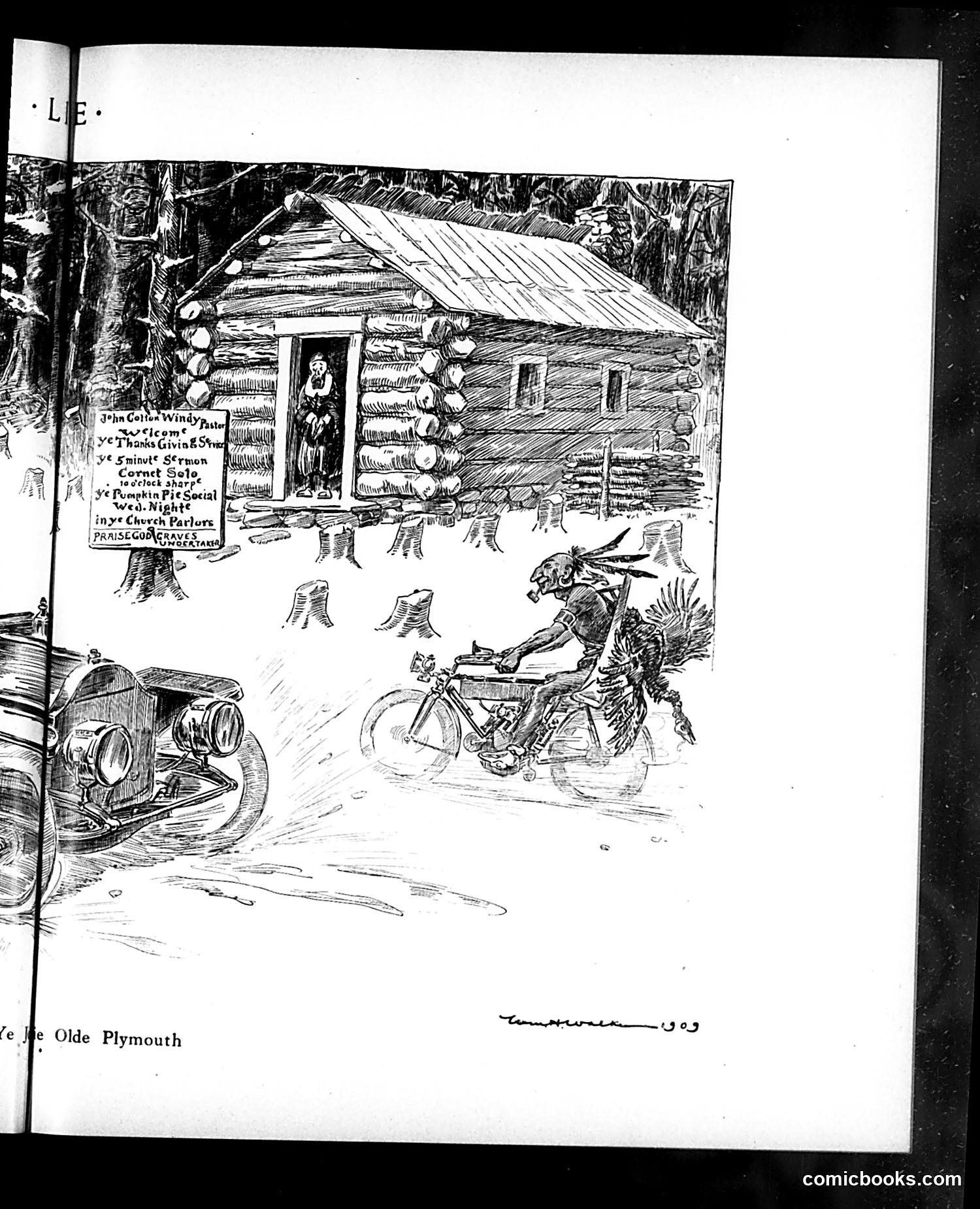
This is a satirical illustration titled "Ye Olde Plymouth" depicting a colonial-era log cabin with anachronistic humor. A figure on a bicycle—an obviously modern invention—rides past the cabin while a period-dressed person stands in the doorway. The cabin advertises various colonial-era activities (hymn singing, pie socials, church services). The joke appears to be about the collision between historical authenticity and modern tourism or commercialization of "Old Plymouth" attractions. The bicycle represents the contemporary world intruding on carefully staged historical recreations. The character name "Praisegod Graves" suggests mock-Puritan nomenclature, reinforcing the satire of commercialized colonial nostalgia—treating genuine history as quaint entertainment rather than serious heritage.
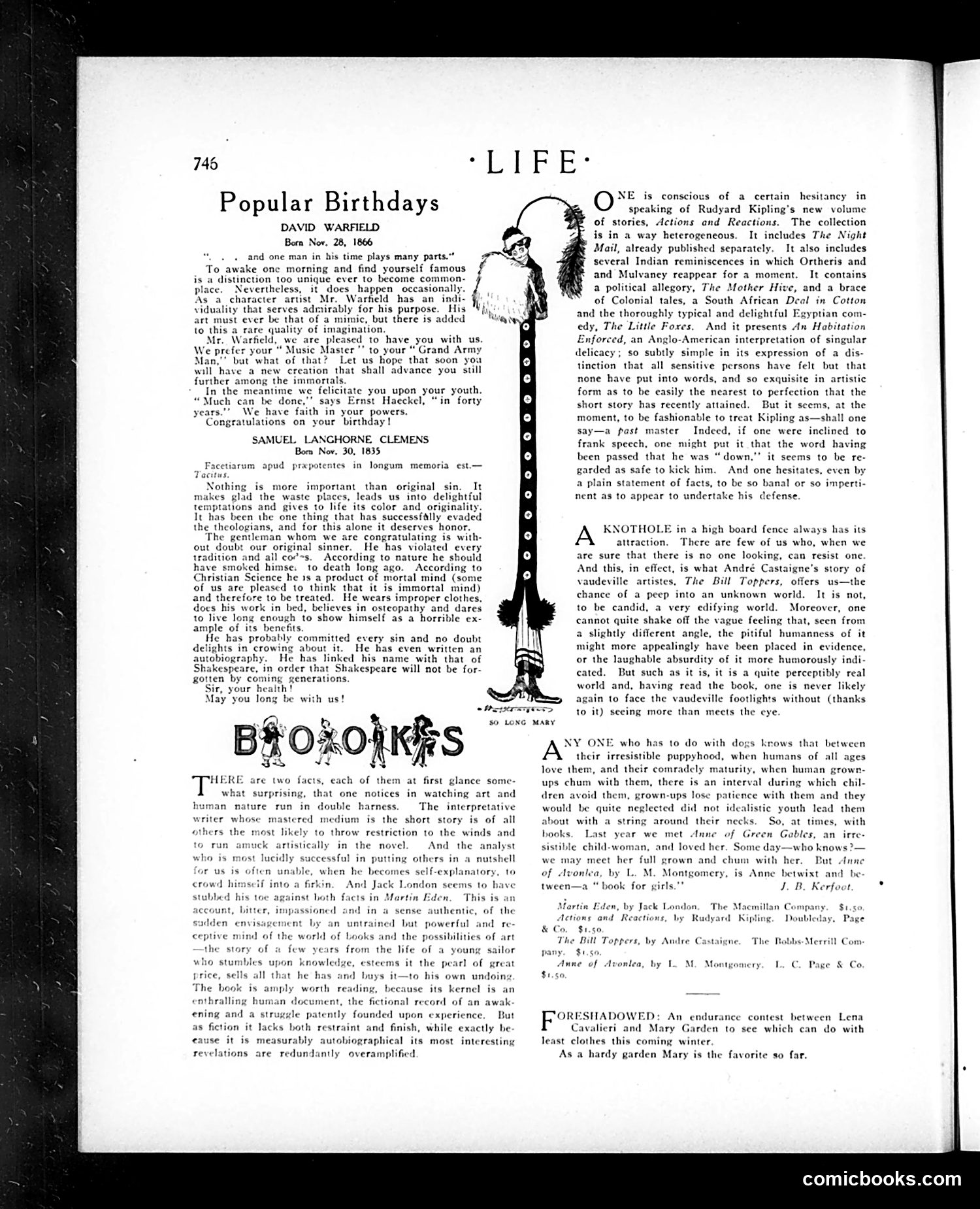
This page from *Life* magazine contains birthday congratulations to three notable figures: actor David Warfield, author Samuel Clemens (Mark Twain), and—based on the visible text—likely Rudyard Kipling. The satire here is affectionate rather than cutting. The Clemens entry especially mocks his legendary rule-breaking: he smoked excessively, dressed poorly, worked in bed, believed in osteopathy, and—most amusingly—"linked his name with that of Shakespeare, in order that Shakespeare will not be forgotten by coming generations." This playfully suggests Twain's outsized ego and unconventional life made him a living scandal to respectable society, yet somehow he thrived anyway. The Warfield entry praises his skill as a character actor while gently ribbing his repertoire choices. The magazine's tone is one of affectionate ribbing toward celebrated figures who violated Victorian social conventions while achieving fame—treating their nonconformity as endearingly audacious rather than condemnable.
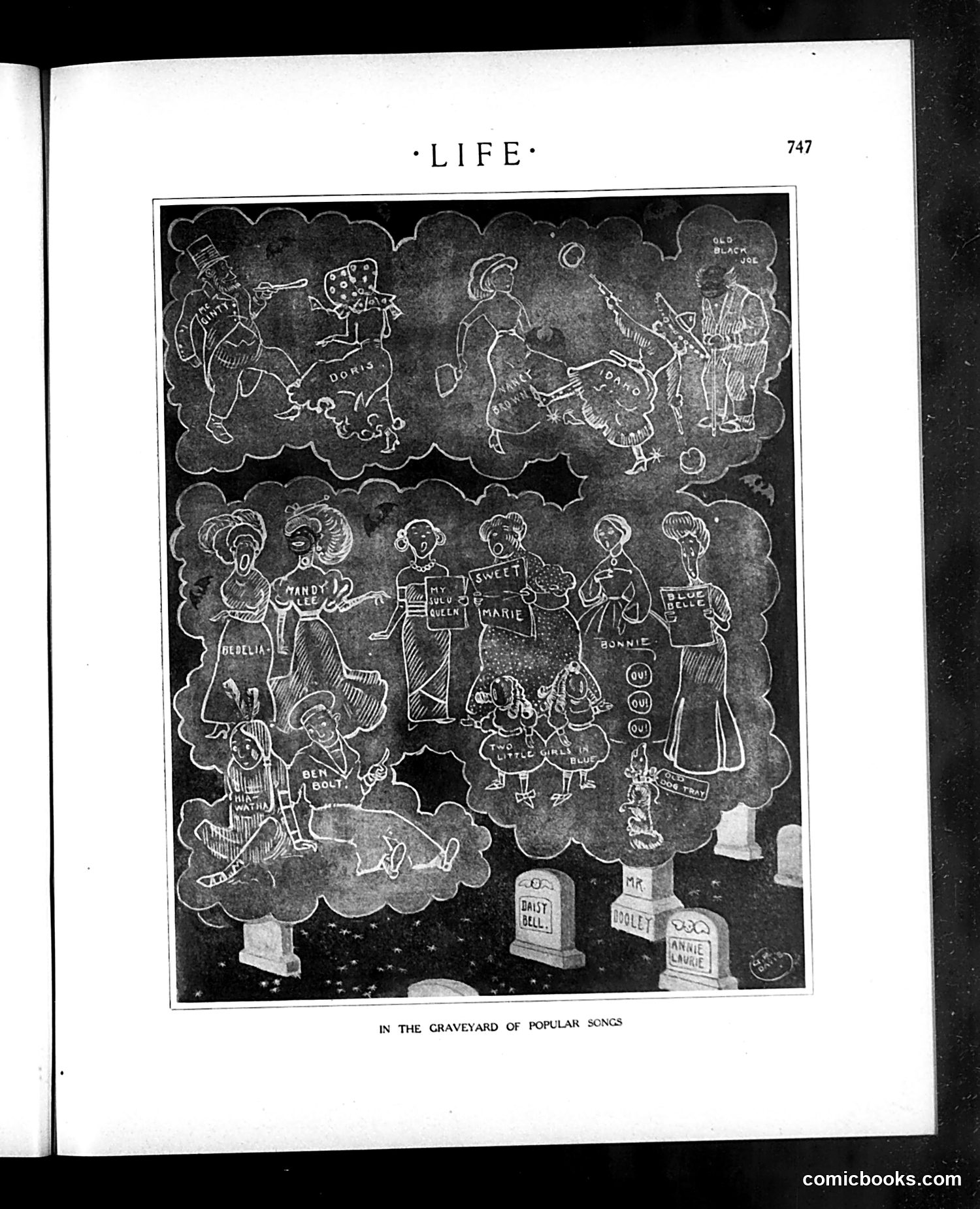
This cartoon depicts deceased popular songs as ghosts and tombstones in a cemetery. The illustration shows figures labeled with song titles (visible names include "Daisy Bell," "Sweet Marie," "Bonnie," and others) arranged in cloud-like thought bubbles above gravestones. The satire mocks the rapid obsolescence of popular music—songs that were once beloved hits have become forgotten "dead" entertainment. The graveyard setting literalizes this cultural death, suggesting how quickly musical trends change and older songs fade from public memory. This reflects early-20th-century anxiety about mass entertainment's fleeting nature and the constant churn of commercial popular culture, where yesterday's hits quickly become relics.
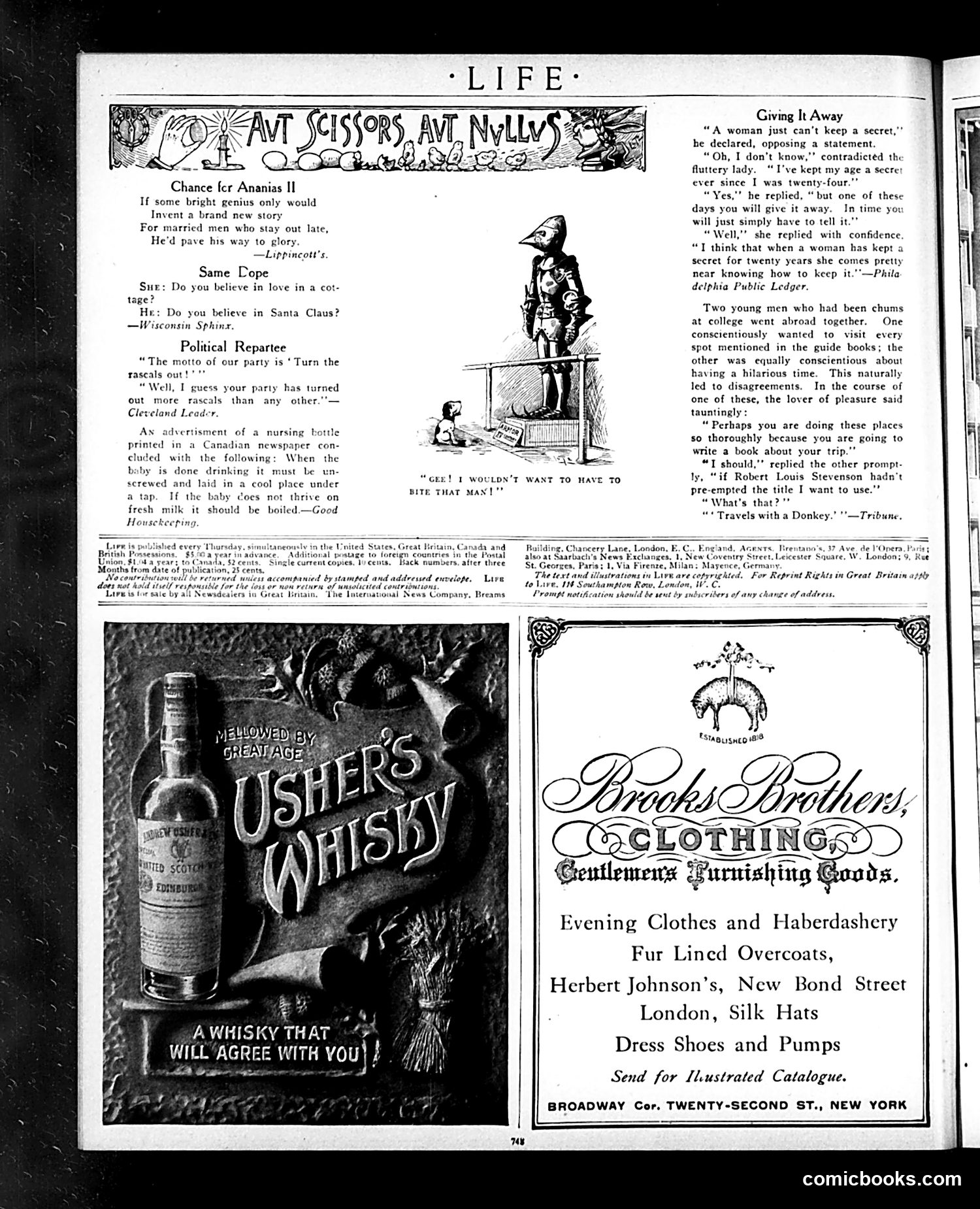
This page from *Life* magazine contains several short satirical jokes and a central cartoon, typical of the publication's humor format. The main cartoon depicts a soldier standing over a small child, with the caption "GEE! I WOULDN'T WANT TO HAVE TO BITE THAT MAN!" The joke satirizes military recruitment propaganda—the child's naive comment implies the soldier looks tough and intimidating, inverting the intended message of strength. The surrounding text contains brief quips mocking common situations: a husband's need for new excuses to stay out late, romantic idealism ("love in a cottage" versus Santa Claus), political hypocrisy, and a humorous mishap in a product advertisement about nursing bottles. The "Travels with a Donkey" reference jokes that a man following guide books so dutifully he won't even write about his trip—Robert Louis Stevenson already claimed that title with his famous travel memoir. The page is primarily advertising, featuring Usher's Whisky and Brooks Brothers clothing.
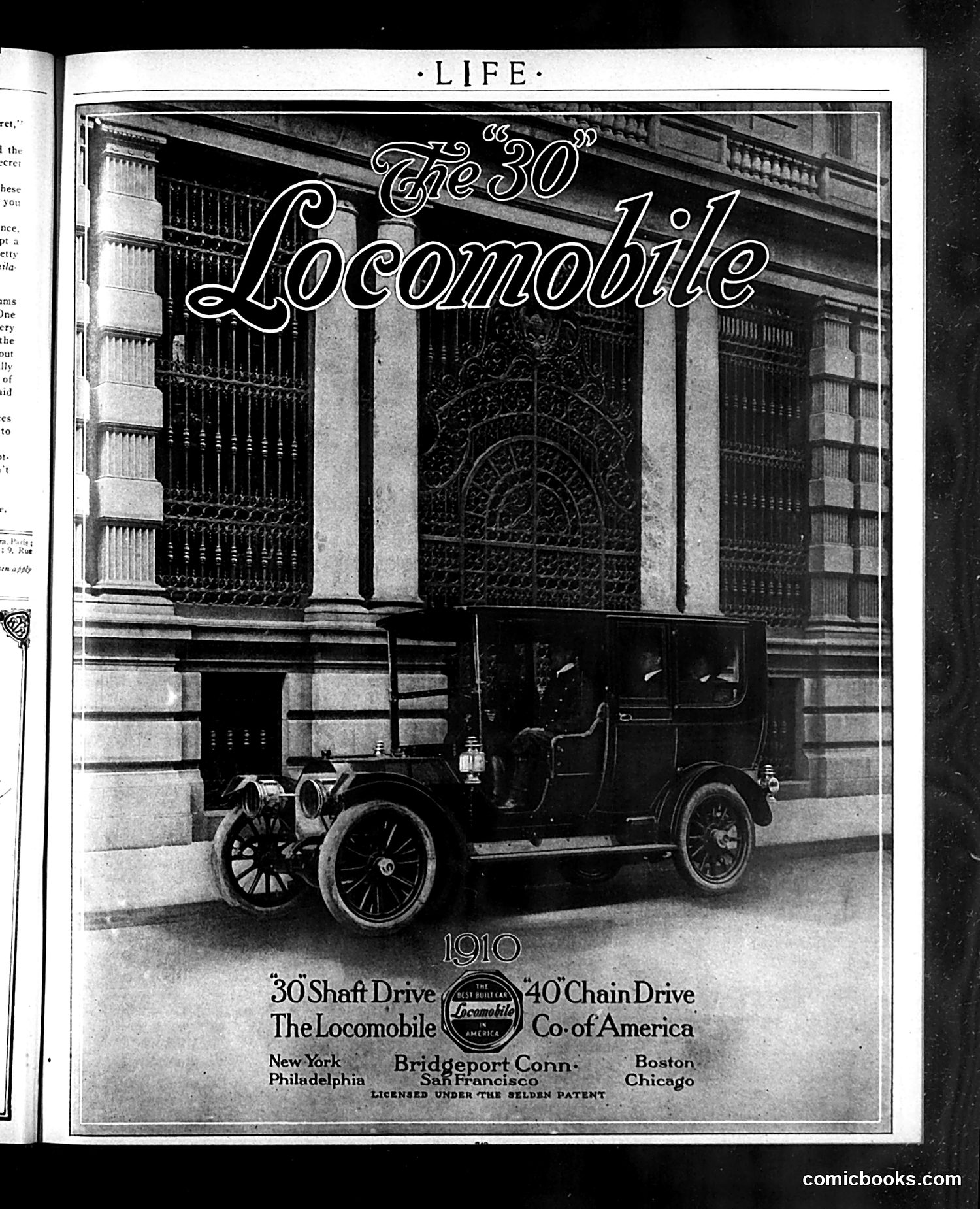
This is **not a cartoon or satirical content** — it's a **full-page advertisement** for the 1910 Locomobile automobile, published in Life magazine. The ad features a photograph of a black, early-model touring car positioned against an ornate building facade with classical columns and decorative ironwork. The car's design reflects early 1910s automotive styling with spoke wheels and an open cabin. The Locomobile Company of America advertised their "30" model with two drivetrain options: shaft drive and chain drive. The company had offices in major American cities (New York, Philadelphia, Boston, Chicago, San Francisco, and Bridgeport, Connecticut). The advertisement is licensed under the Selden Patent, a significant automotive patent of the era. This is essentially vintage product marketing, not political or social satire.
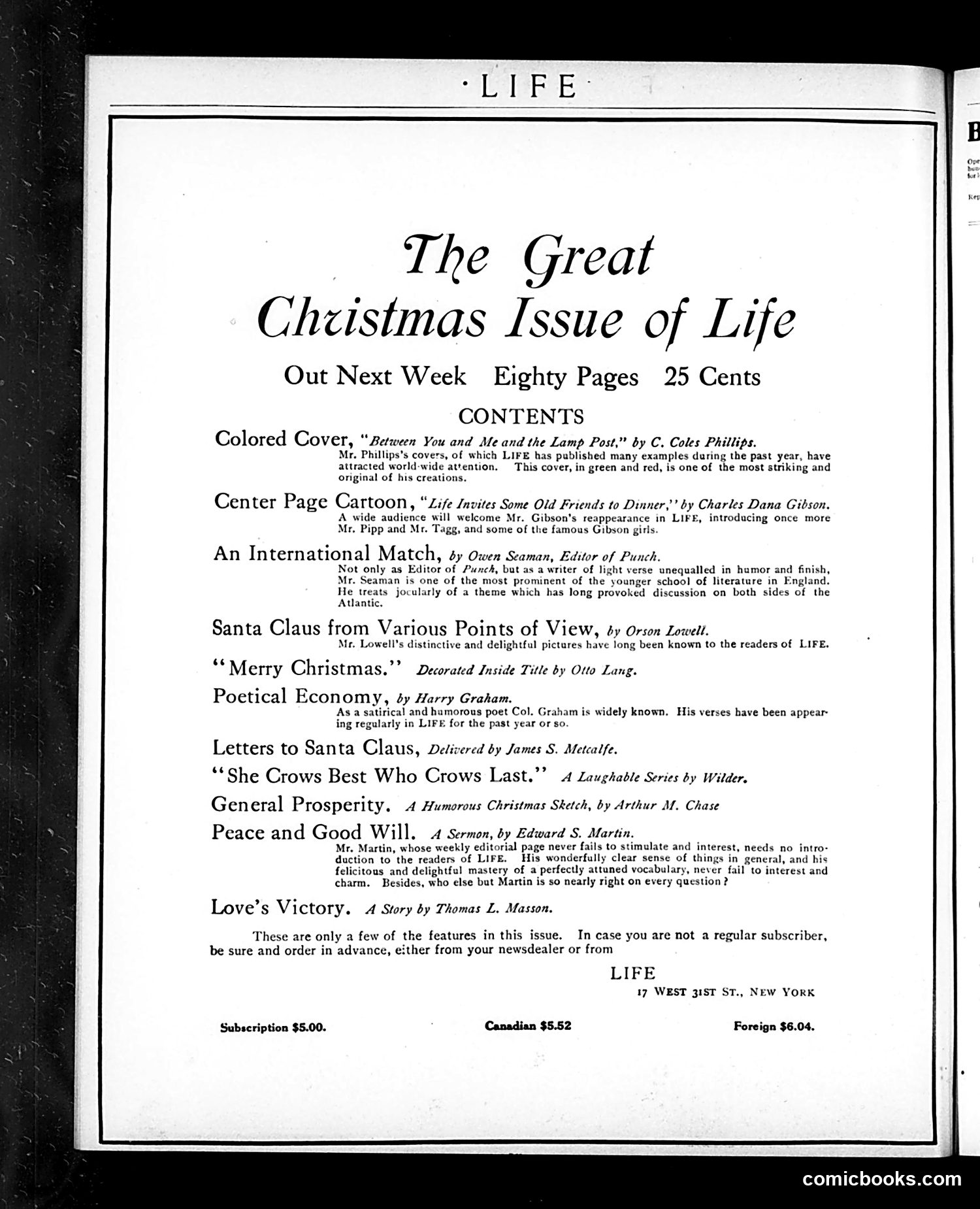
This is a promotional page announcing Life magazine's upcoming Christmas issue. Rather than containing cartoons, it's a contents listing showcasing the publication's contributors and features. Key attractions include Charles Dana Gibson's center-page cartoon featuring his famous "Gibson Girls," and Owen Seaman (editor of British *Punch* magazine) contributing an "International Match"—likely comparing American and British perspectives on an unspecified topic that had caused transatlantic debate. The issue also features illustrations by Orson Lowell, humorous poetry by Colonel Harry Graham, and editorial pieces by Edward S. Martin. The 80-page special costs 25 cents—positioning this as premium holiday content for early 1900s readers seeking sophisticated American satire and illustration.
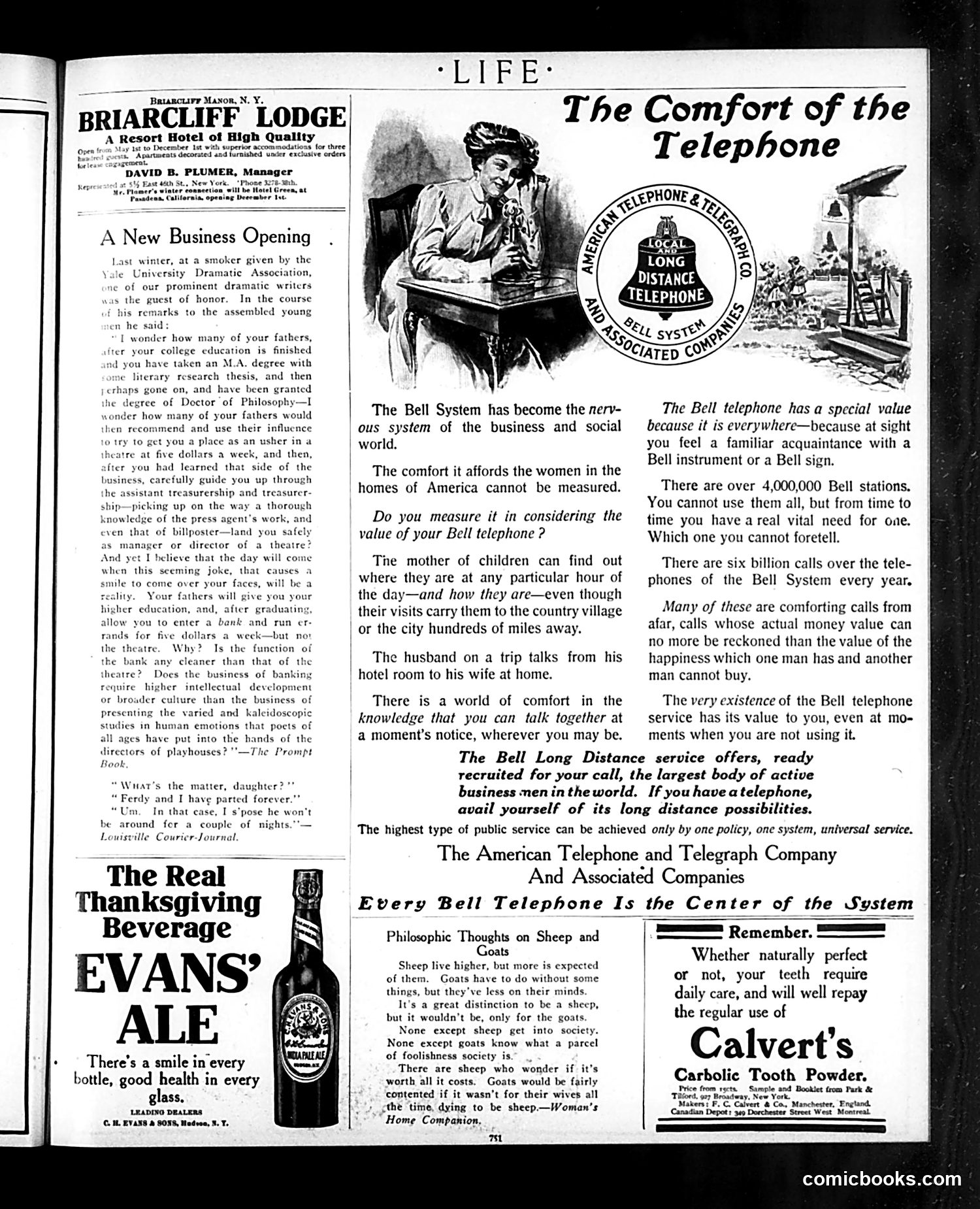
This page is primarily **advertising content**, not political satire. The main feature is a Bell Telephone System advertisement promoting long-distance calling as essential to modern life. **Key elements:** The ad uses emotional appeals—mothers checking on children, husbands away on business trips—to frame the telephone as indispensable for comfort and connection, not mere utility. The illustration shows a well-dressed woman at a desk, representing the "modern" American housewife. **Context:** This reflects early-20th-century corporate marketing that positioned emerging technologies as solving emotional/social needs rather than practical ones. The Bell System monopoly controlled American telephony and promoted itself as a public good. **Other content:** The page includes hotel advertising, a theatrical piece on career advancement, and advertisements for Evans' Ale and Calvert's Tooth Powder—typical Life magazine filler. No clear political cartoons or satire appear on this particular page.
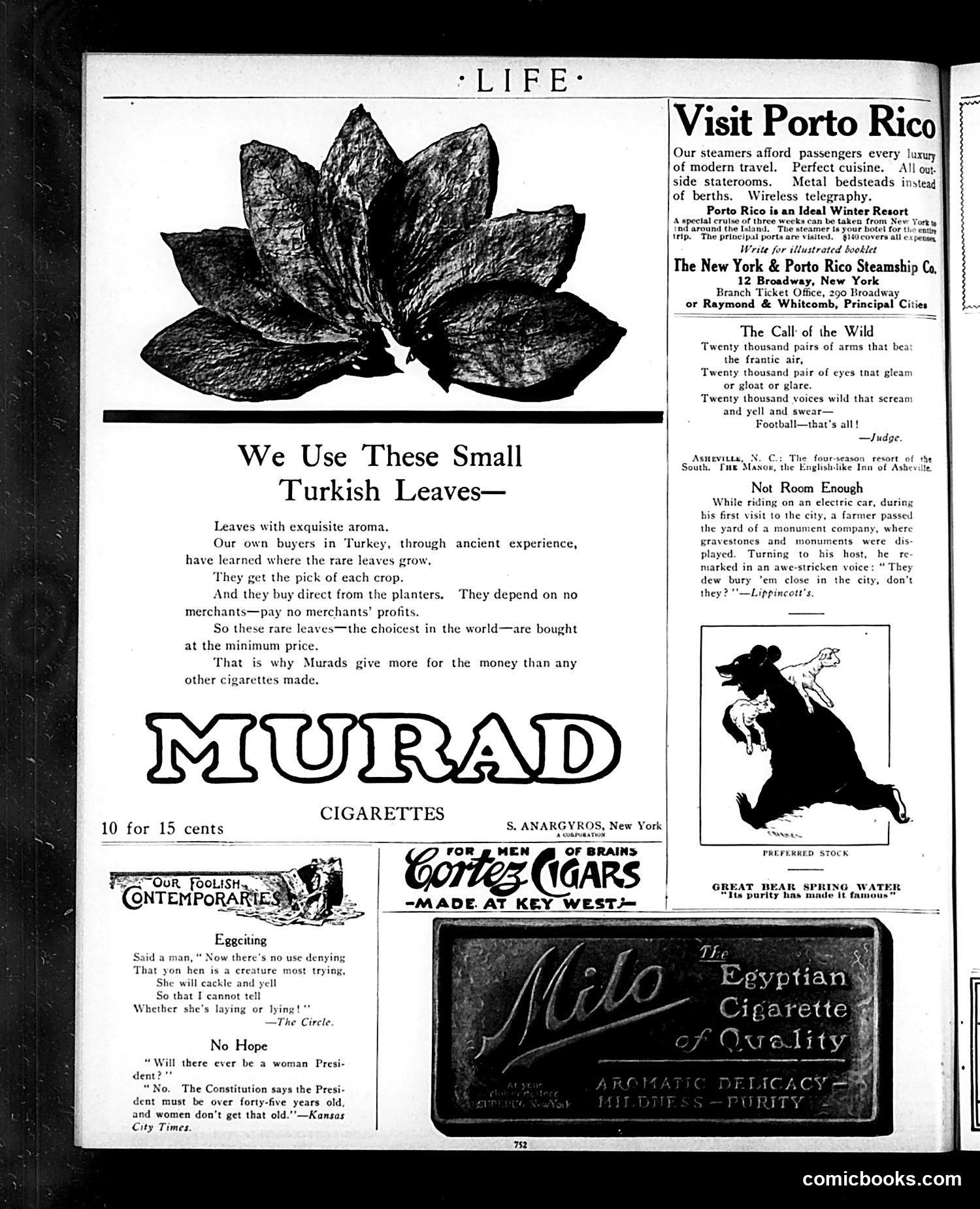
This page is primarily **advertising** for cigarette and travel brands, with brief humorous fillers typical of early 20th-century magazines. **Main Advertisement:** Murad cigarettes emphasizes direct sourcing from Turkish tobacco growers, claiming superior quality at better value than competitors. **Humor Sections:** Three short jokes appear: 1. "Eggciting"—a pun about a hen's confusing behavior 2. "No Hope"—satire suggesting women will never become U.S. President because the Constitution requires the president be over 45, and women allegedly "don't get that old" (mocking both age discrimination and anti-women sentiment) 3. "Not Room Enough"—a rural farmer visiting a city cemetery assumes graves are packed densely because of urban space constraints **Other Ads:** Porto Rico steamship travel, Cortez cigars, Great Bear spring water, and Egyptian cigarettes round out the page. The humor reflects period attitudes: sexism, rural-urban stereotypes, and gentle absurdism rather than sharp political satire.
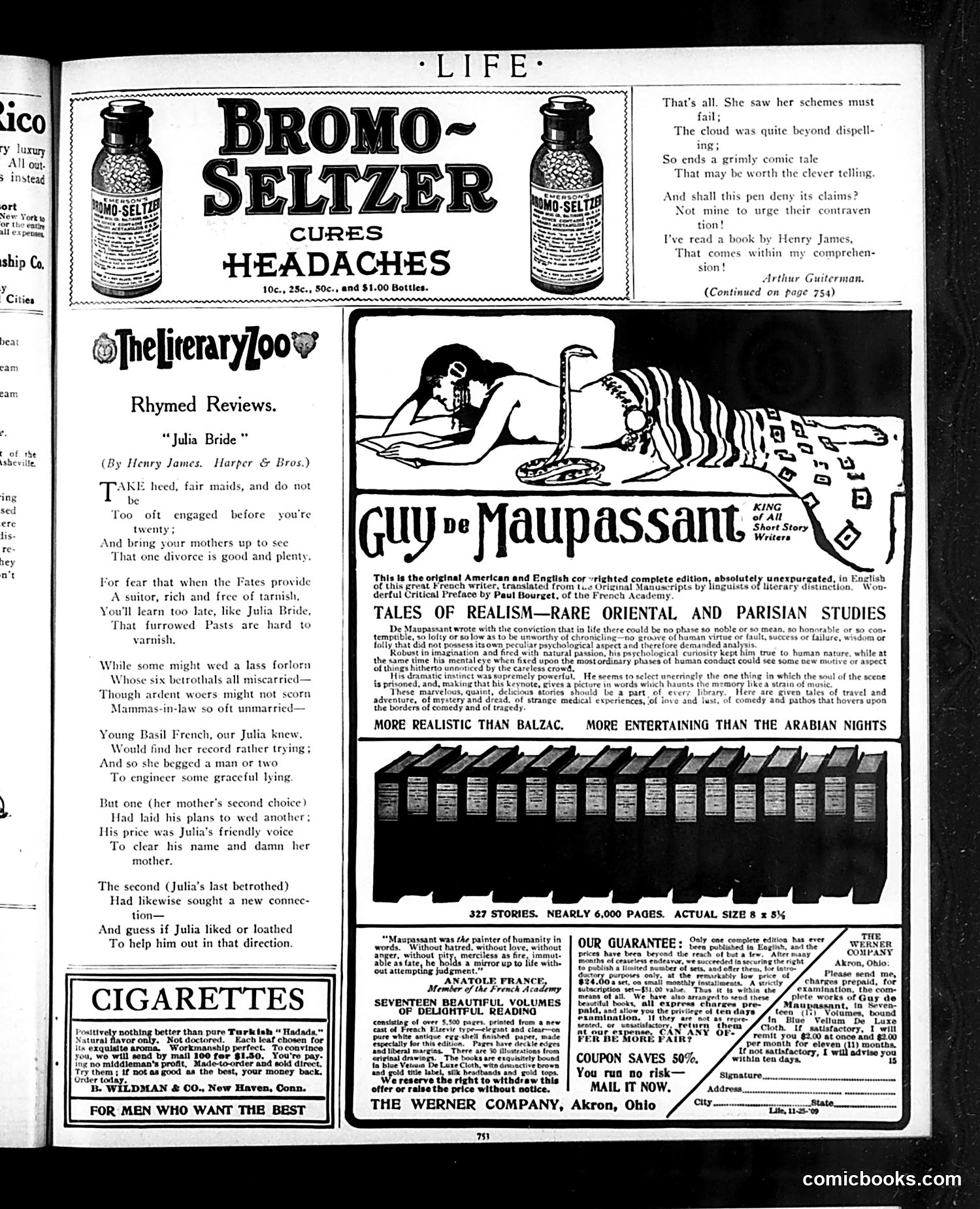
This page from *Life* magazine contains literary and advertising content typical of early 20th-century periodicals. **"Julia Bride" Review (top):** Arthur Guiterman's humorous verse reviews Henry James's novella about a young woman with multiple failed engagements trying to hide her romantic past. The satire mocks how divorce and broken engagements were social scandals for marriageable women—her "tarnished" record makes suitors unreliable. The poem jokes that even men willing to marry her use her as a pawn in their own schemes, illustrating the cynical marriage market of the era. **Advertisement dominance:** The page is primarily advertisements for books (*Guy de Maupassant* collected works, *Bromo-Seltzer*) and Turkish cigarettes, typical of *Life*'s revenue model. **Context for modern readers:** Early 1900s society treated women's romantic history as a permanent liability affecting marriageability and social standing—a concern largely obsolete today.
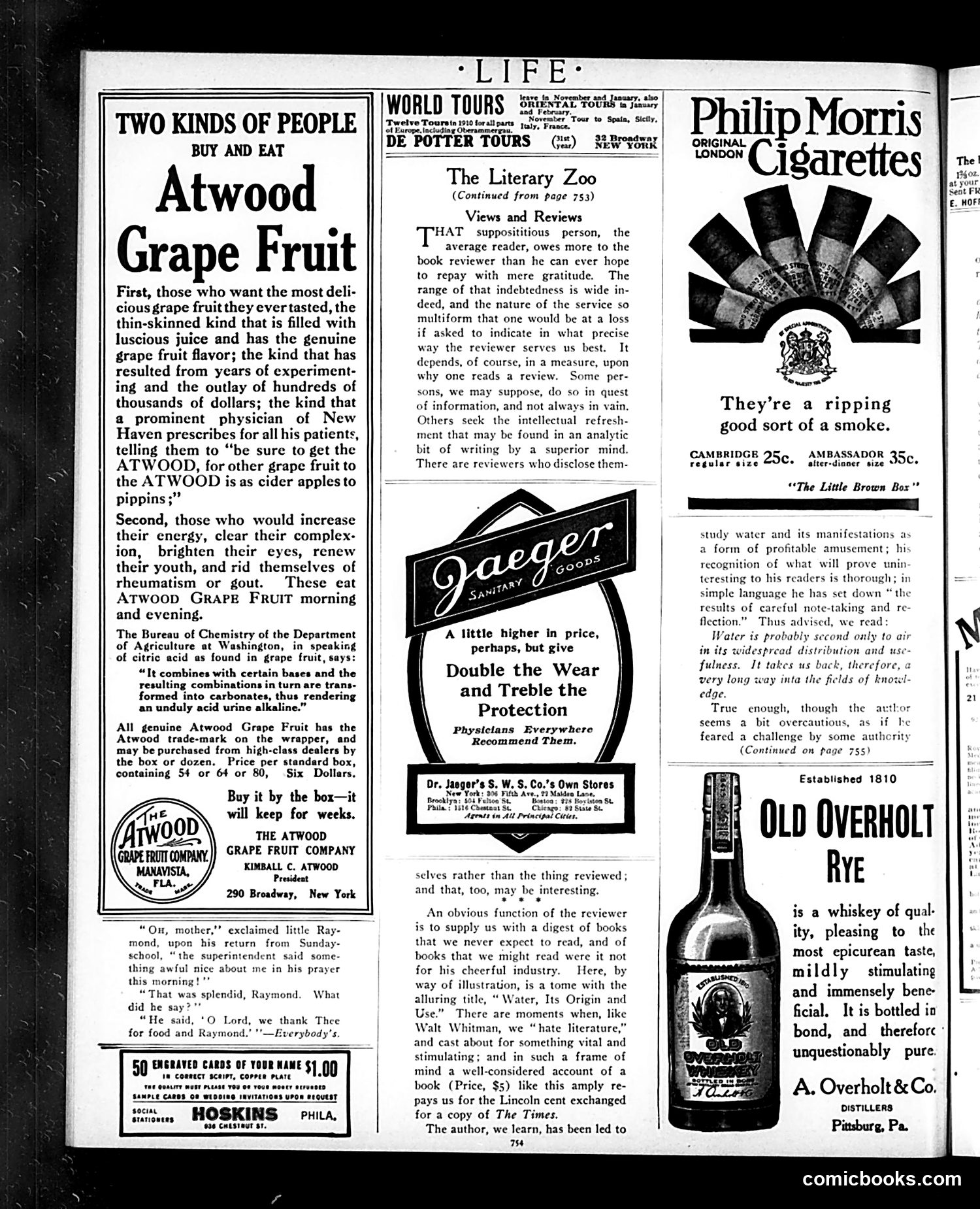
This page is primarily **advertising with some editorial content**. The main satirical element is a brief anecdote at bottom-left: a child returns from Sunday school saying the superintendent prayed, "O Lord, we thank Thee for food and Raymond"—joking that the child equates himself with necessities, inflating his own importance. The bulk of the page contains product advertisements for Atwood Grape Fruit, Philip Morris cigarettes, Old Overholt Rye whiskey, and travel tours. These ads employ common early-20th-century marketing tactics: appeals to authority (prominent physicians), pseudo-scientific claims (citric acid making urine alkaline), and lifestyle branding. The "Literary Zoo" section discusses book reviewers' roles—not satirical commentary but straightforward editorial reflection on reviewing practices. No political cartoons appear. The page reflects period advertising styles and consumer culture circa 1910s-1920s Life magazine, before its later shift toward more satirical content.
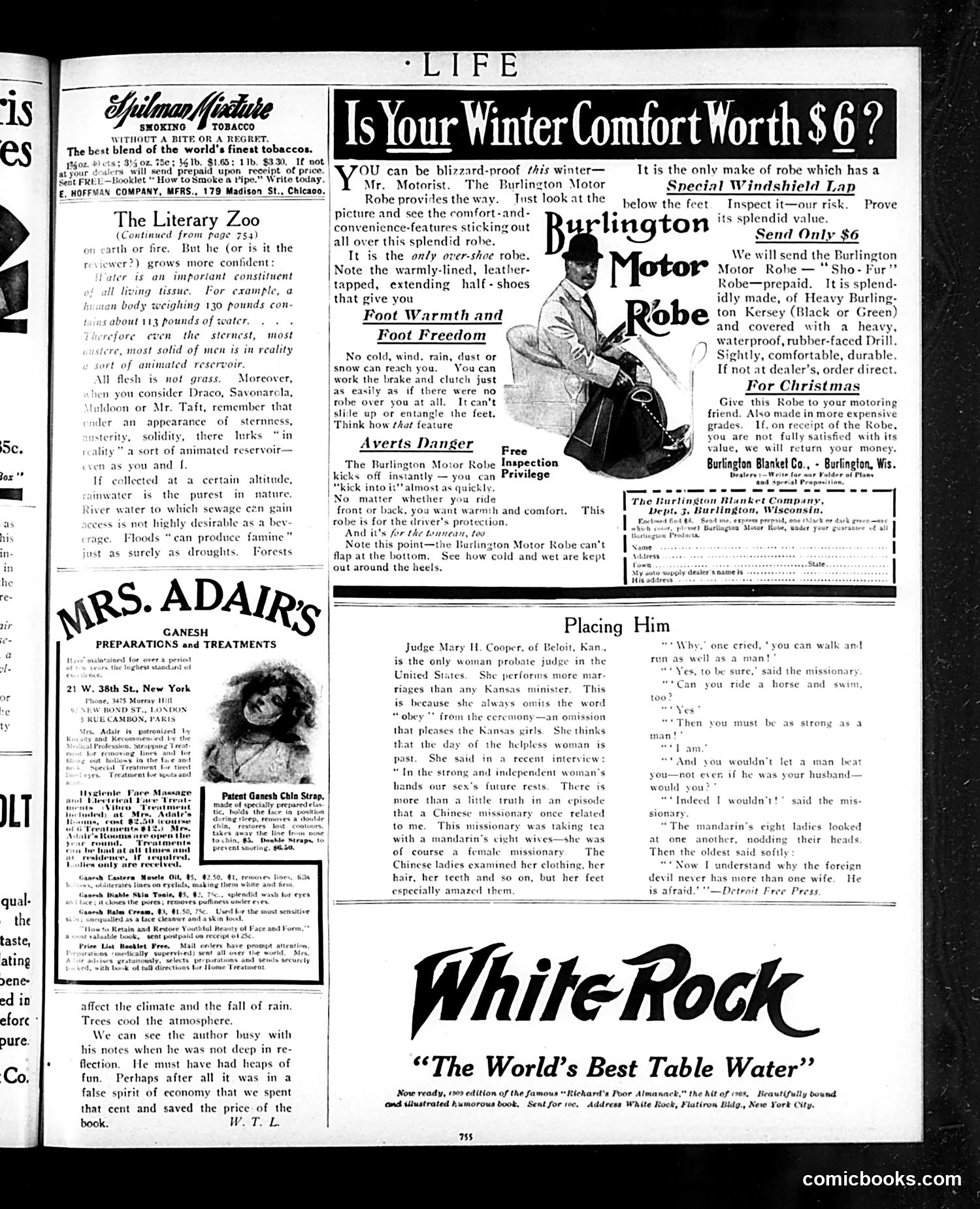
This page is primarily **advertising**, not political satire. It contains multiple product advertisements typical of early 20th-century magazines. The main content includes: - **Burlington Motor Robe advertisement** (center-right): Promotes a winter driving robe for $6, emphasizing warmth, comfort, and practical features like extending half-shoes and a robe that "kicks off instantly." - **Mrs. Adair's Ganesh Preparations** (lower left): A beauty treatment advertisement featuring testimonials about facial massage and skin treatments. - **White Rock Table Water** (bottom): Advertises bottled water as "The World's Best Table Water." - **"The Literary Zoo"** (left): A short essay about animal characteristics and water's importance to life, unrelated to the advertisements. - **"Placing Him"** (right): A brief humorous anecdote about Judge Mary H. Cooper, described as "the only woman probate judge in the United States," discussing women's capabilities—a mild contemporary commentary on women's expanding social roles. The page reflects 1910s-era consumer culture and emerging discussions about women's participation in professional work.
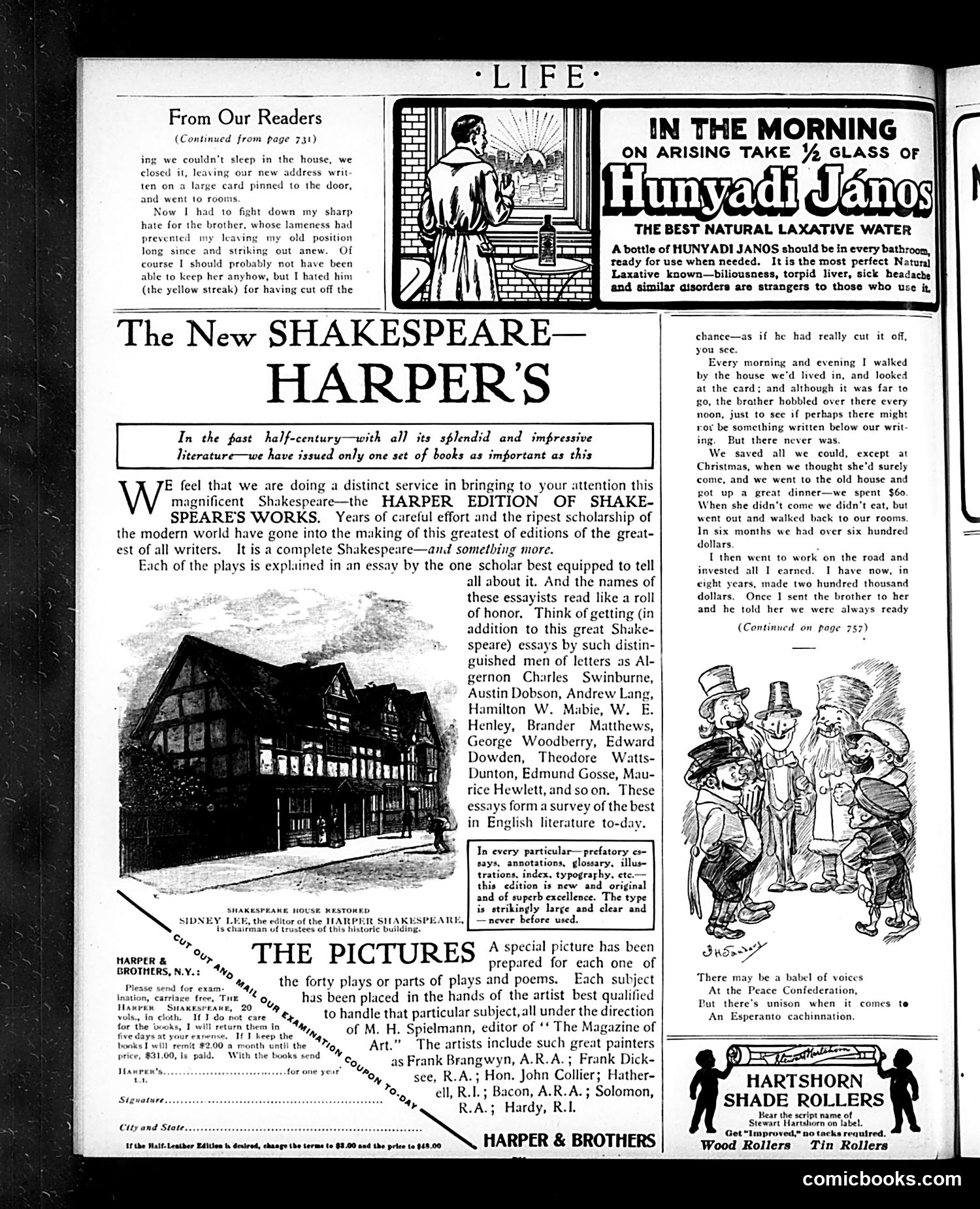
This page is primarily **advertising and literary promotion**, not political satire. The main content advertises Harper & Brothers' new Shakespeare edition and Hunyadi Janos laxative water. The page includes a reader's letter describing family hardship—apparently about separated siblings and financial struggle—but this appears to be genuine editorial content rather than satire. The only illustration with potential satirical intent is the small cartoon in the lower right showing what appears to be **figures at a peace conference**, captioned about "An Esperanto cachanation" (likely "conversation"). This may mock either the Peace Conference proceedings or the constructed language Esperanto, but details are unclear from the image. The rest consists of ads for Shakespeare editions and a "Hartshorn Shade Rollers" product advertisement featuring illustrated figures. **Overall: This is primarily a commercial/literary magazine page with minimal political or satirical content.**
This page is primarily **advertising and reader correspondence**, not political satire. **Content:** - **Left side**: Advertisement for Murray & Lanman's Florida Water (a toilet perfume/cologne) - **Center**: "From Our Readers"—a reader's letter describing romantic distress and depression - **Right side**: Large advertisement for *Scientific American* magazine, promoting its 1910 subscription with claims it offers "clean, wholesome, instructive and entertaining" content on aeronautics, automobiles, engineering, and patents **No political cartoon or satire is present.** The layout is typical of early-1900s *Life* magazine mixing editorial content with advertisements. The reader's letter is genuinely melancholic rather than satirical—describing a man's failed romance and current emotional state. The *Scientific American* ad uses the phrase "completes the circuit between You and Progress," positioning scientific knowledge as essential to modern life.
This page consists primarily of **advertisements and promotional content** rather than political cartoons or satire requiring historical context. **Key elements:** 1. **"Why Run Risks?" anecdote** (top): A humorous story about a Canadian author who rushes to ask a conductor if a concert is over—the joke being his impatience to leave rather than any political reference. 2. **Christmas Favors advertisement** (left): B. Shackman & Co. sells holiday decorations and party items—typical early 20th-century retail promotion. 3. **"Be a Joy King" subscription campaign** (center/right): Life magazine's self-promotional pitch encouraging subscriptions by appealing to readers' mental attitude and well-being—characteristic motivational advertising of the era. 4. **Small illustrations**: Include a child looking at jam jars ("OBEY THAT IMPULSE") and a lion mascot, serving purely as visual branding. 5. **Medical advertisement** (bottom): Man-a-cea Water, a patent medicine claiming to treat digestive issues. No identifiable political figures or satirical commentary appears on this page.
This is primarily an **advertising page** for Scribner's Magazine, not a political cartoon. It promotes two major upcoming serials: 1. **"Rest Harrow"** by Maurice Hewlett—a literary novel praised for its poetry, romance, and unconventional character study. 2. **Theodore Roosevelt's African Trip articles**—Roosevelt's exclusive firsthand account of his post-presidency hunting expedition, featuring illustrations by his son Kermit. The text emphasizes Roosevelt's unique ability to capture American sentiment and his "grim strength" in describing wildlife adventures. The page includes a portrait photograph of author Maurice Hewlett. The advertisement targets educated readers interested in literature and adventure, promoting both serials at $3 per year through Charles Scribner's Sons. The Roosevelt content appears designed to capitalize on his celebrity and recent African prominence.
This appears to be a **product advertisement** rather than political satire or editorial cartoon. The page shows a Crystal brand product display featuring what looks like sugar or coffee packaging, with text reading "CRYSTAL," "DOMINO," and "SUGAR" visible on the containers. There's also text mentioning "BEST SUGAR FOR LEAD COFFEE" and packaging information indicating "2 5lb PACKAGES." The advertisement is oriented sideways on the page and emphasizes product availability and pricing. Given the November 25, 1909 date, this represents early 20th-century consumer advertising within Life magazine. Without clearer visibility of all text, I cannot specify the exact product details or marketing claims being made, but it's clearly promoting a branded sugar or related commodity product to contemporary readers.